
A complete issue · 44 pages · 1914
Life — October 29, 1914
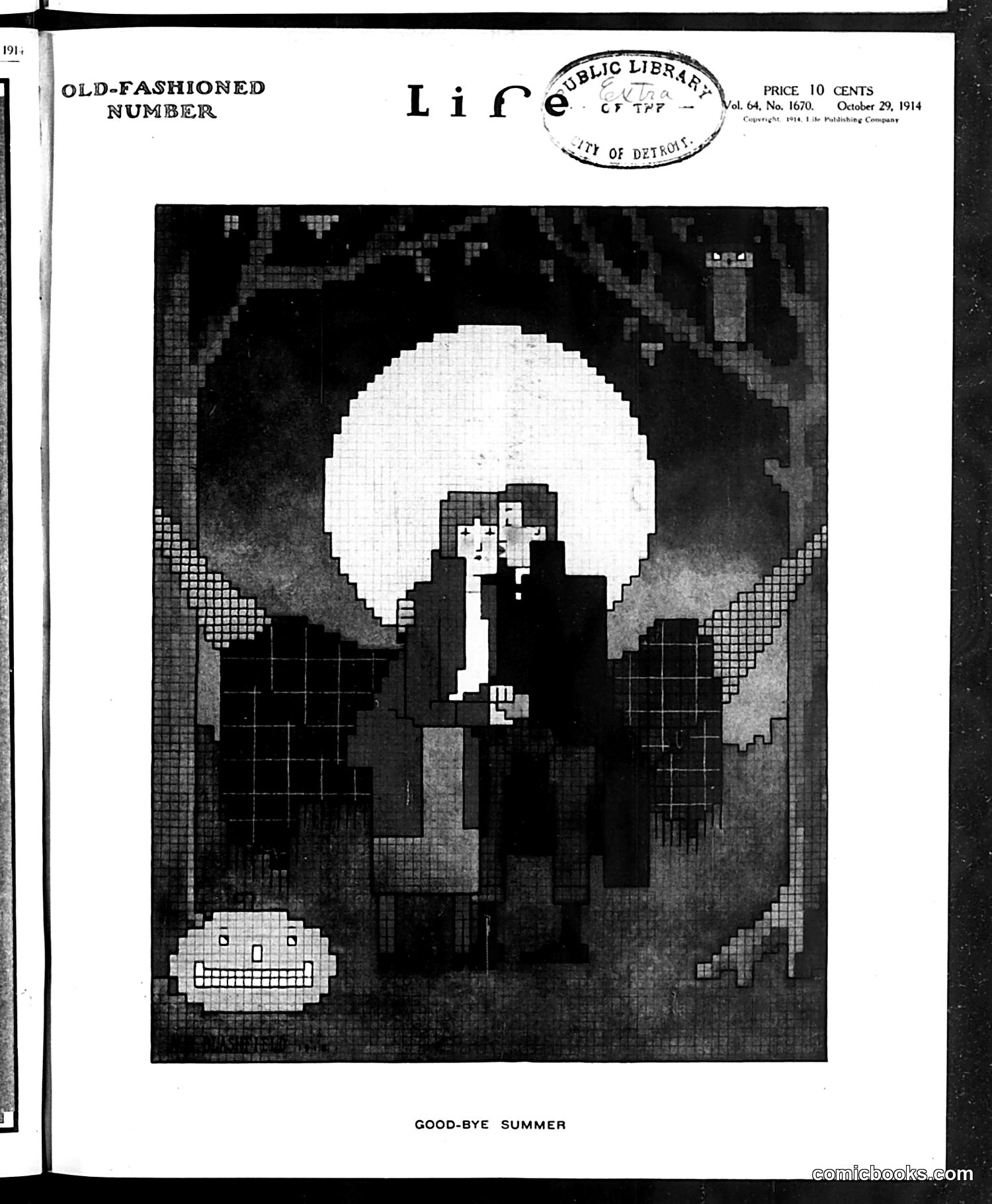
This is the cover of *Life* magazine from October 29, 1914, titled "Good-bye Summer." The image depicts a stylized figure with a large white head silhouetted against a dark cityscape. The figure appears to be a personification of Summer itself, shown departing or fading away as autumn approaches. The artistic style uses a pixelated/mosaic technique popular in early 20th-century illustration. The contrast between the bright white head and dark urban buildings below creates a melancholic mood appropriate to the seasonal transition. Given the 1914 date, this cover appeared during World War I's opening months, though the image itself focuses purely on the seasonal theme rather than contemporary events. The "old-fashioned number" notation suggests this was a retrospective or special issue.
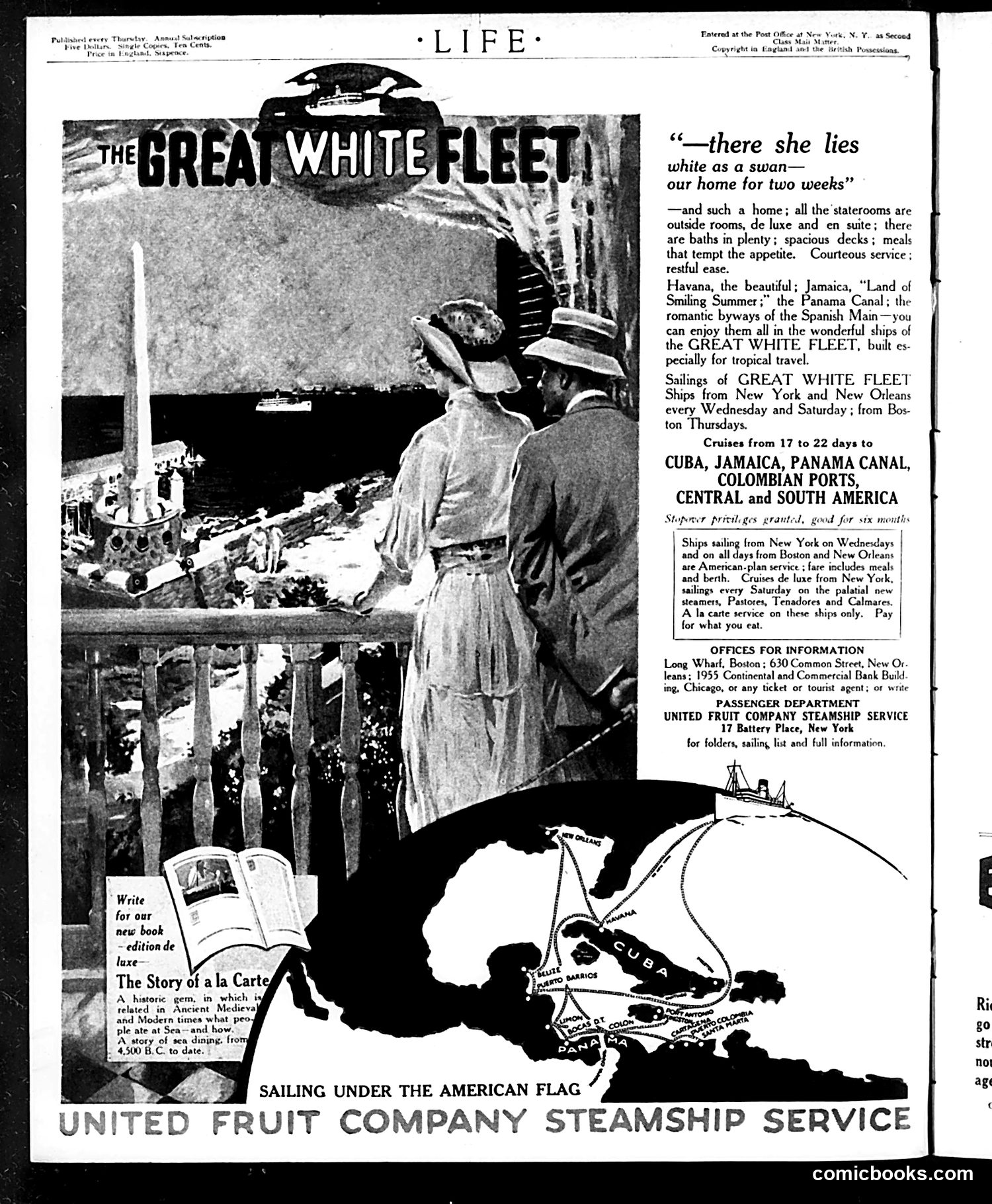
This page is **primarily advertising**, not satirical content. It promotes the United Fruit Company's "Great White Fleet" of steamships offering luxury Caribbean cruises from New York and Boston to Cuba, Jamaica, Panama Canal, and Central/South America. The advertisement uses romanticized imagery: a woman gazes at a ship, tropical destinations are highlighted, and amenities like spacious decks and courteous service are emphasized. The phrase "there she lies white as a swan—our home for two weeks" presents cruise travel as an elegant escape. A small side note advertises "The Story of a la Carte," a book about medieval and modern dining history, suggesting Life's audience included affluent readers interested in refined experiences. The "Sailing Under the American Flag" banner emphasizes U.S. commercial dominance in Caribbean shipping during this period.
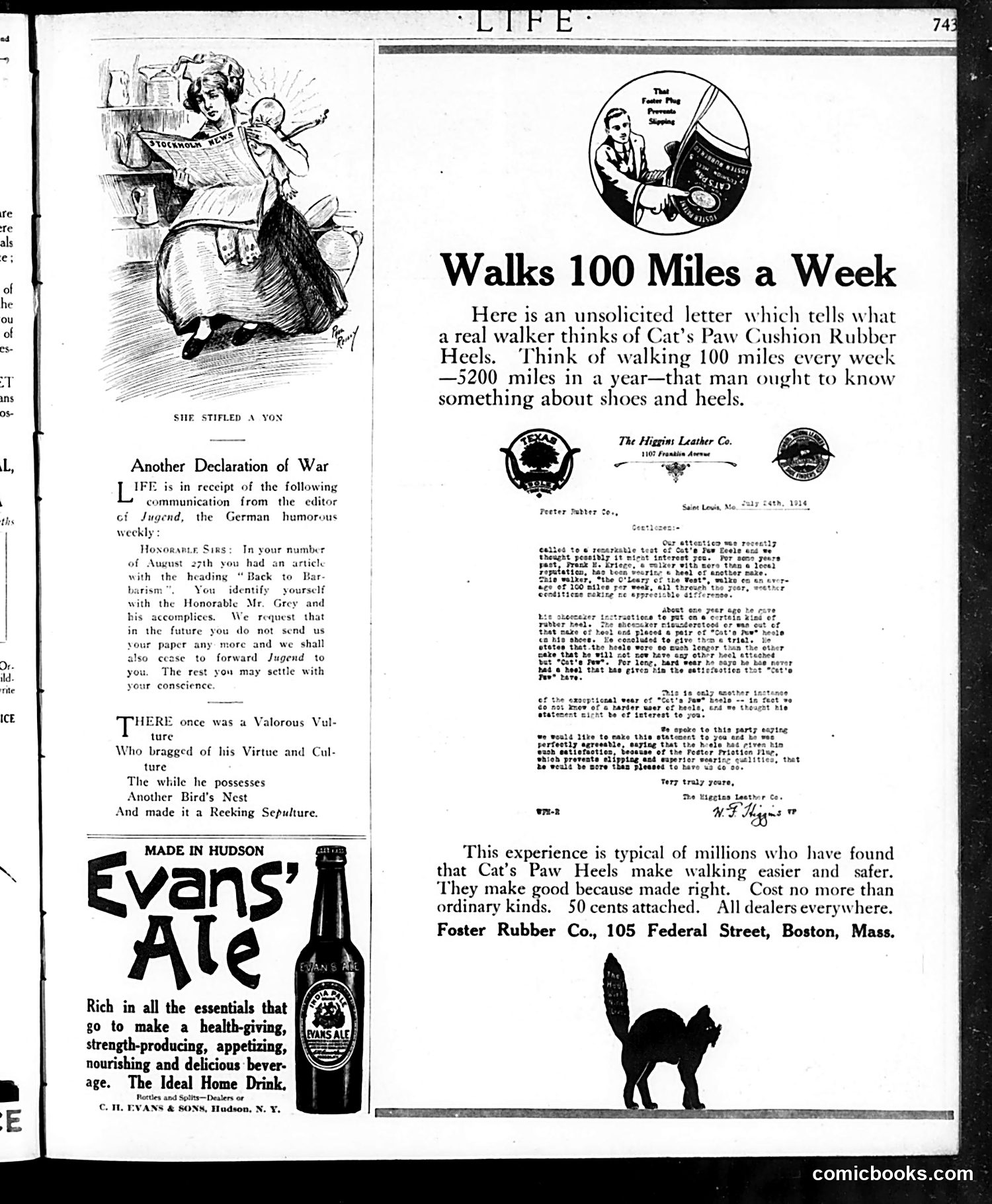
This page is primarily **advertising**, not political satire. The main content features: 1. **"Walks 100 Miles a Week"** - An advertisement for Cat's Paw Cushion Rubber Heels, presenting a testimonial letter from "The Higgin Leather Co." praising the product's comfort for someone walking 5,200 miles annually. 2. **Left sidebar** includes a poem titled "Another Declaration of War" responding to an editor's communication about an article on "Hack No Barbarism," requesting the editor cease publishing such pieces. 3. **Evans' Ale advertisement** - A bottle advertisement describing it as a "health-giving" beverage. The page reflects **early 20th-century advertising conventions**, emphasizing product testimonials and health claims now considered dubious or misleading.
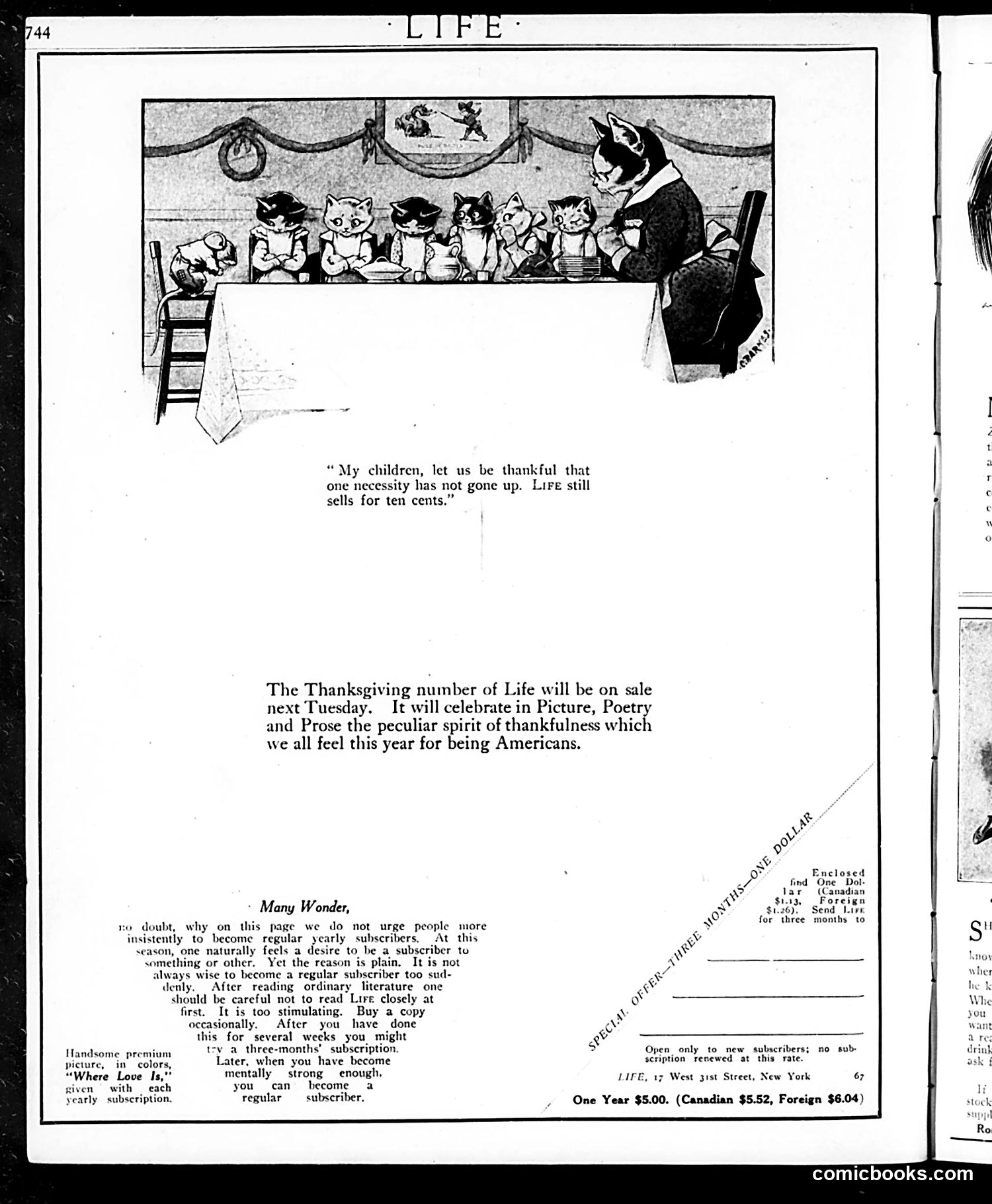
The main cartoon depicts an anthropomorphic cat family gathered around a Thanksgiving dinner table, with a large cat in formal dress addressing them. The caption reads: "My children, let us be thankful that one necessity has not gone up. Life still sells for ten cents." **The satire:** This is a commentary on post-World War I inflation. The joke acknowledges that prices for necessities have risen dramatically, yet Life magazine—the sponsor of this ad—has maintained its ten-cent cover price. The cartoon presents this as a genuine mercy worth giving thanks for. The lower text announces Life's Thanksgiving issue, celebrating American thankfulness "this year for being Americans." The page is essentially an advertisement disguised as editorial content, leveraging holiday sentiment to promote magazine subscriptions and the upcoming special issue.
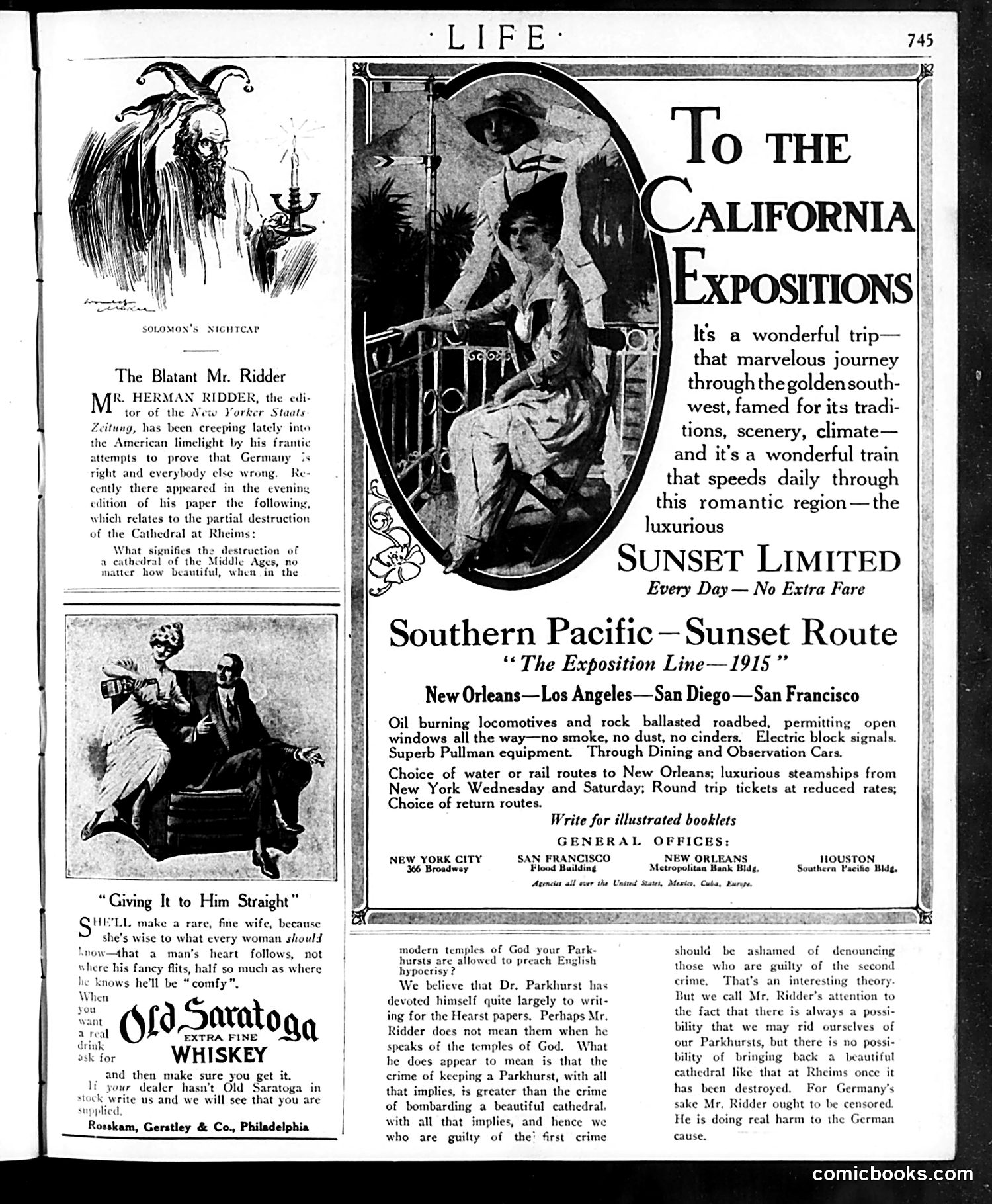
**"The Blatant Mr. Ridder"** – This is a critical editorial about Herman Ridder, editor of the *New York Staats-Zeitung*, a German-language newspaper. The article accuses Ridder of using his publication to defend Germany and argue that "Germany is right and everybody else is wrong." The satire attacks Ridder's recent defense of Germany's bombardment of Rheims Cathedral during World War I. The editors argue this constitutes support for destroying cultural heritage and represents a "crime" worse than the cathedral's destruction itself. The cartoons (showing demonic and mischievous figures) mock Ridder as spreader of German propaganda on American soil during the war. The adjacent Sunset Limited train advertisement appears unrelated.
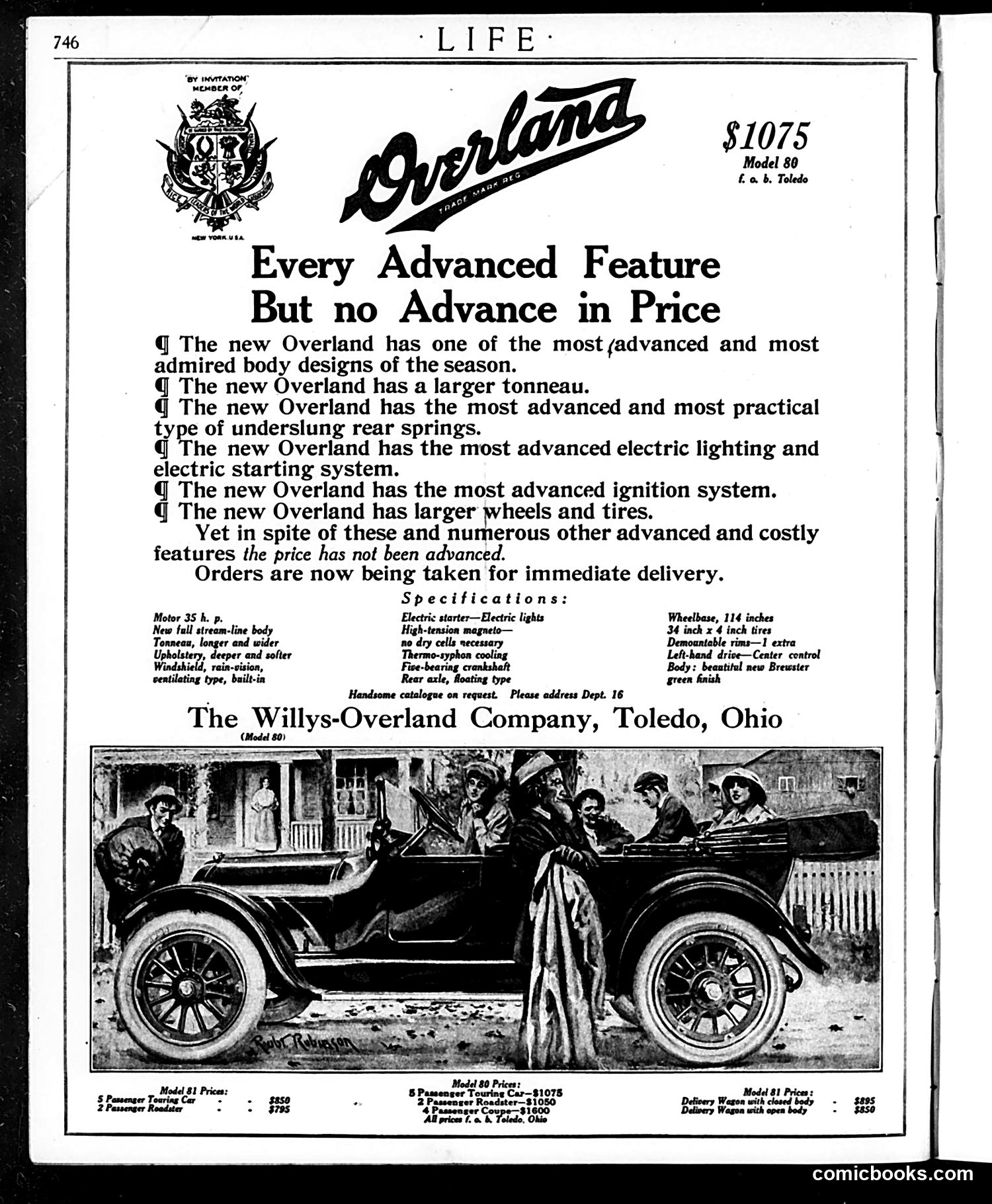
This page is **primarily an advertisement**, not satirical content. It's a full-page ad for the Overland automobile (Model 80), manufactured by the Willys-Overland Company in Toledo, Ohio. The ad's rhetorical strategy is its only noteworthy element: the headline claims "Every Advanced Feature But no Advance in Price"—emphasizing that despite numerous technological improvements (underslung springs, electric lighting, ignition system, larger wheels), the price remains $1,075. This was a common early-20th-century sales tactic: reassuring consumers that innovation needn't mean higher costs. The illustration shows fashionably-dressed people in/around the vehicle, typical period advertising imagery meant to convey modernity and desirability. There is no political or satirical content visible on this page.
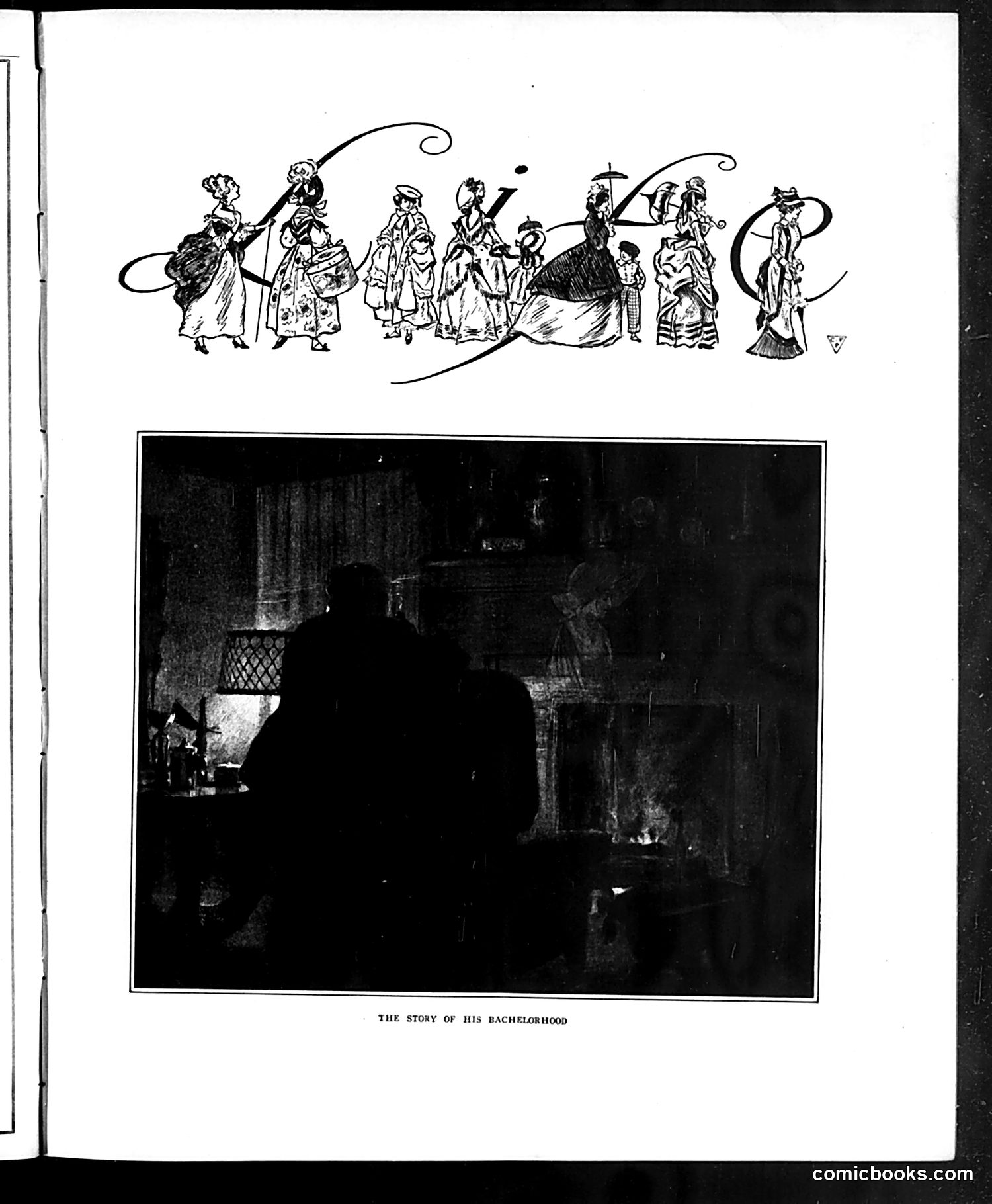
This page contains a whimsical illustrated header showing a line of figures in period costume, likely depicting characters from a narrative or story. Below it is a dark theatrical photograph captioned "THE STORY OF HIS BACHELORHOOD." The juxtaposition suggests this is either a theater review or an illustration accompanying a serialized story about a bachelor's adventures. The ornate line-drawing style of the header—with its decorative flourishes and varied historical costumes—contrasts sharply with the grainy photograph below, suggesting different artistic treatments of the same subject or related content. Without additional OCR context or page numbering, I cannot identify the specific story, characters, or precise satirical intent, though the title suggests domestic/romantic humor typical of *Life* magazine's content during its heyday as an illustrated humor publication.
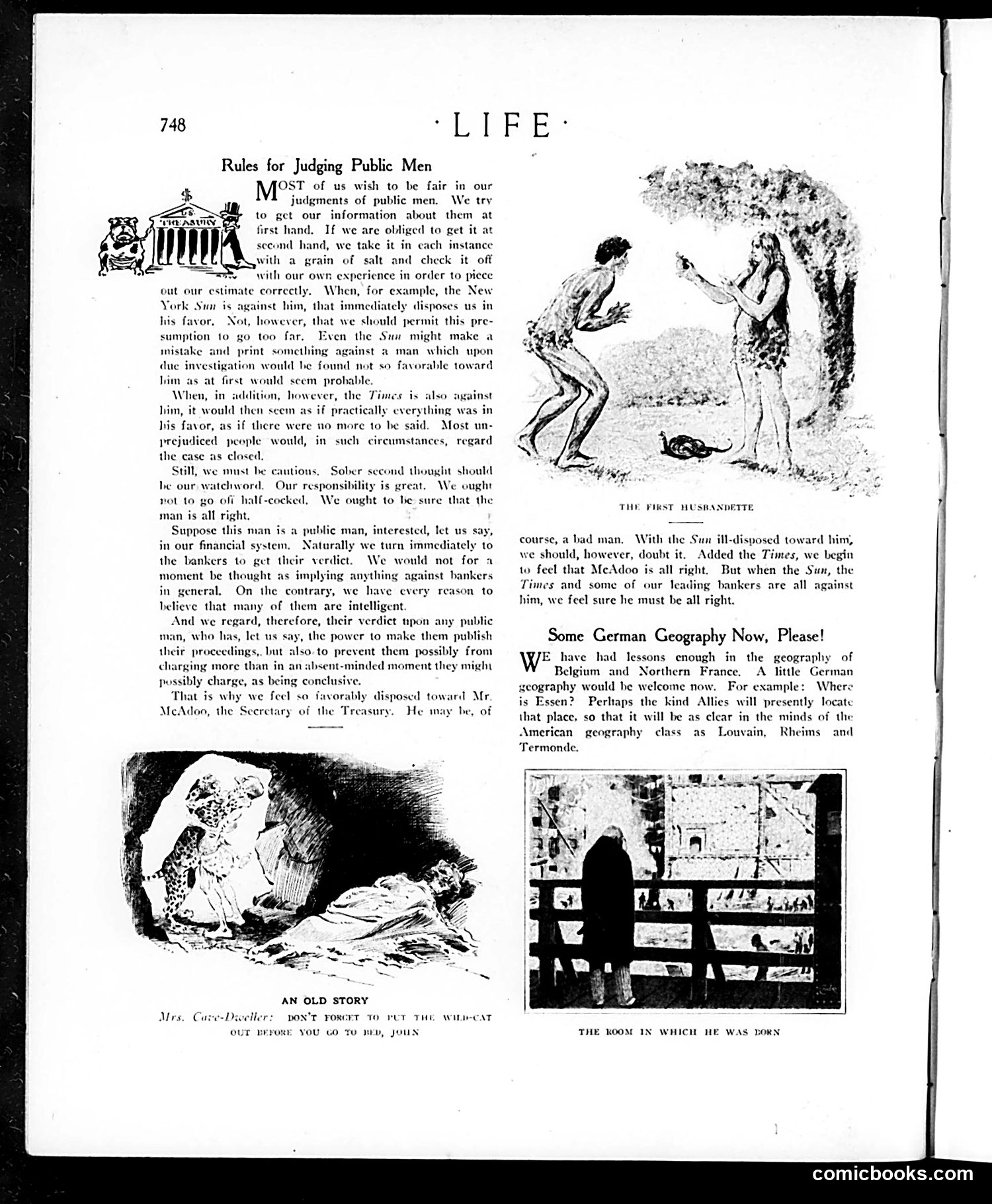
This page contains a satirical article on "Rules for Judging Public Men," discussing fairness in evaluating public figures. The text references specific newspapers—the *New York Sun* and *Times*—as examples of outlets with editorial biases for or against particular individuals, specifically someone named McAdoo (likely William Gibbs McAdoo, Treasury Secretary). The cartoons illustrate the theme: "The First Humanette" shows a primitive figure, while "An Old Story" depicts a cave scene with a caption about a wildcat. The bottom section shifts to "Some German Geography Now, Please!"—likely a WWI-era piece suggesting Americans should learn German geography given the war's relevance. The page reflects early 20th-century American journalism criticism and wartime public discourse.
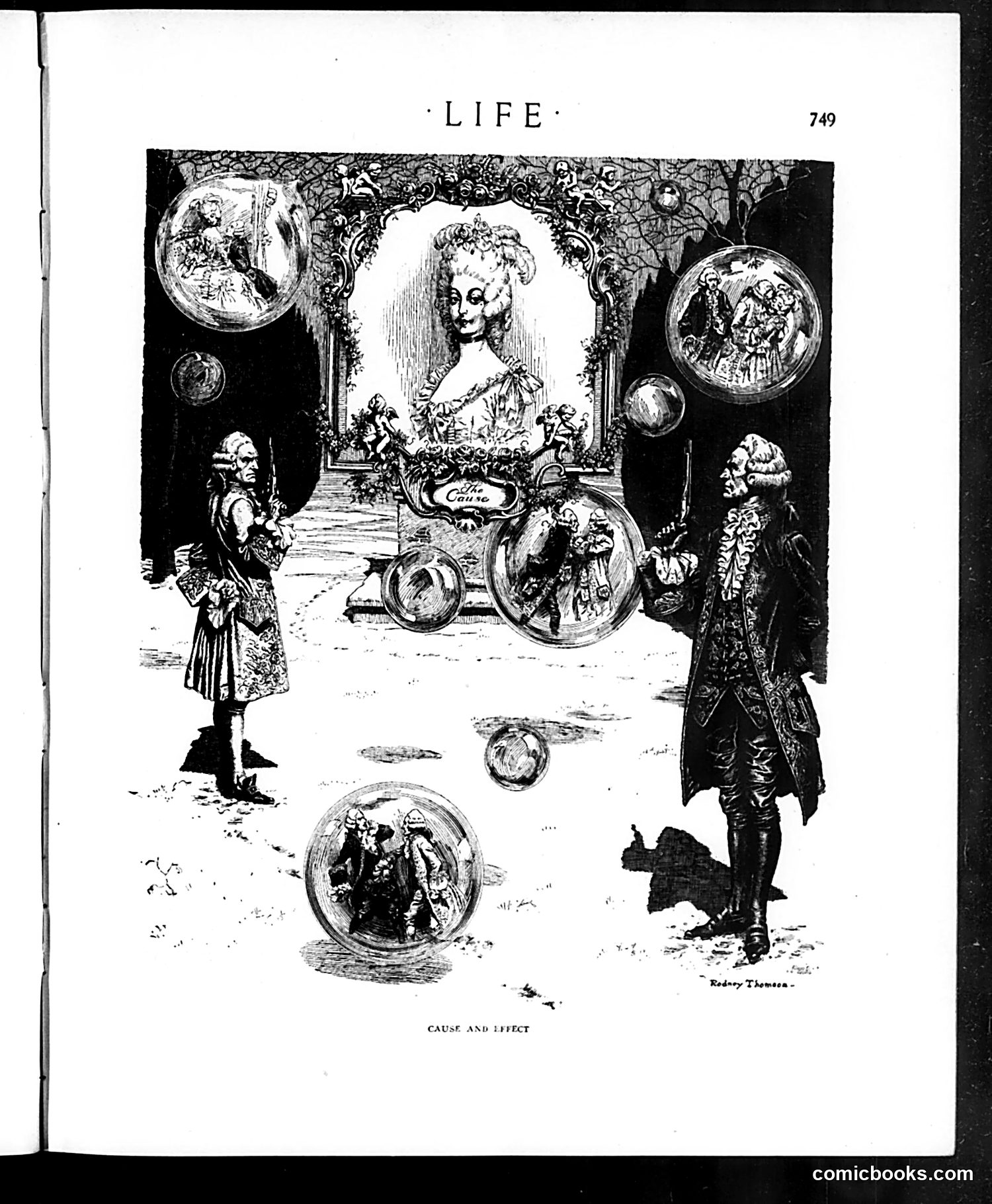
This political cartoon depicts two 18th-century figures flanking a portrait of a woman in an ornate frame, surrounded by spheres containing various scenes. The title "Cause and Effect" suggests the spheres represent consequences or outcomes. The two male figures appear to be period-appropriate caricatures, likely representing historical or political figures relevant to Life magazine's era of publication. The woman's portrait in the center frame is the focal point, with the surrounding spheres possibly illustrating her influence or the results of her actions. Without clearer identification of the specific figures or historical context visible in the image, the precise satirical meaning remains unclear. The ornate baroque styling and multiple spherical vignettes suggest commentary on causality, responsibility, or interconnected political/social consequences—typical themes for Life's satirical content.
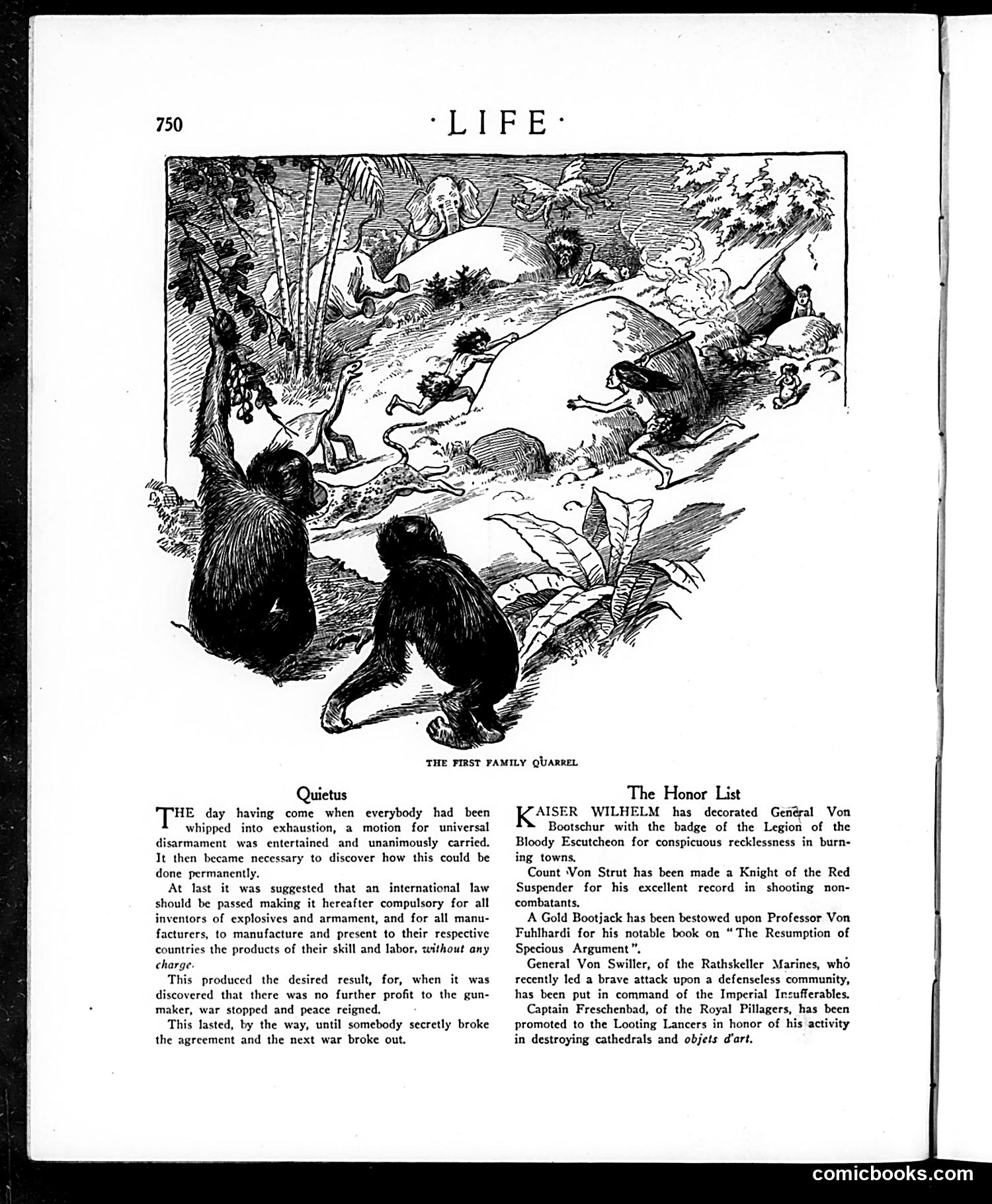
This satirical cartoon depicts two apes observing human conflict in the background. The illustration accompanies two pieces: "Quietus," a story about international disarmament agreements collapsing when gunmakers profit from resumed warfare, and "The Honor List," which sarcastically celebrates military figures for destructive acts (burning towns, destroying cathedrals, looting). The cartoon's title and pairing suggest the satire's point: humanity's "first family quarrel" represents civilization's failure at peace. The apes observing suggests humans are behaving like animals despite pretensions to civility. The juxtaposition mocks the hypocrisy of honoring military destruction while claiming to pursue international peace and disarmament—showing how economic interests and martial glory override humanitarian values.
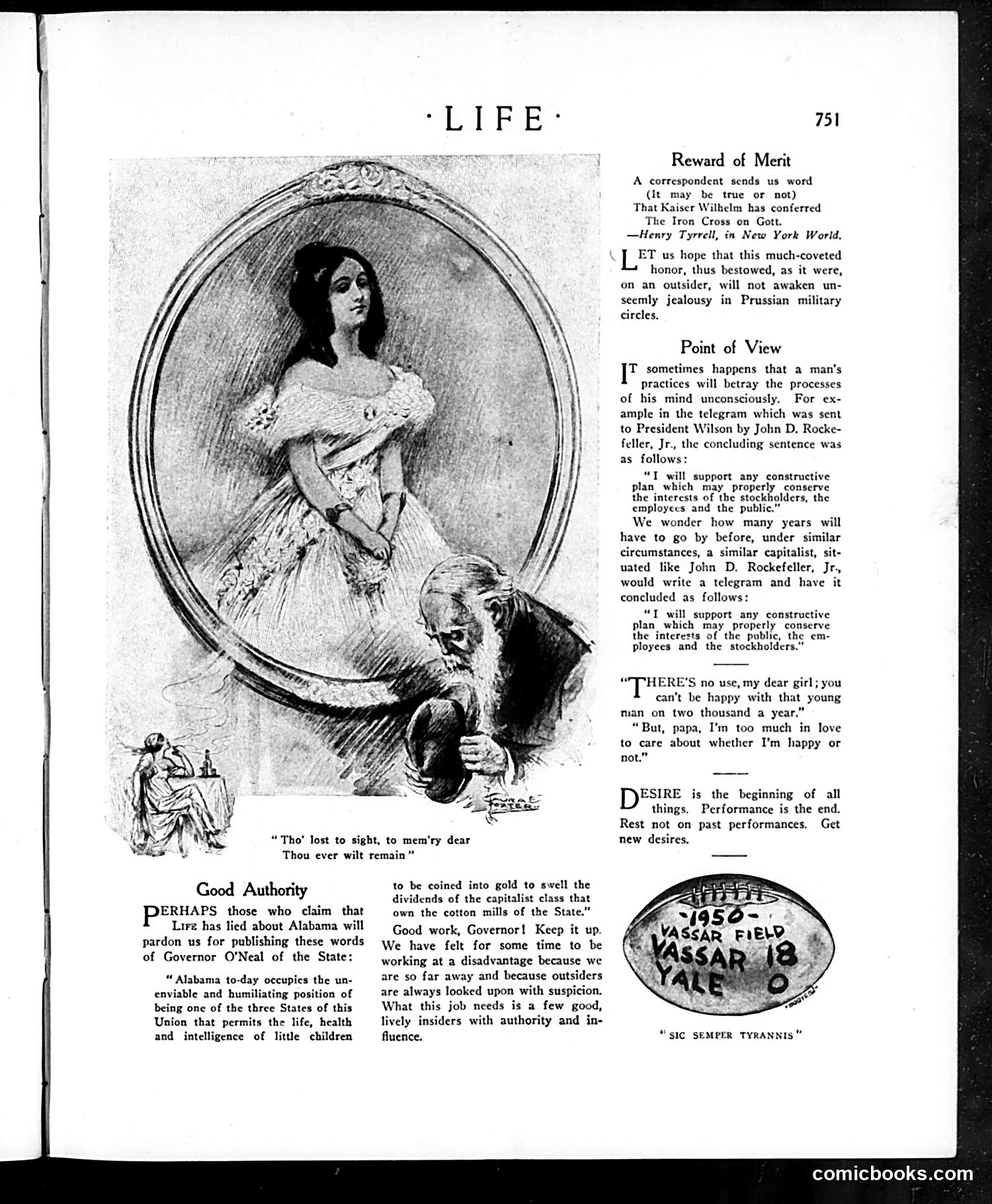
The main illustration depicts an allegorical female figure (representing something valuable or desirable) admired by an older, bearded man gazing upward at her portrait. The caption reads: "Tho' lost to sight, to mem'ry dear / Thou ever wilt remain." **"Good Authority" section** defends Alabama's governor O'Neal against claims that Life has lied about the state's conditions. It argues Alabama's low position among states reflects lack of "life, health and intelligence of little children," while praising the governor's efforts to improve conditions by promoting insider reform. The piece uses romantic/nostalgic imagery ironically—suggesting Alabama's past glory is "lost to sight" while present reforms remain hopes rather than achievements. The satire critiques both the governor's modest progress and the state's broader social deficiencies.
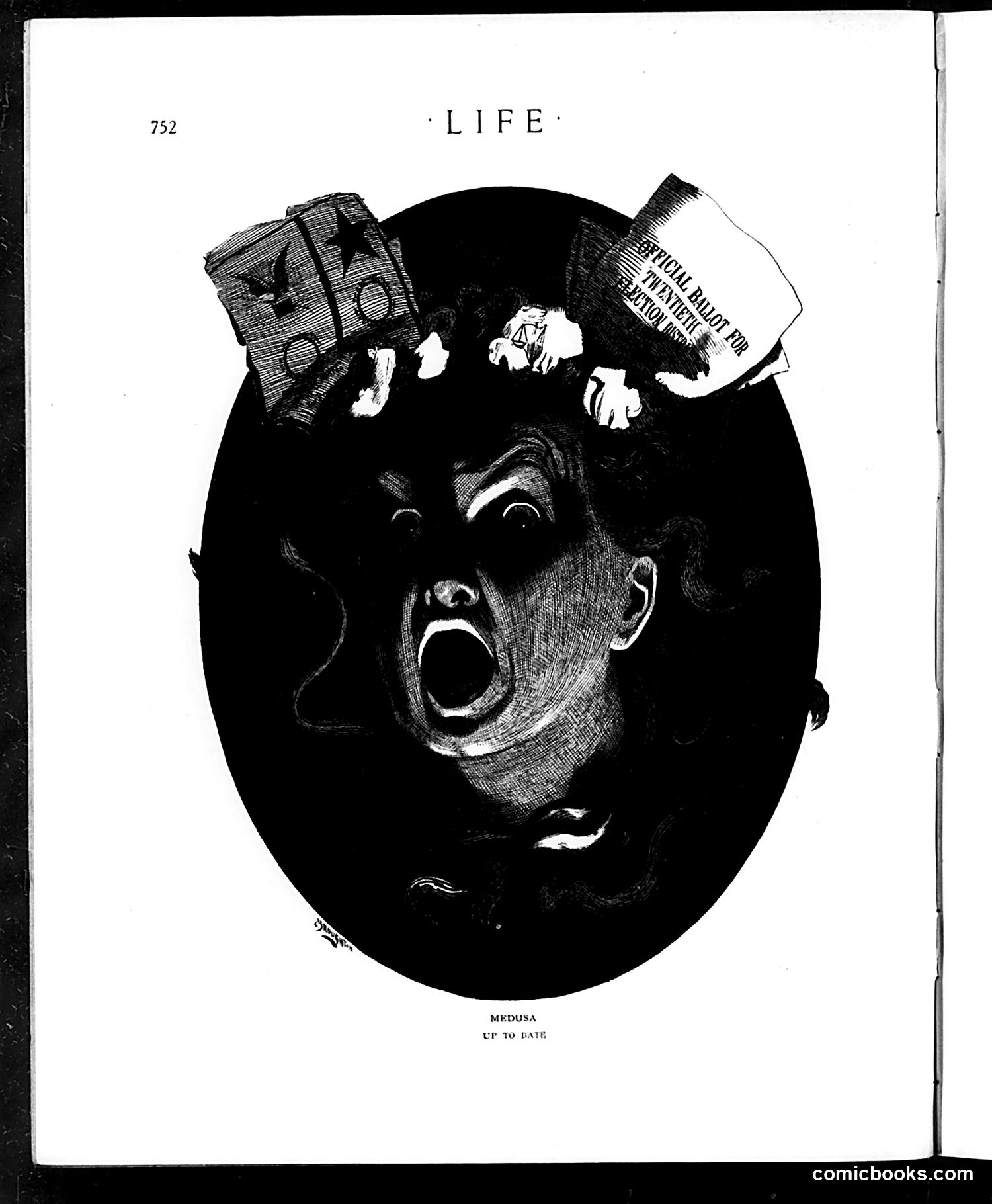
This satirical illustration shows a woman's face with an expression of shock or distress. The image plays on the classical mythological figure of Medusa, whose snake-hair turned viewers to stone. In this "up to date" version, instead of serpents, the woman's head is topped with modern objects: what appears to be a birdcage and a container labeled "WITCH'S BROTH FOR BEAUTY" (text partially visible). The satire likely mocks contemporary women's fashion, beauty culture, or social anxieties of the early 20th century—suggesting that modern women's elaborate or ridiculous adornments have made them as monstrous as the mythological creature. The cartoonist uses classical mythology as commentary on contemporary vanity or artificiality.
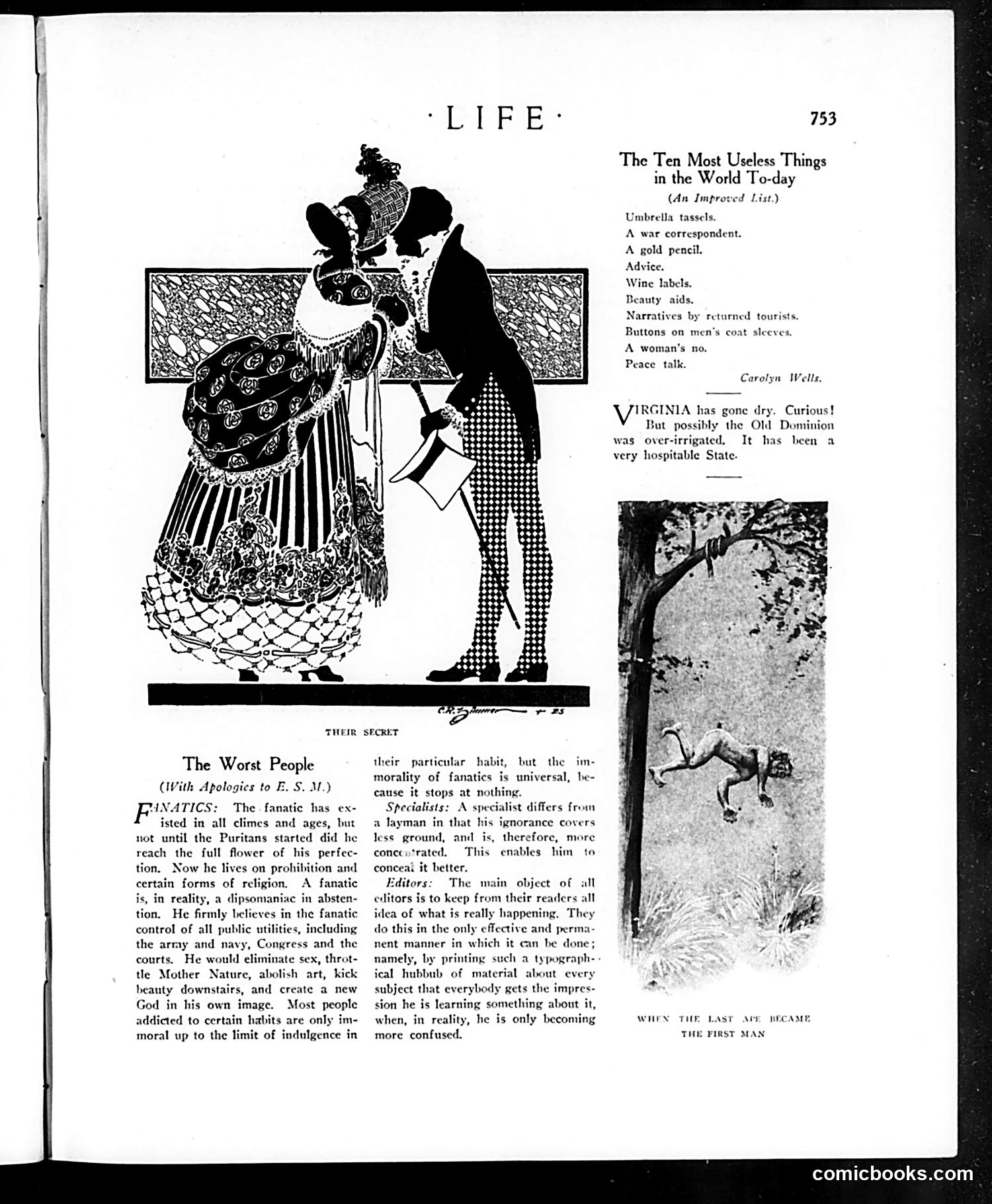
The main cartoon, titled "Their Secret," depicts a fashionably dressed woman and a thin man in checkered pants. The accompanying article "The Worst People" by "E.S.M." satirizes fanatics—particularly religious ones. It criticizes their intolerance and their drive to control public institutions and morality. The piece argues that fanatics' ignorance makes them more dangerous than educated specialists, and mocks newspaper editors for printing sensational material that confuses readers rather than informing them. The upper right lists "The Ten Most Useless Things in the World To-day" by Carolyn Wells, including items like umbrella tassels and peace talks—typical period satire of contemporary frivolities. The photograph captioned "When the Last Ape Became the First Man" appears to illustrate evolutionary themes popular in 1920s discourse.
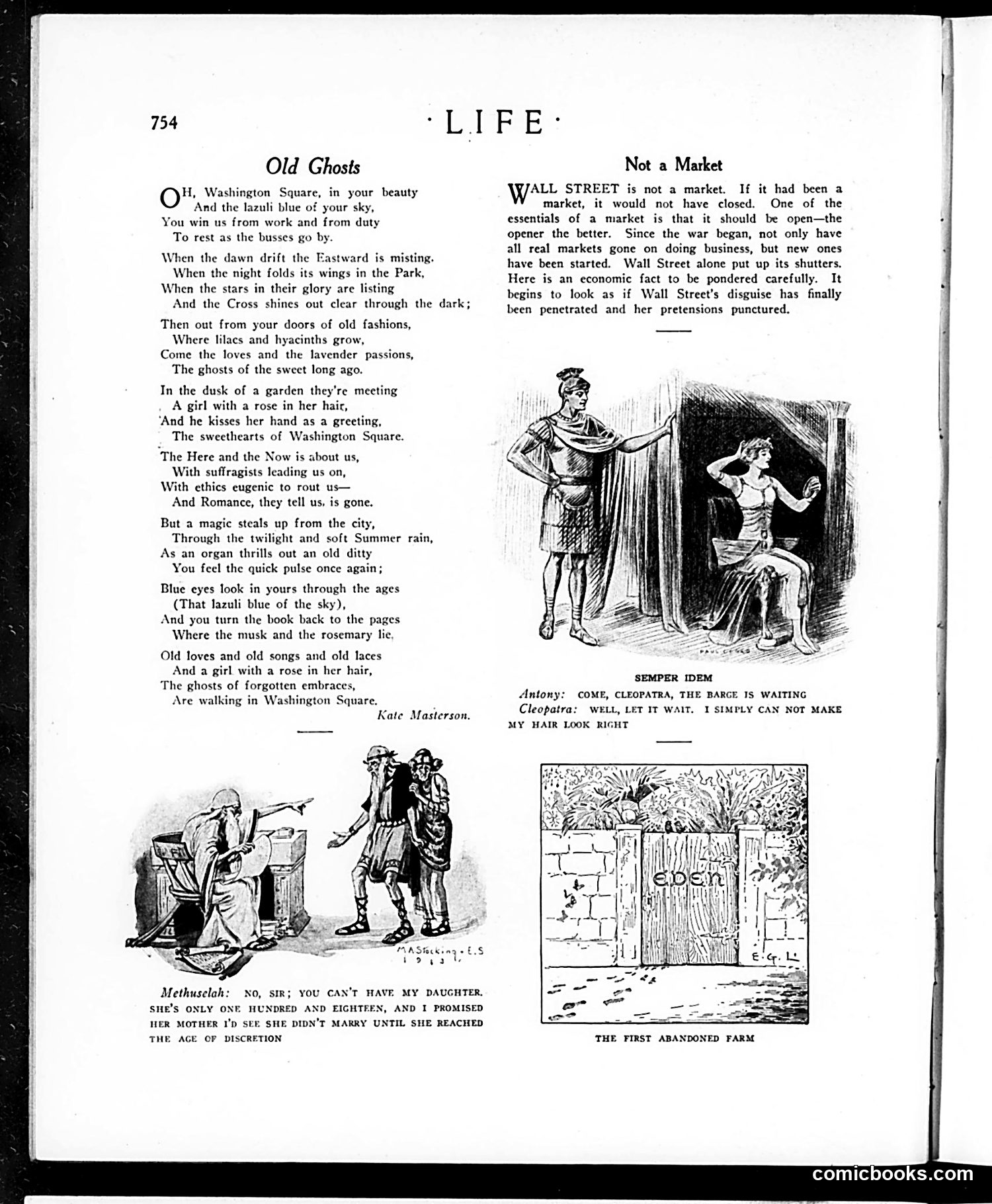
This page contains literary and theatrical content rather than political satire. "Old Ghosts" is a poem by Kate Masterson about Washington Square's romantic past and nostalgic memories. The illustrations appear to be literary sketches: one shows a classical scene (labeled "Semper Idem") with Antony and Cleopatra, illustrating a brief dramatic dialogue about Cleopatra's appearance; another depicts Methuselah refusing to allow his daughter's marriage until she reaches "the age of discretion"; and a final illustration shows an abandoned farm gate labeled "Eden." The page is primarily a mixture of romantic poetry and classical literary/theatrical references rather than contemporary political commentary. The "Not a Market" section discusses Wall Street's economic conditions in what appears to be post-market-crash commentary.
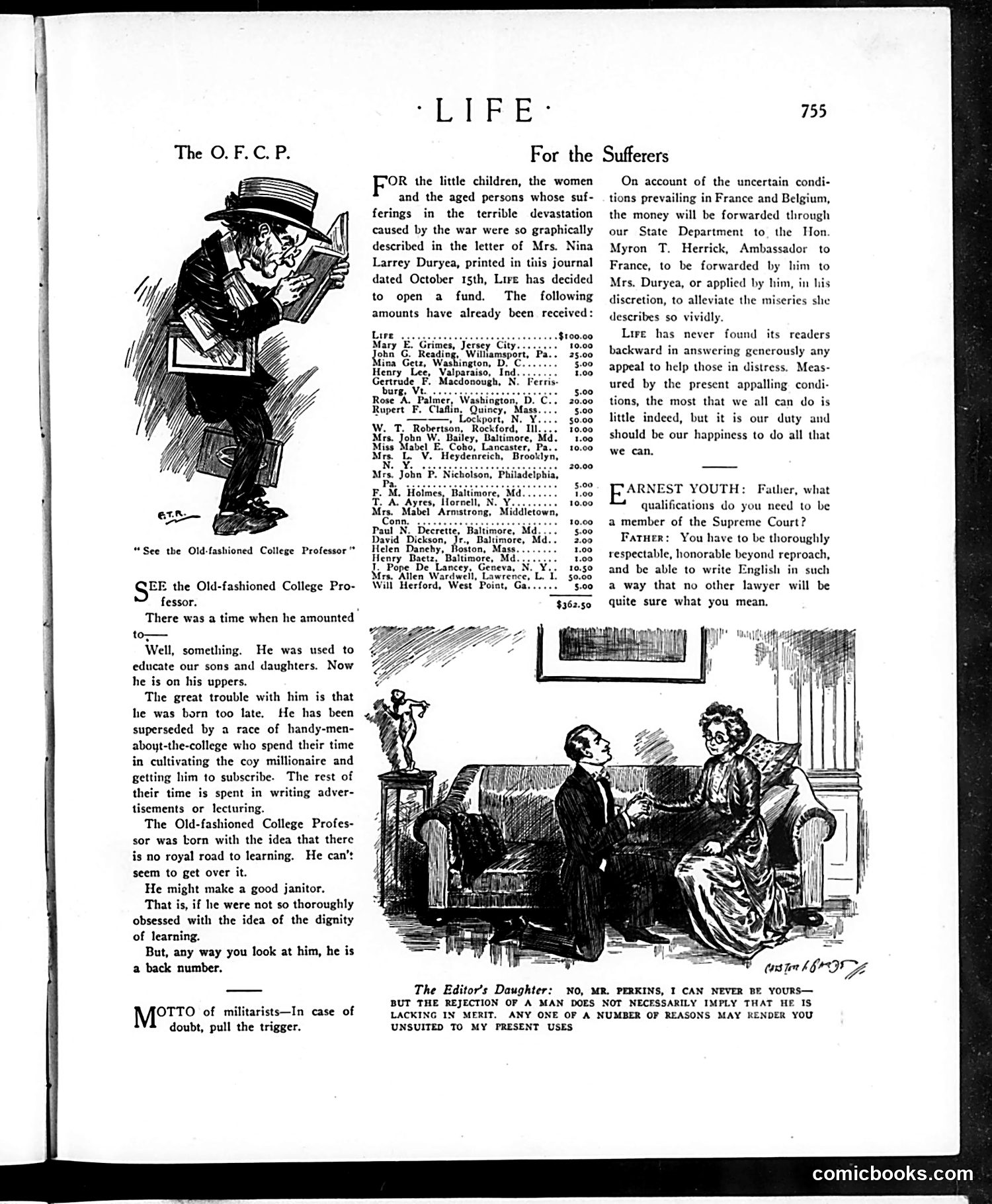
This page contains three distinct satirical pieces: **"The Old-Fashioned College Professor"** (top left): A cartoon lamenting academia's decline. The satire argues that traditional scholars devoted to learning have become obsolete, replaced by fundraisers who cultivate wealthy donors. The professor is depicted as a "back number"—obsolete and unable to adapt to modern commercialized education. **"For the Sufferers"** (top right): A fundraising appeal for war victims in France and Belgium (likely WWI era, based on the October 1914 reference). Life magazine solicits donations to be forwarded through the State Department to Ambassador Myron T. Herrick. **"The Editor's Daughter"** (bottom): A comic dialogue where a young man asks what qualifications are needed for the Supreme Court. The father's cynical reply—that lawyers must write so obscurely "no other lawyer will be quite sure what you mean"—satirizes legal jargon and the profession's impenetrability. All three pieces reflect *Life*'s characteristic progressive-era skepticism toward institutions: academia, law, and diplomacy.
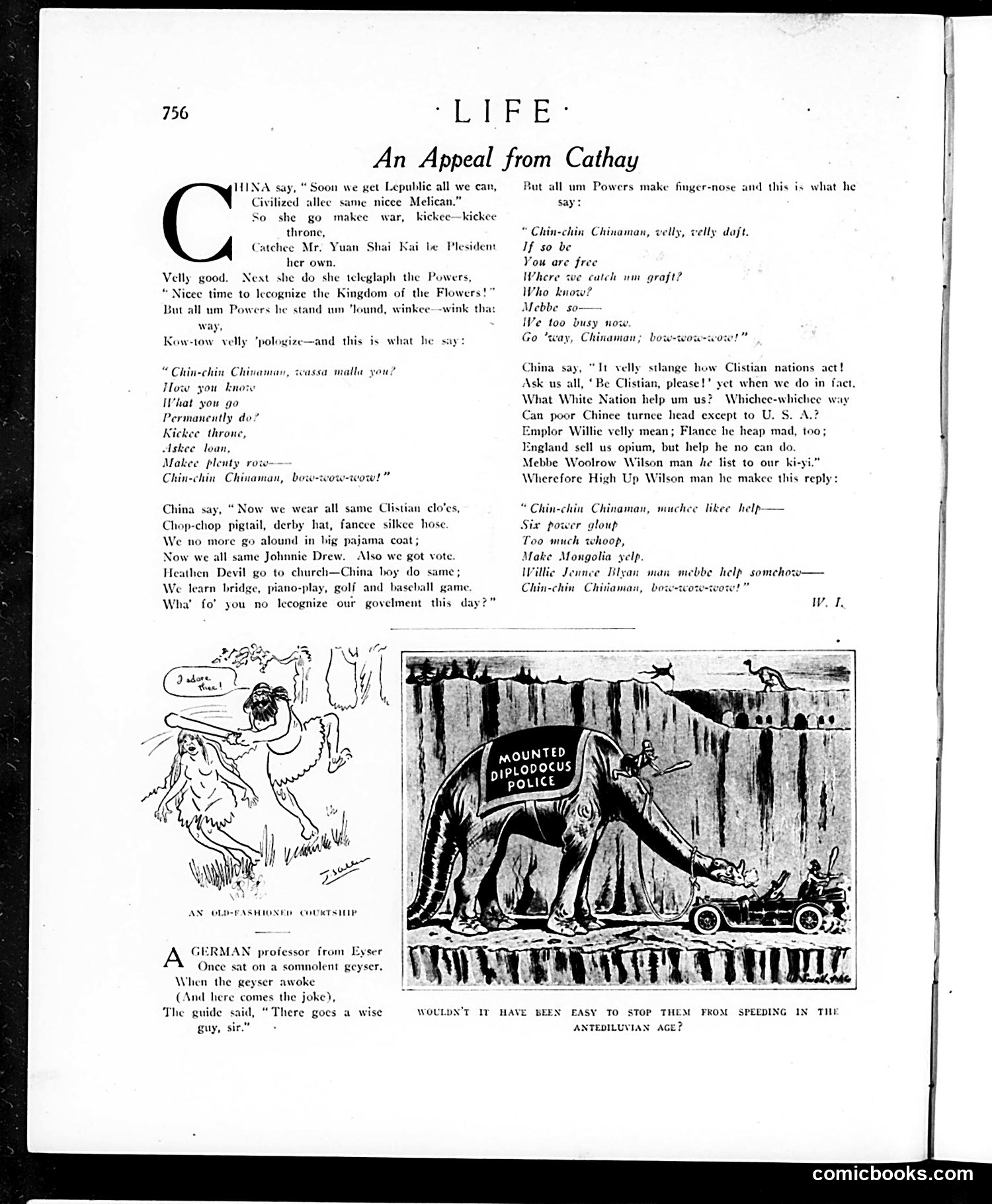
This satire mocks Western powers' hypocrisy toward China during the early Republican period (post-1912, likely referencing Yuan Shikai). China, adopting Western dress, Christianity, and democratic governance, appeals for recognition and aid. The Powers respond with condescending pidgin English ("Chin-chin Chinaman, bow-wow-wow"), refusing to help despite encouraging Westernization. The joke targets Western imperialism: Western nations demand China modernize and "civilize," but refuse reciprocal support. References include England's opium trade, France's indifference, and Wilson's evasiveness. The cartoon suggests the Powers view China as perpetually inferior—adopting Western ways doesn't grant equal status or assistance. The pidgin dialect itself is the satirical vehicle, exposing Western contempt beneath claims of moral superiority. The secondary cartoon about the German professor on a geyser is an unrelated joke.
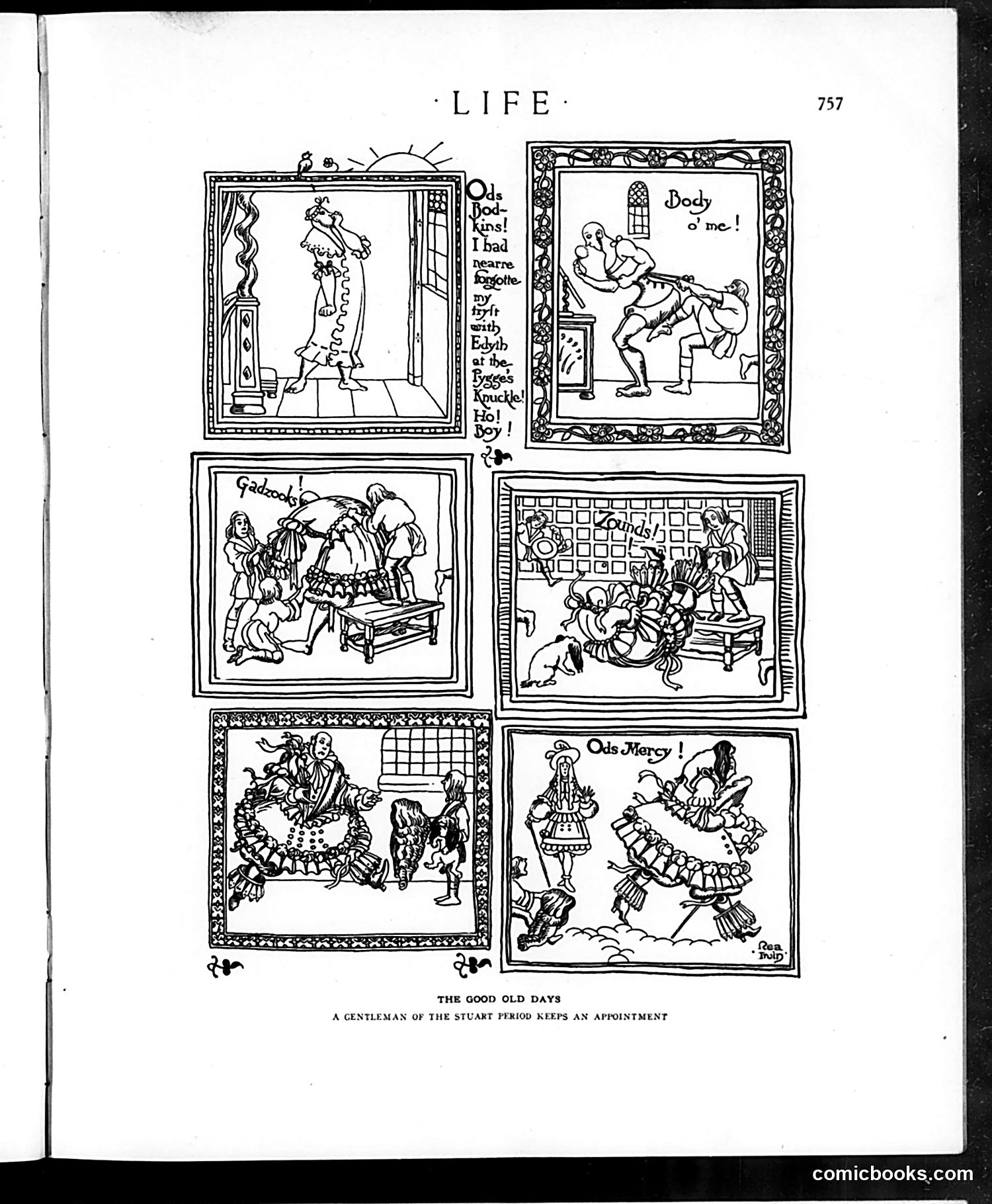
This page depicts "The Good Old Days," satirizing Stuart-era (17th-century England) social customs through six comic panels. The sequence shows a gentleman attempting to keep an appointment, experiencing increasingly chaotic mishaps: physical mistreatment, rowdy tavern scenes, and general disorder. The title's irony suggests the cartoonist is mocking romanticized notions of historical "good old days" by depicting the Stuart period as rough, violent, and disorderly rather than dignified. The exaggerated illustrations—with wild hair, physical comedy, and mayhem—reinforce this satirical critique. The work appears to target nostalgic attitudes toward history by revealing the crude reality beneath period mythology, using humor to undermine idealized historical romanticism popular in early 20th-century America.
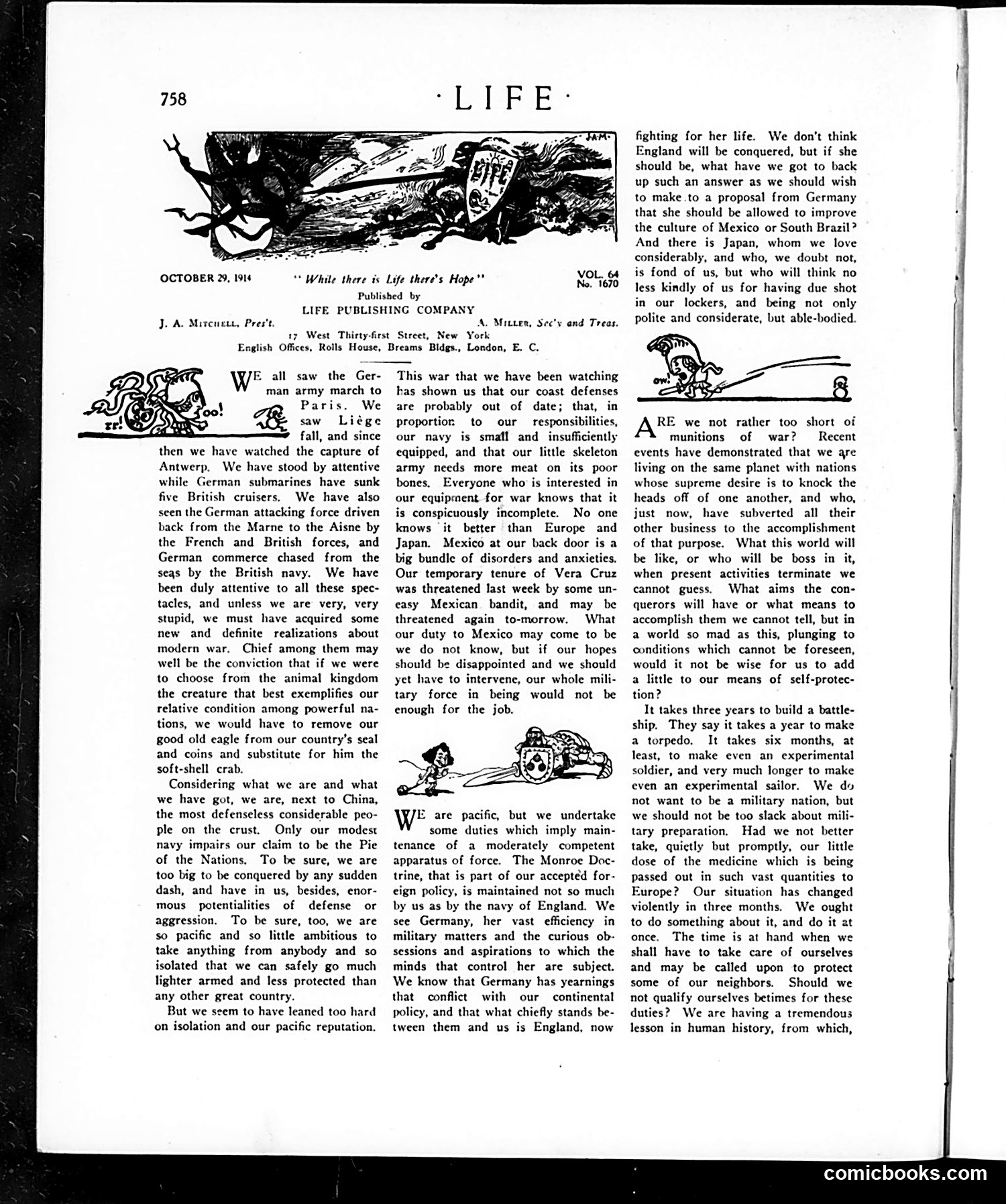
This is a serious editorial (not a cartoon) warning Americans about military unpreparedness during World War I. The author argues that watching European warfare should have taught the U.S. harsh lessons about defense. **Key arguments:** - America's coast defenses are outdated and navy undersized relative to responsibilities - The U.S. is complacently relying on isolation and pacifism while Germany and Japan observe American weakness - Mexico's instability at America's border poses immediate threat - England currently protects the Monroe Doctrine through naval power; if Germany defeats England, what will stop German interference in Mexico or South America? - The U.S. should strengthen military capacity now, not remain "soft-shell crab" among powerful nations **Context:** Published in 1916, before U.S. entry into WWI (April 1917), this represents interventionist-leaning voices arguing preparedness was urgent.
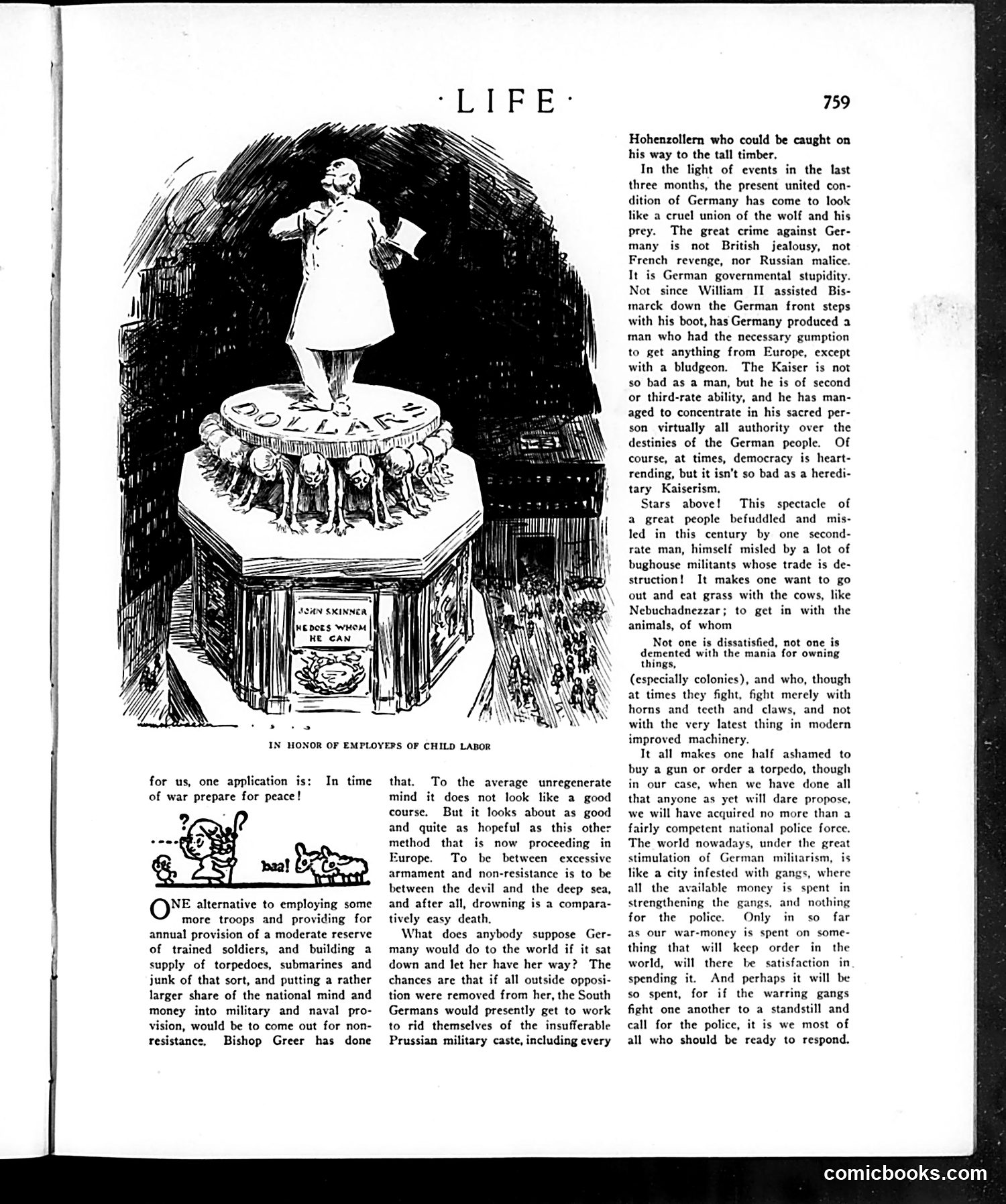
This Life magazine page contains **satirical editorial commentary on World War I**, not a traditional cartoon joke. The illustration shows a woman standing atop a pedestal labeled "KULTUR," surrounded by cherubic figures, sheltered beneath massive dark wings—likely representing German militarism or imperial authority. The text attacks **German Kaiser Wilhelm II** and Prussian military leadership as intellectually mediocre yet dangerously concentrated in power. The author argues Germany's "great crime" is governmental stupidity, not external enemies' jealousy. He suggests that if Germany faced internal opposition rather than unified external enemies, South Germans would overthrow the "insufferable Prussian military caste." The piece advocates for American military preparedness while questioning whether excessive armament or pacifism offers better solutions. It sardonically compares modern warfare's technological destruction to animals' "natural" fighting, implying human civilization has made war absurdly wasteful. The title's irony likely references how war economy exploits workers and children.
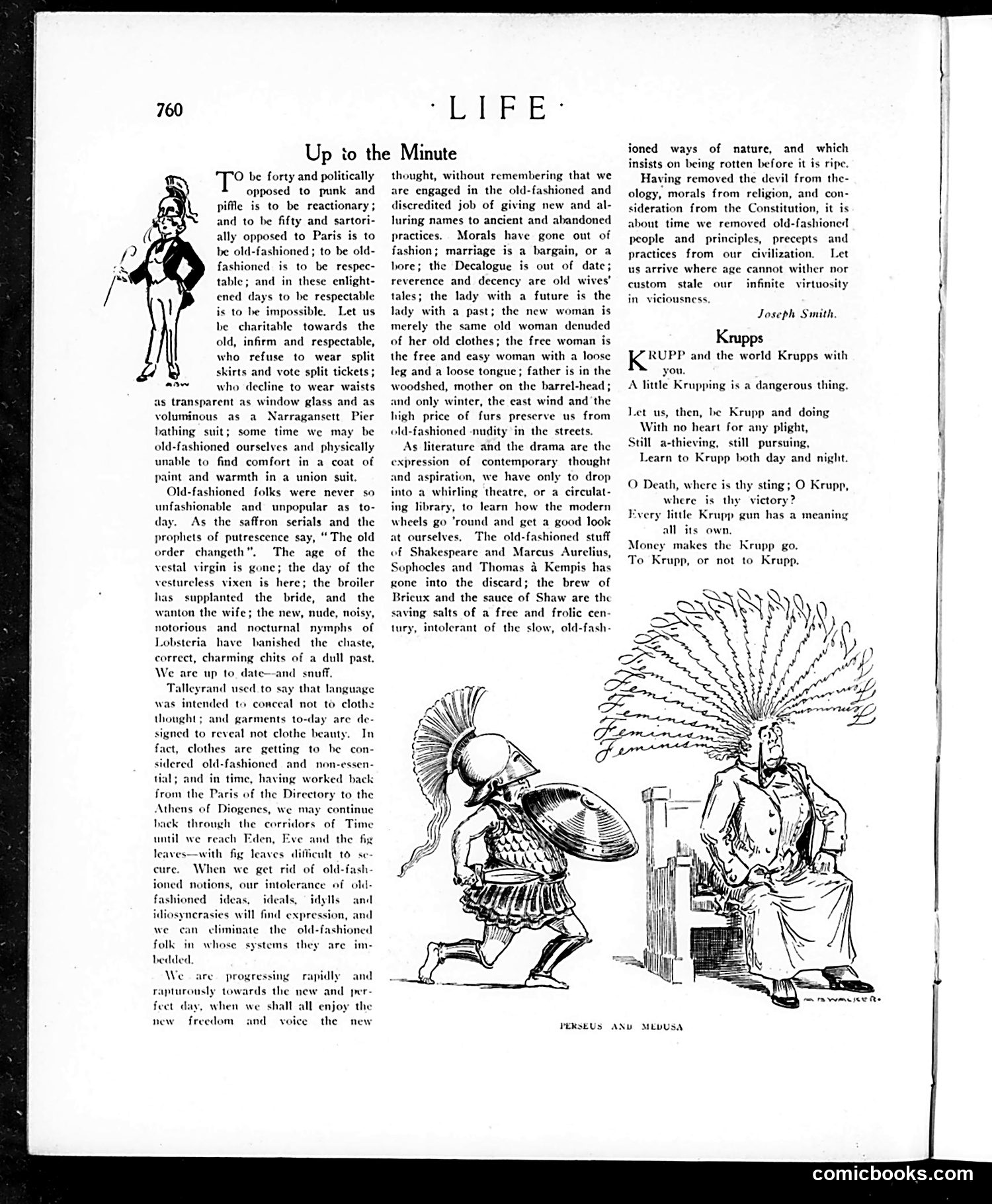
This article mocks modern society's obsession with "progress" and rejection of tradition. The author sarcastically praises the abandonment of old-fashioned morality, modesty, and respect—arguing that contemporary culture foolishly equates being "old" with being "impossible." The satire targets: - **Women's fashion changes**: split skirts, transparent waists, and increasingly minimal clothing (references to the Directory period and ancient Greece) - **Moral decay**: marriage treated as a "bargain," the Decalogue "out of date," reverence abandoned - **Literary modernism**: dismissal of Shakespeare and Marcus Aurelius in favor of playwrights like Shaw and Brieux The piece is fundamentally **conservative criticism**—authored by Joseph Smith, it argues that in discarding tradition, society has removed moral guardrails while calling it freedom. The accompanying illustrations of a woman in modern dress and "Perseus and Medusa" underscore the classical/traditional contrast. The bottom line: Life satirizes those who celebrate "progress" while losing ethical foundations.
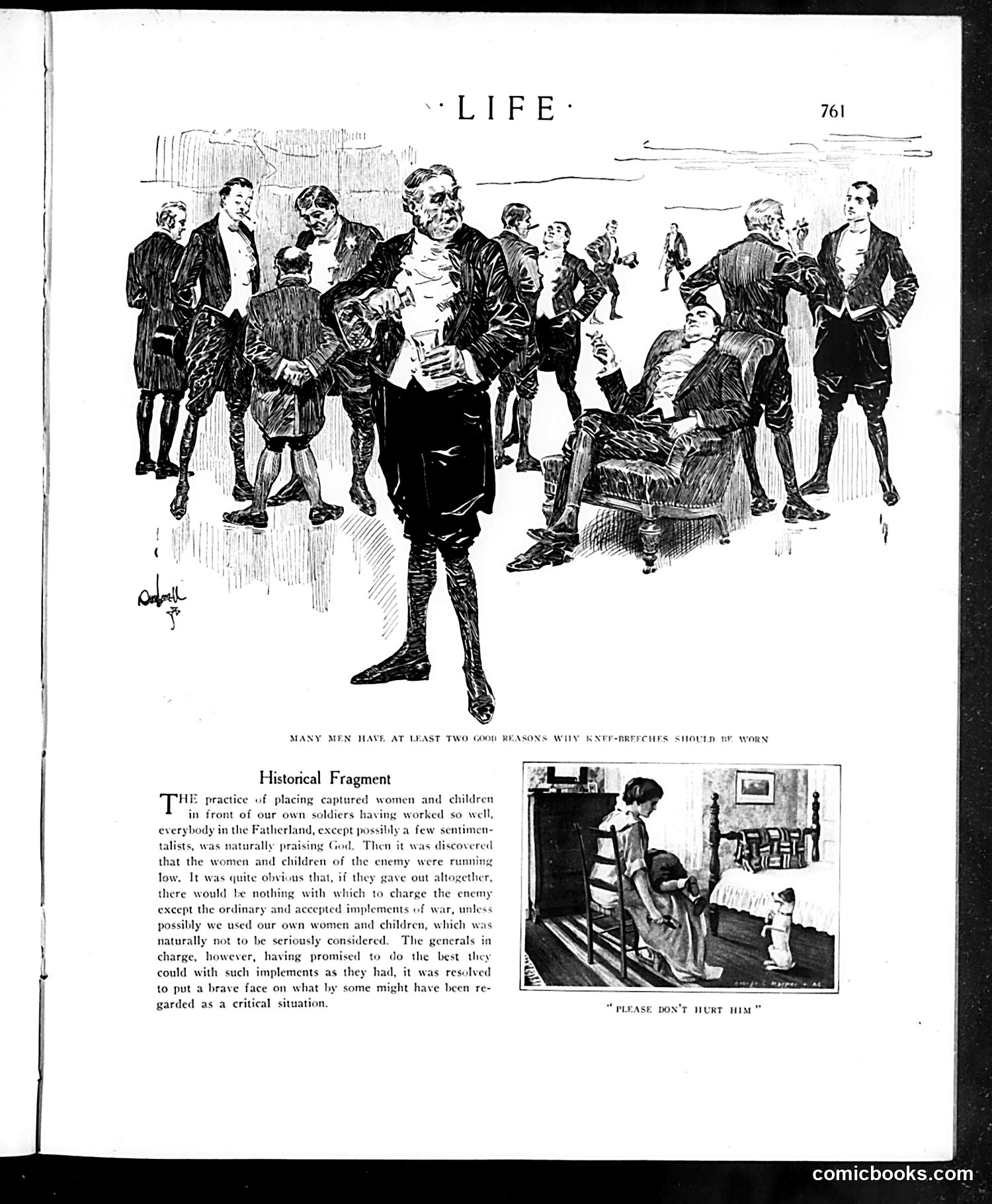
This page satirizes German military practices during World War I, specifically the use of captured civilians as human shields. The "Historical Fragment" text mockingly describes how German forces placed captured enemy women and children in front of their own soldiers—a tactic that apparently "worked so well" until supplies of captives ran low. The satire's dark humor lies in its deadpan presentation: the text ironically suggests German generals faced a "critical situation" when they exhausted their supply of civilian shields and had to rely on "ordinary and accepted implements of war" instead. The cartoon above depicts military officers observing this practice, while the photograph below ("Please Don't Hurt Him") shows a child, emphasizing the human cost of such tactics. This reflects contemporary Allied propaganda criticizing German military conduct, particularly during their invasion of Belgium and France, where documented atrocities against civilians occurred.
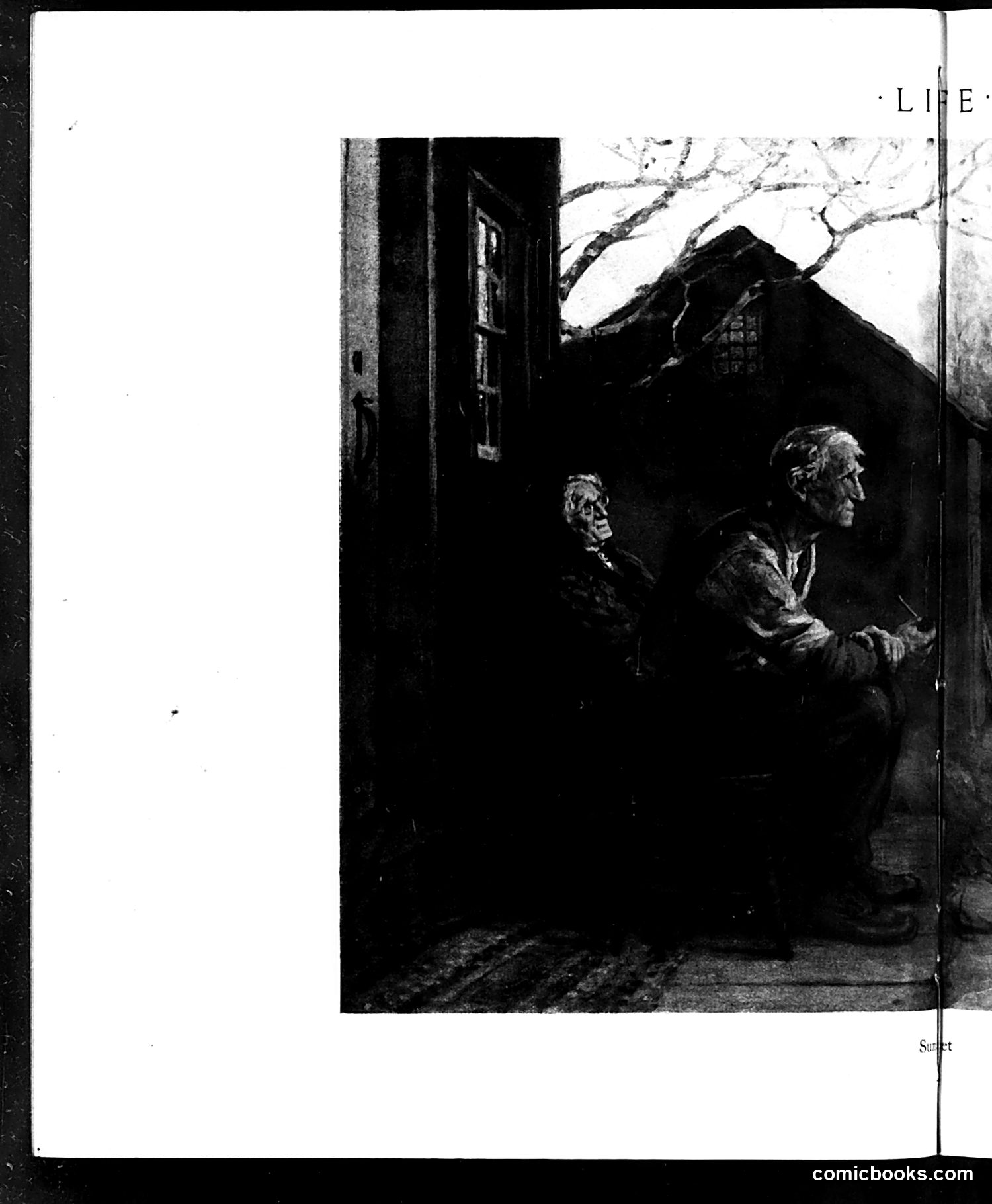
The OCR text is largely illegible, but the image shows a black and white illustration of two figures standing in a doorway or entrance during winter (snow visible above). The figures appear to be men in period clothing, rendered in a dramatic style typical of early 20th-century satirical illustration. Without legible text or clear identifying marks, I cannot definitively identify the specific figures, political references, or satirical point of this cartoon. The artistic style and composition suggest social commentary—possibly about poverty, homelessness, or economic hardship given the snowy setting and modest dress—but I cannot assert the specific meaning without clearer textual context or visible labels identifying the subjects. To properly explain this cartoon's satire, clearer OCR text or additional identifying information would be necessary.
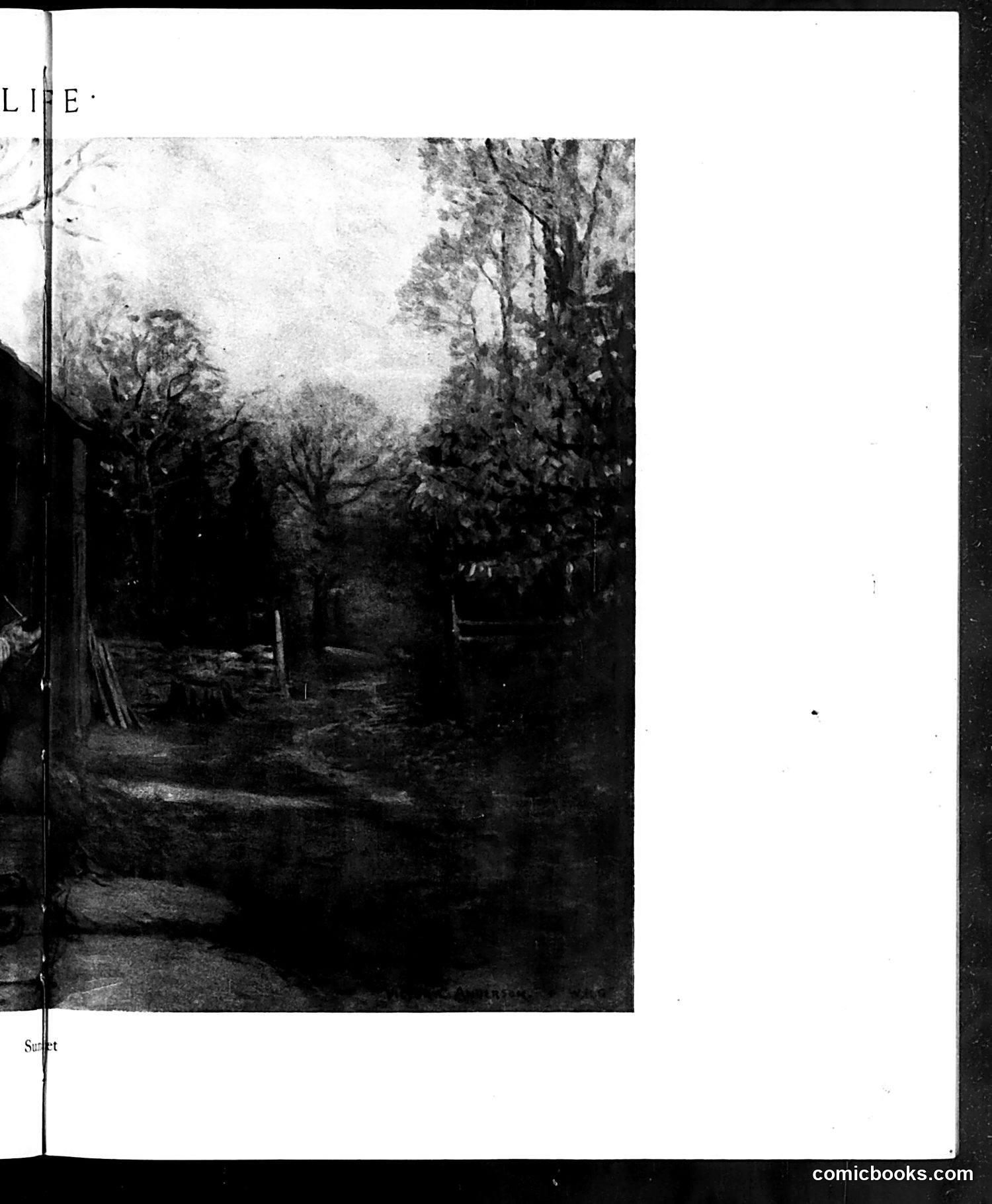
This page contains a black and white landscape photograph rather than a political cartoon. The image shows a wooded forest scene with bare and leafy trees, creating a naturalistic woodland setting. The photograph appears to be artistic or documentary in nature. The page header reads "LIFE" and there is text marked "Sunset" at the bottom left, suggesting this may be a caption or title for the image. Without accompanying satirical text, captions, or cartoon elements, this appears to be a straightforward photographic illustration rather than political commentary. The page lacks the visual caricatures, labeled figures, or contextual text needed to identify specific political references or satirical intent. This may be an illustration from a nature essay or similar feature in the magazine.
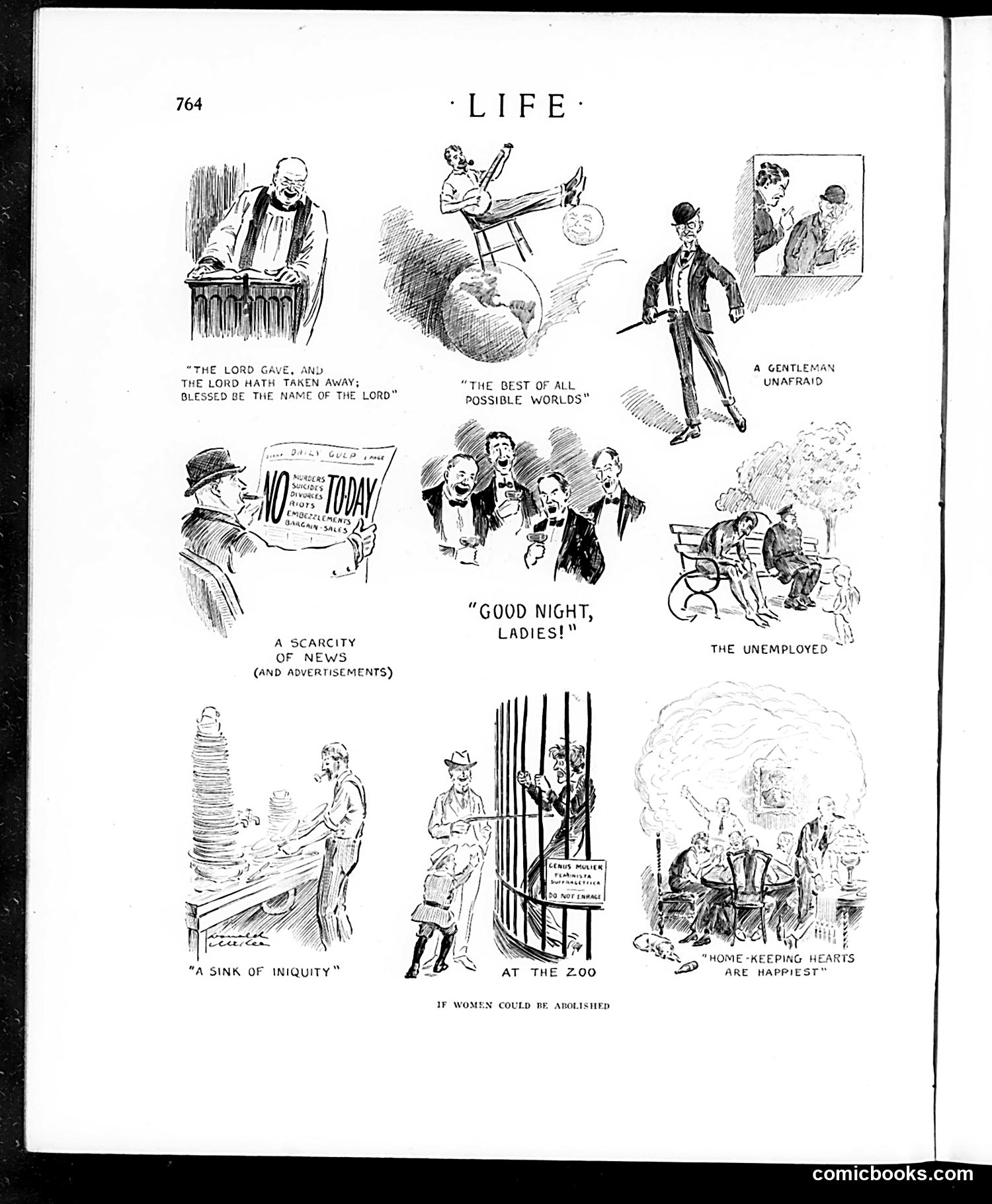
This is a satirical page titled "IF WOMEN COULD BE ABOLISHED," presenting nine vignettes imagining a world without women. Each sketch mocks male complacency and social problems: - Religious acceptance of hardship - Philosophical optimism despite reality - Fearless but foolish behavior - Newspaper scarcity (no ads) - Boisterous nightlife without female restraint - Poverty and unemployment - Filthy living conditions ("sink of iniquity") - Zoo attendance as entertainment - Domestic contentment through absence The satire targets men's tendency to blame women for life's difficulties rather than addressing actual social issues like unemployment, poverty, and poor living conditions. By showing a supposedly "ideal" male world as chaotic and degraded, the cartoon ironically argues that women's presence actually improves society—a progressive feminist critique embedded in this early-20th-century humor magazine.
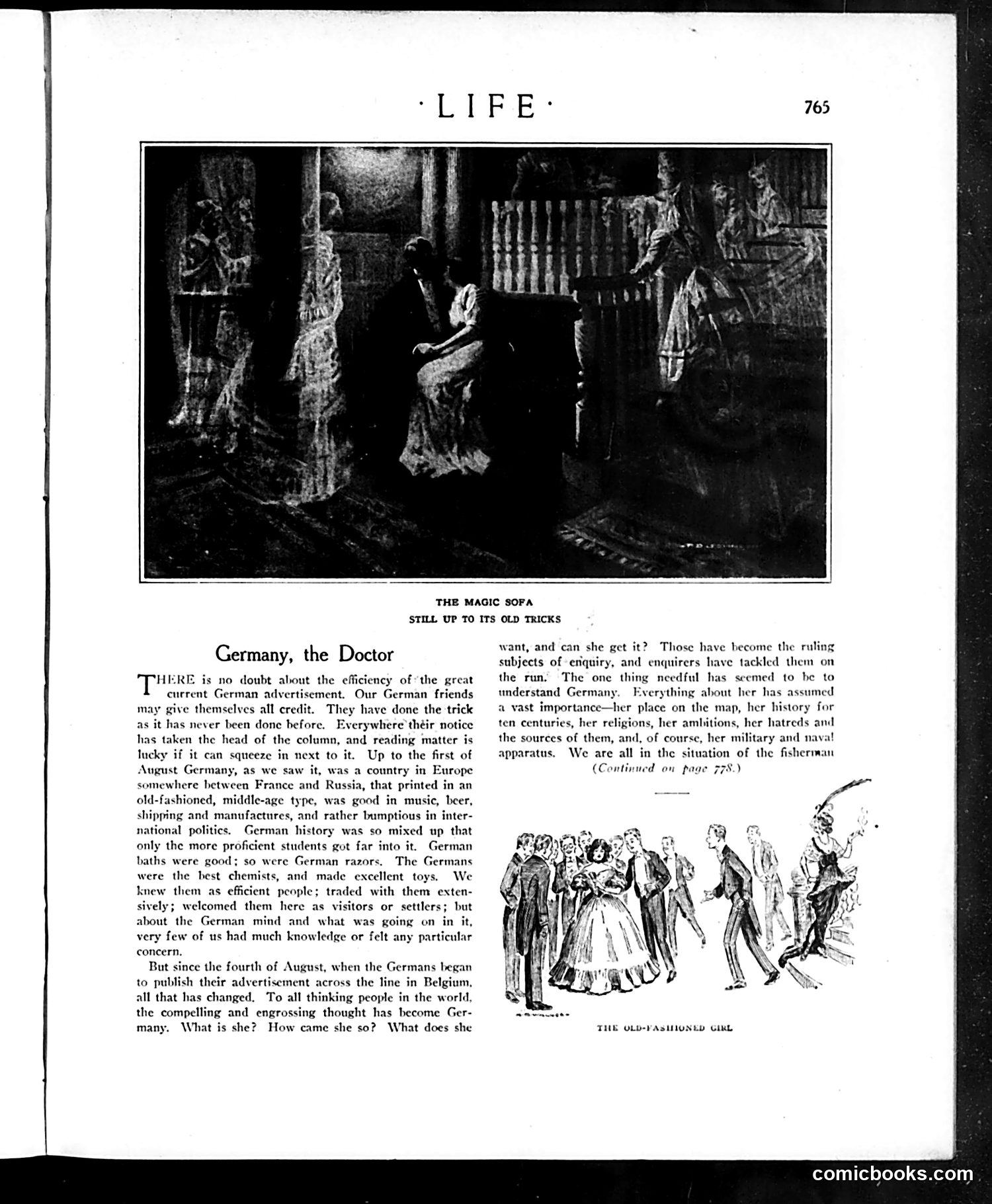
This article from Life magazine, published shortly after August 4, 1914 (when Germany invaded Belgium), satirizes the sudden shift in American public attention toward Germany during WWI's outbreak. **The satire's point:** Before the invasion, Americans viewed Germany neutrally—as a source of good beer, music, chemicals, and toys, with efficient people but a confusing history that few Americans bothered understanding. The invasion was Germany's unfortunate "advertisement" that forced the world to urgently study her intentions, history, religions, and military might. **The metaphor:** Germany is presented as a "doctor" whose advertising campaign (the invasion) paradoxically made everyone intensely focused on diagnosing what she actually is and what she wants—reversing prior indifference into compulsive inquiry. The accompanying illustration "The Magic Sofa" appears to show pre-war social frivolity contrasted with wartime concerns, while "The Old-Fashioned Girl" illustration likely represents outdated attitudes being overtaken by urgent new realities.
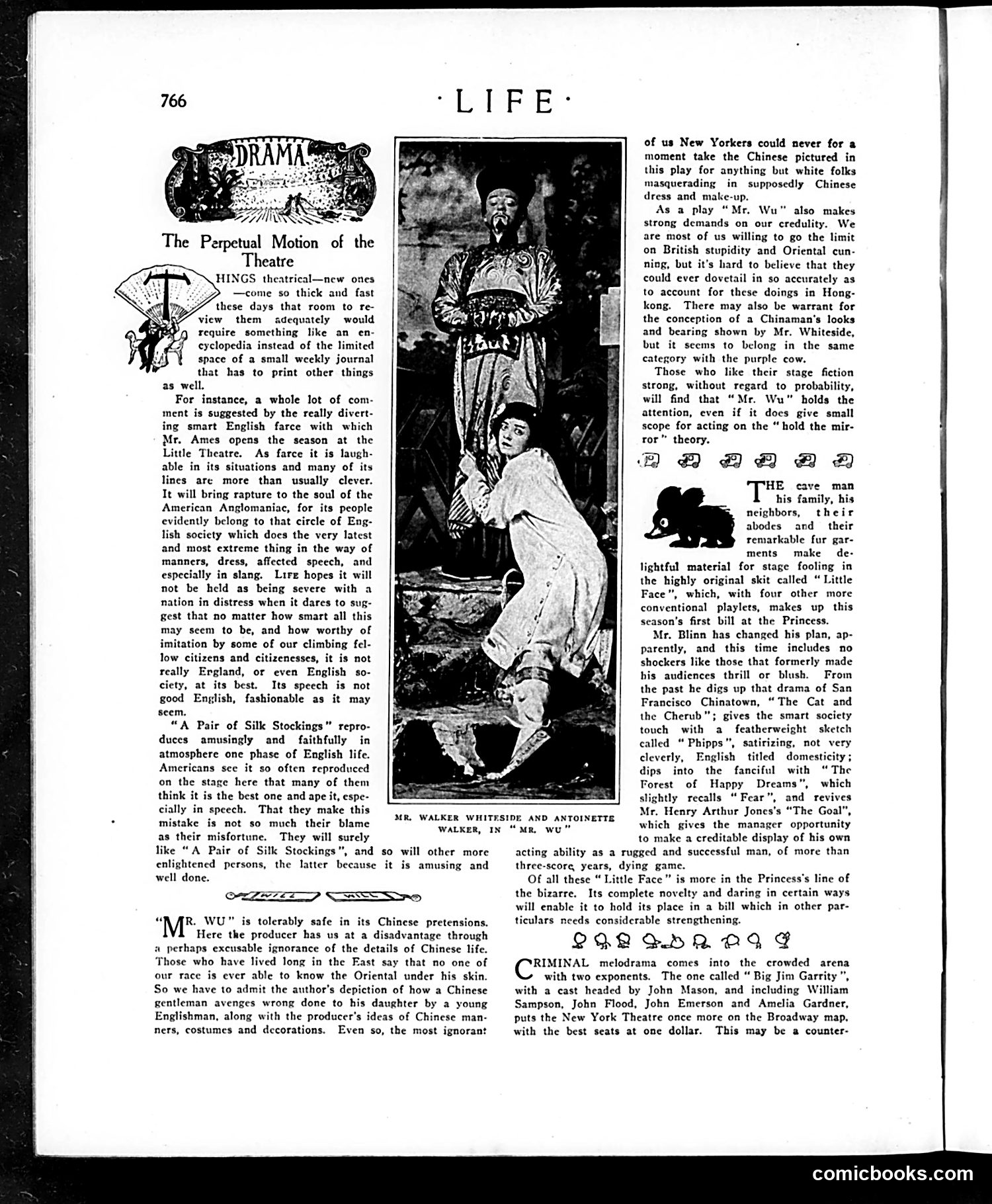
This page reviews three theatrical productions, with particular focus on "Mr. Wu," a play featuring Chinese characters. The satire targets American audiences' casual acceptance of yellowface performance—white actors in "Chinese dress and make-up." The critic acknowledges the play's implausibility but notes audiences willing to suspend disbelief about "British stupidity and Oriental cunning." The photograph shows **Mr. Walker Whiteside and Antoinette Walker** in the production. The piece also reviews two other shows: an English farce at the Little Theatre and "Little Face" at the Princess Theatre (featuring caveman scenes). The underlying satire is gentle but pointed: American theatergoers and producers accept obviously inauthentic racial performances without question, revealing their own ignorance and gullibility. The critic suggests even the author admits outsiders cannot truly understand "the Oriental," yet proceeds with the performance anyway.
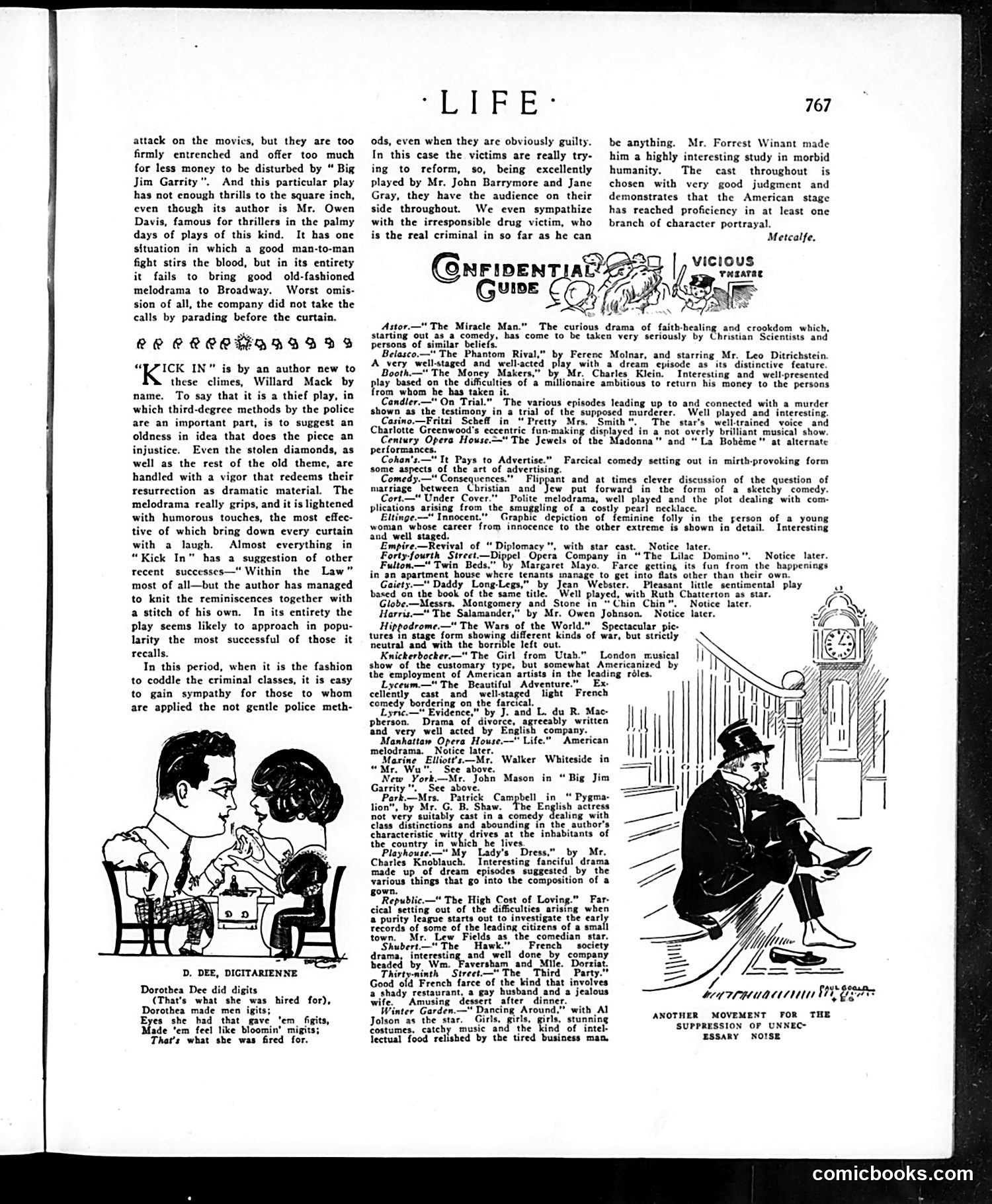
This page contains theater reviews and two cartoon illustrations. The main cartoon at bottom right, captioned "Another Movement for the Suppression of Unnecessary Noise," shows a man in formal dress appearing to eject or silence another figure in a doorway—likely satirizing public complaints about noise pollution or disruptive behavior in theaters or urban spaces during this era. The left illustration depicts "D. Dee, Digitarienne"—a woman performing, with accompanying verse about her theatrical talents. The bulk of the page consists of reviews of contemporary Broadway productions (including works by Owen Davis and Charles Klein), using sharp wit to critique performances and storylines. The tone is sardonic throughout—praising some productions while dismissing others as derivative melodrama. The magazine's satirical approach targets both theatrical trends and broader social issues like the presentation of criminal behavior and morality on stage.
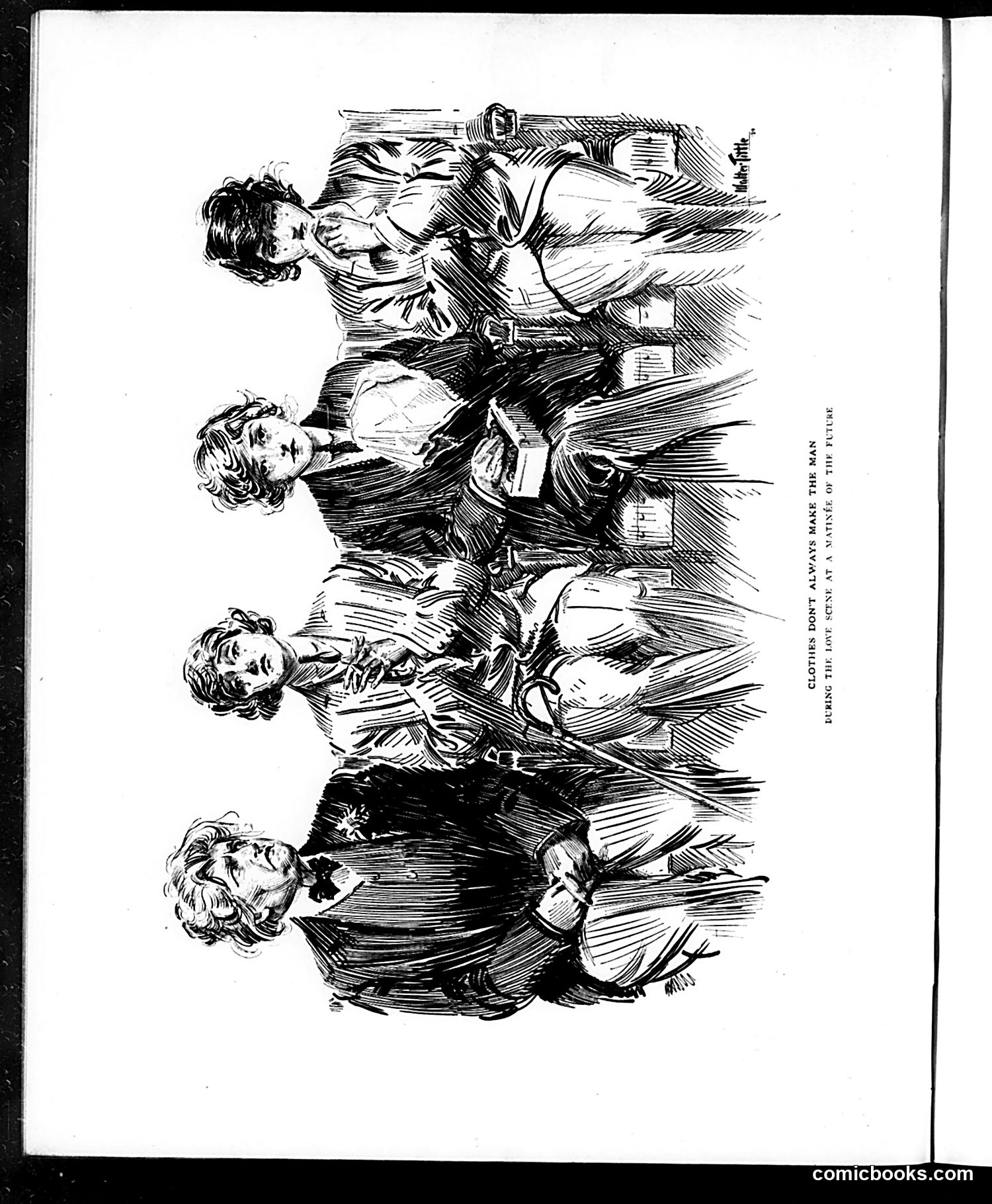
This page appears to be printed upside-down, making the OCR text unreadable and the cartoon difficult to interpret with certainty. The image shows four figures in what appears to be a formal or satirical scene, rendered in black ink with cross-hatching typical of late 19th or early 20th-century magazine illustration. The figures are dressed formally, suggesting political or social commentary. Without readable text identifying the figures or context, I cannot reliably explain who they represent or what specific political/social issue is being satirized. The artistic style and composition suggest social or political satire characteristic of *Life* magazine's editorial content, but determining the exact target of the satire requires legible accompanying text, which this page lacks.
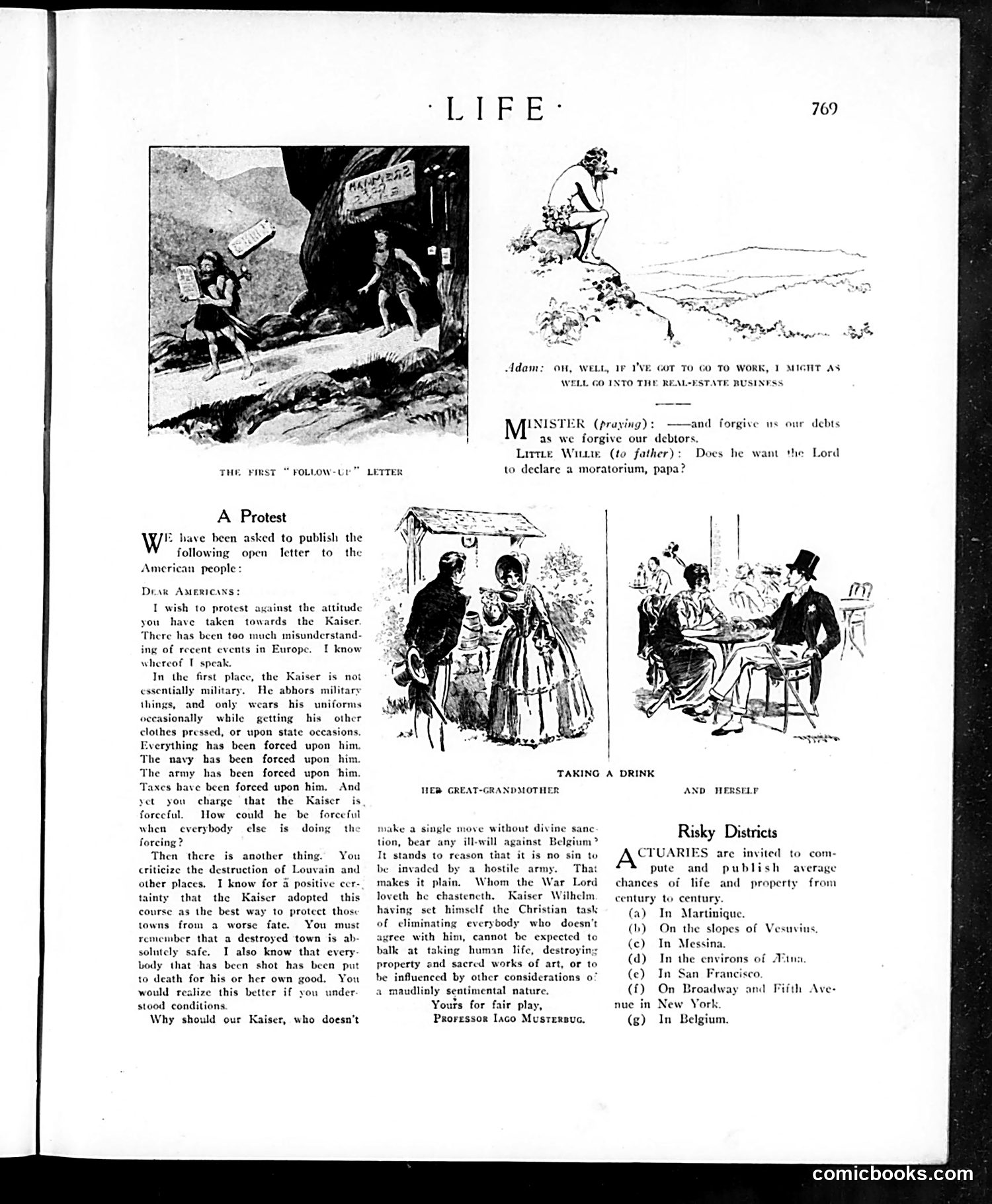
This page contains WWI-era political satire from *Life* magazine. The main piece is a mock "protest letter" sarcastically defending Kaiser Wilhelm II against American criticism. The satire works by presenting absurd pro-Kaiser arguments with a straight face: the Kaiser "abhors military things," everything was "forced upon him," destroyed towns are "absolutely safe," and killing is actually mercy. The accompanying cartoons reinforce the mockery: one shows a child asking if God should "declare a moratorium" (a break) on prayer; another depicts wealth and pleasure continuing obliviously while war rages. The "Risky Districts" section lists dangerous global locations, likely suggesting where property investments are unsafe—a dark joke given the wartime context. The overall message: American neutrality toward Germany's aggressive actions is foolish. The elaborate sarcasm aims to shame readers into recognizing the Kaiser's culpability for the war's destruction.
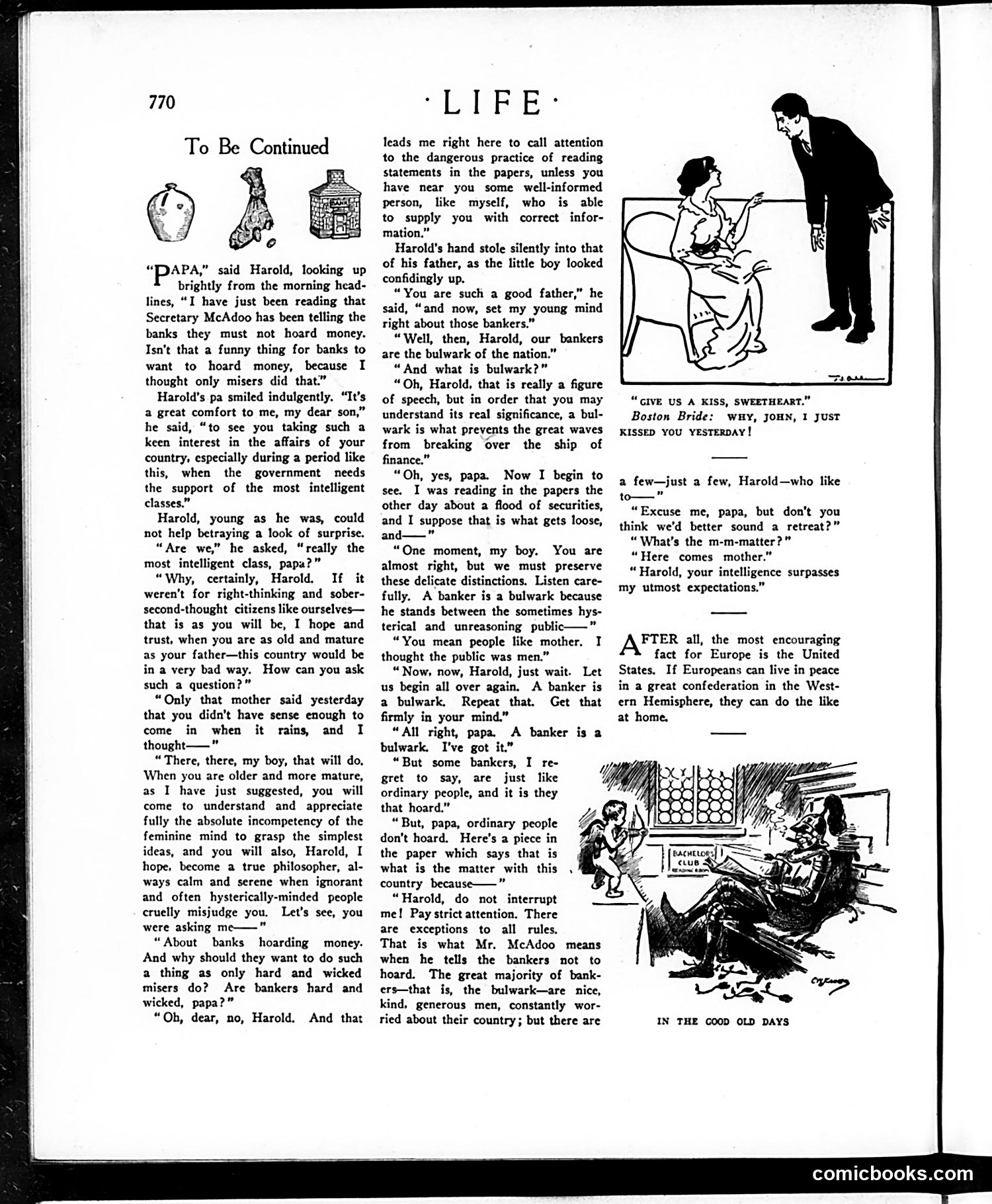
This page satirizes parental hypocrisy and the rationalization of banker privilege during what appears to be the World War I era (Secretary William McAdoo is mentioned as a real historical figure who served under Wilson). The main cartoon shows a father instructing his naive son Harold about banks and banking. The satire works through the father's circular logic: when Harold innocently points out contradictions—that his father lacks "sense enough to come in when it rains," or that ordinary people don't hoard—the father dismisses women's intelligence and redefines terms to protect bankers from scrutiny. The joke targets how the educated upper class uses sophisticated language and special pleading to shield financial elites from criticism. Harold's straightforward reasoning exposes the absurdity: bankers hoarding money should be condemned the same as "misers," yet the father insists bankers are noble "bulwarks" of the nation. The satire mocks how parents (and society) teach children to accept class-based double standards rather than consistent moral principles.
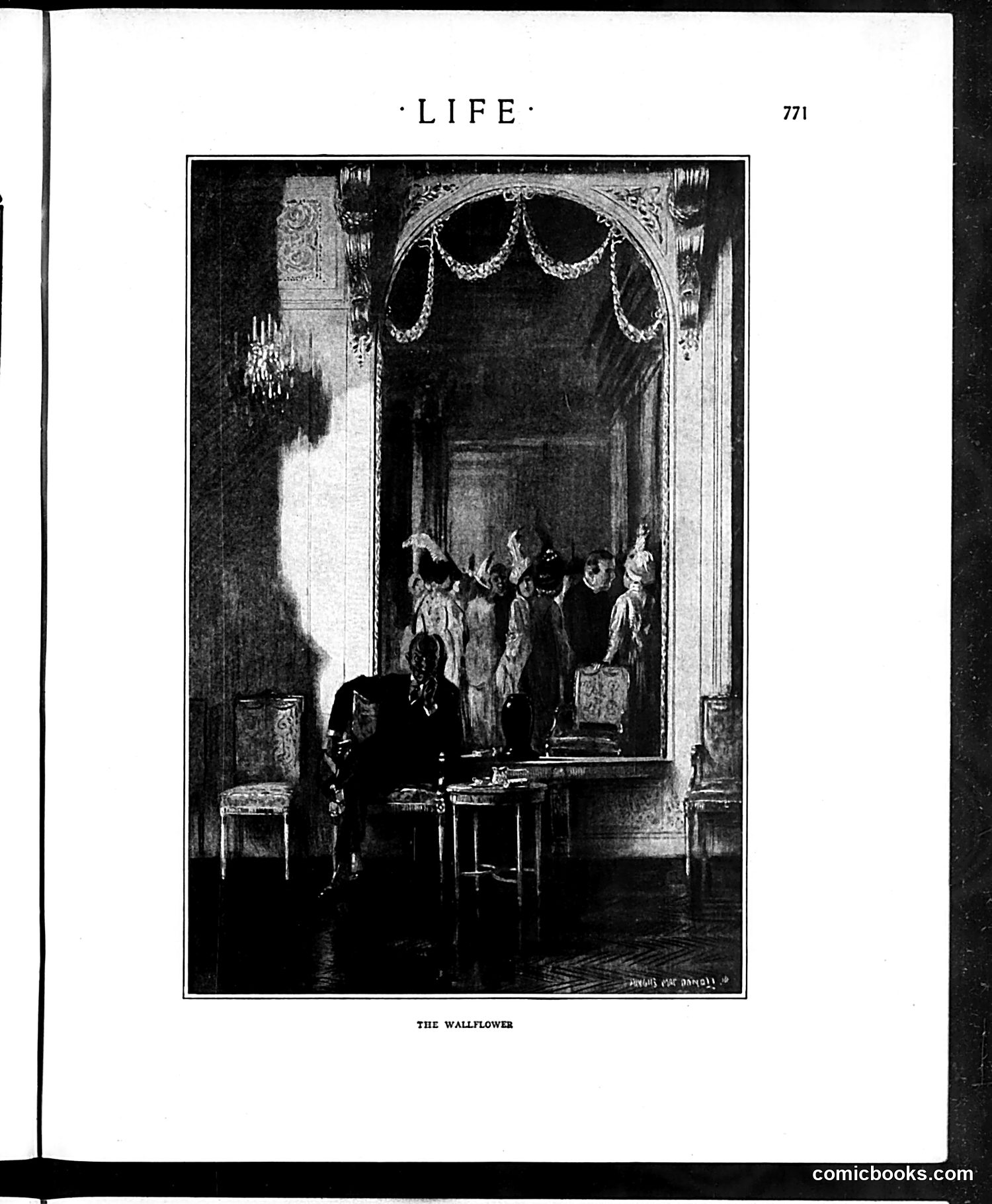
This illustration depicts an elegant interior scene with dramatic architectural elements—an arched doorway framed by classical columns and decorative swags. A solitary figure sits alone in the foreground, silhouetted and removed from the action, while a group of fashionably dressed people gather animatedly within the arched doorway in the background. The title "The Wallflower" refers to someone socially excluded or overlooked at a gathering. This is satirical social commentary on exclusion and loneliness in high society. The stark visual contrast—the isolated figure versus the lively group—emphasizes the emotional distance and rejection. The composition uses architectural grandeur ironically to highlight social awkwardness rather than elegance, making the scene a critique of social hierarchies and the pain of being left out in affluent circles.
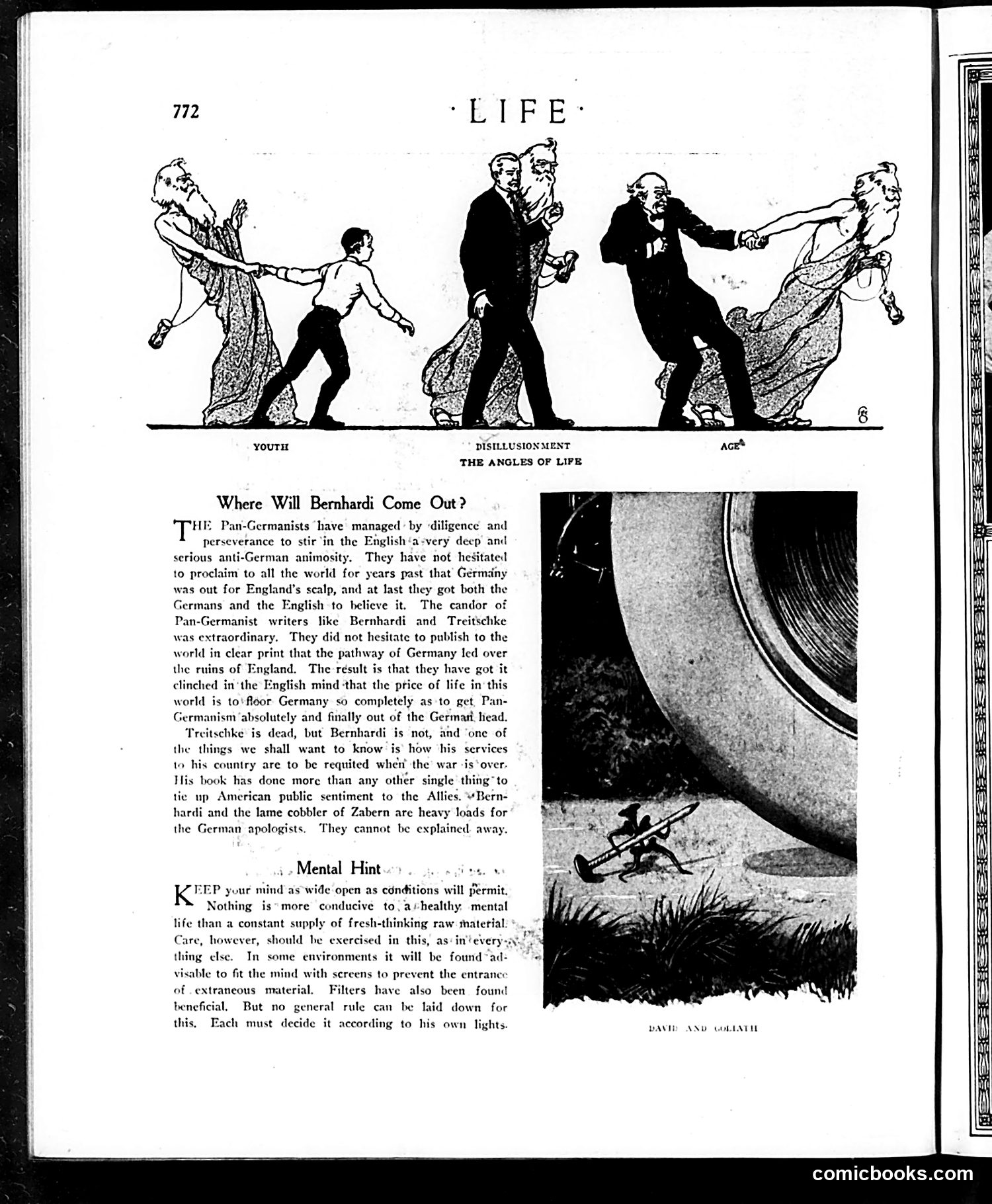
This WWI-era *Life* magazine page satirizes German militarism and its architects. The top cartoon, "The Angles of Life," depicts three life stages (Youth, Disillusionment, Age) showing men increasingly manipulated by aggressive women—likely representing Germany's influence over its male population through nationalist ideology. The article "Where Will Bernhardi Come Out?" discusses Friedrich von Bernhardi, a Prussian general whose writings promoting German expansion alarmed Britain and America. The text argues that Bernhardi and other Pan-Germanist authors (like Treitschke) inadvertently united the Allies against Germany by openly publishing their imperial ambitions. It questions whether Bernhardi will face consequences after the war. The "Mental Hint" section advocates intellectual openness while cautiously accepting that some ideas require filtering—a subtle critique of unchecked nationalist propaganda. The bottom illustration ("David and Goliath") likely represents the conflict between smaller nations and German military might, invoking the biblical underdog story.
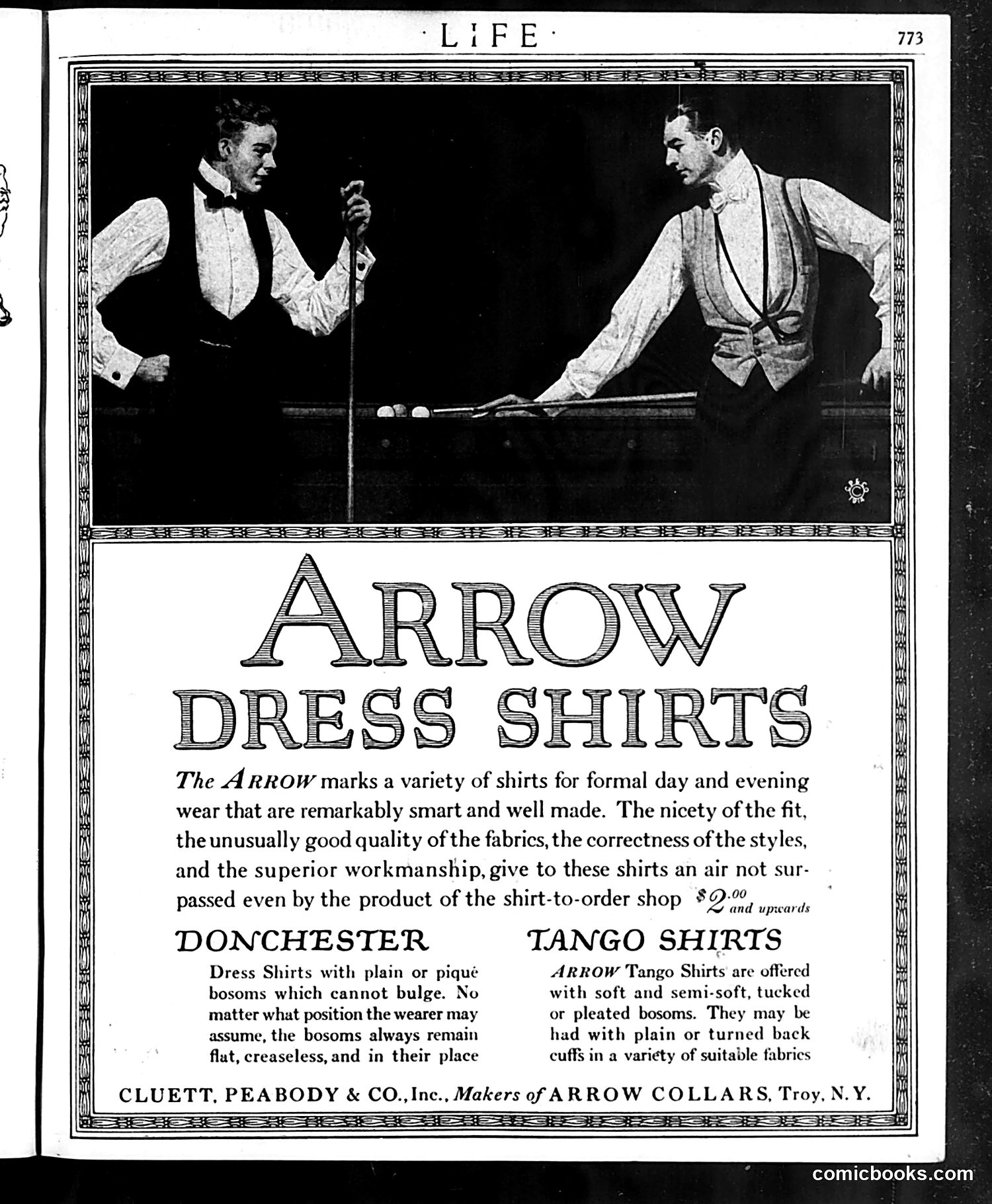
The page features a full-page ad for Arrow Dress Shirts from Cluett, Peabody & Co. The image shows two men in formal wear (tuxedos with dress shirts) playing billiards, presumably demonstrating that Arrow shirts maintain their appearance even during active movement. The ad highlights two shirt styles: the "Donchester" with non-bulging bosoms that stay flat and creaseless regardless of the wearer's position, and "Tango Shirts" with soft or semi-soft pleated bosoms. The emphasis on maintaining proper appearance during physical activity (billiards) was a selling point for formal menswear in this era—suggesting quality and durability. This is straightforward commercial advertising, not editorial content or satire. No political commentary or social criticism is present.
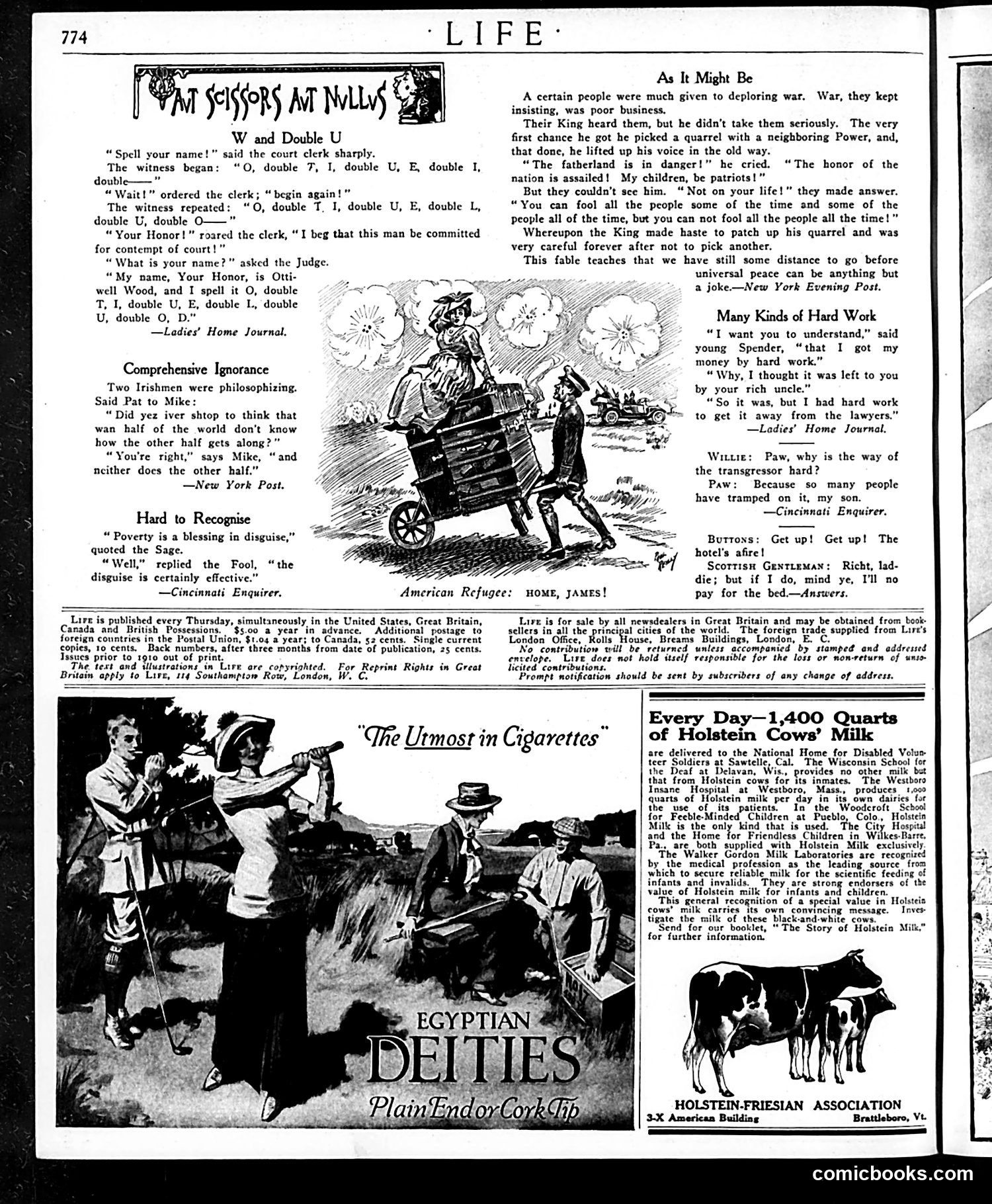
This page's main satirical piece is a fable about a King who declares war despite his subjects' opposition to conflict. When the people refuse to support him—citing Lincoln's maxim that "you can not fool all the people all the time"—the King quickly abandons his quarrel. The satire targets militaristic leaders who expect automatic patriotic compliance from populations tired of war. By showing the King's sudden retreat when confronted with popular resistance, the piece suggests that public opinion matters and that citizens need not blindly accept governmental war-making. The moral, attributed to the *New York Evening Post*, implies that lasting peace requires citizens to resist warmongering propaganda—a notably anti-war message for the era. The surrounding humor pieces (about spelling, poverty, and hard work) are lighter fare typical of *Life* magazine's mixed content format.
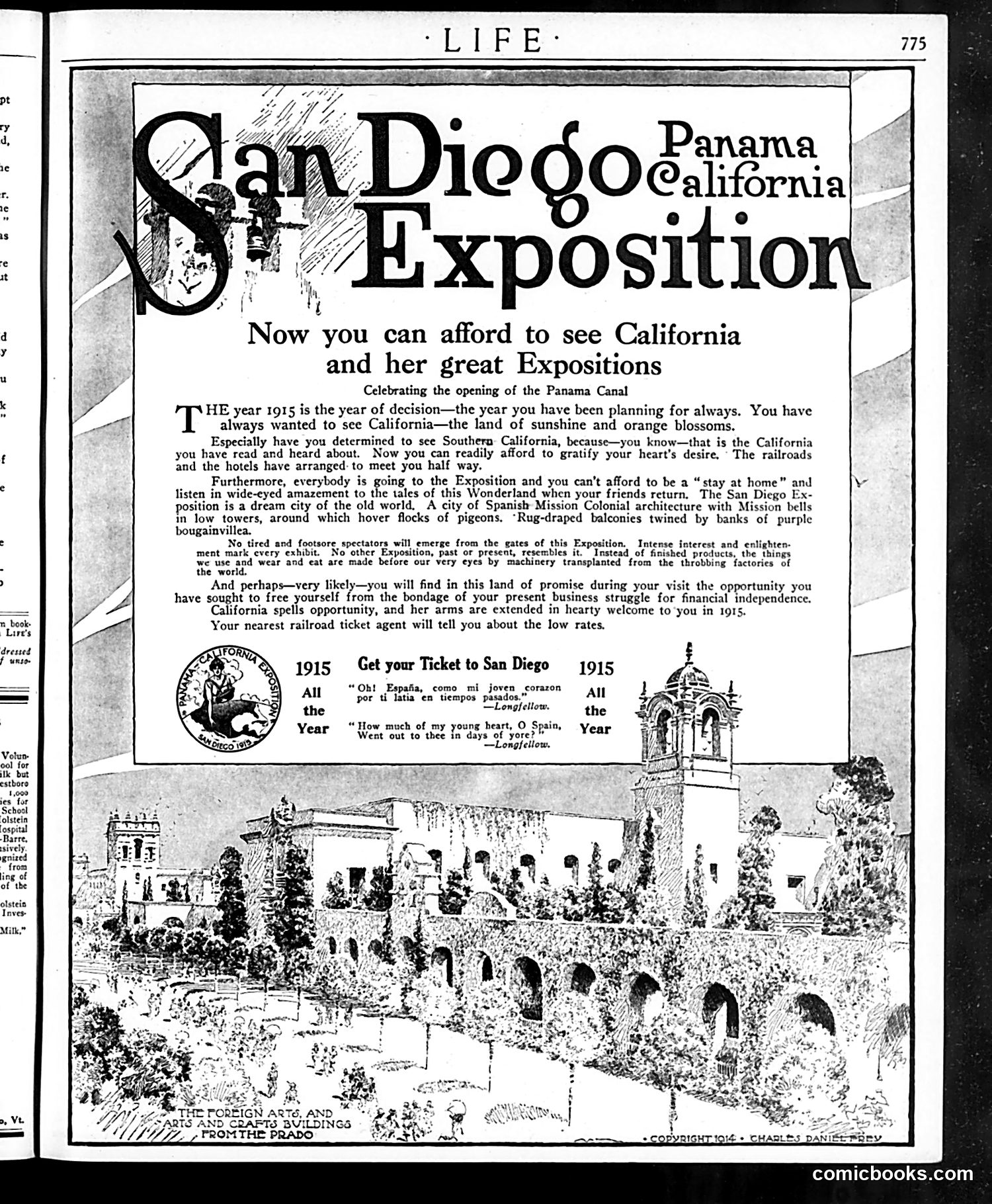
This is a full-page advertisement, not a political cartoon. It promotes the Panama-California Exposition in San Diego, timed to celebrate the 1915 opening of the Panama Canal. The ad uses romantic language to entice readers to visit California, emphasizing affordable travel via railroads and hotels. It promises "Spanish Mission Colonial architecture" with Mission bells, pigeons, and "rug-draped balconies" — essentially marketing exotic colonial aesthetics as tourist attractions. Notably, the ad includes Spanish poetry quotes (misattributed to Longfellow) romanticizing Spain, reinforcing the exposition's theme of celebrating colonial heritage. The bottom illustration shows the "Foreign Arts and Crafts Buildings" styled after Spain's Prado museum. The subtext appeals to business prospects: the ad suggests California offers "opportunity" for financial independence, targeting readers seeking escape from their current economic situations. This reflects early-20th-century American optimism about westward expansion and California's economic potential.
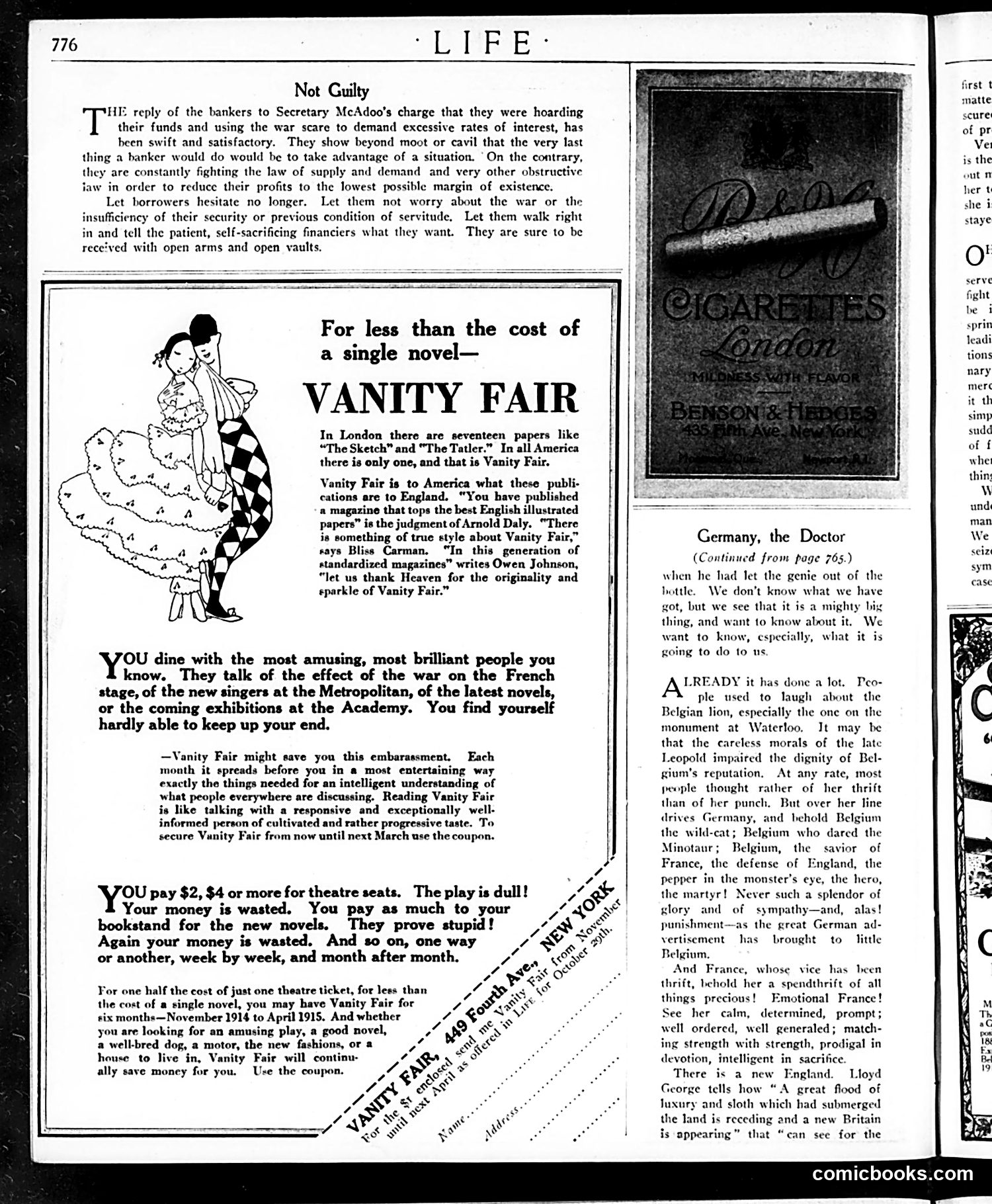
**"Not Guilty" (Top Section):** This is satirical commentary on Secretary of Treasury McAdoo's accusation that bankers were hoarding funds and exploiting wartime fears to raise interest rates. The piece uses heavy irony to defend the bankers—claiming they would *never* exploit a situation and instead sacrifice profits. The sarcasm targets the banking industry's self-serving defense against genuine accusations of profiteering during WWI. **"Vanity Fair" Advertisement (Center):** A straightforward magazine advertisement positioning *Vanity Fair* as America's equivalent to London's sophisticated illustrated papers like *The Sketch*. It markets the publication as essential cultural knowledge for intelligent conversation—discussing theater, opera, novels, and exhibitions. The ad emphasizes cultural refinement while promoting cheap subscription rates. **"Germany, the Doctor" (Right Side):** A continuation discussing Belgium's unexpected military resistance and moral standing during German invasion—contrasting Belgium's previously modest reputation with its newfound heroic status as a defender against Germany and savior of France during WWI.
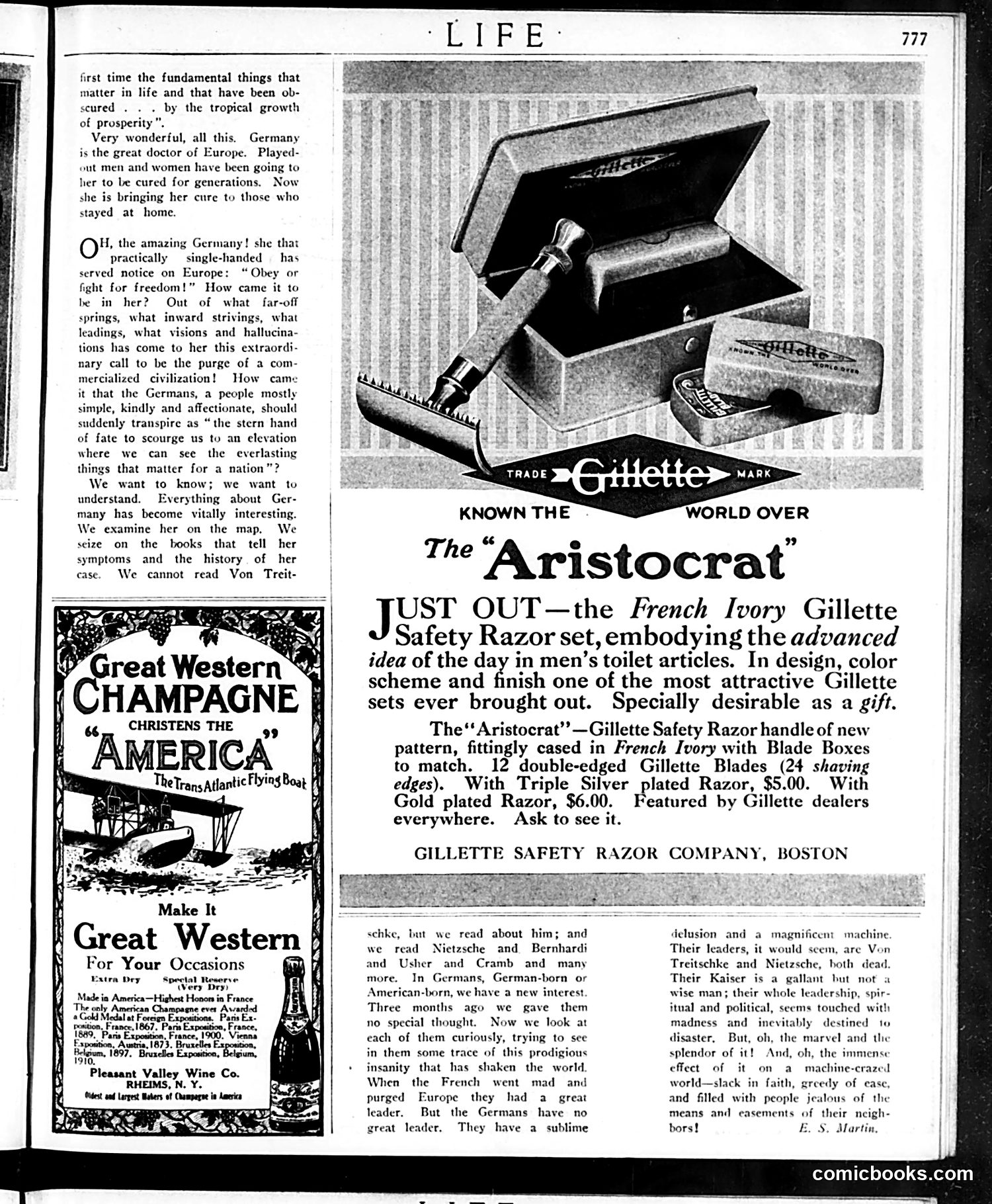
This page contains **no political cartoon**—it is primarily advertising and literary content from Life magazine's editorial section. The text discusses Germany's role in Europe, written with apparent admiration for German culture and philosophy. The author notes Germans have become "vitally interesting" and references German intellectuals like Nietzsche and Bernhardi. This appears to be **pre-World War I commentary** (likely early 1900s based on the reference at bottom), when German intellectual and military power was viewed with fascination rather than hostility by some American observers. The sidebar advertisement promotes the "Aristocrat" Gillette Safety Razor set in French Ivory, positioning it as an upscale gift item. The left ad promotes "Great Western Champagne" as suitable for various occasions. **No satire or caricature appears here**—the Germany discussion is earnest admiration, not mockery, reflecting early-20th-century American attitudes toward German culture before WWI shifted perceptions.
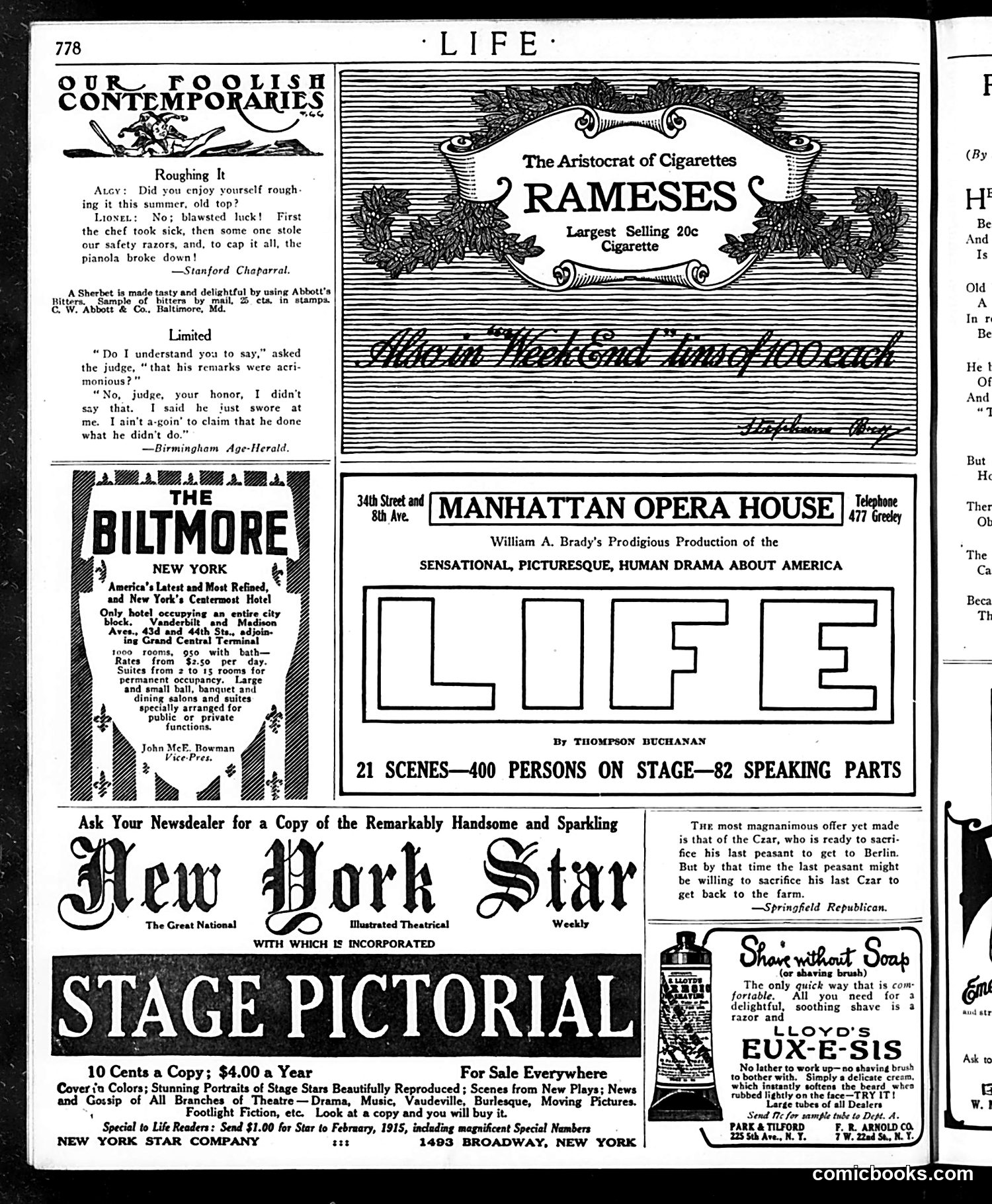
This page is **primarily advertising**, not political satire. It contains: 1. **"Our Foolish Contemporaries"** — a small humor column featuring two brief jokes (one about roughing it, one about courtroom testimony). These are generic social humor, not political commentary. 2. **Multiple advertisements**: The Biltmore hotel in New York, Rameses cigarettes, Manhattan Opera House production of "Sfe" (a Thompson Buchanan play), New York Star theatrical weekly, Stage Pictorial magazine, and Eux-E-Sis shaving product. The page reflects early 1900s consumer culture and entertainment advertising. There is **no visible political cartoon** and no identifiable caricatured figures. The content is straightforward period advertising and light social humor without satirical punch.
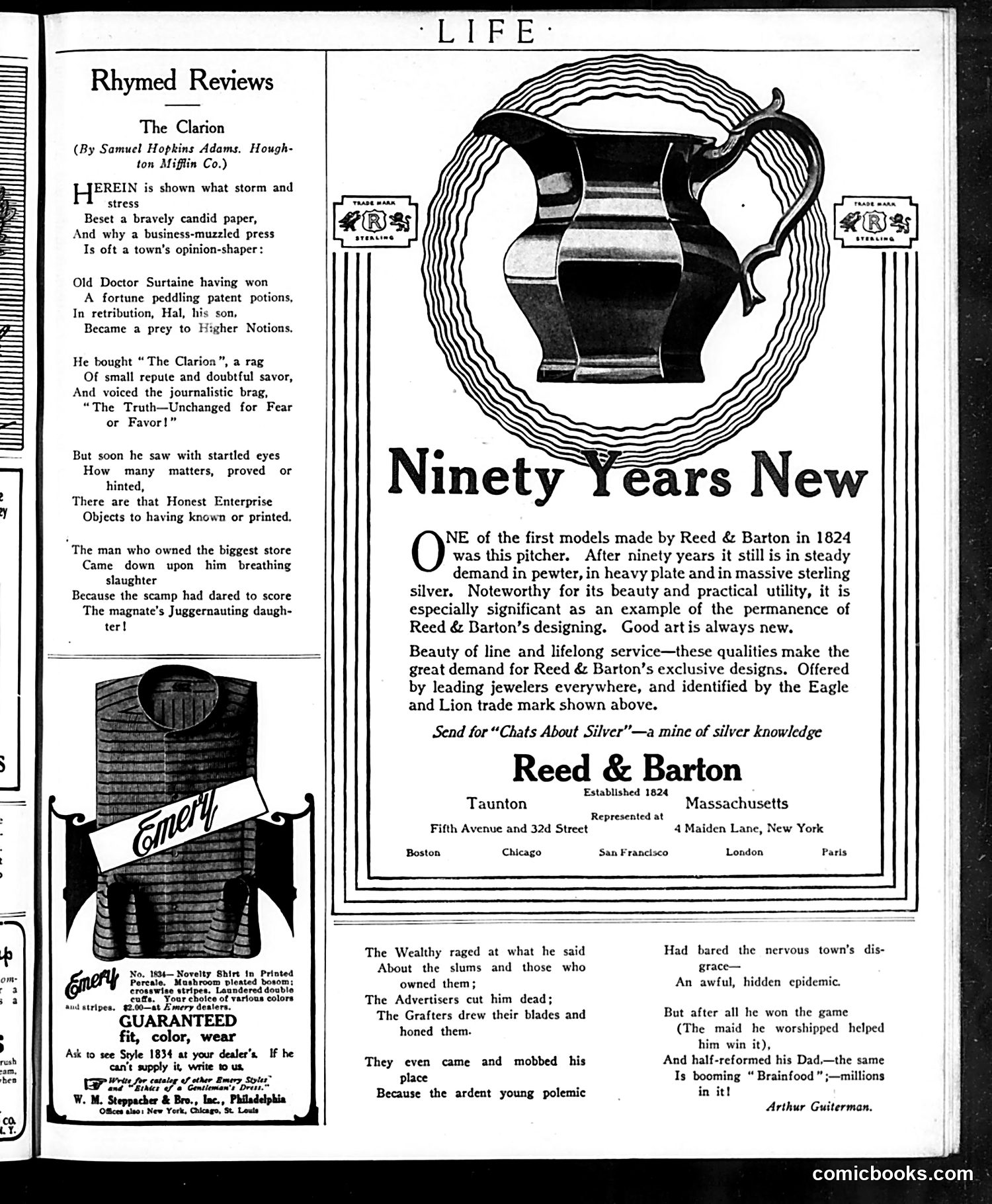
This page reviews Samuel Hopkins Adams' novel about a young newspaper editor fighting corruption. The satirical poem describes Hal, son of a patent-medicine millionaire, who buys a struggling newspaper ("The Clarion") to crusade for truth. However, he discovers that exposing social problems—slums, graft, hidden epidemics—antagonizes advertisers, wealthy store owners, and criminals who threaten violence against his publication. The satire targets the constraints on American press freedom in the early 1900s. Despite claiming to print "The Truth—Unchanged for Fear or Favor," newspapers faced economic and physical pressure to suppress investigations into corruption. The poem's resolution is gently cynical: the hero wins through romance and eventually converts his father, who now profits from a patent remedy called "Brainfood"—suggesting that reform often serves commercial interests rather than genuine social change.
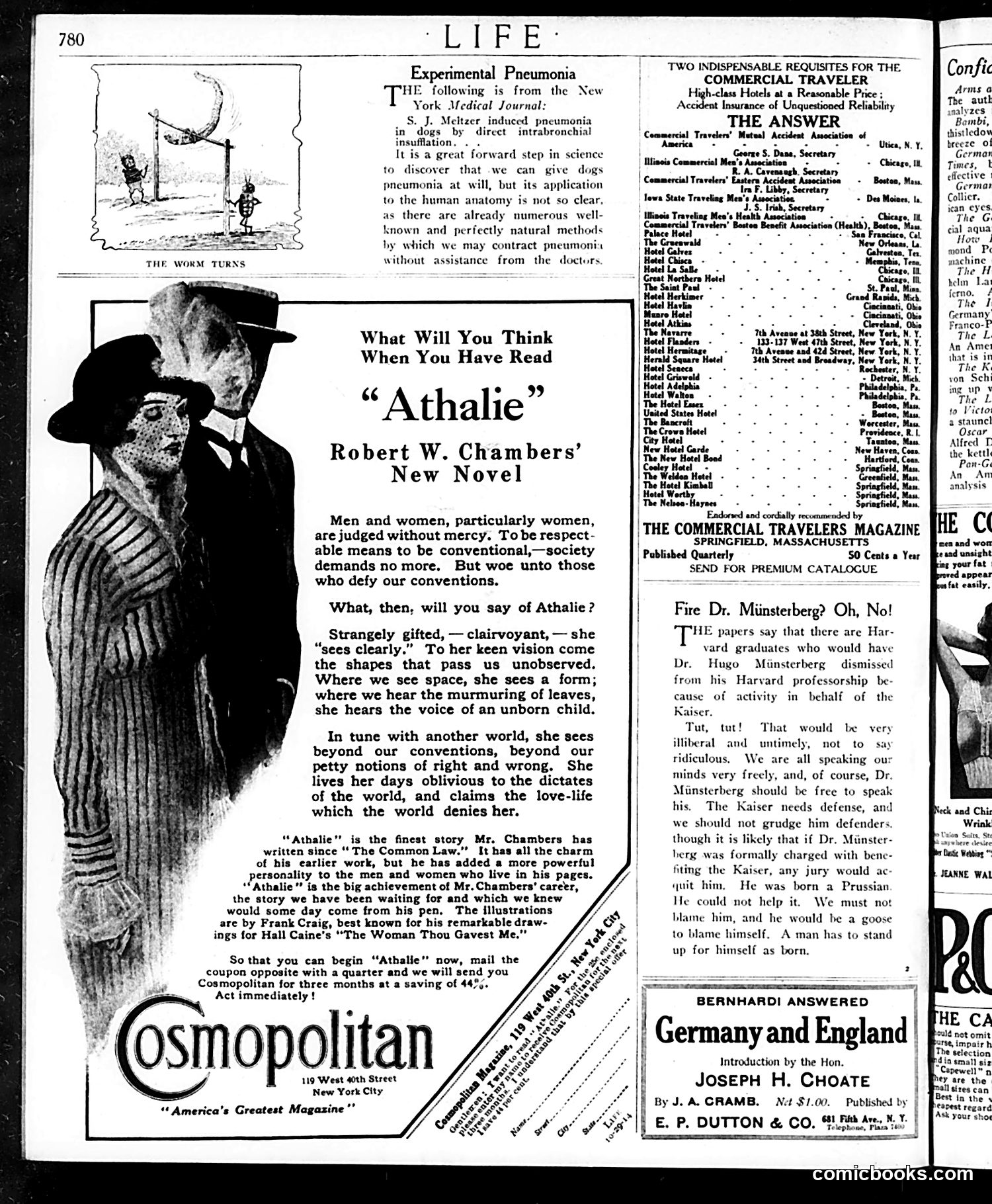
This page mixes editorial content with advertisements. The main cartoon, "The Worm Turns," depicts a small figure confronting a larger one—likely satirizing the experimental pneumonia article above it, which reports scientists deliberately infecting dogs with pneumonia. The satire's point: it's absurd to artificially create disease in animals when humans naturally contract illness "without assistance from the doctors." The lengthy section titled "Fire Dr. Münsterberg? Oh, No!" addresses a contemporary controversy: Harvard professor Hugo Münsterberg, a German immigrant, faced calls for dismissal due to pro-Kaiser advocacy during World War I. The editorial defends his right to free speech and nationalist loyalty, arguing he "was born a Prussian" and shouldn't be blamed for defending his homeland—a notably tolerant stance toward German sympathies during the war period. The remaining content comprises book and magazine advertisements.
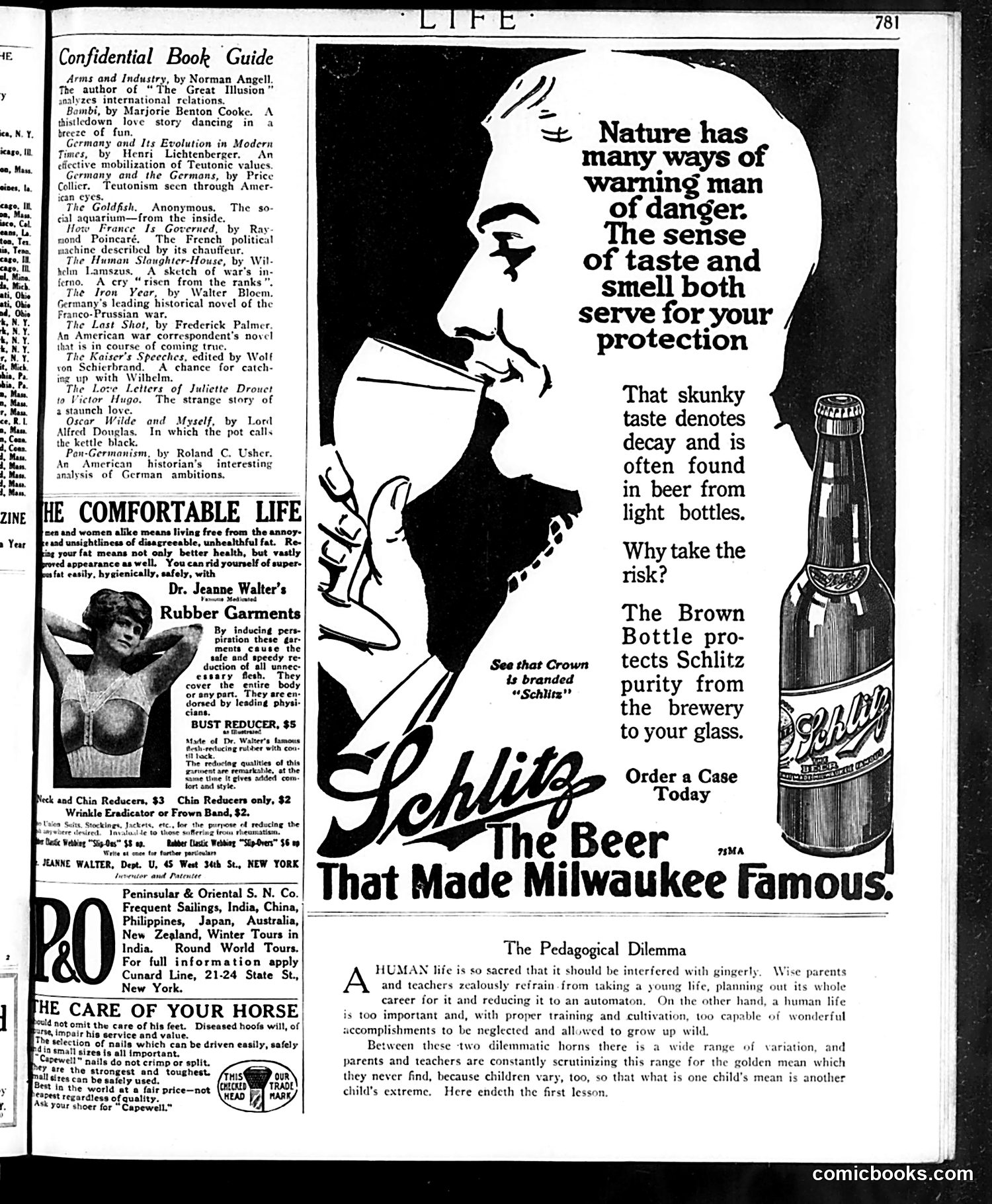
This page mixes book reviews, advertisements, and an educational article. The main visual element is a **Schlitz beer advertisement** featuring a profile illustration of a man's head with text about nature's warning systems—taste and smell—to protect against danger. The ad warns that "skunky taste denotes decay and is often found in beer from light bottles," positioning Schlitz's brown bottle as superior protection for "purity from the brewery to your glass." The **satire here is subtle but present**: the ad anthropomorphizes nature's protective instincts to sell beer, treating beverage quality as a matter of biological survival. This reflects early 20th-century marketing that connected consumer products to health and safety concerns. The book guide lists works about Germany, war, and international relations—reflecting pre-WWI anxieties about global conflict and German militarism (titles like *Pan-Germanism* and *The Kaiser's Speeches*). The "Pedagogical Dilemma" article discusses balancing rigid child discipline against neglect—a period concern about education philosophy.
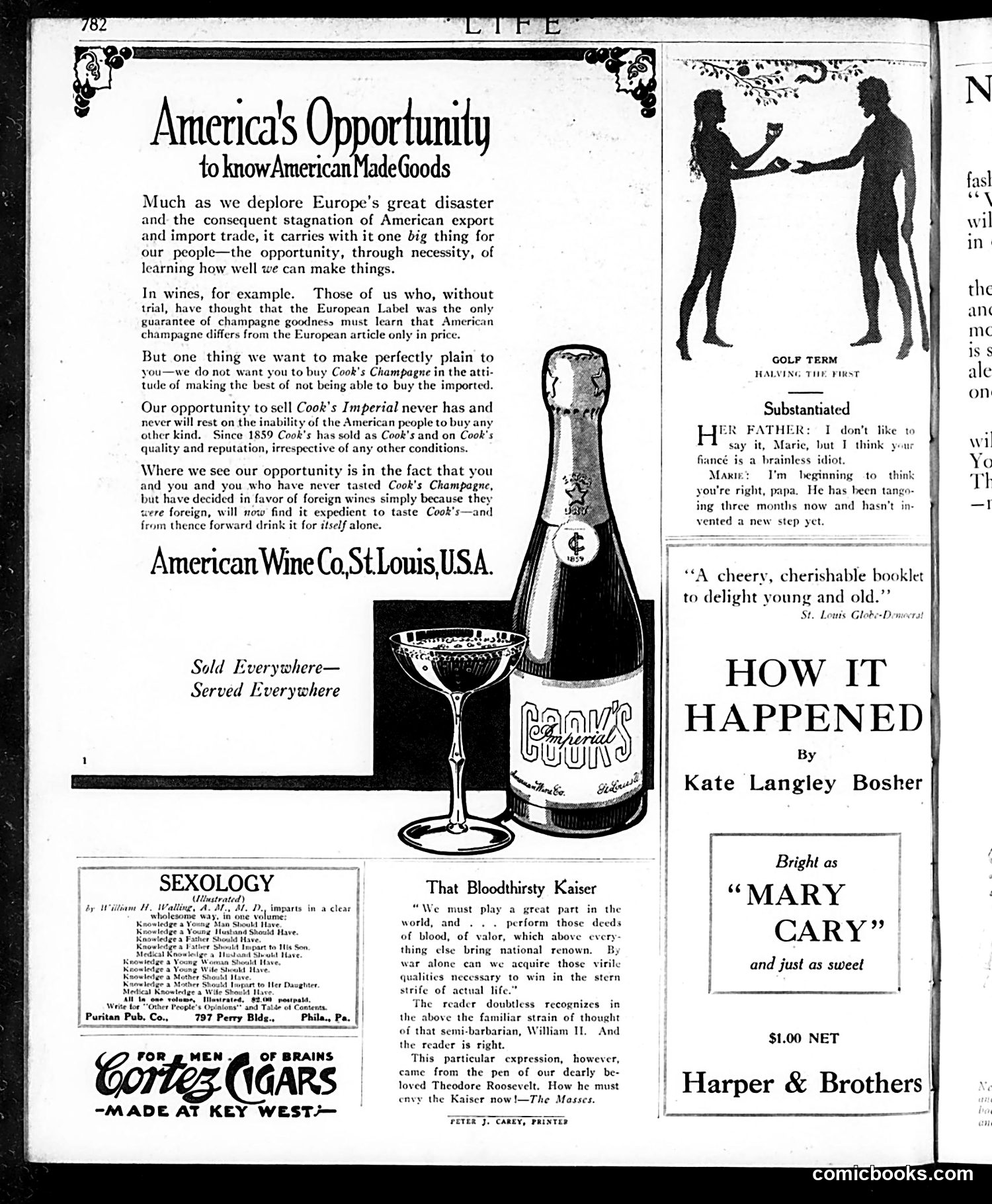
This *Life* magazine page contains **advertising and book promotion**, not political cartoons. The main content promotes **Cook's Imperial Champagne** from St. Louis. The advertisement argues that World War I's disruption of European trade creates an opportunity for Americans to appreciate domestic wine. It reassures readers that American champagne matches European quality—only the price differs—positioning patriotic consumption as practical necessity rather than inferiority. The "Sexology" section appears to be an educational illustrated guide (a common magazine feature of this era). A sidebar titled "That Bloodthirsty Kaiser" critiques **Theodore Roosevelt**, satirizing his militaristic philosophy. The text mocks Roosevelt's praise of warfare and "blood" as paths to national glory, suggesting his rhetoric mirrors Kaiser Wilhelm II's dangerous ideology. This reflects *Life*'s criticism of Roosevelt's pro-war stance during American neutrality debates (pre-1917). The page also advertises *"How It Happened"* by Kate Langley Bosher and promotes Cortez cigars—standard period advertising filler.
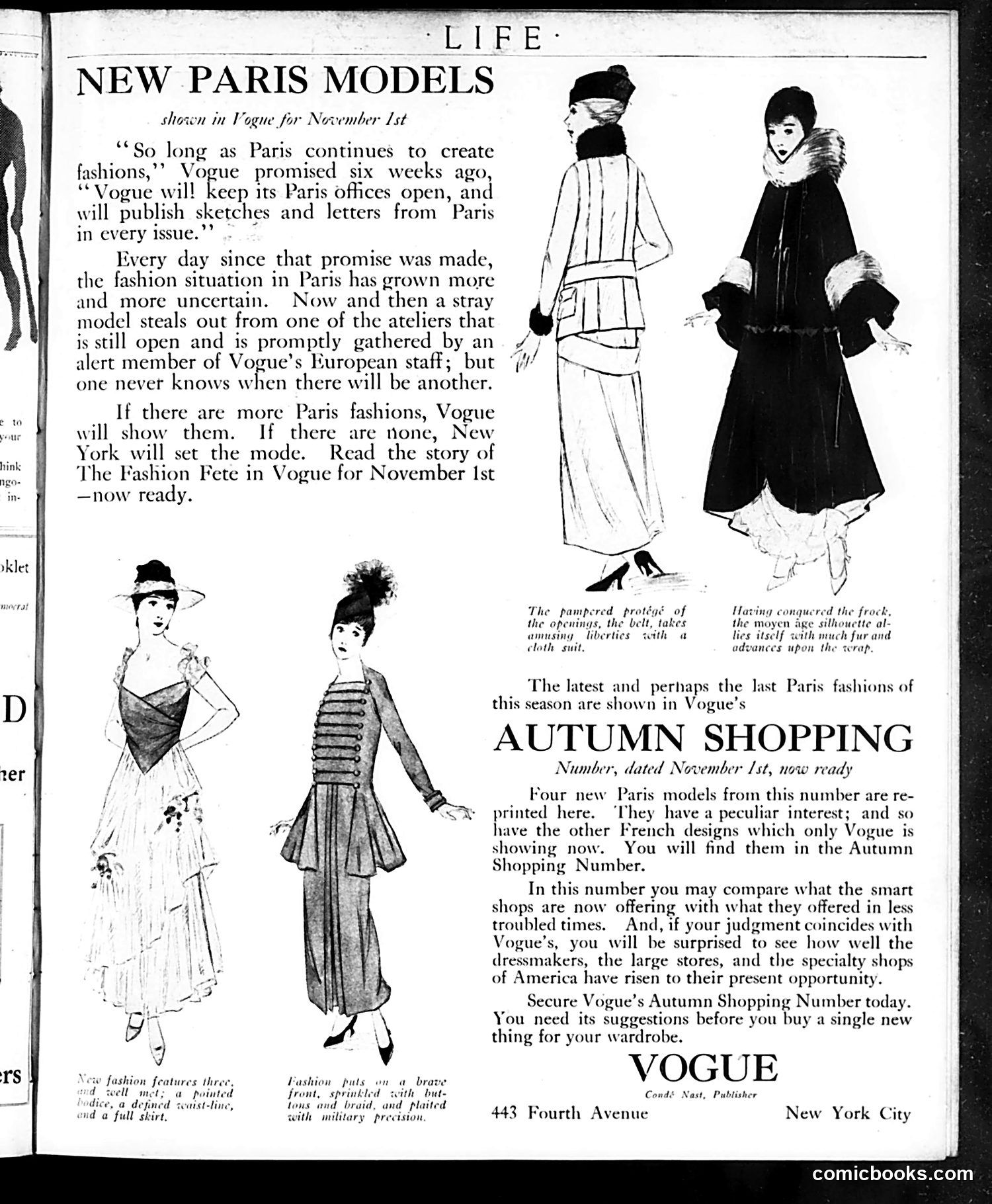
This is primarily a **fashion advertisement** for Vogue magazine, not political satire. However, it contains subtle commentary on World War I's disruption of fashion. The page showcases four Paris fashion sketches for Vogue's November 1st "Autumn Shopping" issue. The accompanying text reveals the context: Vogue had promised six weeks prior to keep reporting on Paris fashions, but the "fashion situation in Paris has grown more and more uncertain." Models "steal out" from ateliers still operating; the implication is that Paris's fashion industry—traditionally Europe's dominant force—is now unstable due to the war. The satire is gentle but pointed: Life/Vogue acknowledges that if Paris stops producing fashions, "New York will set the mode." This signals an unprecedented shift in global fashion authority from Paris to America, presented as an opportunity for American dressmakers and shops to prove themselves during these "troubled times." The sketches display typical 1910s silhouettes: narrow waists, high necklines, and decorative details like fur collars and military-inspired braiding.
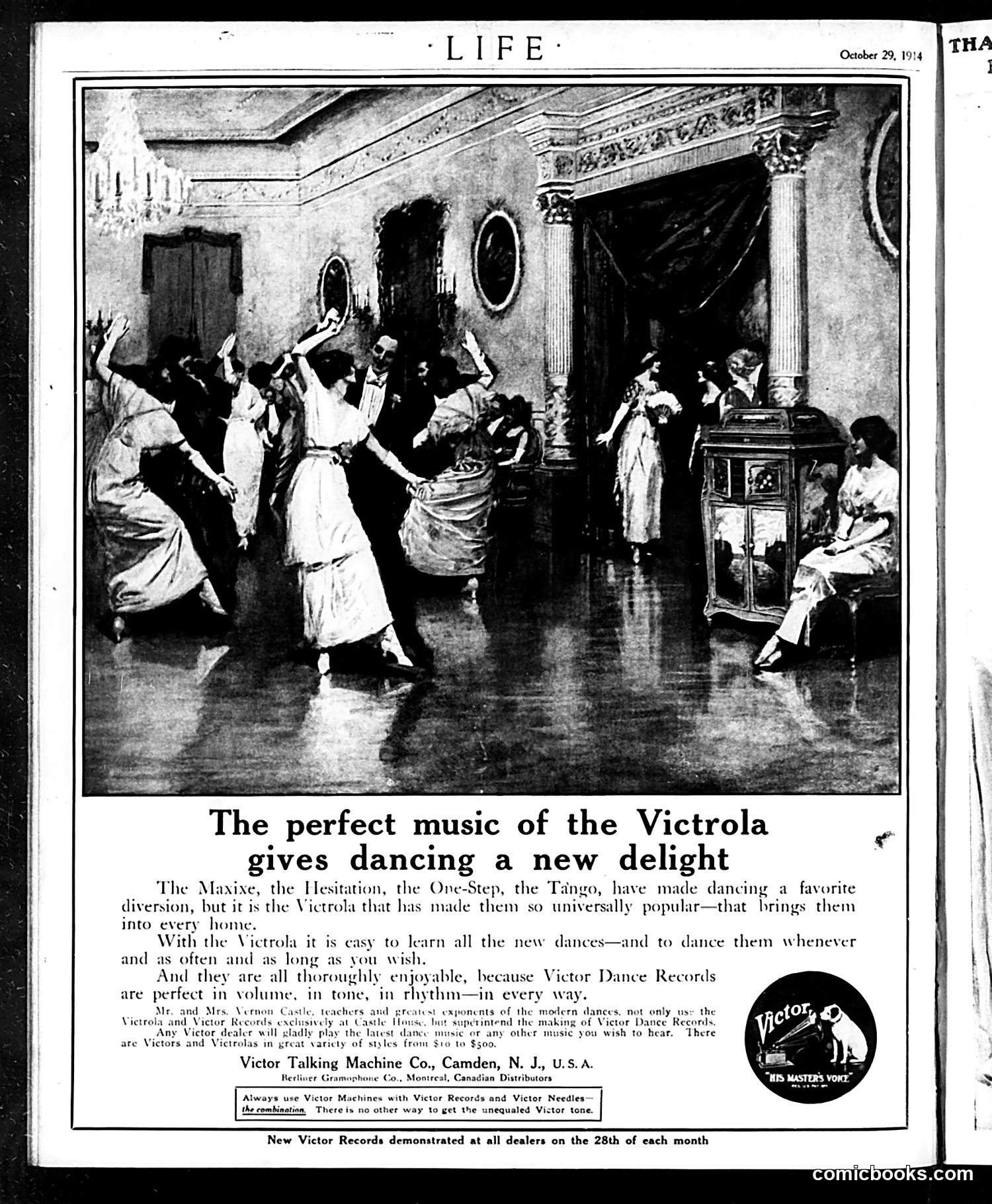
This is **not a political cartoon but a Victrola advertisement** from Life magazine (October 29, 1914). The image shows a fashionable indoor dance party where couples perform modern ballroom dances (the Tango, One-Step, Hesitation, and Maxixe are mentioned). A Victrola phonograph supplies the music. The ad endorses the Victrola by citing **Mr. and Mrs. Vernon Castle**, who were actual celebrity dance instructors and pioneers of modern ballroom dancing in the 1910s. Their endorsement lent prestige and cultural authority to the product. The advertisement's appeal is straightforward: the Victrola makes learning and enjoying fashionable new dances accessible to ordinary homes, not just dance halls. It emphasizes that Victor's dance records are superior in "volume, tone, rhythm"—addressing a real concern for early phonograph users: sound quality. This reflects the Victrola's genuine cultural significance in popularizing social dancing during the Jazz Age.