
Life, 1914-10-29 · page 20 of 44
Life — October 29, 1914 — page 20: what you’re looking at
What you’re looking at
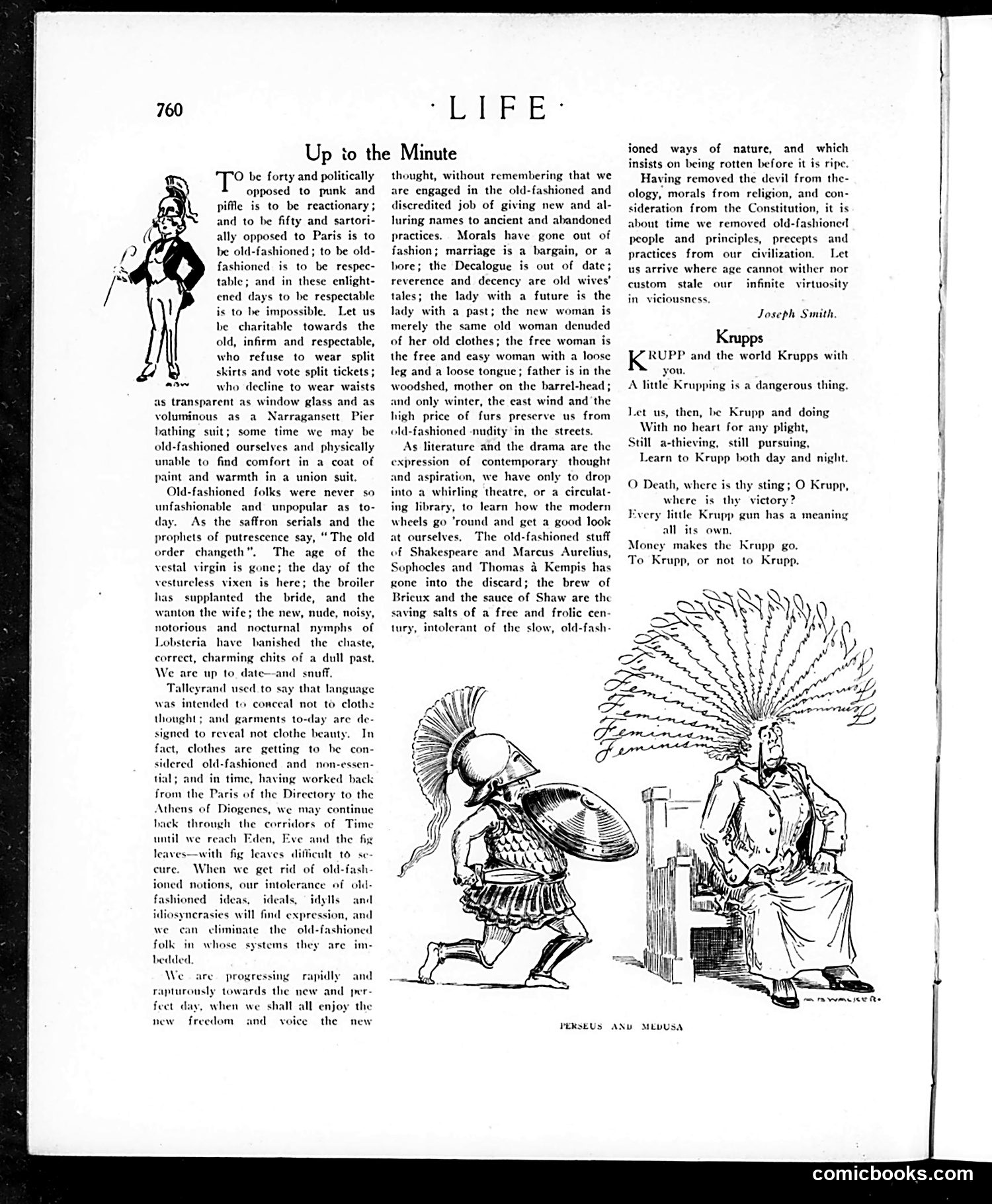
This article mocks modern society's obsession with "progress" and rejection of tradition. The author sarcastically praises the abandonment of old-fashioned morality, modesty, and respect—arguing that contemporary culture foolishly equates being "old" with being "impossible." The satire targets: - **Women's fashion changes**: split skirts, transparent waists, and increasingly minimal clothing (references to the Directory period and ancient Greece) - **Moral decay**: marriage treated as a "bargain," the Decalogue "out of date," reverence abandoned - **Literary modernism**: dismissal of Shakespeare and Marcus Aurelius in favor of playwrights like Shaw and Brieux The piece is fundamentally **conservative criticism**—authored by Joseph Smith, it argues that in discarding tradition, society has removed moral guardrails while calling it freedom. The accompanying illustrations of a woman in modern dress and "Perseus and Medusa" underscore the classical/traditional contrast. The bottom line: Life satirizes those who celebrate "progress" while losing ethical foundations.
📄 Transcribed text from this page (OCR, searchable)
Machine-transcribed from the original scan — historical spelling and the odd misread are preserved.
gCN Le) oe Up io the Minute Te. be forty and politically opposed to punk and Ve pifle is to be reactionary and to be fifty and sartori- ally opposed to Paris is to be old-fashioned ; to be old- fashioned is to be respec- table; and in these enlight- ened days to be respectable 1 is to be impossible. Let us be charitable towards the old, infirm and respectable, who refuse to wear split skirts and vote split tickets; who decline to wear waists as transparent as window glass and as voluminous as a Narragansett Pier lathing suit; some time we may be old-fashioned ourselves and physically unable to find comfort in a coat of paint and warmth in a union suit. Old-fashioned folks were never so unfashionable and unpopular as to- day, As the saffron serials and the prophets of putrescence say, “The old order changeth”. The age of the vestal virgin is gone; the day of the vestureless vixen is here; the broiler has supplanted the bride, and the ton the wife; the new, nude, noi: notorious and nocturnal nymphs of Lobsteria have banished the correct, charming chits of a dull past. We are up to date snuff. Talleyrand used to say that language was intended to conceal not to clothe thought; and garments to-day are de- signed to reveal not clothe beauty. In fact, clothes are getting to be con- sidered old-fashioned and non-essen- tial; and in time, having worked back from the Paris of the Directory to the Athens of Diogenes, we may continue back through the corridors of Time until we reach nd the fig leaves—with fig leaves difficult to se- When we get rid of old ioned notions, our intolerance of fashioned id idiosynerasies w naw chaste, cure. s. ideals, idylls and I find expression, and eliminate the old-fashioned folk in whose systems they are im- we can bedded, We are progressing rapturously towards the new and per- fect day, when we shall all enjoy the new freedom and rapidly and voice the new thought, without remembering that we are engaged in the old-fashioned and discredited job of giving new and al- luring names to ancient and abandoned practices. Morals have gone out of hion; marriage is a bargain, or a bore; the Decalogue is out of date; reverence and decency are old wives’ tales; the lady with a future is the lady with a past; the new woman is merely the same old woman denuded of her old clothes; the free woman is the free and easy woman with a loose leg and a loose tongue; father is in the woodshed, mother on the barrel-head ; and only winter, the east wind and the high price of furs preserve us from old-fashioned ‘nudity in the streets. As literature and the drama are the expression of contemporary thought and aspiration, we have only to drop into a whirling theatre, or a circulat- ing library, to learn how the modern wheels go ‘round and get a good look at ourselves, The old-fashioned stuff of Shakespeare and Marcus Aurelius, Sophocles and Thomas 4 Kempis has gone into the discard; the brew of Brieux and the sauce of Shaw are the ng salts of a free and frolic cen- tury, intolerant of the slow, old-fash- sa PERSEUS joned ways of nature, and which insists on being rotten before it is ripe. Having removed the devil from the- ology, morals from religion, and con- sideration from the Constitution, it is about time we removed old-fashioned people and principles, precepts and practices from our civilization. Let us arrive where age cannot wither nor custom stale our infinite virtuosity in viciousness. Joseph Smith. RUPP and the world Krups with you. A little Krupping is a dangerous thing. Let us, then, be Krupp and doing With no heart for any plight, Still a-thieving, still pursuing, Learn to Krupp both day and night. O Death, where is thy sting; O Krupp, where is thy victory? Every litte Krupp gun has a meaning all its own. Moncey makes the Krupp go. To Krupp, or not to Krupp. AND MEDUSA comicbooks.com