
Life, 1914-10-29 · page 36 of 44
Life — October 29, 1914 — page 36: what you’re looking at
What you’re looking at
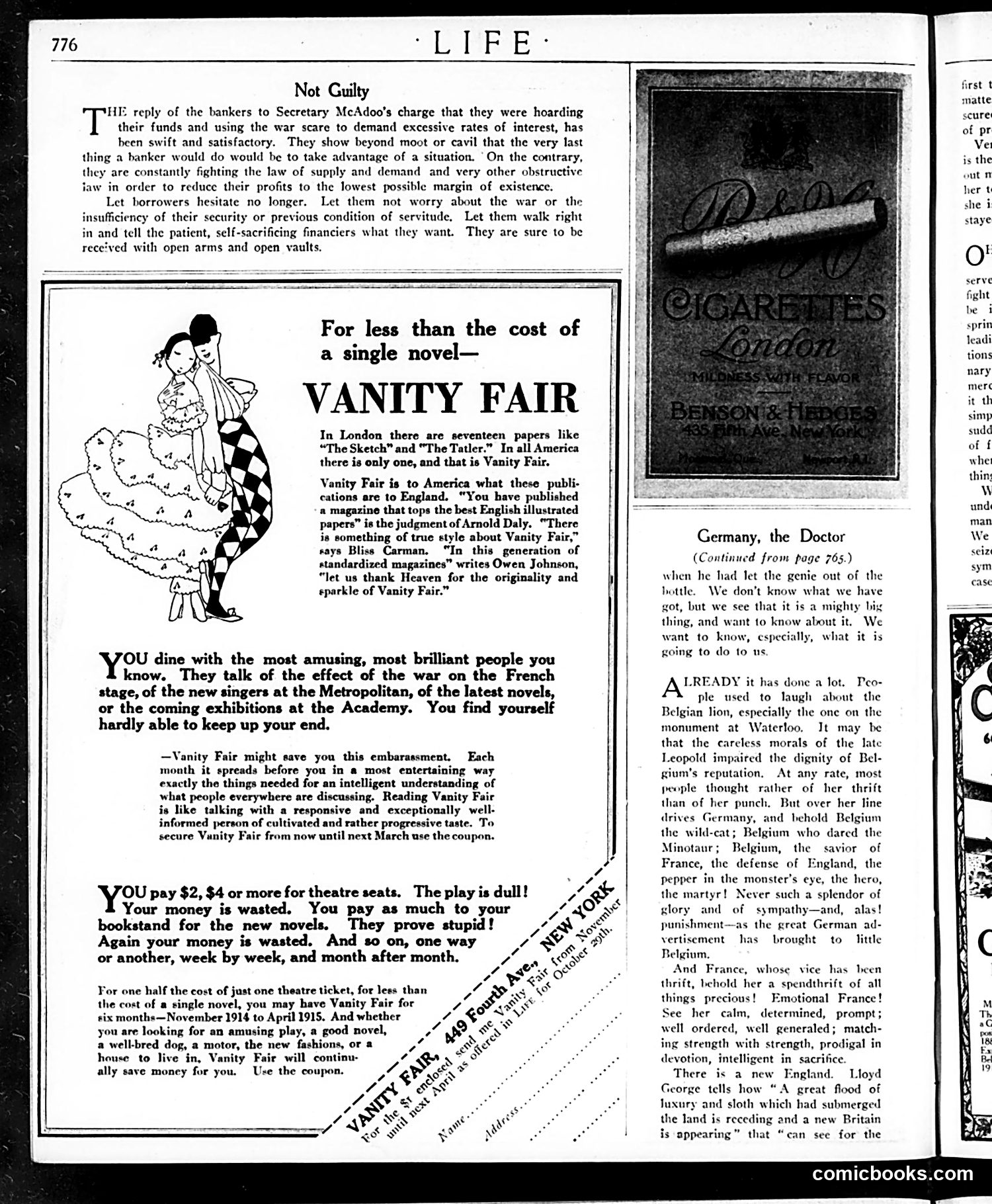
**"Not Guilty" (Top Section):** This is satirical commentary on Secretary of Treasury McAdoo's accusation that bankers were hoarding funds and exploiting wartime fears to raise interest rates. The piece uses heavy irony to defend the bankers—claiming they would *never* exploit a situation and instead sacrifice profits. The sarcasm targets the banking industry's self-serving defense against genuine accusations of profiteering during WWI. **"Vanity Fair" Advertisement (Center):** A straightforward magazine advertisement positioning *Vanity Fair* as America's equivalent to London's sophisticated illustrated papers like *The Sketch*. It markets the publication as essential cultural knowledge for intelligent conversation—discussing theater, opera, novels, and exhibitions. The ad emphasizes cultural refinement while promoting cheap subscription rates. **"Germany, the Doctor" (Right Side):** A continuation discussing Belgium's unexpected military resistance and moral standing during German invasion—contrasting Belgium's previously modest reputation with its newfound heroic status as a defender against Germany and savior of France during WWI.
📄 Transcribed text from this page (OCR, searchable)
Machine-transcribed from the original scan — historical spelling and the odd misread are preserved.
TE TRE Not Guilty HE reply of the bankers to Secretary McAdoo’s charge that they were hoarding their funds and using the war scare to demand excessive rates of interest, has been swift and satisfactory. They show beyond moot or cavil that the very last thing a banker would do would be to take advantage of a situation. On the contrary, they are constantly fighting the law of supply and demand and very other obstructive jaw in order to reduce their profits to the lowest possible margin of existence. Let borrowers hesitate no longer. Let them not worry about the war or the insufficiency of their security or previous condition of servitude, Let them walk right in and tell the patient, self-sacrificing financiers what they want. They are sure to be rece'ved with open arms and open vaults. For less than the cost of a single novel— VANITY FAIR In London there are seventeen papers like “The Sketch” and “The Tatler.” In all America there is only one, and that is Vanity Fair. Vanity Fair is to America what these publi- cations are to England. “You have published a magazine that tops the best English illustrated papers” is the judgmentof Arnold Daly. “There is something of true style about Vanity Fair,” says Bliss Carman. “In this generation of standardized magazines” writes Owen Johnson, “let us thank Heaven for the originality and eparkle of Vanity Fair.” ‘OU dine with the most amusing, most brilliant people you know. They talk of the effect of the war on the French stage, of the new singers at the Metropolitan, of the latest novels, or the coming exhibitions at the Academy. You find yourself hardly able to keep up your end. —Vanity Fair might save you this embarassme month it spreads before you in a most enterta’ exactly the things needed for an intelligent understanding of what people everywhere are discussing. Reading Vanity Fair is like talking with a responsive and exceptionally well- informed person of cultivated and rather progressive taste. To secure Vunity Fair from now until next March use the coupon. ‘OU pay $2, $4 or more for theatre seats. The play is dull! Your money is wasted. You pay as much to your bookstand for the new novels. They prove stupid! Again your money is wasted. 80 on, one way or another, week by week, and month after month. For one half the cost of just one theatre ticket, for less than the cost of a single novel, you may have Vanity Fair for six months—November 1914 to April 1915. And whether you are looking for an amusing play, a good novel, a well-bred dog, a motor, the new fashions, or a house to live in, Vanity Fair will continu- ally save money for you. Use the coupon. Germany, the Doctor (Continued from page 765.) when he had let the genie out of the bottle. We don’t know what we have got, but we see that it is a mighty bix thing, and want to know about it. We want to know, especially, what it is going to do to us. LREADY it has done a lot. Peo- ple used to laugh about the Belgian lion, especially the one on the monument at Waterloo. It may be that the careless morals of the late Leopold impaired the dignity of Bel- gium’s reputation, At any rate, most people thought rather of her thrift than of her punch, But over her line drives Germany, and behold Belgium the wild-cat; Belgium who dared the Minotaur; Belgium, the savior of France, the defense of England, the pepper in the monster’s eye, the hero, the martyr! Never such a splendor of glory and of sympathy—and, alas! punishment s the great German ad- vei ment has brought to little Belgium. And France, whose vice has been thrift, behold her a spendthrift of all things precious! Emotional France! See her calm, determined, prompt; well ordered, well generaled; match- ing strength with strength, prodigal in devotion, intelligent in sacrifice. There is a new England. Lloyd George tells how “A great flood of Juxury and sloth which had submerged the land is receding and a new Britain is appearing” that “can see for the —_— first matte scure of pr Ver is the out n her t she i staye O serve fight be i sprin leadi tions nary mere it th simp sudd of f wher comicbooks.com