
Life, 1914-10-29 · page 26 of 44
Life — October 29, 1914 — page 26: what you’re looking at
What you’re looking at
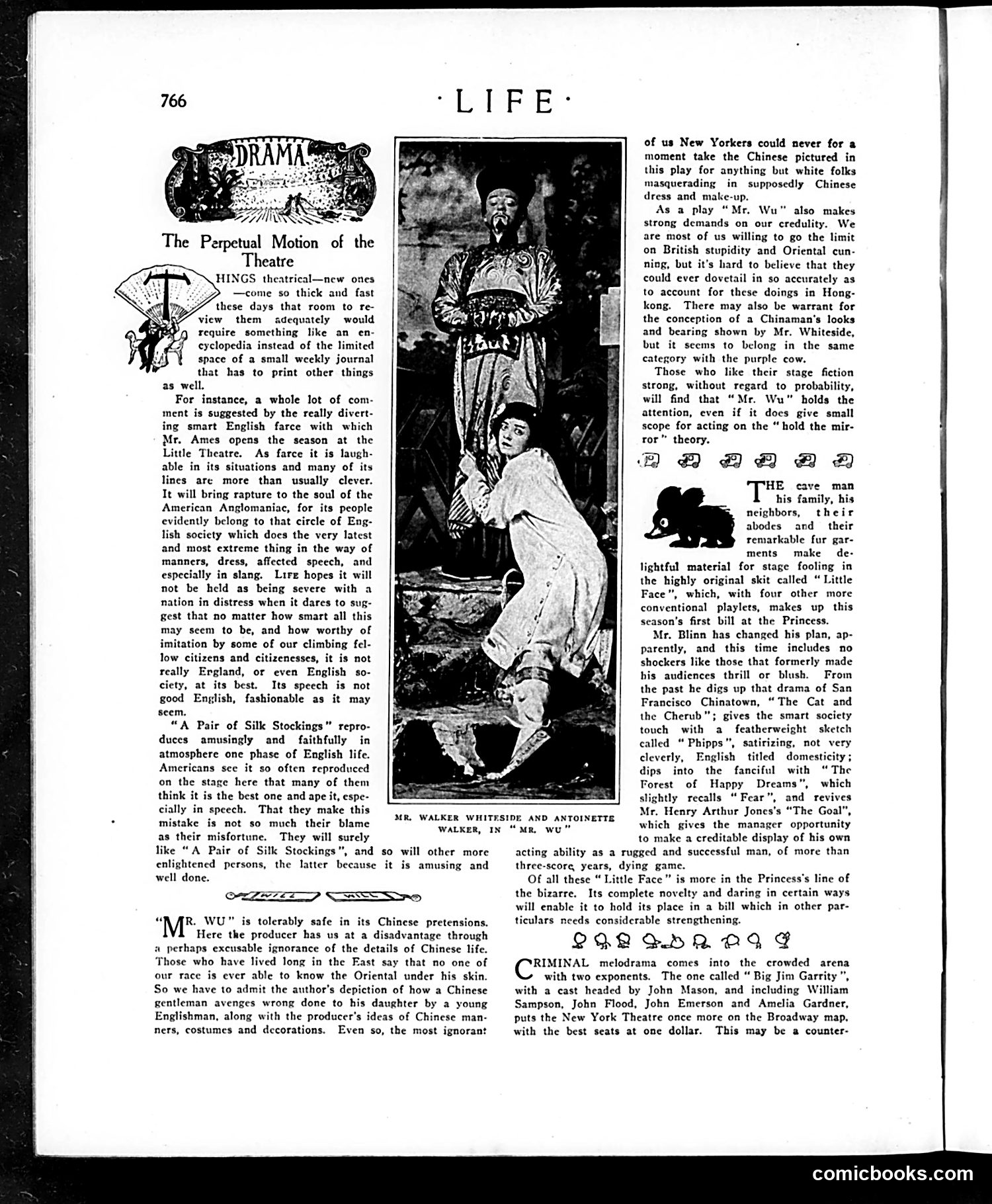
This page reviews three theatrical productions, with particular focus on "Mr. Wu," a play featuring Chinese characters. The satire targets American audiences' casual acceptance of yellowface performance—white actors in "Chinese dress and make-up." The critic acknowledges the play's implausibility but notes audiences willing to suspend disbelief about "British stupidity and Oriental cunning." The photograph shows **Mr. Walker Whiteside and Antoinette Walker** in the production. The piece also reviews two other shows: an English farce at the Little Theatre and "Little Face" at the Princess Theatre (featuring caveman scenes). The underlying satire is gentle but pointed: American theatergoers and producers accept obviously inauthentic racial performances without question, revealing their own ignorance and gullibility. The critic suggests even the author admits outsiders cannot truly understand "the Oriental," yet proceeds with the performance anyway.
📄 Transcribed text from this page (OCR, searchable)
Machine-transcribed from the original scan — historical spelling and the odd misread are preserved.
The Perpetual Motion of the Theatre HINGS theatrical—new ones —come so thick and fast these days that room to re- view them adequately would require something like an en- 4{ cyclopedia instead of the limited space of a small weekly journal that has to print other things as well. For instance, a whole lot of com- ment is suggested by the really divert- ing smart English farce with which Mr. Ames opens the season at the Little Theatre. As farce it is laugh- able in its situations and many of its lines are more than usually clever. It will bring rapture to the soul of the American Anglomaniac, for its people evidently belong to that circle of Eng- lish society which docs the very latest and most extreme thing in the way of manners, dress, affected speech, and especially in slang. Lire hopes it will not be held as being severe with a nation in distress when it dares to sug- gest that no matter how smart all this may seem to be, and how worthy of imitation by some of our climbing fel- low citizens and citizenesses, it is not really Ergland, or even English so- ciety, at its best. Its speech is not good English, fashionable as it may seem. “A Pair of Silk Stockings” repro- duces amusingly and faithfully in atmosphere one phase of English life. Americans see it so often reproduced on the stage here that many of them think it is the best one and ape it, espe- of us New Yorkers could never for a moment take the Chinese pictured in this play for anything but white folks masquerading in supposedly Chinese dress and make-up. As a play “Mr. Wu” also makes strong demands on our credulity. We are most of us willing to go the limit on British stupidity and Oriental cun- ning, but it's hard to believe that they could ever dovetail in so accurately as to account for these doings in Hong- kong. There may also be warrant for the conception of a Chinaman’s looks and bearing shown by Mr. Whiteside, but it seems to belong in the same category with the purple cow. Those who like their stage fiction strong, without regard to probability, will find that “Mr. Wu” holds the attention, even if it docs give small scope for acting on the “hold the mir- ror” theory. HE cave man his family, his neighbors, their abodes and their remarkable fur gar- ments make de- lightful material for stage fooling in the highly original skit called “ Little Face”, which, with four other more conventional playlets, makes up this season’s first bill at the Princess. Mr. Blinn has changed his plan, ap- parently, and this time includes no shockers like those that formerly made his audiences thrill or blush. From the past he digs up that drama of San Francisco Chinatown, “The Cat and the Cherub"; gives the smart society touch with a featherweight sketch called “ Phipps", satirizing, not very cleverly, English titled domesticity ; dips into the fanciful with “ The Forest of Happy Dreams”, which slightly recalls “Fear”, and revive: cially in speech. That they make this mistake is not so much their blame as their misfortune. They will surely like “A Pair of Silk Stockings", and so will other more enlightened persons, the latter because it is amusing and well done. WALKER, OZER TSS = R. WU" is tolerably safe in its Chinese pretensions. Here the producer has us at a disadvantage through x perhaps excusable ignorance of the details of Chinese life. Those who have lived long in the East say that no one of our race is ever able to know the Oriental under his skin. So we have to admit the author's depiction of how a Chinese gentleman avenges wrong done to his daughter by a young Englishman, along with the producer's ideas of Chinese man- ners, costumes and decorations. Even so, the most ignorant MR, WALKER WHITRSIDE AND IN Mr. Henry Arthur Jones's “The Goal which gives the manager opportunity to make a creditable display of his own acting ability as a rugged and successful man, of more than three-score, years, dying game. Of all these “ Little Face” is more in the Princess's line of the bizarre. Its complete novelty and daring in certain ways will enable it to hold its place in a bill which in other par- ticulars needs considerable strengthening. OBk® e529 ¢ RIMINAL melodrama comes into the crowded arena with two exponents. The one called “ Big Jim Garrity ", with a cast headed by John Mason, and including William Sampson, John Flood, John Emerson and Amelia Gardner, puts the New York Theatre once more on the Broadway map. with the best seats at one dollar. This may be a counter- OINETTE, “MR, wu comicbooks.com