
Life, 1914-10-29 · page 25 of 44
Life — October 29, 1914 — page 25: what you’re looking at
What you’re looking at
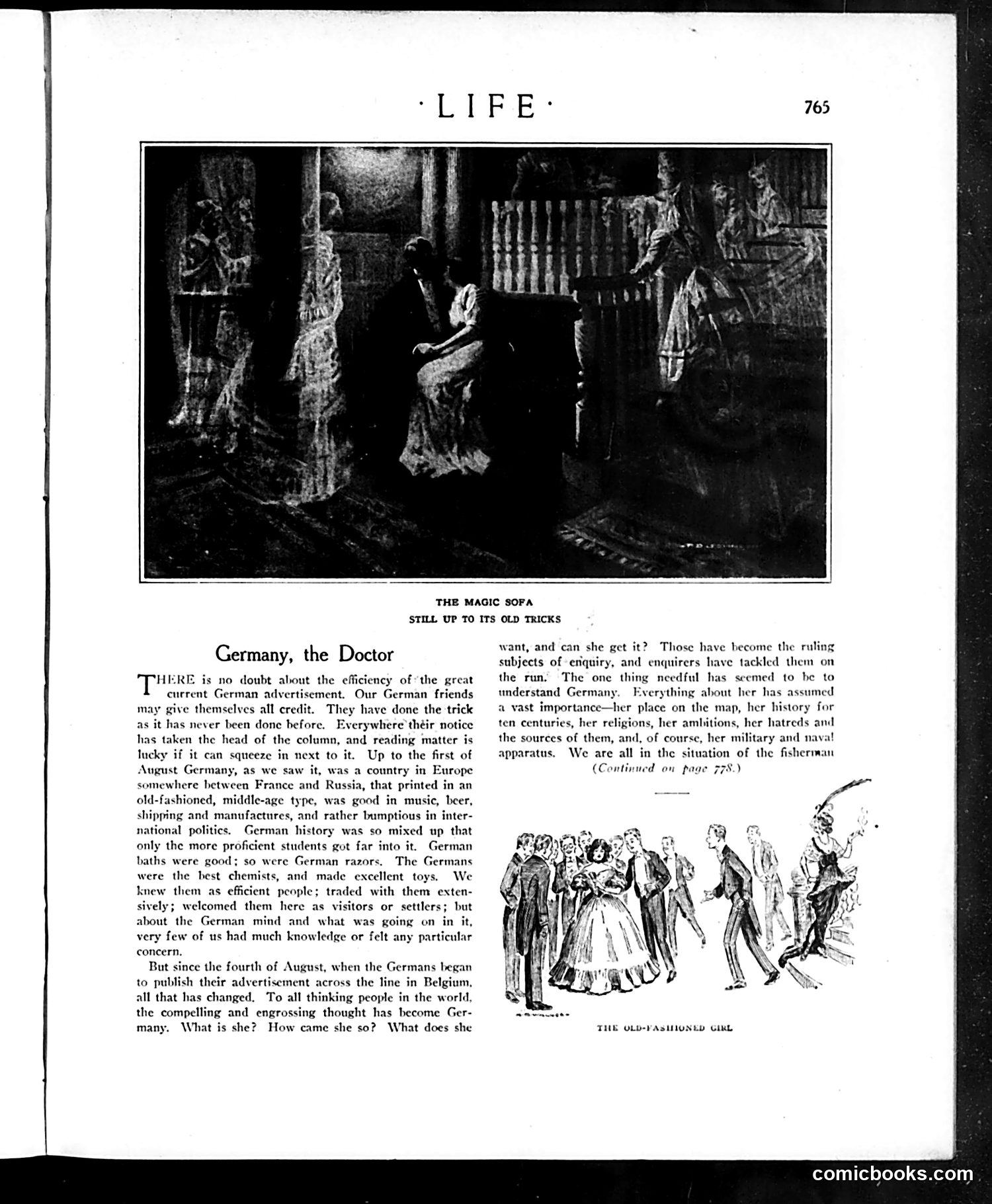
This article from Life magazine, published shortly after August 4, 1914 (when Germany invaded Belgium), satirizes the sudden shift in American public attention toward Germany during WWI's outbreak. **The satire's point:** Before the invasion, Americans viewed Germany neutrally—as a source of good beer, music, chemicals, and toys, with efficient people but a confusing history that few Americans bothered understanding. The invasion was Germany's unfortunate "advertisement" that forced the world to urgently study her intentions, history, religions, and military might. **The metaphor:** Germany is presented as a "doctor" whose advertising campaign (the invasion) paradoxically made everyone intensely focused on diagnosing what she actually is and what she wants—reversing prior indifference into compulsive inquiry. The accompanying illustration "The Magic Sofa" appears to show pre-war social frivolity contrasted with wartime concerns, while "The Old-Fashioned Girl" illustration likely represents outdated attitudes being overtaken by urgent new realities.
📄 Transcribed text from this page (OCR, searchable)
Machine-transcribed from the original scan — historical spelling and the odd misread are preserved.
THE MAGIC SOFA STILL UP TO ITS OLD TRICKS Germany, the Doctor HERE is no doubt about the efficiency of the great current German advertisement. Our German friends y give themselves all credit. have done the trick it has never been done before. rywhere théir notice has taken the head of the column, and reading matter is lucky if it can squeeze in next to it. Up to the first of August Germany, as we saw it, was a country in Europe somewhere between France and Russia, that printed in an old-fashioned, middle-age type, was good in music, beer, shipping and manufactures, and rather bumptious in inter- national politics. German history was so mixed up that only the more proficient students got far into it. German baths were good; so were German razors. The Germans were the best chemists, and made excellent toys. We knew them as efficient people; traded with them exten- sively; welcomed them here as visitors or settlers; but about the German mind and what was going on in it, very few of us had much knowledge or felt any particular concern, But since the fourth of August, when the Germans began to publish their advertisement across the line in Belgium, all that has changed. To all thinking people in the world, the compelling and engrossing thought has become Ger- many. What is she? How came she so? What does she want, and can she get it?) Those have become the ruling subjects of eriquiry, and enquirers have tackled them on the run. The one thing needful has scemed to be to understand Germany, Everything about her has assumed a vast importance—her place on the map, her history for ten centuries, her religions, her ambitions, her hatreds and the sources of them, and, of course, her military and naval apparatus. We are all in the situation of the fisherman (Continued on page 778.) THE OLD-PASMIONED GIRL comicbooks.com