
Life, 1914-10-29 · page 30 of 44
Life — October 29, 1914 — page 30: what you’re looking at
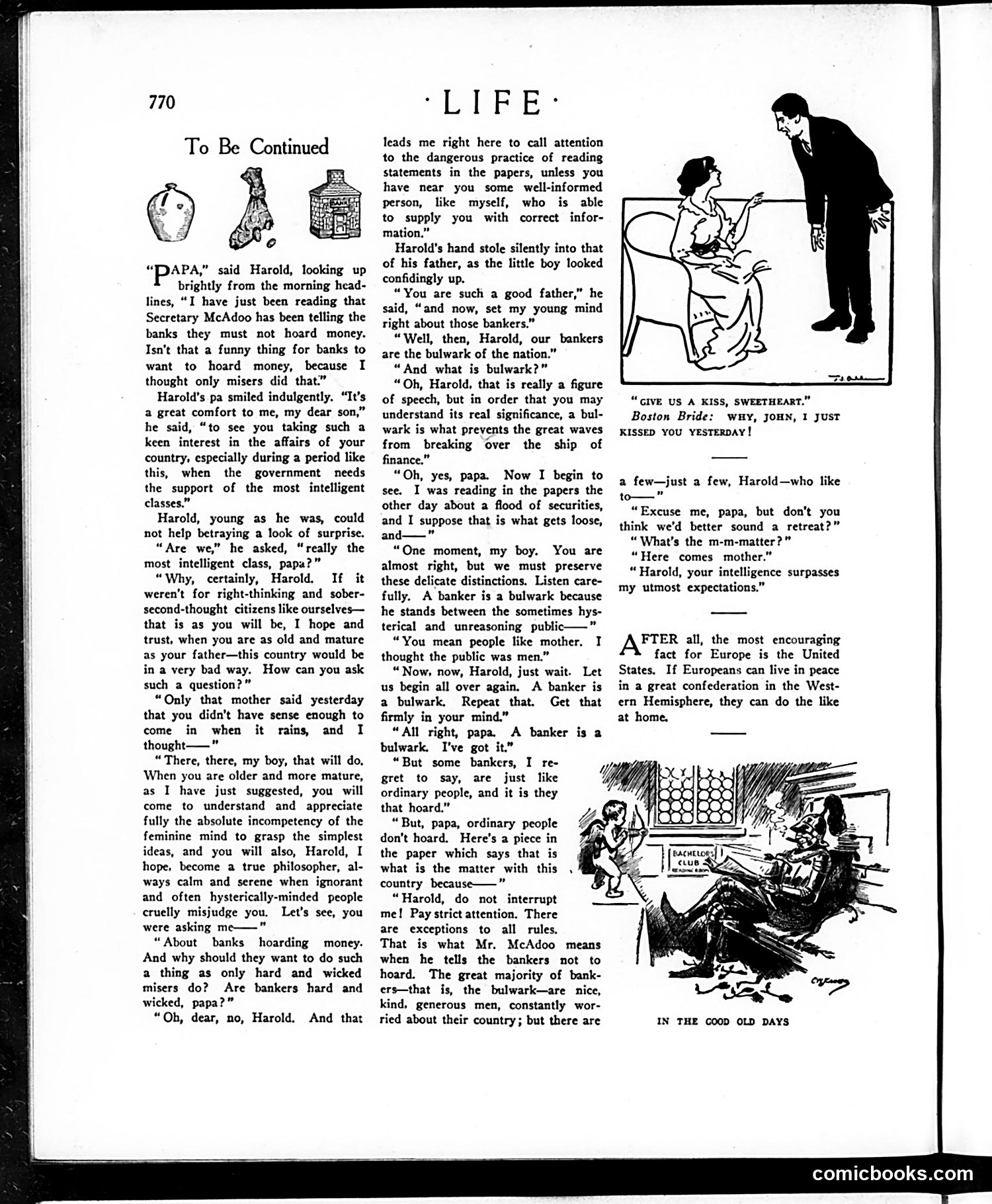
What you’re looking at
This page satirizes parental hypocrisy and the rationalization of banker privilege during what appears to be the World War I era (Secretary William McAdoo is mentioned as a real historical figure who served under Wilson). The main cartoon shows a father instructing his naive son Harold about banks and banking. The satire works through the father's circular logic: when Harold innocently points out contradictions—that his father lacks "sense enough to come in when it rains," or that ordinary people don't hoard—the father dismisses women's intelligence and redefines terms to protect bankers from scrutiny. The joke targets how the educated upper class uses sophisticated language and special pleading to shield financial elites from criticism. Harold's straightforward reasoning exposes the absurdity: bankers hoarding money should be condemned the same as "misers," yet the father insists bankers are noble "bulwarks" of the nation. The satire mocks how parents (and society) teach children to accept class-based double standards rather than consistent moral principles.
📄 Transcribed text from this page (OCR, searchable)
Machine-transcribed from the original scan — historical spelling and the odd misread are preserved.
770 To Be Continued “DAPA,” said Harold, looking up brightly from the morning hcad- lines, “I have just been reading that Secretary McAdoo has been telling the banks they must not hoard money. Isn't that a funny thing for banks to want to hoard money, because I thought only misers did that.” Harold’s pa smiled indulgently. “It's a great comfort to me, my dear son,” he said, “to see you taking such a keen interest in the affairs of your country, especially during a period like this, when the government needs the support of the most intelligent classes.” Harold, young as he was, could not help betraying a look of surprise. “Are we,” he asked, “really the most intelligent class, papa?” “Why, certainly, Harold. If it weren't for right-thinking and sober- second-thought citizens like ourselves— that is as you will be, I hope and trust, when you are as old and mature as your father—this country would be in a very bad way. How can you ask such a question?” “Only that mother said yesterday that you didn’t have sense enough to come in when it rains, and I thought——” “There, there, my boy, that will do, When you are older and more mature, as I have just suggested, you will come to understand and appreciate fully the absolute incompetency of the feminine mind to grasp the simplest ideas, and you will also, Harold, I hope, become a true philosopher, al- ways calm and serene when ignorant and often hysterically-minded people cruelly misjudge you. Let's see, you were asking me—” “About banks hoarding money. And why should they want to do such a thing as only hard and wicked misers do? Are bankers hard and wicked, papa?” “Oh, dear, no, Harold. And that “LDF E * leads me right here to call attention to the dangerous practice of reading statements in the papers, unless you have near you some well-informed person, like myself, who is able to supply you with correct infor- mation.” Harold’s hand stole silently into that of his father, as the little boy looked confidingly up. “You are such a good father,” he said, “and now, set my young mind right about those bankers.” “Well, then, Harold, our bankers are the bulwark of the nation.” “And what is bulwark?” “Oh, Harold, that is really a figure of speech, but in order that you may understand its real significance, a bul- wark is what prevents the great waves from breaking over the ship of finance.” “Oh, yes, papa. Now I begin to see. I was reading in the papers the other day about a flood of securities, and I suppose that is what gets loose, and——" “One moment, my boy, You are almost right, but we must preserve these delicate distinctions. Listen care- fully. A banker is a bulwark because he stands between the sometimes hys- terical and unreasoning public—” “You mean people like mother. I thought the public was men.” “Now, now, Harold, just wait. Let us begin all over again. A banker is a bulwark. Repeat that. Get that firmly in your mind.” “All right, papa) A banker is a bulwark. I've got it.” “But some bankers, I re- gret to say, are just like ordinary people, and it is they that hoard,” “But, papa, ordinary people don’t hoard. Here's a piece in the paper which says that is what is the matter with this country because——” “Harold, do not interrupt me! Pay strict attention. There are exceptions to all rules. That is what Mr. McAdoo means when he tells the bankers not to hoard. The great majority of bank- ers—that is, the bulwark—are nice, kind, generous men, constantly wor- ried about their country; but there are “GIVE US A KISS, SWEETHEART.” Boston Bride: wy, JOHN, I JusT KISSED YOU YESTERDAY! a few—just a few, Harold—who like to=—" “Excuse me, papa, but don't you think we'd better sound a retreat?” “What's the m-m-matter?” “Here comes mother.” “Harold, your intelligence surpasses my utmost expectations,” FTER all, the most encouraging fact for Europe is the United States, If Europeans can live in peace in a great confederation in the West- ern Hemisphere, they can do the like at home, IN THE COOD OLD DAYS comicbooks.com