
A complete issue · 44 pages · 1914
Life — March 19, 1914
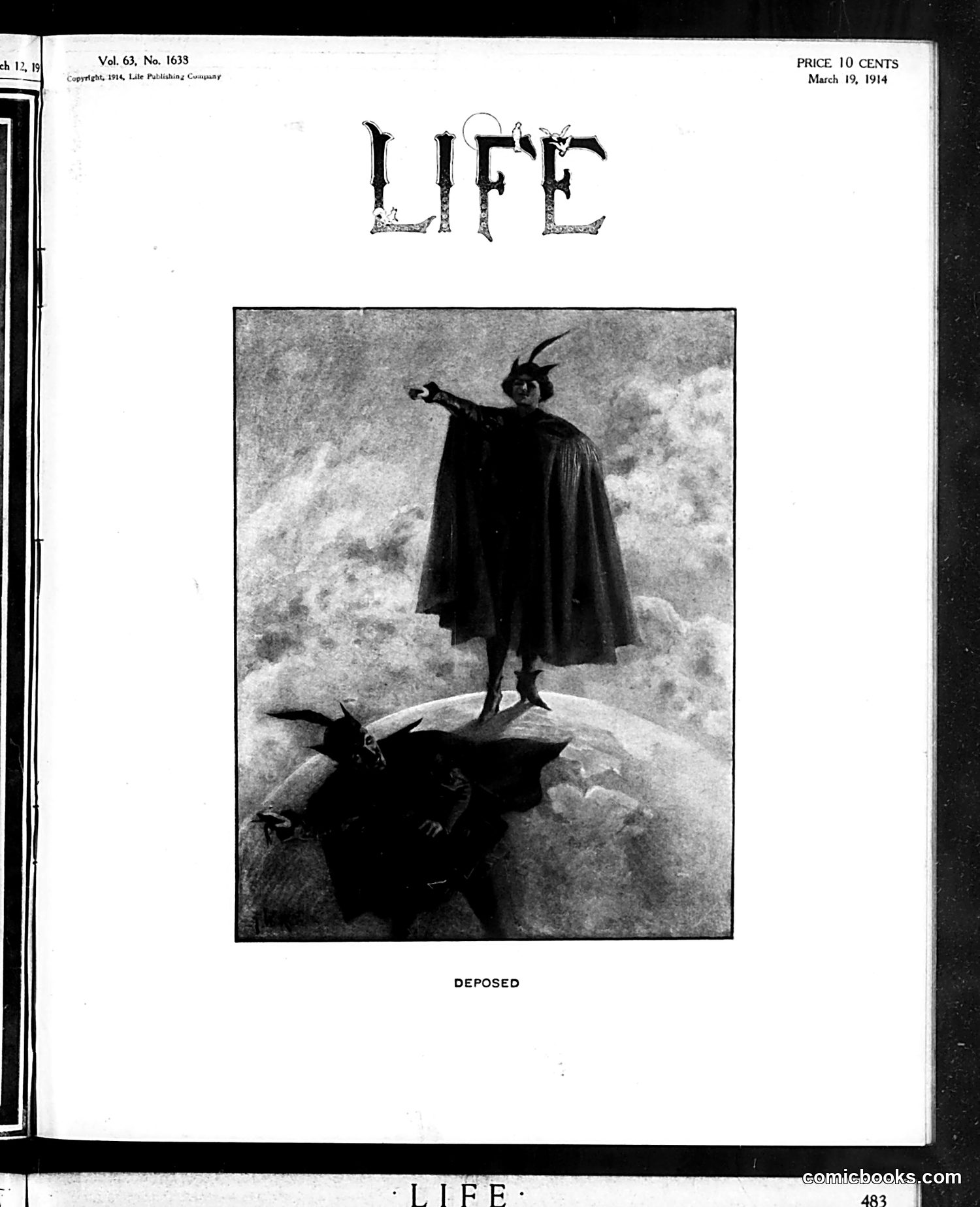
This cover depicts a dramatic allegorical scene titled "DEPOSED." A figure in a dark cape and horned headdress stands triumphantly atop a fallen devil or demon creature, pointing outward in a commanding gesture against a cloudy sky. The imagery appears to reference a contemporary political victory or moral triumph, likely related to progressive reform movements of the 1910s era. The horned figure being defeated suggests evil or corruption vanquished. However, **without additional context about specific 1914 events**, the exact target of this satire is unclear—it could reference labor disputes, political upheaval, or anti-corruption efforts typical of the Progressive Era. The allegorical style was common in *Life*'s political commentary of this period.
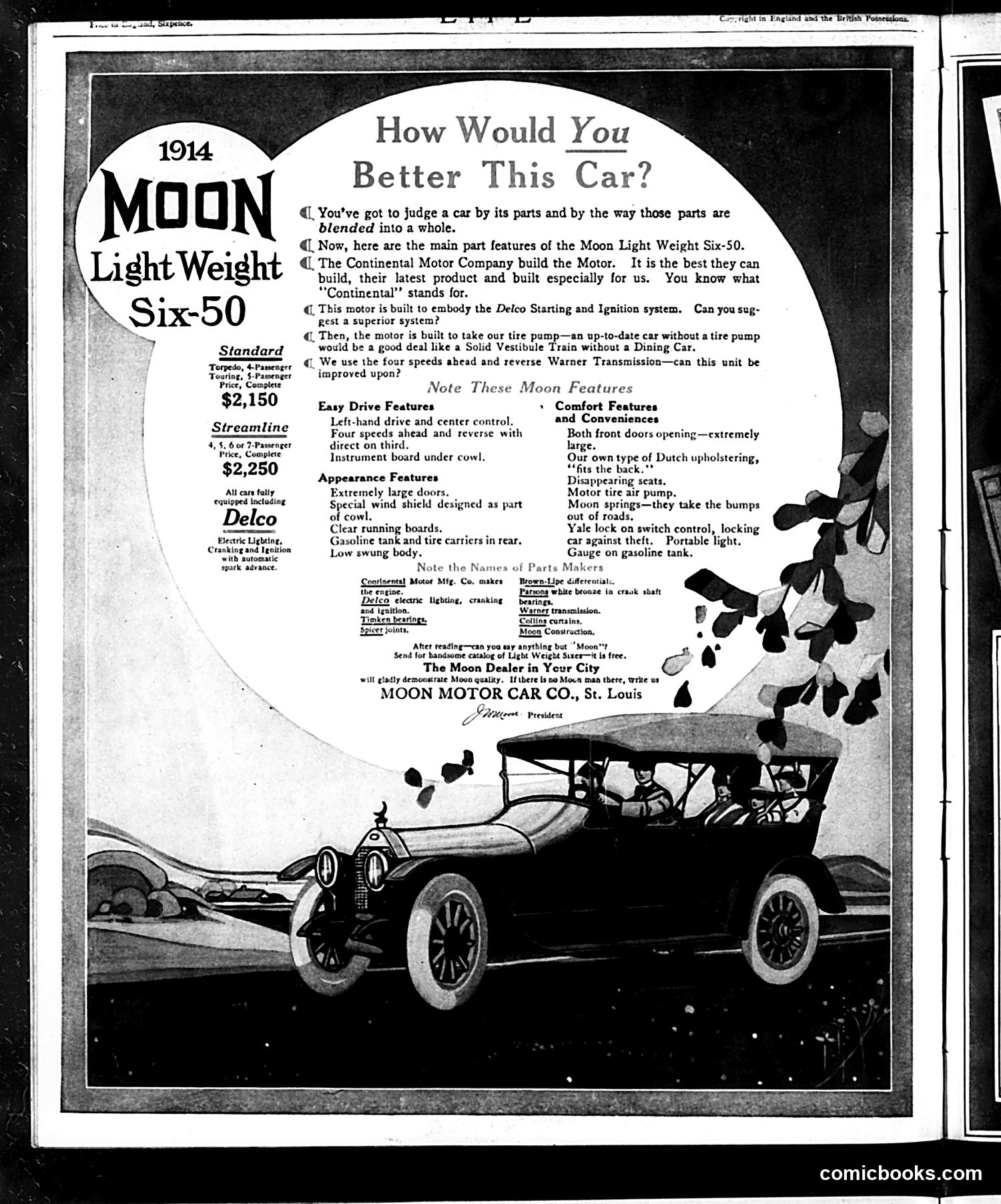
This is **not a political cartoon or satire**—it's a straightforward automobile advertisement for the 1914 Moon Light Weight Six-50 car, manufactured by Moon Motor Car Company in St. Louis. The ad uses a rhetorical device ("How Would You Better This Car?") to highlight the vehicle's features and quality components. It emphasizes the Continental motor, Delco electrical system, Warner transmission, and various comfort features like Dutch upholstery and disappearing seats. The illustration shows the car in profile with stylized leaves blowing from its exhaust—a visual metaphor suggesting speed and performance. This is period marketing copy typical of early automotive advertising, listing mechanical specifications and amenities to appeal to potential buyers.
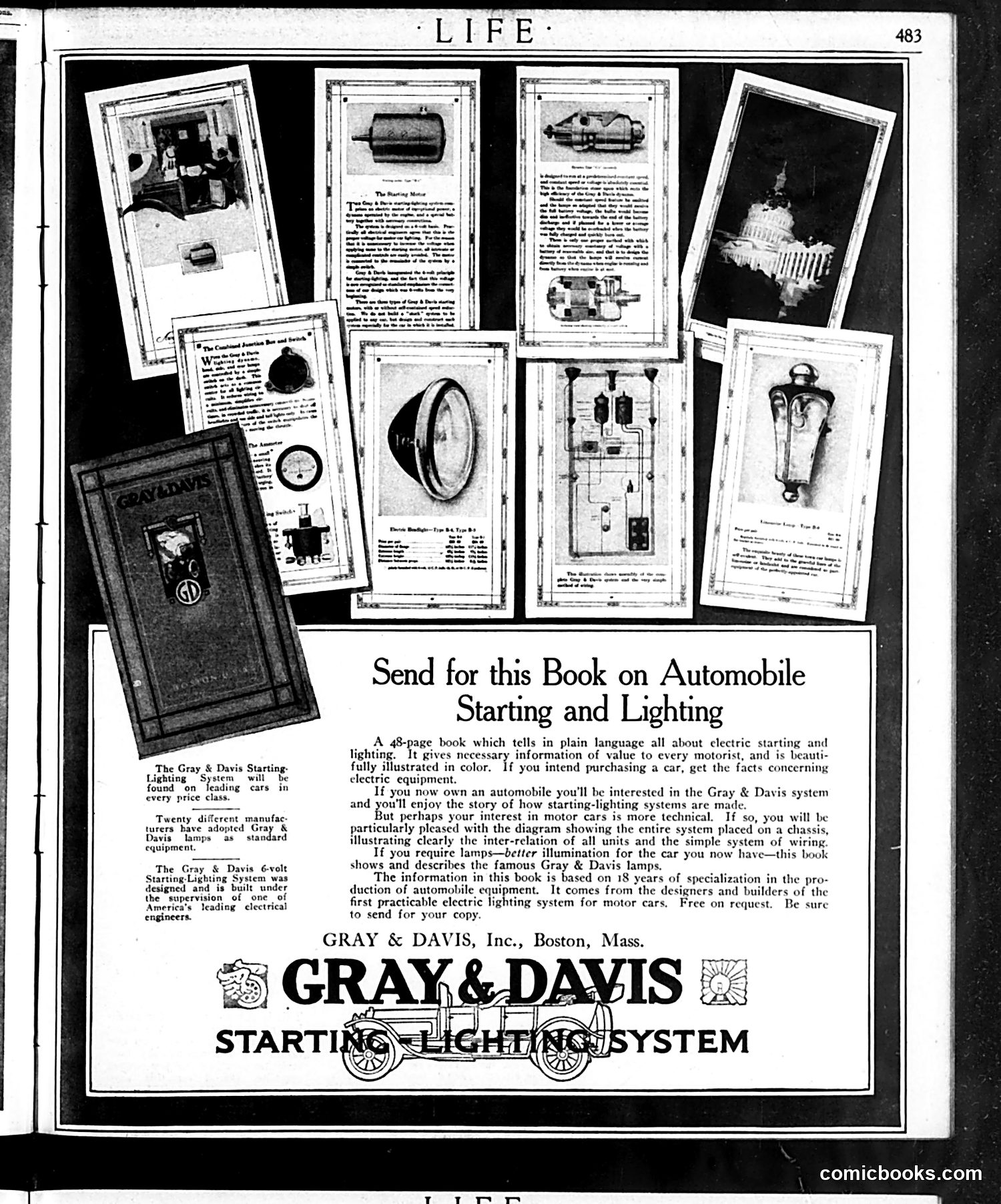
This page is **primarily an advertisement**, not editorial content or satire. It promotes the Gray & Davis Starting-Lighting System for automobiles. The ad displays a 48-page instructional book about electric starting and lighting systems, marketed to car owners and potential buyers. The copy emphasizes that the book explains complex automotive electrical systems in "plain language" with diagrams and illustrations. Gray & Davis positioned themselves as innovators—the text notes they produced "the first practicable electric lighting system for motor cars" and that their system was adopted by "leading cars in every price class." This reflects early 1900s automotive marketing, when electric starting was still a relatively new technology requiring consumer education and brand differentiation.
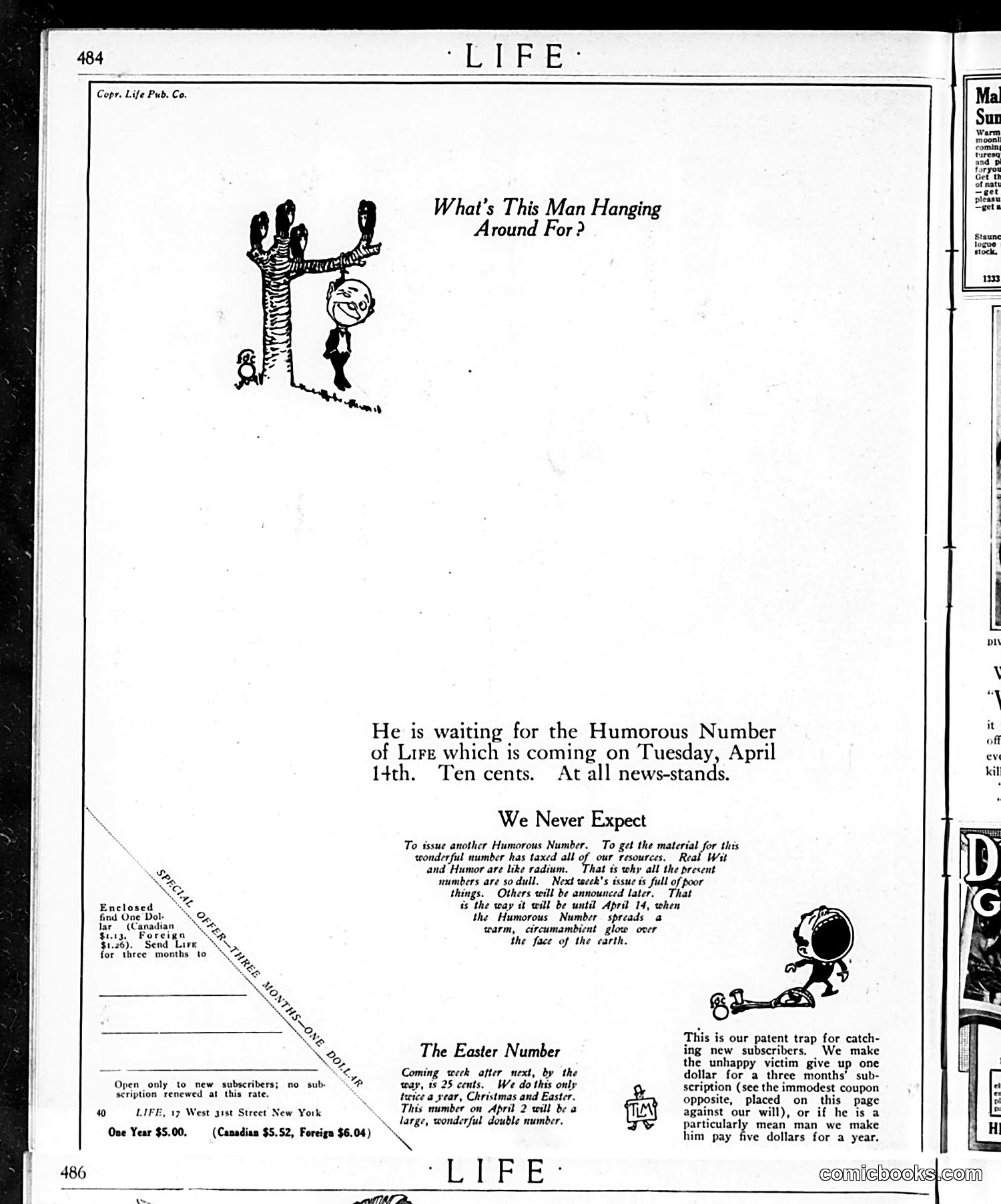
This page from *Life* magazine is primarily **advertising and promotional content** rather than political satire. The main cartoon shows a small figure clinging to a tall pole, with the caption "What's This Man Hanging Around For?" The answer appears below: he's waiting for the "Humorous Number of Life which is coming on Tuesday, April 14th. Ten cents." The text "We Never Expect" then promotes an upcoming Easter Number issue (April 22), describing it as a "large, wonderful double number." The bottom sections contain subscription offers and promotional language about *Life*'s content—describing humor and satire as essential like "radium." **This is essentially a house advertisement**, promoting *Life*'s upcoming special issues to potential subscribers rather than containing editorial satire or political commentary.
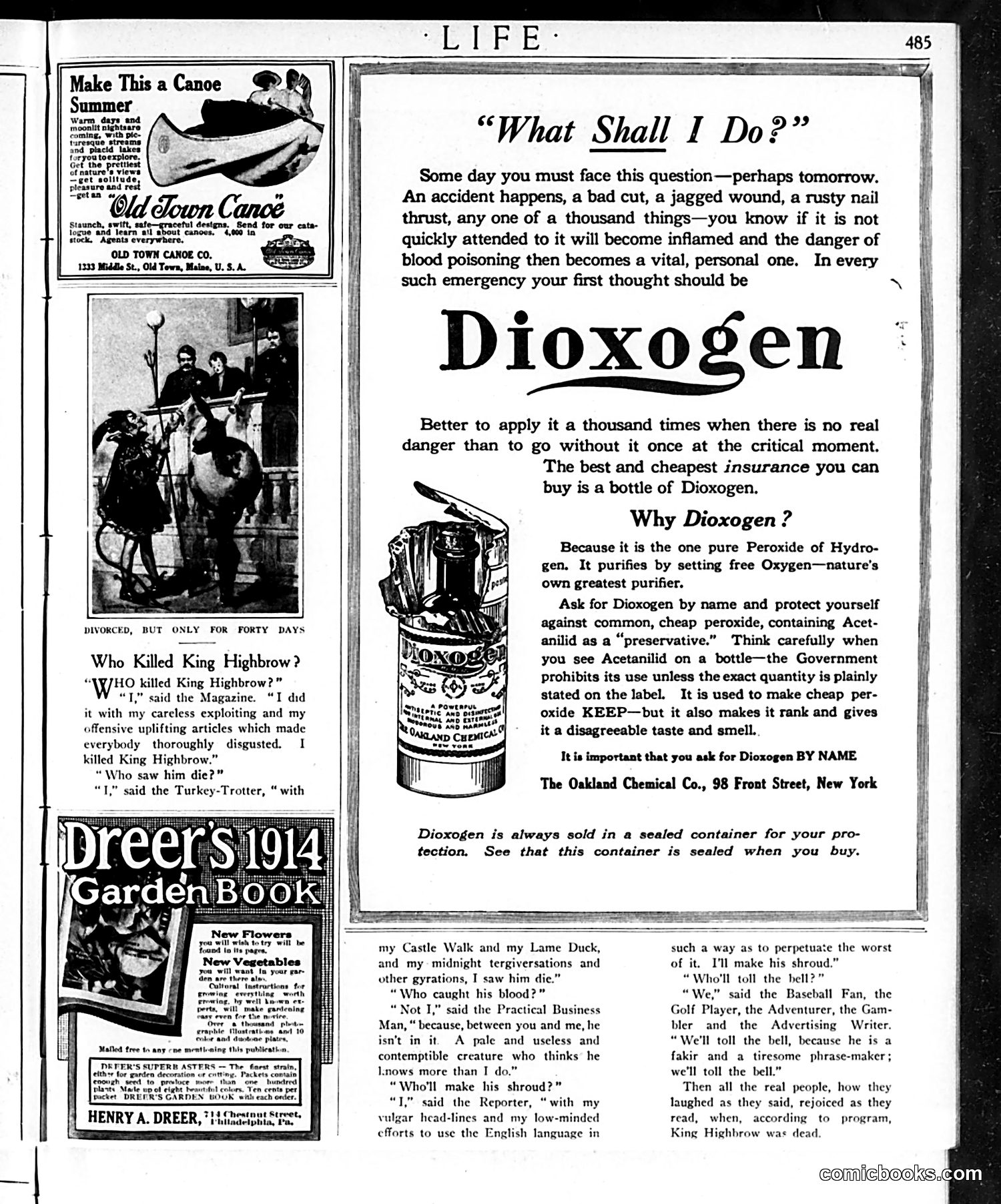
This page is primarily **advertising**, not political satire. The main content is a full-page advertisement for Dioxogen (hydrogen peroxide) by the Oakland Chemical Co., emphasizing it as a first-aid antiseptic for wounds and injuries. The left sidebar contains smaller ads: an Old Town Canoe advertisement, Dreer's Garden Book, and Henry A. Dreer seeds. Below the canoe ad is a brief satirical item titled "Who Killed King Highbrow?" featuring cartoon characters (a Magazine, Turkey-Trotter, Practical Business Man, Reporter, and others) each claiming responsibility for killing "King Highbrow" through various means—careless articles, vulgarity, and lowbrow content. This appears to be social commentary on the decline of highbrow culture, though the specific historical context is unclear.
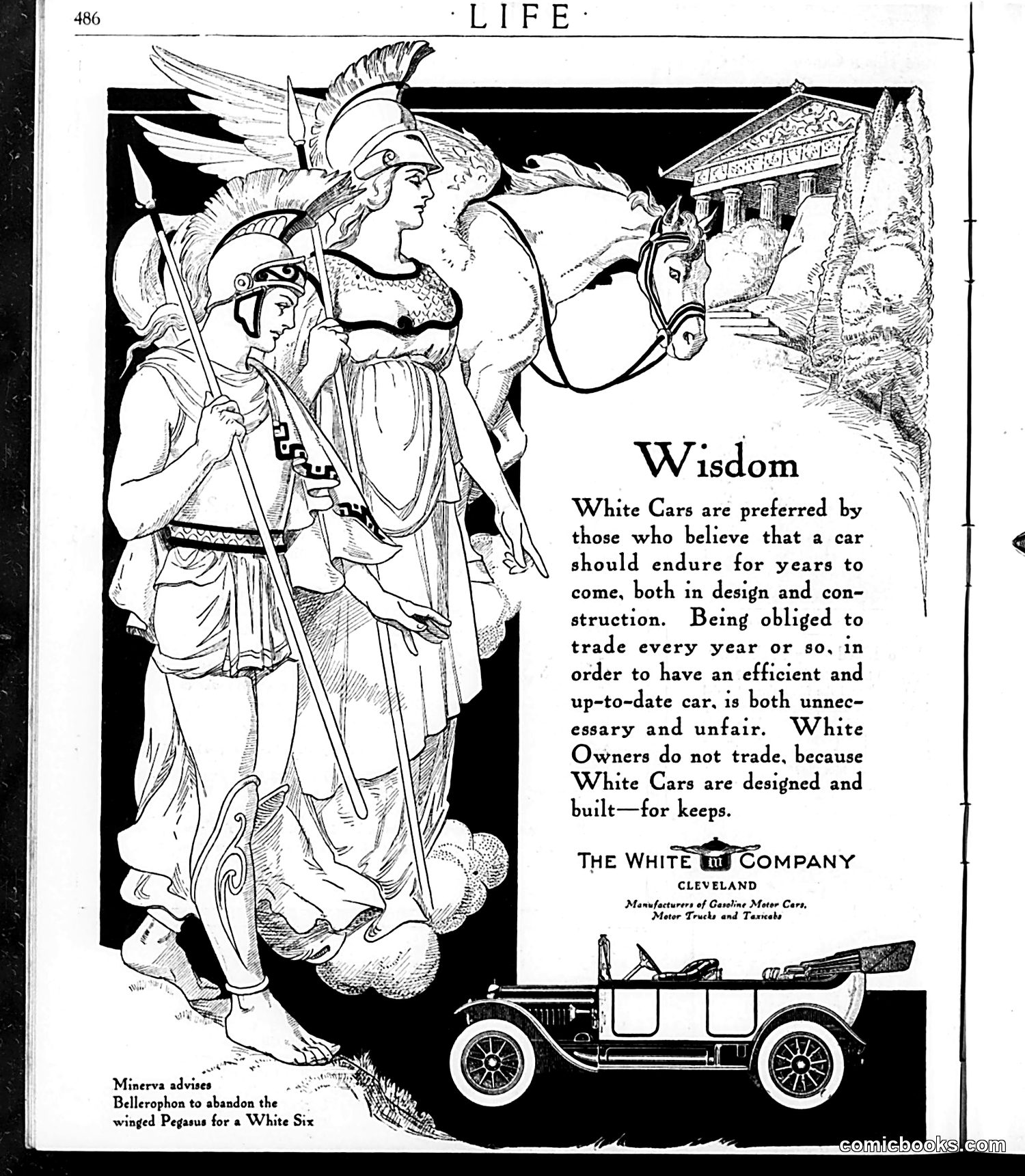
This is primarily a **White Motor Company advertisement**, not political satire. The classical imagery—Minerva (Roman goddess of wisdom) with a winged Pegasus and a smaller armored figure—serves as brand messaging rather than commentary. The "Wisdom" headline argues that White Cars represent superior durability and design, making frequent trading unnecessary. The ad contrasts this favorably against competitors' planned obsolescence—the pressure to buy new models annually. The classical allusion to Minerva "advising Bellerophon to abandon the winged Pegasus for a White Six" is a mythological pun suggesting White vehicles are more practical than fantastical alternatives. This reflects early automotive marketing, emphasizing reliability and longevity as selling points during the industry's competitive early decades.
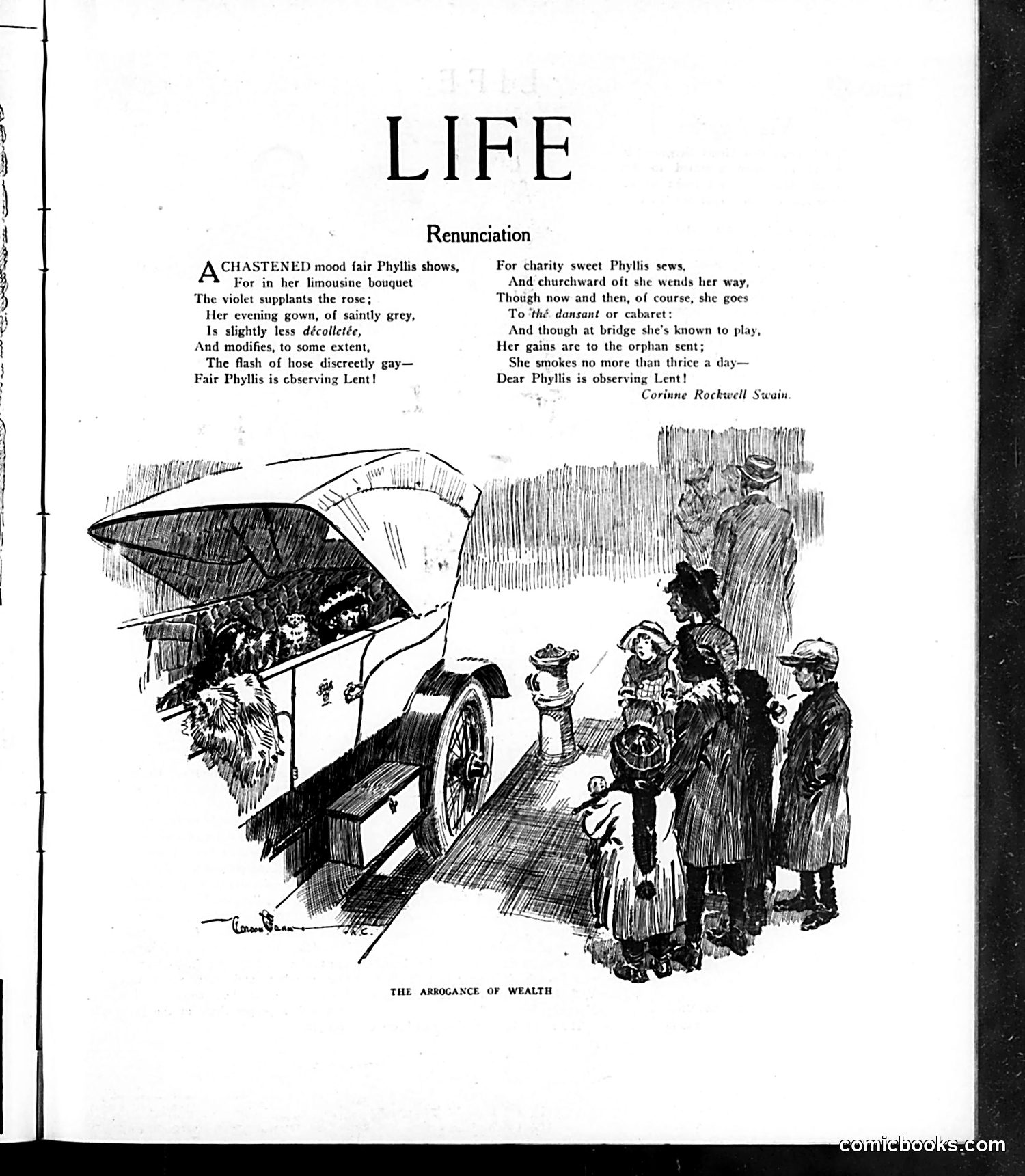
This page satirizes wealthy philanthropy through the character "Phyllis," depicted in the poem by Corinne Rockwell Swain. The satire is biting: Phyllis performs charity work while maintaining her privileged lifestyle—she observes Lent, donates to orphans, and limits smoking to three cigarettes daily, all while riding in a luxury limousine. The accompanying illustration titled "The Arrogance of Wealth" reinforces this message, showing an elegant motorcar and well-dressed figures on a street. The satire criticizes how the wealthy use modest charitable gestures and religious observance as cover for their fundamental self-interest and class superiority. Their "renunciation" is performative rather than genuine sacrifice.
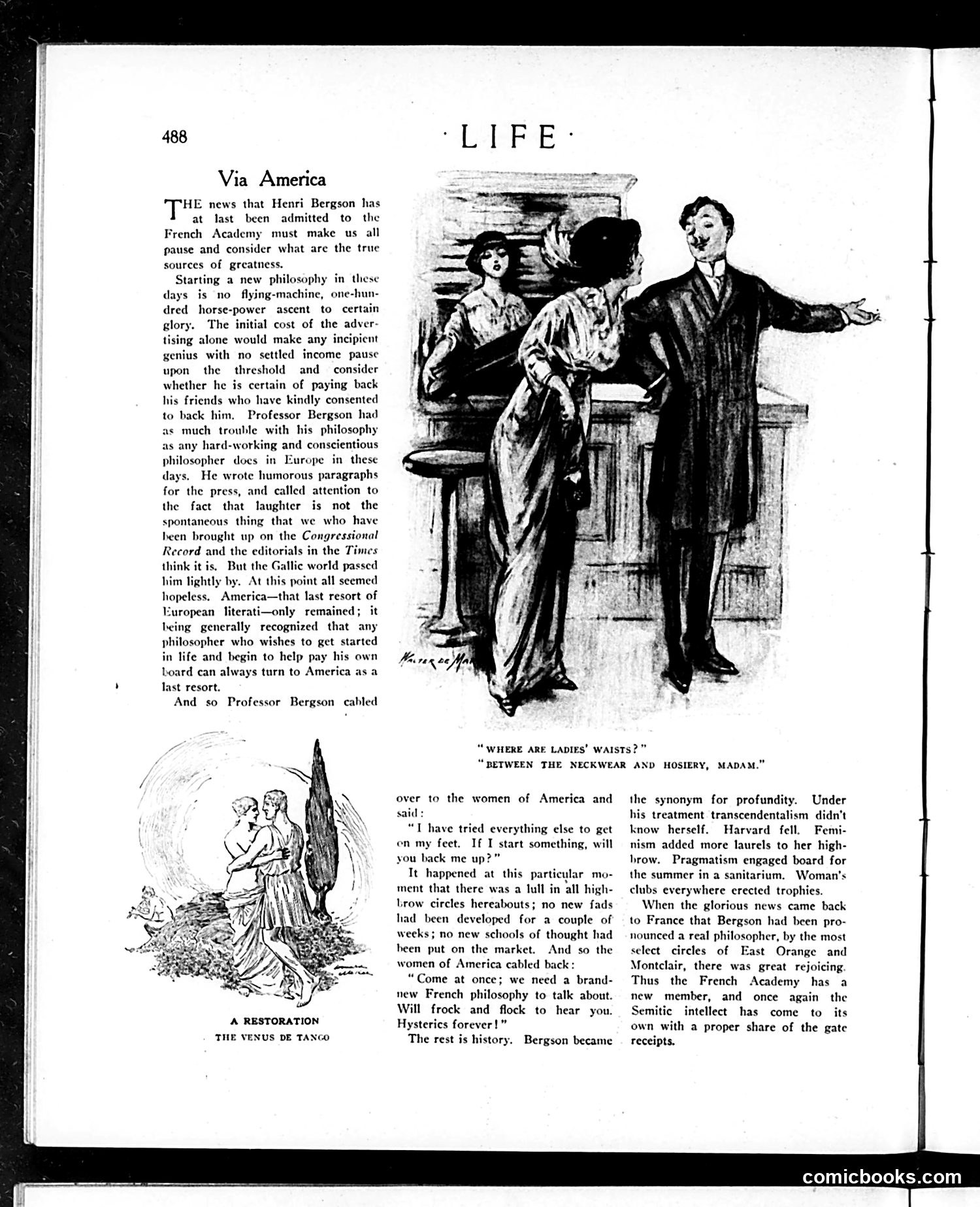
This satirical piece mocks Henri Bergson's admission to the French Academy. The main cartoon shows a woman asking a man "Where are ladies' waists?" with the reply "Between the neckwear and hosiery, madam"—a joke about the fashionable, high-waisted silhouette of the era that made women's actual waists nearly invisible. The broader satire suggests Bergson, a serious philosopher, struggled financially and had to resort to America (seen as a commercial, unintellectual resort) to make money. The accompanying illustration, "A Restoration: The Venus of Tango," parodies contemporary dance crazes and changing aesthetics. The humor targets both Bergson's commercial compromises and contemporary American culture's perceived shallowness compared to European intellectual traditions.
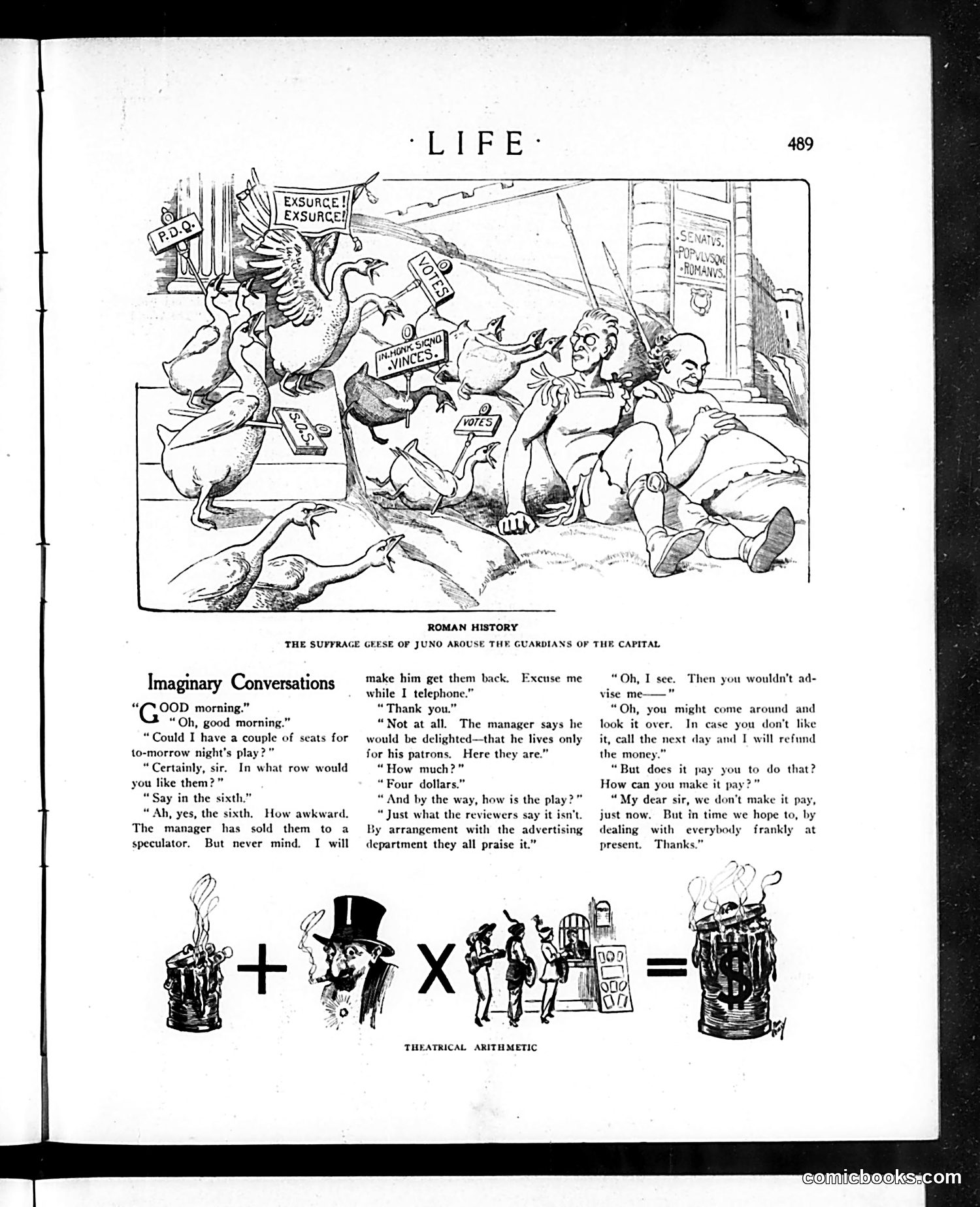
This page from *Life* magazine contains a satirical cartoon titled "Roman History: The Suffrage Geese of Juno Arouse the Guardians of the Capitol." The cartoon depicts geese attacking what appears to be male political figures or senators in classical Roman dress. This references the historical legend where geese saved Rome by alerting defenders to an attack. Here, the satire inverts that narrative: the "geese" represent women suffragists, portrayed as aggressive attackers "arouse[ing]" the (male) "guardians of the Capitol." The satire mocks anti-suffrage sentiment by comparing women's voting rights activism to an invasive threat requiring defense. Below is an "Imaginary Conversation" about theater tickets and business, followed by "Theatrical Arithmetic"—visual wordplay about theatrical economics. The page satirizes both suffrage opposition and theater industry practices.
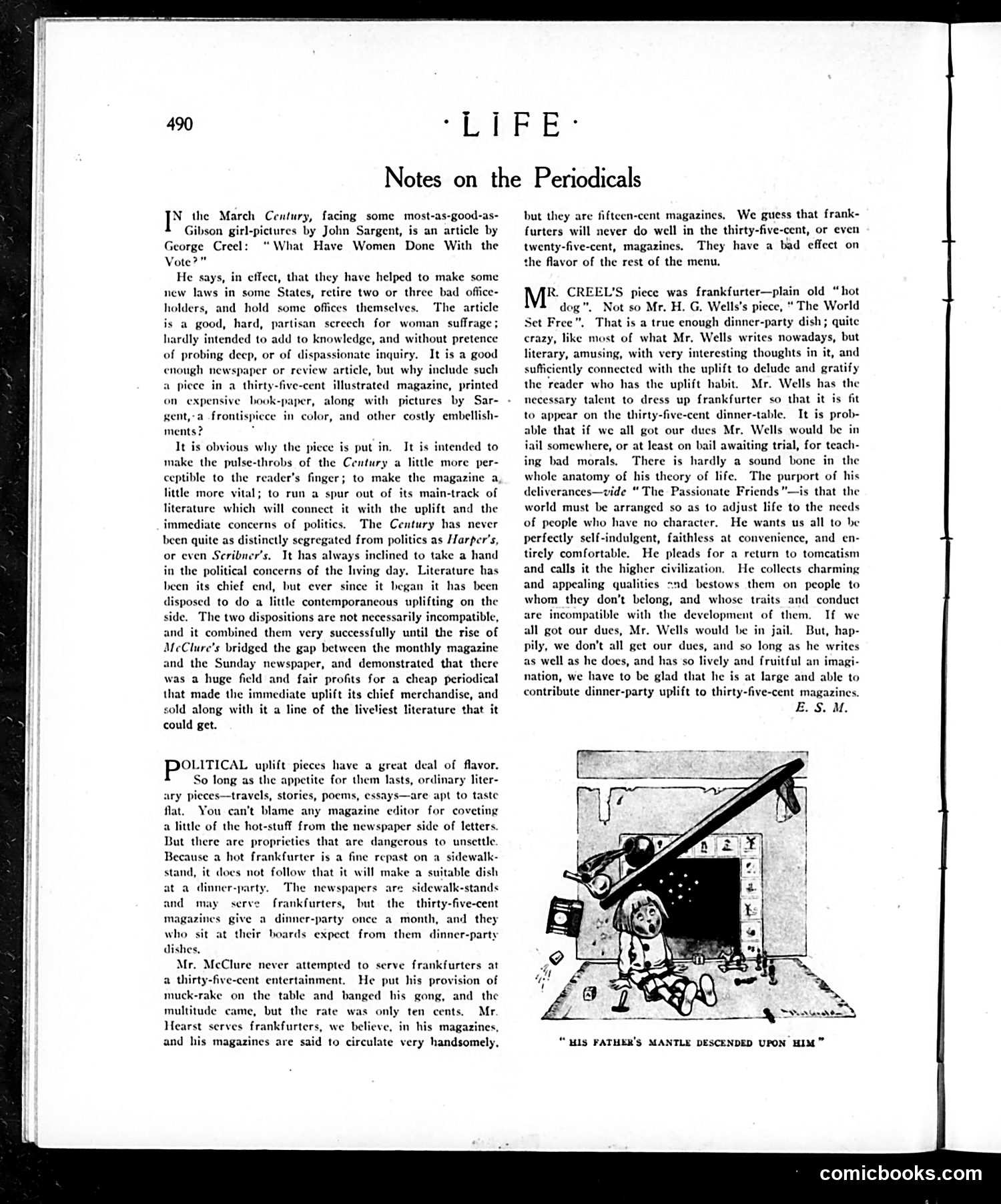
This page contains editorial commentary on magazine content rather than a political cartoon. The main illustration shows a child beneath a falling mantle or cloak labeled "HIS FATHER'S MANTLE DESCENDED UPON HIM." The text discusses how different magazines serve different audiences. It critiques the editorial choices of *Century* magazine for including a suffrage article alongside Gibson Girl pictures, arguing this creates tonal inconsistency. The author contrasts this with H.G. Wells's approach in another piece. The editorial debates whether serious political content belongs in entertainment-focused magazines, noting that while literature has traditionally engaged politics, thirty-five-cent magazines should maintain lighter "dinner-party" appeal. The illustration likely represents the burden or inheritance of serious responsibility, complementing the discussion about editorial responsibility and audience expectations.
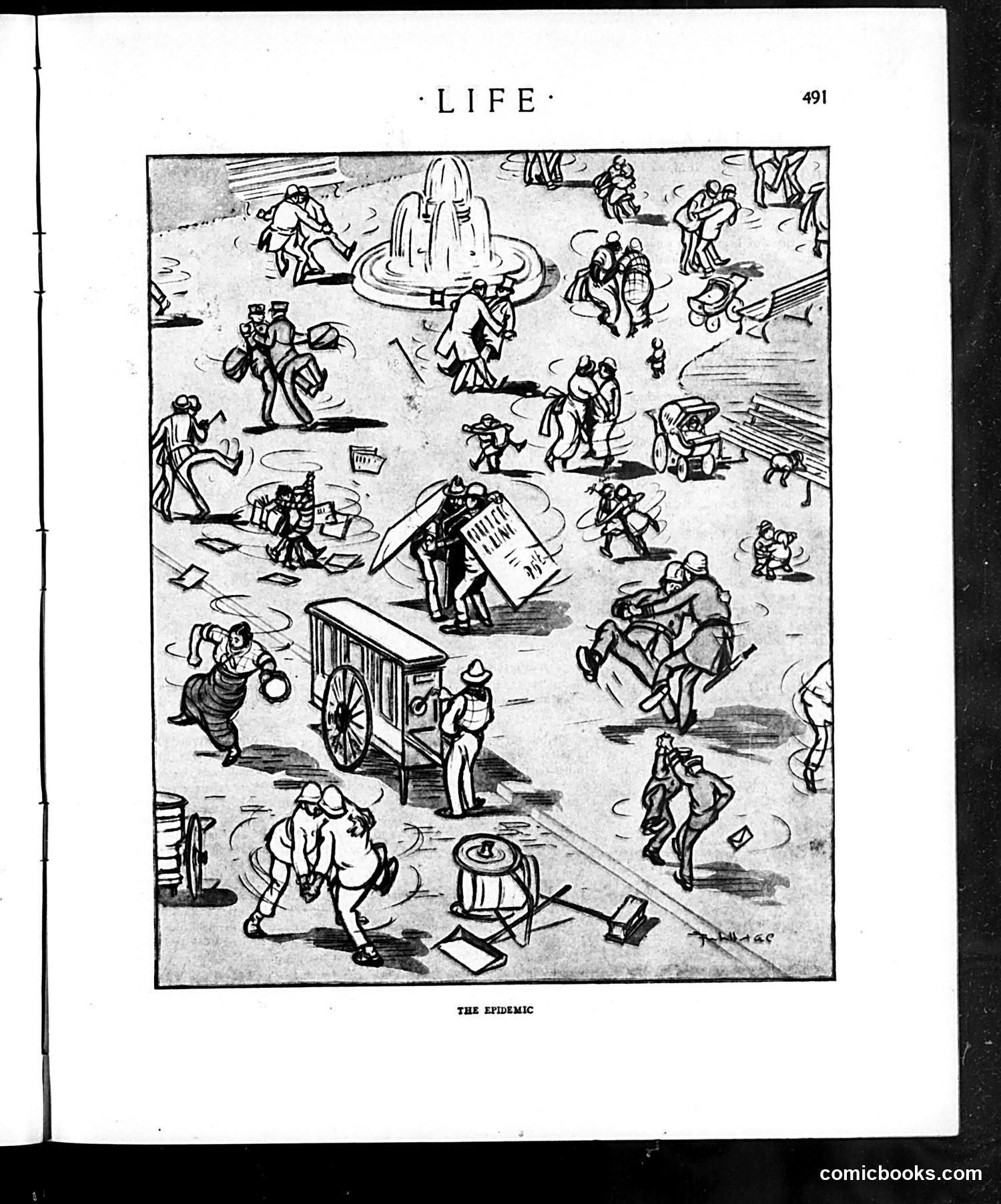
This cartoon depicts a chaotic public square during what appears to be a disease outbreak. The title "THE EPIDEMIC" and the frantic scene suggest social panic—figures flee in various directions, some carrying possessions or children. A fountain anchors the composition's center, with a vendor's cart, barrels, and scattered goods visible. The satire likely mocks mass hysteria and disorderly public behavior during epidemics rather than the disease itself. The exaggerated, comedic poses of the fleeing crowds emphasize panic as absurd and contagious as any illness. The mix of social classes and the carnival-like chaos suggest Life magazine's critique of how epidemics expose or amplify human irrationality and mob mentality across society. The specific epidemic referenced remains unclear without additional context.
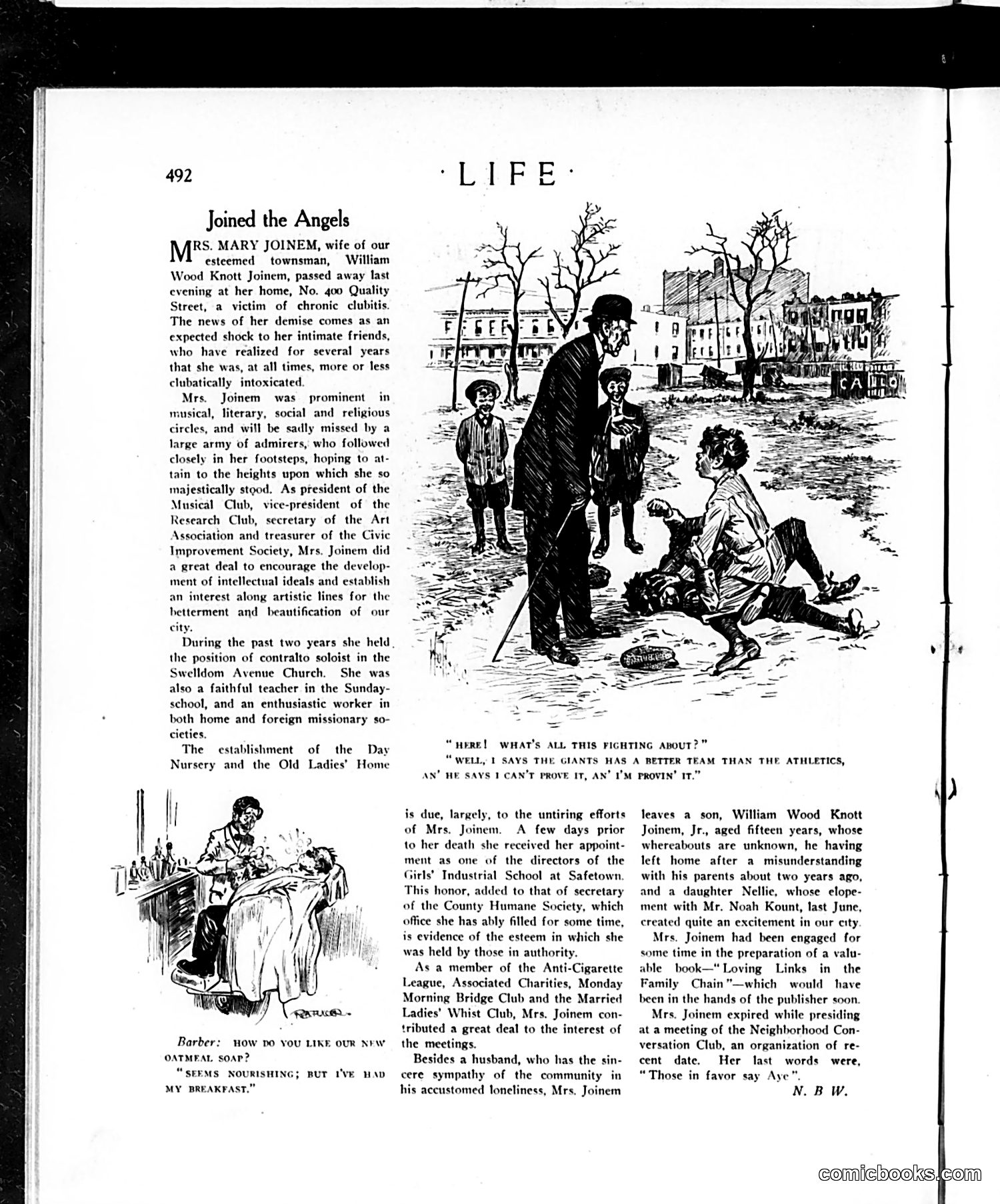
This is an **obituary page** for Mrs. Mary Joinем, an esteemed townsman and prominent community figure who died of chronic clubitis (likely a satirical ailment). The main cartoon depicts a street scene where an adult (possibly a barber or working-class man) converses with children. The caption reads: "Here! What's all this fighting about?" with a response claiming "the giants has a better team than the athletics" and "I can't prove it, an' I'm provin' it." This appears to be **satire about working-class disputes over baseball teams**—likely the New York Giants versus Philadelphia Athletics, with the joke being that street-level arguments about sports teams are settled through fighting rather than evidence. The lower cartoon shows someone at a barber shop discussing oatmeal soup as breakfast, suggesting working-class domestic life.
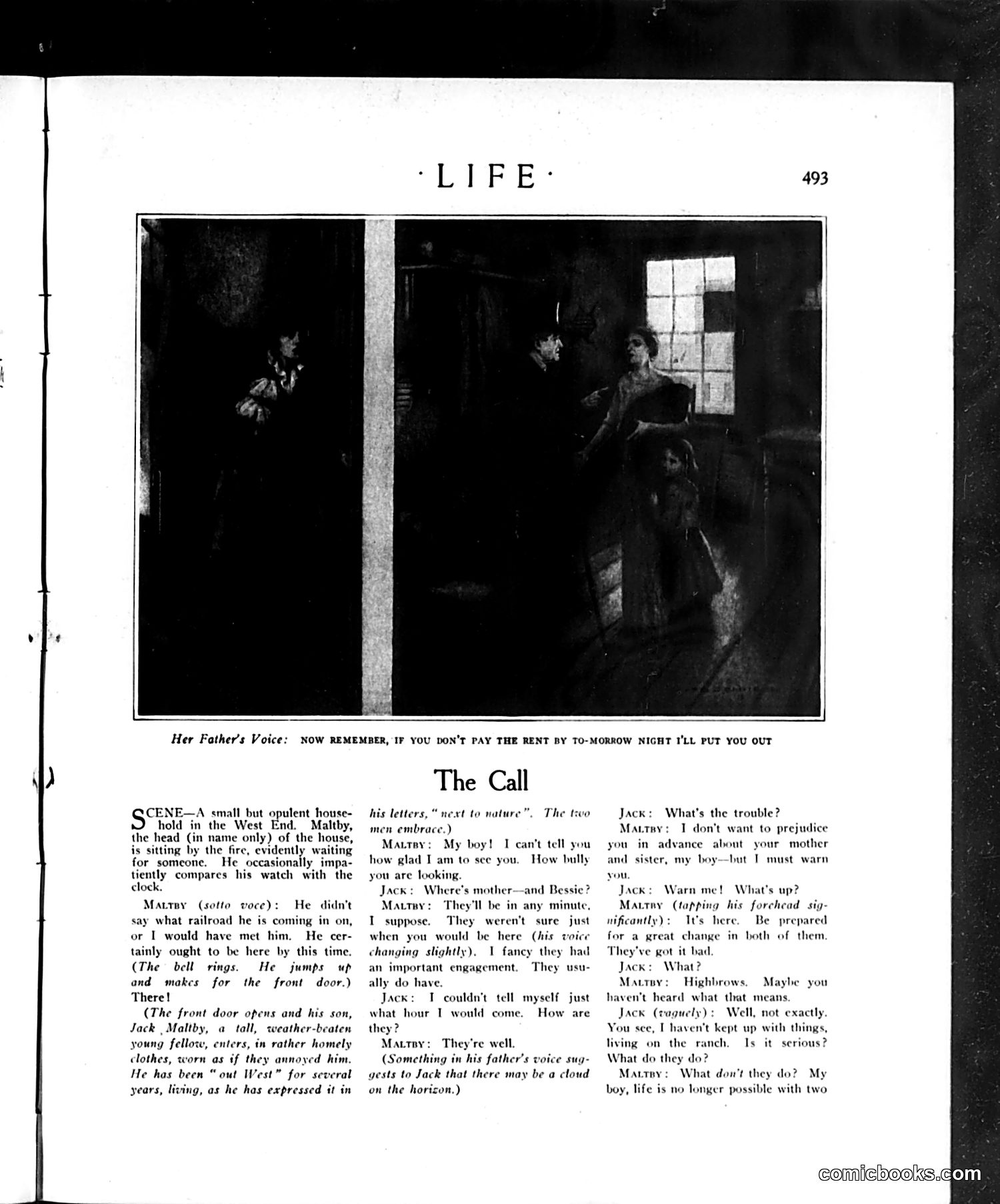
This appears to be a dramatic scene from an early 20th-century play or serialized story rather than political satire. The scene depicts a working-class family in financial distress: a father waiting impatiently for rent payment while a son (Jack) has apparently been absent for years. The dialogue reveals tension between duty to family and personal circumstances—Jack claims he's been "living on the ranch" and hasn't "kept up with things," suggesting he's been estranged or isolated. The caption's threatening line about eviction reflects genuine period anxieties about tenant farming, poverty, and economic hardship. This appears to be serialized domestic melodrama exploring class struggle and family obligation rather than political commentary.
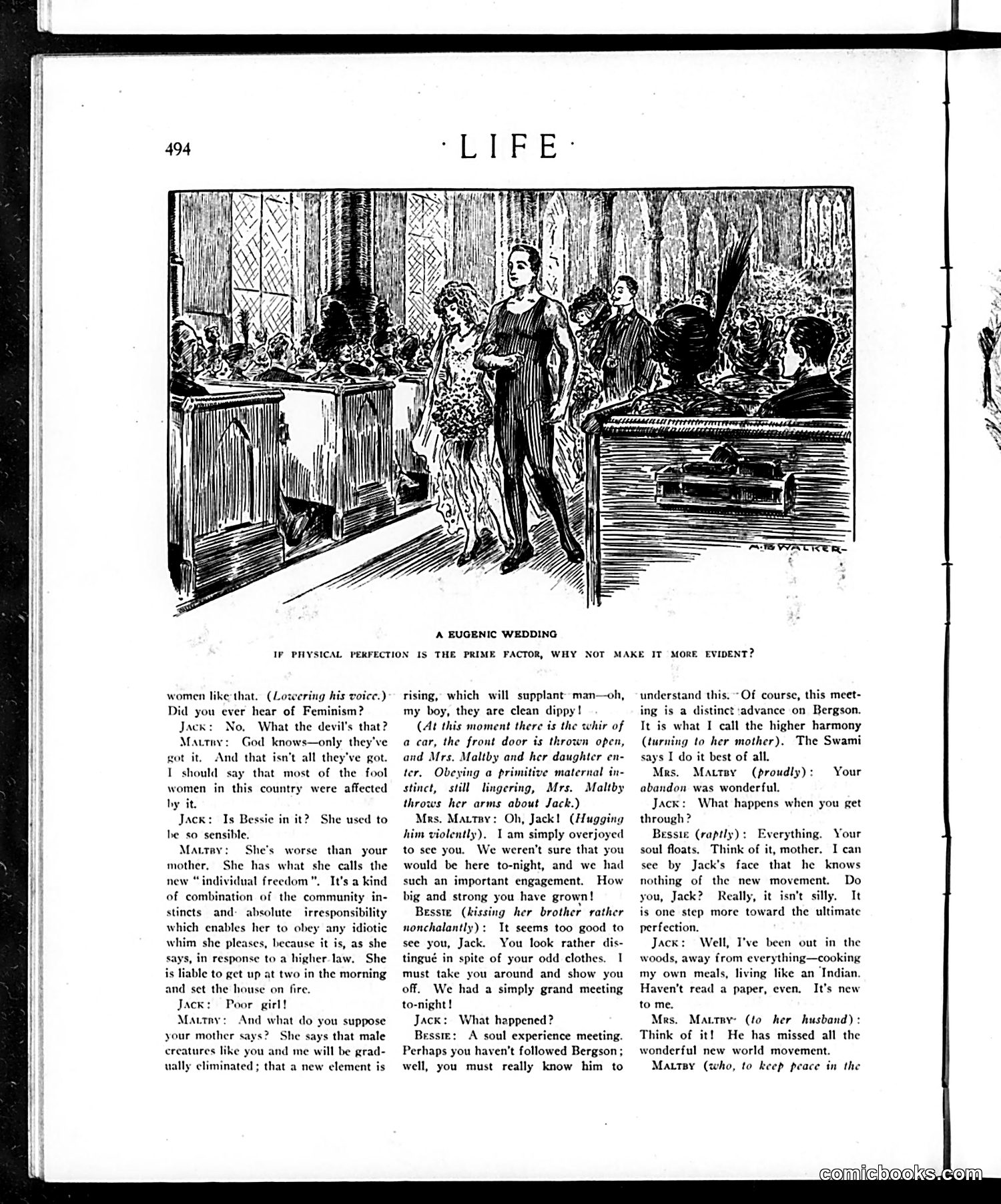
This satirical cartoon critiques the eugenics movement, popular among early 20th-century American intellectuals. The subtitle poses a provocative question: "If physical perfection is the prime factor, why not make it more evident?" The illustration shows an elegant wedding scene where the bride appears to be displayed or exhibited. The dialogue below suggests the bride (Bessie) is being evaluated primarily for physical attributes and breeding potential rather than emotional compatibility. Characters debate whether she represents an improvement—a "higher harmony"—suggesting people are being assessed like livestock for genetic quality. The satire mocks how eugenic ideology reduced human relationships to biological calculation, treating marriage as a tool for producing "perfect" offspring rather than a personal union.
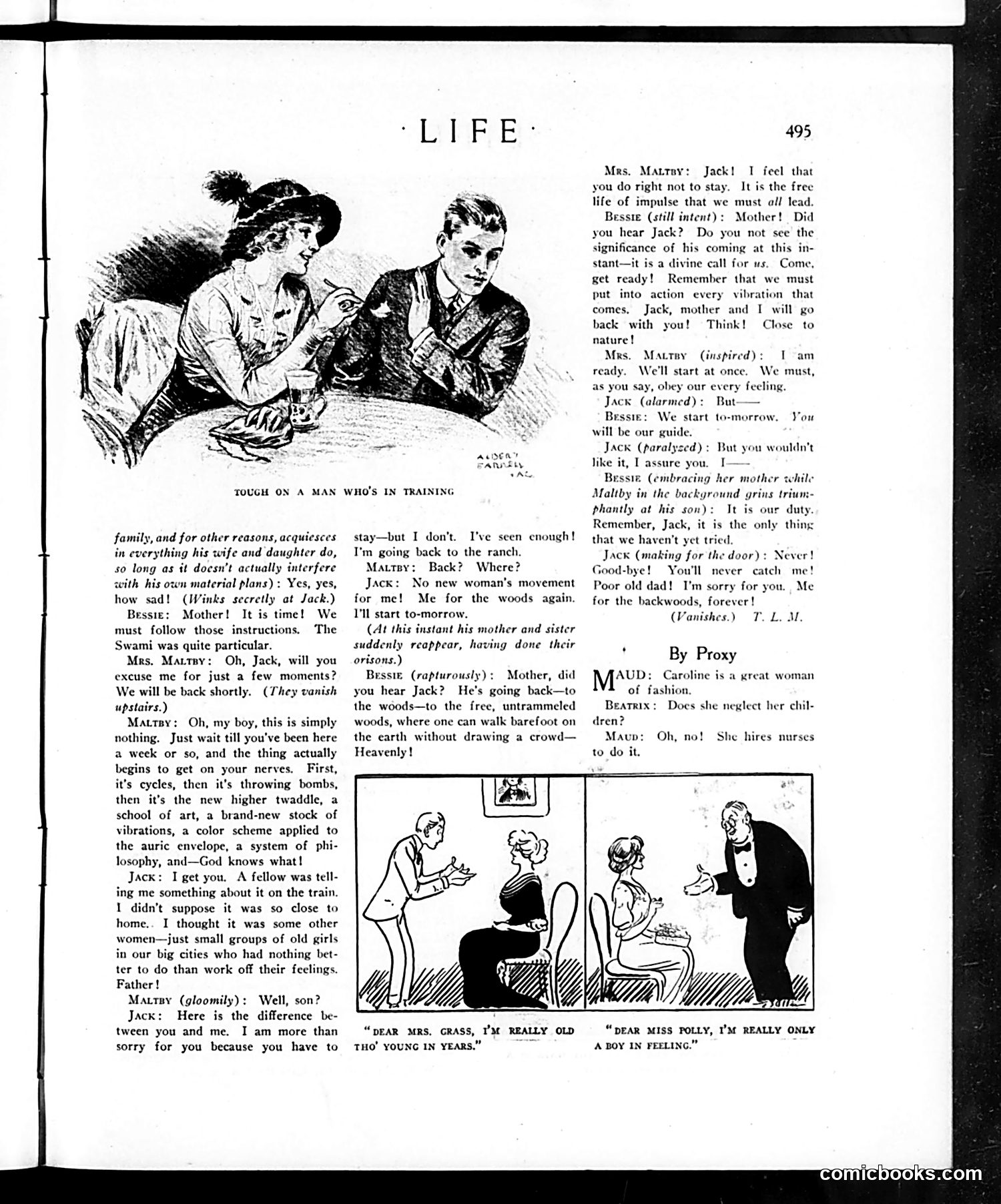
This Life magazine page satirizes the "New Woman's Movement" of the early 20th century, mocking women's liberation and progressive activism as fashionable fads that entrap entire families. **The Main Scene:** Jack arrives home to find his family—particularly his mother and sister Bessie—absorbed in mystical "new woman" movements. They cycle through trendy causes: "cycles" (likely women's suffrage/independence), philosophy, art schools, and spiritual vibrations guided by a "Swami." Jack, horrified, escapes to the ranch. His mother and sister, interpreting this as a "divine call," insist on joining him—entirely missing his point. **The Satire:** The humor targets how women adopt progressive causes uncritically and superficially, treating serious movements as social games. The father's secret wink suggests male complicity in tolerating women's "foolishness." Jack's exasperation represents the satirist's view that these movements are absurd impositions on rational family life. **"By Proxy" cartoon:** Mocks wealthy women who claim femininity while outsourcing motherhood to hired nurses—highlighting perceived hypocrisy in progressive women's claims of independence.
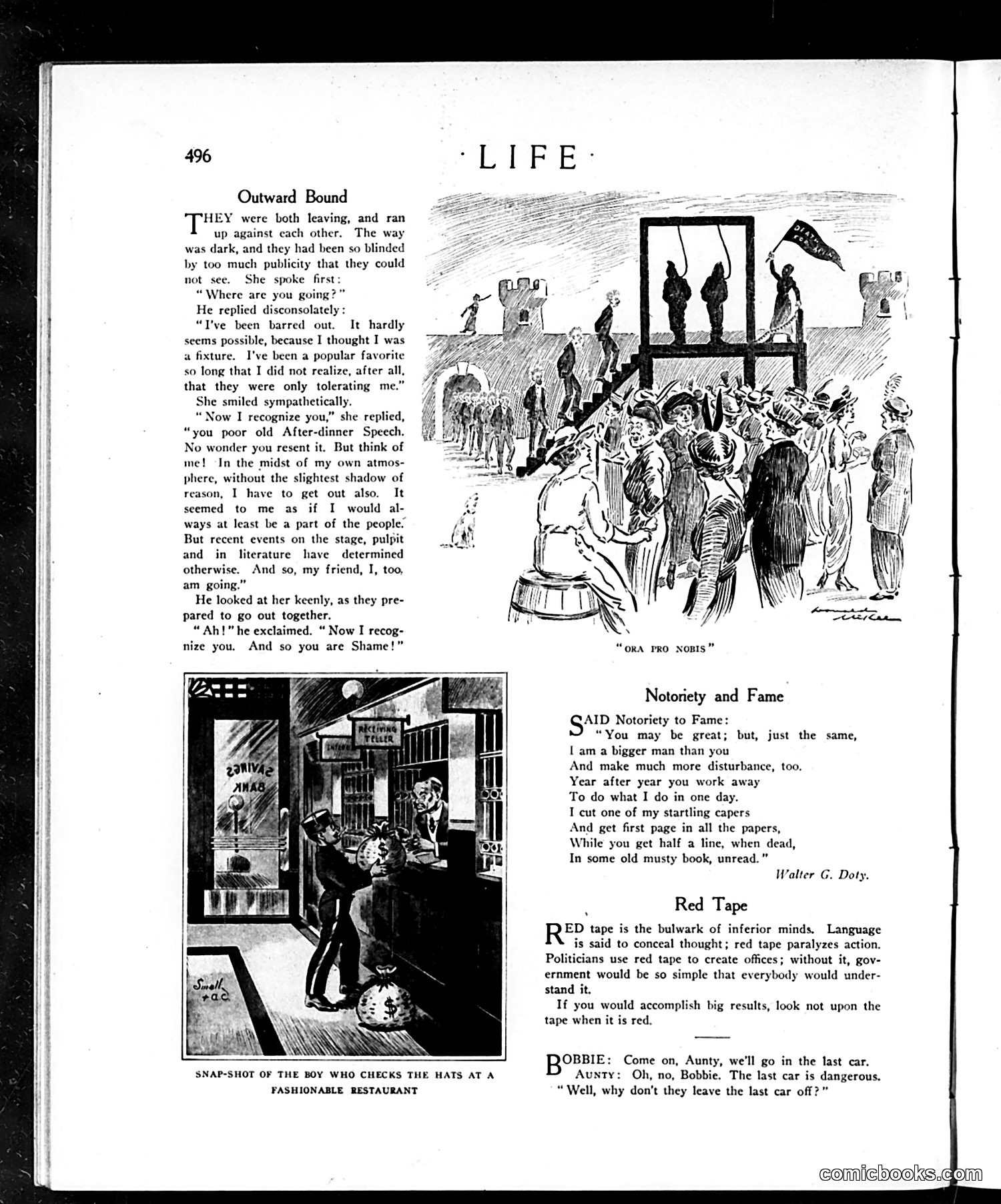
This page satirizes social and institutional decline in early 20th-century America through personification. The main dialogue features two allegorical figures: "After-dinner Speech" and "Shame," both being expelled from public life. The satire suggests that after-dinner speeches (a popular entertainment form) and public shame have become socially obsolete—likely due to changing standards of propriety and the rise of new entertainment media. The accompanying poem "Notoriety and Fame" contrasts sensationalism's immediate impact against genuine achievement's lasting legacy, suggesting contemporary culture prioritizes scandal over substance. "Red Tape" mocks bureaucratic inefficiency as a tool of inferior minds and incompetent politicians. The lower cartoon depicts a boy checking hats at a restaurant—likely satirizing class pretension or youth employment in service industries. The overall theme: American institutions and values are deteriorating, replaced by sensationalism and bureaucratic dysfunction.
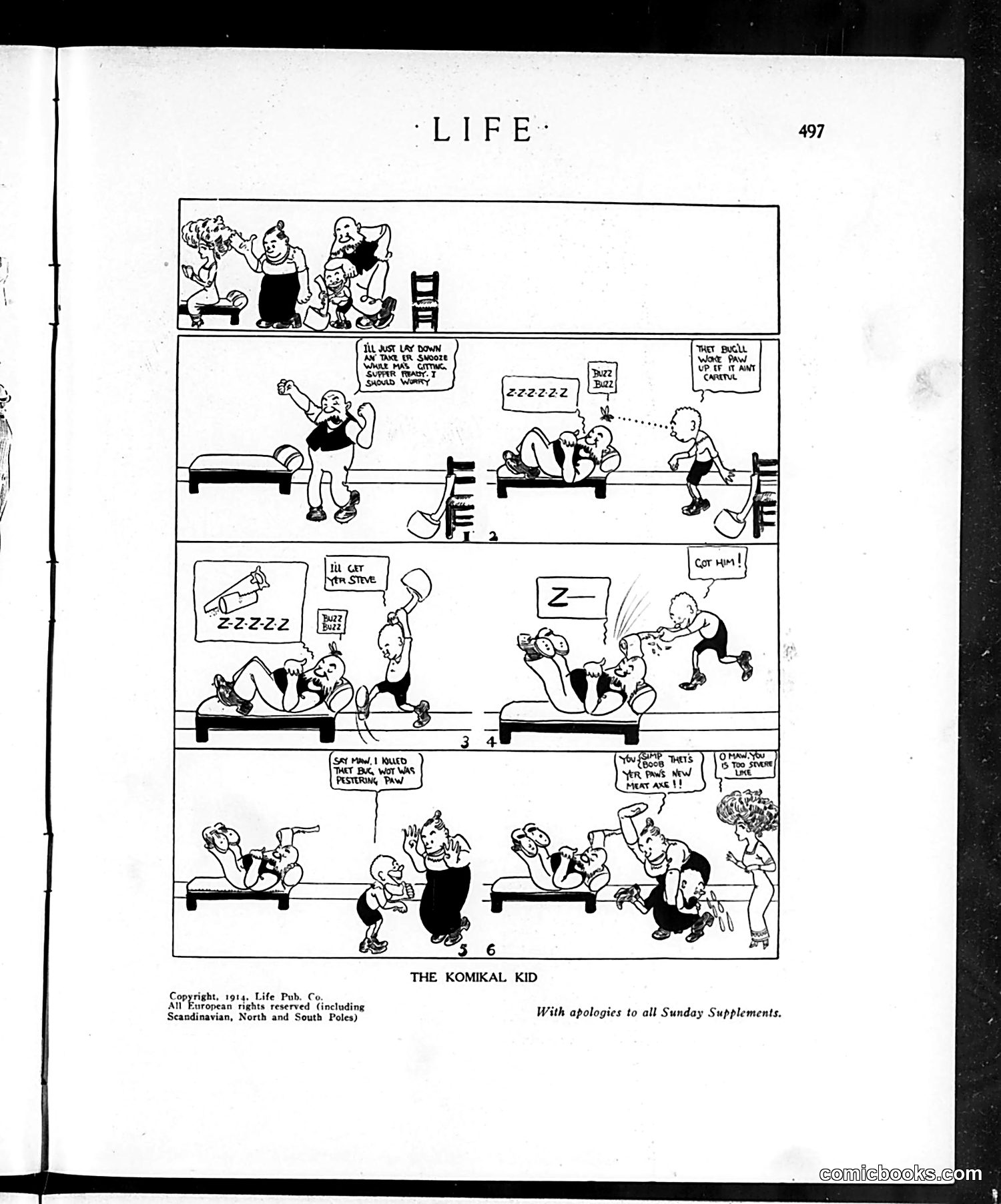
This is a satirical comic strip mocking the melodramatic, exaggerated action comics popular in Sunday newspaper supplements of that era. The strip depicts a chaotic bedroom scene where a child wreaks havoc—jumping on beds, disturbing sleeping adults, causing general mayhem. The humor targets both the absurdly over-the-top adventure narratives in contemporary comics and parental frustration with unruly children. The title's deliberate misspelling ("Komikal") suggests the lowbrow entertainment it's parodying. The final apology "to all Sunday Supplements" confirms Life's intent: satirizing the sensationalism and silliness of mass-market comics that newspapers ran to boost circulation. The 1914 copyright dates this to when such supplements were hugely popular but often dismissed by intellectual publications like Life as crude entertainment.
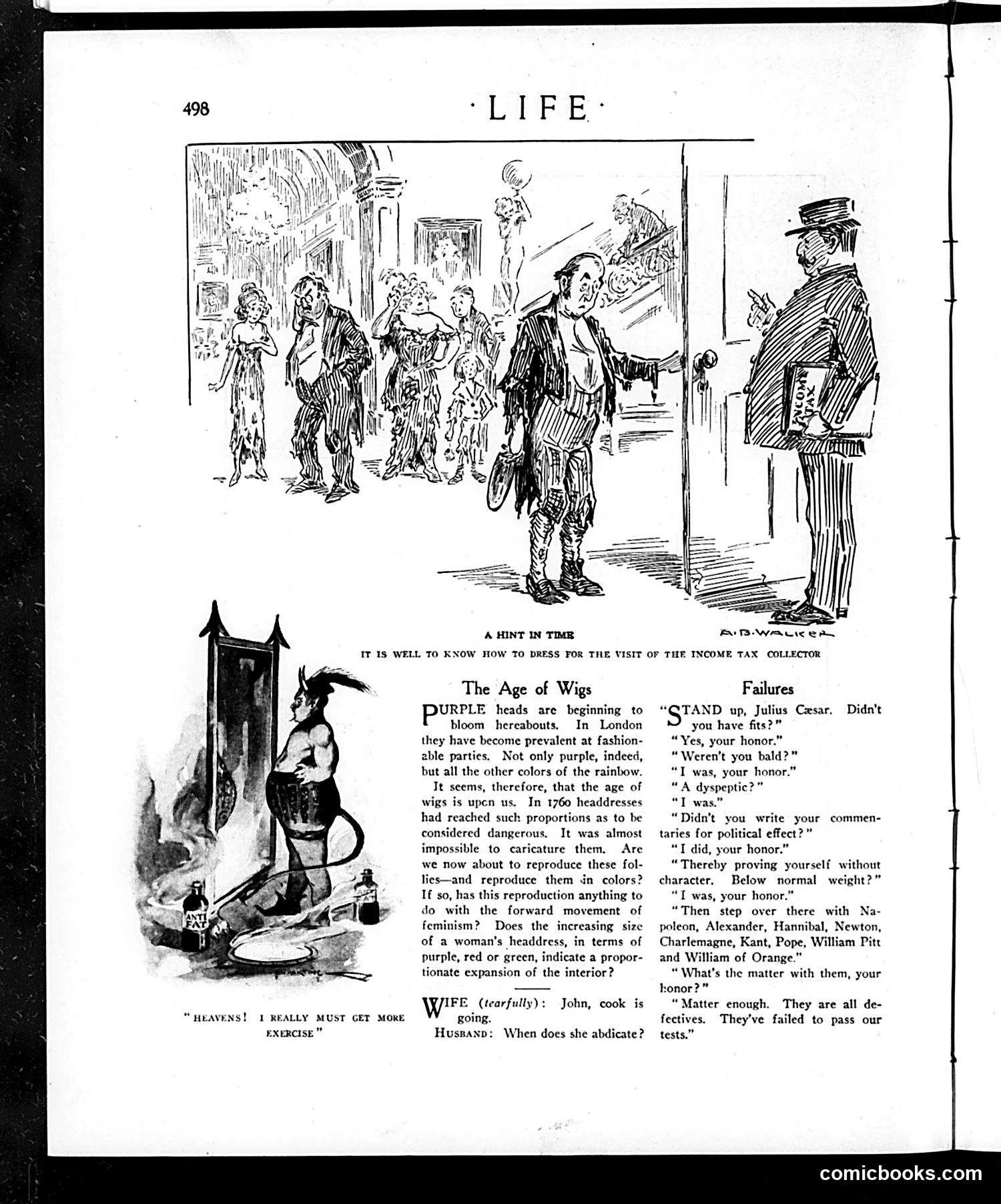
This page contains three distinct satirical pieces: **Top cartoon**: A tax collector visits a household. The caption suggests dressing appropriately—the satire mocks anxiety about income tax inspections, a relatively new concept at this time. **"The Age of Wigs"**: Mocks the revival of colorful, oversized wigs at fashionable London parties. The author sarcastically questions whether this trend relates to feminism, cynically suggesting that women's expanding headdresses indicate expanding emptiness of mind rather than genuine intellectual expansion. **"Failures"**: A courtroom scene where famous historical figures (Julius Caesar, Napoleon, Hannibal, Newton, etc.) are rejected for failing modern "tests"—they're deemed "defectives" lacking normal weight, without character flaws, etc. The satire mocks modern bureaucratic obsession with standardization and testing, suggesting contemporary society foolishly rejects greatness that doesn't fit narrow specifications. All three pieces target early 20th-century social anxieties: taxation, fashion trends, and mechanized conformity.
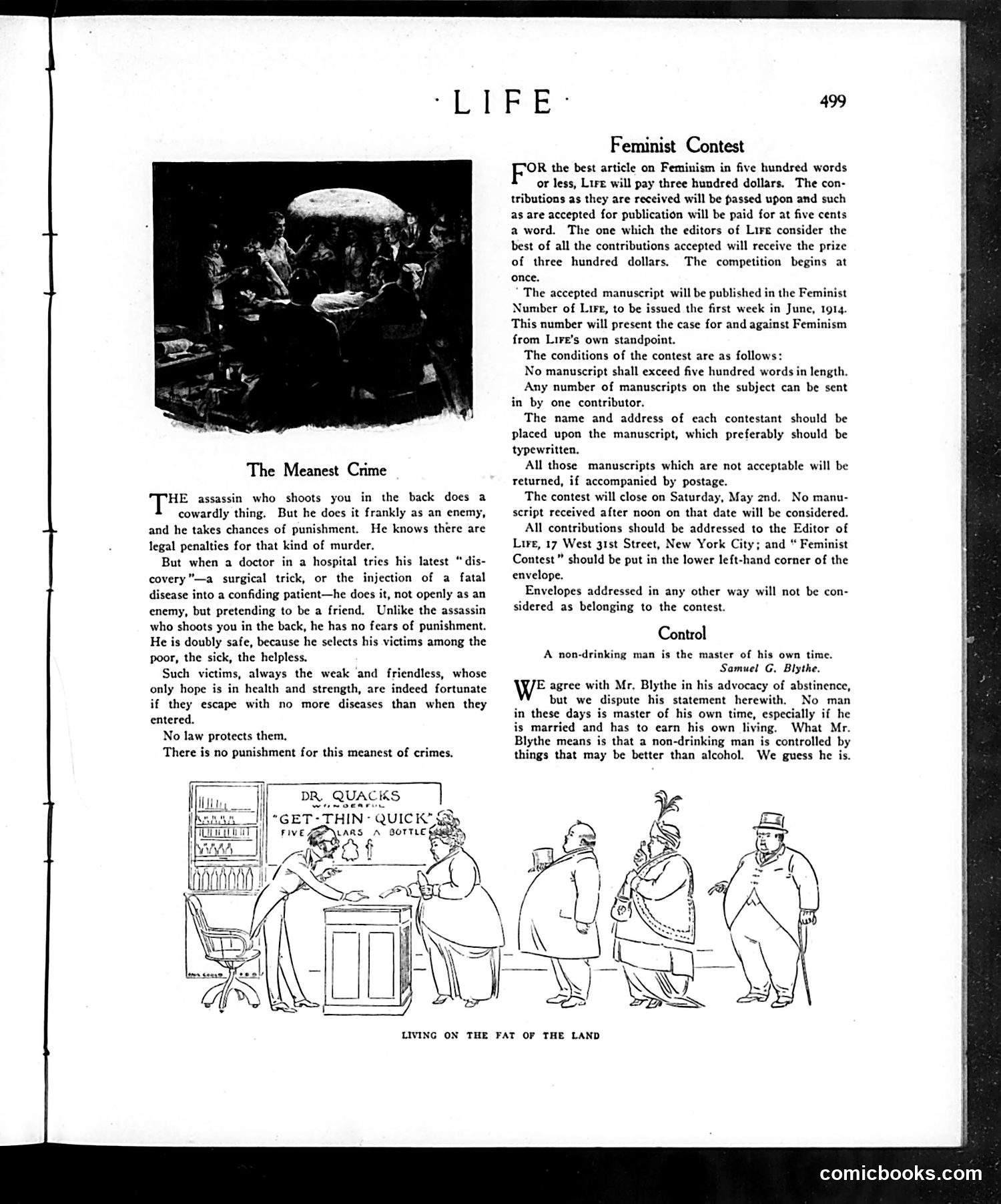
**"The Meanest Crime"** condemns unethical medical practitioners—quack doctors who exploit vulnerable patients (the poor and sick) by performing dangerous "experiments" under the guise of treatment. The piece argues these doctors are worse than assassins because they betray trust while hiding behind professional authority, yet face no legal consequences. **The cartoon below** satirizes "Dr. Quacks" and his "Get-Thin-Quick" scheme, depicting a line of overweight patients waiting to buy his bogus weight-loss tonic. It illustrates the text's point: charlatans prey on desperate, vulnerable people seeking quick fixes, profiting from false promises with no accountability. **"Feminist Contest"** announces Life's call for 500-word submissions on feminism, offering $300 for the best entry—positioning the magazine as a forum for debate on this emerging 1914 social movement. **"Control"** disputes Samuel Blythe's claim that non-drinkers master their time, sarcastically suggesting married working men are controlled by obligations rather than alcohol—a commentary on modern constraints on personal freedom.
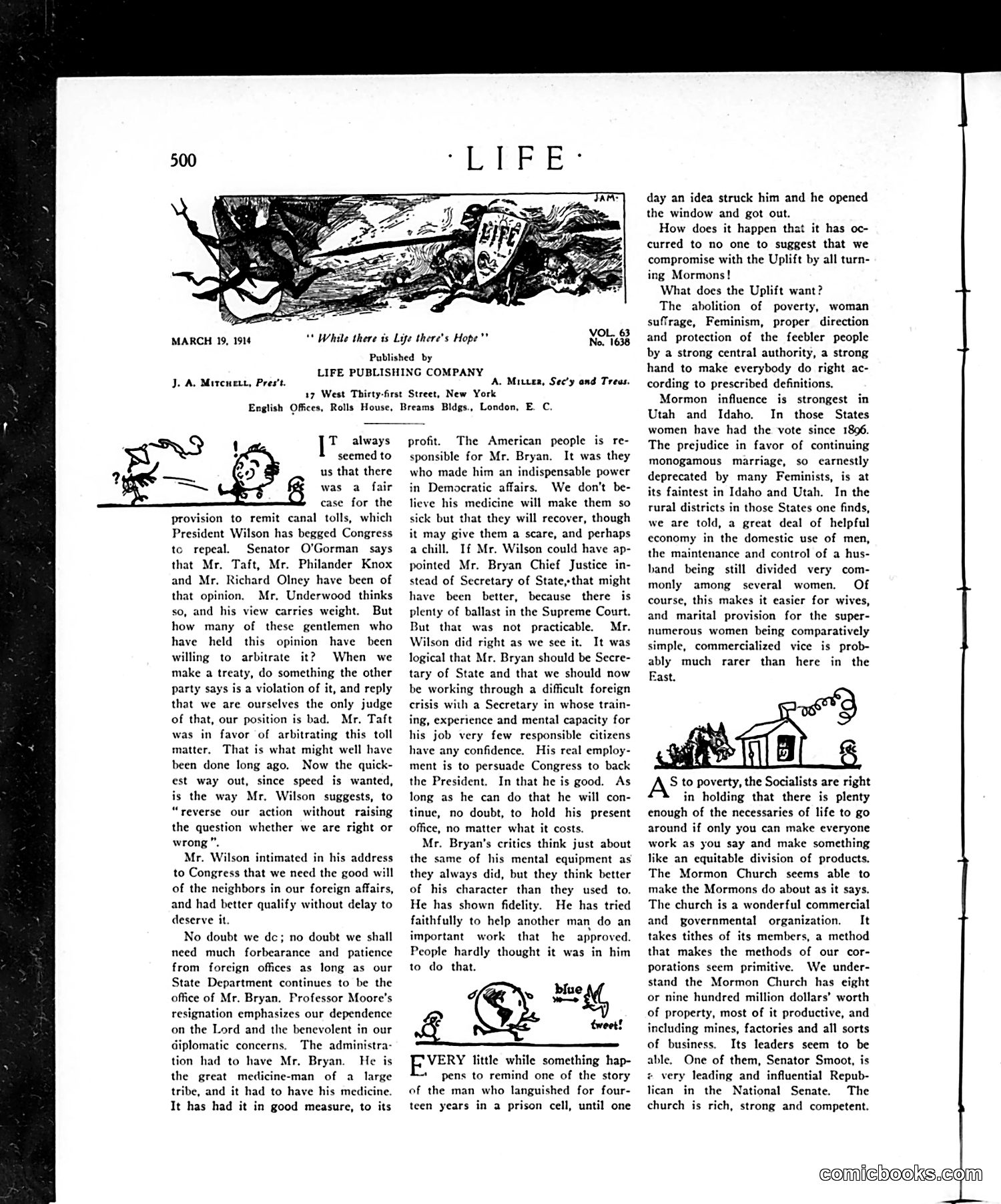
The main editorial discusses President Wilson's canal-toll policy and Secretary of State William Jennings Bryan's diplomatic role. Life argues Wilson was right to reverse course on tolls without admitting error—pragmatism matters more than pride in foreign relations. The piece is largely critical of Bryan, suggesting Wilson had to appoint him (as the powerful voice of his Democratic base) despite doubts about Bryan's diplomatic competence. The cartoon's joke is more pointed: it sarcastically suggests Americans solve the "Uplift" problem—progressive reformers demanding poverty abolition, women's suffrage, feminism, and centralized authority—by simply converting to Mormonism. The humor lies in mocking both progressive reformers' ambitious agenda and the Mormon Church's reputation for tight social control and strict discipline. Life implies Mormons have already achieved the regimented society progressives want.
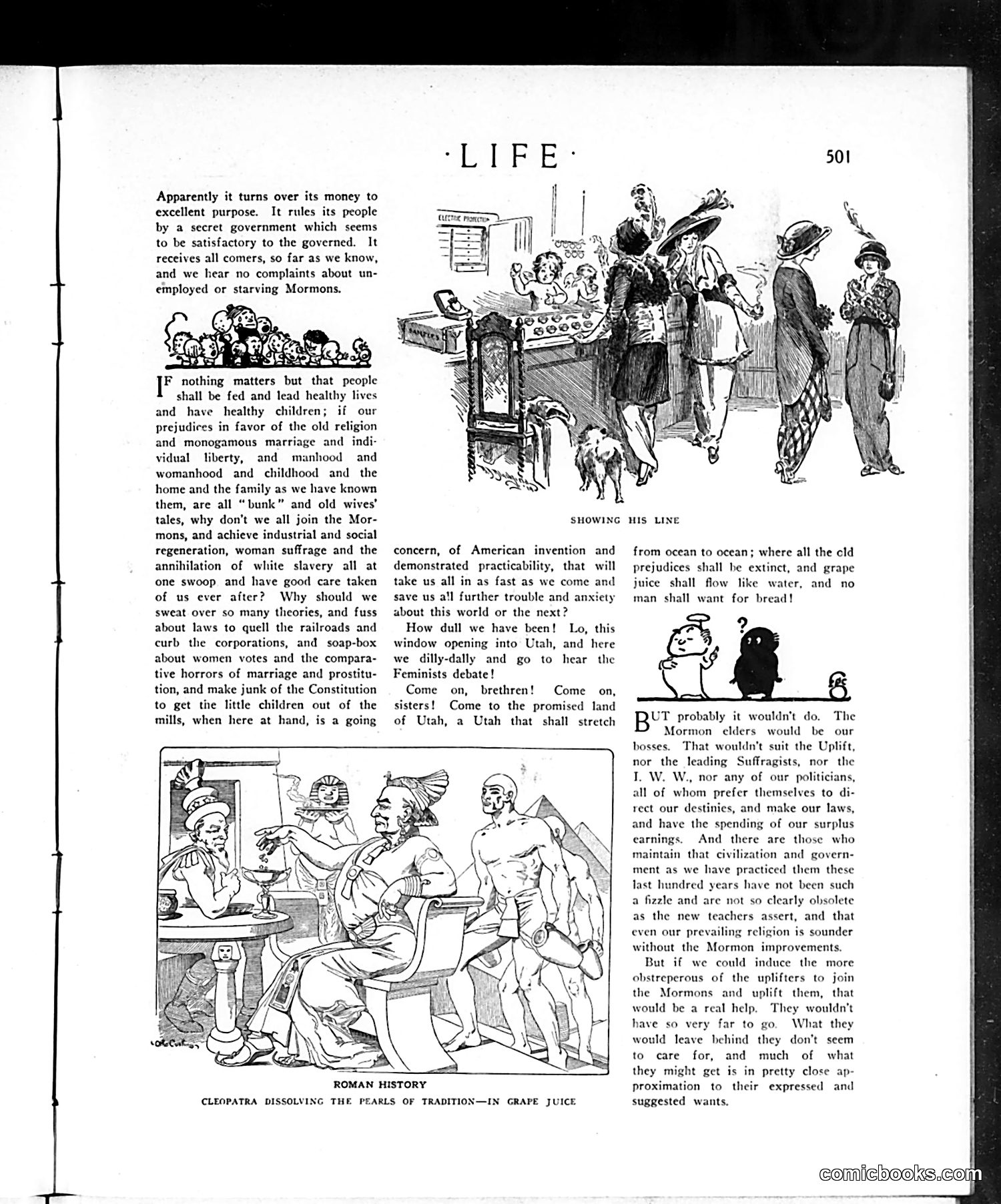
This satirical piece attacks Progressive Era "uplift" movements and their advocates. The author sarcastically suggests that if critics truly believed their own rhetoric about social reform, they should join the Mormons—who, the piece claims, successfully provide food, health, and social order. The satire targets feminists, labor activists (the I.W.W.), and other reformers who advocate for women's suffrage, factory reform, and social change. The author mocks them as hypocritical: they criticize American society while refusing the "proven" Mormon alternative because they actually want power themselves rather than genuine improvement. The "Roman History" cartoon shows Cleopatra dissolving pearls (representing tradition) in grape juice—implying Mormon culture and other new movements are carelessly destroying established values. The piece's core argument: these reformers don't truly care about people's welfare; they just want to control society according to their own ideologies. It's a defense of existing institutions (religion, monogamy, constitutional government) against what the author views as dangerous radical experimentation.
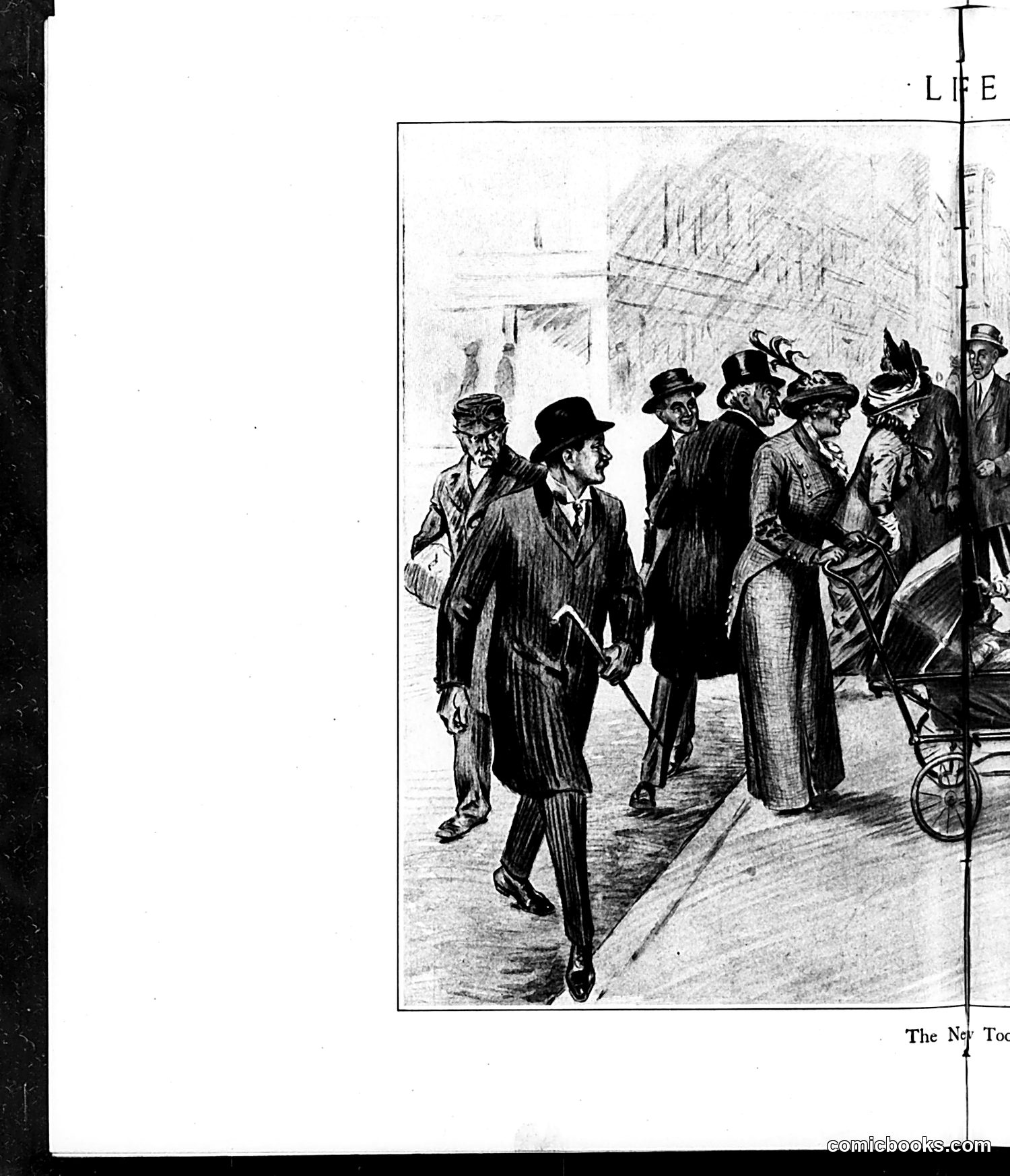
This appears to be a satirical street scene depicting well-dressed men in late 19th or early 20th century attire (top hats, formal suits). The partial caption reads "The New Toc" (possibly incomplete OCR). The cartoon likely satirizes urban social dynamics or a particular social movement of the era. The gathering of formally-dressed figures in a public space, combined with Life magazine's satirical tradition, suggests commentary on either: - A new social trend among the wealthy or elite - Urban fashion or behavioral pretension - A specific contemporary phenomenon (unclear without full caption) The precise meaning remains uncertain without the complete caption and publication date. The sketch style and clothing suggest American magazine illustration from approximately 1900-1920s.
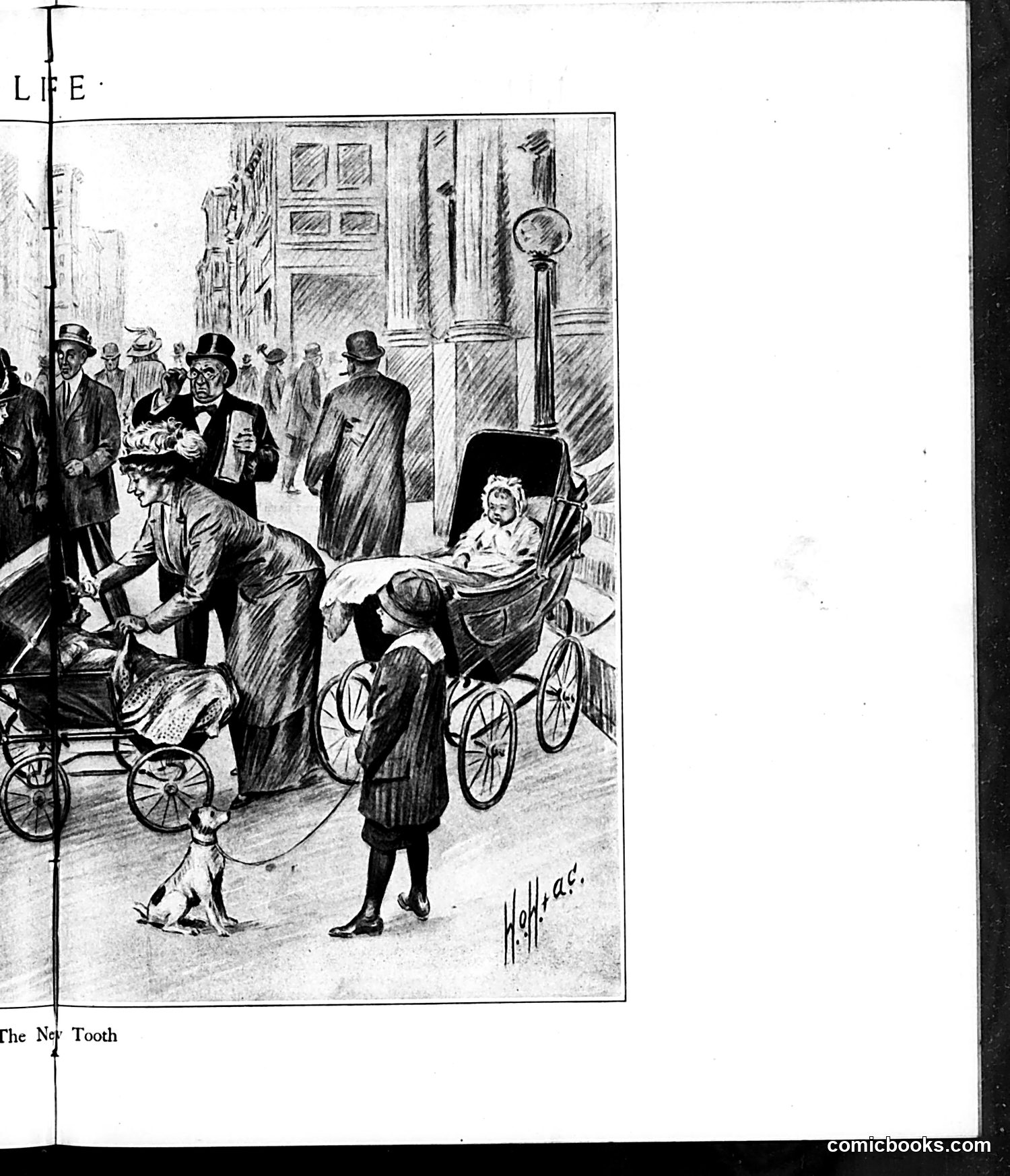
This appears to be a satirical cartoon from *Life* magazine depicting a street scene where well-dressed adults and children examine a new electric street lamp—a symbol of modern urban progress. The "new tooth" likely refers to the lamp's protruding bulb resembling a tooth. The satire seems to mock how city dwellers treat technological innovations with wonder and curiosity, gathering around the streetlamp as if it were a novelty rather than practical infrastructure. A small dog is also drawn to investigate. The cartoon captures early-20th-century attitudes toward electrification and modern urban development—treating technological advancement as a spectacle worthy of public fascination and scrutiny rather than an ordinary utility.
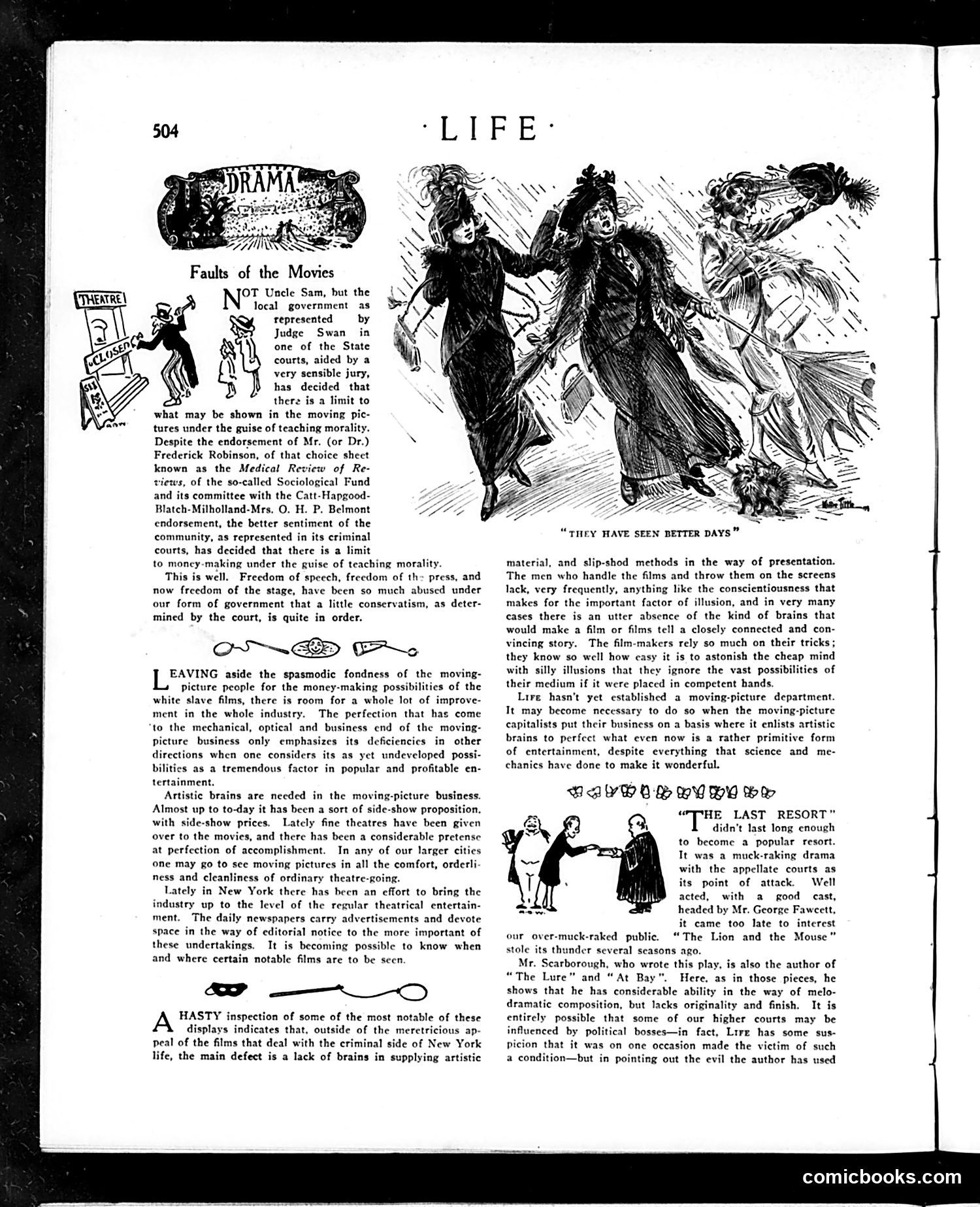
This 1910s *Life* magazine page critiques both film censorship and the film industry's artistic limitations. **The Censorship Debate:** Judge Swan ruled that movies cannot show certain content under the pretense of "teaching morality"—likely referencing controversial "white slave" films (trafficking narratives). The text names prominent progressive reformers (Catt, Hapgood, Blatch, Belmont) who apparently supported such films, but the court disagreed. *Life* supports the court's decision, arguing that "freedom of the stage" has been abused and "a little conservatism" is warranted. **The Industry Critique:** The main article attacks filmmakers for relying on cheap tricks and illusions rather than developing serious artistic storytelling. It argues the industry lacks "brains"—skilled writers and directors—despite recent improvements in theater venues and technical quality. **The Cartoon:** "They Have Seen Better Days" appears to mock struggling actresses, possibly suggesting fallen women—perhaps commentary on films depicting moral decline. **"The Last Resort"** review dismisses a "muck-raking drama" about appellate courts as short-lived and unmarketable. The page reveals early tensions between censorship, artistic merit, and exploitation in cinema.
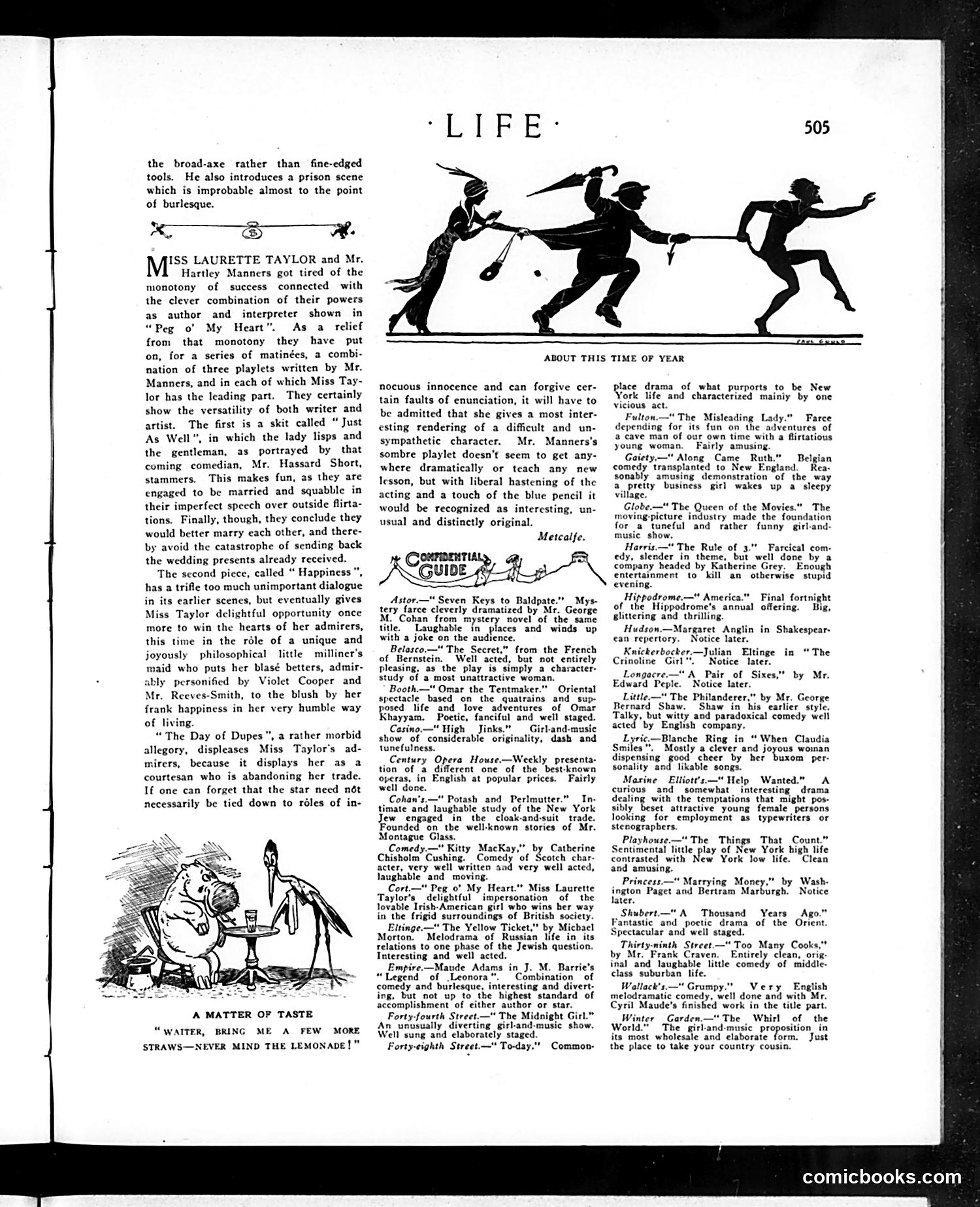
The cartoon "A Matter of Taste" depicts a waiter serving a drink through multiple straws to a customer who requests "a few more straws—never mind the lemonade!" This is a satire on excessive consumption and priorities. The joke operates on the contrast between the ostensible beverage (lemonade, a modest drink) and the customer's focus on the straws themselves—suggesting he cares more about the apparatus of drinking than the actual content. The cartoon likely critiques either wasteful consumption habits, misplaced values among the wealthy, or possibly Prohibition-era concerns about drinking culture (if this predates the 1920 ban). The figure appears to be a well-dressed gentleman, suggesting the satire targets upper-class indulgence or absurd priorities among affluent consumers. The page primarily contains theater reviews rather than political content; the cartoon serves as light satirical commentary on contemporary consumer behavior.
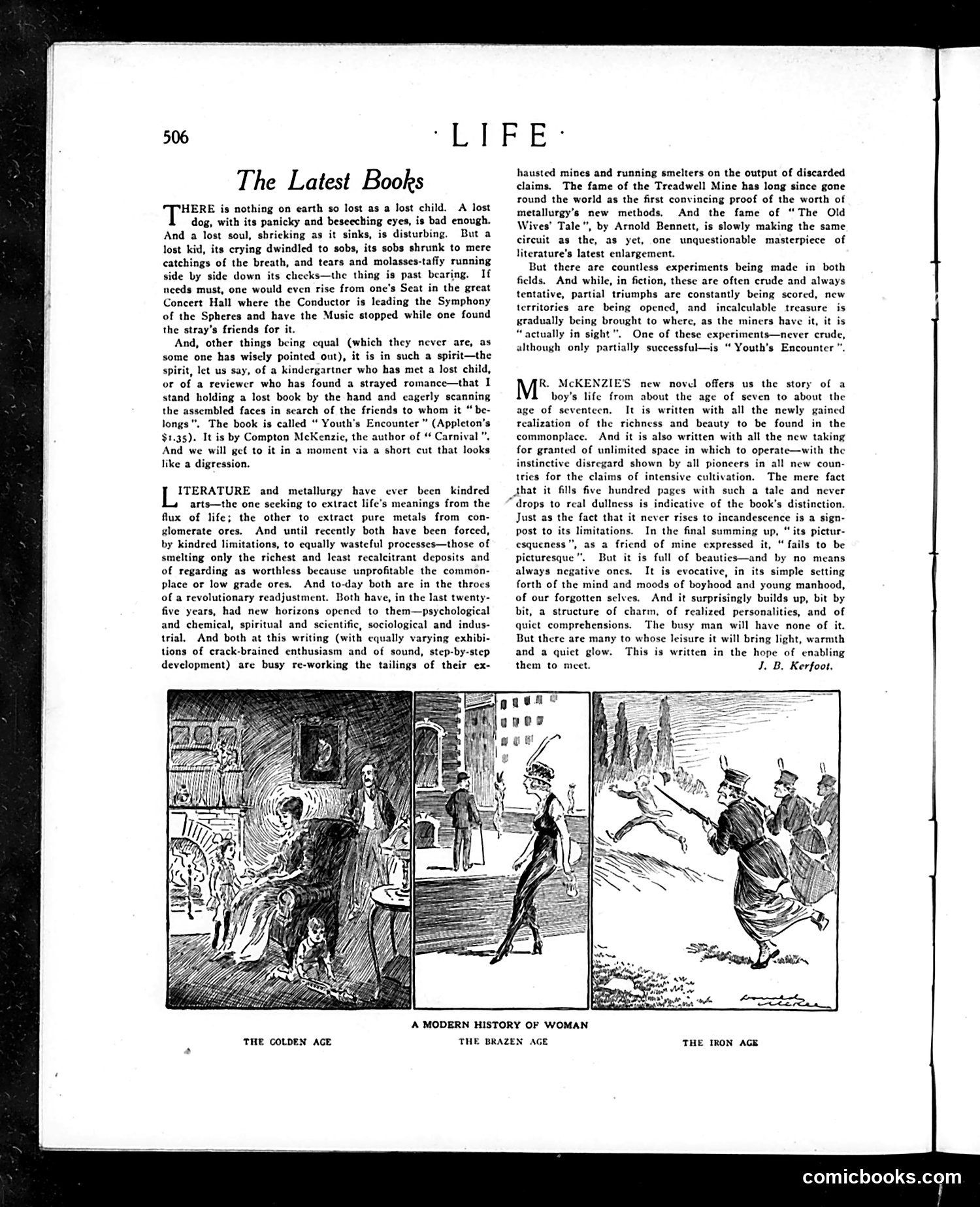
This three-panel comic illustrates changing gender roles through historical "ages," labeled The Golden Age, The Brazen Age, and The Iron Age. **The Golden Age** (left): Shows a woman in domestic contentment—sewing or crafting by candlelight, representing traditional domesticity and feminine virtue. **The Brazen Age** (center): Depicts a woman in fashionable, revealing clothing striking a confident pose, suggesting the "new woman" of the modern era—sexually liberated and socially bold. **The Iron Age** (right): Shows women engaged in active, physical labor alongside men (possibly farm work or industrial activity), humorously suggesting that women's liberation has resulted in grueling manual work rather than the promised freedom. The satire mocks the progression of women's liberation by suggesting each stage represents deterioration: from idealized domesticity, to scandalous modernity, to exhausting labor. This reflects conservative anxieties about changing women's roles in the early 20th century.
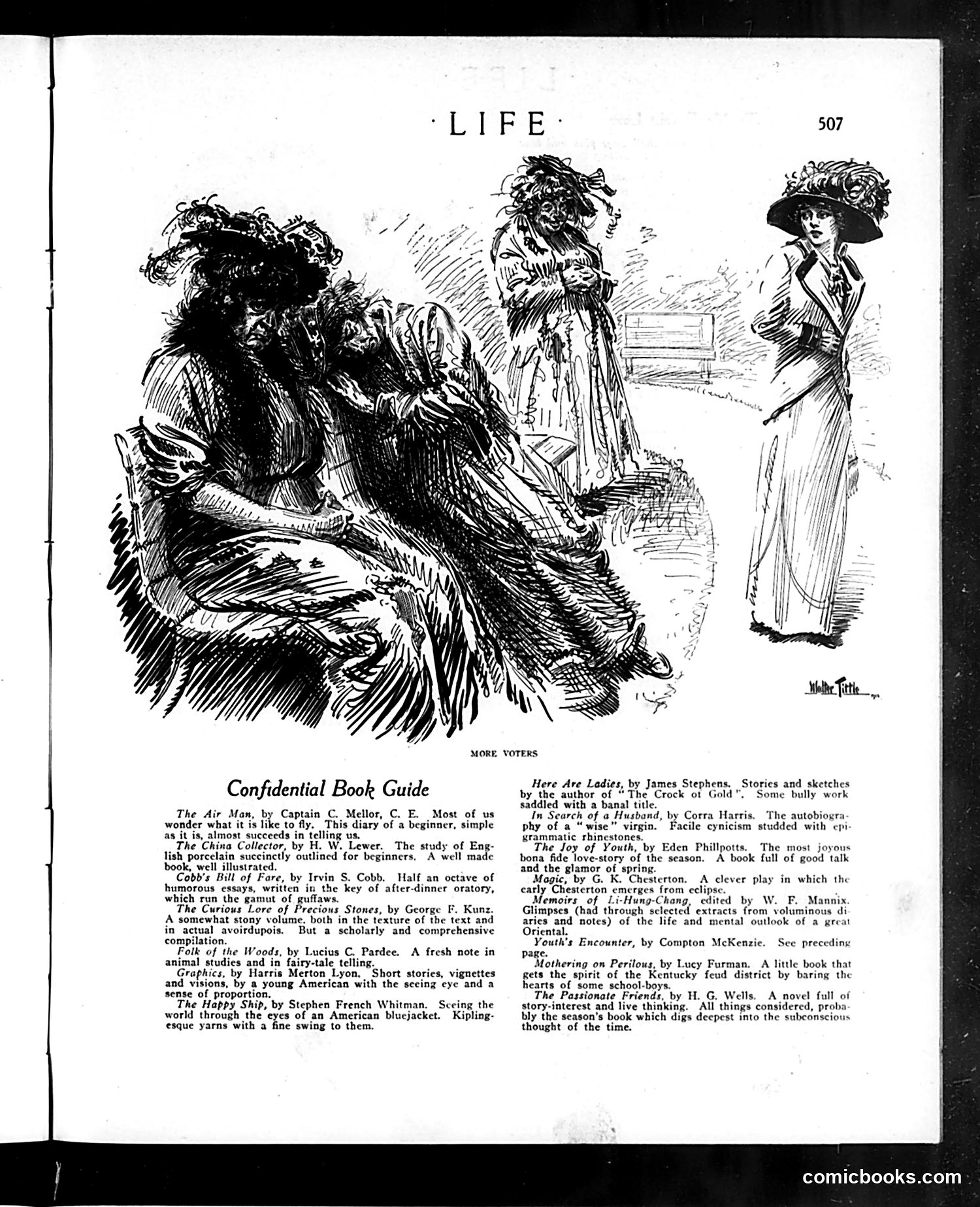
This page is primarily a **book review section**, not a political cartoon. The small illustration at the top labeled "MORE VOTERS" appears to be a satirical sketch showing women in fashionable dress, likely commenting on women's suffrage—a major political issue of the early 20th century. The joke seems to reference expanding the electorate: the well-dressed women represent newly enfranchised or soon-to-be voters. The sketch's style and the page's positioning suggest Life magazine was making a contemporary social comment about women gaining voting rights. The bulk of the page consists of brief, witty reviews of current books, written in Life's characteristic caustic style—offering clever one-liners about each work's merit or pretension rather than thorough analysis.
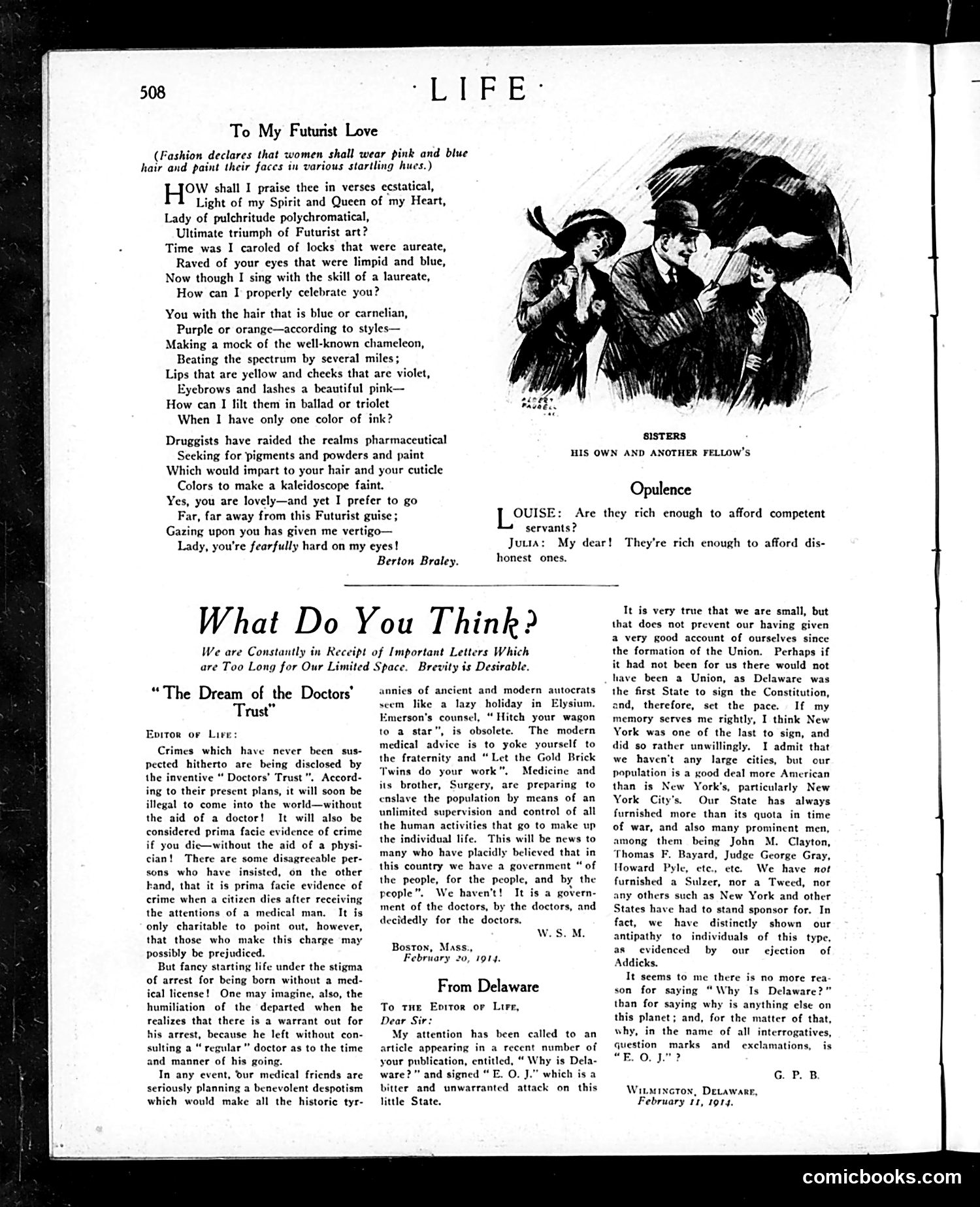
**"To My Futurist Love" (Poem by Berton Braley):** This satire mocks the Futurist art movement's radical approach to women's appearance. The poem's speaker struggles to praise his lover in traditional poetic language when she adopts the Futurist fashion of wearing multicolored hair (blue, purple, orange, pink) and face paint in jarring hues. The joke is that modern artistic innovation has made conventional romantic expression impossible—he can only describe her with one color of ink, yet she presents a "kaleidoscope" of colors. The accompanying illustration shows women with exaggerated, theatrical styling typical of Futurist aesthetic experiments. The satire gently ridicules both Futurism's extreme anti-traditionalism and the impracticality of its fashion declarations. **"Opulence" (Comic Dialogue):** Two sisters discuss whether wealthy people can afford honest servants—a brief class-conscious joke about wealth and moral compromise. **"The Dream of the Doctors' Trust":** This letter attacks physicians organizing into a monopolistic "trust," sarcastically imagining a dystopian future where medical licensing controls all aspects of life, from birth through death, enslaving the population under doctor-controlled despotism.
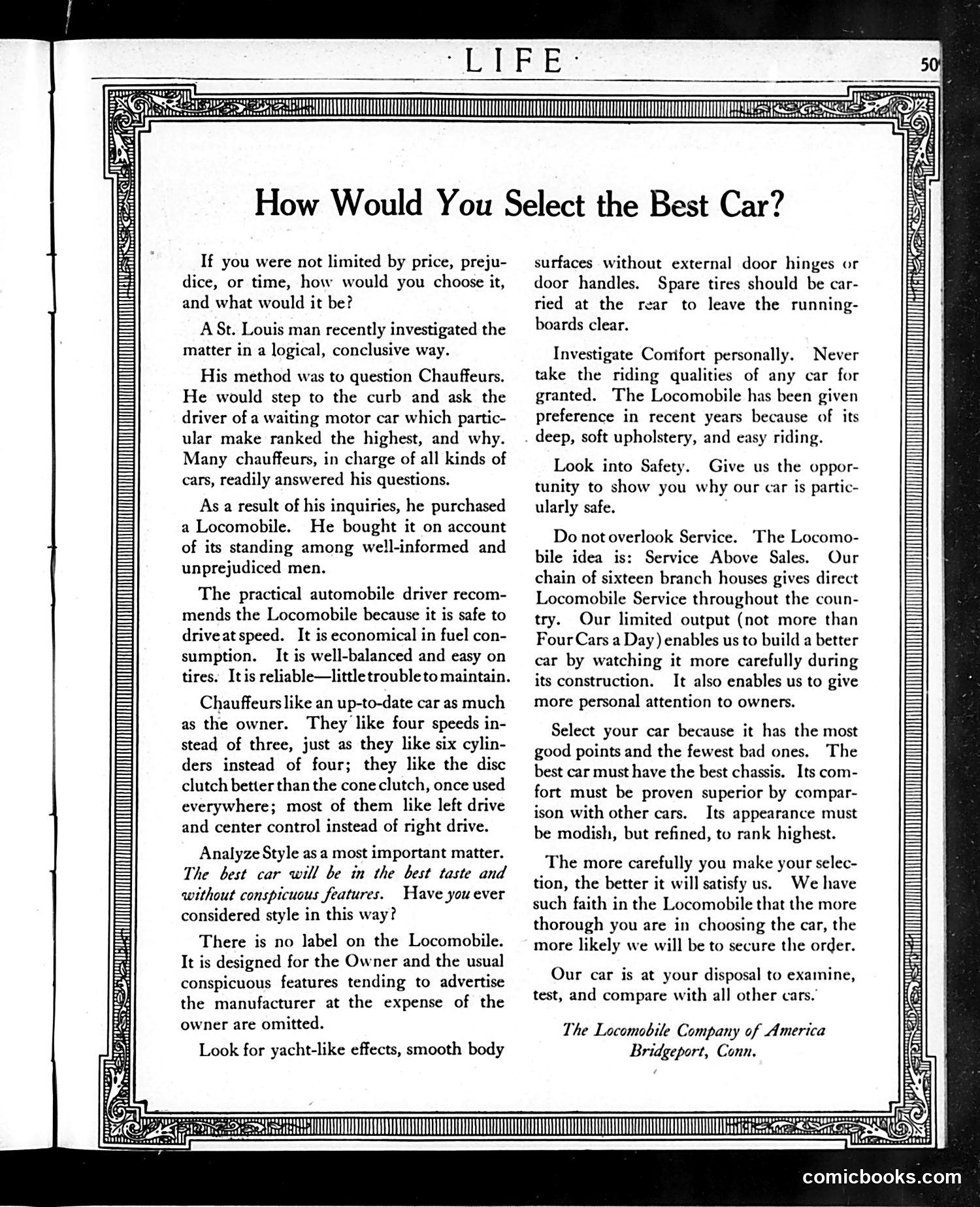
This is not a cartoon or satirical piece—it's a straightforward automobile advertisement disguised as consumer advice. The Locomobile Company presents itself as offering impartial guidance on car selection, but the entire article is marketing copy promoting their product. The "satire" (if any) lies in the framing device: a St. Louis man supposedly conducted objective research by interviewing chauffeurs—workers whose professional judgment would carry credibility. This appeals to readers' desire for expert opinion while subtly suggesting that knowledgeable professionals (not manufacturers' claims) endorse Locomobiles. The text emphasizes luxury features (deep upholstery, yacht-like design, refined appearance) and service superiority rather than price, targeting affluent early-20th-century buyers. The company's confidence that thorough inspection will "secure the order" assumes their product will win direct comparison. This represents early automotive marketing positioning quality and service over flashy advertising.
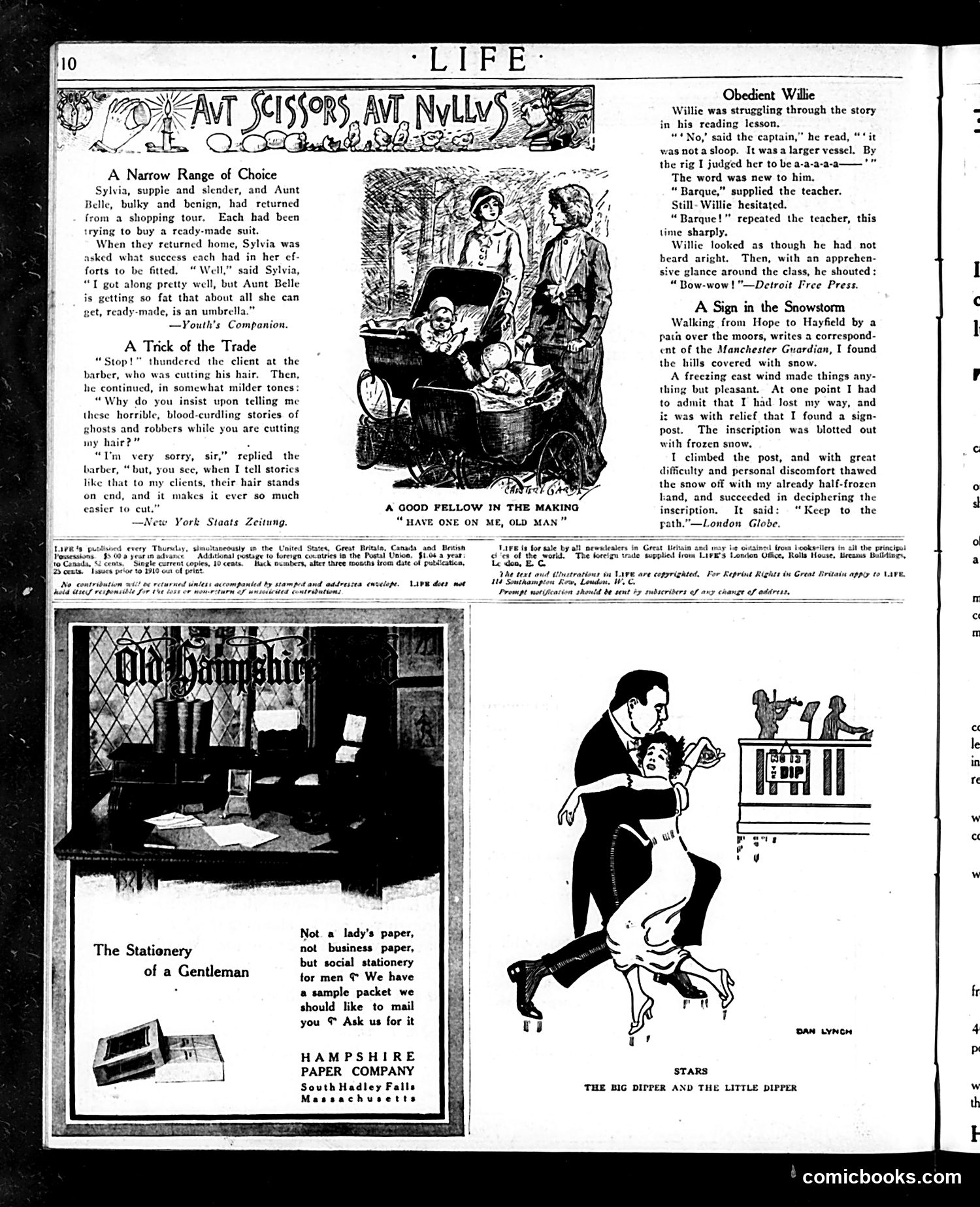
This page contains several brief humorous anecdotes typical of early 20th-century American satirical magazines: **"A Narrow Range of Choice"** jokes about ready-made clothing's limited sizes—Aunt Belle is so fat that only an umbrella fits her. **"A Trick of the Trade"** satirizes a barber's dubious technique: he deliberately tells scary stories to make clients' hair stand on end, making it easier to cut. The joke mocks both the barber's dishonesty and the gullibility of clients. **"Obedient Willie"** depicts a schoolboy mispronouncing "barque" (a sailing ship) as "bow-wow," mistaking a nautical term for a dog's bark. **"A Sign in the Snowstorm"** is an anecdote about a traveler who laboriously clears snow from a signpost only to find it merely says "Keep to the path"—anticlimactic advice. The page also includes an advertisement for Hampshire Paper Company stationery. These are lighthearted, family-friendly humor pieces with no political content—typical filler material for early-1900s publications.
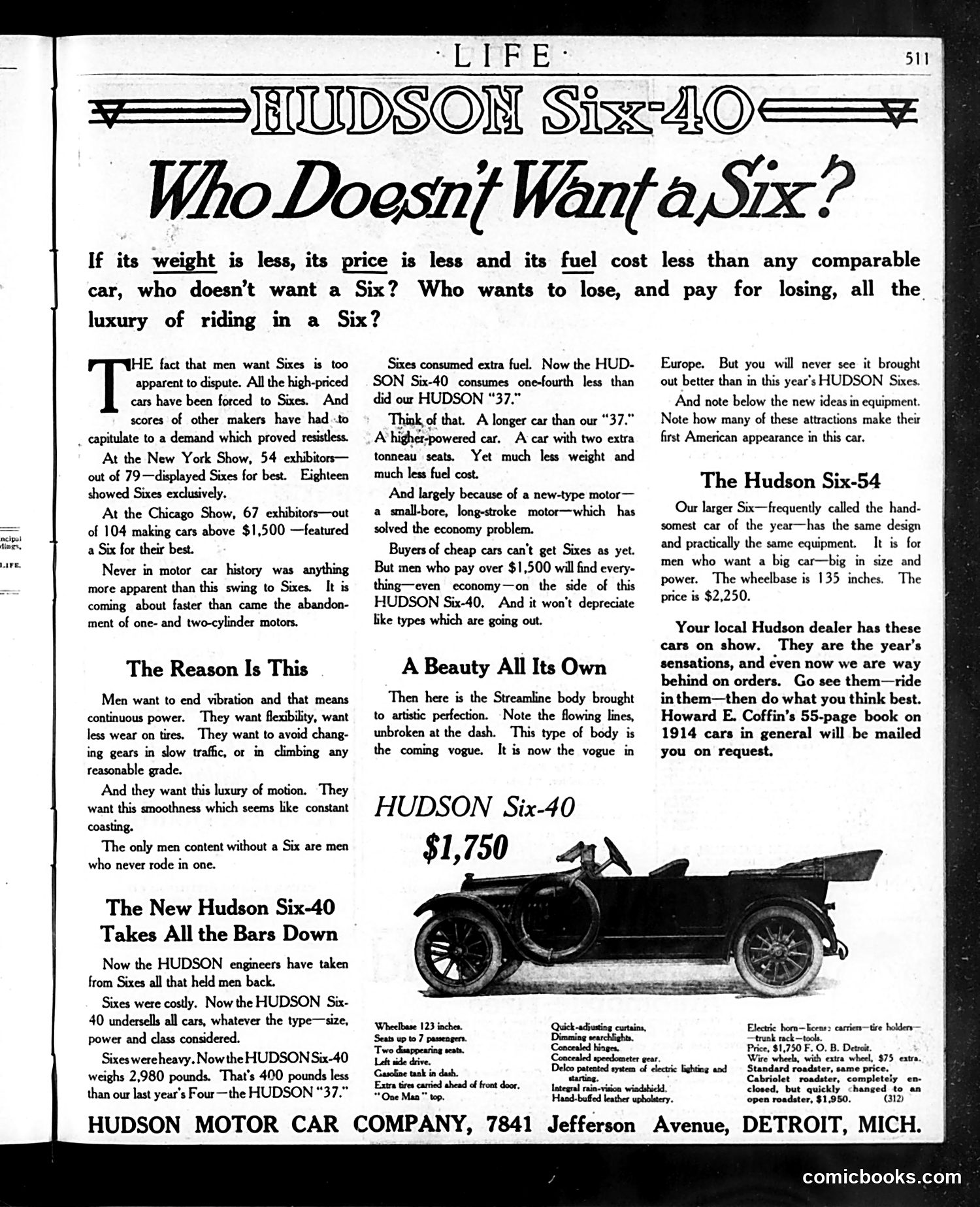
This is **entirely an advertisement**, not satire or political content. It's a full-page promotional piece for Hudson Motor Car Company's new Six-40 automobile, published in *Life* magazine (page 511). The "joke" in the headline—"Who Doesn't Want a Six?"—is rhetorical advertising copy, not satire. The page argues that six-cylinder cars have become the market standard, and Hudson's new model undersells competitors while offering superior performance. Key selling points highlighted: lighter weight (2,980 lbs), lower fuel consumption (one-fourth less than previous Hudson "37" model), smoothness, and streamlined body design. Two models are promoted—the Six-40 at $1,750 and the larger Six-54 at $2,250. The actual illustration shows a side-view of the Six-40 automobile. This represents typical early-1910s automotive advertising emphasizing technological innovation and value proposition to affluent buyers ($1,500+ car market).
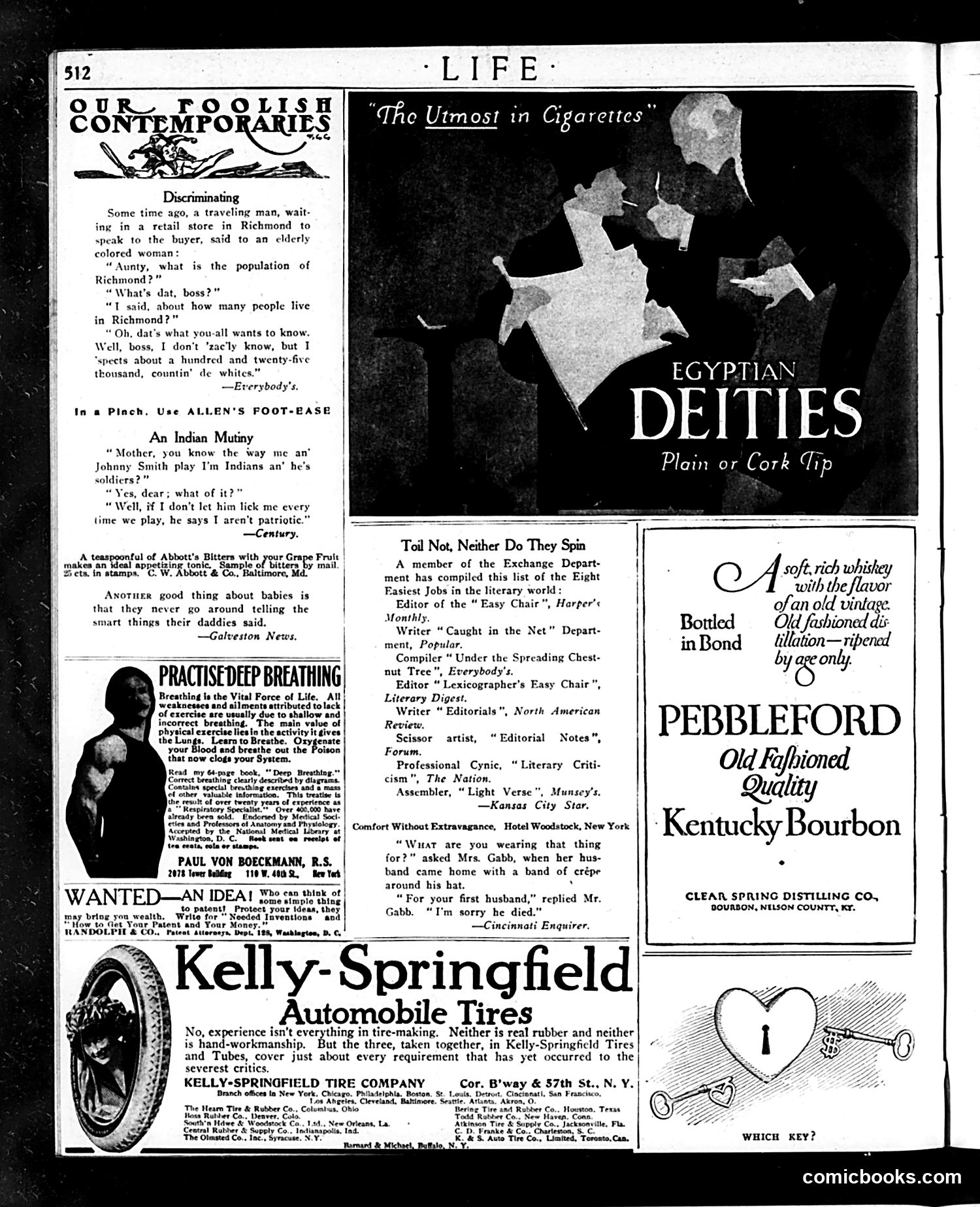
This page comprises mostly **advertisements and humor snippets** rather than political cartoons. The content reflects early 20th-century American racial attitudes: ## "Our Foolish Contemporaries" Section The main humor column includes racist jokes. One depicts an elderly Black woman in Richmond asked about the city's population; she responds she estimates "about a hundred and twenty-five thousand, countin' de whites"—the joke's premise being that she wouldn't naturally count Black residents as part of the population worth mentioning. Another joke portrays Native Americans stereotypically. ## Advertisements The page features period product ads (Kelly-Springfield tires, Pebbleford bourbon, Egyptian Deities cigarettes) typical of Life's commercial content. The page demonstrates how casual racial caricature and offensive stereotypes were embedded in mainstream American humor and advertising of this era—now recognized as deeply problematic but presented here without irony or critique.
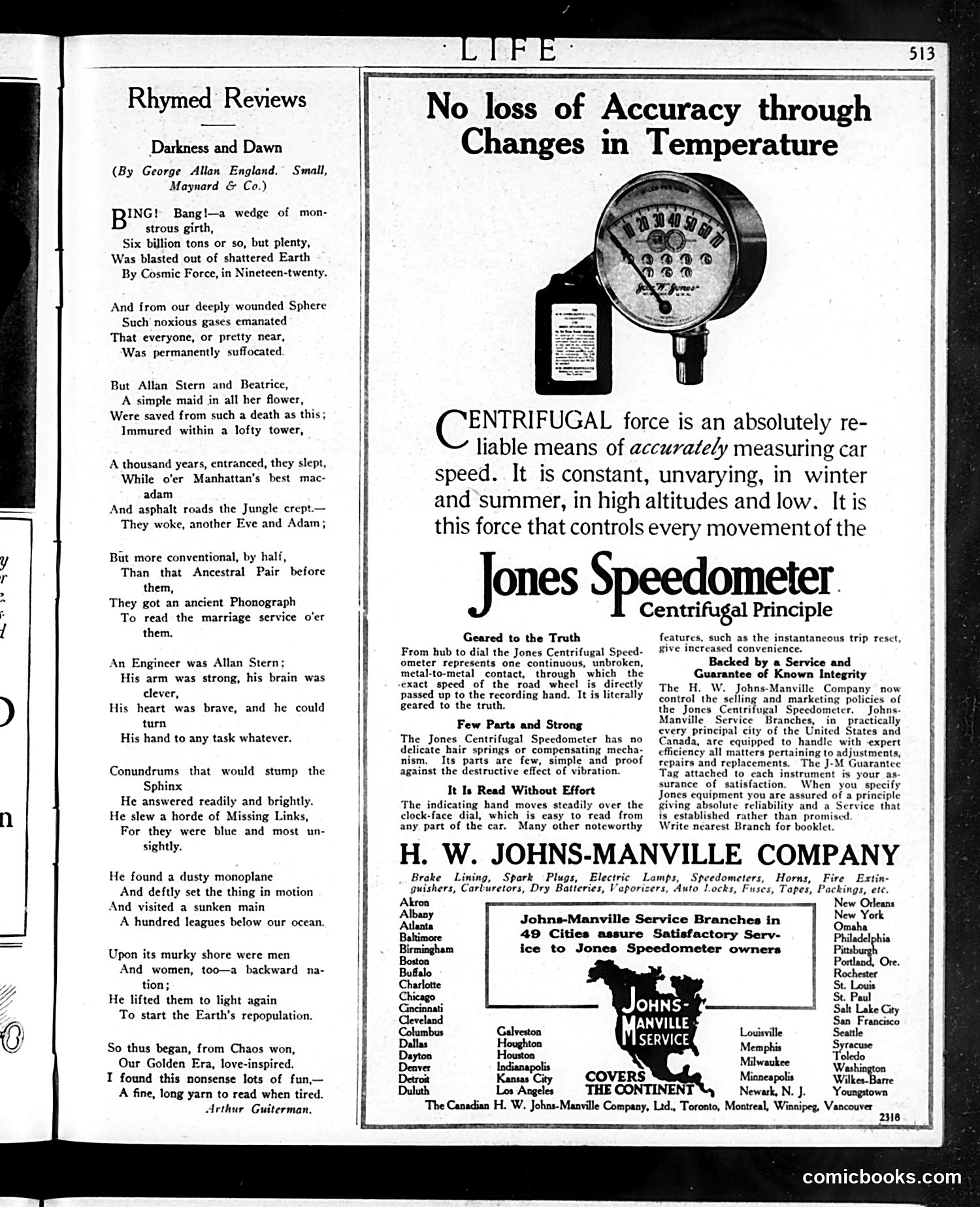
This page contains a **book review in verse** (left) and a **product advertisement** (right), typical of Life magazine's mixed content. **The Poem**: A humorous review of George Allan England's science fiction novel *Darkness and Dawn*. The satirical summary describes a 1920 cosmic catastrophe that kills nearly all humanity. Two survivors—Allan Stern (an engineer) and Beatrice—awaken 1,000 years later to a jungle-covered Manhattan. The verse mocks both the melodramatic plot and the convenient "second Adam and Eve" trope, noting they're "more conventional" than the biblical pair—even using a phonograph to conduct their marriage ceremony. **The Advertisement**: The Jones Speedometer, a car speedometer using centrifugal force technology. This occupies most of the page and emphasizes reliability across temperature variations and altitudes. H.W. Johns-Manville Company (a major industrial manufacturer) controlled distribution through 49 service branches nationwide, offering guaranteed repairs and maintenance. The juxtaposition—dystopian fiction against commercial optimism about automotive precision—is purely editorial layout, not intentional satire.
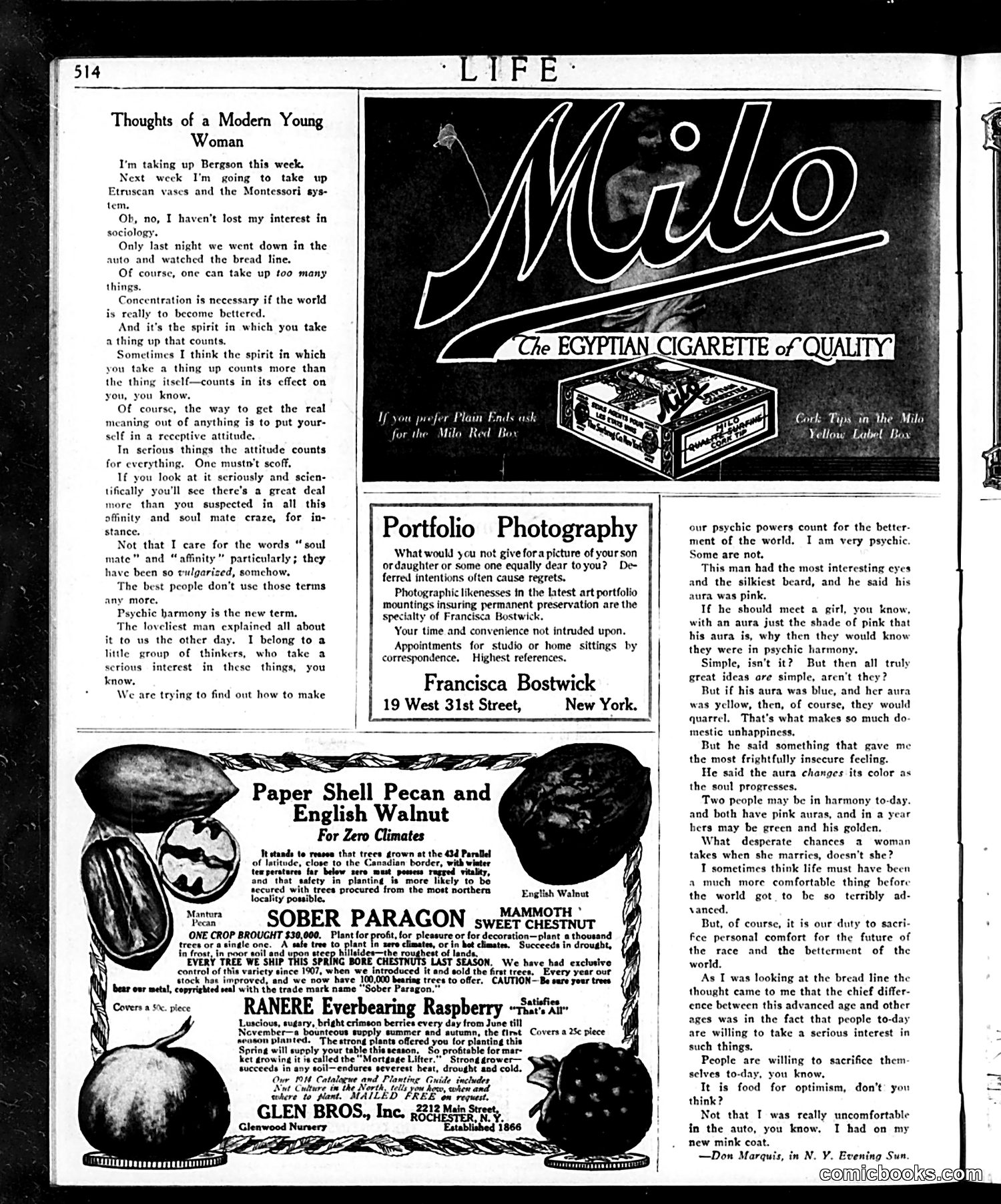
This page is primarily **advertising**, not political satire. The main content is a satirical column titled "Thoughts of a Modern Young Woman" that mocks the intellectual pretensions and scattered interests of affluent women of the era. The satire targets a young woman who claims serious intellectual pursuits (reading Bergson philosophy, studying Etruscan vases, the Montessori educational system) while simultaneously admitting to frivolous pastimes like watching breadlines from automobiles and obsessing over "psychic harmony" and "auras." The piece ridicules how she performs depth of thought while intellectually dabbling superficially in whatever seems fashionable. The column particularly mocks the period's interest in pseudo-spiritual concepts like "soul mates" and "psychic auras," presenting them as pretentious affectations replacing older, equally shallow romantic terminology. The remainder of the page contains typical period advertisements for photography services, fruit trees, chestnuts, and pecans—standard commercial content with no satirical intent.
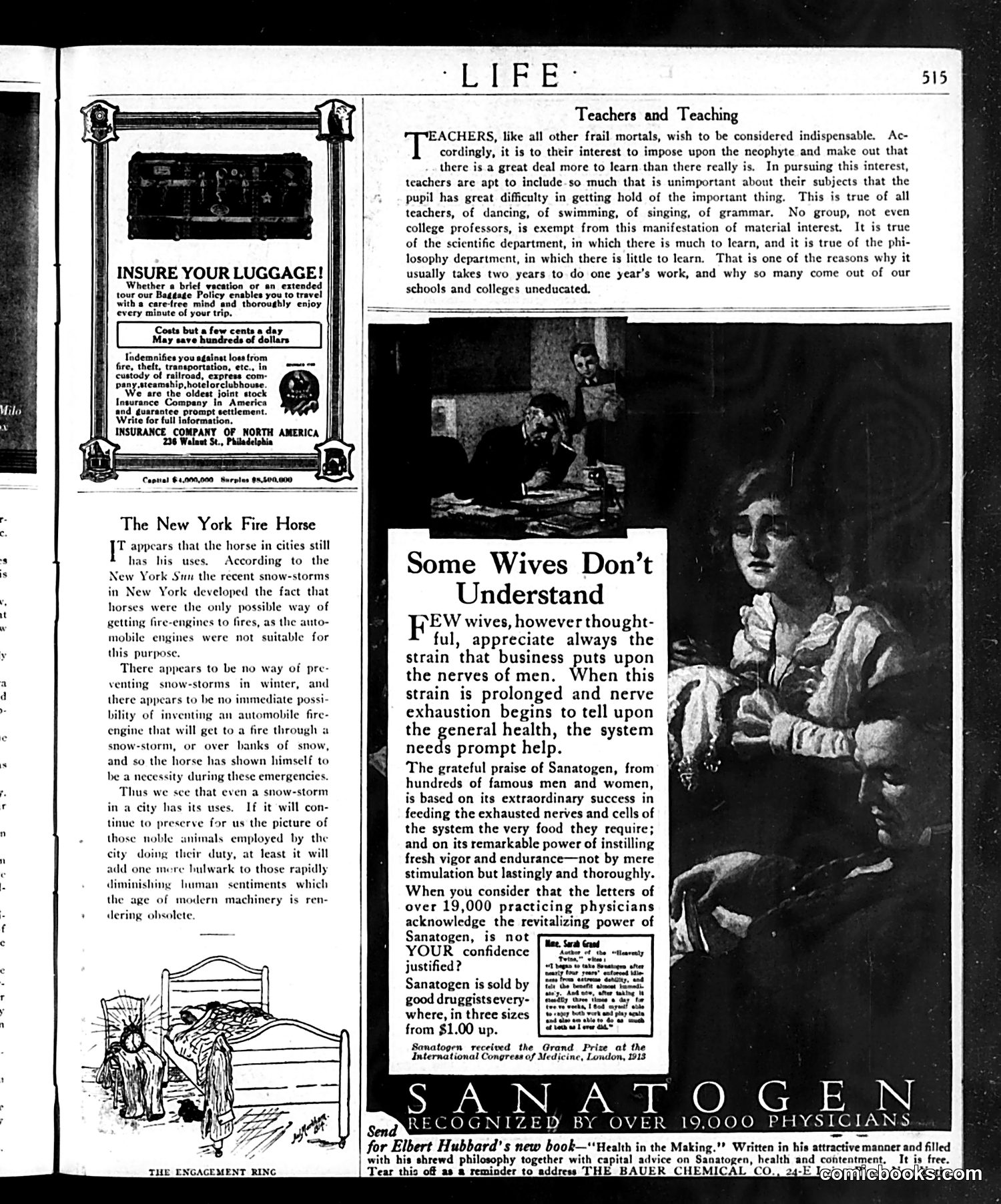
This page combines editorial commentary with period advertising, typical of early 20th-century Life magazine. **"Teachers and Teaching"** satirizes educators' tendency to overcomplicate subjects, making material seem more complex than necessary. The author argues teachers—from dance to grammar instructors—inflate content importance to appear indispensable, causing students to waste time on non-essentials. Philosophy is singled out as particularly guilty, since "there is little to learn" yet instruction takes excessive time. The satire blames this for students graduating "uneducated." **"The New York Fire Horse"** celebrates horses' continued utility during recent snowstorms, when automobiles proved unsuitable for fire response. The piece uses this practical necessity to nostalgically defend horses against mechanical obsolescence, framing snow emergencies as preserving "noble animals" and "human sentiments" against modernity's march. The **Sanatogen advertisement** targets wives, suggesting they don't understand business strain's nervous toll on men. The product claims to restore vitality through "feeding exhausted nerves," endorsed by 19,000 physicians. This reflects period anxieties about male workplace stress and gendered domestic roles.
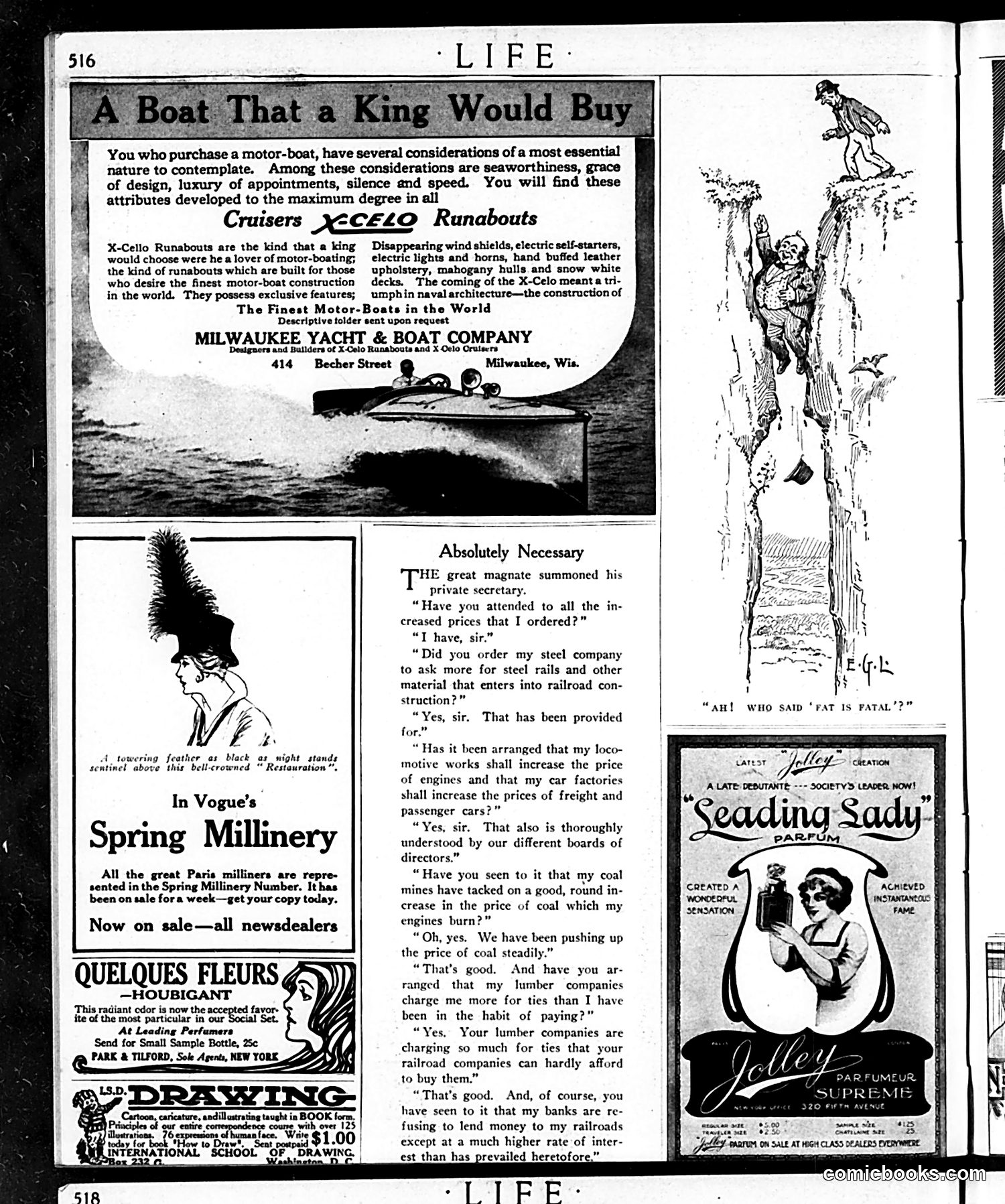
This cartoon satirizes monopolistic business practices and price-fixing by wealthy industrialists. The unnamed "great magnate" represents robber barons of the early 20th century who controlled multiple industries—steel, railroads, locomotives, coal, and lumber—and manipulated prices across their interconnected enterprises. The joke's dark irony: the magnate orchestrates systematic price increases *within his own companies*, forcing his railroad division to pay inflated costs from his steel, coal, and lumber operations. His secretary confirms each corrupt arrangement approvingly. This creates a circular scheme where the wealthy industrialist extracts profits while appearing to operate separate businesses. The satire targets the era's lack of antitrust enforcement and exposes how monopolists could manipulate markets with impunity. The "absolutely necessary" title mocks the magnate's casual assumption that such collusion is simply routine business practice—highlighting how normalized corruption had become among the wealthy and powerful.
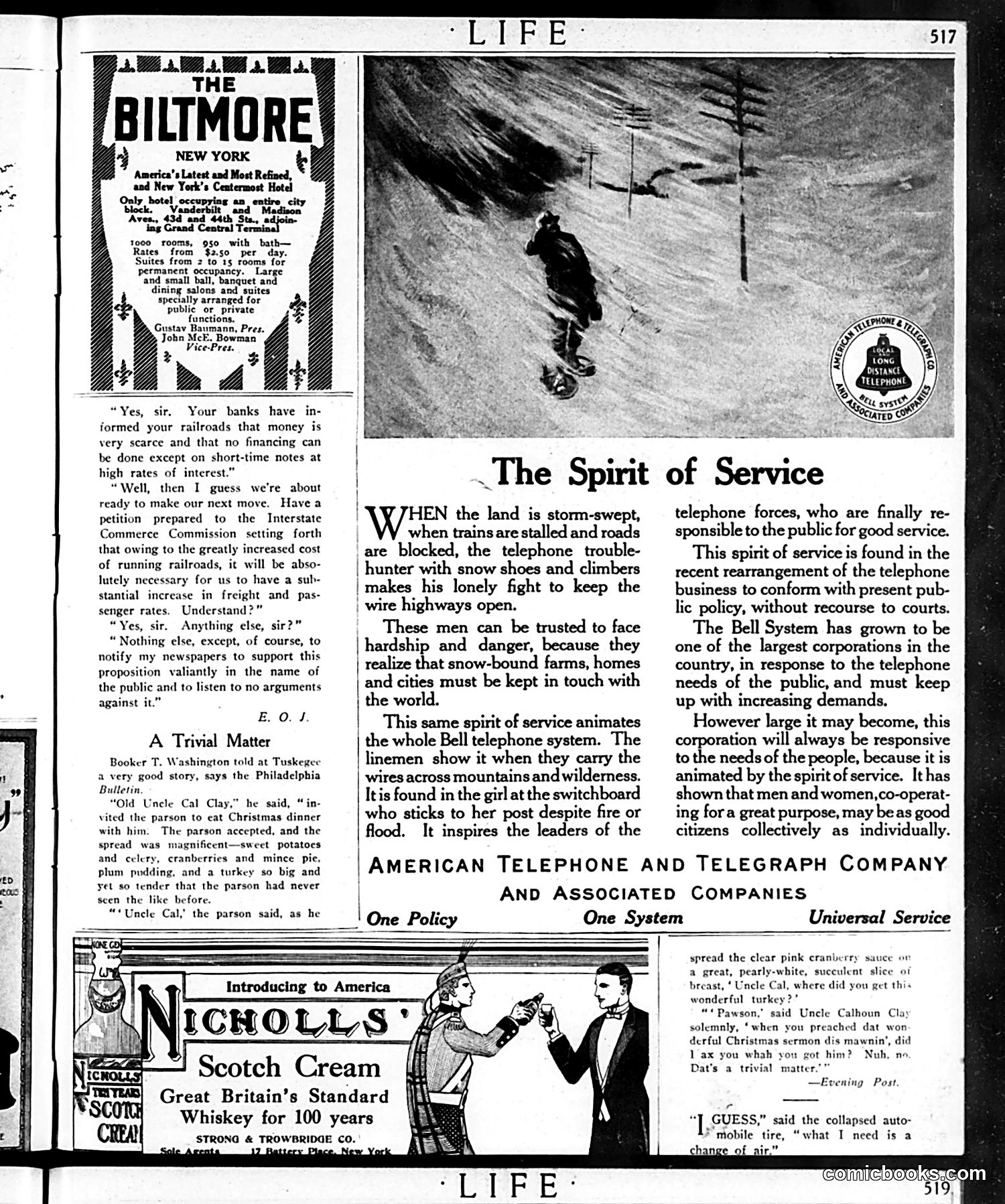
This page contains a **satirical dialogue about railroad monopolies and price-fixing** (left side), presented as overheard conversation between a railroad executive and subordinate. The satire targets corporate manipulation: the executive instructs his associate to fabricate financial hardship claims to justify rate increases to the Interstate Commerce Commission, while simultaneously directing company newspapers to propagandize support—all "in the name of the public." The joke exposes how corporations used manufactured scarcity arguments and controlled media to justify price hikes while claiming public interest. The page also features a **Bell Telephone System advertisement** disguised as editorial content, celebrating telephone linemen's "spirit of service" during emergencies—ironic given the contemporaneous critique of telephone monopoly practices. Additional content includes brief humorous anecdotes unrelated to satire, plus advertising. The satire reflects Progressive Era anxieties about corporate power, regulatory capture, and media manipulation by large trusts.
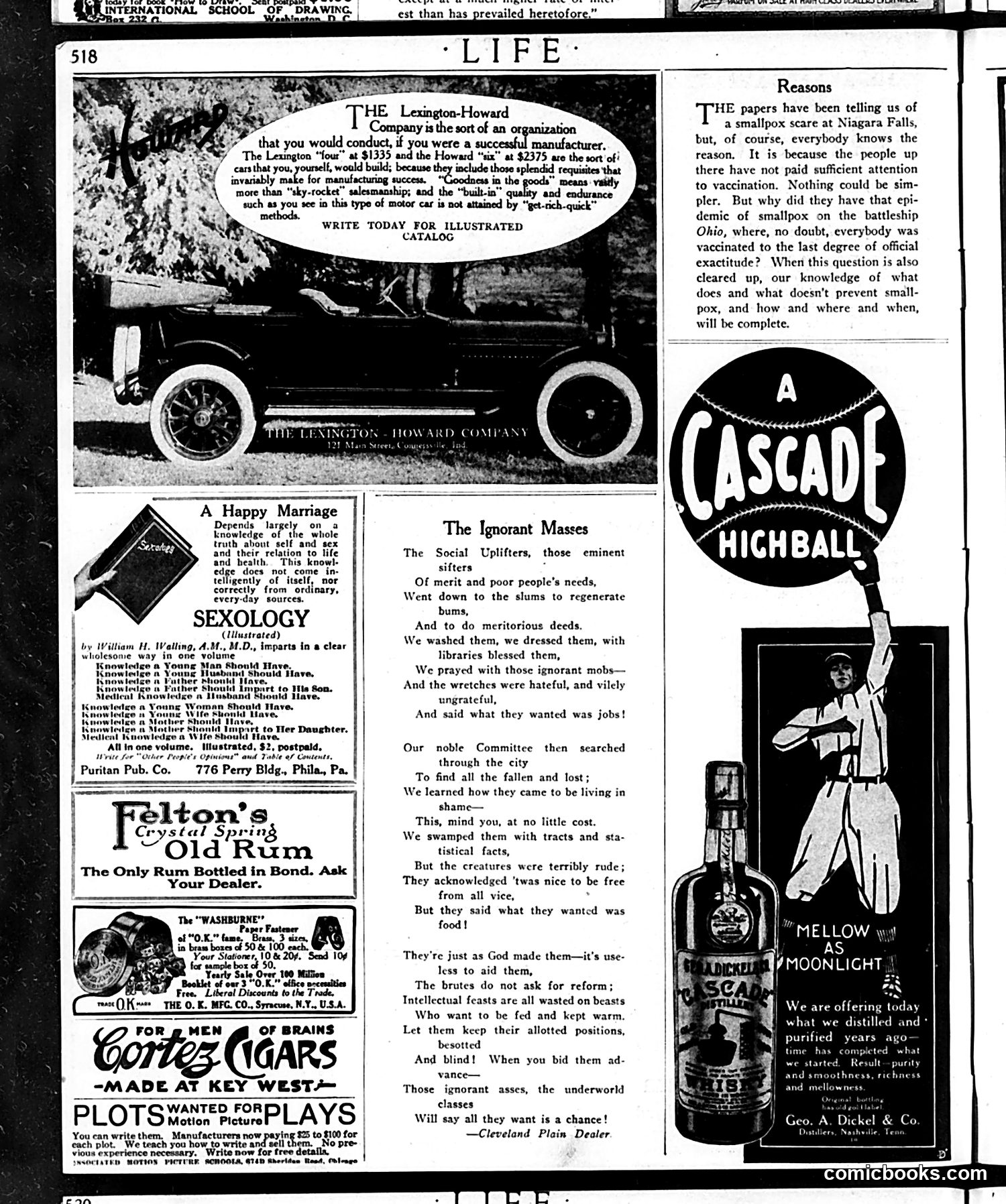
This page contains two distinct satirical pieces: **"The Ignorant Masses"** (center poem) is a scathing critique of wealthy philanthropists and social reformers. The satire mocks well-intentioned "Social Uplifters" who condescendingly attempt to help poor people through moral instruction—distributing tracts, libraries, and prayer—while completely missing what impoverished people actually need: jobs and food. The poem's repeated refrain "they wanted was jobs" and "they wanted was food" undercuts the reformers' self-satisfied charity work as fundamentally disconnected from reality. **"Reasons"** (right column) criticizes public health messaging about smallpox vaccination. It highlights the hypocrisy of authorities promoting vaccination to civilians while a fully-vaccinated battleship crew (USS Ohio) simultaneously experienced a smallpox outbreak, exposing gaps in official health knowledge. The remaining content is period advertising (automobiles, rum, cigars, educational books). The page reflects early 20th-century skepticism toward both paternalistic charity and government health claims.
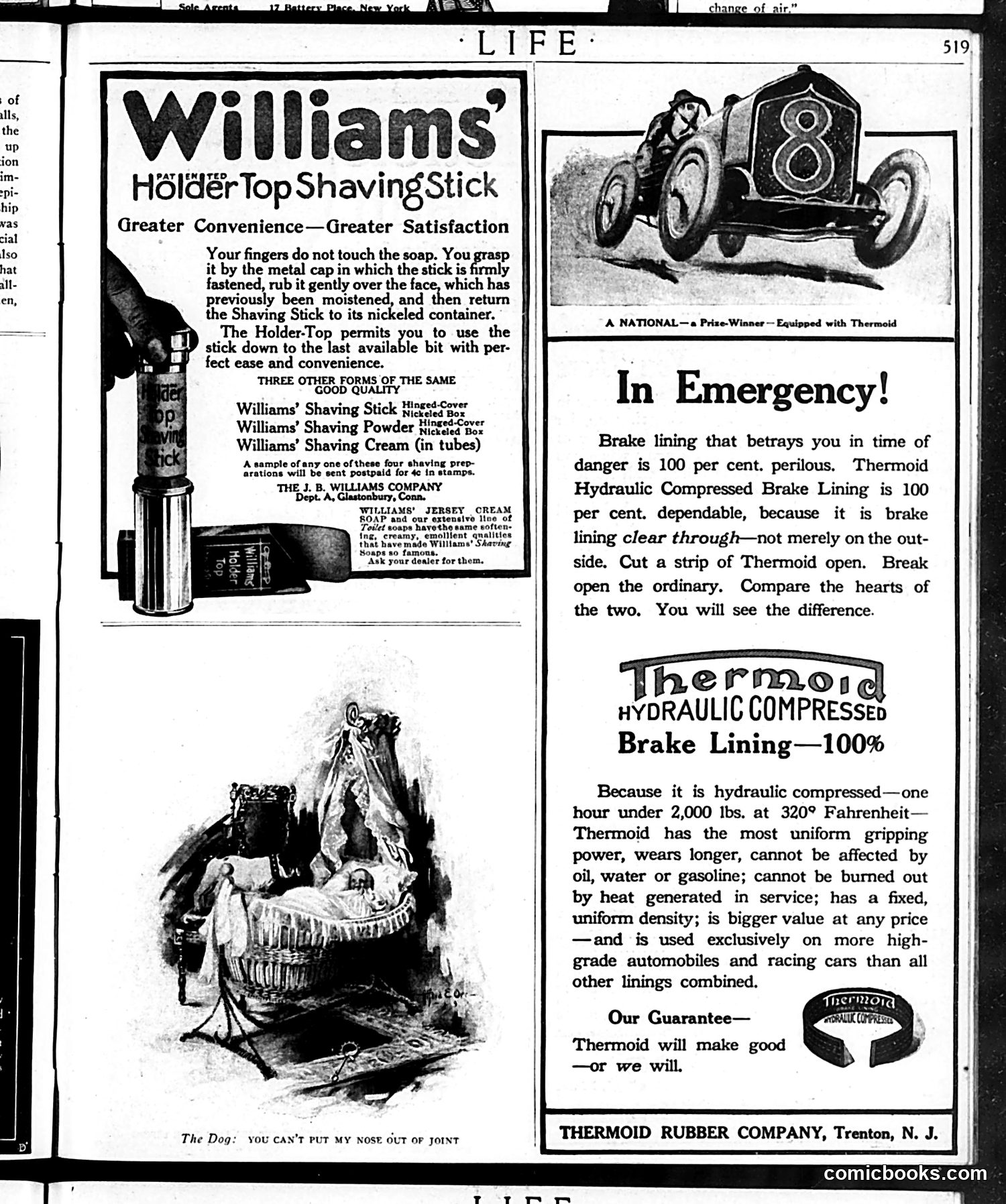
This page contains three advertisements with minimal editorial content. The Williams shaving stick ad (left) emphasizes convenience—a metal-capped holder keeps fingers clean during shaving, a selling point for early 20th-century grooming. Below it is a small cartoon captioned "The Dog: you CAN'T PUT MY NOSE OUT OF JOINT," showing a dog with a basket of baby items, likely satirizing parental displacement of pets by newborns—a common domestic humor trope of the era. The right side features Thermoid Hydraulic Brake Lining advertisements: one showing a racing car (emphasizing performance), the other warning that faulty brakes are dangerous in emergencies. The copy stresses reliability through technical superiority (hydraulic compression, heat resistance), marketing brake safety as a life-or-death selling point for automobiles—reflecting early automotive safety concerns when reliable braking was genuinely critical.
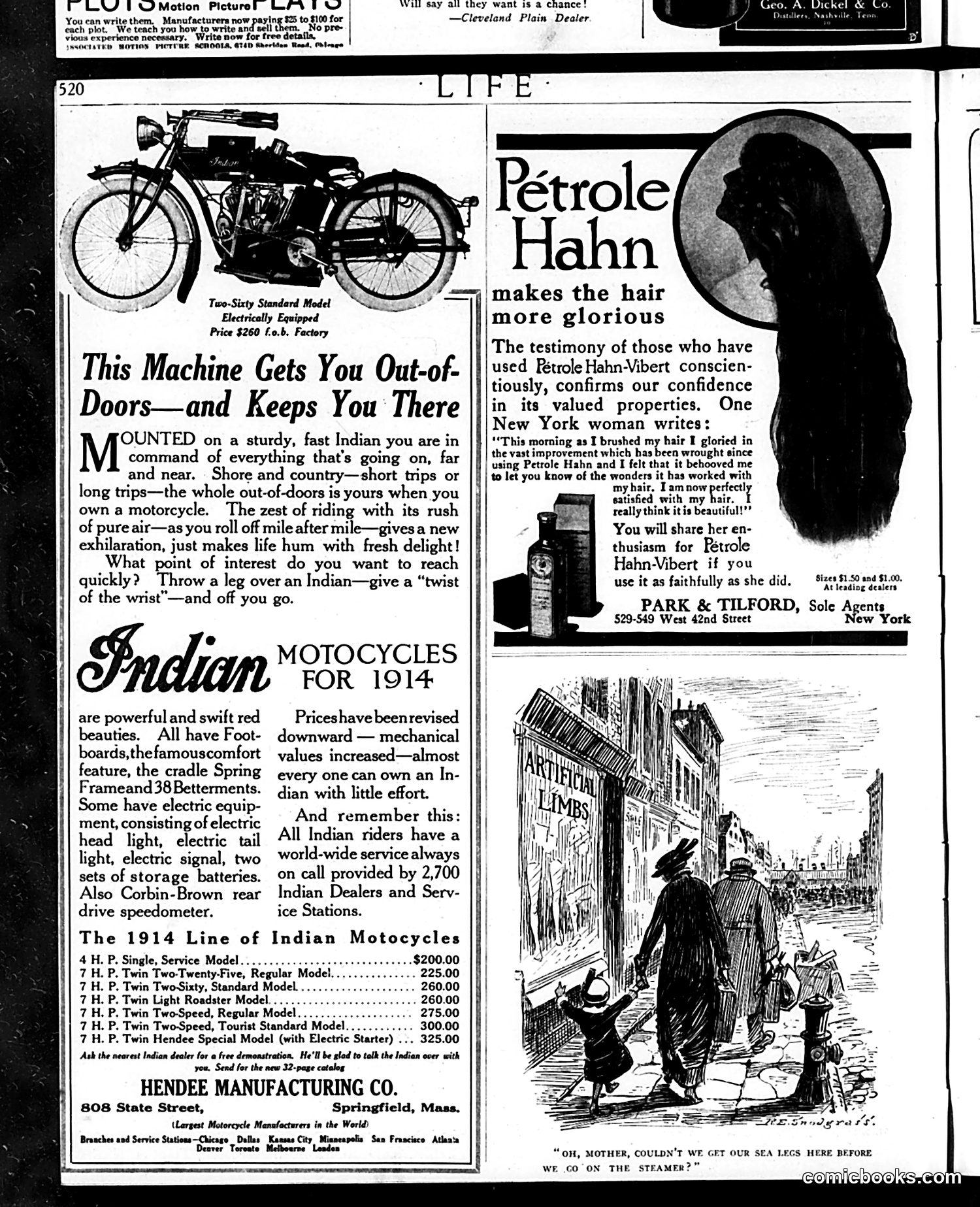
This is primarily an **advertising page** from Life magazine, circa 1914, featuring three main commercial pitches: 1. **Indian Motorcycles** (left): Promotes the 1914 line with prices ranging $200-$325. The ad emphasizes freedom and adventure ("gets you out-of-doors"), appealing to consumers seeking independence and mobility. 2. **Pétrole Hahn hair product** (right): A testimonial ad featuring a woman's silhouette, claiming the hair treatment produces dramatic improvements. The enthusiastic quote reflects period marketing tactics using customer endorsements. 3. **Small cartoon** (bottom right): A humorous sketch showing a woman and child at what appears to be a dock or waterfront, with the child asking if they can "get our sea legs" before boarding a steamer—a pun on the nautical term for adjusting to ship motion. The page reflects early 20th-century consumer culture and advertising conventions, with minimal editorial content. No political satire is evident.
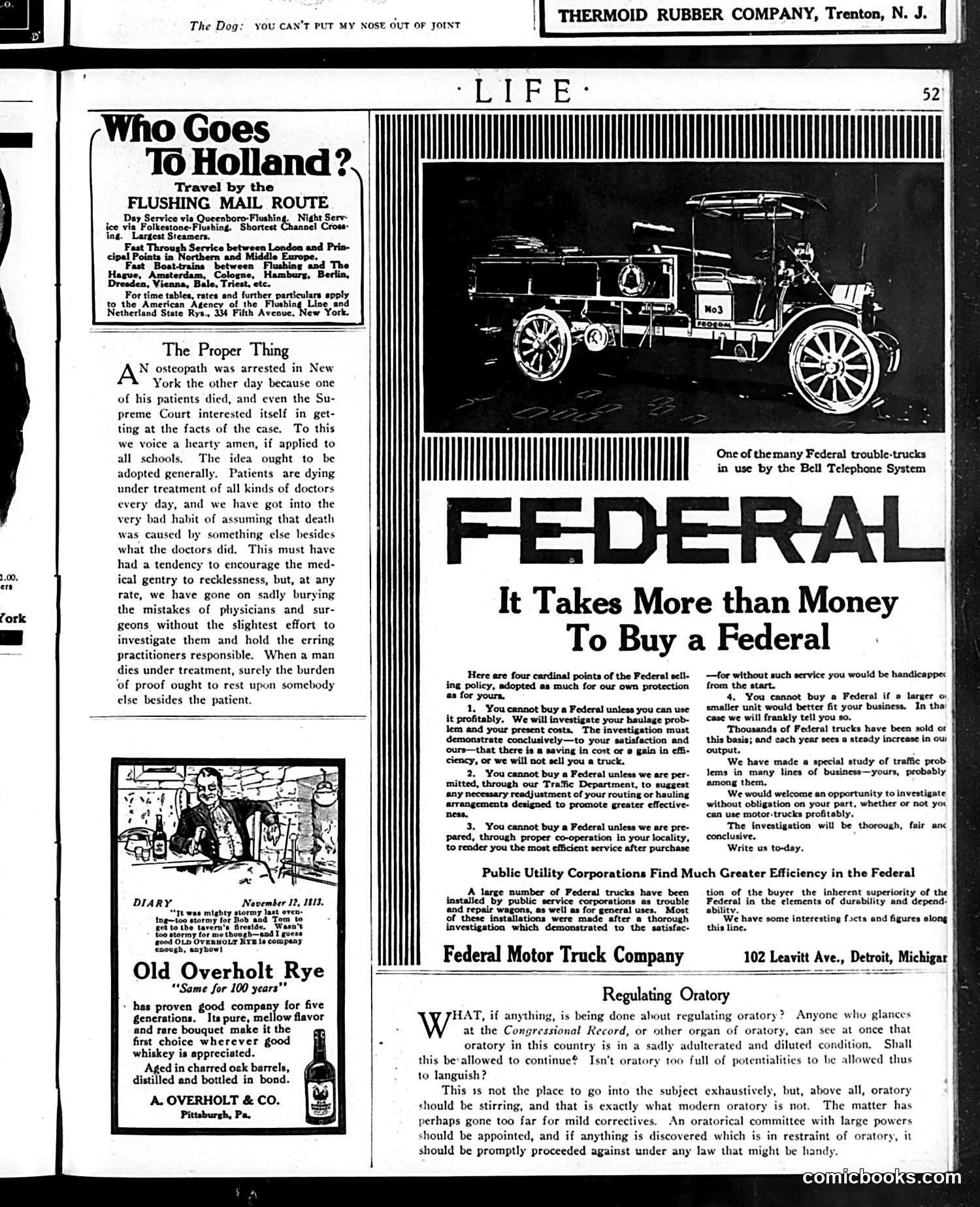
This LIFE magazine page (November 12, 1913) contains primarily **advertisements and opinion pieces** rather than political cartoons. **"The Proper Thing"** discusses an osteopath arrested in New York after a patient's death. The editorial argues courts should routinely investigate physician deaths—a call for medical accountability that was apparently novel in 1913. **The Federal Motor Truck advertisement** dominates the right side, promoting commercial trucks to businesses. Its four-point "selling policy" emphasizes that Federal won't sell trucks unless they'll be profitable for the buyer—framed as ethical business practice. The page includes vintage ads for shipping routes, whiskey ("Old Overholt Rye"), and rubber products—typical of this era's LIFE magazine content. **There are no significant political cartoons** on this page. The small illustration near "The Proper Thing" appears to be a generic cartoon, not satirical commentary. The page reflects early-20th-century concerns: medical regulation, emerging automobile commerce, and advertising-heavy magazine format.
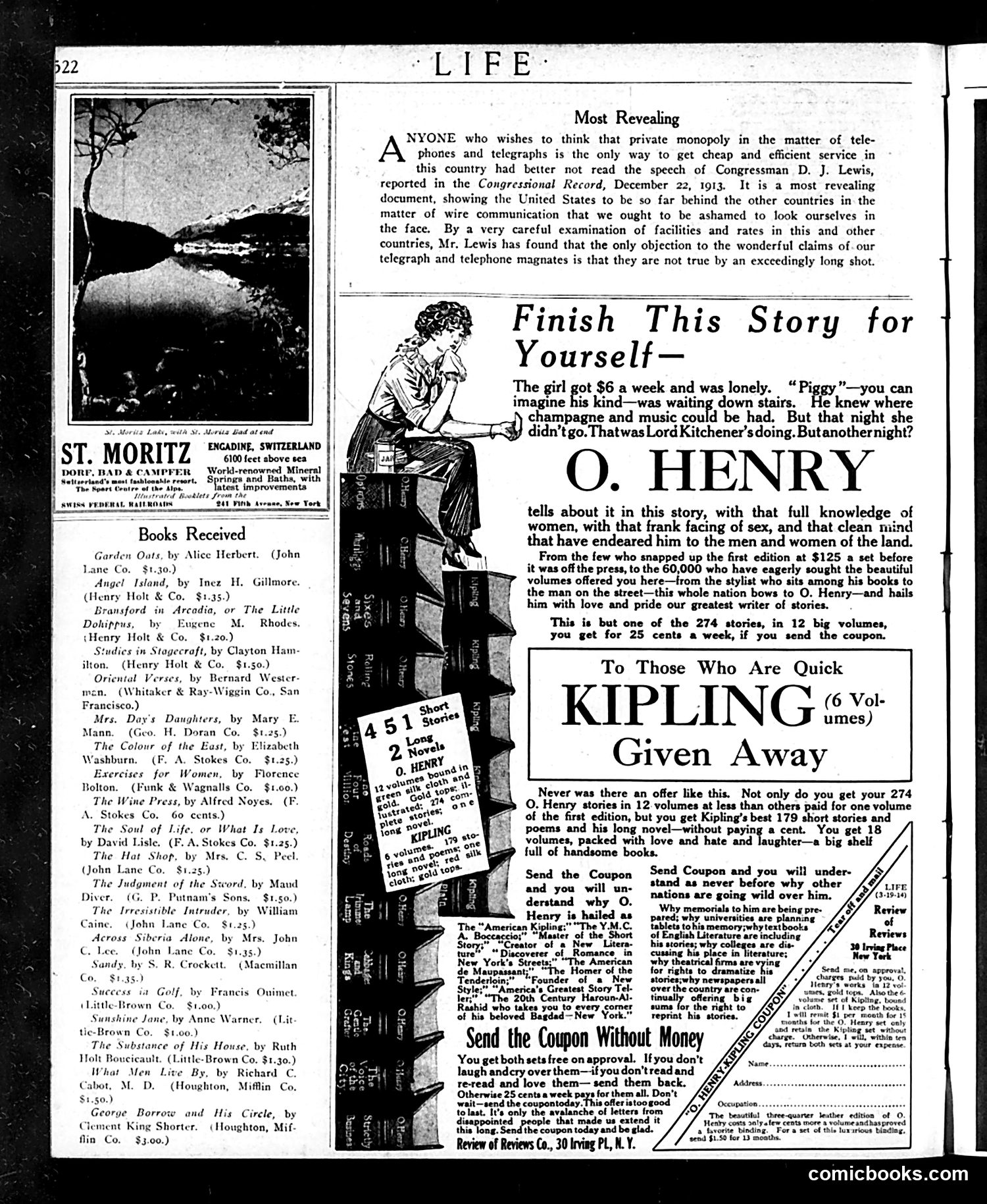
This page mixes political commentary with literary advertising. The main editorial section critiques telecommunications monopolies, citing Congressman D.J. Lewis's December 1913 Congressional Record speech. Lewis apparently documented that American telephone and telegraph rates were worse than other countries', contradicting industry claims about private monopoly being the only efficient model. The piece sardonically notes that the magnates' "wonderful claims" are "not true by an exceedingly long shot." The bulk of the page advertises O. Henry's collected stories and Kipling's works through a mail-order subscription scheme. An illustration shows a young woman choosing books over evening entertainment, with a caption referencing "Lord Kitchener's doing"—likely invoking wartime patriotism (WWI context). The "Books Received" section lists contemporary literary publications. Overall, this is primarily a commercial page using light political commentary as editorial filler.
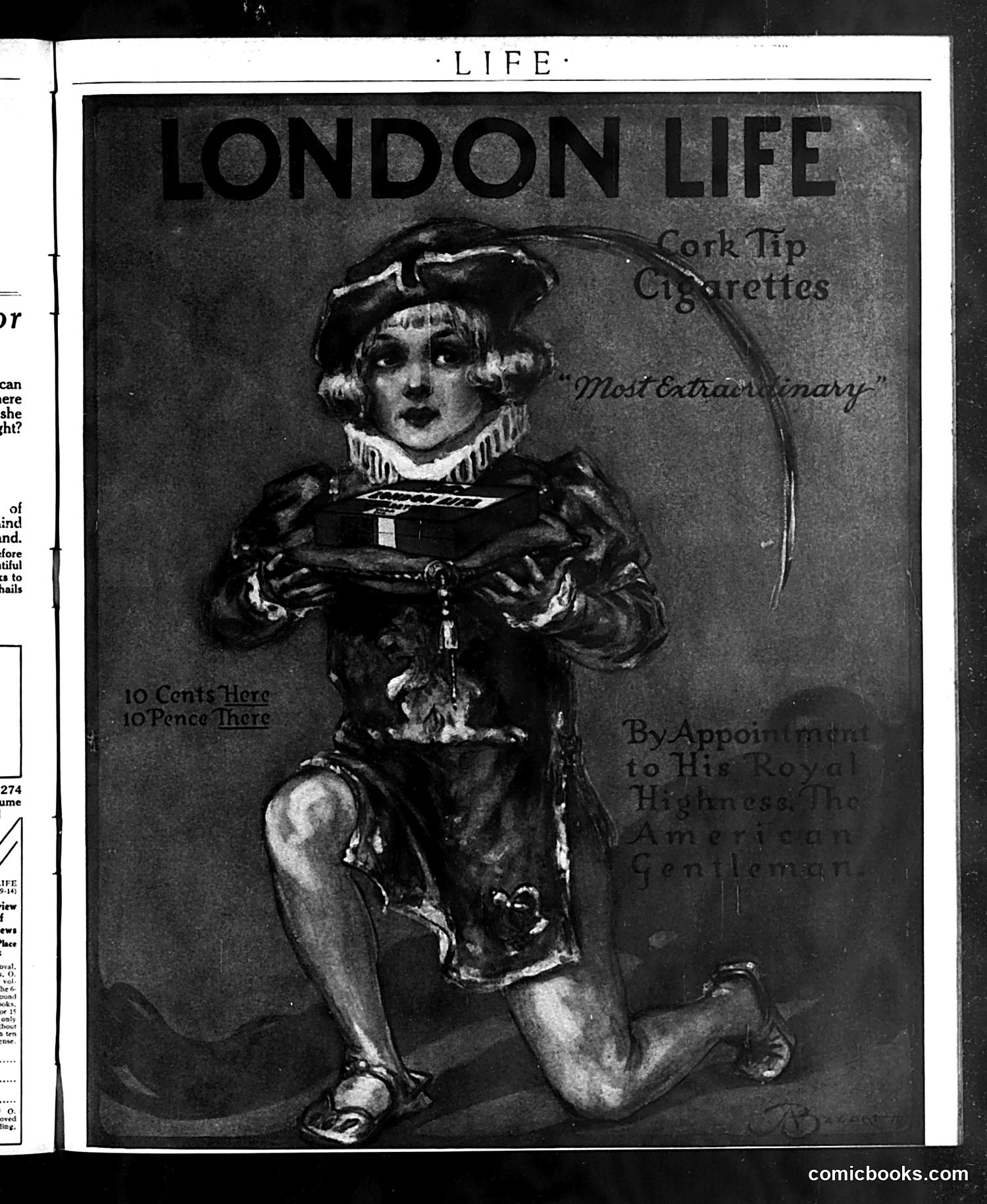
This appears to be a **Life magazine cover** advertising **Cork Tip Cigarettes**. The illustration depicts a figure in historical costume (appearing to be from the Elizabethan or Renaissance period, given the ruff collar and period dress) in a kneeling pose, holding a cigarette box. The text claims the product is "Most Extraordinary" and notes it has "By Appointment to His Royal Highness The American Gentleman" — a faux-royal endorsement typical of period advertising. The pricing visible ("10 Cents Here / 10 Pence There") suggests this targets both American and British markets. This is primarily **cigarette advertising** rather than political satire. The historical costume appears decorative rather than referencing a specific political figure or event.
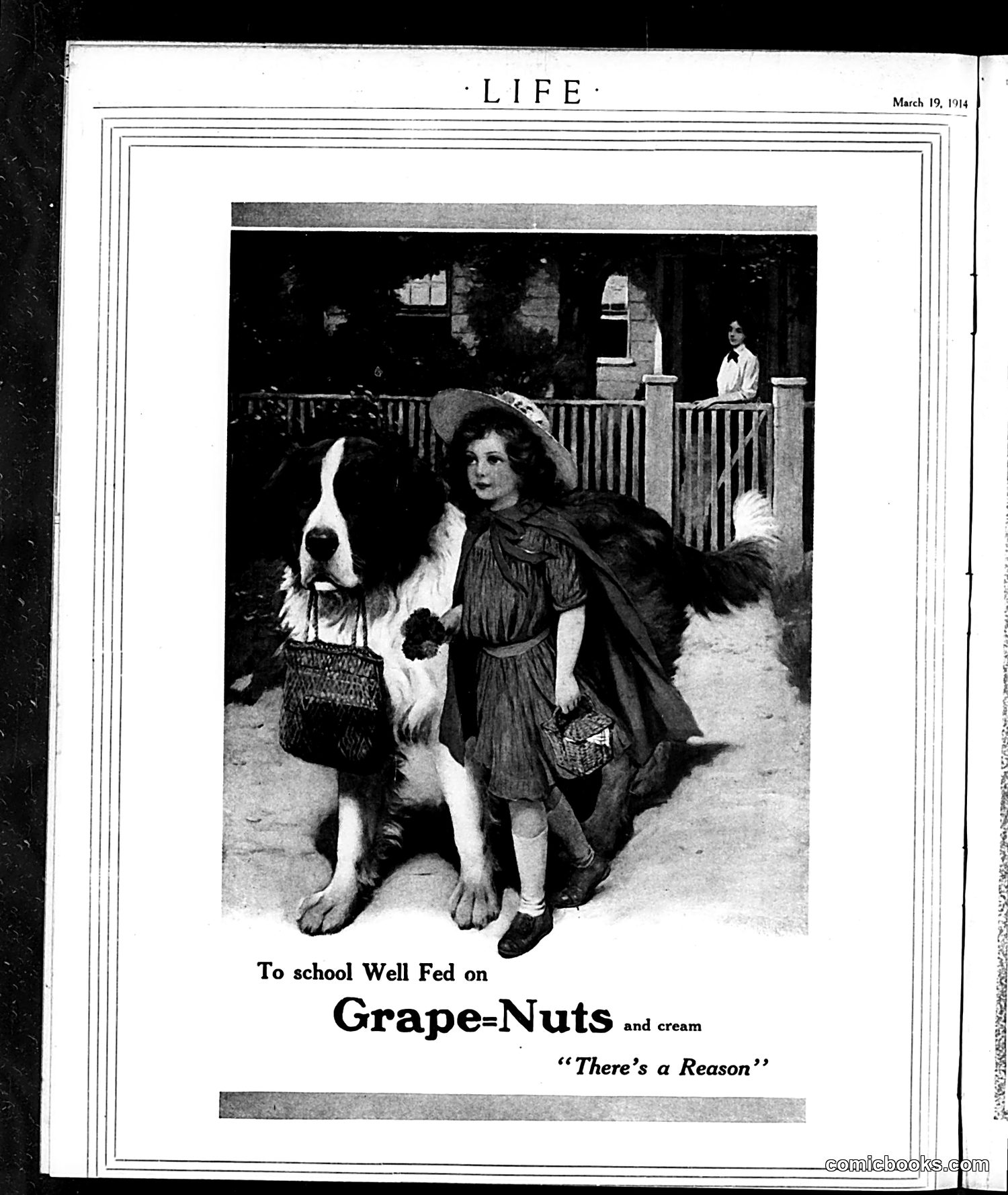
This is a **Grape-Nuts cereal advertisement** from Life magazine (March 19, 1914), not political satire or a cartoon. The image shows a young girl and a large Saint Bernard dog, both wearing small baskets, apparently heading to school together. The ad's message is straightforward: children fed on Grape-Nuts cereal will be well-nourished and healthy enough for school. The tagline "There's a Reason" references Grape-Nuts' actual advertising slogan of that era. The humor appears gentle—pairing the child with an oversized, well-fed dog suggests vitality and robust health. By modern standards, the imagery is simply a period advertisement using sentimentality and cute imagery to market breakfast cereal to parents concerned about their children's nutrition.