
Life, 1914-03-19 · page 10 of 44
Life — March 19, 1914 — page 10: what you’re looking at
What you’re looking at
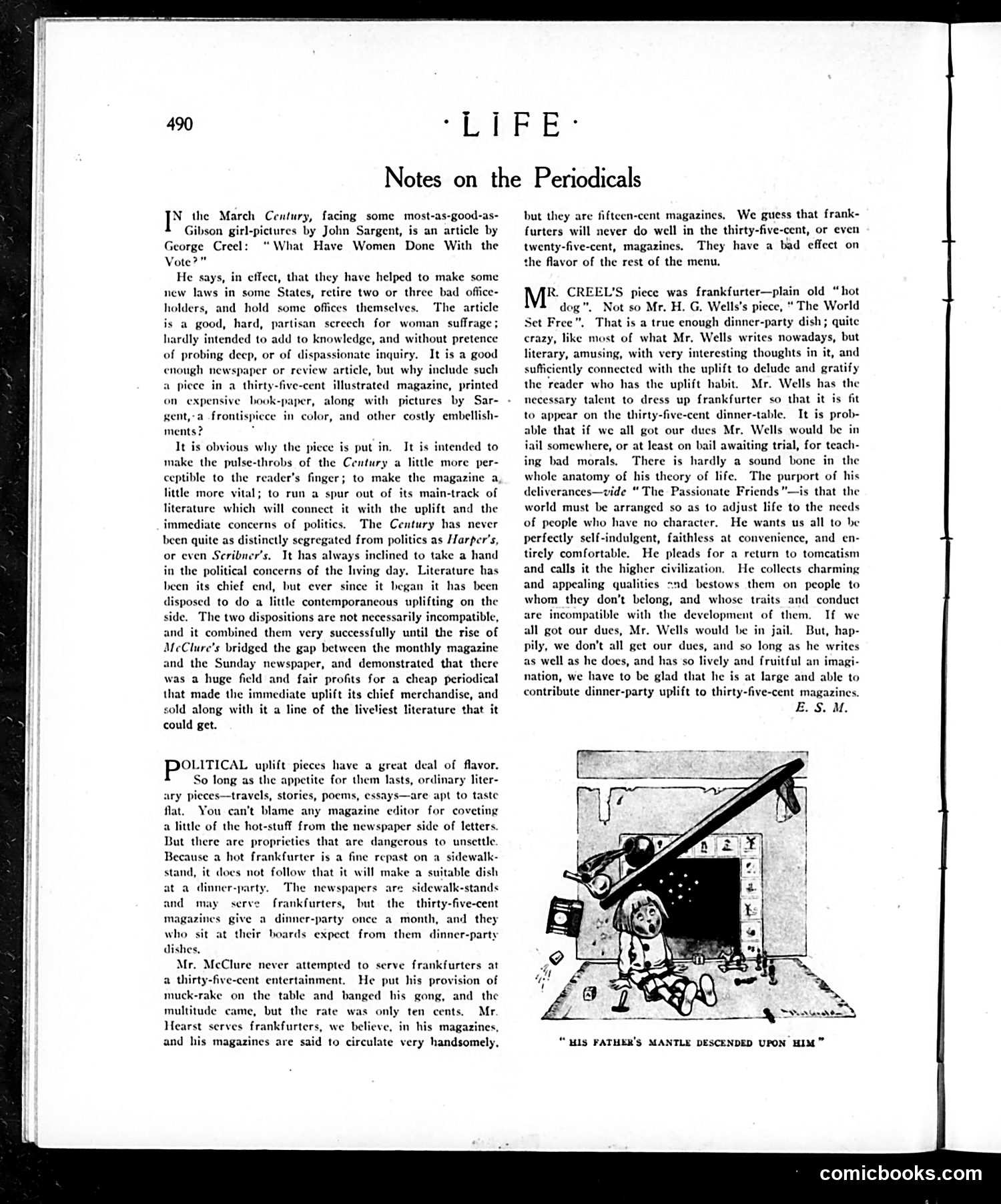
This page contains editorial commentary on magazine content rather than a political cartoon. The main illustration shows a child beneath a falling mantle or cloak labeled "HIS FATHER'S MANTLE DESCENDED UPON HIM." The text discusses how different magazines serve different audiences. It critiques the editorial choices of *Century* magazine for including a suffrage article alongside Gibson Girl pictures, arguing this creates tonal inconsistency. The author contrasts this with H.G. Wells's approach in another piece. The editorial debates whether serious political content belongs in entertainment-focused magazines, noting that while literature has traditionally engaged politics, thirty-five-cent magazines should maintain lighter "dinner-party" appeal. The illustration likely represents the burden or inheritance of serious responsibility, complementing the discussion about editorial responsibility and audience expectations.
📄 Transcribed text from this page (OCR, searchable)
Machine-transcribed from the original scan — historical spelling and the odd misread are preserved.
‘LIFE: Notes on the Periodicals I* the March Century, facing some most-as-good-as- Gibson girl-pictures by John Sargent, is an article by George Creel: “What Have Women Done With the Vote?" He says, in effect, that they have helped to make some new laws in some States, retire two or three bad office- holders, and hold some offices themselves. The article is a good, hard, partisan screech for woman suffrage; hardly intended to add to knowledge, and without pretence of probing deep, or of dispassionate inquiry. It is a good enough newspaper or review article, but why include such a piece in a thirty-five-cent illustrated magazine, printed on expensive book-paper, along with pictures by Sar- gent,-a frontispiece in color, and other costly embellish- ments? . It is obvious why the piece is put in. It is intended to make the pulse-throbs of the Century a little more per- ptible to the reader's finger; to make the magazi little more vital; to run a spur out of its main-track of literature which will connect it with the uplift and the immediate concerns of politics. The Century has never been quite as distinctly segregated from politics as Harper's, or even Seri 's. It has always inclined to take a hand in the political concerns of the living day. Literature has been its chief end, but ever since it began it has been disposed to do a little contemporaneous uplifting on the side. The two dispositions are not necessarily incompatible, and it combined them very successfully until the rise of MeClure’s bridged the gap between the monthly magazine and the Sunday newspaper, and demonstrated that there was a huge field and fair profits for a cheap periodical that made the immediate uplift its chief merchandise, and sold along with it a line of the liveliest literature that it could get. PowticaL uplift pieces have a great deal of flavor. So long as the appetite for them lasts, ordinary liter- ary pieces—travels, stories, poems, essays—are apt to taste flat. You can’t blame any magazine editor for coveting a little of the hot-stuff from the newspaper side of letters. But there are proprieties that are dangerous to unsettle. Because a hot frankfurter is a fine repast on a sidewalk- stand, it does not follow that it will r a suitable dish ata dinner-party, The newspapers are sidewalk-stands and may serve frankfurters, but the thirty-five-cent magazines give a dinner-party once a month, and they who sit at their boards expect from them dinner-party dishes, Mr. McClure never attempted to serve frankfurters at a thirty-five-cent entertainment. He put his provision of muck-rake on the table and banged his gong, and the multitude came, but the rate was only ten cents. Mr. Hearst serves frankfurters, we believe, in his magazines, and his magazines are said to circulate very handsomely, but they are fiftcen-cent magazines, We guess that frank- furters will never do well in the thirty-five-cent, or even twenty-five-cent, magazines, They have a bad effect on the flavor of the rest of the menu, R. CREEL’S piece was frankfurter—plain old “hot dog”. Not so Mr. H. G. Wells's piece, “ The World Set Free”, That is a true enough dinner-party dish ; quite crazy, like most of what Mr. Wells writes nowadays, but literary, amusing, with very interesting thoughts in it, and sufficiently connected with the uplift to delude and gratify the reader who has the uplift habit. Mr. Wells has the necessary talent to dress up frankfurter so that it is fit to appear on the thirty-five-cent dinner-table. It is prob- able that if we all got our ducs Mr, Wells would be in iail somewhere, or at least on bail awaiting trial, for teach- ing bad morals, There is hardly a sound bone in the whole anatomy of his theory of life. The purport of his deliverances—vide “ The Passionate Friends”—is that the world must be arranged so as to adjust life to the needs of people who have no character. He wants us all to be perfectly self-indulgent, faithless at convenience, and en- tirely comfortable. He pleads for a return to tomcatism and calls it the higher civilization. He collects charming and appealing qualities snd bestows them on people to whom they don’t belong, and whose traits and conduct are incompatible with the development of them. If we all got our dues, Mr. Wells would be in jail. But, hap- pily, we don’t all get our dues, and so long as he writes as well as he does, and has so lively and fruitful an imagi- nation, we have to be glad that he is at large and able to contribute dinner-party uplift to thirty-five-cent magazines. E.S.M. “MIS FATHER'S MANTLE DESCENDED UPON HIM” comicbooks.com