
Life, 1914-03-19 · page 20 of 44
Life — March 19, 1914 — page 20: what you’re looking at
What you’re looking at
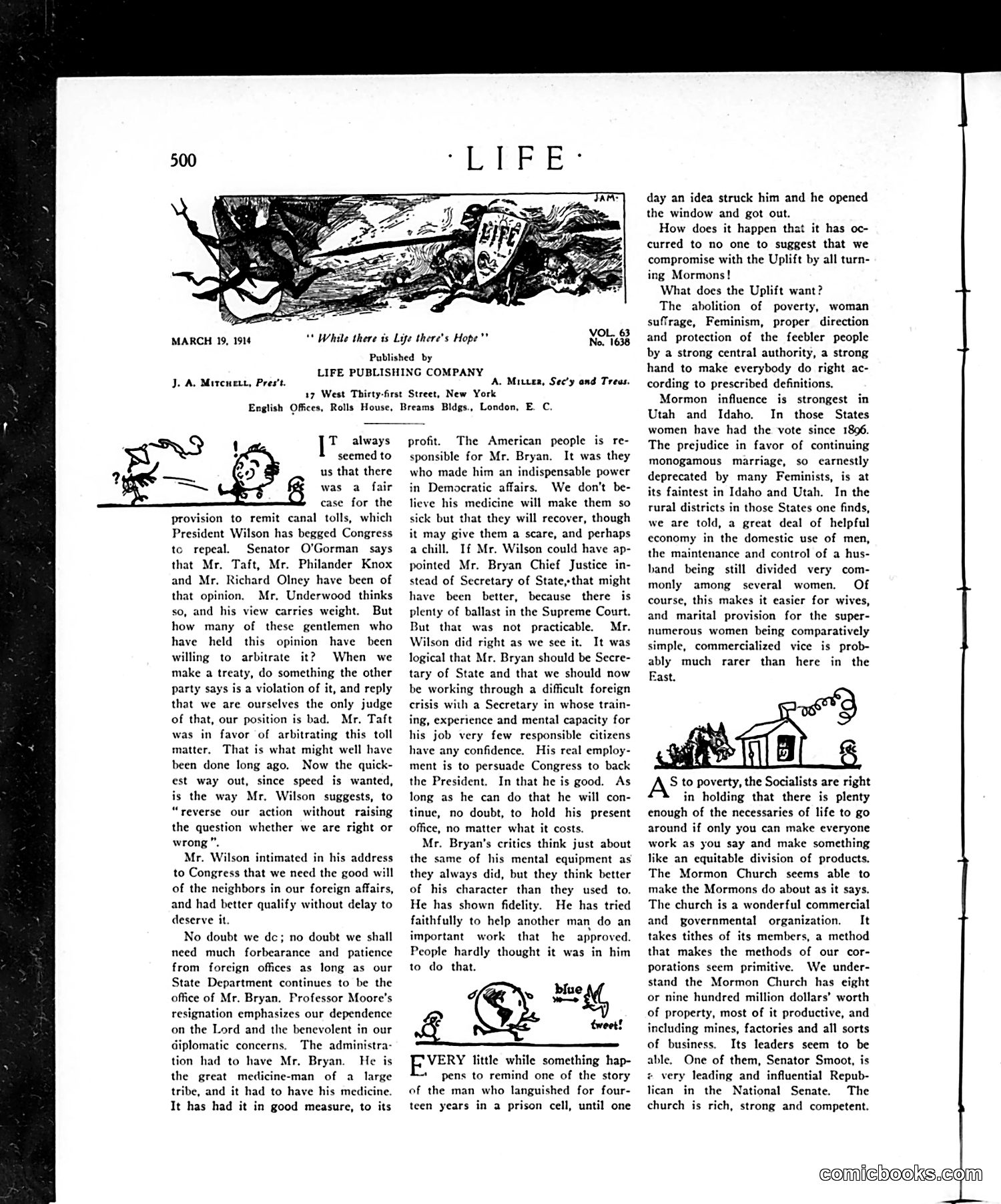
The main editorial discusses President Wilson's canal-toll policy and Secretary of State William Jennings Bryan's diplomatic role. Life argues Wilson was right to reverse course on tolls without admitting error—pragmatism matters more than pride in foreign relations. The piece is largely critical of Bryan, suggesting Wilson had to appoint him (as the powerful voice of his Democratic base) despite doubts about Bryan's diplomatic competence. The cartoon's joke is more pointed: it sarcastically suggests Americans solve the "Uplift" problem—progressive reformers demanding poverty abolition, women's suffrage, feminism, and centralized authority—by simply converting to Mormonism. The humor lies in mocking both progressive reformers' ambitious agenda and the Mormon Church's reputation for tight social control and strict discipline. Life implies Mormons have already achieved the regimented society progressives want.
📄 Transcribed text from this page (OCR, searchable)
Machine-transcribed from the original scan — historical spelling and the odd misread are preserved.
MARCH 19, 1914 “While there is Life there's Hope" VOL. 63 No. 1638 Published by LIFE PUBLISHING COMPANY 17 West Thirty-first Street, New York English Offices, Rolls House, Breams Bldgs., London, E. C. J. A. Mitcnent, Pres’t. ]* always seemed to us that there was a fair case for the provision to remit canal tolls, which President Wilson has begged Congress to repeal. Senator O'Gorman says that Mr. Taft, Mr. Philander Knox and Mr, Richard Olney have been of that opinion. Mr, Underwood thinks and his view carries weight. But how many of these gentlemen who have held this opinion have been willing to arbitrate it? When we make a treaty, do something the other party says is a violation of it, and reply that we are ourselves the only judge of that, our position is bad. Mr, Taft was in favor of arbitrating this toll matter, That is what might well have been done long ago. Now the quick- est way out, since speed is wanted, is the way Mr. Wilson suggests, to “reverse our action without raising the question whether we are right or wrong”. Mr. Wilson intimated in his address to Congress that we need the good will of the neighbors in our foreign affairs, and had better qualify without delay to deserve it. No doubt we dc; no doubt we shall need much forbearance and patience from foreign offices as long as our State Department continues to be the office of Mr. Bryan. Professor Moore's resignation emphasizes our dependence on the Lord and the benevolent in our diplomatic concerns. The administra- tion had to have Mr. Bryan. He is the great medicine-man of a large tribe, and it had to have his medicine. It has had it in good measure, to its A. Mitten, Sec’y and Treas. profit. The American people is re- sponsible for Mr. Bryan. It was they who made him an indispensable power in Democratic affairs. We don’t be- lieve his medicine will make them so sick but that they will recover, though it may give them a scare, and perhaps achill, If Mr. Wilson could have ap- pointed Mr. Bryan Chief Justice in- stead of Secretary of State,that might have been better, because there is plenty of ballast in the Supreme Court. But that was not practicable. Mr. Wilson did right as we see it. It was logical that Mr. Bryan should be Secre- tary of State and that we should now be working through a difficult foreign crisis with a Secretary in whose train- ing, experience and mental capacity for his job very few responsible citizens have any confidence. His real employ- ment is to persuade Congress to back the President. In that he is good. As long as he can do that he will con- tinue, no doubt, to hold his present office, no matter what it costs. Mr. Bryan's critics think just about the same of his mental equipment as they always did, but they think better of his character than they used to. He has shown fidelity. He has tried faithfully to help another man do an important work that he approved. People hardly thought it was in him to do that. g > blue GRE ee VERY little while something hap- pens to remind one of the story of the man who languished for four- teen years in a prison cell, until one day an idea struck him and he opened the window and got out. How does it happen that it has oc- curred to no one to suggest that we compromise with the Uplift by all turn- ing Mormons! What does the Uplift want? The abolition of poverty, woman suffrage, Feminism, proper direction and protection of the feebler people by a strong central authority, a strong hand to make everybody do right ac- cording to prescribed definitions, Mormon influence is strongest in Utah and Idaho. In those States women have had the vote since 1896. The prejudice in favor of continuing monogamous marriage, so earnestly deprecated by many Feminists, is at its faintest in Idaho and Utah. In the rural districts in those States one finds, we are told, a great deal of helpful economy in the domestic use of men, the maintenance and control of a hus- hand being still divided very com- monly among several women. Of course, this makes it easier for wives, and marital provision for the super- numerous women being comparatively simple, commercialized vice is prob- ably much rarer than here in the East. S to poverty, the Socialists are right in holding that there is plenty enough of the necessaries of life to go around if only you can make everyone work as you say and make something like an equitable division of products, The Mormon Church seems able to make the Mormons do about as it says. The church is a wonderful commercial and governmental organization. It takes tithes of its members, a method that makes the methods of our cor- Porations seem primitive. We under- stand the Mormon Church has eight or nine hundred million dollars’ worth of property, most of it productive, and including mines, factories and all sorts of business. Its leaders seem to be able, One of them, Senator Smoot, is % very leading and influential Repub- lican in the National Senate. The church is rich, strong and competent. comichooks.com