
Life, 1914-03-19 · page 26 of 44
Life — March 19, 1914 — page 26: what you’re looking at
What you’re looking at
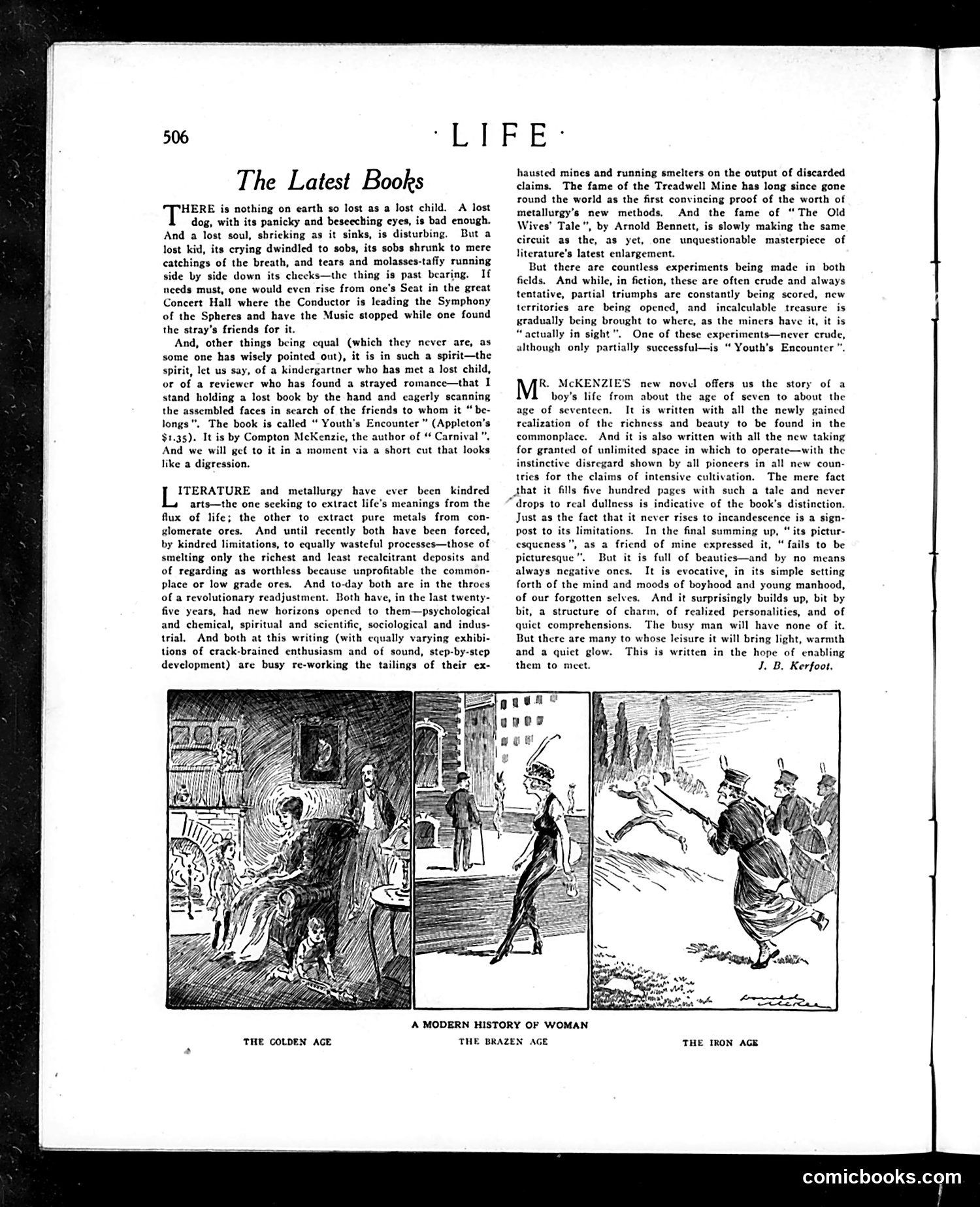
This three-panel comic illustrates changing gender roles through historical "ages," labeled The Golden Age, The Brazen Age, and The Iron Age. **The Golden Age** (left): Shows a woman in domestic contentment—sewing or crafting by candlelight, representing traditional domesticity and feminine virtue. **The Brazen Age** (center): Depicts a woman in fashionable, revealing clothing striking a confident pose, suggesting the "new woman" of the modern era—sexually liberated and socially bold. **The Iron Age** (right): Shows women engaged in active, physical labor alongside men (possibly farm work or industrial activity), humorously suggesting that women's liberation has resulted in grueling manual work rather than the promised freedom. The satire mocks the progression of women's liberation by suggesting each stage represents deterioration: from idealized domesticity, to scandalous modernity, to exhausting labor. This reflects conservative anxieties about changing women's roles in the early 20th century.
📄 Transcribed text from this page (OCR, searchable)
Machine-transcribed from the original scan — historical spelling and the odd misread are preserved.
‘LIPE> The Latest Books HERE is nothing on earth so lost as a Jost child. A lost dog, with its panicky and beseeching eyes, is bad enough. And a lost soul, sbricking as it sinks, is disturbing. But a lost kid, its crying dwindled to sobs, its sobs shrunk to mere catchings of the breath, and tears and molasses-tafly running side by side down its cheeks—the thing is past bearing. If needs must, one would even rise from one’s Seat in the great Concert Hall where the Conductor is leading the Symphony of the Spheres and have the Music stopped while one found the stray’s friends for it. And, other things being cqual (which they never are, as some one has wisely pointed out), it is in such a spirit—the spirit, let us say, of a kindergartner who has met a lost child, or of a reviewer who has found a strayed romance—that I stand holding a lost book by the hand and cagerly scanning the assembled faces in search of the friends to whom it “ be- longs". The book is called “ Youth's Encounter ” (Appleton’s $1.35). It is by Compton McKenzie, the author of “ Carnival ", And we will get to it in a moment via a short cut that looks like a digression. ITERATURE and metallurgy have ever been kindred arts—the one seeking to extract life's meanings from the flux of life; the other to extract pure metals from con- glomerate ores. And until recently both have been forced, by kindred limitations, to equally wasteful processes—those of smelting only the richest and least recalcitrant deposits and of regarding as worthless because unprofitable the common- place or low grade ores, And to-day both are in the throcs of a revolutionary readjustment. Both have, in the last twenty- five years, had new horizons opened to them—psychological and chemical, spiritual and scientific, sociological and indus- trial. And both at this writing (with equally varying exhibi- tions of crack-brained enthusiasm and of sound, step-by-step development) are busy re-working the tailings of their ex- hausted mines and running smelters on the output of discarded claims, The fame of the Treadwell Mine has long since gone round the world as the first convincing proof of the worth of metallurgy’s new methods. And the fame of “The Old Wives’ Tale”, by Arnold Bennett, is slowly making the same circuit as the, as yet, one unquestionable masterpiece of literature’s latest enlargement. But there are countless experiments being made in both ficlds. And while, in fiction, these are often crude and always tentative, partial triumphs are constantly being scored, new territories are being opencd, and incalculable treasure is gradually being brought to where, as the miners have it, it is “actually in sight". One of these experiments—never crude, although only partially successful—is “ Youth’s Encounter”. M* McKENZIE’S new novel offers us the story of a boy's life from about the age of seven to about the age of seventeen. It is written with all the newly gained realization of the richness and beauty to be found in the commonplace. And it is also written with all the new taking for granted of unlimited space in which to operate—with the instinctive disregard shown by all pioncers in all new coun- tries for the claims of intensive cultivation. The mere fact that it fills five hundred pages with such a tale and never “drops to real dullness is indicative of the book's distinction. Just as the fact that it never rises to incandescence is a sign- post to its limitations. In the final summing up, “ its pictur- esqueness", as a friend of mine expressed it, “fails to be picturesque”. But it is full of beauties—and by no means always negative oncs. It is evocative, in its simple setting forth of the mind and moods of boyhood and young manhood, of our forgotten selves. And it surprisingly builds up, bit by bit, a structure of charm, of realized personalities, and of quict comprehensions. The busy man will have none of it. But there are many to whose leisure it will bring light, warmth and a quiet glow. This is written in the hope of enabling them to meet. J. B. Kerfoot, A MODERN HISTORY OF WOMAN THE COLDEN AGE THE BRAZEN AGE THE IRON AGE comicbooks.com