
Life, 1914-03-19 · page 25 of 44
Life — March 19, 1914 — page 25: what you’re looking at
What you’re looking at
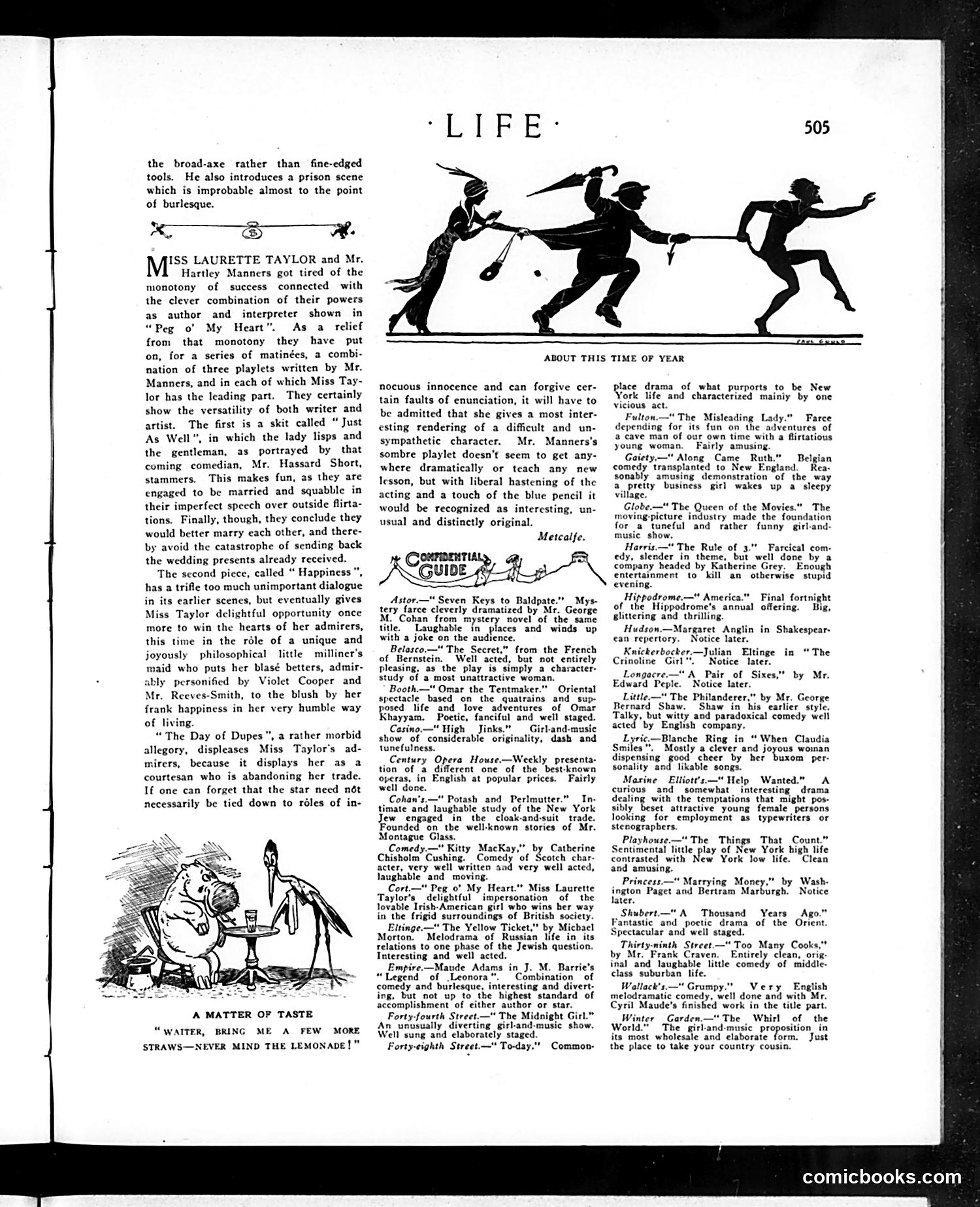
The cartoon "A Matter of Taste" depicts a waiter serving a drink through multiple straws to a customer who requests "a few more straws—never mind the lemonade!" This is a satire on excessive consumption and priorities. The joke operates on the contrast between the ostensible beverage (lemonade, a modest drink) and the customer's focus on the straws themselves—suggesting he cares more about the apparatus of drinking than the actual content. The cartoon likely critiques either wasteful consumption habits, misplaced values among the wealthy, or possibly Prohibition-era concerns about drinking culture (if this predates the 1920 ban). The figure appears to be a well-dressed gentleman, suggesting the satire targets upper-class indulgence or absurd priorities among affluent consumers. The page primarily contains theater reviews rather than political content; the cartoon serves as light satirical commentary on contemporary consumer behavior.
📄 Transcribed text from this page (OCR, searchable)
Machine-transcribed from the original scan — historical spelling and the odd misread are preserved.
the broad-axe rather than fine-edged tools. He also introduces a prison scene which is improbable almost to the point of burlesque. rr ISS LAURETTE TAYLOR and Mr. Hartley Manners got tired of the monotony of success connected with the clever combination of their powers as author and interpreter shown in “Peg o' My Heart”. As a relief from that monotony they have put on, for a series of matinées, a combi- nation of three playlets written by Mr. Manners, and in cach of which Miss Tay- lor has the leading part. They certainly show the versatility of both writer and artist. The first is a skit called “ Just As Well”, in which the lady lisps and the gentleman, as portrayed by that coming comedian, Mr. Hassard Short, stammers. This makes fun, as they are engaged to be married and squabble in their imperfect speech over outside flirta- tions. Finally, though, they conclude they would better marry each other, and there- by avoid the catastrophe of sending back the wedding presents already received. The second picce, called “ Happiness ", has a trifle too much unimportant dialogue in its earlier scenes, but eventually gives Miss Taylor delightful opportunity once more to win the hearts of her admirers, this time in the réle of a unique and joyously philosophical little milliner’s maid who puts her blasé betters, admir- ably personified by Violet Cooper and Mr. Reeves-Smith, to the blush by her frank happiness in her very humble way of living. “The Day of Dupes”, a rather morbid allegory, displeases Miss Taylor's ad- mirers, because it displays her as a courtesan who is abandoning her trade. If one can forget that the star need nét necessarily be tied down to réles of in- A MATTER OF TASTE “WAITER, BRING ME A FEW MORE STRAWS—NEVER MIND THE LEMONADE!” oo ET ABOUT THIS TIME OF YEAR nocuous innocence and can forgive cer- tain faults of enunciation, it will have to be admitted that she gives a most inter- esting rendering of a difficult and un- sympathetic character. Mr. Manners’s sombre playlet doesn’t seem to get any- where dramatically or teach any new lesson, but with liberal hastening of the acting and a touch of the blue pencil it would be recognized as interesting, un- usual and distinctly original. Metcalfe. Astor.— Seven Keys to Baldpate.""_ Mys- tery farce cleverly dramatized by Mr. George M. Cohan from mystery novel of the same titie, Laughable ta places and winds up with a joke on the audience. Belasco.—" The Secret," from the French of Bernstein. Well acted, but not entirely pleasing, as the play is simply a character- study of a most unattractive woman. Booth.—" Omar the Tentmaker.” Oriental spectacle based on the quatrains and sup- osed life and love adventures of Omar Khayyam. Poetic, fanciful and well staged. Casino.—" High Jinks." Girl-and-musie show of considerable originality, dash and tunefulness. Century Opera House.—Weekly presenta- tion of a different one of the best-known operas, in English at popular prices. Fairly well done. Cohan's.—" Potash and Perlmutter.” | Tn- timate and laughable study of the New York Jew engaged in the cloak-and-suit trade. Founded on the well-known stories of Mr. Montague Glass. Comedy.—" Kitty MacKay,” by Catherine Chisholm Cushing. Comedy ‘of Scotch char- acter, very well written and very well acted, laughable and moving. Co Peg o' My Heart.” Miss Laurette Taylor's delightful impersonation of the lovable Irish-American girl who wins her way in the frigid surroundings of British society. Eltinge.—" The Yellow Ticket,” by Michael Morton. Melodrama of Russian life in, its relations to one phase of the Jewish question. Interesting and well acted. Empire-—Maude Adams in J. M. Barrie's “Legend of .Leonora”. Combination of comedy and burlesque, interesting and divert: ing, but not up to the highest standard of accomplishment of either author or star, Forty-fourth Street.—" The Midnight Girl.” An unusually diverting gir-and-music show. Well sung and elaborately stage Forty-eighth Street.—" To-day. Place drama of what purports to be New York life and characterized mainiy by one vicious act. Fulton.—" The Misleading Lady.” Farce depending for its fun on the adventures of a cave man of our own time with a flirtatious young woman. Fairly amusing. Goiety.—" Along Came Rut! Belgian comedy transplanted to New England. Rea- sonably amusing demonstration of the way a pretty business girl wakes up a sleepy village. The Queen of the Movies.” The icture industry made the foundation a tuneful and rather funny girl-and- music show. Harris.—" The Rule of 3." Farcical com: edy, slender in theme, but well done by a company headed by Katherine Grey. Enough entertainment to kill an otherwise stupid evening. Hippodrome.— America.” Final fortnight of the Hippodrome’s annual offering. Big, glittering and thrilling. Hudson.—Margaret Anglin in Shakespear- can repertory. Notice later. Knickerbocker—Julian Eltinge in Crinoline Girl". “Notice later. _ Longacre—" A Pair of Sixes," by Mr. Edward Peple. Notice later. Little.—" The Philanderer." by Mr. George Rernard Shaw. Shaw in his earlier style. Talky, but witty and paradoxical comedy well acted ‘by English company. Blanche Ring in “When Claudia Mostly a clever and joyous woman dispensing good cheer by her buxom per- sonality and likable songs. Marine Elliott’s—" Help Wanted.” A curious and somewhat interesting drama dealing with the temptations that might pos- sibly beset attractive young female persons looking for employment as typewriters or stenographers. _ Playhouse—"The Things That Count.” Sentimental little play of New York high life contrasted with New York low life. Clean and amusing. __ Princess.—" Marrying Money,” by Wash- ington Paget and Bertram Marburgh. Notice later. _Shubert—" A Thousand Years Ago.” Fantastic and poetic drama of the Orient. Spectacular and well staged. Thirty-minth Street —" Too Many Cooks.” by Mr. Frank Craven. Entirely clean, orig- inal and laughable little comedy of middle- class suburban life. Wattack's.—" Grumpy." Very English melodramatic comedy, well done and with Mr. Cyril Maude's finished work in the title part. Winter Garden.—" The Whirl of the World.” The girl-and-music proposition in its most wholesale and elaborate form. Just the place to take your country cousin. “The comicbooks.com