
Life, 1914-03-19 · page 24 of 44
Life — March 19, 1914 — page 24: what you’re looking at
What you’re looking at
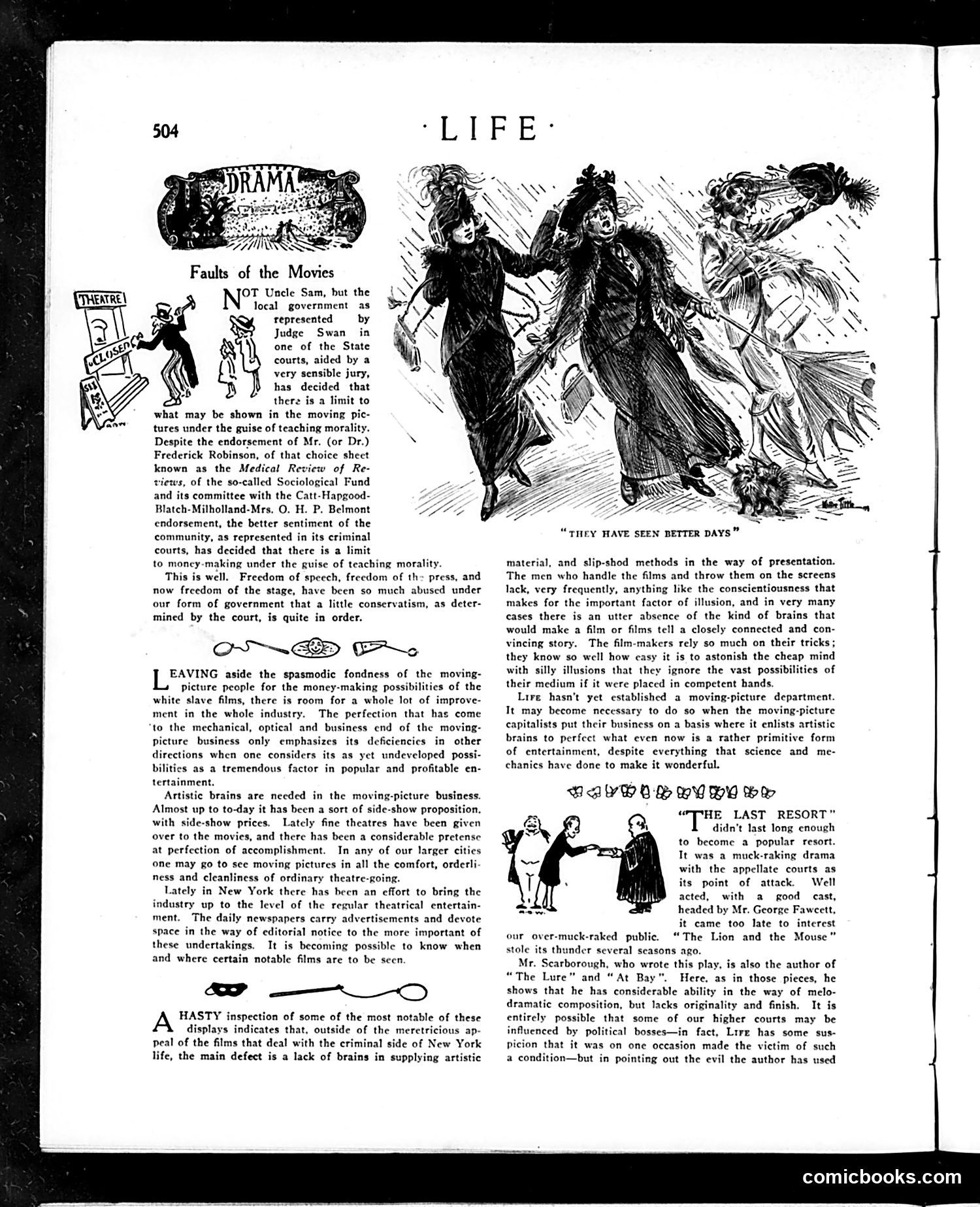
This 1910s *Life* magazine page critiques both film censorship and the film industry's artistic limitations. **The Censorship Debate:** Judge Swan ruled that movies cannot show certain content under the pretense of "teaching morality"—likely referencing controversial "white slave" films (trafficking narratives). The text names prominent progressive reformers (Catt, Hapgood, Blatch, Belmont) who apparently supported such films, but the court disagreed. *Life* supports the court's decision, arguing that "freedom of the stage" has been abused and "a little conservatism" is warranted. **The Industry Critique:** The main article attacks filmmakers for relying on cheap tricks and illusions rather than developing serious artistic storytelling. It argues the industry lacks "brains"—skilled writers and directors—despite recent improvements in theater venues and technical quality. **The Cartoon:** "They Have Seen Better Days" appears to mock struggling actresses, possibly suggesting fallen women—perhaps commentary on films depicting moral decline. **"The Last Resort"** review dismisses a "muck-raking drama" about appellate courts as short-lived and unmarketable. The page reveals early tensions between censorship, artistic merit, and exploitation in cinema.
📄 Transcribed text from this page (OCR, searchable)
Machine-transcribed from the original scan — historical spelling and the odd misread are preserved.
‘OT Uncle Sam, but the local government as represented by Judge Swan in one of the State courts, aided by a very sensible jury, has decided that there is a limit to what may be shown in the moving pic- tures under the guise of teaching morality. Despite the endorsement of Mr. (or Dr.) Frederick Robinson, of that choice shect known as the Medical Review of Re- views, of the so-called Sociological Fund and its committee with the Catt-Hapgood- Blatch-Milholland-Mrs. O. H. P. Belmont endorsement, the better sentiment of the community, as represented in its criminal courts, has decided that there is a limit to moncy-making under the guise of teaching morality. This is well. Freedom of speech, freedom of th= press, and now freedom of the stage, have been so much abused under our form of government that a little conservatism, as deter- mined by the court, is quite in order. ON-~ ED 1 ~ EAVING aside the spasmodic fondness of the moving- picture people for the money-making possibilities of the white slave films, there is room for a whole lot of improve- ment in the whole industry. The perfection that has come to the mechanical, optical and business end of the moving- picture business only emphasizes its deficiencies in other directions when one considers its as yet undeveloped possi- bilities as a tremendous factor in popular and profitable en- tertainment. Artistic brains are needed in the moving-picture business. Almost up to to-day it has been a sort of side-show proposition. with side-show prices. Lately fine theatres have been given over to the movies, and there has been a considerable pretense at perfection of accomplishment. In any of our larger cities one may go to see moving pictures in all the comfort, orderli- ness and cleanliness of ordinary theatre-going. Lately in New York there has been an effort to bring the industry up to the level of the regular theatrical entertain- ment. The daily newspapers carry advertisements and devote space in the way of editorial notice to the more important of these undertakings. It is becoming possible to know when and where certain notable films are to be secn. HASTY inspection of some of the most notable of these displays indicates that, outside of the meretricious ap- peal of the films that deal with the criminal side of New York life, the main defect is a lack of brains in supplying artistic “THEY HAVE SEEN BETTER DAYS” material, and slip-shod methods in the way of presentation. The men who handle the films and throw them on the screens lack, very frequently, anything like the conscientiousness that makes for the important factor of illusion, and in very many cases there is an utter absence of the kind of brains that would make a film or films tell a closely connected and con- vincing story. The film-makers rely so much on their tricks; they know so well how casy it is to astonish the cheap mind with silly illusions that they ignore the vast possibilities of their medium if it were placed in competent hands. Lire hasn't yet established a moving-picture department. It may become necessary to do so when the moving-picture capitalists put their business on a basis where it enlists artistic brains to perfect what even now is a rather primitive form of entertainment, despite everything that science and me- chanics have done to make it wonderful. BAYHOL OY HY SH “7THE LAST RESORT” didn’t last long enough to become a popular resort. Tt was a muck-raking drama with the appellate courts as its point of attack. Well acted, with a good cast, headed by Mr. George Fawcett, it came too late to interest our over-muck-raked public. “The Lion and the Mouse” stole its thunder several seasons ago. Mr. Scarborough, who wrote this play, is also the author of “The Lure” and “At Bay". Here, as in those pieces, he shows that he has considerable ability in the way of melo- dramatic composition, but lacks originality and finish. It is entirely possible that some of our higher courts may be influenced by political bosses—in fact, Lire has some sus- picion that it was on one occasion made the victim of such a condition—but in pointing out the evil the author has used comicbooks.com