
A complete issue · 40 pages · 1913
Life — August 28, 1913
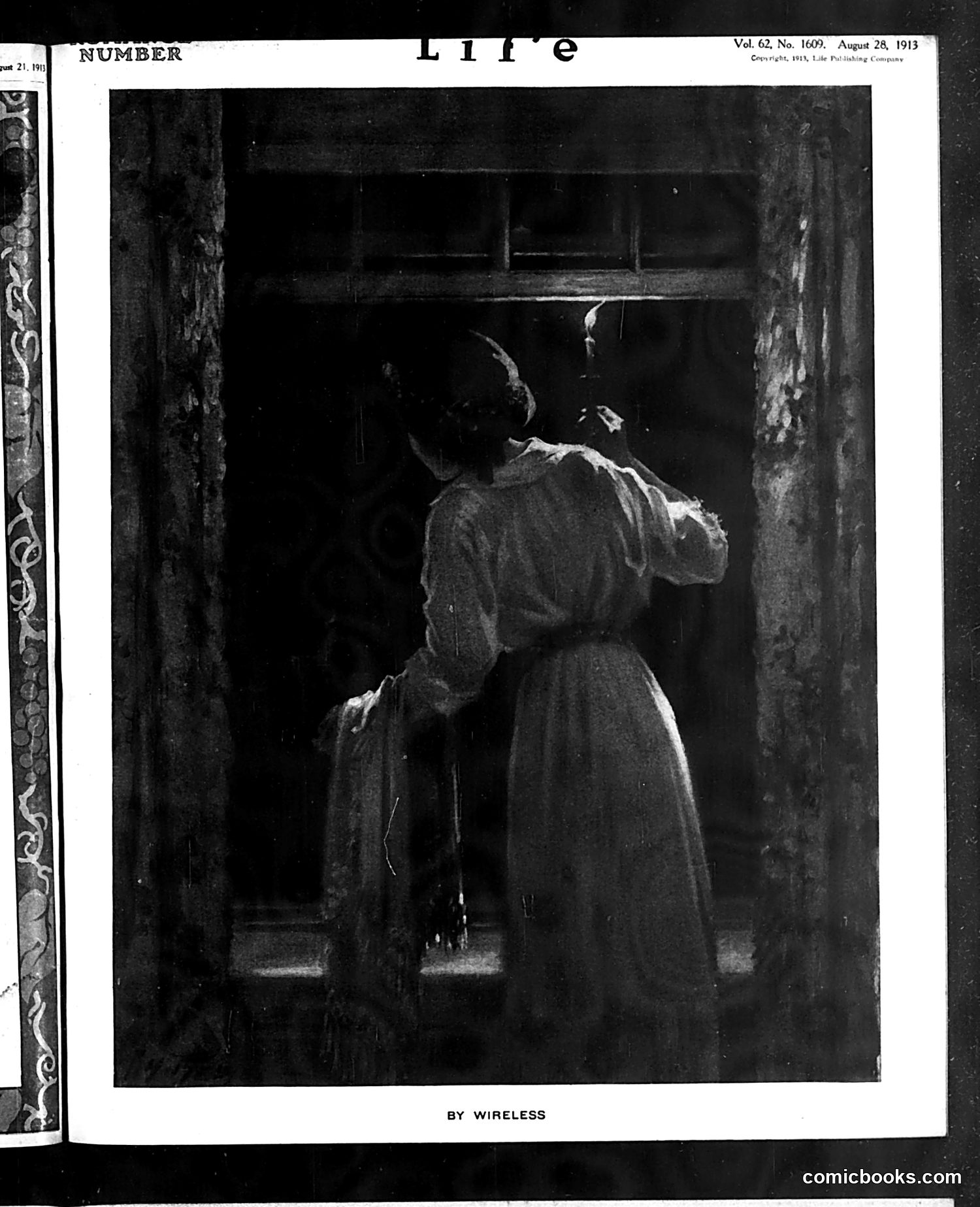
This page from Life magazine (August 28, 1913) shows a photograph credited "BY WIRELESS" depicting a woman in Edwardian dress standing at what appears to be a dark doorway or window. The image is atmospheric and somewhat mysterious in quality. Without additional context or caption text visible on this particular page excerpt, the specific political or social satire is unclear. The "BY WIRELESS" credit suggests this photograph was transmitted electronically—a relatively novel technology in 1913—which itself may be the point: showcasing modern wireless transmission capabilities. The image could relate to contemporary social issues, but identifying the specific figures, event, or satirical intent requires information not legible in this reproduction.
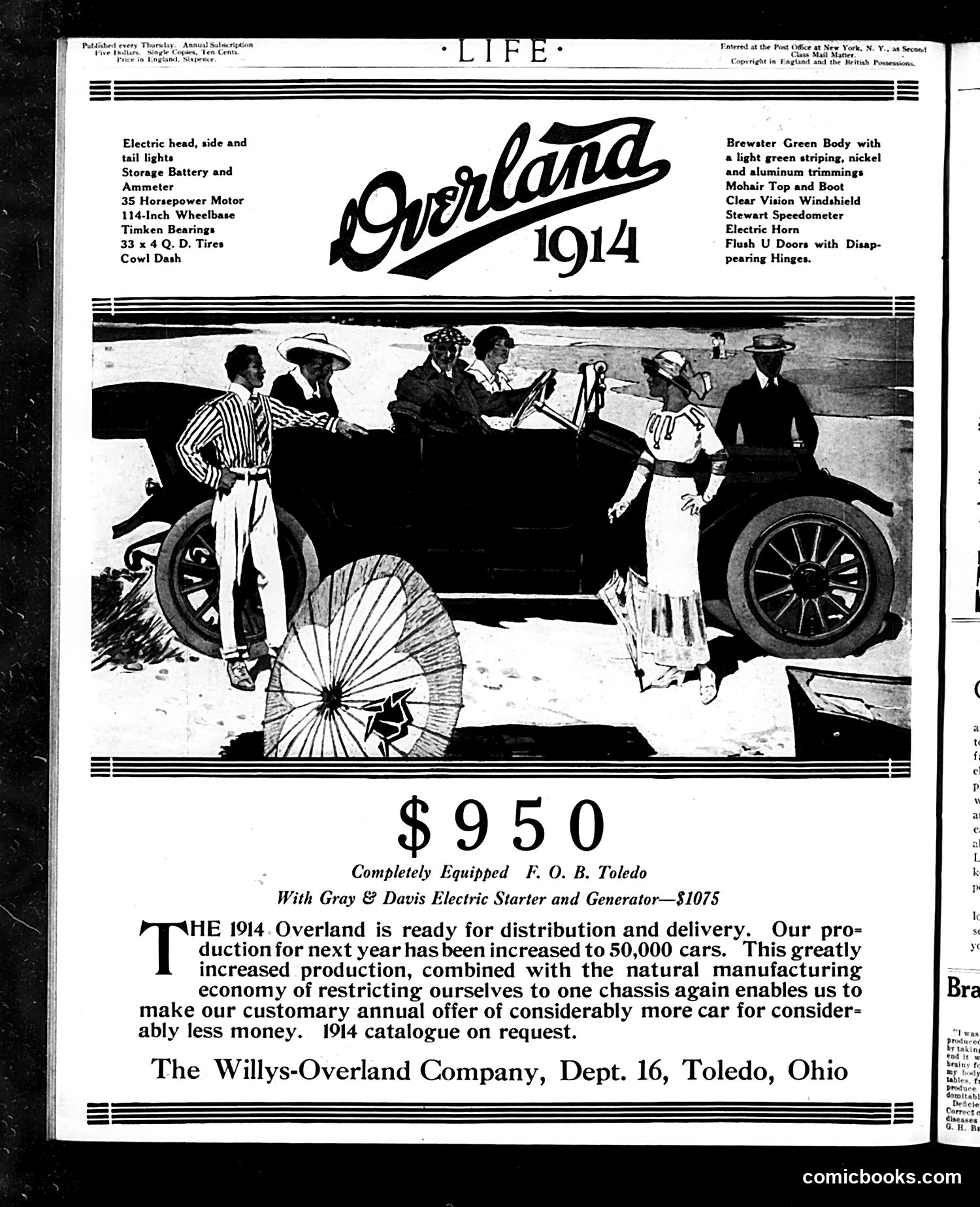
This page is **primarily an automobile advertisement**, not political satire. It advertises the 1914 Overland car manufactured by the Willys-Overland Company of Toledo, Ohio, priced at $950. The illustration depicts well-dressed early-1900s passengers (men in suits and hats, women in elaborate dress with parasols) posed around the vehicle at what appears to be a beach or resort setting. This reflects common advertising imagery of the era—associating automobiles with leisure, wealth, and social status. The advertisement emphasizes production capacity (50,000 cars planned) and value proposition: offering "considerably more car for considerably less money" through standardized single-chassis manufacturing. **This is commercial content, not editorial commentary or satire.** Life magazine, though known for satirical cartoons elsewhere, regularly published such paid advertisements throughout its pages.
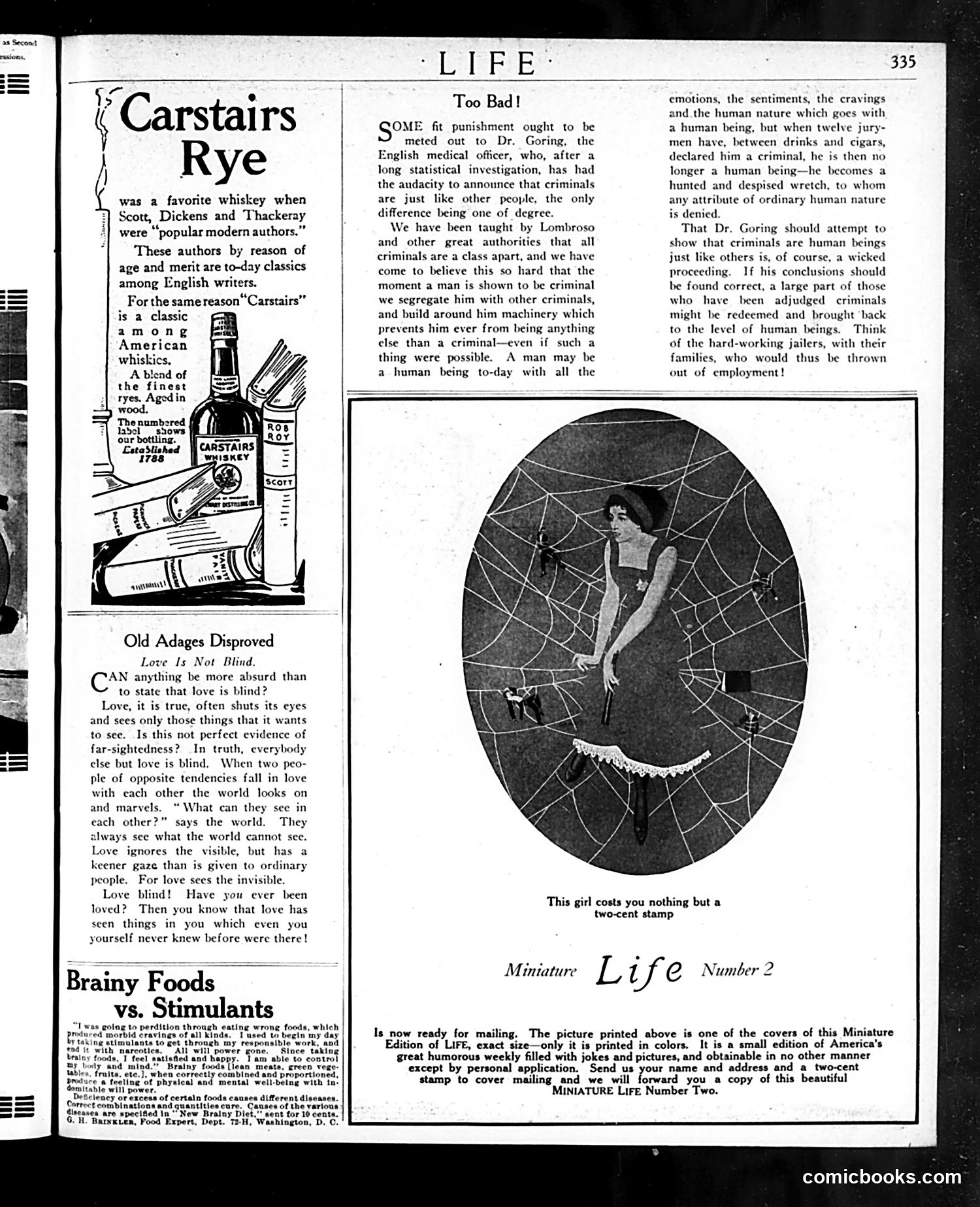
This page contains three distinct elements: 1. **"Carstairs Rye" Advertisement**: A whiskey ad emphasizing the product's heritage and quality, featuring illustrated bottles. 2. **"Too Bad!" Editorial Piece**: A commentary on Dr. Goring (appears to be a real medical officer) who conducted statistical research on criminals. The text argues against classifying criminals as fundamentally different from ordinary people, advocating instead for rehabilitation and employment opportunities rather than permanent social exclusion. It critiques the notion that criminals are inherently separate from humanity. 3. **"Miniature Life" Magazine Cover**: Features a photograph of a woman posed within a spider web, illustrating the miniature edition of Life magazine itself—a promotional piece emphasizing the publication's visual appeal and collectibility. The page reflects early 20th-century debates about criminology, rehabilitation, and social reform.
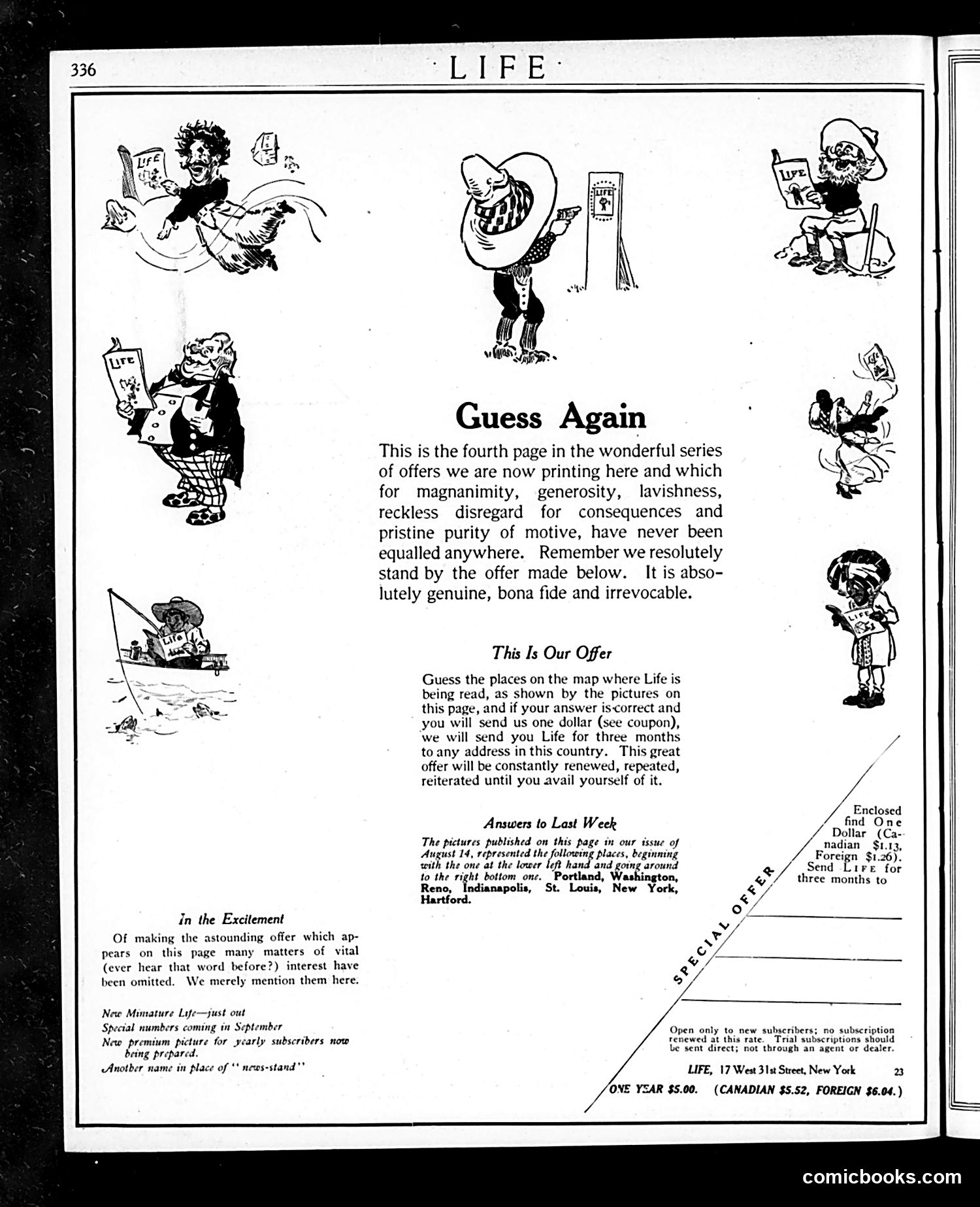
This page is primarily an **advertisement for Life magazine subscriptions**, using a "Guess Again" contest format. The central offer invites readers to identify locations on a map where Life is being read, with a correct answer earning one dollar plus three months of free subscription. The cartoon vignettes surrounding the text appear to depict various characters engaged in **reading or promoting Life magazine** in different settings and scenarios—fishing, wearing hats, and other everyday situations. These serve as visual humor suggesting Life's broad appeal across different demographics. The page emphasizes Life's claimed qualities: "magnanimity, generosity, lavishness, reckless disregard for consequences." This is **self-promotional satire**, humorously overstating the magazine's virtues as part of its marketing appeal to potential subscribers.
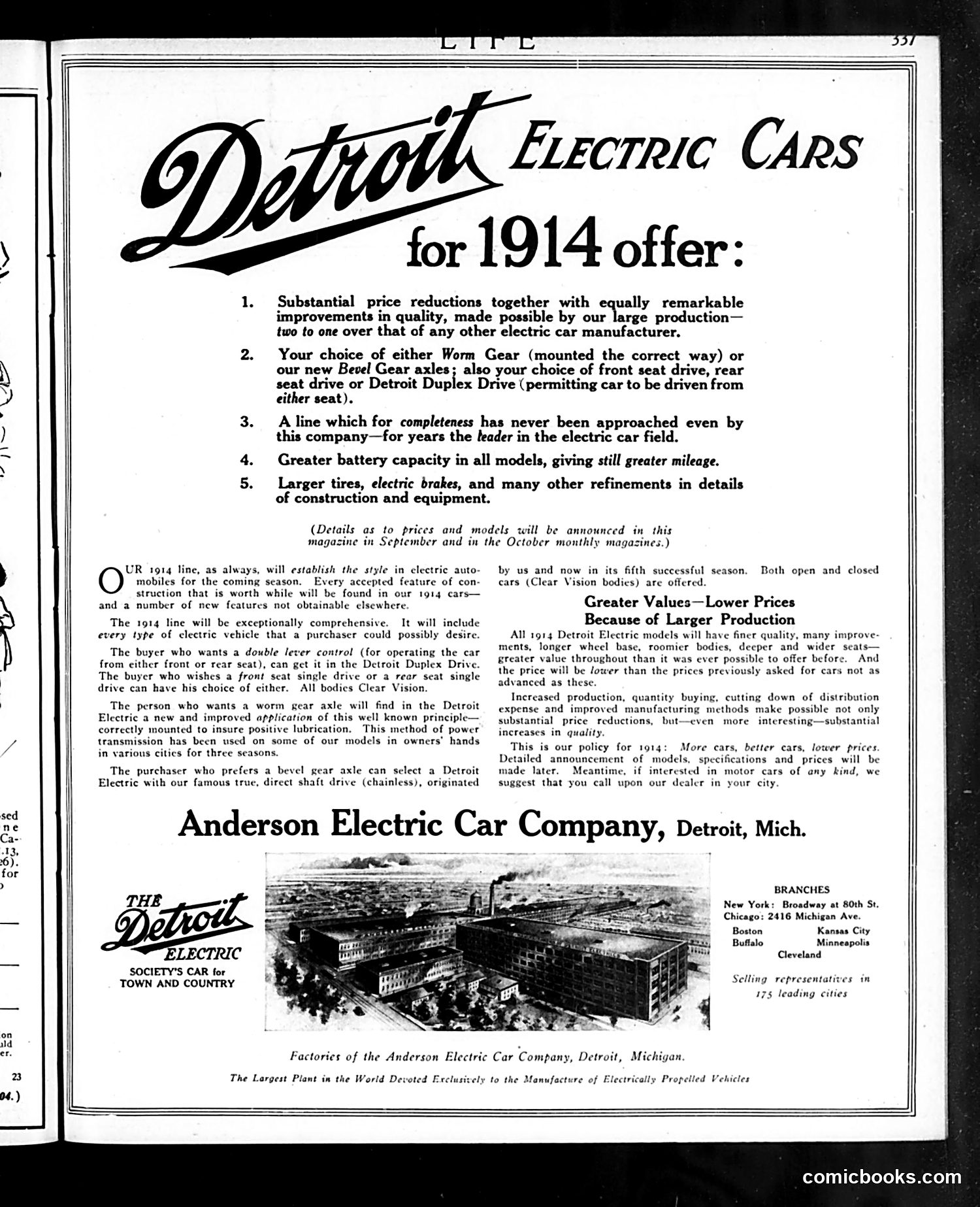
This page is **primarily an advertisement**, not a satirical cartoon. It promotes Detroit Electric Cars for 1914, published by the Anderson Electric Car Company of Detroit, Michigan. The ad emphasizes practical features: price reductions, gear options (Worm or Bevel), battery capacity, and safety features like electric brakes. It highlights the company's "fifth successful season" and claims their manufacturing scale enables quality improvements and lower costs. The photograph shows the Anderson factory in Detroit, described as "the largest plant in the world devoted exclusively to the manufacture of electrically propelled vehicles." For modern readers: this represents the era when electric vehicles competed seriously with gasoline cars—before the Model T and mass production of gas engines dominated the market by the 1920s.
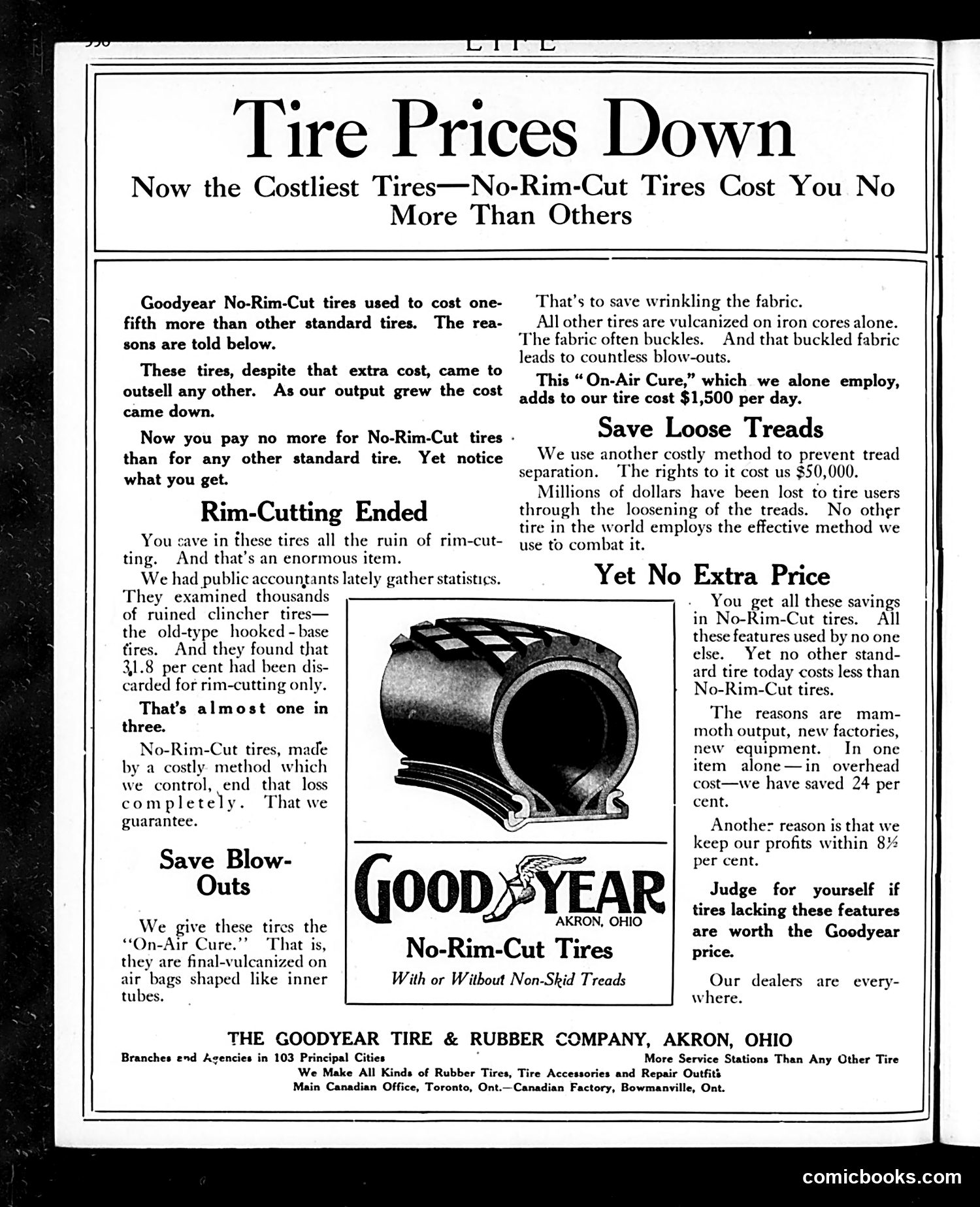
This is **not satire or a cartoon**—it's a straightforward advertisement for Goodyear No-Rim-Cut tires from the early 20th century (Goodyear Tire & Rubber Company, Akron, Ohio). The ad makes a business argument: Goodyear's premium tires, formerly one-fifth more expensive than competitors, now cost the same as standard tires. The pitch emphasizes technological advantages: special "On-Air Cure" vulcanization process, methods to prevent tread separation, and elimination of "rim-cutting" defects that plagued earlier tires. The accompanying image shows a cross-section of a tire. The advertising strategy is straightforward: justify premium pricing through superior manufacturing and durability claims, ultimately presenting cost parity as a consumer win. This represents early automotive-industry competition based on technical innovation rather than price alone.
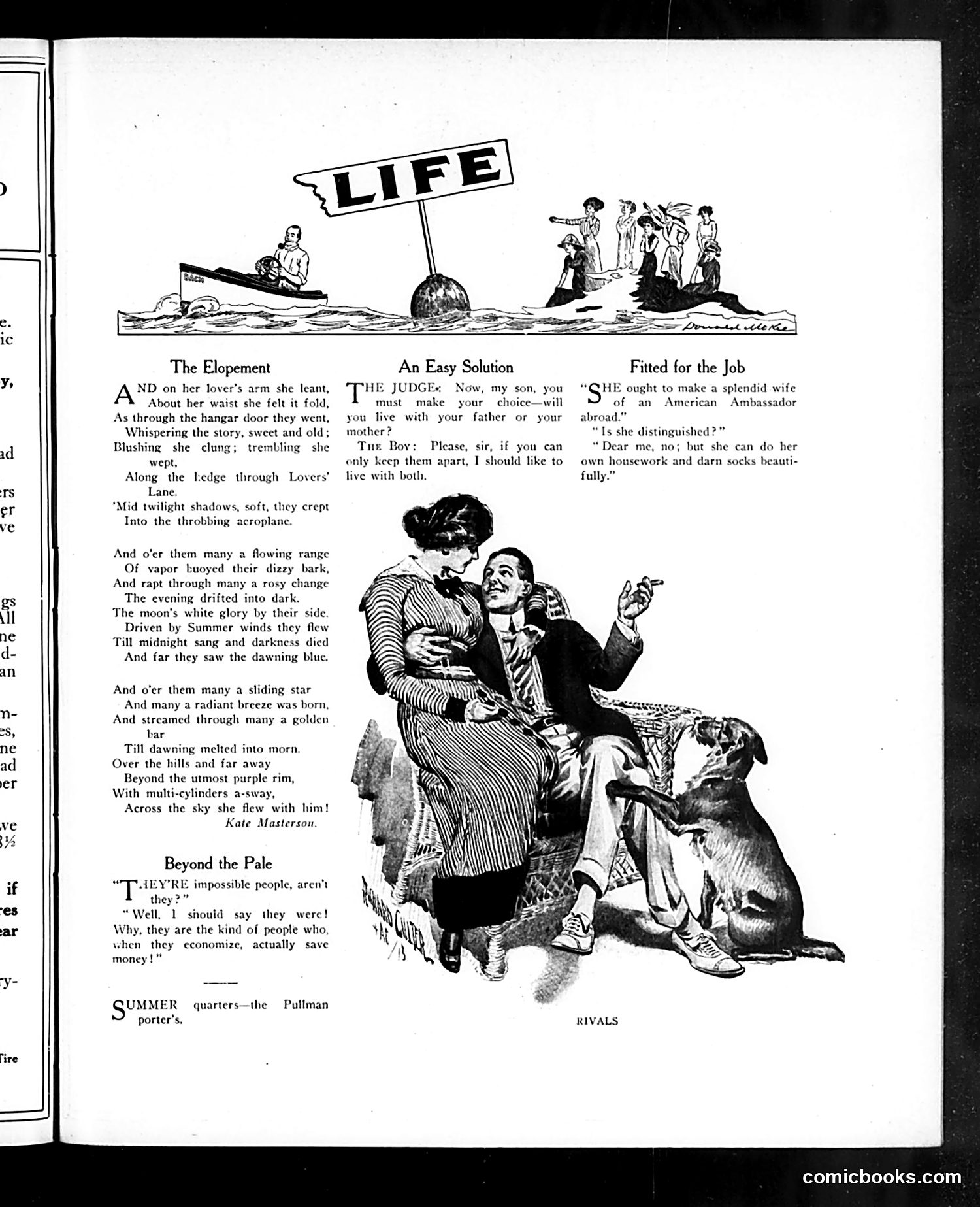
This page satirizes early 20th-century courtship and marriage dilemmas through three comic scenarios. "The Elopement" depicts a dramatic romantic escape via airplane. "An Easy Solution" presents a boy choosing between living with his father or mother—the joke being that he pragmatically suggests living with both to avoid choosing. "Fitted for the Job" mocks the expectations placed on wives as ambassadors' spouses, suggesting that domestic skills (housework and darning socks) qualify women for diplomatic roles—satirizing the limited professional recognition of women's contributions. The central illustration labeled "Rivals" shows a woman with two suitors competing for her attention, with a dog also vying for notice—reducing romantic rivalry to absurdity. The humor targets traditional gender roles and marriage conventions of the era.
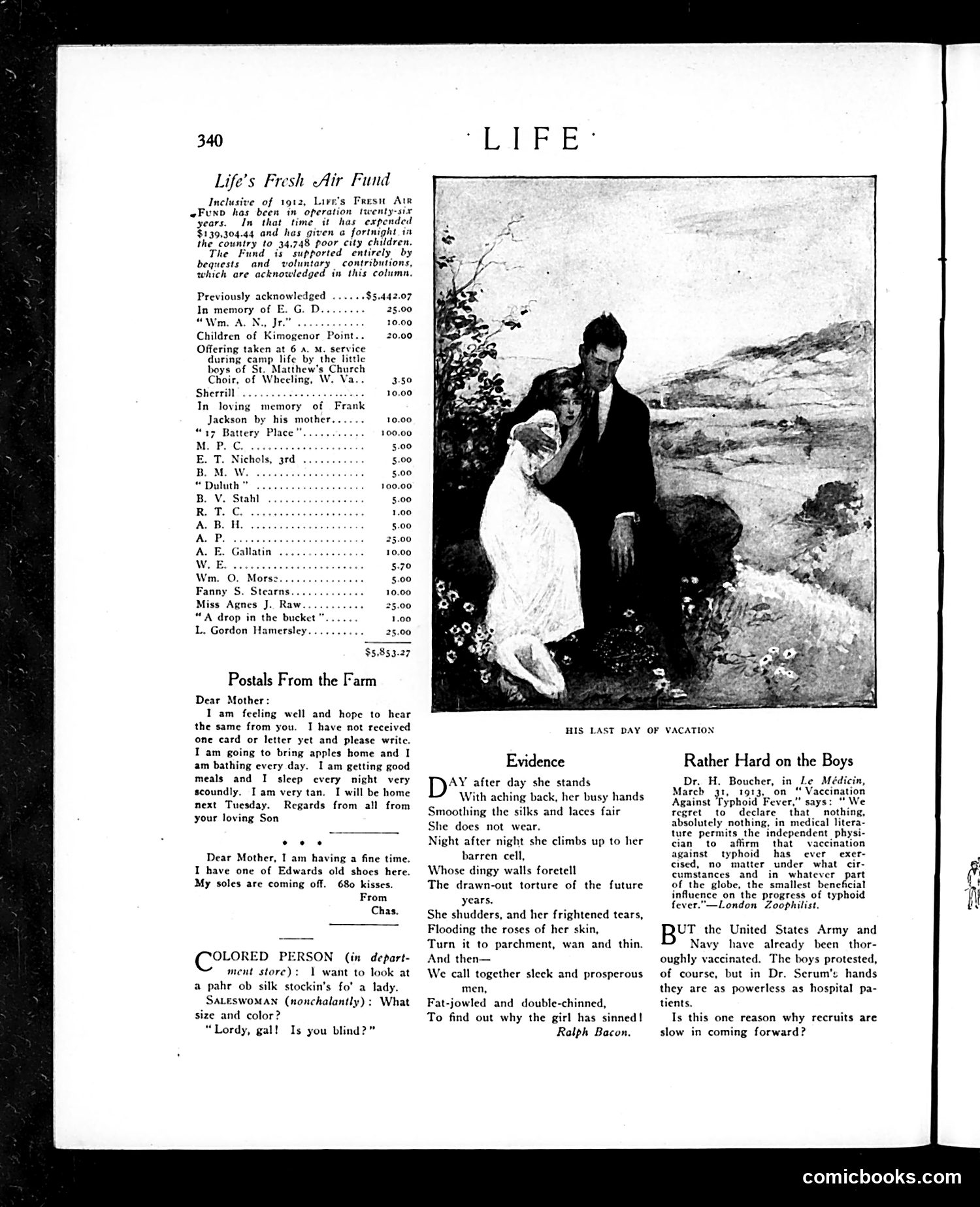
This page contains three distinct elements: 1. **Life's Fresh Air Fund** - A charitable fundraising column listing donations to help poor city children, with contributions ranging from $1 to $100. 2. **"His Last Day of Vacation"** - A photograph showing a couple in an intimate moment outdoors, apparently their final day before returning to regular life. 3. **Two opinion pieces**: "Evidence" (a poem by Ralph Bacon about a woman's emotional distress) and "Rather Hard on the Boys" (an editorial from March 31, 1911, defending vaccination against typhoid fever, arguing that despite boys being "powerless as hospital patients," vaccination remains medically sound and questioning why military recruitment is slow). The page mixes charitable appeals, sentimental romance imagery, and public health advocacy typical of early-20th-century Life magazine's satirical-but-civic-minded approach.
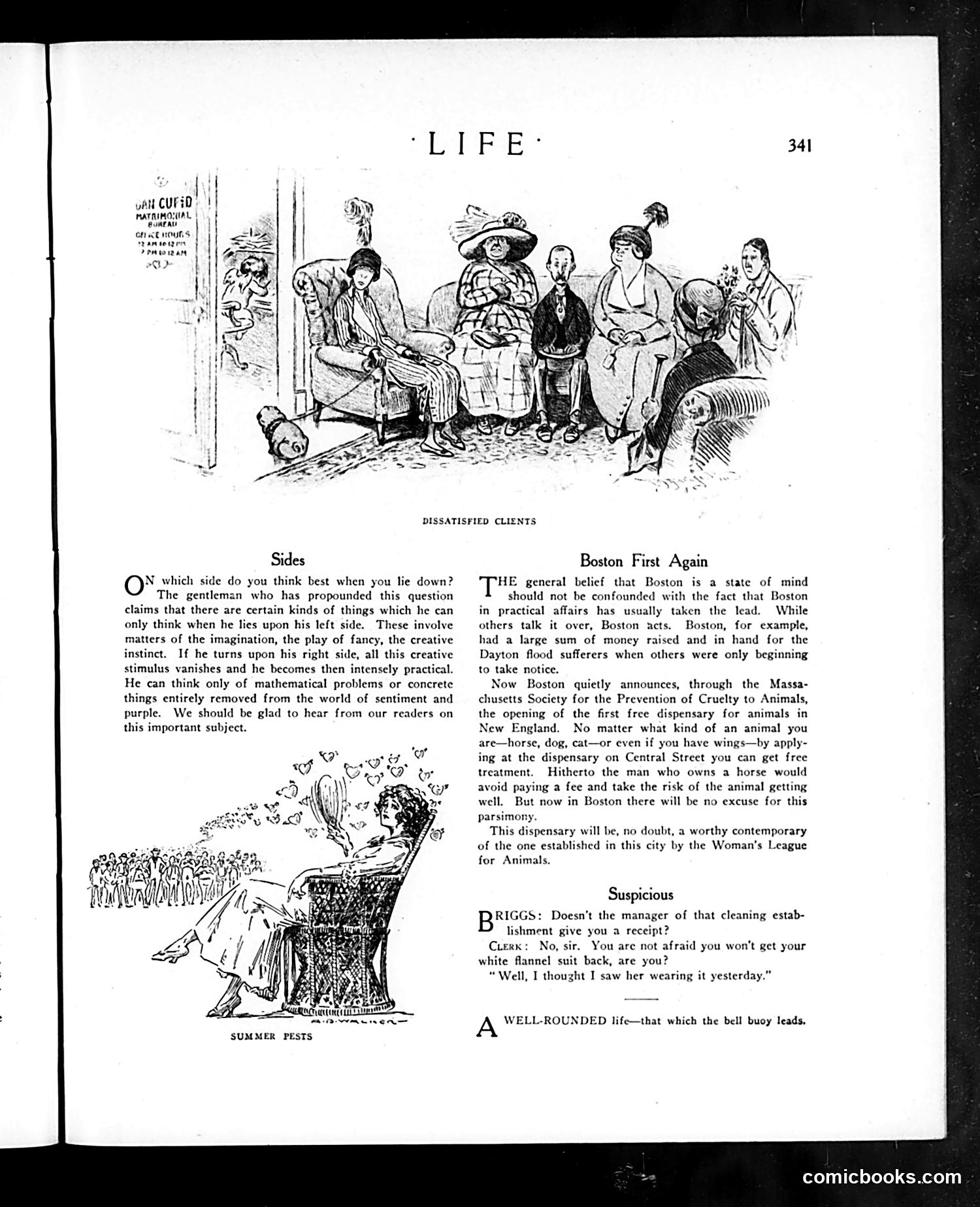
**Top Cartoon ("Dissatisfied Clients"):** Shows a crowded waiting room of various clients or patients appearing frustrated or bored. The specific context isn't entirely clear from the image alone. **"Sides":** Discusses which side to sleep on, treating this as a serious philosophical question. The piece gently mocks overthinking trivial matters. **"Summer Pests":** Cartoon showing a woman overwhelmed by a swarm of small figures, apparently representing summer insects or nuisances—a relatable seasonal complaint. **"Boston First Again":** Announces Boston's new animal dispensary for free veterinary care, positioned as civic progress. The tone is congratulatory toward this welfare initiative. **"Suspicious":** Brief comedic dialogue between a dry cleaner and customer about a missing white flannel suit—everyday urban humor about domestic mishaps.
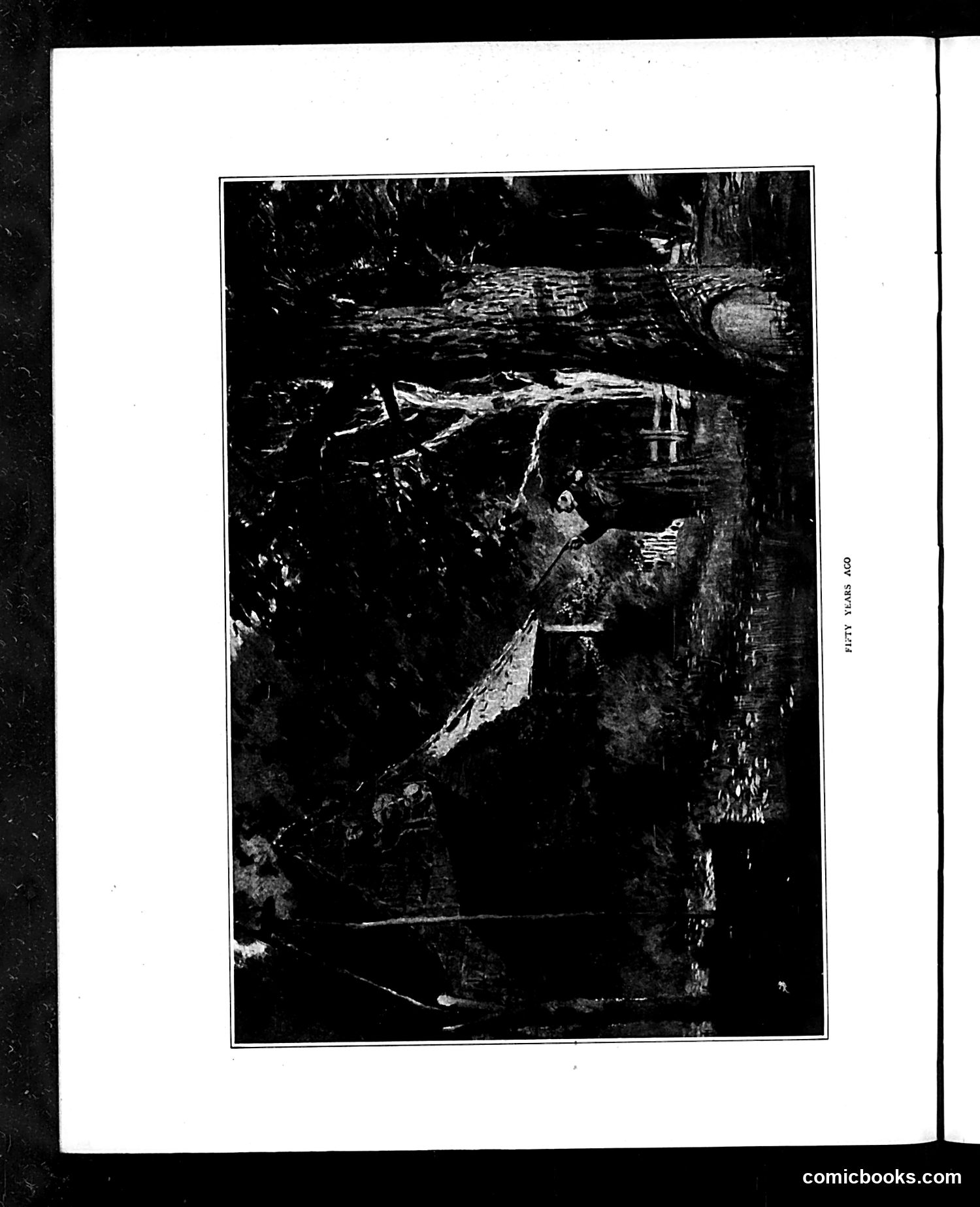
This appears to be a dark, atmospheric black-and-white illustration rather than a political cartoon. The image shows what looks like a cave or underground setting with dramatic shadows, fallen logs or branches, and possibly water or reflective surfaces. The composition is moody and somewhat difficult to parse clearly due to the high contrast and age of the photograph. The caption reads "FIFTY YEARS AGO," suggesting this is either a historical illustration or a before/after comparison piece. Without clearer visibility of specific figures, text labels, or recognizable caricatures, I cannot confidently identify the satirical subject matter or political references. The image quality and style suggest this is from an early 20th-century publication, but the specific satirical point remains unclear from what's visible here.
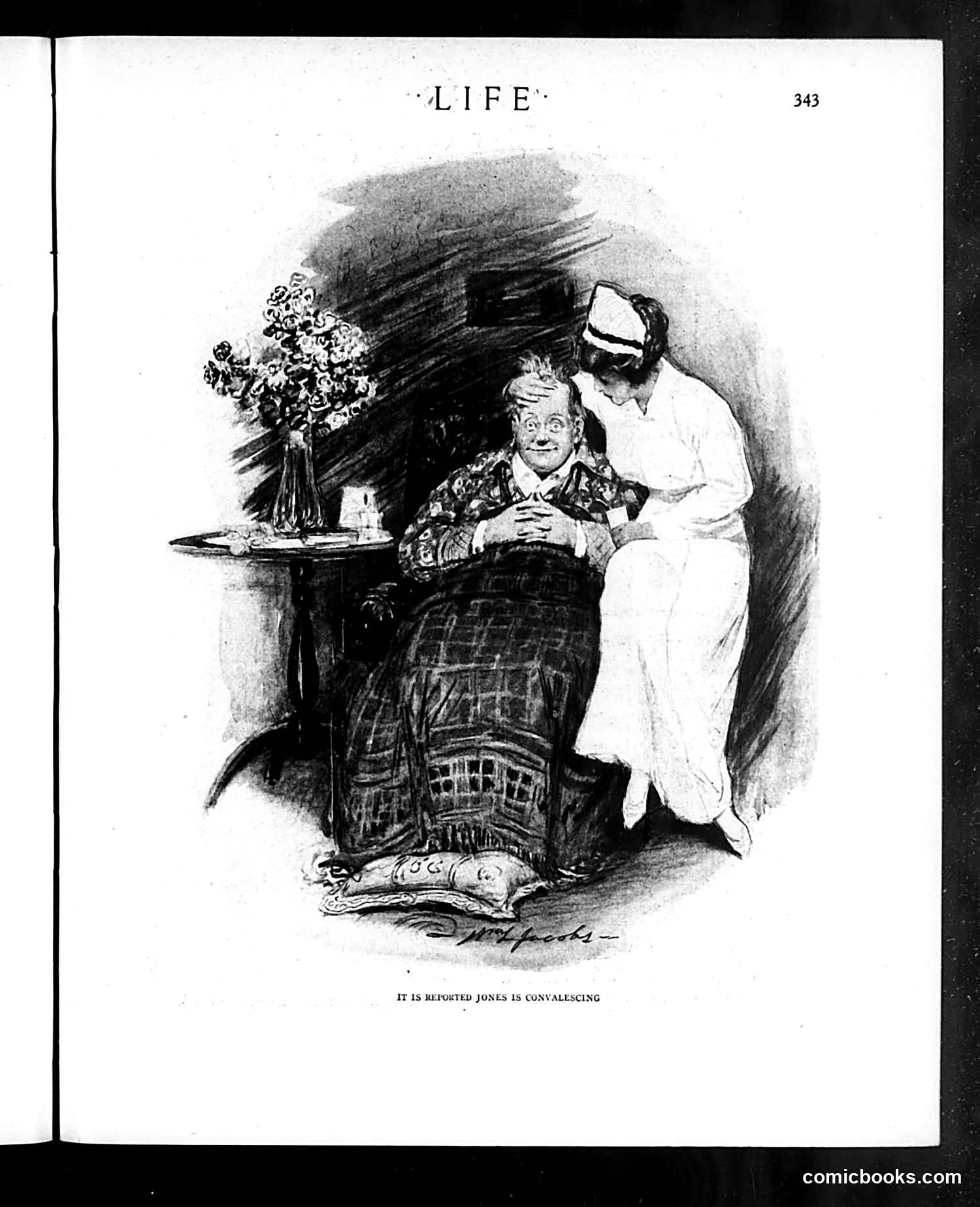
This satirical cartoon depicts a medical scene where a nurse tends to a patient identified as "Jones." The exaggerated facial expression and body language suggest Jones is recovering from illness, though the caption's word "convalescing" implies slow improvement. The humor likely relies on contemporary references to a specific "Jones" known to Life's readers—possibly a public figure, politician, or celebrity of the era. Without additional context about which Jones is referenced or the magazine's publication date, the specific satirical target remains unclear. The cartoon style and domestic medical setting were typical of Life's social satire during the early 20th century, mocking either the patient's condition or the medical care depicted.
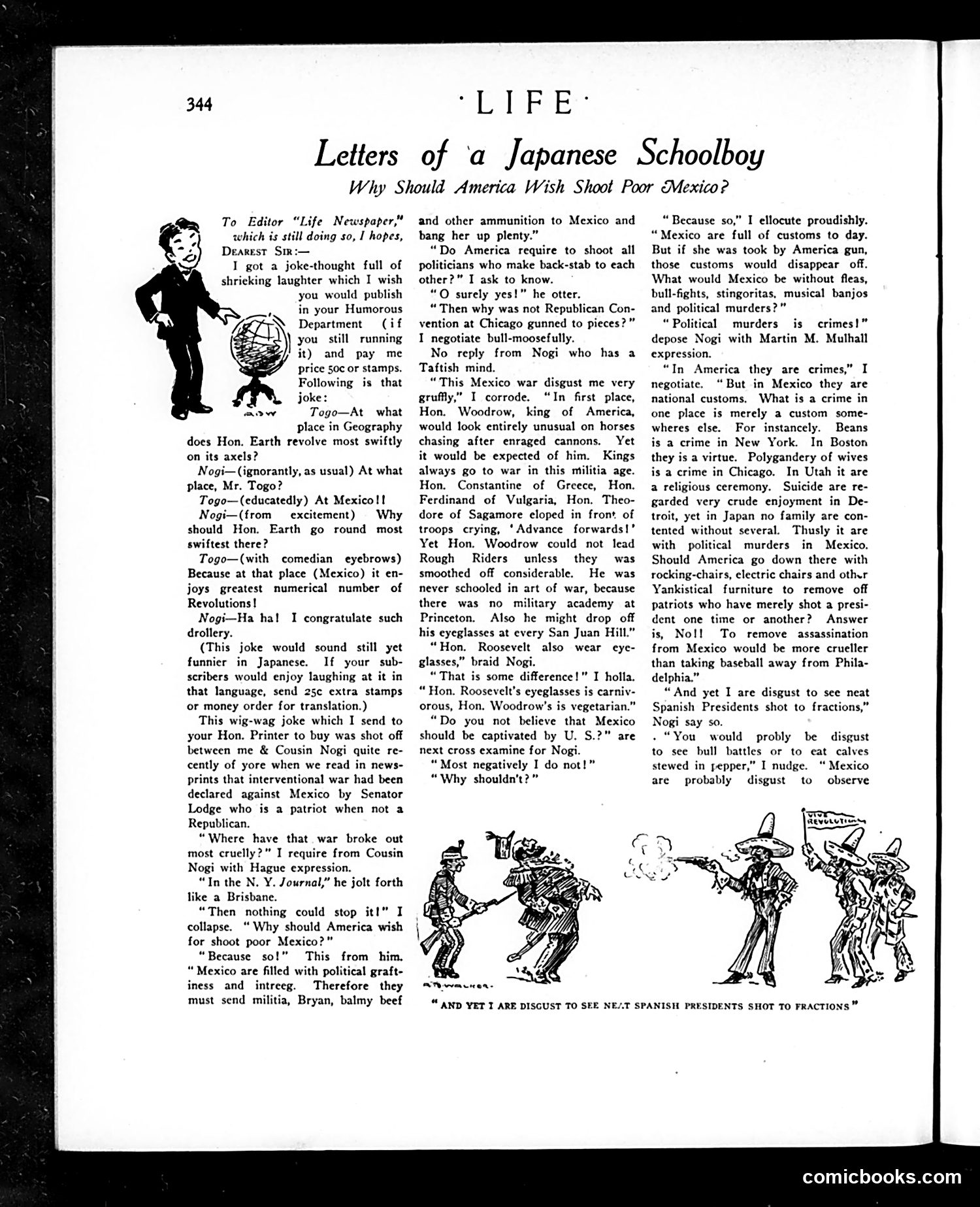
This satirical piece uses a Japanese schoolboy character named Nogi to critique American interventionism in Mexico through naive questioning. The "schoolboy" asks why America would shoot at Mexico, referencing recent U.S. military intervention there—likely the 1916 Pershing Expedition or earlier tensions. The humor relies on the device of "innocent" questions exposing alleged American hypocrisy: politicians make back-stab accusations at each other, yet America itself engages in military aggression. The schoolboy challenges specific American figures (Roosevelt, Woodrow Wilson) for their claimed principles versus actual conduct. The bottom illustration depicts armed conflict, reinforcing the critique of American military action. This represents Life magazine's satirical commentary on U.S. foreign policy contradictions.
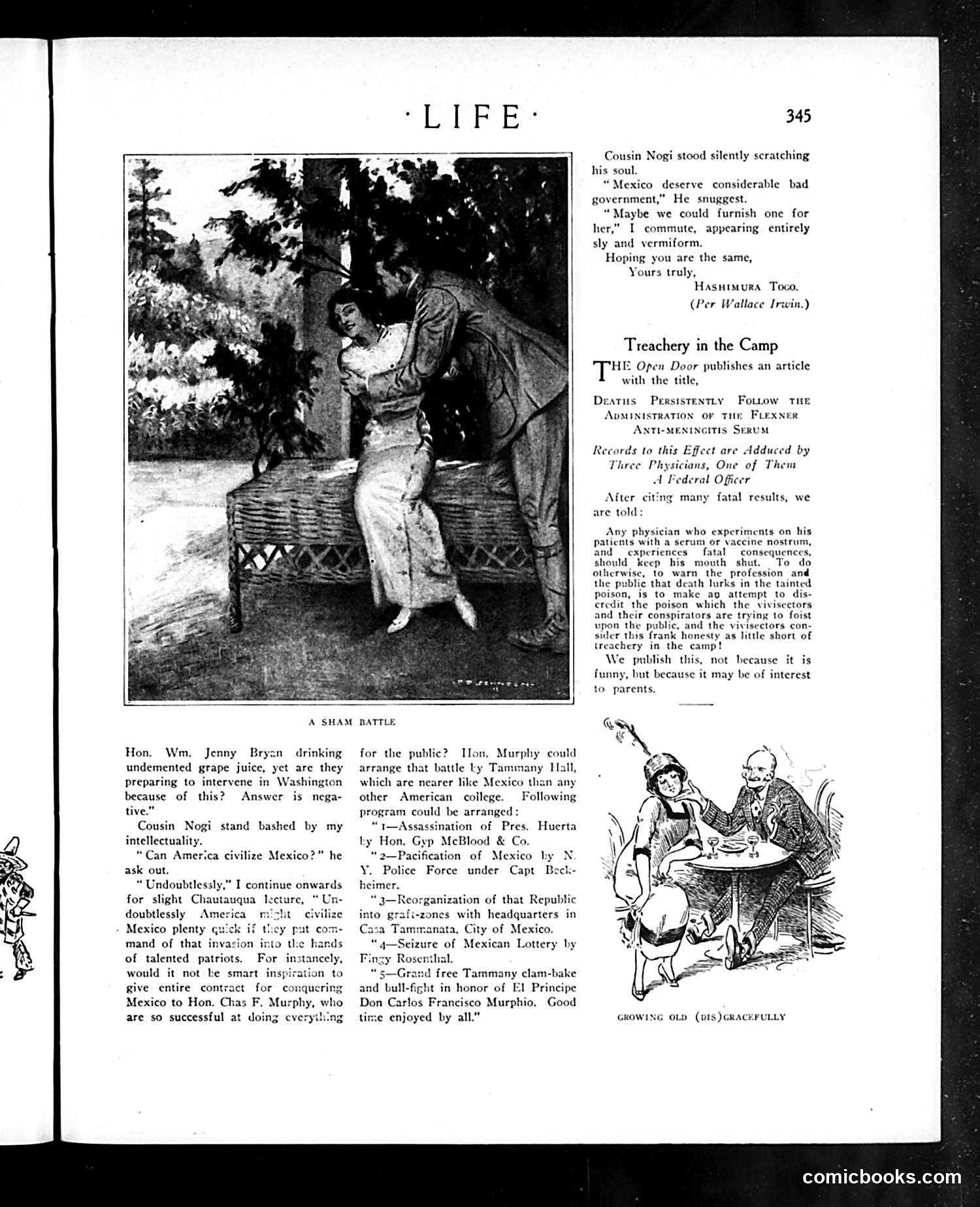
The page contains two distinct sections: **"A Sham Battle"** discusses American intervention in Mexico. Cousin Nogi critiques U.S. policy, sarcastically suggesting America could "civilize Mexico" by hiring talented patriots like Hon. Chas F. Murphy. The satire mocks the notion that Americans could effectively govern Mexico, implying such interventionist schemes are absurd. References to "Assassination of Pres. Huerta" and Mexican reorganization suggest this concerns early 20th-century U.S.-Mexico relations, likely during the Mexican Revolution era. **"Treachery in the Camp"** warns parents about fraudulent meningitis vaccines circulating in camps—doctors allegedly using worthless serums while claiming effectiveness. This exposes medical quackery targeting vulnerable children. The illustration "Growing Old (Dis)gracefully" appears unrelated to the text.
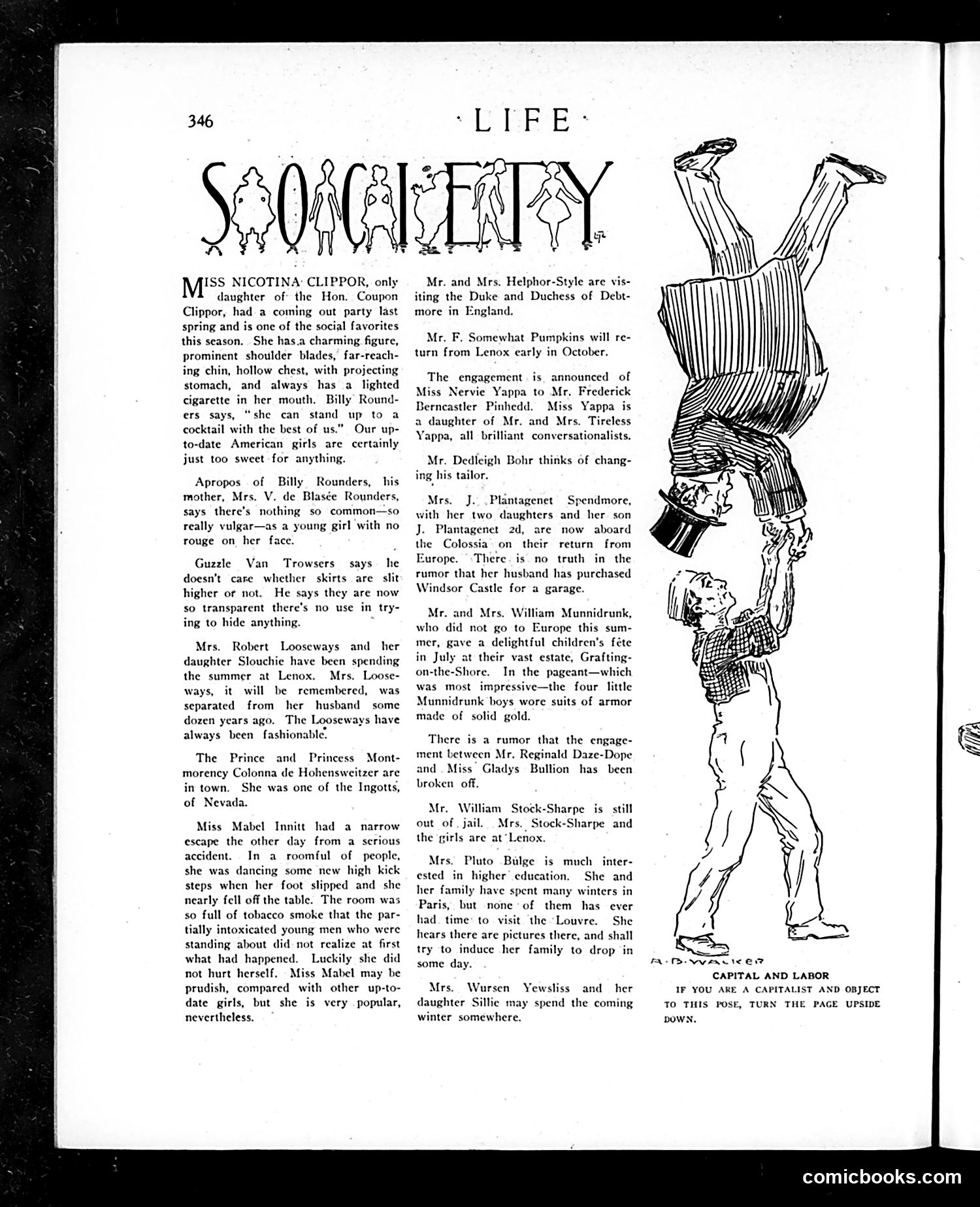
This is a **society/gossip column** page, not a political cartoon. The main content consists of brief items about wealthy socialites and their activities—visits abroad, engagements, parties, and social scandals. The single cartoon on the right shows a figure doing an **acrobatic handstand or headstand**, labeled "CAPITAL AND LABOR." The accompanying text (partially visible) suggests this is satirizing the relationship between capitalists and laborers, likely depicting capital as precariously balanced or workers literally supporting the system on their heads. The joke appears to be about labor's precarious position in the economic hierarchy—they bear the weight of capital's survival, a common satirical theme in early 20th-century American commentary on class struggle.
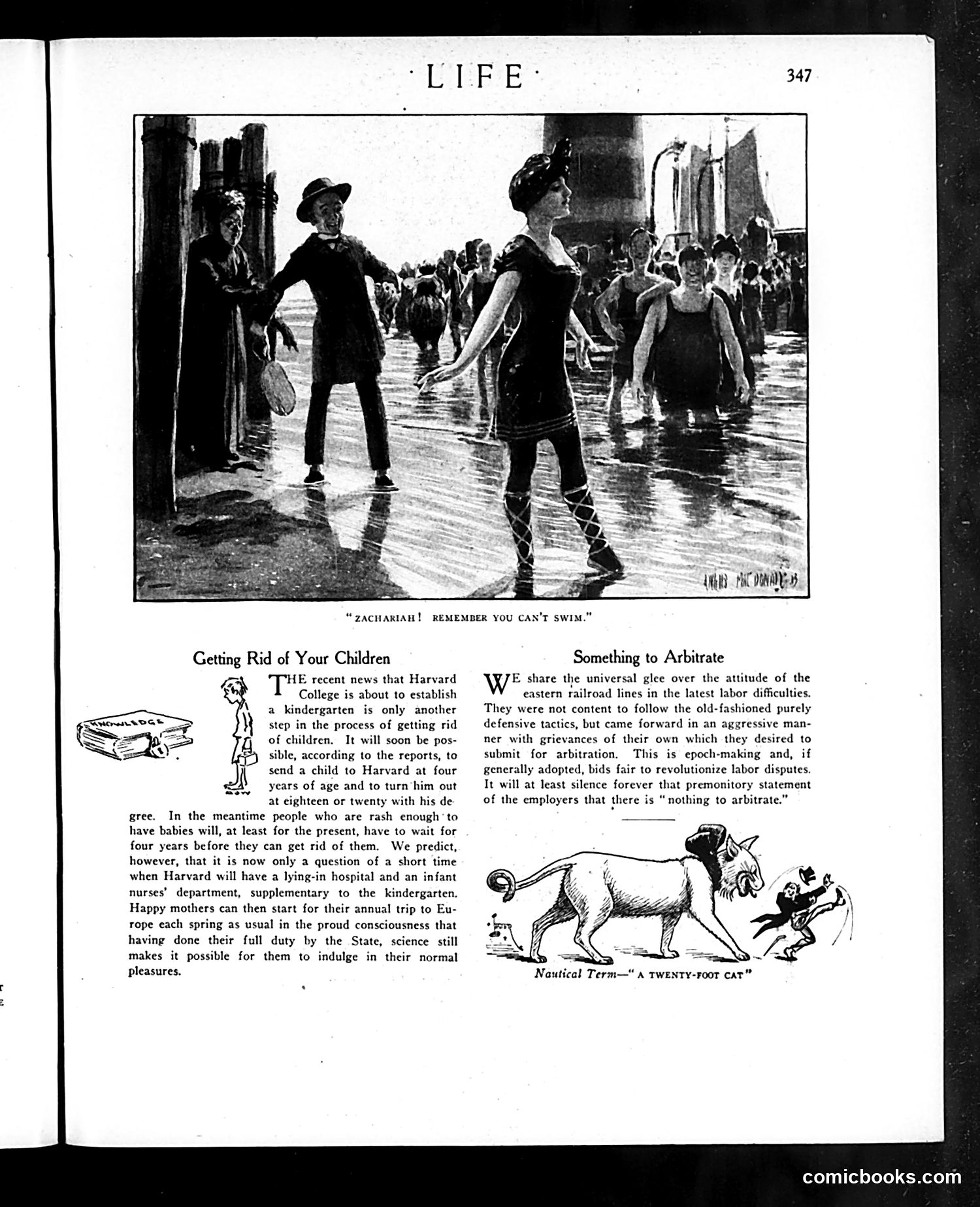
**Main Cartoon:** The top image depicts a beach scene with the caption "Zachariah! Remember You Can't Swim." This appears to be dark humor about child endangerment or abandonment—a parent warning a child who cannot swim before leaving them at the water's edge, likely satirizing parental negligence. **Left Article: "Getting Rid of Your Children"** Satirizes Harvard College's establishment of a kindergarten as part of a broader societal trend toward institutional childcare. The piece mockingly suggests that parents are eager to offload children to institutions—first kindergarten at age four, eventually Harvard by eighteen. It jokes that mothers can then vacation in Europe "guilt-free," having delegated parenting to "the State" and "science." The satire criticizes both parental abdication of responsibility and the growing industrialization of education. **Right Article: "Something to Arbitrate"** Praises eastern railroad workers for bringing grievances to arbitration rather than using purely defensive labor tactics. The satire suggests employers previously claimed there was "nothing to arbitrate," making this workers' initiative revolutionary for labor relations. **Bottom Cartoon:** A "nautical term" joke depicting a cat as a "twenty-foot cat," likely visual wordplay.
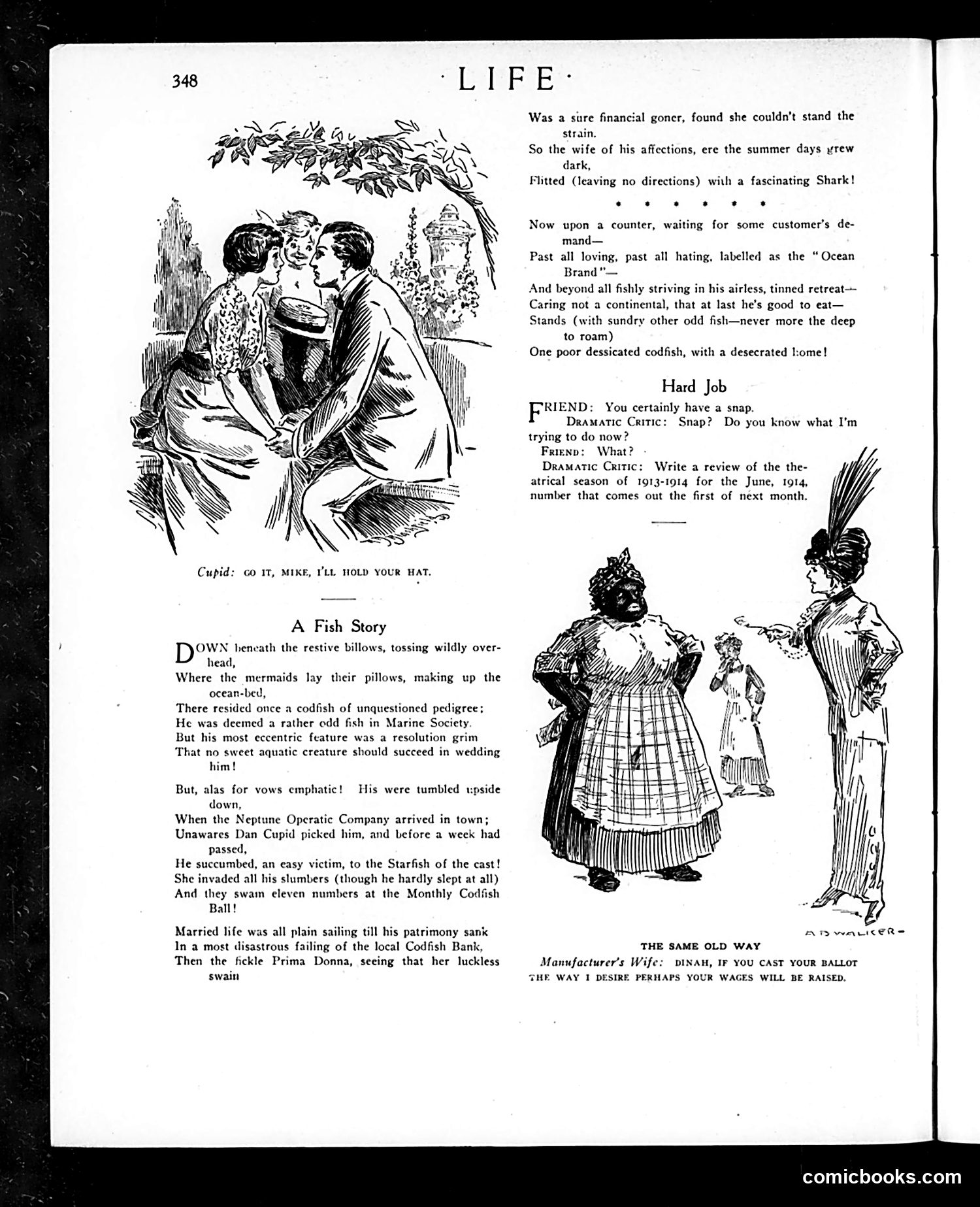
This page contains three satirical pieces from an early 1900s American humor magazine: **"A Fish Story"** (main narrative): A mock-operatic tale mocking romantic melodrama. A codfish vows never to marry but is seduced by a starfish performer in the "Neptune Operatic Company." After they marry, his finances collapse (the "Codfish Bank" fails), and the fickle starfish abandons him. The satire targets both romantic excess and financial instability of the era. **"Hard Job"** (top dialogue): A dramatic critic complains about the demanding task of reviewing an entire 1913-1914 theatrical season for a June 1914 publication deadline—satirizing both the pressure of arts criticism and publication schedules. **"The Same Old Way"** (bottom): A manufacturer's wife tells her servant Dinah that voting the "correct way" might result in wage increases—satirizing paternalistic workplace manipulation and the emerging women's suffrage debate, suggesting employers coerced workers' votes. All employ exaggerated Victorian sentimentality and social pretension as targets for ridicule.
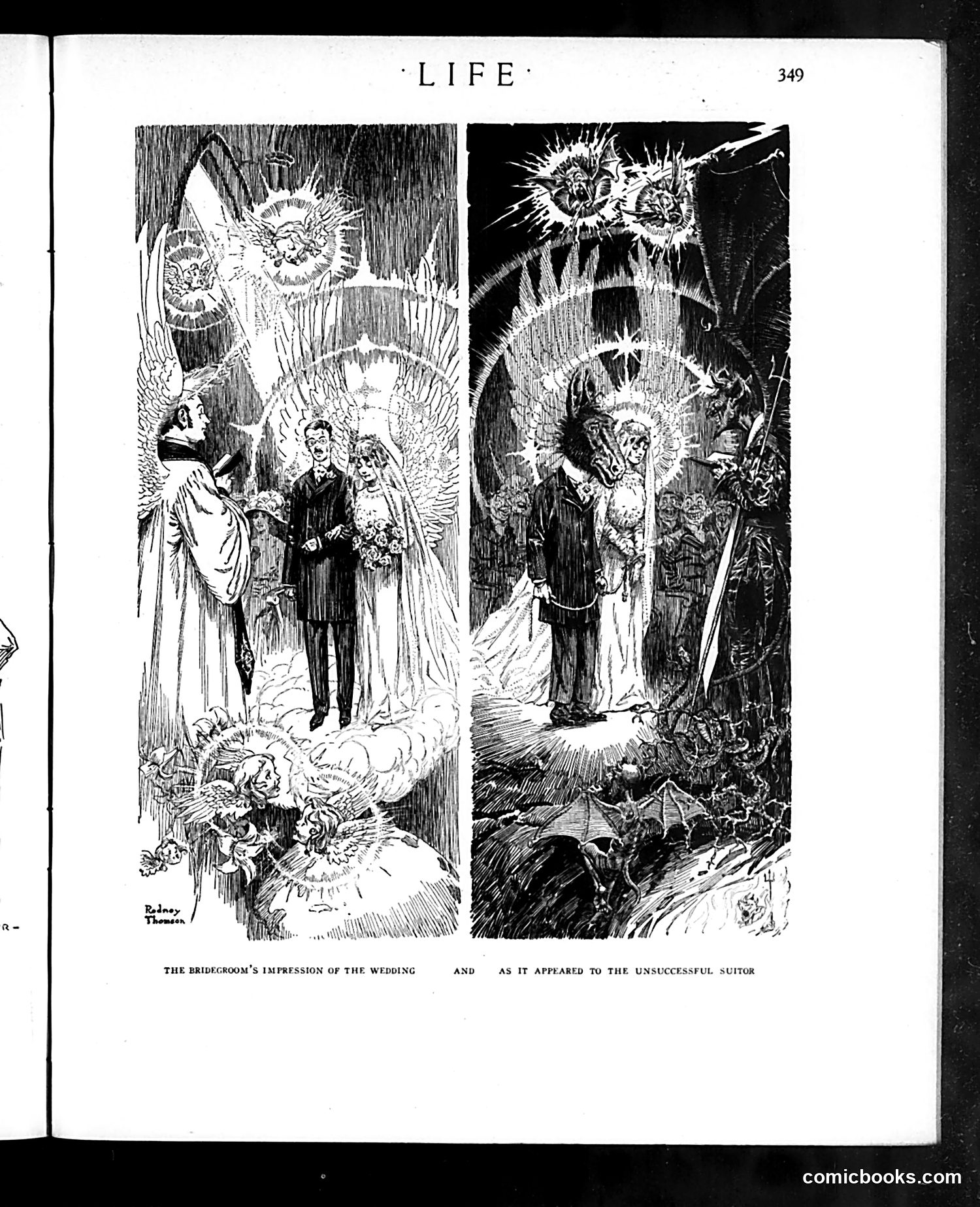
This page presents two contrasting woodcut-style illustrations of the same wedding scene, labeled as "The Bridegroom's Impression of the Wedding" (left) and "As It Appeared to the Unsuccessful Suitor" (right). The satire compares how the same event appears differently depending on emotional perspective. The bridegroom sees a heavenly, blessed occasion—angels and divine light surround the couple. The rejected suitor, meanwhile, perceives demons, darkness, and hellish imagery in the identical scene. This is a commentary on how subjective emotion colors perception. The same objective reality—a wedding—transforms into either paradise or torment based on the observer's romantic success or failure. It's a humorous take on heartbreak and the distorted perspective grief produces.
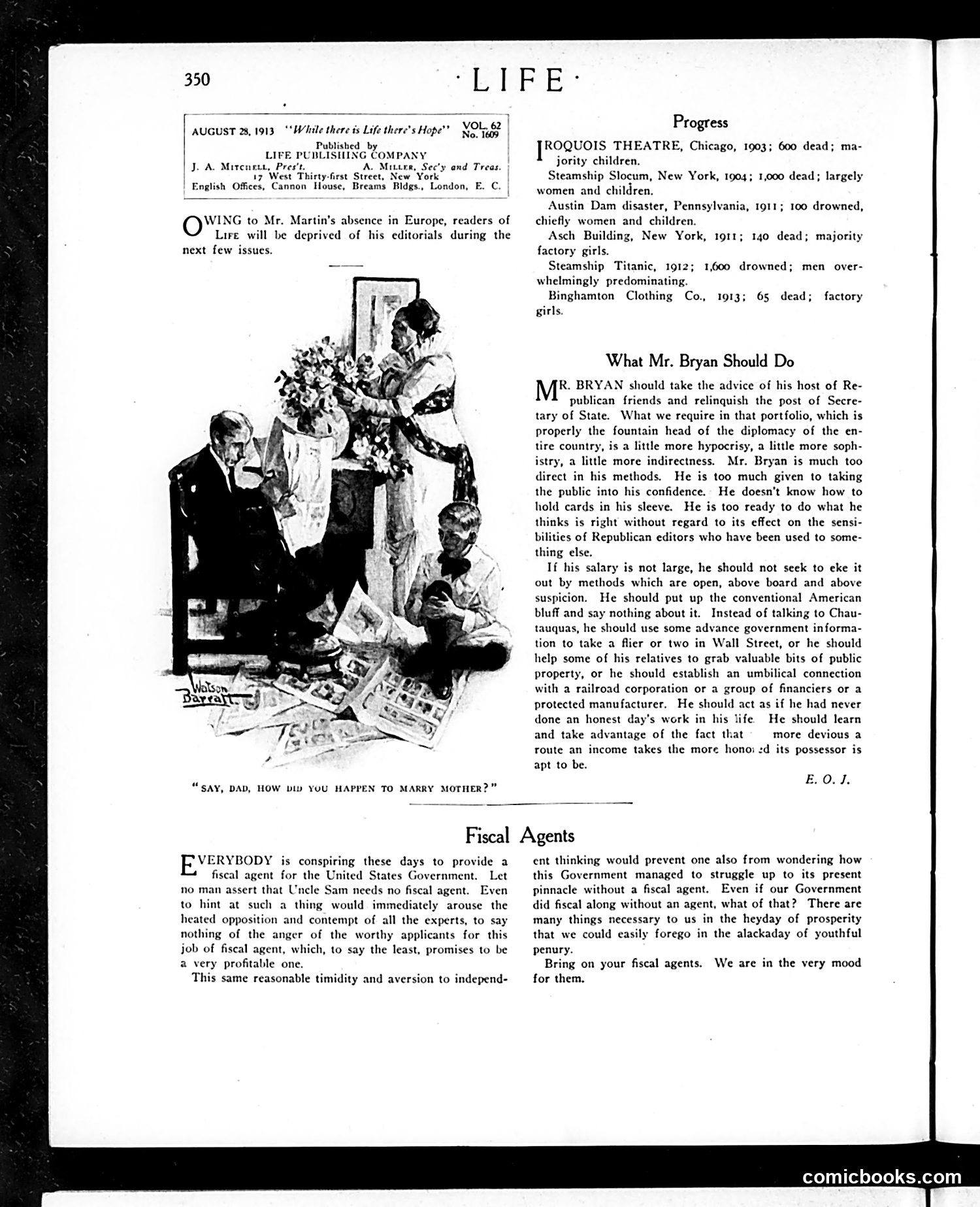
This page contains two satirical pieces targeting Democratic politicians and government practices. **The cartoon** (captioned "Say, Dad, How Did You Happen to Marry Mother?") appears to show a father figure surrounded by children, likely satirizing William Jennings Bryan or another politician's prolific political "offspring"—their various initiatives or policies. **"What Mr. Bryan Should Do"** directly attacks Secretary of State William Jennings Bryan, a prominent Democrat. The satirist argues Bryan is *too honest* for high office, mocking him for being direct, transparent, and unwilling to engage in corruption—practices the author suggests are standard diplomatic behavior. The piece sarcastically advises Bryan to profit from insider information, help relatives steal public property, or establish corrupt corporate connections instead of maintaining integrity. **"Progress"** lists major industrial disasters (1903-1913) with casualty counts, implying criticism of inadequate safety regulations or corporate accountability. **"Fiscal Agents"** mocks proposed government financial appointees as unnecessary profiteers exploiting national resources. The overall tone is bitterly sarcastic, attacking Democratic governance as simultaneously too naive and too corrupt.
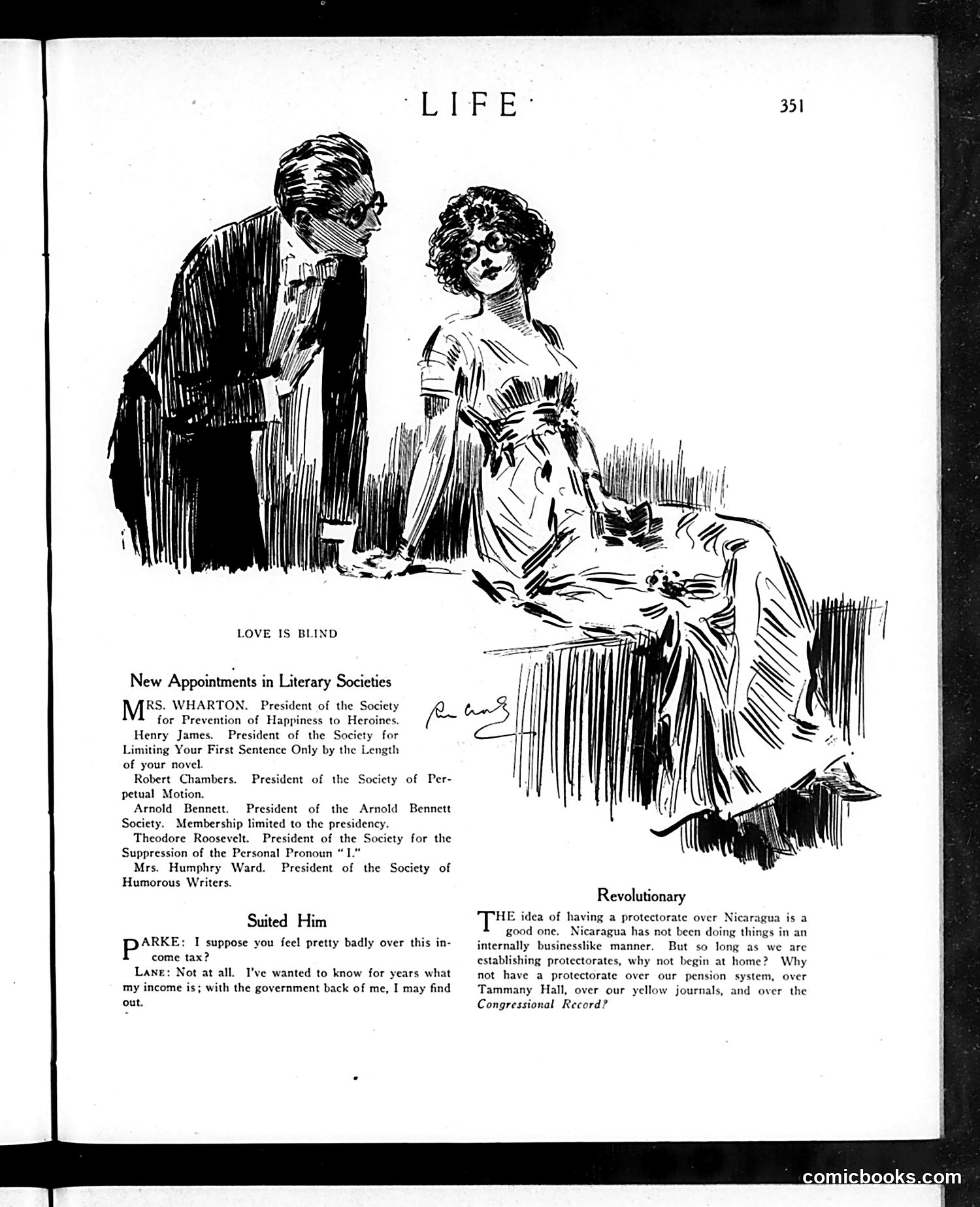
This satirical page contains two main sections: **"Love is Blind" cartoon**: Shows a man (standing) and woman (seated) in an intimate moment, captioned with a humorous "literary societies" list that parodies famous authors of the era—Edith Wharton, Henry James, Robert Chambers, Arnold Bennett, Theodore Roosevelt, and Mrs. Humphry Ward. Each fictional society mocks these writers' known characteristics: Wharton's tragic heroines, James's famously long opening sentences, Bennett's self-promotion, Roosevelt's excessive use of "I," and Ward's reputation. **"Suited Him" joke**: A brief exchange about income tax, likely referencing recent U.S. income tax legislation, with the humor being that one character welcomes government scrutiny to finally understand his own finances. **"Revolutionary" section**: Political satire suggesting the U.S. should apply its paternalistic "protectorate" approach (referenced regarding Nicaragua interventionism) to domestic problems: the pension system, Tammany Hall (corrupt NYC political machine), sensationalist newspapers, and Congress itself. The page satirizes both literary figures and progressive-era American politics and imperialism.
This appears to be a black and white photograph rather than a political cartoon. The image shows a young girl in a patterned dress standing in what looks like a narrow alley or courtyard between brick buildings. The setting appears urban and possibly run-down, with overgrown vegetation visible. The girl appears to be the central subject of the composition. Without additional context or clearer text identifying the subject matter, caption, or article this accompanies, I cannot determine what specific social or political commentary this photograph was intended to convey in *Life* magazine. The page reference "comicbooks.com" at the bottom suggests this may be from a digital archive rather than the original publication. More context would be needed to explain the satirical or editorial intent.
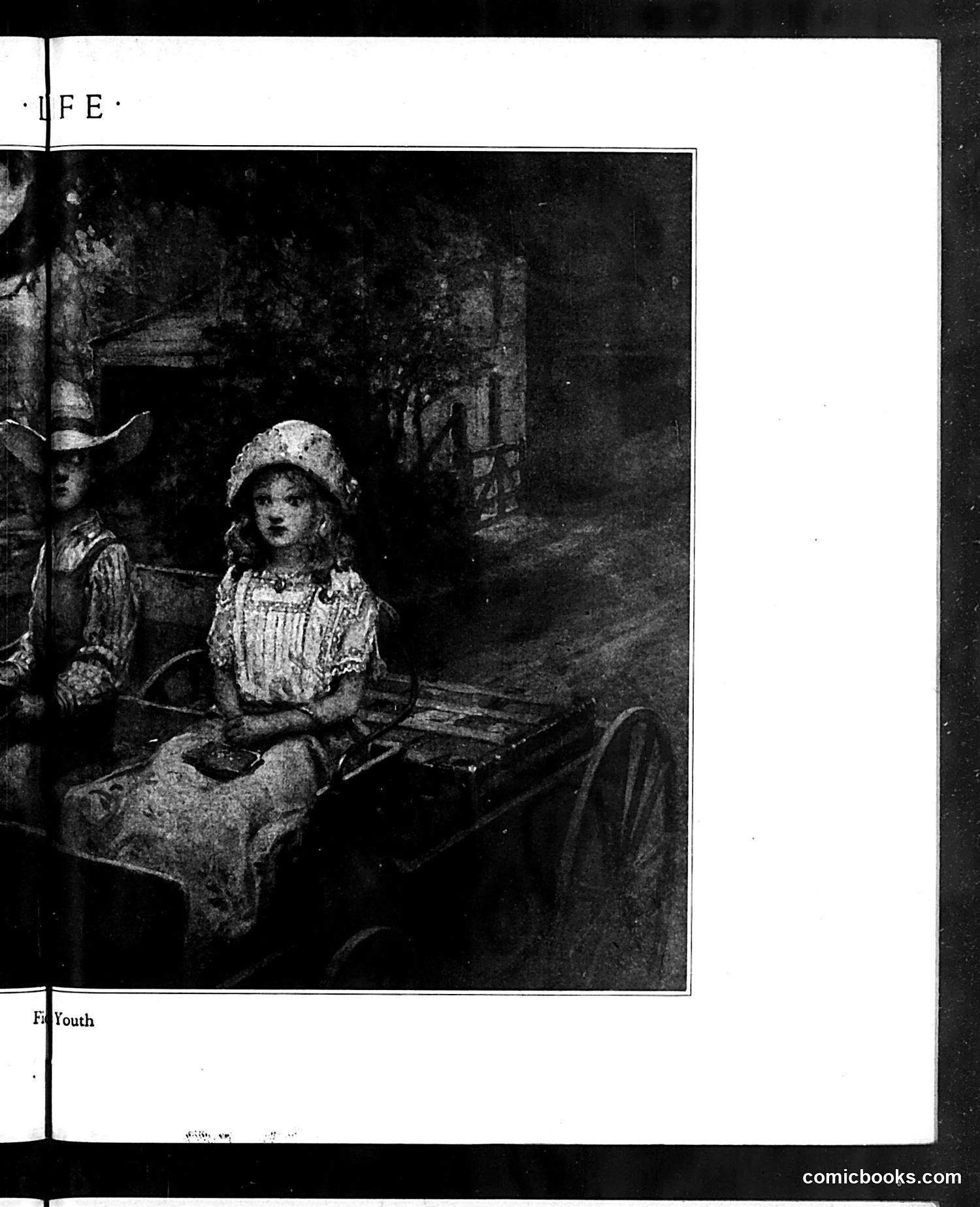
This page shows a black and white photograph labeled "Youth" depicting a young girl seated on what appears to be a cart or wagon. She wears period clothing including a bonnet and long dress with an apron, suggesting rural or working-class attire from an earlier era. The OCR text is largely illegible and doesn't provide clear context. Without additional readable text, the specific satirical point remains unclear. However, the photograph's title "Youth" combined with the worn clothing and setting suggests Life magazine may be commenting on child labor, rural poverty, or social conditions affecting young people—common subjects of American satirical journalism in the early-to-mid 20th century. The exact historical context and intended critique cannot be determined from the visible image alone.
This is a book review section, not a political cartoon. The page discusses several newly published works, with particular emphasis on **Walter Lippmann's "A Preface to Politics"** (1911). The opening essay uses an extended metaphor: surgical treatment of a crippled hand mirrors intellectual progress in modern society. Just as doctors must painfully break up adhesions to restore function, society must undergo uncomfortable intellectual "breaking up" of old assumptions to achieve healthy political and economic thinking. The review celebrates that serious political philosophy—once a "dead pseudo science"—is gaining vital attention through books by Lippmann, Jack London, and others. The page lists contemporary bestsellers including Winston Churchill's "The Inside of the Cup" and works by Bergson and Gerald Stanley Lee, suggesting early 20th-century appetite for serious social commentary and progressive political thought.
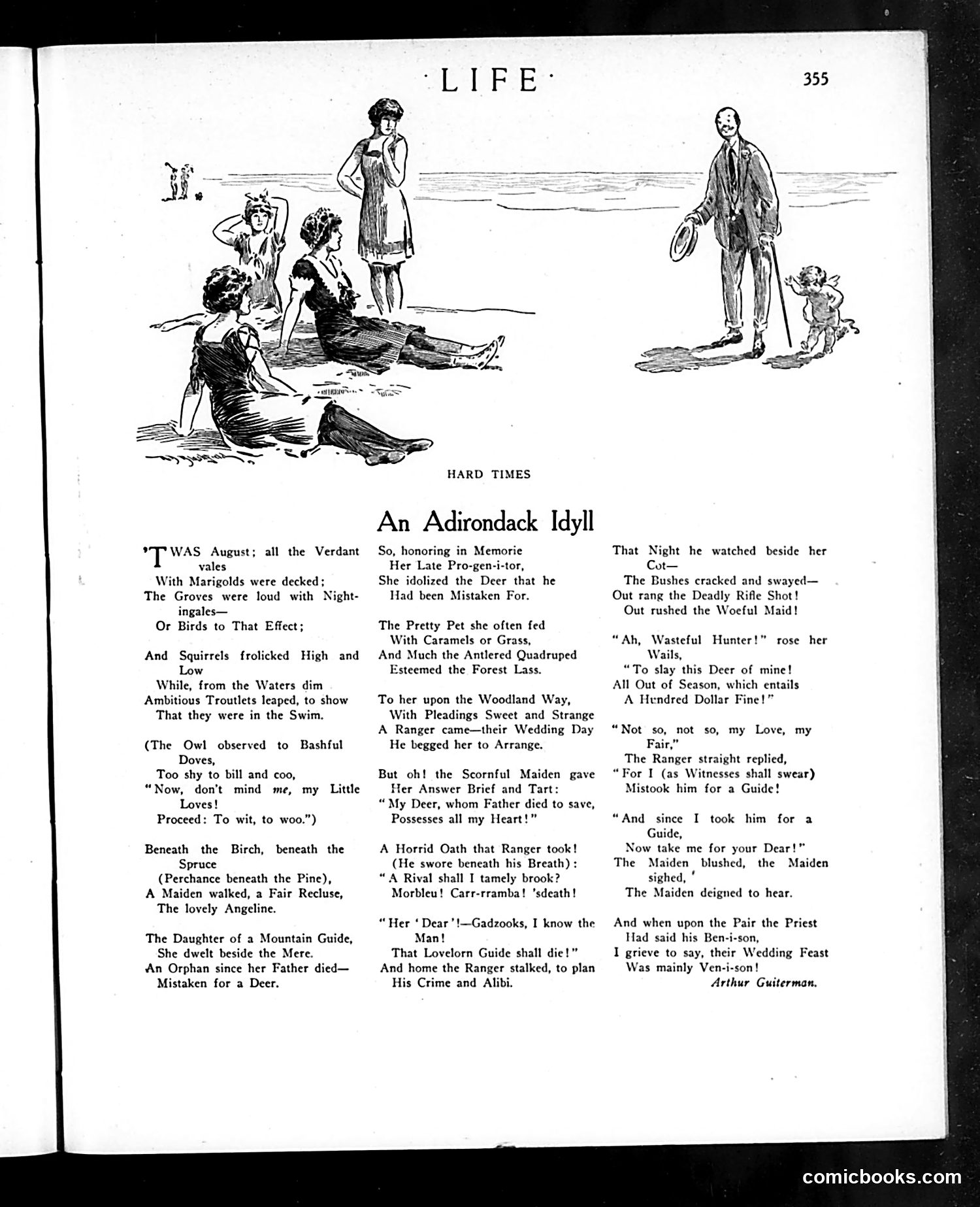
This is a humorous narrative poem by Arthur Guiterman satirizing romantic melodrama and legal absurdities through exaggerated wordplay. The story follows Angeline, an orphan daughter of a mountain guide (killed by being mistaken for a deer), who loves the actual deer her father died protecting. A ranger proposes; she refuses, devoted to her "Dear." The jealous ranger shoots the deer but claims he mistook it for a *guide*—thus avoiding the legal penalty for killing a deer out of season (a "hundred dollar fine"). The maiden accepts his proposal. The satire targets: (1) overwrought romantic conventions ("Rival shall I tamely brook?"); (2) legal technicalities and how they can be exploited; (3) the absurdity of mistaking a deer for a human. The punchline—their wedding feast is venison—suggests dark irony: the beloved deer becomes dinner anyway. The illustration shows beach/vacation scenes, likely titled "Hard Times" to mock leisure contrasted with the melodrama.
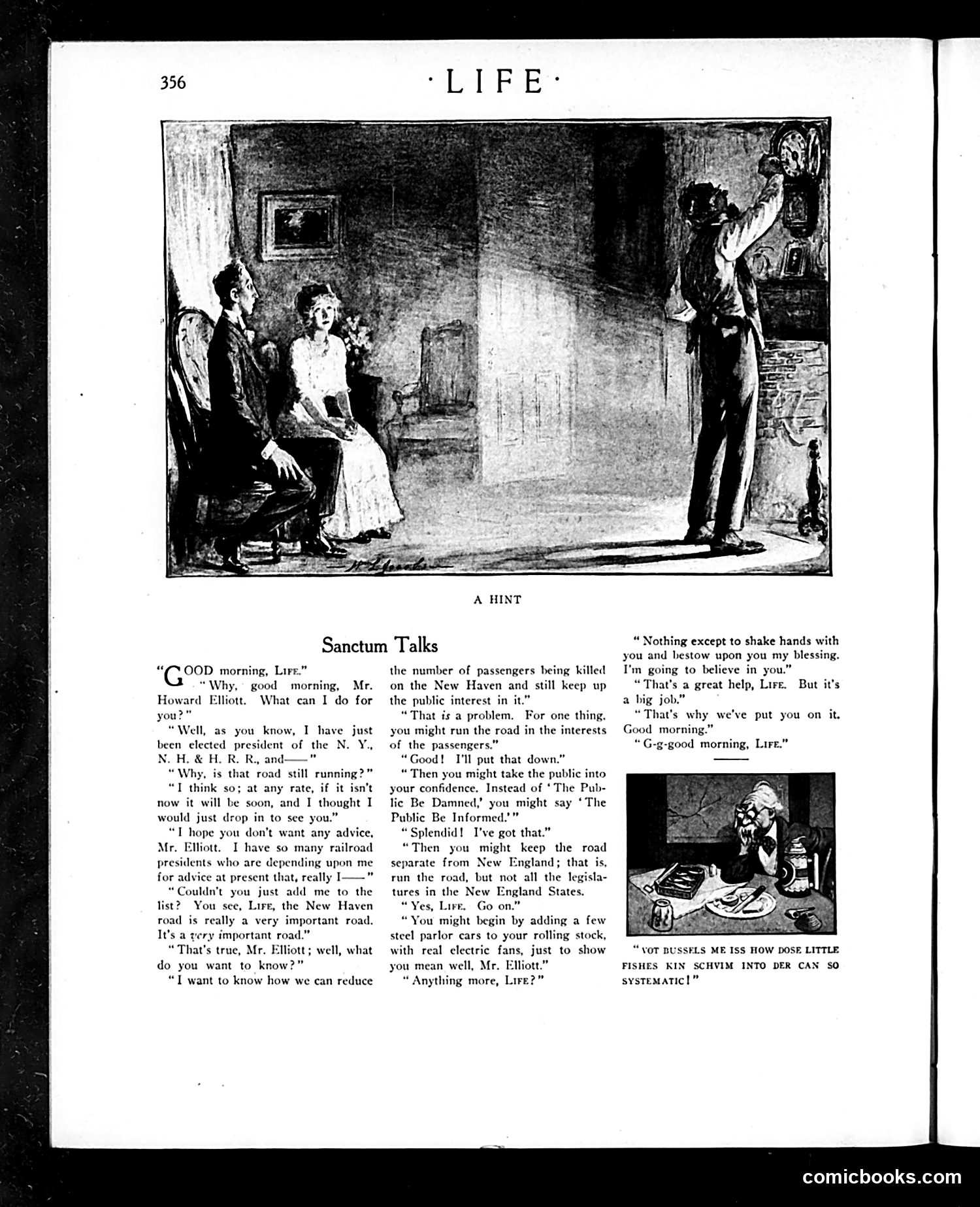
This is satirical commentary on the New Haven Railroad's notorious safety and management problems. The cartoon depicts an editor of *Life* magazine offering sardonic "advice" to Howard Elliott, the newly elected president of the New York, New Haven & Hartford Railroad. The satire targets the railroad's documented failures: passenger deaths, poor service, and public distrust. The editor's "solutions" are deliberately absurd—suggesting Elliott simply "run the road in the interests of passengers" and replace the infamous motto "The Public Be Damned" with "The Public Be Informed"—mocking how obvious these fixes should be yet apparently weren't implemented. The bottom cartoon appears unrelated: a figure observing fish swimming systematically into a can, likely a separate joke about German immigrants ("Schvim," "dER"). The page ridicules both corporate mismanagement and the railroad's callous indifference to public welfare—a major Progressive-era complaint.
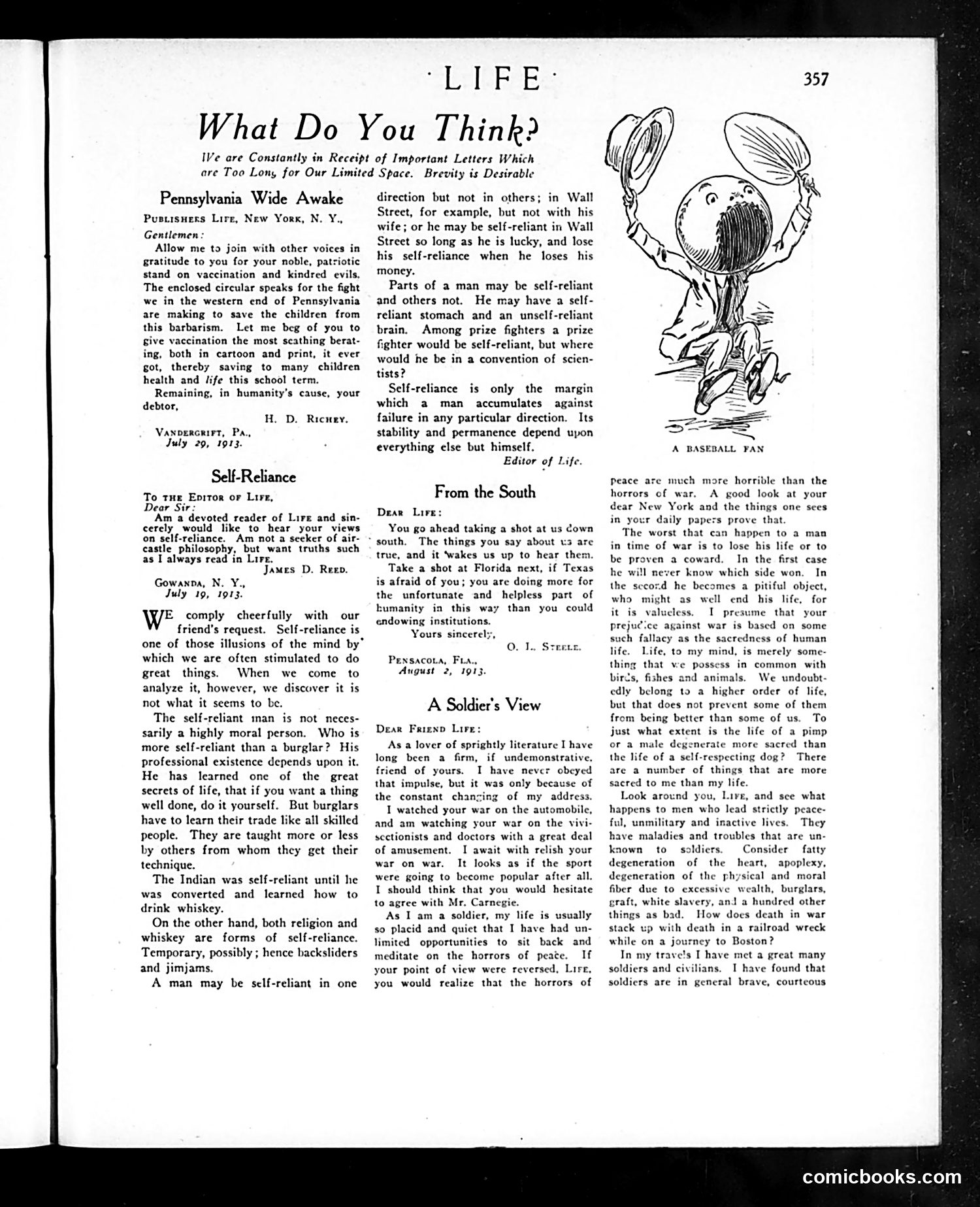
This page presents reader letters responding to Life's editorial positions. The main cartoon depicts a baseball fan celebrating wildly—a visual joke about American enthusiasm for sports, likely contrasting with the serious social issues discussed in the letters. The letters address Life's recent campaigns: one praises their anti-vaccination stance (a surprising position by modern standards); another discusses self-reliance philosophically; a third encourages Life to criticize Southern institutions; and a soldier's letter suggests Life should expand its satirical "wars" against automobiles, vivisection, and doctors to include war itself—perhaps sarcastically, since Carnegie (likely Andrew Carnegie, the industrialist) apparently opposed such criticism. The page reflects Life's role as a crusading satirical magazine tackling social reform issues of 1913, though some positions (anti-vaccination) would be considered harmful today.
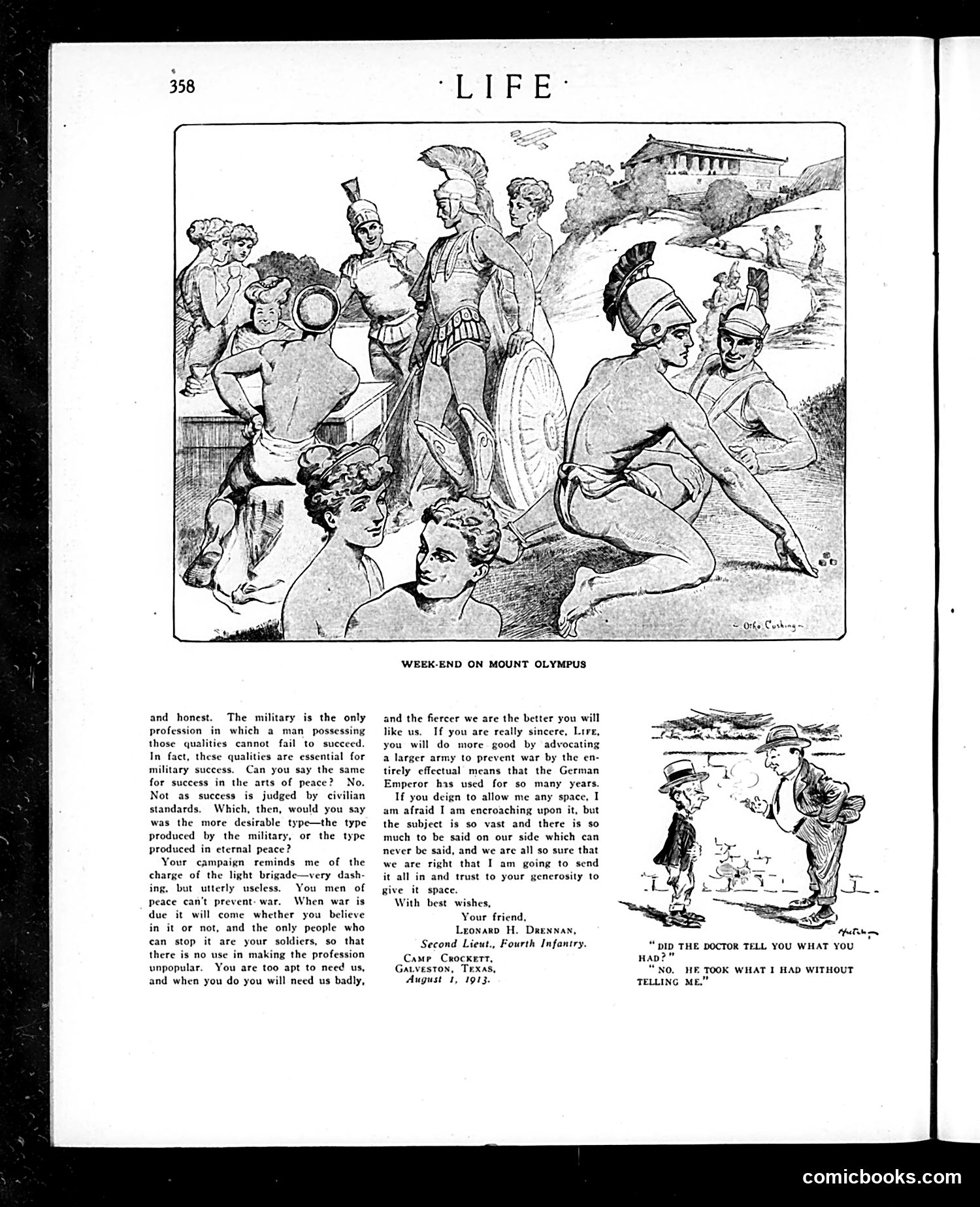
**Main Illustration ("Week-End on Mount Olympus"):** A satirical scene depicting Greek gods and goddesses relaxing while soldiers in modern military dress stand nearby. The juxtaposition mocks the disconnect between classical ideals of peace and beauty with contemporary military reality. **Letter Context:** The page publishes a letter from Second Lieutenant Leonard H. Drennan (August 1, 1913) responding to *Life* magazine's apparent pacifist advocacy. Drennan argues that military virtues are essential, that soldiers—not peace advocates—prevent war, and that larger armies (specifically citing German military buildup) maintain peace through strength. He implicitly critiques *Life*'s anti-militarism as naive and dangerous. **Small Comic:** The bottom illustration is a joke about a doctor's visit—likely satirizing medical billing practices where doctors charge without transparent disclosure. **Historical Context:** This reflects pre-WWI tensions (1913) when German military expansion was debated, and American military advocacy competed with pacifist sentiment.
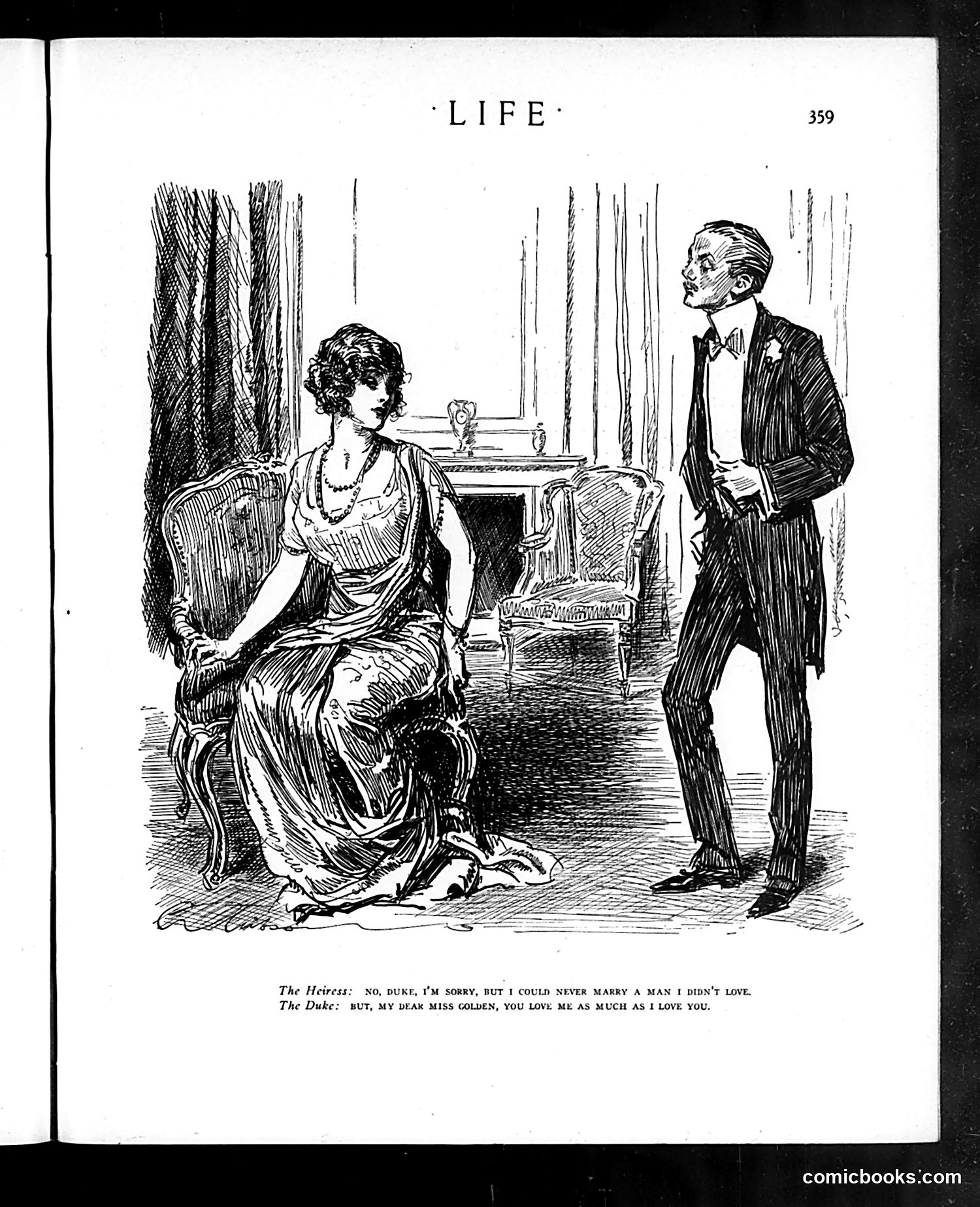
This illustration depicts a romantic scene between a woman ("Miss Golden") seated and a man ("the Duke") standing. The dialogue reveals the cartoon's satirical point: the Duke declares mutual love, but the heiress responds she cannot marry him despite his affection. The satire targets **wealthy heiress-aristocrat marriages** common in Gilded Age America. "Miss Golden" represents a rich American woman; "the Duke" appears to be a titled European nobleman seeking to marry American wealth. The joke highlights the transactional nature of such unions—the woman loves him, but won't compromise her independence by marrying for romance alone. This reflects contemporary anxieties about American heiresses marrying foreign titles and the tension between romantic love and practical matrimonial considerations in high society.
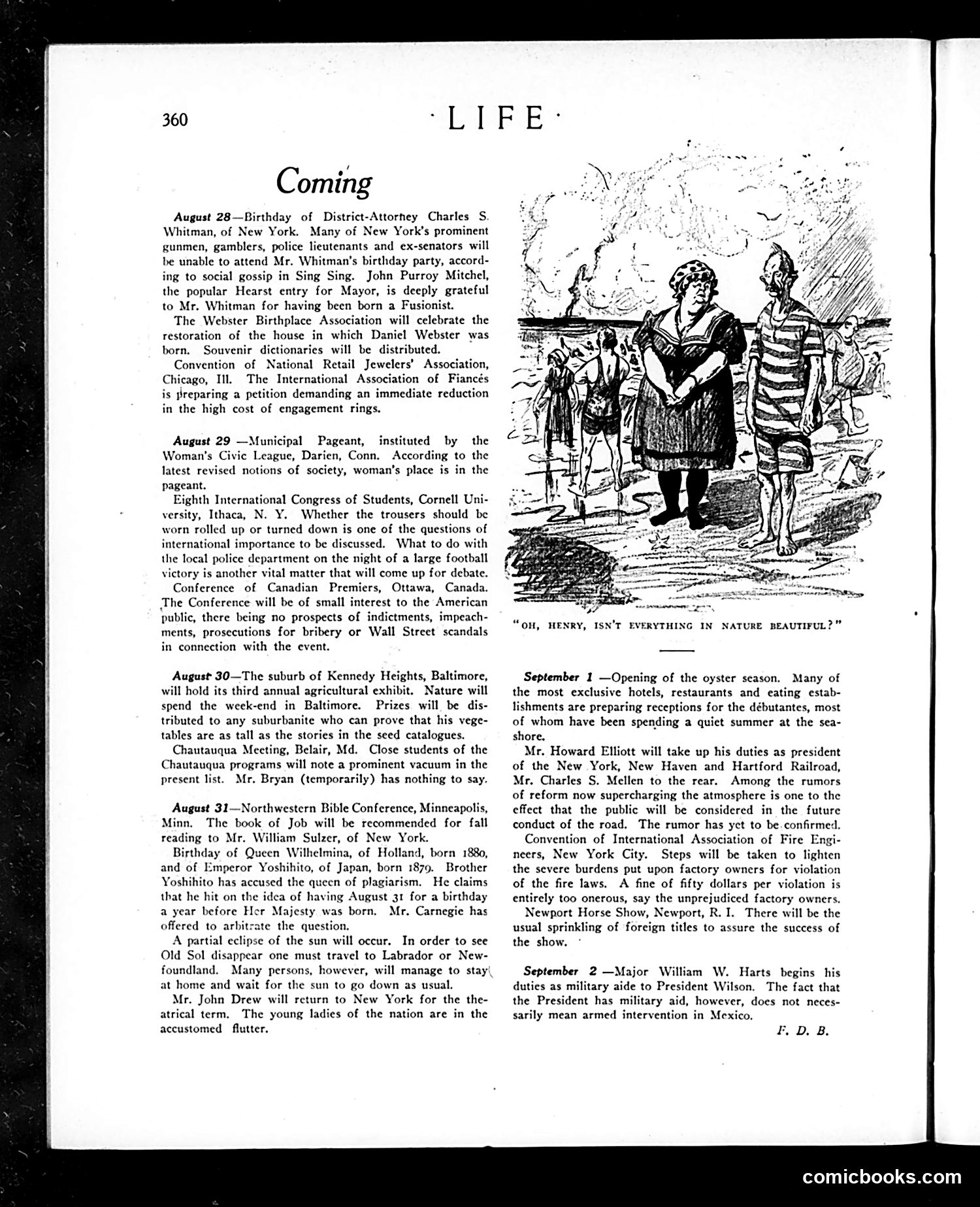
This is a "Coming Events" satirical column listing upcoming August-September events with pointed commentary. The cartoon shows a woman and man observing nature, with the woman's naive question serving as ironic counterpoint to the cynical items below. The satire targets: **Political corruption**: District-Attorney Whitman's birthday party is mocked because criminals ("gunmen, gamblers, police lieutenants") won't attend—implying systemic corruption he's prosecuting. The Sulzer reference suggests New York political scandal. **Social hypocrisy**: The "Woman's place is in the pageant" mocks contemporary debates about women's roles. Engagement ring prices are satirized as an absurd concern. **Corporate malfeasance**: The railroad company comment sarcastically doubts that public welfare will actually be considered, suggesting habitual disregard for passengers. **General cynicism**: Multiple entries mock current events as meaningless or contradictory (the sun eclipse you must travel to see; the queen/emperor birthday dispute). The cartoon's caption—"Oh, Henry, isn't everything in nature beautiful?"—serves as naive counterpoint to the page's pervasive mockery of human society's corruption and pretense.
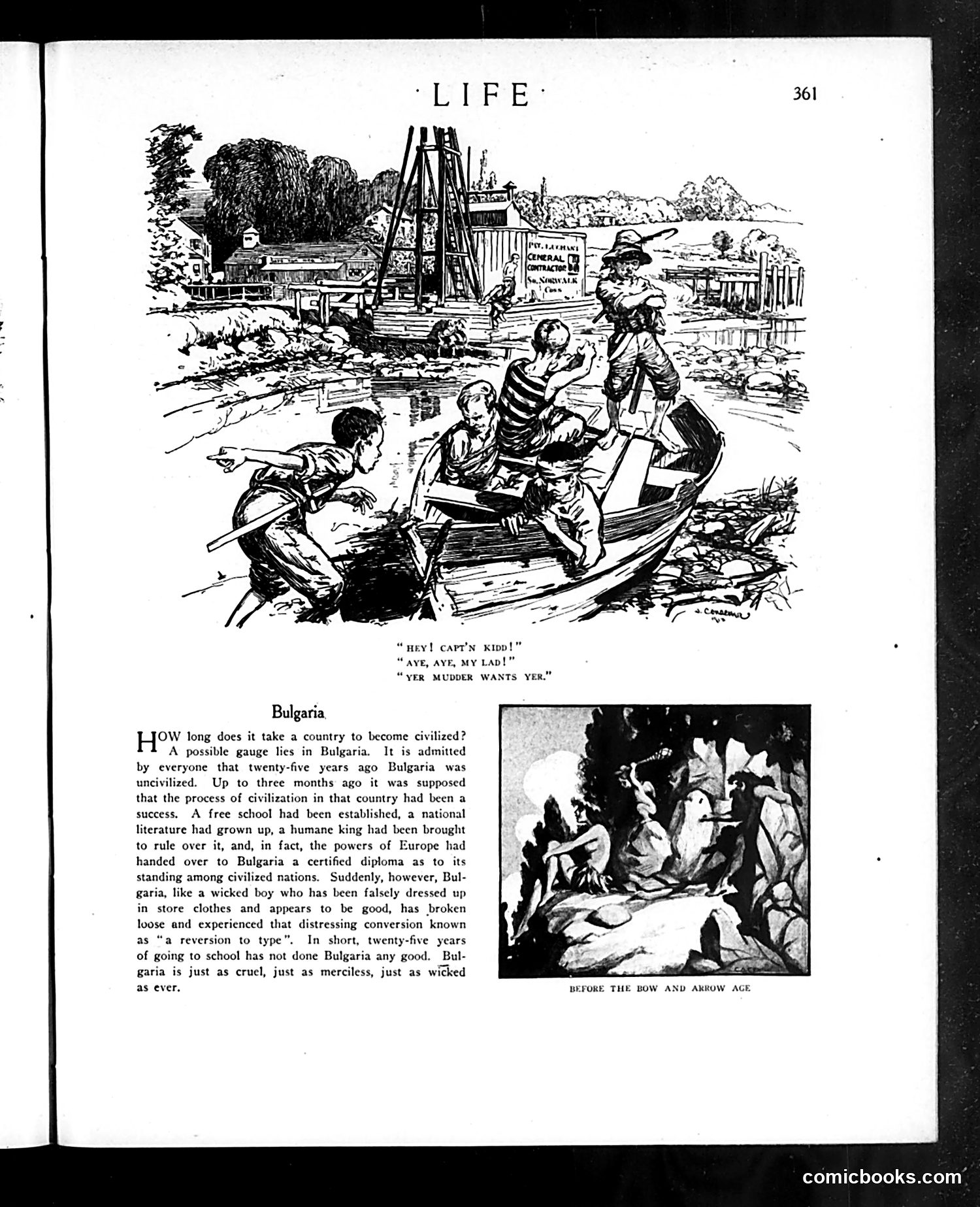
This page satirizes Bulgaria's apparent regression from European civilization. The text argues that despite twenty-five years of modernization—including schools, literature, and a "humane king"—Bulgaria recently "reverted to type," proving that superficial civilizing efforts cannot change a nation's inherent character. The top cartoon depicts working-class dock workers in casual, crude interaction ("Yer mudder wants yer"), suggesting ordinary people remain uncivilized regardless of societal improvements. The bottom image, captioned "Before the Bow and Arrow Age," likely references Bulgaria's recent violent actions (possibly Balkan Wars atrocities, circa 1912-1913), implying the country has abandoned modern civilization and returned to primitive brutality. The satire's point: European attempts to "civilize" non-Western nations through education and institutions are futile—suggesting deeply racist assumptions about inherent national character and capability for civilization.
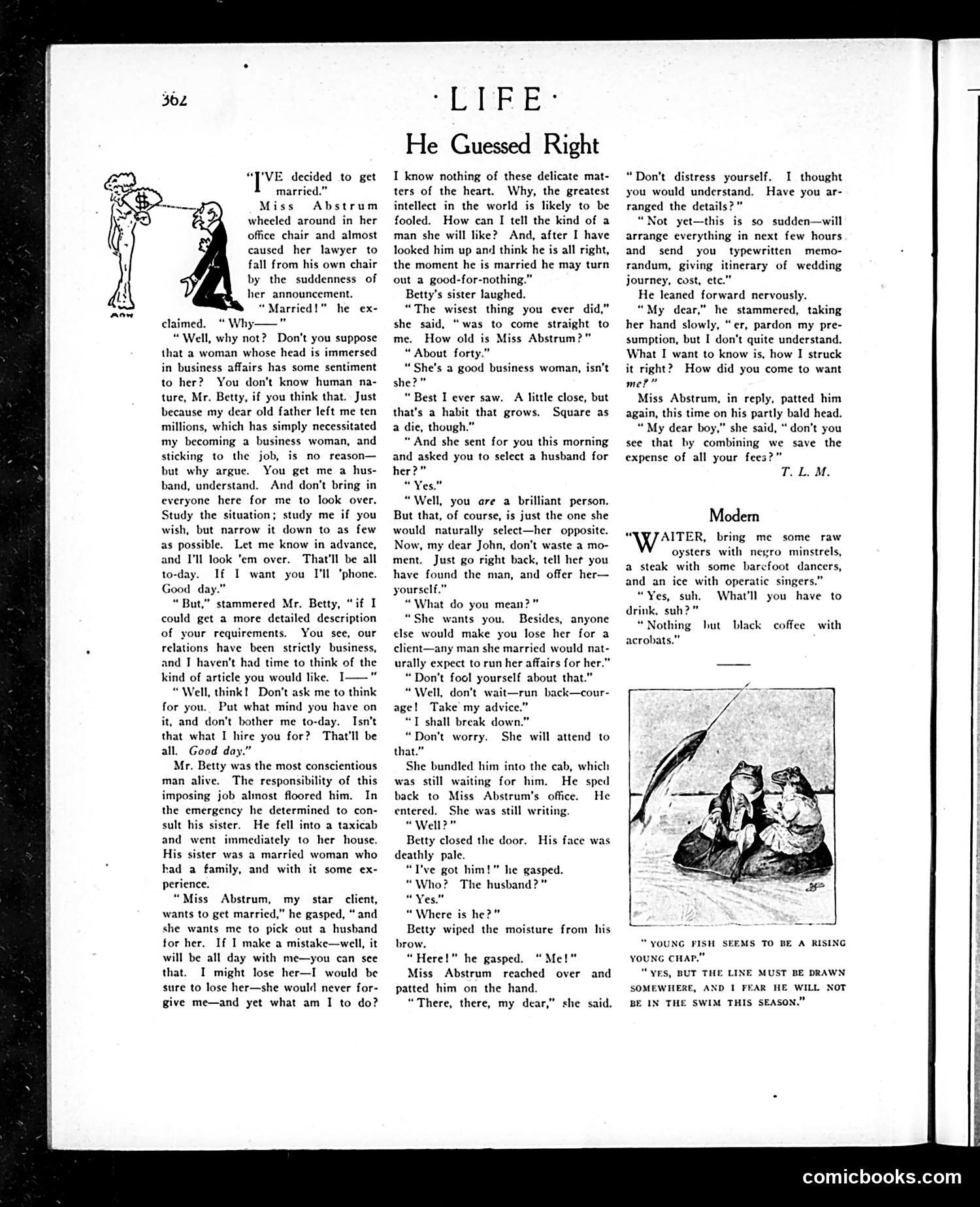
This story satirizes early 20th-century gender dynamics and the "New Woman" of business. Miss Abstrum is a wealthy, independent businesswoman who inherited millions and runs her affairs herself—a notable figure for the era. When she decides to marry, she treats husband-selection as a business transaction, instructing her lawyer Mr. Betty to find her a suitable match. The satire's joke: Betty's sister advises him that Miss Abstrum, being a sharp, logical businesswoman, would naturally choose her *opposite*—an emotional, sentimental man. The punchline reveals Betty should propose himself. The humor mocks both the "career woman" (portrayed as cold, transactional) and the assumption that women automatically seek men unlike themselves. It also gently ridicules the legal/business professions for treating marriage as a contractual matter rather than romantic one. The story reflects contemporary anxiety about changing gender roles.
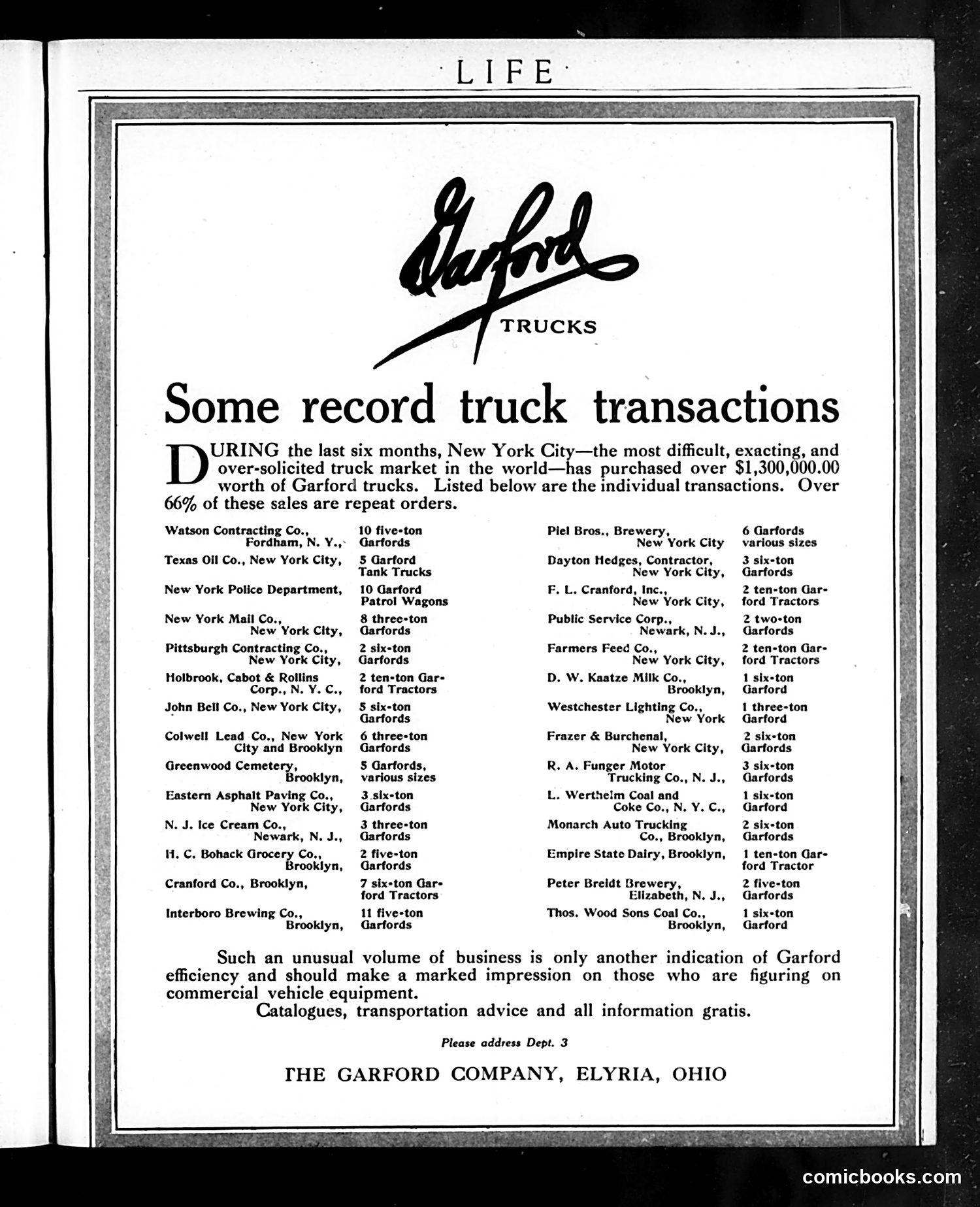
This is not a cartoon or satire—it's a **straight advertisement** for Garford trucks, a commercial vehicle manufacturer based in Elyria, Ohio. The page lists over $1.3 million in truck sales to New York City businesses during a six-month period, emphasizing that 66% were repeat orders. The customers range from the New York Police Department and Mail Co. to breweries, dairies, and construction firms—establishing Garford's credibility across diverse industries. The ad's strategy is to demonstrate market dominance and customer loyalty in "the most difficult, exacting" truck market in America. By naming prestigious clients (police, utilities, major breweries), the company positions itself as the trusted choice for serious commercial operations. There is no political satire or joke here—simply industrial-era marketing showcasing sales volume as proof of quality and reliability.
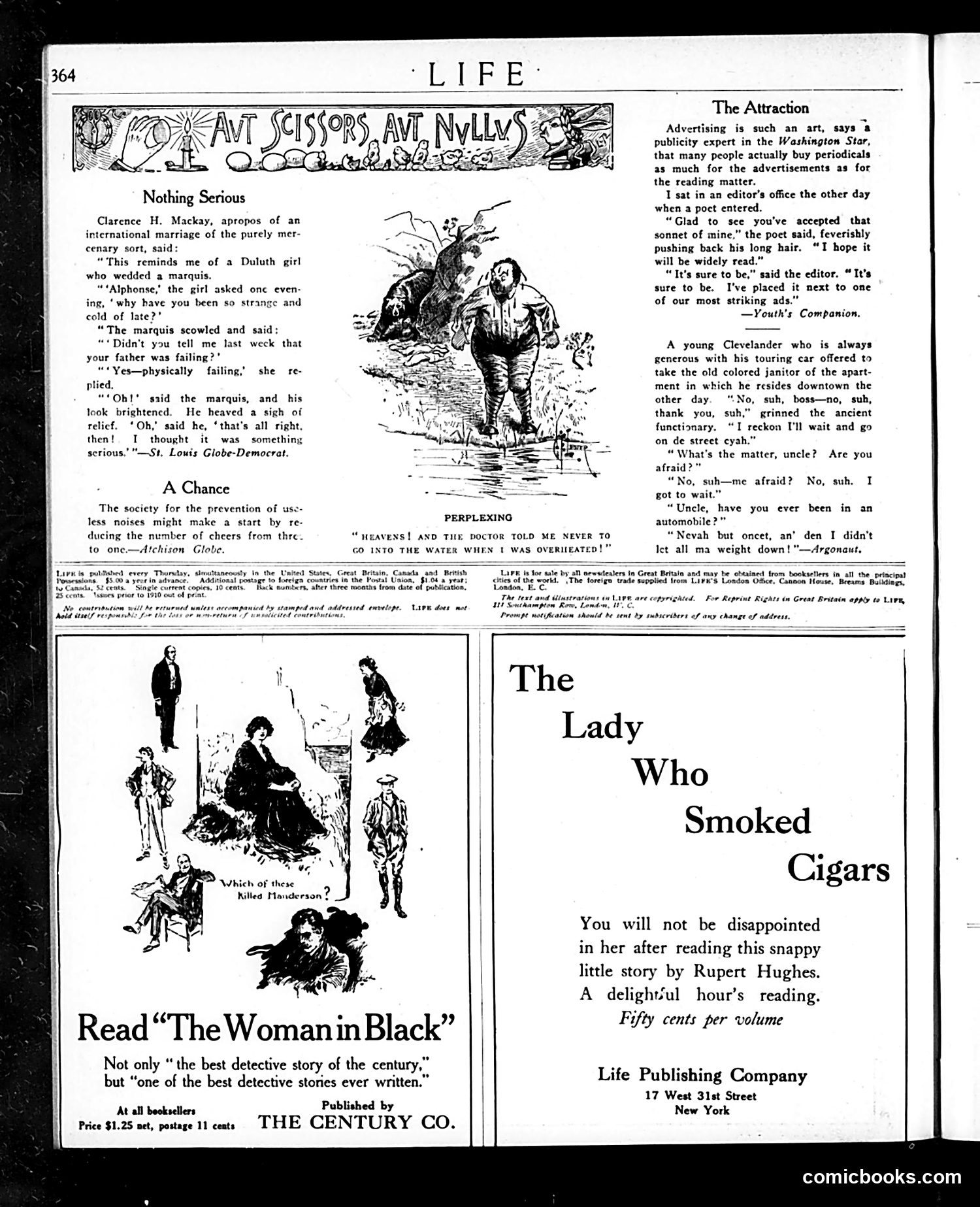
This page contains three satirical anecdotes and advertisements typical of early 20th-century Life magazine humor. **"Nothing Serious"** mocks mercenary marriages by contrasting a marquis's concern about his wife's father's health with his relief upon learning it's merely *physical* decline—implying the father's wealth remains intact. The joke targets marriages of convenience where monetary considerations override genuine affection. **"A Chance"** briefly suggests reducing unnecessary noise (cheers at events). **"Perplexing"** shows a figure confused about swimming safety rules, a simple observational gag. The page also includes anecdotes about advertising's appeal and a Black janitor's reluctance to ride in a car—the latter reflecting period racial attitudes through dialect humor. The advertisements promote detective fiction and books, typical of Life's commercial content. This was a magazine balancing light satire with commercial interests, aimed at educated middle-class readers who appreciated wordplay and social observation over visual comedy.
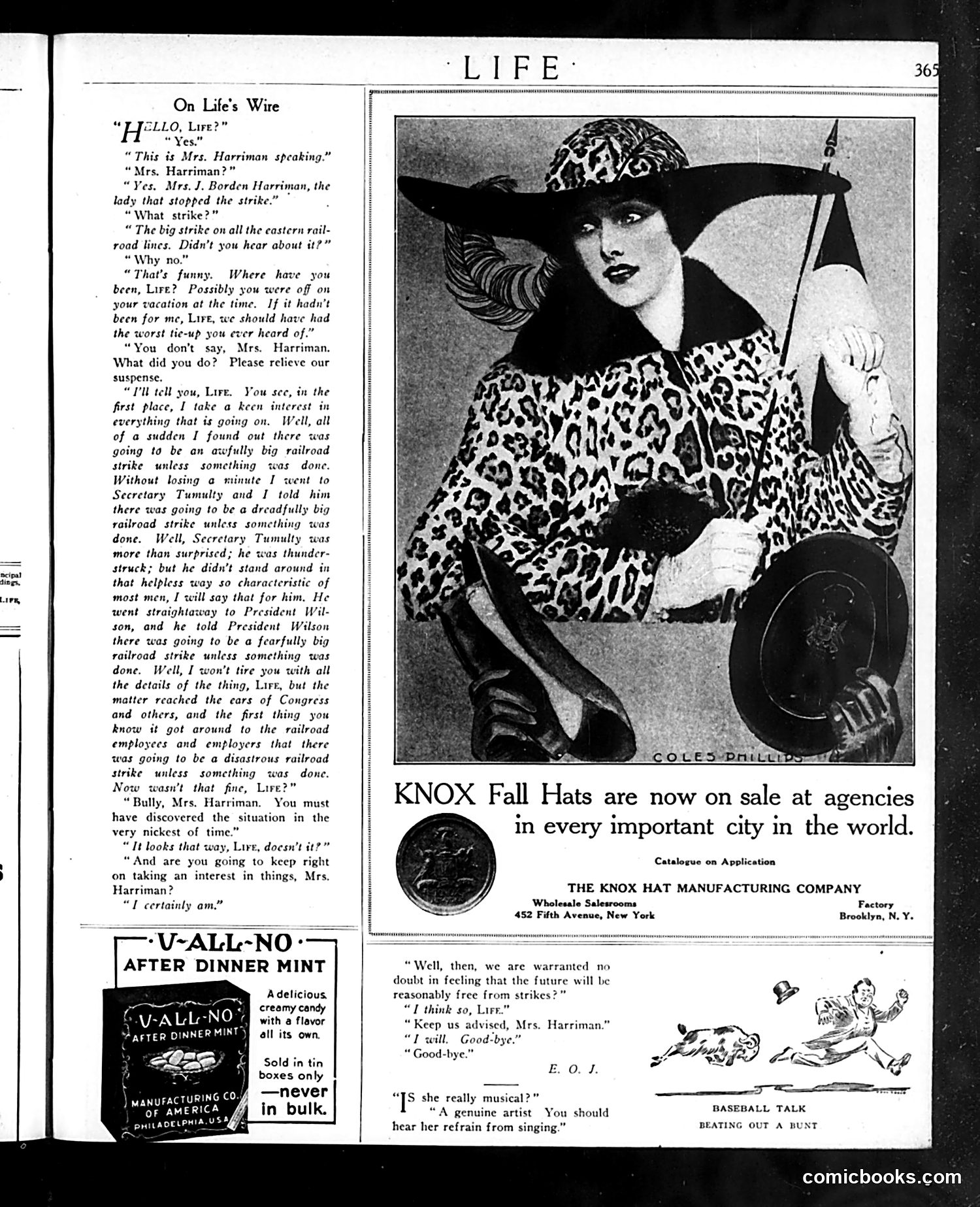
This page satirizes **Mrs. J. Borden Harriman**, a real socialite who apparently claimed credit for resolving a major eastern railroad strike (likely the 1916 rail workers' strike). The cartoon's joke: Harriman boasts to "Life" magazine that she single-handedly stopped the strike by simply *telling* Secretary Tumulty about it, who told President Wilson, who told Congress, who told the railroad companies—as if her mere awareness of the problem solved it. The satire mocks her for taking undeserved credit for what was actually resolved through official government channels. The humor relies on: her self-importance, the absurd chain-of-command she describes, and the implication that nothing she actually *did* mattered—the strike resolution happened regardless. It's a pointed critique of wealthy socialites claiming political influence without substance. The page also contains period advertisements (Knox Hats, V-All-No mints) and unrelated baseball humor.
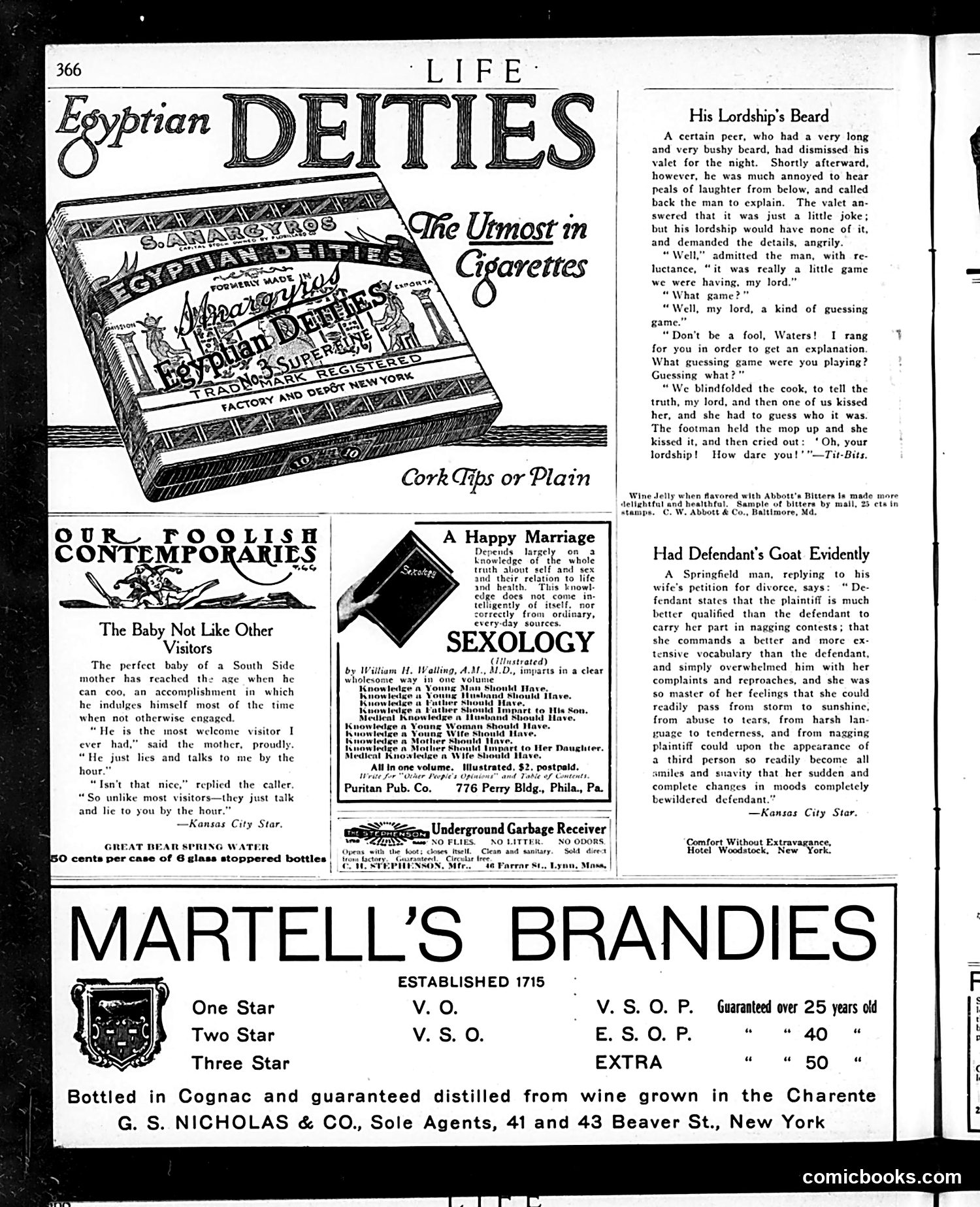
This page mixes advertisements with period humor pieces typical of Life magazine's satirical approach. **"His Lordship's Beard"** is a short anecdote mocking class pretension. A British nobleman dismisses his valet, then summons him back after hearing servants laughing below stairs. The valet reluctantly admits they were playing a "guessing game"—they blindfolded the cook, had servants kiss her so she'd guess who, but the footman held up a mop instead. When the cook kissed it, she exclaimed "Oh, your lordship!"—the joke being she mistook a mop for the aristocrat, humiliating him. **"The Baby Not Like Other Visitors"** humorously contrasts an ideal infant (who "lies and talks") with typical adult visitors ("just talk and lie to you"). **"Had Defendant's Goat Evidently"** satirizes divorce proceedings through a defendant's complaint that his wife is superior at nagging—commanding better vocabulary, shifting moods dramatically to manipulate him. The page is otherwise dominated by period advertising (Egyptian Deities cigarettes, Martell's Brandies, sexology books) reflecting early 20th-century consumer culture.
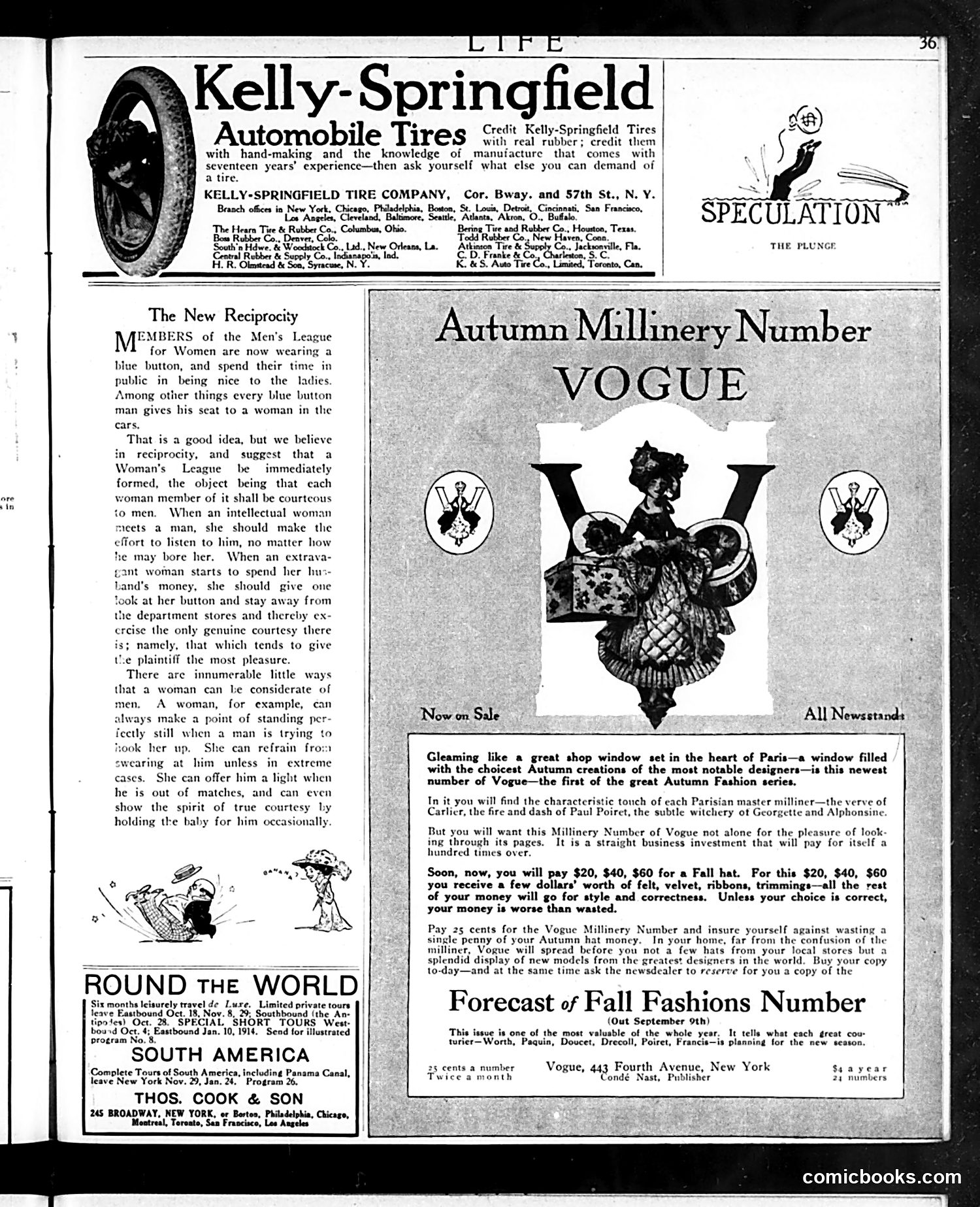
This page contains two unrelated items: **Left side:** A satirical article titled "The New Reciprocity" argues that if men's civic groups wear blue buttons to courteously give seats to women, women should reciprocate by being courteous to men—listening patiently when bored, restraining spending, standing still while being dressed, and offering cigarettes. The accompanying cartoons show women in exaggerated poses illustrating these behaviors. **Right side:** A full-page advertisement for *Vogue*'s Autumn Millinery Number, promoting high-end Paris fashion hats from designers like Paul Poiret. The ad argues that buying the magazine (25 cents) is a smart investment to avoid wasting money on incorrect hat choices. The satire mocks early-20th-century gender relations and women's emerging public roles, while the ad targets affluent female readers anxious about fashion correctness during a period of changing women's fashions and social positions.
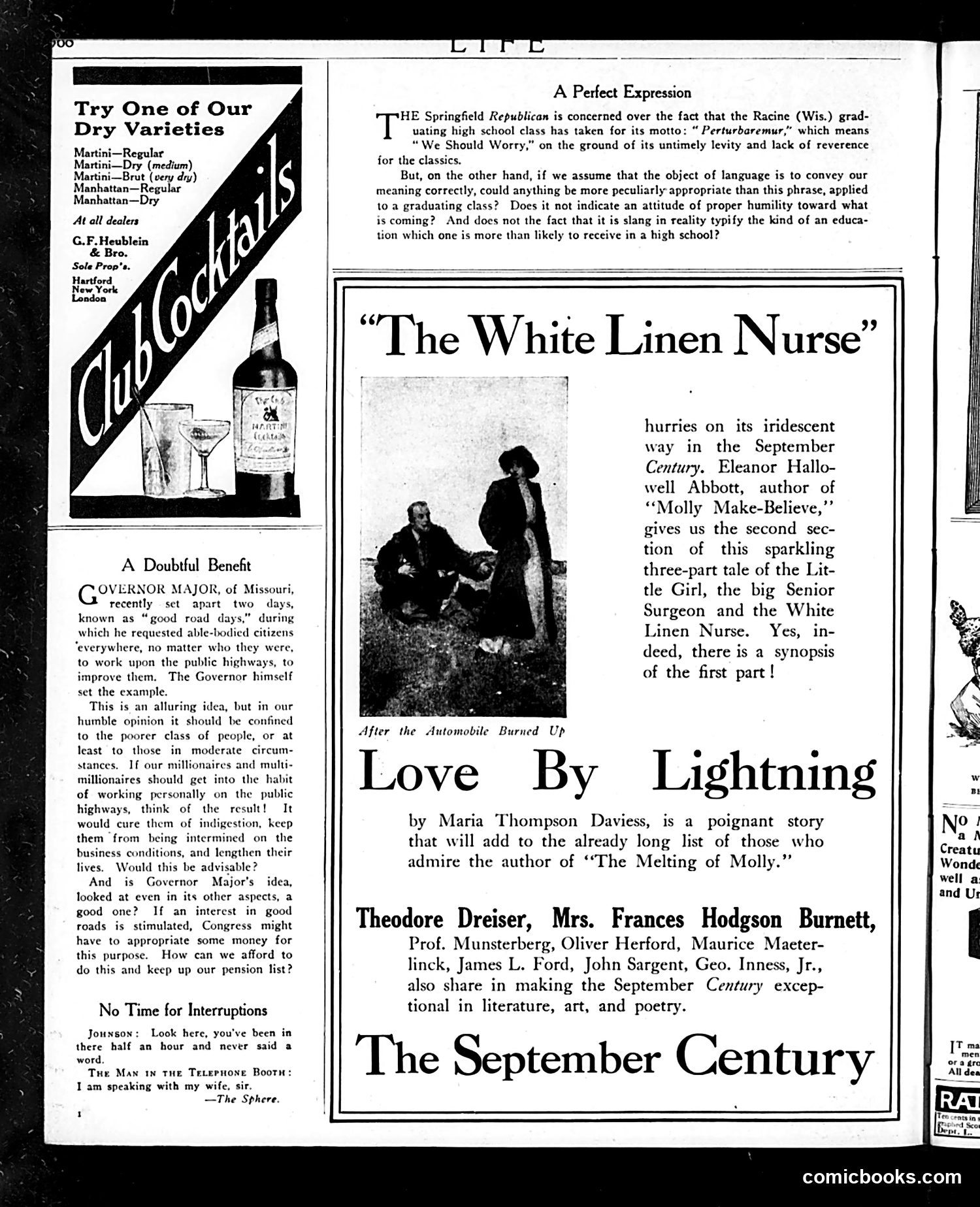
This page primarily features **literary advertisements and book reviews** rather than political satire. The main content announces the September issue of *Century* magazine, highlighting serialized fiction by Eleanor Hallowell Abbott ("The White Linen Nurse") and Maria Thompson Daviess ("Love By Lightning"), alongside contributions from prominent authors and artists like Theodore Dreiser and Frances Hodgson Burnett. A sidebar editorial titled "A Perfect Expression" satirizes a Wisconsin high school's choice of the Latin motto "Perturbaremur" ("We Should Worry")—mocking the Springfield Republican's complaint that it shows disrespect. *Life's* counterargument: the slang phrase perfectly encapsulates modern education's actual priorities. Another brief item, "A Doubtful Benefit," humorously questions Missouri Governor Major's "good road days" policy, suggesting that if millionaires actually worked on highways, it might cure their indigestion—a lighthearted jab at wealth and idleness rather than serious political critique. The small cartoon joke at bottom involves a man monopolizing a telephone while speaking to his wife—a domestic humor bit common to the era.
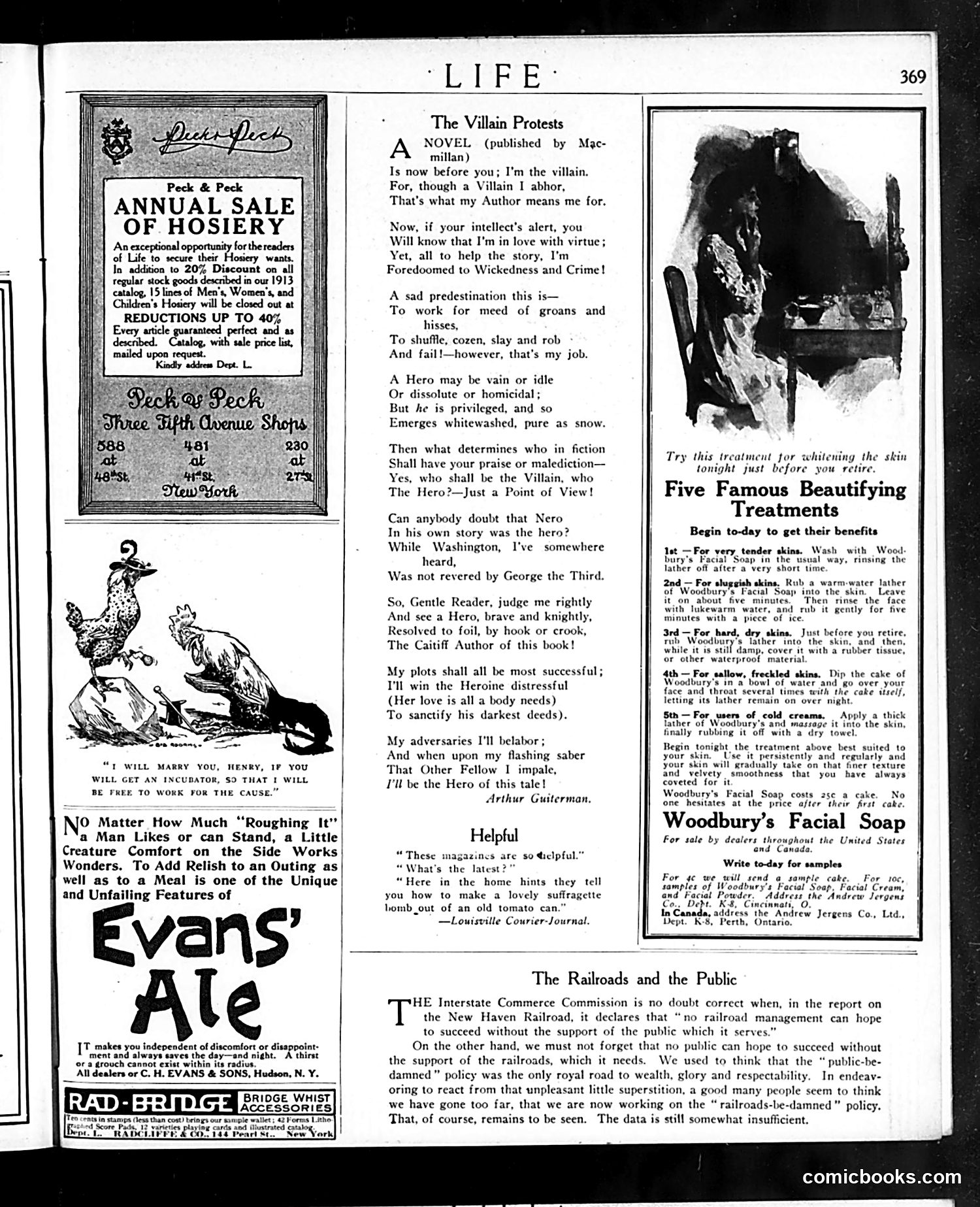
This page is primarily **advertisements and satirical poetry**, not political cartoons. The main satirical content is "The Villain Protests"—a poem where a fictional villain complains about literary double standards. The villain argues that heroes in fiction can be "vain or idle / Or dissolute or homicidal" yet emerge "whitewashed, pure as snow," while villains are predetermined for wickedness solely to serve the plot. He cites Nero (Roman emperor) as someone who considered himself the hero of his own story, suggesting that morality and heroism are matters of perspective, not absolute truth. The satire targets **Victorian moral fiction conventions**—the notion that characters are inherently "good" or "bad" regardless of their actual actions. It's a meta-commentary on storytelling rather than direct political satire. The page also contains advertisements for Peck & Peck hosiery, Evans' Ale, Woodbury's Facial Soap, and other period products. The small cartoon of a rooster and the Henry the Incubator ad are unrelated commercial illustrations.
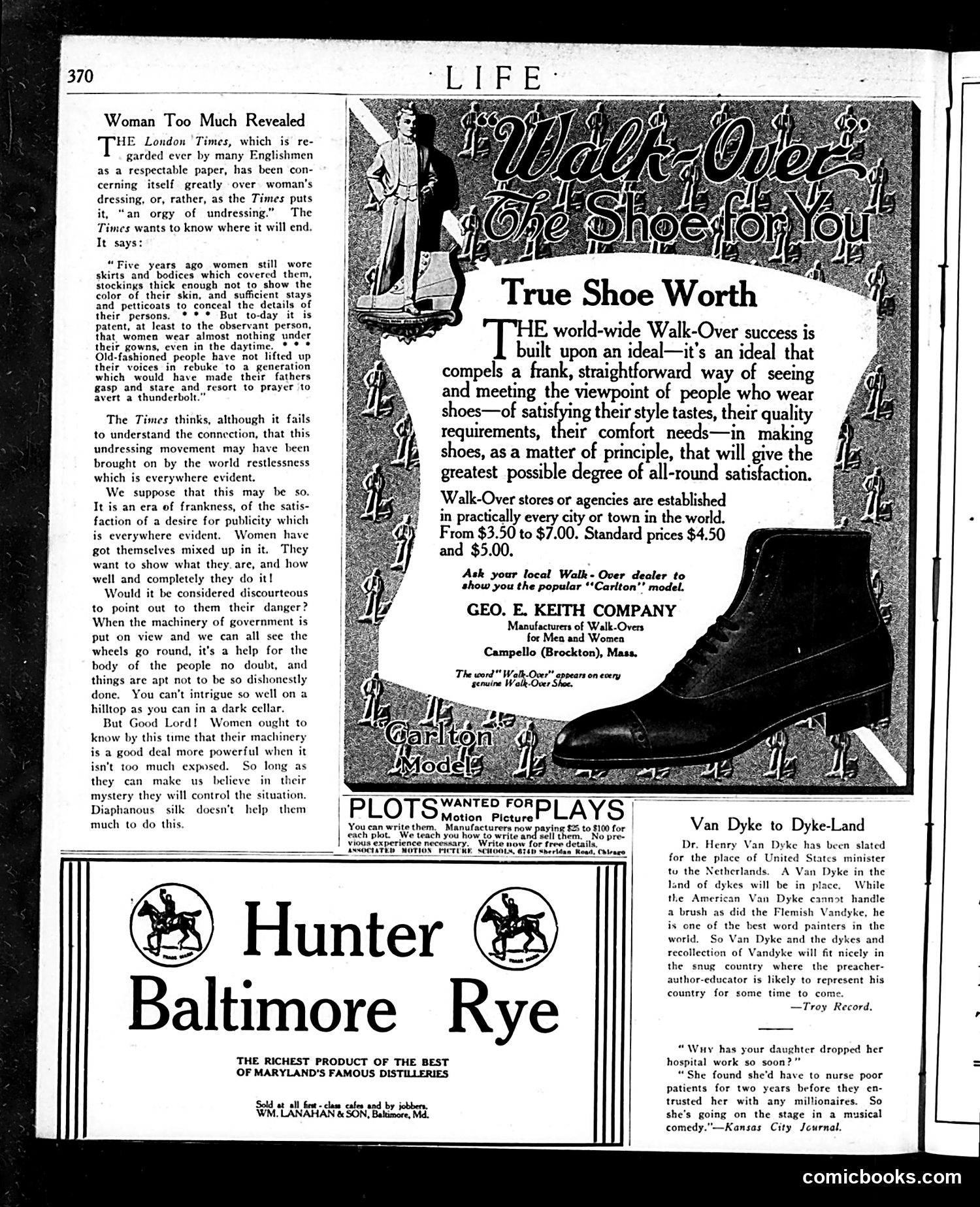
This page contains satirical commentary on women's fashion and social change, alongside period advertisements. **"Woman Too Much Revealed"**: The main article satirizes *The London Times* for its alarm over women's increasingly revealing clothing. The Times worried that shorter skirts and fewer undergarments represented moral decay and dangerous female "undressing." Life's satire critiques this anxiety by noting that women's visible confidence and self-presentation is actually a *source of power*—the editorial argues that mystery and concealment gave women more control, implying the Times misunderstands female agency. The piece ironically suggests women should understand their "machinery" works better when kept mysterious. **Advertisements**: Walk-Over shoes and Hunter Baltimore Rye whiskey ads occupy significant space, representing typical 1920s consumer marketing. **"Van Dyke to Dyke-Land"**: A brief humorous note announcing Henry Van Dyke's appointment as U.S. minister to the Netherlands, making a pun on his name and Dutch "dykes." The page reflects post-WWI anxieties about changing gender roles and women's visibility in public life.
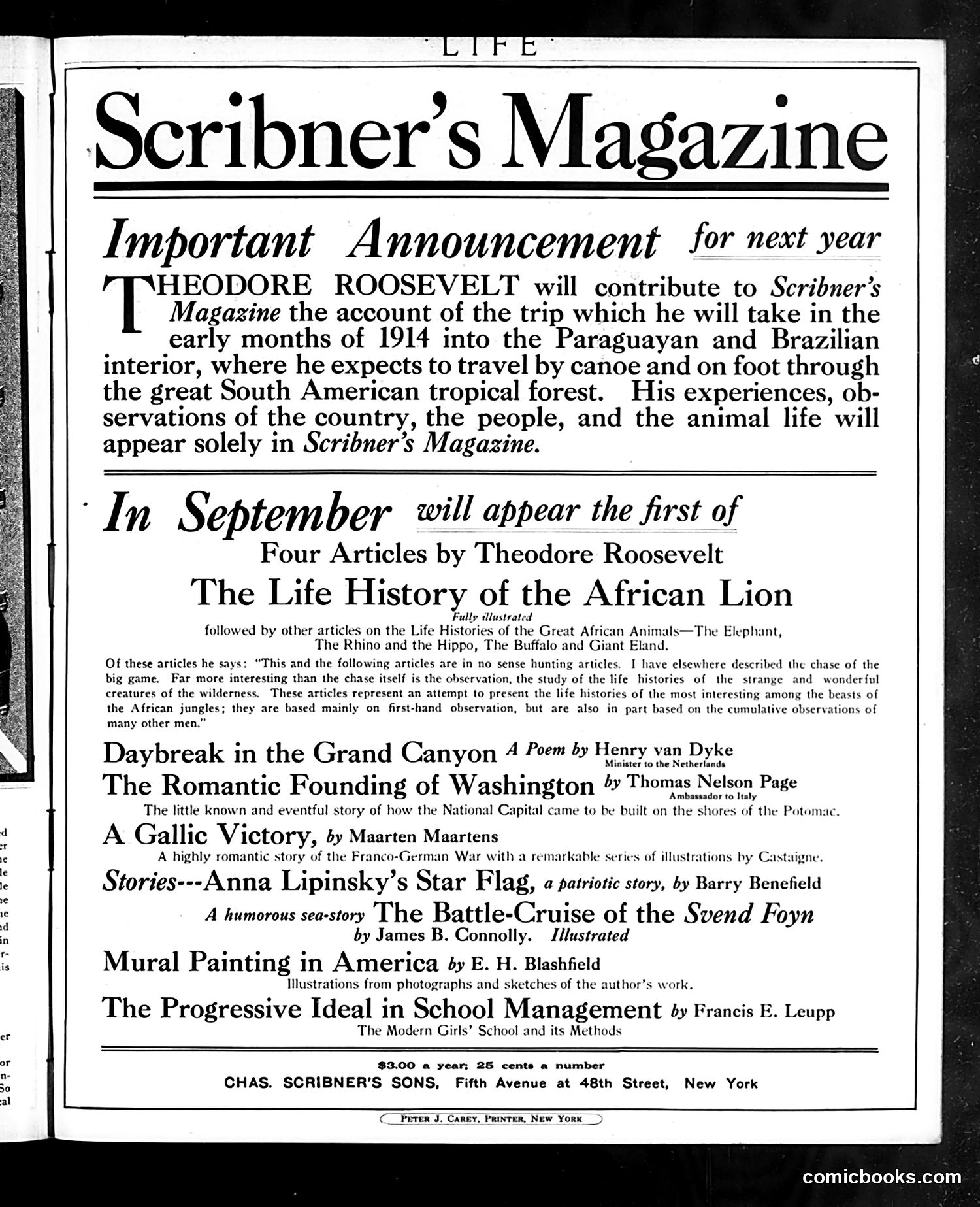
This is a **title page advertisement** for Scribner's Magazine, not a cartoon. It announces upcoming content for the next year (appears to be 1913, for 1914 publication). The key announcement is that **Theodore Roosevelt** will contribute exclusive articles to Scribner's about his planned 1914 expedition into the Paraguayan and Brazilian interior—a major publishing coup. Roosevelt promises firsthand accounts of his South American travels plus a series on African animal life histories (lion, elephant, rhino, hippo, buffalo). The page lists other coming features: poetry, historical pieces on Washington's founding, a Franco-German War story, patriotic fiction, and articles on art and education. **Context for modern readers**: This represents Roosevelt's post-presidency celebrity status (he left office in 1909). His exotic expeditions and writings were major publishing events. Scribner's was leveraging Roosevelt's fame to attract subscribers—a common editorial strategy for prestigious magazines of that era.
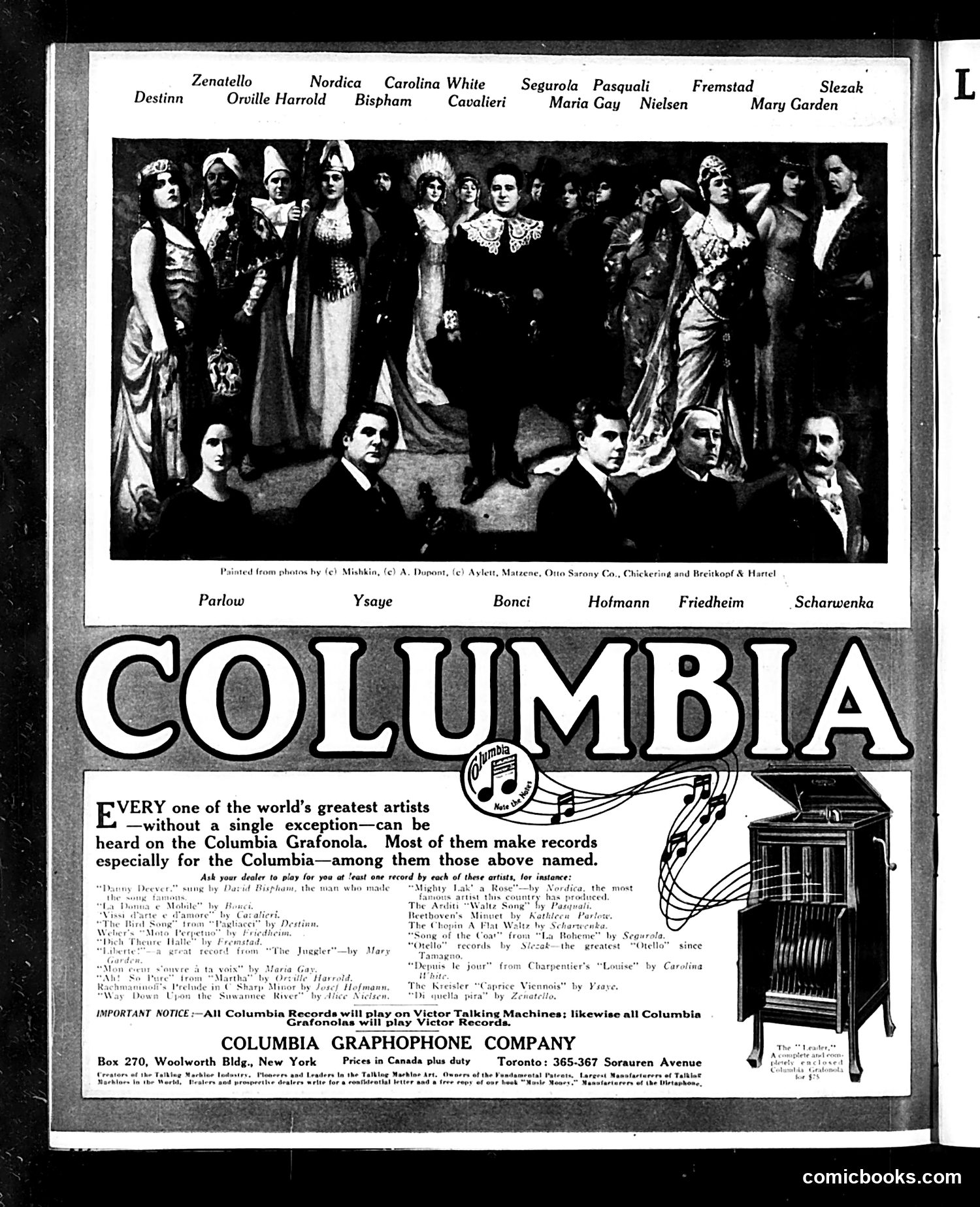
This is primarily **a Columbia Graphophone Company advertisement**, not political satire. It features photographs of famous opera singers and classical musicians (Caruso, Nordica, Mary Garden, and others—genuine celebrity artists of the early 1900s) to promote Columbia's grafonola (phonograph) records. The sales pitch claims "EVERY one of the world's greatest artists...can be heard on the Columbia Grafonola." The advertisement lists specific recordings available from these performers. The notable element is the **"IMPORTANT NOTICE"** stating that Columbia records play on Victor machines and vice versa—indicating this was an era when competing phonograph companies (Columbia and Victor) were negotiating compatibility, likely after patent disputes or licensing agreements. This is **commercial advertising** using celebrity endorsements rather than satire or political commentary. The historical interest lies in documenting early 20th-century recording industry competition and the roster of famous performers available on early phonograph records.