
Life, 1913-08-28 · page 22 of 40
Life — August 28, 1913 — page 22: what you’re looking at
What you’re looking at
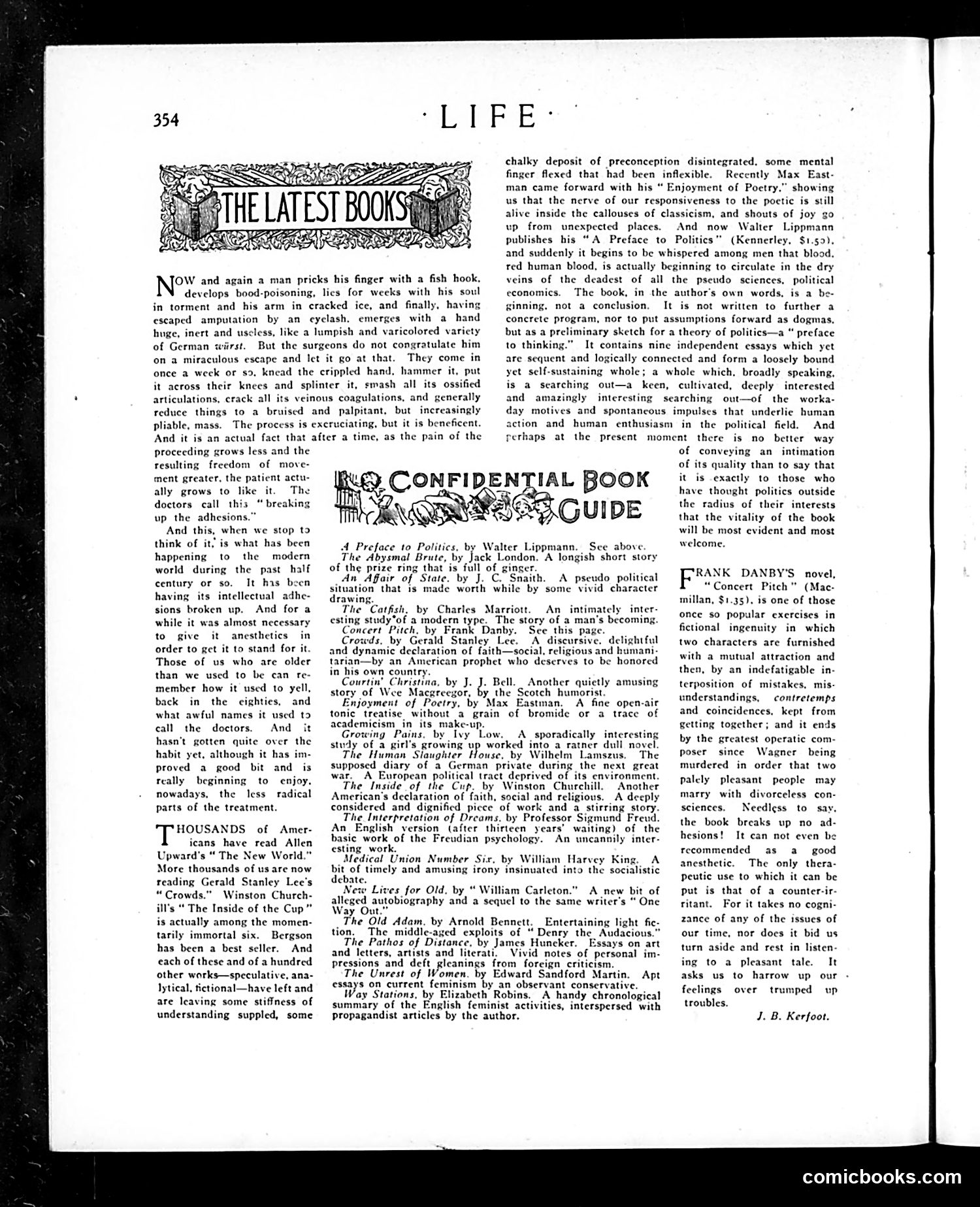
This is a book review section, not a political cartoon. The page discusses several newly published works, with particular emphasis on **Walter Lippmann's "A Preface to Politics"** (1911). The opening essay uses an extended metaphor: surgical treatment of a crippled hand mirrors intellectual progress in modern society. Just as doctors must painfully break up adhesions to restore function, society must undergo uncomfortable intellectual "breaking up" of old assumptions to achieve healthy political and economic thinking. The review celebrates that serious political philosophy—once a "dead pseudo science"—is gaining vital attention through books by Lippmann, Jack London, and others. The page lists contemporary bestsellers including Winston Churchill's "The Inside of the Cup" and works by Bergson and Gerald Stanley Lee, suggesting early 20th-century appetite for serious social commentary and progressive political thought.
📄 Transcribed text from this page (OCR, searchable)
Machine-transcribed from the original scan — historical spelling and the odd misread are preserved.
Oo os Ce (OW and again a man pricks his finger with a fish hook, develops bood-poisoning, lics for weeks with his soul in torment and his arm in cracked ice, and finally, having escaped amputation by an eyelash, emerges with a hand huge, inert and useless, like a lumpish and varicolored variety of German wirst. But the surgeons do not congratulate him on a miraculous escape and let it go at that. They come in once a week or so, knead the crippled hand, hammer it, put it across their knees and splinter it, smash all its ossified articulations, crack all its veinous coagulations, and generally chalky deposit of preconception disintegrated. some mental finger flexed that had been inflexible. Recently Max East- man came forward with his “ Enjoyment of Poetry.” showing us that the nerve of our responsiveness to the poctic is still alive inside the callouses of classicism, and shouts of joy go up from unexpected places. And now Walter Lippmann publishes his “A Preface to Politics” (Kennerley, $1.59). and suddenly it begins to be whispered among men that blood, red human blood, is actually beginning to circulate in the dry veins of the deadest of all the pseudo sciences, political economics. The book, in the author's own words, is a be- ginning, not a conclusion. It is not written to further a concrete program, nor to put assumptions forward as dogmas. but as a preliminary sketch for a theory of politics—a “ preface to thinking.” It contains nine independent essays which yet are sequent and logically connected and form a loosely bound yet self-sustaining whole; a whole which, broadly speaking, is a searching out—a keen, cultivated, deeply interested reduce things to a bruised and palpitant, but increasingly pliable, mass. The process is excruciating, but it is beneficent. And it is an actual fact that after a time, as the pain of the proceeding grows less and the resulting freedom of move- ment greater, the patient actu ally grows to like it. The doctors call this “ breaking up the adhesions.” And this, when we stop to think of it is what has been happening to the modern world during the past half century or so. It has been having its intellectual adhe- ns broken up. And for a while it was almost necessary to give it anesthetics in order to get it to stand for it. Those of us who are older than we used to be can re- member how it used to yell, back in the cighties, and what awful names it used to call the doctors. And it hasn't gotten quite over the habit yet, although it has im- proved a good bit and is really beginning to enjoy. nowadays, the less radical parts of the treatment. HOUSANDS of Amer- icans have read Allen Upward's “ The New World.” More thousands of us are now reading Gerald Stanley Lee's Crowds.” Winston Church- ill's * The Inside of the Cup” is actually among the momen- tarily immortal six. Bergson has been a best seller. And each of these and of a hundred other works—spcculative, ana- lytical, tictional—have left and are leaving some stiffness of understanding suppled, some and amazingly interesting day motiv perhaps at the present ONFIDENTIAL BOOK Cc Cu SESS.CUIDE A Preface t0 Politics, by Walter Lippmann. See above The Abysmal Brute, by Jack London. A longish short story of the prite ring that is fall of ginger, in Aw Afar of State. by J.C. Snaith. A pseudo political situation that is made worth while by ‘some vivid character drawing, The ‘Catfish, by Charles Marriott. An intimately inter- esting study*of a modern type. The story of a man’s becoming. Concert Pitch, by Frank Danby. See this page. Crowds, by Gerald Stanley Lee. A discursive. delightful and dynamic declaration of faith—-social, religious and humani- tarian—by an American prophet who deserves to be honored in his own country. : Courtin’ Christina, by J. J. Bell. Another quietly amusing story of Wee Macgreegor, by the Scotch humorist " Enjoyment of Poetry. by Max Eastman, A fine open-air tonic’ treatise without a grain of bromide or a trace of aeademicism, in its, make-up. Growing Pains. by Ivy Low. A_ sporadically interesting stwly of 2 girl's growing up worked into a ratner dull novel The Human Sleughter House, by Wilhelm Lamszus. The supposed diary of a German private during the next great war, A. European political tract. deprived of its environment, The Inside of the Cup, by Winston Churchill. Another American's declaration of faith, social and religious. A deeply considered and dignified picee of work and a. stirring story. The Interpretation of Dreams. by Professor Sigmund Freud. An English version (after thirteen years’ waiting). of the basic work of the Freudian psychology. An uncannily inter: esting ‘work. Medical Union Number Sir, by William Harvey King, A bit of timely and amusing irony insinuated into the socialistic debate. Nets Lives for Old. by “ William Carleton.” A new bit of alleged autobiography and a sequel to the same writer's" One Way Out.” The Old Adam. by Arnold Bennett, Entertaining light fie- tion, The middle-aged exploits of “ Denry the. Audacious” The Pathos of Distance. by James Huneker. Essays on art and letters, artists and literati, Vivid notes of personal im- pressions and deft gleanings from foreign, eriticism, The Unrest of Women. by Edward Sandford Martin. Apt essays on current feminism by an observant conservative. Way Stations, by Elizabeth Robins. A handy chronological summary of the English feminist activities, interspersed, with propagandist articles by the author. searching s and spontancous impulses that underlie human action and human enthusiasm moment out—of the worka- field. And is no better way of conveying an intimation of its quality than to say that it is exactly to those who have thought politics outside the radius of their interests that the vitality of the book will be most evident and most welcome. in the political there RANK DANBY'S novel, “Concert Pitch" (Mac- millan, $1.35), is one of those once so popular exercises in fictional ingenuity in which two characters are furnished with a mutual attraction and then, by an indefatigable in- terposition of mistakes, mis- understandings, contretemps and coincidences, kept from getting together; and it ends by the greatest operatic com- poser since Wagner being murdered in order that two palcly pleasant people may marry with divorceless con- sciences. Needless to say, the book breaks up no ad- hesions! It can not even be recommended as a good anesthetic. The only thera- Peutic use to which it can be put is that of a counter-ir- ritant. For it takes no cogni- zance of any of the issues of our time, nor does it bid us turn aside and rest in listen- ing to a pleasant tale. It asks us to harrow up our feelings over trumped up troubles. J. B. Kerfoot. comicbooks.com