
Life, 1913-08-28 · page 25 of 40
Life — August 28, 1913 — page 25: what you’re looking at
What you’re looking at
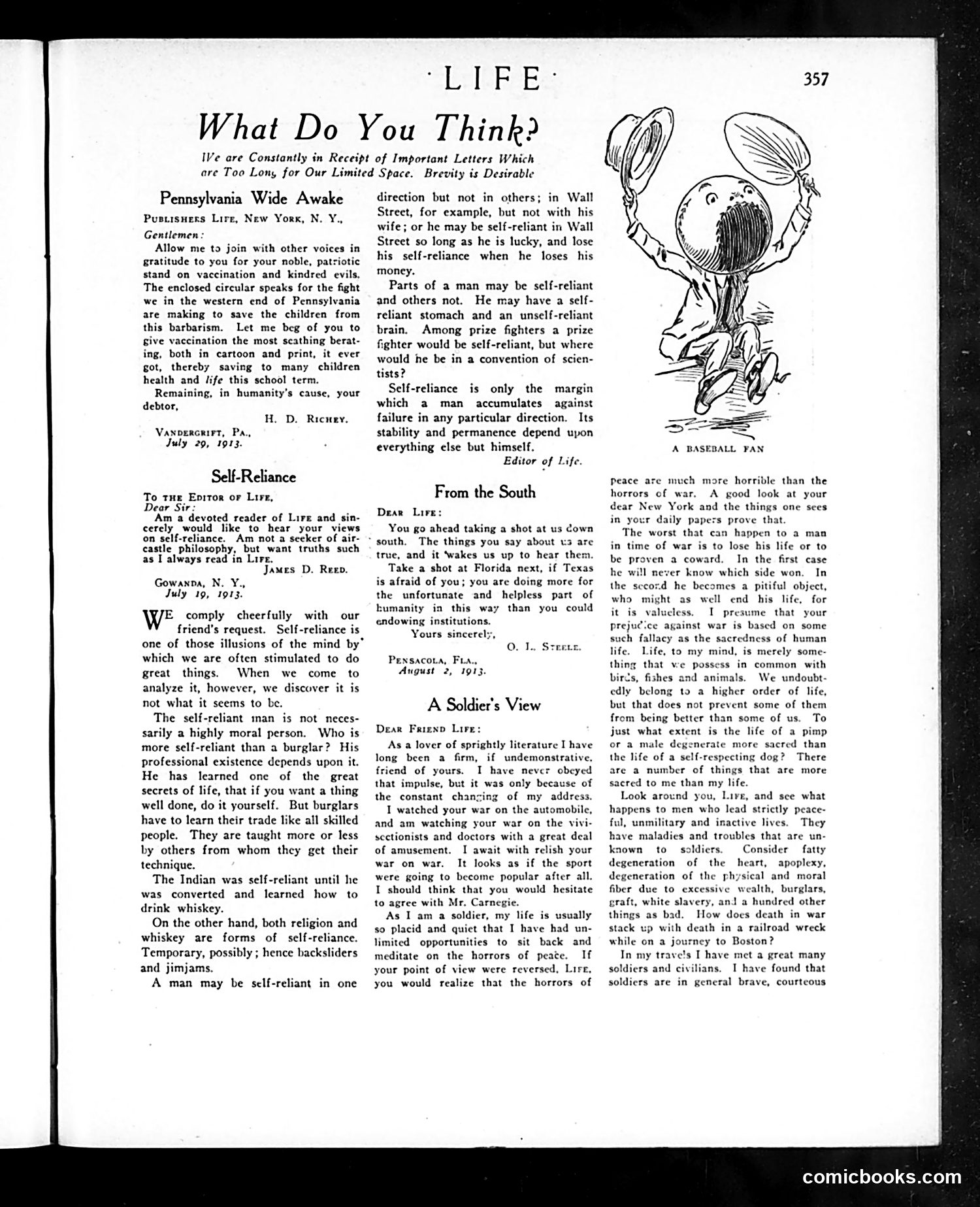
This page presents reader letters responding to Life's editorial positions. The main cartoon depicts a baseball fan celebrating wildly—a visual joke about American enthusiasm for sports, likely contrasting with the serious social issues discussed in the letters. The letters address Life's recent campaigns: one praises their anti-vaccination stance (a surprising position by modern standards); another discusses self-reliance philosophically; a third encourages Life to criticize Southern institutions; and a soldier's letter suggests Life should expand its satirical "wars" against automobiles, vivisection, and doctors to include war itself—perhaps sarcastically, since Carnegie (likely Andrew Carnegie, the industrialist) apparently opposed such criticism. The page reflects Life's role as a crusading satirical magazine tackling social reform issues of 1913, though some positions (anti-vaccination) would be considered harmful today.
📄 Transcribed text from this page (OCR, searchable)
Machine-transcribed from the original scan — historical spelling and the odd misread are preserved.
= GREES What Do You Think? Ve are Constantly in Receipt of Important Letters Which are Too Lon, for Our Limited Space. Brevity is Desirable Pennsylvania Wide Awake Pustisuers Lire, New York, N. Y., Gentlemen: Allow me to join with other voices in gratitude to you for your noble, patriotic stand on vaccination and kindred evils. The enclosed circular speaks for the fight we in the western end of Pennsylvania are making to save the children from this barbarism. Let me beg of you to Give vaccination the most scathing berat- ing, both in cartoon and print, it ever got, thereby saving to many children health and life this school term. Remaining, in humanity's cause, your debtor, H. D. Ricney. Vanpercrirt, Pa., July 29, 1913. Self-Reliance To tHe Epitor or Lik, Dear Sir: Am a devoted reader of Lire and sin- cerely would like to hear your views on self-reliance. Am not a seeker of air- castle philosophy, but want truths such as I always read in Lire. James D. Reep. Gowanna, N. Y., July 19, 1913. W comply cheerfully with our friend’s request. Self-reliance is one of those illusions of the mind by” which we are often stimulated to do great things. When we come to analyze it, however, we discover it is not what it seems to be. The self-reliant man is not neces- sarily a highly moral person. Who is more self-reliant than a burglar? His professional existence depends upon it. He has learned one of the great secrets of life, that if you want a thing well done, do it yourself. But burglars have to learn their trade like all skilled people. They are taught more or less by others from whom they get their technique. The Indian was self-reliant until he was converted and learned how to drink whiskey. On the other hand, both religion and whiskey are forms of self-reliance. Temporary, possibly ; hence backsliders and jimjams. A man may be self-reliant in one direction but not in others; in Wall Street, for example, but not with his wife; or he may be self-reliant in Wall Street so long as he is lucky, and lose his self-reliance when he loses his money. Parts of a man may be self-reliant and others not. He may have a self- reliant stomach and an unself-reliant brain. Among prize fighters a prize fighter would be self-reliant, but where would he be in a convention of scien- tists? Self-retiance is only the margin which a man accumulates against failure in any particular direction. Its stability and permanence depend upon everything else but himself. Editor of Life. From the South Dear Lire: You go ahead taking a shot at us down ~ south. The things you say about x3 are true, and it ‘wakes us up to hear th Take a shot at Florida next, if Texas is afraid of you; you are doing more for the unfortunate and helpless part of humanity in this way than you could endowing institutions. Yours sincerely, O.1 Pensacota, Fa, August 2, 1913. A Soldier's View Dear Frreno Lire: As a lover of sprightly literature I have long been a firm, if undemonstrative, friend of yours. I have never obcyed that impulse, but it was only because of the constant chanzing of my address. I watched your war on the automobile, and am watching your war on the vivi- scetionists and doctors with a great deal of amusement. I await with relish your war on war. It looks as if the sport were going to become popular after all. I should think that you would hesitate to agree with Mr. Carnegie. As I am a soldier, my life is usually so placid and quict that I have had un- limited opportunities to sit back and meditate on the horrors of peate. If your point of view were reversed, Lire, you would realize that the horrors of A BASEBALL FAN Peace are much more horrible than the horrors of war. A good look at your dear New York and the things one sees in your daily papers prove that. The worst that can happen to a man in time of war is to lose his life or to be proven a coward. In the first case he will never know which side won. In the sccord he becomes a pitiful object, who might as well end his life, for it is valueless. I pre je that your prejudice against war is based on some such fallacy as the sacredness of human life. Life, to my mind, is merely some- thing that we possess in common with bircs, fishes and animals. We undoubt- edly belong to a higher order of life, but that does not prevent some of them from being better than some of us. To just what extent is the life of a pimp or a male degenerate more sacred than the life of a self-respecting dog? There are a number of things that are more sacred to me than my life. Look around you, Live, and sce what happens to men who lead strictly peace- ful, unmilitary and inactive lives. They have maladies and troubles that are un- known to soldiers. Consider fatty degeneration of the heart, apoplexy, degeneration of the physical and moral fiber due to excessive wealth, burglars, graft, white slavery, and a hundred other things as bad. How does death in war stack up with death in a railroad wreck while on a journey to Boston? In my trave!s I have met a great many soldiers and civilians. I have found that soldiers are in general brave, courteous comicbooks.com