
A complete issue · 44 pages · 1912
Life — July 18, 1912
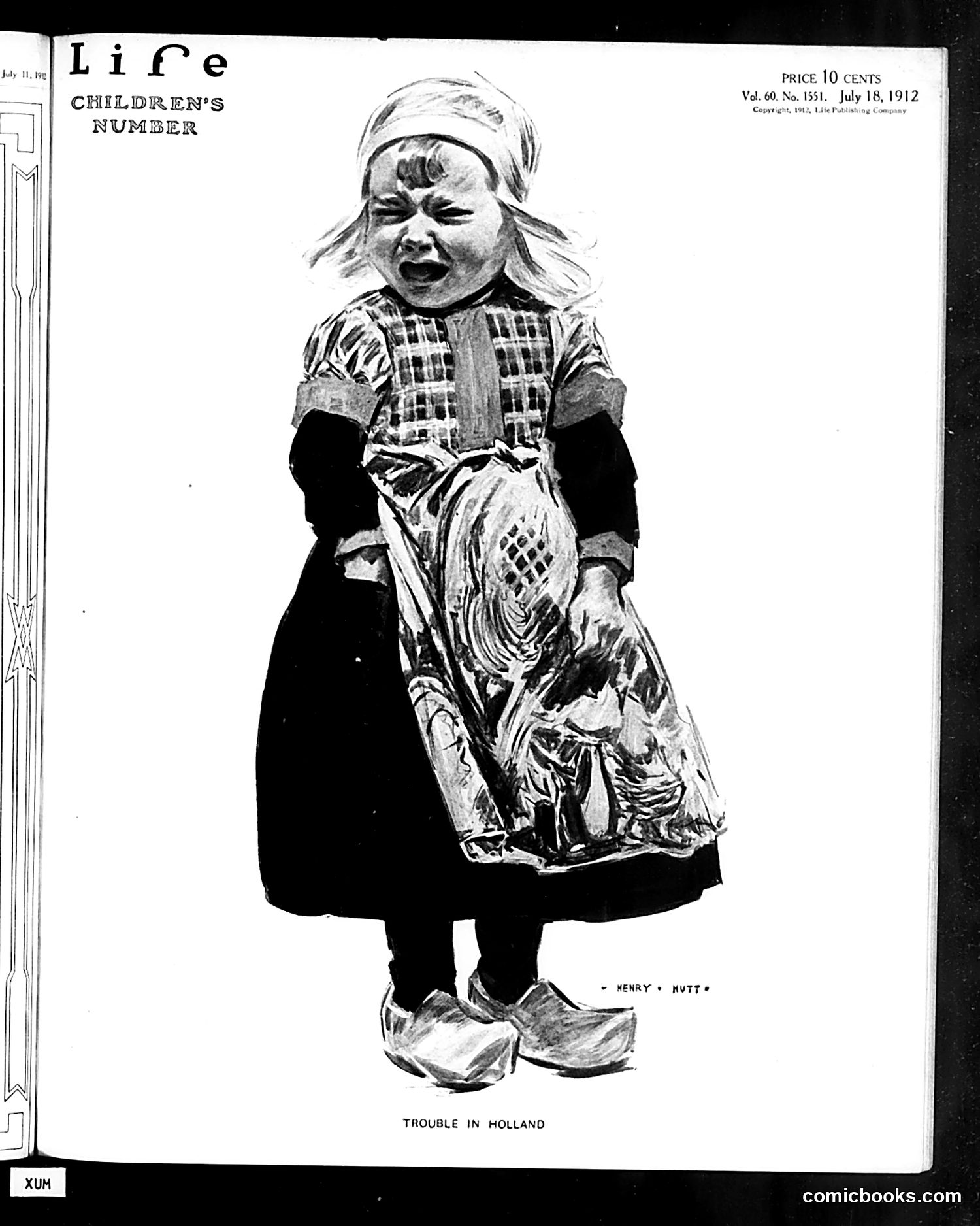
This Life magazine cover from July 18, 1912, depicts a crying child in Dutch traditional dress (wooden shoes, white bonnet, checkered apron) titled "Trouble in Holland." Artist Henry Hutt's illustration uses the child as a metaphor for the Dutch nation experiencing difficulties. The specific "trouble" likely references early-20th-century Dutch political or social unrest, though the exact event isn't immediately clear from the image alone. The cartoonist anthropomorphizes the Netherlands as a distressed child—a common satirical technique of the era—to communicate that something has gone wrong in Dutch affairs. The sentimental, exaggerated crying conveys both sympathy and critique toward Holland's predicament, whether political, economic, or social in nature.
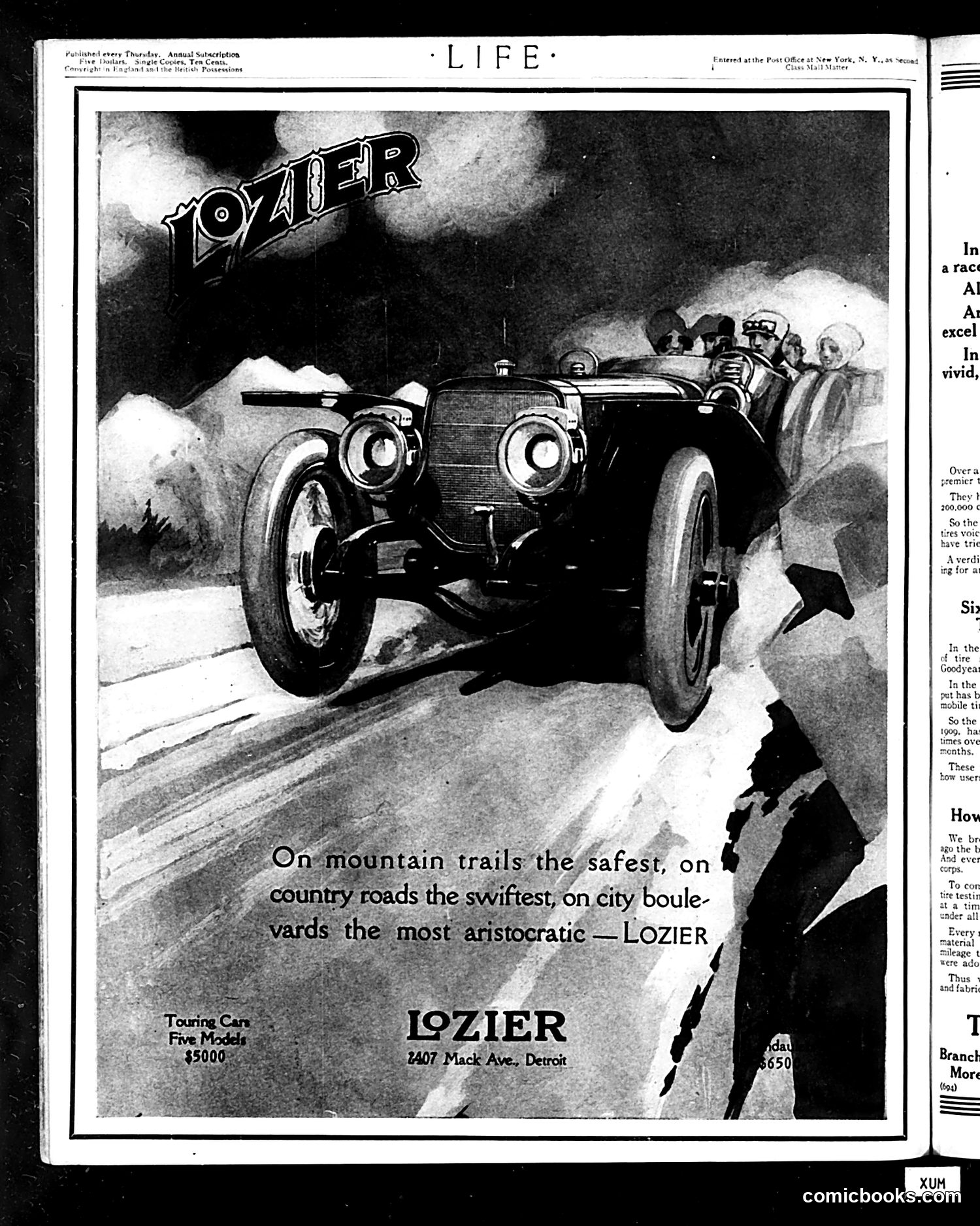
This page is primarily a **car advertisement**, not political satire. It promotes the Lozier automobile, a luxury touring car manufactured in Detroit. The advertisement uses dramatic imagery of a speeding open-air touring car navigating a mountain road, with passengers bundled against the elements. The tagline—"On mountain trails the safest, on country roads the swiftest, on city boulevards the most aristocratic"—targets wealthy consumers by emphasizing the car's performance and social prestige. The visual appeal to adventure and luxury was typical of early automotive marketing (Lozier operated roughly 1900-1917). The "Five Models" pricing starting at $5000 indicates this was high-end transportation for the affluent.
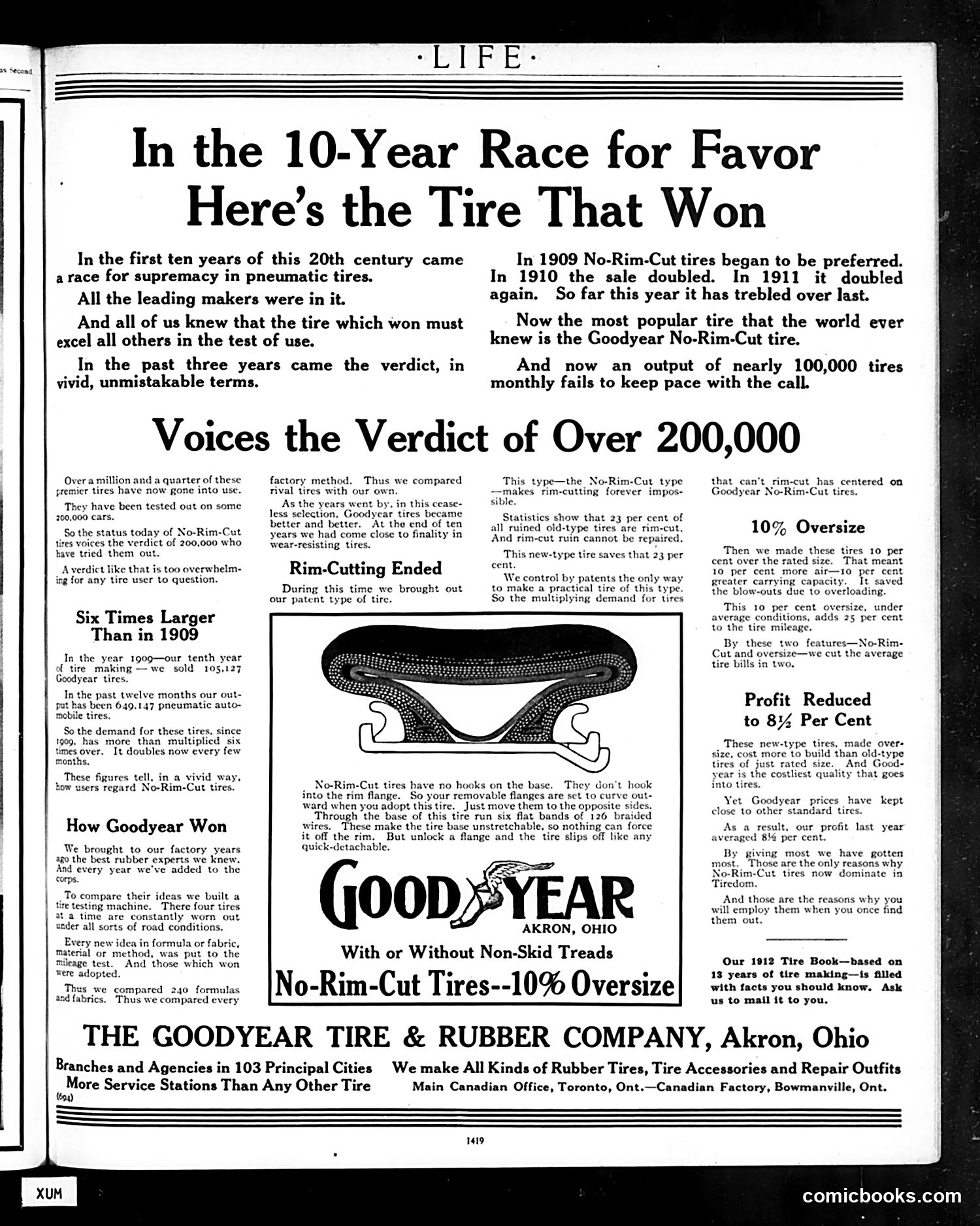
This is **not a satirical cartoon page**, but rather a **Goodyear Tire advertisement** from Life magazine (circa 1912, based on the 1909-1911 timeline references). The page celebrates Goodyear's "No-Rim-Cut" tire innovation, which won a decade-long competition for pneumatic tire supremacy. The central image shows a cross-section of the tire's base design—featuring flat bands of 126 braided wires that prevent rim-cutting and tire slippage. The advertisement uses marketing language ("Voices the Verdict of Over 200,000") to claim consumer validation. It emphasizes technical superiority: the tire design prevents rim-cutting (a common failure), offers oversizing capability, and maintains competitive pricing despite quality improvements. This represents early 20th-century industrial advertising targeting automobile owners during the rapid motorization era.
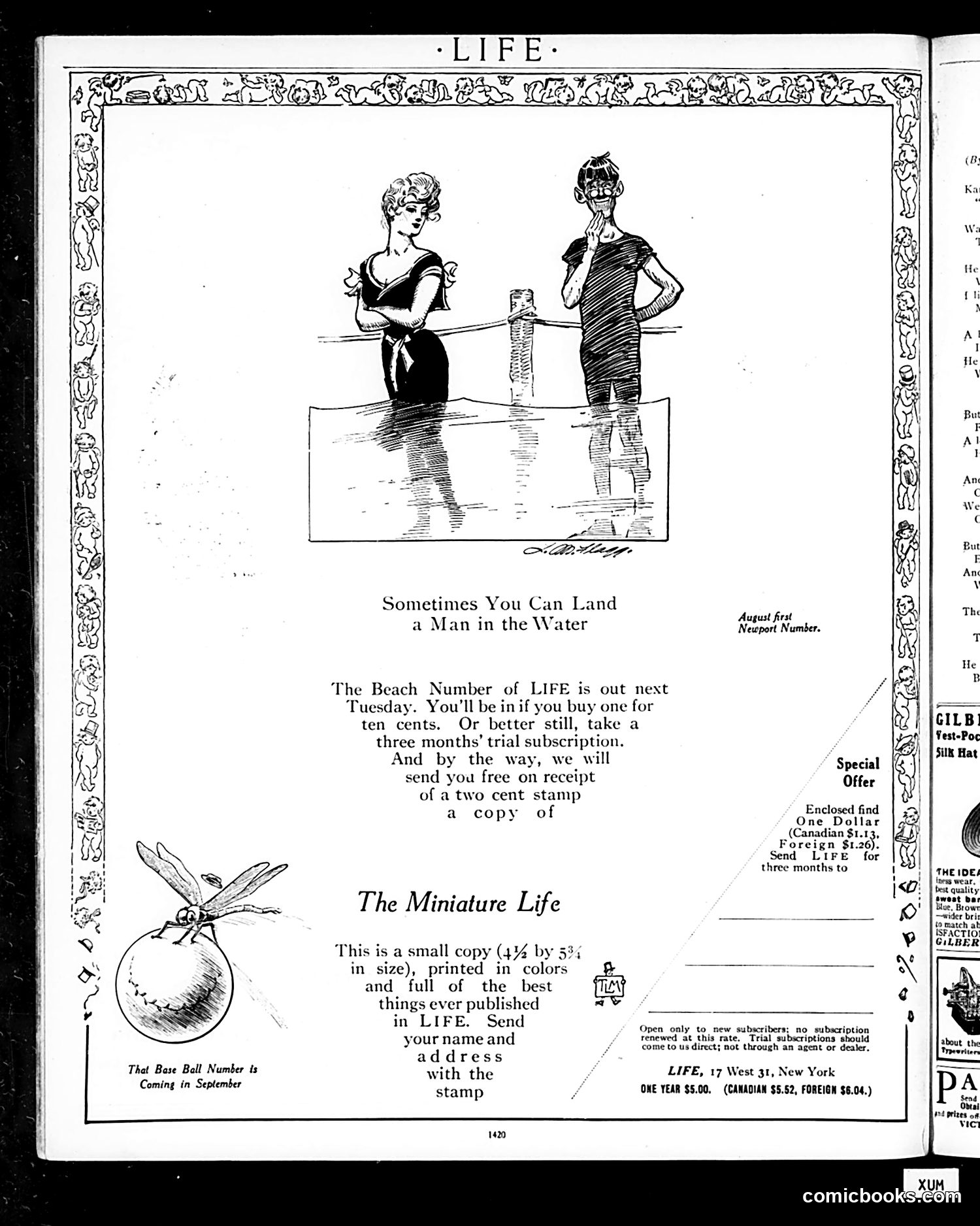
This cartoon satirizes courtship and dating customs of the early 20th century. It depicts two fashionably dressed women wading in water—one holding what appears to be a fishing line or rope attached to a man submerged beside them. The caption's double entendre suggests women "catching" or securing romantic partners through strategic flirtation, using aquatic settings (beaches, swimming) as venues for courtship. The humor relies on treating romantic pursuit as literal fishing—men are "catches" to be landed like fish. This reflects anxieties about changing gender roles, as women increasingly participated in public leisure activities and took active roles in courtship rather than passive ones. The page also advertises LIFE's upcoming Beach Number and subscription offers.
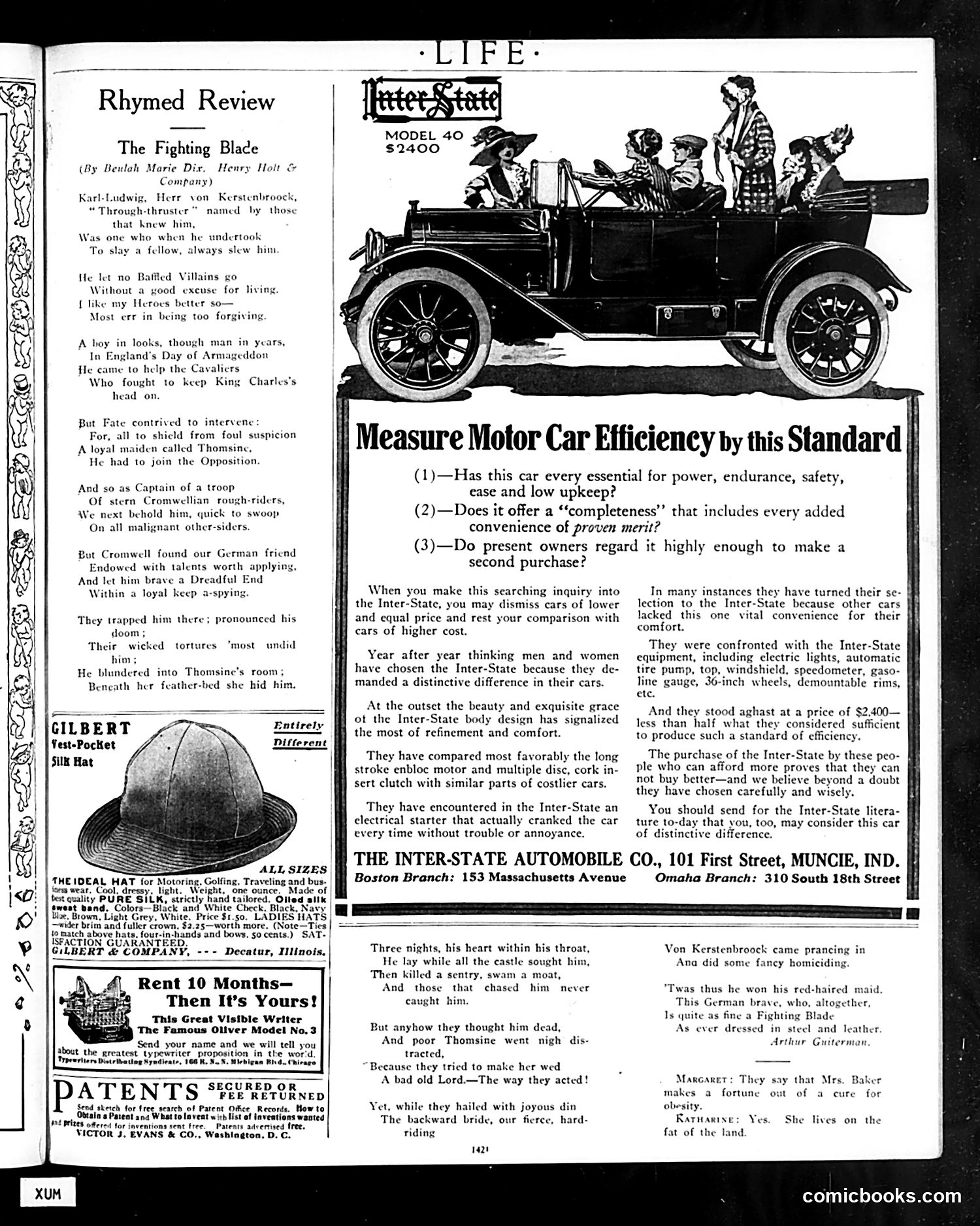
This page contains no political cartoon or satire. Instead, it features: 1. **"Rhymed Review: The Fighting Blade"** (left column)—a poem summarizing a historical narrative about Karl-Ludwig and English civil war, mentioning King Charles and Cromwell. The poem appears to review a literary work rather than satirize current events. 2. **Inter-State Automobile Advertisement** (center/right)—a large ad for the Inter-State Model 40 motor car, priced at $2,400. The ad emphasizes efficiency standards and appeals to practical buyers. 3. **Gilbert Silk Hat Advertisement** (bottom left)—a hat company ad. 4. **"Rent 10 Months—Then It's Yours"** (bottom)—a typewriter rental advertisement. The page is primarily advertising with historical poetry—no satire or political commentary is present.
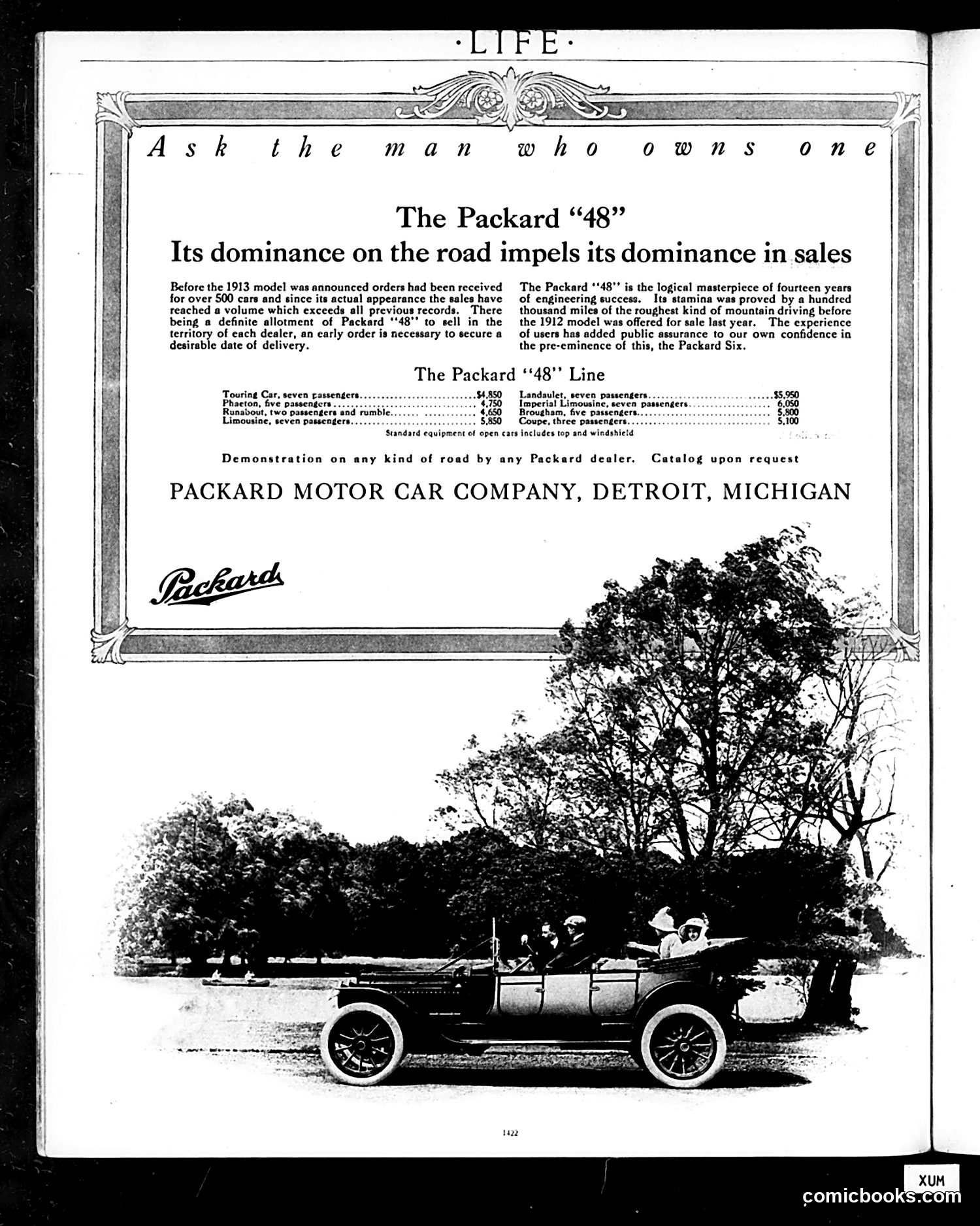
This page is primarily **advertising, not satire or editorial content**. It's a 1913 Packard Motor Car Company advertisement for the "48" model. The header "Ask the man who owns one" is Packard's actual marketing slogan (a famous early automotive advertising campaign). The text emphasizes the car's engineering superiority and sales dominance—over 500 cars sold, exceeding "all previous records." The illustration shows a touring car with well-dressed passengers in a scenic landscape, typical luxury automobile advertising imagery of the era. There is **no political cartoon or satire present**. This is straightforward commercial promotion positioning Packard as the premium automobile choice, appealing to wealthy buyers through claims of proven reliability and market leadership.
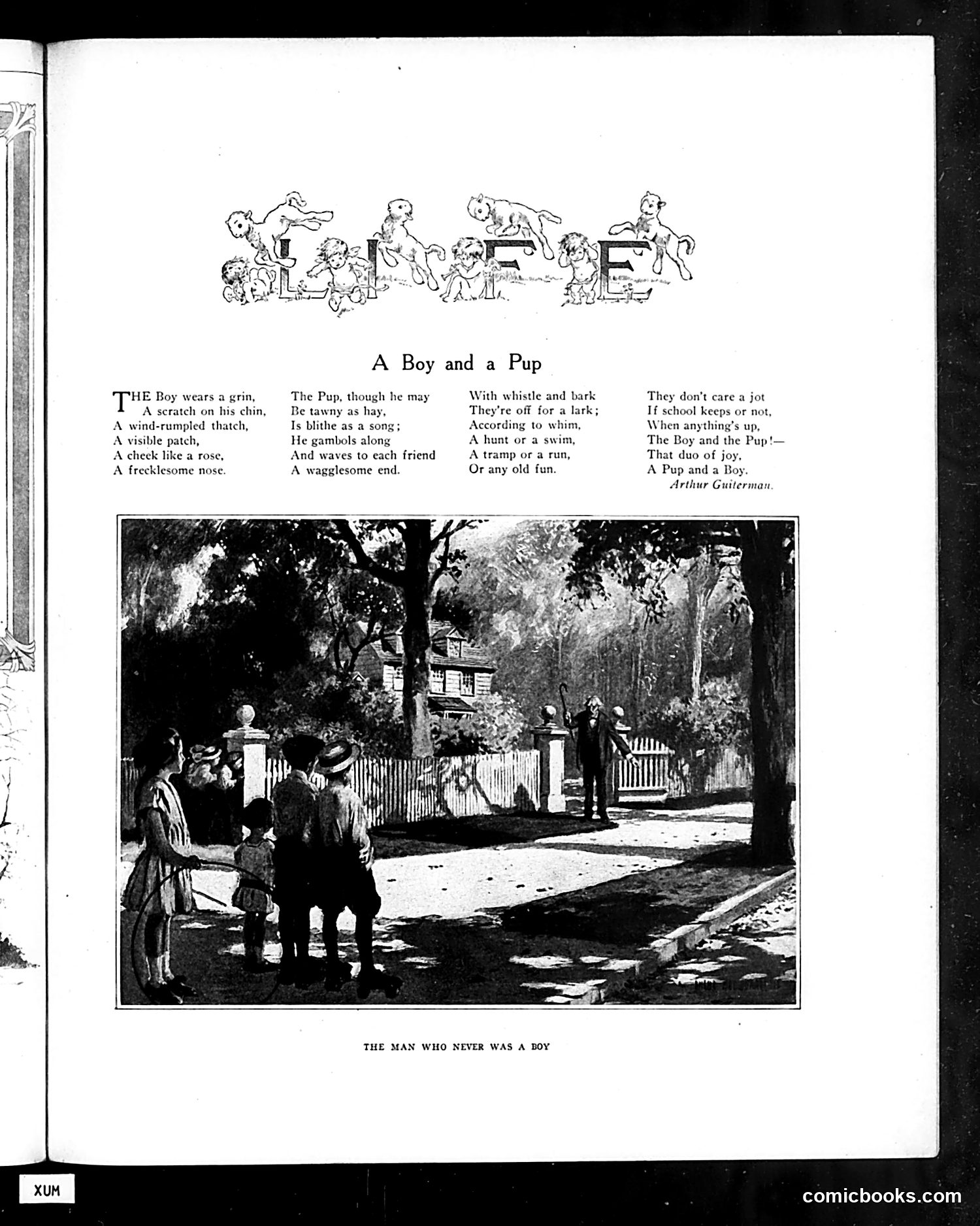
This page presents a sentimental poem by Arthur Guiterman celebrating childhood innocence and the bond between a boy and his dog. The poem describes idealized boyish traits (a grin, wind-rumpled thatch, rosy cheeks) and the pup's carefree nature (whistling, barking, wandering). The accompanying illustration titled "THE MAN WHO NEVER WAS A BOY" shows an adult man observing children playing with a dog near a fence and house—apparently someone who missed out on such simple joys. The satire appears gentle: a commentary on lost innocence or adults disconnected from childhood play. This reflects early-20th-century *Life* magazine's frequent romanticization of childhood as an idealized state, contrasting carefree youth with adult responsibilities and emotional distance.
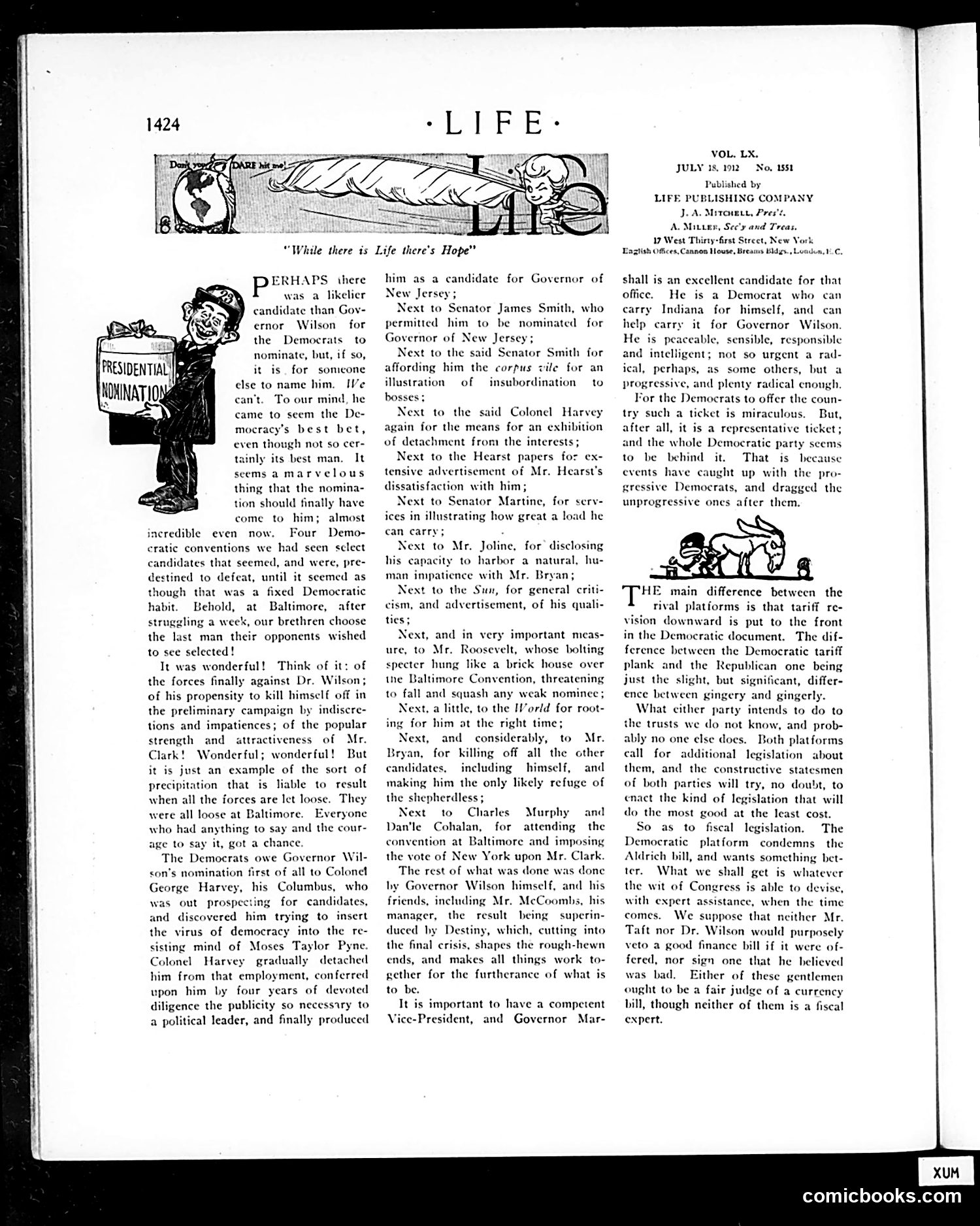
This page satirizes the 1912 Democratic National Convention and presidential nomination process. The left cartoon depicts a figure labeled "PRESIDENTIAL NOMINATION" as a chaotic grab-bag, suggesting the nomination process was unpredictable and uncontrolled. The text discusses various Democratic candidates being considered, including Governor Judson Harmon, Senator James Smith, Colonel Harvey, and others. It references the "corpse vile" (likely "corpus vile"—a disposable body for experimentation). The satire mocks how the Democrats struggled to unite behind a single candidate, contrasting their difficulty with what the text calls the "fixed Democratic habit" of past conventions. The overall tone suggests the Democrats were fractured and unable to decisively choose their nominee, making their selection process appear desperate and haphazard.
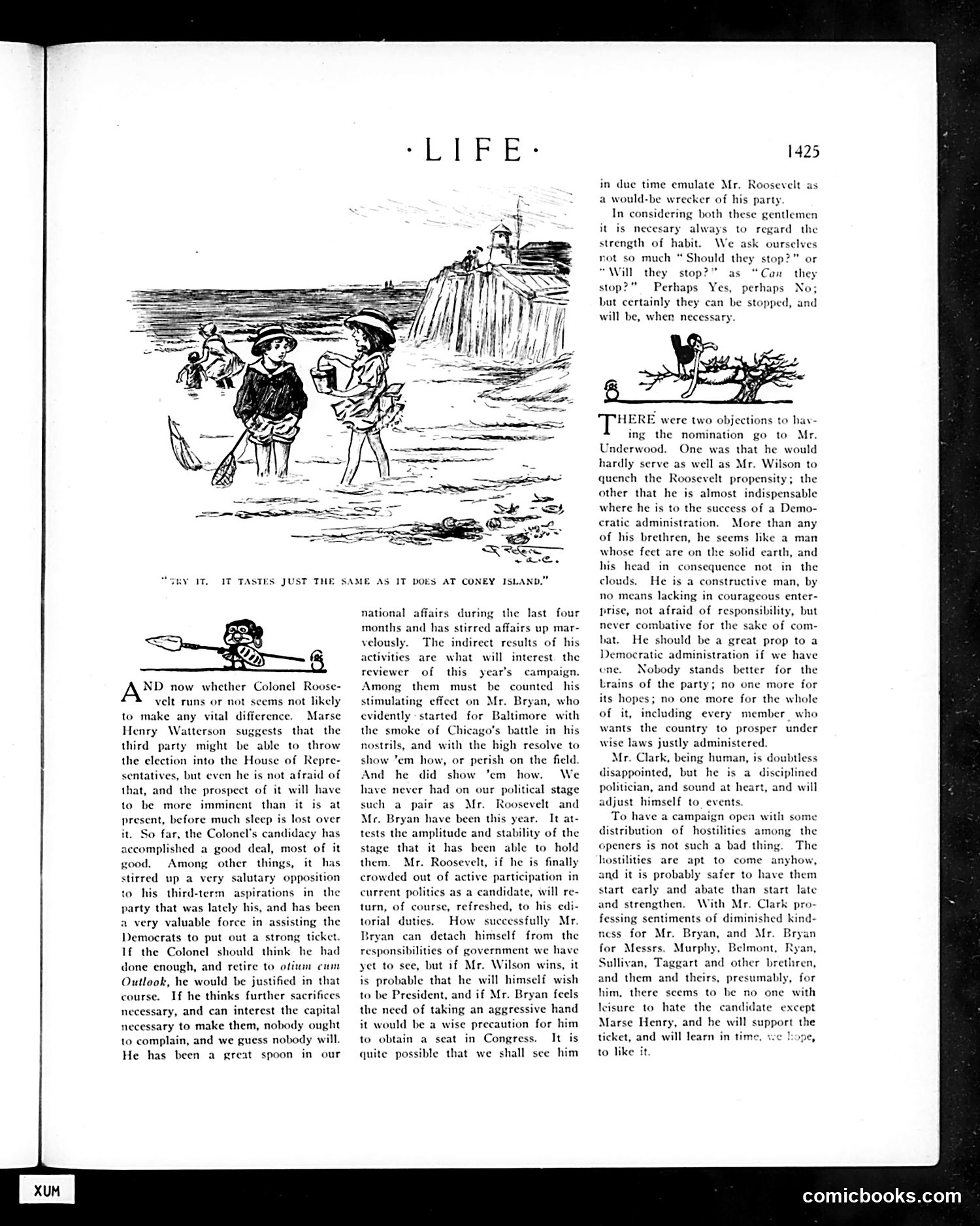
This page discusses the 1912 presidential election. The main cartoon depicts people at what appears to be Coney Island, with the caption "EY IT, IT TASTES JUST THE SAME AS IT DOES AT CONEY ISLAND." The article analyzes Colonel Roosevelt's potential third-party candidacy, addressing whether he might challenge incumbent President Taft. The text references "Mr. Bryan" (likely William Jennings Bryan from previous Democratic campaigns) and discusses Democratic party strategy. The satirical point appears to be that regardless of where one engages in politics—whether at elite venues or popular amusement parks like Coney Island—the underlying experience or "taste" remains identical: standard political maneuvering. The cartoon jokes that political activity is fundamentally the same across different social contexts, suggesting the circus-like nature of the election season was universal.
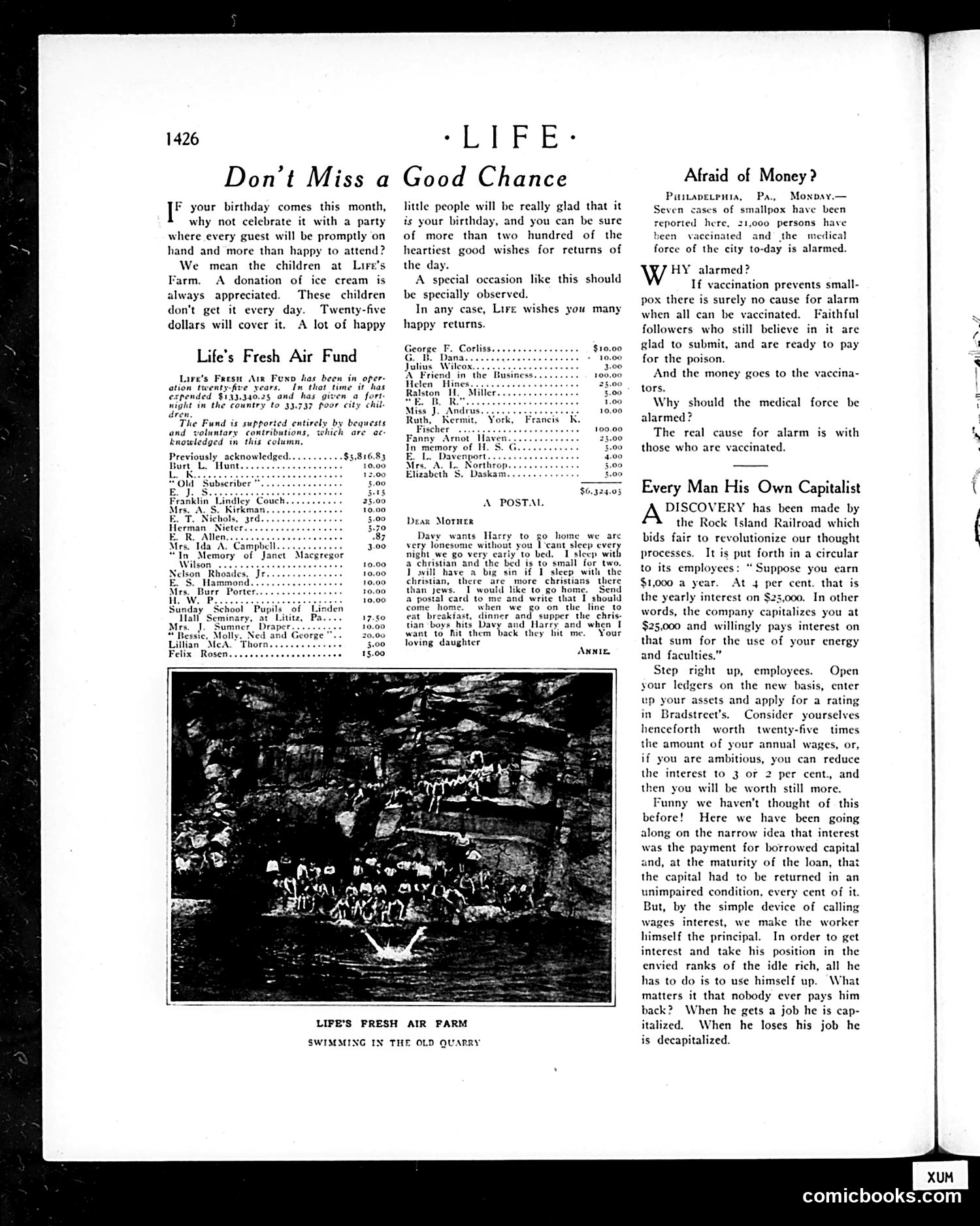
This page contains no political cartoon. Instead, it features: **Left column:** "Don't Miss a Good Chance" — advice to celebrate birthdays with parties, and "Life's Fresh Air Fund" — a fundraising section listing donors to a charitable cause providing fresh air experiences for children. **Center:** A photograph labeled "LIFE'S FRESH AIR FARM — SWIMMING IN THE OLD QUARRY" showing people swimming. **Right column:** Two articles — "Afraid of Money?" discussing smallpox vaccination concerns in Philadelphia, and "Every Man His Own Capitalist," proposing a wage-based investment scheme where workers build capital through interest payments rather than traditional borrowing. The content reflects early 20th-century progressive concerns about public health, charity, and worker economic empowerment.
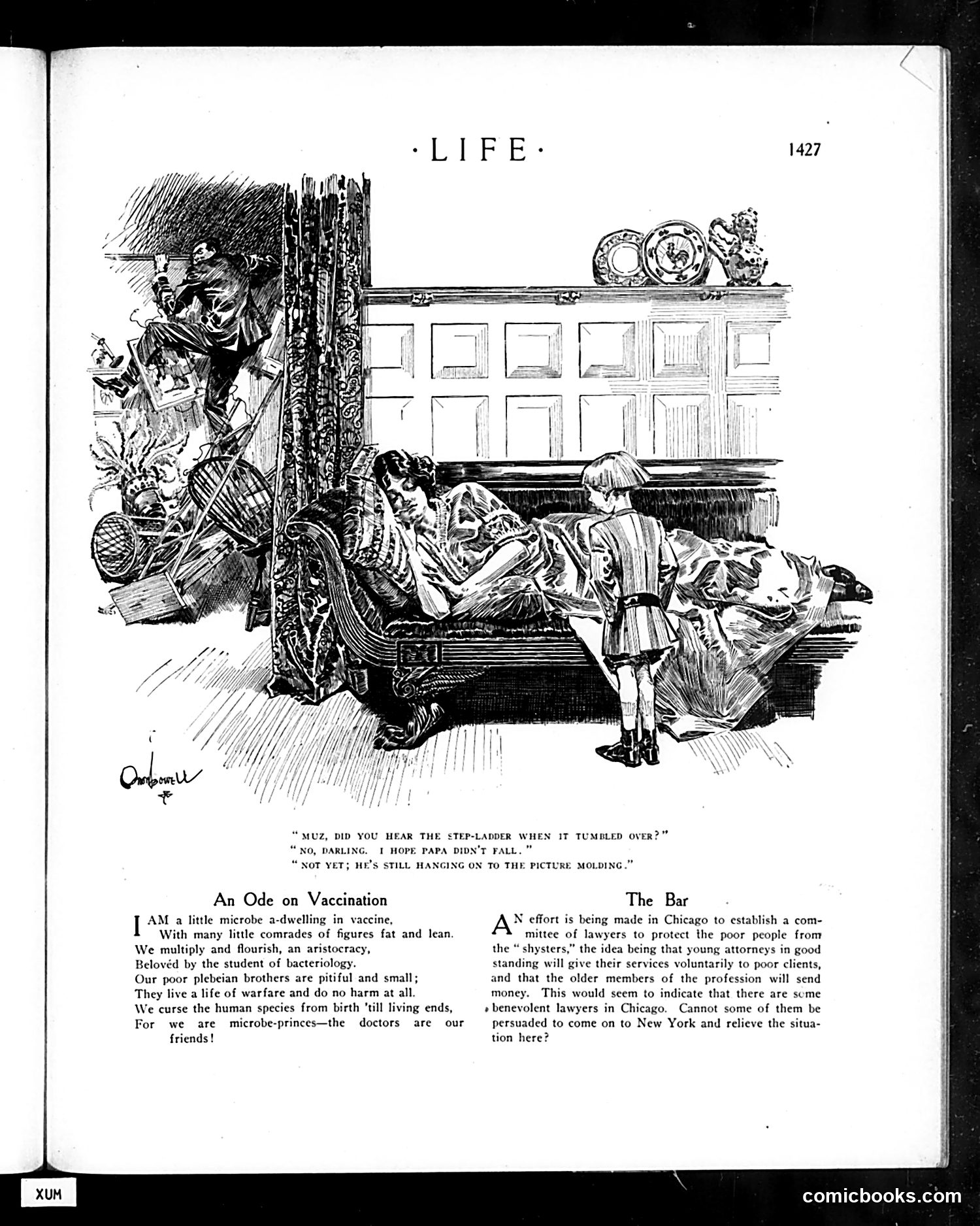
The illustration depicts two young girls discovering an overturned stepladder near a picture molding, with dialogue suggesting their father fell while hanging a picture. This serves as a visual setup for the accompanying humor pieces below. "An Ode on Vaccination" celebrates doctors as "microbe-princes" fighting disease, portraying physicians as modest heroes who "live a life of warfare" against illness for humanity's benefit—reflecting early 20th-century admiration for medical advances. "The Bar" criticizes Chicago lawyers, appealing to New York attorneys to voluntarily help poor clients, suggesting the profession's reluctance to provide pro bono services. The piece implies some lawyers in Chicago are more philanthropic than their New York counterparts. Both pieces employ gentle satire about social institutions and professional conduct.
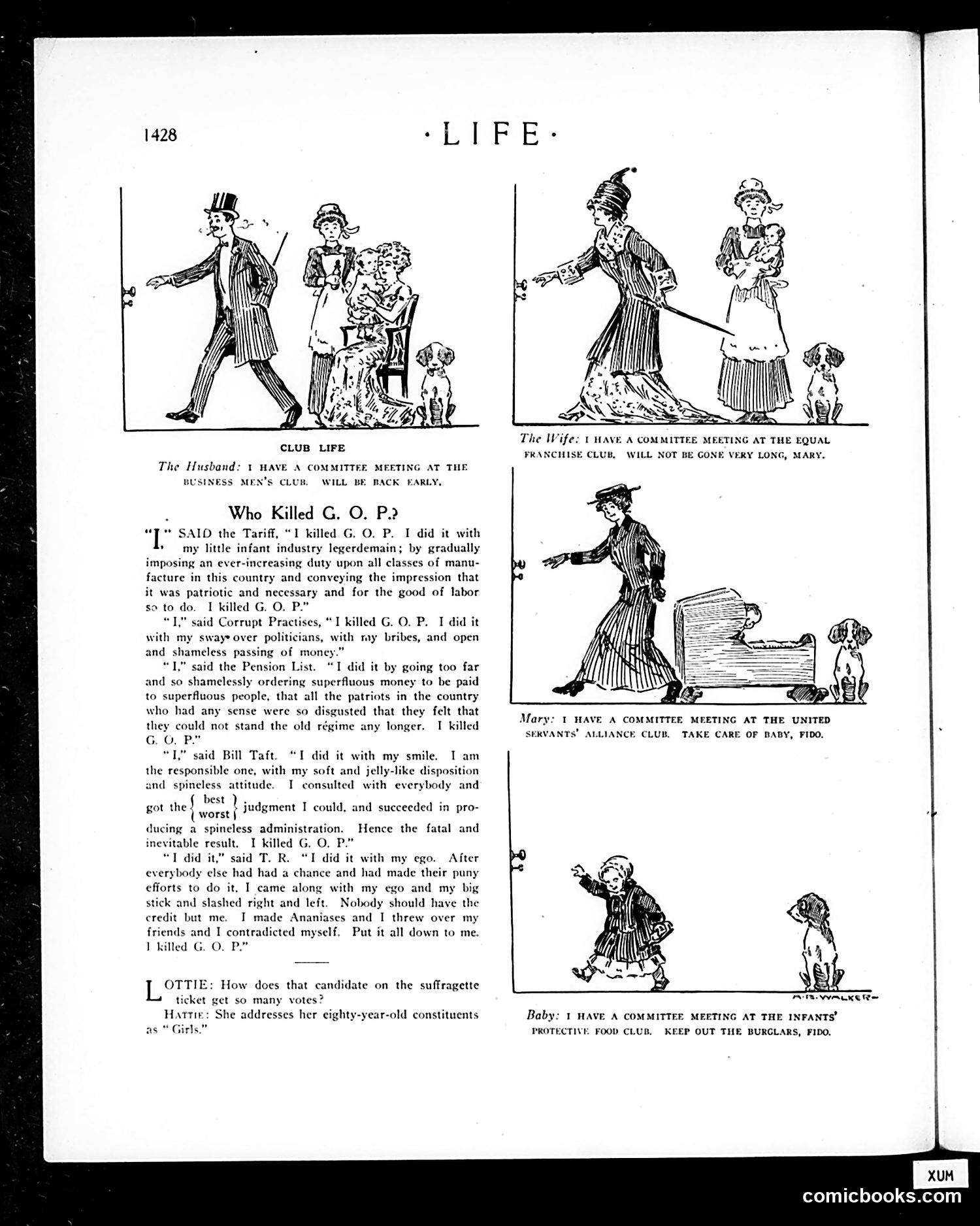
This Life magazine page satirizes early 20th-century debates about women's roles and political involvement. The main article "Who Killed G.O.P.?" presents various political figures—the Tariff, Corrupt Practices, Pension List, Bill Taft, and T.R. (Theodore Roosevelt)—each claiming responsibility for damaging the Republican Party (G.O.P.). The illustrated vignettes on the right mock women's newly-active committee work by showing wives, mothers, and servants attending various "committee meetings" instead of managing homes—the Equal Franchise Club, United Servants' Alliance, Infants' Protective Food Club. The satire suggests women's political participation threatens domestic duties, a common anti-suffrage argument. The humor relies on contemporary anxieties about women's expanding social roles.
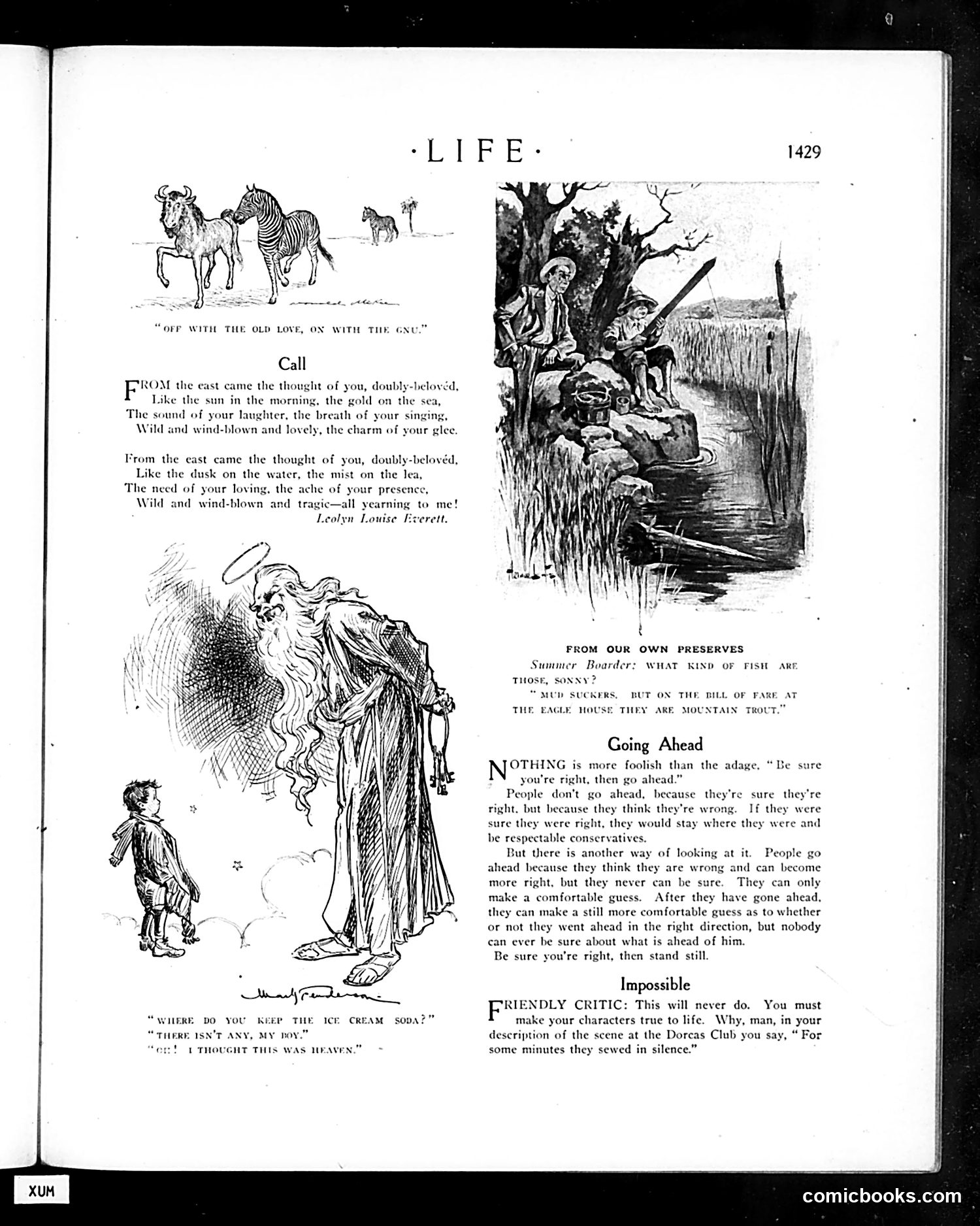
This page contains three distinct pieces: **"Call"** — A poem by Loelyn Louise Everett about yearning for a beloved person, accompanied by romantic illustrations of figures in nature and a bearded man (possibly Father Time or Death) with a child. **"From Our Own Preserves"** — A fishing-related cartoon joke about types of fish, with a rural scene showing men by water. **"Going Ahead"** and **"Impossible"** — Two short prose pieces offering social commentary. "Going Ahead" satirizes human indecision and the paradox of being "sure you're right" versus risk-taking. "Impossible" critiques fiction writers for unrealistic character dialogue, citing a specific example from the Dorcas Club. The page blends sentimental poetry with lighthearted social satire typical of Life's format during this era.
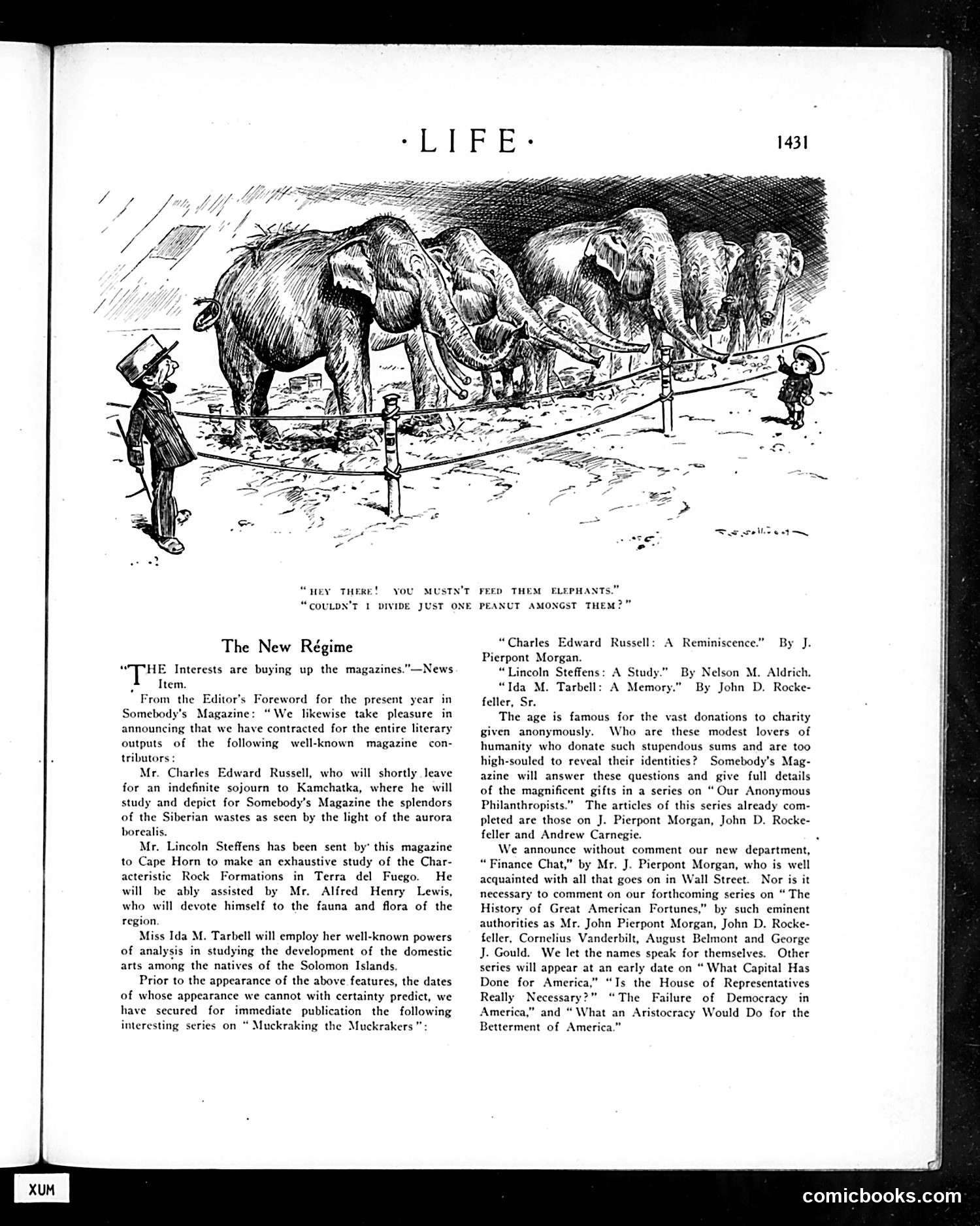
This Life magazine satire mocks the corruption of American journalism by wealthy industrialists. The cartoon depicts elephants (representing major magazines) being controlled by a tiny handler, illustrating how business interests are "buying up the magazines" as stated in the news item. The text satirizes this by listing famous muckraking journalists—Russell, Steffens, and Tarbell—being sent on absurd, deliberately obstructive assignments to remote locations (Kamchatka, Terra del Fuego, Solomon Islands), removing them from investigative reporting. The joke deepens with proposed magazine departments: J. Pierpont Morgan writing "Finance Chat," and wealthy tycoons (Morgan, Rockefeller, Vanderbilt) authoring series on "Great American Fortunes" and democracy's failures—having the robber barons literally explain their own wealth and power. The satire attacks the era's moneyed interests silencing critical journalism by controlling editorial content and reassigning reformist writers, replacing accountability with propaganda disguised as legitimate journalism.
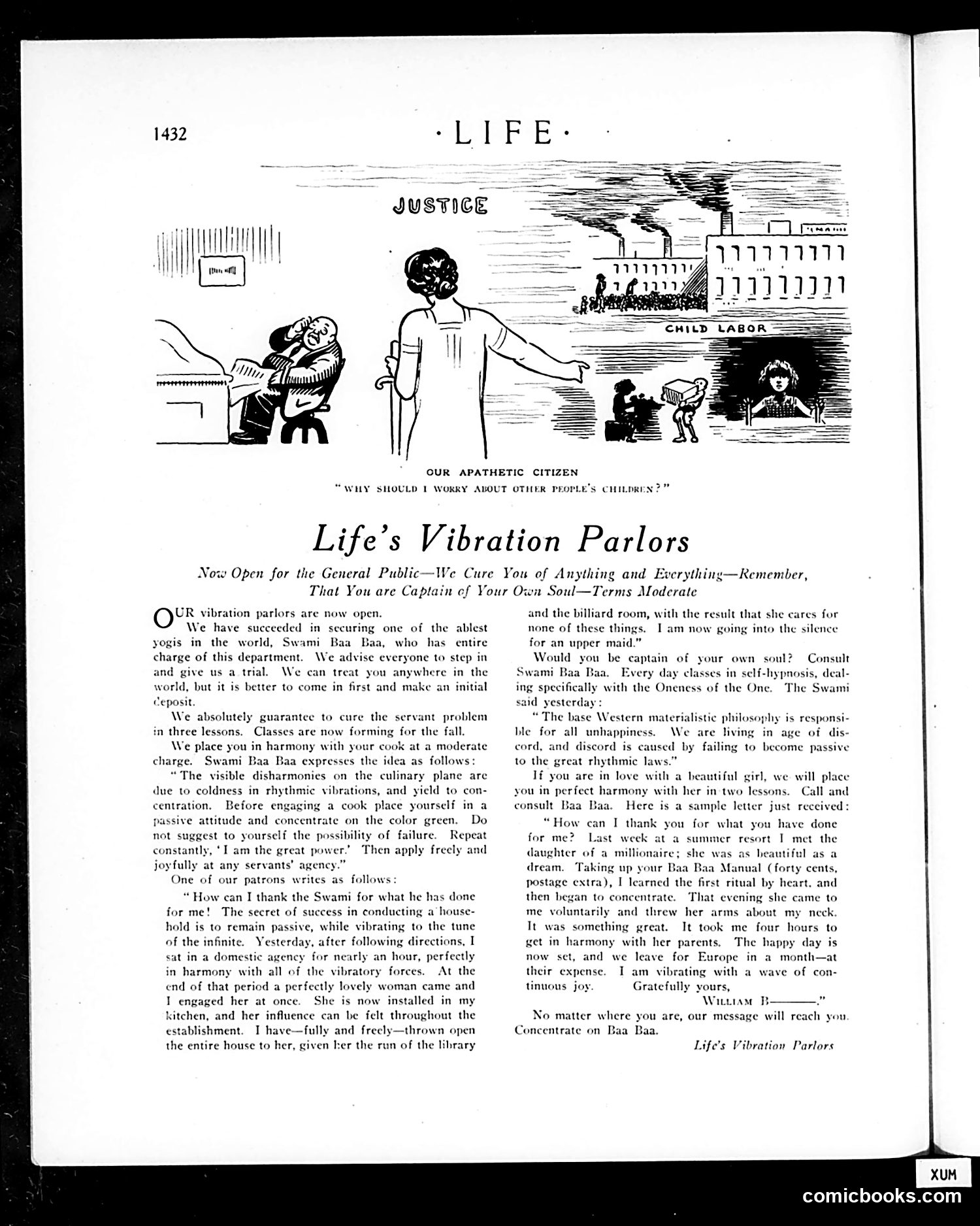
This page satirizes the early 20th-century fad of mystical self-help movements and pseudo-scientific "vibration" therapies. The cartoon at top shows "Our Apathetic Citizen" ignoring social problems (child labor, injustice) with the caption "Why should I worry about other people's children?" The main satire mocks a fraudulent "Swami Baa Baa" who offers absurd solutions through mental concentration and "vibration" — curing servant problems, winning romance, and solving life's issues via passive meditation and willpower. The testimonials are intentionally ridiculous: a woman throws open her entire house to a maid after "vibrating"; a man wins a millionaire's daughter through concentration rituals. The satire targets gullible wealthy people seeking magical solutions to mundane problems (hiring household staff, romantic competition) rather than addressing actual social issues. It's cynical commentary on how the privileged use spiritualism as escapism while ignoring broader injustice — connecting the cartoon's "apathetic citizen" to the foolish clients patronizing fraudulent parlors.
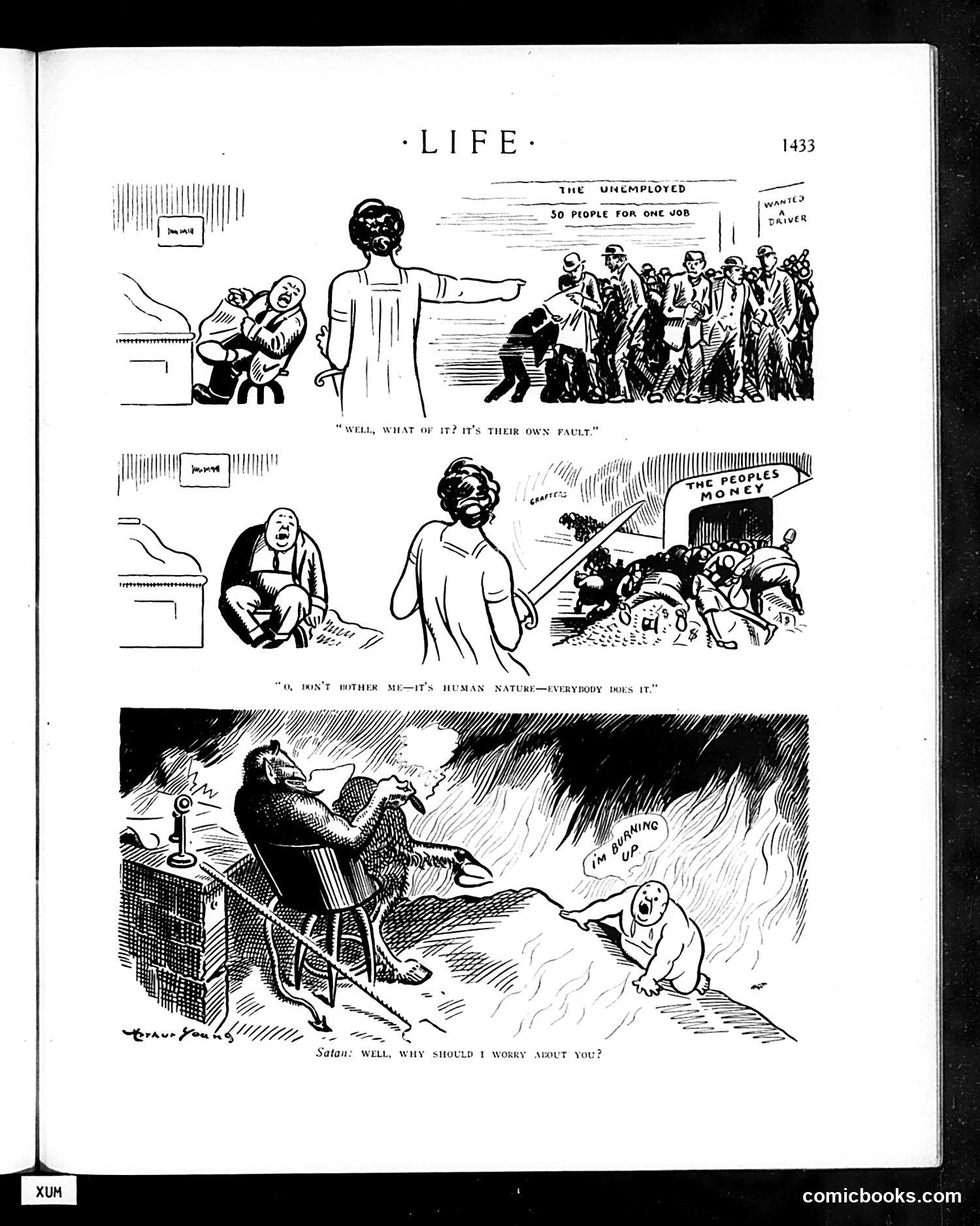
This page from *Life* magazine presents a satirical commentary on unemployment and economic inequality. The top panel shows fifty jobless people competing desperately for one available position, with a figure dismissively saying "Well, what of it? It's their own fault." The middle panel depicts a poor man with a starving child beside "The People's Money"—suggesting wealth exists but remains inaccessible to the desperate. The bottom panel shows Satan knitting while a suffering soul asks "Well, why should I worry about you?"—implying that indifference to human suffering is devilish. The cartoons criticize callous attitudes toward unemployment, arguing that blaming joblessness on personal failure ignores systemic inequality and suggests that societal indifference to poverty is morally corrupt. The satire targets wealthy or powerful figures who dismiss responsibility for widespread destitution.
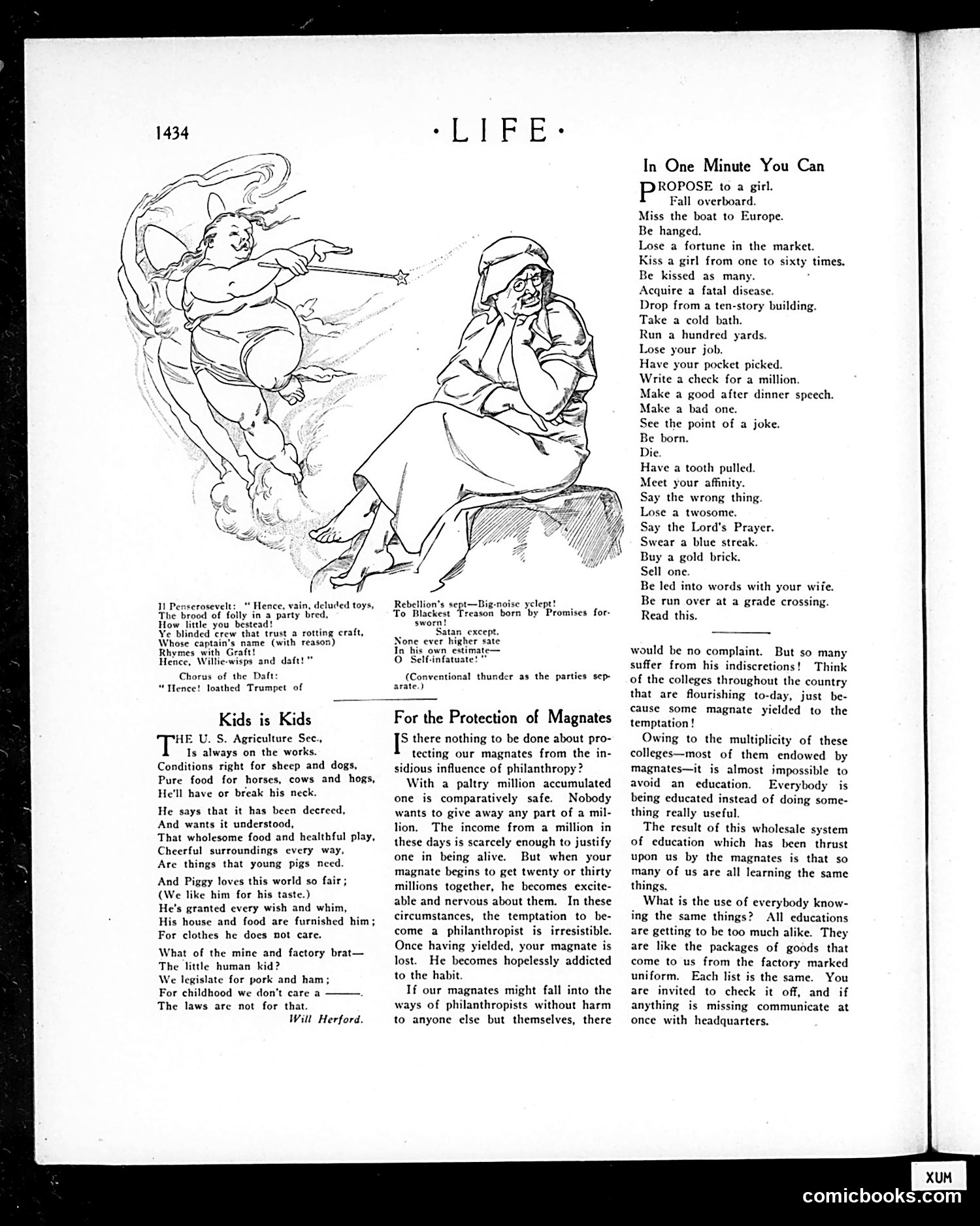
This page contains two distinct satirical pieces: **"Penserosevelt" (top left):** A political cartoon mocking Theodore Roosevelt and the Republican Party. The caption parodies Milton's "Il Penseroso," with "Penserosevelt" lamenting corrupt party members whose leader's name "rhymes with Graft"—a direct attack on Roosevelt's administration for corruption and cronyism. **"Kids is Kids" (middle):** Satirizes agricultural policy hypocrisy. The U.S. Agriculture Secretary carefully regulates conditions for farm animals (pigs, horses, cows) but ignores poor working children in mines and factories. The piece criticizes this as callous neglect of actual human children while protecting livestock. **"For the Protection of Magnates" (right):** Mocks wealthy industrialists-turned-philanthropists. The satire argues that once magnates accumulate 20-30 million dollars, nervous anxiety drives them to give away money to colleges, inadvertently spreading unwanted universal education that makes society uniformly mediocre rather than usefully diverse. All three pieces target Progressive Era policies and wealthy interests with biting irony.
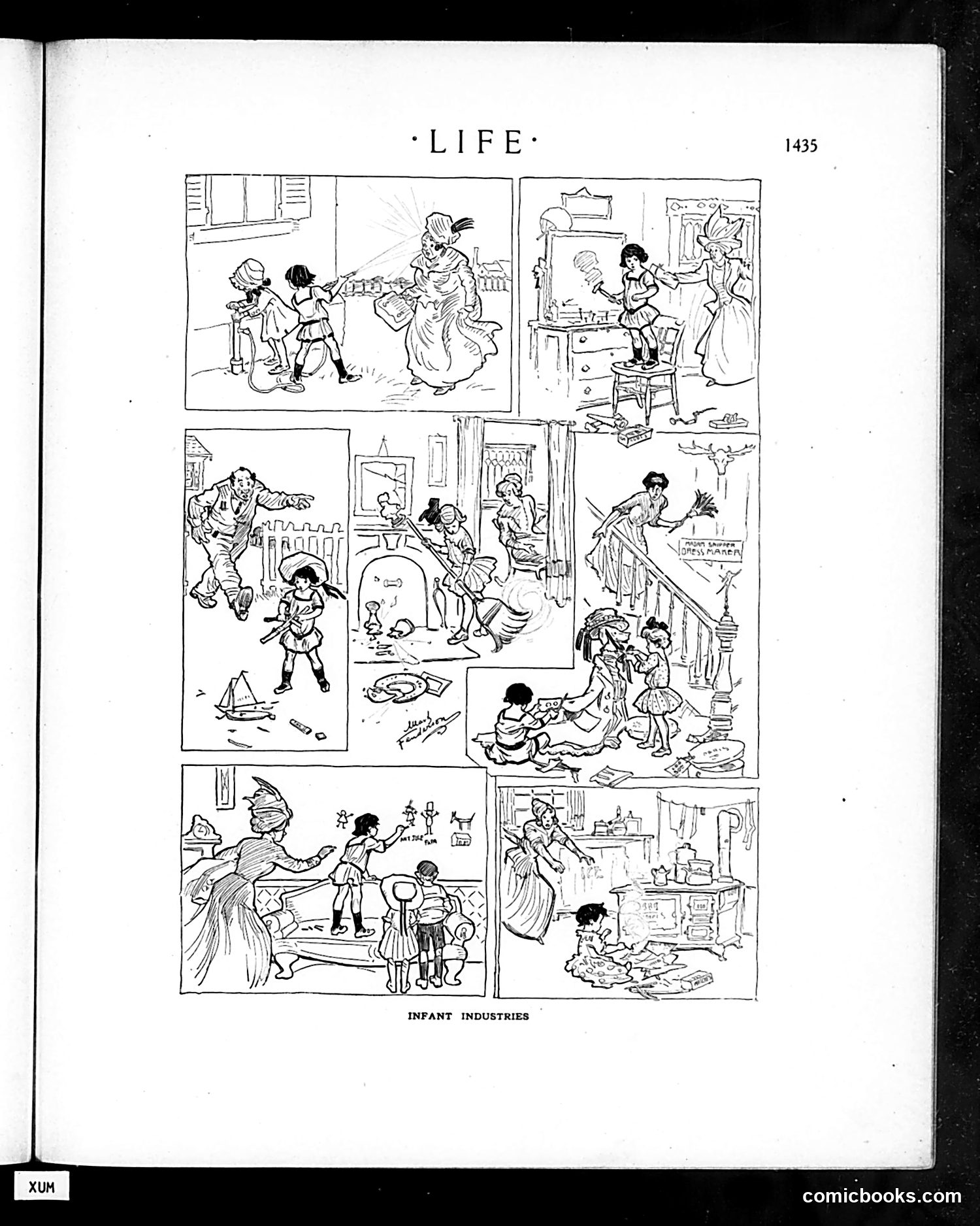
This satirical comic strip depicts children engaged in various domestic activities and play—cooking, cleaning, sewing, playing with toys, and other household tasks. The title "Infant Industries" is a pun playing on the economic term "infant industries," which refers to new, developing sectors needing government protection. The satire suggests that children's domestic work and play *are* industries themselves—treating childhood activities as labor. This likely critiques either: (1) child labor practices of the era, or (2) the romanticization of children's household contributions as productive "work." The humor comes from the absurdist application of industrial terminology to innocent childhood activities, inviting readers to reconsider whether we're appropriately valuing or exploiting children's domestic roles.
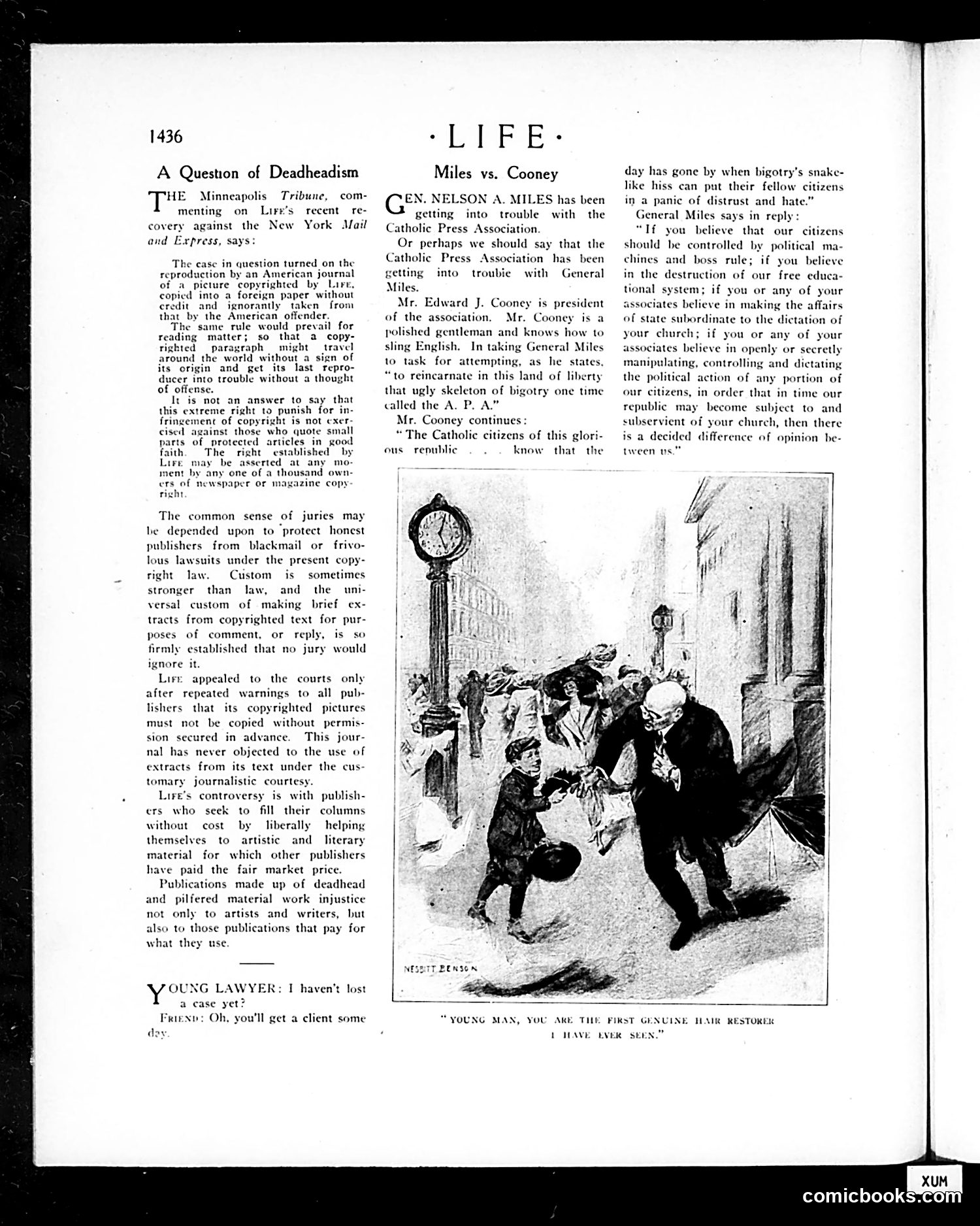
This page contains two separate items: **"A Question of Deadheadism"** discusses a copyright dispute between *Life* magazine and the *New York Mail and Express*. The issue: newspapers were republishing *Life's* copyrighted pictures and articles without permission or attribution. The text argues this "deadhead" (free) pilfering of content harms both the original creators and publications that legitimately pay for material. The satirical angle critiques publishers who fill columns cheaply by stealing rather than licensing content. **"Miles vs. Cooney"** reports a public dispute between General Nelson A. Miles and Edward J. Cooney, president of the Catholic Press Association. Miles accused Cooney's organization of reviving the "A.P.A." (American Protective Association—a nativist, anti-Catholic organization). Cooney denied bigotry; Miles countered that Catholic organizations were manipulating politics and subordinating state affairs to church dictation. The cartoon's joke at page bottom is unrelated—a quip about a "hair restorer" salesman.
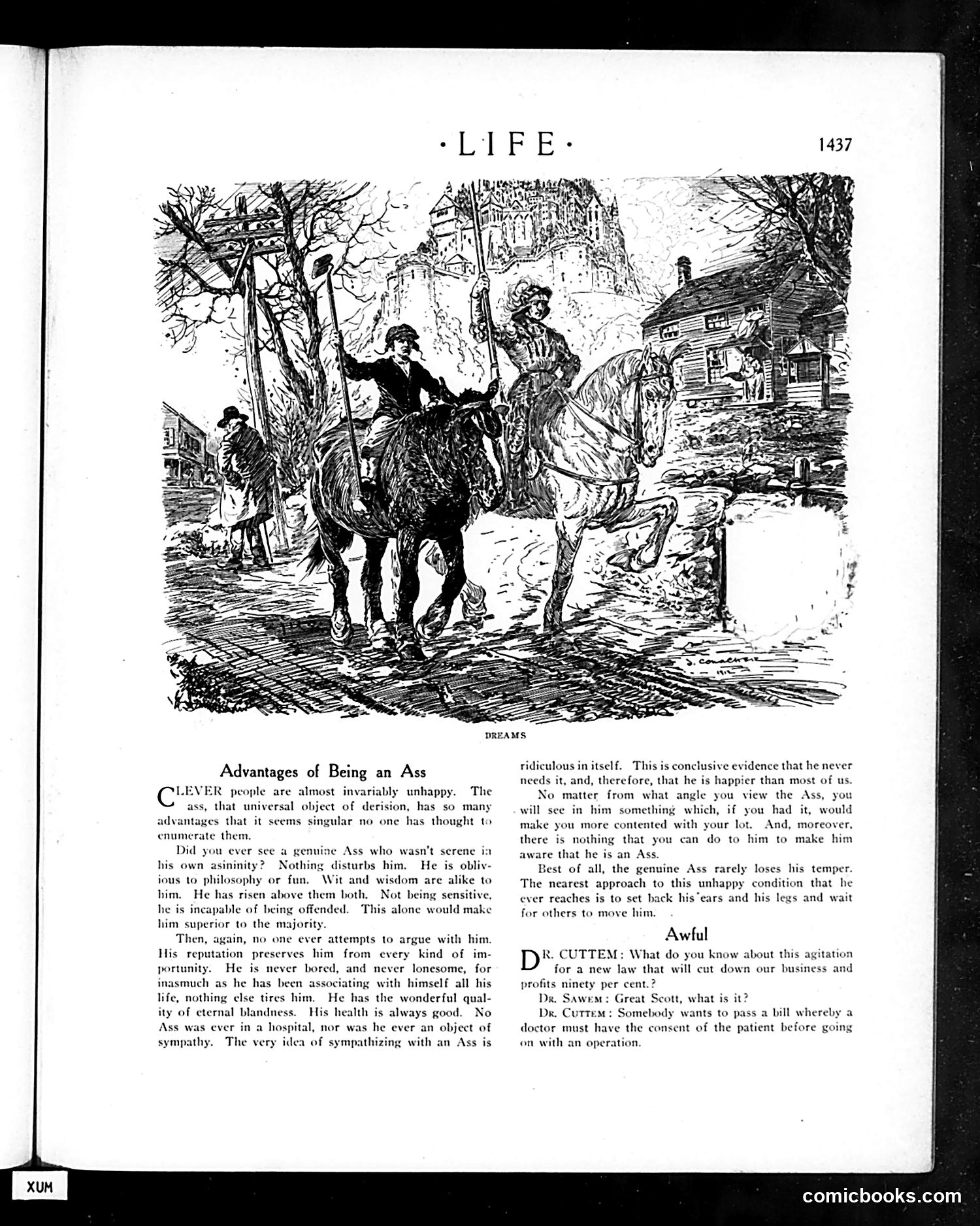
The illustration depicts a rural scene with figures on horseback, while the article satirically praises the "Ass" (donkey) as genuinely happy—immune to worry, argument, boredom, and sympathy because it lacks intellectual sensitivity and self-awareness. The satirical point: humans torment themselves with consciousness, philosophy, and social awareness. An ass, being oblivious and unfeeling, achieves contentment the clever person cannot. This inverts typical hierarchy—the "stupid" creature is superior by virtue of its stupidity. The second piece, "Awful," presents a dialogue between doctors opposing a proposed law requiring patient *consent* before surgery. They view informed consent as bad for medical profits. This satirizes physicians' resistance to patient autonomy and regulation—mocking their prioritization of revenue over ethical practice. Both pieces use humor to critique human folly: one celebrates ignorance as bliss; the other exposes professional self-interest masquerading as expertise.
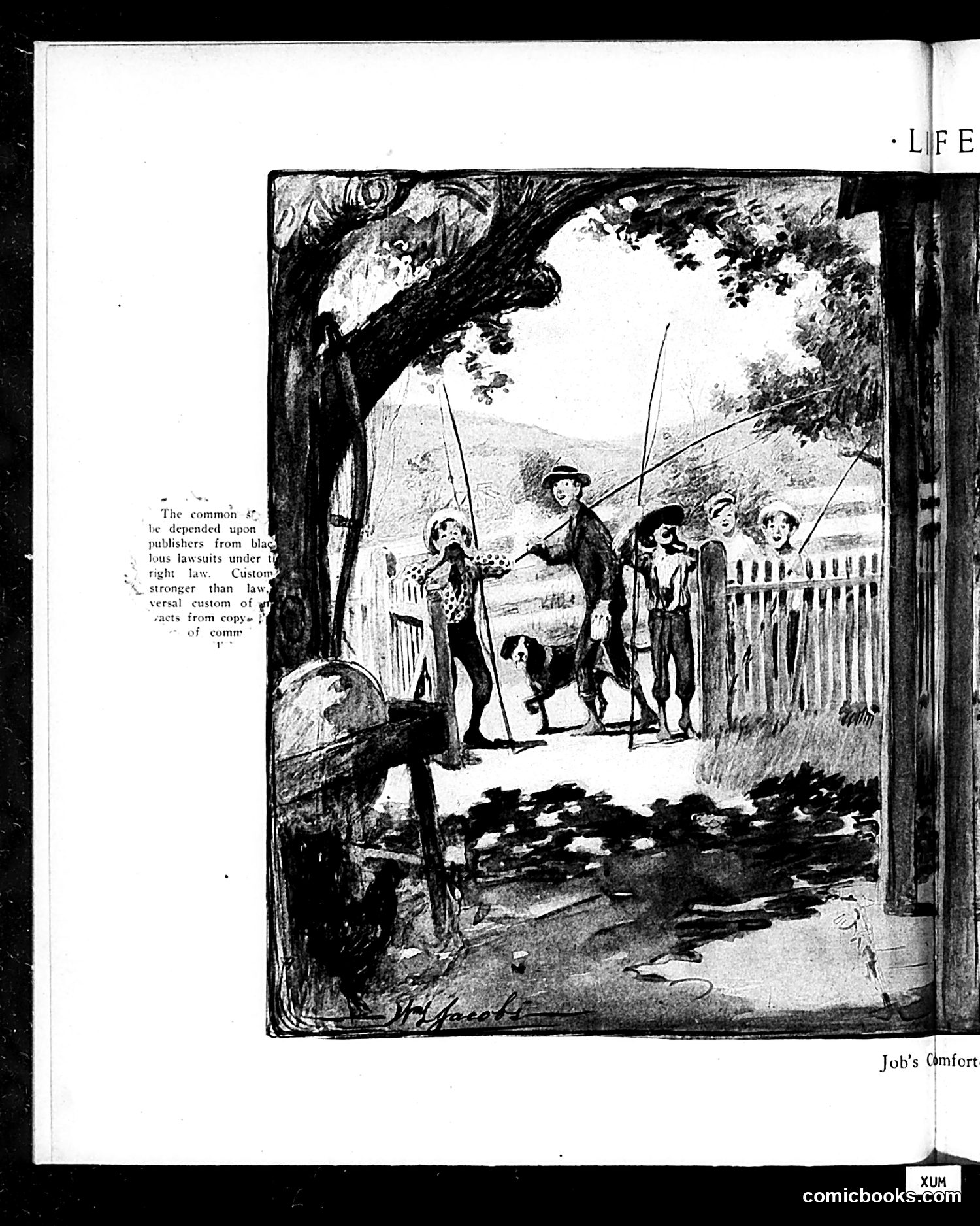
This illustration depicts a group of boys fishing by a stream near a fence and large tree. The caption "Job's Comfort" is a biblical reference—Job endured great suffering, and his "comforts" were actually his friends offering hollow consolation. The accompanying text fragment discusses copyright law and custom being "stronger than law," suggesting the cartoon satirizes inadequate legal protections. The boys likely represent publishers or those in the publishing industry dealing with copyright infringement or piracy. The peaceful fishing scene ironically contrasts with the text's serious legal discussion—implying that customary practices (like unauthorized copying) persist despite laws meant to prevent them, offering false "comfort" that accepted practice makes something acceptable even when illegal.
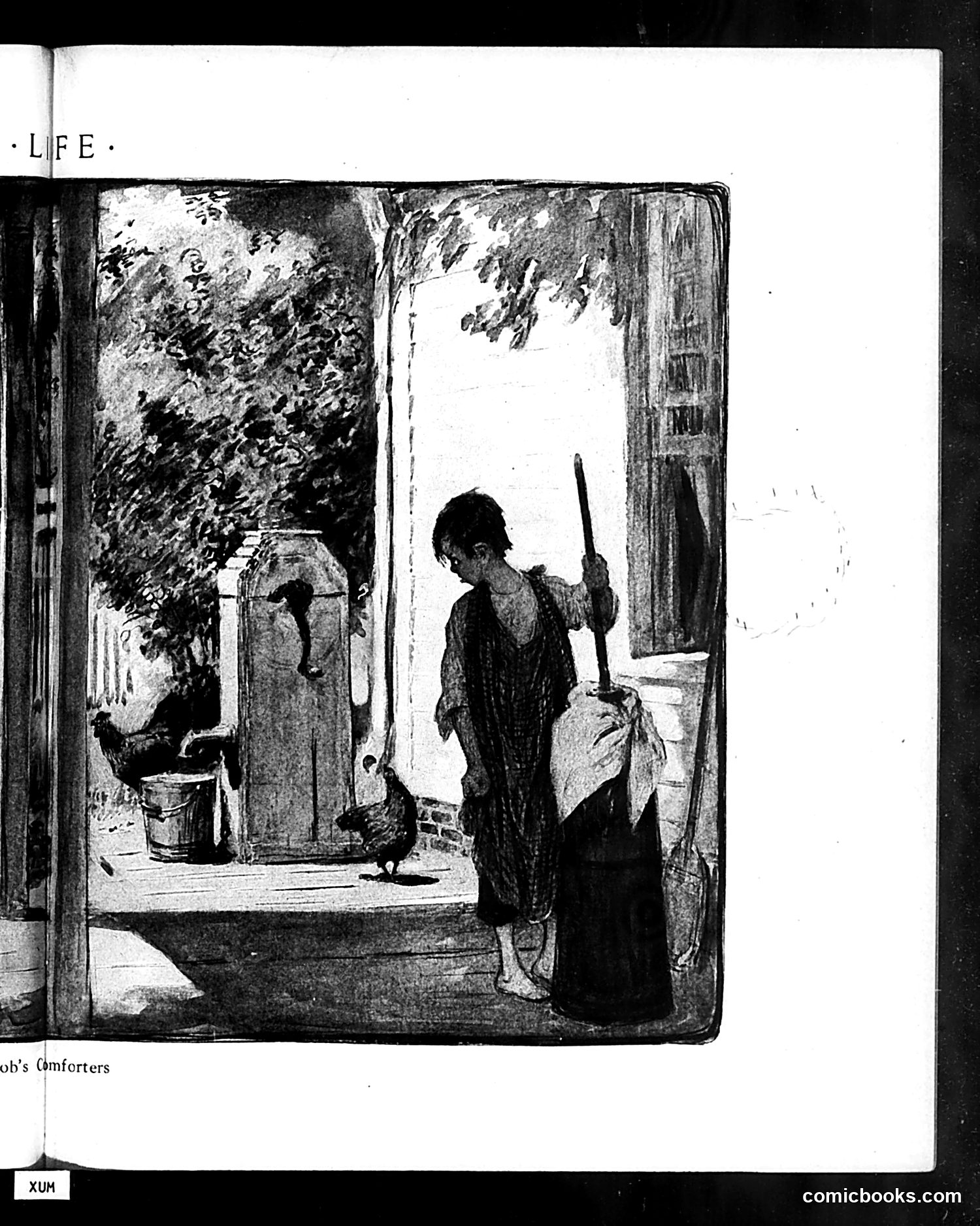
This illustration from *Life* magazine depicts a biblical reference: "Job's comforters." The phrase originates from the Book of Job, where Job's friends visit him during his suffering, ostensibly to comfort him but actually worsen his distress through their unhelpful advice and accusations. The image shows a woman holding a broom, apparently doing domestic work, with another figure visible in the background. The satire likely critiques people who offer false sympathy or unwanted "help" during difficult circumstances—appearing supportive while actually making situations worse. The term became proverbial for those whose attempts at comfort prove counterproductive or annoying, making it useful satirical commentary on social hypocrisy or meddlesome behavior.
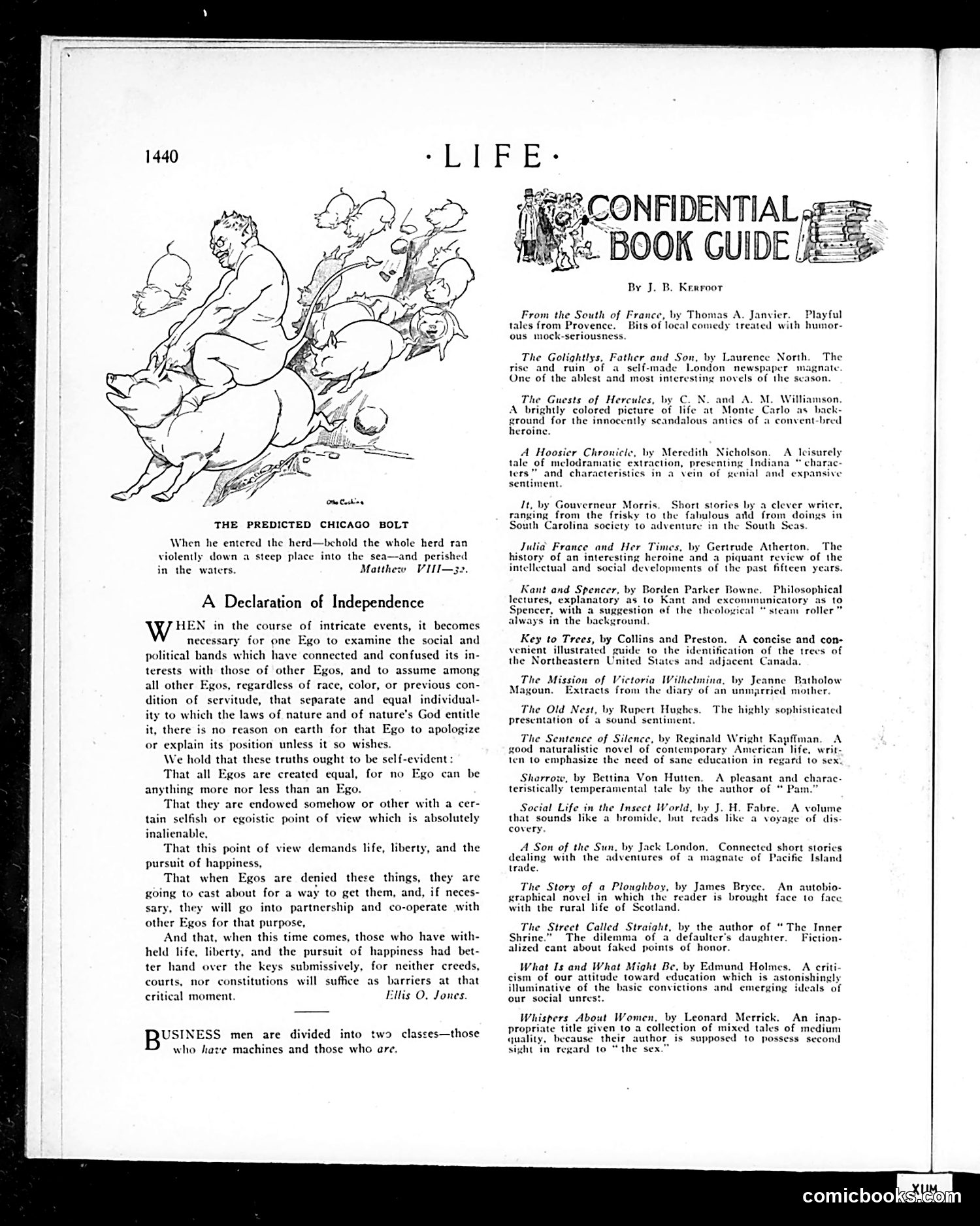
This cartoon satirizes the 1896 presidential election and William Jennings Bryan's "Cross of Gold" speech. The image shows pigs stampeding violently off a cliff into the sea—a visual pun on the biblical Matthew 8:32 reference about demons entering a herd of swine. The "Chicago bolt" likely refers to Bryan's dramatic nomination at the Democratic Convention in Chicago, which electrified and divided the nation. The stampeding pigs represent voters or the electorate responding to Bryan's populist, free-silver platform with irrational panic. The cartoon suggests Bryan's rhetoric caused mass hysteria among businessmen and the conservative establishment who feared his economic policies would destroy prosperity. The accompanying text by Ellis O. Jones parodies the Declaration of Independence, applying Enlightenment ideals to modern "Egos" pursuing happiness and liberty—possibly mocking Bryan's populist appeals to common people against established power. The magazine positions itself against Bryan's movement.
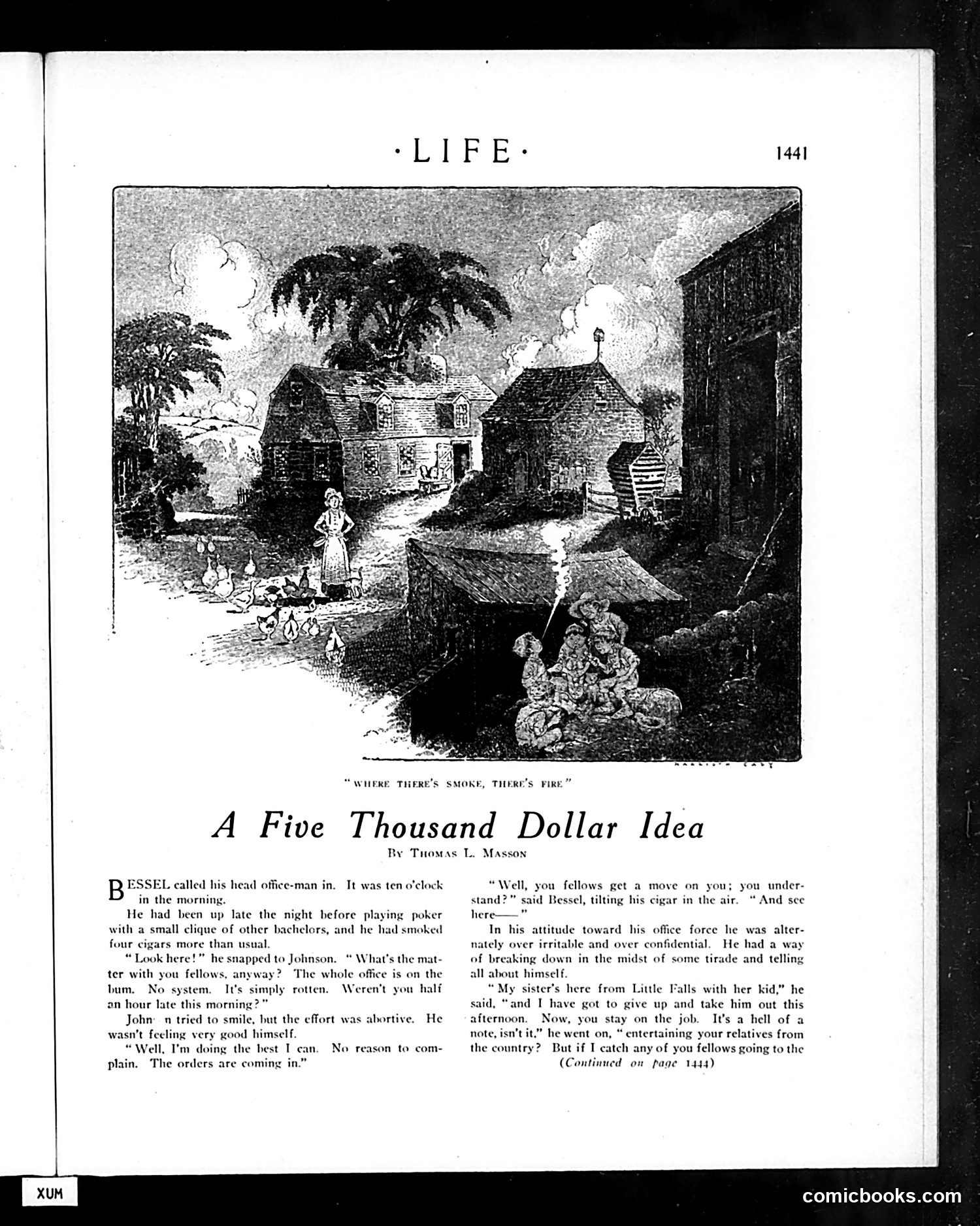
This is the opening of a short story by Thomas L. Masson, not primarily a political cartoon. The illustration depicts a rural or small-town American setting with domestic buildings and figures. The story satirizes workplace dynamics and employer hypocrisy. Bessel, a business owner, arrives at his office irritable after a late night of poker and excessive cigars. He immediately berates his employees—particularly Johnson—for poor performance and tardiness, demanding they work harder. The satire emerges when Bessel immediately undercuts his authority by complaining about his own problems: his sister's unwelcome visit from the countryside forces him to leave early. The humor targets the boss's inconsistency—he demands dedication from workers while failing to model it himself, and he overshares personal grievances while expecting professional distance. The story's title suggests the "idea" (likely revealed later) will involve money or business scheme, probably exposing further workplace absurdity.
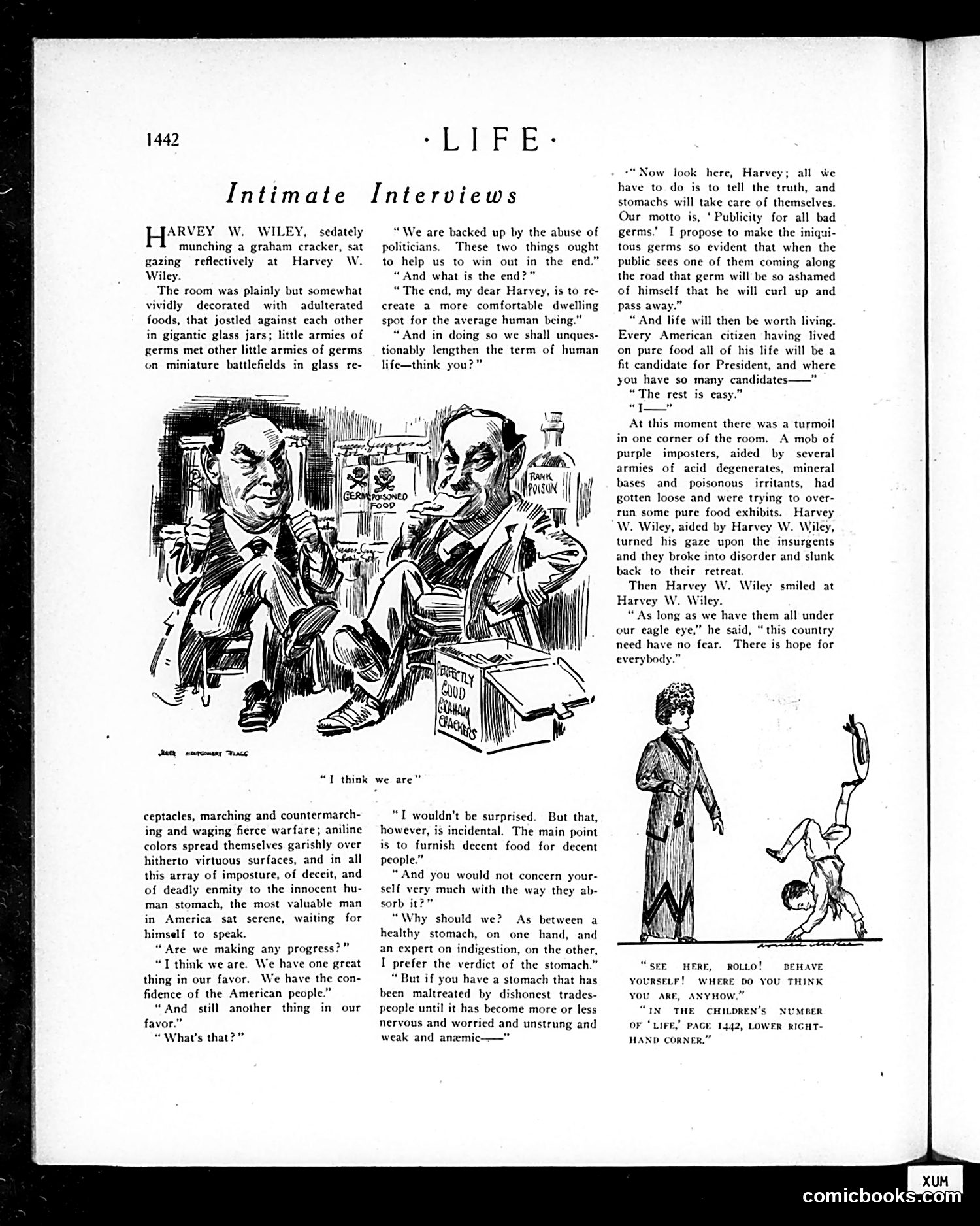
This cartoon celebrates **Harvey W. Wiley**, the real chemist who headed the U.S. Department of Agriculture's fight against food adulteration in the early 1900s. The "Intimate Interview" depicts Wiley conversing with himself—a satirical device emphasizing his singular dedication to the cause. The cartoon mocks adulterated foods displayed in jars (poisonous colorings, contaminated ingredients, disease-causing germs). Wiley's strategy—"Publicity for all bad germs"—reflects his actual approach: exposing dangerous practices to shame manufacturers into compliance. The "turmoil" where "purple imposters" and "acid degenerates" attack pure food exhibits represents the ongoing battle against corrupt food producers and their political allies. The satire celebrates Wiley's vigilance while mocking both the absurdity of widespread food poisoning and the food industry's resistance to regulation. This reflects the Progressive Era's food safety crusade, which eventually led to the 1906 Pure Food and Drug Act.
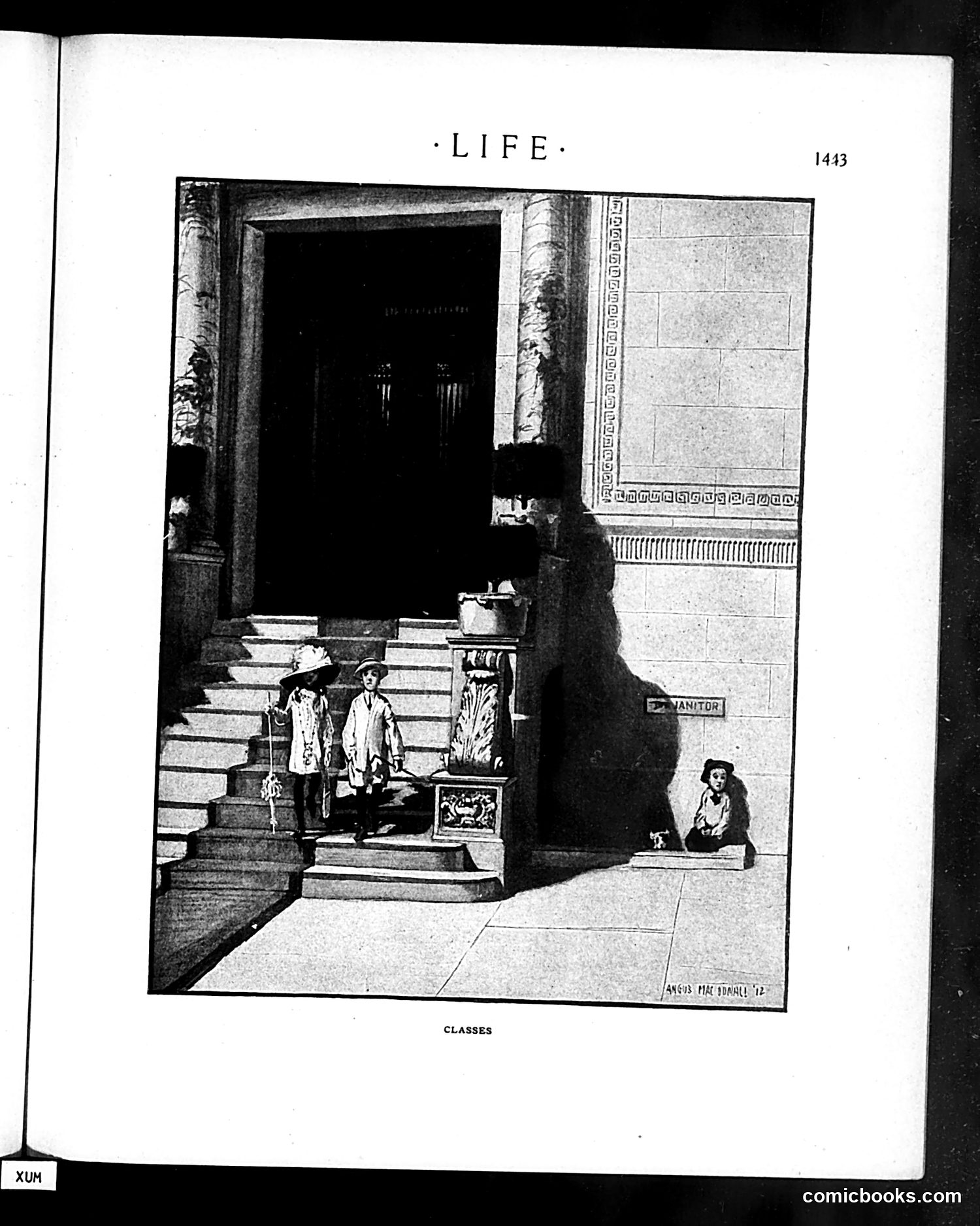
This cartoon depicts a social hierarchy commentary. Two well-dressed figures stand on an ornate building's steps, positioned prominently in the doorway—appearing to represent the upper classes or elite. Below them on the street level sits a solitary figure, separated both physically and spatially, suggesting a lower social class. The architectural framing—with the elevated entrance and grand classical details—emphasizes the literal and metaphorical separation between social groups. The "JANITOR" label visible on the right reinforces this class distinction. The cartoon's title, "Classes," satirizes the rigid stratification of American society, using spatial positioning to criticize economic and social inequality. The composition suggests those "above" enjoy privilege and access, while others remain literally and figuratively beneath them.
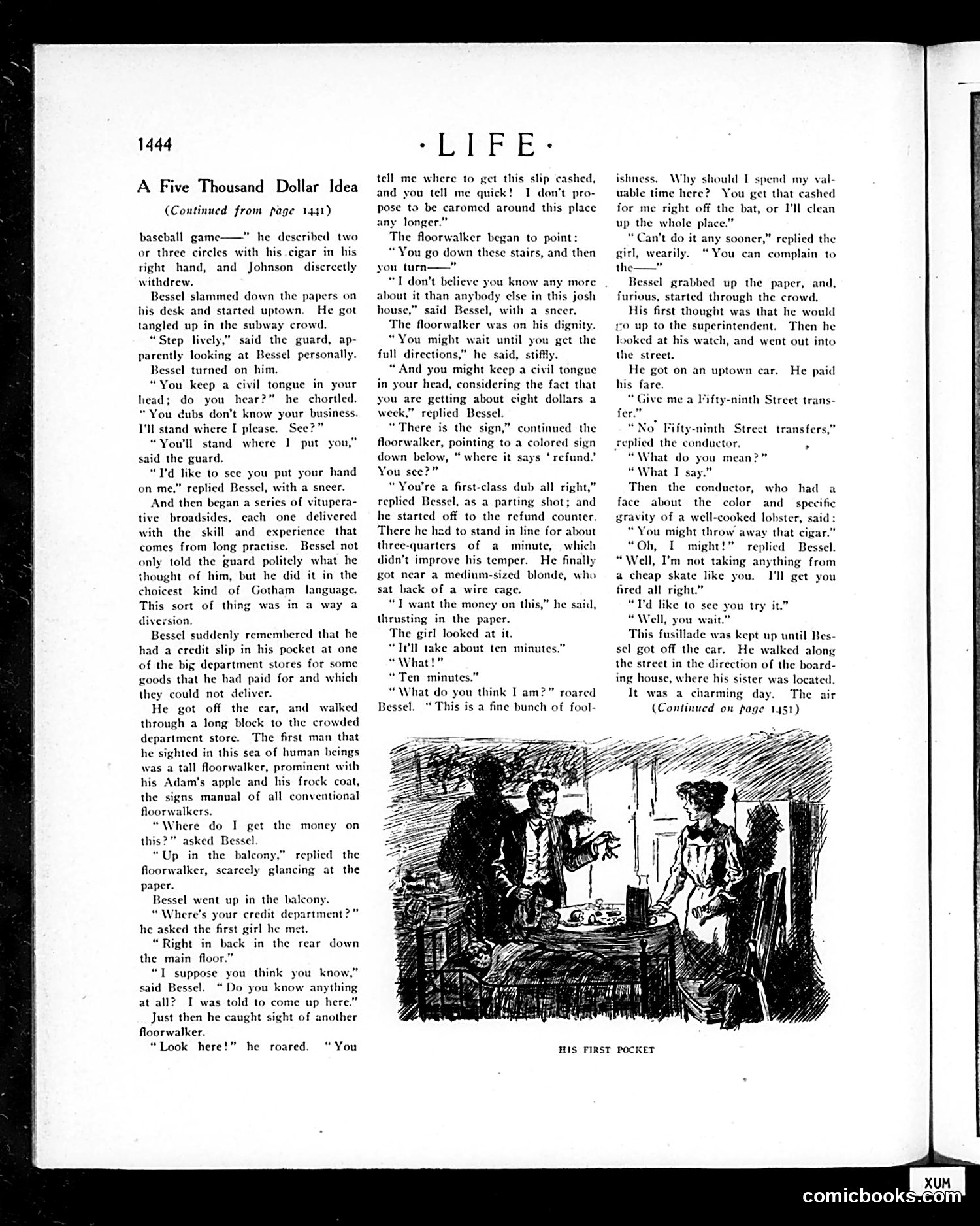
This is a serialized short story (continued from page 1441) rather than a political cartoon. The illustrated scene shows the protagonist Bessel, an increasingly hostile man, confronting a department store employee. The satire targets **the abrasive, aggressive customer archetype**—a man who verbally bullies service workers (a subway guard, a floorwalker, a cashier) over minor inconveniences. Bessel's belligerence is presented as ridiculous: he insults people's intelligence, refuses directions, demands instant service, and threatens violence over a routine refund that takes ten minutes. The story appears to mock how entitled customers treat minimum-wage workers with contempt and profanity. The irony is that Bessel's aggressive behavior solves nothing—he still must wait, still gets no special treatment—yet he continues his tirade. The "five thousand dollar idea" presumably refers to whatever business scheme motivates his urgency, making his mistreatment of workers over trivial delays even more absurd.

This is a straightforward product advertisement, not satire. It promotes Calox "Oxygen Tooth Powder" by McKesson & Robbins, a real pharmaceutical company. The ad features a well-dressed man with an exaggerated smile, holding a toothbrush and displaying the product bottle. The appeal emphasizes Calox's unique selling point: it generates oxygen when moistened, which supposedly prevents decay, reduces tartar, and freshens breath—claims that no competing dentifrice allegedly offered. The advertisement promises samples and booklets free on request, with the powder priced at 25 cents at drugstores. A matching toothbrush is also available for three cents. This represents early-twentieth-century marketing in *Life* magazine, using an enthusiastic male endorser to sell dental hygiene products with pseudoscientific oxygen-generation claims.
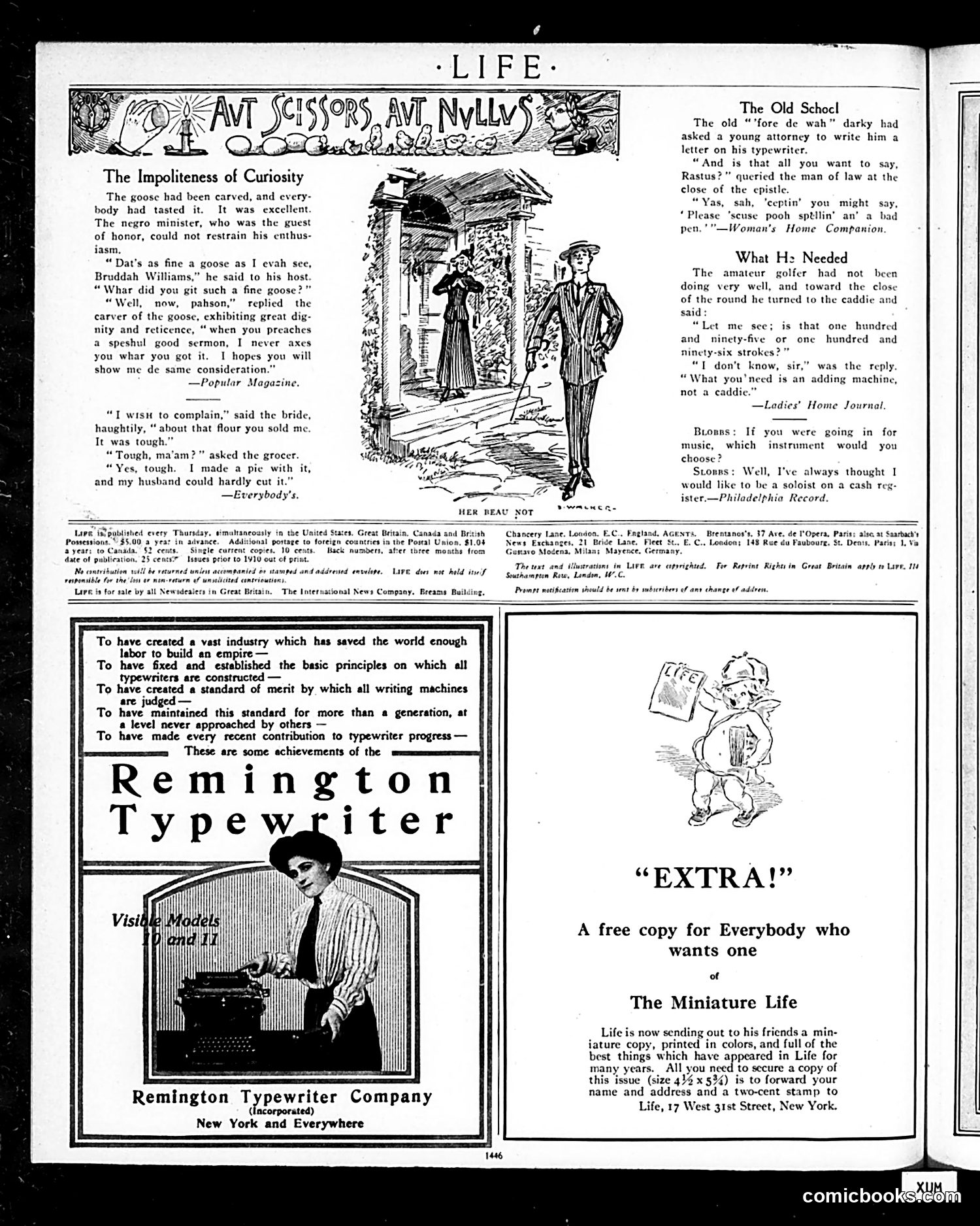
This page contains three brief humorous anecdotes reflecting early 20th-century racial stereotypes and social attitudes. **"The Impoliteness of Curiosity"** depicts a Black minister guest praising a carved goose, then being rebuffed when he asks its source. The host compares the question to asking where the minister gets his sermon ideas—implying the guest should mind his own business. The joke relies on stereotyped dialect ("Dat's," "Bruddah"). **"The Old School"** features a Black man named "Rastus" asking an attorney to type a letter, requesting the addition of "poor spelling" and "bad pen" as if these are desirable features—a crude joke about illiteracy. The remaining items are unrelated anecdotes about grocery shopping and golf. The page also advertises Remington Typewriters and promotes a miniature edition of *Life* magazine itself. These pieces exemplify how mainstream American humor of this era casually incorporated dehumanizing racial caricatures as entertainment.
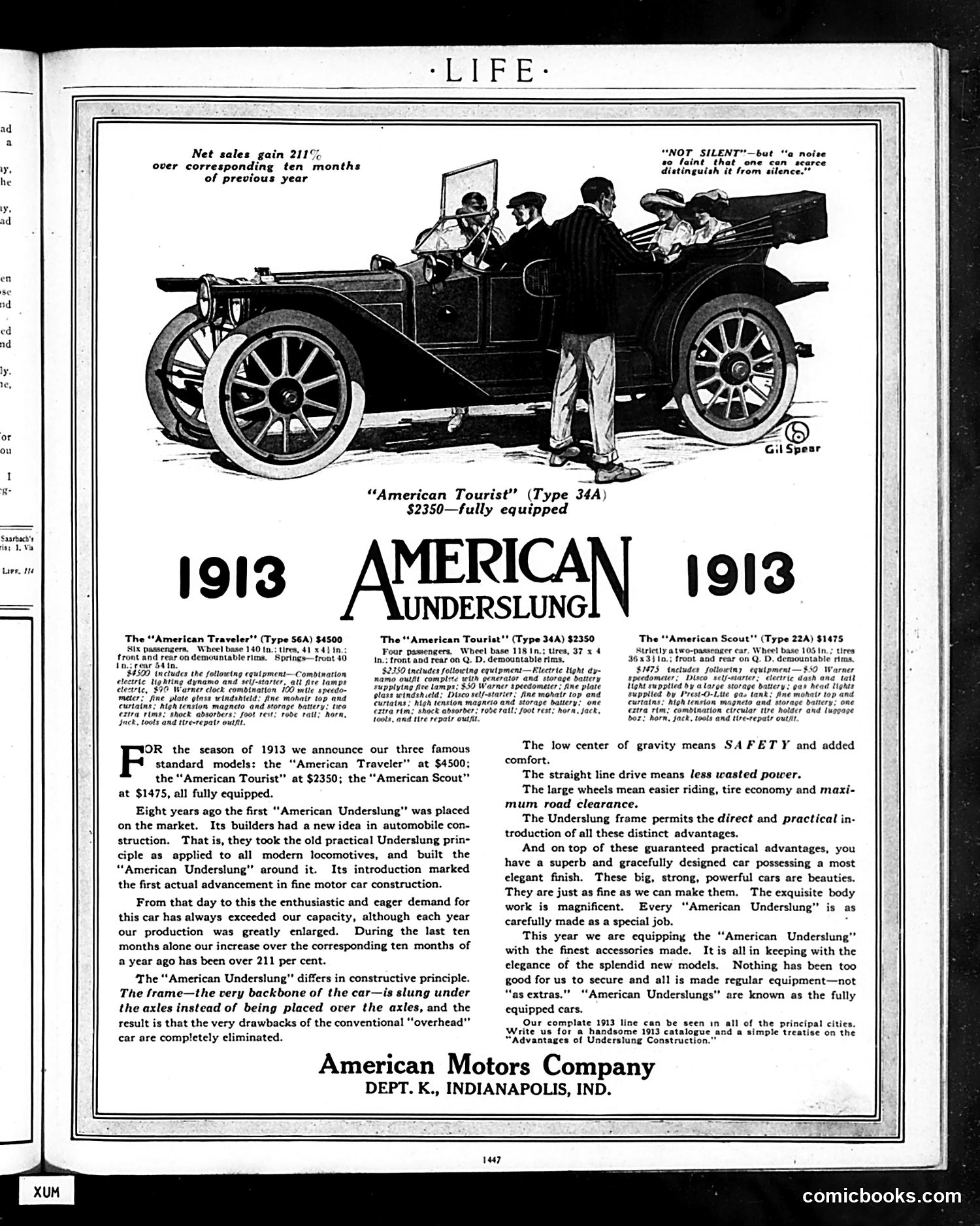
This is primarily **automobile advertising**, not political satire. The page promotes American Motors Company's 1913 car line—three models: the "American Traveler," "Tourist," and "Scout." The illustration shows a well-dressed couple in an early motorcar, with the satirical caption "'NOT SILENT'—but 'a noise so faint that one can scarcely distinguish it from silence.'" This is **humorous advertising copy** praising the car's quiet operation—a selling point for luxury automobiles of that era. The ad emphasizes the "Underslung" frame design (frame mounted *under* rather than over the axles), claiming advantages in safety, comfort, power efficiency, and road clearance. The 211% sales increase demonstrates market success. This reflects early-1900s automotive advertising's focus on technical innovation and refinement as status symbols for affluent buyers. The satire is gentle product promotion, not social commentary.
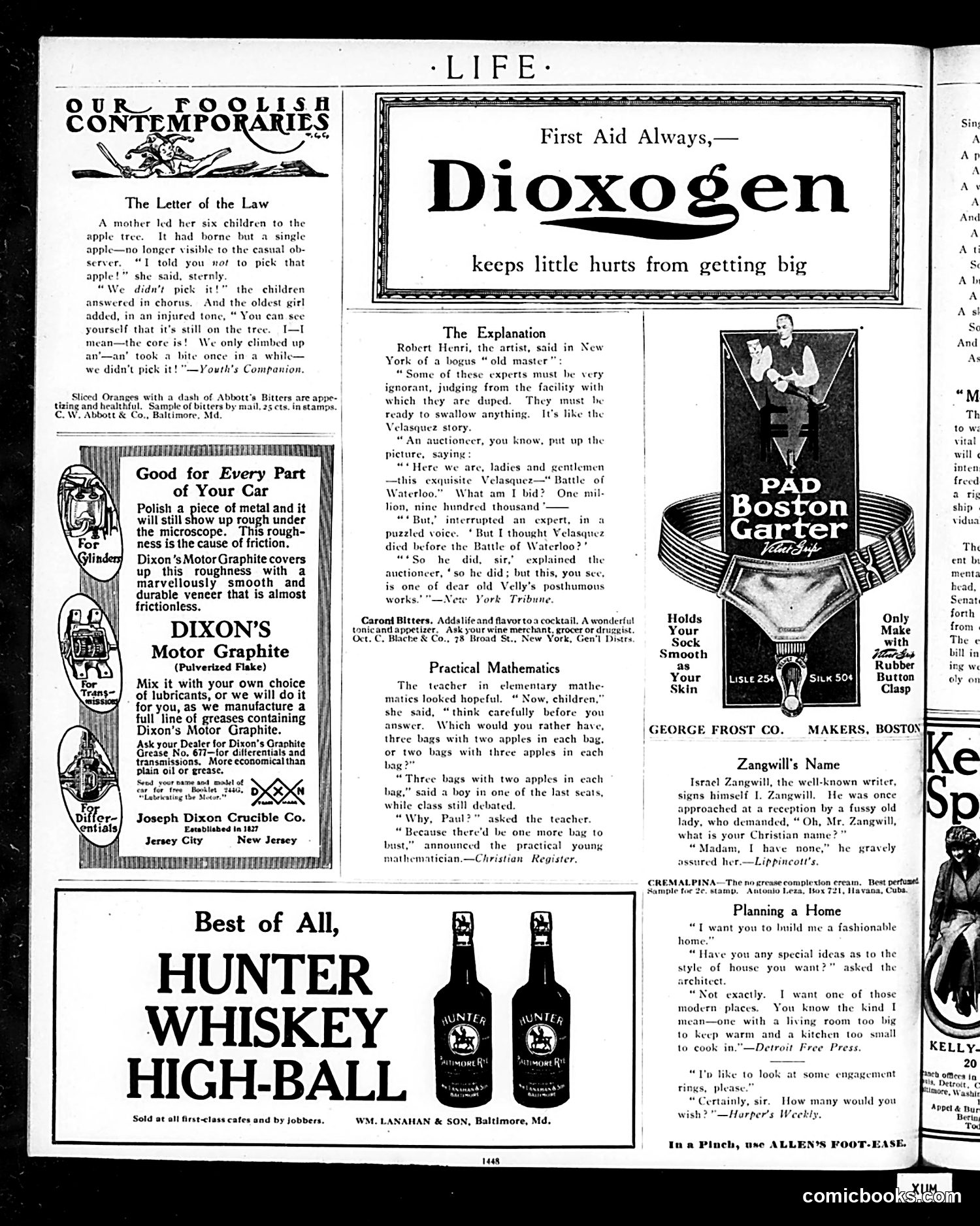
This page from *Life* magazine is primarily **advertising and light humor** rather than political satire. The main content includes: **"The Letter of the Law"** — A children's anecdote mocking sophistry: kids claim they didn't "pick" an apple from a tree, only ate it in place, leaving only the core. The joke satirizes how technically correct statements can obscure the obvious truth. **"The Explanation"** — A satirical anecdote about art authentication. An auctioneer sells a fake "Velasquez" painting; when an expert notes Velasquez died before the depicted Battle of Waterloo, the auctioneer blithely responds it's merely a "posthumous work." This mocks credulous art dealers and experts who accept transparently false attributions without question. **"Practical Mathematics"** — A child chooses three bags with two apples over two bags with three apples because the extra bag means "one more bag to bust"—practicality over math. The remainder is **product advertising** (Dixon's Motor Graphite, Dioxogen, Hunter Whiskey) with scattered brief humor pieces unrelated to current events.
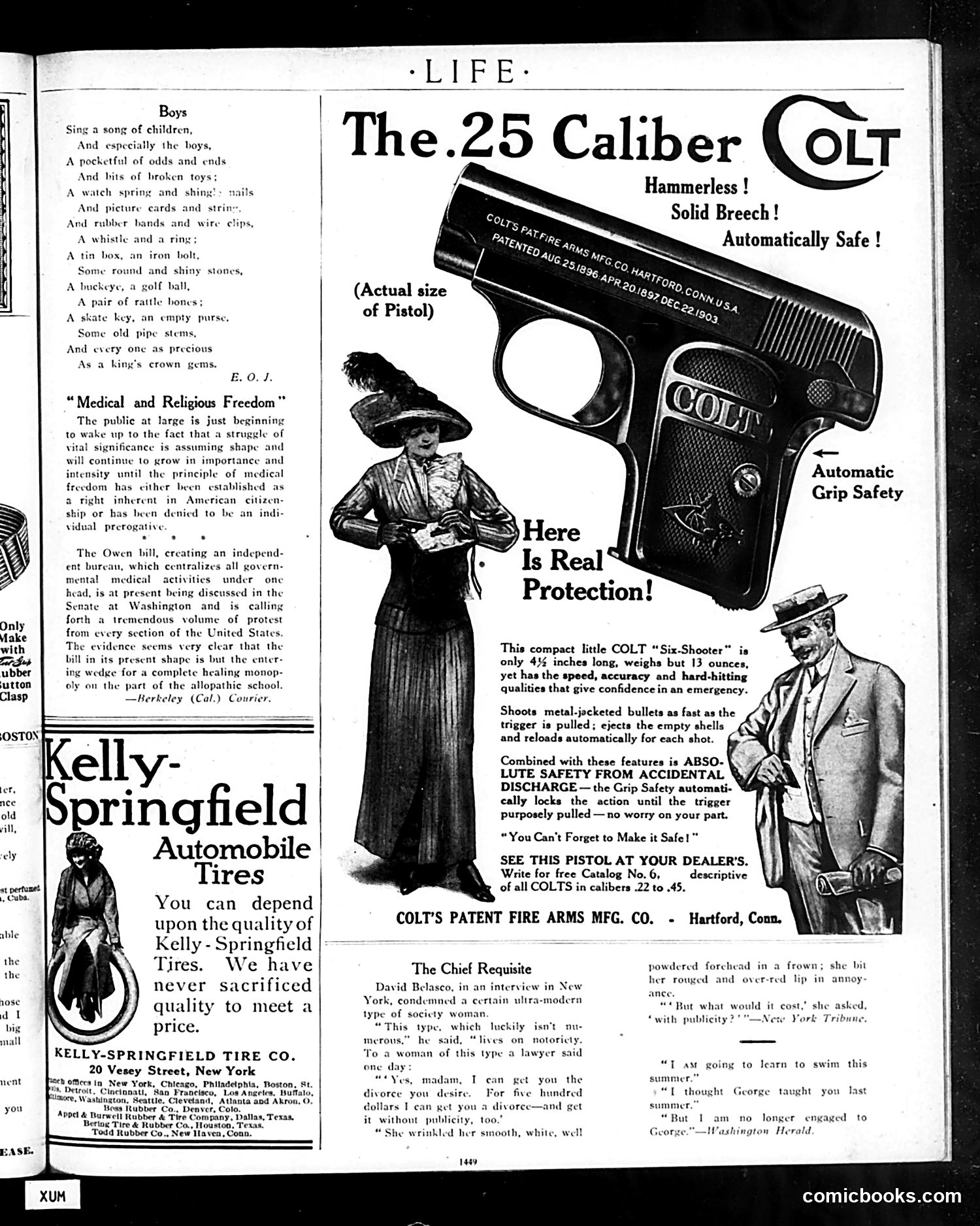
This page mixes poetry, social commentary, and period advertising (circa early 1900s). **The Poetry and Articles:** The opening poem celebrates boys' treasures—humble objects like tin boxes, pipe stems, and skate keys—treating them as precious as "a king's crown gems." This sentimentalizes childhood wonder. The "Medical and Religious Freedom" article argues against a proposed government medical bureau (the Owen bill), warning it would create a monopoly for "allopathic" (conventional) doctors, threatening individual medical choice. **The Advertisements:** The Colt .25 Caliber pistol ad emphasizes "safety"—promoting it as a compact "Six-Shooter" with automatic grip safety and hammerless design for self-defense. The Kelly-Springfield Tire ad assures quality. **"The Chief Requisite":** This anecdote about theater producer David Belasco satirizes a shallow "ultra-modern" society woman obsessed with notoriety. A lawyer offers her a quiet divorce, but she refuses—she wants publicity. The joke: her concern for public image exceeds moral considerations.
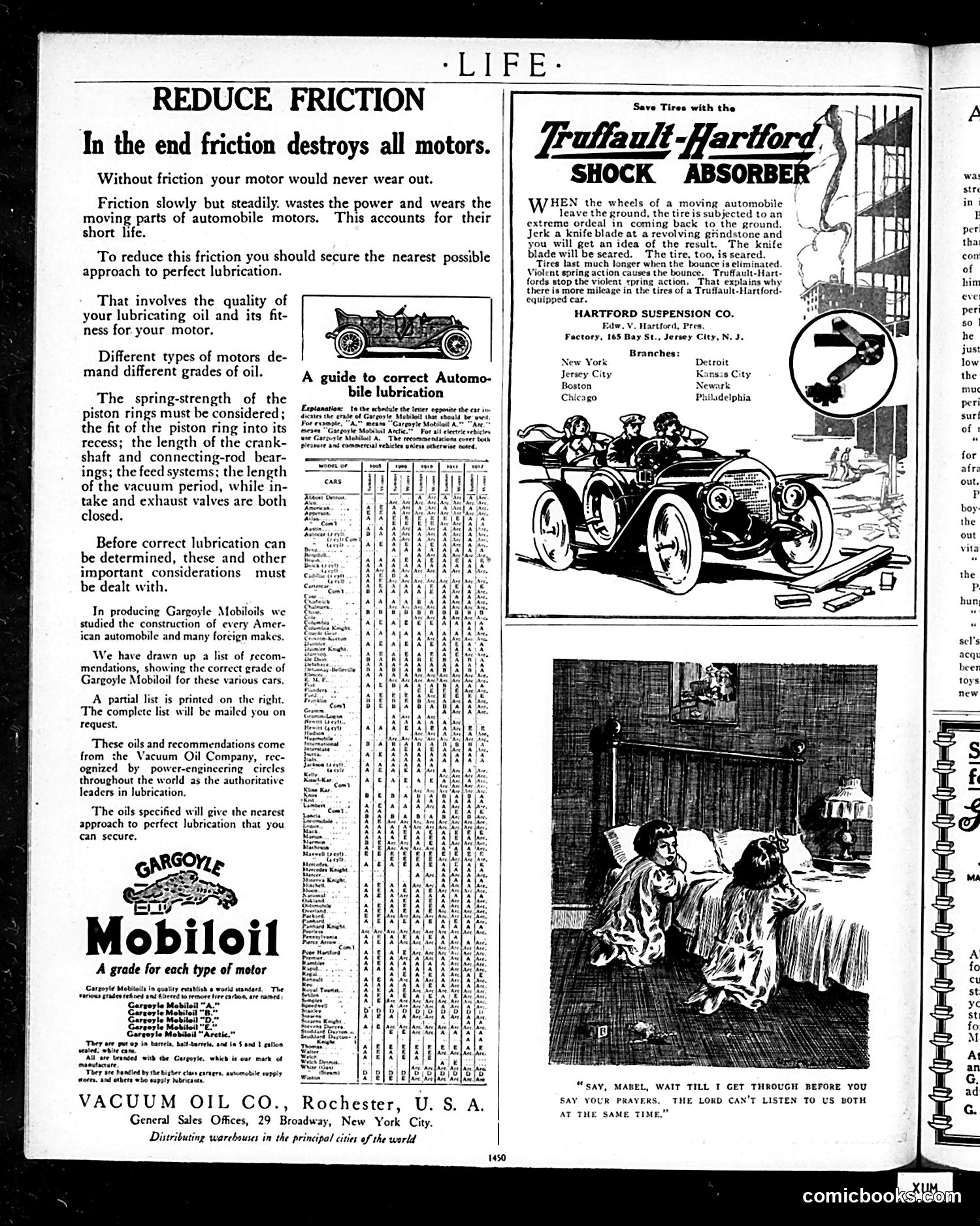
This page is **primarily advertising** for automotive products (Mobiloil lubricant, Truffault-Hartford shock absorbers, Hartford suspension systems) rather than satirical editorial content. The only cartoon appears at the bottom: a domestic scene showing a man and woman in bed. The man asks the woman to delay her prayers until he finishes speaking, joking that "the Lord can't listen to us both at the same time." This is a **mild marital humor joke** playing on 1920s gender dynamics—the assumption that wives pray while husbands talk, and the comedic notion of competing for divine attention. The satire targets neither politics nor social issues, but rather pokes gentle fun at household dynamics and religious practice. It reflects period attitudes about male authority in domestic life, though presented as lighthearted rather than pointed social criticism. The page itself is from an era when *Life* magazine mixed serious advertising with small comic asides.
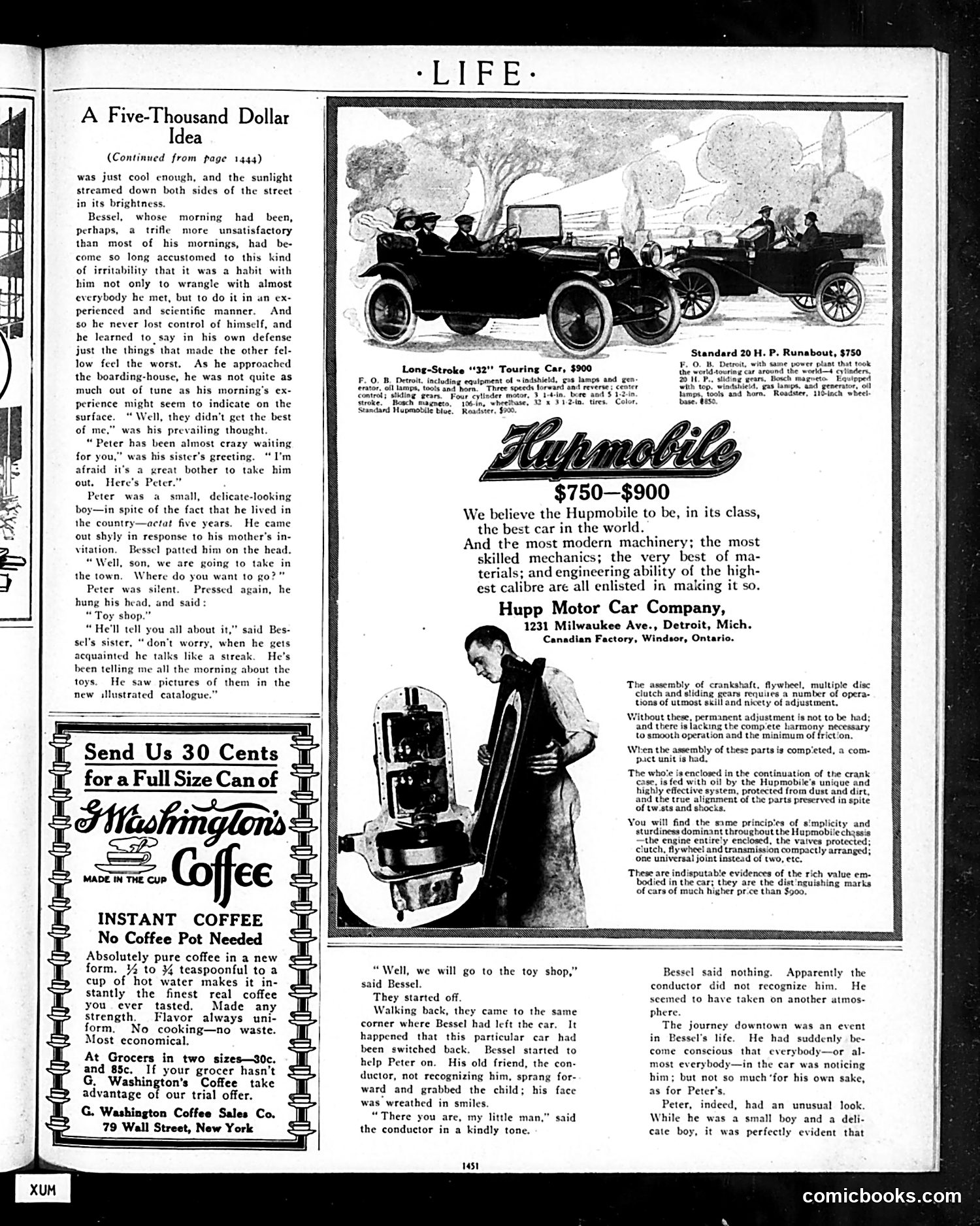
This page contains a serialized short story titled "A Five-Thousand Dollar Idea" about a man named Bessel taking his young nephew Peter to town. The narrative focuses on character dynamics—Bessel is irritable and argumentative by nature, while Peter is a shy five-year-old who wants to visit a toy shop after seeing pictures in a catalog. The page is primarily **advertising**, featuring two automobile ads: a Long-Stroke "32" Touring Car ($900) and a Hupmobile ($750-$900), both emphasizing modern engineering and quality craftsmanship. There's also an ad for G. Washington's instant coffee. **No political satire or cartoon appears on this page.** It's a straightforward mix of serialized fiction and period automobile advertising. The story itself contains no satirical elements—it's a domestic narrative about a man and child. Modern readers would mainly note the quaint depiction of early 1910s automobiles and the casual way children were entertained (toy catalogs).
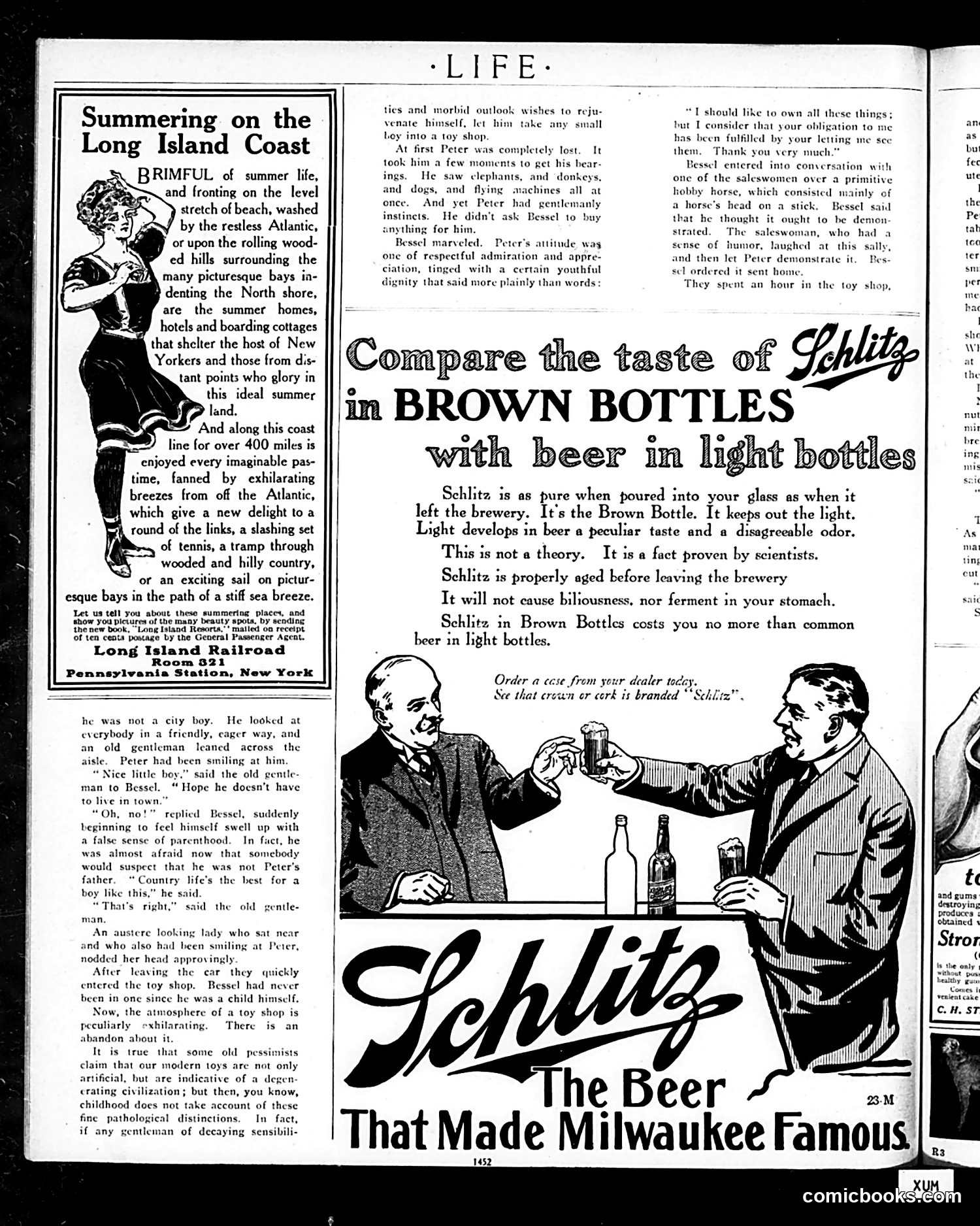
This page combines a fiction story about a man named Bessel visiting a toy shop with his young companion Peter with a major **Schlitz beer advertisement**. The narrative portion (left column and bottom) depicts a sentimental scene: Bessel, initially anxious about appearing as Peter's father to strangers, becomes emotionally invested when others respond approvingly to the "boy." The story illustrates early 20th-century social attitudes about parenthood and respectability—Bessel feels validated by public assumption of paternity. The dominant advertisement (center-right) promotes Schlitz beer in brown bottles versus competitors' light bottles. The copy claims brown glass prevents light exposure that causes bad taste and odor in beer, emphasizing purity and digestive safety. Two men are illustrated comparing bottles. This reflects period advertising strategies: scientific-sounding claims about product superiority and health benefits (claims later regulated). The page represents typical Life magazine content: middlebrow fiction appealing to aspirational readers alongside prominent advertising revenue.
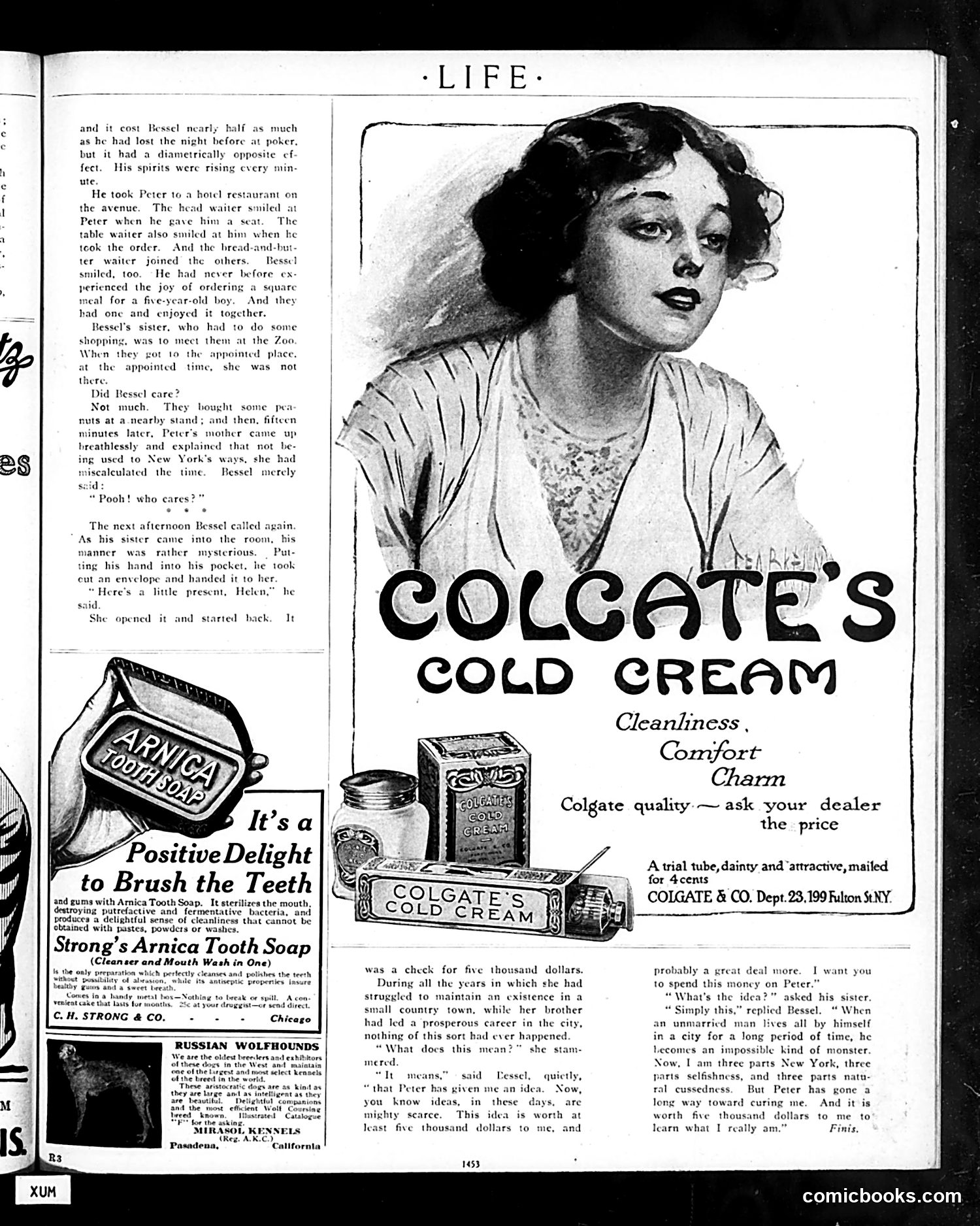
This page presents a serialized story about a man named Bessel who experiences a moral awakening through caring for a young boy named Peter. The narrative depicts Bessel—apparently a wealthy, self-centered bachelor living in New York City—discovering unexpected joy in simple acts of kindness: ordering a meal for the child and later giving Peter's mother (his sister) five thousand dollars. The satire targets the callousness of urban, affluent men of the era. Bessel's realization that Peter has "cured" him of selfishness by revealing his capacity for generosity critiques the isolation and moral emptiness of city life. The story suggests that even hardened cynics can be reformed through human connection and familial responsibility. The page also contains period advertisements (Colgate Cold Cream, Strong's Arnica Tooth Soap, Russian Wolfhounds) typical of Life's content, indicating this is likely early 20th century.
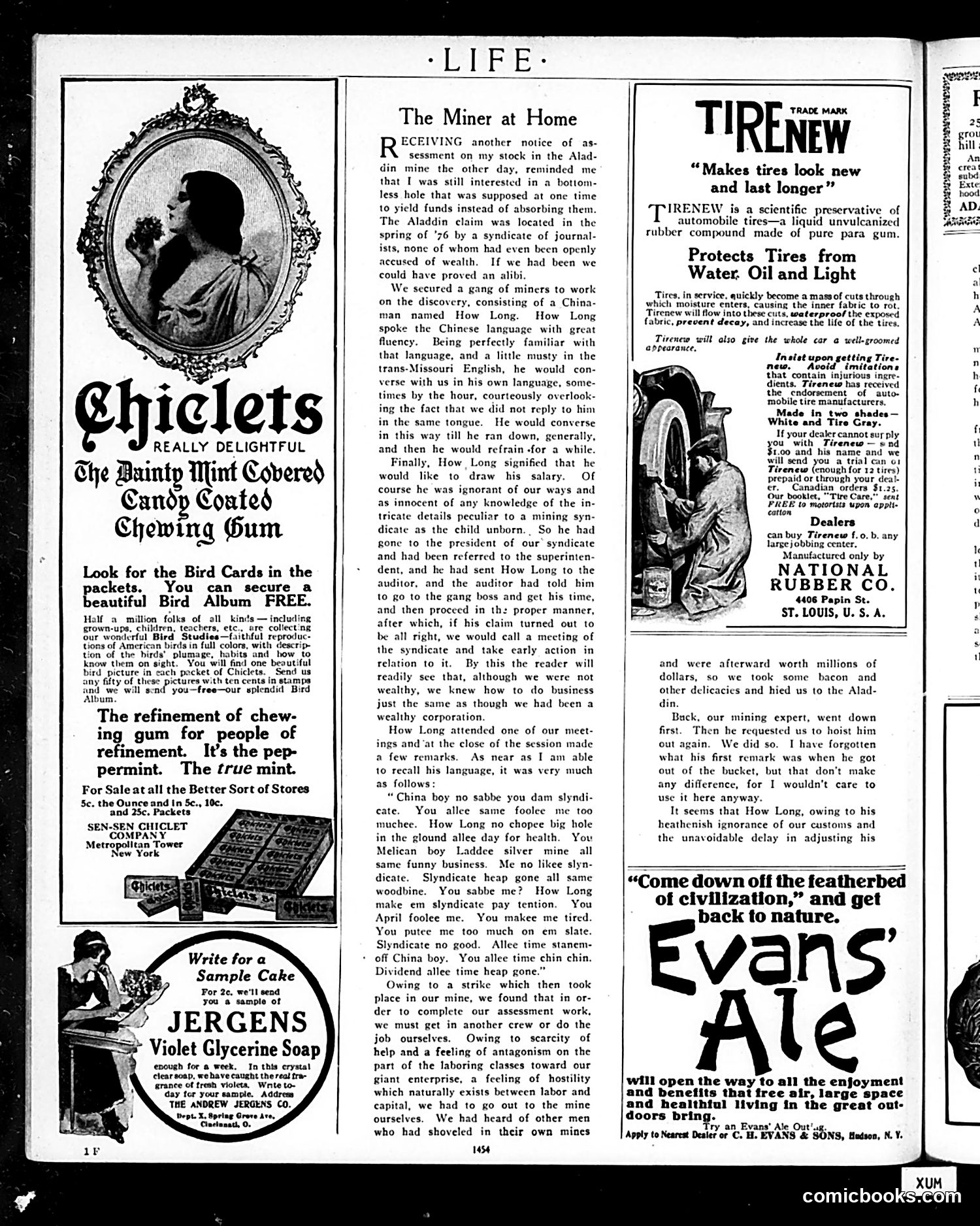
This page primarily contains a humorous narrative essay rather than a political cartoon. The story mocks American mining syndicates and their business practices through the experience of Chinese laborer "How Long." The satire targets wealthy speculators who formed mining ventures (here, the "Aladdin mine" of 1876) while knowing little about actual mining. How Long, a Chinese worker, becomes the unwitting victim of bureaucratic runaround—passed between president, superintendent, auditor, and gang boss—when seeking his wages. The humor culminates in How Long's fractured-English monologue, which, despite its comedic dialect writing, conveys legitimate frustration: the syndicate exploits workers, pays nothing, and treats Chinese laborers with contempt ("allee time chin chin"—stereotyping Chinese speech). The satire reveals period attitudes: while mocking American business incompetence, the text simultaneously employs racist caricature of Chinese workers. The "joke" relies on both critique of corporate malfeasance *and* ethnic mockery—typical of 1910s Life magazine.
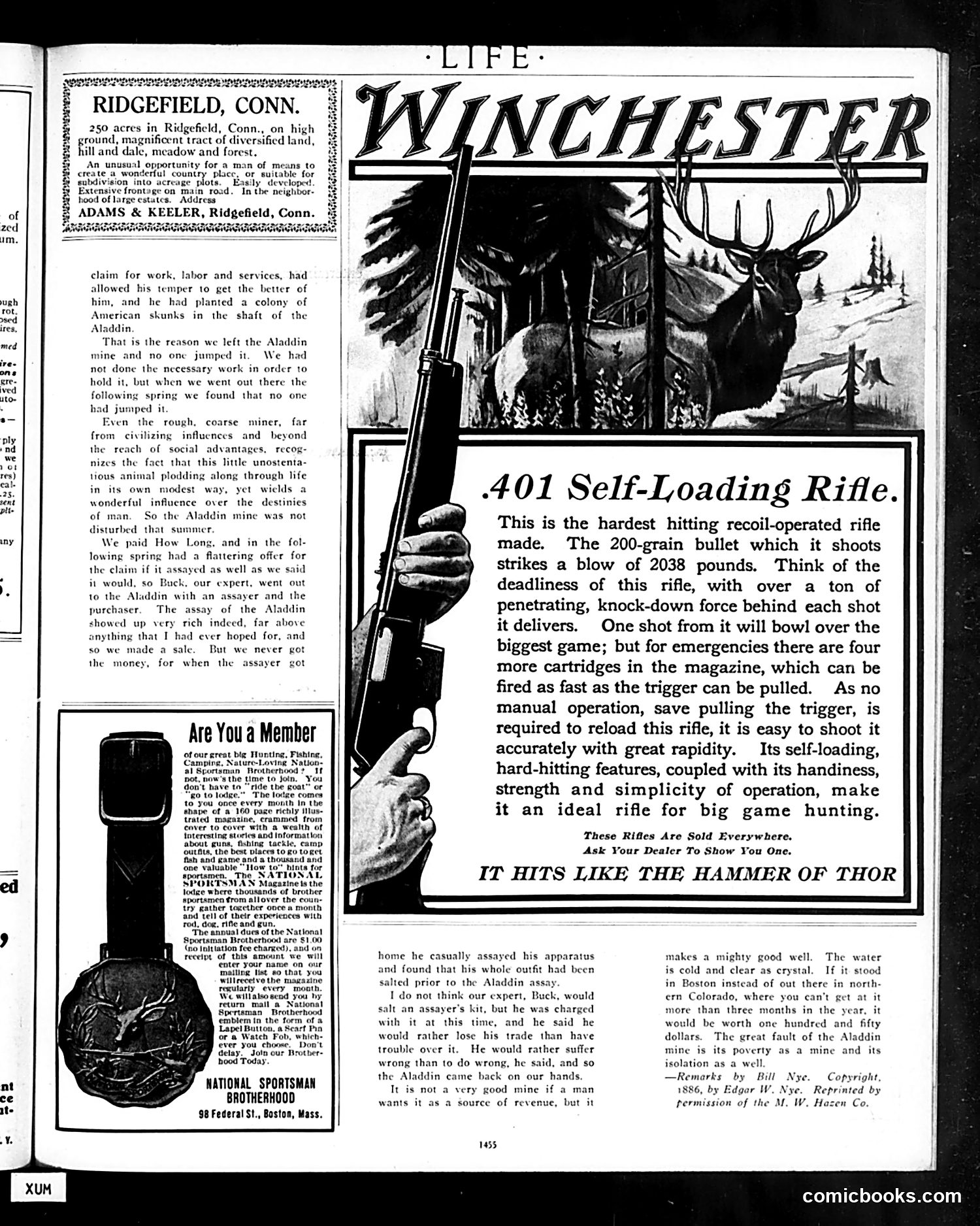
This page is primarily **advertising content** rather than political satire. It contains: 1. **Real estate ad** (top left): Property in Ridgefield, Connecticut for sale 2. **Winchester rifle advertisement** (center/right): The dominant feature, promoting the Model 401 Self-Loading Rifle with dramatic hunting imagery and hyperbolic language ("hits like the hammer of Thor") 3. **Membership ad** (bottom left): The National Sportsman Brotherhood magazine recruitment The editorial text discusses **mining claims and business disputes**—specifically a story about an Aladdin mine where someone planted skunks in the shaft to discourage claim-jumpers, and later accusations of "salting" (fraudulently adding valuable ore to fool assayers). **For modern readers:** This is a snapshot of early 20th-century American consumer culture targeting affluent hunters and outdoorsmen, mixing lifestyle advertising with adventure narratives. The page reflects period assumptions about masculinity, hunting, and business ethics rather than containing political commentary or satire.
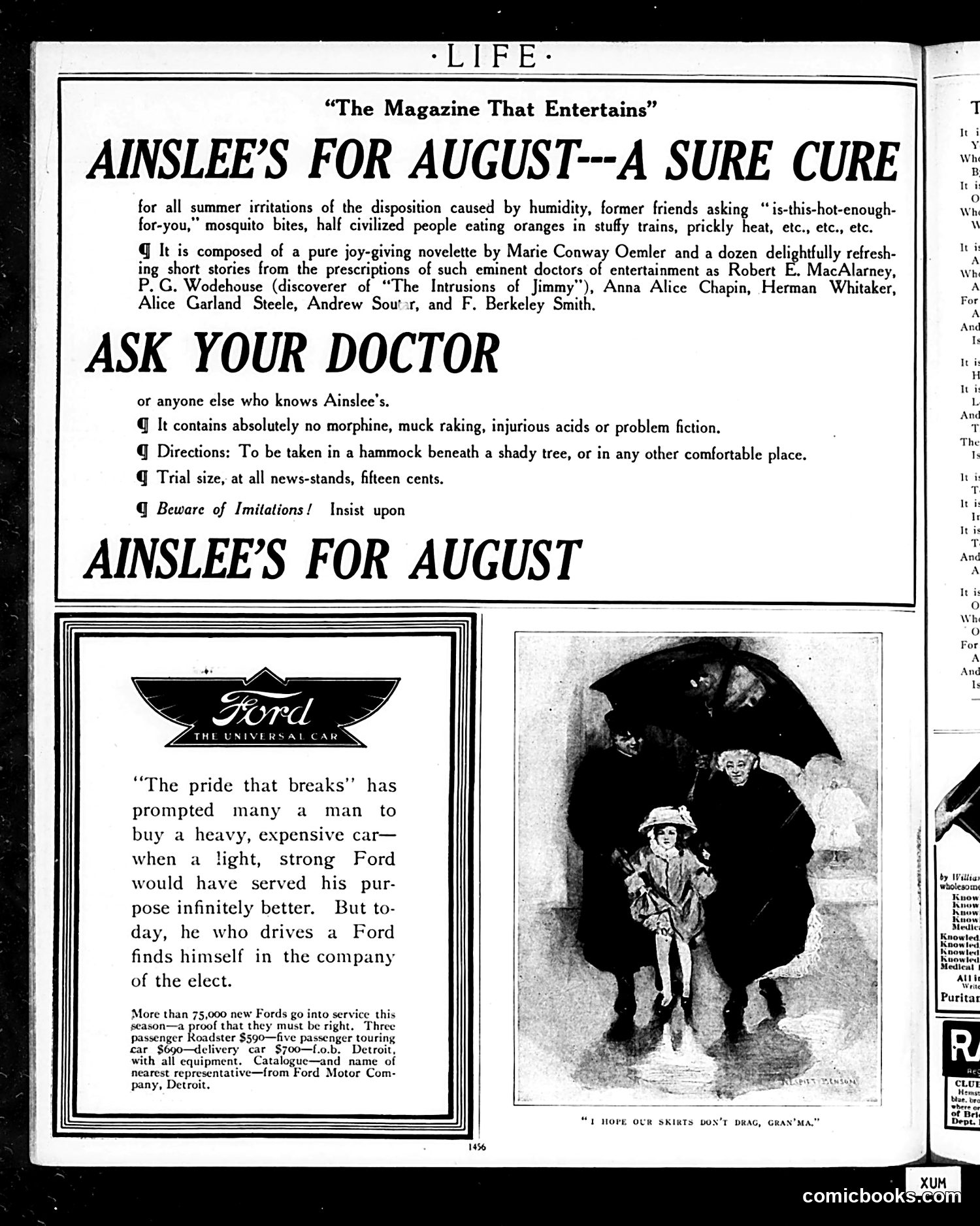
This page consists primarily of **advertisements**, not editorial content or political satire. The top third advertises **Ainslee's Magazine** for August, humorously framing it as a "cure" for summer irritations—humidity, mosquito bites, stuffy train travel, "prickly heat." The ad satirizes summer complaints in a lighthearted way, listing contributing authors like P.G. Wodehouse. It mimics pharmaceutical advertising language ("ask your doctor," "beware of imitations"), joking that the magazine contains "no morphine...or problem fiction"—a reference to the era's concerns about drug-laced patent medicines and muckraking journalism. Below is a **Ford Motor Company advertisement** promoting the Model T as an economical alternative to expensive automobiles, emphasizing that Ford ownership represents modern practicality rather than wasteful extravagance. The right side shows a photograph with caption **"I hope our skirts don't drag, gran'ma,"** depicting what appears to be a woman and child under an umbrella—likely illustrating changing fashion (shorter skirts) between generations. This is primarily **commercial content**, not political commentary.
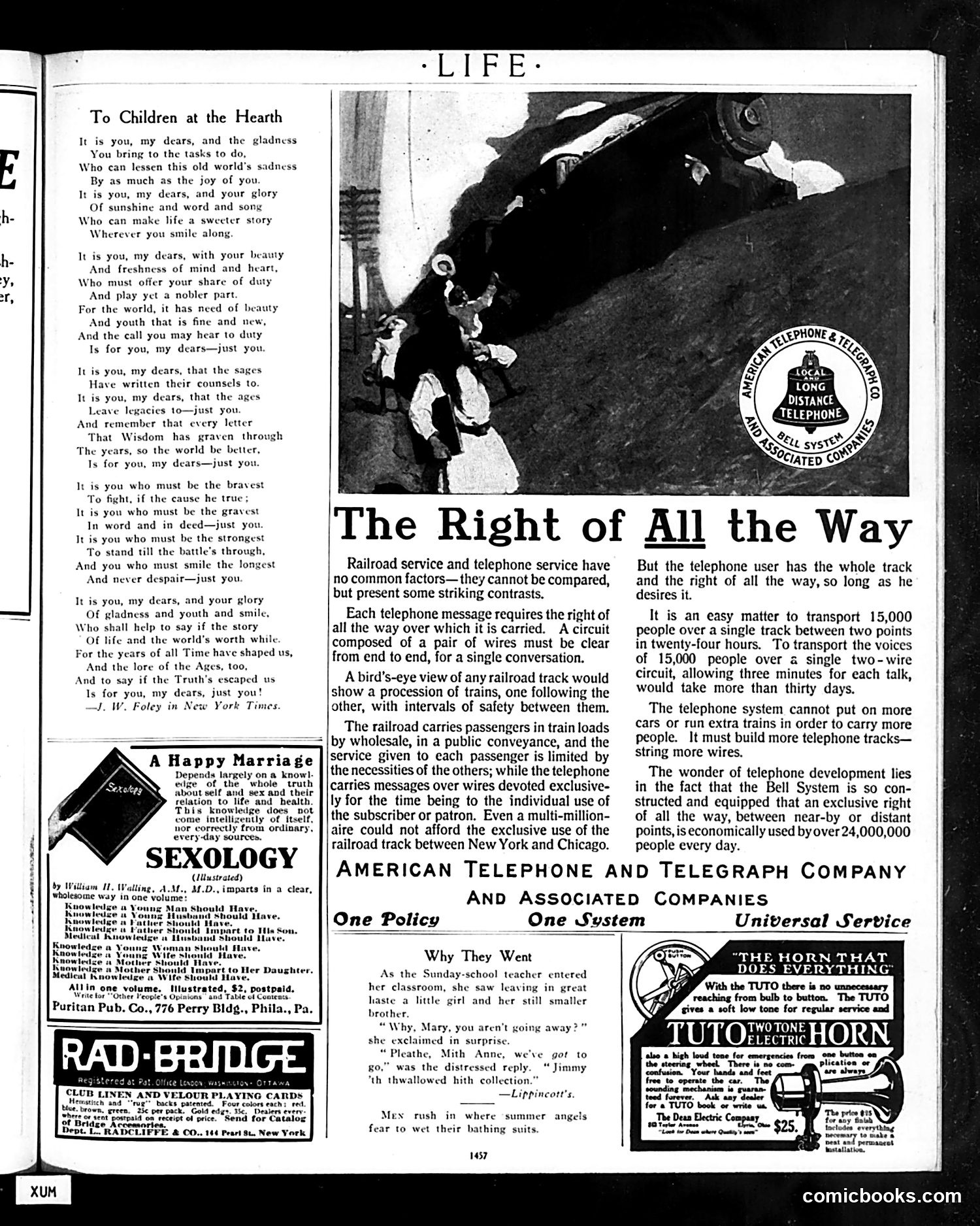
This page is primarily **advertising and corporate messaging**, not satire. The main content is a lengthy advertisement from American Telephone and Telegraph (AT&T), comparing railroad and telephone infrastructure. The argument: railroads share tracks among many trains with safety gaps between them, but telephone calls require *exclusive* wire access for the entire duration. Therefore, while railroads can move 15,000 people daily on one track, moving 15,000 voices over two wires would take thirty days. AT&T's pitch is that their "Bell System" justifies massive infrastructure investment because 24 million people daily need exclusive "right of way" over telephone lines. The framing—comparing their service to railroads—was designed to justify why telephone monopoly was economically necessary and efficient, a regulatory argument AT&T made in the early 20th century. Other page content includes sentimental poetry about children's duties and advertisements for books on sexuality and bridge games.
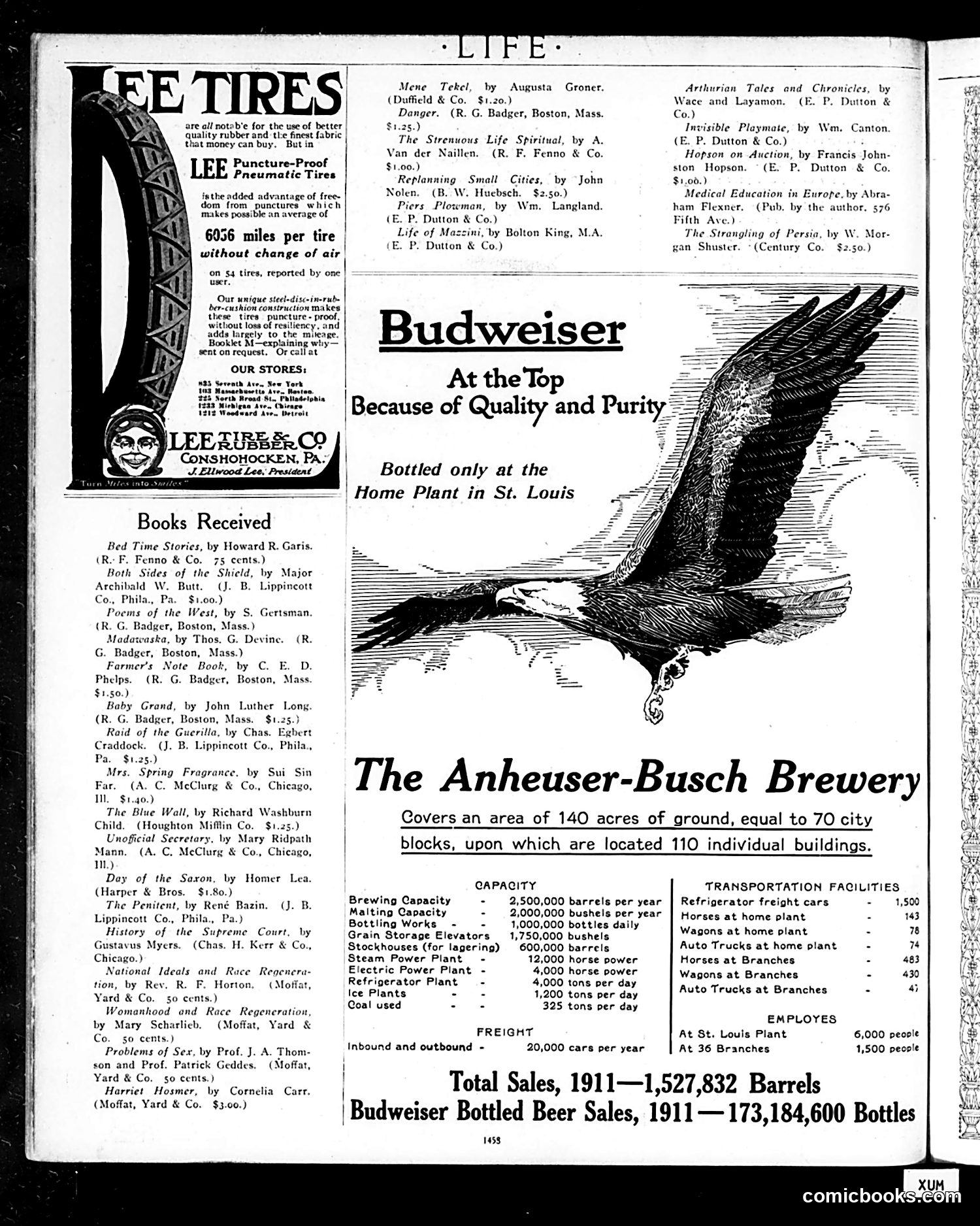
This page is primarily **advertising and book listings** from Life magazine (circa 1912, based on the 1911 sales figures). There are no political cartoons or satirical illustrations requiring historical interpretation. The page contains: 1. **Lee Tire advertisement** (left): Promoting puncture-proof pneumatic tires with 6,056 miles per tire without air changes—a practical industrial sales pitch. 2. **Budweiser advertisement** (center-right): Features an eagle illustration and emphasizes the beer's "Quality and Purity," bottled exclusively at the St. Louis home plant. The detailed capacity statistics (2.5 million barrels annually, 173+ million bottles sold in 1911) showcase industrial scale and corporate pride. 3. **Books Received** (left column): A standard literary listings section covering various 1912 publications. The Budweiser ad is notable primarily as a **pre-Prohibition artifact**—beer advertising was routine and celebrated corporate achievement before alcohol became illegal (1920). The eagle symbolism emphasizes American patriotism and quality.
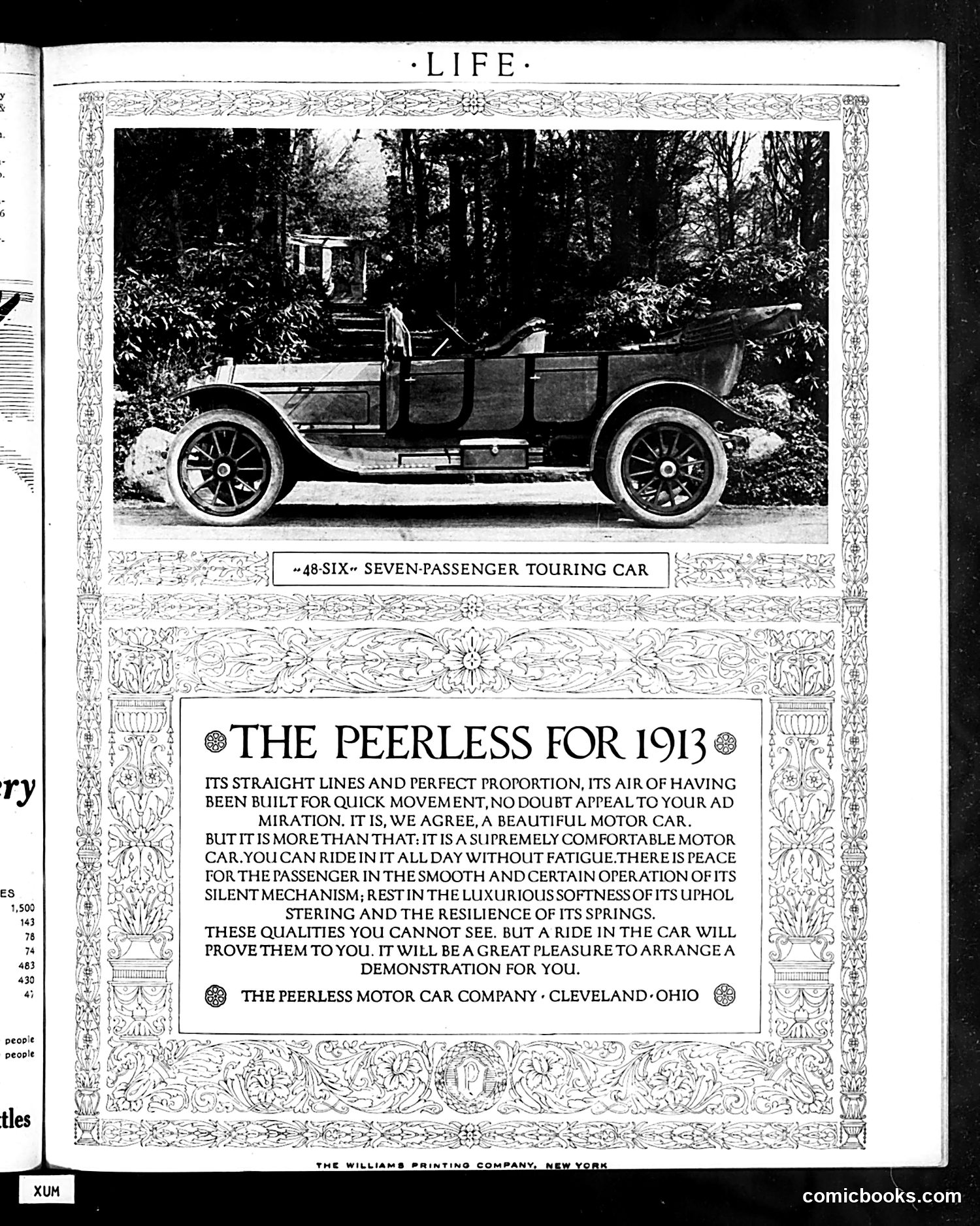
This page is primarily an **advertisement**, not political satire. It features a photograph of the 1913 Peerless "48-Six" seven-passenger touring car, shown in side profile against a wooded background. The ad's text emphasizes the vehicle's visual appeal ("straight lines and perfect proportion") while arguing that true quality lies in invisible features: smooth operation, comfortable seating, soft upholstery, and spring resilience. It concludes with an invitation for a test drive demonstration. There is no cartoon, caricature, or political commentary present. This is a straightforward luxury automobile advertisement using the rhetorical strategy of contrasting superficial aesthetics with substantive engineering and comfort—a common sales approach for high-end vehicles of the era aimed at affluent buyers.
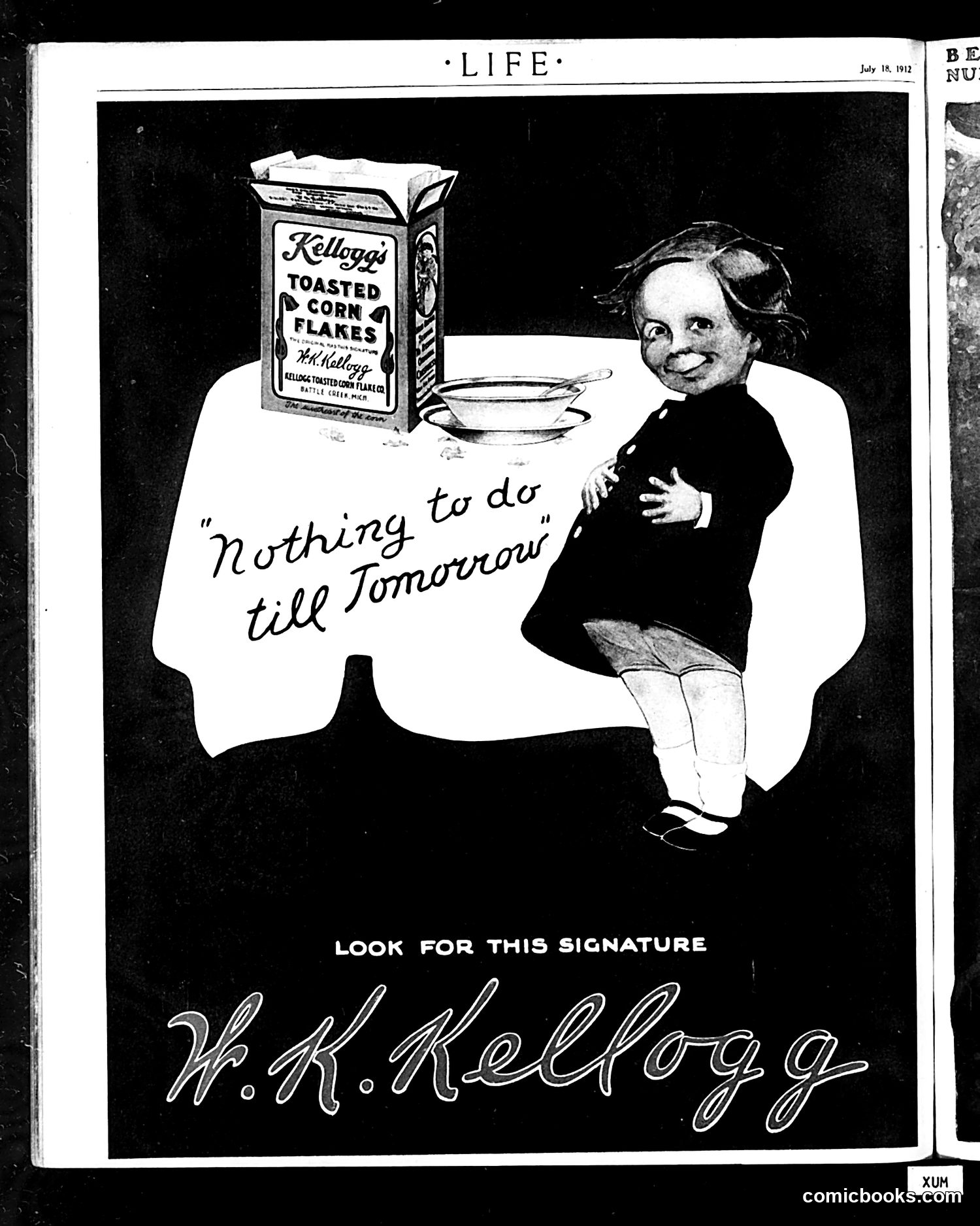
This is a Kellogg's Toasted Corn Flakes advertisement from Life magazine (July 18, 1912). It features a young child at a breakfast table with a box of the cereal and a bowl, with the slogan "Nothing to do till Tomorrow" in a speech bubble. The ad uses the child as an endorsement vehicle—a common advertising strategy of the era. The phrase suggests the cereal is so satisfying and nourishing that the child has no pressing concerns. The prominent signature "W.K. Kellogg" at the bottom emphasizes brand authenticity and the founder's personal endorsement, a marketing technique meant to build consumer trust during an era when branded foods were still relatively novel. This reflects early 20th-century advertising conventions: using innocent childhood imagery and founder endorsements to sell mass-produced breakfast products.