
Life, 1912-07-18 · page 24 of 44
Life — July 18, 1912 — page 24: what you’re looking at
What you’re looking at
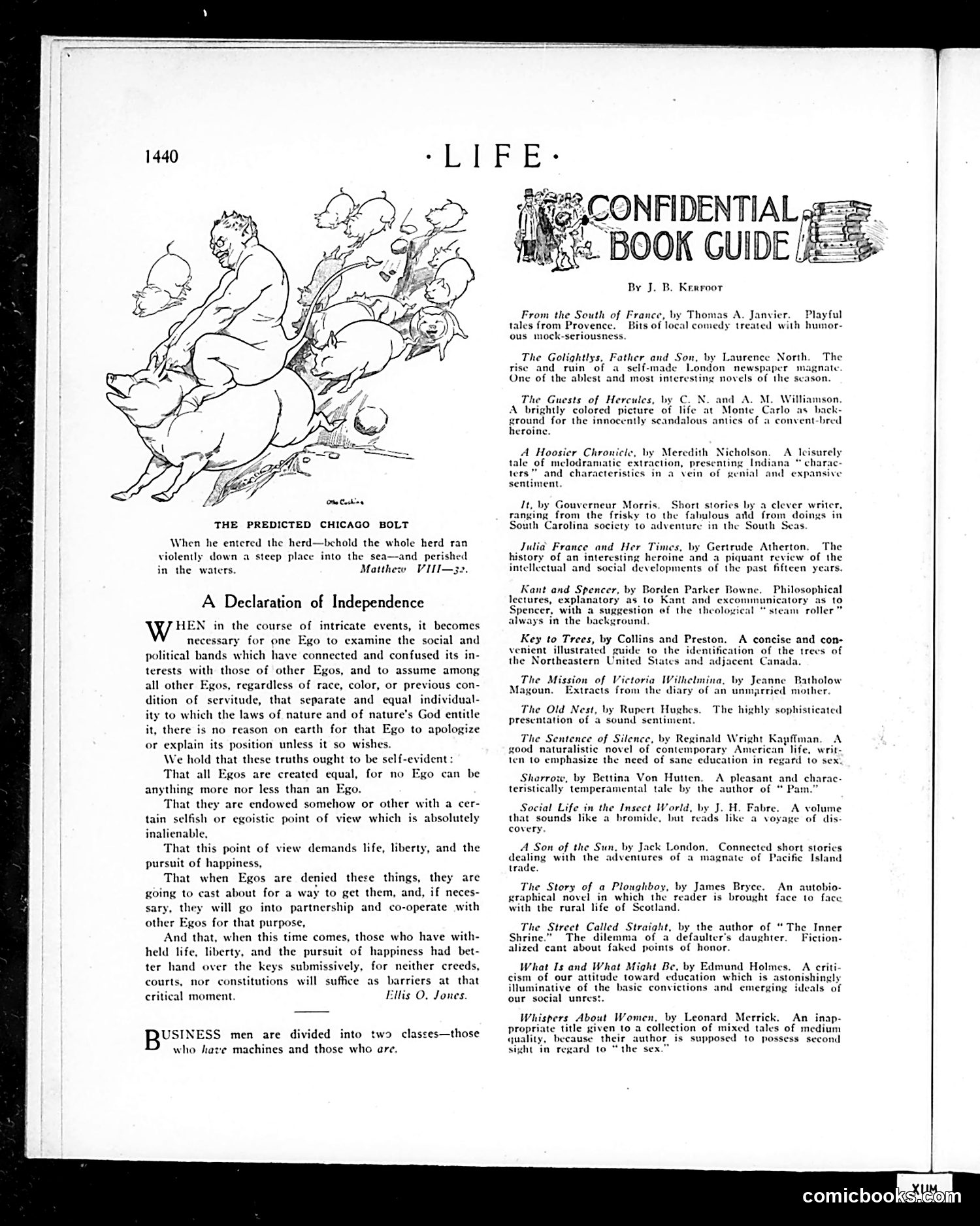
This cartoon satirizes the 1896 presidential election and William Jennings Bryan's "Cross of Gold" speech. The image shows pigs stampeding violently off a cliff into the sea—a visual pun on the biblical Matthew 8:32 reference about demons entering a herd of swine. The "Chicago bolt" likely refers to Bryan's dramatic nomination at the Democratic Convention in Chicago, which electrified and divided the nation. The stampeding pigs represent voters or the electorate responding to Bryan's populist, free-silver platform with irrational panic. The cartoon suggests Bryan's rhetoric caused mass hysteria among businessmen and the conservative establishment who feared his economic policies would destroy prosperity. The accompanying text by Ellis O. Jones parodies the Declaration of Independence, applying Enlightenment ideals to modern "Egos" pursuing happiness and liberty—possibly mocking Bryan's populist appeals to common people against established power. The magazine positions itself against Bryan's movement.
📄 Transcribed text from this page (OCR, searchable)
Machine-transcribed from the original scan — historical spelling and the odd misread are preserved.
Om Coking THE PREDICTED CHICAGO BOLT When he entered the herd—bchold the whole herd ran violently down a steep place into the sea—and perished in the waters. Matthew VIII—3 A Declaration of Independence HEN in the course of intricate events, it becomes necessary for one Ego to examine the social and political bands which have connected and confused its in- terests with those of other Egos, and to assume among all other Egos, regardless of race, color, or previous con- dition of servitude, that separate and equal individual- ity to which the laws of nature and of nature's God entitle it, there is no reason on earth for that Ego to apologize or explain its position unless it so wishes. We hold that these truths ought to be self-evident: That all Egos are created equal, for no Ego can be anything more nor less than an Ego. That they are endowed somehow or other with a cer- tain selfish or egoistic point of view which is absolutely inalienable, That this point of view demands life, liberty, and the pursuit of happiness, That when Egos are denied these things, they are going to cast about for a way to get them, and, if neces- sary, they will go into partnership and co-operate with other Egos for that purpose, And that, when this time comes, those who have with- held life, liberty, and the pursuit of happiness had bet- ly, for neither creeds, ter hand over the keys submissi courts, nor constitutions will suffice as barriers at that critical moment. Ellis O, Jones. B INESS men are divided into two classes—those who have machines and those who are. By J. B. Kerroor From the South of France, by Thomas A. J Playful tales from Provence. Bits of local comedy treated with humo: ous mock-seriousness. The Golightlys, Father and Son, by Laurence North. The rise and ruin of a self-made London newspaper magnate One of the ablest and most interesting novels of the season. The Guests of Hercules, by C. and A. M. Williamson, A brightly colored picture of life at Monte Carlo as bac! ground for the innocently scandalous antics of a convent-bre heroine. A Hoosier Chronicie, by Meredith Nicholson. A Icisurely tale of melodramatic extraction, presenting Indiana “ chara ters” and characteristics in a vein of genial and expansive sentiment It, by Gouverneur Morris. Short stories by a clever writer, ranging from the frisky to the fabulous aid from doings in South Carolina society to adventure in the South Seas Julia France and Her Times, by Gertrude Atherton, ‘The history of an interesting heroine and a piquant review of the intellectual and social developments of the past fifteen years. Kant and Spencer, by Borden Parker Bowne. Philosophical lectures, explanatory as to Kant and excommunicatory as to Spencer, with a suggestion @f the theological “ steam roller” always in the background Key to Trees, by Collins and Preston. A concise and con- venient illustrated guide to the identification of the trees of the Northeastern United States and adjacent Canada. The Mission of Victoria Wilhelmina, by Jeanne Batholow Magoun. Extracts from the diary of an unmarried mother. The Old Nest, by Rupert Hughes. The highly sophisticated presentation of a sound sentimen The Sentence of Silence, by Reginald Wright Kapfiman. A good naturalistic novel of contemporary American life, wri ten to emphasize the need of sane education in regard to s by Bettina Von Hutten. A pleasant and charac- Hy temperamental tale by the author of “* Pam.” Social Life in the Insect World, by J. H. Fabre. A volume that sounds like a bromide, but reads like a voyage of dis- covery. A Son of the Sun, by Jack London, Connected short storics dealing with the adventures of a magnate of Pacific Island trade. Sharri terist The Story of a Ploughboy, by James Bryce. An autobio- graphical novel in which the reader is brought face to face with the rural life of Scotland. The Street Called Straight, by the author of “ The Inner Shrine.” The dilemma of a defaulter's daughter. Fiction- alized cant about faked points of honor. What Is and What Might Be, by Edmund Holme: A criti- cism of our attitude toward education which is astonishingly iluminative of the basic convictions and emerging ideals of our social unrest. Whispers About Women, by Leonard Merrick. An inap- propriate title given to a collection of mixed tales of medium quality, because their author is supposed to possess second sight in regard to “the sex.” comicboo!