
Life, 1912-07-18 · page 36 of 44
Life — July 18, 1912 — page 36: what you’re looking at
What you’re looking at
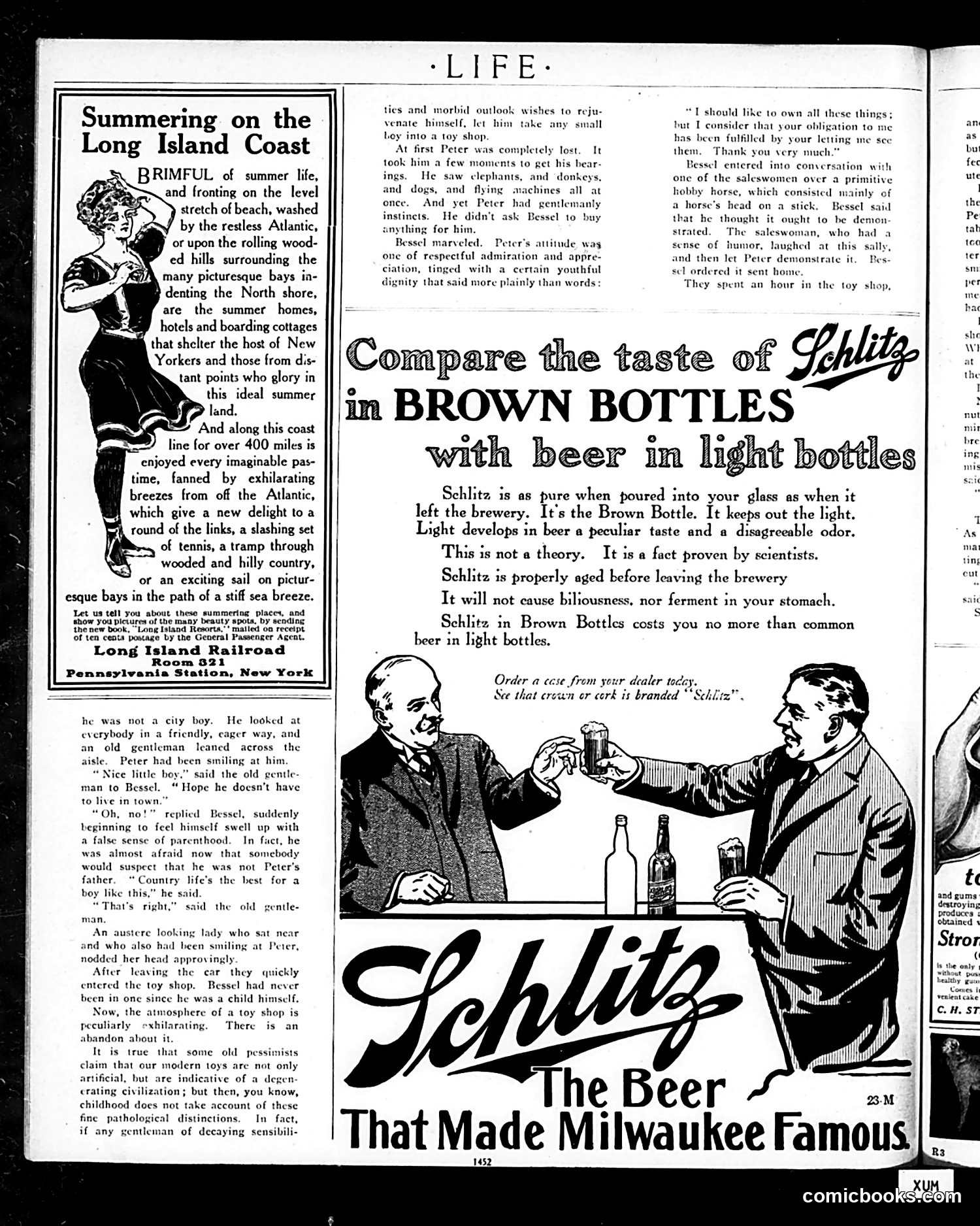
This page combines a fiction story about a man named Bessel visiting a toy shop with his young companion Peter with a major **Schlitz beer advertisement**. The narrative portion (left column and bottom) depicts a sentimental scene: Bessel, initially anxious about appearing as Peter's father to strangers, becomes emotionally invested when others respond approvingly to the "boy." The story illustrates early 20th-century social attitudes about parenthood and respectability—Bessel feels validated by public assumption of paternity. The dominant advertisement (center-right) promotes Schlitz beer in brown bottles versus competitors' light bottles. The copy claims brown glass prevents light exposure that causes bad taste and odor in beer, emphasizing purity and digestive safety. Two men are illustrated comparing bottles. This reflects period advertising strategies: scientific-sounding claims about product superiority and health benefits (claims later regulated). The page represents typical Life magazine content: middlebrow fiction appealing to aspirational readers alongside prominent advertising revenue.
📄 Transcribed text from this page (OCR, searchable)
Machine-transcribed from the original scan — historical spelling and the odd misread are preserved.
ties and m S10 reju- “LT should like to own all these things; A Summering on the venate himself, let him take any. small but I consider that your obligation to me Loy into a toy shop has been fulfilled by your letting me sce Long Island Coast At first Peter was completely lost them. Thank you very much.” took him a few moments to get his hear- Bessel entered into conversation with BRIMFUL of summer life, ings. He saw clephants, and donkeys, one of the saleswomen over a primitive and fronting on the level and dogs ia flying 4 shies all at hobby horse, which consisted mainly of once. And yet Peter h: emanly a horse’s head on a stick. Bessel said stretch of beach, washed instinets. He didn't ask Bessel to buy that he thought it ought to be demon. by the restless Atlantic, anything for him. strated. The saleswoman, who had a or upon the rolling wood- Bessel marveled. Peter's attitude was sense of humor, laughed at this sally, ed hills surrounding the one of respectful admiration and appre- and then let Peter demonstrate it. Bes- z 5 ciation, tinged with a certain youthful sel ordered it sent home. many picturesque bays in- dignity that said more plainly than words: They spent an hour in the toy shop, denting the North shore, are the summer homes, hotels and boarding cottages Void boctend> ||Compare the taste of os tant points who glory in ia“ im BROWN BOTTLES My And along ahs cone ° ° ° line f 400 miles i ie ida rr with beer in light bottles time, fanned by exhilarating breezes from off the Atlantic, Schlitz is as pure when poured into your glass as when it which give a new delight to a left the brewery. It's the Brown Bottle. It keeps out the light. jet 4) round of the links, a slashing set Light develops in beer a peculiar taste and a disagreeable odor. l i of tennis, a tramp through ora wooded and hilly country, of an exciting sail on pictur- esque bays in the path of a stiff sea breeze. Té will notcause Biliousness; nor férment Sh yourstonuch, Let us tell you about these summering places, and show you pictures of the many beauty spots, by sending itz 2: . 5 Rotce book “hoog Inland Ienorea’ matted co receipe Schlitz in Brown Bottles costs you no more than common of ten cents postage by the General Passenger Agent. beer in light bottles. Long Island Railroad * Room 821 Pennsylvania Station, New York This is not a theory. It is a fact proven by scientists. Schlitz is properly aged before leaving the brewery Order a case from your dealer toda See that crown or cork is branded “Schlitz. he was not a city boy. He looked at everybody in a friendly, eager way, and an old gentleman leaned across the aisle. Peter had been smiling at him. Nice little boy.” said the old gentle- man to Bessel. “Hope he doesn’t have to live in town.” “Oh, no!” replied Bessel, suddenly beginning to feel himself swell up with a false sense of parenthood. In fuct, he was almost afraid now that somebody | H would suspect that he was not Peter's 3 ; ( | father. “Country life's the best for a i, te id destroyi: said the old gentle- i ) produce: obtained « An austere looking lady who sat near u and who also had been smiling at Peter, @ Stror nodded her head approvingly ( After leaving the car they quickly he : entered the toy shop. Bessel had never ‘) Con been in one since he was a child himself. atl” pets Now, the atmosphere of a toy shop is C,H. ST peculiarly oxhilarating. There isan | abandon about it. / It is true that some old pessimists f claim that our modern toys are not only : artificial, but are indicative of a degen- ‘ childhood does not take account of these r comicboohneel