
Life, 1912-07-18 · page 41 of 44
Life — July 18, 1912 — page 41: what you’re looking at
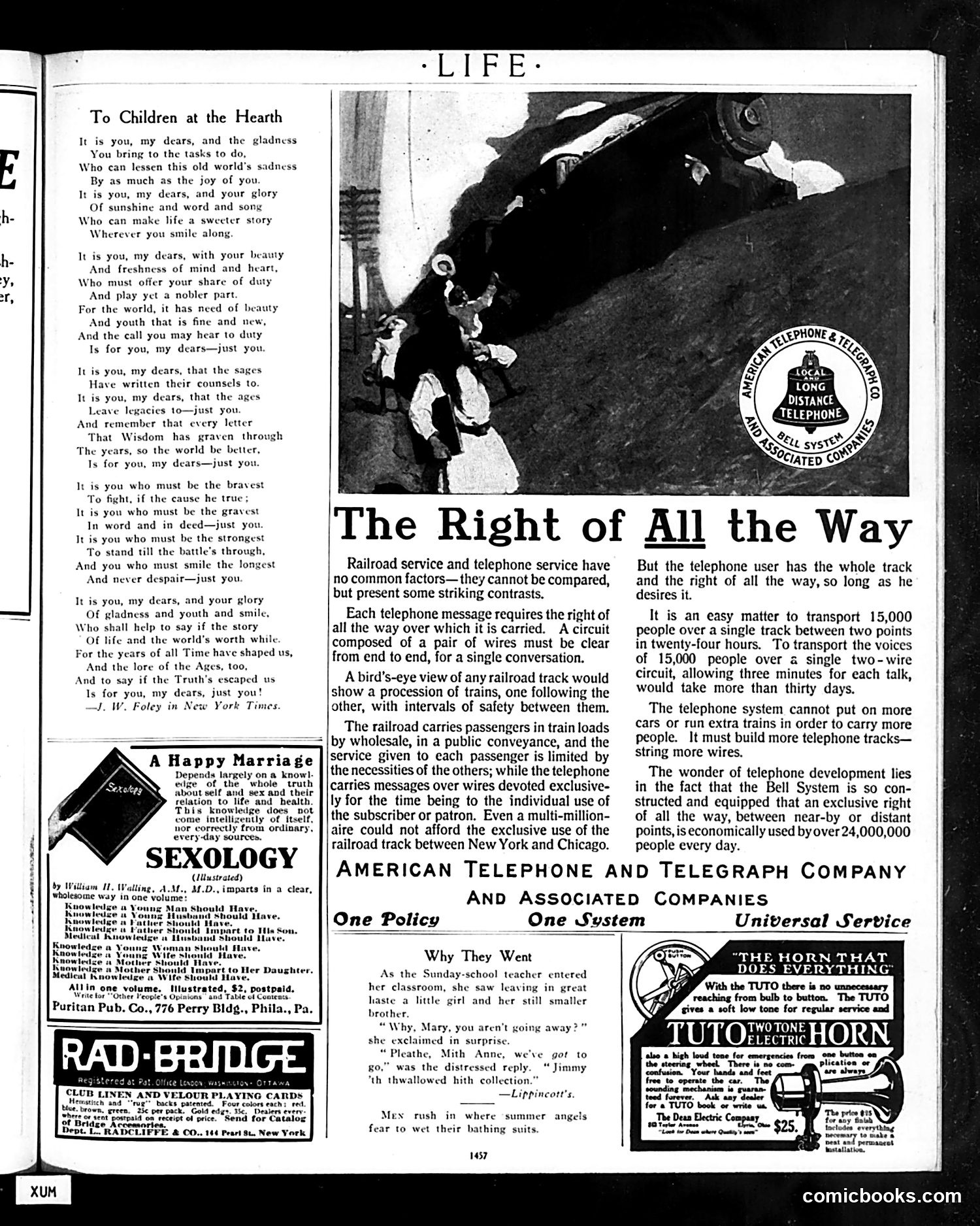
What you’re looking at
This page is primarily **advertising and corporate messaging**, not satire. The main content is a lengthy advertisement from American Telephone and Telegraph (AT&T), comparing railroad and telephone infrastructure. The argument: railroads share tracks among many trains with safety gaps between them, but telephone calls require *exclusive* wire access for the entire duration. Therefore, while railroads can move 15,000 people daily on one track, moving 15,000 voices over two wires would take thirty days. AT&T's pitch is that their "Bell System" justifies massive infrastructure investment because 24 million people daily need exclusive "right of way" over telephone lines. The framing—comparing their service to railroads—was designed to justify why telephone monopoly was economically necessary and efficient, a regulatory argument AT&T made in the early 20th century. Other page content includes sentimental poetry about children's duties and advertisements for books on sexuality and bridge games.
📄 Transcribed text from this page (OCR, searchable)
Machine-transcribed from the original scan — historical spelling and the odd misread are preserved.
To Children at the Hearth It is you, my dears, and the gladness You bring to the tasks to do, Who can lessen this old world’s sadness By as much as the joy of you. It is you, my dears, and your glory Of sunshine and word and song Who can make life a sweeter story Wherever you smile along. It is you, my dears, with your beauty And freshness of mind and heart, Who must offer your share of duty And play yet a nobler part For the world, it has need of beauty And youth that is fine and new, And the call you may hear to duty Is for you, my dears—just you It is you, my dears, that the sages Have written their counsels to. It is you, my dears, that the a Leave legacies to—just you. And remember that every letter That Wisdom has graven through The years, so the world be better, Is for you, my dears—just you. It is you who must be the bravest To fight, if the cause he true; It is you who must be the gravest In word and in deed—just you. It is you who must be the strongest To stand till the battle’s through, And you who must smile the longest And never despair—just you It is you, my dears, and your glory Of gladness and youth and smile, Who shall help to say if the story Of life and the world’s worth while For the years of all Time have shaped us, And the lore of the Ages, too, And to say if the Truth’s escaped us Is for you, my dears, just you! -J. W. Foley in New York Times. A Happy Marriage Depends largely on a knowl- edge of the ‘whole truth about self and sex and their iT d health. This ledge does not ly of itself, nor correctly from ordinary, relation to life and come intelli every-day sources. SEXOLOGY (Ilustrated) { : The Right of Railroad service and telephone service have no common factors— they cannot be compared, but present some striking contrasts. Each telephone message requires the right of all the way over which it is carried. A circuit composed of a pair of wires must be clear from end to end, for a single conversation. A bird's-eye view of any railroad track would show a procession of trains, one following the other, with intervals of safety between them. The railroad carries passengers in train loads = | by wholesale, in a public conveyance, and the service given to each passenger is limited by the necessities of the others; while the telephone carries messages over wires devoted exclusive- ly for the time being to the individual use of the subscriber or patron. Even a multi-million- aire could not afford the exclusive use of the railroad track between New York and Chicago. All the Way But the telephone user has the whole track and the right of all the way, so long as he desires it. It is an easy matter to transport 15,000 people over a single track between two points in twenty-four hours. To transport the voices of 15,000 people over a single two-wire circuit, allowing three minutes for each talk, would take more than thirty days. The telephone system cannot put on more cars or run extra trains in order to carry more people. It must build more telephone tracks— string more wires. The wonder of telephone development lies in the fact that the Bell System is so con- structed and equipped that an exclusive right of all the way, between near-by or distant points, is economically used by over 24,000,000 people every day. AMERICAN TELEPHONE AND TELEGRAPH COMPANY by William IL. Walling, A lesome way in one volui Knowledge tT Roowicuse a youee te M.D., imparts in a clear, AND ASSOCIATED COMPANIES One System Universal Service Should Have, Should Mave. One Policy Why They Went As the Sunday-school teacher entered her classroom, she saw leaving in great haste a little girl and her still smaller brother. “Why, Mary, you aren't going away?” she exclaimed in surprise. Pleathe, Mith Anne, we've go,” was the distressed reply. ‘th thwallowed hith collection.” —Lippincott's. “THE HORN THAT DOES EVERYTHING With the TUTO there is no unnecessary Teaching from bulb to button. The TUTO ives a soft low tone for regular service and EvecraC HOR, ze aM. Kuowledge a ™ rt to Her Daughter. Medieat aves is ir m pai wledge a Wife Should volume. Illustrated, $2, postpaid, for “Other Feople’s Opisions "and Table of Contes: Puritan Pub. Co., 776 Perry Bldg., Phila., Pa, got to “Jimmy Mew rush in where summer angels ise, Acoma fear to wet their bathing suits. Dept. L. RADCLIFFE & CO. 44 Peart 9. New York, 1457 comicbooks.com