A complete issue · 44 pages · 1912
Life — January 25, 1912
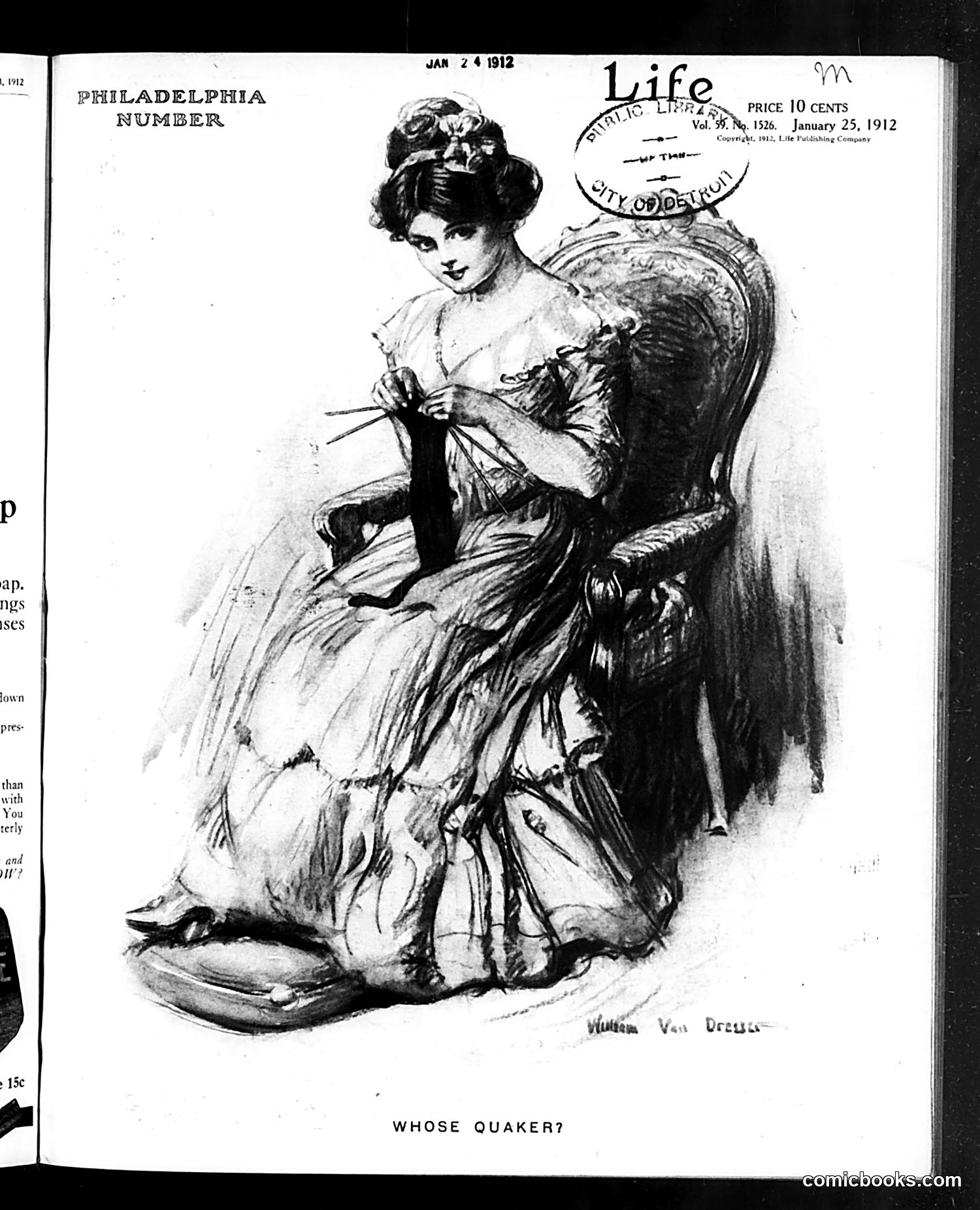
This satirical illustration by William Van Dresda depicts a fashionably dressed woman in an elaborate gown sitting in a chair, appearing to hold or display fabric. The caption "Whose Quaker?" likely references a contemporary commercial or social debate, though the specific context is unclear today. The satire appears to target either fashion industry practices, consumer culture, or possibly a corporate naming dispute involving "Quaker" branding—which was becoming prominent in early 20th-century advertising. The woman's ostentatious dress and pose suggest mockery of either high fashion pretension or commercial claims about product origins and authenticity. Without additional contextual information from that era's business or social landscape, the precise target of this satire remains uncertain.

This page is primarily a **straightforward advertisement** for Sanitol Tooth Powder or Paste, not satire or political commentary. The ad features a woman at a dental sink, promoting the product's benefits ("white teeth and a pure mouth"). The accompanying text explicitly **disclaims** any miraculous claims, stating that Sanitol cannot replace regular dentist visits or cure tooth decay—it merely helps maintain dental hygiene by keeping teeth clean and preventing bacterial growth. The cautionary tone is notable: the company preemptively addresses consumer expectations, warning against believing the product could eliminate the need for professional dental care. This appears to be honest advertising for the era (early 20th century), with the manufacturer, Sanitol Chemical Laboratory Co. of St. Louis, Mo., being deliberately transparent about limitations.
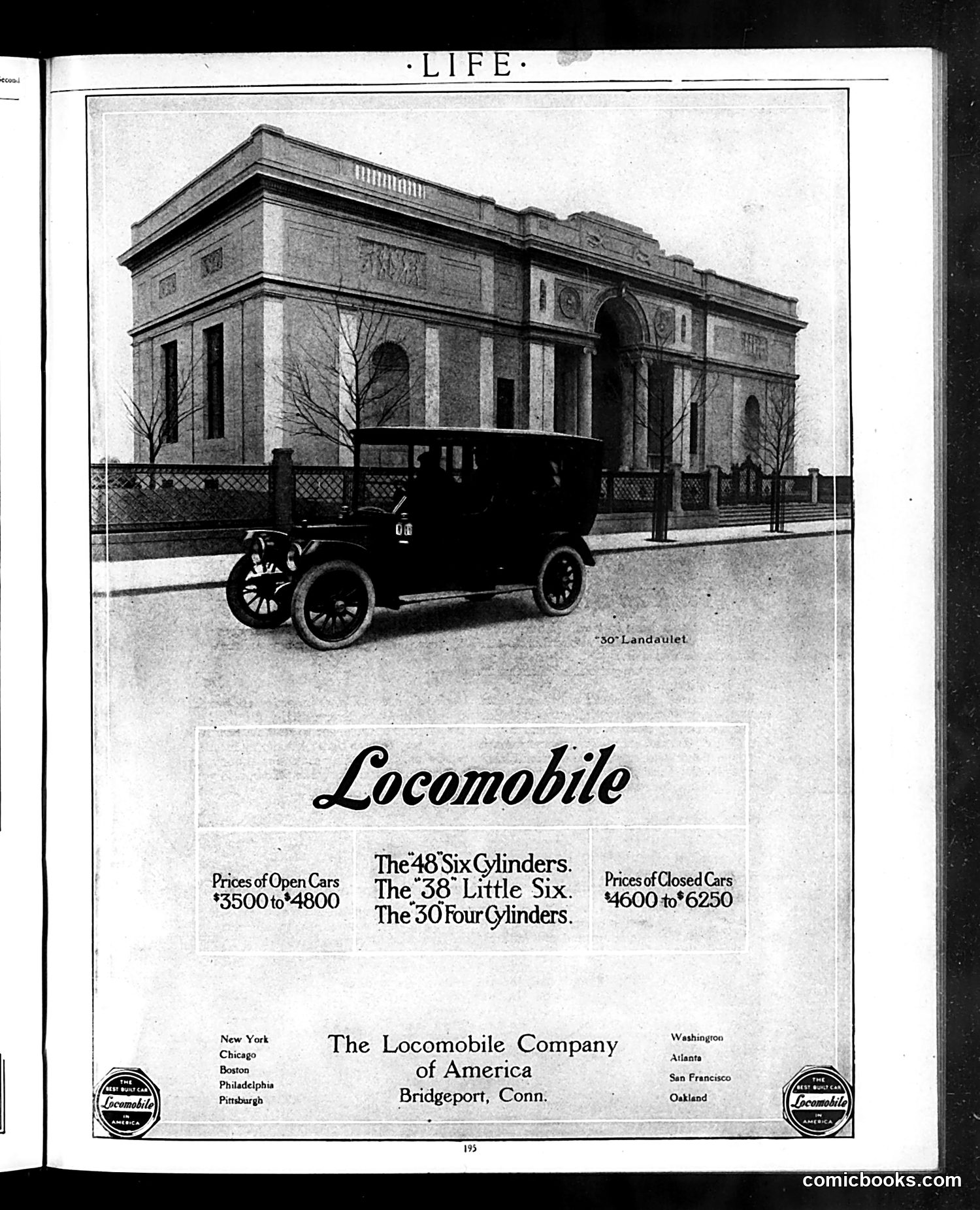
This page is **primarily advertising, not editorial content or satire**. It features a Locomobile automobile advertisement from The Locomobile Company of America (Bridgeport, Connecticut), showcasing a "30" Landaulet model parked before an neoclassical public building. The ad lists three vehicle models: the 48 Six Cylinders, the 38 Little Six, and the 50 Four Cylinders, with price ranges for open and closed cars ($3,500-$6,250). The company lists offices in major cities: New York, Chicago, Boston, Philadelphia, Pittsburgh, Washington, Atlanta, San Francisco, and Oakland. **This is a straightforward luxury automobile advertisement typical of early 20th-century Life magazine, not satirical content.**
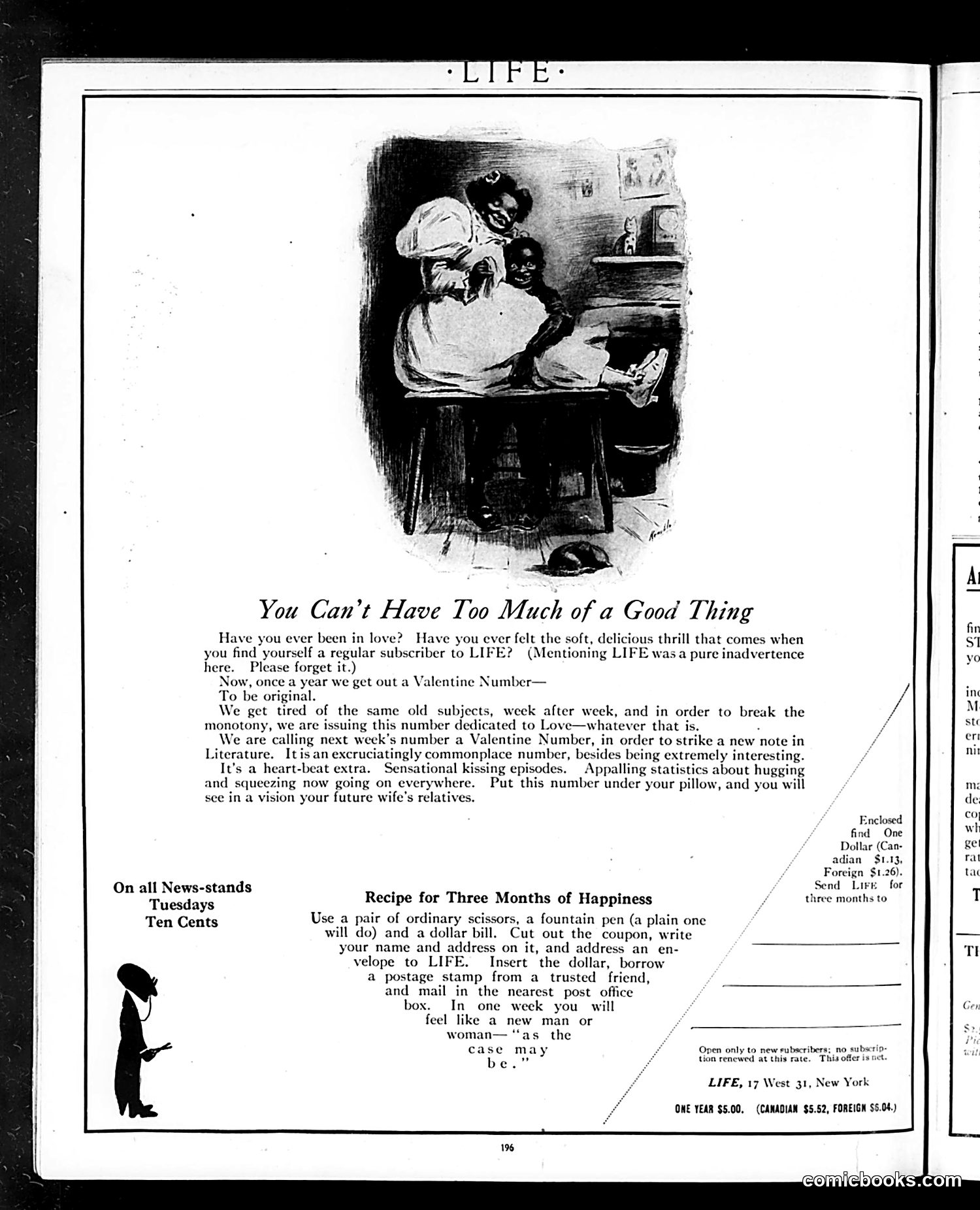
This page is primarily a **subscription advertisement** for *Life* magazine, not a political cartoon. The main illustration shows a woman sitting at a desk with a child, depicting domestic contentment—likely meant to appeal to potential subscribers. The ad's headline, "You Can't Have Too Much of a Good Thing," promotes *Life*'s upcoming Valentine's Day issue. It humorously suggests that regular readership provides romantic excitement comparable to love itself. The "Recipe for Three Months of Happiness" is a tongue-in-cheek subscription offer: send scissors, a pen, a dollar, and a postage stamp to receive three months of the magazine. The small silhouetted figure at bottom left is generic—simply illustrating the ad's playful tone rather than referencing a specific person or political figure.
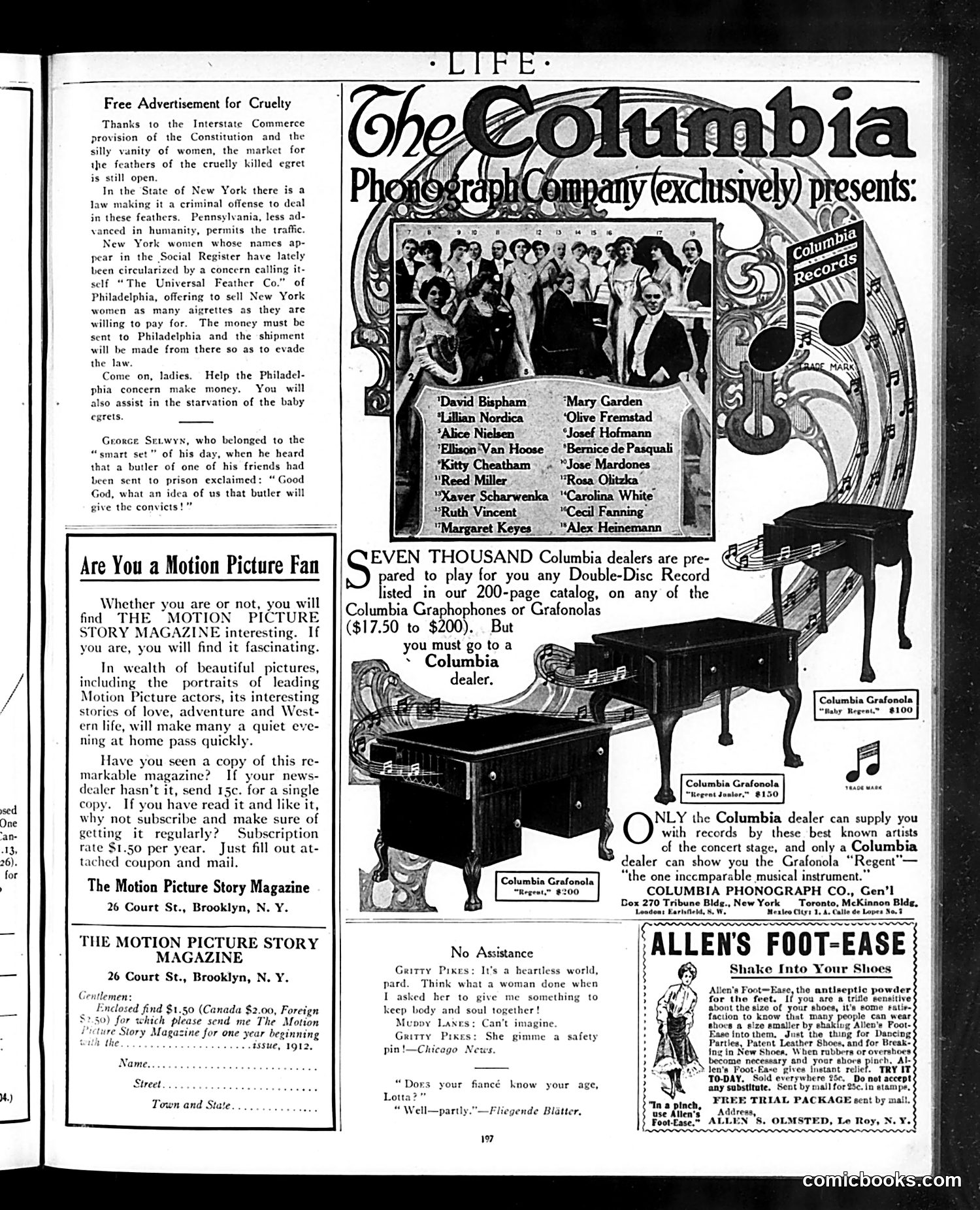
This page is primarily **advertising and entertainment content**, not political satire. The dominant feature is a Columbia Records advertisement for a phonograph featuring a group photograph of entertainment figures. The ad promotes Columbia dealers selling records and gramophones priced $17.50 to $200. The page includes: - A "Motion Picture Story Magazine" advertisement (left column) - Columbia phonograph promotion with named performers including Mary Garden, Olive Fremstad, and others - "Allen's Foot-Ease" powder advertisement - A brief humor section titled "No Assistance" with jokes about courtship and women's fashion The content reflects early 20th-century consumer culture, entertainment industry cross-promotion, and period social attitudes toward women. There is no identifiable political cartoon or satire on this page.
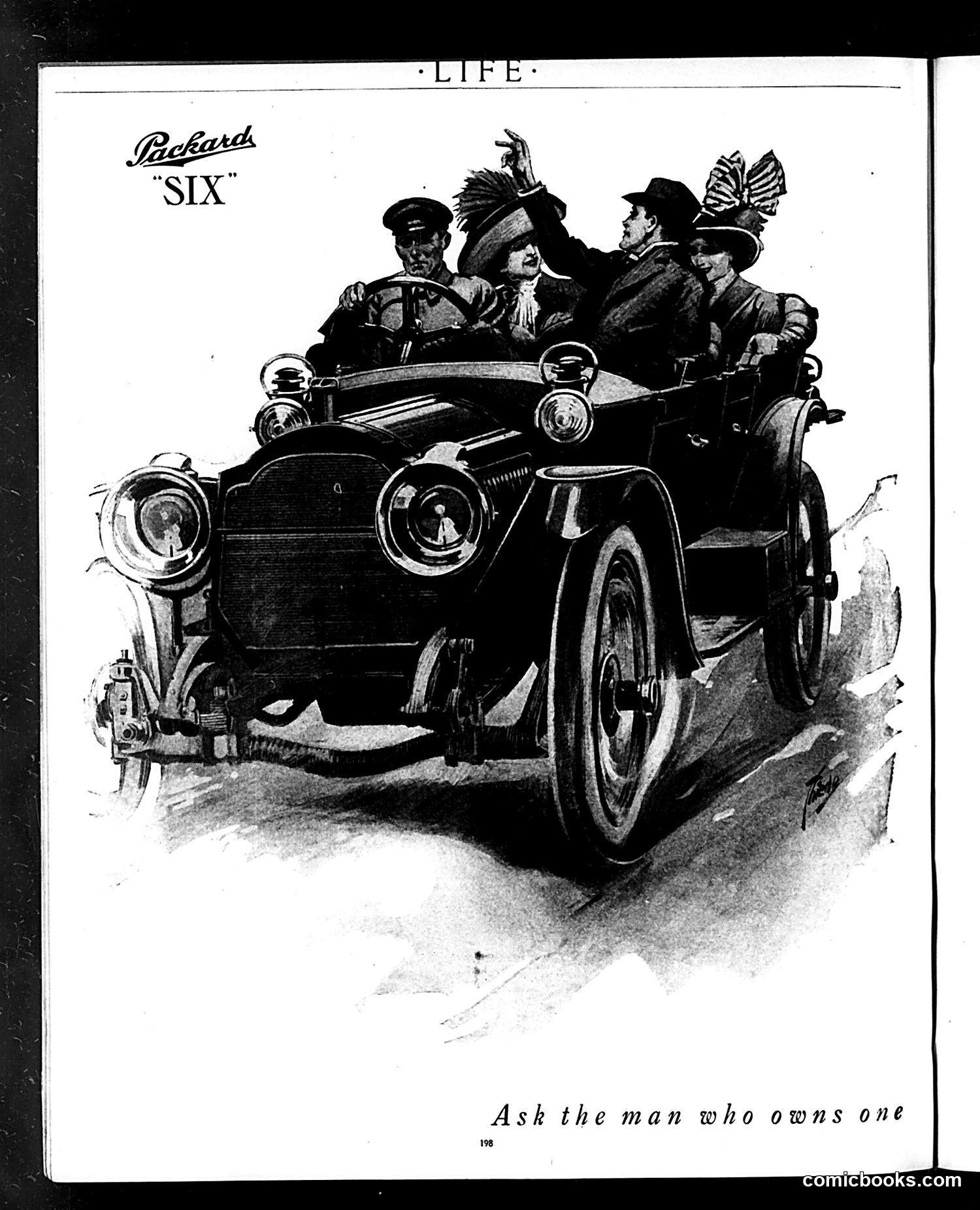
This is a car advertisement from *Life* magazine, not a political cartoon. It depicts a Packard automobile with four well-dressed passengers in early 20th-century clothing and styling. The tagline reads "Ask the man who owns one," a famous Packard advertising slogan from that era. The ad uses social aspirational messaging typical of luxury car marketing: the fashionably dressed figures and their confident bearing suggest that owning a Packard "Six" signals wealth and status. The illustration style and clothing indicate this is from approximately the 1910s-1920s. The humor is subtle—it's not satirical commentary but rather promotional copy relying on the idea that potential buyers would trust existing owners' endorsements of the vehicle's quality.
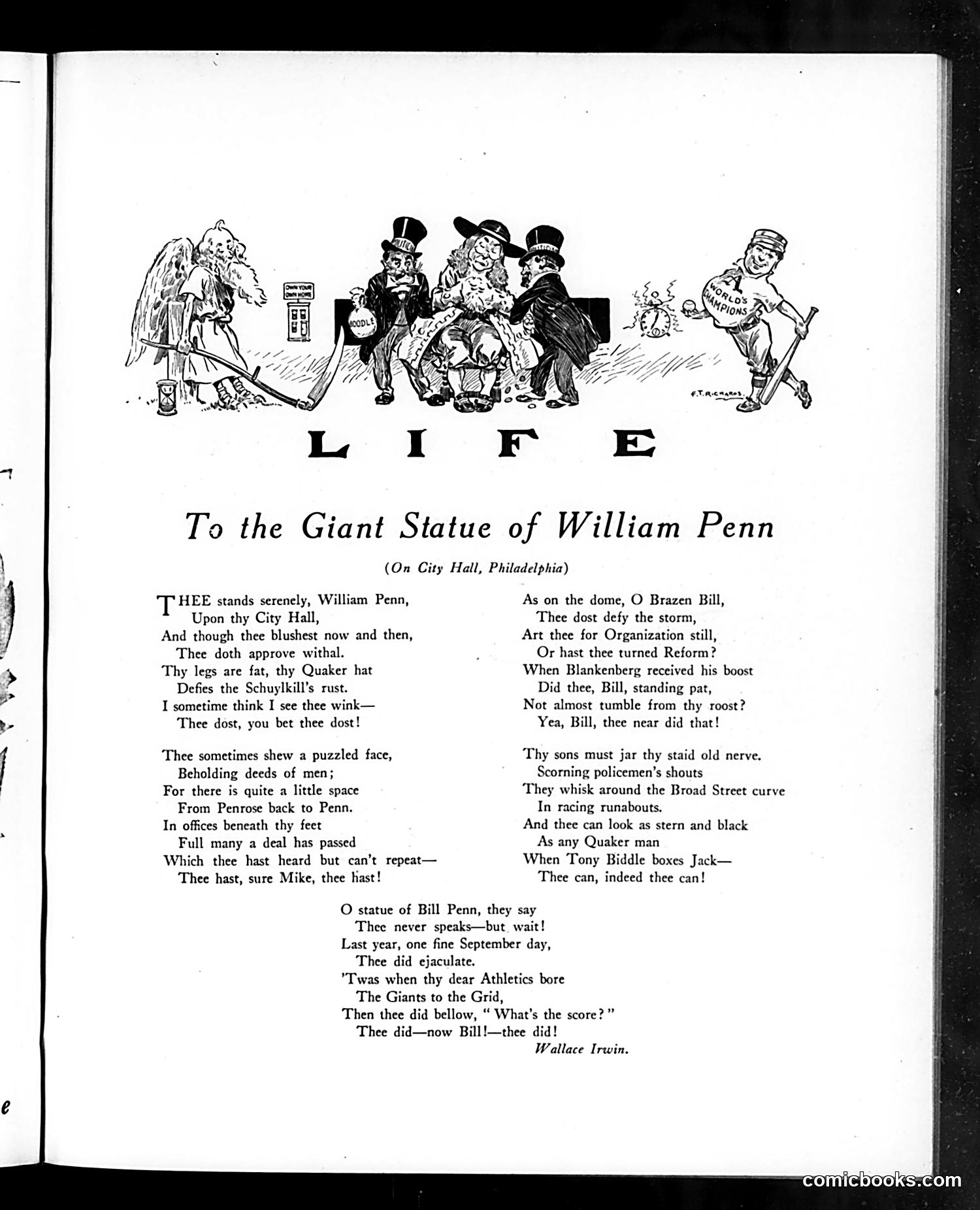
This is a satirical poem by Wallace Irwin mocking Philadelphia's William Penn statue atop City Hall. The cartoon header depicts various figures interacting with the statue—angels, politicians, and what appear to be reform-minded characters. The poem satirizes the statue's prominent placement and its symbolic weight in Philadelphia politics. It references: - Penn's Quaker legacy ("thy Quaker") - Local political figures (mentions "Mike," "Blankenberg," "Tony Biddle") - Philadelphia institutions (Penrose, Broad Street) - A baseball game where the Athletics played the Giants, during which the statue apparently "spoke" and asked about the score—the poem's humorous climax The satire suggests the statue is a static, oversized monument to past ideals while current Philadelphia politics and life move messily around it. The joke hinges on the statue's apparent indifference being broken only by sports-related excitement.
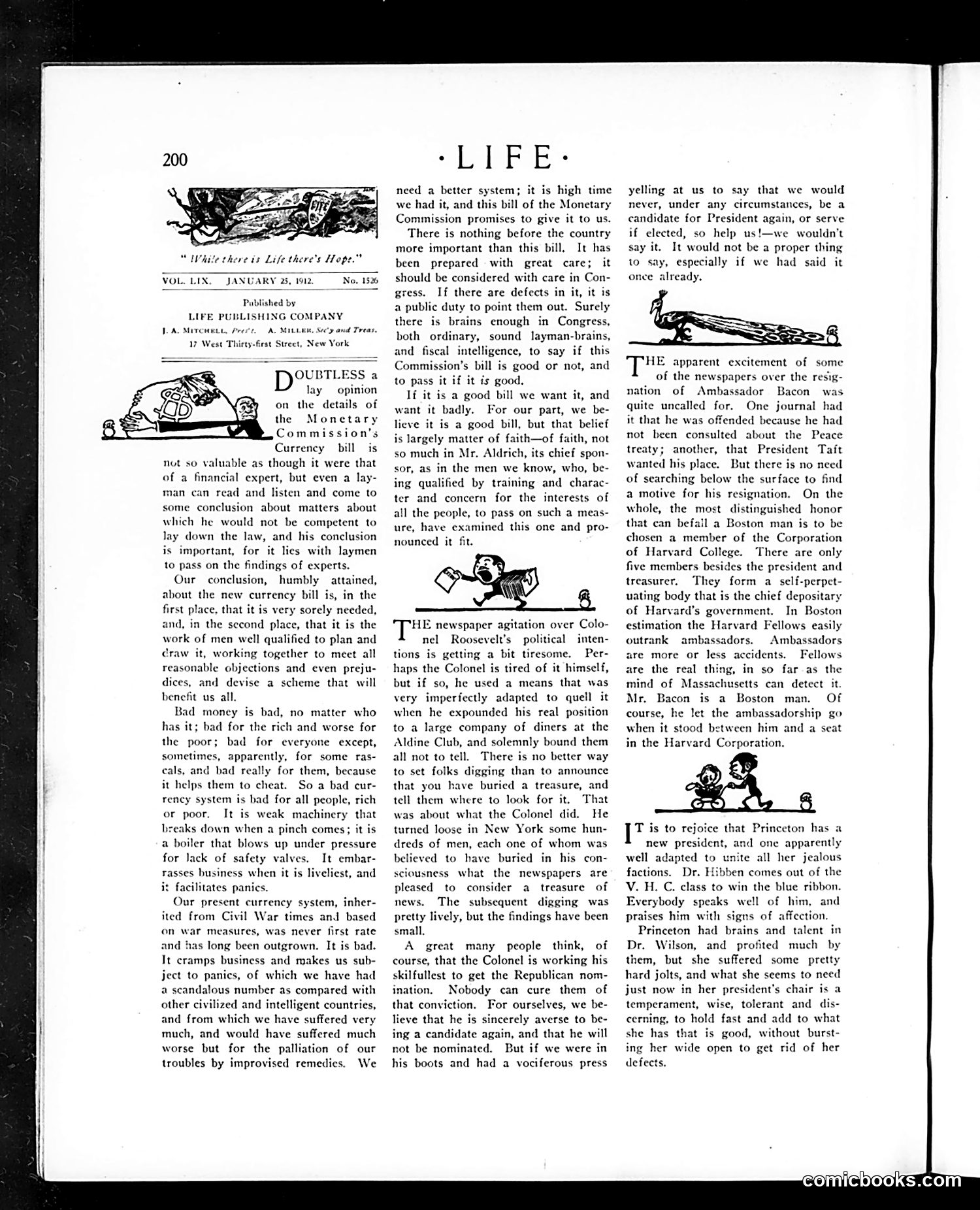
This page contains political commentary rather than traditional cartoons. The main text discusses the **Monetary Commission's currency bill**, arguing it needs congressional scrutiny before passage, not blind acceptance by "ordinary, sound layman-brains." A second article criticizes **Colonel Roosevelt's newspaper agitation** regarding his political intentions, suggesting he's using media manipulation to position himself for the Republican nomination. The text implies Roosevelt buried his real political aims while publicly denying candidacy—a critique of his political strategy and media management. The final brief item praises **Princeton's new president**, likely Woodrow Wilson (who later became U.S. President), noting he brings talent and brains to the role despite some initial challenges. The cartoons appear decorative/illustrative rather than specifically satirical.
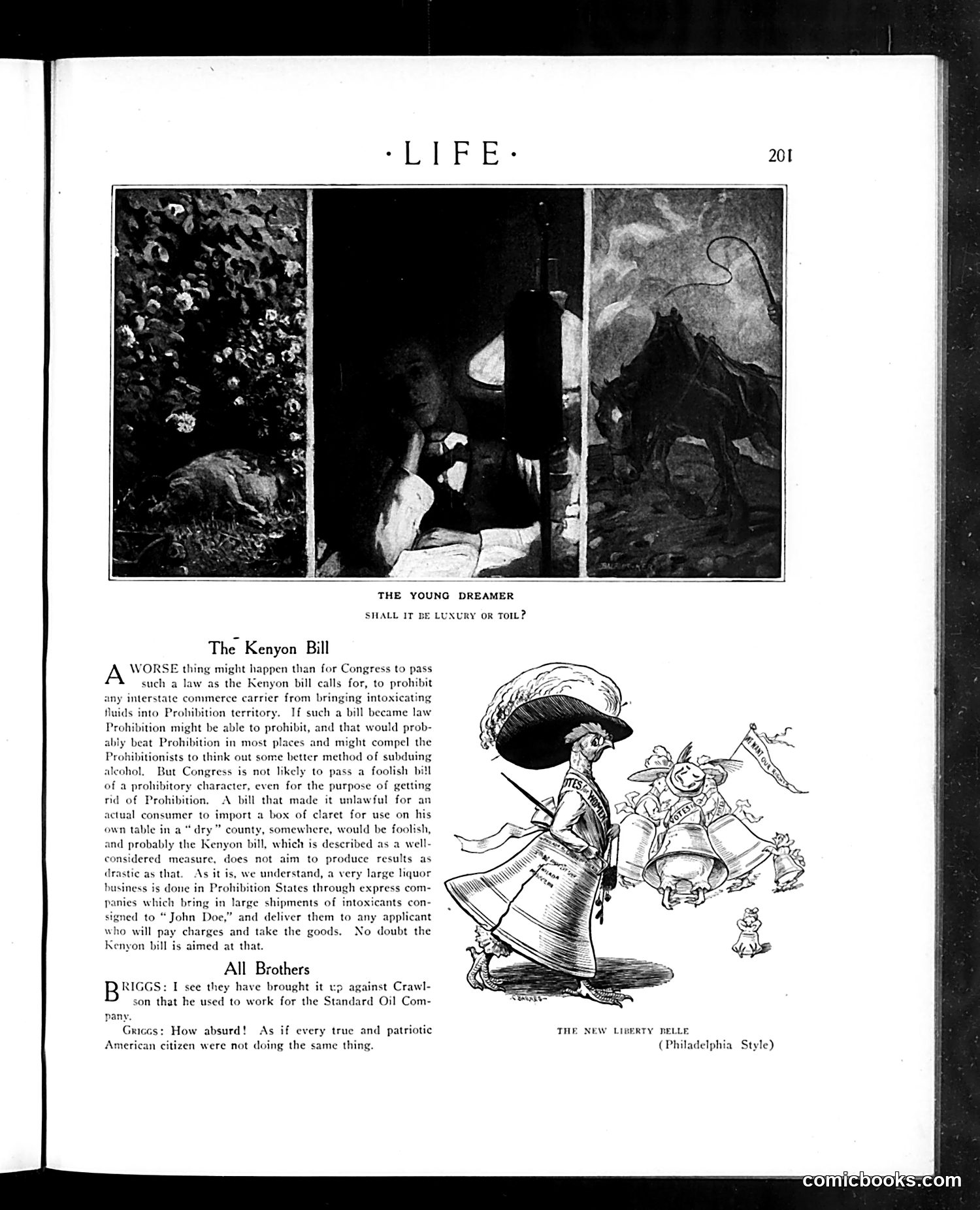
This page satirizes Prohibition-era politics and enforcement. "The Kenyon Bill" section discusses a proposed law to prohibit interstate commerce in alcohol—a mechanism to strengthen Prohibition. The satire argues this would be absurd: even allowing personal importation for private use would be foolish, yet the Kenyon bill supposedly aims at actual enforcement. "The New Liberty Belle" cartoon (lower right) depicts Lady Liberty as a heavily burdened figure, weighed down by bottles and chaos—mocking how Prohibition advocates claimed to protect American liberty while actually restricting personal freedom. The "All Brothers" dialogue criticizes citizens who report Prohibition violations to authorities, framing such patriotic informing as hypocritical opportunism against former colleagues (Briggs worked for Standard Oil).
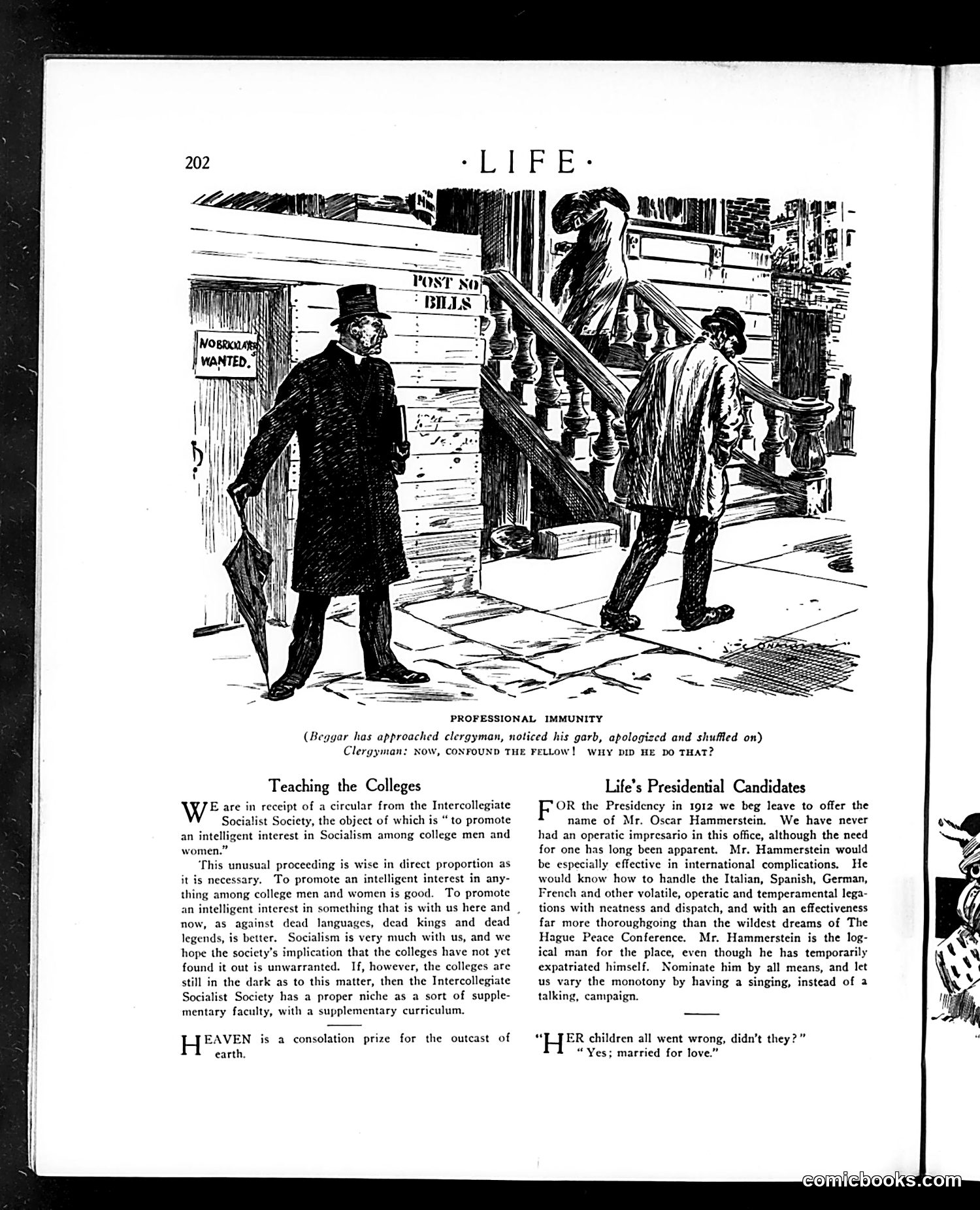
The main cartoon, titled "Professional Immunity," depicts a clergyman (identifiable by his collar and top hat) approaching two men on a street. The caption indicates the clergyman has "noticed his garb, apologized and shuffled on," suggesting religious figures received social protection from criticism. The accompanying articles discuss two topics: "Teaching the Colleges" critiques the Intercollegiate Socialist Society's influence in academia, and "Life's Presidential Candidates" sarcastically proposes Oscar Hammerstein as a 1912 presidential candidate, suggesting he'd handle diplomatic matters better than typical politicians through operatic performance rather than traditional campaigning. The satire targets institutional hypocrisy, socialist influence in education, and political incompetence.
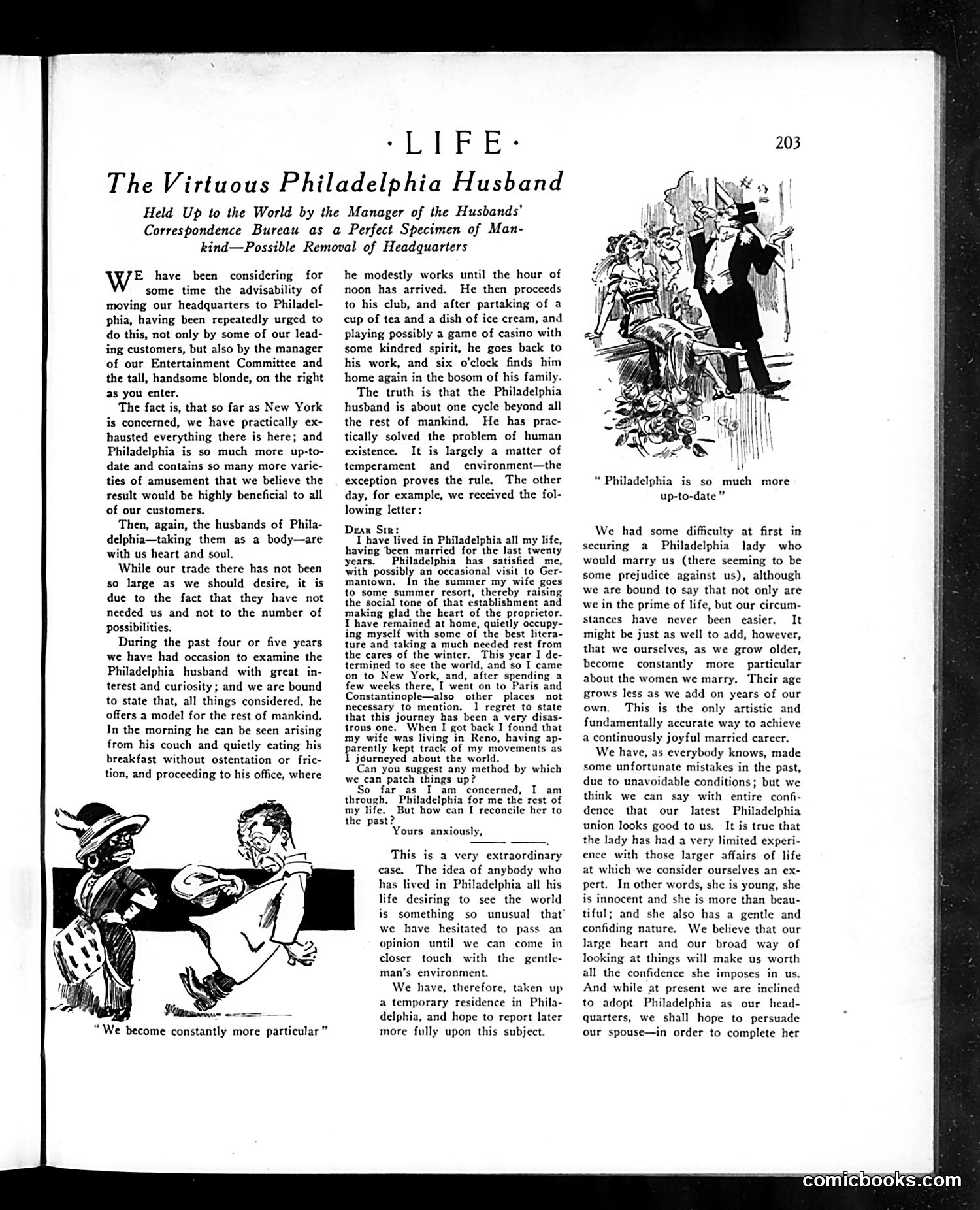
This satirical piece mocks the idealized notion of the "perfect" Philadelphia husband through a humorous letter from a man who has lived his entire life in Philadelphia and traveled the world without his wife knowing. The cartoon shows a man reading or working while his wife tends to domestic matters—illustrating the article's theme about gender roles and marital dynamics. The satire targets Philadelphia's self-regard as a bastion of propriety and virtue. The "Philadelphia husband" supposedly solves the problem of human existence through "temperament and environment," yet the letter reveals he's actually been globe-trotting while his oblivious wife stayed home. The joke exposes the gap between Philadelphia's pious reputation and actual husbands' behavior—mocking both marital deception and the city's pretensions to moral superiority.
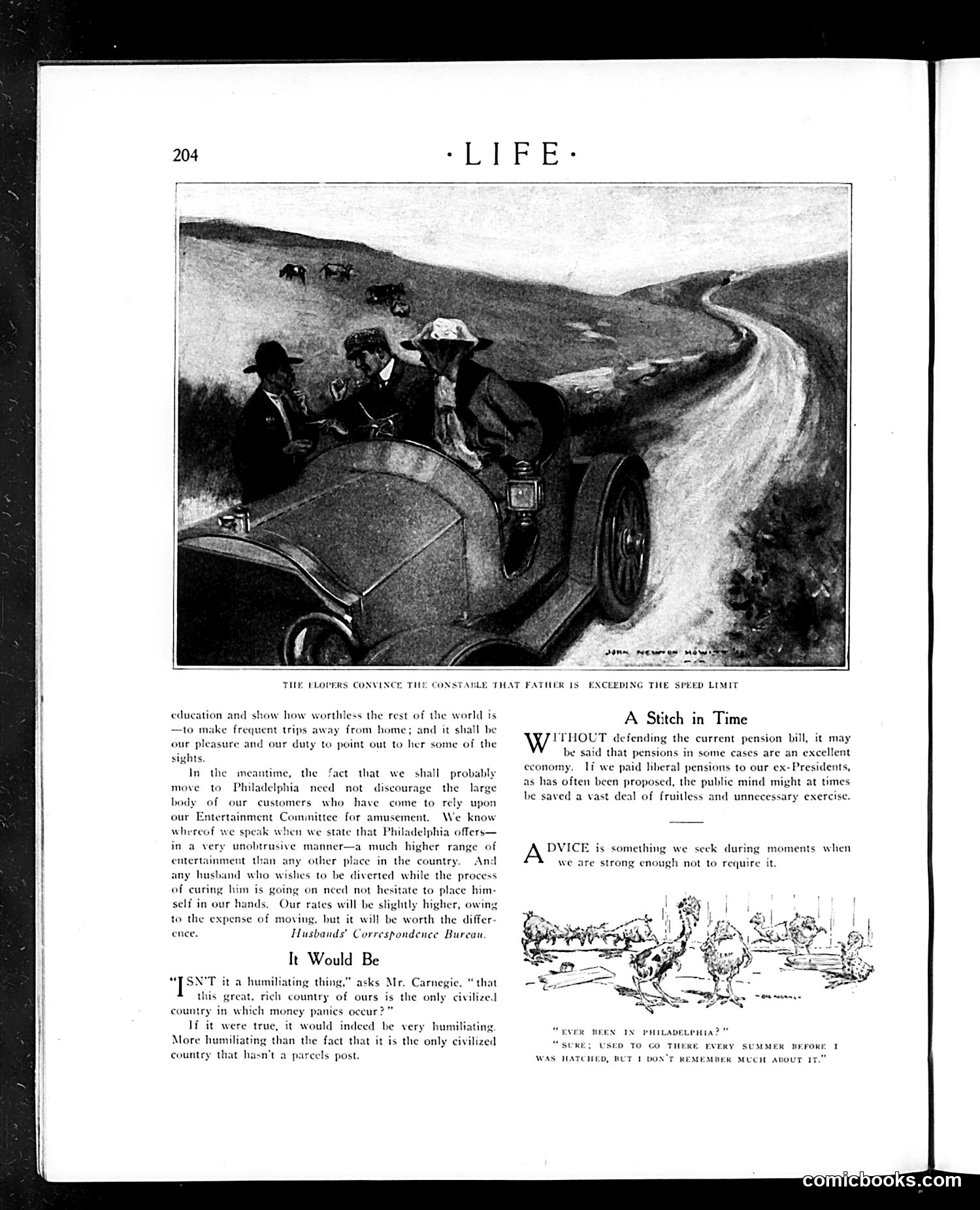
**Top Image:** A cartoon showing men in an automobile exceeding the speed limit on a winding road, titled "THE FLOPERS CONVINCE THE CONSTABLE THAT FATHER IS EXCEEDING THE SPEED LIMIT." The satire mocks traffic enforcement—the automobile's passengers are apparently persuading a police officer that the *driver* (father) is speeding, when he may not be, or they're deflecting blame. **Lower Content:** Three separate pieces—a column about pensions and Philadelphia entertainment, titled "A Stitch in Time"; Mr. Carnegie's quote about America being "civilized" because "money comes easy"; and a cartoon showing people at a Philadelphia location, with dialogue about summer visits. The overall theme satirizes American wealth, social pretension, and early automotive culture circa 1910s-1920s.
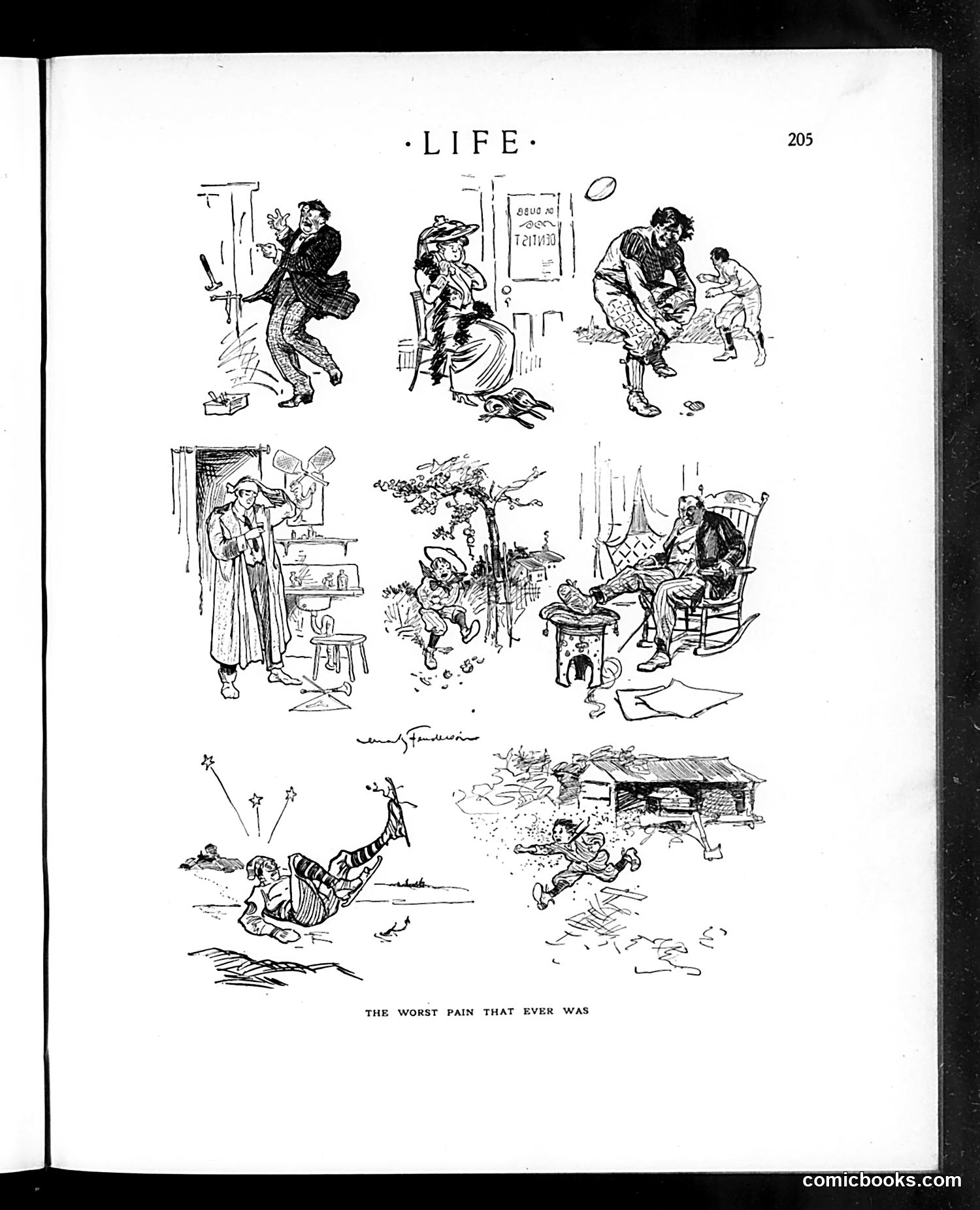
This page from *Life* magazine presents a series of humorous domestic and everyday scenarios illustrating various minor misfortunes and discomforts. The vignettes depict: - A man attempting home repairs or construction - A woman at a mirror or vanity - Adults playing with children - Medical or dental scenes - A person in a rocking chair - Someone being chased or fleeing - Figures near a shed or structure The title "The Worst Pain That Ever Was" uses ironic exaggeration—common to *Life's* satirical approach—to mock how people dramatize trivial inconveniences (stubbed toes, minor injuries, household mishaps) as catastrophic suffering. The cartoonist celebrates everyday human foolishness and overreaction through these relatable domestic comedy situations.
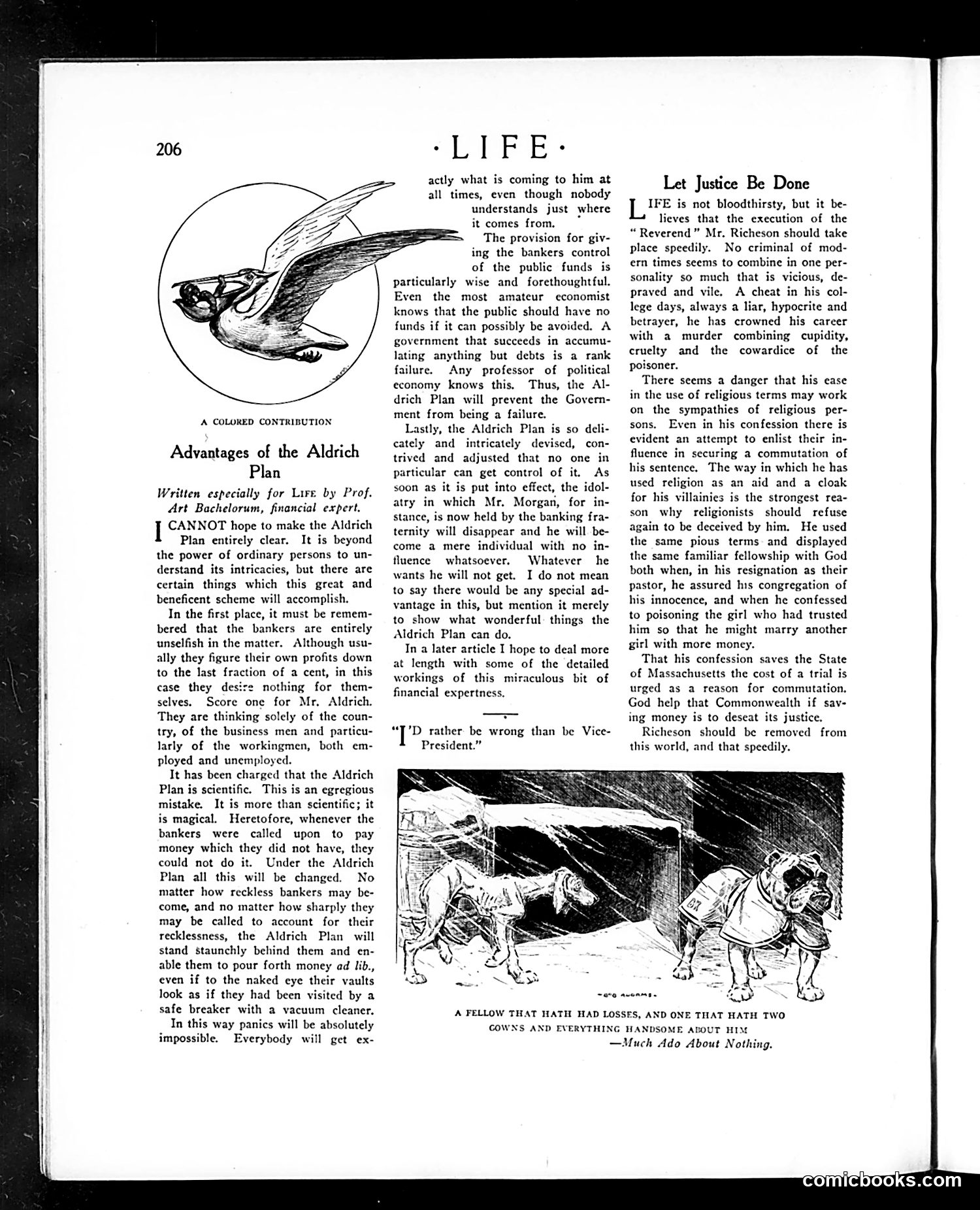
This page contains two distinct pieces: **"Advantages of the Aldrich Plan"** - An article by Prof. Art Bachelornum praising a financial reform proposal. The text defends the plan as scientific and beneficial, claiming it will stabilize banking and prevent government debt accumulation. However, the author appears to be using satire—describing the plan as almost "magical" and noting that bankers will somehow produce money they don't actually have, which seems impossible. **"Let Justice Be Done"** - An editorial criticizing "Reverend" Mr. Richeson, who appears to be a corrupt or hypocritical religious figure accused of serious crimes (murder, possibly involving a young woman). The piece condemns his use of religious language to manipulate his congregation and calls for his swift removal. **Bottom illustration** - A cartoon showing dogs referencing Shakespeare's *Much Ado About Nothing*, likely commenting on idle gossip or worthless talk surrounding these scandals.
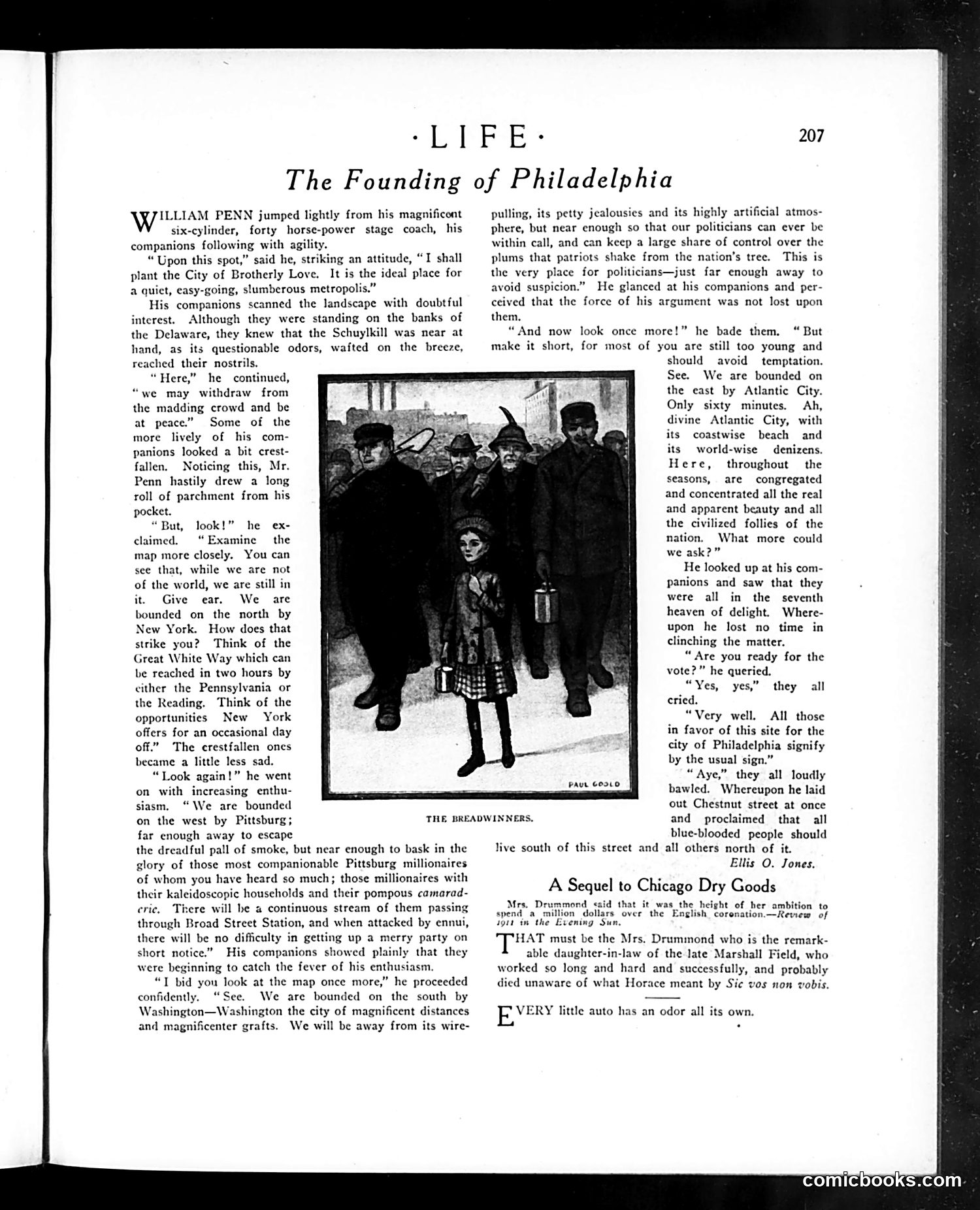
This is a humorous reframing of William Penn's 1682 founding of Philadelphia. The satire mocks early-20th-century American commercialism and urban culture by portraying Penn selling the city's location to companions based entirely on proximity to wealthy leisure destinations and corrupt political opportunities. The joke hinges on treating Philadelphia's neighbors as selling points: New York's "Great White Way" (entertainment district), Pittsburgh's millionaires with their "pompous camaraderie," Washington's "magnificenter grafts" (political corruption), and Atlantic City's resorts. Penn frames what should be a spiritual/civic endeavor as a real-estate pitch emphasizing vice and wealth. The cartoon satirizes how American cities had become defined by materialism, corruption, and frivolous consumption rather than idealistic founding principles. The image shows Penn addressing his followers, visualizing this mercenary pitch.
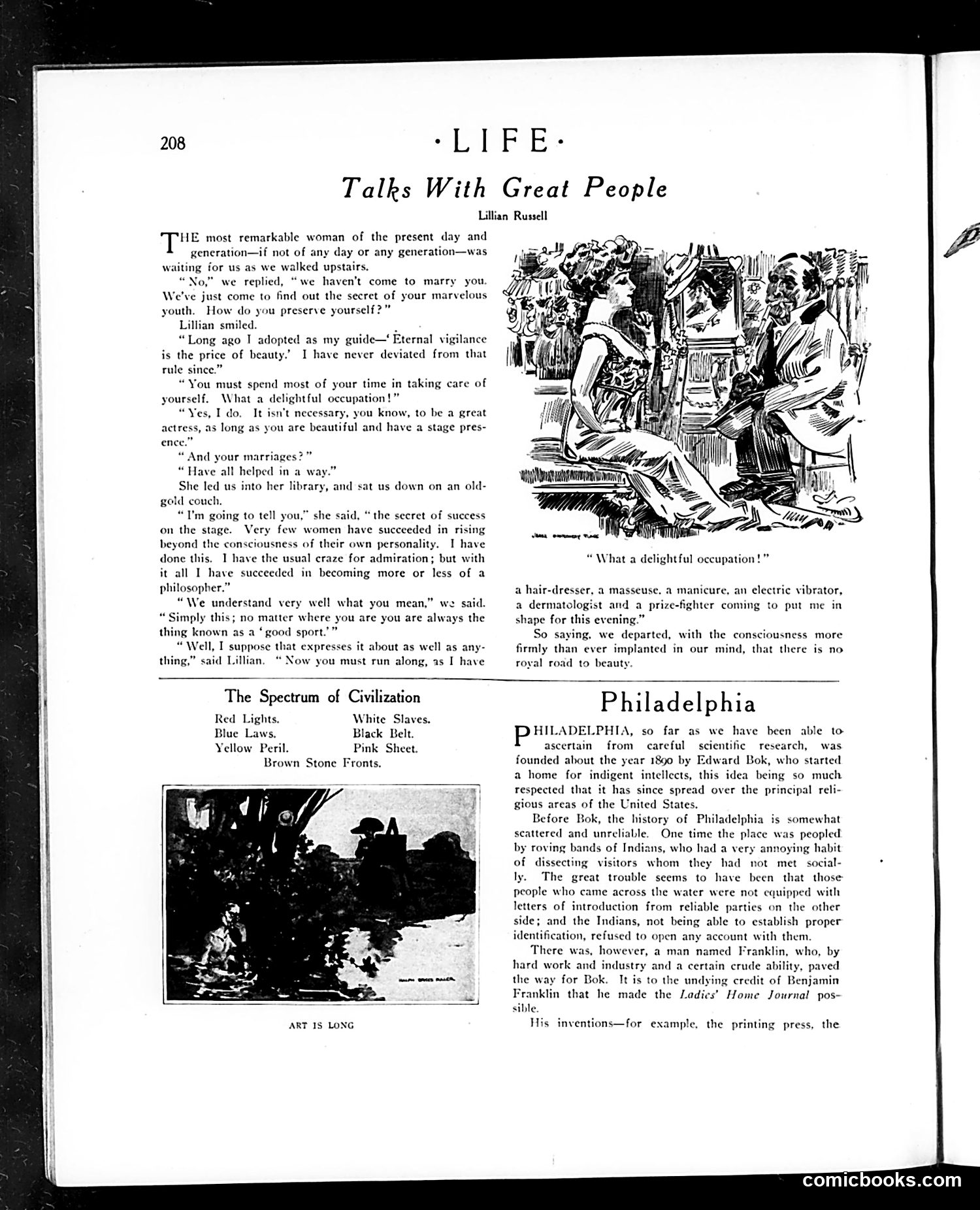
**Top Section - "Talks With Great People: Lillian Russell"** This interviews the famous actress Lillian Russell, presenting her as "the most remarkable woman of the present day." The piece satirizes both Russell's vanity and the obsessive beauty culture of her era. Russell claims her secret to youth is "eternal vigilance" and spends her day with "a hair-dresser, a masseuse, a manicure, an electric vibrator, a dermatologist and a prize-fighter"—mocking the elaborate, almost absurd beauty regimens wealthy women pursued. The humor lies in treating beauty maintenance as a serious philosophical pursuit while gently ridiculing the superficiality it represents. **Bottom Section - "The Spectrum of Civilization" and Philadelphia** This satirizes Philadelphia's history and character through wordplay: "Red Lights," "Blue Laws," "Yellow Peril," etc. The Philadelphia section humorously credits Edward Bok (editor of *Ladies' Home Journal*) as the city's 1890 founder, and Benjamin Franklin merely as his precursor—inverting historical importance for comedic effect.
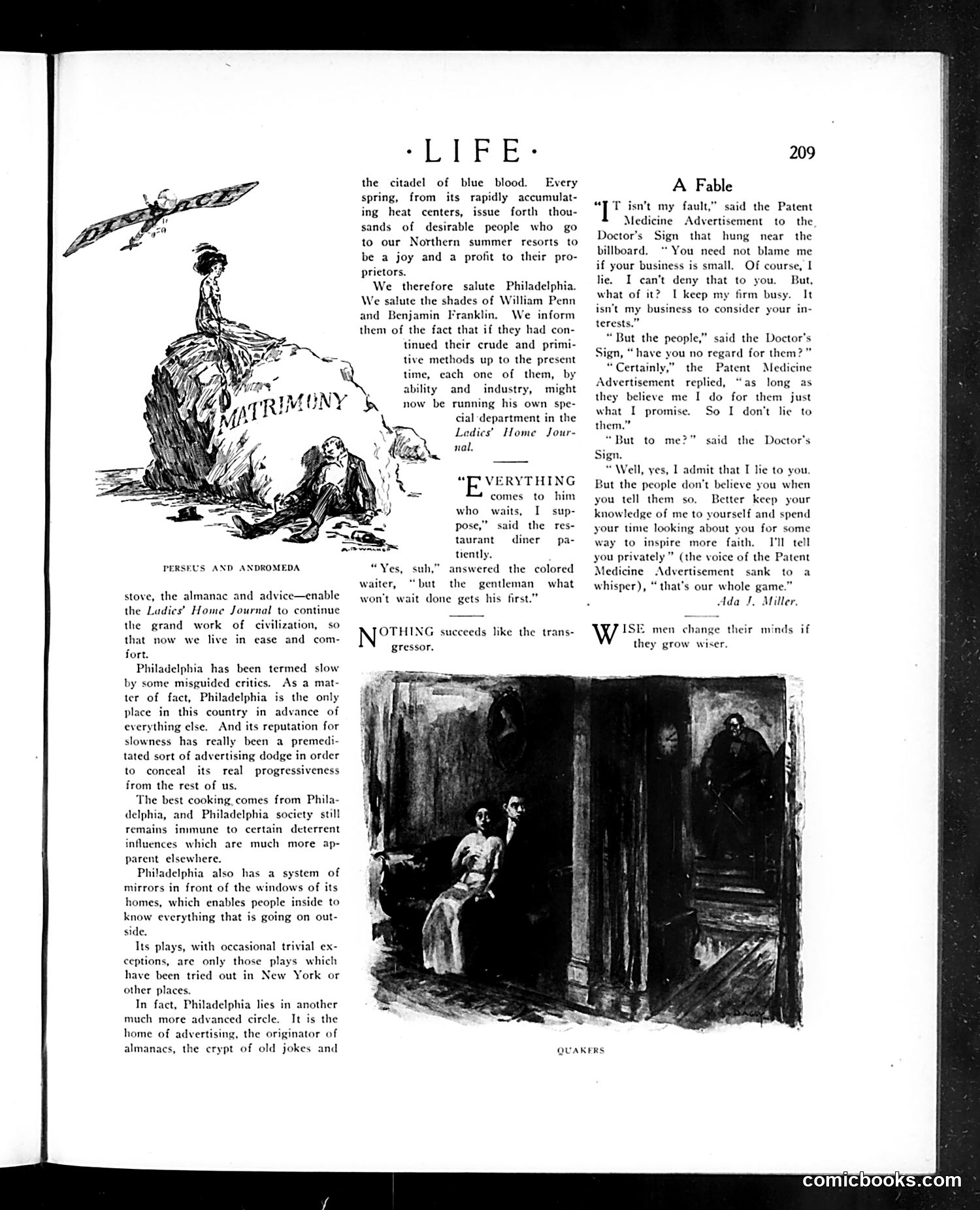
This page contains **satirical commentary on Philadelphia** and includes two separate pieces: **"Perseus and Andromeda"** (left illustration): A classical mythology reference presented as social satire. The caption explains that Philadelphia—historically dismissed as slow—is actually "in advance of everything else." The satire is ironic: Philadelphia is mocked for being the "home of advertising, the originator of almanacs, the crypt of old jokes," suggesting it recycles tired material while pretending to progressiveness. The article sarcastically praises the city's "blue blood" elite and notes that wealthy Philadelphians seasonally migrate to Northern resorts, enriching resort owners. **"A Fable"** (right side): A moral dialogue between a Patent Medicine Advertisement and a Doctor's Sign. The Patent Medicine openly admits to lying but argues it works because people *want* to believe false claims. The satire critiques both fraudulent advertising and public gullibility—the real problem isn't the liar but the willing audience. This reflects Progressive Era concerns about patent medicine deception. Both pieces target pretense, false advertising, and societal complicity in accepting lies.
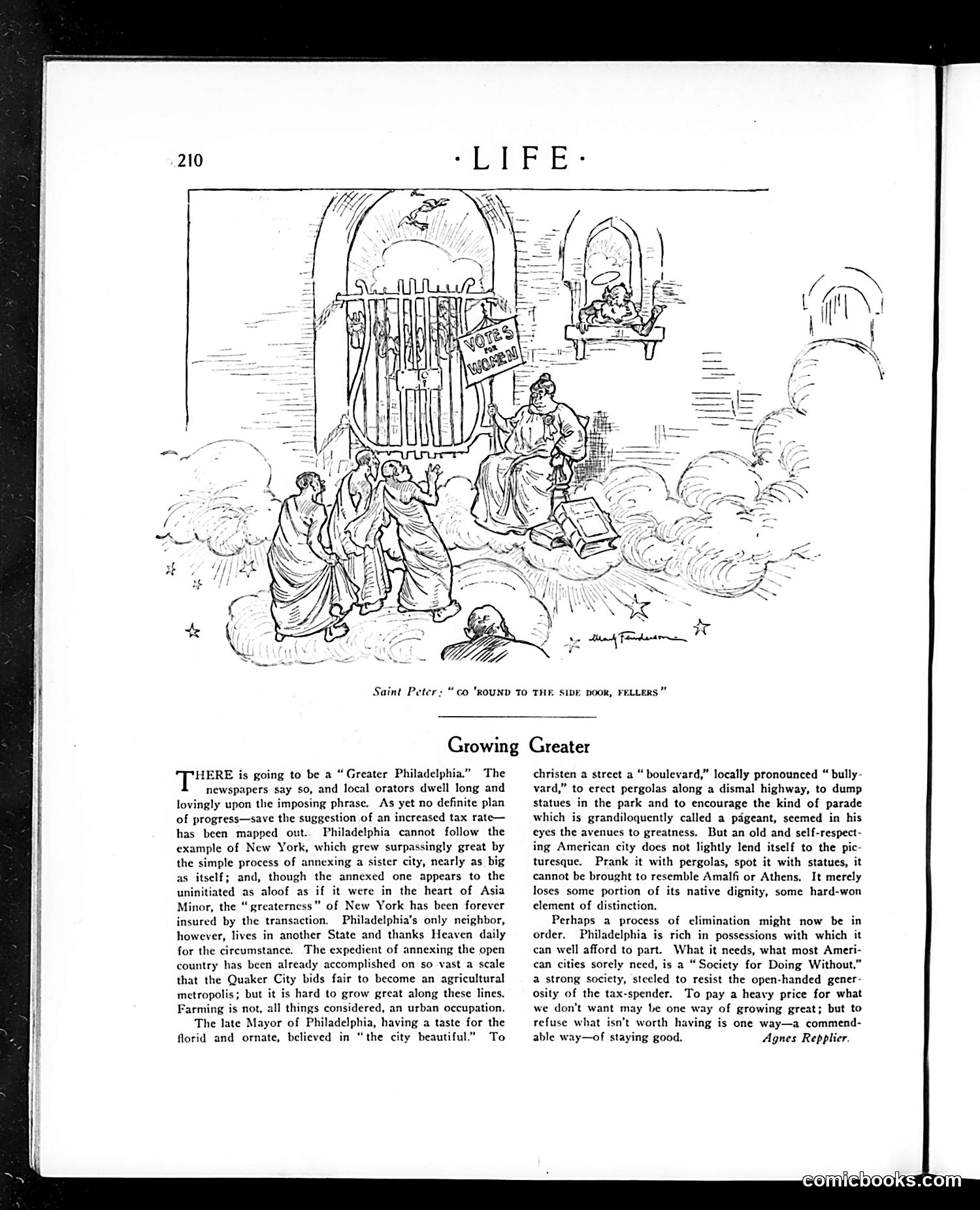
**The Cartoon:** The top illustration shows Saint Peter at heaven's gates redirecting people to "the side door," a sardonic commentary on selective entry to heaven—likely referencing hypocrisy or moral compromise. **The Article "Growing Greater":** This is social satire about Philadelphia's expansion plans. Author Agnes Repplier mocks the city's vague aspirations for becoming "Greater Philadelphia" without substantive improvement. She criticizes: - The mayor's superficial "city beautiful" approach (adding boulevards, pergolas, statues, pageants) that merely masks the city's lack of authentic grandeur - Wasteful spending on ornamental projects while avoiding real civic problems - The false belief that architectural decoration can create greatness Repplier argues Philadelphia should instead practice restraint—a "Society for Doing Without"—refusing unnecessary expenditures rather than chasing growth through frivolous spending. The piece reflects Progressive Era skepticism about municipal corruption and wasteful governance, advocating fiscal responsibility over flashy development.
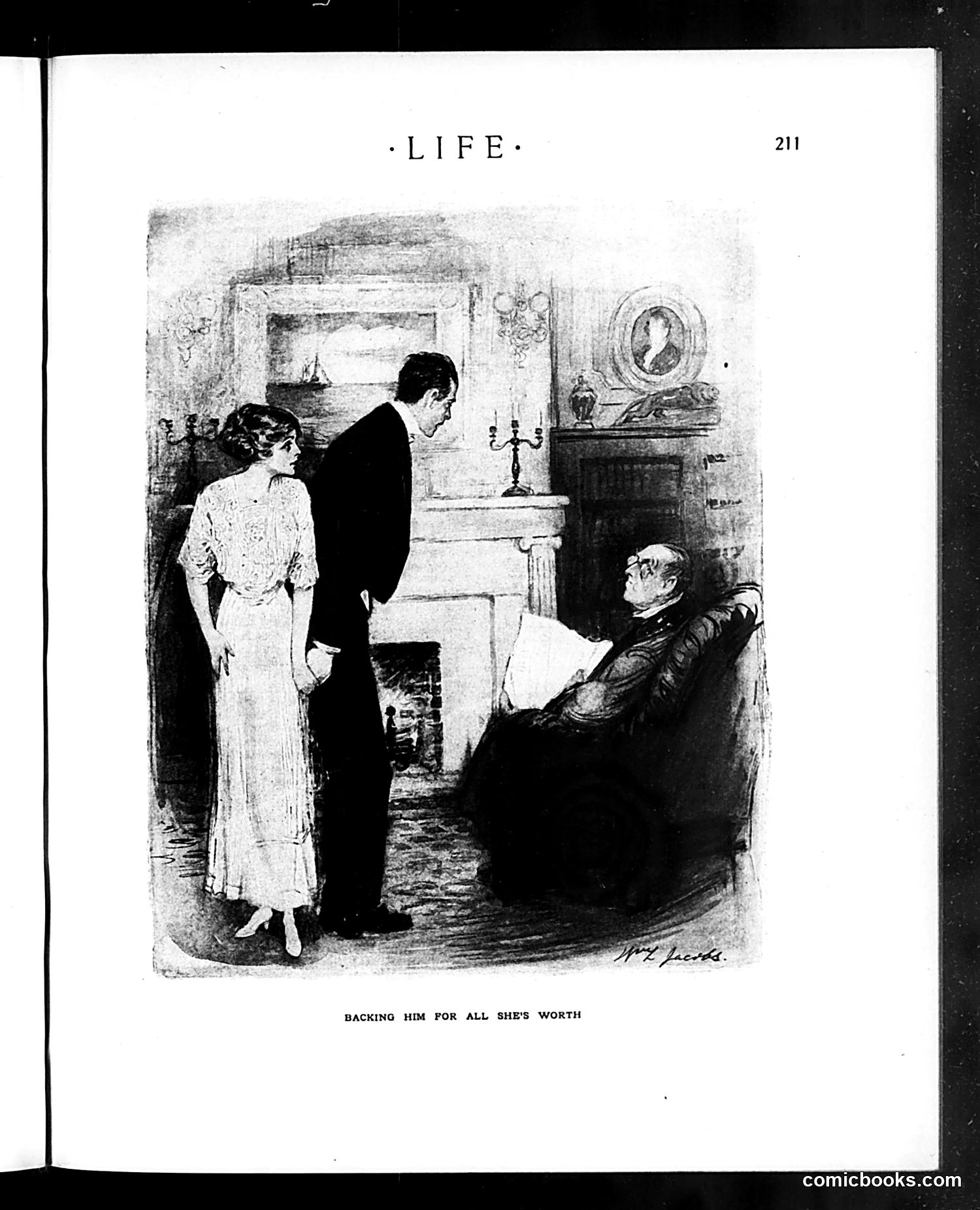
This cartoon depicts a domestic scene showing a woman standing supportively beside a man in formal attire, while an older man sits in a chair nearby. The caption suggests the woman is providing strong backing or support to the central male figure. The drawing style and setting—an elegant interior with a fireplace and portrait—indicate this is likely satirizing upper-class or political relationships. The specific meaning depends on context from Life magazine's era, but the composition suggests commentary on spousal support, financial backing, or a woman's role in advancing a man's ambitions or position. Without additional contextual information about the publication date or specific figures referenced, the precise satirical target remains unclear, though the theme clearly concerns gender dynamics and patronage.
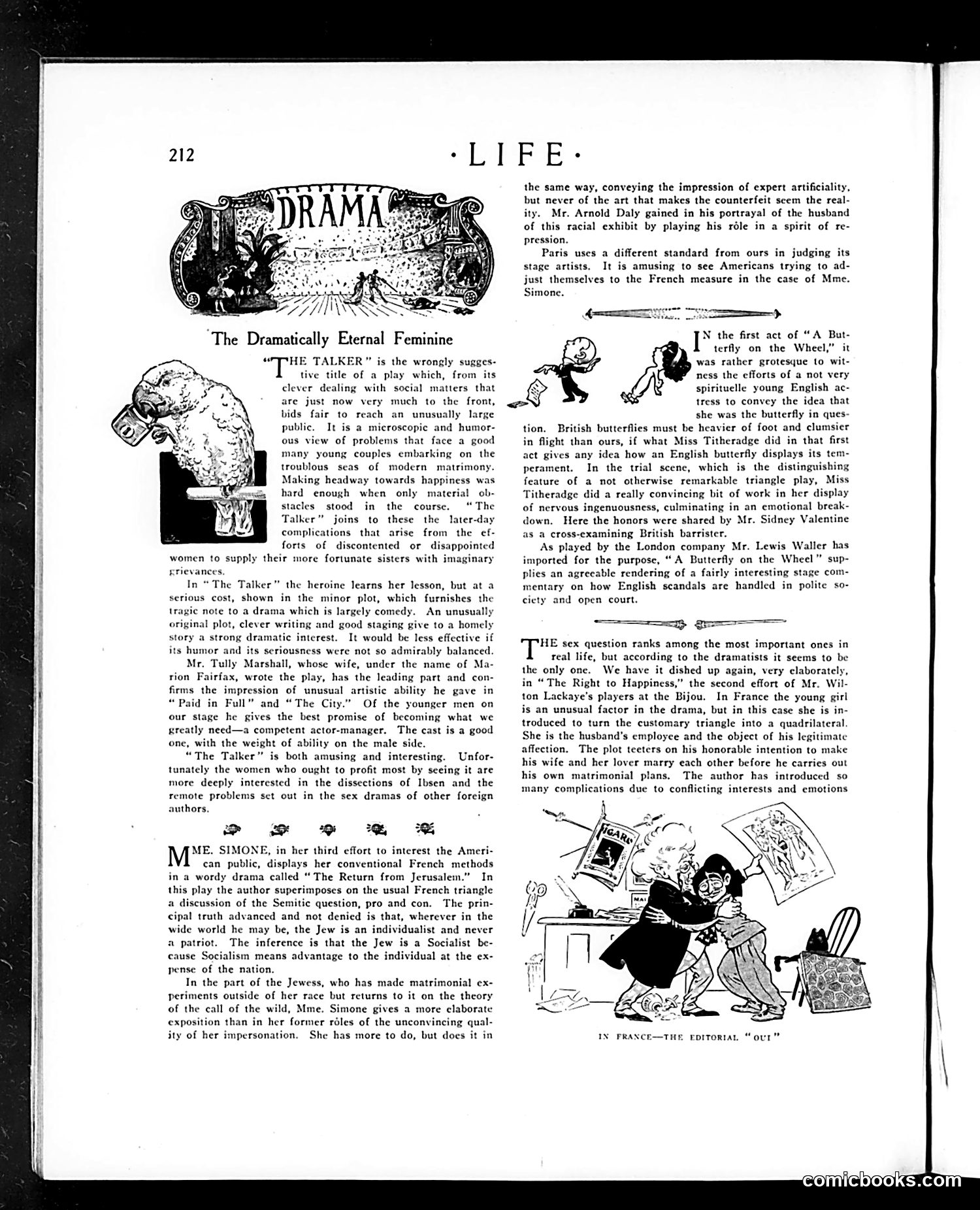
This page contains theater reviews from Life magazine's drama section. The main content discusses three plays: **"The Talker"** — A comedy about modern marriage problems, praised for balancing humor with serious social commentary. The review notes it stars actor-manager Tully Marshall and criticizes female audiences for preferring Ibsen's work to this more accessible piece. **"The Return from Jerusalem"** by Mme. Simone — A French play combining a love triangle with debate about Jewish identity and patriotism. The review dismisses Simone's acting as artificially expert but emotionally hollow, and sarcastically notes Americans struggle to adopt French standards for judging stage artists. **"A Butterfly on the Wheel"** — The review mocks an English actress's portrayal of a delicate butterfly character, suggesting British actresses are heavier and clumsier than American ones. The cartoons illustrate the "eternal feminine" theme—women causing domestic complications through discontent. The satire targets both theatrical artificiality and period gender stereotypes about women's emotional nature.
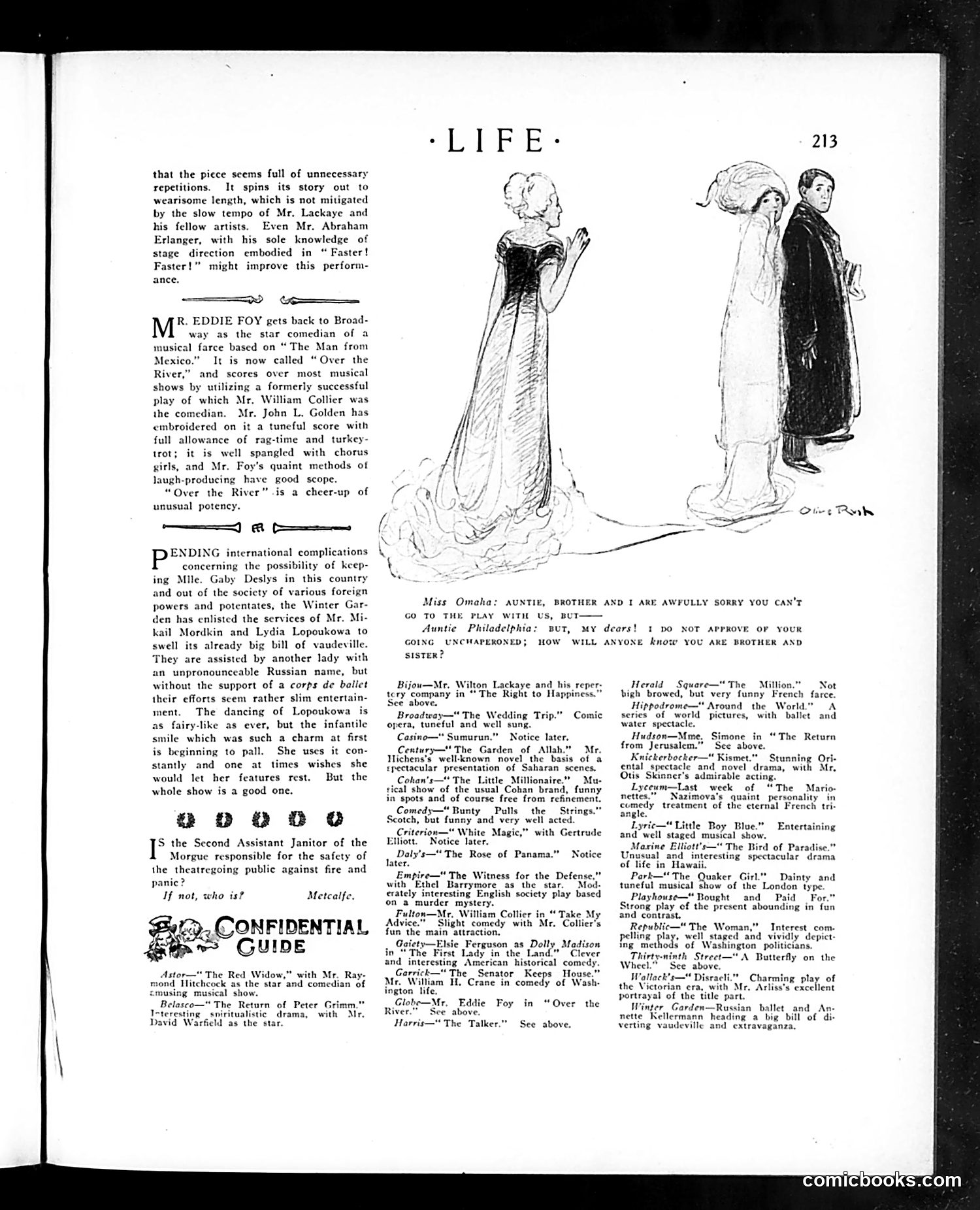
This page contains theater reviews mixed with a pointed satirical cartoon about social propriety. **The Main Cartoon:** A young woman ("Miss Omaha") writes to her aunt ("Auntie Philadelphia") seeking permission to attend a play unchaperoned. The aunt's response—delivered by her brother—sternly refuses, insisting the girl cannot go "unchaperoned" and demanding to know how anyone would recognize her as a respectable unmarried woman without a chaperone present. **The Satire:** This mocks rigid Victorian-era social conventions that required unmarried women to be constantly supervised in public. The absurdity is that attending a theater—a respectable entertainment—required a chaperone, and that a woman's reputation depended entirely on visible supervision rather than her own character or behavior. **Context:** This reflects early 20th-century anxieties about women's increasing independence, particularly their desire for public freedom and social activities without constant male oversight. The rest of the page consists of standard theater reviews of contemporary Broadway shows.
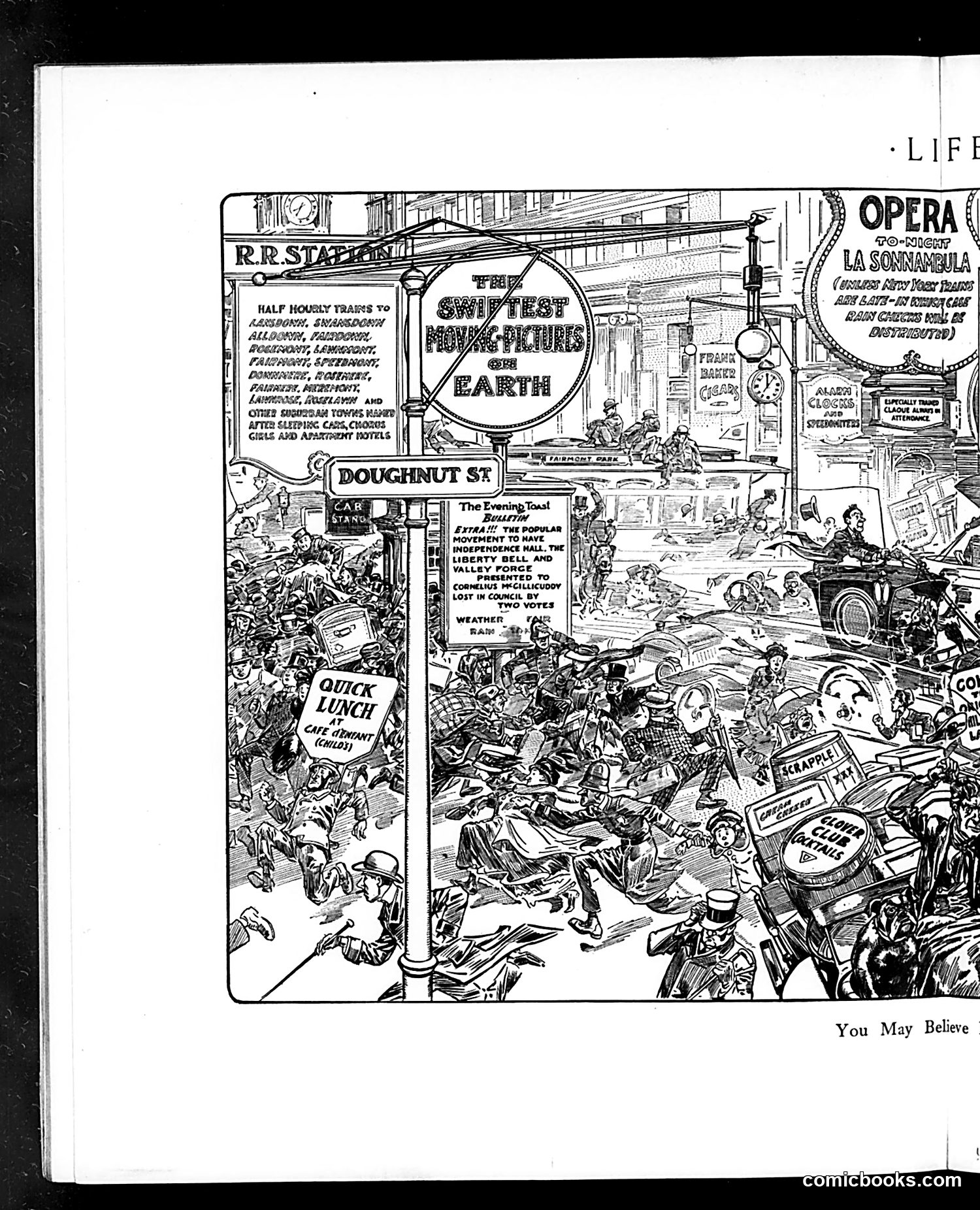
This is a satirical illustration depicting a chaotic street scene centered on Philadelphia landmarks. The cartoon mocks what appears to be a local political movement (likely early 20th century) proposing to relocate Independence Hall, the Liberty Bell, and Valley Forge. The visual joke shows the absurdity of this proposal through a crowded, tumultuous street scene with cars, pedestrians, and general disorder at "Doughnut St." and the R.R. Station. Text boxes reference "The Sweetest Home on Earth" and mention weather reports sarcastically. The satire suggests that moving these foundational American historical symbols would be ridiculous and chaotic—hence the chaotic street scene as visual metaphor. The proposal apparently failed narrowly ("lost in Council by two votes"), making it a real but ultimately rejected idea worth mocking. The cartoon ridicules both the proposal and the close vote, implying only folly could come from relocating America's historical treasures.
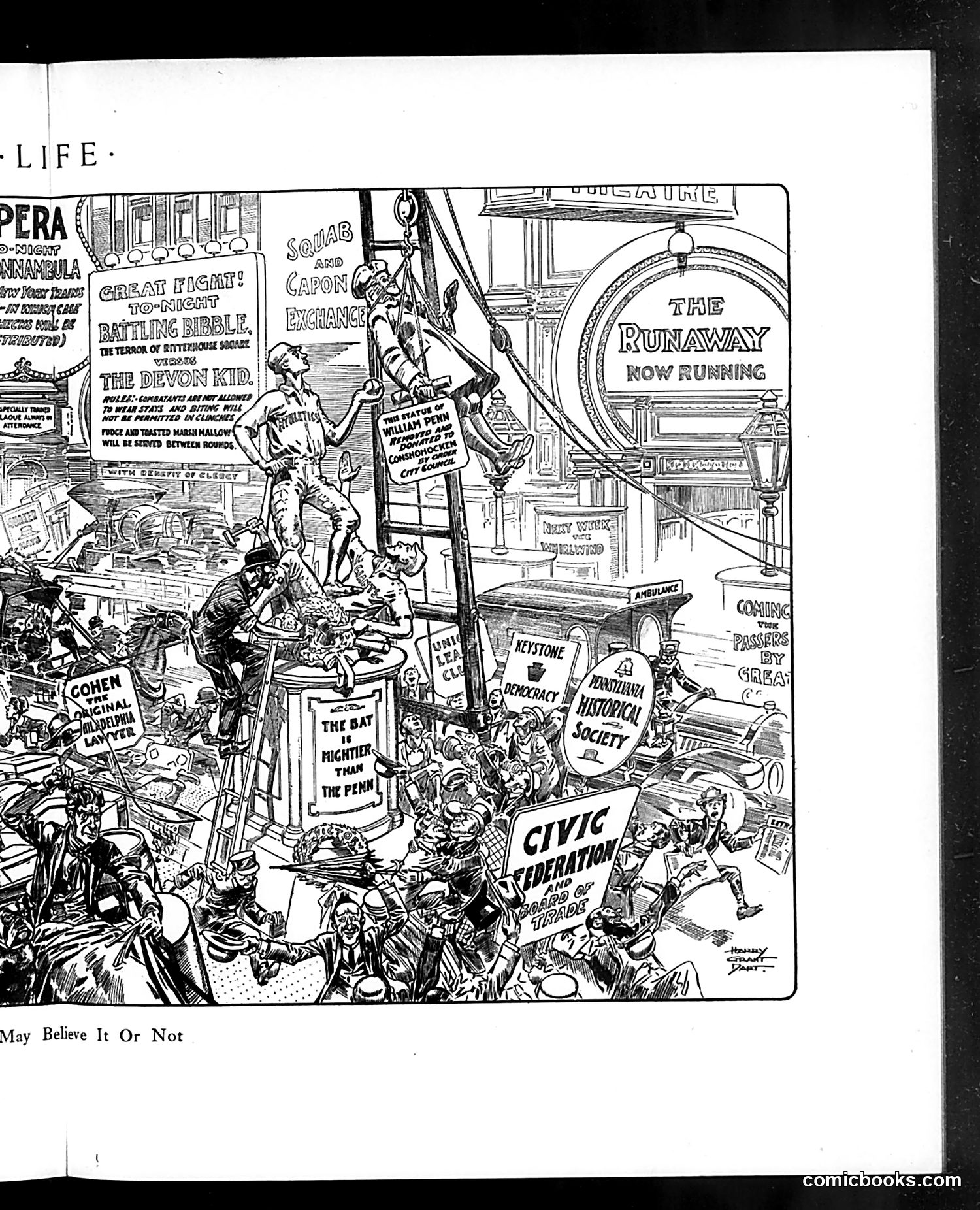
This is a crowded satirical scene depicting various Philadelphia civic institutions and organizations participating in what appears to be a chaotic parade or demonstration. Visible signs reference the "Keystone Democracy Historical Society," "Civic Federation," and other local organizations. The cartoon mocks Philadelphia's civic life through exaggerated activity and disorder. There are references to theaters (opera), legal services ("Cohen, Original Dyed-in-Wool Lawyer"), and various social institutions. The chaos suggests satire about Philadelphia's government, institutions, or civic administration—likely critiquing their inefficiency or dysfunction. The "Believe It Or Not" caption at bottom suggests the absurdity being depicted. Without knowing the specific publication date, the exact political targets remain unclear, though the piece satirizes the city's institutional landscape.
This is a book review of George Moore's *Hail and Farewell*, disguised as literary commentary. The author uses an opening anecdote about a Strauss symphony to make a satirical point: Moore's American publishers have written an overly instructive prefatory note that tells readers what to think about the book, rather than letting them experience it directly. The satire targets the publishers' patronizing attitude toward Moore—treating him like a "foster-parental hen" protecting a reckless duckling. The reviewer criticizes this hand-holding approach, arguing readers should engage with the work on their own terms without predetermined interpretations. The underlying joke: the publishers are so worried Moore might embarrass himself (he has a reputation for risqué content) that they've essentially provided a safety manual. The title references Moore's Irish identity and the phrase "wearing of the green," suggesting his literary voice is distinctly Irish—yet the publishers want to mediate that authenticity for American readers.
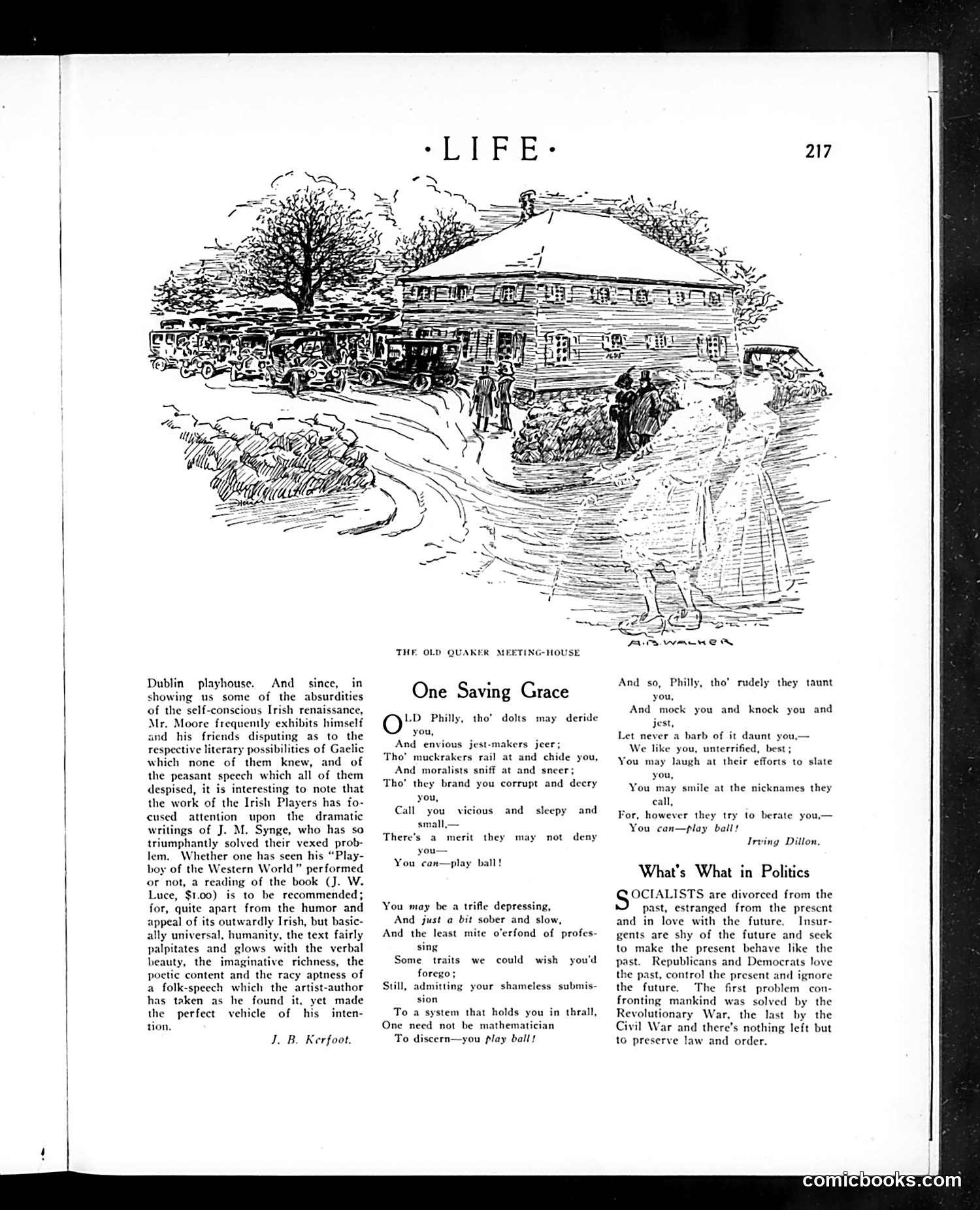
**The Sketch:** "The Old Quaker Meeting-House" depicts a rural Pennsylvania building with period figures and carriages—illustrative content accompanying a literary review. **"One Saving Grace":** This poem praises Philadelphia ("Old Philly") despite its perceived faults—described as depressing, sober, corrupt, and submissive to a restrictive system. The sole virtue the city possesses is that it can "play ball" (cooperate/function as expected). The satire mocks Philadelphia's reputation as a staid, conservative city by suggesting compliance is its only redeeming quality. The repeated refrain "play ball" suggests the city's willingness to go along with the status quo rather than innovate or rebel. **"What's What in Politics":** This brief commentary characterizes American political movements: Socialists reject the past; Insurgents reject the future; Republicans and Democrats cling to the past while controlling present politics. The author suggests major American problems were solved by the Revolutionary and Civil Wars, with nothing substantive remaining except law-and-order maintenance—a somewhat cynical assessment of contemporary politics and progress.
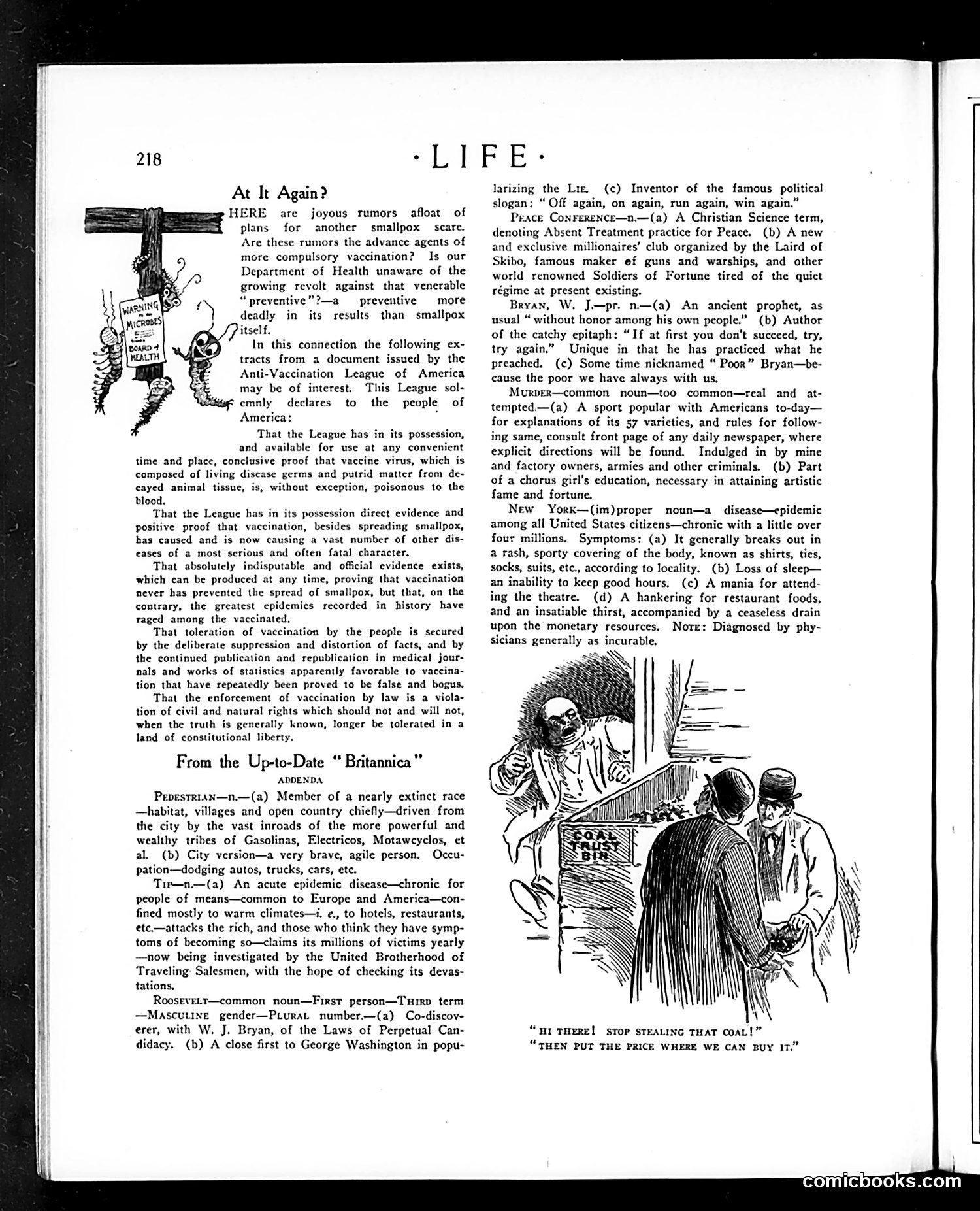
This page mocks the **Anti-Vaccination League of America**, presenting their claims as absurd. The League claims vaccines contain "putrid matter" and cause disease rather than prevent it—arguments Life presents to ridicule anti-vaccination activism gaining traction in early 20th-century America. The cartoon (bottom right) shows a thief stealing coal, with the caption sarcastically suggesting price-fixing: "Stop stealing that coal! Then put the price where we can buy it." The satirical dictionary definitions mock contemporary political figures and issues: **Roosevelt** is lampooned for perpetual political candidacy and his "Off again, on again" political maneuvering; **Bryan** (William Jennings Bryan) is referenced as a perennial candidate; and **"Tin"** (influenza/typhoid) is presented as an epidemic affecting the wealthy. Life satirizes both anti-vaccine pseudoscience and Gilded Age corruption simultaneously.
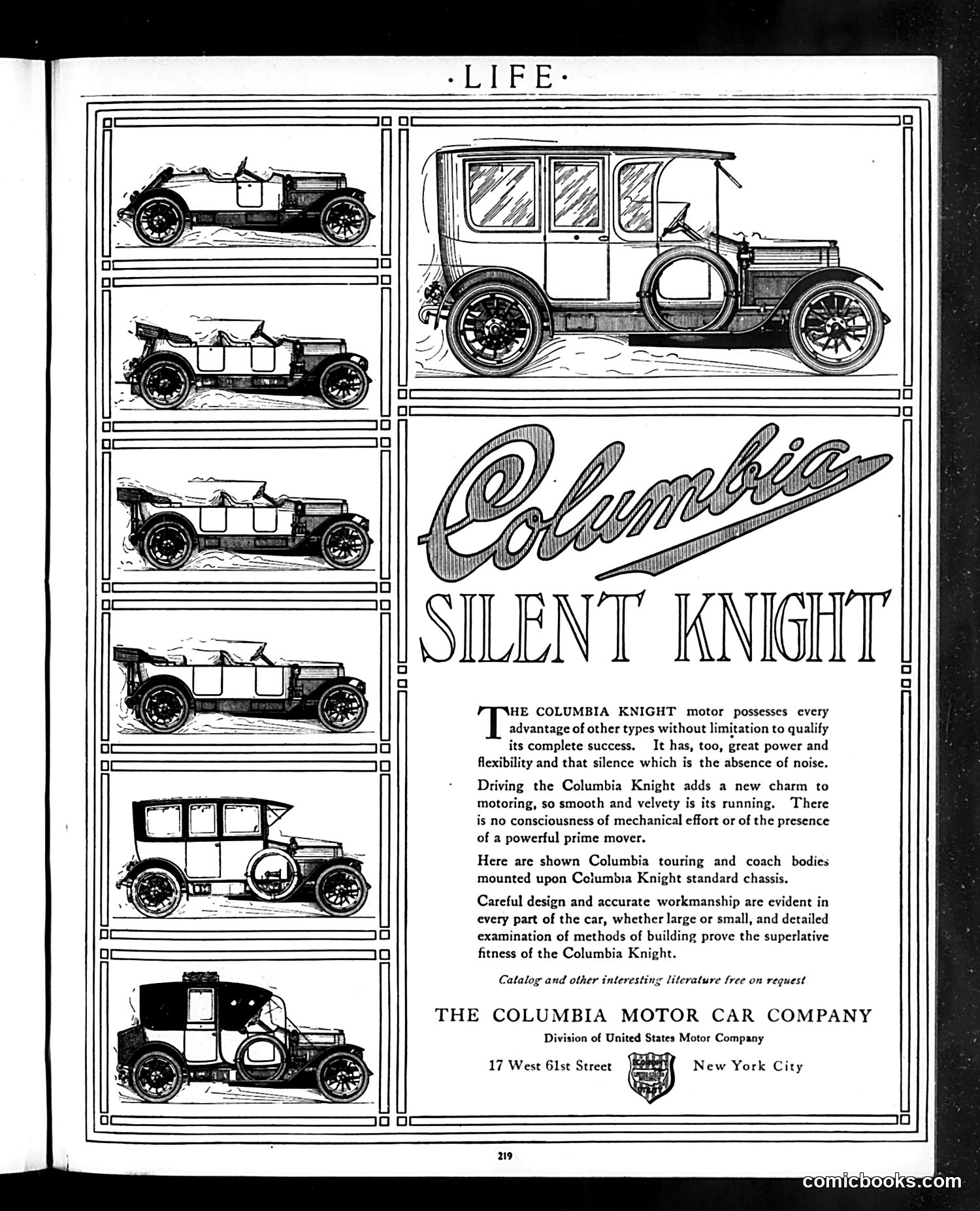
This is a **full-page automobile advertisement**, not political satire. The Columbia Motor Car Company showcases their "Silent Knight" vehicle through six different body style variations (touring cars, coaches, sedans) displayed on the left side of the page. The advertisement emphasizes the car's key selling points: quietness ("silence which is the absence of noise"), smooth operation, and powerful performance. The copy appeals to comfort-conscious buyers by highlighting the lack of "consciousness of mechanical effort"—a significant marketing angle when early automobiles were notoriously loud and mechanically demanding. The company, a division of United States Motor Company, operated from New York City. This represents typical early-20th-century automobile advertising that marketed luxury features and engineering refinement to affluent consumers.
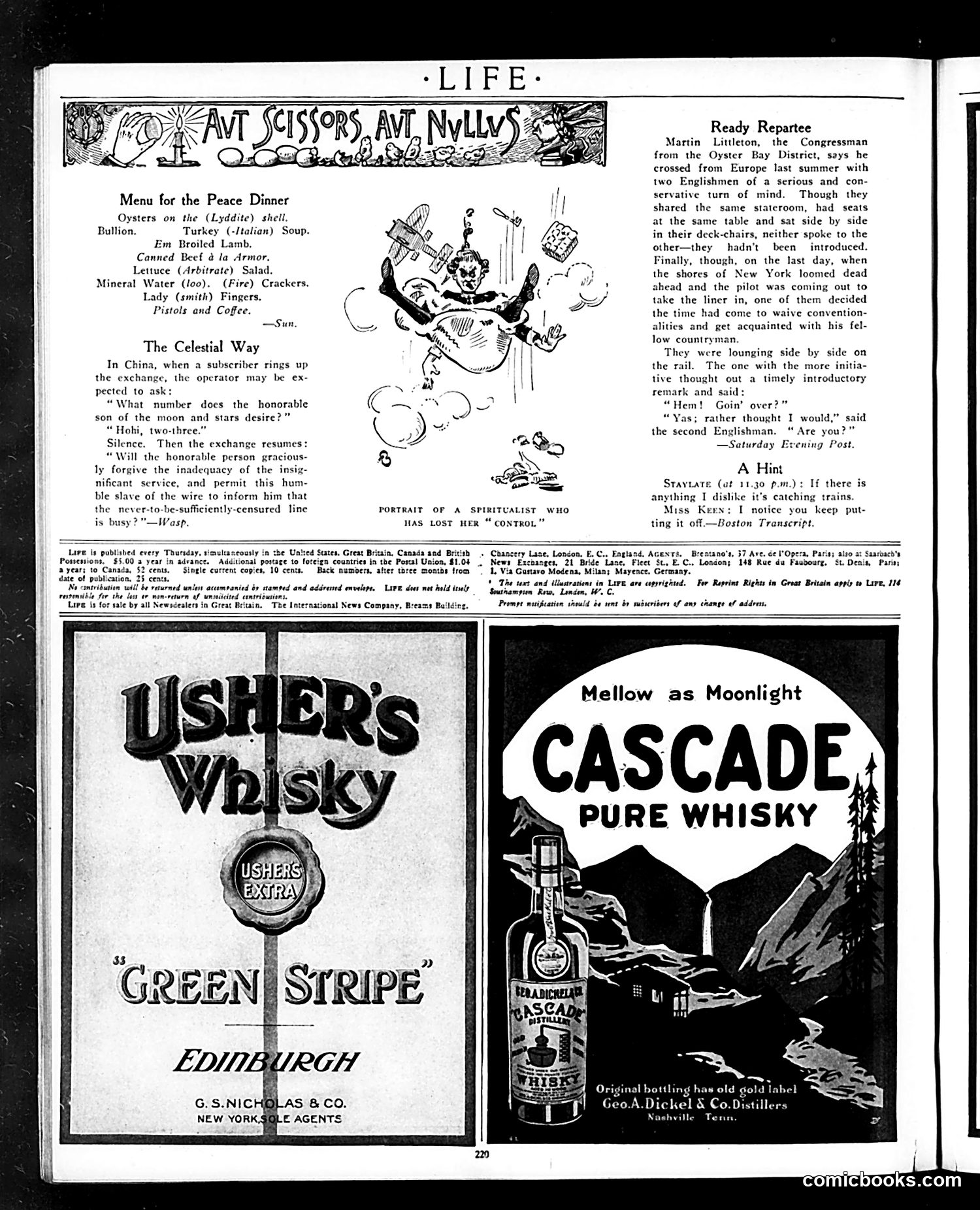
This page contains satirical humor and advertisements from an early 20th-century American publication. **"Menu for the Peace Dinner"** is a wordplay joke mocking post-war peace conferences. Course names contain war-related puns: "Lyddite" (an explosive), "Bullion" (wealth/war profiteering), "Canned Beef à la Armor" (military armor), "Arbitrate" salad, and "Pistols and Coffee"—suggesting peace negotiations are merely appetizers for continued conflict. **"The Celestial Way"** satirizes Chinese telephone operators' overly formal, verbose politeness—a stereotype for ethnic humor typical of the era. The **spiritualist cartoon** shows a woman losing control mid-séance, depicted falling/flailing chaotically—a visual gag about spiritualism's fraudulent nature. The remaining items are brief anecdotes poking fun at British reserve and social awkwardness. The page is primarily advertising whisky brands (Usher's, Cascade), with content filling space between ads—typical magazine layout of the period.
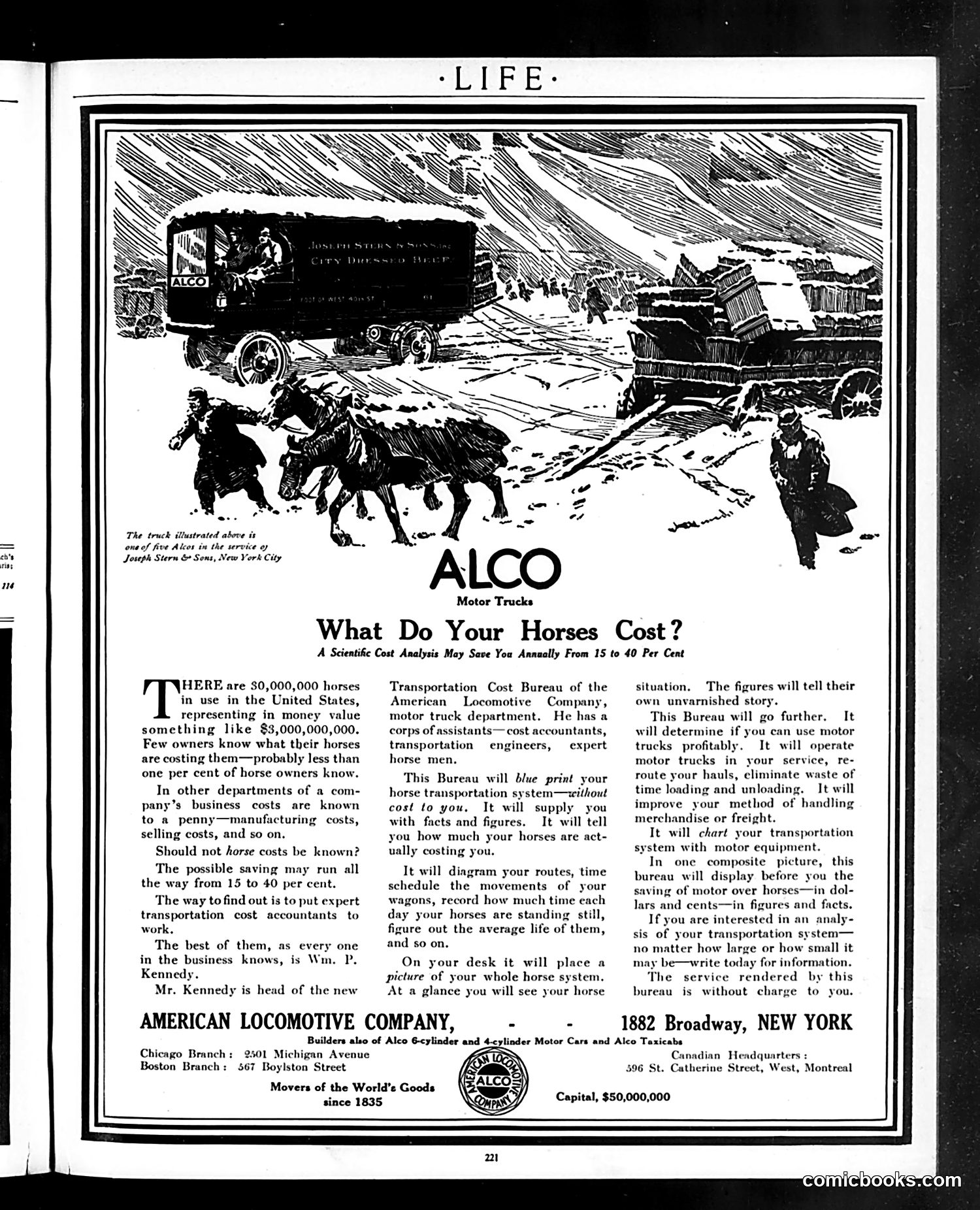
This is primarily a commercial advertisement for Alco motor trucks, not a political cartoon. The page depicts the early automotive industry's push to replace horse-drawn transportation. The image shows Alco trucks operating alongside horses and wagons in an urban setting, illustrating the transition from traditional to motorized transport. The text targets business owners, arguing they should calculate the true cost of maintaining 30 million horses in American service (worth $3 billion). The American Locomotive Company's Transportation Cost Bureau, headed by "Wm. P. Kennedy," offers free analysis to demonstrate that motor trucks could reduce transportation costs by 15-40 percent. For modern readers: this reflects America's early-1900s industrial shift. The advertisement essentially asks businessmen to abandon their horses for newfangled trucks—a revolutionary proposal when horses were standard. The "scientific cost analysis" pitch represents early industrial management thinking and marketing strategy during this transitional era.
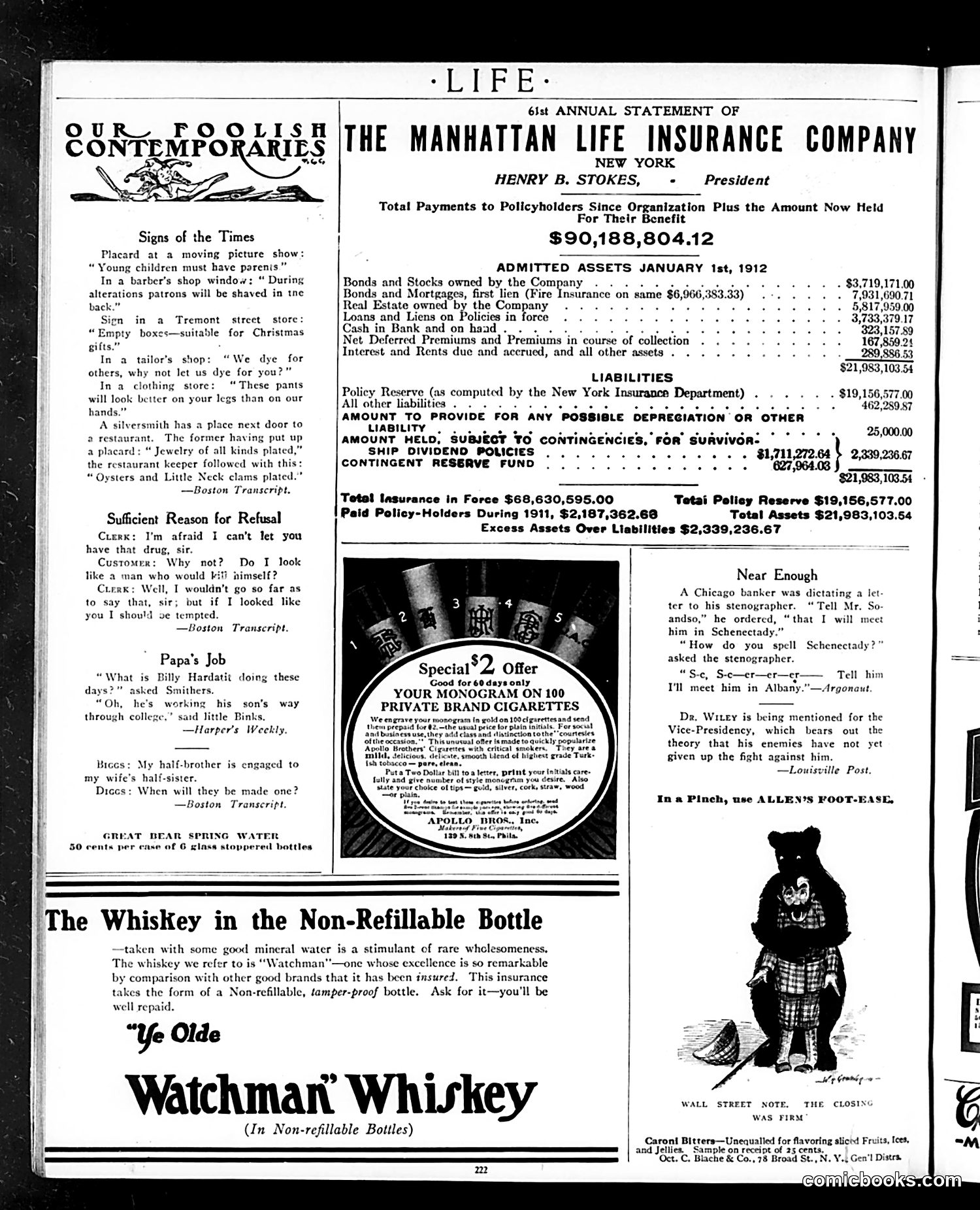
This page from *Life* magazine (dated 1912, based on the Manhattan Life Insurance statement) is primarily a collection of **short humorous anecdotes** under "Signs of the Times," plus advertisements and financial notices. The jokes satirize **everyday absurdities**—poorly worded business signs, a pharmacist's logic, a pun about a young man "working his way through college" by being supported through his son's education, and a banker's solution to spelling difficulty (changing "Schenectady" to "Albany" because it's easier). The central cartoon is absent or unclear in this image, but the page features advertisements for **"Ye Olde Watchman" Whiskey** (marketed as tamper-proof) and personalized cigarettes, typical of 1912 consumer goods. The **financial statement** for Manhattan Life Insurance dominates the upper half—standard corporate advertising presenting assets and liabilities to build investor confidence during an era when insurance company solvency was a public concern. The humor throughout is gentle, observational satire targeting minor linguistic and social confusions of urban American life.
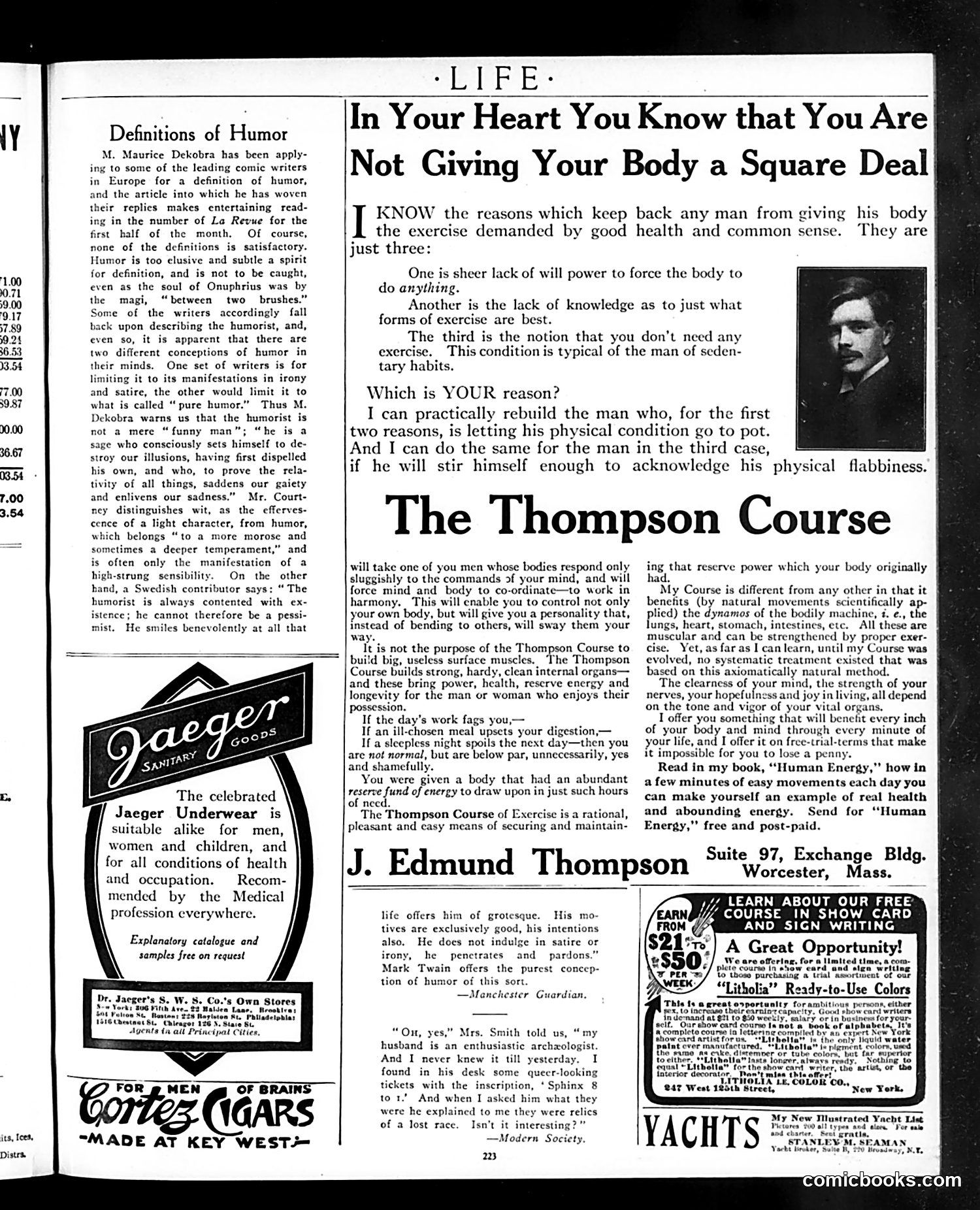
This page is primarily **advertising and health promotion content**, not political satire. The main article promotes "The Thompson Course" — a mail-order exercise program by J. Edmund Thompson promising to build internal organs and restore bodily vigor. The page includes: 1. **A column on humor definitions** discussing European writers' attempts to define humor — contrasting "pure humor" (benevolent, accepting) with satirical wit (critical, exposing illusions). 2. **Multiple advertisements** for Jaeger Underwear and Cortez Cigars — period products marketed with health claims. 3. **The Thompson Course pitch** — promising to coordinate "mind and body" and restore "reserve energy," addressing the sedentary lifestyle concerns of the era. 4. **A closing anecdote** about a woman discovering her husband has been placing bets (disguised as archaeological "relics of a lost race") — a gentle joke about deception. The tone reflects early 20th-century anxieties about physical fitness and health, targeting men specifically with promises of vigor and control.
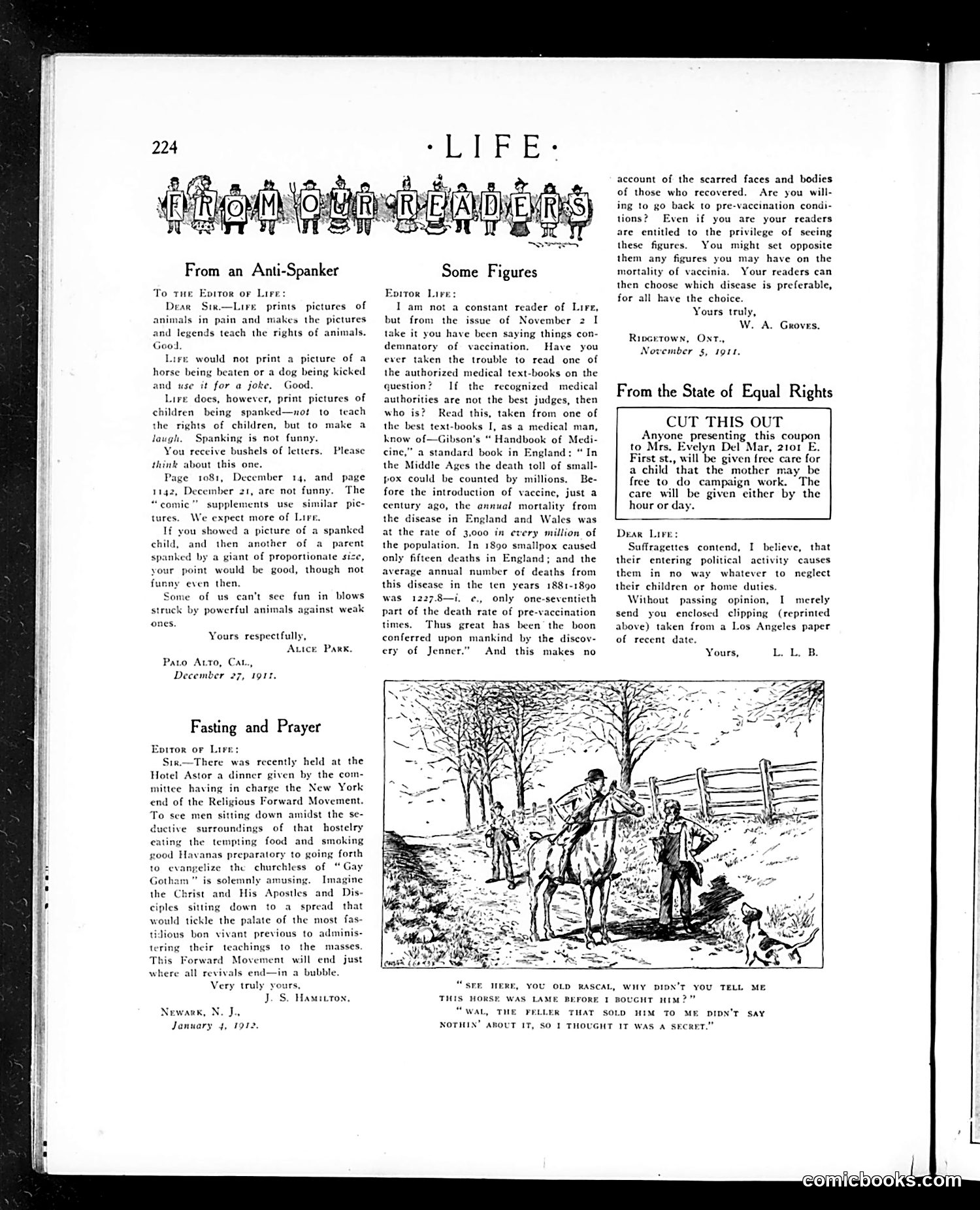
This page collects reader letters responding to Life's editorial stances. Key content: **Animal Rights vs. Child Discipline**: Alice Park criticizes Life for publishing spanking cartoons as humor while refusing to mock animal abuse. She argues this inconsistency undermines children's rights. **Religious Hypocrisy**: J.S. Hamilton mocks the "Religious Forward Movement" dinner at the upscale Hotel Astor, finding it absurd that clergymen feast luxuriously before preaching temperance—like Christ dining lavishly before teaching the apostles. **Vaccination Debate**: W.A. Groves defends vaccination against Life's apparent anti-vaccine stance, citing medical statistics showing smallpox mortality plummeted from 3,000 per million (pre-vaccine) to near-zero by 1890. **Suffrage**: An incomplete letter from "L.L.B." addresses suffragettes' claims that political activism doesn't neglect domestic duties. These letters reflect early 20th-century progressive debates: animal welfare, religious authenticity, public health, and women's rights.
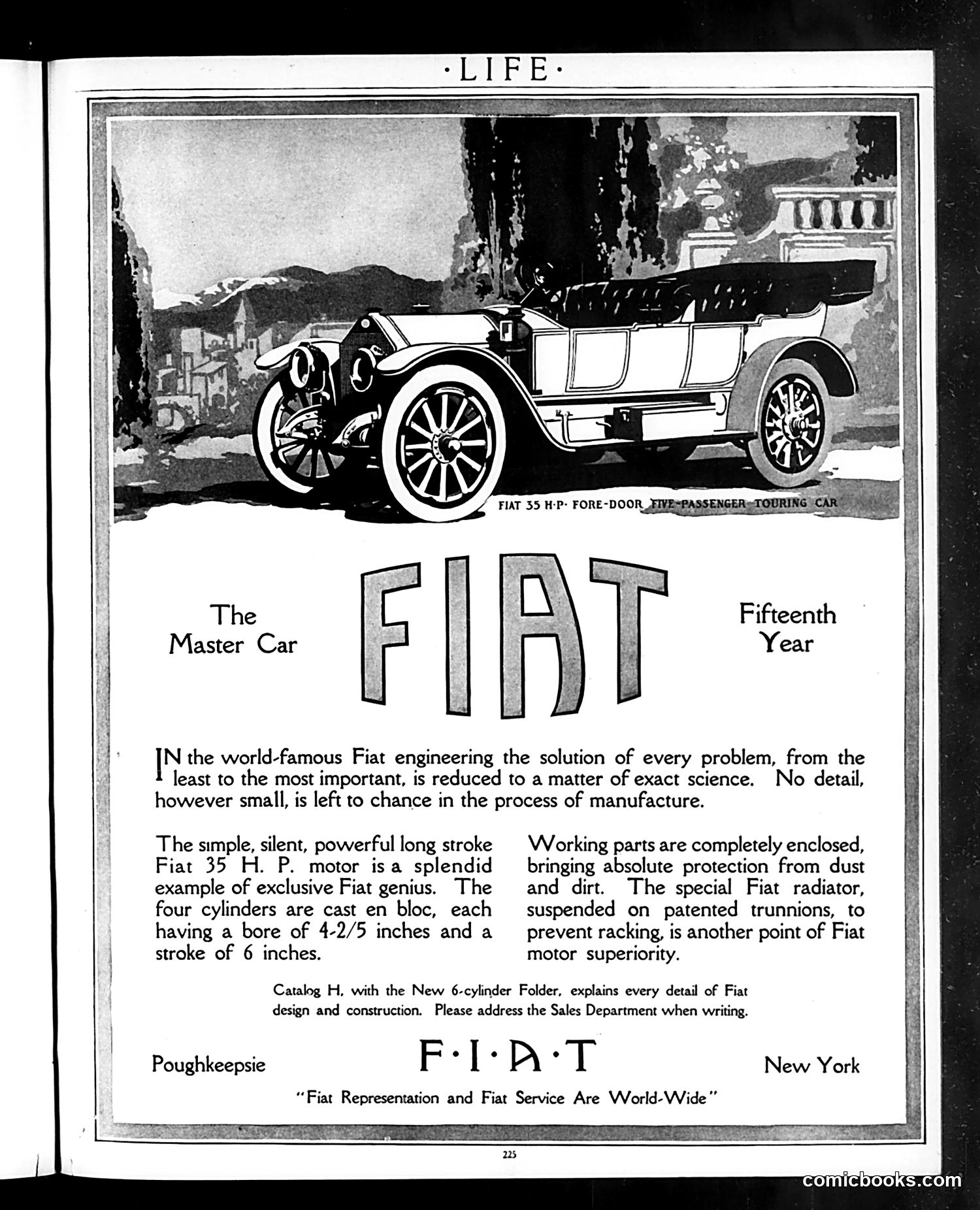
This is a straightforward automobile advertisement, not satire or political content. It's a FIAT car advertisement from *Life* magazine promoting the Fiat 55 H.P. five-passenger touring car, described as "The Master Car" in its "Fifteenth Year." The ad emphasizes engineering precision and manufacturing quality—that Fiat solves problems through "exact science" with no detail left to chance. It highlights specific technical features: the 35 H.P. long-stroke motor with four cylinders, enclosed working parts for dust protection, and a specially-designed radiator. The image shows a vintage open-air automobile typical of the 1910s-1920s era. The text includes a note about a detailed "Catalog H" and references Fiat's offices in Poughkeepsie, New York and worldwide representation. This is essentially a technical specification sheet dressed as advertising copy—there is no cartoon, satire, or political commentary present.
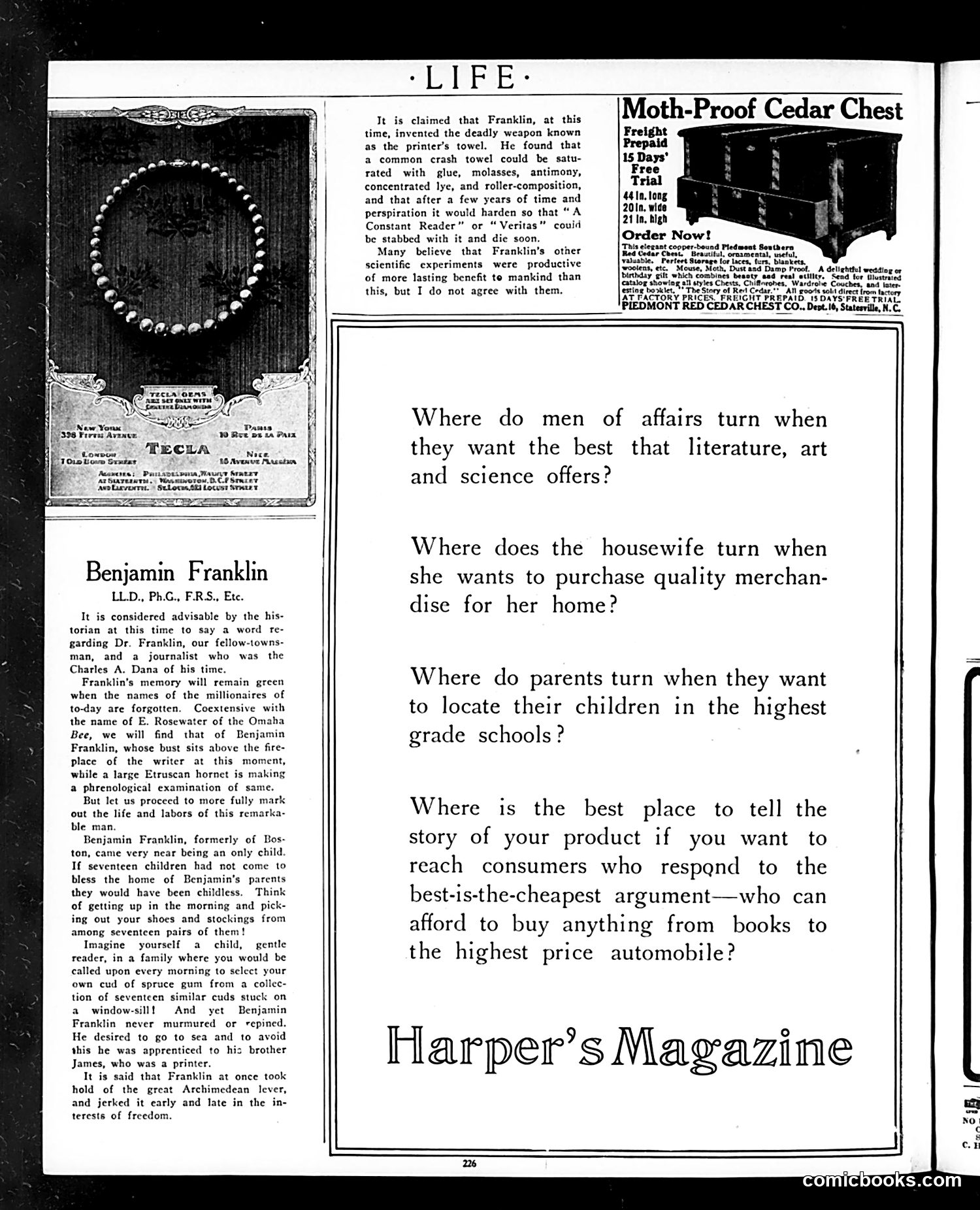
This page combines satirical content about Benjamin Franklin with advertising. The left side contains a humorous biographical essay about Franklin, presented as serious historical commentary but written with absurdist exaggeration. The joke appears to be a parody of reverent, overwrought biographical writing: the author credits Franklin with inventing a "deadly weapon" (a glue-saturated towel) and notes he "never murmured or repined" despite chaotic childhood circumstances with seventeen siblings. The right page is a straightforward advertisement for Harper's Magazine, using rhetorical questions to position the publication as the answer for educated consumers seeking quality literature, merchandise, and information—implicitly contrasting it with lower-brow alternatives. A cedar chest advertisement also appears, unrelated to the editorial content. The satire targets pretentious biographical hagiography and America's tendency to mythologize founding figures like Franklin, while the magazine advertisement appeals to middle and upper-class aspirations.
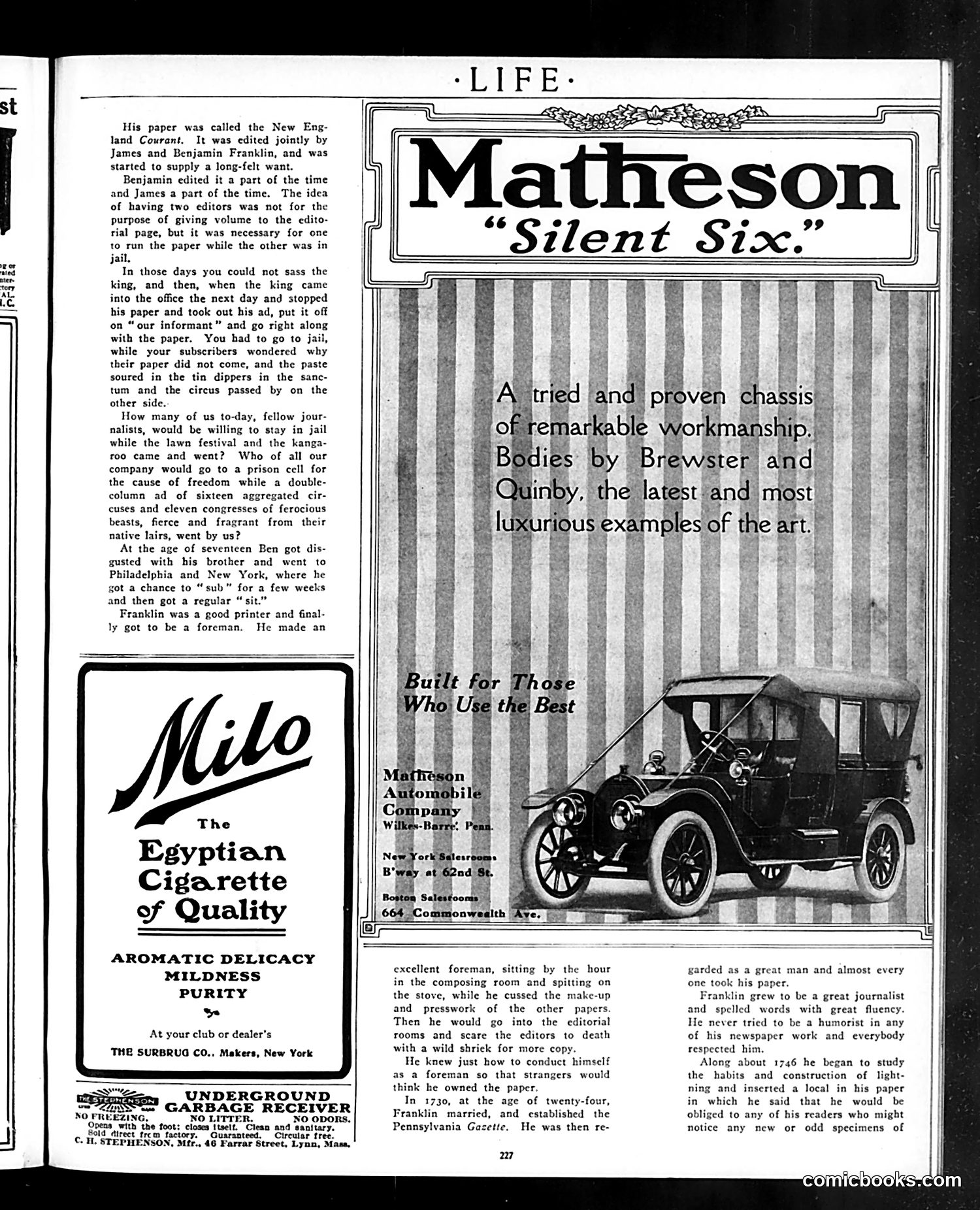
This page is primarily **advertising**, not satire or political commentary. The dominant content is an advertisement for the Matheson automobile, a luxury car marketed as having "a tried and proven chassis of remarkable workmanship" with bodies by premium manufacturers Brewster and Quinby. The left column contains historical text about Benjamin Franklin's journalism career—his work on the *New England Courant*, his imprisonment for press freedom, and his later success with the *Pennsylvania Gazette*. This appears to be **contextual editorial content**, possibly establishing Franklin as an American journalistic icon to lend prestige to the publication itself. The smaller advertisements for Milo cigarettes and an Underground Garbage Receiver are typical period magazine filler. There are **no cartoons or caricatures** visible on this page. The "Silent Six" in the Matheson ad likely refers to the car's engine type, a common marketing phrase of the era.
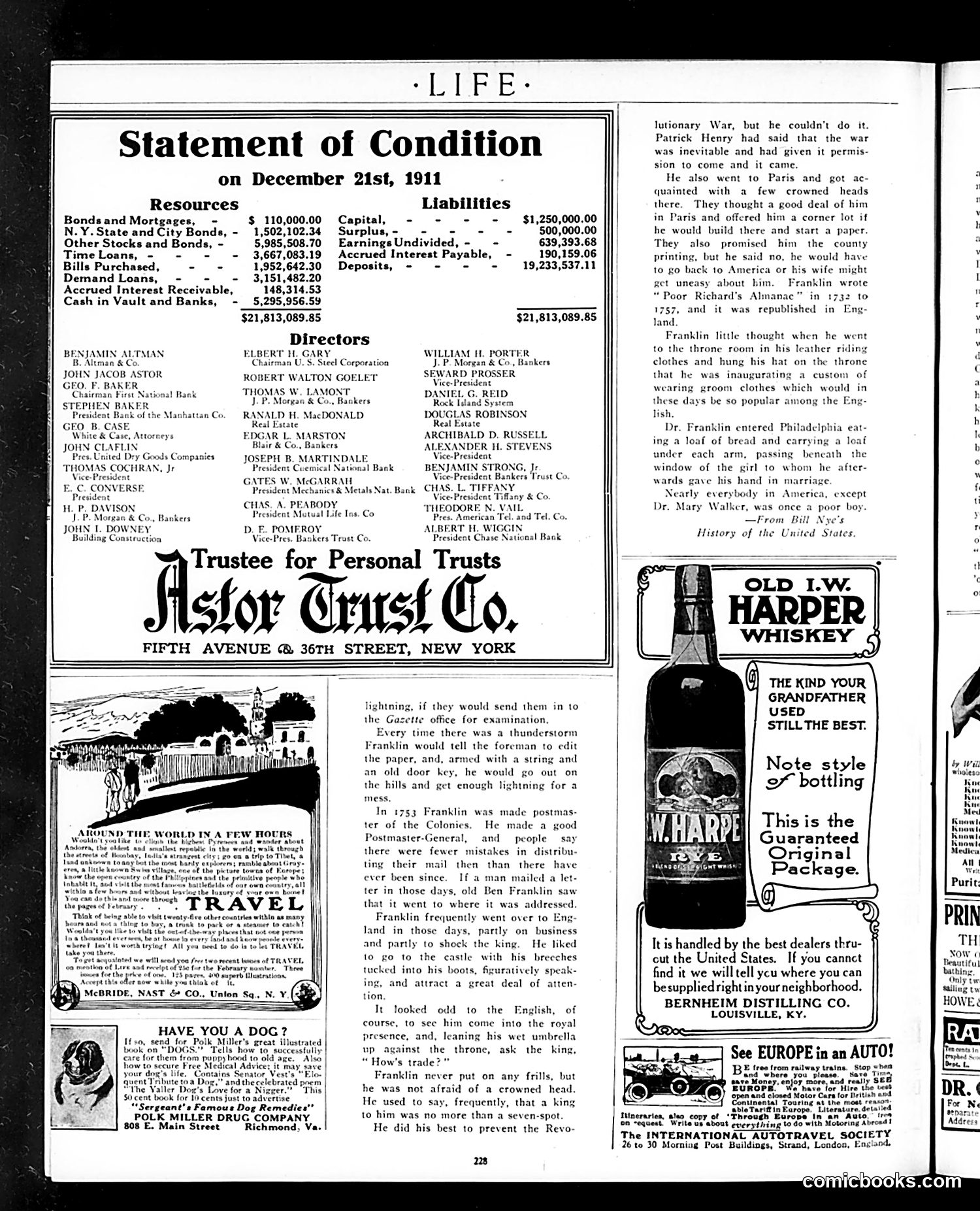
This page is primarily **financial and commercial content**, not political satire. The main feature is the Astor Trust Company's Statement of Condition—a bank balance sheet listing assets of $21.8 million and naming prominent directors (Astor, Baker, J.P. Morgan partners, Vanderbilt connections). The cartoon/illustrated content is minimal: a small landscape sketch accompanies text about Benjamin Franklin's postal service and diplomatic work in England and France. The narrative emphasizes Franklin's informality with royalty and his role preventing (unsuccessfully) the Revolutionary War. The page is otherwise dominated by advertisements—Astor Trust Co., Old I.W. Harper Whiskey, travel guides, dog remedies—typical of Life magazine's revenue model. **For modern readers**: This represents Life's mix of satirical content with institutional advertising targeting wealthy readers. The Franklin narrative is nostalgic Americana, not contemporary political commentary.
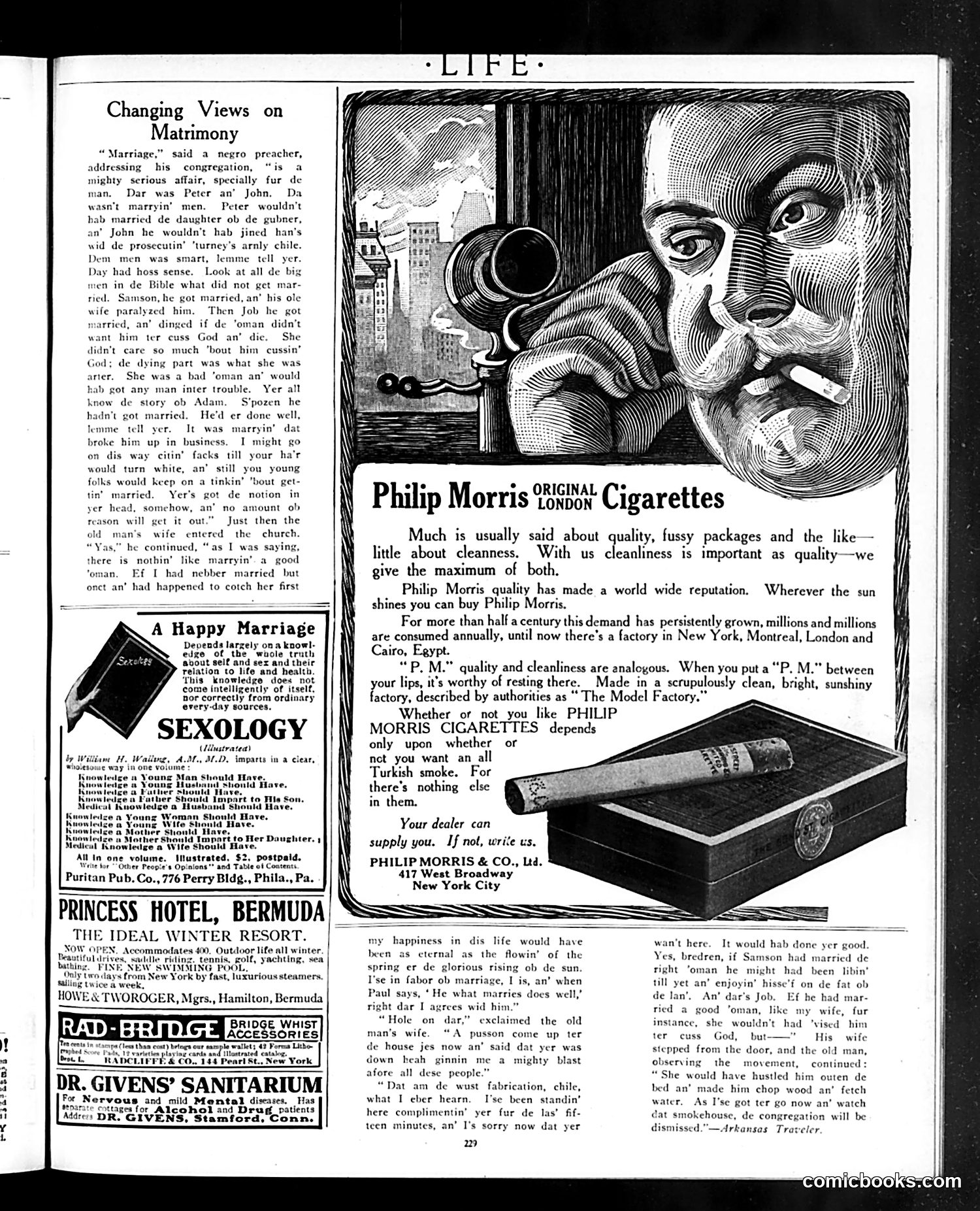
This page contains a satirical piece titled "Changing Views on Matrimony," presented as a dialect monologue by a Black preacher addressing his congregation about marriage—specifically warning against it. **The Satire:** The joke relies on racist stereotyping common in early 20th-century American humor. The preacher uses exaggerated dialect and cherry-picked biblical examples (Peter, John, Samson, Job, Adam) to argue that marriage has ruined men throughout history. The punchline occurs when his own wife enters the church mid-sermon, forcing him to abruptly reverse course and praise marriage as "a good [woman]." **The Point:** This plays on the stereotype of henpecked husbands and domineering wives—a frequent comedy trope of the era. The humor depends entirely on racial caricature and dialect humor that would be considered offensive today. The remainder of the page consists of period advertisements, including one for a "Sexology" book on marriage guidance and Philip Morris cigarettes emphasizing factory cleanliness.
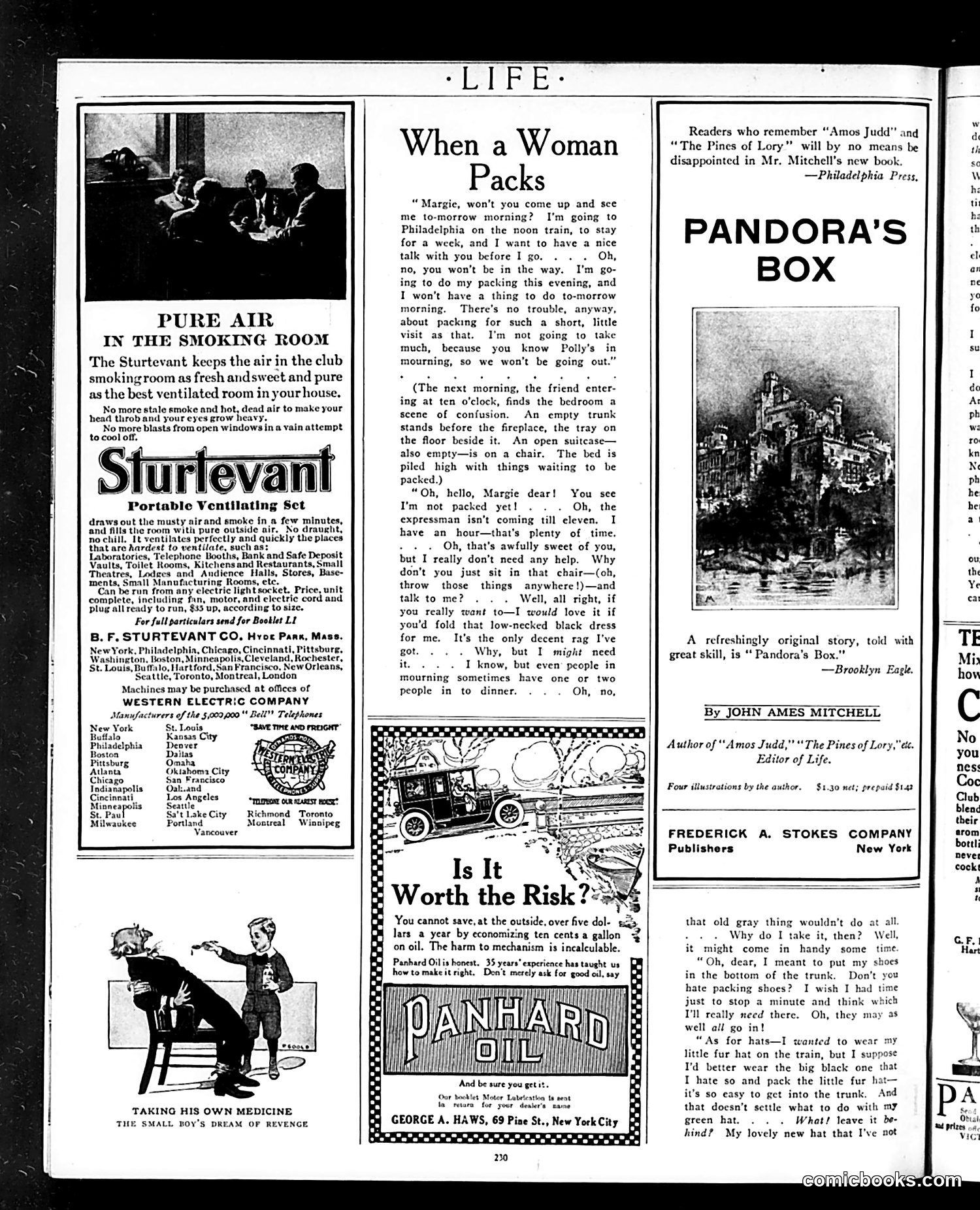
This page primarily contains **advertising and serialized fiction**, not political satire. The main content is "When a Woman Packs"—a humorous domestic story by John James Mitchell depicting the chaos of a woman preparing for a trip. The humor relies on period gender stereotypes: a woman who claims packing is effortless but creates massive disorder, then enlists a friend to help fold clothes while chattering away. The joke assumes readers will find it amusing that women are disorganized despite their confident claims. The cartoons are minor: "Taking His Own Medicine" shows a small boy administering bitter medicine to a doll—depicting childish revenge fantasies, likely resonating with readers' memories of unpleasant childhood medical experiences. The bulk of the page features advertisements for the Sturtevant ventilation system, Panhard Oil, and Mitchell's book "Pandora's Box." This was typical *Life* magazine content—mixing light humor with commercial messages for affluent, urban readers interested in consumer goods and literature.
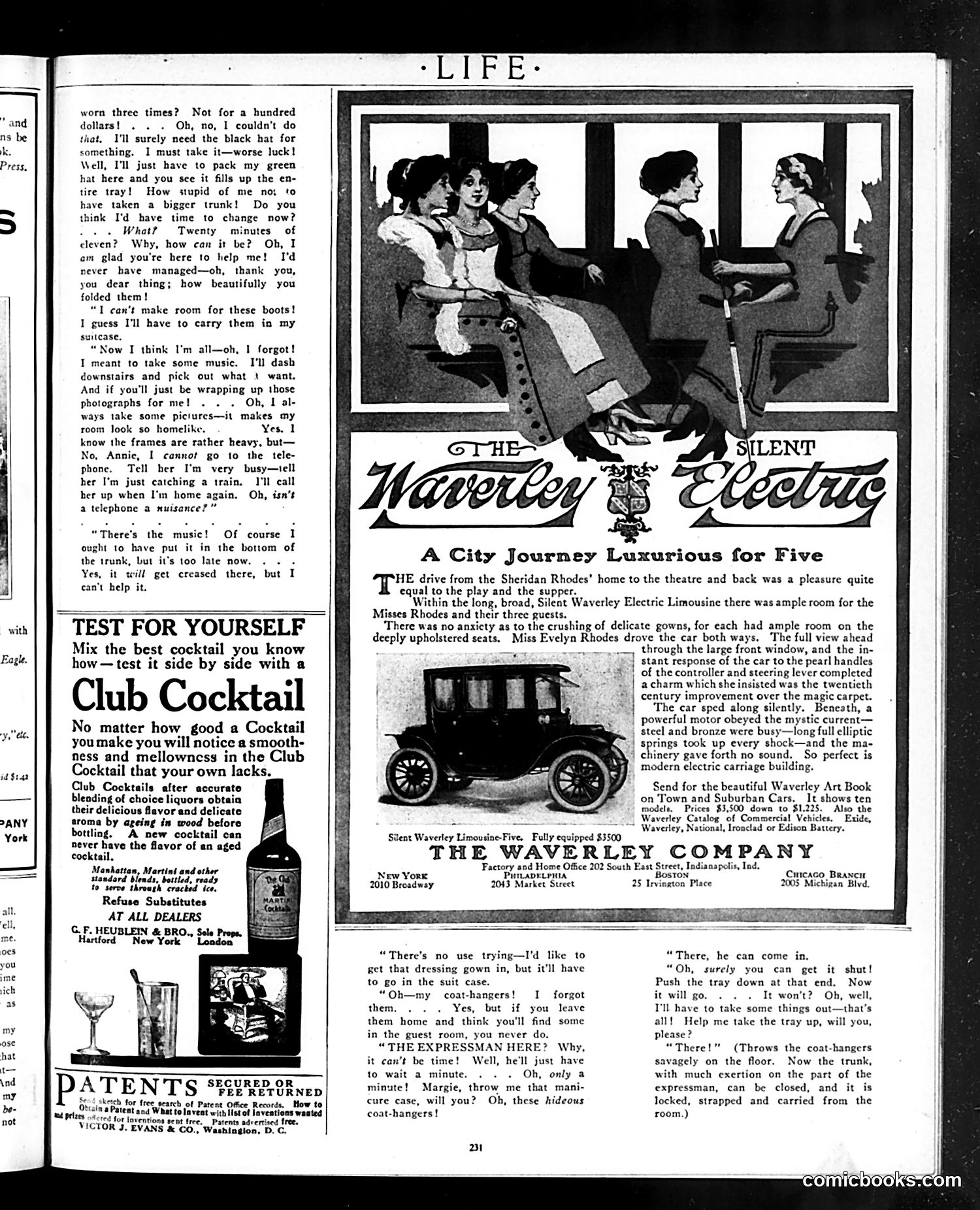
This page contains primarily **advertising content** rather than political satire or comics requiring historical context. The main feature is a **Waverley Electric automobile advertisement** showing women in an elegant limousine. The ad emphasizes luxury amenities: ample seating, smooth ride, silent operation, and modern engineering—selling the vehicle as superior to horse-drawn carriages. The left side includes a **domestic humor piece** about a woman frantically packing for travel, obsessing over which hats and items to bring—a relatable scenario for early 20th-century readers about travel anxieties. Below are advertisements for **Club Cocktail** (comparing homemade to commercial versions), **C.F. Heublein & Bros.** liquor distributor, and **patent services**. **Historical context**: The Waverley Electric was a real vehicle marketed to wealthy, primarily female consumers during the early 1900s when electric cars competed with gasoline engines. The advertisement's focus on women drivers and spacious interiors reflects the era's emerging female independence and automobile culture.
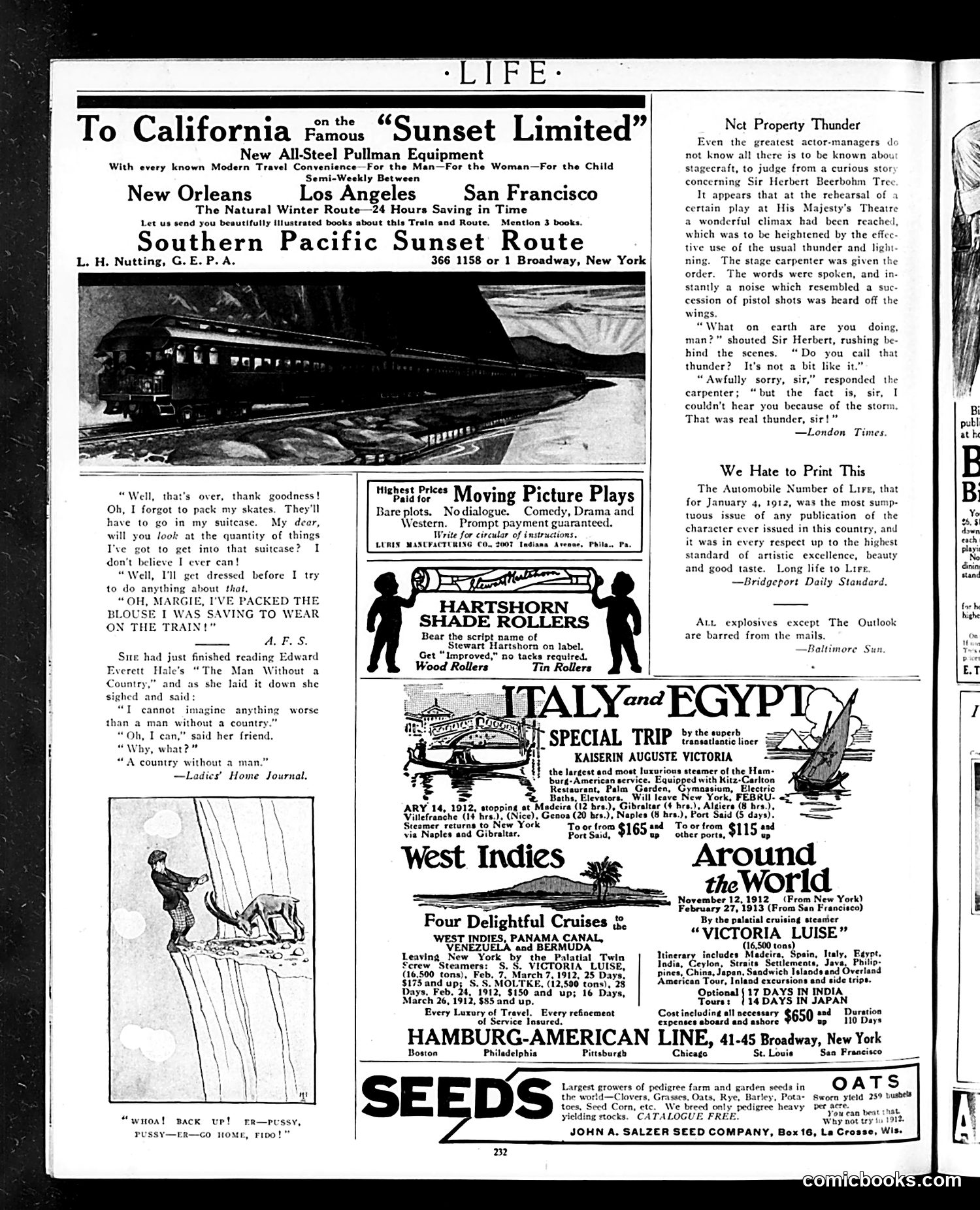
This page is primarily **advertising**, not political satire. It features travel and consumer product ads typical of early 1900s publications. The small cartoon at bottom-left shows a woman on a swing with the caption "Whoa! Back up! Er—pussy, pussy—or go home, Fido!" This is gentle domestic humor about a woman on a swing addressing her pets, reflecting period gender expectations. The main editorial content includes an anecdote about **Sir Herbert Beerbohm Tree** (a famous British actor-manager) at a theater rehearsal where real thunder interrupted a stage thunder effect, creating comedy through the contrast between artificial and genuine sound. The page also contains a brief satirical exchange where a woman, after reading Edward Everett Hale's "The Man Without a Country," declares she cannot imagine anything worse than a man without a country—to which her friend responds, "A country without a man," poking gentle fun at gender relations of the era. Otherwise, the page is dominated by luxury travel advertisements for steamships and trains.
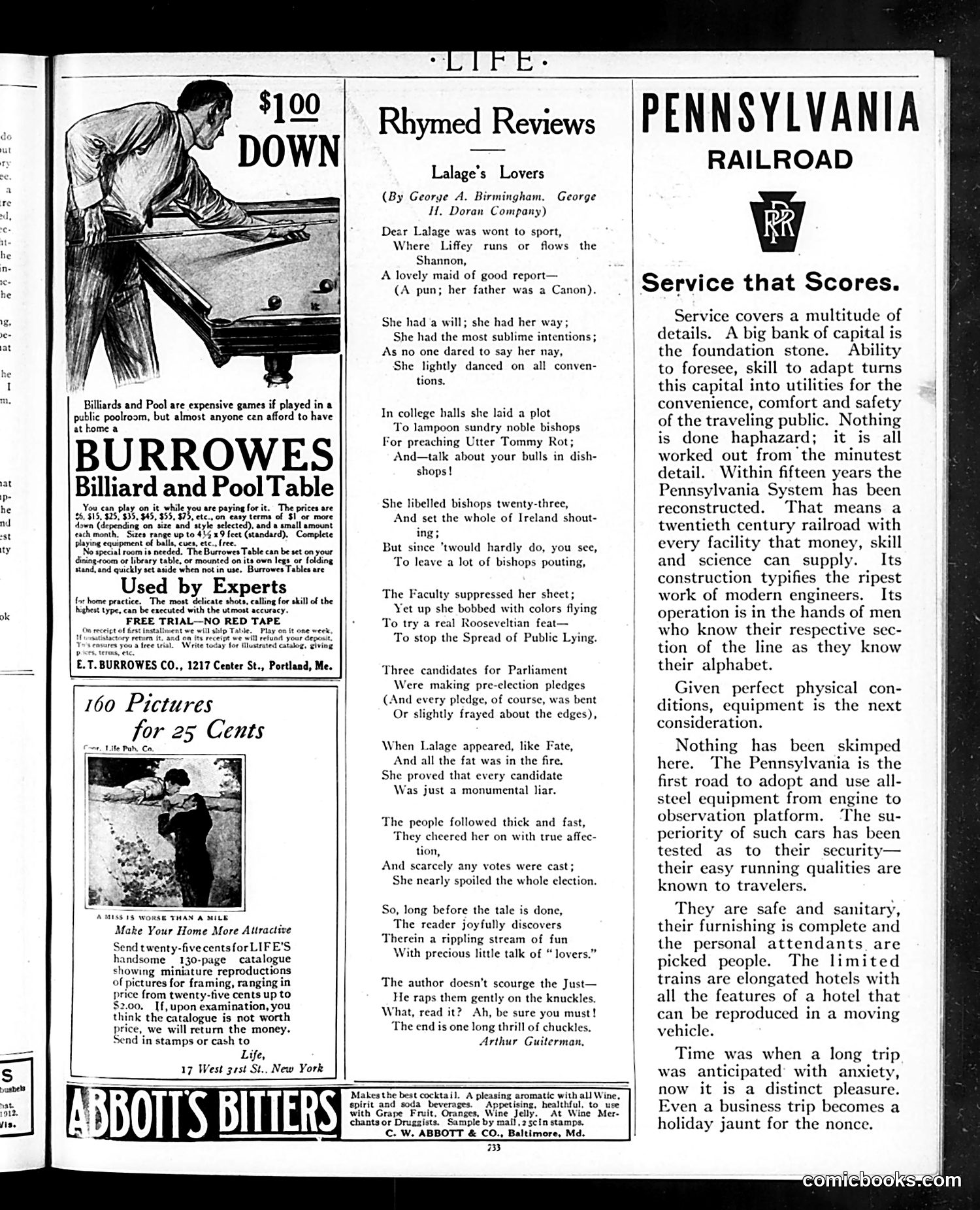
This page contains three distinct elements: **Left side:** A billiards advertisement featuring a man playing pool, with promotional copy for Burrowes Billiard and Pool Tables, plus a separate ad for Life magazine's picture collection. **Center:** A humorous poem titled "Lalage's Lovers" by George A. Birmingham, satirizing Irish politics and morality. The poem describes a young Irish woman named Lalage who publicly exposes politicians as liars during an election campaign, undermining their pre-election pledges. The satire targets both political hypocrisy and clerical corruption (bishops are repeatedly mocked). The ending suggests her truth-telling ironically "spoiled" the election by revealing all candidates as dishonest. **Right side:** Pennsylvania Railroad corporate advertising emphasizing service quality, modernization, safety equipment, and professional staff—selling railroad travel as a refined, reliable experience. The page juxtaposes entertainment/consumer products with transportation advertising typical of early 20th-century magazine layouts.
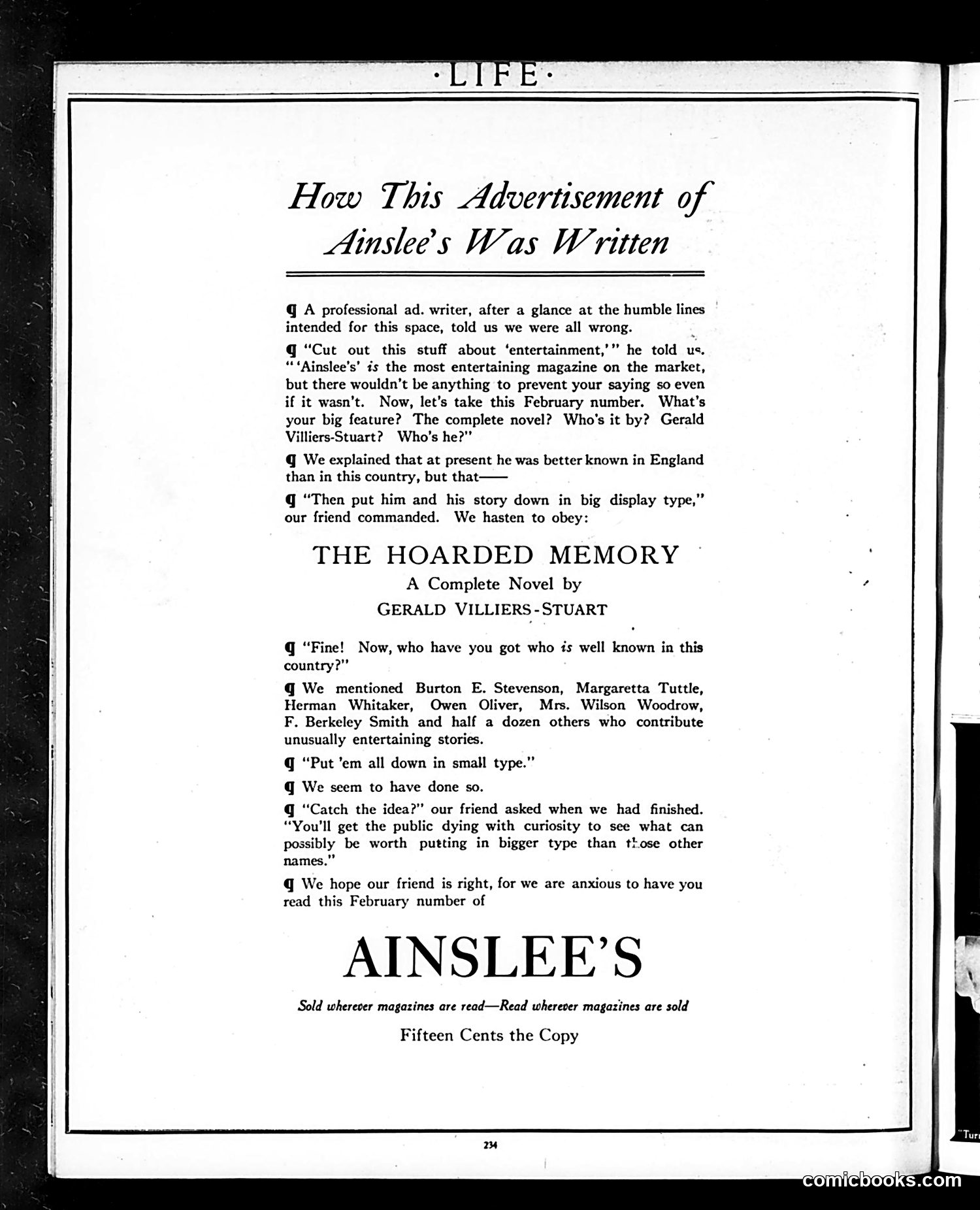
This is an advertisement for *Ainslee's* magazine (a competitor to *Life*), presented as satire about advertising itself. The page humorously depicts how a professional ad copywriter convinced the magazine's staff to reverse their marketing instincts. The joke: The ad writer's counterintuitive strategy is to prominently feature Gerald Villiers-Stuart—an author "better known in England" and relatively unknown to American readers—while burying the names of established American contributors (Burton E. Stevenson, Margaretta Tuttle, etc.) in small type. The satire mocks both advertising psychology and magazine marketing: by making the unknown author's name the biggest feature, the writer creates "curiosity" about why this obscure name gets top billing, theoretically driving sales. The piece satirizes how artificial scarcity and mystery—rather than genuine reputation—can manipulate consumer interest. This is primarily advertising disguised as self-aware editorial commentary, typical of *Life's* satirical approach to contemporary media and consumer culture.
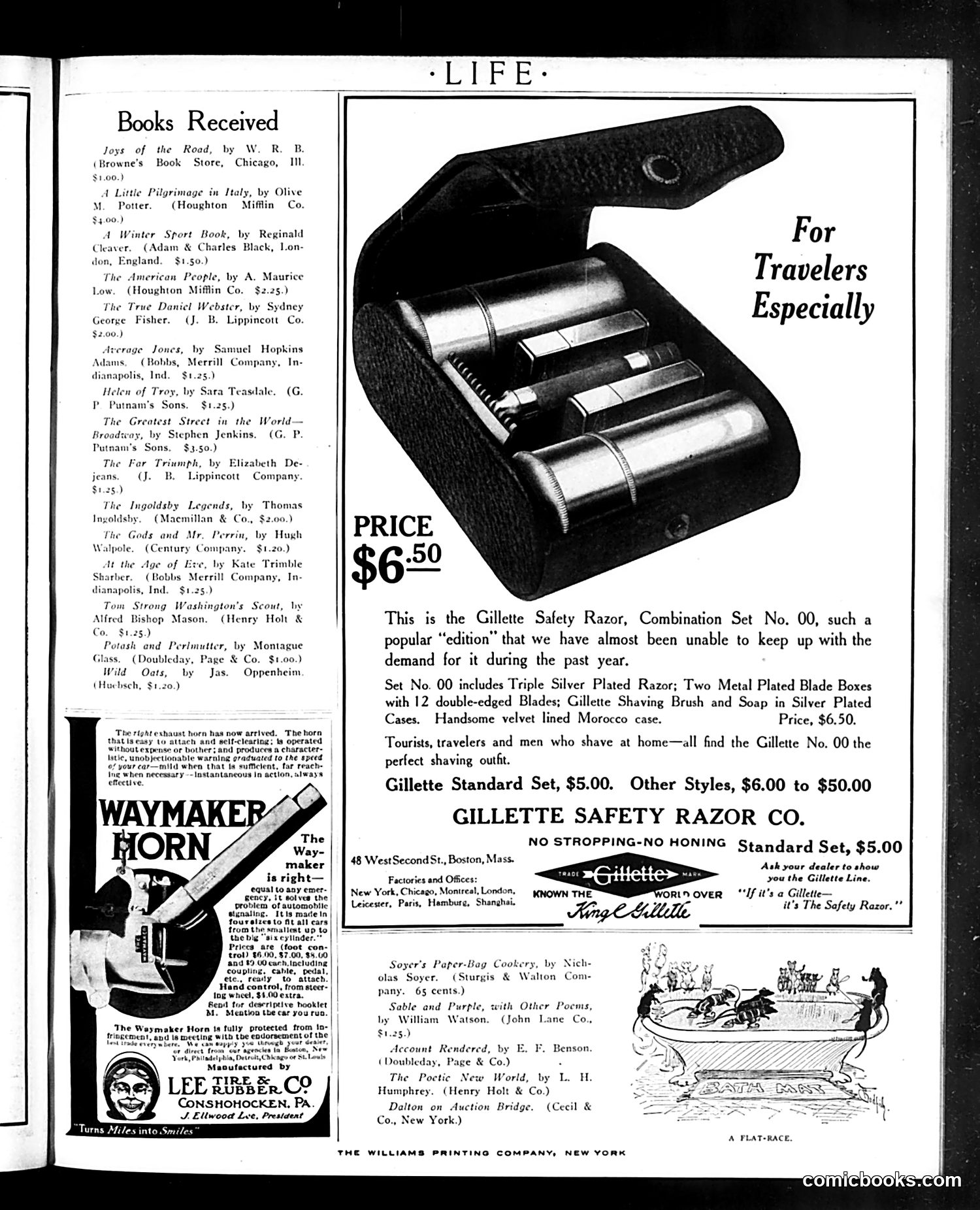
This is primarily an **advertising and books review page**, not a satirical cartoon page. The main content includes: **Left side:** A "Books Received" section listing recent publications with prices, and two product advertisements—a Waymaker automobile horn and a Lee Rubber tire company ad. **Center/Right side:** A large advertisement for the Gillette Safety Razor Combination Set, priced at $6.50, marketed specifically "For Travelers Especially." The ad emphasizes its portability and convenience for men traveling or shaving at home. **Bottom:** A small decorative illustration labeled "A Plat-Race" showing people in period dress, likely a literary reference rather than editorial commentary. The page reflects early 20th-century consumer culture, targeting mobile men with modern grooming products. There is **no political satire or significant social commentary**—it is a commercial publication page typical of *Life* magazine's advertising-heavy layout from this era.