
Life, 1912-01-25 · page 24 of 44
Life — January 25, 1912 — page 24: what you’re looking at
What you’re looking at
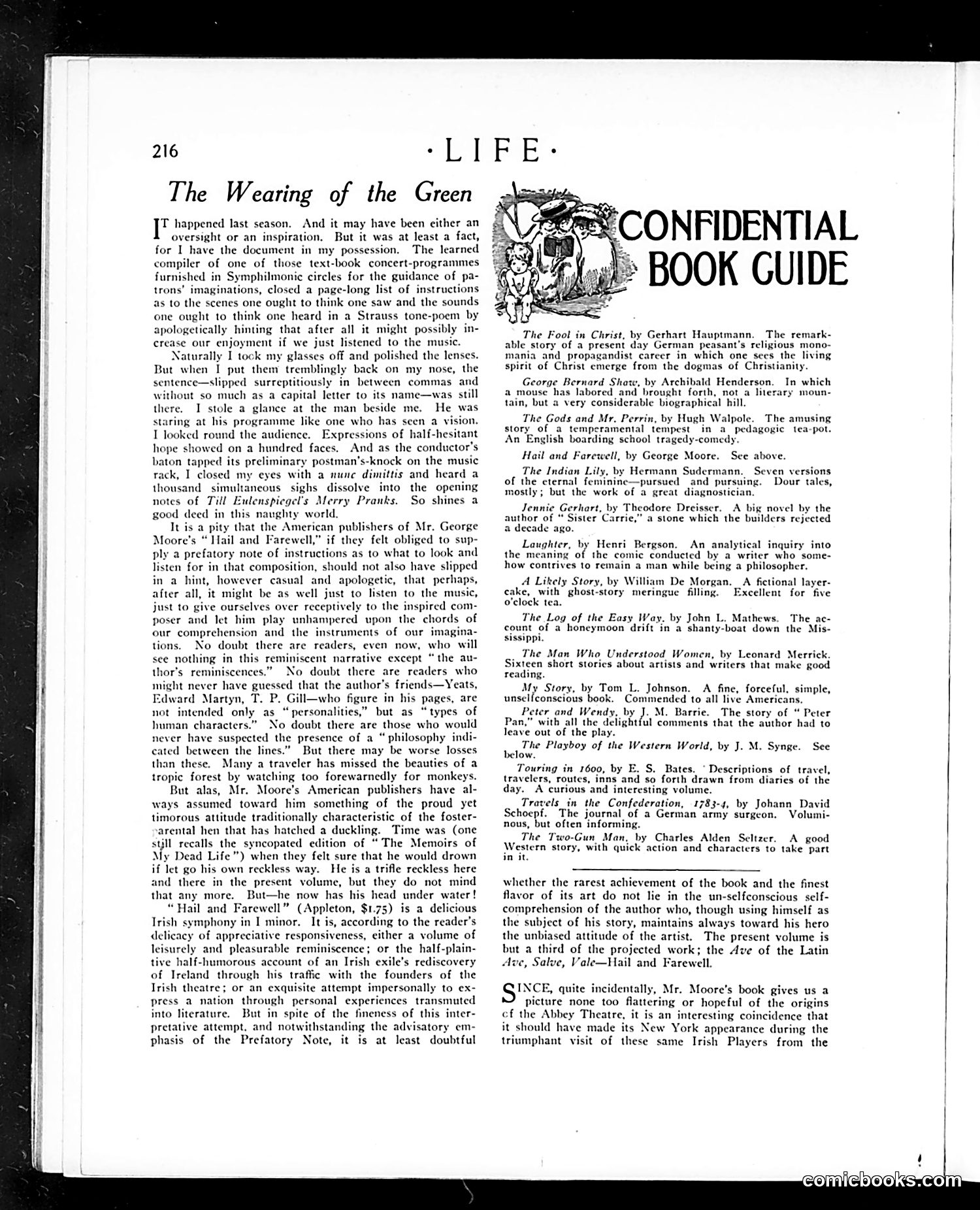
This is a book review of George Moore's *Hail and Farewell*, disguised as literary commentary. The author uses an opening anecdote about a Strauss symphony to make a satirical point: Moore's American publishers have written an overly instructive prefatory note that tells readers what to think about the book, rather than letting them experience it directly. The satire targets the publishers' patronizing attitude toward Moore—treating him like a "foster-parental hen" protecting a reckless duckling. The reviewer criticizes this hand-holding approach, arguing readers should engage with the work on their own terms without predetermined interpretations. The underlying joke: the publishers are so worried Moore might embarrass himself (he has a reputation for risqué content) that they've essentially provided a safety manual. The title references Moore's Irish identity and the phrase "wearing of the green," suggesting his literary voice is distinctly Irish—yet the publishers want to mediate that authenticity for American readers.
📄 Transcribed text from this page (OCR, searchable)
Machine-transcribed from the original scan — historical spelling and the odd misread are preserved.
216 -LIFE-: The Wearing of the Green 'T happened last season. And it may have been either an oversight or an inspiration, But it was at least a fact, for I have the document in my possession. The learned compiler of one of those text-book concert-programmes furnished in Symphilmonic circles for the guidance of pa- trons’ imaginations, closed a page-long list of instructions as to the scenes one ought to think one saw and the sounds one ought to think one heard in a Strauss tone-poem by apologetically hinting that after all it might possibly in- crease our enjoyment if we just listened to the music. Naturally I tock my glasses off and polished the lenses. But when I put them tremblingly back on my nose, the sentence—slipped surreptitiously in between commas and without so much as a capital letter to name—was still there, I stole a glance at the man beside me. He was staring at his programme like one who has seen a vision. I looked round the audience. Expressions of half-hesitant hope showed on a hundred faces. And as the conductor's baton tapped its preliminary postman’s-knock on the music rack, I closed my eyes with a nunc dimittis and heard a thousand simultancous sighs dissolve into the opening notes of Till Eulenspiegel’s Merry Pranks. So shines a good deed in this naughty world. It is a pity that the American publishers of Mr. George Moore's “ Hail and Farewell,” if they felt obliged to sup- ply a prefatory note of instructions as to what to look and listen for in that composition, should not also have slipped in a hint, however casual and apologetic, that perhaps, after all, it might be as well just to listen to the music, just to give ourselves over receptively to the inspired com- poser and let him play unhampered upon the chords of our comprehension and the instruments of our imagin: tions, No doubt there are readers, even now, who will see nothing in this reminiscent narrative except “the au- thor’s reminiscences.” No doubt there are readers who might never have guessed that the author's friends—Yeats, Edward Martyn, T. P. Gill—who figure in his pages, are not intended only as “personalities,” but as “types of human characters.” No doubt there are those who would never have suspected the presence of a “philosophy indi- cated between the lines.” But there may be worse losses than these. Many a traveler has missed the beauties of a tropic forest by watching too forewarnedly for monkey: But alas, Mr. Moore's American publishers have al- ways assumed toward him something of the proud yet timorous attitude traditionally characteristic of the foster- arental hen that has hatched a duckling. Time was (one still recalls the syncopated edition of “The Memoirs of My Dead Life”) when they felt sure that he would drown if let go his own reckless way. He is a trifle reckless here and there in the present volume, but they do not mind that any more. But—he now has his head under water! “Hail and Farewell” (Appleton, $1.75) is a delicious Trish symphony in I minor. It is, according to the reader's delicacy of appreciative responsiveness, either a volume of leisurely and pleasurable reminiscence; or the half-plain- tive half-humorous account of an Irish exile’s rediscovery of Ireland through his traffic with the founders of the Irish theatre; or an exquisite attempt impersonally to ex- press a nation through personal experiences transmuted into literature. But in spite of the fineness of this inter- pretative attempt. and notwithstanding the advisatory em- phasis of the Prefatory Note, it is at least doubtful » BOOK GUIDE The Fool in Christ, by Gerhart Hauptmann. The remark- able story of a present day German peasant’s religious mono- mania and propagandist career in which one secs the living spirit of Christ emerge from the dogmas of Christianity. George Bernard Shaw, by Archibald Henderson. In which a mouse has labored and brought forth, not a literary moun- tain, but a very considerable biographical hill. The Gods and Mr. Perrin, by Hugh Walpole. The amusing story of a temperamental tempest in a pedagogic tea-pot. An English boarding school tragedy-comedy. Hail and Farewell, by George Moore. See The Indian Lily, by Hermann Sudermann. Seven versions of the cternal femininc—pursued and pursuing. Dour tales, mostly; but the work of a great diagnostician. bove. Jennie Gerhart, by Theodore Dreisser. A big novel by the author of “ Sister Carrie,” a stone which the builders rejected a decade ago. Laughter, by Henri Bergson. An analytical inquiry into the meaning’ of the comic conducted by a writer who some- how contrives to remain a man while being a philosopher. A Likely Story, by William De Morgan. A fictional layer- cake, with ghost-story meringue filling. Excellent for five o'clock tea. The Log of the Easy Way, by John L. Mathews. The ac- count of a honeymoon drift in a shanty-boat down the Mis- sissippi. __ The Man Who Understood Women, by Leonard Merrick, Sixteen short stories about artists and writers that make good reading. My Story, by Tom L. Johnson. A fine, forceful, simple, unseliconscious book. Commended to all live Americans, Peter and Wendy, by J. M, Barrie. The story of “ Peter Pan,” with all the delightful comments that the author had to leave out of the play. The Playboy of the Western World, by J. M. Synge. See below. Touring in 1600, by E. S, Bates. “Descriptions of travel, travelers, routes, inns and so forth drawn from diaries of the day. A curious and interesting volume. Travels_in the Confederation, 1783-4, by Johann David Schoepf. The journal of a German ‘army surgeon, Volumi nous, but often informing. The Two-Gun Man, by Charles Alden Seltzer. A good Western story, with quick action and characters to take part in it, whether the rarest achievement of the book and the finest flavor of its art do not lie in the un-selfconscious self- comprehension of the author who, though using himself as the subject of his story, maintains always toward his hero the unbiased attitude of the artist. The present volume is but a third of the projected work; the Ave of the Latin Ave, Salve, Vale—Hail and Farewell. INCE, quite incidentally, Mr. Moore’s book gives us a picture none too flattering or hopeful of the origins cf the Abbey Theatre, it is an interesting coincidence that it should have made its New York appearance during the triumphant visit of these same Irish Players from the