
Life, 1912-01-25 · page 20 of 44
Life — January 25, 1912 — page 20: what you’re looking at
What you’re looking at
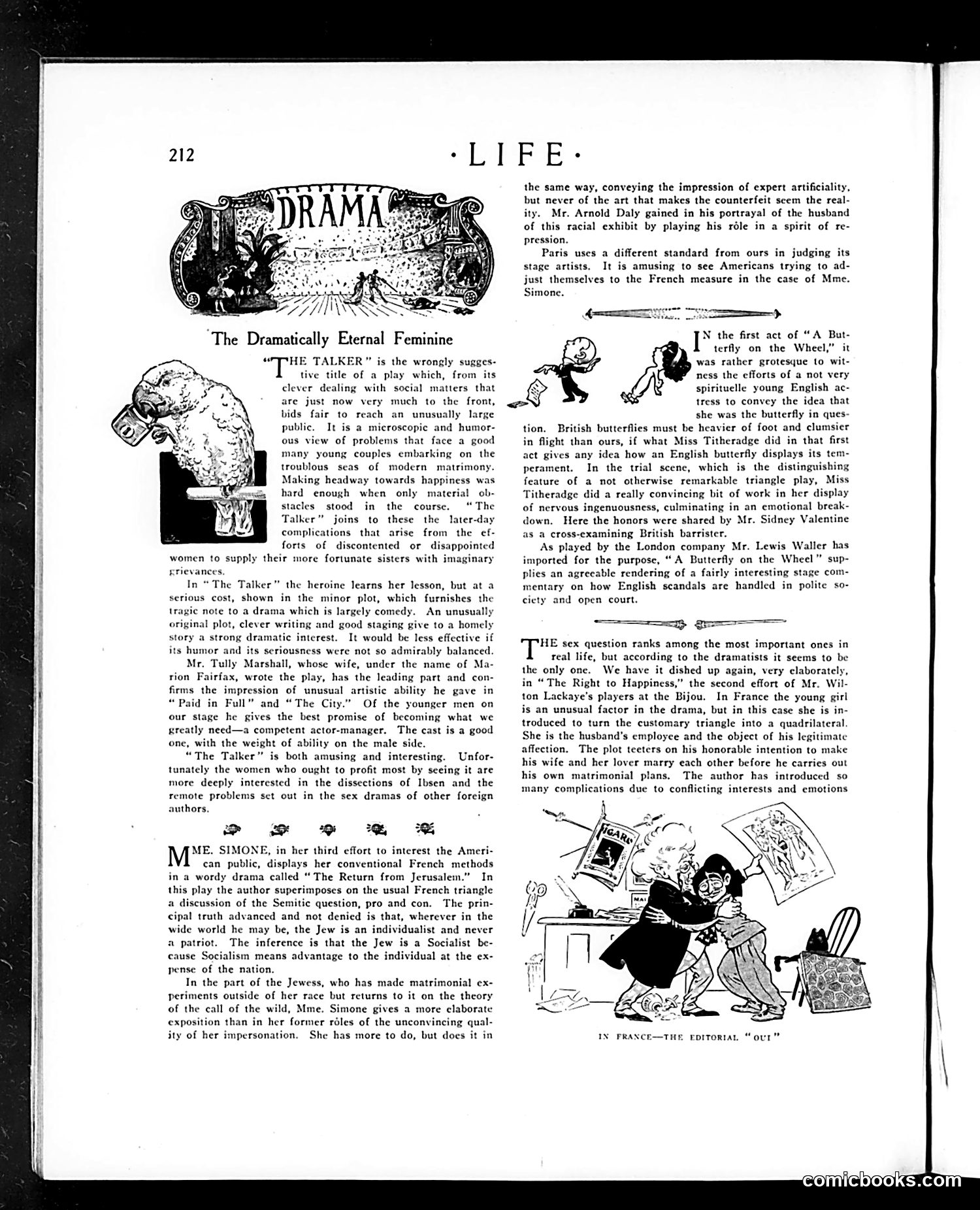
This page contains theater reviews from Life magazine's drama section. The main content discusses three plays: **"The Talker"** — A comedy about modern marriage problems, praised for balancing humor with serious social commentary. The review notes it stars actor-manager Tully Marshall and criticizes female audiences for preferring Ibsen's work to this more accessible piece. **"The Return from Jerusalem"** by Mme. Simone — A French play combining a love triangle with debate about Jewish identity and patriotism. The review dismisses Simone's acting as artificially expert but emotionally hollow, and sarcastically notes Americans struggle to adopt French standards for judging stage artists. **"A Butterfly on the Wheel"** — The review mocks an English actress's portrayal of a delicate butterfly character, suggesting British actresses are heavier and clumsier than American ones. The cartoons illustrate the "eternal feminine" theme—women causing domestic complications through discontent. The satire targets both theatrical artificiality and period gender stereotypes about women's emotional nature.
📄 Transcribed text from this page (OCR, searchable)
Machine-transcribed from the original scan — historical spelling and the odd misread are preserved.
vLVEE « ‘The Dramatically Eternal Feminine “HE TALKER” is the wrongly sugges- tive title of a play which, from its clever dealing with social matters that are just now very much to the front, bids fair to reach an unusually large public. It is a microscopic and humor- ous view of problems that face a good many young couples embarking on the troublous seas of modern matrimony. Making headway towards happiness w hard enough when only material o! acles stood in the course. “The alker” joins to these the later- complications that arise from the ef- forts of discontented or disappointed women to supply their more fortunate sisters with imaginary grievances In “The Talker” the heroine learns her lesson, but at a serious cost, shown in the minor plot, which furnishes the tragic note to a drama which is largely comedy. An unusually original plot, clever writing and good staging give to a homely story a strong dramatic interest. It would be less effective if its humor and its seriousness were not so admirably balanced. Mr. Tully Marshall, whose wife, under the name of Ma- rion Fairfax, wrote the play, has the leading part and con- firms the impression of unusual artistic ability he gave in “Paid in Full” and “The City.” Of the younger men on our stage he gives the best promise of becoming what we greatly need—a competent actor-manager. The cast is a good one, with the weight of ability on the male side. “The Talker” is both amusing and interesting. Unfor- tunately the women who ought to profit most by seeing it are more deeply interested in the dissections of Ibsen and the remote problems set out in the sex dramas of other forcign authors. 7 ME. SIMONE, in her third effort to interest the Ameri- Pe can public, dis her conventional French methods in a wordy drama called “The Return from Jerusalem.” In this play the author superimposes on the usual French triangle a discussion of the Semitic question, pro and con. The prin- cipal truth advanced and not denied is that, wherever in the wide world he may be, the Jew is an individualist and never a patriot. The inference is that the Jew is a Socialist be- cause Socialism means advantage to the individual at the ex- pense of the nation. In the part of the Jewess, who has made matrimonial ex- periments outside of her race but returns to it on the theory of the call of the wild, Mme. Simone gives a more elaborate exposition than in her former rdles of the unconvincing qual- ity of her impersonation. She has more to do, but does it i <_ the same way, conveying the impression of expert artificiality, but never of the art that makes the counterfeit scem the real- ity. Mr. Arnold Daly gained in his portrayal of the husband of this racial exhibit by playing his role in a spirit of re- pression. Paris uses a different standard from ours in judging its stage artists, It is amusing to see Americans trying to ad- just themselves to the French measure in the case of Mme. Simone. ed I the first act of “A But- terfly on the Wheel,” it was rather grotesque to wit- ness the efforts of a not very & spirituelle young English ac- tress to convey the idea that she was the butterfly in ques- tion. British butterflies must be heavier of foot and clumsier in flight than ours, if what Miss Titheradge did in that first act gives any idea how an English butterfly displays its tem- perament. In the trial scene, which is the distinguishing feature of a not otherwise remarkable triangle play, Miss Titheradge did a really convincing bit of work in her display of nervous ingenuousness, culminating in an emotional break- down, Here the honors were shared by Mr. Sidney Valentine as a cross-examining British barrister. As played by the London company Mr. Lewis Waller has imported for the purpose, “A Butterfly on the Wheel” sup- plies an agreeable rendering of a fairly interesting stage com- mentary on how English scandals are handled in polite so- ciety and open court. = HE sex question ranks among the most important ones in real life, but according to the dramatists it seems to be the only one. We have it dished up again, very elaborately, in “The Right to Happiness,” the second effort of Mr. Wil- ton Lackaye’s players at the Bijou. In France the young girl is an unusual factor in the drama, but in this case she is in- troduced to turn the customary triangle into a quadrilateral She is the husband’s employce and the object of his legitimate affection. The plot teeters on his honorable intention to make his wife and her lover marry each other before he carries out his own matrimonial plans, The author has introduced so many complications due to conflicting interests and emotions IN PRANCE—THE EDITORIAL “our”