
Life, 1912-01-25 · page 18 of 44
Life — January 25, 1912 — page 18: what you’re looking at
What you’re looking at
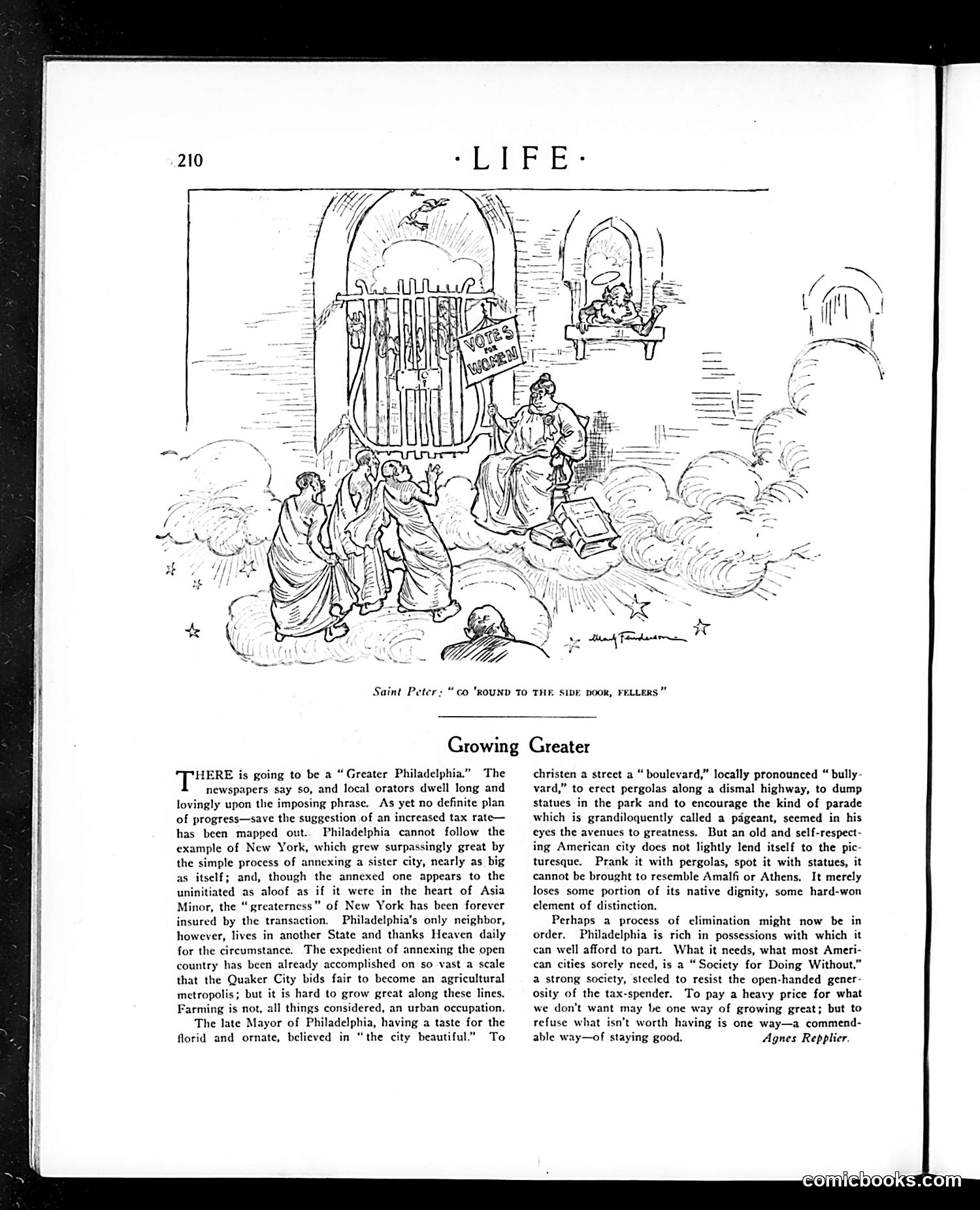
**The Cartoon:** The top illustration shows Saint Peter at heaven's gates redirecting people to "the side door," a sardonic commentary on selective entry to heaven—likely referencing hypocrisy or moral compromise. **The Article "Growing Greater":** This is social satire about Philadelphia's expansion plans. Author Agnes Repplier mocks the city's vague aspirations for becoming "Greater Philadelphia" without substantive improvement. She criticizes: - The mayor's superficial "city beautiful" approach (adding boulevards, pergolas, statues, pageants) that merely masks the city's lack of authentic grandeur - Wasteful spending on ornamental projects while avoiding real civic problems - The false belief that architectural decoration can create greatness Repplier argues Philadelphia should instead practice restraint—a "Society for Doing Without"—refusing unnecessary expenditures rather than chasing growth through frivolous spending. The piece reflects Progressive Era skepticism about municipal corruption and wasteful governance, advocating fiscal responsibility over flashy development.
📄 Transcribed text from this page (OCR, searchable)
Machine-transcribed from the original scan — historical spelling and the odd misread are preserved.
Saint Peter “co ’ROUND TO THE SIDE DOOR, FELLERS” Growing Greater HERE is going to be a “Greater Philadelphia.” The newspapers say so, and local orators dwell long and lovingly upon the imposing phrase. As yet no definite plan of progress—save the suggestion of an increased tax rate— has been mapped out. Philadelphia cannot follow the example of New York, which grew surpassingly great by the simple process of annexing a sister city, nearly as big as itself; and, though the annexed one appears to the uninitiated as aloof as if it were in the heart of Asia Minor, the “ greaterness” of New York has been forever insured by the transaction. Philadelphia's only neighbor, however, lives in another State and thanks Heaven daily for the circumstance. The expedient of annexing the open country has been already accomplished on so vast a scale that the Quaker City bids fair to become an agricultural metropolis; but it is hard to grow great along these lines. Farming is not, all things considered, an urban occupation. The late Mayor of Philadelphia, having a taste for the florid and ornate, believed in “the city beautiful.” To christen a street a “ boulevard,” locally pronounced “ bully- vard,” to erect pergolas along a dismal highway, to dump statues in the park and to encourage the kind of parade which is grandiloquently called a pageant, seemed in his eyes the avenues to greatness. But an old and self-respect- ing American city does not lightly lend itself to the pic turesque. Prank it with pergolas, spot it with statues, it cannot be brought to resemble Amalfi or Athens, It merely loses some portion of its native dignity, some hard-won element of distinction, Perhaps a process of elimination might now be in order. Philadelphia is rich in possessions with which it can well afford to part. What it needs, what most Ameri- can cities sorely need, is a “Society for Doing Without,” a strong society, stecled to resist the open-handed gener- osity of the tax-spender. To pay a heavy price for what we don’t want may be one way of growing great; but to refuse what isn’t worth having is one way—a commend- able way—of staying good. Agnes Repplier.