
Life, 1912-01-25 · page 9 of 44
Life — January 25, 1912 — page 9: what you’re looking at
What you’re looking at
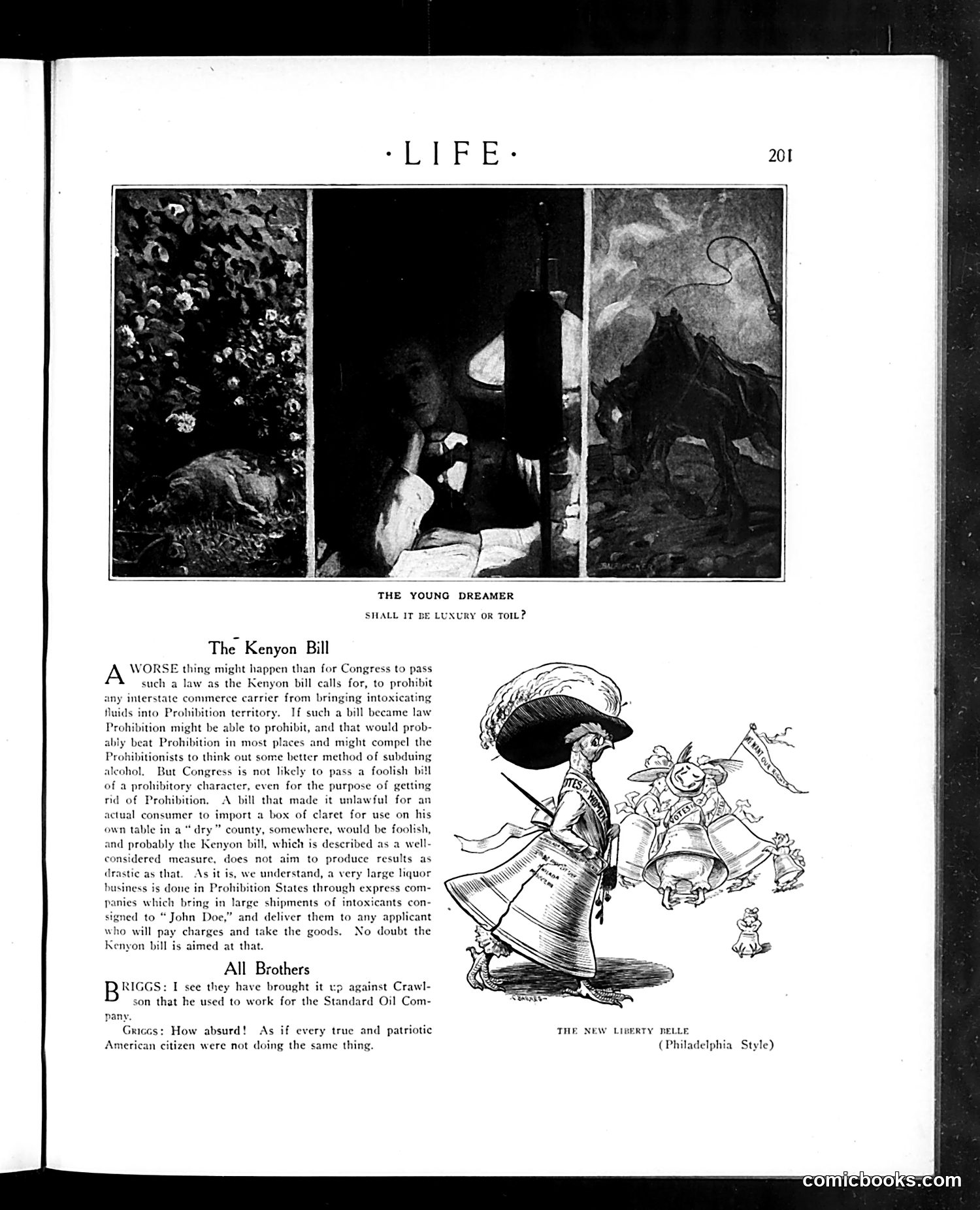
This page satirizes Prohibition-era politics and enforcement. "The Kenyon Bill" section discusses a proposed law to prohibit interstate commerce in alcohol—a mechanism to strengthen Prohibition. The satire argues this would be absurd: even allowing personal importation for private use would be foolish, yet the Kenyon bill supposedly aims at actual enforcement. "The New Liberty Belle" cartoon (lower right) depicts Lady Liberty as a heavily burdened figure, weighed down by bottles and chaos—mocking how Prohibition advocates claimed to protect American liberty while actually restricting personal freedom. The "All Brothers" dialogue criticizes citizens who report Prohibition violations to authorities, framing such patriotic informing as hypocritical opportunism against former colleagues (Briggs worked for Standard Oil).
📄 Transcribed text from this page (OCR, searchable)
Machine-transcribed from the original scan — historical spelling and the odd misread are preserved.
THE YOUNG DREAMER SHALL IT BE LUXURY OR TOIL? The Kenyon Bill WORSE thing might happen than for Congress to pass such a law as the Kenyon bill calls for, to prohibit any interstate commerce carrier from bringing intoxicating Nuids into Prohibition territory. If such a bill became law Prohibition might be able to prohibit, and that would prob- beat Prohibition in most places and might compel the Prohibitionists to think out some better method of subduing alcohol. But Congress is not likely to pass a foolish bil of a prohibitory character, even for the purpose of getting rid of Prohibition, A bill that made it unlawful for an actual consumer to import a box of claret for use on his own table in a“ dry” county, somewhere, would be foolish, and probably the Kenyon bill, which is described as a well- considered measure, does not aim to produce results as tic as that. As it is, we understand, a very large liquor business is done in Prohibition States through express com- panies which bring in large shipments of intoxicants con- signed to “John Doe,” and deliver them to any applicant who will pay charges and take the goods. No doubt the Kenyon bill is aimed at that. All Brothers RIGGS: I see they have brought it xp against Crawl- son that he used to work for the Standard Oil Com- pany Griccs: How absurd! As if every true and patriotic THE NEW LIBERTY RELLE American citizen were not doing the same thing. (Philadelphia Style)