
Life, 1912-01-25 · page 25 of 44
Life — January 25, 1912 — page 25: what you’re looking at
What you’re looking at
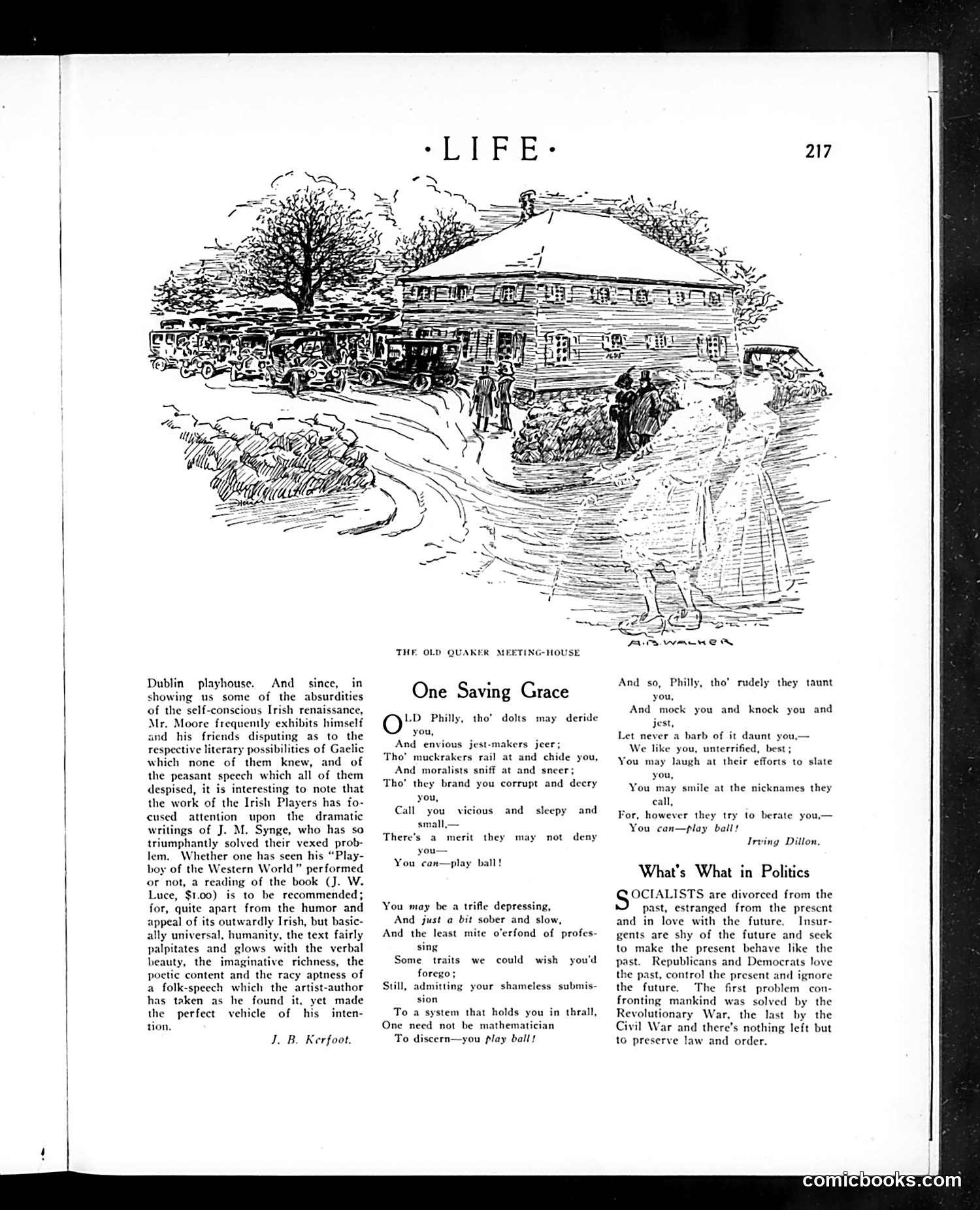
**The Sketch:** "The Old Quaker Meeting-House" depicts a rural Pennsylvania building with period figures and carriages—illustrative content accompanying a literary review. **"One Saving Grace":** This poem praises Philadelphia ("Old Philly") despite its perceived faults—described as depressing, sober, corrupt, and submissive to a restrictive system. The sole virtue the city possesses is that it can "play ball" (cooperate/function as expected). The satire mocks Philadelphia's reputation as a staid, conservative city by suggesting compliance is its only redeeming quality. The repeated refrain "play ball" suggests the city's willingness to go along with the status quo rather than innovate or rebel. **"What's What in Politics":** This brief commentary characterizes American political movements: Socialists reject the past; Insurgents reject the future; Republicans and Democrats cling to the past while controlling present politics. The author suggests major American problems were solved by the Revolutionary and Civil Wars, with nothing substantive remaining except law-and-order maintenance—a somewhat cynical assessment of contemporary politics and progress.
📄 Transcribed text from this page (OCR, searchable)
Machine-transcribed from the original scan — historical spelling and the odd misread are preserved.
Dublin playhouse. And since, in showing us some of the absurdities of the self-conscious Irish renaissance, Mr. Moore frequently exhibits himself and his friends disputing as to the respective literary possibilities of Gaelic which none of them knew, and of the peasant speech which all of them despised, it is interesting to note that the work of the Irish Players has fo- cused attention upon the dramatic writings of J. M. Synge, who has so triumphantly solved their vexed prob- lem. Whether one has seen his “Play- hoy of the Western World” performed or not, a reading of the book (J. W. Luce, $1.00) is to be recommended; for, quite apart from the humor and appeal of its outwardly Irish, but basic- ally universal, humanity, the text fairly palpitates and glows with the verbal beauty, the imaginative richness, the poetic content and the racy aptness of a folk-speech which the artist-author has taken as he found it, yet made the perfect vehicle of his inten- tion. J.B. Kerfoot. 217 THF. OLD QUAKER MEETING-HOUSE One Saving Grace O D Philly, tho’ dolts may deride you, And envious jest-makers jeer; Tho’ muckrakers rail at and chide you, And moralists sniff at and sneer; Tho’ they brand you corrupt and decry you, Call’ you vicious and sleepy and small, — There’s a merit they may not deny you— You can—play ball! You may be a trifle depressing, And just a bit sober and slow, And the least mite o’erfond of profes- sing Some traits we could wish you'd forego; Still, admitting your shameless submis- sion To a system that holds you in thrall, One need not be mathematician To discern—you play ball! And so, Philly, tho’ rudely they taunt you, And mock you and knock you and jest, Let never a barb of it daunt you,— We like you, unterrified, best ; You may laugh at their efforts to slate you, You may call, For, however they try to berate you,— You can—play ball! Irving Dillon, What's What in Politics OCIALISTS are divorced from the past, estranged from the present and in love with the future, Insur- gents are shy of the future and seek to make the present behave like the past. Republicans and Democrats love the past, control the present and ignore the future. The first problem con- fronting mankind was solved by the Revolutionary War, the last by the Civil War and there’s nothing left but to preserve law and order. smile at the nicknames they