
A complete issue · 41 pages · 1911
Life — December 28, 1911
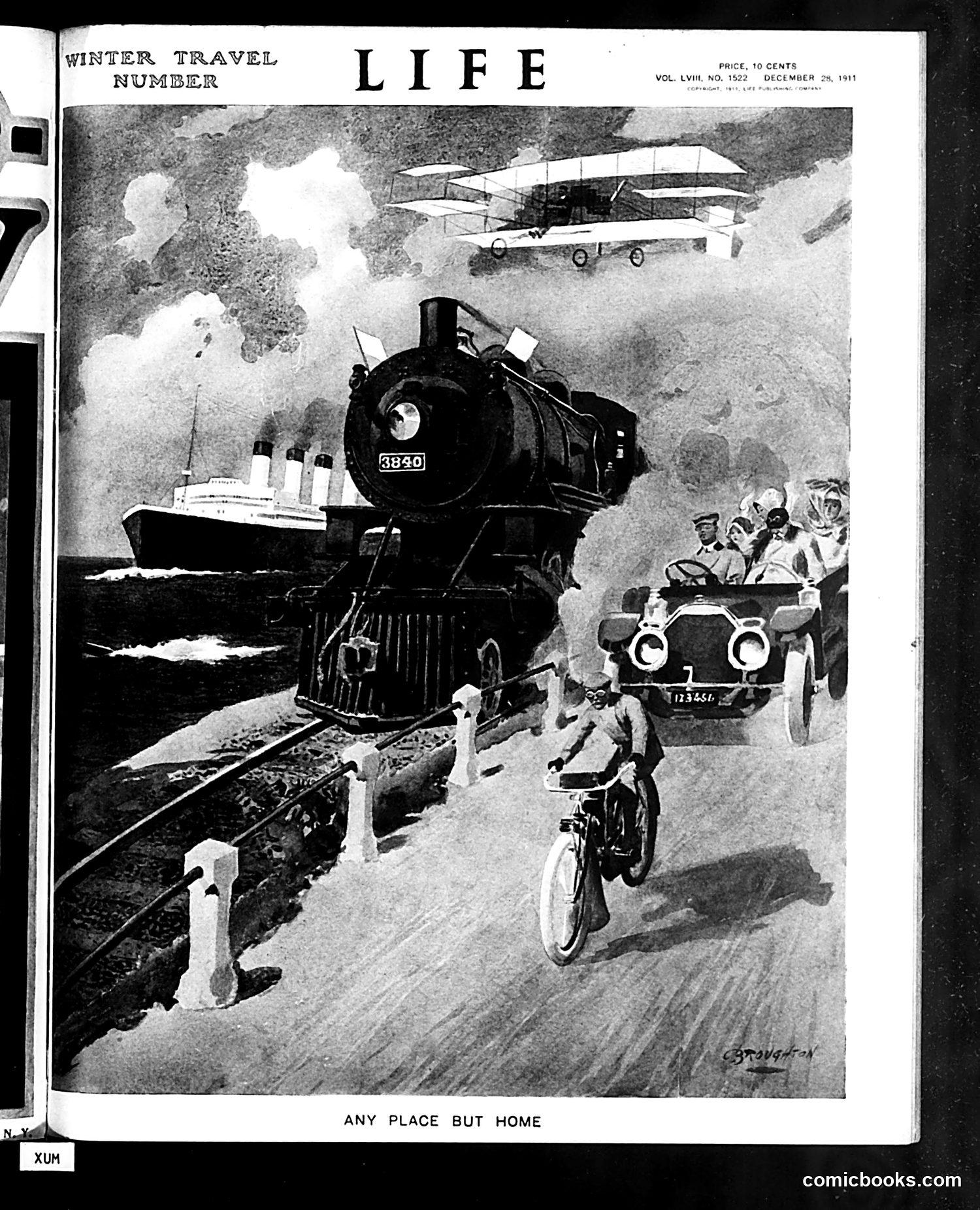
This is a Winter Travel Number cover from Life magazine (December 29, 1911). The satirical illustration depicts various modes of transportation—a steam locomotive, ocean liner, airplane, automobile, and bicycle—all departing in different directions. The caption "Any Place But Home" suggests the joke: Americans are so eager to travel anywhere else that they'll use any available conveyance to escape home during winter. This reflects early 20th-century leisure travel becoming fashionable among the wealthy and middle class. The humor lies in the exaggeration of travel enthusiasm and the implication that winter at home is so unappealing that people will go to absurd lengths and use any transportation method available to get away.
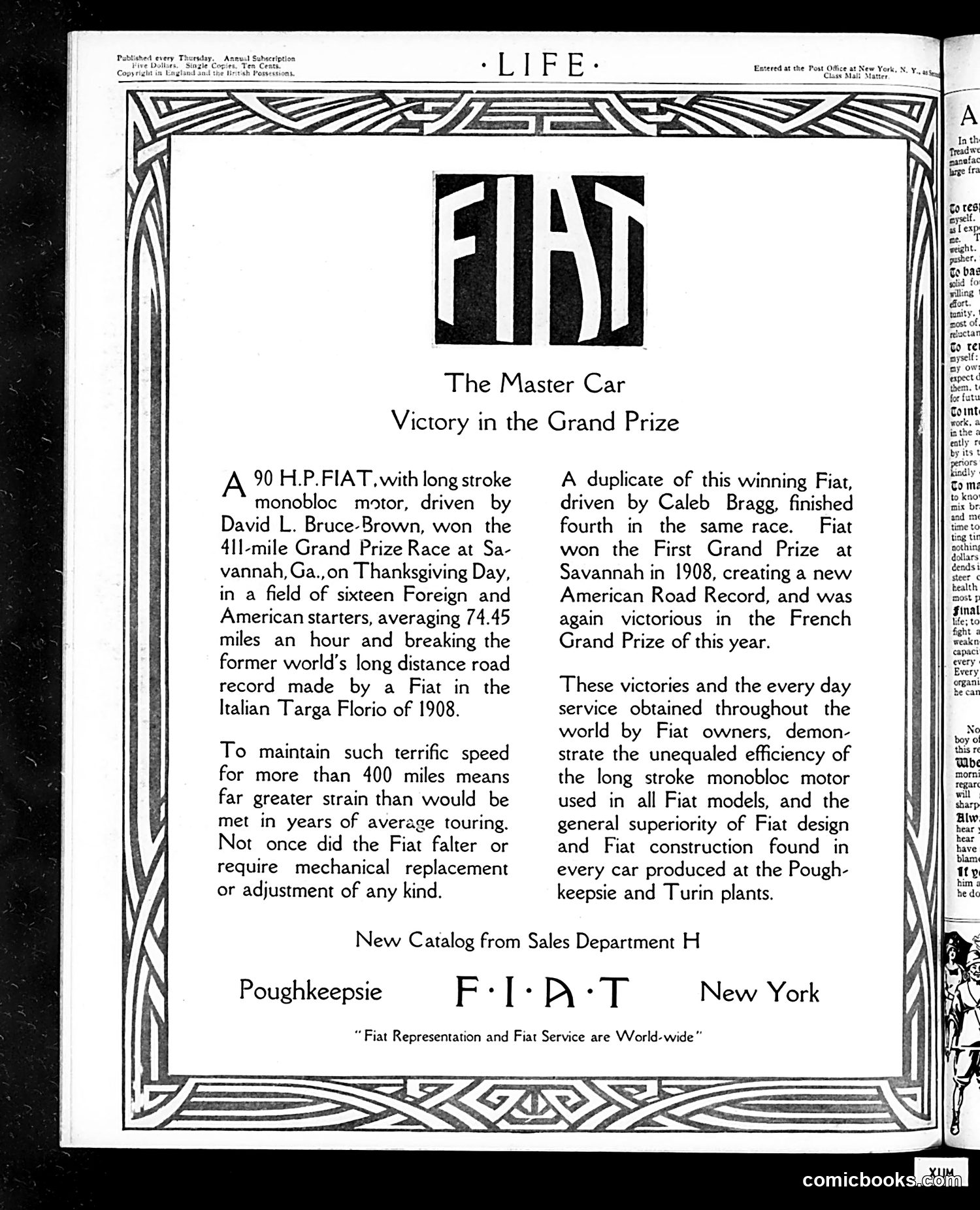
This page is **not a cartoon or satire**—it's a straightforward **advertisement for Fiat automobiles**, published in Life magazine. The ad celebrates Fiat's racing victories, specifically mentioning: - A 90 HP Fiat driven by David Bruce-Brown that won the 411-mile Grand Prize Race at Savannah, Georgia on Thanksgiving Day, averaging 74.45 mph - Another Fiat driven by Caleb Bragg that won Savannah's First Grand Prize in 1908 and the French Grand Prize The ad uses these racing achievements to promote Fiat's engineering superiority and reliability to American consumers. The decorative border and prominent FIAT logo are typical of early 1900s advertising design. This represents commercial marketing rather than editorial content or political commentary.

This page is primarily **advertising** rather than satire. The dominant content is a large advertisement for the "20th Century Limited" train service operated by New York Central Lines, featuring a globe showing rail routes across North America. The left side contains "A Business Creed" — a manifesto about ethical business practices by M.H. Treadwell and Company, steel manufacturers. It emphasizes honesty, hard work, and treating employees fairly. This appears to be **corporate philosophy rather than satirical commentary**. Below is a smaller advertisement for Japan travel by Raymond & Whitcomb Co., promoting spring trips during "Cherry Blossom Season." The page reflects early 20th-century business culture emphasizing commercial idealism and corporate paternalism, presented straightforwardly rather than satirically.
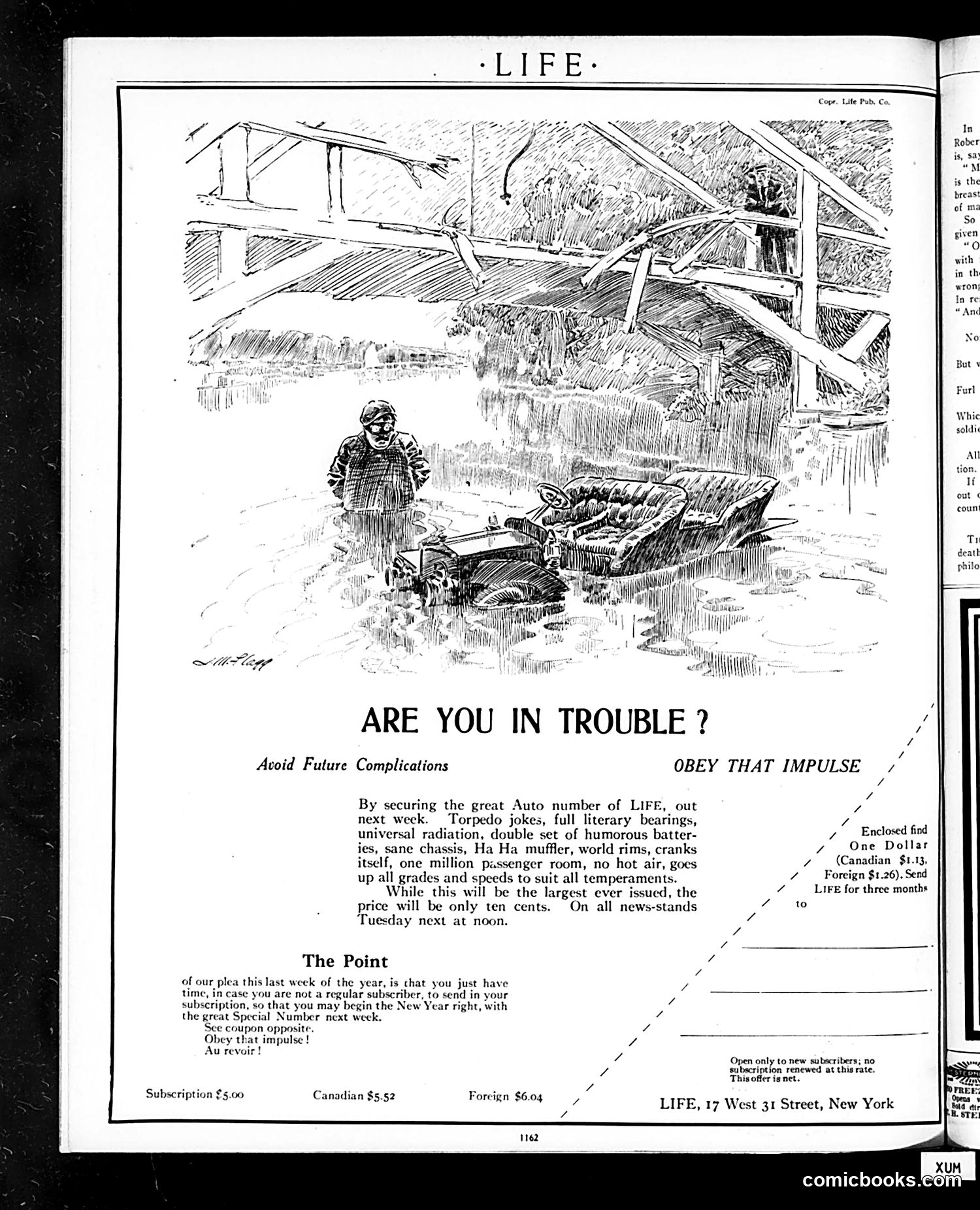
This page is primarily **advertising** for LIFE magazine's upcoming special issue, not political satire. The cartoon depicts a farmer standing beside a broken-down automobile in muddy conditions near a barn, illustrating the ad's headline "ARE YOU IN TROUBLE?" The image plays on early automotive frustrations—mechanical failures, muddy roads, and general vehicle unreliability were common complaints in the early automobile era. The advertisement promotes LIFE's next issue, promising "Torpedo jokes, full literary bearings, universal transmission, double set of humorous batteries, sane chassis, Ha Ha muffler, world rims, cranks itself, and million passenger room"—automotive puns and mechanical humor targeting car owners. The subscription cost is listed as $5.00 (or $5.52 Canadian, $6.04 foreign).
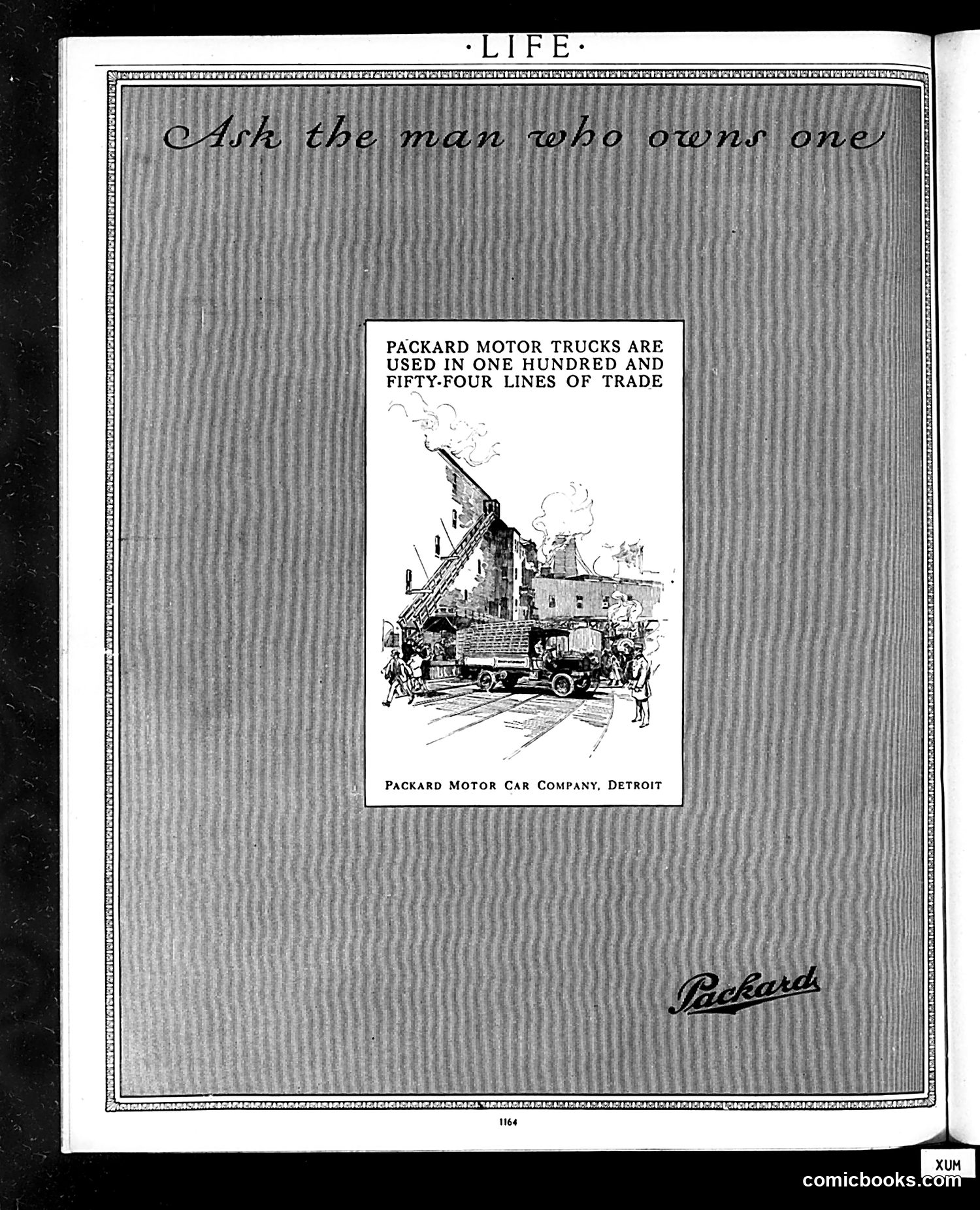
This is a **Packard Motor Trucks advertisement**, not satire or political commentary. The page headline "Ask the man who owns one" was Packard's actual advertising slogan, used to establish credibility through customer testimonials. The illustrated scene shows a Packard truck unloading cargo at an industrial building, with workers present. The accompanying text claims Packard motor trucks are "used in one hundred and fifty-four lines of trade," positioning them as versatile, reliable commercial vehicles. This represents early automotive advertising strategy: emphasizing practical utility and widespread adoption to persuade business owners that Packard trucks were the dependable choice for commercial operations. There is no political satire intended—it's purely commercial promotion.
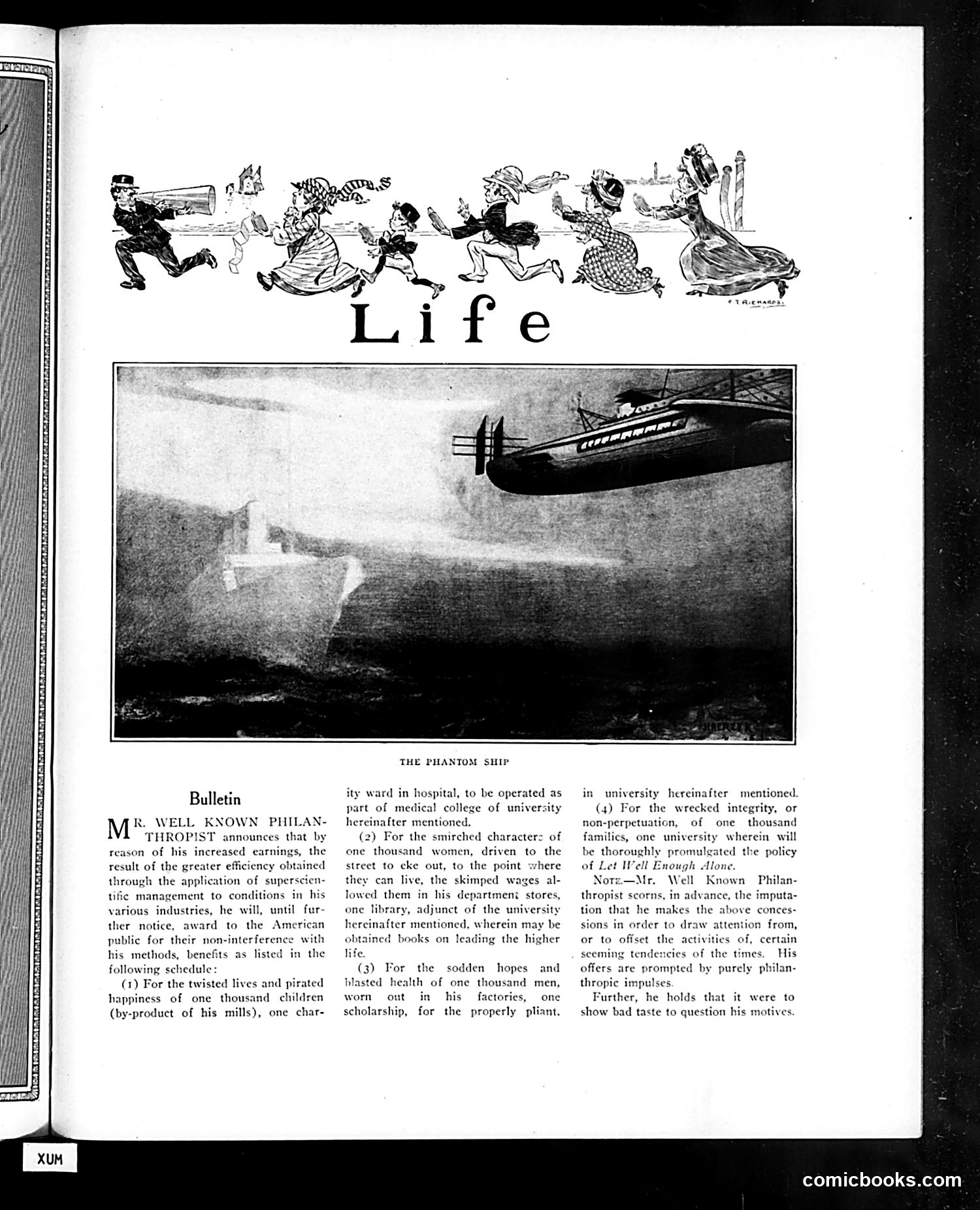
This page satirizes a well-known philanthropist (unnamed in visible text) whose increased earnings enabled expanded charitable giving. The illustration "The Phantom Ship" shows an airship observing what appears to be a shipwreck or disaster below. The accompanying "Bulletin" mocks the philanthropist's publicized charitable schedule with numbered items listing beneficiaries: children in mills, hospital wards, women in poverty, sick factory workers, and university students. The satire's target is **performative philanthropy**—the way wealthy industrialists publicized their charitable acts as moral justification for their business practices and wealth accumulation. The "phantom ship" metaphor suggests these charitable gestures are illusory or detached from actual human suffering below, critiquing the gap between publicized benevolence and systemic exploitation underlying industrial fortunes.
This December 28, 1911 Life magazine page contains editorial text discussing Russian-Jewish relations and American immigration policy—not a political cartoon requiring visual interpretation. The article argues against Congressional measures to restrict Jewish immigration in response to Russian persecution. The text defends Jewish immigrants' contributions to American society, noting their concentration in business (newspapers, banking, textiles, law). It acknowledges Russia's anti-Jewish prejudice while questioning whether restricting American immigration serves retaliation or principle. The small decorative illustrations (a child with a barrel, children playing) are generic ornamental vignettes common to period publications, not satirical commentary. The page represents serious political advocacy against discriminatory immigration policy during an era of significant Russian-Jewish emigration to America.
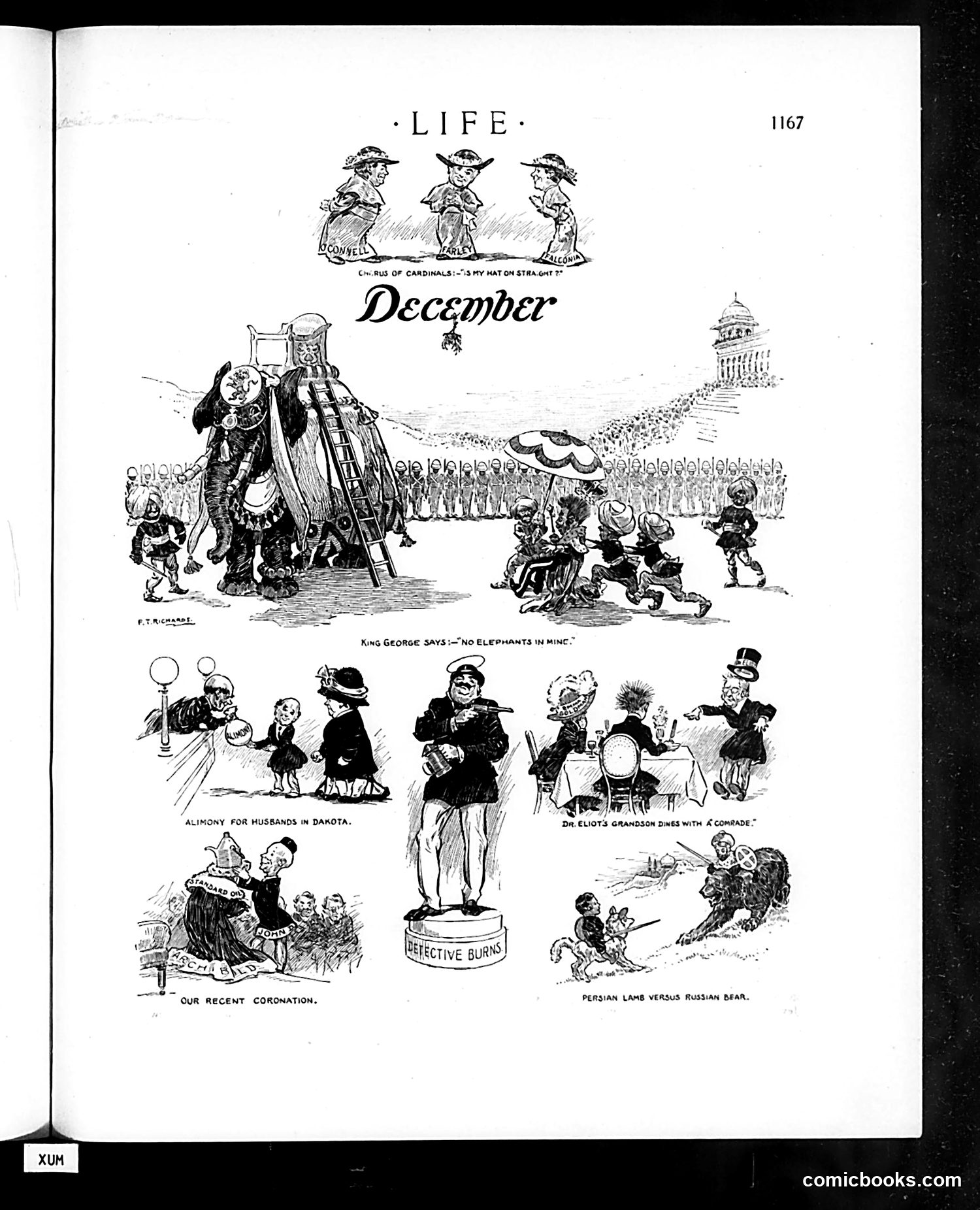
This is a December satirical page from *Life* magazine featuring several political cartoons. The main illustration depicts "King George Says: 'No Elephants in Mine,'" likely referencing British colonial politics and King George V. Below are smaller cartoons with captions including "Alimony for Husbands in Dakota," "Our Recent Coronation," "Dr. Eliot's Grandson Dines with a Comrade," and "Persian Lamb Versus Russian Bear"—suggesting commentary on contemporary social issues (alimony laws, coronation ceremonies) and international tensions. The top vignette shows three figures discussing cardinals' hats, with unclear political meaning. These cartoons employ satirical humor about governance, domestic law, and geopolitical conflicts typical of early 20th-century American political satire, though specific references require additional historical context to fully decode.
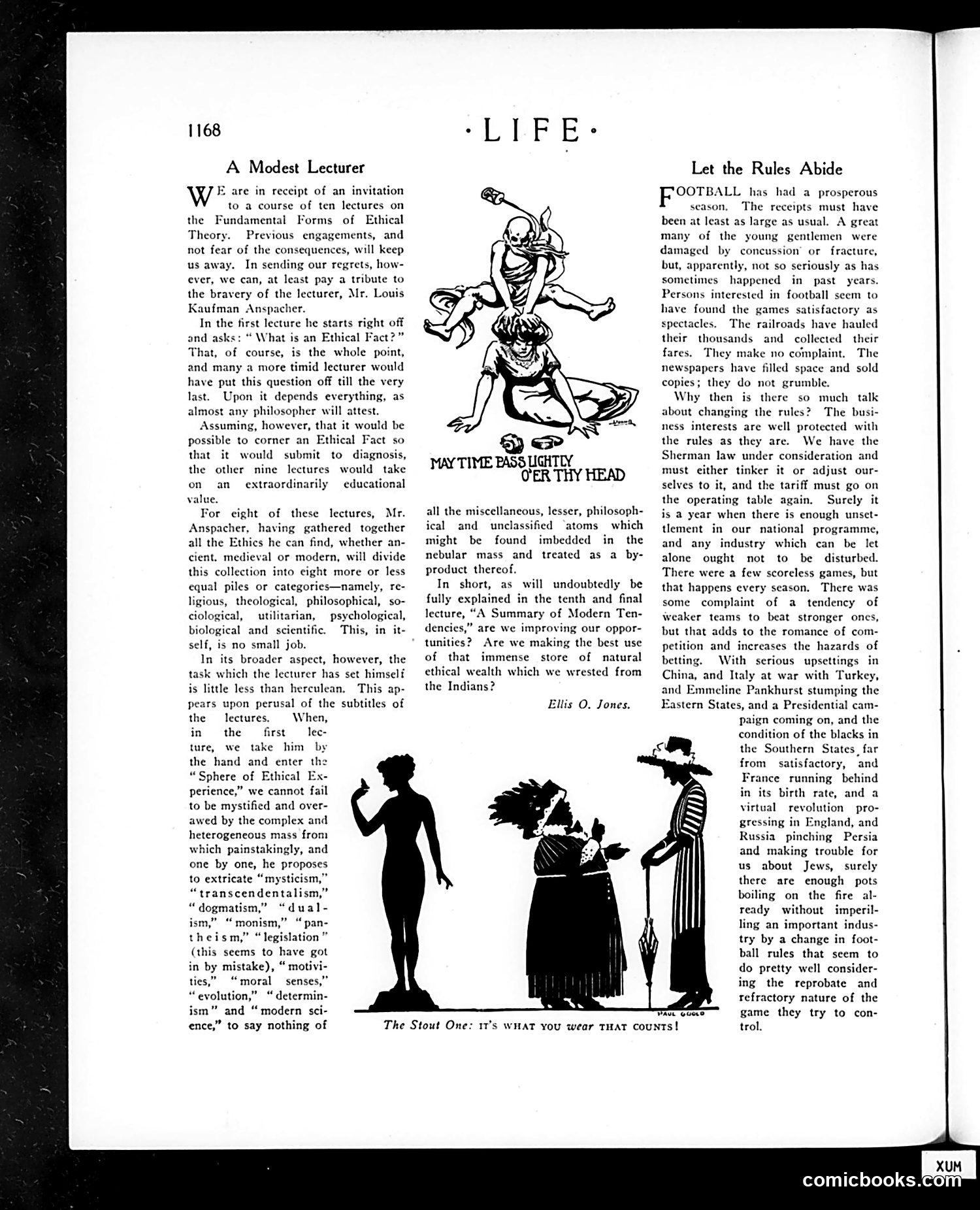
The left column discusses Dr. Louis Kaufman Anspacher's lecture series on ethical theory, praising his attempt to address complex philosophical questions systematically. The right column, titled "Let the Rules Abide," argues against changing football rules. It defends the current ruleset against business and newspaper pressure for modifications, suggesting that excessive rule changes—driven by commercial interests rather than genuine safety concerns—threaten the sport's integrity. The accompanying cartoons appear to satirize fashion and social behavior through silhouettes. "Maytime Passes Lightly O'er Thy Head" depicts spring frivolity, while "The Stout One" comments on clothing and appearance, with the caption "IT'S WHAT YOU WEAR THAT COUNTS!"—likely mocking superficial social judgment based on fashion rather than character.
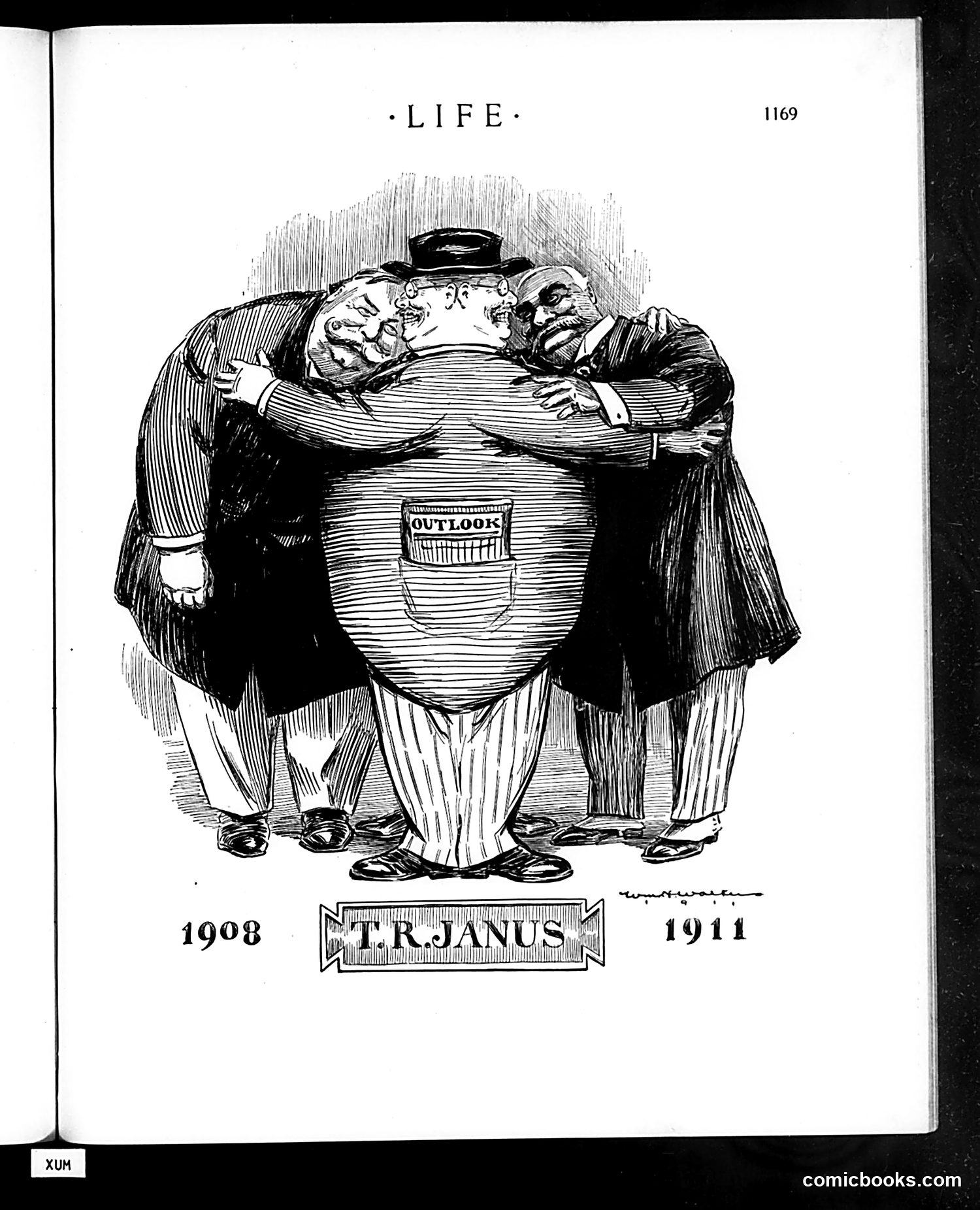
This political cartoon depicts **"T.R. Janus"** — a reference to President **Theodore Roosevelt**, shown with two faces looking in opposite directions, labeled for the years 1908-1911. The figure wears an "Outlook" magazine pocket, referencing Roosevelt's post-presidency editorial work. The satire mocks Roosevelt's contradictory positions or shifting stances during this period. After leaving office in 1908, Roosevelt became increasingly critical of his successor William Howard Taft, eventually challenging him in 1912. The two-faced Janus imagery suggests inconsistency, hypocrisy, or inability to commit to a single political direction — a common criticism leveled at Roosevelt's unpredictable political movements during these years.
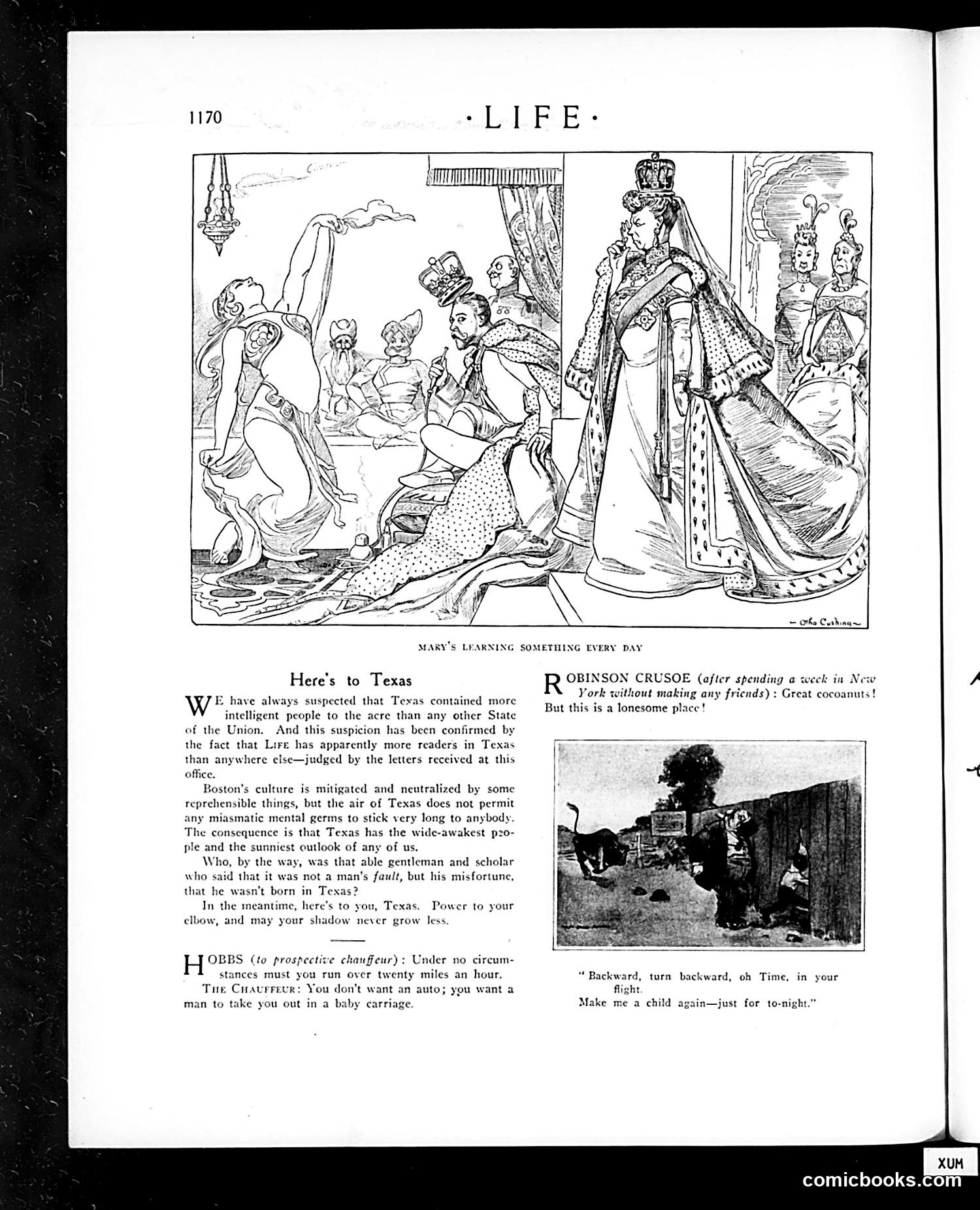
The top illustration titled "Mary's Learning Something Every Day" depicts a royal court scene with elegantly dressed figures in elaborate period costume. The specific narrative is unclear from the image alone. Below, "Here's to Texas" is a humorous essay praising Texas's practical intelligence and straightforward outlook, contrasting it favorably with Boston's more pretentious "culture." The piece uses gentle satire to celebrate Texas's no-nonsense character. The "Robinson Crusoe" section appears to be a satirical commentary on isolation and loneliness, with an accompanying photograph showing what seems to be a desolate landscape or solitary figure. The "Hobbs" dialogue jokes about transportation—a prospective chauffeur claiming he can drive over 20 miles per hour, though the chauffeur dismisses this as unnecessary speed for a "baby carriage." Overall, this page combines visual satire, regional humor, and light social commentary typical of Life magazine's approach.
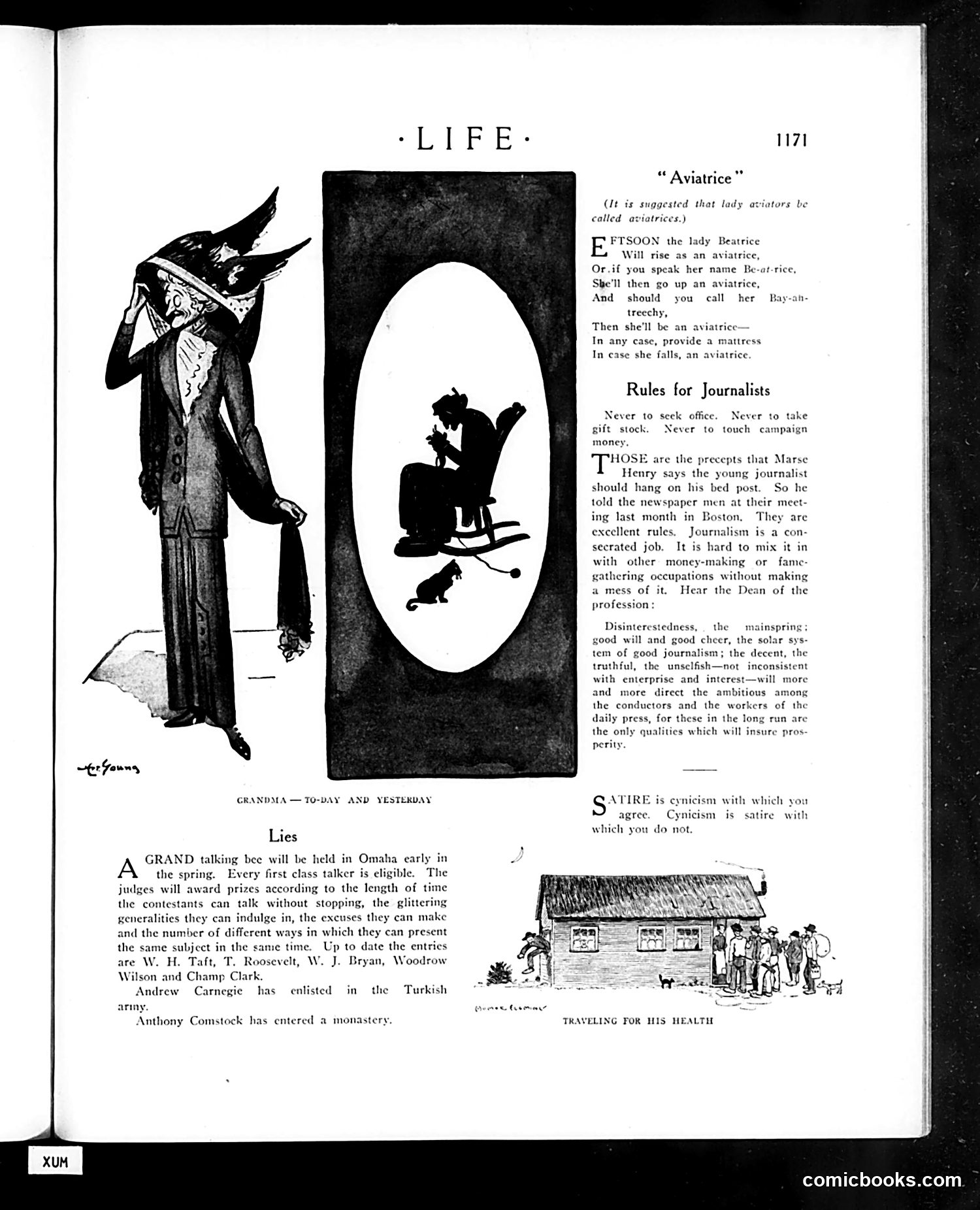
The main cartoon, titled "Grandma—To-Day and Yesterday," contrasts an elderly woman from the past (left) with a modern woman in a rocking chair (right). The joke appears to satirize how women's lives have changed: the old grandmother figure looks witchlike and skeletal, suggesting hardship, while the modern version sits comfortably with leisure time, a small dog nearby. Below, "Lies" discusses a grand talking bee competition in Omaha where prominent figures like W.H. Taft and Roosevelt are mentioned as contestants. This satirizes politicians' reputation for lengthy speeches. The page also includes "Rules for Journalists" and other brief humorous items typical of Life's satirical format from the early 20th century.
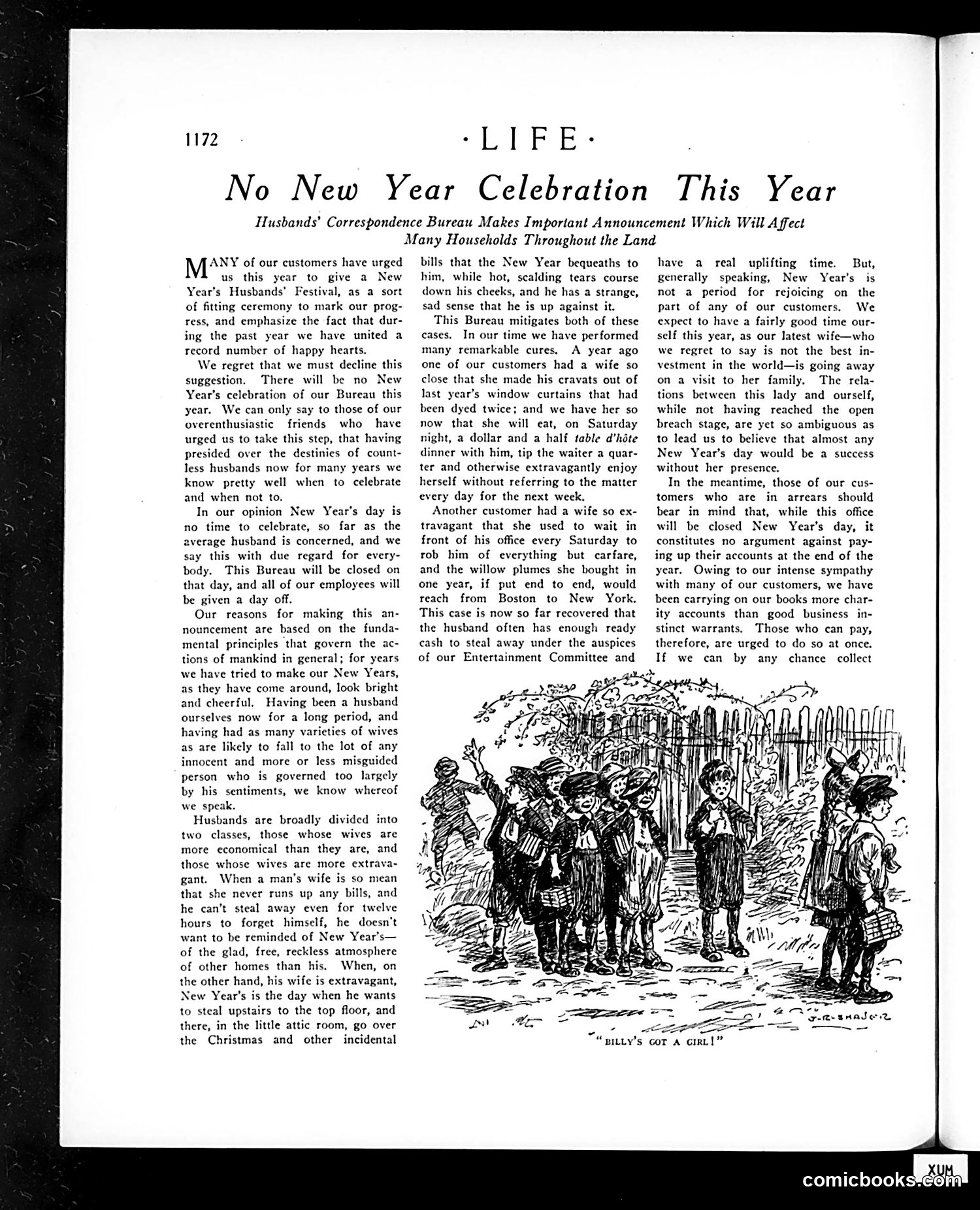
This page is primarily **text-based satire** rather than a political cartoon. The "Husbands' Correspondence Bureau" announces they will **close on New Year's Day** and advises husbands against celebrating. The satire targets **marital discord**—specifically wives' jealousy and control. The article describes wives who prevent husbands from enjoying New Year's festivities, citing examples of women who destroyed decorations or made husbands steal money to avoid questions about spending. The accompanying illustration ("Billy's Got a Girl!") shows soldiers celebrating with women, contrasting the carefree revelry the article suggests married men cannot enjoy. The humor relies on **early 20th-century gender dynamics**: wives as jealous controllers, husbands as victims. It's misogynistic by modern standards but reflects contemporary anxieties about marital power struggles.
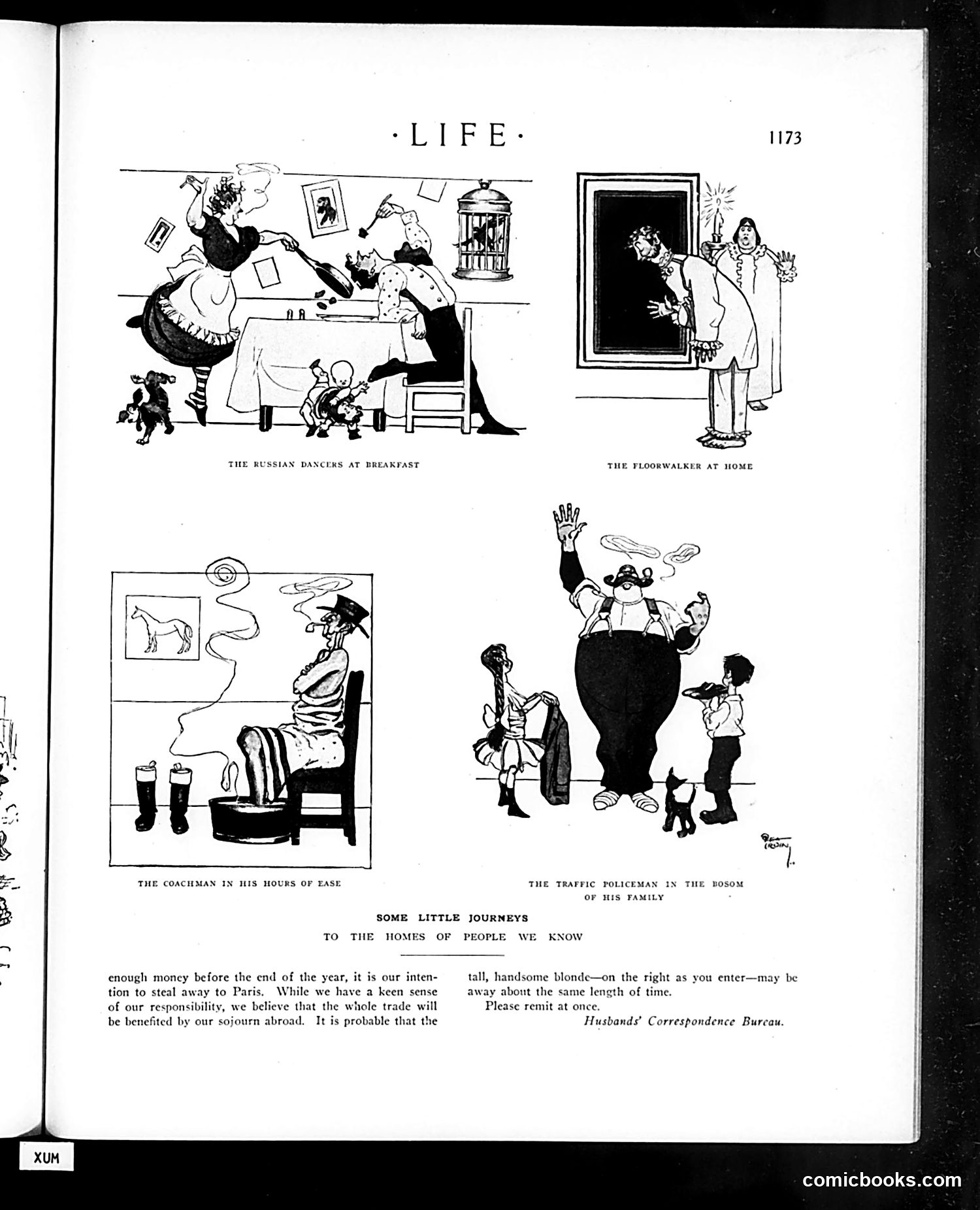
This page presents four comic vignettes mocking different social types through exaggerated domestic scenes. "The Russian Dancers at Breakfast" caricatures exotic performers in chaotic disarray. "The Floorwalker at Home" depicts a department store employee conducting himself pompously in his own residence—satirizing how workers adopt artificial authority outside their stations. "The Coachman in His Hours of Ease" shows a working-class driver relaxing with excessive comfort, likely mocking working-class pretension. "The Traffic Policeman in the Bosom of His Family" presents an authoritarian cop surrounded by chaos at home, suggesting his public power doesn't translate domestically. The page's humor relies on class-based stereotypes common to early 20th-century American satire: mocking foreigners, social climbers, and the collision between public roles and private reality. The accompanying text about stealing to Paris reinforces themes of aspiration and financial irresponsibility among the working and middle classes.
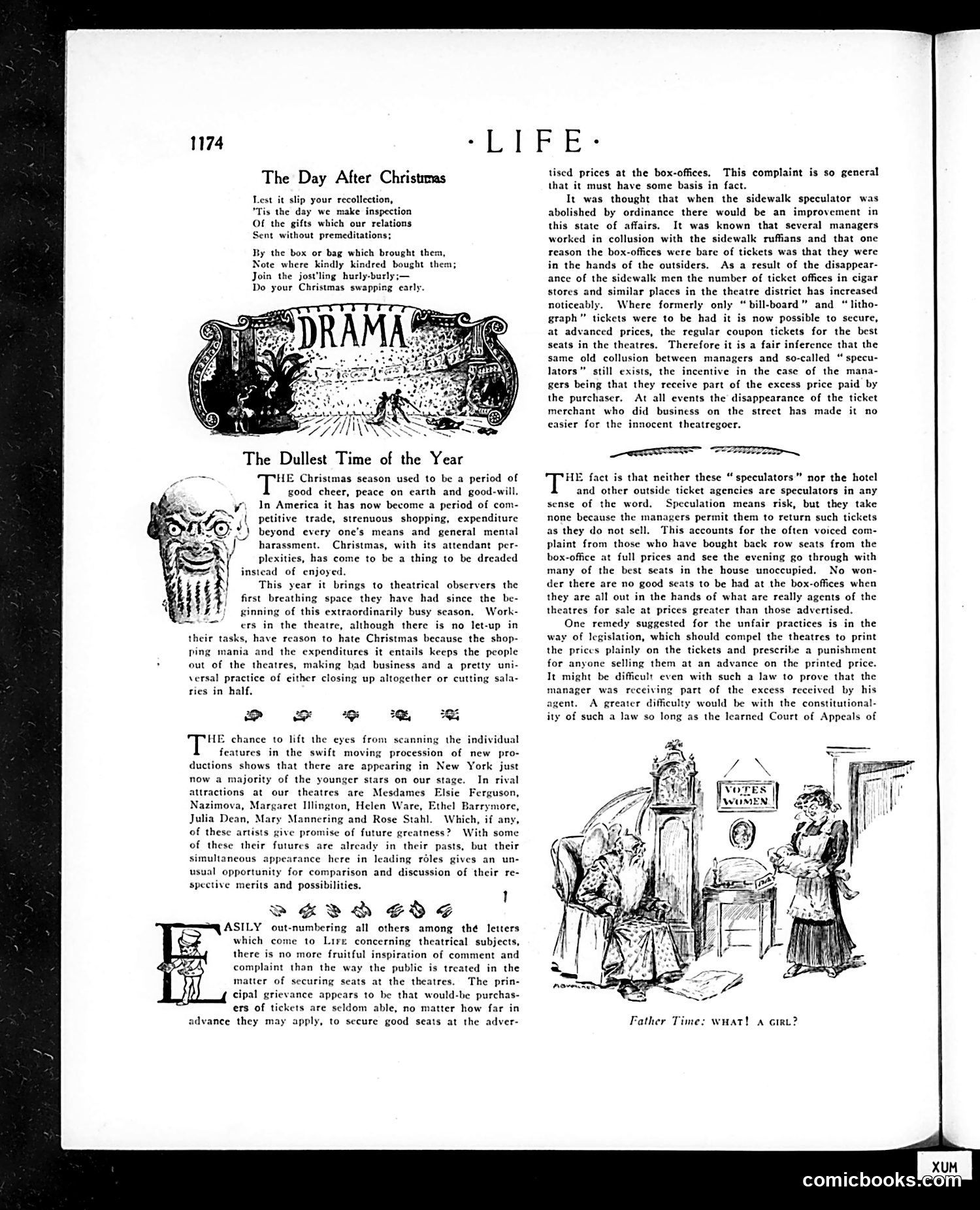
This 1910s *Life* magazine page satirizes two interconnected issues: **"The Day After Christmas"** (top): A humorous poem mocking the post-holiday ritual of gift-swapping—acknowledging that relatives give thoughtless, unwanted presents. The joke: "Do your Christmas swapping early" suggests people should immediately exchange bad gifts rather than pretend to like them. **"The Dullest Time of the Year"** (main article): Complains that Christmas shopping empties theaters, forcing closures and salary cuts for theatrical workers. The accompanying cartoon shows a father shocked to learn he's having a daughter—likely satirizing how Christmas expenses burden families. **The theater ticket scandal** (right column): The article's core grievance: ticket scalpers still control good seats despite being officially "abolished." Managers covertly collude with scalpers operating from cigar stores, marking up prices. This is satire of official reform that merely shuffled the problem rather than solving it—a timeless critique of regulatory failure.
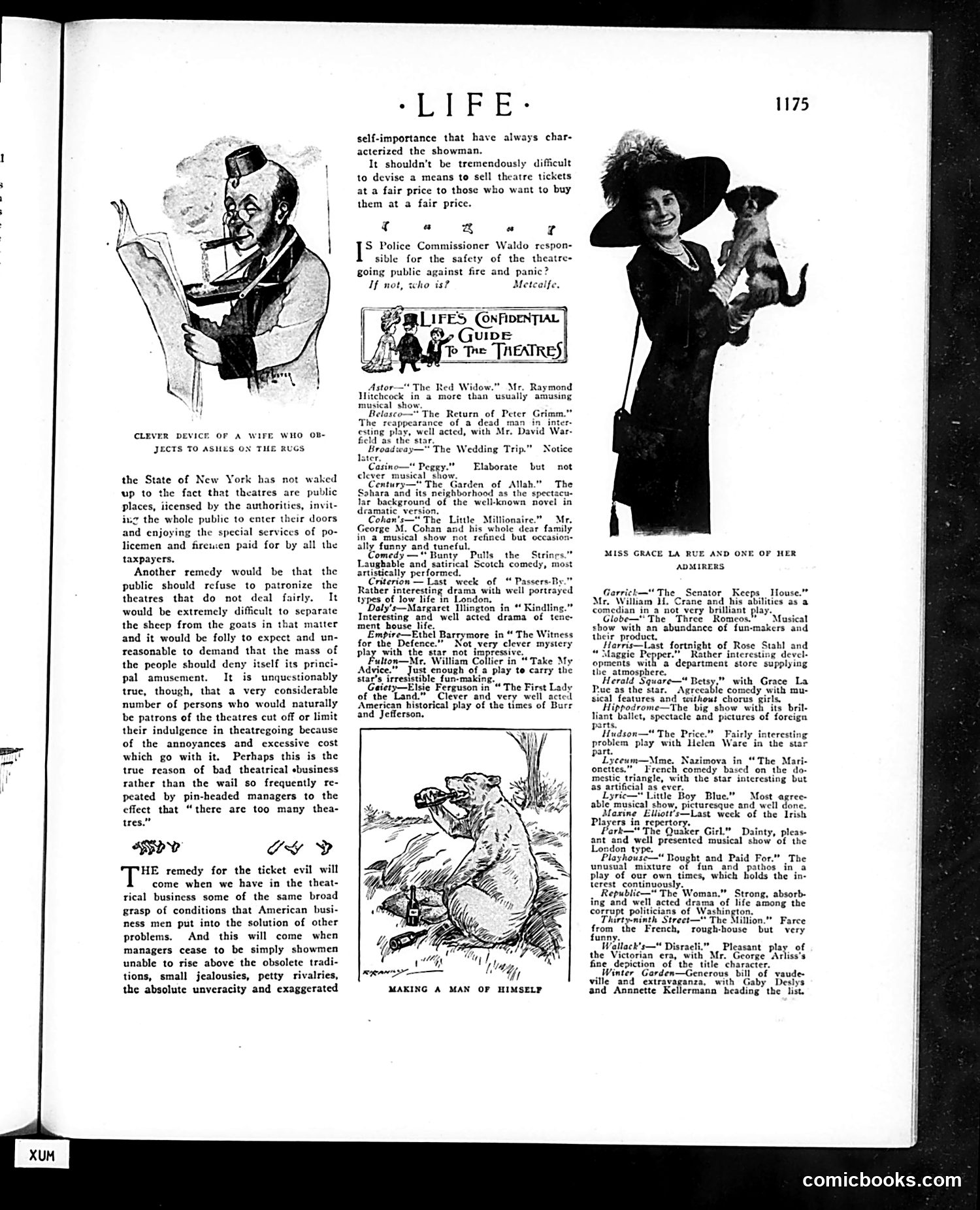
This page combines theater criticism with social commentary. The main cartoons mock domestic life and theatrical economics: **"Clever Device of a Wife"** (left): Shows a husband reading while his wife uses ash rugs—satirizing wives' indifference to household cleanliness, a common era stereotype. **"Making a Man of Himself"** (bottom): Depicts someone in mud or filth, likely mocking theatrical or social pretension about self-improvement. The lengthy text argues that **New York theaters exploit patrons** through unfair ticket pricing and unsafe conditions. It criticizes theater managers as old-fashioned "showmen" lacking modern business sense, and questions whether Police Commissioner Waldo ensures public safety. The piece suggests the "ticket evil" stems from managerial incompetence rather than too many theaters. **"Life's Confidential Guide to the Theatres"** reviews current Broadway shows, offering satirical assessments of various productions and performers. The satire targets theater industry greed and poor management while defending public theater access as a legitimate taxpayer-funded amenity.
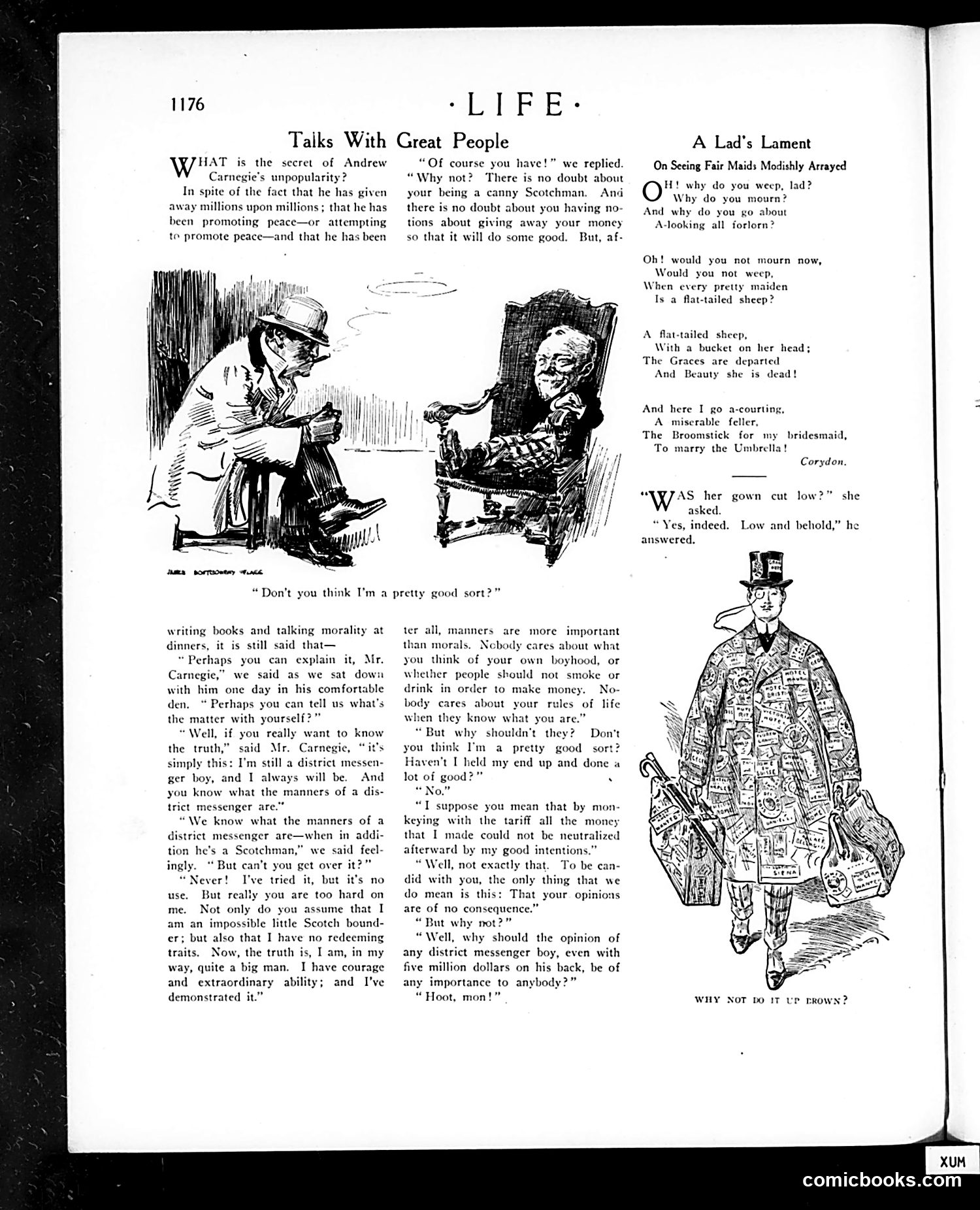
## Main Cartoon: "Talks With Great People" This satirizes **Andrew Carnegie**, the Scottish-American industrialist and philanthropist. The cartoon depicts him as still mentally a "district messenger boy" despite his wealth and charitable works. **The satire's point**: Carnegie's unpopularity stems not from his giving, but from his *manner*—he remains an uncouth social climber. The interviewer argues that his moral pronouncements and opinions are worthless because of his common origins. The joke is cruel: no amount of money or good deeds can erase his working-class Scottish manners or give his views social consequence among the elite. ## Side Content: "A Lad's Lament" A poem mocking women's fashion, specifically the "flat-tailed sheep" silhouette (likely the Gibson Girl or similar 1900s style). The lad despairs that modern dress has destroyed feminine beauty. Both pieces reflect *Life* magazine's satirical focus on social pretension, class anxiety, and changing fashion in early 20th-century America.
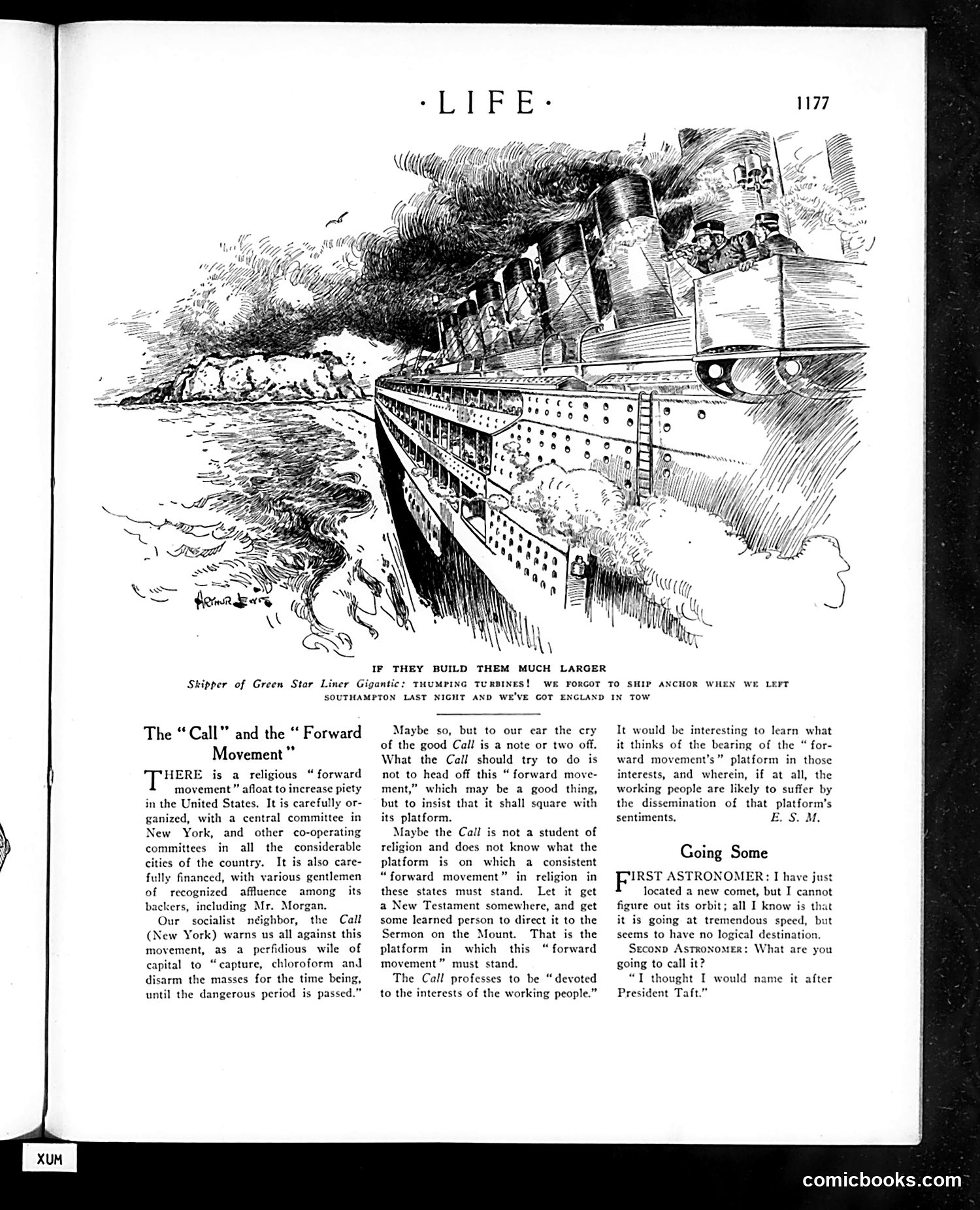
This page contains two distinct satirical pieces: **Main Cartoon:** Mocks the obsession with building ever-larger ocean liners (like the Titanic era). The joke: a ship captain reports they were so focused on size that they accidentally left England itself in tow—absurd hyperbole about gigantism. **"The Call and the Forward Movement":** Critiques a religious revival campaign backed by wealthy industrialists (including J.P. Morgan) aimed at promoting piety among American workers. Life's editors sarcastically suggest The Call (a socialist newspaper) is wrong to oppose it outright. Instead, Life argues The Call should demand the movement align with Christian teachings—specifically the Sermon on the Mount's emphasis on helping the poor—making the point that if capitalists truly followed their stated religious values, workers would benefit. **"Going Some":** A brief joke comparing President Taft to a comet with no logical destination or orbit—suggesting his presidency was directionless and chaotic.
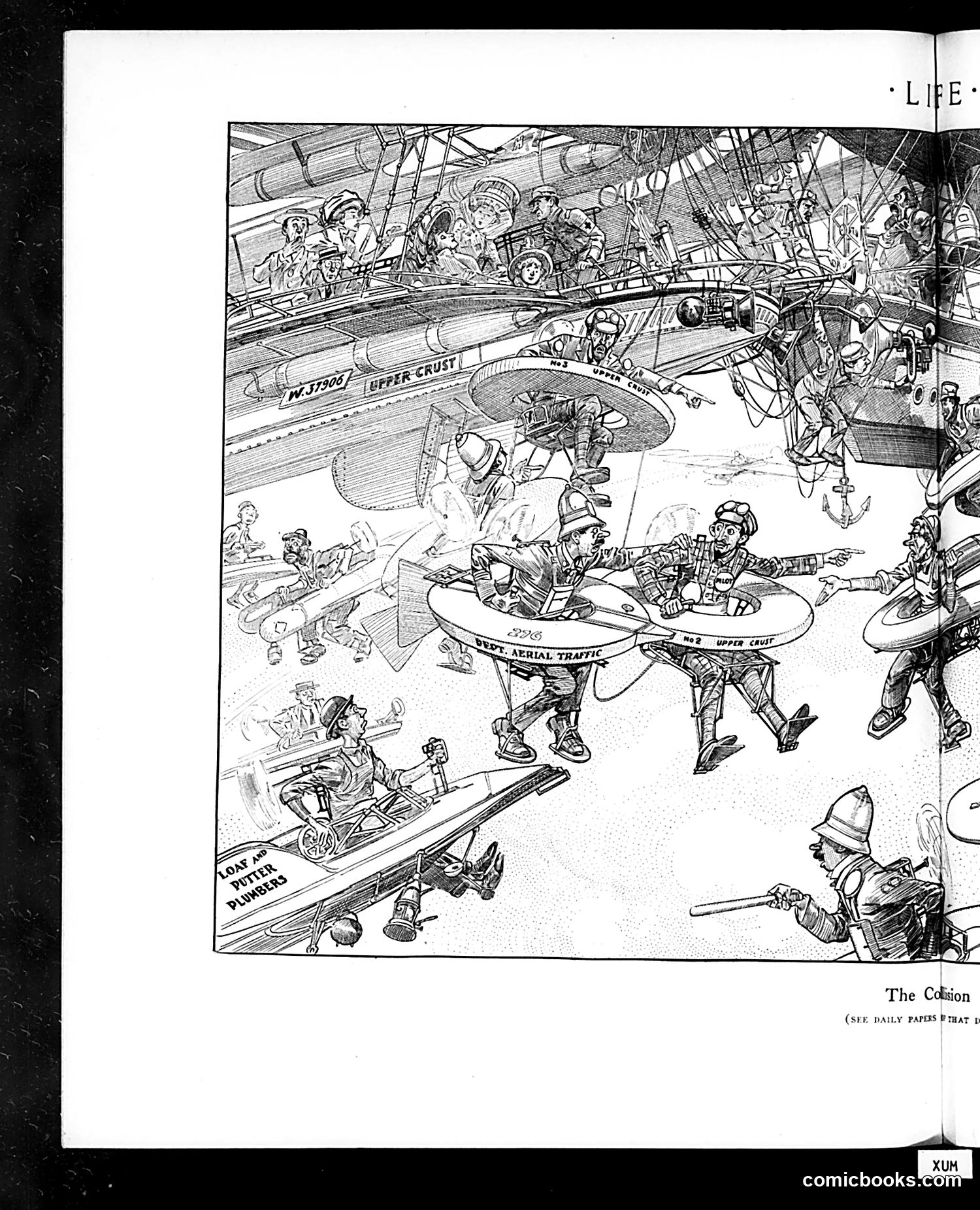
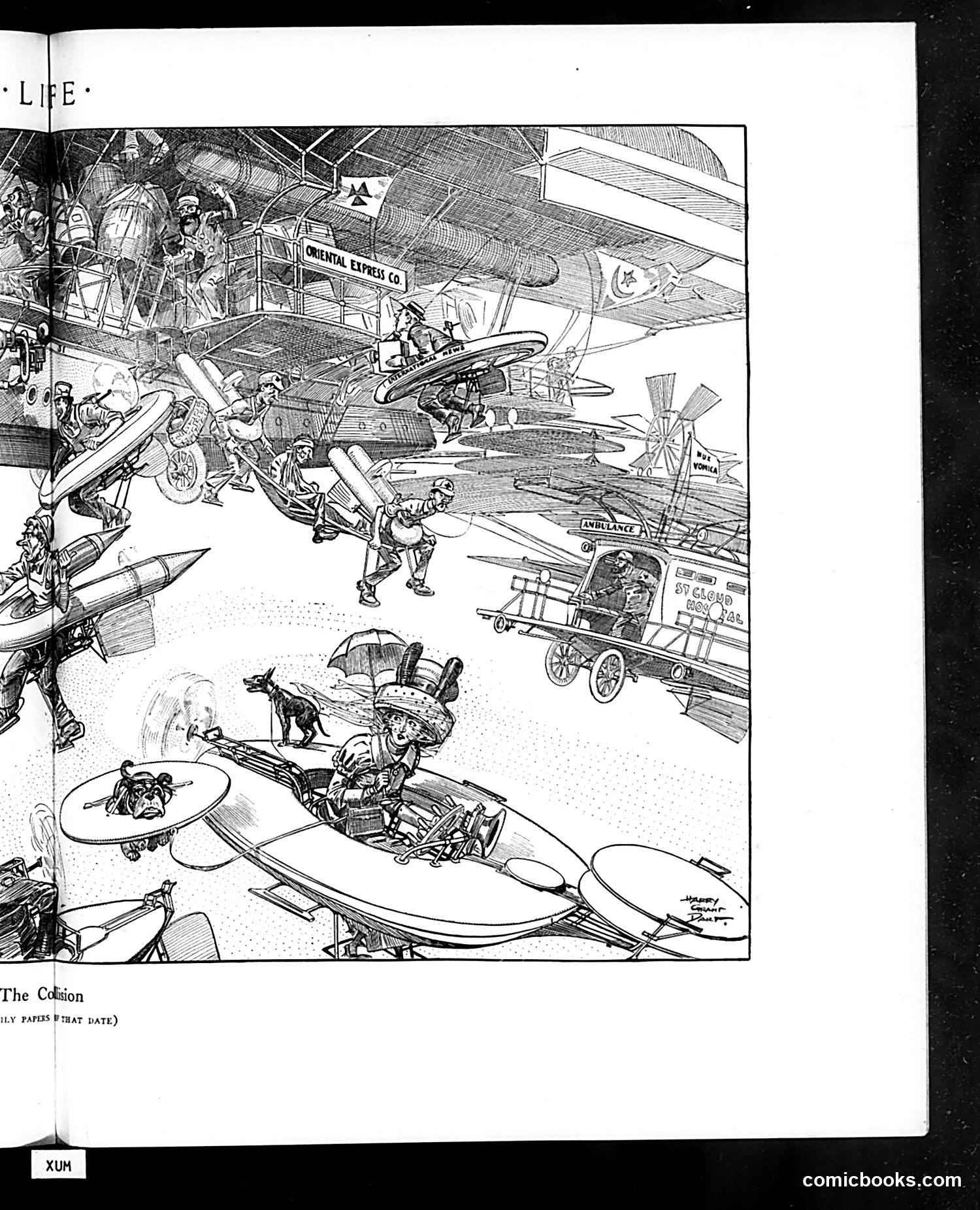
This is a satirical illustration titled "The Collision," depicting air and sea traffic chaos. The cartoon shows multiple aircraft (labeled "Upper Crust" and "M.37902") colliding or converging in crowded airspace above ships below, including one labeled "Expect Aerial Traffic." Personnel on vessels and in the water are shown in disarray, with various small boats labeled "Lifeboat with Plumbers" and maritime traffic signs visible. The satire appears to mock the growing congestion and safety hazards of modern aviation and naval traffic in early-to-mid twentieth century, humorously suggesting that increased air traffic creates dangerous collision risks, mixing aviation with maritime comedy elements. The reference to "plumbers" adds absurdist humor to the disaster scenario.
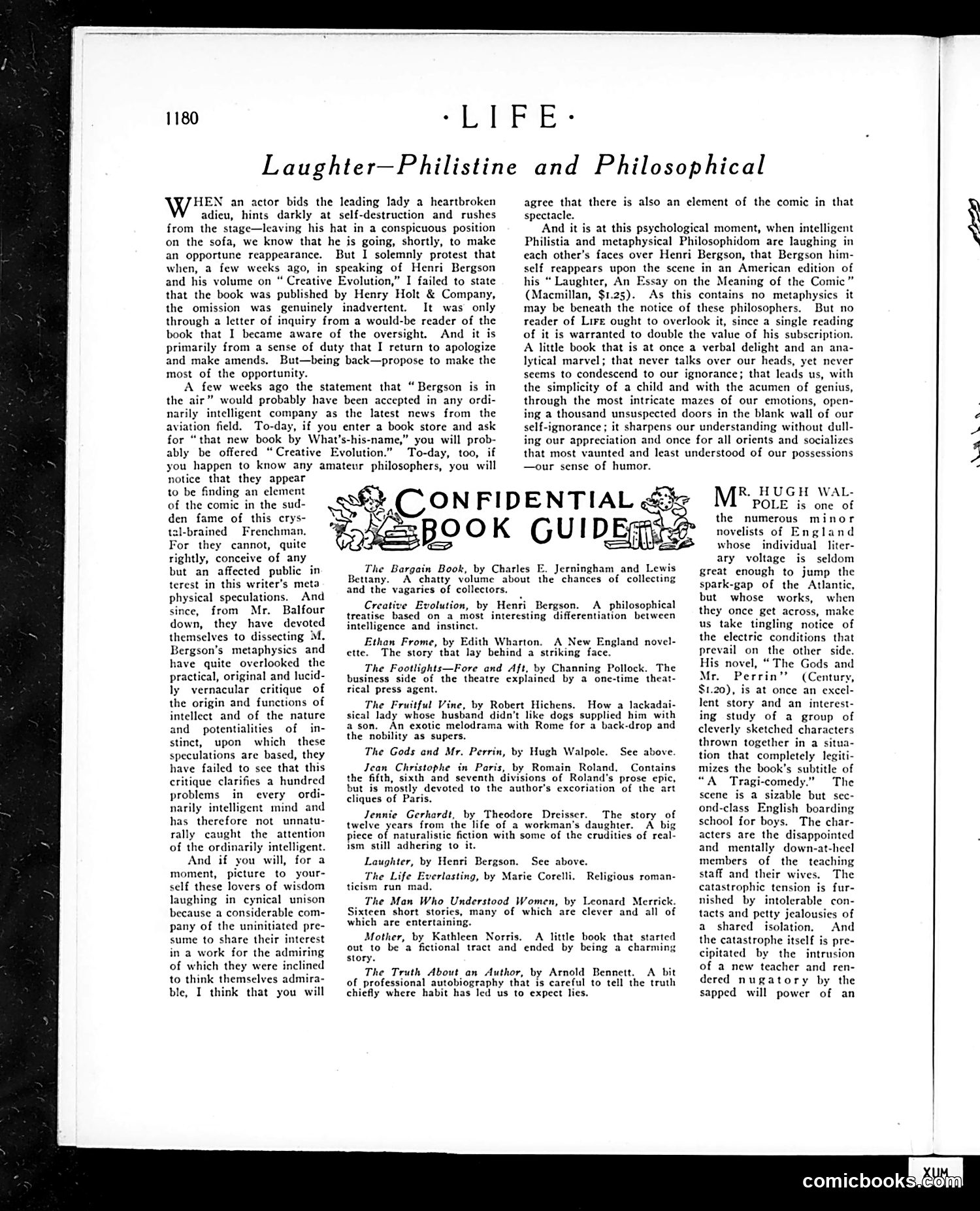
This page discusses Henri Bergson's sudden popularity in America following publication of his essay "Laughter: An Essay on the Meaning of the Comic" (Macmillan, $1.25). The author satirizes the irony that amateur philosophers are finding humor in Bergson's newfound celebrity among non-intellectuals ("Philistia"), while Bergson himself—the subject of their mockery—has now published an accessible work on comedy that the author argues is valuable precisely *because* it avoids the metaphysical pretension these same philosophers admire him for. The satire targets intellectual snobbery: sophisticated thinkers devoted themselves to Bergson's dense metaphysics while overlooking his clearer, practical analysis of intellect and instinct. Now ordinary readers are discovering what the self-styled intellectuals missed. The author implies these "lovers of wisdom" are laughing cynically at popular interest in Bergson, unaware that the accessibility they disdain is actually the work's greatest merit. The "Confidential Book Guide" sidebar reviews contemporary literary works.
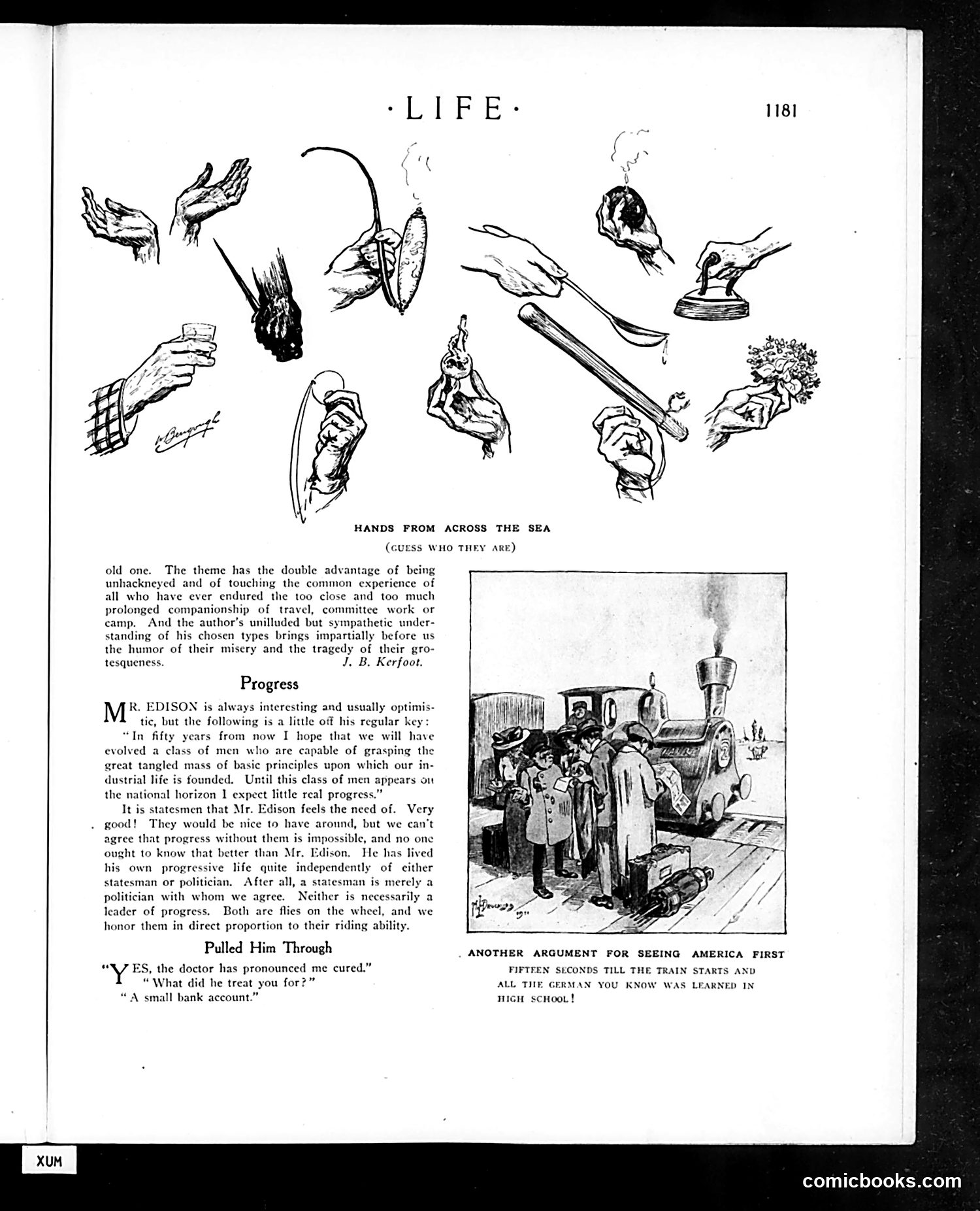
**"Hands Across the Sea"** shows various hands holding foreign objects—a fan, vegetables, tools, a plant—representing different nationalities. Readers are invited to guess which country each hand represents. This is a visual guessing game playing on national stereotypes and characteristics recognizable through everyday objects. **"Progress"** features Thomas Edison's pessimistic quote about needing better statesmen for industrial progress. The article counters Edison, arguing that progress happens independently of politicians—who are merely "flies on the wheel." The tone is skeptical of political leadership. **"Pulled Him Through"** is a brief joke: a doctor "cured" a patient by treating his "small bank account"—implying financial stress caused the illness, not actual disease. **"Another Argument for Seeing America First"** cartoon shows Americans boarding a train in Germany with only high school German knowledge—satirizing inadequate travel preparation and promoting domestic tourism as superior to foreign travel.
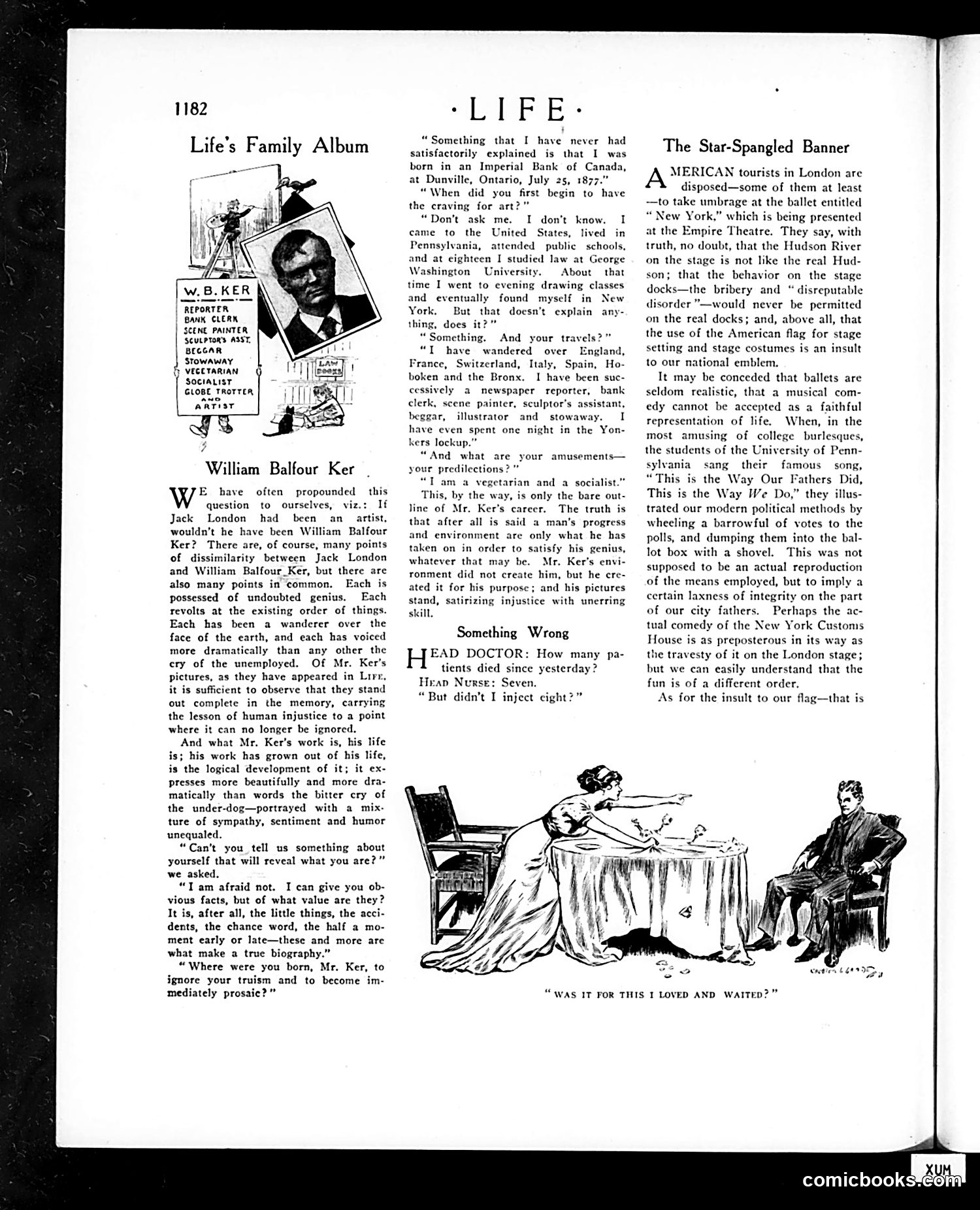
**William Balfour Ker Profile**: This is a biographical sketch of an artist-illustrator whose varied life experiences—reporter, bank clerk, stowaway, beggar—inform his work depicting social injustice and the plight of the "under-dog." Life compares him favorably to writer Jack London, praising his ability to express "the bitter cry of the unemployed" through art with "sympathy, sentiment and humor." **"Something Wrong" Cartoon**: A darkly comedic medical joke showing a head doctor and nurse discussing patient deaths. The punch line reveals administrative incompetence: the doctor injected eight patients but only seven died—implying either a miscalculation or that someone survived unexpectedly. **"The Star-Spangled Banner" Section**: American tourists in London object to a ballet called "New York" at the Empire Theatre for inaccurate depictions of the Hudson River and, more seriously, for using the American flag as stage scenery—they consider this disrespectful to the national symbol. The author notes ballets are rarely realistic.
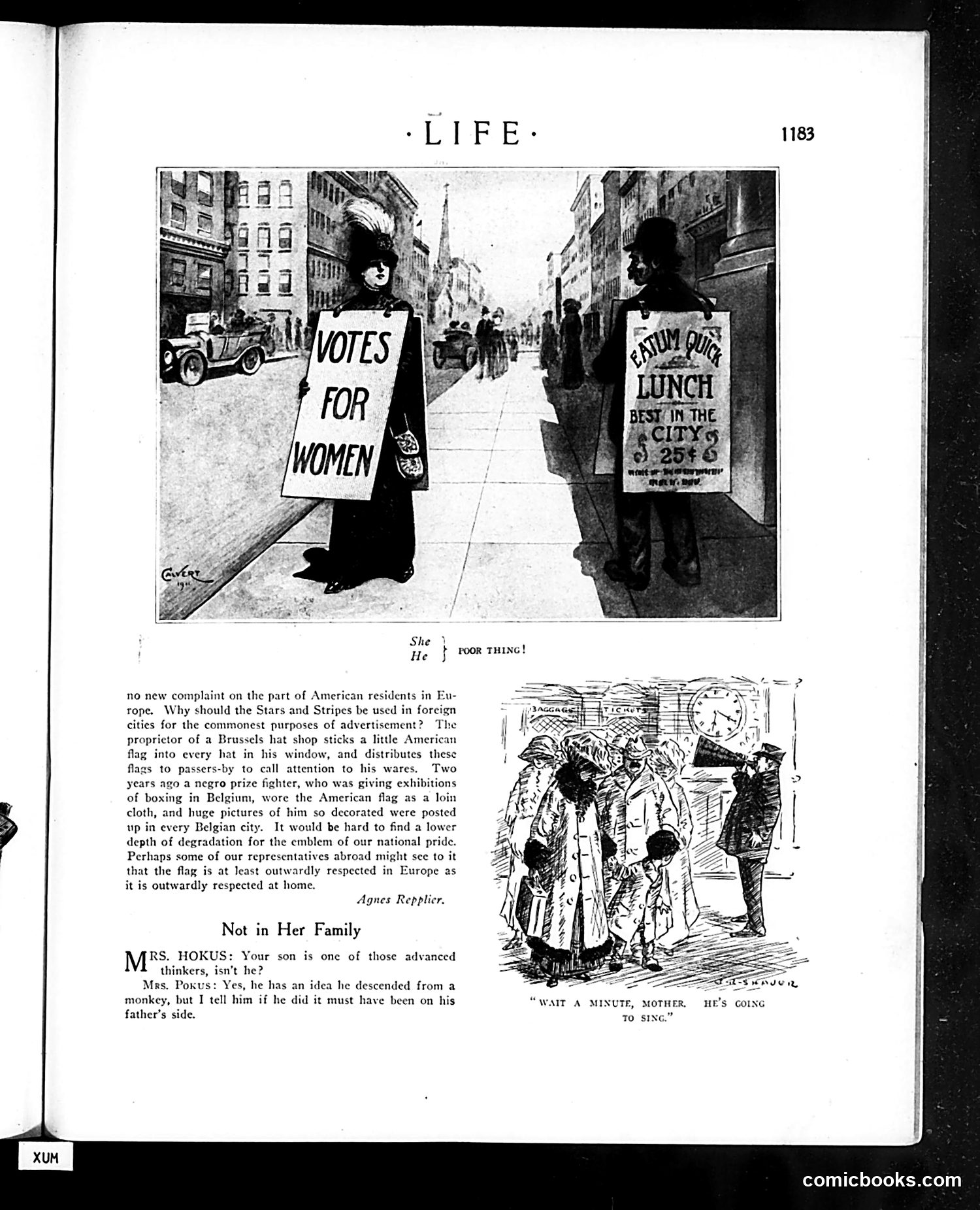
The top photograph shows women suffragists picketing with signs reading "VOTES FOR WOMEN" and a restaurant advertisement, contrasting their serious political activism with a commercial message. This satirizes the visibility clash between women's suffrage demonstrations and everyday commerce in urban America (likely 1910s-1920s). The accompanying essay by Agnes Repplier criticizes the misuse of the American flag abroad—specifically mentioning a Brussels hat shop using flags as window decoration and a Black boxer wearing the flag as a loincloth. Repplier argues this degrades national pride and calls for diplomatic intervention. The bottom cartoon "Not in Her Family" depicts a humorous exchange where Mrs. Pokus responds to a comment about her son being an "advanced thinker" (likely meaning someone interested in evolution/Darwinism) by joking that if he descended from monkeys, it must be on his father's side—a gender-based insult disguised as a joke about evolutionary theory.
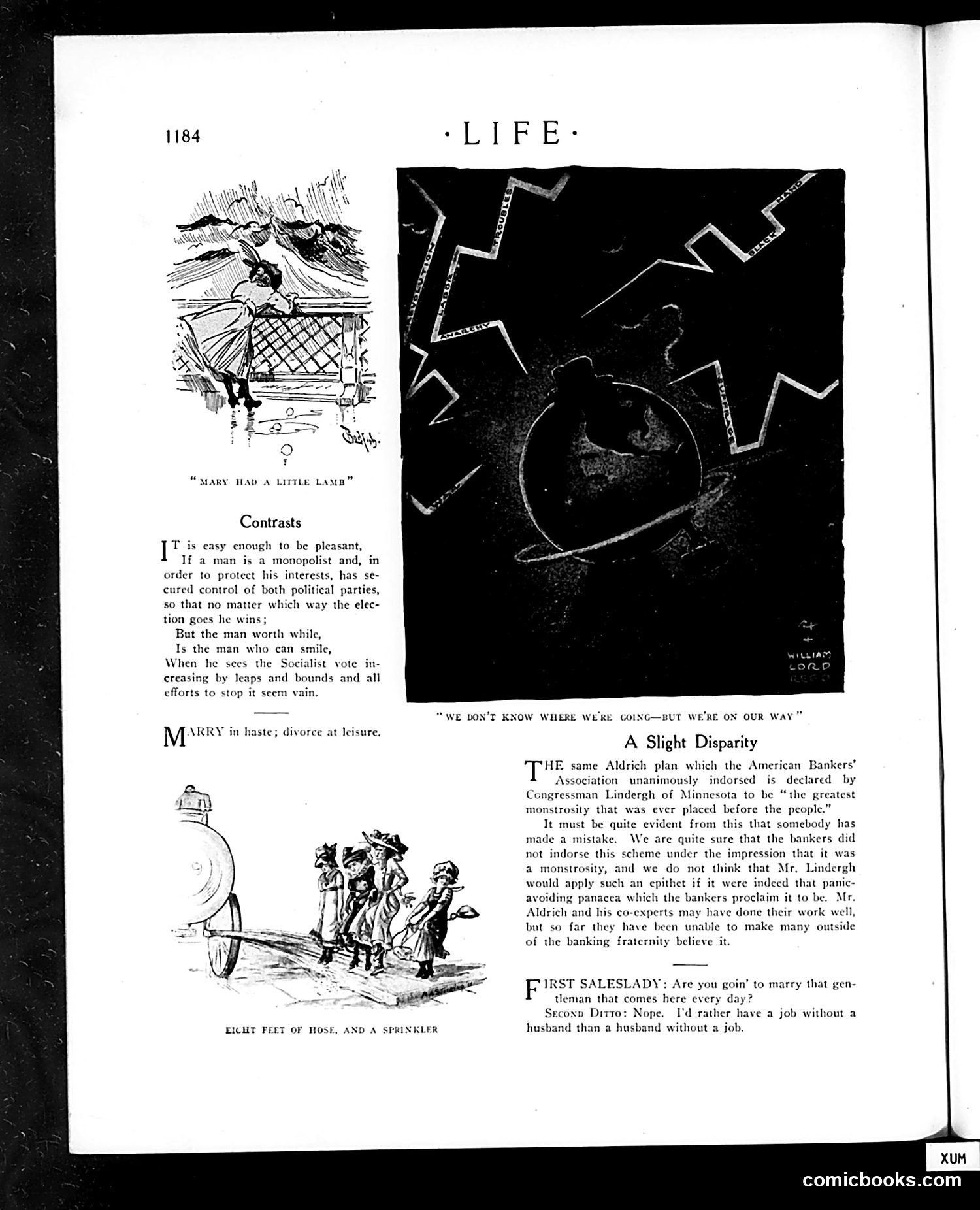
This page contains political satire from the early 1900s addressing monopolies, banking reform, and socialist politics. The **"Contrasts" poem** mocks monopolists who control both political parties to guarantee victory regardless of election outcomes. It praises those who can smile while witnessing growing Socialist support—suggesting socialism was a rising political threat the establishment feared it couldn't stop. **"A Slight Disparity"** criticizes the **Aldrich Plan** (a banking reform backed by Republican Senator Nelson Aldrich and bankers). Congressman **Lindergh of Minnesota** publicly called it "the greatest monstrosity," while bankers endorsed it as panic-preventing. The satire highlights this stark disagreement: bankers promoted it as beneficial, yet Lindergh condemned it as dangerous—suggesting someone is deceiving the public. The lower cartoon and dialogue joke about economic hardship: a saleswoman prefers unemployment to marriage without financial security—dark humor reflecting Depression-era anxieties about male breadwinners.
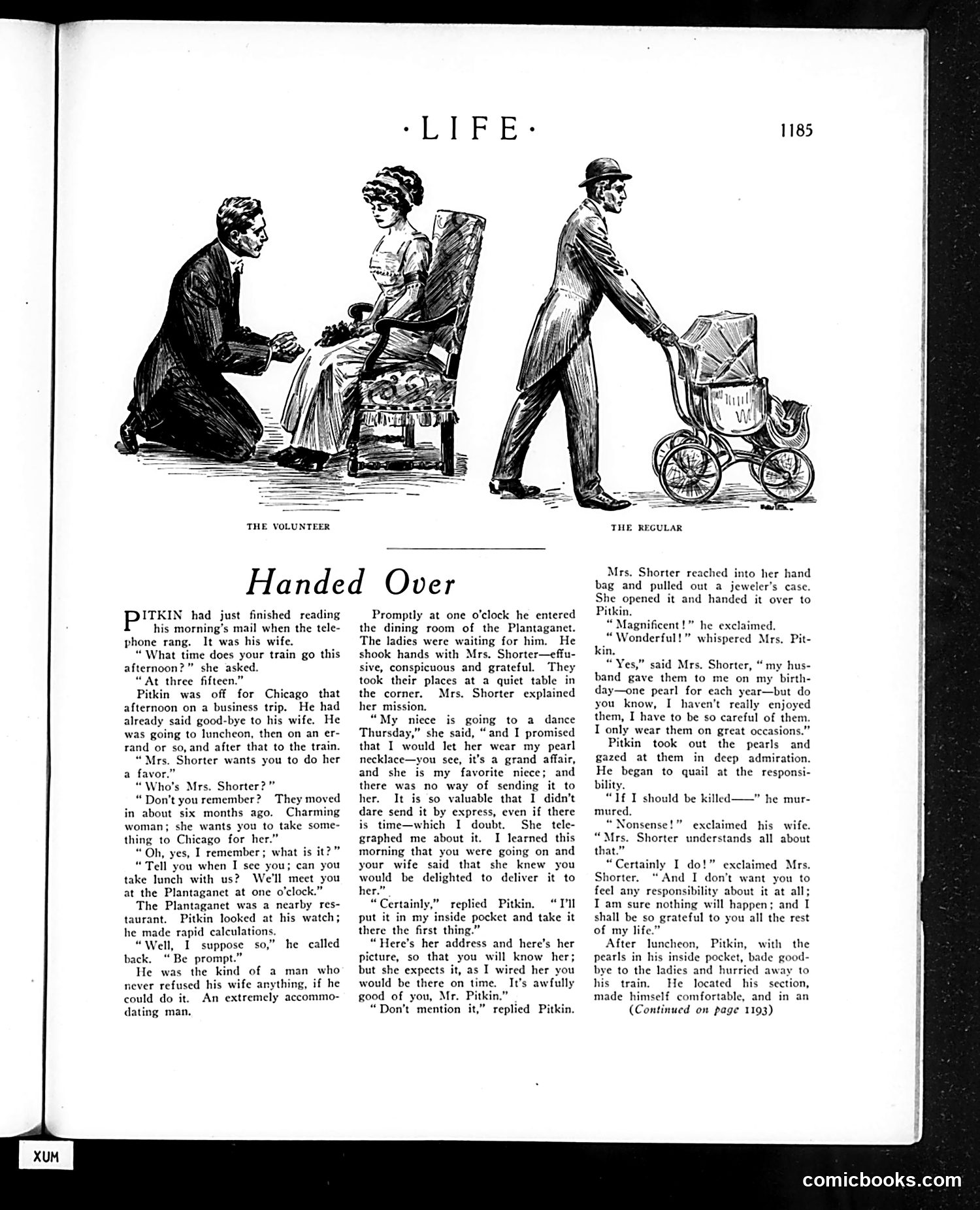
This story-illustration satirizes the anxieties of the accommodating middle-class male in early 20th-century America. The three sketches labeled "The Volunteer" and "The Regular" contrast two masculine archetypes: the eager-to-please husband (left) who cannot refuse his wife's requests, and the practical family man (right) managing domestic responsibilities. The narrative depicts Pitkin, an obliging businessman who agrees to transport Mrs. Shorter's valuable pearl necklace to Chicago—a favor his wife has already volunteered him for without asking. The satire targets masculine social weakness: Pitkin's inability to decline requests despite his time constraints and growing anxiety about the responsibility. The story emphasizes his worried questions ("If I should be killed—") versus Mrs. Shorter's dismissive reassurance, highlighting how such "helpful" husbands become unwitting mules for others' needs, their compliance masking actual discomfort.
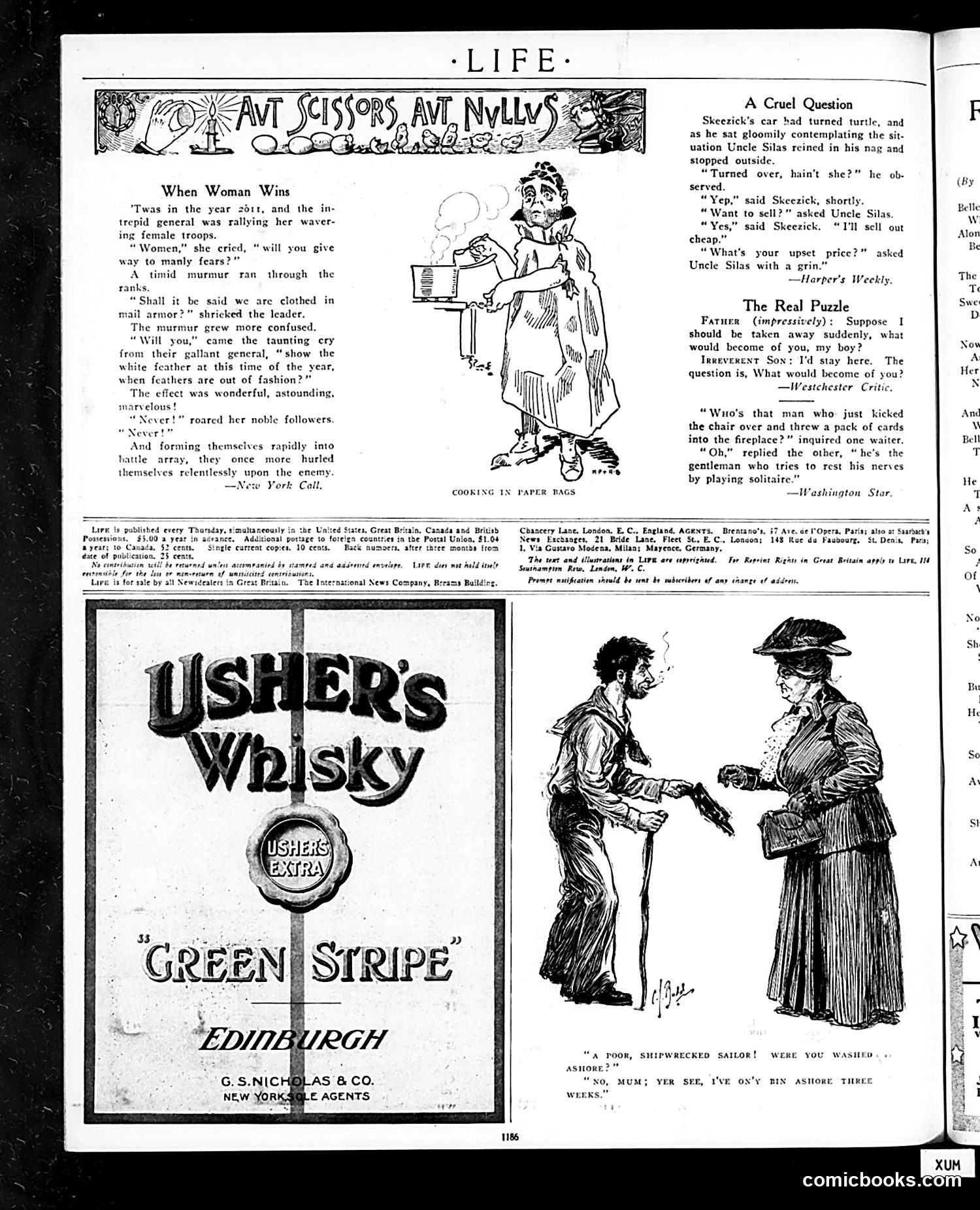
This page contains three separate humorous pieces typical of early 20th-century American satire: **"When Woman Wins"** satirizes women's wartime mobilization (likely WWI era). A female general rallies women soldiers by shaming them—questioning whether they'll show "the white feather" (cowardice). The joke mocks both military rhetoric and the novelty of women in combat roles, treating it as absurd theater rather than serious warfare. **"A Cruel Question"** features Uncle Silas discovering Skeezick's overturned car. When asked his "upset price" (a pun on the vehicle being literally upset/overturned), the joke plays on rural dialect and the transition from horse culture to automobiles. **"A Poor, Shipwrecked Sailor"** presents a sailor who claims to have been ashore only three weeks despite appearing shipwrecked—the humor lying in his apparently rapid deterioration or the absurdity of his timeline. These pieces reflect Life's satirical approach to contemporary American life, social change, and human nature through brief, illustrated comic narratives.
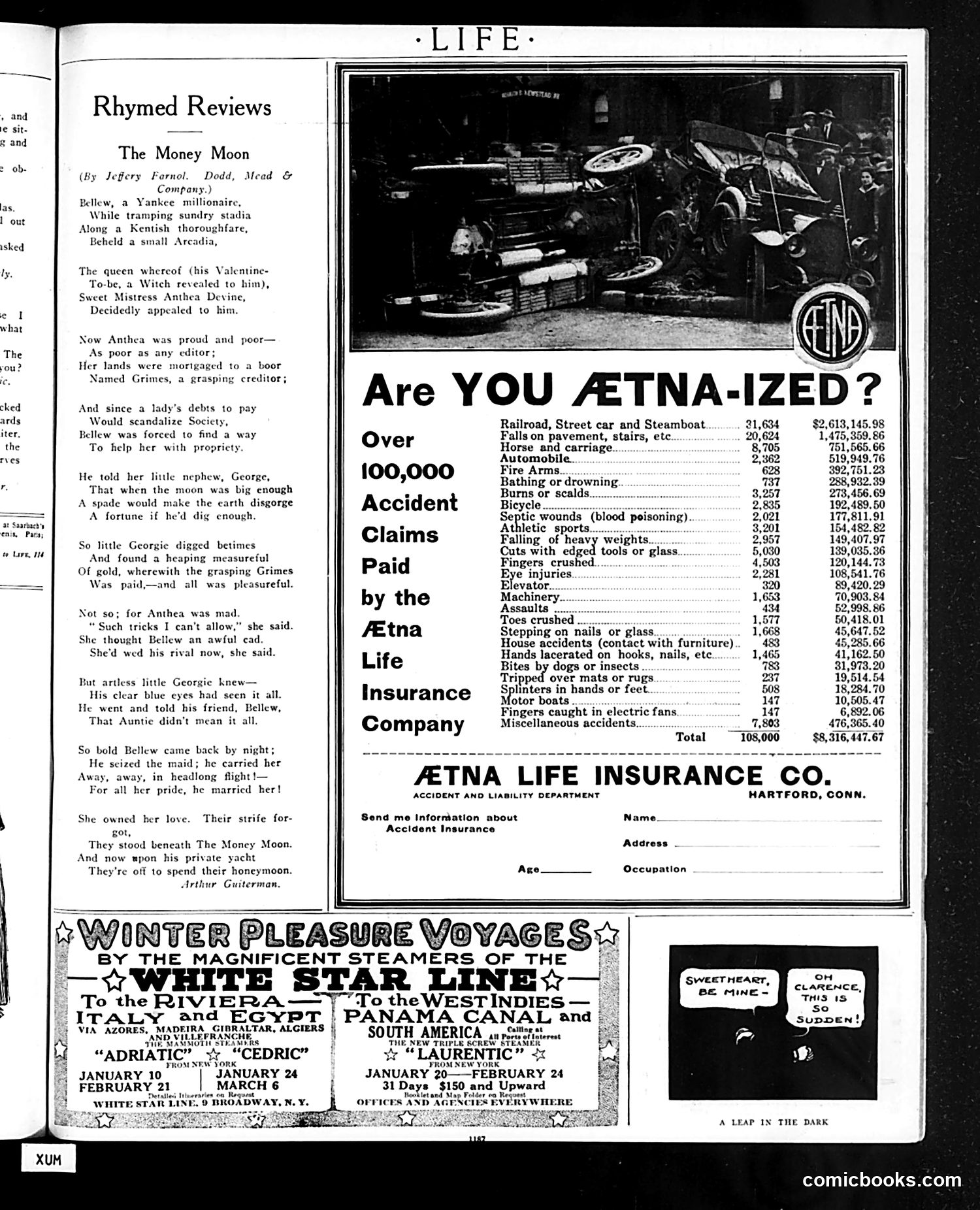
This page contains a **rhymed book review** of *The Money Moon* (a romantic novel), plus advertisements, not political cartoons. The review summarizes the plot: A wealthy American (Bellew) encounters a poor but proud English woman (Anthea) and falls in love. To help her financially without insulting her pride, he tells her young nephew that digging by moonlight will unearth treasure. The nephew finds gold, solving her debts. However, Anthea initially rejects Bellew for a rival. The nephew reveals her true feelings, Bellew returns, abducts her (presented romantically), and they marry. The satire is gentle—mocking both the sentimental romance-novel plot and the convenient "magic" solution to class conflict through wealth. The dominant visual is a large **Aetna Life Insurance advertisement** claiming over 100,000 accident claims paid, listing causes from railroad accidents to insect bites—essentially promoting accident insurance by cataloging all possible mishaps. The title "Are YOU AETNA-IZED?" is advertising jargon. Below are cruise-line advertisements for White Star steamers.
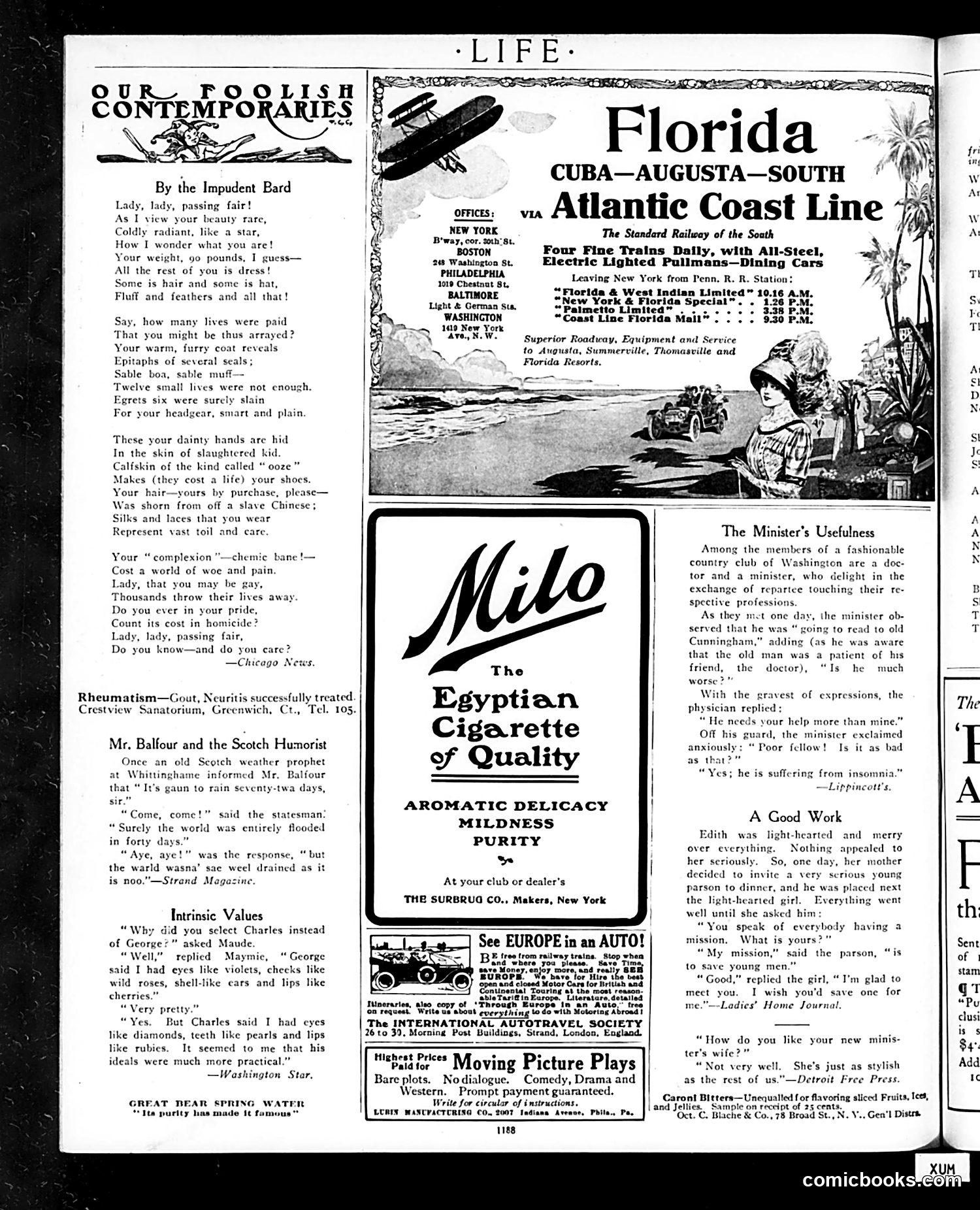
This page's main satirical poem attacks women's fashion for its hidden human and animal costs. "The Impudent Bard" addresses a fashionably dressed woman, cataloging how her appearance represents death and exploitation: her fur boas and muffs required dead egrets and seals; her calfskin shoes came from slaughtered animals; her hair was "purchased" (implying it came from exploited Chinese workers); her makeup involved chemical processing causing "woe and pain." The poem's central irony: elegant ladies appear refined while unknowingly complicit in mass death. The satirical question—"Do you know—and do you care?"—targets upper-class women's obliviousness to the human and environmental costs of their luxury goods, a common Progressive Era critique of consumer culture and labor exploitation. The piece assumes readers share disgust at this disconnect between beauty and brutality.
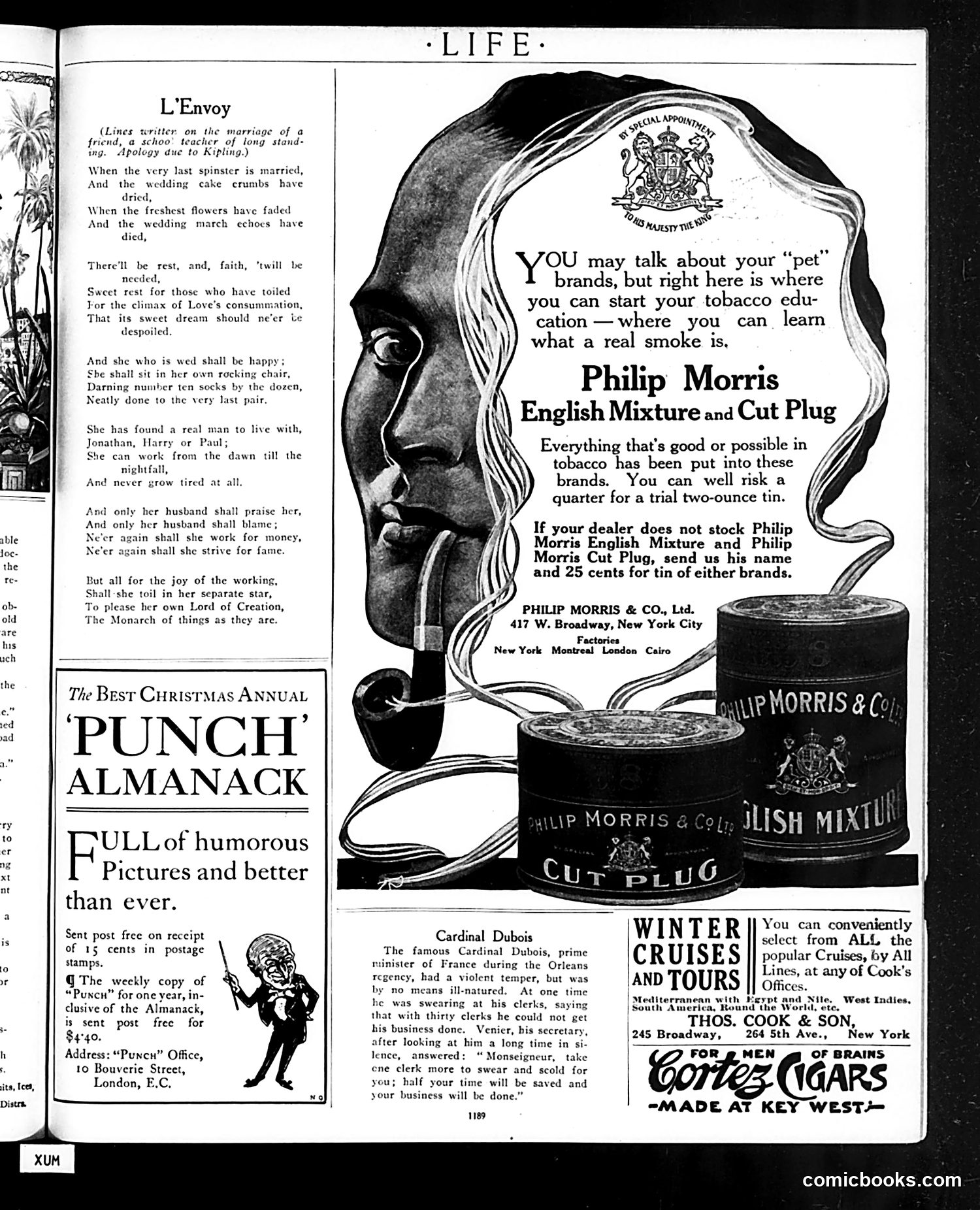
This page mixes editorial content with period advertising, typical of early 20th-century magazines. **"L'Envoy" Poem**: A satirical verse (credited to Kipling) about marriage. It ironically presents a woman's married life as restful reward—yet the actual details reveal drudgery: sitting in a rocking chair darning socks endlessly, working dawn to nightfall without payment or recognition, existing solely to please her husband as "Lord of Creation." The satire lies in the gap between the promise of "rest" and the reality of unpaid domestic servitude. This reflects contemporary feminist critique of women's marriage as economic and social imprisonment. **Advertisements**: The page features ads for Philip Morris tobacco, a winter cruise company (Thomas Cook), and Cortez cigars—typical luxury goods marketed to affluent readers. **Cardinal Dubois anecdote**: A brief humor piece about the French cardinal's temperament, showing a clever secretary's witty solution to his excessive swearing. The page's juxtaposition—romantic poem about marriage's "rest" alongside ads for leisure travel—underscores the irony: some enjoyed leisure; married women, apparently, did not.
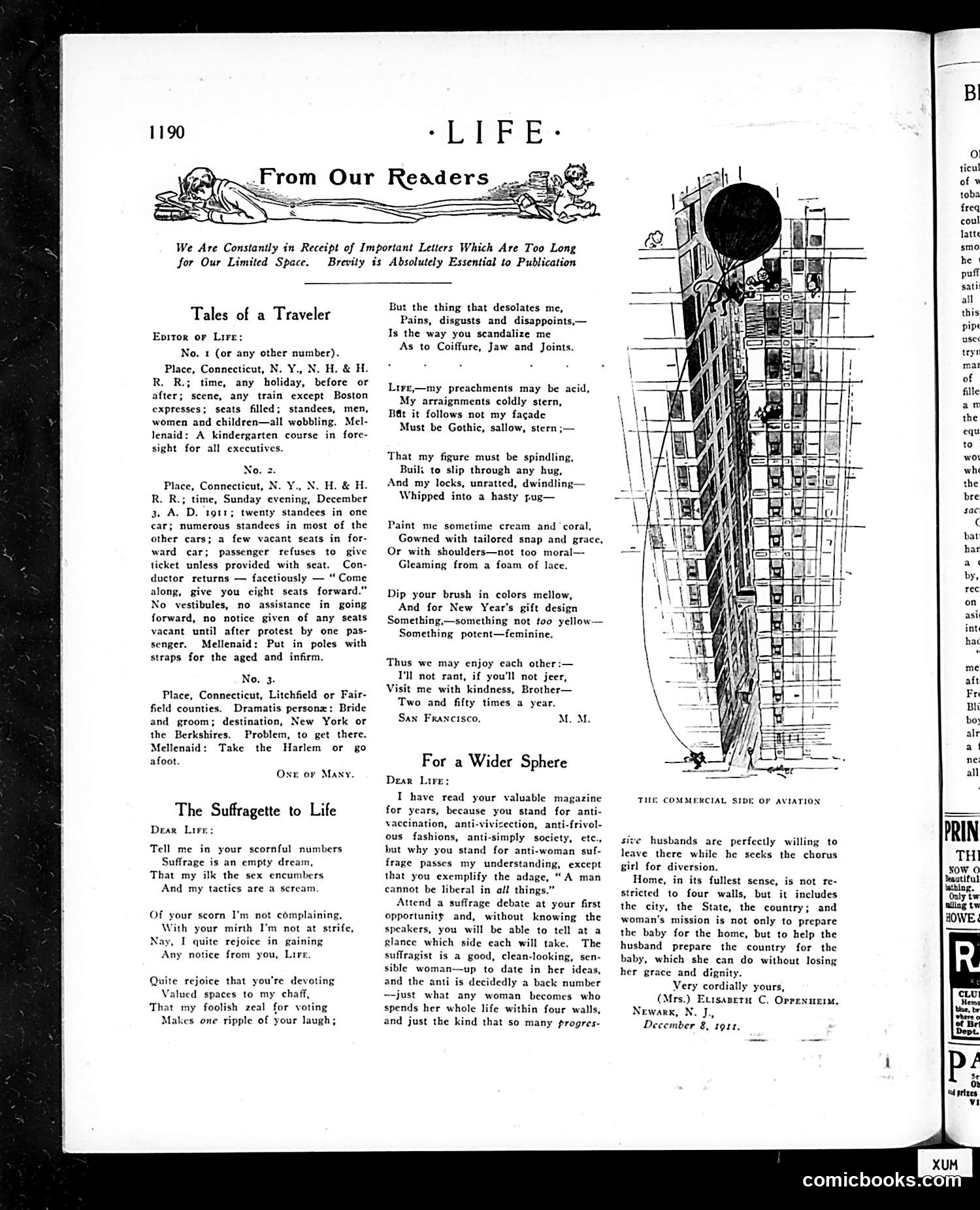
This page contains reader letters and commentary rather than political cartoons. The content reflects early 1910s debates: **"The Suffragette to Life"** is a poem from a suffrage advocate responding to Life's mockery of women's suffrage activists. The writer protests that Life ridicules suffragists' appearances (describing them as having poor fashion sense, bad hair, and unattractive figures) rather than engaging with their arguments. She requests Life depict suffragists as "cream and coral," fashionable and feminine, to enable respectful dialogue. **"For a Wider Sphere"** argues that suffragists are "clean-looking, sensible women" while anti-suffragists are "back numbers" confined to homes. The writer suggests women's citizenship extends beyond domestic walls to the state and nation. These letters reveal Life magazine's anti-suffrage stance and its use of personal ridicule—particularly about women's appearance and fashion—to delegitimize voting rights activism, a common tactic opponents of women's suffrage employed before the 19th Amendment (1920).
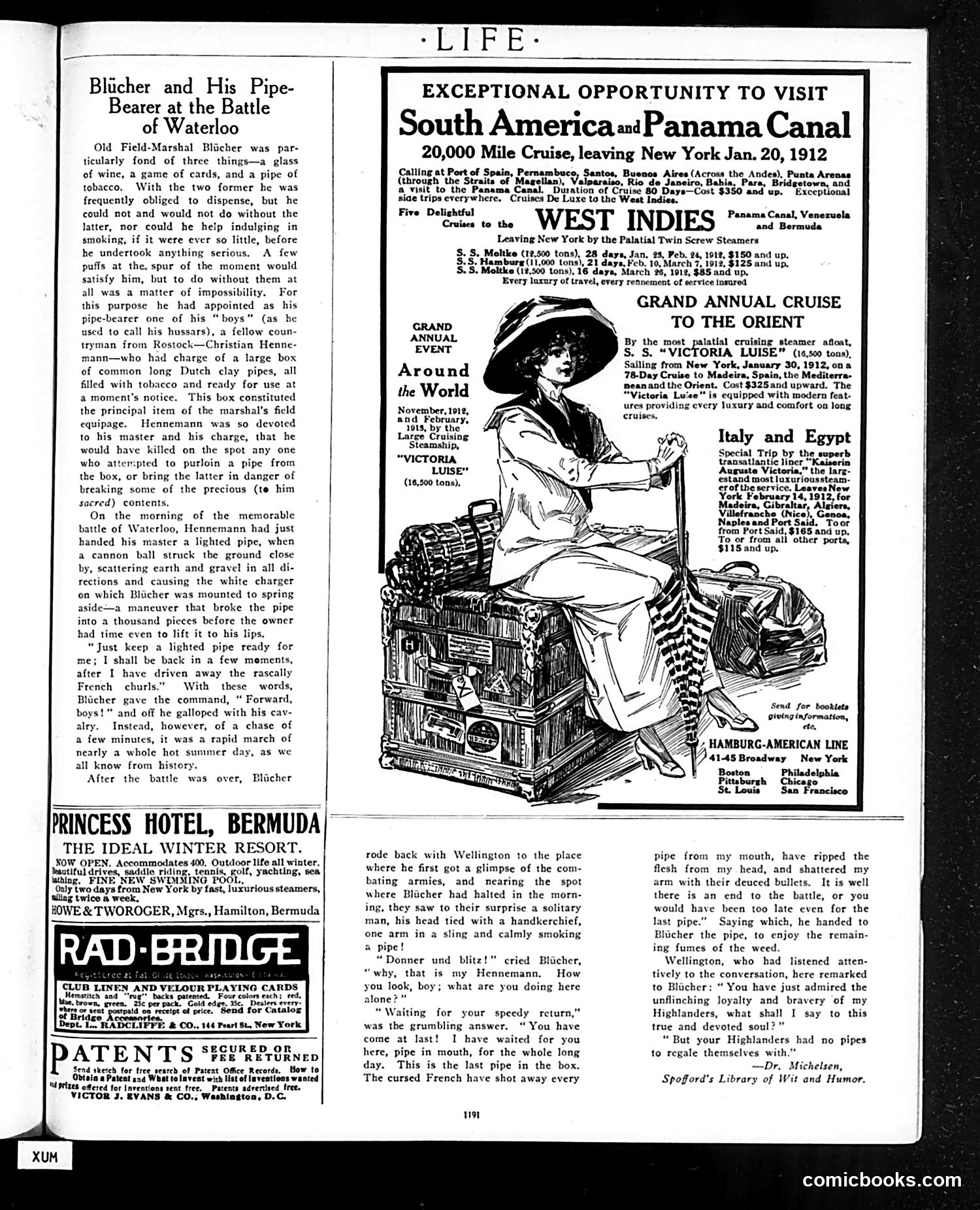
This is a historical anecdote with satirical humor, not a political cartoon. It recounts a story about Prussian Field-Marshal Blücher at the 1815 Battle of Waterloo, emphasizing his three passions: wine, cards, and pipe-smoking. The humor centers on Blücher's absurd devotion to his pipe. His trusted pipe-bearer, Hennemann, jealously guards a box of Dutch clay pipes. During battle, a cannon blast destroys Blücher's lit pipe, prompting him to order Hennemann to have a replacement ready—which Hennemann faithfully does despite the chaos. The punchline suggests Blücher's pipe obsession supersedes even military urgency. The satire mocks aristocratic vanity and quirky personal habits, portraying Blücher as ridiculous for prioritizing comfort over battlefield practicality. It's gentle mockery of military pretension dressed as historical anecdote—typical of *Life* magazine's satirical style.
This page is a straightforward advertisement for *Ainslee's Magazine*, not political satire or a cartoon. It promotes the January issue, emphasizing the magazine's entertainment value through its mix of fiction. The ad highlights the featured novelette—P.G. Wodehouse's "The Prince and Betty"—and lists prominent short-story authors of the era (Joseph C. Lincoln, Alicia Ramsay, Egerton Castle, and others) to attract readers. The tagline "Sold wherever magazines are read—Read wherever magazines are sold" is a playful, circular marketing phrase. For modern readers: this reflects early 1900s magazine culture, when general-interest magazines like *Ainslee's* competed on literary content quality and famous authors' names as selling points. The fifteen-cent price anchors this in the pre-inflation era. There is no satire or political commentary present—it's period advertising.
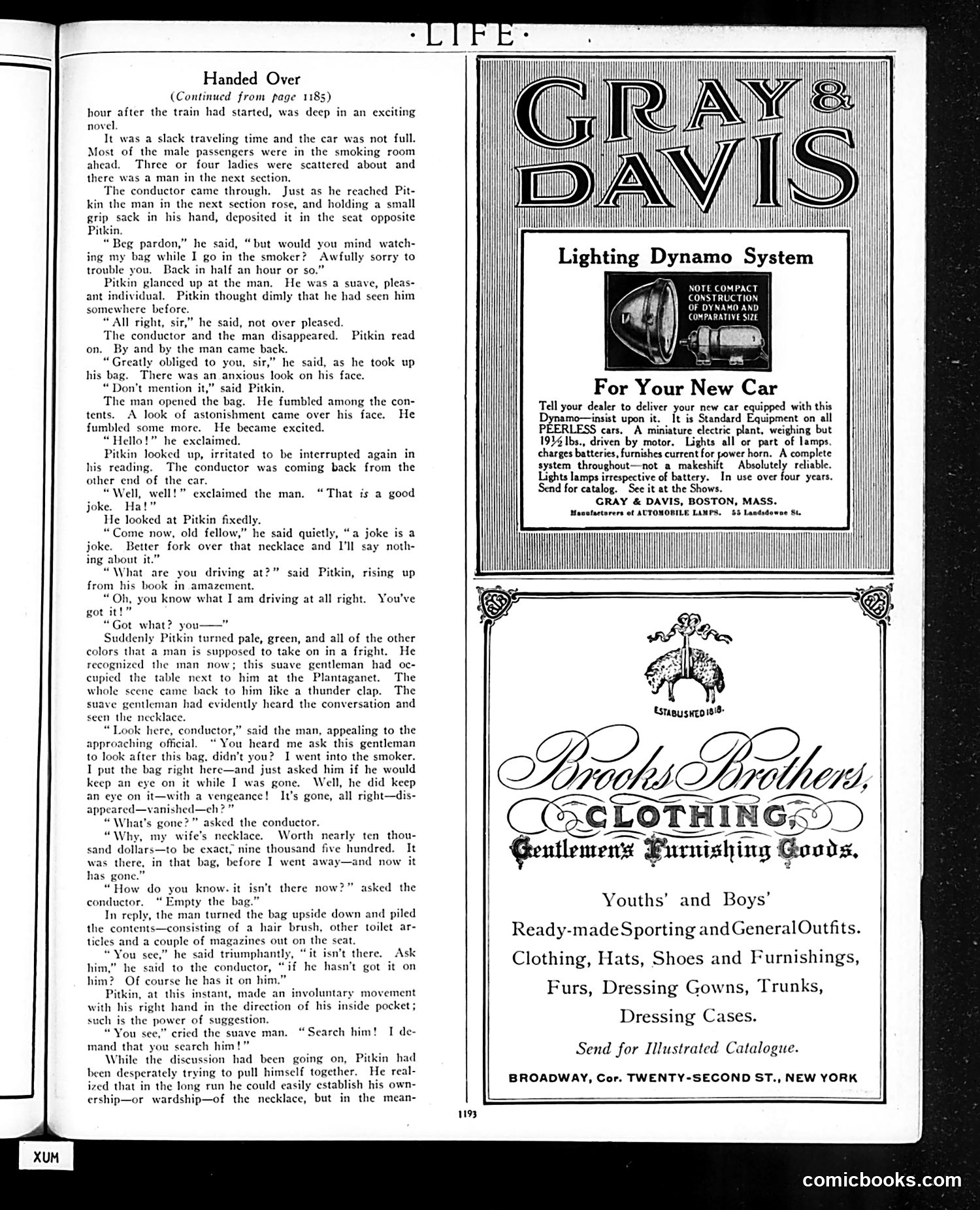
This page contains a serialized short story titled "Handed Over" (continued from page 1185), not a political cartoon. The narrative describes a train passenger named Pitkin who agrees to watch another man's bag while he visits the smoking car. When the man returns, his valuable necklace (worth $9,500) is missing from the bag. The story appears to be a mystery or theft plot: the man accuses Pitkin of stealing it, claiming he saw Pitkin at a previous location (the Plantaganet) and assumes Pitkin took the necklace. The conductor is summoned as a witness. The page is primarily text-based fiction rather than satirical commentary. The advertisements (for Gray & Davis lighting systems and Brooks Brothers clothing) are standard commercial content typical of Life magazine's era. **No political satire or caricature is present on this page.**
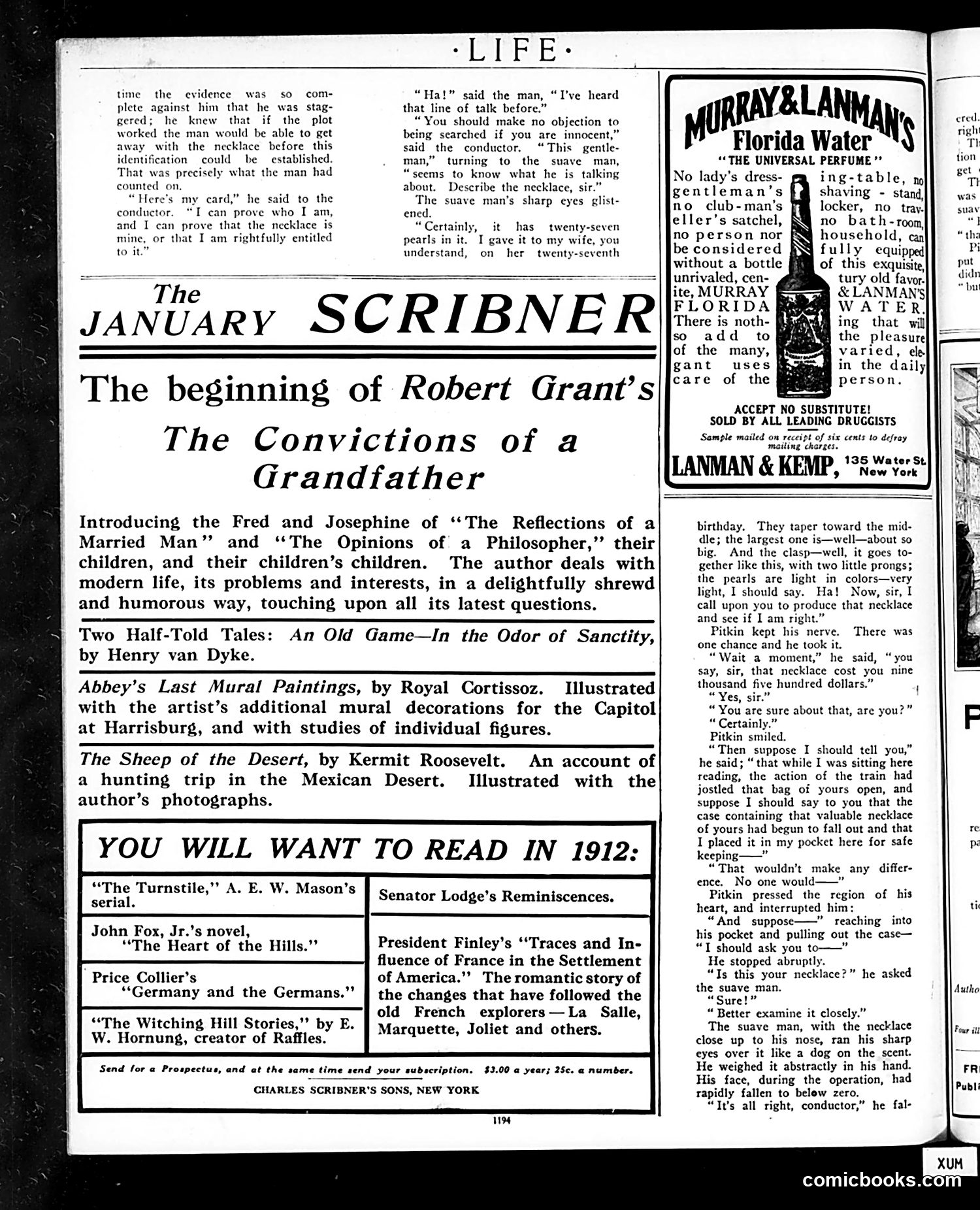
This is primarily a **title page and table of contents** for the January 1912 issue of Scribner's magazine (published by Charles Scribner's Sons), not a political cartoon page. The main content announces Robert Grant's serialized story "The Convictions of a Grandfather," which appears to be a domestic fiction piece about family life across generations. The visible text excerpt shows a mystery plot involving a disputed necklace—possibly a theft or con-artist scenario where a conductor and passenger debate ownership. The right side features a **Murray & Lanman's Florida Water advertisement**, a perfume product marketed as "the universal perfume" for household use. Below the masthead are previews of upcoming 1912 content, including works by A.E.W. Mason, John Fox Jr., and President Finley on French colonial America. **No political satire or caricature is evident** on this page—it's a straightforward literary magazine preview with period advertising.
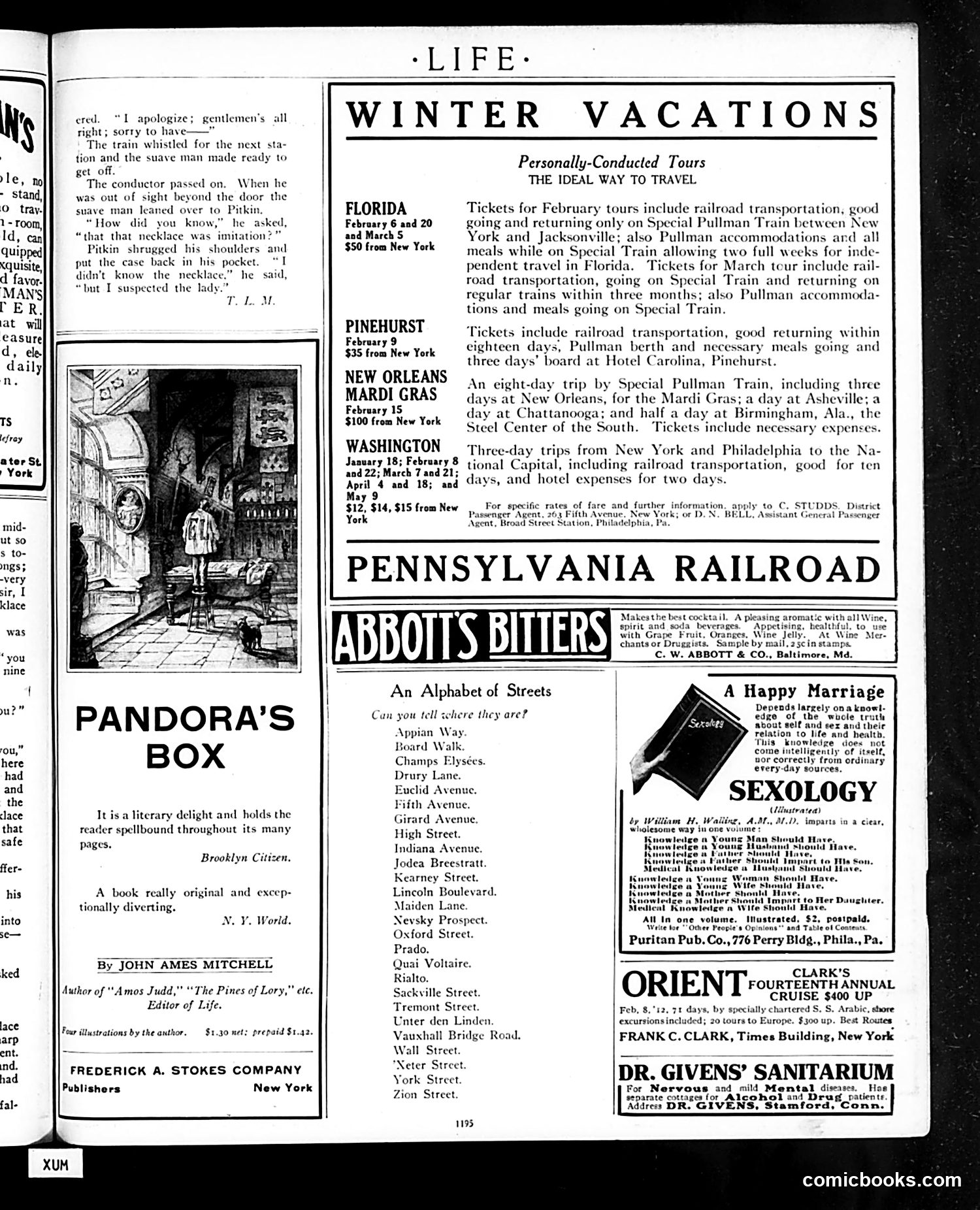
The "PANDORA'S BOX" section appears to be a short story excerpt. The visible text shows a narrative about identifying counterfeit jewelry on a train. A character named Pitkin correctly identifies a necklace as "imitation" without actually knowing whether it was genuine—he simply "suspected" it. When confronted by a "suave man," Pitkin admits his deception, explaining he was bluffing. The story appears to be humorous commentary on confidence schemes and deception, likely exploring the theme that sometimes deception succeeds through luck rather than actual knowledge. The accompanying illustration (a woman in what appears to be a train setting) supports this travel-based narrative of trickery and social manipulation.
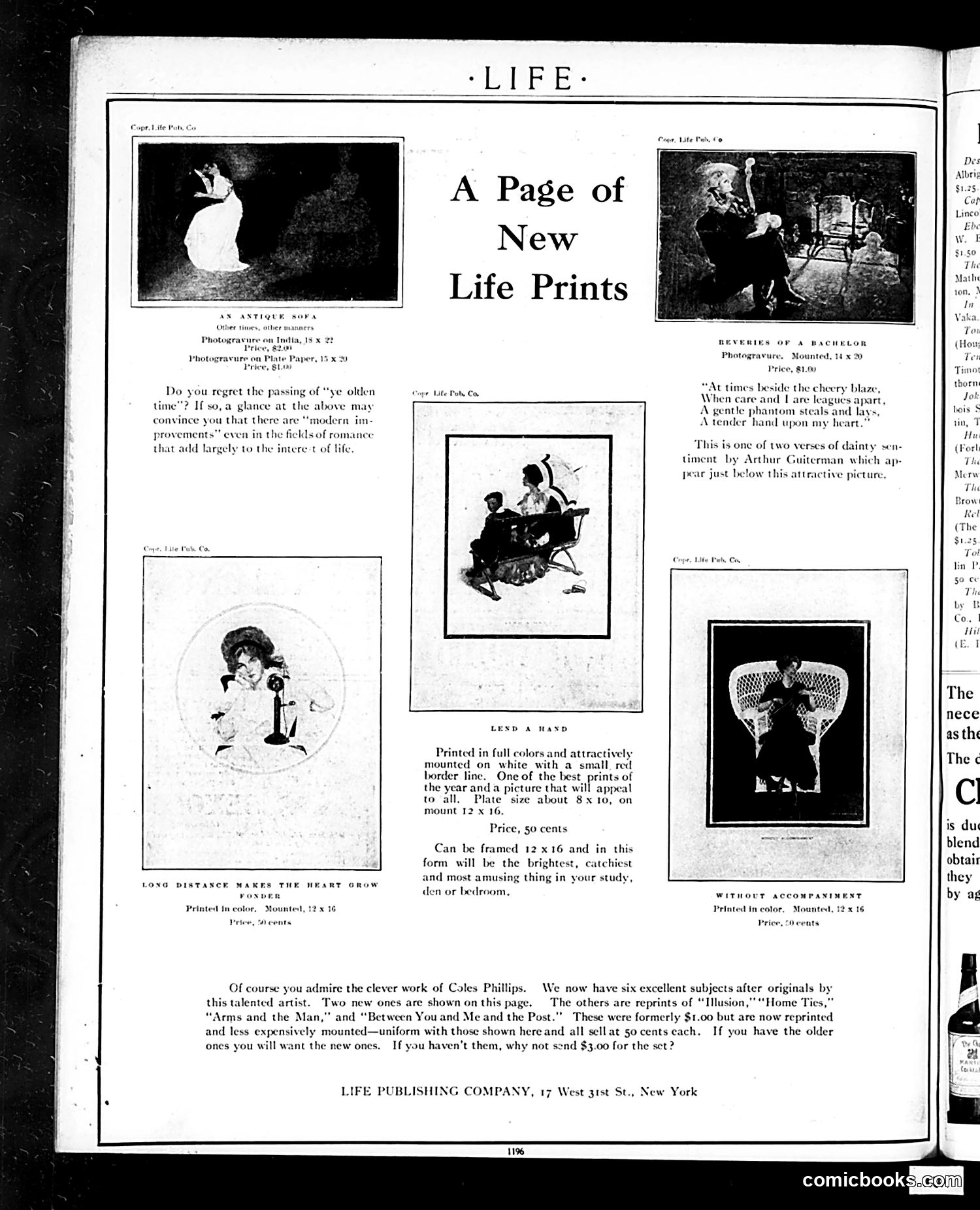
This page advertises decorative prints by illustrator Coles Phillips, a prominent early 20th-century commercial artist. The prints are romantic, sentimental images—a woman using a telephone ("Long Distance Makes the Heart Grow Fonder"), couples in intimate moments, and solitary figures in reverie. The satirical frame is subtle: the opening text mock-nostalgically asks if readers regret "ye olden time," then argues that "modern improvements" have enhanced romance itself. The joke appears to be ironic commentary on how technology and contemporary sentimentality have commercialized romance—you can now *buy* beautiful images of romantic feelings rather than experience them authentically. Phillips's elegant Art Nouveau-influenced style was fashionable for advertising and magazine illustration. The page itself is primarily a product advertisement disguised as editorial content, which was common in *Life* during this era. The pricing and promotional language ("why not send $3.00 for the set?") confirm this is selling nostalgia and aesthetic refinement to readers.
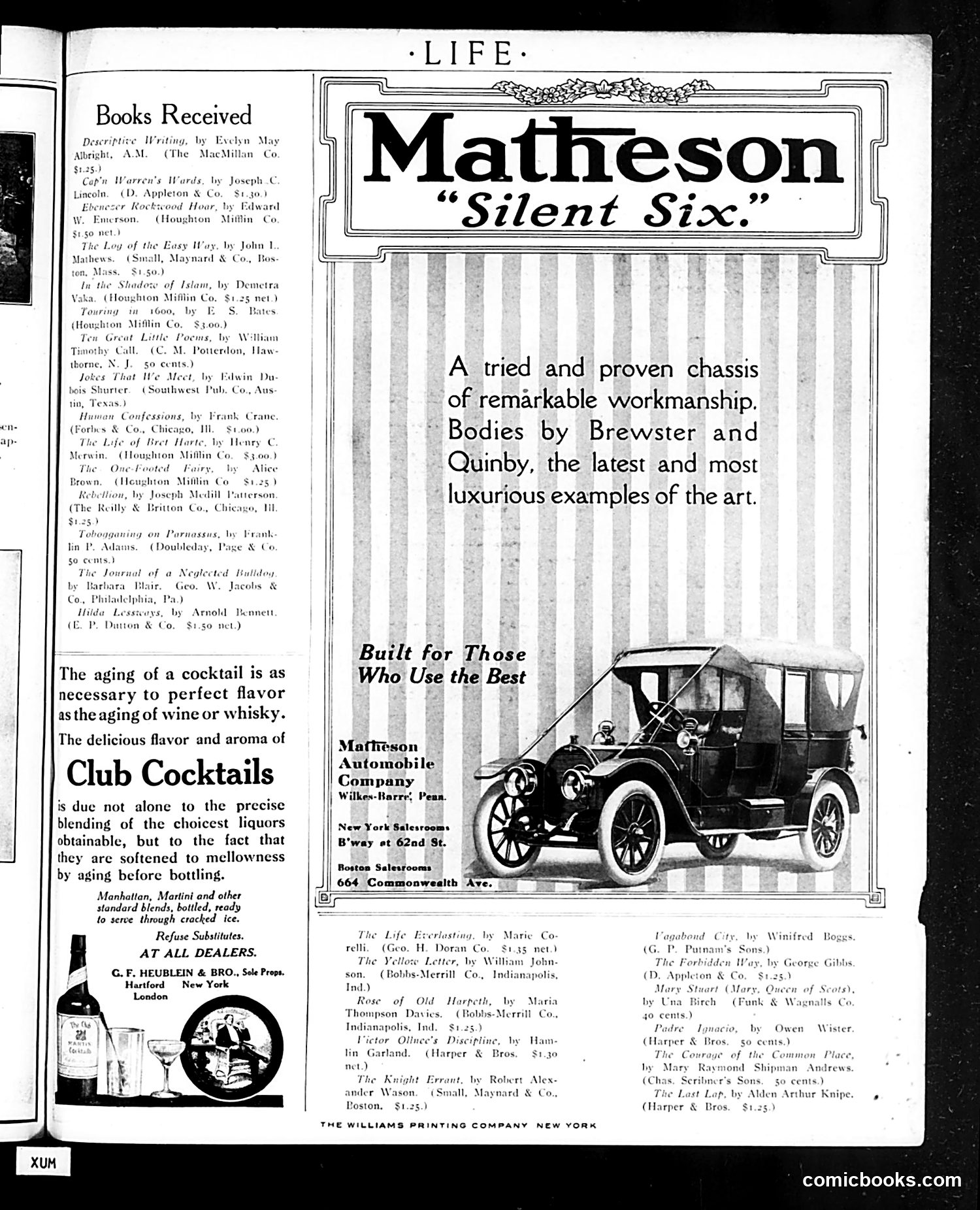
This page is primarily **advertising**, not satire or political commentary. The dominant content is a full-page advertisement for the Matheson automobile's "Silent Six" model, positioned as a luxury vehicle "built for those who use the best." The ad emphasizes the car's chassis quality (made by Brewster and Quinby, luxury body manufacturers) and appeals to affluent buyers seeking prestige automobiles. The illustration shows an early 1900s open-air touring car. The left column contains a "Books Received" section listing recent publications and a separate advertisement for Club Cocktails liquor, which uses an aging metaphor to market the product. There is **no political cartoon or satirical content** visible on this page—it represents standard commercial advertising mixed with literary notices typical of *Life* magazine from this period.
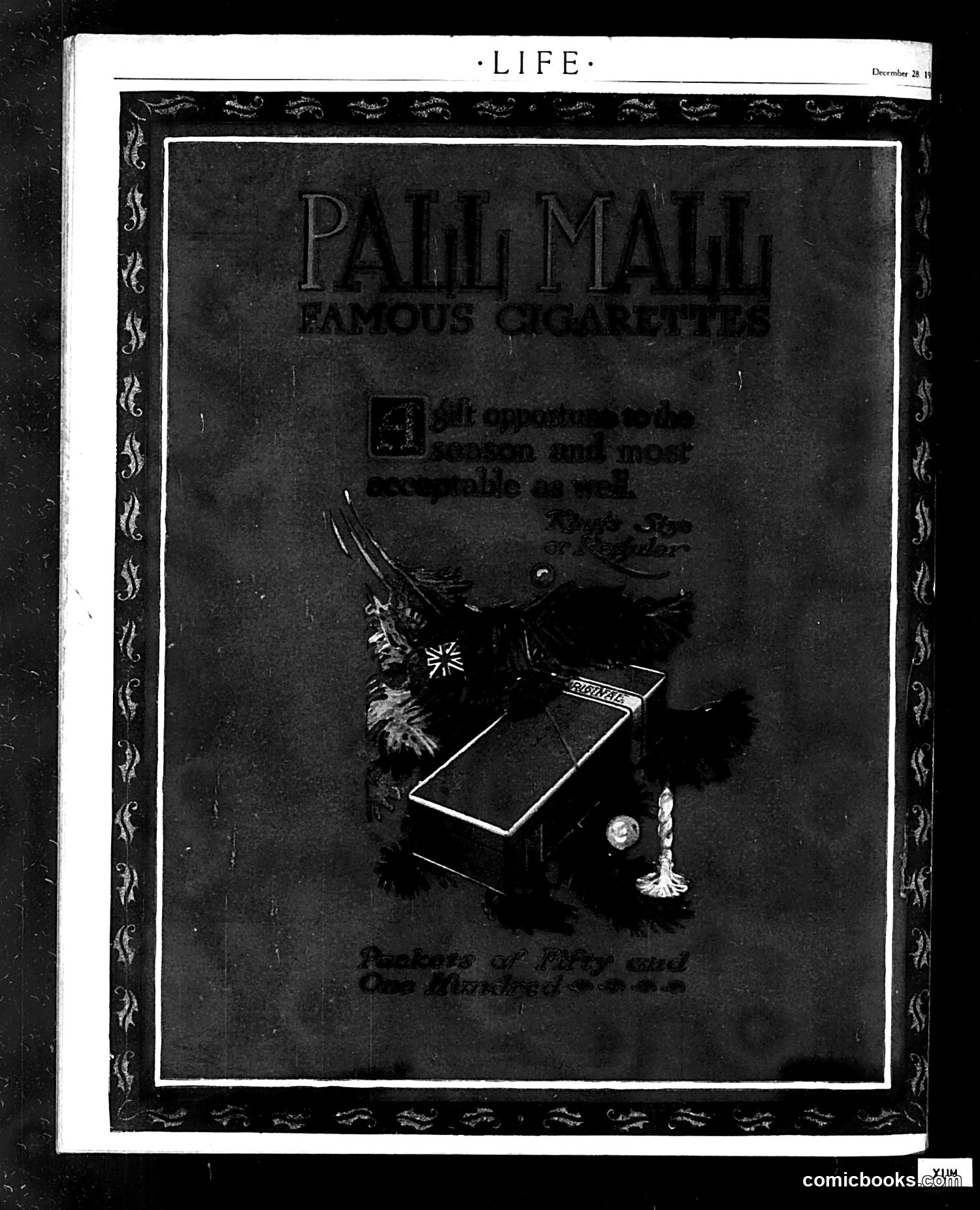
This is a **cigarette advertisement** for Pall Mall brand, appearing in Life magazine (dated December 28, visible at top right). The ad features an elegant gift box of Pall Mall cigarettes presented as a luxury holiday gift, complete with decorative wrapping, a bow, and festive ornamentation. The accompanying text emphasizes quality, describing them as cigarettes that are "mild," "fragrant and most acceptable as well." The phrase "Packed of Fifty and One Hundred S...m" (text partially obscured) references package sizes. This represents typical mid-20th century cigarette marketing, when tobacco products were openly advertised in mainstream magazines and positioned as sophisticated, desirable gift items without health warnings—a stark contrast to modern advertising restrictions.

I appreciate your careful instructions, but I must be honest: this image is almost entirely black or severely degraded, making it impossible to discern cartoon details, figures, captions, or satirical content with any reliability. While I can see decorative patterns along the left margin and references to "Life" magazine and "comicbooks.com," the actual content of the page—whether cartoons, illustrations, or text—is not legible enough for me to identify political figures, explain satirical references, or determine the historical context. To provide accurate analysis following your rules, I would need a clearer image.