
Life, 1911-12-28 · page 36 of 41
Life — December 28, 1911 — page 36: what you’re looking at
What you’re looking at
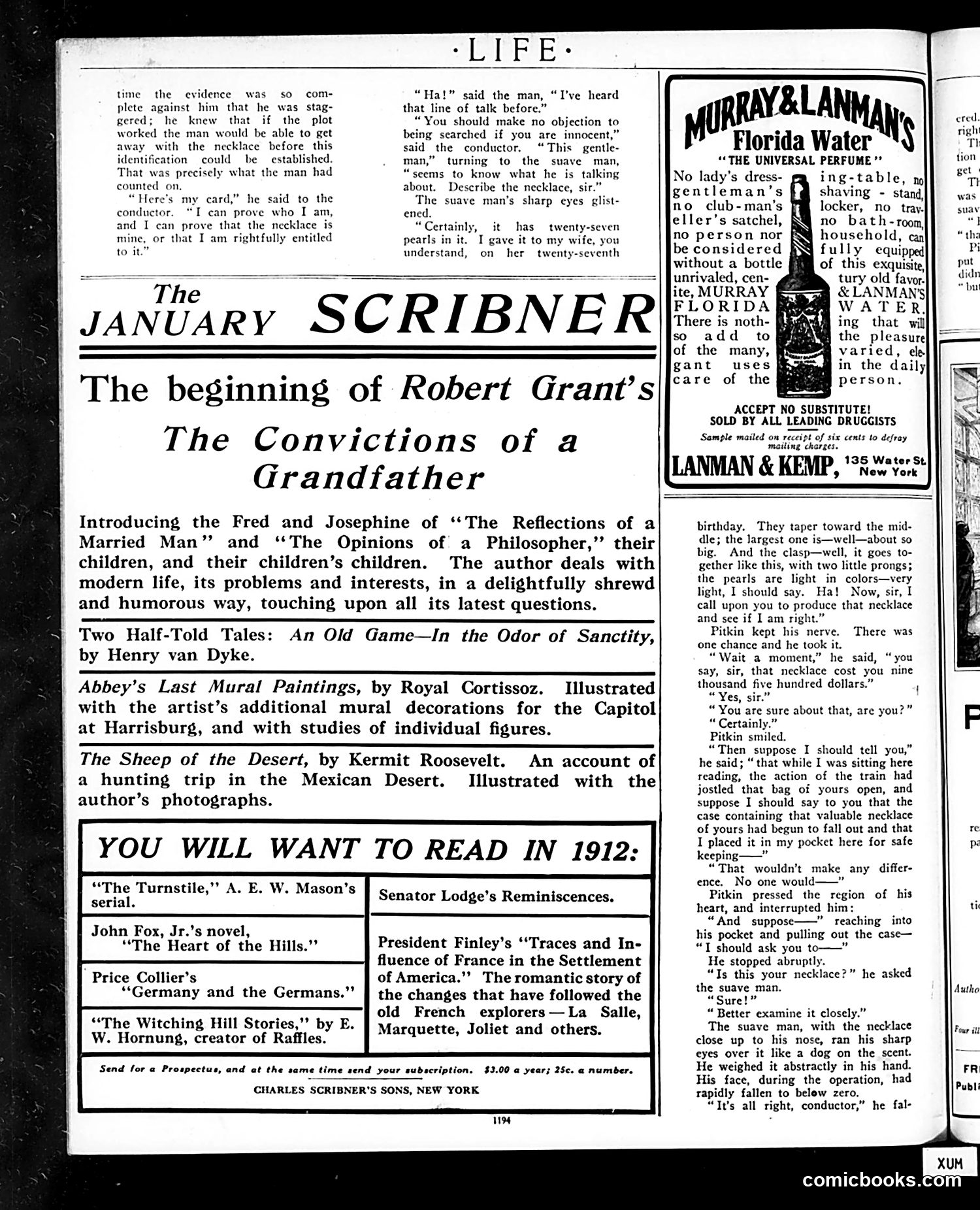
This is primarily a **title page and table of contents** for the January 1912 issue of Scribner's magazine (published by Charles Scribner's Sons), not a political cartoon page. The main content announces Robert Grant's serialized story "The Convictions of a Grandfather," which appears to be a domestic fiction piece about family life across generations. The visible text excerpt shows a mystery plot involving a disputed necklace—possibly a theft or con-artist scenario where a conductor and passenger debate ownership. The right side features a **Murray & Lanman's Florida Water advertisement**, a perfume product marketed as "the universal perfume" for household use. Below the masthead are previews of upcoming 1912 content, including works by A.E.W. Mason, John Fox Jr., and President Finley on French colonial America. **No political satire or caricature is evident** on this page—it's a straightforward literary magazine preview with period advertising.
📄 Transcribed text from this page (OCR, searchable)
Machine-transcribed from the original scan — historical spelling and the odd misread are preserved.
-LIFE-_ time the evidence was so com- plete against him that he was stag- gered; he knew that if the plot worked the man would be able to get with the necklace before this tion could be established. That was precisely what the man had counted on. “ “s my card,” he said to the conductor. “I can prove who I am, “Hal” said the man, “I’ve heard that line of talk before.” “You should make no objection to being searched if you are innocent,” said the conductor. “This gentle- man,” turning to the suave man, “seems to know what he is talking about. Describe the necklace, sir.” The suave man’s sharp eyes glist- ened. and I can prove that the necklace is “Certainly, it has twenty-seven ine, or that Iam rightfully entitled pearls in it. I gave it to my wife, you understand, on her twenty The JANUARY SCRIBNER The beginning of Robert Grant’s The Convictions of a Grandfather Introducing the Fred and Josephine of ‘‘The Reflections of a Married Man” and ‘The Opinions of a Philosopher,’ their children, and their children’s children. The author deals with modern life, its problems and interests, in a delightfully shrewd and humorous way, touching upon all its latest questions. Two Half-Told Tales: An Old Game—In the Odor of Sanctity, by Henry van Dyke. No lady's dress- yy gentleman's f¢ no club-man’s F eller’s satchel, no person nor R be considered without a bottle unrivaled, cen- ite, MURRAY FLORIDA There is noth- so add to of the many, gant care of the LANMAN & KEMP, RL ponent NMA “THE UNIVERSAL PERFUME” ing-table, locker, uses in the dai person. ACCEPT NO SUBSTITUTE! SOLD BY ALL LEADING DRUGGISTS Sample mailed on receipt of six cents to defray mailing charges. S shaving - stand] no tray. no bath-room| household, can S fully equipped of this exquisite tury old favor. varied, es 135 Water St New York no ly Abbey’s Last Mural Paintings, by Royal Cortissoz. Illustrated with the artist’s additional mural decorations for the Capitol at Harrisburg, and with studies of individual figures. The Sheep of the Desert, by Kermit Roosevelt. a hunting trip in the Mexican Desert. author’s photographs. YOU WILL WANT TO READ IN 1912: “The Turnstile,’ A. E. W. Mason’s serial. John Fox, Jr.’s novel, “The Heart of the Hills.” Price Collier’s ‘““Germany and the Germans.” An account of Illustrated with the Senator Lodge’s Reminiscences. President Finley’s ‘‘Traces and In- fluence of France in the Settlement of America.’’ The romantic story of the changes that have followed the old French explorers—La Salle, Marquette, Joliet and others. “The Witching Hill Stories,” by E. W. Hornung, creator of Raffles. Send for a Prospectus, and at the same time send your subscription. $3.00 a year; 25c. a number. CHARLES SCRIBNER'S SONS, NEW YORK birthday, They taper toward the mid- dle; the largest one is—well—about so big. And the clasp—well, it goes to- gether like this, with two little prongs; the pearls are light in colors—very light, I should say. Ha! Now, sir, I call upon you to produce that necklace and see if I am right.” Pitkin kept his nerve. one chance and he took it. “Wait a moment,” he said, “you say, sir, that necklace cost you nine thousand five hundred dollars.” “Yes, sir.” “You are sure about that, are you?” “ Certainly.” Pitkin smiled. “Then suppose I should tell you,” he said; “that while I was sitting here reading, the action of the train had jostled that bag of yours open, and suppose I should say to you that the case containing that valuable necklace of yours had begun to fall out and that I placed it in my pocket here for safe keeping: “That wouldn’t make any differ- ence. No one would——” Pitkin pressed the region of his heart, and interrupted him: “And suppose——” reaching into his pocket and pulling out the case— “T should ask you to——” He stopped abruptly. “Is this your necklace?” he asked the suave man. “Sure!” “ Better examine it closely.” The suave man, with the necklace close up to his nose, ran his sharp eyes over it like a dog on the scent. He weighed it abstractly in his hand. His face, during the operation, had rapidly fallen to below zero. “It's all right, conductor,” he fal- There was comicbooks. co put didn bu ti Autho Four ill