
Life, 1911-12-28 · page 24 of 41
Life — December 28, 1911 — page 24: what you’re looking at
What you’re looking at
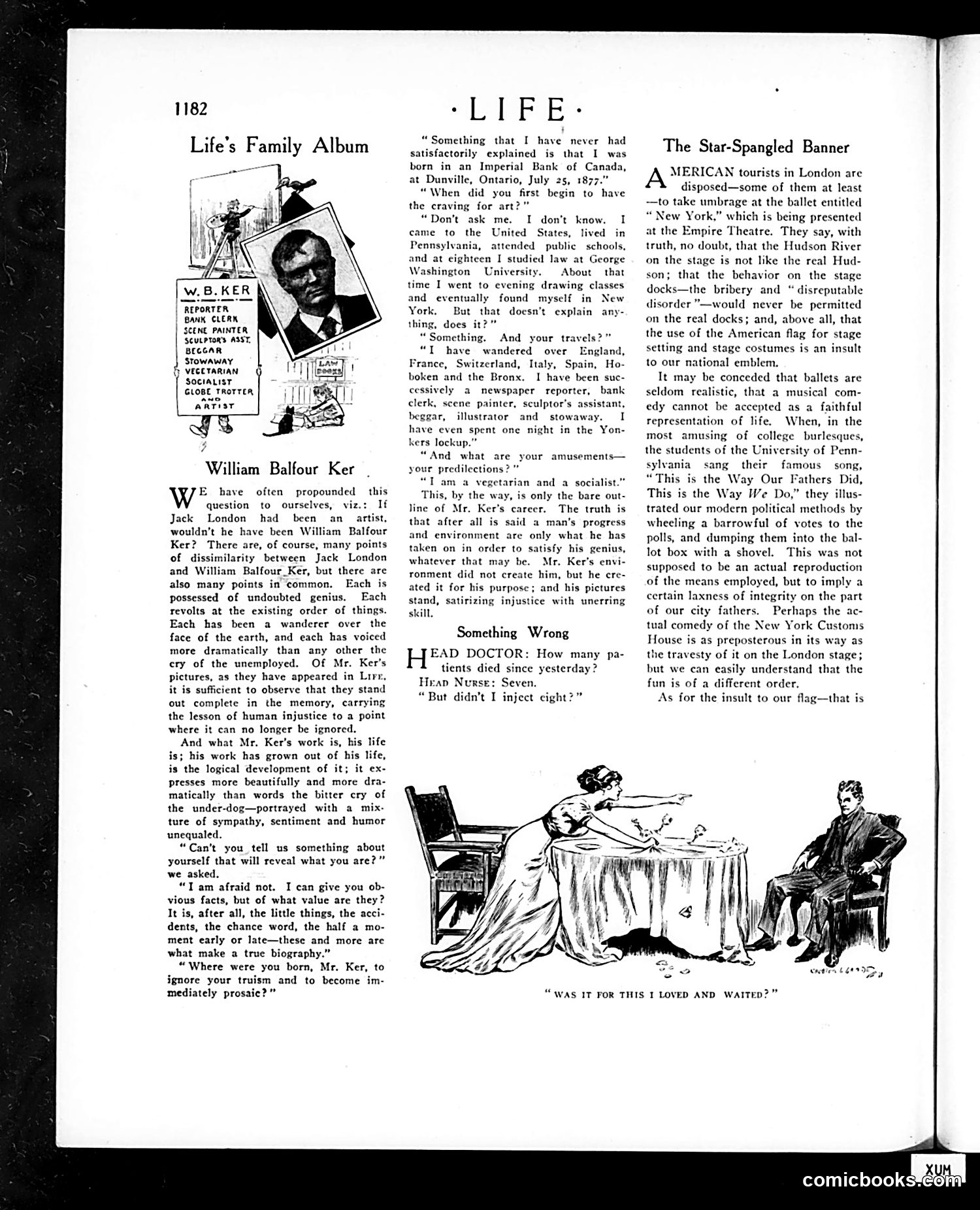
**William Balfour Ker Profile**: This is a biographical sketch of an artist-illustrator whose varied life experiences—reporter, bank clerk, stowaway, beggar—inform his work depicting social injustice and the plight of the "under-dog." Life compares him favorably to writer Jack London, praising his ability to express "the bitter cry of the unemployed" through art with "sympathy, sentiment and humor." **"Something Wrong" Cartoon**: A darkly comedic medical joke showing a head doctor and nurse discussing patient deaths. The punch line reveals administrative incompetence: the doctor injected eight patients but only seven died—implying either a miscalculation or that someone survived unexpectedly. **"The Star-Spangled Banner" Section**: American tourists in London object to a ballet called "New York" at the Empire Theatre for inaccurate depictions of the Hudson River and, more seriously, for using the American flag as stage scenery—they consider this disrespectful to the national symbol. The author notes ballets are rarely realistic.
📄 Transcribed text from this page (OCR, searchable)
Machine-transcribed from the original scan — historical spelling and the odd misread are preserved.
1182 Life’s Family Album | REPORTER BANK CLERK | SCENE PAINTER SCULPTORS ASST. BEccAR STOWAWAY. VECCTARIAN SociauisT GLOBE TROTTER ARTIST William Balfour Ker E have often propounded this question to ourselves, viz.: If Jack London had been an_ artist, wouldn’t he have been William Balfour Ker? There are, of course, many points of dissimilarity between Jack London and William Balfour_Ker, but there are also many points in’common. Each is possessed of undoubted genius. Each revolts at the existing order of things. Each has been a wanderer over the face of the earth, and each has voiced more dramatically than any other the cry of the unemployed. Of Mr. Ker’s pictures, as they have appeared in Lire, it is sufficient to observe that they stand out complete in the memory, carrying the lesson of human injustice to a point where it can no longer be ignored. And what Mr. Ker’s work is, his life is; his work has grown out of his life, is the logical development of it; it ex- presses more beautifully and more dra- matically than words the bitter cry of the under-dog—portrayed with a mix- ture of sympathy, sentiment and humor unequaled. “Can't you tell us something about yourself that will reveal what you are?” we asked. “Tam afraid not. I can give you ob- vious facts, but of what value are they? It is, after all, the little things, the acci- dents, the chance word, the half a mo- ment early or late—these and more are what make a true biography.” “Where were you born, Mr. Ker, to ignore your truism and to become im- mediately prosaic?” SFE “Something that I have never had satisfactorily explained is that I was born in an Imperial Bank of Canada, at Dunville, Ontario, July 25, 1877.” “When did you first begin to have the craving for art?” “Don't ask me. I don't came to the United States, lived in Pennsylvania, attended public schools, and at eighteen I studied law at George Washington Univer: About that time I went to evening drawing classes and eventually found myself in York, But that doesn’t explain any- thing, does it?” “Something. And your travels?” “I have wandered over England, France, Switzerland, Italy, Spain, Ho- boken and the Bronx. I have been suc- cessively a newspaper reporter, bank clerk, scene painter, sculptor’s assistant, beggar, illustrator and stowaway. I have even spent one night in the Yon- kers lockup.” “And what are your amusements— your predilections?” “Tam a vegetari know. I in and a socialis This, by the way, is only the bare out- c of Mr. Ker’s career. The truth is after all is said a man’s progress d environment are only what he has taken on in order to satisfy his genius, whatever that may be. Mr. Ker’s envi- ronment did not create him, but he cre- ated it for his purpose; and his pictures stand, satirizing injustice with unerring skill. Something Wrong EAD DOCTOR: How many pa- tients died since yesterday? Heap Nur Seven. “But didn’t I inject cight?” The Star-Spangled Banner MERICAN tourists in London are disposed—some of them at least —to take umbrage at the ballet entitled “New York,” which is being presented at the Empire Theatre. They say, with truth, no doubt, that the Hudson River on the stage is not like the real Hud- son; that the behavior on the stage docks—the bribery and “ disreputable disorder "—would never be permitted on the real docks; and, above all, that the use of the American flag for stage setting and stage costumes is an insult to our national emblem, It may be conceded that ballets are seldom realistic, that a musical com- edy cannot be accepted as a faithful representation of li When, in the most amusing of college burlesques, the students of the University of Penn- sylvania sang their famous song, “This is the Way Our Fathers Did, This is the Way We Do,” they illus- trated our modern political methods by wheeling a barrowful of votes to the polls, and dumping them into the bal- lot box with a shovel. This was not supposed to be an actual reproduction of the means employed, but to imp! certain laxness of integrity on the part of our city fathers. Perhaps the ac- tual comedy of the New York Customs House is as preposterous in its way as the travesty of it on the London stage; but we can easily understand that the fun is of a different order, As for the insult to our flag—that is “WAS IT FOR THIS I LOVED AND WarTED?” comicbook Meum