
Life, 1911-12-28 · page 34 of 41
Life — December 28, 1911 — page 34: what you’re looking at
What you’re looking at
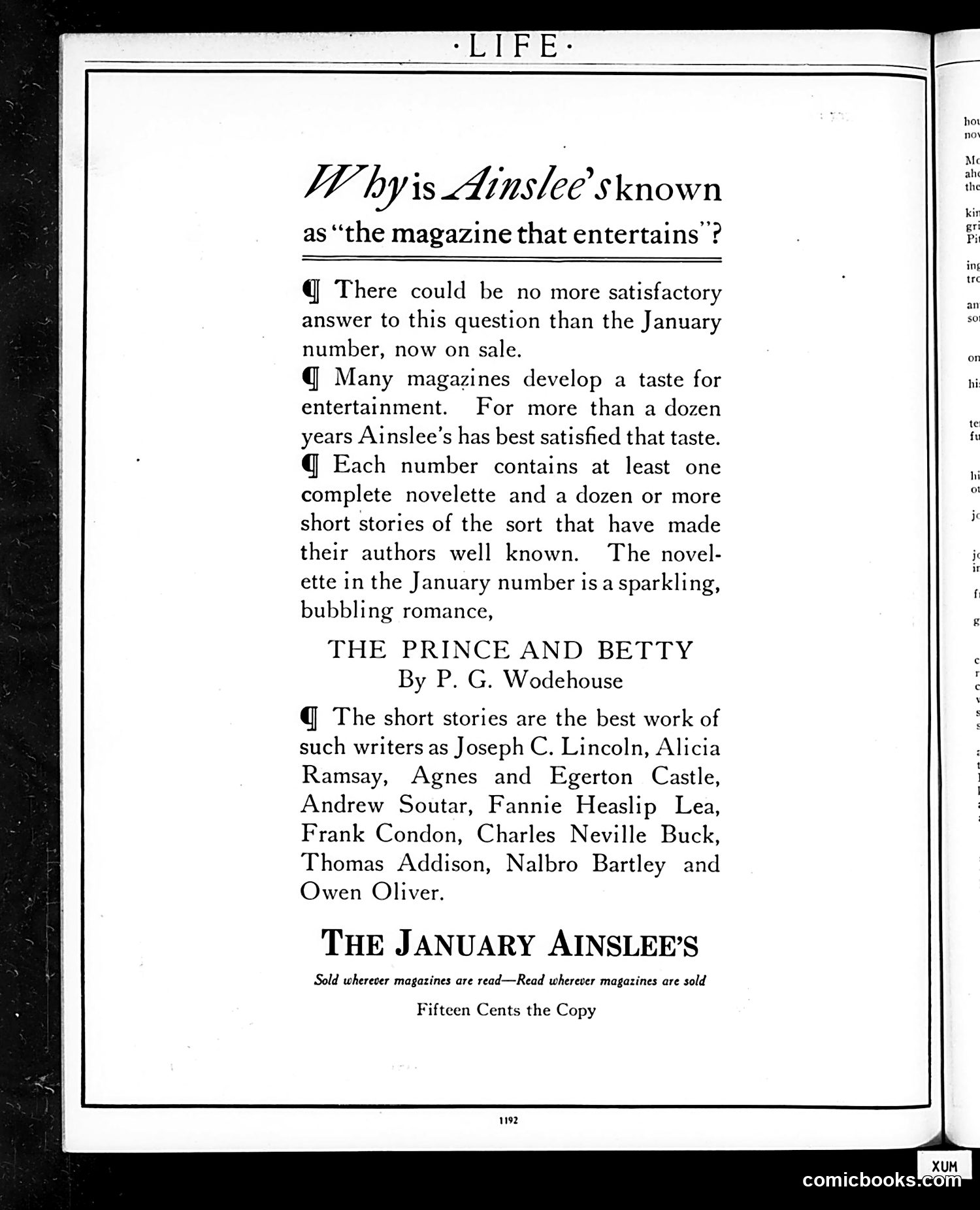
This page is a straightforward advertisement for *Ainslee's Magazine*, not political satire or a cartoon. It promotes the January issue, emphasizing the magazine's entertainment value through its mix of fiction. The ad highlights the featured novelette—P.G. Wodehouse's "The Prince and Betty"—and lists prominent short-story authors of the era (Joseph C. Lincoln, Alicia Ramsay, Egerton Castle, and others) to attract readers. The tagline "Sold wherever magazines are read—Read wherever magazines are sold" is a playful, circular marketing phrase. For modern readers: this reflects early 1900s magazine culture, when general-interest magazines like *Ainslee's* competed on literary content quality and famous authors' names as selling points. The fifteen-cent price anchors this in the pre-inflation era. There is no satire or political commentary present—it's period advertising.
📄 Transcribed text from this page (OCR, searchable)
Machine-transcribed from the original scan — historical spelling and the odd misread are preserved.
TT by is Ainslee s known as “the magazine that entertains’? @ There could be no more satisfactory answer to this question than the January number, now on sale. @ Many magazines develop a taste for entertainment. For more than a dozen years Ainslee’s has best satisfied that taste. @ Each number contains at least one complete novelette and a dozen or more short stories of the sort that have made their authors well known. The novel- ette in the January number isa sparkling, bubbling romance, THE PRINCE AND BETTY By P. G. Wodehouse @ The short stories are the best work of such writers as Joseph C. Lincoln, Alicia Ramsay, Agnes and Egerton Castle, Andrew Soutar, Fannie Heaslip Lea, Frank Condon, Charles Neville Buck, Thomas Addison, Nalbro Bartley and Owen Oliver. THE JANUARY AINSLEE’S Sold wherever magazines are read—Read wherever magazines are sold Fifteen Cents the Copy comicbooks Men ‘om