
Life, 1911-12-28 · page 8 of 41
Life — December 28, 1911 — page 8: what you’re looking at
What you’re looking at
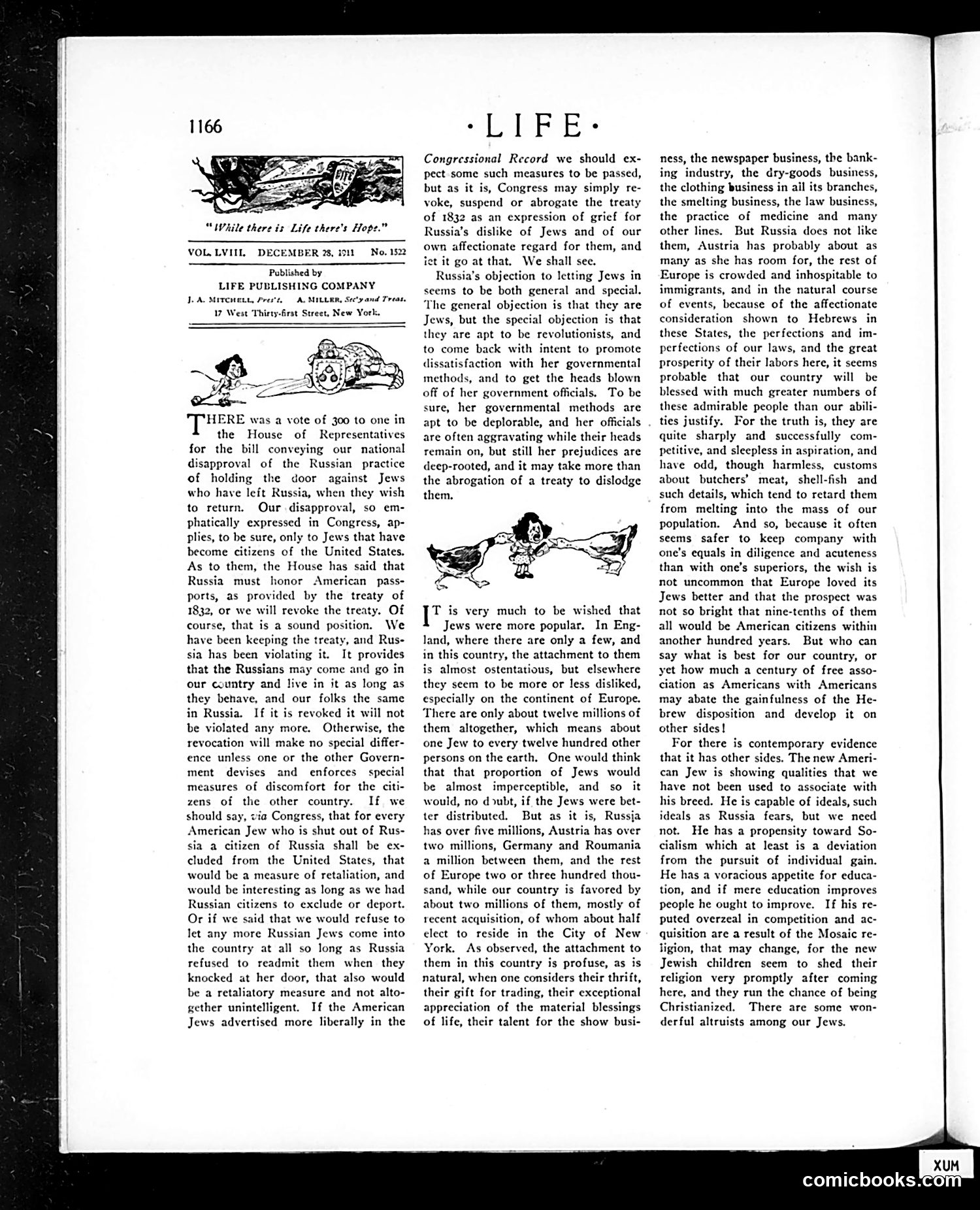
This December 28, 1911 Life magazine page contains editorial text discussing Russian-Jewish relations and American immigration policy—not a political cartoon requiring visual interpretation. The article argues against Congressional measures to restrict Jewish immigration in response to Russian persecution. The text defends Jewish immigrants' contributions to American society, noting their concentration in business (newspapers, banking, textiles, law). It acknowledges Russia's anti-Jewish prejudice while questioning whether restricting American immigration serves retaliation or principle. The small decorative illustrations (a child with a barrel, children playing) are generic ornamental vignettes common to period publications, not satirical commentary. The page represents serious political advocacy against discriminatory immigration policy during an era of significant Russian-Jewish emigration to America.
📄 Transcribed text from this page (OCR, searchable)
Machine-transcribed from the original scan — historical spelling and the odd misread are preserved.
“While there is Life there's Hope.” VOL. LVIIL, DECEMBER 28, i911 No. 1522 Published by LIFE PUBLISHING COMPANY JA. Mrvewent, Prete, 17 West Thirty-firat Street, New York. A. MILLAR, Sectyand Treas. y THERE was a vote of 300 to one in the House of Representatives for the bill conveying our national disapproval of the Russian practice of holding the door against Jews who have left Russia, when they wish to return. Our disapproval, so em- phatically expressed in Congress, ap- plies, to be sure, only to Jews that have become citizens of the United States. As to them, the House has said that Russia must honor American pass- ports, as provided by the treaty of 1832, or we will revoke the treaty. Of course, that is a sound position. We have been keeping the treaty, and Rus- sia has been violating it. It provides that the Russians may come and go in our country and live in it as long as they behave, and our folks the same in Russia. If it is revoked it will not be violated any more. Otherwise, the revocation will make no special differ- ence unless one or the other Govern- ment devises and enforces special measures of discomfort for the citi- zens of the other country. If we should say, via Congress, that for every American Jew who is shut out of Rus- sia a citizen of Russia shall be ex- cluded from the United States, that would be a measure of retaliation, and would be interesting as long as we had Russian citizens to exclude or deport. Or if we said that we would refuse to let any more Russian Jews come into the country at all so long as Russia refused to readmit them when they knocked at her door, that also would be a retaliatory measure and not alto- gether unintelligent. If the American Jews advertised more liberally in the “DPE Congressional Record we should ex- pect some such measures to be passed, but as it is, Congress may simply re- voke, suspend or abrogate the treaty of 1832 as an expression of grief for Russia’s dislike of Jews and of our own affectionate regard for them, and iet it go at that. We shall see. Russia’s objection to letting Jews in seems to be both general and special. The general objection is that they are Jews, but the special objection is that they are apt to be revolutionists, and to come back with intent to promote dissatisfaction with her governmental methods, and to get the heads blown off of her government officials. To be sure, her governmental methods are apt to be deplorable, and her officials are often aggravating while their heads remain on, but still her prejudices are deep-rooted, and it may take more than the abrogation of a treaty to dislodge them, io is very much to be wished that Jews were more popular. In Eng- land, where there are only a few, and in this country, the attachment to them is almost ostentatious, but elsewhere they seem to be more or less disliked, especially on the continent of Europe. There are only about twelve millions of them altogether, which means about one Jew to every twelve hundred other persons on the earth, One would think that that proportion of Jews would be almost imperceptible, and so it would, no doubt, if the Jews were bet- ter distributed. But as it is, Russja has over five millions, Austria has over two millions, Germany and Roumania a million between them, and the rest of Europe two or three hundred thou- sand, while our country is favored by about two millions of them, mostly of recent acquisition, of whom about half elect to reside in the City of New York. As observed, the attachment to them in this country is profuse, as is natural, when one considers their thrift, their gift for trading, their exceptional appreciation of the material blessings of life, their talent for the show busi- ness, the newspaper business, the bank- ing industry, the dry-goods business, the clothing business in ail its branches, the smelting business, the law business, the practice of medicine and many other lines. But Russia does not like them, Austria has probably about as many as she has room for, the rest of Europe is crowded and inhospitable to immigrants, and in the natural course of events, because of the affectionate consideration shown to Hebrews in these States, the perfections and im- perfections of our laws, and the great prosperity of their labors here, it seems probable that our country will be blessed with much greater numbers of these admirable people than our abili- ties justify. For the truth is, they are quite sharply and successfully com- petitive, and sleepless in aspiration, and have odd, though harmless, customs about butchers’ meat, shell-fish and such details, which tend to retard them from melting into the mass of our population. And so, because it often seems safer to keep company with one’s equals in diligence and acuteness than with one’s superiors, the wish is not uncommon that Europe loved its Jews better and that the prospect was not so bright that nine-tenths of them all would be American citizens within another hundred years. But who can say what is best for our country, or yet how much a century of free asso- ciation as Americans with Americans may abate the gainfulness of the He- brew disposition and develop it on other sides! For there is contemporary evidence that it has other sides. The new Ameri- can Jew is showing qualities that we have not been used to associate with his breed. He is capable of ideals, such ideals as Russia fears, but we need not. He has a propensity toward So- cialism which at least is a deviation from the pursuit of individual gain. He has a voracious appetite for educa- tion, and if mere education improves people he ought to improve. If his re- puted overzeal in competition and ac- quisition are a result of the Mosaic re- ligion, that may change, for the new Jewish children seem to shed their religion very promptly after coming here, and they run the chance of being Christianized. There are some won- derful altruists among our Jews. comicbooks oxo)