
Life, 1911-12-28 · page 22 of 41
Life — December 28, 1911 — page 22: what you’re looking at
What you’re looking at
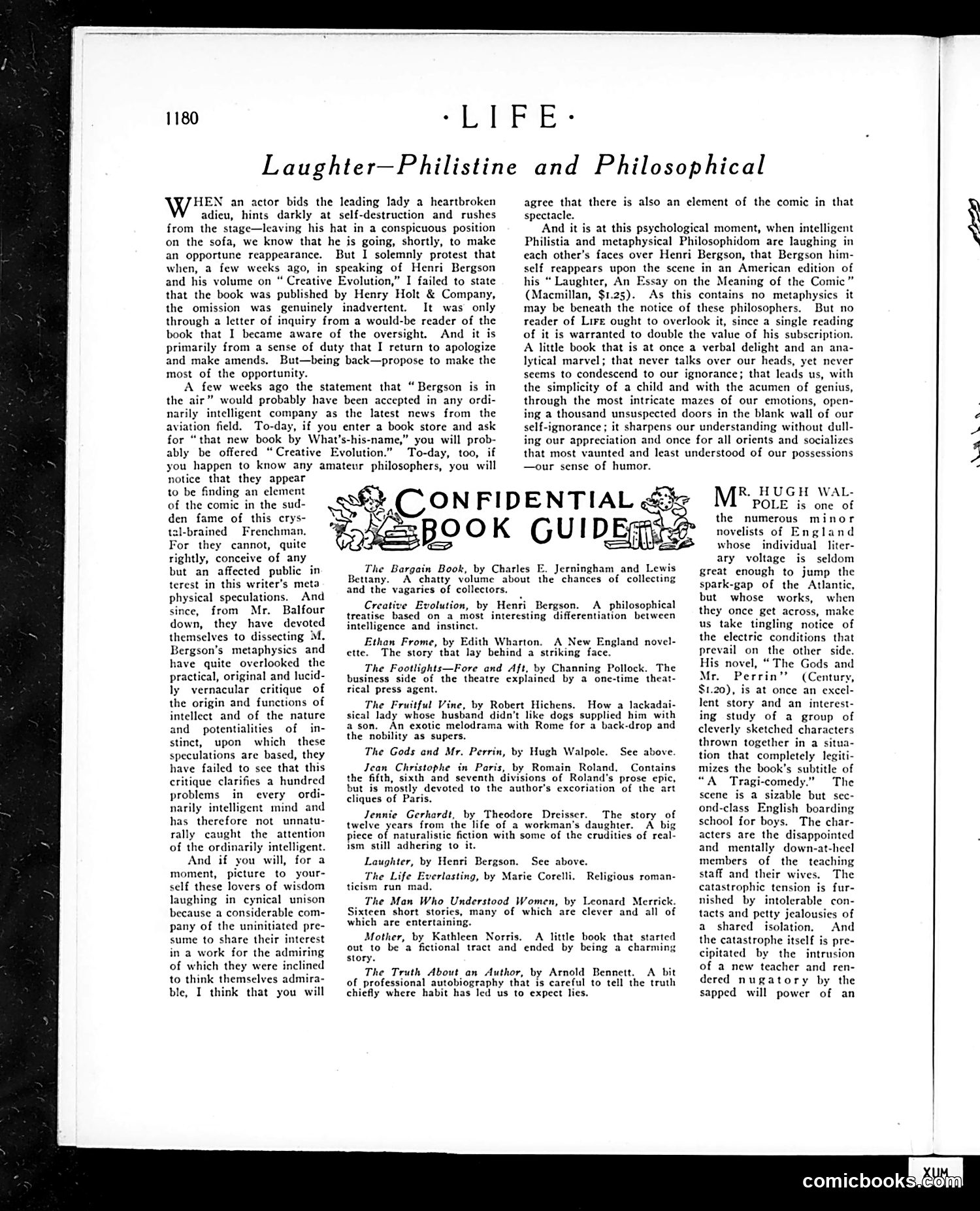
This page discusses Henri Bergson's sudden popularity in America following publication of his essay "Laughter: An Essay on the Meaning of the Comic" (Macmillan, $1.25). The author satirizes the irony that amateur philosophers are finding humor in Bergson's newfound celebrity among non-intellectuals ("Philistia"), while Bergson himself—the subject of their mockery—has now published an accessible work on comedy that the author argues is valuable precisely *because* it avoids the metaphysical pretension these same philosophers admire him for. The satire targets intellectual snobbery: sophisticated thinkers devoted themselves to Bergson's dense metaphysics while overlooking his clearer, practical analysis of intellect and instinct. Now ordinary readers are discovering what the self-styled intellectuals missed. The author implies these "lovers of wisdom" are laughing cynically at popular interest in Bergson, unaware that the accessibility they disdain is actually the work's greatest merit. The "Confidential Book Guide" sidebar reviews contemporary literary works.
📄 Transcribed text from this page (OCR, searchable)
Machine-transcribed from the original scan — historical spelling and the odd misread are preserved.
WHex an actor bids the leading lady a heartbroken adieu, hints darkly at self-destruction and rushes from the stage—leaving his hat in a conspicuous position on the sofa, we know that he is going, shortly, to make an opportune reappearance. But I solemnly protest that when, a few weeks ago, in speaking of Henri Bergson and his volume on “ Creative Evolution,” I failed to state that the book was published by Henry Holt & Company, the omission was genuinely inadvertent. It was only through a letter of inquiry from a would-be reader of the book that I became aware of the oversight. And it is primarily from a sense of duty that I return to apologize and make amends. But—being back—propose to make the most of the opportunity. A few weeks ago the statement that “Bergson is in the air” would probably have been accepted in any ordi- narily intelligent company as the latest news from the aviation field. To-day, if you enter a book store and ask for “that new book by What’s-his-name,” you will prob- ably be offered “Creative Evolution.” To-day, too, if you happen to know any amateur philosophers, you will notice that they appear to be finding an element of the comic in the sud- den fame of this crys- tal-brained — Frenchman. For they cannot, quite rightly, conceive of any Laughter—Philistine and Philosophical S.C ON FIDENTIAL ‘ty¥esBOOK GUIDEG ral of Exeland agree that there is also an element of the comic in that spectacle. And it is at this psychological moment, when intelligent Philistia and metaphysical Philosophidom are laughing in each other’s faces over Henri Bergson, that Bergson him- self reappears upon the scene in an American edition of his “ Laughter, An Essay on the Meaning of the Comic” (Macmillan, $1.25). As this contains no metaphysics it may be beneath the notice of these philosophers. But no reader of Lire ought to overlook it, since a single reading of it is warranted to double the value of his subscription. A little book that is at once a verbal delight and an ana- lytical marvel; that never talks over our heads, yet never seems to condescend to our ignorance; that leads us, with the simplicity of a child and with the acumen of genius, through the most intricate mazes of our emotions, open- ing a thousand unsuspected doors in the blank wall of our self-ignorance; it sharpens our understanding without dull- ing our appreciation and once for all orients and socializes that most vaunted and least understood of our possessions —our sense of humor. so) R. HUGH WAL- POLE is one of the numerous minor ary voltage is seldom but an affected public in terest in this writer's meta physical speculations. And since, from Mr. Balfour down, they have devoted themselves to dissecting M. Bergson’s metaphysics and have quite overlooked the practical, original and lucid- ly vernacular critique of the origin and functions of intellect and of the nature and potentialities of in- stinct, upon which these speculations are based, they have failed to sce that this critique clarifies a hundred problems in every ordi- narily intelligent mind and has therefore not unnatu- rally caught the attention of the ordinarily intelligent. And if you will, for a moment, picture to your- self these lovers of wisdom laughing in cynical unison because a considerable com- pany of the uninitiated pre- sume to share their interest in a work for the admiring of which they were inclined to think themselves admira- ble, I think that you will The Bargain Book, by Charles E. Jerningham and Lewis Bettany. A chatty volume about the chances of collecting and the vagaries of collectors. Creative Evolution, by Henti Bergson. A philosophical treatise based on a most interesting differentiation between intelligence and instinct. Ethan Frome, by Edith Wharton. A New England novel- ette. The story that lay behind a striking face. The Footlights—Fore and Aft, by Channing Pollock. The business side of the theatre explained by a one-time theat- rical press agent. The Fruitful Vine, by Robert Hichens. How a lackadai- sical lady whose husband didn’t like dogs supplied him with a son. An exotic melodrama with Rome for a back-drop and the nobility as supers. The Gods and Mr. Perrin, by Hugh Walpole. See above. Jean Christophe in Paris, by Romain Roland. Contains the fifth, sixth and seventh divisions of Roland's prose epic, but is mostly devoted to the author's excoriation of the art cliques of Paris. Jennie Gerhardt, by Theodore Dreisser. The story of twelve years from the life of a workman's daughter. A big iece of naturalistic fiction with some of the crudities of real- ism still adhering to it. Laughter, by Henri Bergson. See above. he Life Everlasting, by Marie Corelli. Religious roman- sm run mad, The Man Who Understood Women, by Leonard Merrick. Sixteen short stories, many of which are clever and all of which are entertaining. Mother, by Kathleen Norris. A little book that. started out to be'a fictional tract and ended by being a charming story. The Truth About an Author, by Arnold Bennett. A bit of professional autobiography that is careful to tell the truth chiefly where habit has led us to expect lies. great enough to jump the spark-gap of the Atlantic, but whose works, when they once get across, make us take tingling notice of the electric conditions that prevail on the other side. His novel, “The Gods and Mr. Perrin’? (Century, $1.20), is at once an excel- lent story and an interest- ing study of a group of cleverly sketched characters thrown together in a situa- tion that completely legiti- mizes the book's subtitle of “A Tragi-comedy. The scene is a sizable but sec- ond-class English boarding school for boys. The char- acters are the disappointed and mentally down-at-heel members of the teaching staff and their wiv The catastrophic tension is fur- nished by intolerable con- tacts and petty jealousies of a shared isolation, And the catastrophe itself is pre- cipitated by the intrusion of a new teacher and ren- dered nugatory by the sapped will power of an comicbookMeom a oS ee ae