
Life, 1911-12-28 · page 16 of 41
Life — December 28, 1911 — page 16: what you’re looking at
What you’re looking at
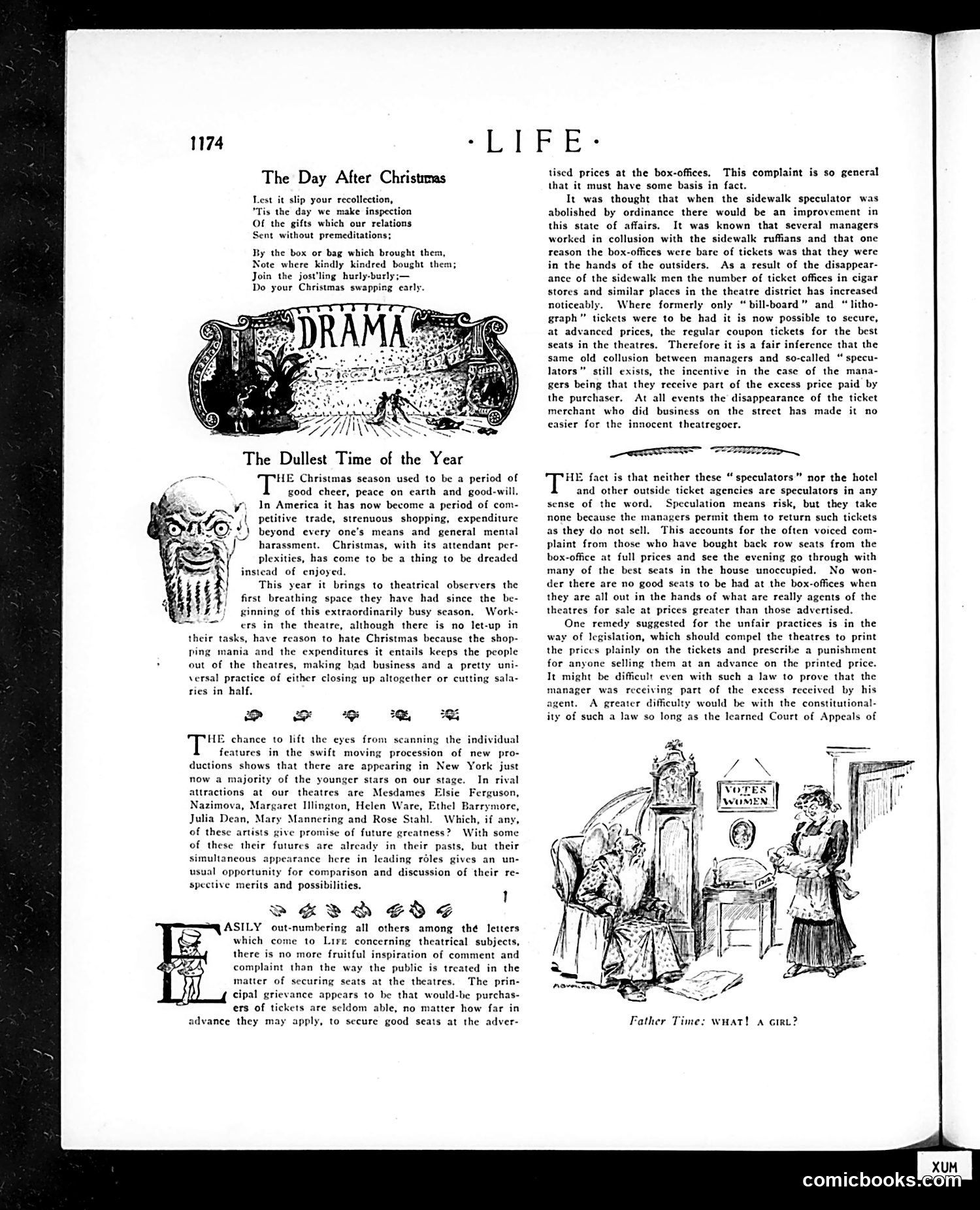
This 1910s *Life* magazine page satirizes two interconnected issues: **"The Day After Christmas"** (top): A humorous poem mocking the post-holiday ritual of gift-swapping—acknowledging that relatives give thoughtless, unwanted presents. The joke: "Do your Christmas swapping early" suggests people should immediately exchange bad gifts rather than pretend to like them. **"The Dullest Time of the Year"** (main article): Complains that Christmas shopping empties theaters, forcing closures and salary cuts for theatrical workers. The accompanying cartoon shows a father shocked to learn he's having a daughter—likely satirizing how Christmas expenses burden families. **The theater ticket scandal** (right column): The article's core grievance: ticket scalpers still control good seats despite being officially "abolished." Managers covertly collude with scalpers operating from cigar stores, marking up prices. This is satire of official reform that merely shuffled the problem rather than solving it—a timeless critique of regulatory failure.
📄 Transcribed text from this page (OCR, searchable)
Machine-transcribed from the original scan — historical spelling and the odd misread are preserved.
“LIP E# The Day After Christrmas Lest it slip your recollection, "Tis the day we make inspection Of the gifts which our relations Sent without premeditations; By the box or bag which brought th Note where kindly kindred bought them Join the jost'ling burly-burly;— Do your Christmas swapping early. The Dullest Time of the Year T! Christmas season used to be a period of good cheer, peace on earth and good-will. In America it has now become a period of com- petitive trade, strenuous shopping, expenditure beyond every one’s means and general mental harassment. Christmas, with its attendant per- plexities, has come to be a thing to be dreaded instead of enjoyed. This year it brings to theatrical observers the first breathing space they have had since the be- ginning of this extraordinarily busy season, Work- ers in the theatre, although there is no let-up in their tasks, have reason to hate Christmas because the shop- ping mania and the expenditures it entails keeps the people out of the theatres, making bad business and a pretty uni- versal practice of either closing up altogether or cutting sala- ries in half. a HE chance to lift the eyes from scanning the individual features in the swift moving procession of new pro- ductions shows that there are appearing in New York just now a majority of the younger stars on our stage. In rival attractions at our theatres are Mesdames Elsie Ferguson, Nazimova, Margaret Illington, Helen Ware, Ethel Barrymore, Julia Dean, Mary Mannering and Rose Stahl. Which, if any, of these artists give promise of future greatness? With some of these their futures are already in their pasts, but their simultaneous appearance here in leading rdles gives an un- usual opportunity for comparison and discussion of their re- spective merits and possibilities. : SS EZYxXA EGE ASILY out-numbering all others among thé letters which come to Lire concerning theatrical subjects, there is no more fruitful inspiration of comment and complaint than the way the public is treated in the matter of securing seats at the theatres. The prin- cipal grievance appears to be that would-be purchas- ers of tickets are seldom able, no matter how far in advance they may apply, to secure good seats at the adver- tised prices at the box-offices, This complaint is so general that it must have some basis in fact. It was thought that when the sidewalk speculator was abolished by ordinance there would be an improvement in this state of affairs. It was known that several managers worked in collusion with the sidewalk ruffians and that one reason the box-offices were bare of tickets was that they were in the hands of the outsiders. As a result of the disappear- ance of the sidewalk men the number of ticket offices in cigar stores and similar places in the theatre district has increased noticeably. Where formerly only “bill-board” and “ litho- graph” tickets were to be had it is now possible to secure, at advanced prices, the regular coupon tickets for the best seats in the theatres. Therefore it is a fair inference that the same old collusion between managers and so-called “ specu lators” still exists, the incentive in the case of the mana- gers being that they receive part of the excess price paid by the purchaser. At all events the disappearance of the ticket merchant who did business on the street has made it no casier for the innocent theatregoer. AOE OAT HE fact is that neither these “ speculators” nor the hotel and other outside ticket agencies are speculators in any sense of the word. Speculation means risk, but they take none because the managers permit them to return such tickets as they do not sell. is accounts for the often voiced com- plaint from those who have bought back row seats from the box-office at full prices and see the evening go through with many of the best seats in the house unoccupied. No won- der there are no good seats to be had at the box-offices when they are all out in the hands of what are really agents of the theatres for sale at prices greater than those advertised. One remedy suggested for the unfair practices is in the way of legislation, which should compel the theatres to print the prices plainly on the tickets and prescribe a punishment for anyone selling them at an advance on the printed price. It might be difficult even with such a law to prove that the ager was receiving part of the excess received by his nt. A greater difficulty would be with the constitutional- ity of such a law so long as the learned Court of Appeals of Father Time: wuat! a Girt? comicbooks Men