
A complete issue · 40 pages · 1911
Life — August 3, 1911
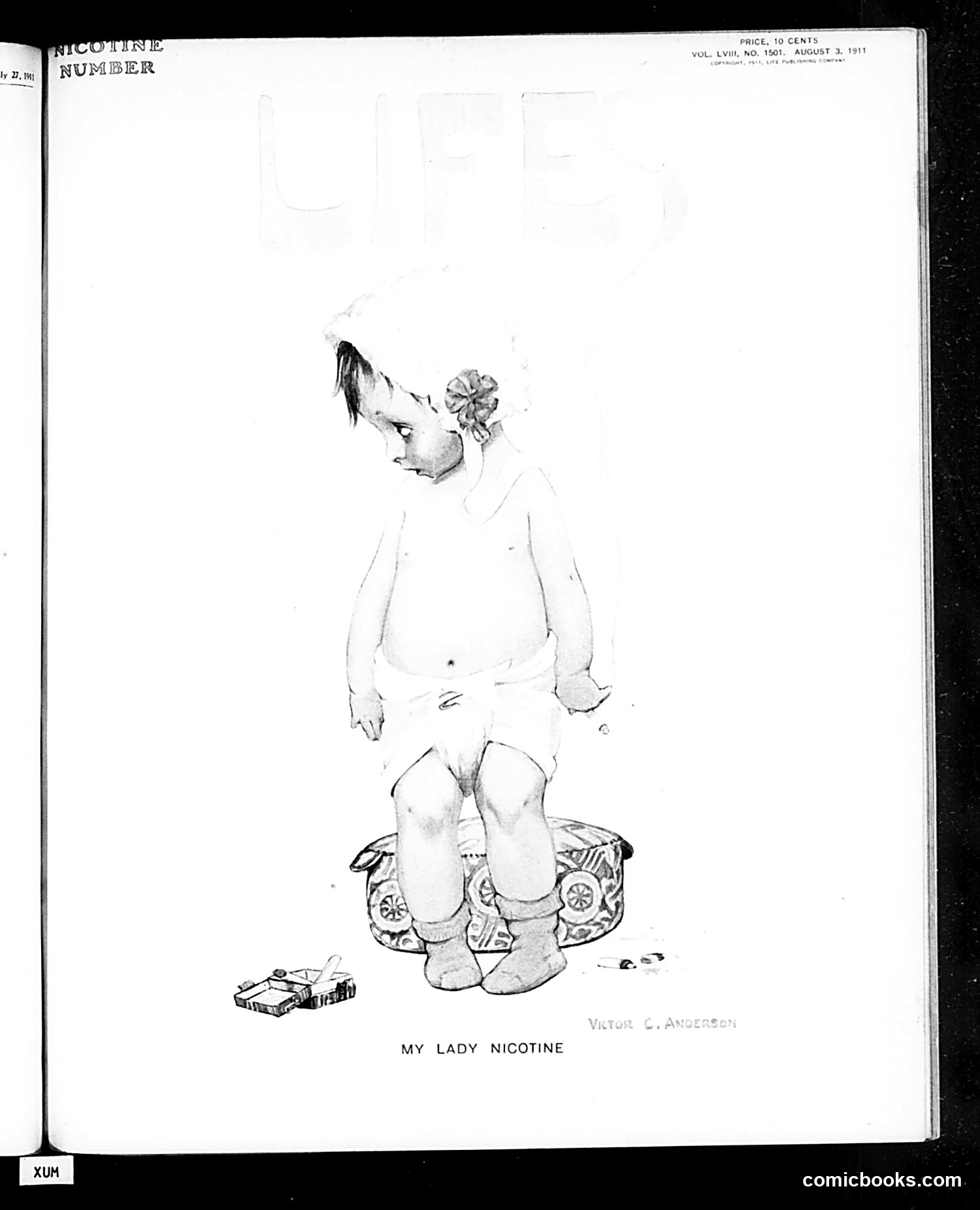
This satirical illustration by Victor C. Anderson depicts a cherubic child figure personifying "Nicotine"—the addictive substance in tobacco. The image mocks nicotine addiction by portraying it as a seductive, childlike temptress. The figure stands on decorative shoes (likely representing expensive habits or lifestyle), with a cigarette package discarded nearby, suggesting the casual way people consumed tobacco. The title "My Lady Nicotine" ironically elevates nicotine to aristocratic status, while the infantile depiction emphasizes the foolishness of regarding an addictive drug with romantic affection. This reflects early 20th-century growing awareness of nicotine's dangers, using humor to critique the era's widespread tobacco consumption and social normalization of smoking.
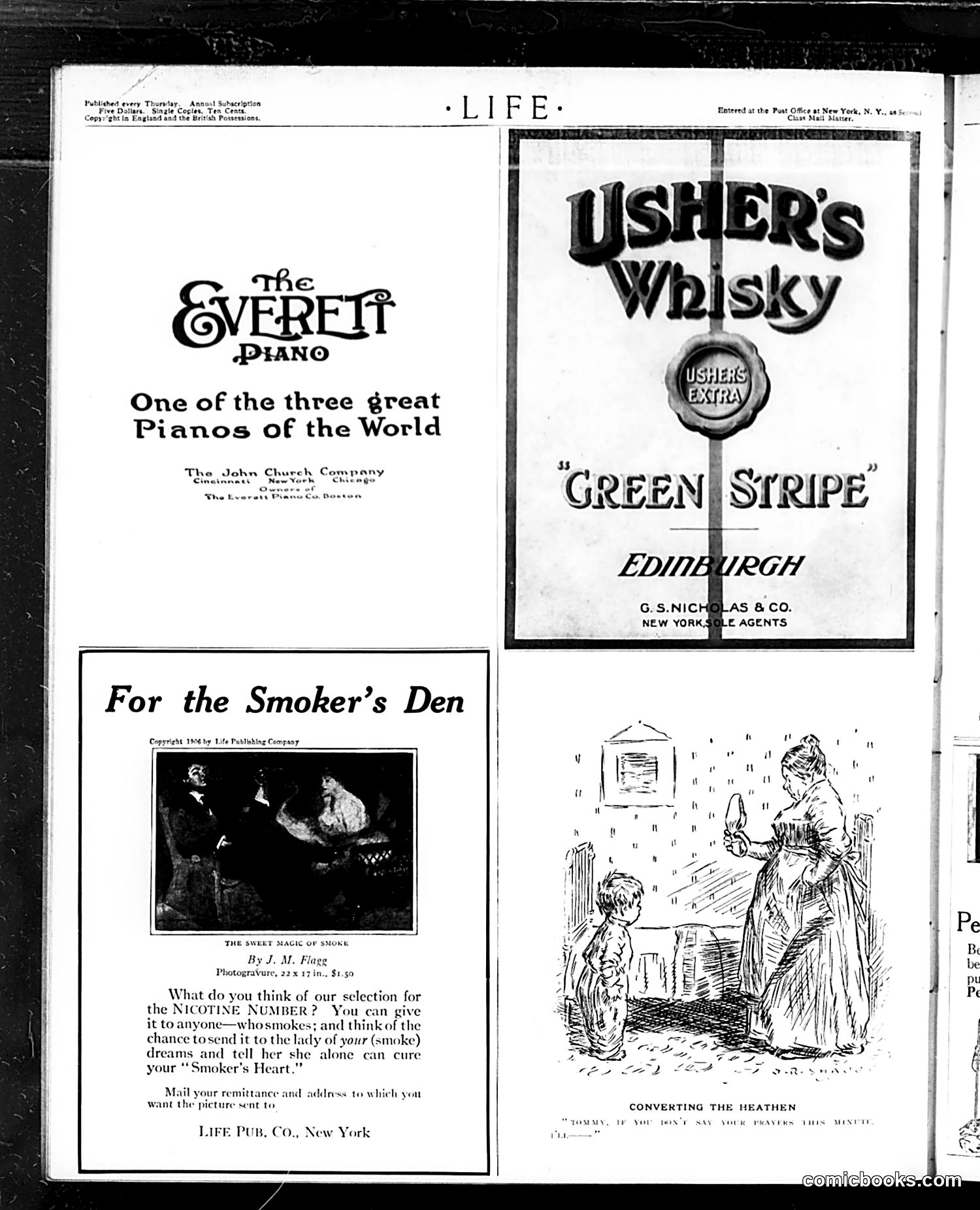
This page is primarily **advertising** rather than political satire. The left side advertises the **Everett Piano**, claiming it as "one of the three great Pianos of the World," manufactured by The John Church Company across multiple U.S. cities. Below that is an ad for "the Smoker's Den" featuring a photograph titled "The Sweet Magic of Smoke" by J.M. Flagg, promoting nicotine products to send to ladies. The right side advertises **Usher's Whisky** ("Green Stripe" brand from Edinburgh), distributed by G.S. Nicholas & Co. in New York. The bottom illustration, titled "Converting the Heathen," depicts a woman teaching a child about Christian faith during rainfall—likely a missionary or religious education scene, though the satirical intent remains unclear from the image alone.
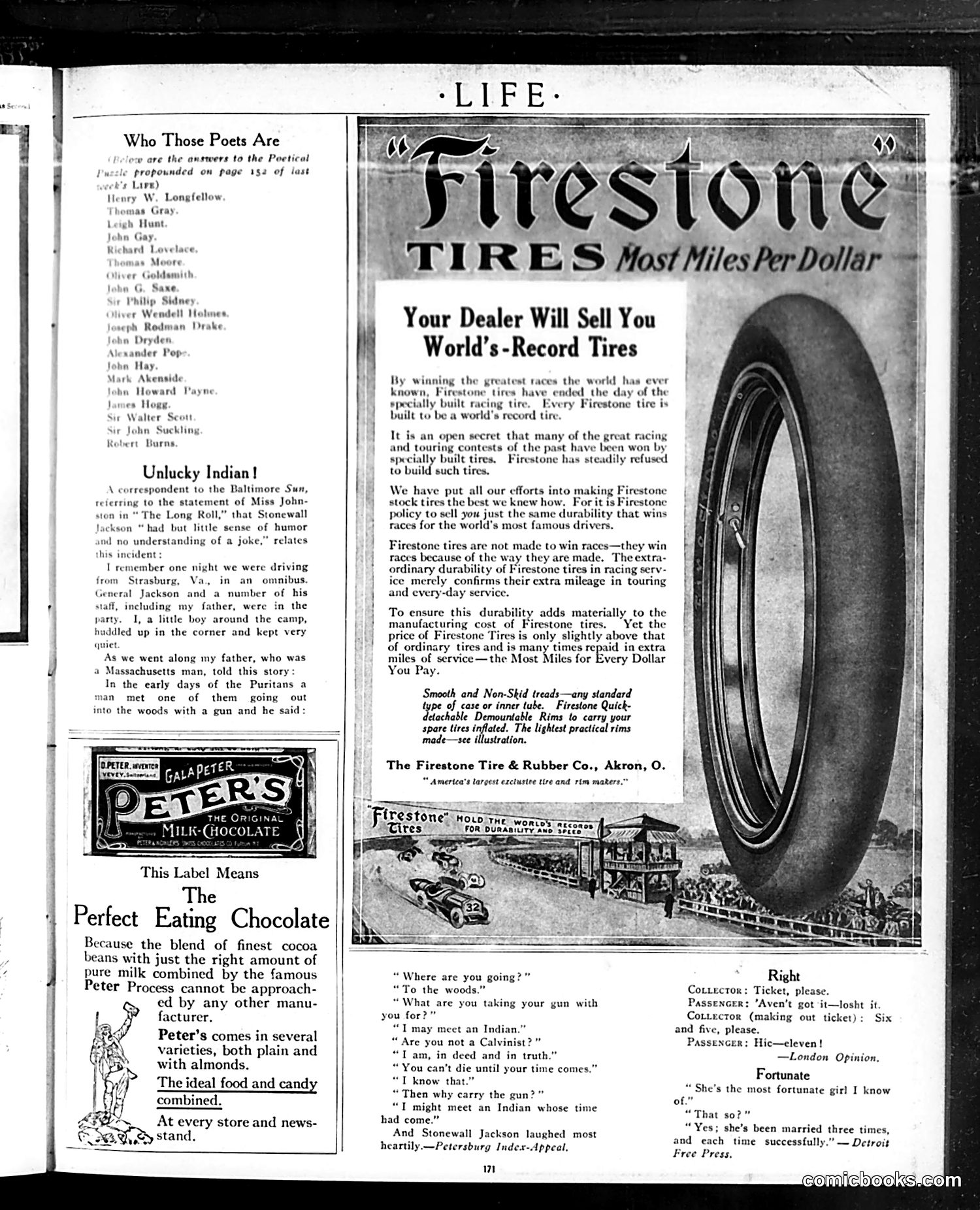
This page is predominantly **advertising rather than satire or political commentary**. The right side features a large Firestone Tires advertisement claiming their product wins races and offers superior durability and value. The left side contains miscellaneous content: a list titled "Who Those Poets Are," a brief anecdote labeled "Unlucky Indian!" about Stonewall Jackson and Native Americans, and a Peter's chocolate advertisement. The "Unlucky Indian" section appears to be light period humor—a brief joke about cultural misunderstanding between a Native American and Stonewall Jackson during the Civil War era, though the humor's exact point is unclear from the text provided. Overall, this reads as a standard magazine page mixing editorial content with advertising, lacking significant political cartoons or sustained satirical commentary.
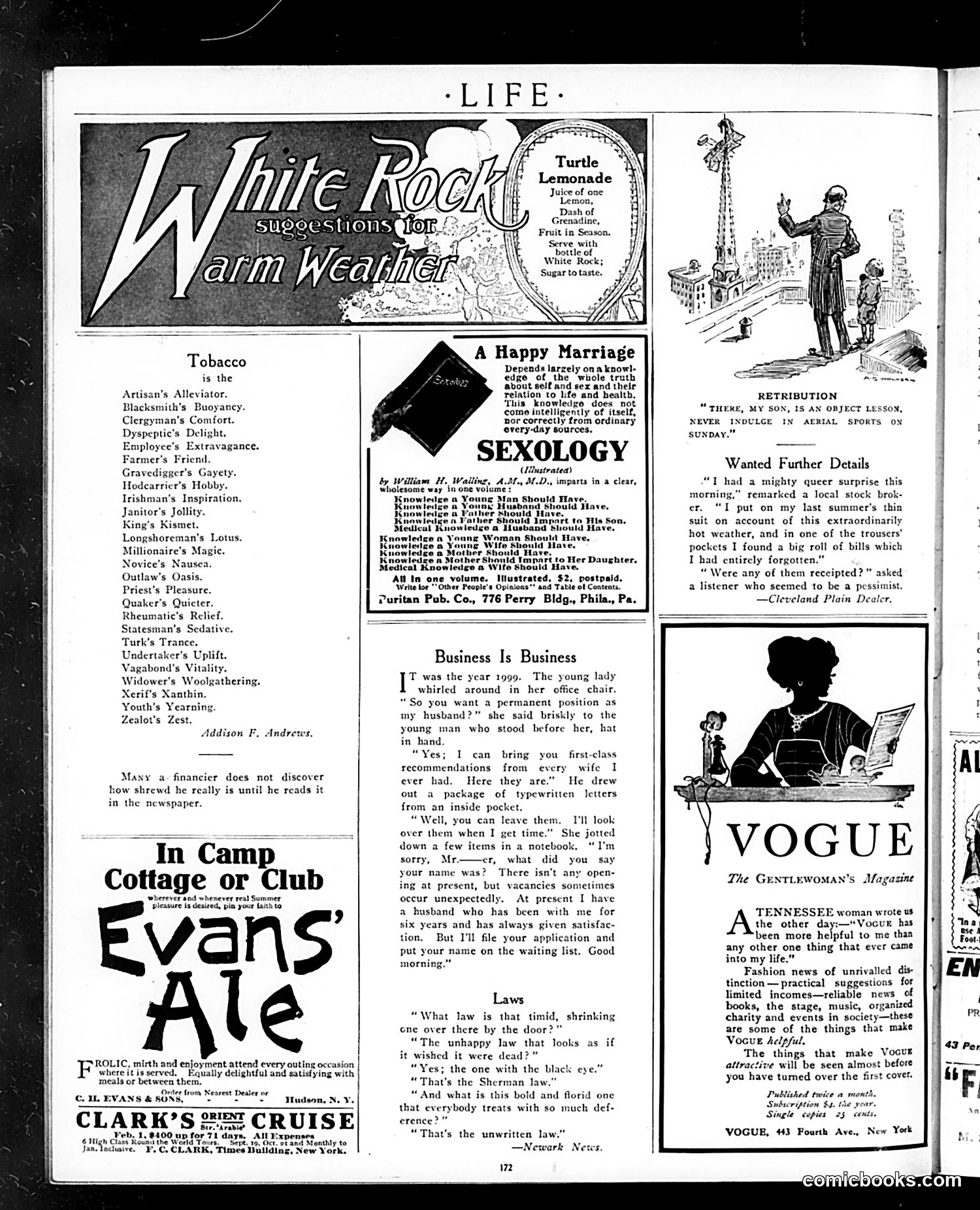
This page is primarily **advertisements and humor columns** rather than political satire. The main content includes: **"White Rock Suggestions for Warm Weather"** — an ad for a lemonade brand featuring a product recipe. **"A Happy Marriage" / "Sexology"** — an advice column by Dr. William H. Walling about marital relations and sexual knowledge, typical of early 20th-century "scientific" relationship guidance. **"Business Is Business"** — a humorous anecdote about hiring practices and office dynamics from 1909, satirizing workplace formality. **"In Camp, Cottage or Club"** — Evans' Ale advertisement emphasizing social enjoyment. **"VOGUE"** — promotes the fashion magazine to readers. The page reflects **early 1900s American consumer culture and social advice**, with no specific political cartoon or identifiable caricatures of public figures present.
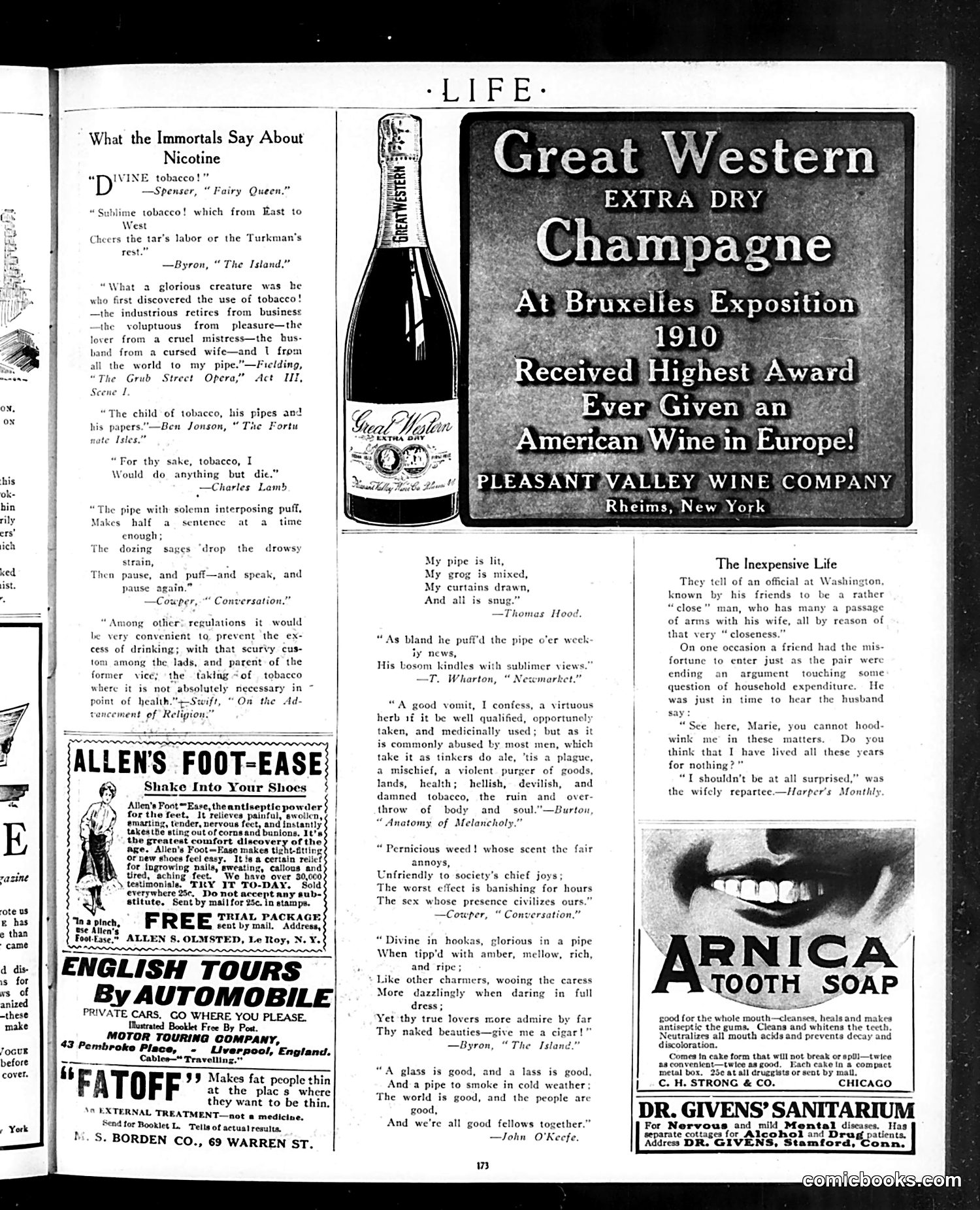
This page is **primarily advertising** with literary content. The main advertisement—a large black rectangle—promotes "Great Western Extra Dry Champagne" from Pleasant Valley Wine Company (Rheims, New York), claiming it won the highest award ever given an American wine at the 1910 Brussilles Exposition. The left column contains **literary quotations about tobacco**, gathered under "What the Immortals Say About Nicotine"—references to smoking from Byron, Ben Jonson, Charles Lamb, and others. These appear designed to legitimize tobacco use through classical literary authority. The remaining advertisements cover foot-ease products, English automobile tours, a weight-loss treatment, and tooth soap. The page reflects early 20th-century consumer culture and promotional practices normalizing tobacco and patent medicines now recognized as harmful.
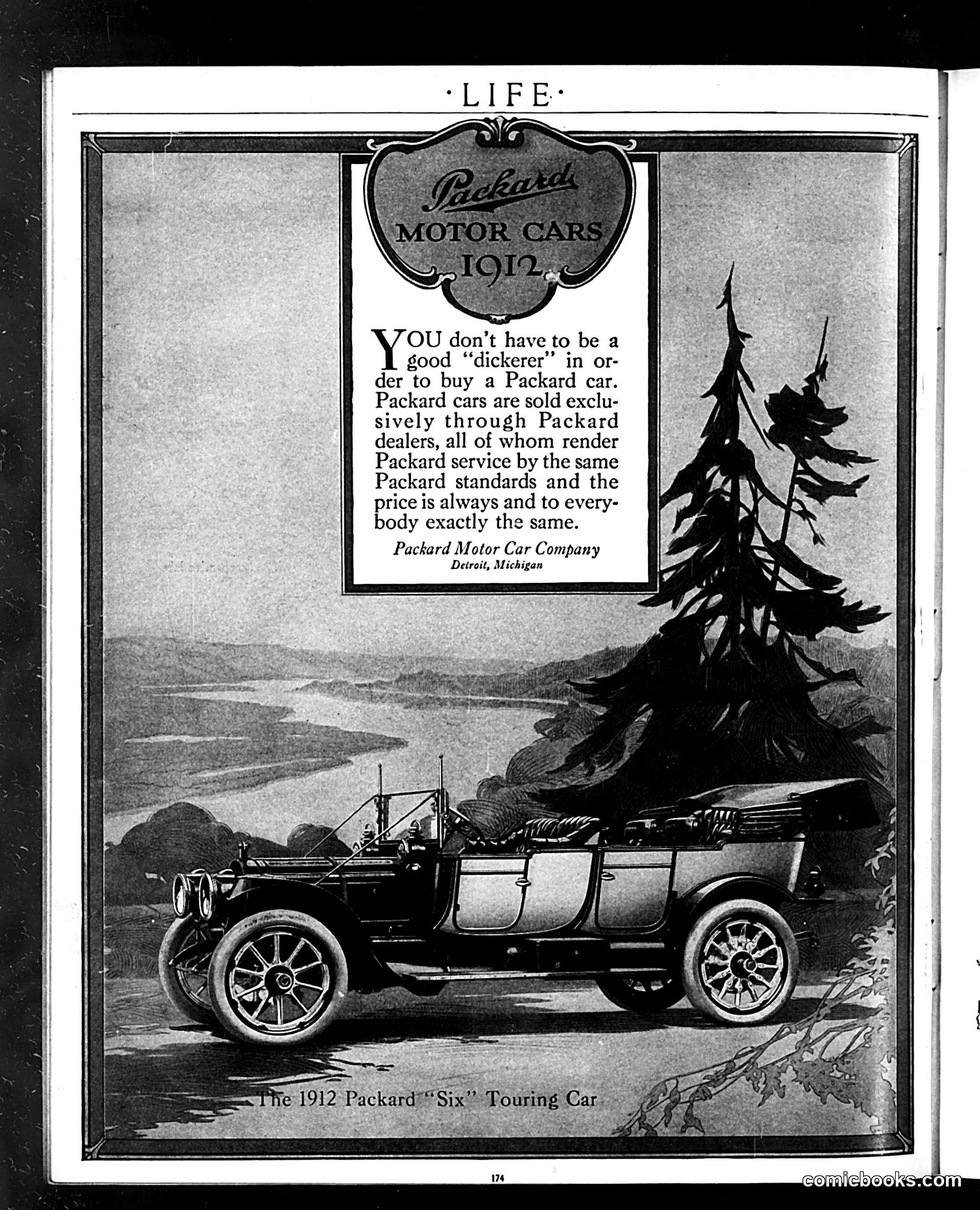
This page is primarily **advertising, not satire or political commentary**. It's a 1912 Packard Motor Car Company advertisement appearing in *Life* magazine. The ad features the 1912 Packard "Six" Touring Car photographed against a scenic landscape with evergreen trees and water. The accompanying text emphasizes that buyers "don't have to be a good 'dickerer'" (negotiator) because Packard cars are sold exclusively through authorized dealers who maintain uniform pricing and service standards nationwide. The scenic imagery suggests luxury and reliability rather than satirizing any political or social figure. This is straightforward commercial advertising leveraging *Life*'s readership to market high-end automobiles to affluent readers.
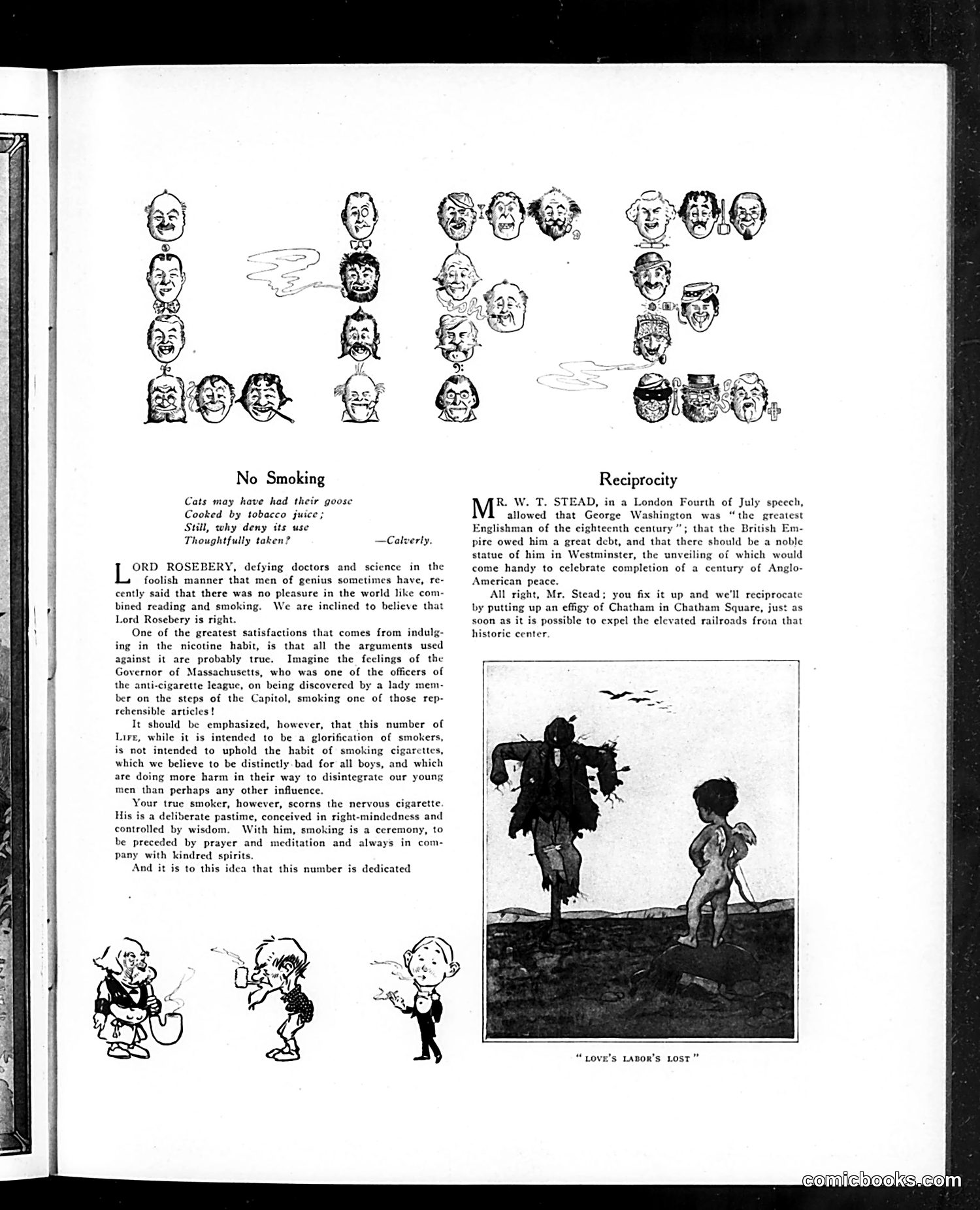
This page contains two satirical pieces: **"No Smoking"** (left): A humorous attack on Lord Rosebery, who claimed smoking provided no pleasure. The caricatured faces stacked vertically mock him. The text defends smoking as a harmless, meditative practice—contrasting with anti-cigarette campaigns. It notably defends boys smoking cigarettes as less harmful than other influences on youth. **"Reciprocity"** (right): References Mr. W.T. Stead's proposal to honor George Washington with a statue in Westminster Abbey, suggesting Anglo-American friendship. The satire proposes reciprocal placement of a statue in Chadham Square. The accompanying illustration titled "Love's Labor's Lost" depicts what appears to be a romantic or military encounter. Both pieces employ caricature and absurdist logic typical of Life's satirical approach to contemporary social and political debates.
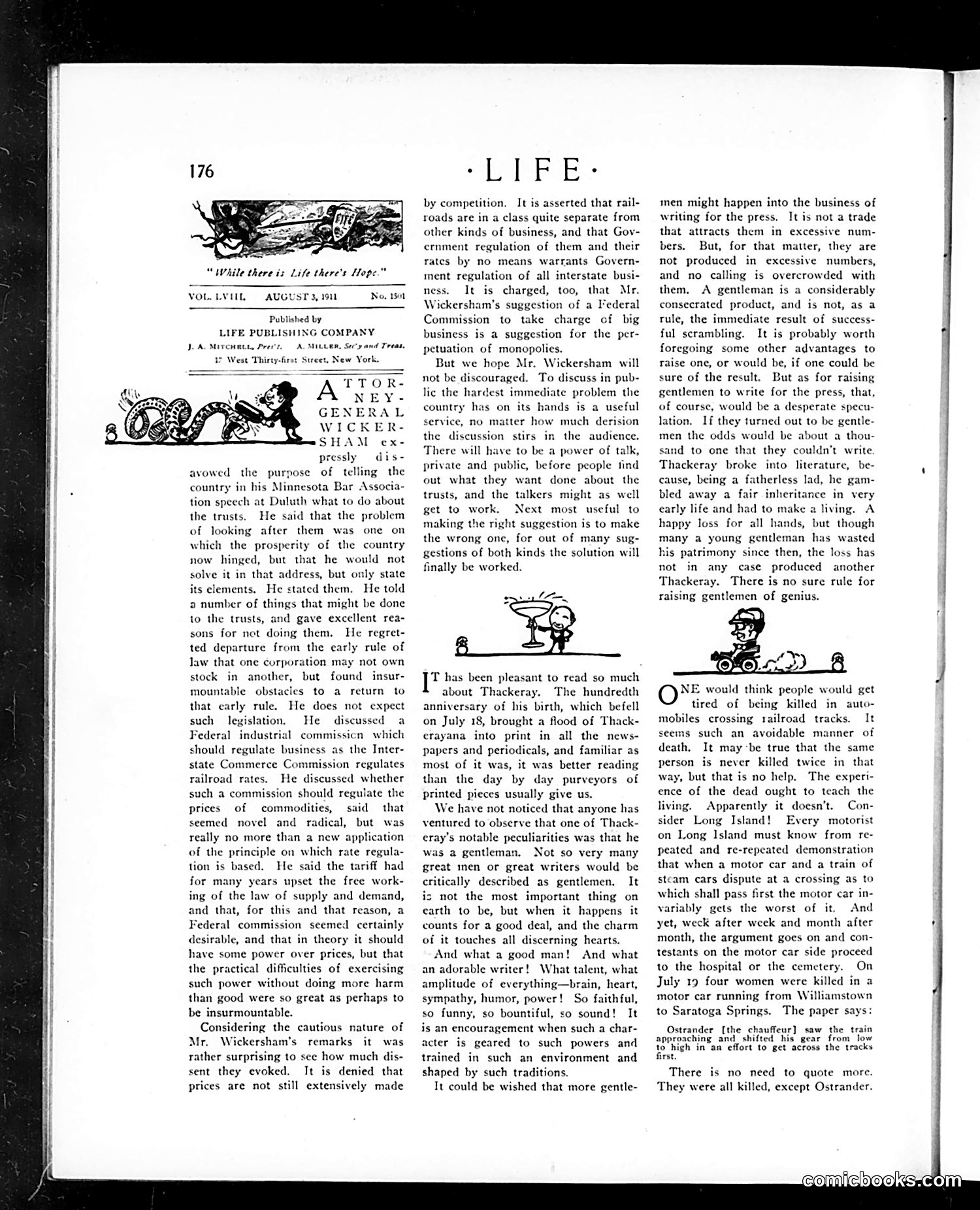
This page from *Life* magazine (August 5, 1911) contains an "Attorney-General's General Wickersham" column—a satirical piece about U.S. Attorney General James Wickersham's views on railroad regulation and trusts. The text mocks Wickersham's suggestion that a Federal Commission should regulate interstate business, arguing this is an overly radical proposal. The author sarcastically presents Wickersham's reasoning while critiquing the impracticality of such regulation. The small cartoon illustrations (appearing between text sections) show figures in comedic situations, likely reinforcing the satirical tone about bureaucratic complications. The page's humor targets Progressive Era debates over government regulation of big business—a central political controversy of the period. The satire suggests Wickersham's proposals, though intended as solutions, would create more problems than they solve.
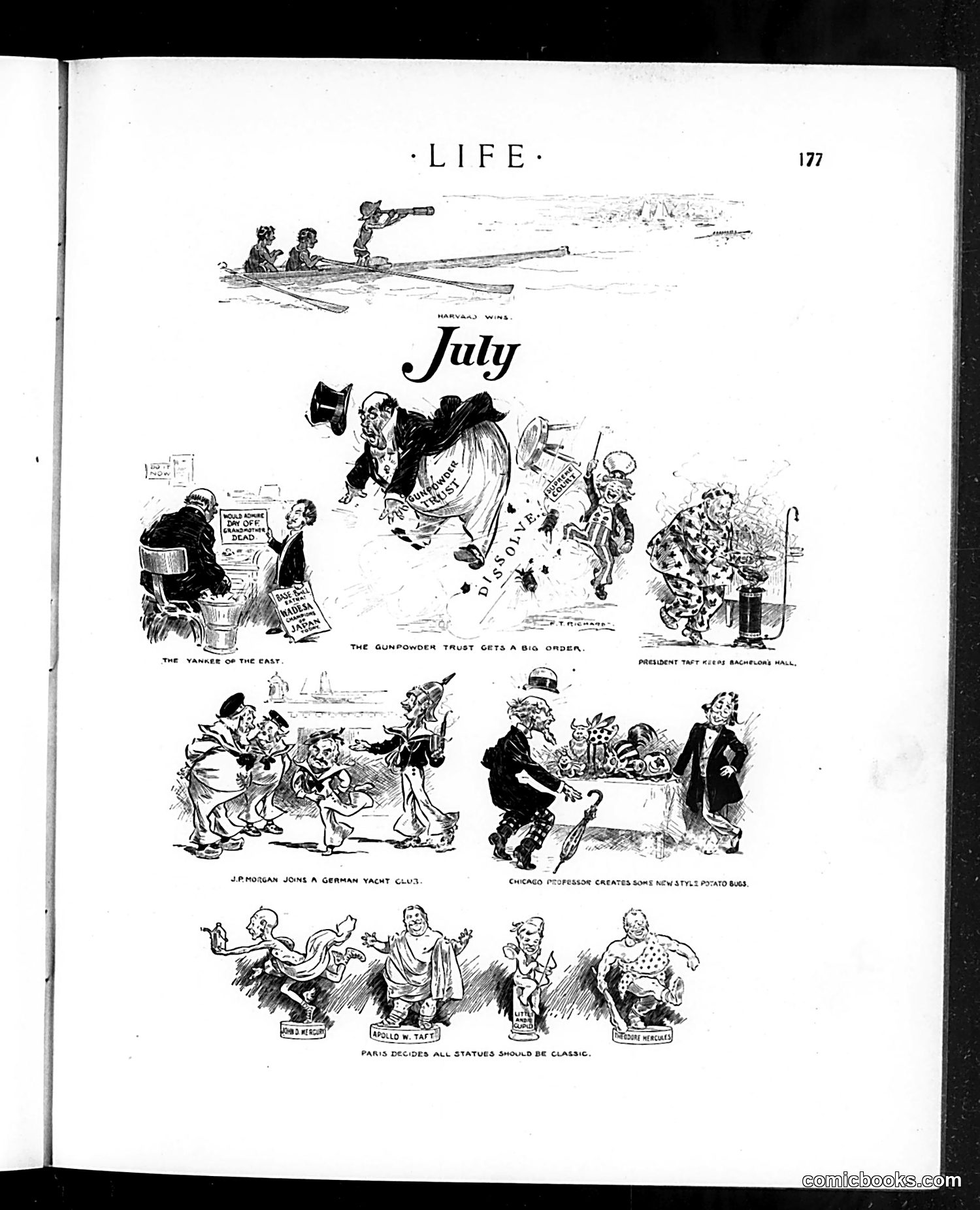
This page collects seven satirical cartoons commenting on July events, likely from the early 1910s (based on style). The captions reference: - **"The Yankee of the East"**: appears to mock American imperial interests - **"The Gunpowder Trust Gets a Big Order"**: criticizes munitions manufacturers profiting from conflict - **"President Taft Visits Jamestown Hall"**: topical reference to President Taft's activities - **"J.P. Morgan Joins a German Yacht Club"**: satirizes wealthy Americans' European connections - **"Chicago Professor Creates Some New Style Potato Bags"**: mocks academic pretension - **"Paris Decides All Statues Should Be Classic"**: social commentary on artistic standards The cartoons employ caricature and exaggeration to critique political figures, business interests, and contemporary social trends, typical of Life's satirical approach.
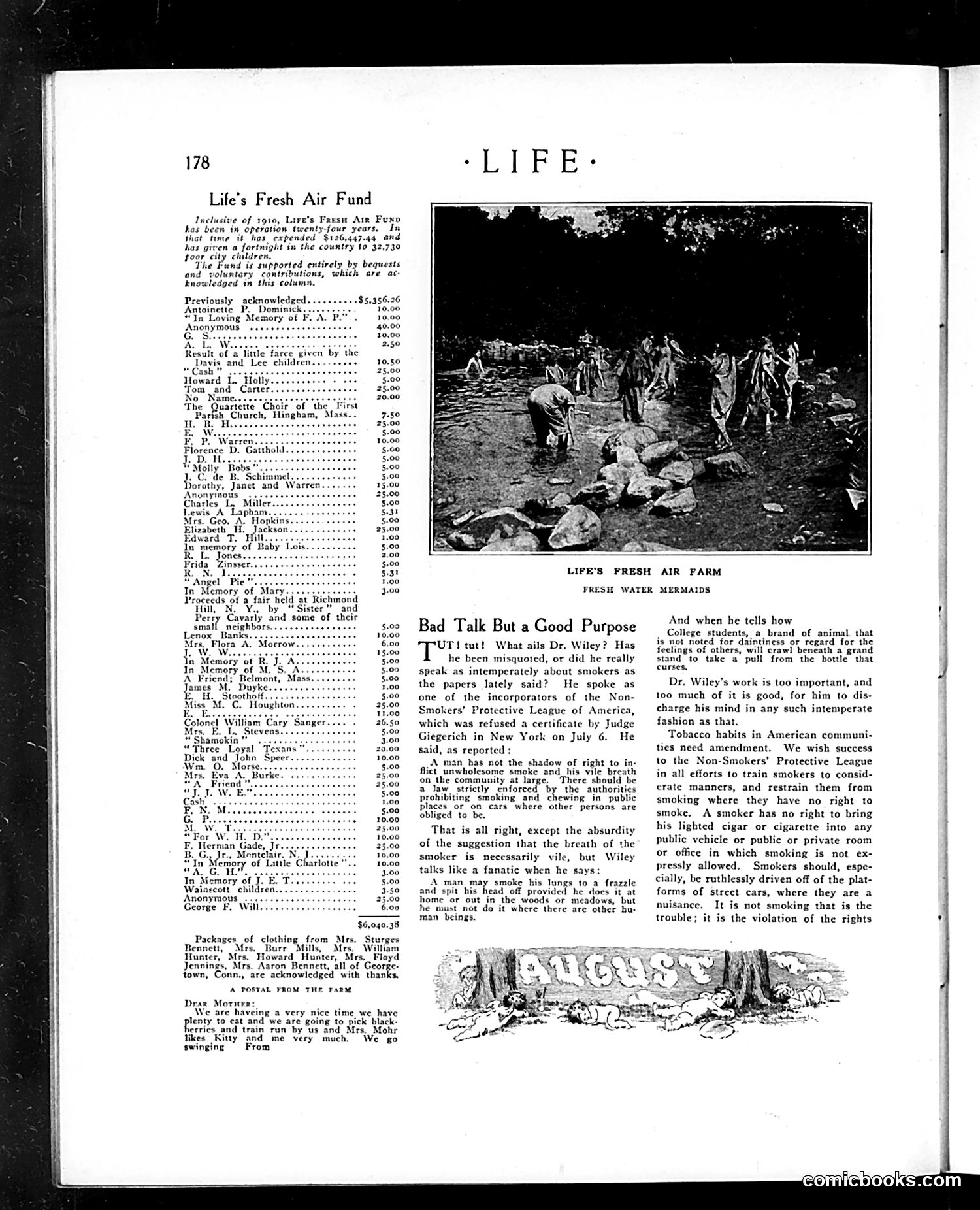
This page contains a fundraising list for "Life's Fresh Air Fund" (supporting poor city children) and an article titled "Bad Talk But a Good Purpose" defending Dr. Wiley against criticism. **The Main Content:** The article discusses Dr. Wiley's allegedly intemperate public statements about smokers. Though Wiley spoke harshly about smoking and the "Smokers' Protective League of America," the author argues his controversial rhetoric serves a valid purpose—protecting non-smokers' rights in public spaces. The satire suggests that while Wiley's harsh language may be excessive, his underlying cause (restricting smoking in public) is legitimate and important enough to overlook his abrasive tone. **Visual Element:** A photograph labeled "Fresh Water Mermaids" shows people at Life's Fresh Air Farm, illustrating the charitable work being fundraised.
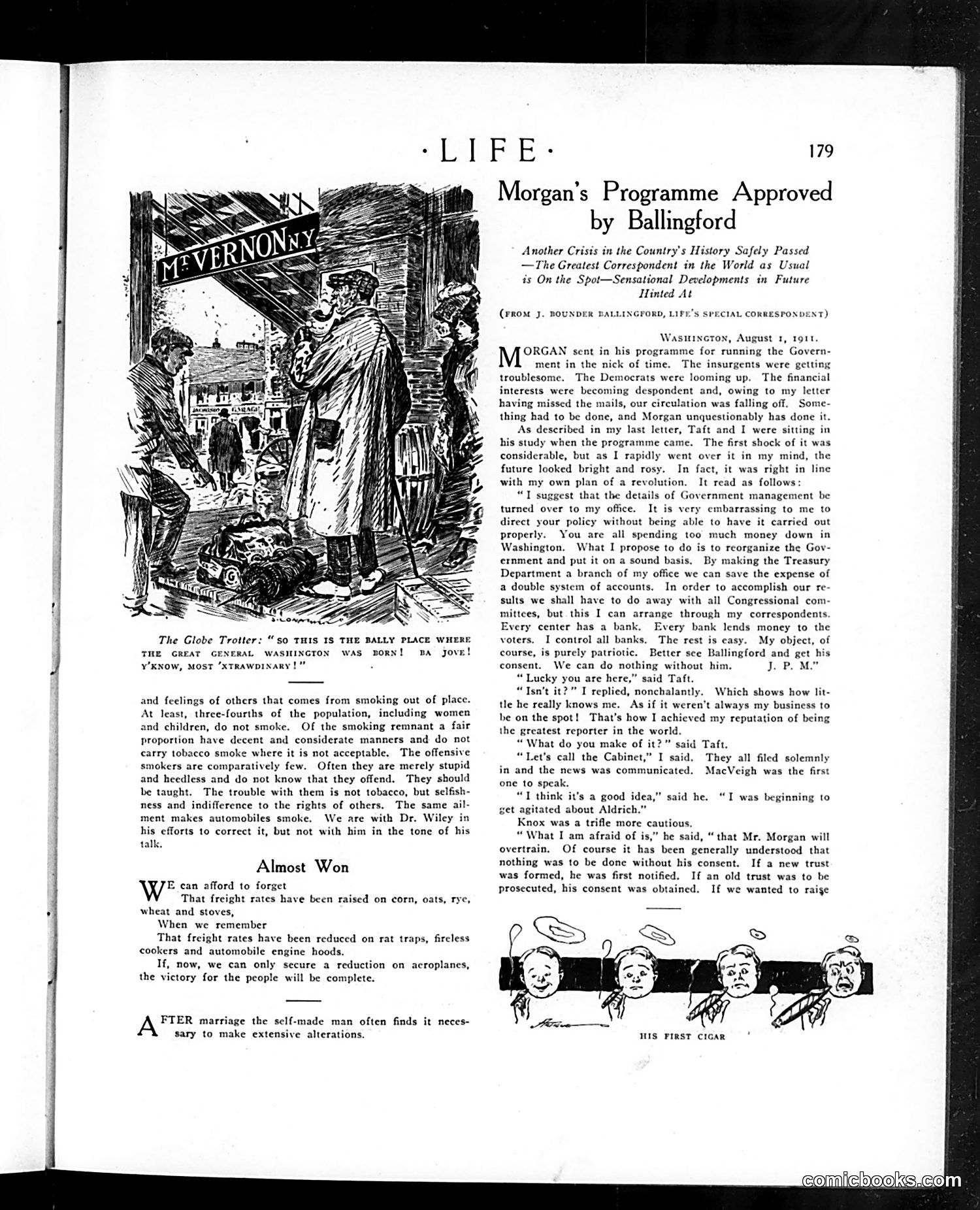
This page satirizes a political disagreement over government spending during a crisis (dated August 1, 1911). **The main cartoon** depicts Vernon, likely a political figure, presenting a government reorganization plan. The satire criticizes wasteful federal spending and proposes consolidating financial operations through a centralized banking system to reduce duplication. **The figures** appear to be politicians debating these reforms—the text references Taft, Morgan, Knox, and Ballingford as key players in this proposal. **The joke** hinges on bureaucratic inefficiency: the speaker ironically notes they're "smoking out" government waste while acknowledging the irony that smokers themselves create waste. **"His First Cigar"** (bottom cartoon) depicts men with cigars, likely mocking politicians newly empowered by these reforms. The satire targets governmental excess and financial mismanagement during economic uncertainty.
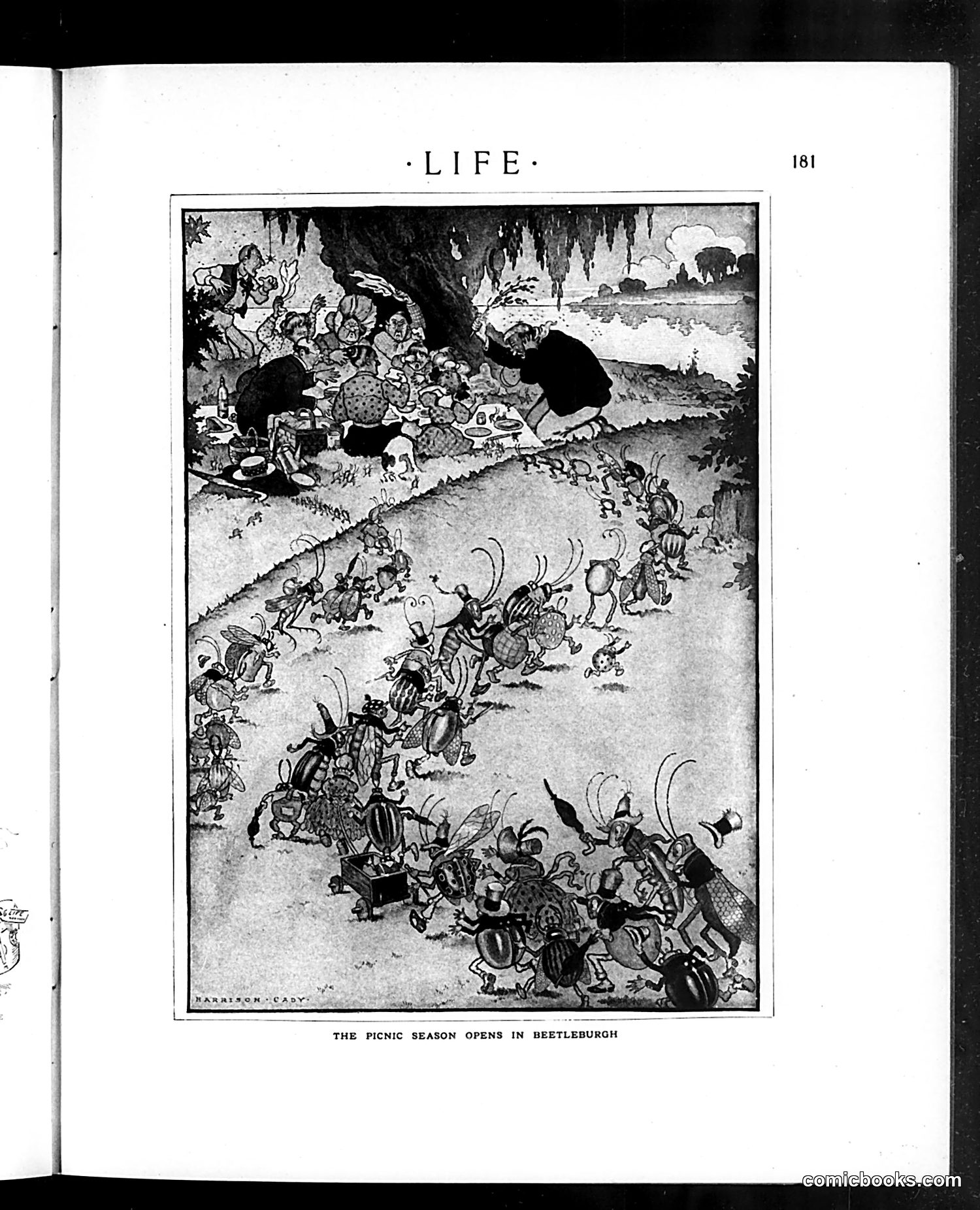
This is a whimsical illustration by Harrison Cady depicting an insect picnic in a fantastical woodland setting. Anthropomorphized beetles, ants, and other bugs gather for a social outing—some seated under a large tree enjoying food, others parading or marching across the ground with characteristic bug-like appendages exaggerated for comic effect. The cartoon appears to be pure nonsensical humor rather than political satire. It plays on the popular "Beetleburgh" conceit (a fictional insect community), treating bugs as Victorian society members engaged in leisure activities. The elaborate antennae, multiple legs, and bustling activity create absurdist comedy typical of Life magazine's lighter fare—entertainment meant to amuse rather than critique contemporary politics or social issues.
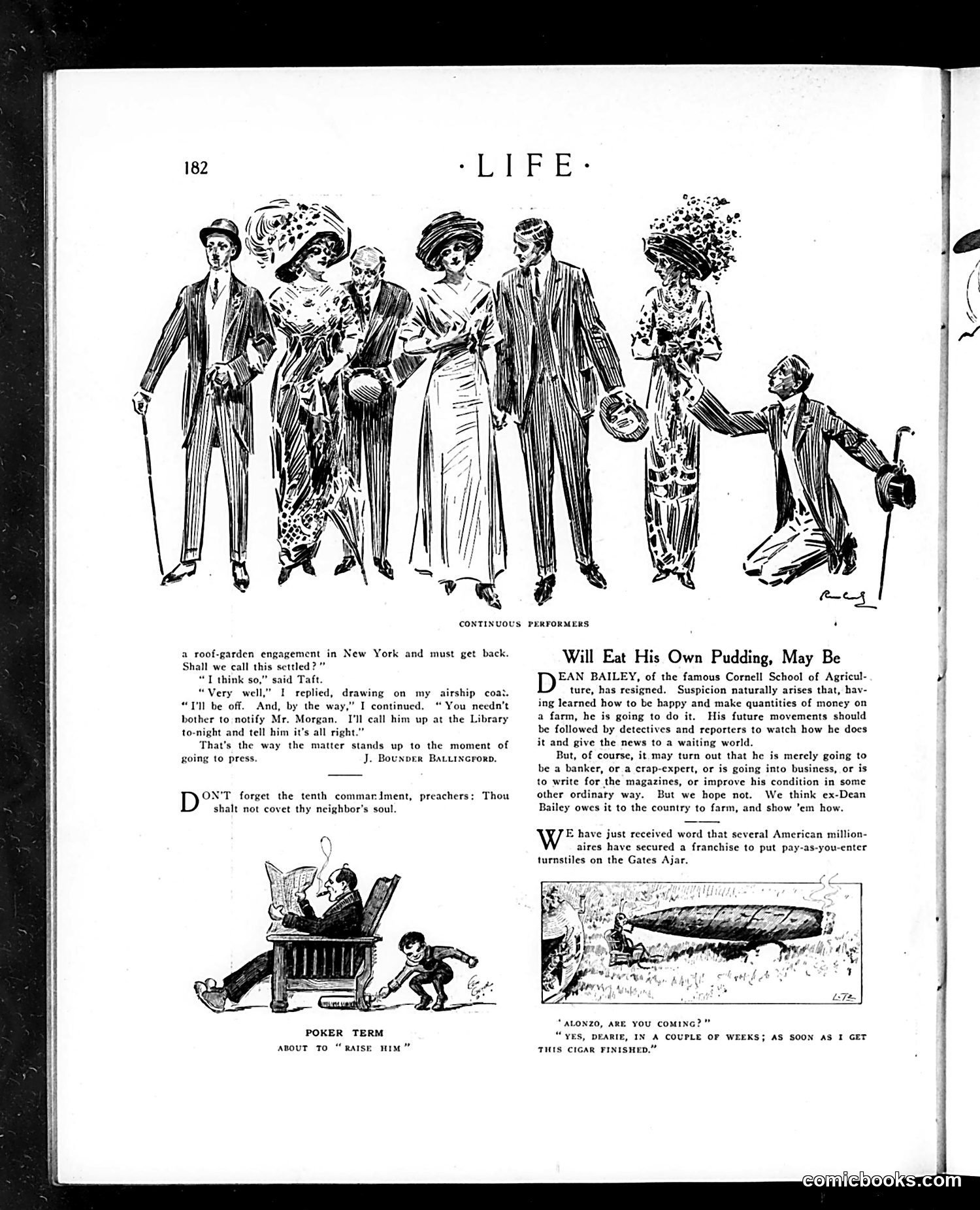
The top illustration shows fashionably dressed figures representing "Continuous Performers"—likely society people or entertainment figures of the era in formal wear and elaborate hats. The main article "Will Eat His Own Pudding, May Be" discusses Dean Bailey from Cornell's agricultural school resigning to farm and become self-sufficient, with detectives supposedly monitoring his progress. The satire suggests skepticism that this wealthy person could actually sustain rural life independently. The bottom cartoon, "Poker Term About to 'Raise Him'," depicts someone apparently going broke—a child or small figure being "raised" (lifted) out of a basket, playing on the poker term. The airship and cigar jokes reference contemporary technological developments, though their specific references are unclear without additional historical context.
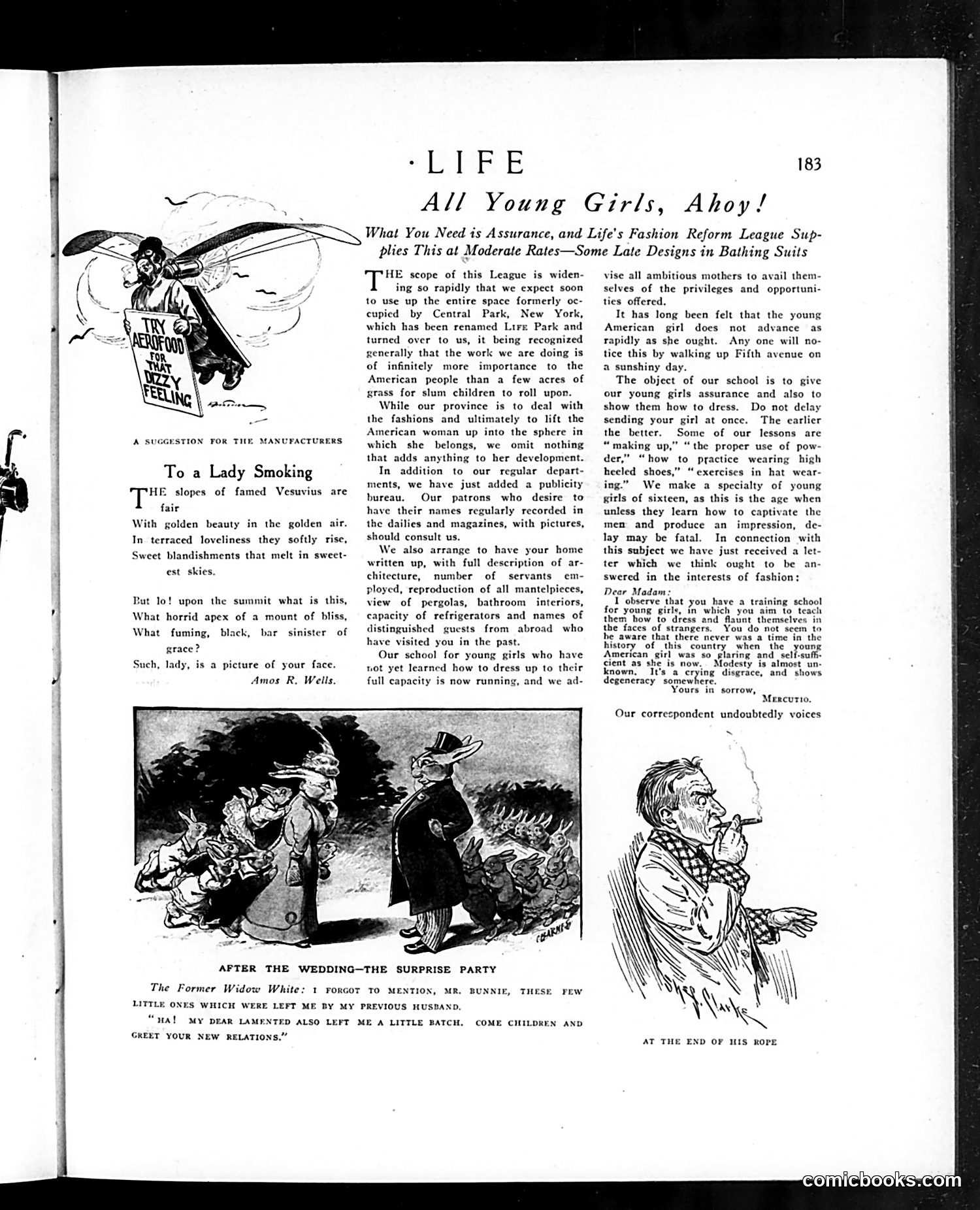
This page contains social satire typical of early 20th-century Life magazine. The main content mocks a fictional "Fashion Reform League" that claims to educate young girls in dress and comportment while actually promoting vanity and materialism. The satire suggests the League has become so important it should replace Central Park, and now offers services like publicizing patrons' homes and servants—lampooning wealthy women's status-seeking. The poem "To a Lady Smoking" criticizes women smoking in public, comparing a woman's face while smoking unfavorably to Mount Vesuvius's beauty. The cartoon "After the Wedding" depicts a widow presenting her illegitimate children from a previous marriage as a "surprise" to her new husband—satirizing remarriage complications and social pretense. A reader's letter criticizing young American girls' lack of modesty provides counterpoint, suggesting the page critiques both excessive female vanity and generational decline in propriety.
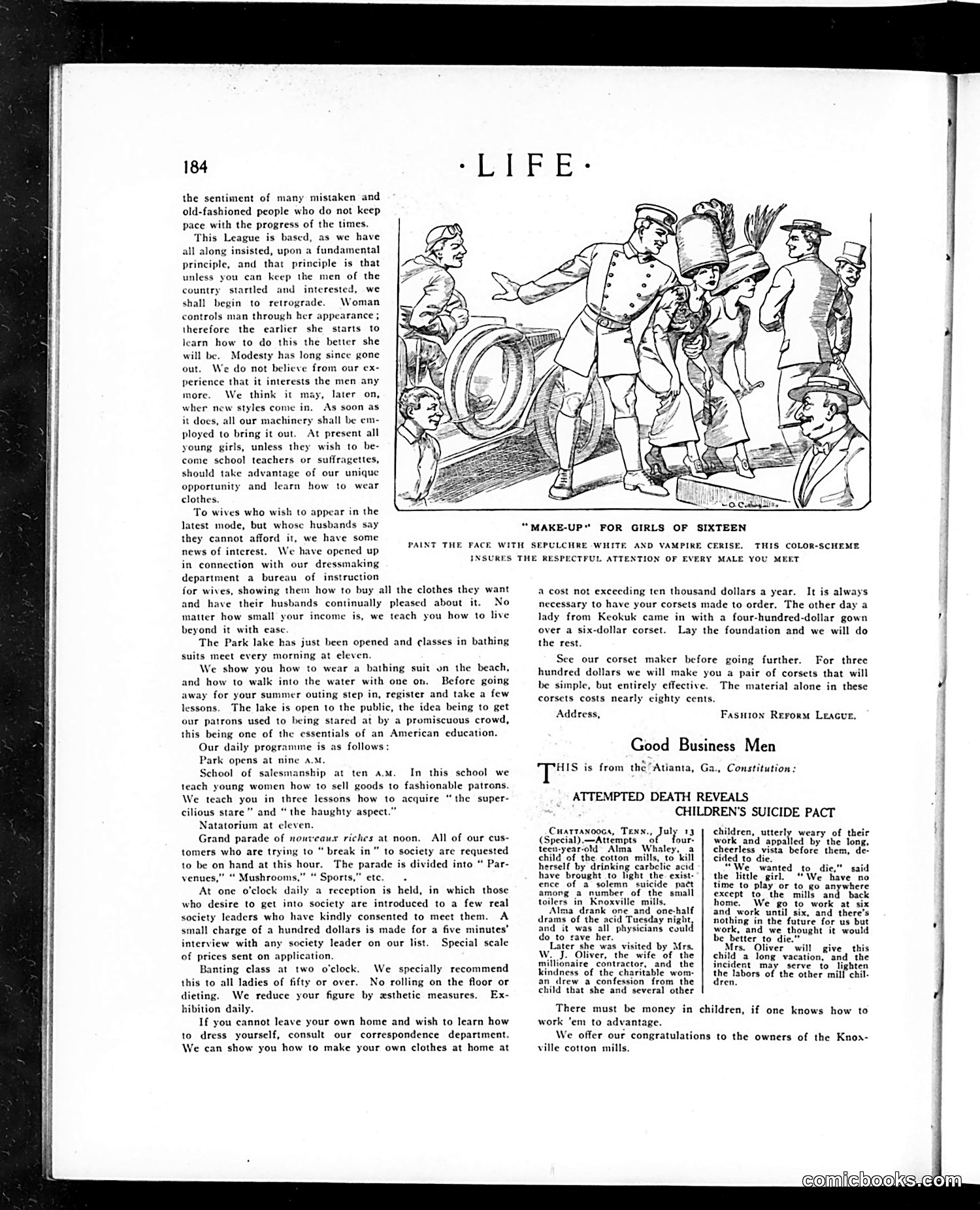
This page satirizes the "New Woman" movement and commercialized femininity of the early 1900s. The cartoon depicts a dubious "League" teaching young women to prioritize appearance and attract male attention through makeup, fashion, and deportment. The satire targets: 1. **Shallow consumerism**: The fake institution offers absurd paid services—$100 for five-minute introductions to "society leaders," $300+ corsets, $10,000/year dress lessons—mocking wealthy women's spending and the fashion industry's exploitation. 2. **Anti-feminist backlash**: The text dismisses modesty as outdated while promoting appearance as women's primary power, rejecting education (mocking "suffragettes"). It's cynical commentary on how society redirects female ambition into consumer culture. 3. **Class anxiety**: References to "nouveaux riches" trying to "break into" society satirize the nouveau-riche obsession with status markers during America's Gilded Age. The accompanying article about children's suicide attempts provides grim contrast, suggesting social commentary on desperation underlying this gilded facade.
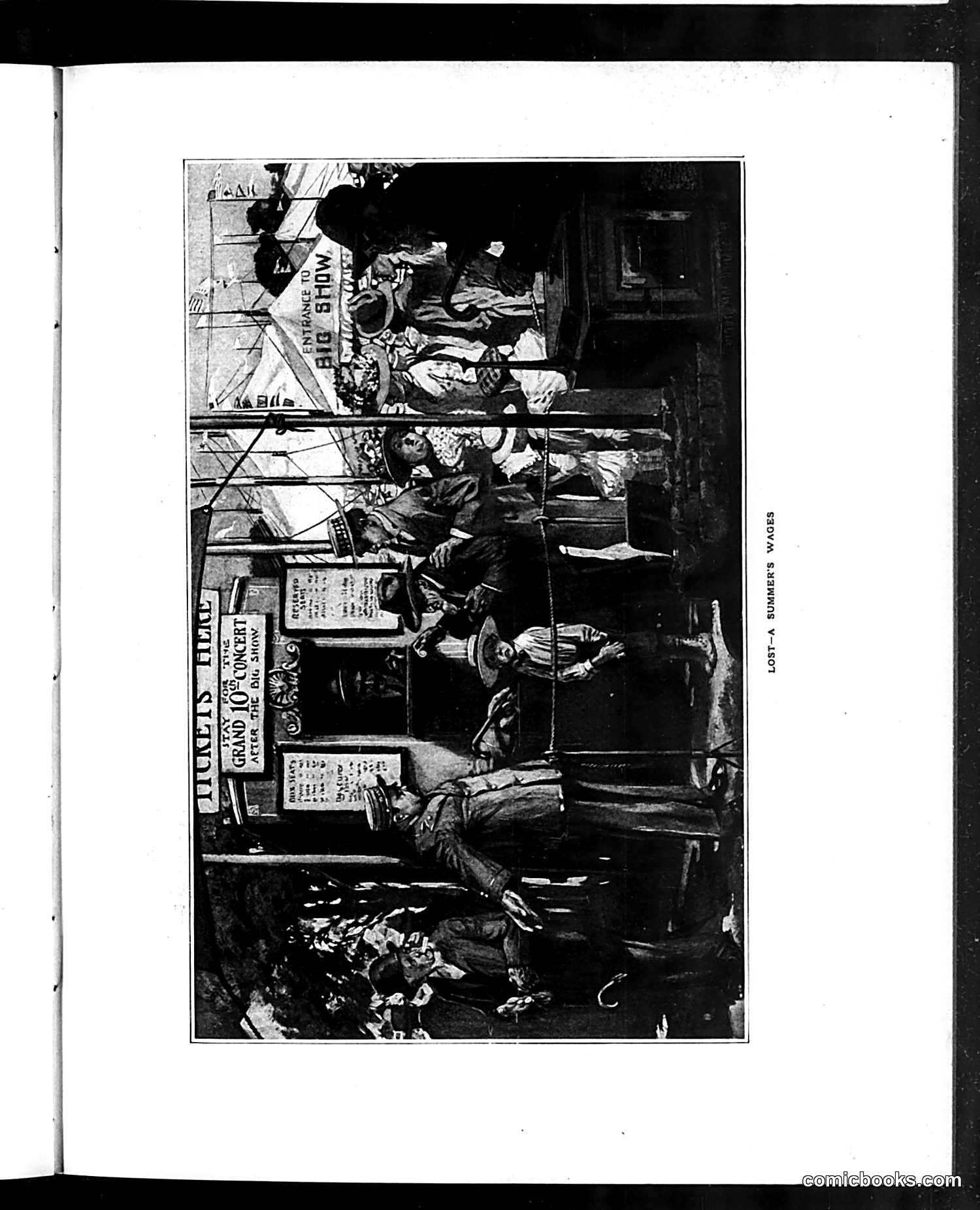
The OCR text is severely corrupted and unreadable, appearing as reversed or scrambled characters rather than legible English. While the black-and-white photograph shows what appears to be a street scene with storefront signage (including what looks like "LUNCH" signage), multiple figures, and period clothing suggesting early-to-mid 20th century, I cannot confidently identify the specific political or social satire without readable text context. The page header indicates this is from *Life* magazine and the caption references "lost a summer's wages," suggesting economic hardship as a theme, but without clear OCR text or visible publication date, I cannot reliably explain the cartoon's specific meaning or targets to a modern reader.
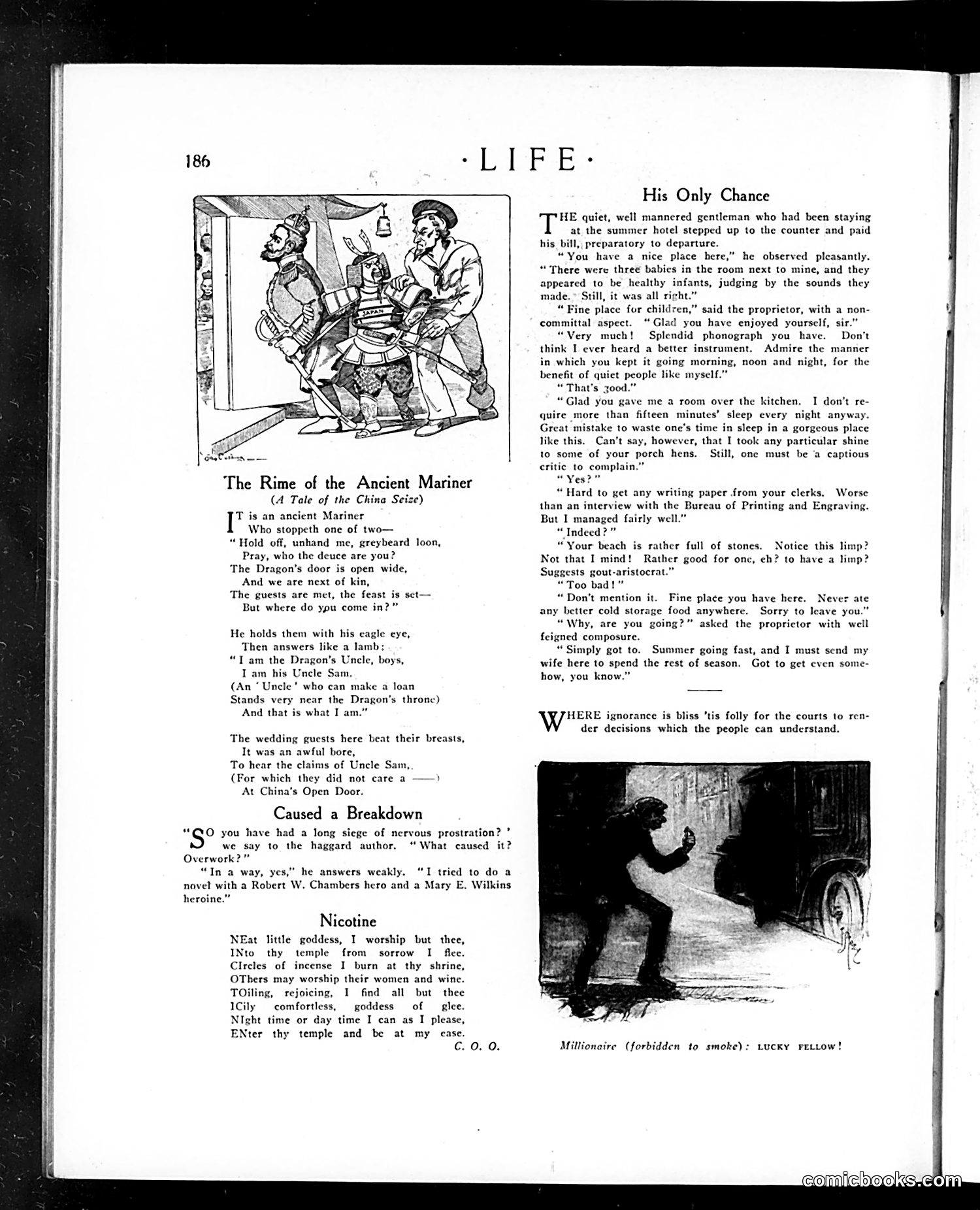
This page contains three satirical pieces typical of early-20th-century American humor: **"The Rime of the Ancient Mariner"** parodies Coleridge's poem, substituting "Uncle Sam" for the mariner. It mocks American intervention in China during the "Open Door" policy era, portraying the U.S. as an unwelcome interloper at China's affairs—Uncle Sam arrives uninvited to the "Dragon's" (China's) wedding feast, claiming kinship merely because he can offer loans. The satire critiques American imperialism disguised as familial obligation. **"His Only Chance"** presents a departing hotel guest delivering backhanded compliments about awful conditions (screaming babies, loud phonographs, noisy hens, rocky beach, poor service, cold food). The joke: he's sending his wife there to "get even"—the real revenge is subjecting her to the same misery. **"Nicotine"** is a humorous poem worshipping tobacco as a goddess, using religious language ironically. The bottom cartoon shows a millionaire forbidden to smoke, calling a laborer "lucky fellow"—inverting class hierarchy's typical privileges.
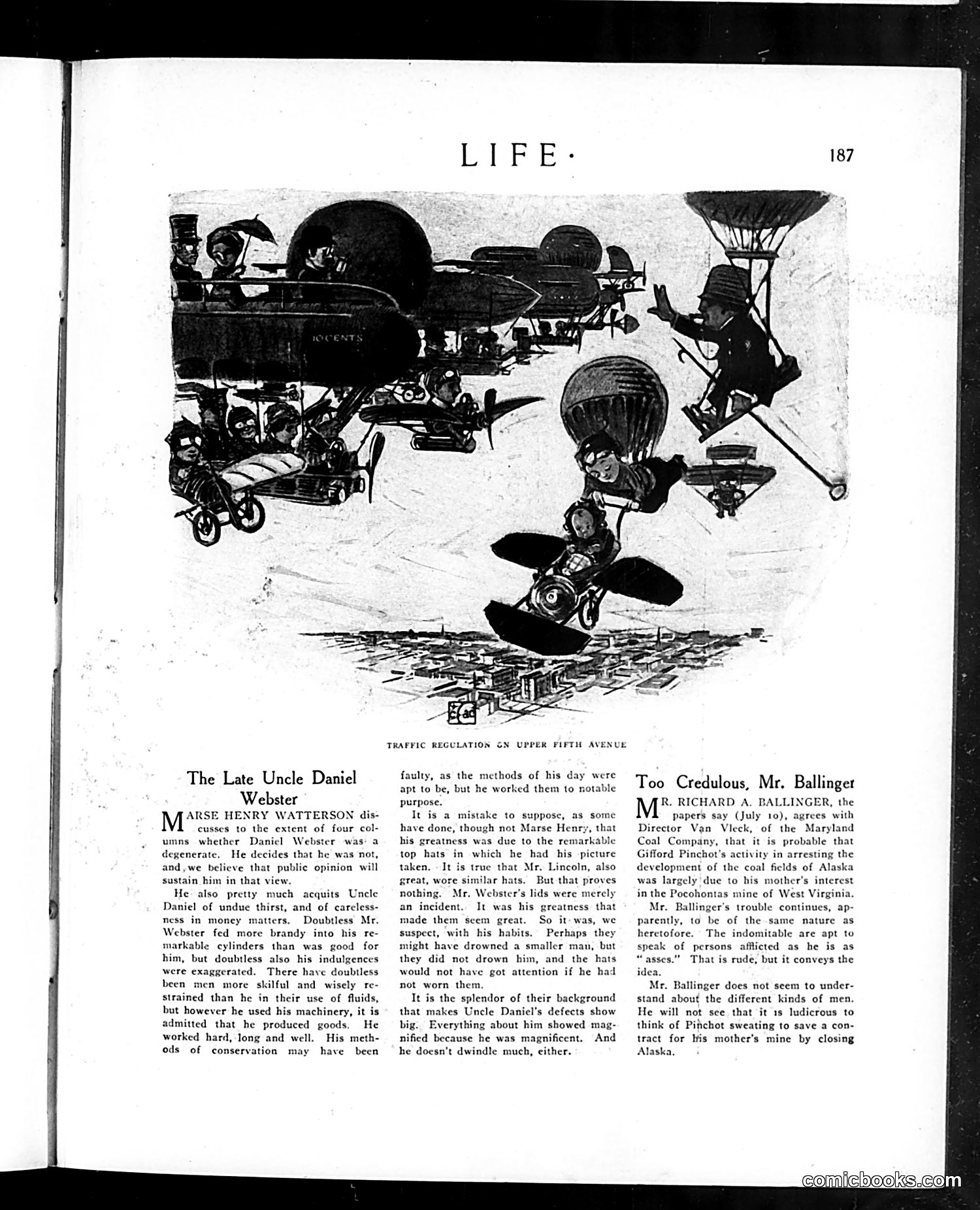
This satirical cartoon depicts various flying machines and early aircraft hovering over a cityscape, illustrating the emerging problem of aerial traffic congestion in New York City's sky above Fifth Avenue. The joke is topical: as aviation technology rapidly advanced in the early 1900s, Life humorously imagines a future where air traffic becomes as crowded and chaotic as street traffic, requiring regulation. The accompanying articles discuss Daniel Webster's character (defending him against charges of degeneracy and excessive drinking) and criticize Secretary of Interior Richard Ballinger for allegedly credulous reasoning about conservationist Gifford Pinchot's motives regarding Alaska coal development. The Ballinger piece sarcastically suggests Ballinger lacks understanding of human nature.
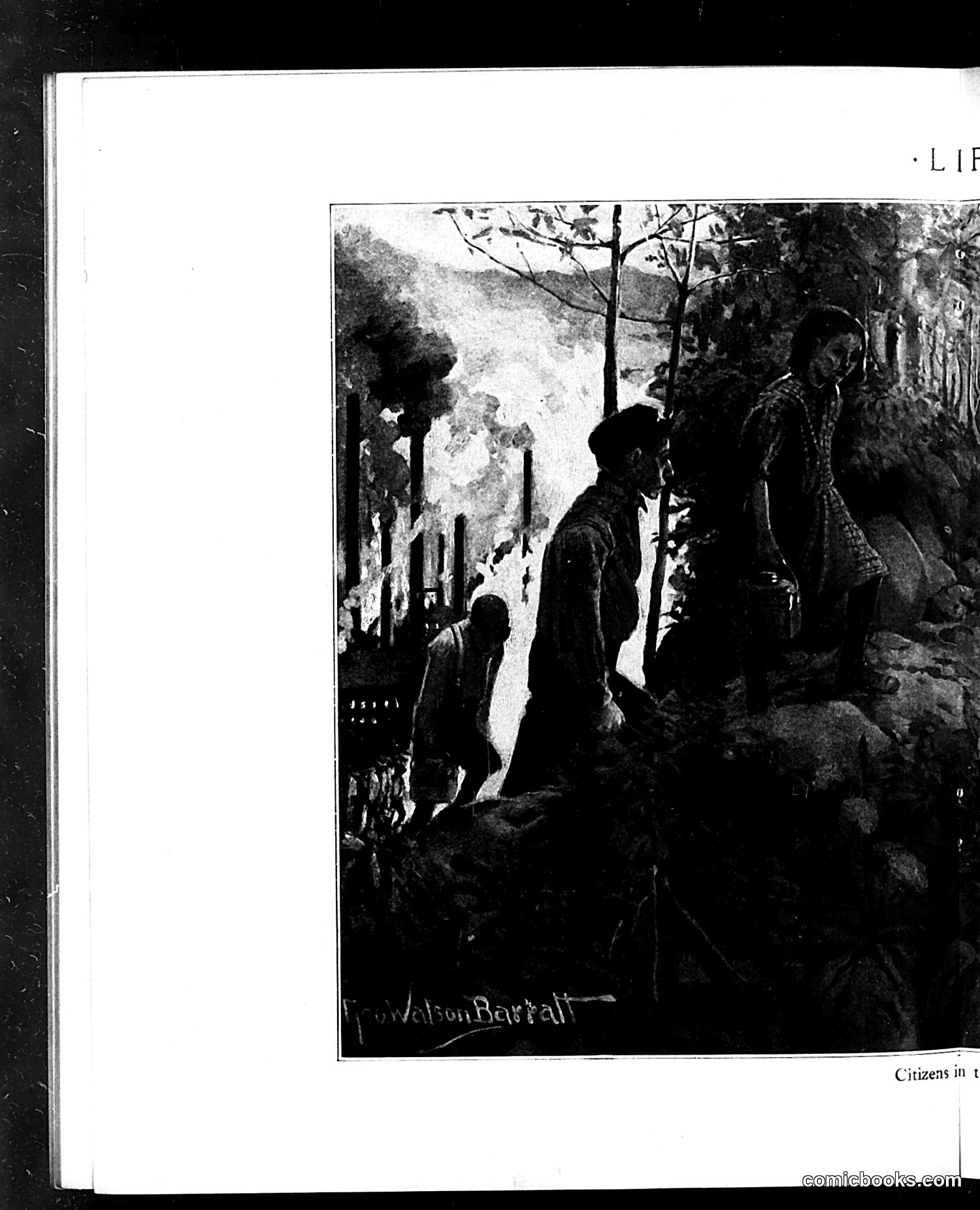
This appears to be an illustration (signed "Watson Barrall") showing a nighttime street scene with multiple figures gathered along a pathway lined with bare trees. The composition is dark and atmospheric, rendered in black and white. The OCR text is largely corrupted and unreadable, providing only the fragment "Citizens in t[...]" at the bottom, which suggests the caption discusses citizens in some context. Without legible caption text, I cannot definitively identify what specific political or social situation this cartoon satirizes. The gathering of figures and nocturnal setting could suggest a protest, political meeting, or social commentary, but **I cannot safely assert which event or figures are being referenced**. The artistic style and page layout confirm this is from *Life* magazine's satirical tradition, but the specific meaning requires legible text context I lack here.
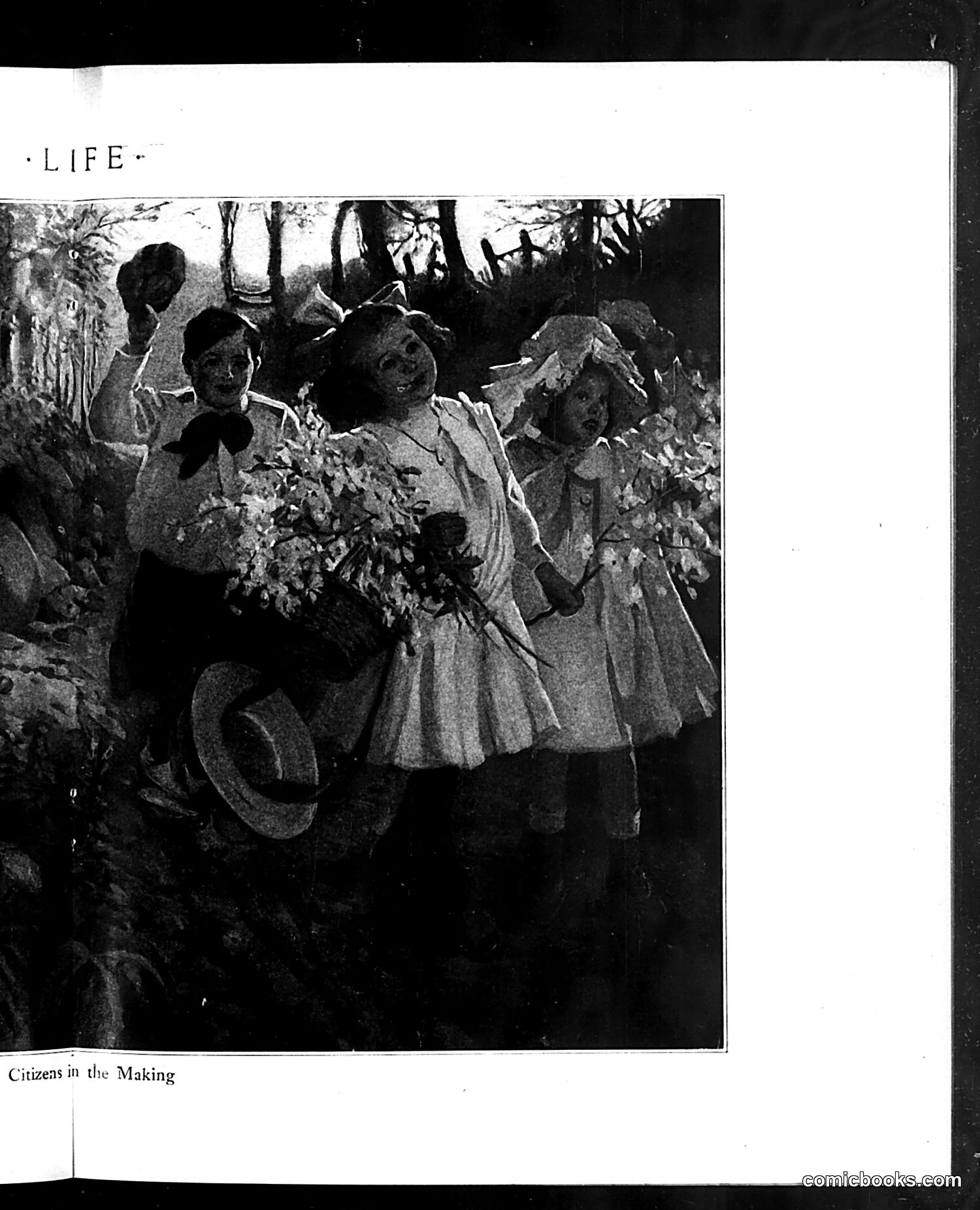
This appears to be a page from *Life* magazine featuring a photograph labeled "Citizens in the Making." The black-and-white image shows a group of children in a natural outdoor setting among trees and vegetation. Without additional context or caption text visible on the page, the satire or commentary isn't entirely clear from the image alone. The title suggests the photograph may be commenting on childhood, education, or civic development—possibly satirizing idealized notions of how American citizens are formed or educated. The somewhat staged, pastoral quality of the scene might indicate irony about natural versus artificial cultivation of youth. More specific historical context would be needed to identify the precise social or political reference intended.
This is a satirical short story (not a cartoon) by G.S. Giradet that uses talking-animal fiction to mock American politicians, specifically members of Congress. **The Setup:** A man encounters a philosophical muskrat who reveals he is a reincarnationalist—claiming his current animal form is actually a *reward* for his previous life as a U.S. Congressman. **The Satire:** The joke is that being demoted from human to muskrat constitutes an *improvement*. The muskrat explains Congress members excel at deception ("a man can scarcely do anything else" but lie), and that his political wisdom consisted of staying silent and abstaining from votes—implying real politicians should do likewise. **Historical Context:** This reflects Progressive Era skepticism toward Congress (early 1900s), portraying elected representatives as foolish, dishonest, and obstructive. The muskrat's strategy of non-interference mocks both political gridlock and the belief that inaction constitutes wisdom. The piece uses gentle, philosophical humor to critique American governance and human nature generally.
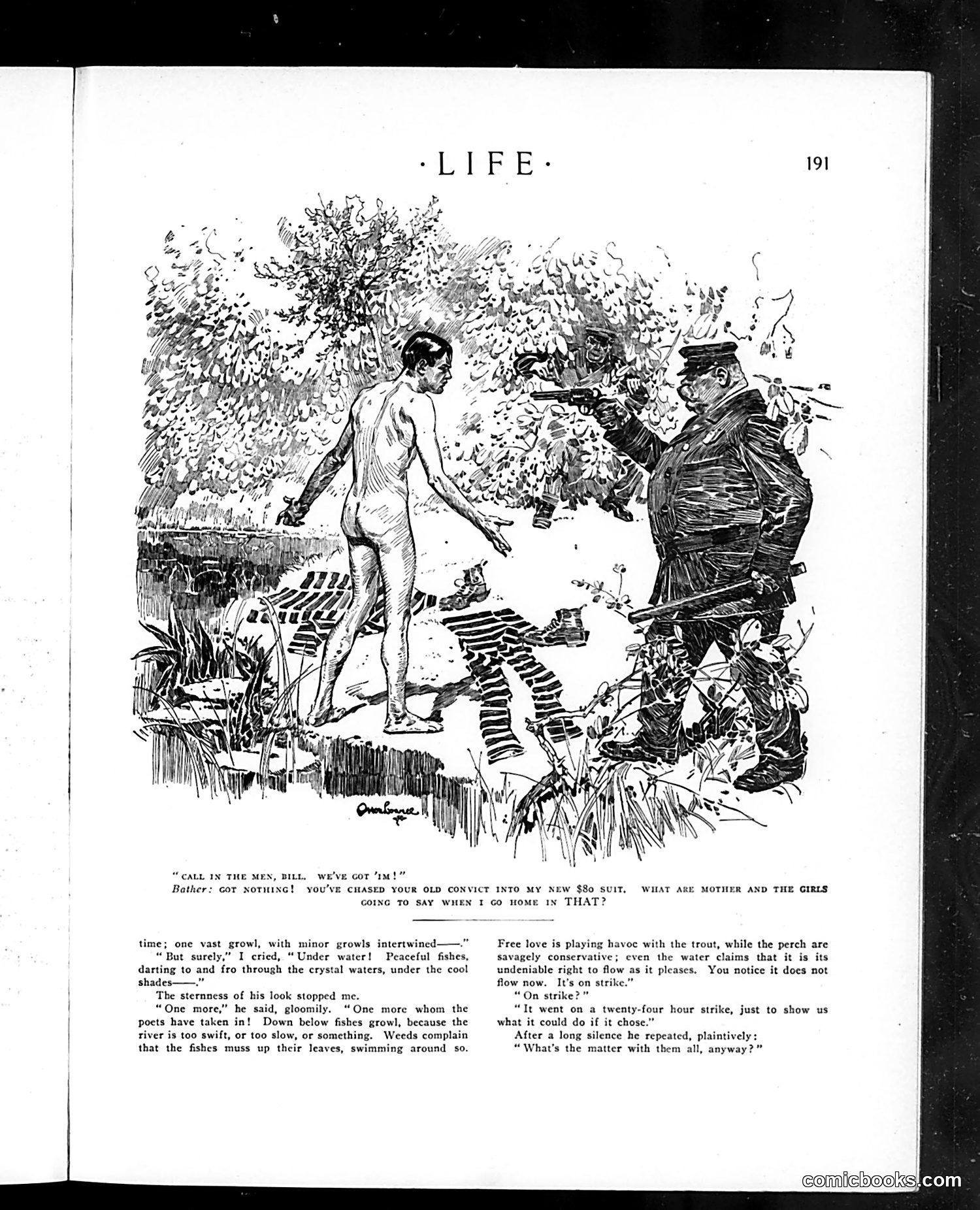
This page from *Life* magazine (page 191) contains two distinct pieces of satire. **The Cartoon (top):** A naked bather confronts two police officers who've chased an escaped convict into his new $80 suit (left on the riverbank). The joke is physical comedy—the bather is indignant that his expensive clothing has been ruined during the pursuit, and he's worried about explaining the damaged suit to his mother and girlfriend at home. The humor relies on the absurdity of prioritizing fashion over the capture of a criminal. **The Text (bottom):** This appears to be a philosophical monologue about widespread social discontent. The speaker cynically describes nature itself as complaining and going on strike—fish, weeds, and water all have grievances. This likely reflects post-WWI anxieties about labor unrest, socialist movements, and general social upheaval of the 1920s. The satire suggests that discontent has become so universal that even inanimate nature participates in complaint and protest.
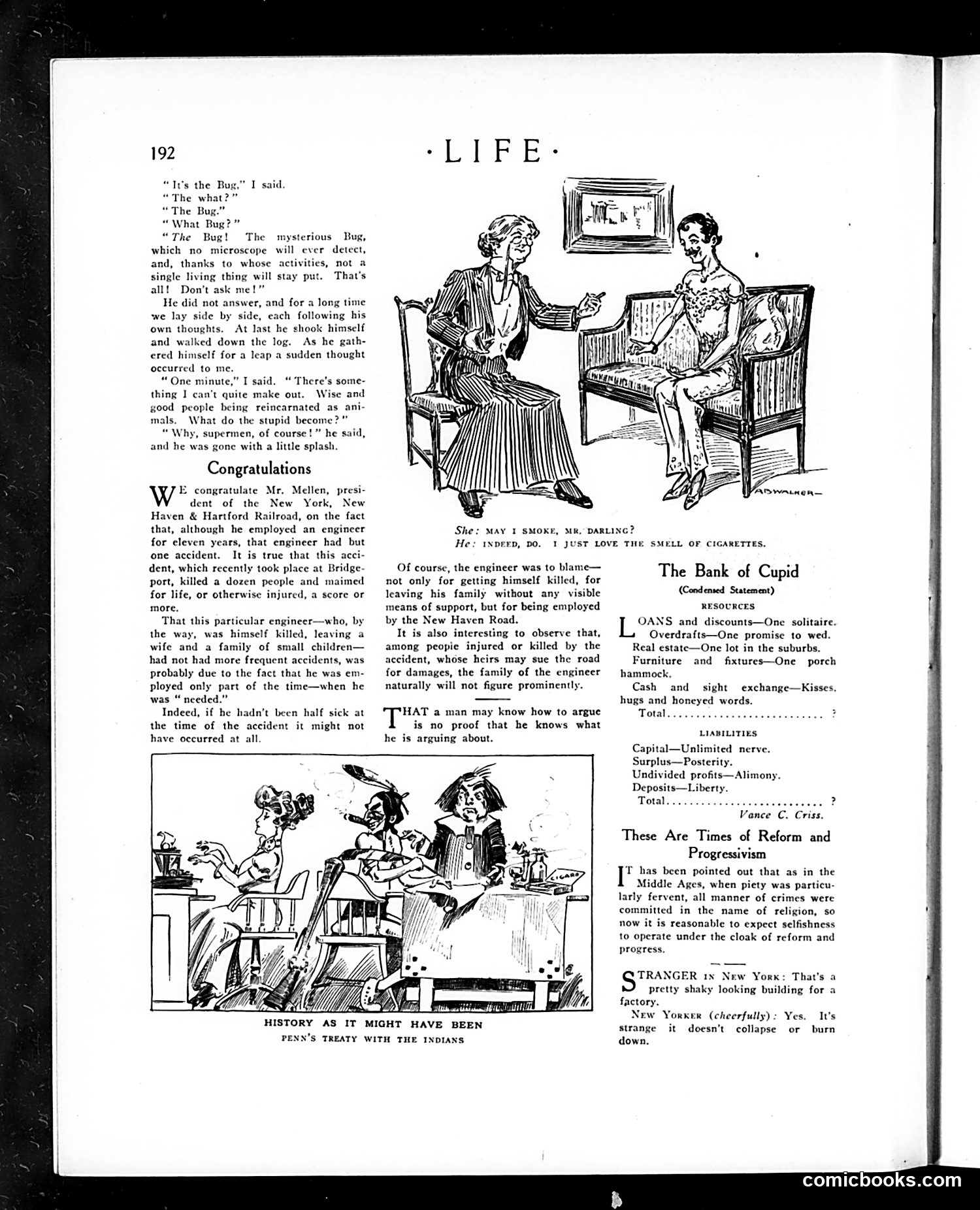
This page contains multiple satirical pieces critiquing early 20th-century American industrial practices and social hypocrisy. **Main editorial piece**: Sarcastically "congratulates" railroad president Mellen on his engineer's safety record—despite the engineer causing a Bridgeport accident that killed a dozen people and injured twenty more. The satire attacks both the railroad's negligent employment practices (the engineer worked only part-time) and the legal system's bias: while accident victims' families could sue for damages, the engineer's own widow and children would receive nothing because he was technically an "employee" responsible for his own death. **"The Bug" dialogue**: A philosophical exchange about reincarnation, suggesting that foolish people are reborn as "supermen"—likely satirizing contemporary "superman" theories or social Darwinism. **"Bank of Cupid"**: A humorous accounting ledger treating romance as a financial institution, with liabilities including "Unlimited nerve" and assets of kisses. The overall message critiques industrial capitalism's indifference to worker safety and legal injustice.
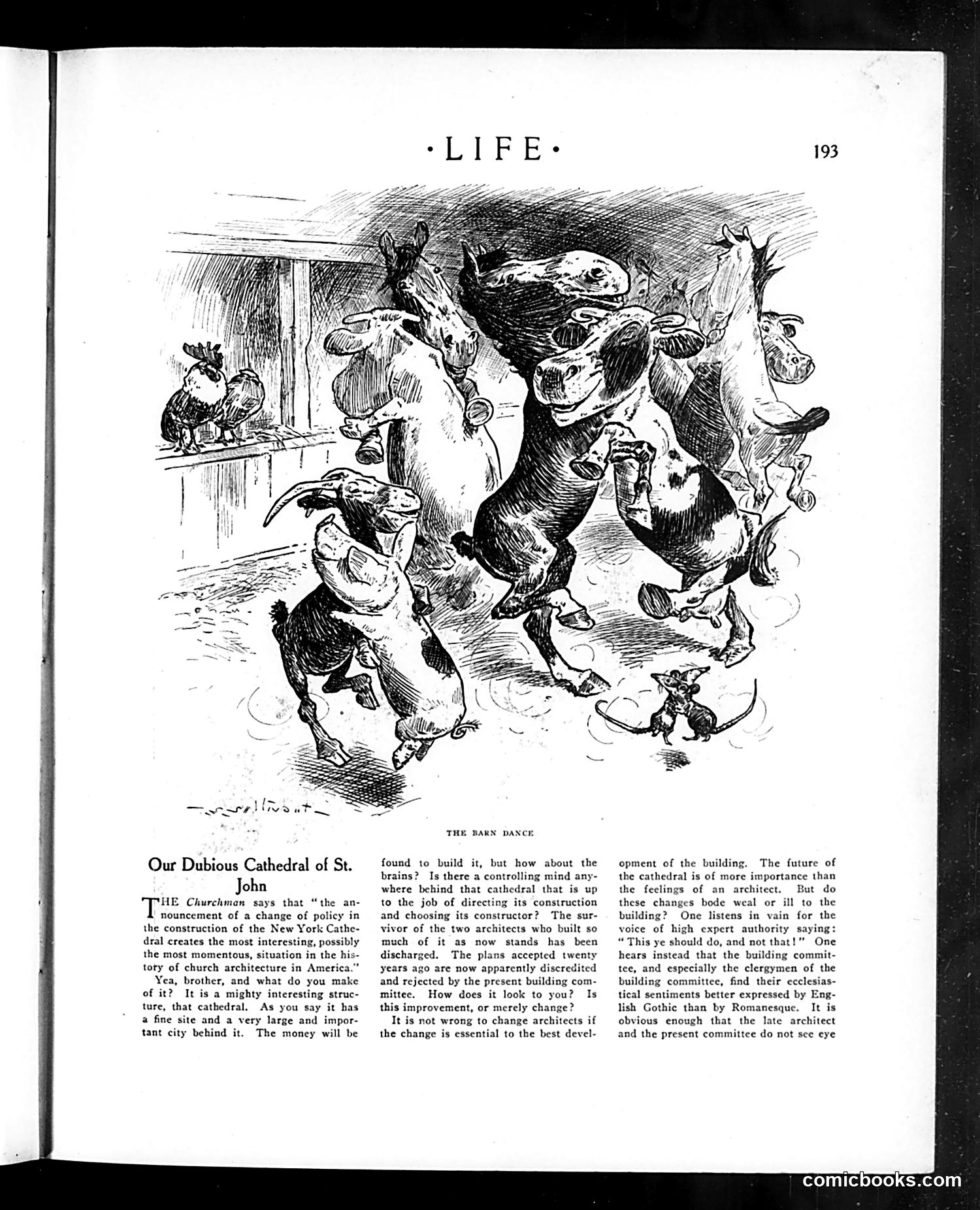
This page satirizes mismanagement of New York Cathedral's construction. The cartoon (top) depicts animals dancing chaotically in a barn, likely representing the discord among the cathedral's building committee. The accompanying article critiques the project's leadership vacuum. A recently discharged architect had overseen much work; now the committee has rejected twenty-year-old approved plans in favor of English Gothic over Romanesque style—a decision driven by the clergy's aesthetic preferences rather than architectural expertise. The satire's point: the committee prioritizes ecclesiastical sentiment over sound construction judgment. The "barn dance" metaphor suggests the project has become an undisciplined mess, with no authoritative expert voice directing proceedings. The cartoon questions whether such chaotic decision-making bodes well for the cathedral's future.
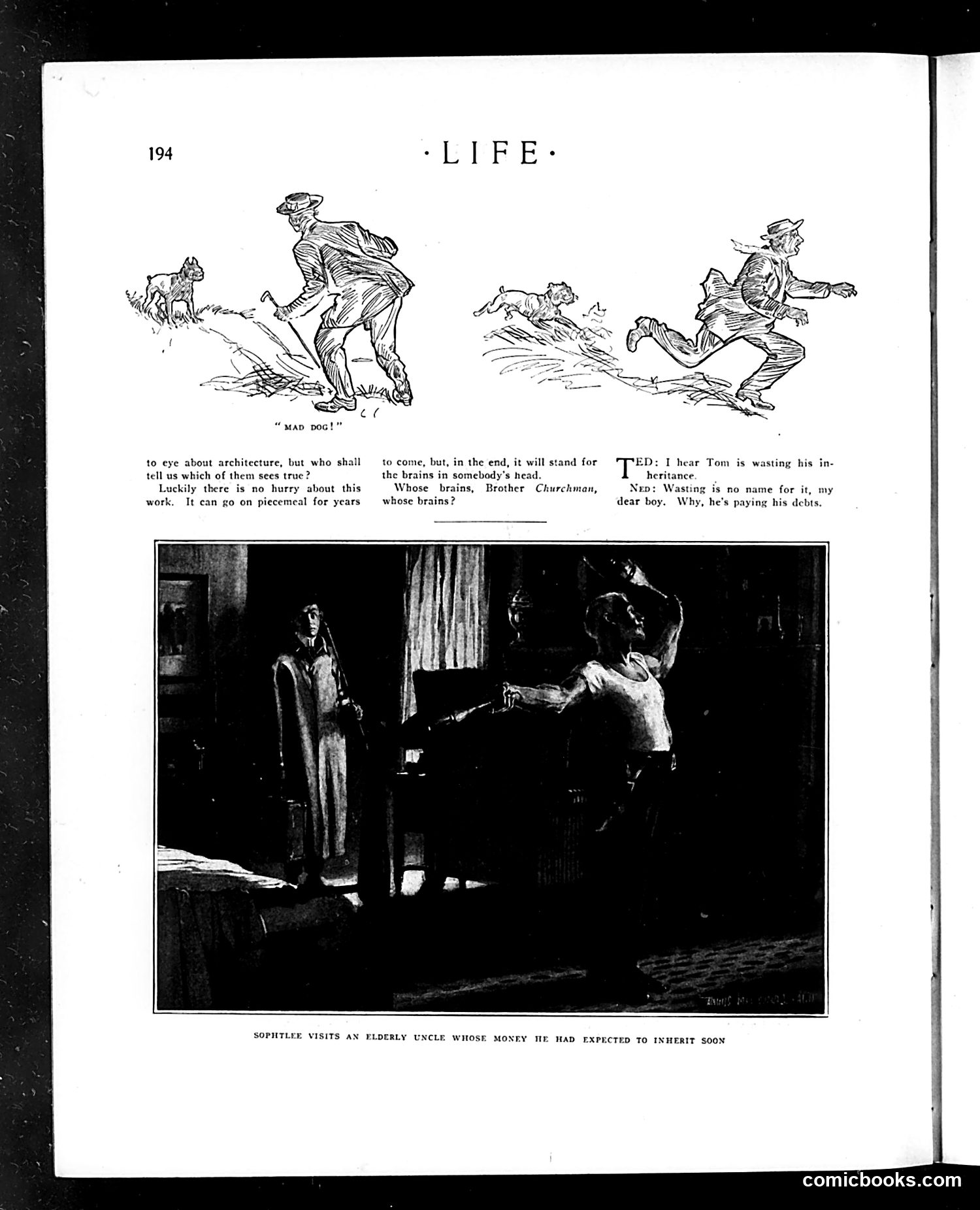
**The Cartoons:** The top sketches labeled "Mad Dog!" show men chasing or fleeing from dogs—likely satirizing foolish or reckless behavior. **The Main Joke:** The photograph below depicts "Sophtlee" visiting an elderly uncle he expected to inherit money from soon. The accompanying dialogue reveals the satire: when one character mentions Tom is "wasting his inheritance," another corrects him—Tom isn't wasting it, he's "paying his debts." **The Point:** This satirizes young men of means who squander family fortunes through irresponsible spending, reframed here as actually *paying debts* rather than inheritance dissipation. The humor lies in the twisted logic: paying debts sounds virtuous but ironically confirms the money is already gone. The visit to the "elderly uncle" suggests Sophtlee hoped to inherit soon—a commentary on financial dependency and the entitled expectations of wealthy heirs.
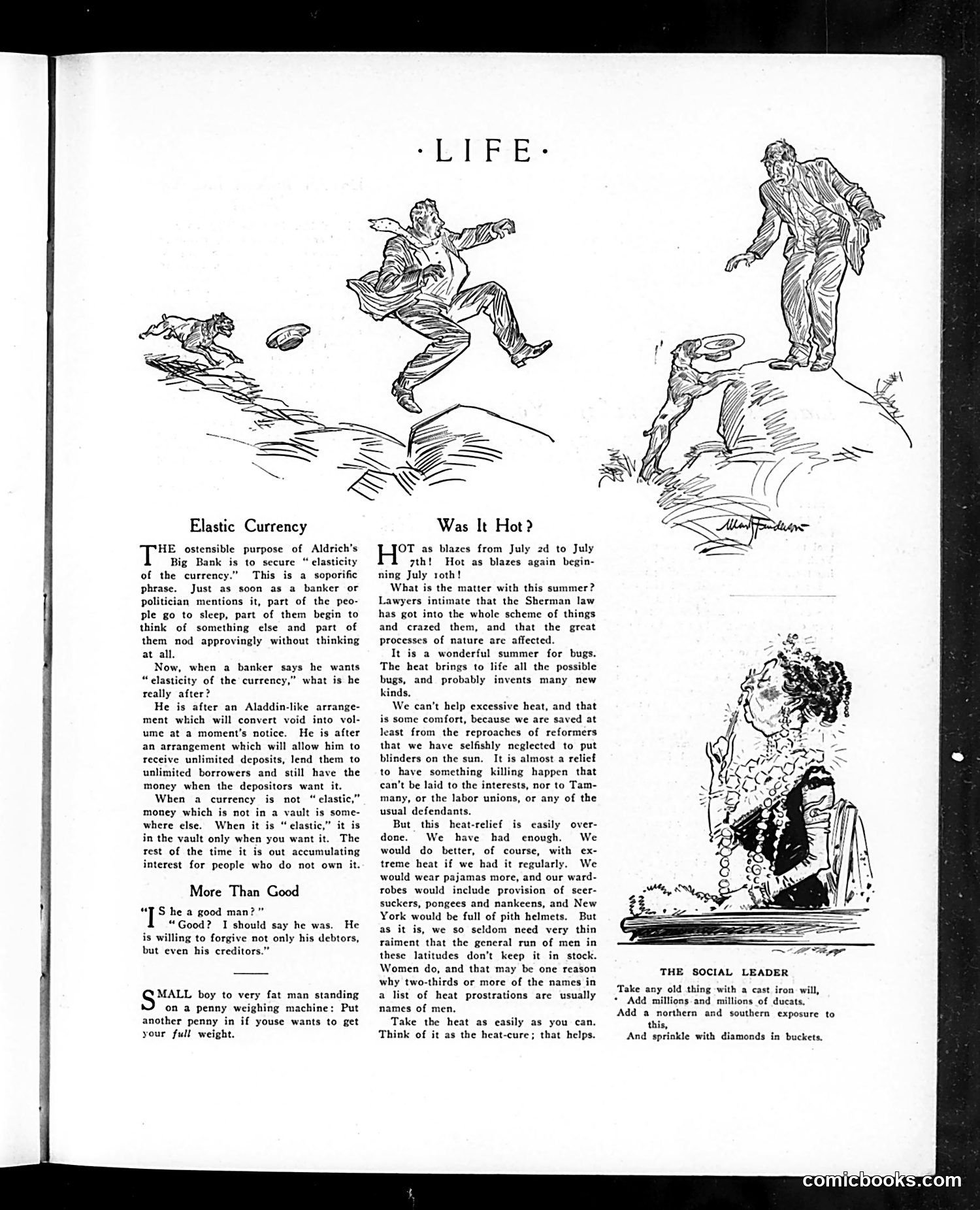
This page contains three satirical pieces from *Life* magazine: **"Elastic Currency"** critiques the proposed Aldrich banking reforms. The cartoon shows men jumping over hurdles, illustrating how bankers want "elastic currency"—the ability to lend out deposited money while still claiming to have it available. The satire argues this is essentially financial magic: money that exists in a vault only when depositors want it, but circulates elsewhere earning interest for bankers the rest of the time. It's mocking both the obscure jargon ("elastic currency") that puts people to sleep and the self-serving arrangement it conceals. **"Was It Hot?"** is lighter satire about an unusually hot summer (July dates given), joking that the extreme weather must result from the Sherman Antitrust Act disrupting nature itself. The humor lies in blaming reform laws for everything, and noting that men suffer more heat prostrations than women because men don't own lightweight clothing—while wealthy women do. **"The Social Leader"** is a brief satirical formula for creating a society woman: take willpower, add millions of dollars, property exposure, and diamond jewelry.
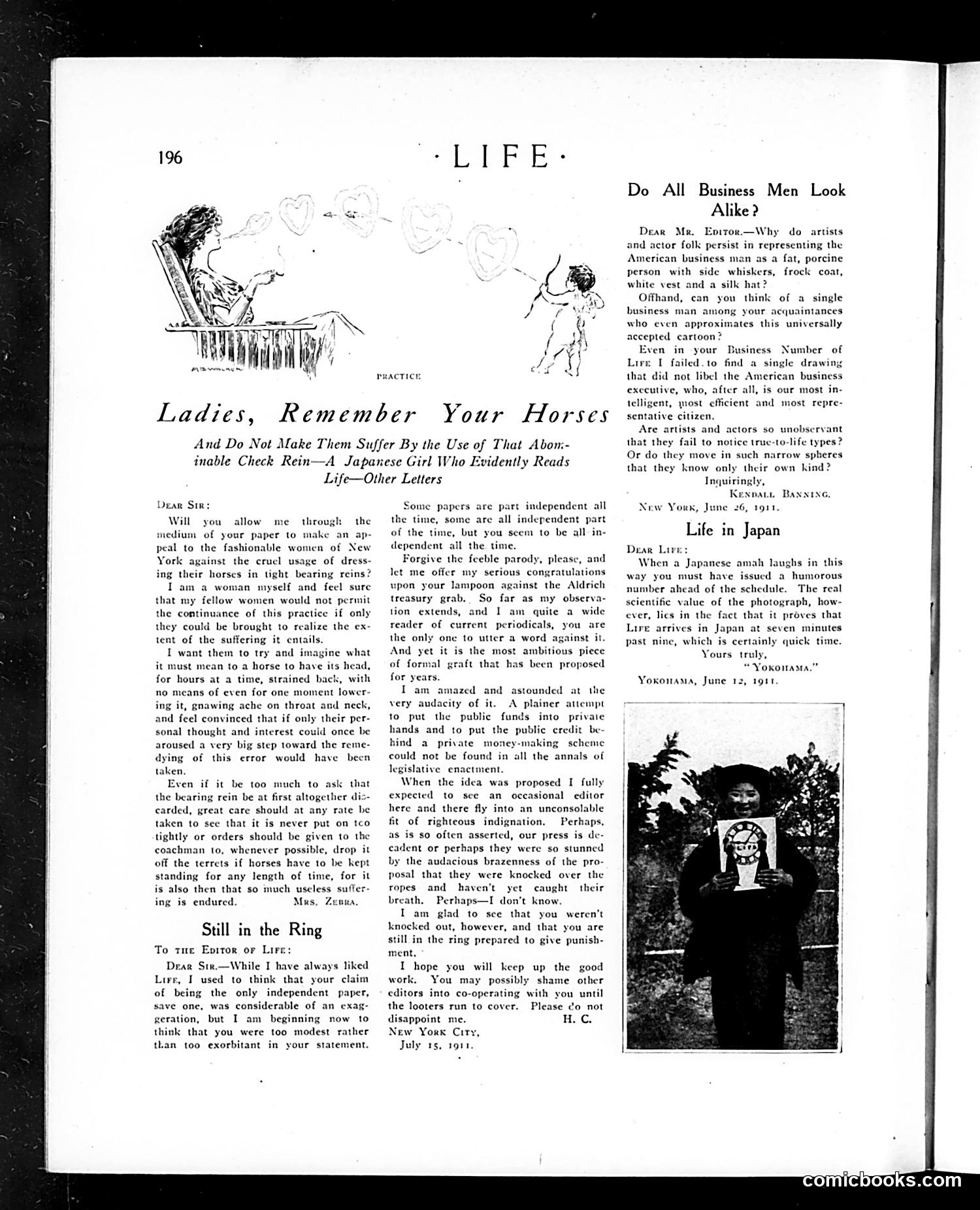
This page contains three reader letters addressing different social issues: **"Ladies, Remember Your Horses"** criticizes the cruel "check rein"—a device that forced horses' heads back unnaturally for fashion. The writer appeals to wealthy New York women to stop this practice, noting the animal suffering it caused. **"Still in the Ring"** praises *Life* magazine for being the only publication criticizing the "Aldrich treasury grab"—likely referring to a 1911 financial reform proposal the writer views as corrupt. The letter compliments *Life's* independence and calls other editors cowardly for not opposing this "formal graft." **"Do All Business Men Look Alike?"** objects to *Life's* cartoons stereotyping businessmen as overweight, whiskered men in formal dress. The writer claims this caricature doesn't match actual American executives and constitutes libel. These letters reveal *Life's* mission: satirizing hypocrisy and injustice while engaging readers in social debate about animal welfare, government corruption, and media representation.
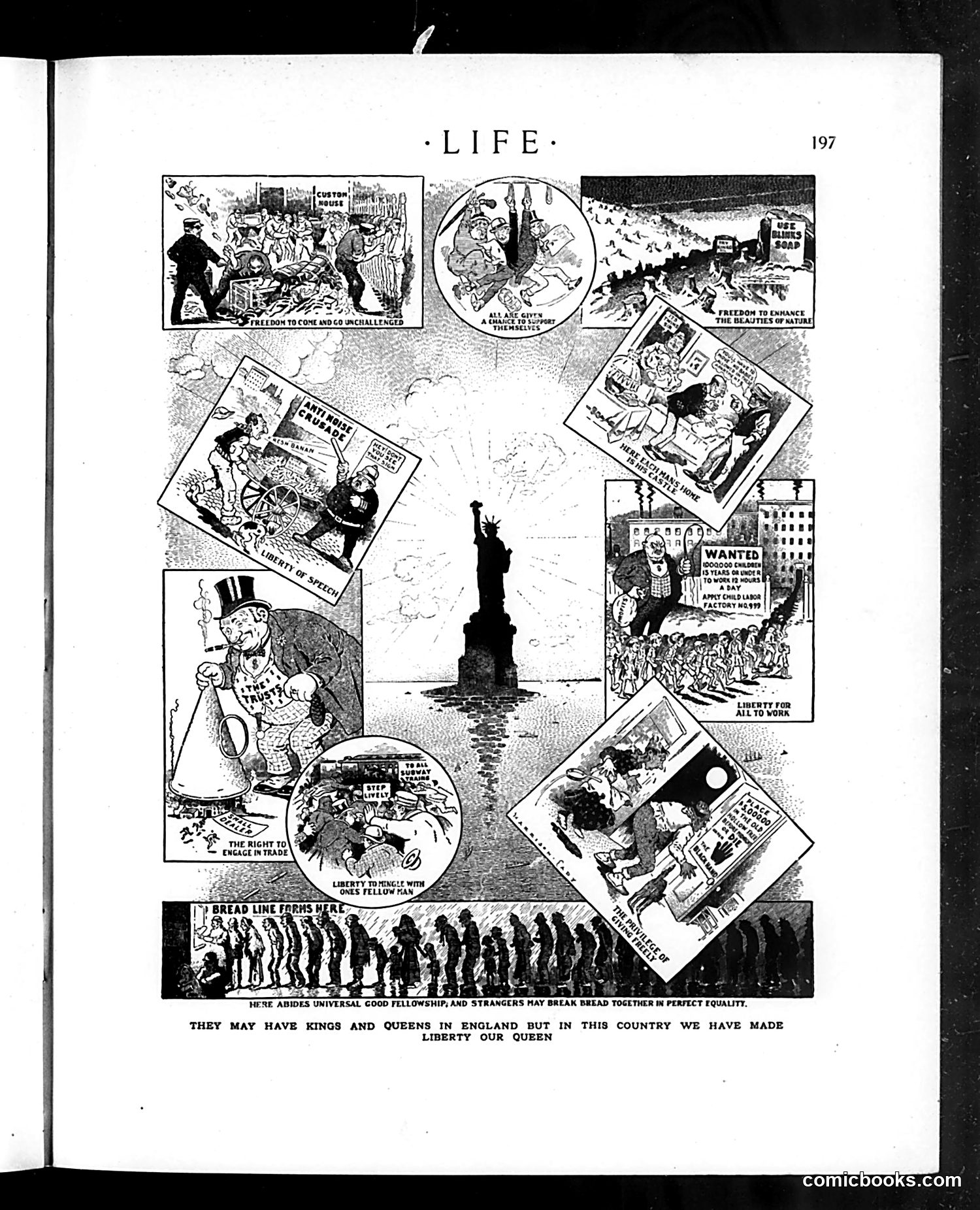
This Life magazine page celebrates American liberty through multiple cartoon vignettes arranged around a central Statue of Liberty. The layout contrasts American democratic values with European monarchy. The surrounding panels illustrate various freedoms: freedom of speech, press, religion, and assembly. Figures appear to represent different social classes and ethnicities breaking bread together, emphasizing equality. The bottom silhouette shows a bread line, suggesting shared hardship transcends class divisions. The concluding text makes the page's central argument explicit: unlike England with its literal royalty, America has elevated "Liberty" itself to queen status. This appears to be patriotic propaganda promoting American exceptionalism and egalitarian ideals, likely from the early 20th century given the artistic style. The satire gently mocks European hierarchies while celebrating American democratic principles, though the bread line may ironically suggest economic disparities persist despite ideological claims.
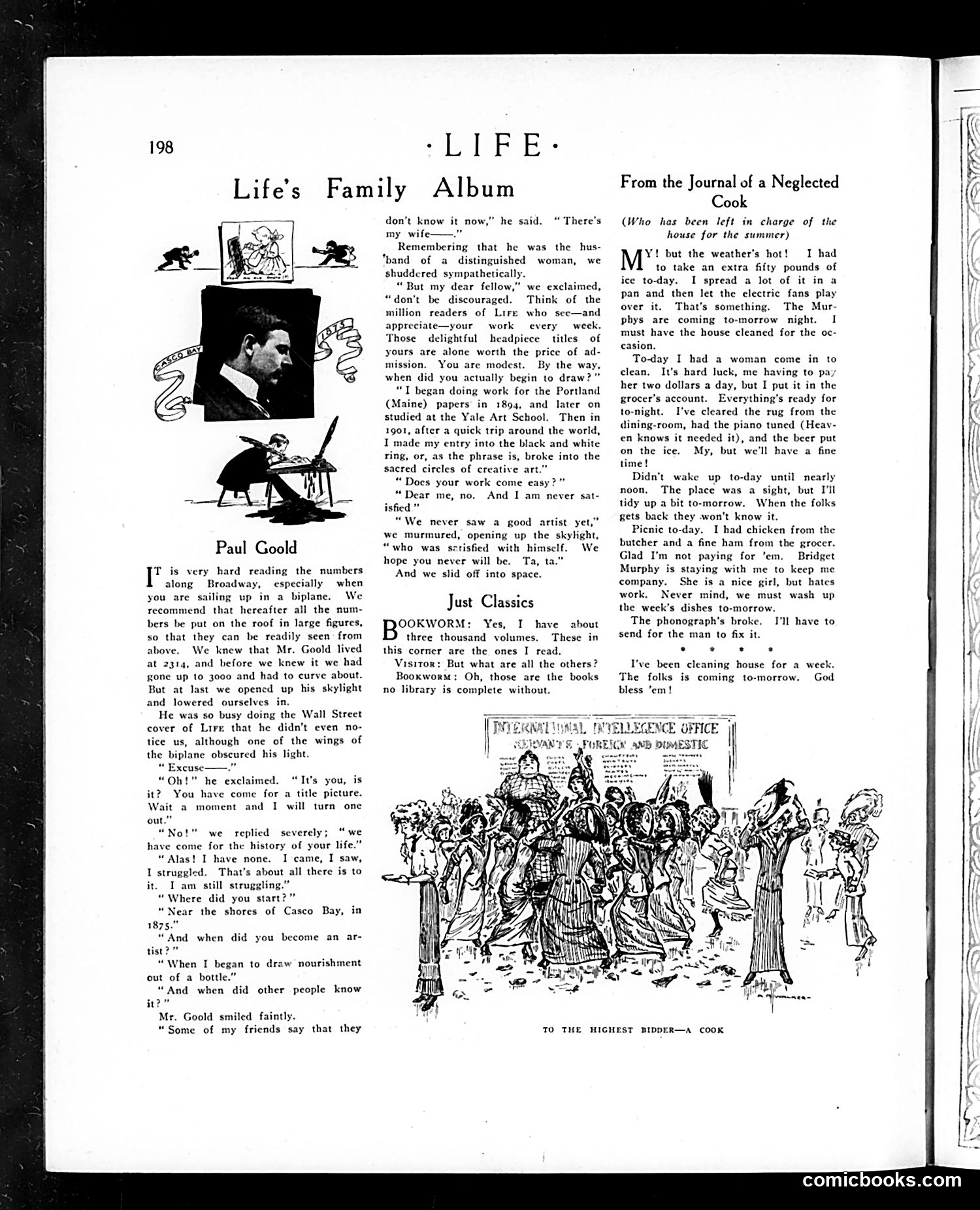
This page contains three distinct pieces of satirical content: **Paul Goold Interview**: A humorous "biography" of Life magazine artist Paul Goold, obtained when the interviewer literally flies a biplane to his studio and enters through the skylight. The joke satirizes artists' typical modesty and self-doubt—Goold claims he has "no" life story, only "struggle," and dismisses his own successful work for Life despite its broad readership. **Just Classics**: A brief gag about a "bookworm" who owns 3,000 volumes but only reads a small corner of them. The rest exist solely because "no library is complete without" them—mocking pretentious collectors who buy books for appearance rather than reading. **Journal of a Neglected Cook**: A diary from a servant left in charge of a wealthy household during summer. The humor derives from the cook's casual dishonesty: she charges personal expenses to the grocers' account, takes leisurely naps, and admits the house is messy—yet expects the owners won't notice upon return. It satirizes both servant irresponsibility and the absent wealthy class.
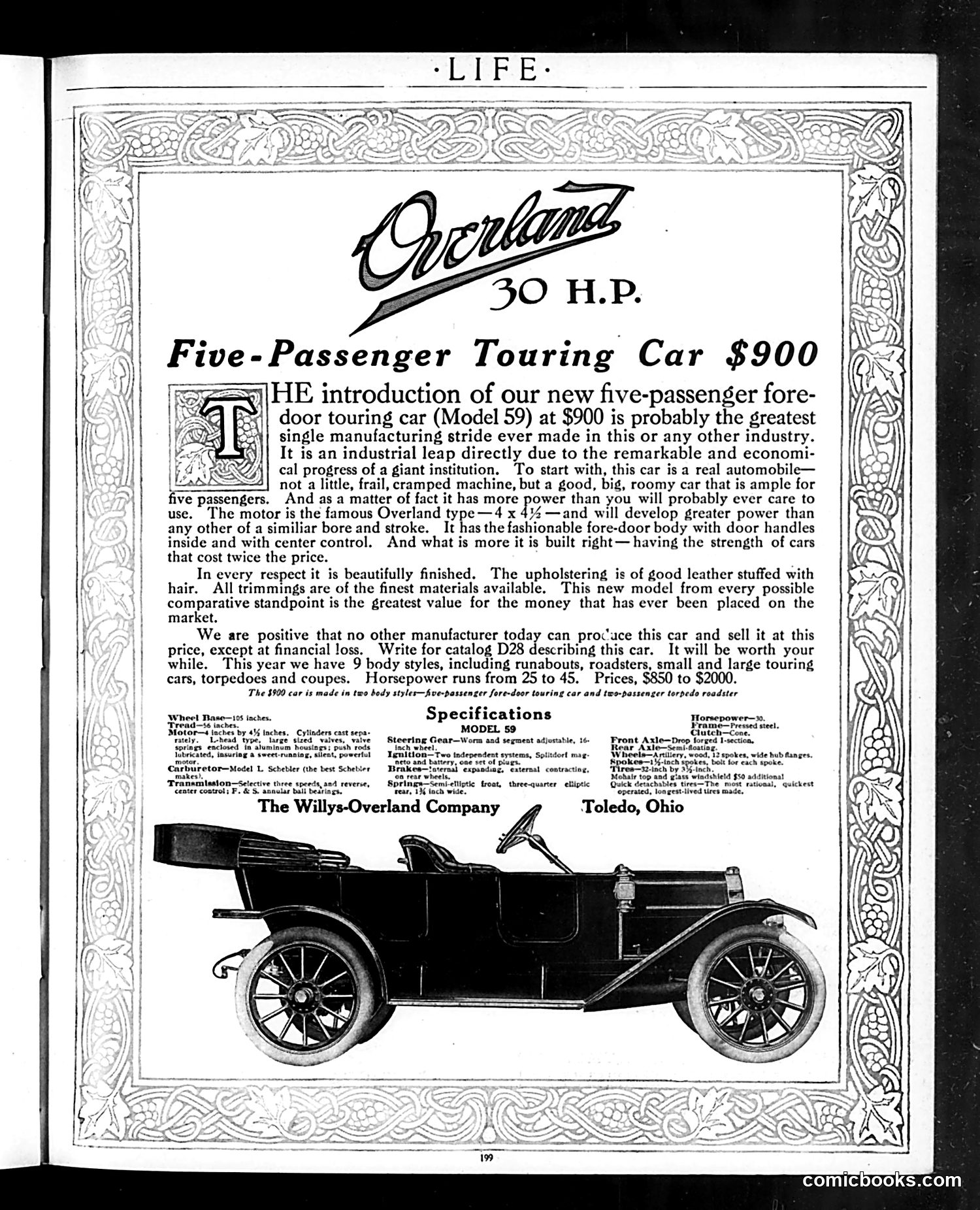
This is **not a cartoon or satire**—it's a straightforward **product advertisement** for the Willys-Overland Company's new Model 59 automobile, priced at $900. The page appeared in *Life* magazine during the early automotive era (likely 1910s), when cars were still luxury items. The advertisement emphasizes revolutionary value: a five-passenger touring car at an unprecedented low price, marketed as achieving industrial efficiency that competitors supposedly cannot match profitably. Key selling points include the powerful Overland motor, spacious design, quality materials (leather upholstery), and multiple body style options ($850-$2000 range). The language stresses this represents a "manufacturing stride" and "industrial leap"—appealing to buyers' sense of getting premium quality at an accessible price. The side-view illustration shows the open-air touring car typical of the era, featuring the "fore-door" design mentioned in the text. This is advertising copy, not satirical commentary.
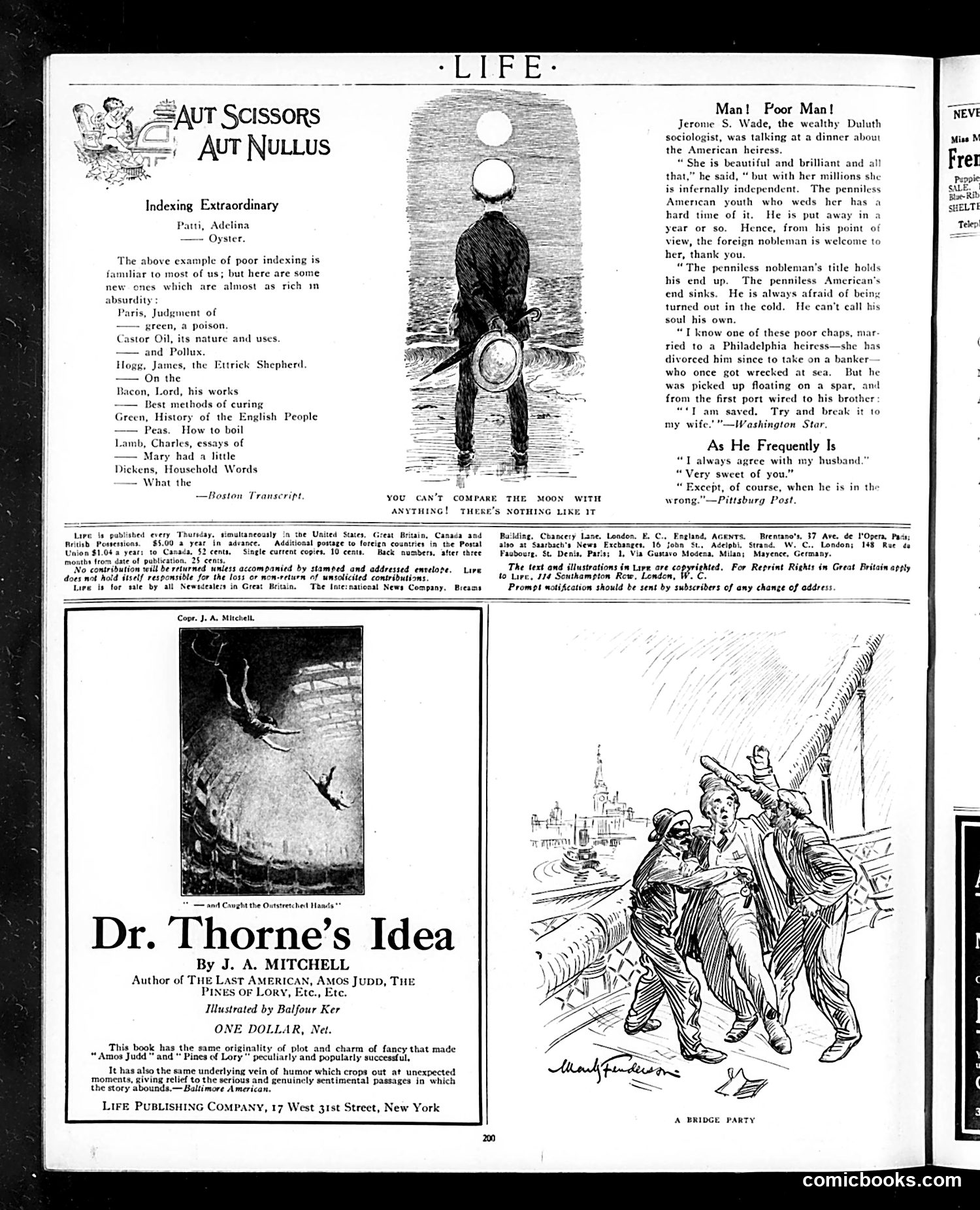
This page contains several satirical pieces typical of early 20th-century American humor: **"Aut Scissors Aut Nullus"** mocks absurd library indexing—entries that nonsensically link unrelated topics (e.g., "Bacon, Lord, his works — Best methods of curing"). The satire targets poor cataloging practices. **"Man! Poor Man!"** presents three anecdotes about American heiresses and their marriages. The central joke concerns wealthy American women divorcing poor foreign noblemen and American men. The satire critiques how economic dependence emasculates men—the penniless husband fears abandonment, while titled Europeans maintain dignity through their status. The final quip about a wife always agreeing with her husband when he's "in the wrong" mocks marital dynamics. **The moon illustration** is purely decorative/poetic—no political content. **"Dr. Thorne's Idea"** is a book advertisement for J.A. Mitchell's novel, emphasizing its originality and humor. **"A Bridge Party"** illustration depicts social leisure activity with no apparent satirical intent. The page reflects early 1900s concerns about American wealth, gender relations, and marriage.
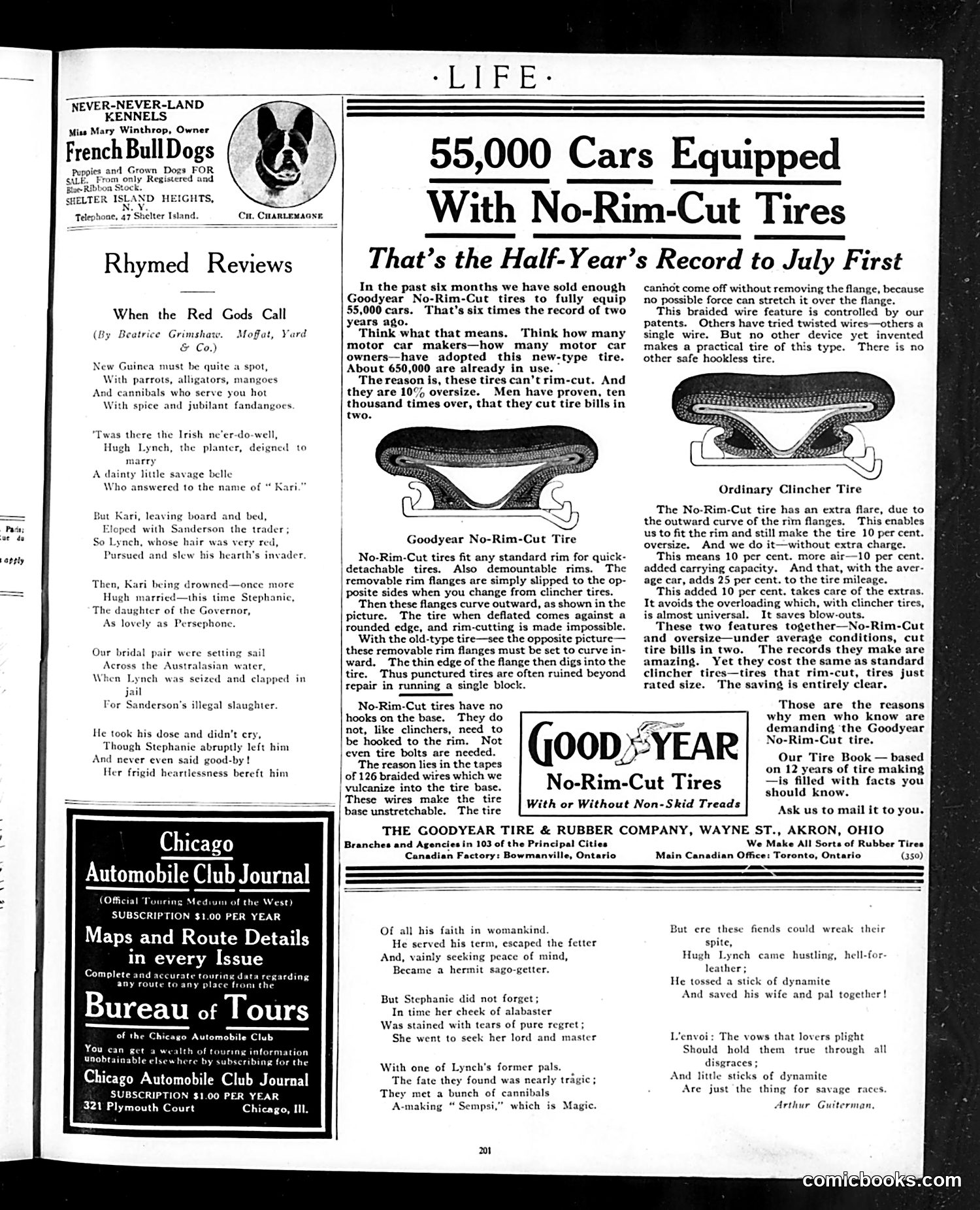
This page contains primarily **advertising and light verse, not political satire**. The main content is a **Goodyear tire advertisement** promoting their new "No-Rim-Cut" tires, which the company claims have sold enough units to equip 55,000 cars in six months. The ad includes technical diagrams comparing their tire design to competitors', emphasizing advantages like preventing rim-cutting and being 10% oversize. The left side features **"Rhymed Reviews," a serialized romantic adventure poem** by Beatrice Grimshaw about an Irish trader named Hugh Lynch in New Guinea. The plot involves Lynch marrying a local woman named Kari, who elopes with another trader; Lynch then marries a governor's daughter named Stephanie, gets imprisoned for murder, and becomes a hermit—while Stephanie later seeks him out. The verse is lighthearted colonial-era fiction, not satire. There are also **small advertisements** for a French Bull Dog kennel and the Chicago Automobile Club Journal. This is primarily a **commercial publication page**, not editorial commentary.
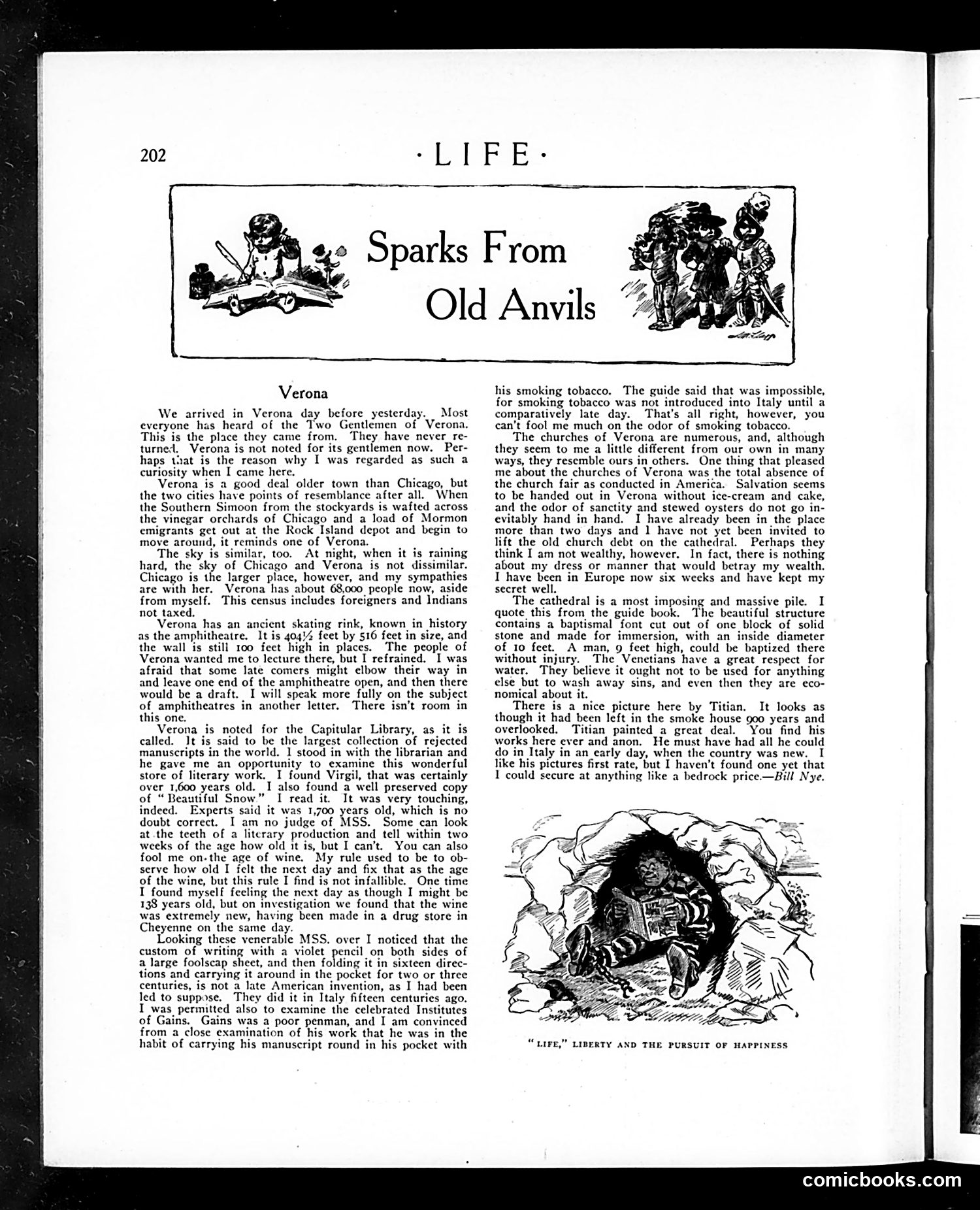
This is a humorous travel essay by an American visitor to Verona, Italy, not a political cartoon. The author (likely Mark Twain, given the byline "Bill Nye" visible at bottom) employs satirical wit comparing the ancient Italian city to Chicago. The humor derives from mock-serious observations: Verona's amphitheater resembles a skating rink; its famous library contains "rejected manuscripts"; he examines a 1,700-year-old copy of sentimental poem "Beautiful Snow"; he judges wine age by how old he *feels* the next day. The satire mocks American provincialism—comparing Verona unfavorably to Chicago, dismissing European customs, and applying American standards (church fairs, ice cream) as measures of civilization. The cartoon at bottom illustrates the essay's theme of finding profound meaning in overlooked antiquity, captioned "Life, Liberty and the Pursuit of Happiness."
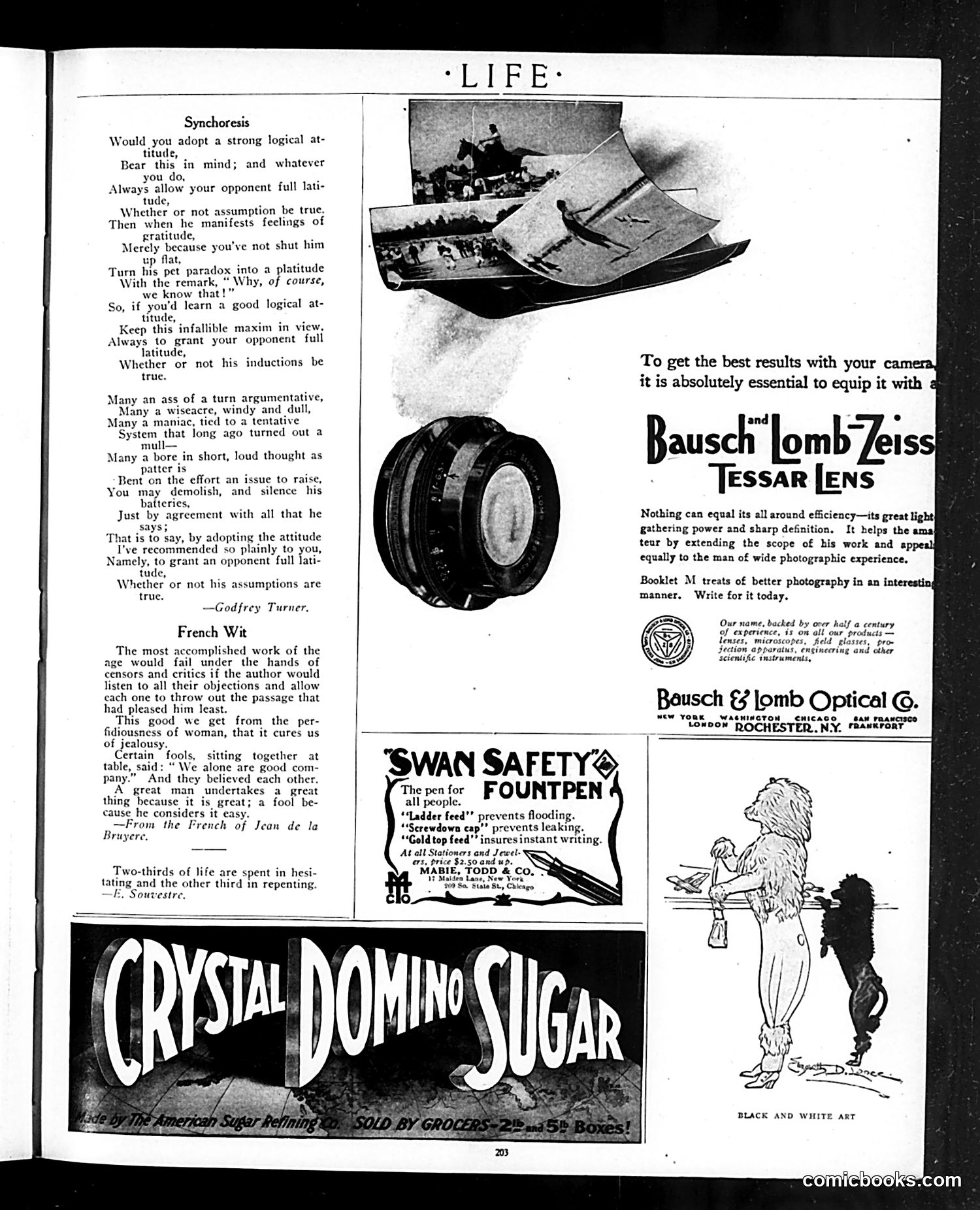
This page is primarily **advertising and light satirical verse**, not political cartooning with specific figures. The main content is "Synchoresis," a humorous poem by Godfrey Turner advising readers to appear agreeable in arguments—nodding along with your opponent regardless of truth. The joke is that this paradoxical strategy actually defeats them: by never confronting them directly, you rob them of the satisfaction of debate. It mocks argumentative bores, "wisecares," and those who argue loudly for their own sake. Accompanying French wit quotes similarly skewer human folly: criticism, jealousy, foolish vanity, and procrastination. The advertisements include **Bausch & Lomb camera lenses, Swan Safety Fountain pens, and Crystal Domino Sugar**—typical early-20th-century product marketing. The cartoons are generic (children, animals) and unrelated to the satirical text; they serve only as page decoration.
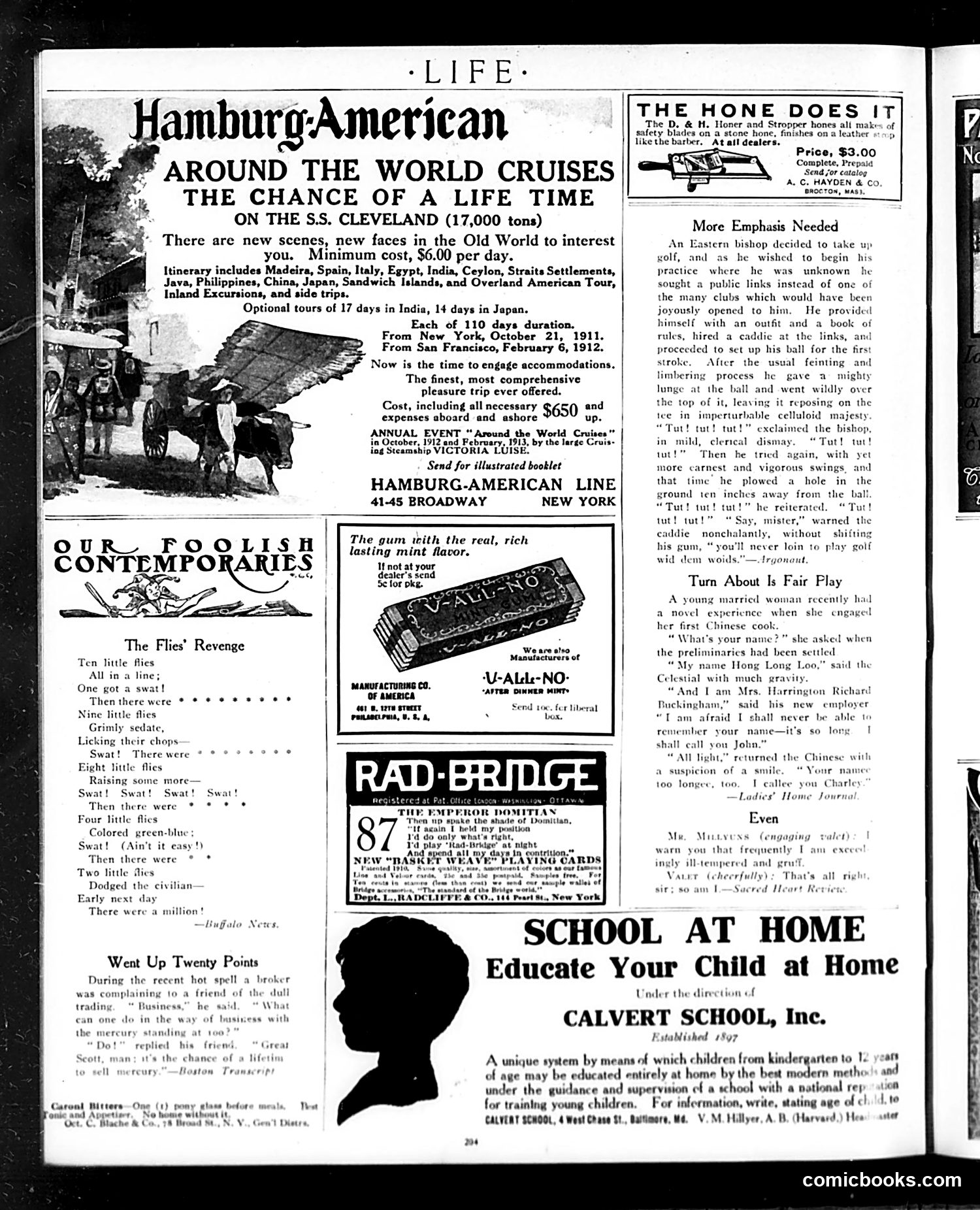
This page is primarily **advertising and light humor**, not political satire. The main content includes: - A Hamburg-American Line cruise advertisement featuring the S.S. Cleveland, promoting 110-day world voyages (October 1911, February 1912) - "The Flies' Revenge": a humorous poem about swatting flies, playing on the ironic theme that killing flies only leads to more appearing - "Went Up Twenty Points": a brief joke about a stockbroker during a heat wave - Various product advertisements (U-Al-d-No gum, "Rad-Bridge" cards, home honing devices) - "More Emphasis Needed": anecdote about a bishop learning golf who uses only mild exclamations, while his caddie suggests stronger language - "Turn About Is Fair Play": a joke about a Chinese cook and employer with long names who both resort to calling each other by simpler names (John and Charley) The racial humor in the final piece reflects period attitudes but isn't sophisticated political commentary. This is a typical 1911 Life magazine mix of advertisements, light verse, and gentle domestic humor.
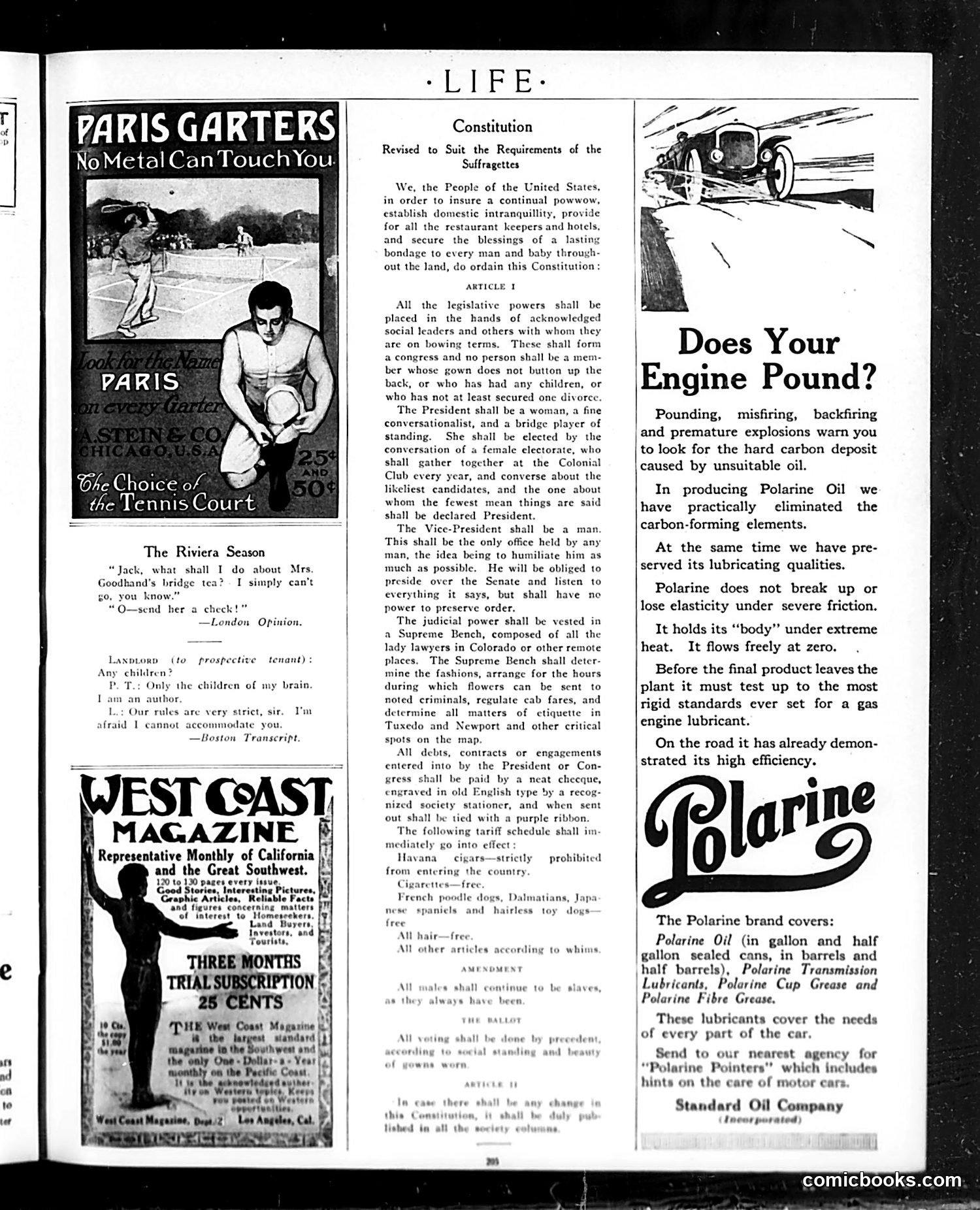
This page satirizes the women's suffrage movement through a mock constitution. The joke imagines what American government would look like if women gained voting power—presenting an exaggerated, absurd alternate system where: - Women hold all major political offices and make decisions via gossip at the "Colonial Club" - Men are deliberately humiliated, holding only a powerless vice-presidency - Laws concern trivial social matters (fashion, flower-delivery etiquette, cab fares) - Bills are paid with decorative checks tied in purple ribbons The satire reflects anti-suffrage sentiment common in the 1910s: the implication that women voters would prioritize frivolous social concerns over serious governance. The piece mocks both suffragettes and the supposed incompetence of female political participation—humor designed to ridicule the women's rights movement by portraying it as shallow and chaotic. The accompanying short jokes reinforce gender stereotypes about women's financial irresponsibility and domestic concerns.
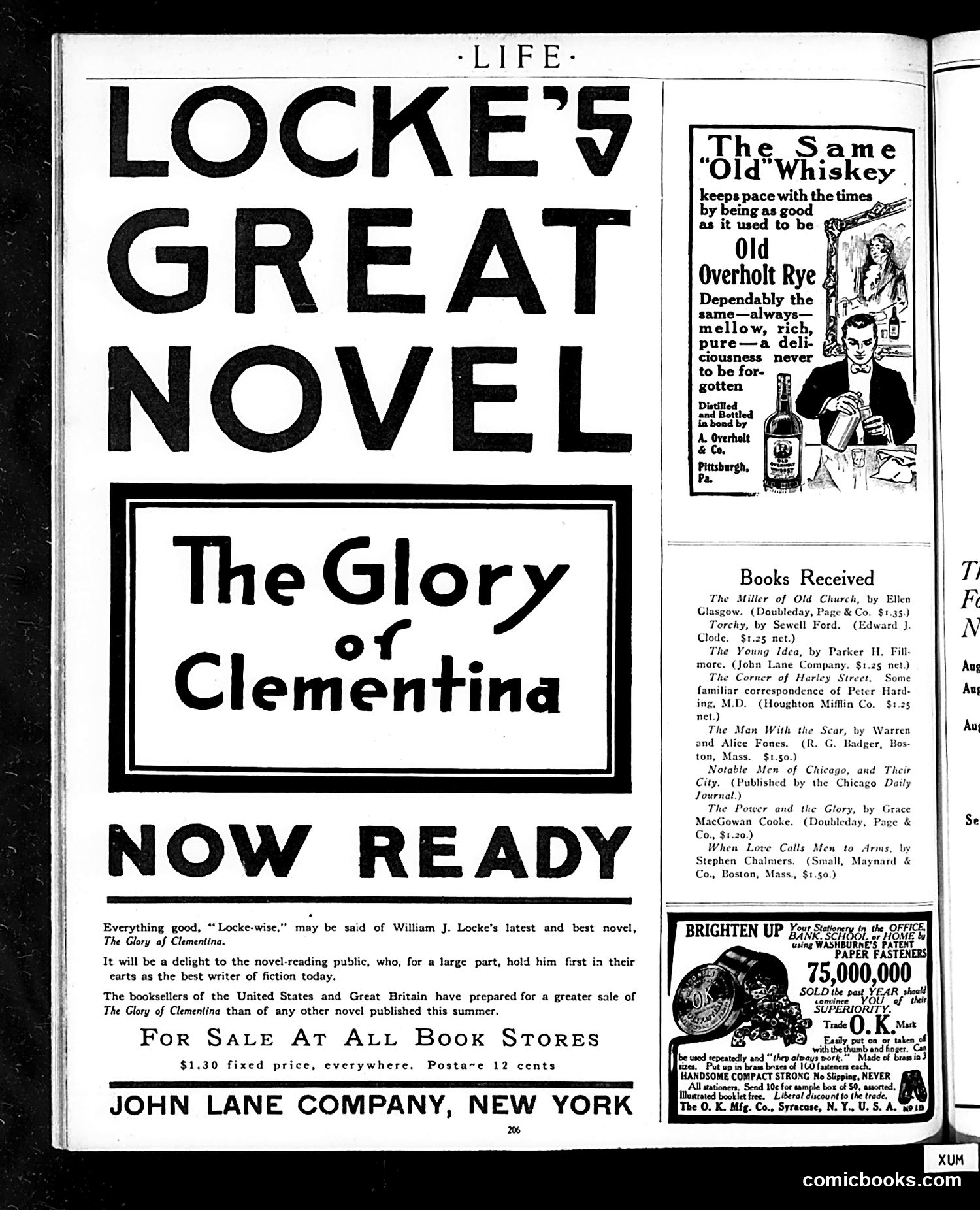
This page is primarily **advertising and book notices**, not political satire. The dominant content is a full-page advertisement for William J. Locke's novel *The Glory of Clementina*, published by John Lane Company at $1.30. The copy emphasizes Locke's reputation as "the best writer of fiction today" and claims booksellers expect record sales. The right column contains routine "Books Received" listings—standard publishing notices of new titles with prices. Below that is an advertisement for Old Overholt Rye whiskey (playing on timelessness: "keeps pace with the times by being as good as it used to be") and an ad for paper fasteners claiming 75 million units sold annually. **There is no political cartoon or satire on this page.** It represents typical early 20th-century magazine content mixing literature promotion with commercial advertising, all framed within *Life* magazine's broader editorial space.
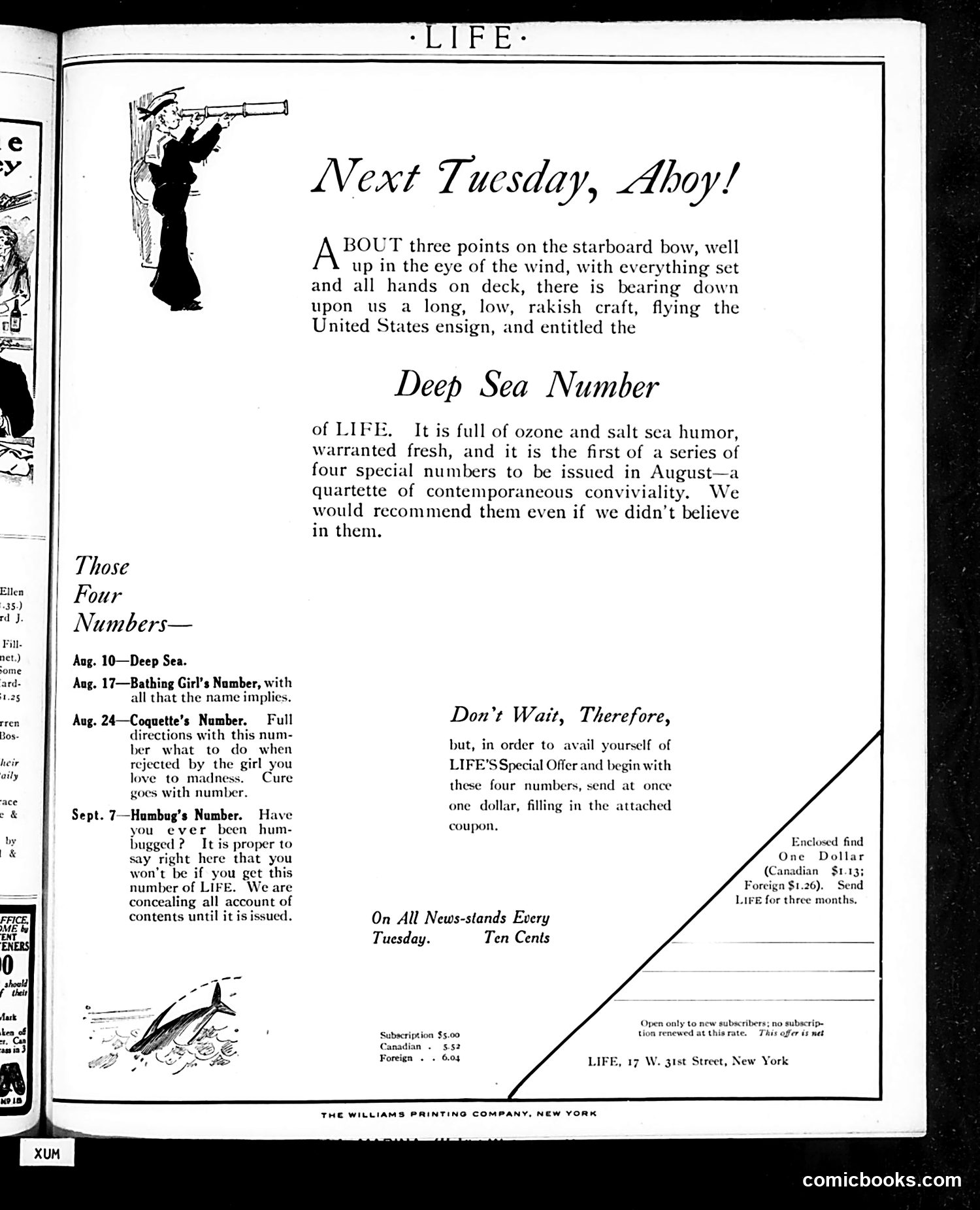
This is an advertisement page promoting *Life* magazine's four special August issues. The small illustration shows a figure with a telescope, using nautical language ("Ahoy," "starboard bow") to announce the upcoming "Deep Sea Number." The page advertises a subscription offer: four themed issues launching August 10th—"Deep Sea," "Bathing Girl's Number," "Coquette's Number," and "Humbug's Number." The humor plays on stereotypical magazine content: maritime adventure, attractive women, romantic rejection advice, and satirical debunking (the "Humbug" issue withholds details for mystery). This reflects *Life*'s identity as a humor and satire publication focused on contemporary leisure, romance, and social absurdities. The offer targets new subscribers at one dollar for three months—relatively accessible pricing for the era. The nautical framing and playful tone typify *Life*'s lighthearted approach to marketing itself as modern, entertaining reading.
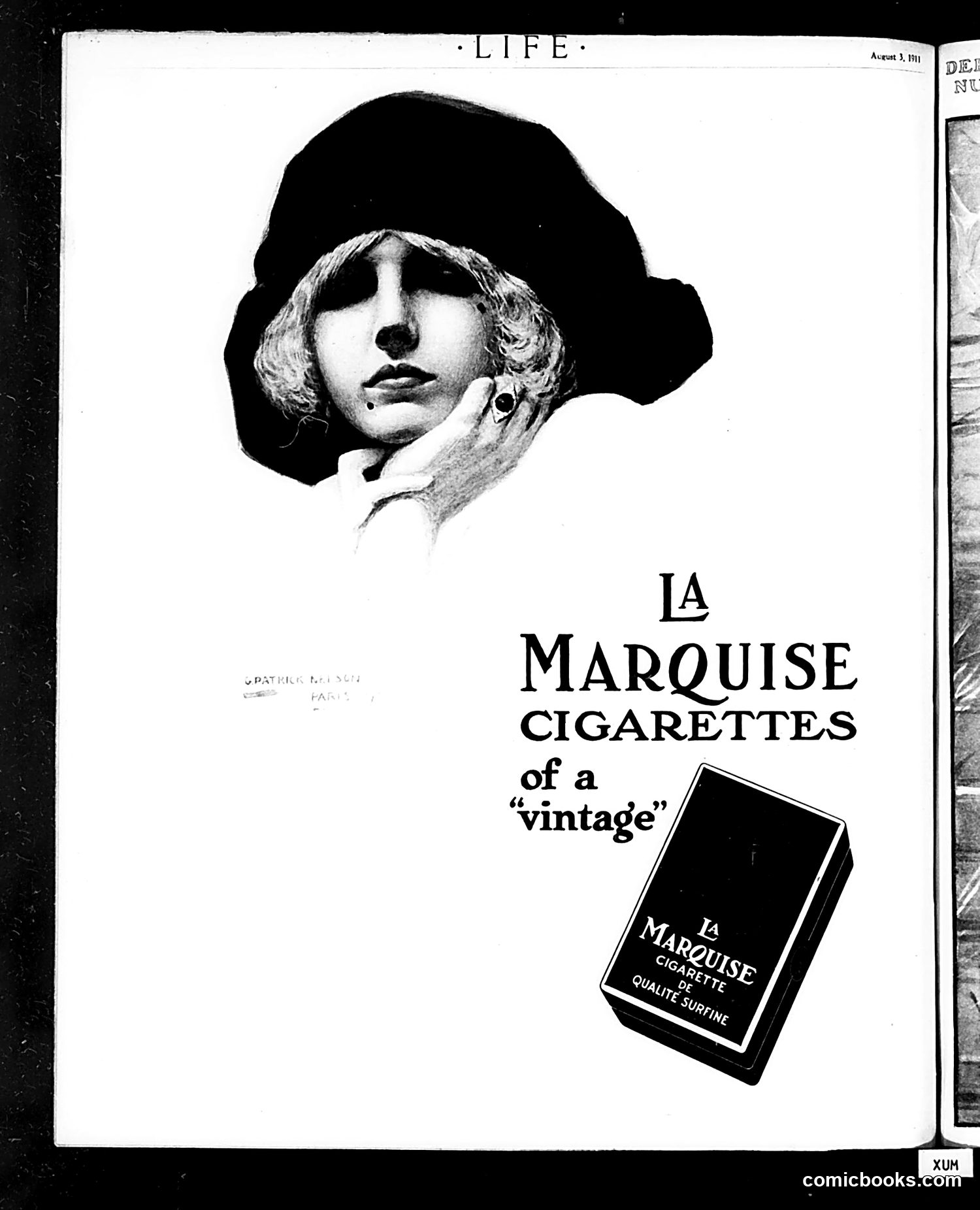
This is a straightforward cigarette advertisement from Life magazine (August 3, 1911), not political satire. The ad features a stylized portrait of a woman wearing a wide-brimmed black hat, with her hand raised to her neck in an elegant pose. The ad emphasizes "La Marquise Cigarettes of a 'vintage'"—using the word "vintage" to suggest quality, refinement, and timelessness, much like fine wine. A cigarette box is shown below the portrait. The advertisement appeals to sophistication and elegance, targeting consumers who associated the product with upper-class French taste. This represents early 20th-century cigarette marketing before modern health warnings or advertising restrictions existed.