
Life, 1911-08-03 · page 25 of 40
Life — August 3, 1911 — page 25: what you’re looking at
What you’re looking at
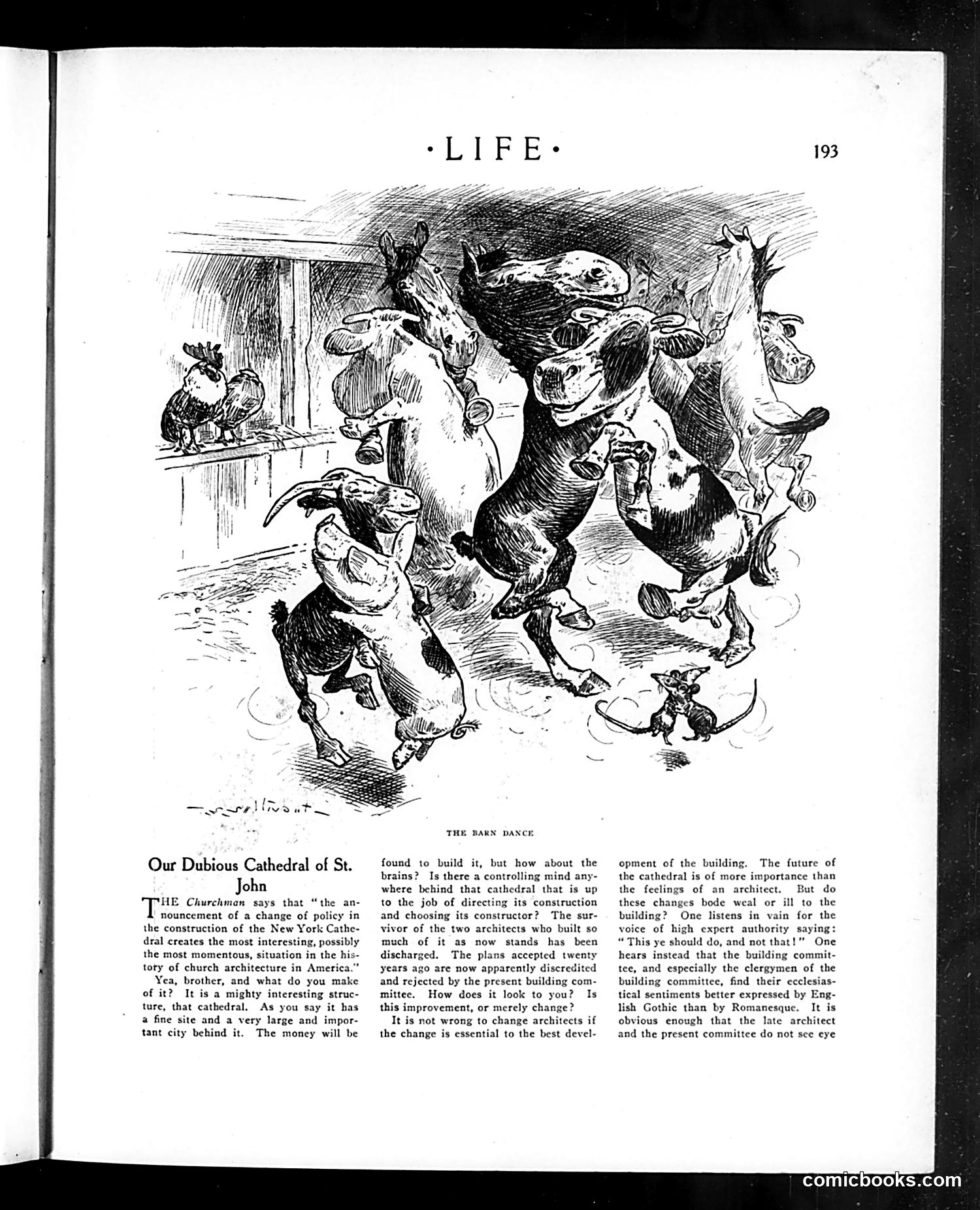
This page satirizes mismanagement of New York Cathedral's construction. The cartoon (top) depicts animals dancing chaotically in a barn, likely representing the discord among the cathedral's building committee. The accompanying article critiques the project's leadership vacuum. A recently discharged architect had overseen much work; now the committee has rejected twenty-year-old approved plans in favor of English Gothic over Romanesque style—a decision driven by the clergy's aesthetic preferences rather than architectural expertise. The satire's point: the committee prioritizes ecclesiastical sentiment over sound construction judgment. The "barn dance" metaphor suggests the project has become an undisciplined mess, with no authoritative expert voice directing proceedings. The cartoon questions whether such chaotic decision-making bodes well for the cathedral's future.
📄 Transcribed text from this page (OCR, searchable)
Machine-transcribed from the original scan — historical spelling and the odd misread are preserved.
—arwr! les at Our Dubious Cathedral of St. John HE Churchman says that “the an- nouncement of a change of policy in the construction of the New York Cathe- dral creates the most interesting, possibly the most momentous, situation in the his- tory of church architecture in America.” Yea, brother, and what do you make of it? It is a mighty interesting struc- ture, that cathedral, As you say it has a fine site and a very large and impor- tant city behind it. The money will be THE BARN DANCE. found to build it, but how about the brains? Is there a controlling mind any- where behind that cathedral that is up to the job of directing its construction and choosing its constructor? The sur- vivor of the two architects who built so much of it as now stands has been discharged. The plans accepted twenty years ago are now apparently discredited and rejected by the present building com- mittee. How does it look to you? Is this improvement, or merely change? It is not wrong to change architects if the change is essential to the best devel- opment of the building. The future of the cathedral is of more importance than the feelings of an architect. But do these changes bode weal or ill to the building? One listens in vain for the voice of high expert authority saying: “This ye should do, and not that!” One hears instead that the building commit- tee, and especially the clergymen of the building committee, find their ecclesias- tical sentiments better expressed by Eng- lish Gothic than by Romanesque. It is obvious enough that the late architect and the present committee do not sce eye comicbooks.com