
Life, 1911-08-03 · page 15 of 40
Life — August 3, 1911 — page 15: what you’re looking at
What you’re looking at
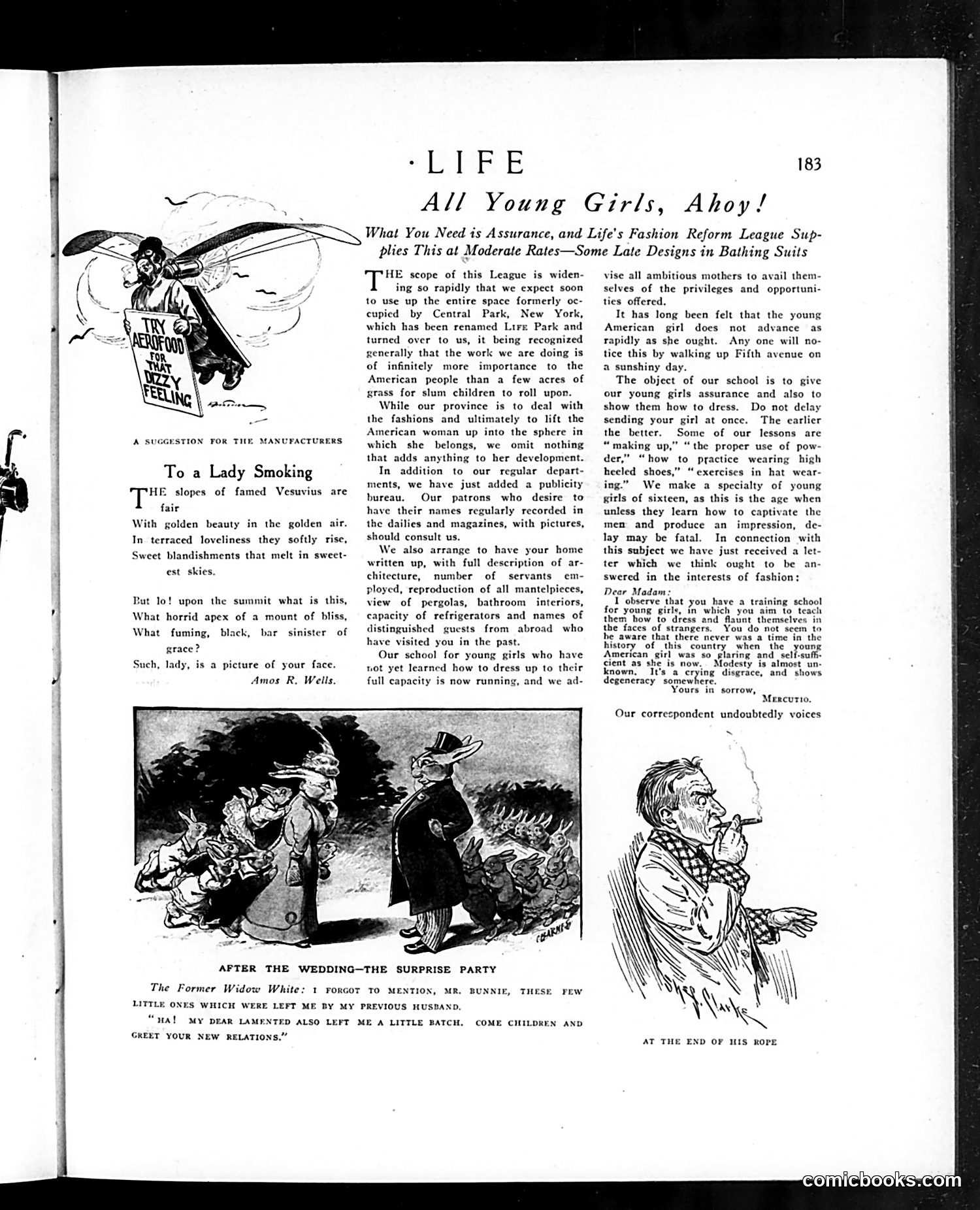
This page contains social satire typical of early 20th-century Life magazine. The main content mocks a fictional "Fashion Reform League" that claims to educate young girls in dress and comportment while actually promoting vanity and materialism. The satire suggests the League has become so important it should replace Central Park, and now offers services like publicizing patrons' homes and servants—lampooning wealthy women's status-seeking. The poem "To a Lady Smoking" criticizes women smoking in public, comparing a woman's face while smoking unfavorably to Mount Vesuvius's beauty. The cartoon "After the Wedding" depicts a widow presenting her illegitimate children from a previous marriage as a "surprise" to her new husband—satirizing remarriage complications and social pretense. A reader's letter criticizing young American girls' lack of modesty provides counterpoint, suggesting the page critiques both excessive female vanity and generational decline in propriety.
📄 Transcribed text from this page (OCR, searchable)
Machine-transcribed from the original scan — historical spelling and the odd misread are preserved.
A SUGGESTION FOR TH MANUFACTURERS To a Lady Smoking [HE soves of famed Vesuvius are fair With golden beauty in the golden air. In terraced loveliness they softly rise, Sweet blandishments that melt in sweet- est skies. But lo! upon the summit what is this, What horrid apex of a mount of bliss, What fuming, black, bar sinister of grace? Such, lady, is a picture of your face. Amos R. Wells. AFTER THE WEDDING—THE SURPRISE PARTY “US SEE All Young Girls, Ahoy! What You Need is Assurance, and Life's Fashion Reform League Sup- plies This at Moderate Rates—Some Late Designs in Bathing Suits HE scope of this League is widen- ing so rapidly that we expect soon to use up the entire space formerly oc- cupied by Central Park, New York, which has been renamed Lire Park and turned over to us, it being recognized generally that the work we are doing is of infinitely more importance to the American people than a few acres of grass for slum children to roll upon. While our province is to deal with the fashions and ultimately to lift the American woman up into the sphere in which she belongs, we omit nothing that adds anything to her development. In addition to our regular depart- ments, we have just added a publicity bureau, Our patrons who desire to have their names regularly recorded in the dailies and magazines, with pictures, should consult us. We also arrange to have your home written up, with full description of ar- chitecture, number of servants em- ployed, reproduction of all mantelpicces, view of pergolas, bathroom interiors, capacity of refrigerators and names of distinguished guests from abroad who have visited you in the past. Our school for young girls who have not yet Iearned how to dress up to their full capacity is now running, and we ad- The Former Widow White: 1 rorGot TO MENTION, MR. BUNNIE, THESE FEW LITTLE ONES WHICH WERE LEFT ME BY MY PREVIOUS HUSDAND, “Al My DEAR LAME: GREET YOUR NEW RELATIONS.” TED ALSO LEFT ME A LITTLE BATCH, COME CHILDREN AND vise all ambitious mothers to avail them- Ives of the privileges and opportuni- ties offered. It has long been felt that the young American girl does not advance as rapidly as she ought. Any one will no- tice this by walking up Fifth avenue on a sunshiny day. The object of our school is to give our young girls assurance and also to show them how to dress. Do not delay sending your girl at once, The earlier the better, Some of our lessons are “making up,” “the proper use of pow- der,” “how to practice wearing high heeled shoes,” “exercises in hat wear- ing.” We make a specialty of young girls of sixteen, as this is the age when unless they learn how to captivate the men and produce an impression, de- lay may be fatal. In connection with this subject we have just received a let- ter which we think ought to be an- swered in the interests of fashion: Dear Madam: I observe that you have a training school for young girls, in which you aim to teach them how to dress and flaunt themselves in the faces of strangers. You do not seem to be aware that there never was a time in the history of this country when the young American girl was so glaring and self-sufh- cient as she is now. Modesty is almost un- known, It's a crying disgrace, and shows degeneracy somewhere. Yours in’ sorrow, Mercurio. Our correspondent undoubtedly voices AT THE END OF MIS ROPE