
Life, 1911-08-03 · page 22 of 40
Life — August 3, 1911 — page 22: what you’re looking at
What you’re looking at
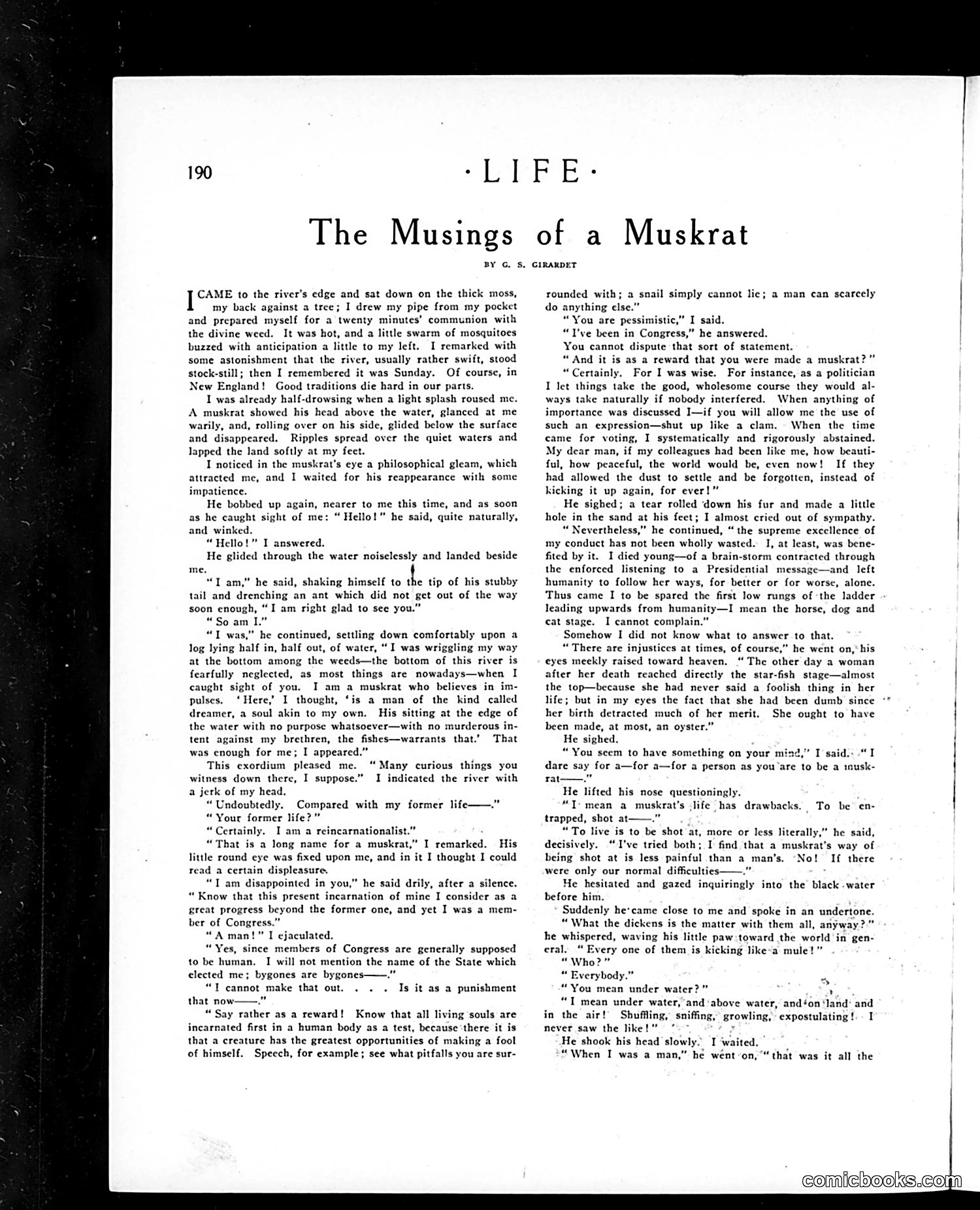
This is a satirical short story (not a cartoon) by G.S. Giradet that uses talking-animal fiction to mock American politicians, specifically members of Congress. **The Setup:** A man encounters a philosophical muskrat who reveals he is a reincarnationalist—claiming his current animal form is actually a *reward* for his previous life as a U.S. Congressman. **The Satire:** The joke is that being demoted from human to muskrat constitutes an *improvement*. The muskrat explains Congress members excel at deception ("a man can scarcely do anything else" but lie), and that his political wisdom consisted of staying silent and abstaining from votes—implying real politicians should do likewise. **Historical Context:** This reflects Progressive Era skepticism toward Congress (early 1900s), portraying elected representatives as foolish, dishonest, and obstructive. The muskrat's strategy of non-interference mocks both political gridlock and the belief that inaction constitutes wisdom. The piece uses gentle, philosophical humor to critique American governance and human nature generally.
📄 Transcribed text from this page (OCR, searchable)
Machine-transcribed from the original scan — historical spelling and the odd misread are preserved.
ek The Musings BY G. Ss, CAME to the river’s edge and sat down on the thick moss, my back against a tree; I drew my pipe from my pocket and prepared myself for a twenty minutes’ communion with the divine weed. It was hot, and a little swarm of mosquitoes buzzed with anticipation a little to my left. I remarked with some astonishment that the river, usually rather swift, stood stock-still; then I remembered it was Sunday. Of course, in New England! Good traditions die hard in our parts. 1 was already half-drowsing when a light splash roused mc. A muskrat showed his head above the water, glanced at me warily, and, rolling over on his side, glided below the surface and disappeared. Ripples spread over the quict waters and lapped the land softly at my feet. I noticed in the muskrat’s eye a philosophical gleam, which attracted me, and I waited for his reappearance with some impatience. He bobbed up again, nearer to me this time, and as soon as he caught sight of me: “ Hello!” he said, quite naturally, and winked. “Hello!” I answered. He glided through the water noiselessly and landed beside me. “Tam,” he said, shaking himself to i tip of his stubby tail and drenching an ant which did not get out of the way soon enough, “I am right glad to see you.” “So am 1.” “I was,” he continued, settling down comfortably upon a log lying half in, half out, of water, “I was wriggling my way at the bottom among the weeds—the bottom of this river is fearfully neglected, a8 most things are nowadays—when I caught sight of you. I am a muskrat who believes in im- pulses. ‘Here, I thought, ‘is a man of the kind called dreamer, a soul akin to my own. His sitting at the edge of the water with no purpose whatsoever—with no murderous in- tent against my brethren, the fishes—warrants that’ That was enough for me; I appeared.” This cxordium pleased me. “Many curious things you witness down there, I suppose.” I indicated the river with a jerk of my head. “Undoubtedly. Compared with my former life—. “Your former life?" Certainly. I am a reincarnationalist.” “That is a long name for a muskrat,” I remarked. His little round eye was fixed upon me, and in it I thought I could read a certain displeasure. I am disappointed in you,” he said drily, after a silence. “ Know that this present incarnation of mine I consider as a great progress beyond the former one, and yet I was a mem- ber of Congress.” “A man!” I ejaculated. “Yes, since members of Congress are generally supposed to be human. I will not mention the name of the State which elected me; bygones are bygones—.” “T cannot make that out. . . . Is it as a punishment that now—.” “Say rather as a reward! Know that all living souls are incarnated first in a human body as a test, because ‘there it that a creature has the greatest opportunities of making a fool of himself. Speech, for example; see what pitfalls you are sur- FE: of a Muskrat CIRARDET rounded with; a snail simply cannot lic; a man can scarcely do anything else.” “You are pessimistic,” I said. “T've been in Congress,” he answered. You cannot dispute that sort of statement. “ And it is as a reward that you were made a muskrat?” “Certainly, For I was wise. For instance, as a politician I let things take the good, wholesome course they would al- ways take naturally if nobody interfered, When anything of importance was discussed I—if you will allow me the use of such an expression—shut up like a clam. When the time came for voting, I systematically and rigorously abstained. My dear man, if my colleagues had been like me, how beauti- ful, how peaceful, the world would be, even now! If they had allowed the dust to settle and be forgotten, instead of kicking it up again, for ever!" He sighed; a tear rolled ‘down his fur and made a little hole in the sand at his feet; I almost cried out of sympathy. “ Nevertheless,” he continued, “the supreme excellence of my conduct has not been wholly wasted. I, at least, was bene- fited by it. I died young—of a brain-storm contracted through the enforced listening to a Presidential message—and left humanity to follow her ways, for better or for worse, alone. Thus came I to be spared the first low rungs of the ladder leading upwards from humanity—I mean the horse, dog and cat stage. I cannot complain.’ Somehow I did not know what to answer to that. “There are injustices at times, of course,” he went on, his eyes meekly raised toward heaven. “The other day a woman after her death reached directly the star-fish stage—almost the top—because she had never said a foolish thing in her life; but in my eyes the fact that she had been dumb since her birth detracted much of her merit. She ought to have been made, at most, an oyster.” He sighed. “You seem to have something on your mind,” I said. “I dare say for a—for a—for a person as you‘are to be a inusk- rat—." He lifted his nose questioningly. “I> mean a muskrat’s life has drawbacks. To be en- trapped, shot at—.” To live is to be shot at, more or less literally,” he said, decisively. “I've tried both; I find that a muskrat’s way of being shot at is less painful than a man’s. “No! If there were only our normal difficulties—.” He hesitated and gazed inquiringly into the black -water before him. Suddenly he*came close to me and spoke in an undertone. “What the dickens is the matter with them all, anyway?” he whispered, waving his little paw toward the world in gen- eral. “ Every one of them is kicking like-a mule!” “Who?” erybody.” “ You mean under water?” a “T mean under water, and’above water, and‘on ‘land: and in the air!’ Shuffling, sniffing, growling, expostulating!. I never saw the like!” ” He shook his head slowly. I waited. “When I was a man,” he went on,“ that was it all the comichooks.coun