
Life, 1911-08-03 · page 8 of 40
Life — August 3, 1911 — page 8: what you’re looking at
What you’re looking at
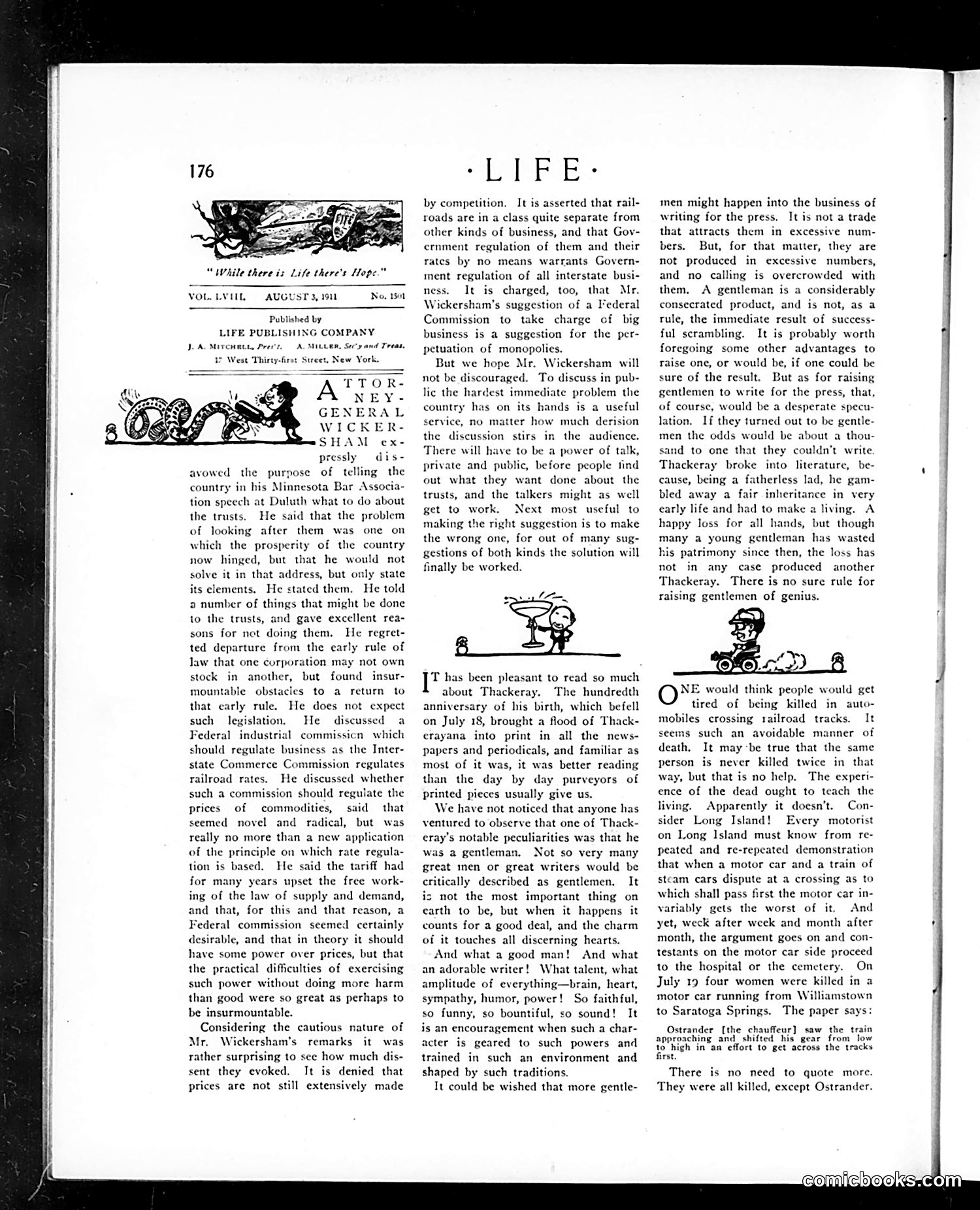
This page from *Life* magazine (August 5, 1911) contains an "Attorney-General's General Wickersham" column—a satirical piece about U.S. Attorney General James Wickersham's views on railroad regulation and trusts. The text mocks Wickersham's suggestion that a Federal Commission should regulate interstate business, arguing this is an overly radical proposal. The author sarcastically presents Wickersham's reasoning while critiquing the impracticality of such regulation. The small cartoon illustrations (appearing between text sections) show figures in comedic situations, likely reinforcing the satirical tone about bureaucratic complications. The page's humor targets Progressive Era debates over government regulation of big business—a central political controversy of the period. The satire suggests Wickersham's proposals, though intended as solutions, would create more problems than they solve.
📄 Transcribed text from this page (OCR, searchable)
Machine-transcribed from the original scan — historical spelling and the odd misread are preserved.
“ While there iz Life there's Hope.” VOL.LVUIL = AUGUST, 1911 No. 1501 Published by LIFE PUBLISHING COMPANY JA. Mavcoteet, Pre A. MILLER, See’y and Treas, 1 West Thirtysfrst Street, New York, we TTOR- NEY- GENERAL WICKER- SHAM ex- dis- press avowed the purpose of telling the country in his Minnesota Bar Associa- tion speech at Duluth what to do about the trusts. He said that the problem of looking after them was one on which the prosperity of the country now hinged, but that he would not solve it in that address, but only state its elements. He stated them. He told a number of things that might be done to the trusts, and gave excellent rea- sons for not doing them. He regret- ted departure from the early rule of Jaw that one corporation may not own stock in another, but found insur- mountable obstacles to a return to that early rule. He does not expect such legislation. He discussed a Federal industrial commissicn which should regulate business as the Inter- state Commerce Commission regulates railroad rates. He discussed whether such a commission should regulate the prices of commodities, said that seemed novel and radical, but was really no more than a new application of the principle on which rate regula- tion is based. He said the tariff had for many years upset the free work- ing of the law of supply and demand, and that, for this and that reason, a deral commission seemed certainly desirable, and that in theory it should have some power over prices, but that the practical difficulties of exercising such power without doing more harm than good were so great as perhaps to be insurmountable. Considering the cautious nature of Mr. Wickersham’s remarks it was rather surprising to see how much dis- sent they evoked. It is denied that prices are not still extensively made APE by competition. It is asserted that rail- roads are in a class quite separate from other kinds of business, and that Gov- ernment regulation of them and their ratcs by no means warrants Govern- ment regulation of all interstate busi- It is charged, too, that Mr. rsham’s suggestion of a Federal Commission to take charge of big business is a suggestion for the per- petuation of monopolies. But we hope Mr. Wickersham will not be discouraged. To discuss in pub- lic the hardest immediate problem the country h on its hands is a useful rvice, no matter how much derision the discussion stirs in the audience. There will have to be a power of talk, private and public, before people tind out what they want done about the trusts, and the talkers might as well get to work. Next most useful to making the right suggestion is to make the wrong one, for out of many sug- gestions of both kinds the solution will finally be worked. lo. .y ! T has been pleasant to read so much about Thackeray. The hundredth anniversary of his birth, which befell on July 18, brought a flood of Thacl erayana into print in all the news- papers and periodicals, and familiar as most of it was, it was better reading than the day by day purveyors of printed pieces usually give us. We have not noticed that anyone has ventured to observe that one of Thac! eray’s notable peculiarities was that he was a gentleman. Not so very many great men or great writers would be critically described as gentlemen. It is not the most important thing on earth to be, but when it happens it counts for a good deal, and the charm of it touches all discerning hearts. And what a good man! And what an adorable writer! What talent, what amplitude of everything—brain, heart, sympathy, humor, power! So faithful, so funny, so bountiful, so sound! It is an encouragement when such a char- acter is geared to such powers and trained in such an environment and shaped by such traditions. It could be wished that more gentle- men might happen into the business of writing for the press. It is not a trade that attracts them in excessive num- bers. But, for that matter, they are not produced in excessive numbers, and no calling is overcrowded with them. A gentleman is a considerably consecrated product, and is not, as a rule, the immediate result of success- ful scrambling. It is probably worth foregoing some other advantages to raise one, or would be, if one could be sure of the result. But as for raising gentlemen to write for the press, that, of course, would be a desperate specu- lation, If they turned out to be gentle- men the odds would be about a thou- sand to one that they couldn't write. Thackeray broke into literature, be- cause, being a fatherless lad, he gam- bled away a fair inheritance in very early life and had to make a living. A happy loss for all hands, but though many a young gentleman has wasted his patrimony since then, the loss has not in any case produced another Thackeray. There is no sure rule for raising gentlemen of genius. O*= would think people would get tired of being killed in auto- mobiles crossing tailroad trai It seems such an avoidable manner of death, It maybe true that the same person is never killed twice in that way, but that is no help. The experi- ence of the dead ought to teach the living. Apparently it doesn’t. Con- sider Long Island! Every motorist on Long Island must know from re- peated and re-repeated demonstration that when a motor car and a train of steam cars dispute at a crossing as to which shall pass first the motor car in- variably gets the worst of it. And yet, week after week and month after month, the argument goes on and con- testants on the motor car side proceed to the hospital or the cemetery. On July 19 four women were killed in a motor car running from Williamstown to Saratoga Springs. The paper say Ostrander [the chauffeur] saw the train approaching and shifted his gear from low tom high in an effort to get across the tracks There is no need to quote more, They were all killed, except Ostrander.