
A complete issue · 44 pages · 1910
Life — December 15, 1910
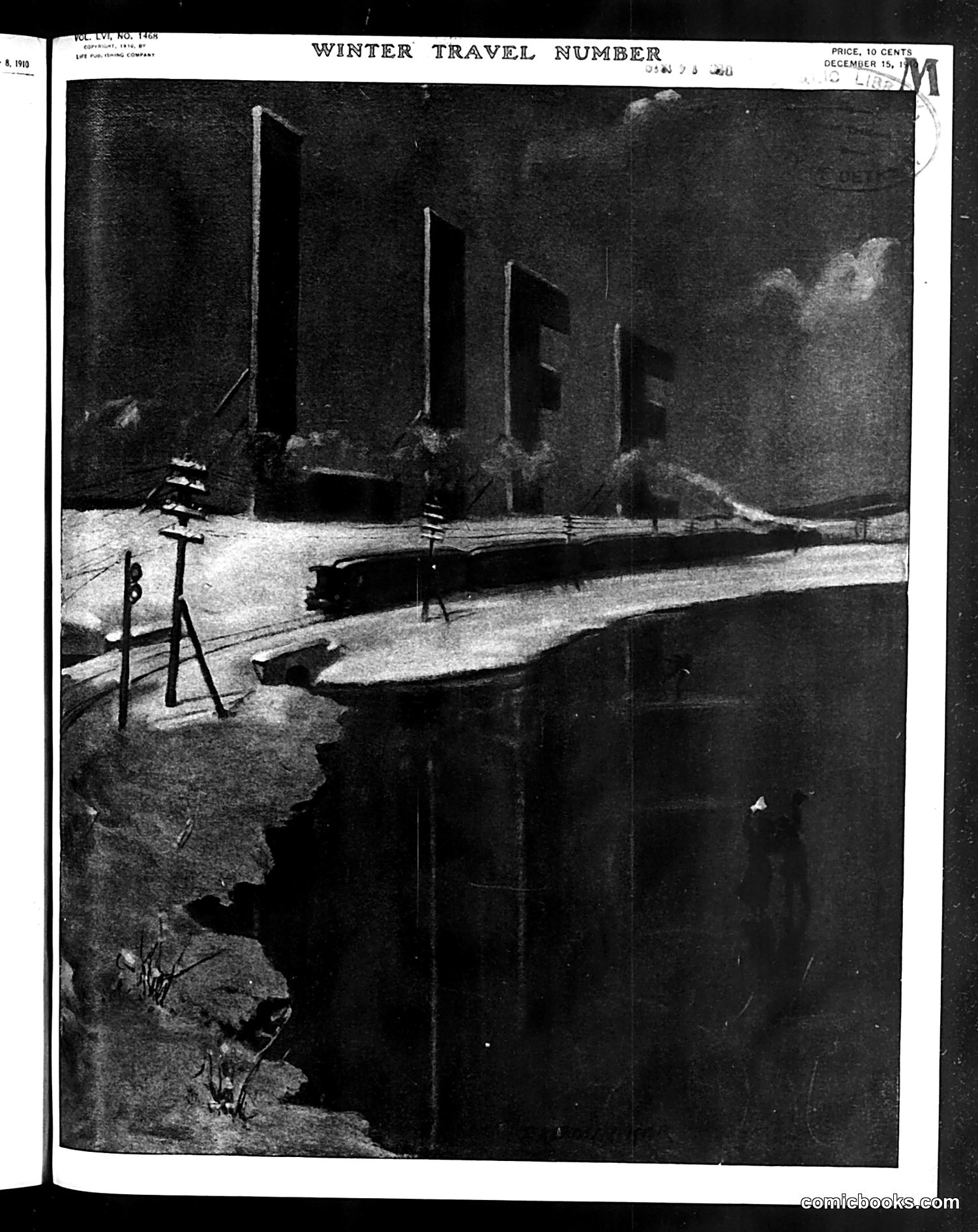
This is a "Winter Travel Number" cover from *Life* magazine (December 15, priced at 10 cents). The black-and-white photograph shows an industrial or mining landscape with tall wooden structures (likely mining headframes or industrial buildings), railroad tracks, and snowy terrain. The composition appears designed as a winter travel photograph. However, without visible cartoon panels or caricatured figures in this particular image, I cannot identify specific satirical targets or political references. The image reads as a straightforward winter landscape photograph rather than a political cartoon. The "winter travel" framing suggests it's promotional content for seasonal tourism destinations, though the industrial setting is austere rather than conventionally scenic. To explain the satire intended, I would need clearer visibility of any figures, captions, or cartoon elements in the reproduction.
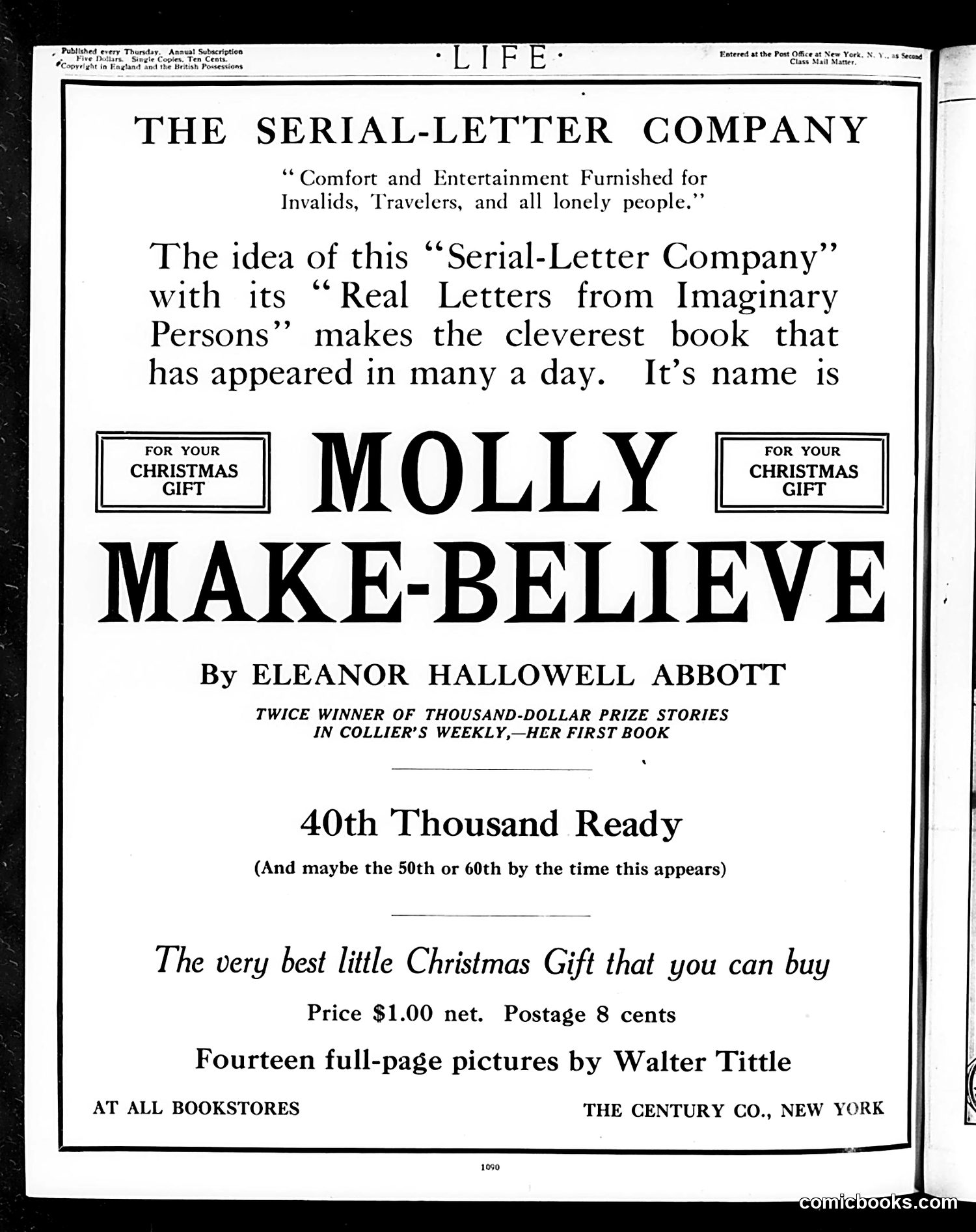
This page is primarily **advertising, not satire or political commentary**. It's a full-page book advertisement from *Life* magazine promoting "Molly Make-Believe" by Eleanor Hallowell Abbott, published by The Century Co. The ad highlights the book's commercial success (40,000 copies sold) and its premise: the "Serial-Letter Company" concept of letters from imaginary persons providing "Comfort and Entertainment" for invalids and lonely people. The tagline positions it as an ideal Christmas gift. The ad notes Abbott's prior success winning thousand-dollar prizes in *Collier's Weekly*, and mentions illustrations by Walter Tittle. There is no political cartoon or satire—simply a marketing pitch for what appears to be an early 1900s epistolary fiction work.
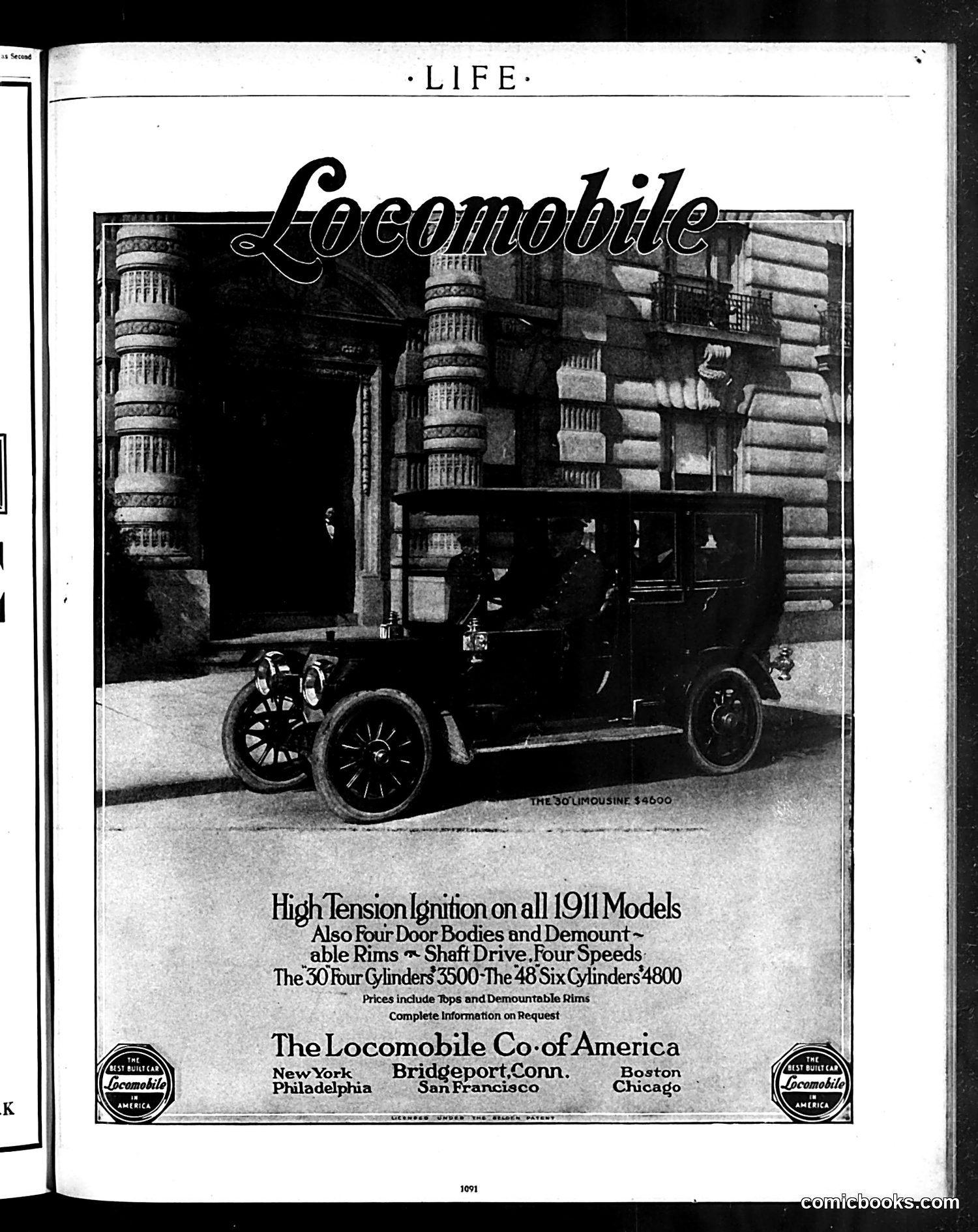
This page is **not a political cartoon or satire**—it's a straightforward advertisement for the Locomotive automobile company, published in *Life* magazine around 1911. The image shows a "30 Limousine" model parked before an ornate classical building, emphasizing the vehicle's elegance and respectability. The ad highlights features: high-tension ignition, four-door bodies, demountable rims, shaft drive, and multiple engine options (30 four-cylinder at $3500; 48 six-cylinder at $4800). The Locomotive Co. of America had offices in major cities: New York, Philadelphia, Bridgeport (Connecticut), San Francisco, Boston, and Chicago. This is period advertising targeting wealthy buyers, not satire or commentary.
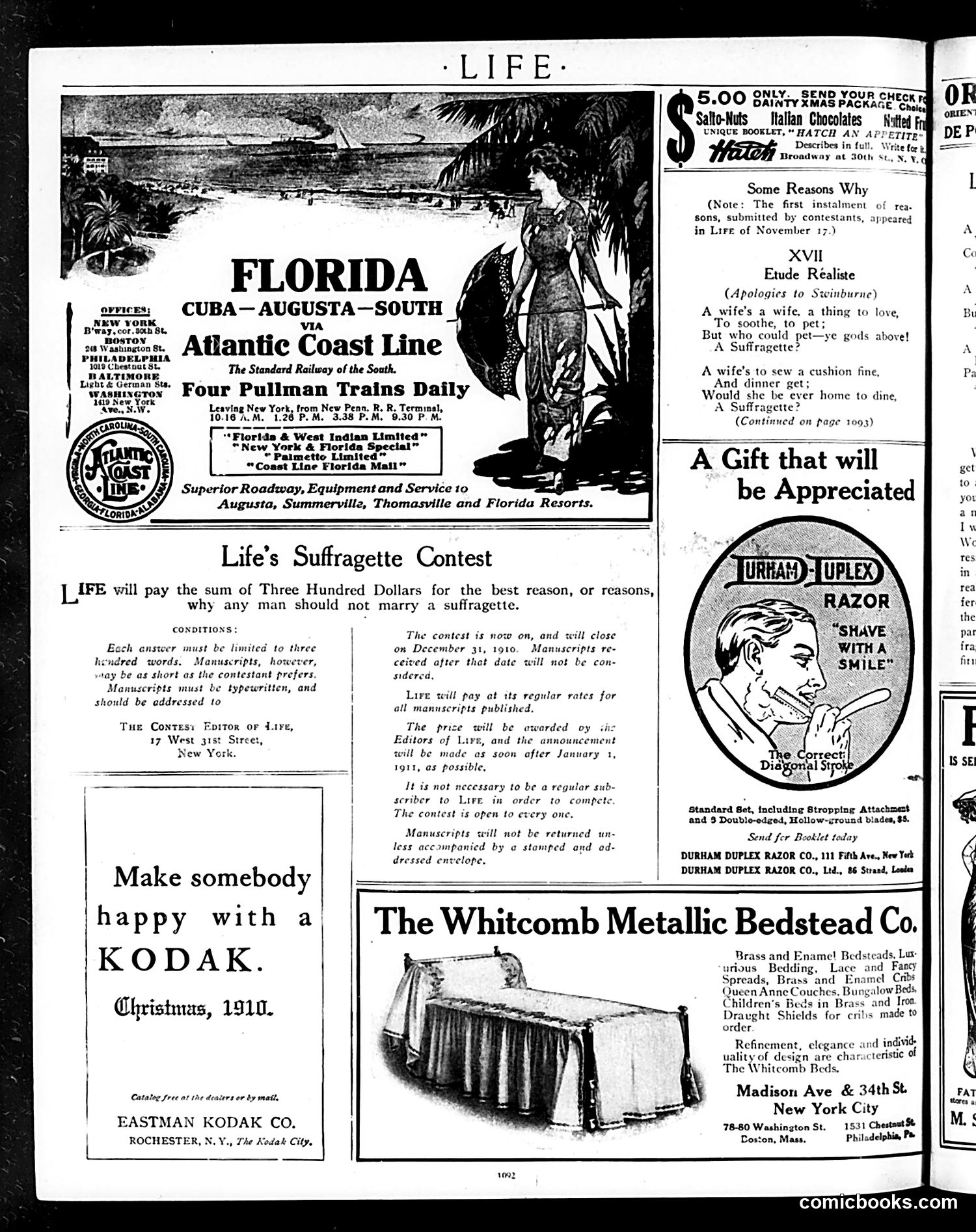
This page is primarily **advertising content** rather than political satire. The main illustrated advertisement shows the "Florida Cuba-Augusta-South Atlantic Coast Line" railroad, featuring an elegantly dressed woman with palm trees—marketing luxury train travel to Florida resorts. The page includes a "Life's Suffragette Contest" offering $300 for the best reason why any man should not marry a suffragette. This reflects **anti-suffrage sentiment** common in 1910, mocking women's voting rights advocates through humor. Other advertisements promote a Kodak camera for Christmas gifts, Durham Duplex razors, and Whitcomb Metallic Bedsteads. The content reflects early-20th-century consumer culture and gender attitudes rather than political cartooning.
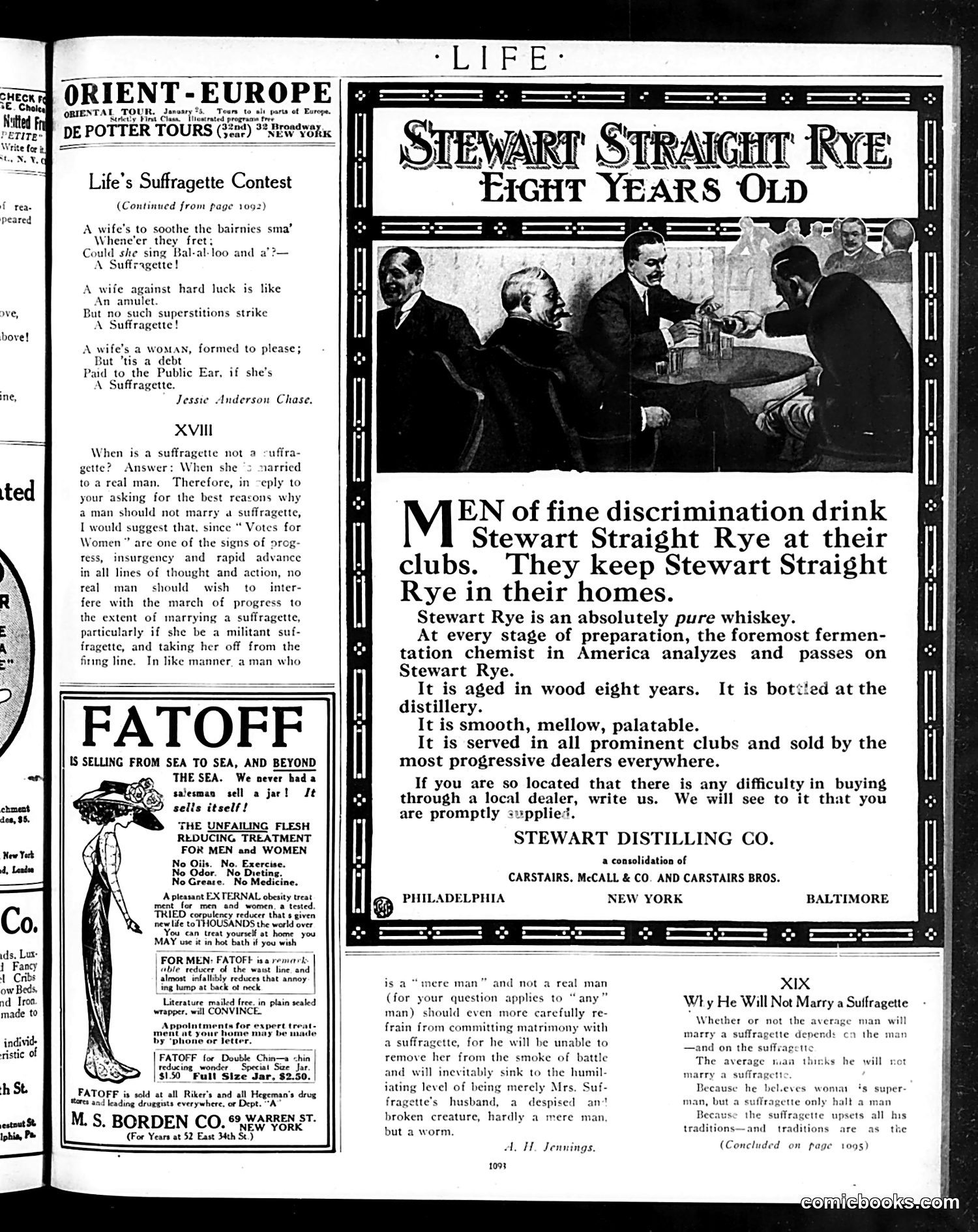
This page contains two unrelated elements: **Left side:** "Life's Suffragette Contest" continues a satirical poem mocking women's suffrage. The verses ridicule suffragettes as unsuitable wives, suggesting they're too aggressive and unfeminine for marriage. It represents anti-suffrage sentiment common in the 1910s, presenting women's political activism as incompatible with traditional domestic roles. **Right side:** A full-page advertisement for Stewart Straight Rye whiskey featuring five men in formal attire around a table. The ad appeals to wealthy, discriminating male consumers at exclusive clubs, emphasizing the whiskey's purity and eight-year aging. The juxtaposition is striking: anti-woman satire paired with luxury marketing to affluent men—reflecting the era's gender divisions and target demographics of premium products.
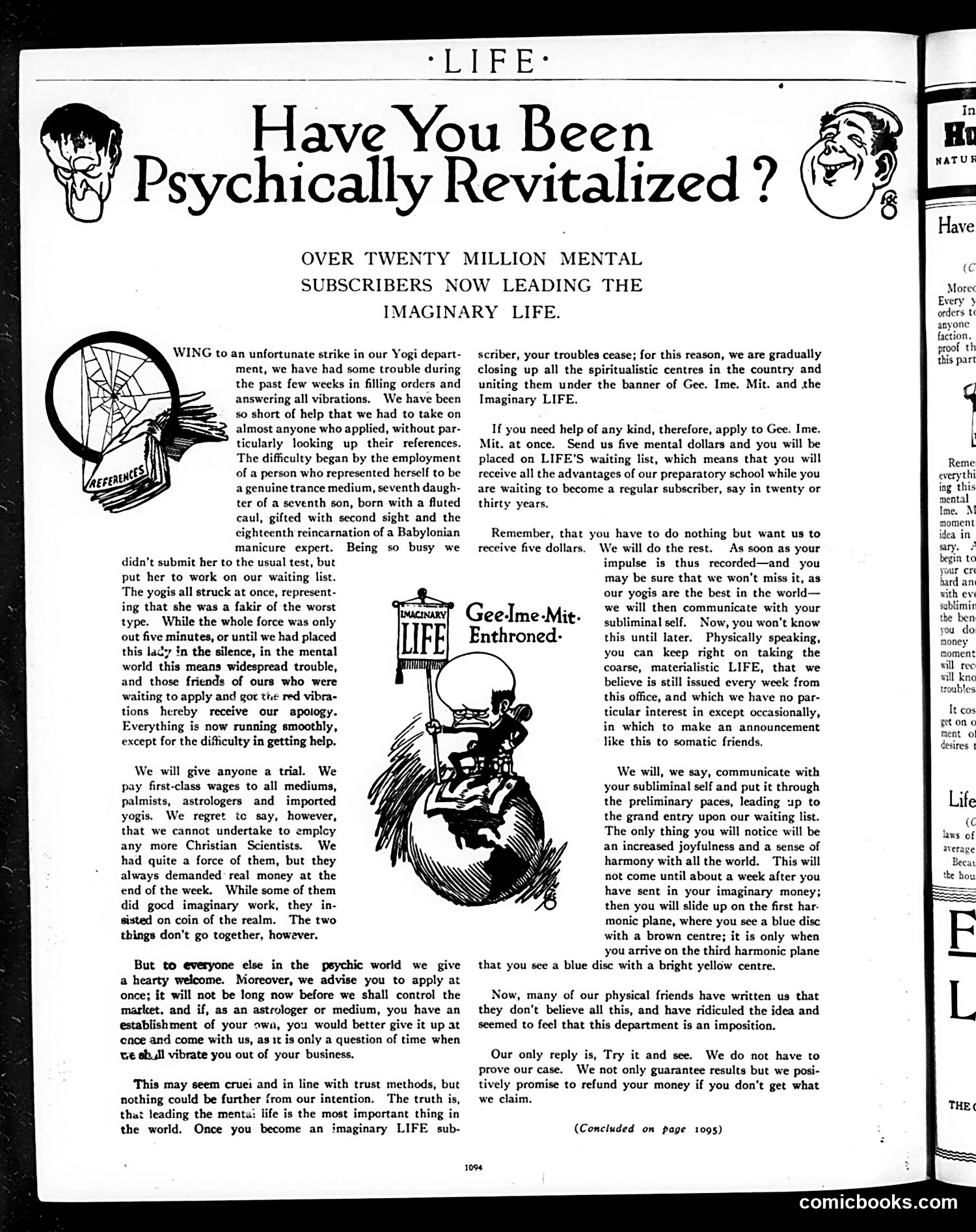
This is a satirical advertisement masquerading as editorial content, mocking the early 20th-century spiritualist and New Thought movements that promised psychological transformation and occult enlightenment. The caricatures at top appear to represent stereotypical spiritualist practitioners—figures associated with the era's popular mysticism craze. The main illustration depicts a figure in cosmic/mystical imagery, parodying spiritualist iconography. The text satirizes spiritualist organizations' recruitment tactics and dubious promises: "twenty million mental subscribers" achieving "imaginary life" through meditation and yogic practice. The satire targets their claims of supernatural communication, money-back guarantees, and vague spiritual benefits ("increased joyfulness," "harmony with all the world"). The magazine ridicules both the spiritualists' grandiose claims and their cynical commercialism—charging fees for courses leading to "the imaginary life."
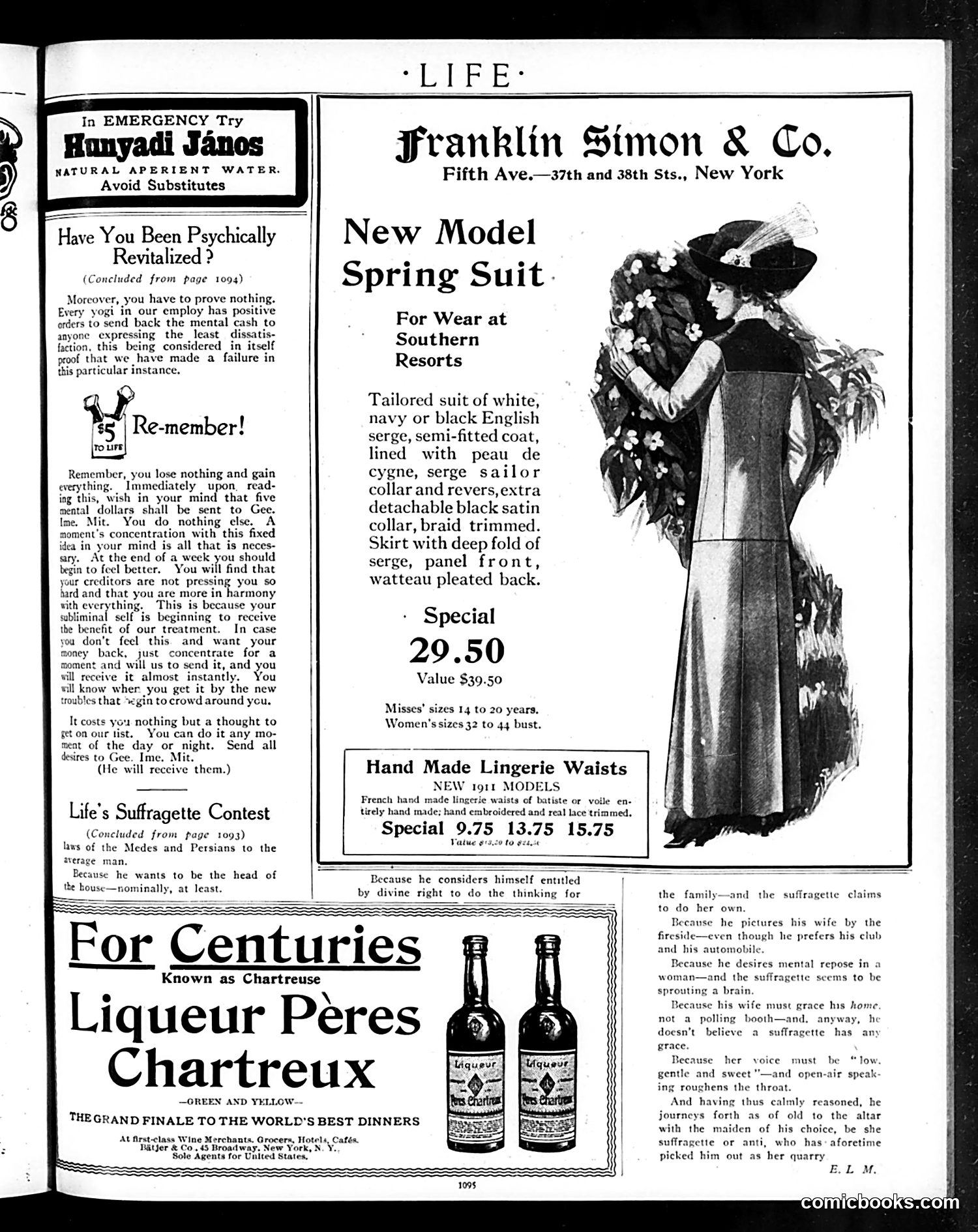
This page is primarily **advertising and fashion content**, not political satire. The main features are: 1. **Franklin Simon & Co. fashion advertisement** (center-right): promotes a "New Model Spring Suit" for Southern Resorts, priced at $29.50 2. **Hand-made lingerie waists advertisement** below the suit 3. **Liqueur Pères Chartreux advertisement** (bottom): promoting this French liqueur as "the grand finale to the world's best dinners" 4. **Left column content**: includes an ad for Hunyadi János natural aperient water and articles on yoga/psychological revitalization and women's suffrage The page reflects early 1910s consumer culture and advertising practices. There is no prominent political cartoon—the suffrage reference appears to be part of an ongoing article series rather than satirical commentary.
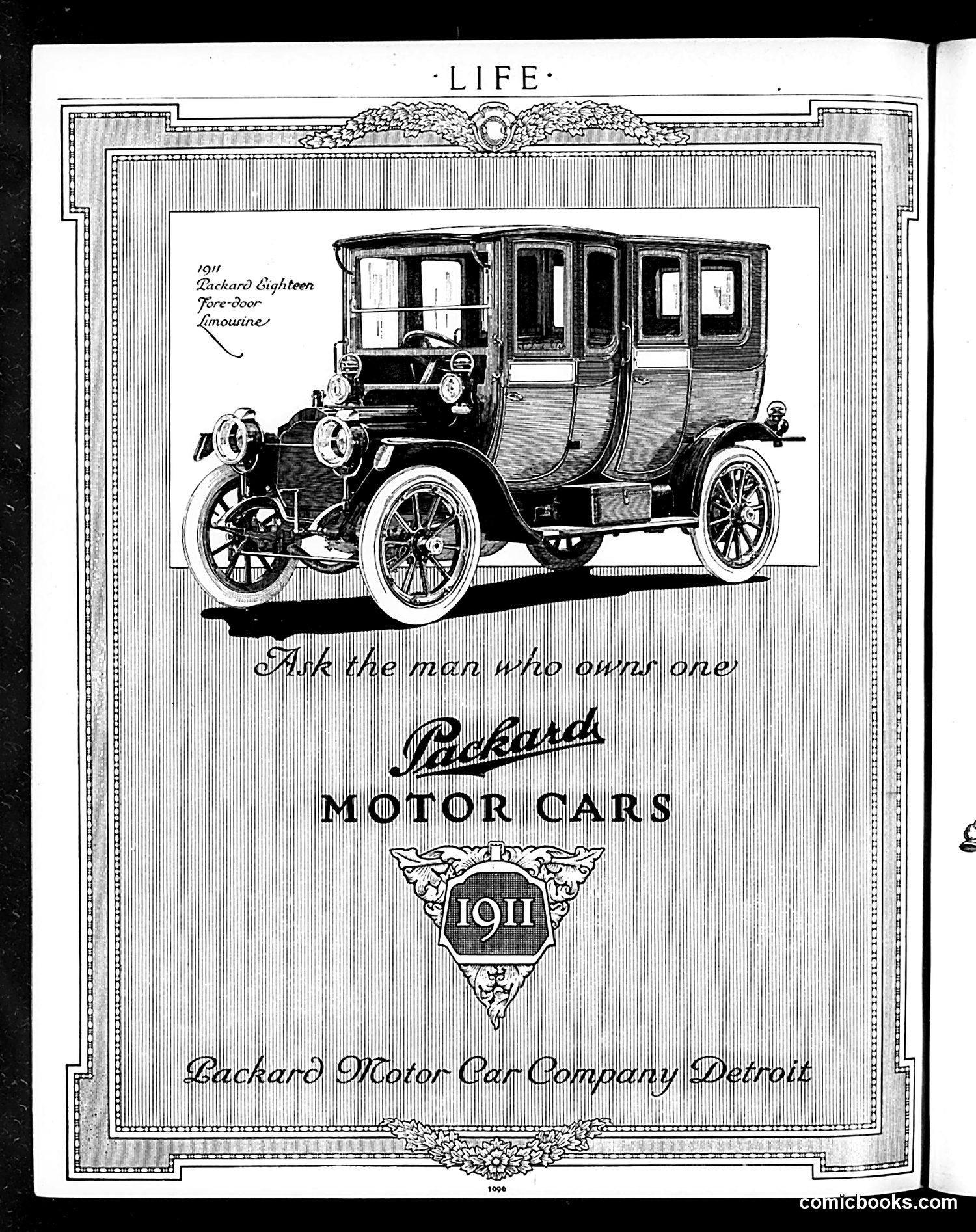
This is a 1911 advertisement for Packard Motor Cars from Detroit, not political satire. The page features an illustration of a 1911 Packard Eighteen limousine—a luxury automobile with an enclosed passenger cabin and open driver's area. The ad's slogan, "Ask the man who owns one," was Packard's actual marketing tagline, appealing to wealthy buyers by suggesting existing owners could testify to the car's quality. The specific model name and year (visible in the upper left) emphasize exclusivity and precision engineering. The ornate decorative border and formal presentation in *Life* magazine reflect how automobiles were aspirational luxury goods for the affluent in this era. This represents early automotive advertising targeting the wealthy elite during the pioneer age of motorized transportation.
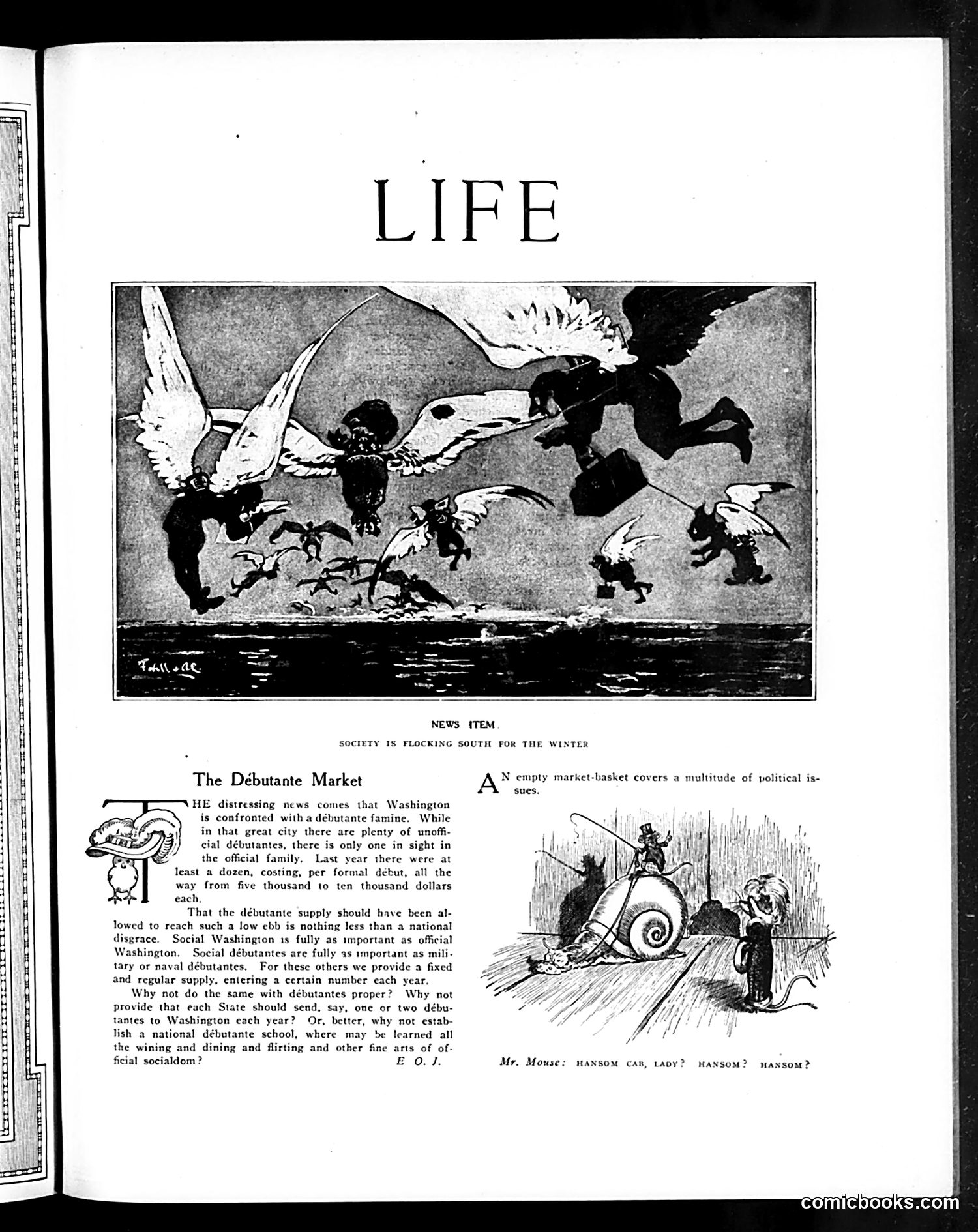
**Top Illustration**: A satirical drawing titled "Society is Flocking South for the Winter" depicts wealthy figures (shown as silhouettes with wings) fleeing northward like migrating birds. This mocks the social elite's annual winter migration to warmer climates—a status symbol among the wealthy. **"The Débuntante Market" Article**: Criticizes Washington's debutante system, where young women from prominent families were formally introduced to society at expensive formal balls (costing $5,000-$10,000 each). The author argues this wasteful tradition is a "national disgrace" and satirically proposes establishing a state-run "debutante school" to standardize and regulate these frivolous coming-out ceremonies—mocking both the practice's excess and ineffective government solutions. **Bottom Cartoon**: A small humorous sketch about a mouse seeking ransom; context unclear from visible text.
This page contains two editorial cartoons about consumer advocacy and government regulation. The first cartoon (top left) depicts **Mr. Brandeis**, identified in the text as speaking for "the shippers of the Eastern Seaboard" to the Interstate Commerce Commission. The image shows him as a figure of authority advocating for railroad rate reforms. The second cartoon (center-right) shows a figure being buffeted by forces, illustrating the text's central theme: the **consumer's vulnerable position** in an economy controlled by competing interests—railroads, trusts, tariff advocates, and strikers all extracting value at his expense. The article argues that government's chief duty is protecting the consumer from exploitation by organized business interests. The cartoons satirize how the average person gets caught between powerful economic forces beyond his control.
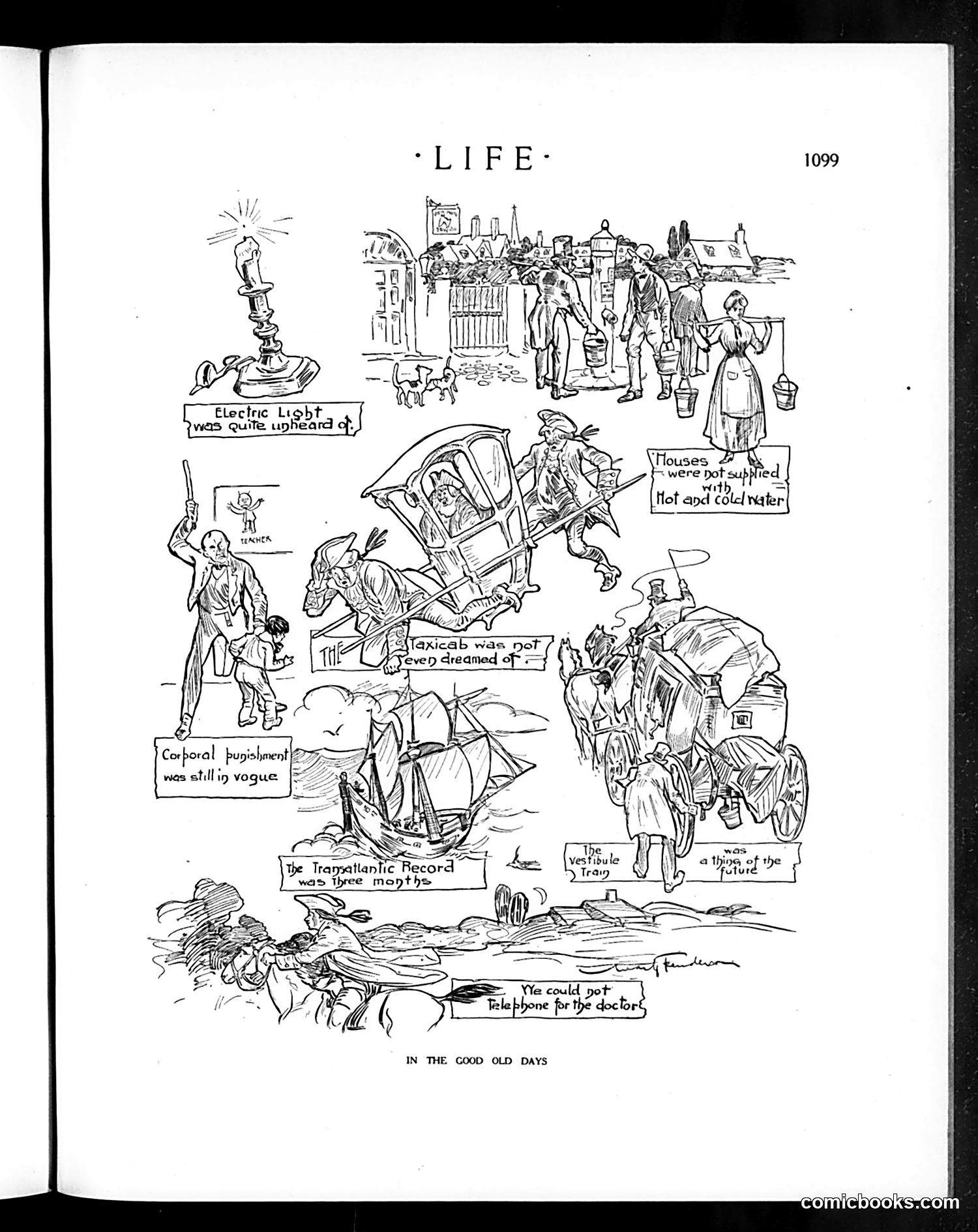
This page satirizes life before modern conveniences by contrasting past hardships with contemporary (early 20th century) innovations. The labeled vignettes mock outdated conditions: - **Electric light** was "quite upheaded" (unclear phrasing, possibly "unheard of") - **Houses** required manual hot/cold water delivery - **Taxicabs** were merely horse-drawn carriages, not motorized - **Corporal punishment** was "still in vogue" - **Transatlantic travel** took months by ship - **Vestigial** transportation methods preceded trains - **Telephones** for doctors were unavailable The bottom panel shows people struggling in primitive conditions with the caption "You could not telephone for the doctor." The overall message celebrates modern progress and technological advancement as liberation from past suffering—a common progressive-era theme in American humor.
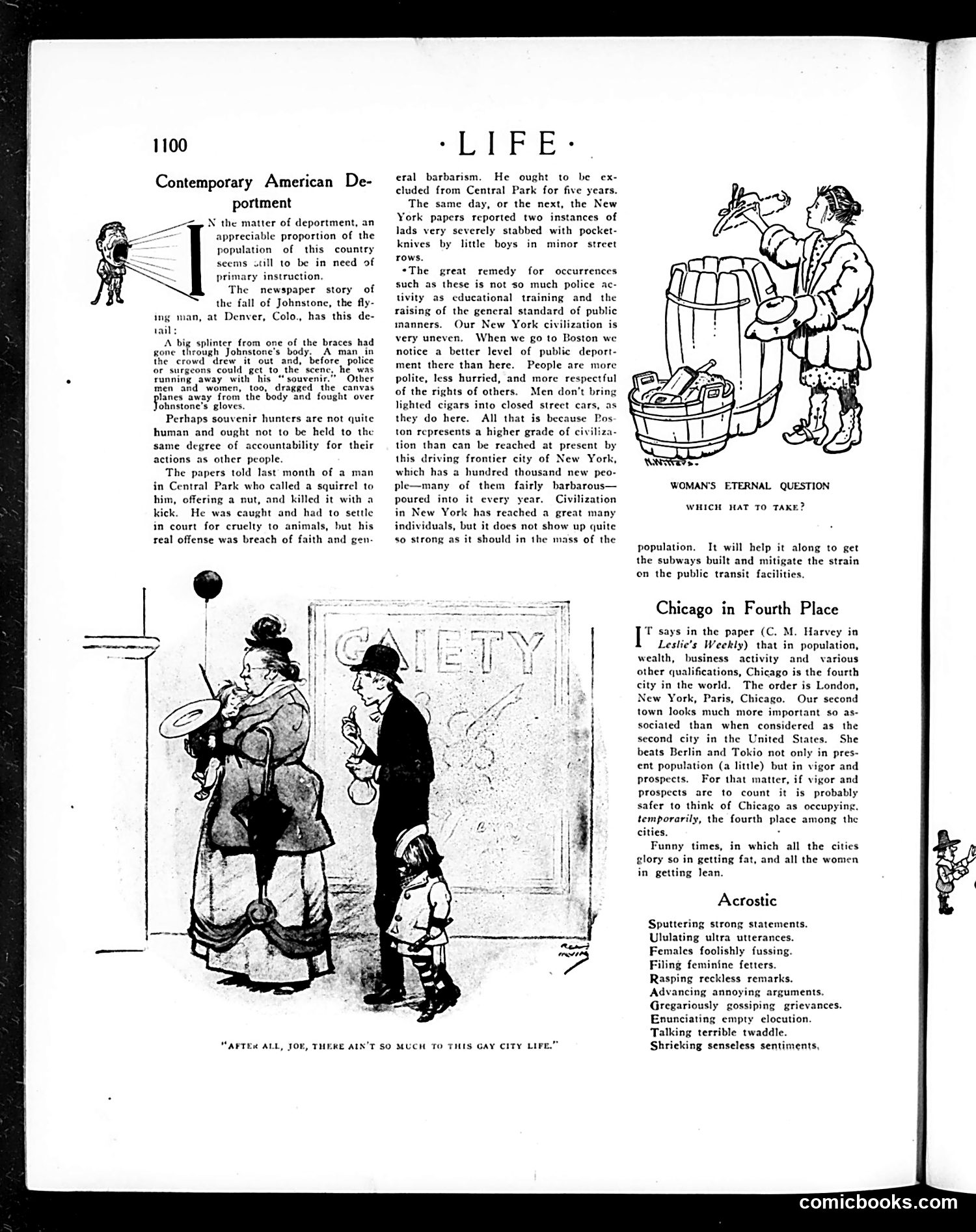
This page contains satirical commentary on urban civilization and public behavior in early 20th-century America. The main cartoon depicts two figures—an adult and child—observing city life, with the caption "After all, Joe, there ain't so much to this gay city life," suggesting disappointment with urban excitement. The text above discusses New York's problems: street crime, uncivil behavior, and lack of public decorum compared to Boston. It critiques how civilization appears uneven in New York despite the city's importance. The "Woman's Eternal Question" cartoon shows a woman deciding what hat to wear—mocking women's fashion obsession. Another section ranks Chicago fourth among world cities by population and wealth, while an acrostic poem lists female character flaws, reflecting period attitudes about women's verbose and emotional nature.
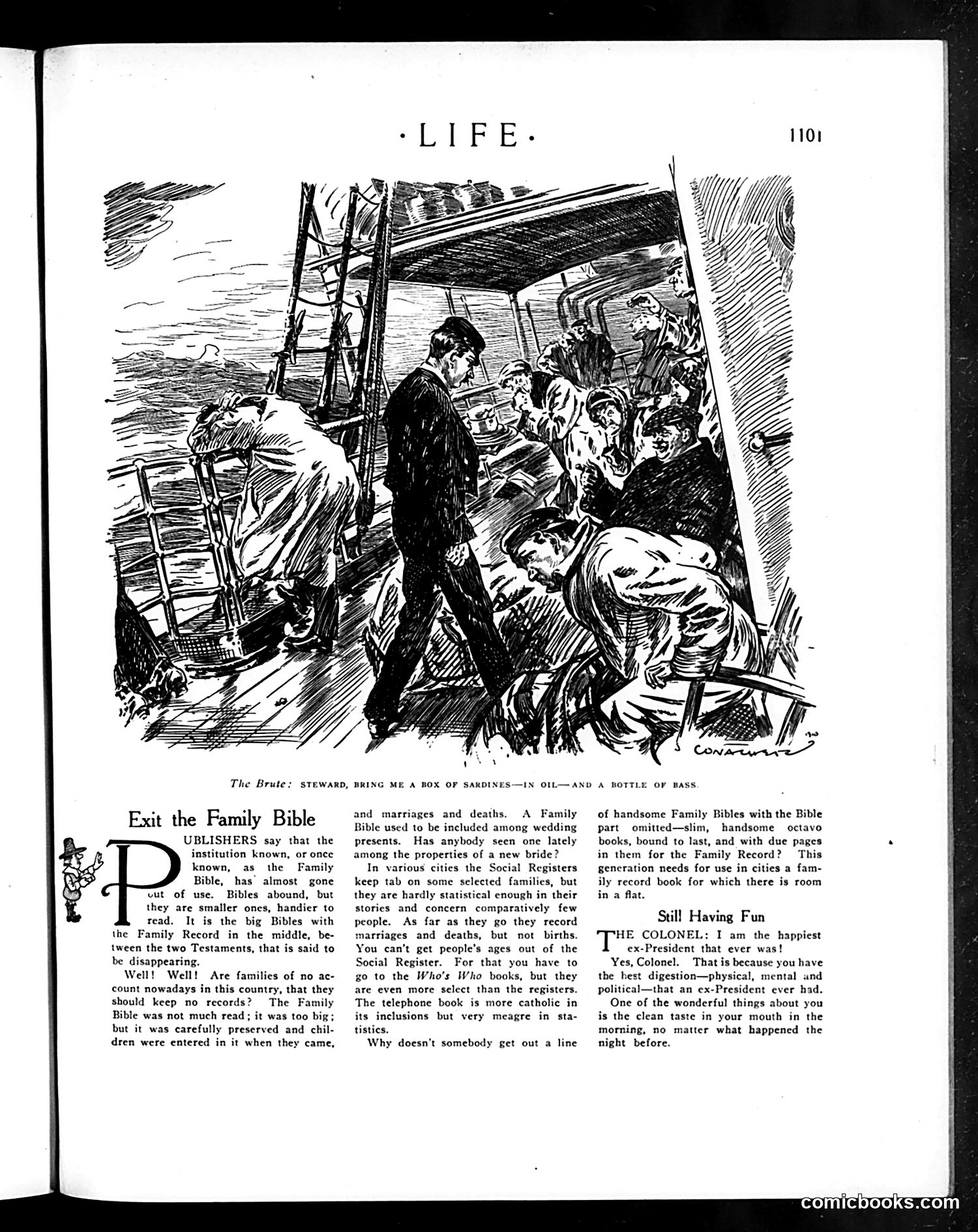
This page contains a satirical article titled "Exit the Family Bible" alongside a sketch depicting a crowded ship scene. The article argues that the Family Bible—once a household staple recording births, marriages, and deaths—is becoming obsolete. Publishers note these record-keeping Bibles are disappearing from use, replaced by other sources like Social Registers and telephone books for tracking family information. The accompanying sketch appears to illustrate immigration or passenger transport, showing crowded conditions aboard a vessel, though its direct connection to the Family Bible commentary is unclear from the visible text. A separate humor piece titled "Still Having Fun" features dialogue between a Colonel and a President (likely Theodore Roosevelt, given the early 1900s publication period), joking about political temperament and morning demeanor.
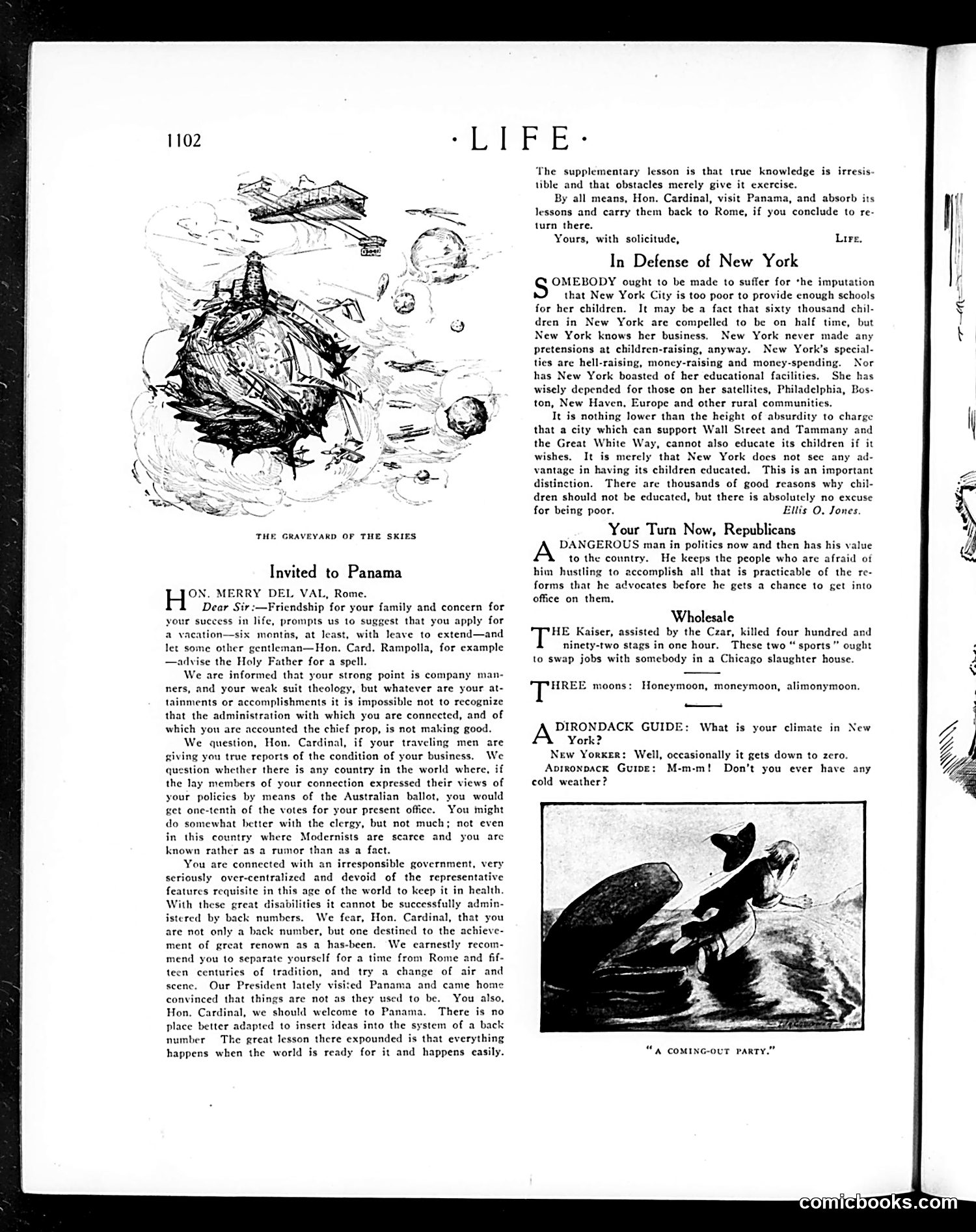
The main cartoon depicts airplanes crashing or falling from the sky, likely satirizing early aviation's dangers and failures—a timely concern in the early 1900s when powered flight was nascent and frequently fatal. The text "Invited to Panama" is a cutting satirical letter addressed to Cardinal Merry del Val (the Pope's Secretary of State), essentially telling him to take a six-month vacation and let Cardinal Rampolla run things instead. The writer argues del Val is a "back number" mismanaging the Church, which operates as an "irresponsible government" lacking representative features. The Panama reference suggests vacation/exile to somewhere remote. "In Defense of New York" sardonically defends New York City against charges of being too poor to fund schools for 60,000 half-time students. The satire argues New York's real specialties are "hell-raising, money-raising and money-spending"—implying the city *chooses* not to educate children despite having wealth for Wall Street and Tammany Hall politics.
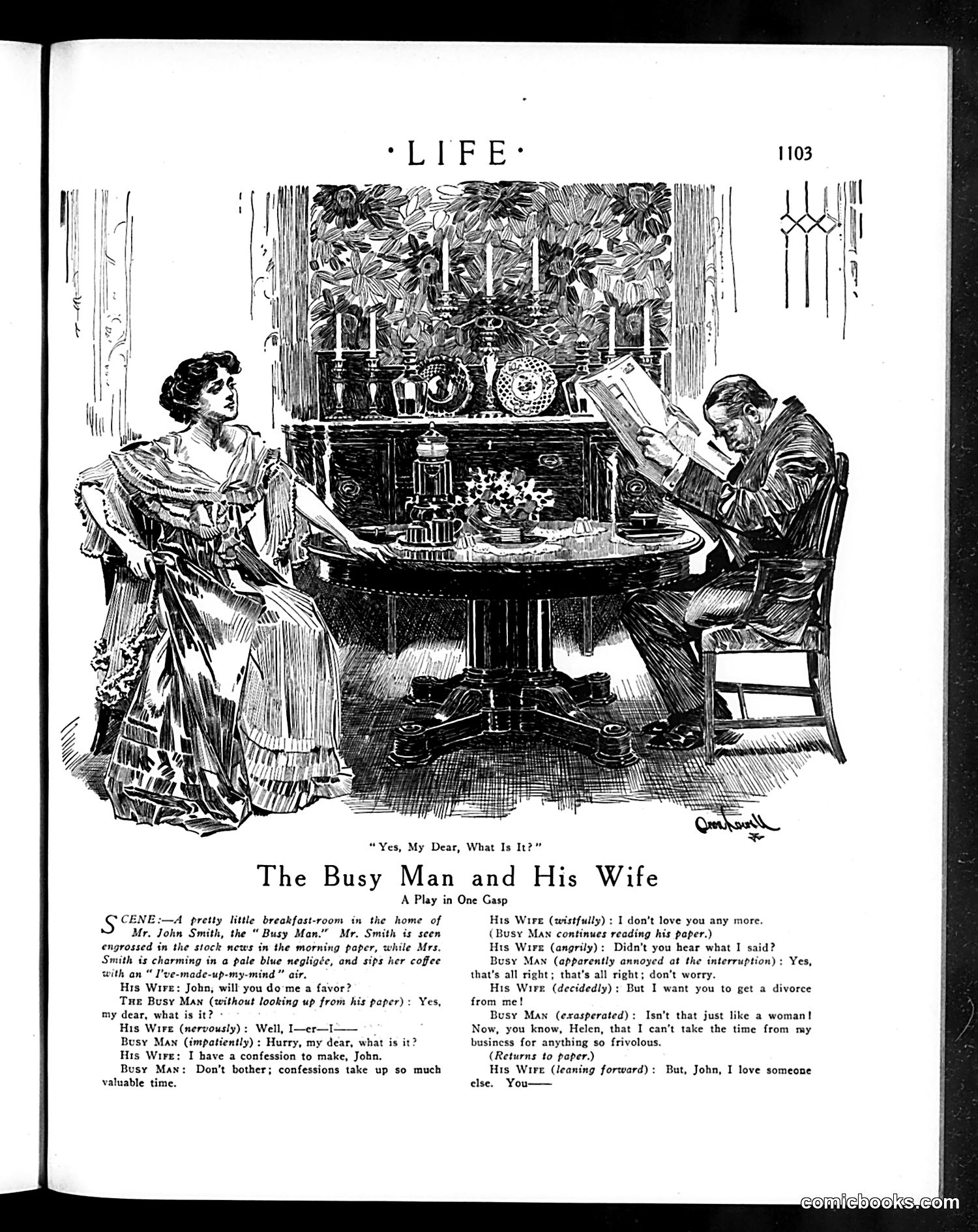
This satirical sketch mocks the stereotype of the early-20th-century workaholic husband, obsessed with business and the stock market. The "Busy Man," John Smith, is so absorbed in his newspaper that his wife Helen's dramatic confession—that she no longer loves him and wants a divorce because she loves someone else—barely registers. The joke targets both male indifference and misplaced priorities: he dismisses her emotional crisis as a frivolous interruption to his business concerns, unable to comprehend that personal relationships might matter more than profit margins. The wife's escalating desperation ("wistfully," "angrily," "decidedly") contrasts sharply with his detached annoyance, amplifying the absurdity. This reflects early-1900s anxieties about industrialization's erosion of domestic life and marital connection among the professional classes.
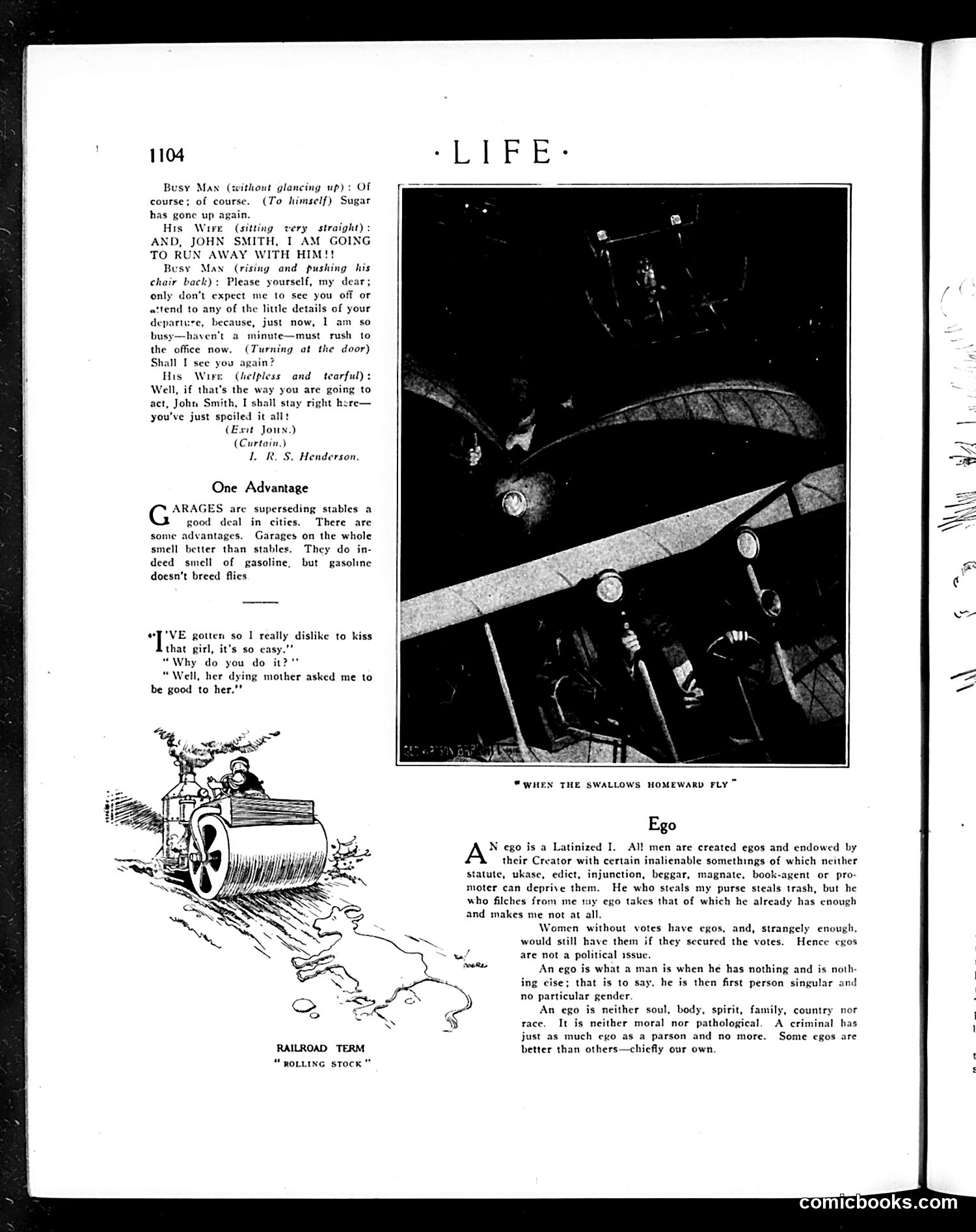
This page contains three satirical pieces reflecting early 20th-century American social attitudes: **"Busy Man" sketch (by L.R.S. Henderson):** A wife announces she's running away with another man, but her preoccupied husband—obsessing over rising sugar prices—barely reacts, telling her not to expect him to handle "details" of her departure. The satire targets the self-absorbed businessman so consumed with work and minor financial concerns that he's oblivious to genuine domestic crisis, rendering his wife's dramatic confession absurd. **"One Advantage":** A brief joke contrasting garages favorably to horse stables (they smell better, don't breed flies), reflecting the automobile's increasing urban presence. **"Ego" essay:** A philosophical piece defining ego as an inalienable human quality independent of morality, social status, or gender. It notes that even women without voting rights possess egos—likely a subtle comment on the suffrage debate of the era, suggesting that ego transcends political rights. The cartoon "When the Swallows Homeward Fly" appears to illustrate romantic sentiment, though its specific meaning is unclear from the visible image.
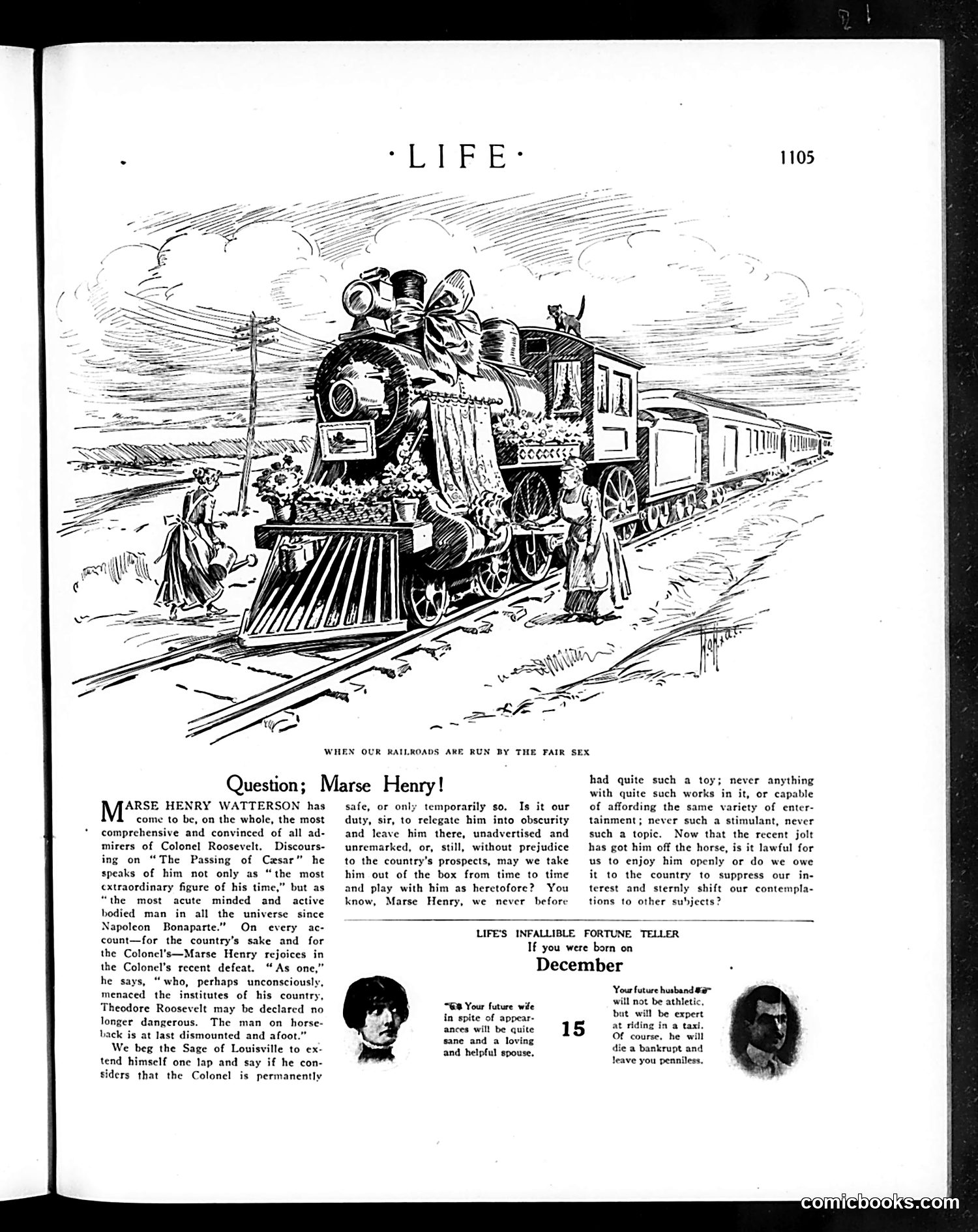
This page satirizes women's suffrage and workplace capability through a whimsical illustration of a locomotive extravagantly decorated with bows and flowers, operated by women. The cartoon implies absurdity in the idea of women running railroads—suggesting they would prioritize decoration over functionality, a common anti-suffrage argument of the era. The accompanying text, a letter to "Marse Henry" (Henry Watterson, a real Louisville newspaper editor), discusses Theodore Roosevelt's recent electoral defeat. It jokingly treats Roosevelt as a "toy" the public enjoys playing with, questioning whether the country should keep him "in the box" or continue using him for entertainment. The "Fortune Teller" section mocks matrimony, predicting an athletic-free husband who dies bankrupt—cynical commentary on marriage and women's economic dependence. Together, these pieces reflect early 20th-century anxieties about changing gender roles and political power.
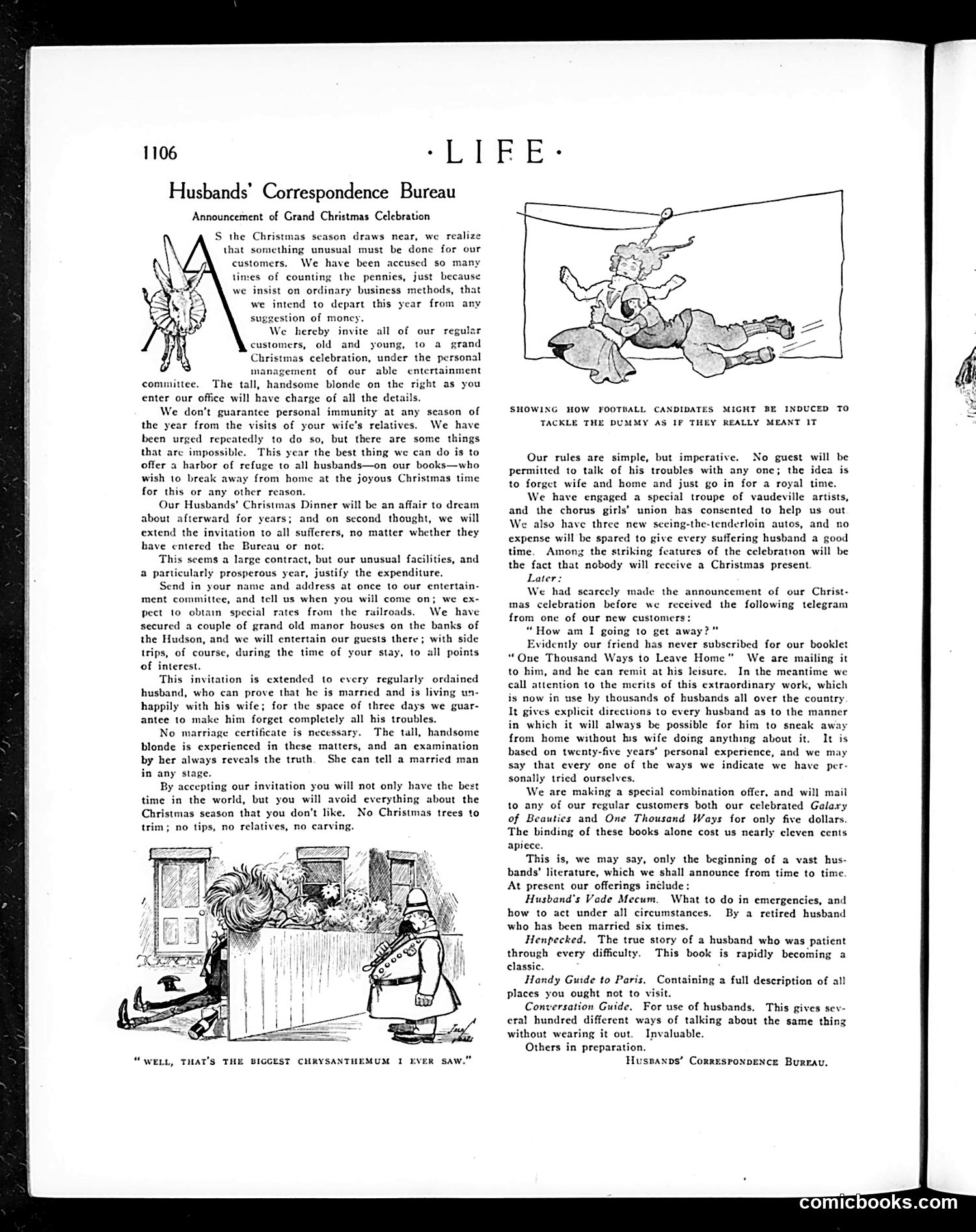
This is a satirical advertisement for a fictional "Husbands' Correspondence Bureau"—a fake service offering married men a Christmas escape from their wives and domestic obligations. The joke targets early 1900s marital dissatisfaction and gender dynamics. The Bureau promises husbands refuge at manor houses with entertainment (vaudeville, "chorus girls"), fancy dinners, and automobile trips—all framed as relief from Christmas's domestic demands (tree-trimming, relatives, wife's company). The satire cuts both ways: it mocks husbands seeking escape from marriage while also critiquing the restrictive, joyless Christmas obligations imposed on men. References to the "tall, handsome blonde" who can identify suffering husbands and a companion booklet ("One Thousand Ways to Leave Home") add ribald humor. The cartoons below show absurd domestic scenes, reinforcing the comedy about marital strife. This represents *Life* magazine's typical early-20th-century humor targeting middle-class marriage and gender relations.
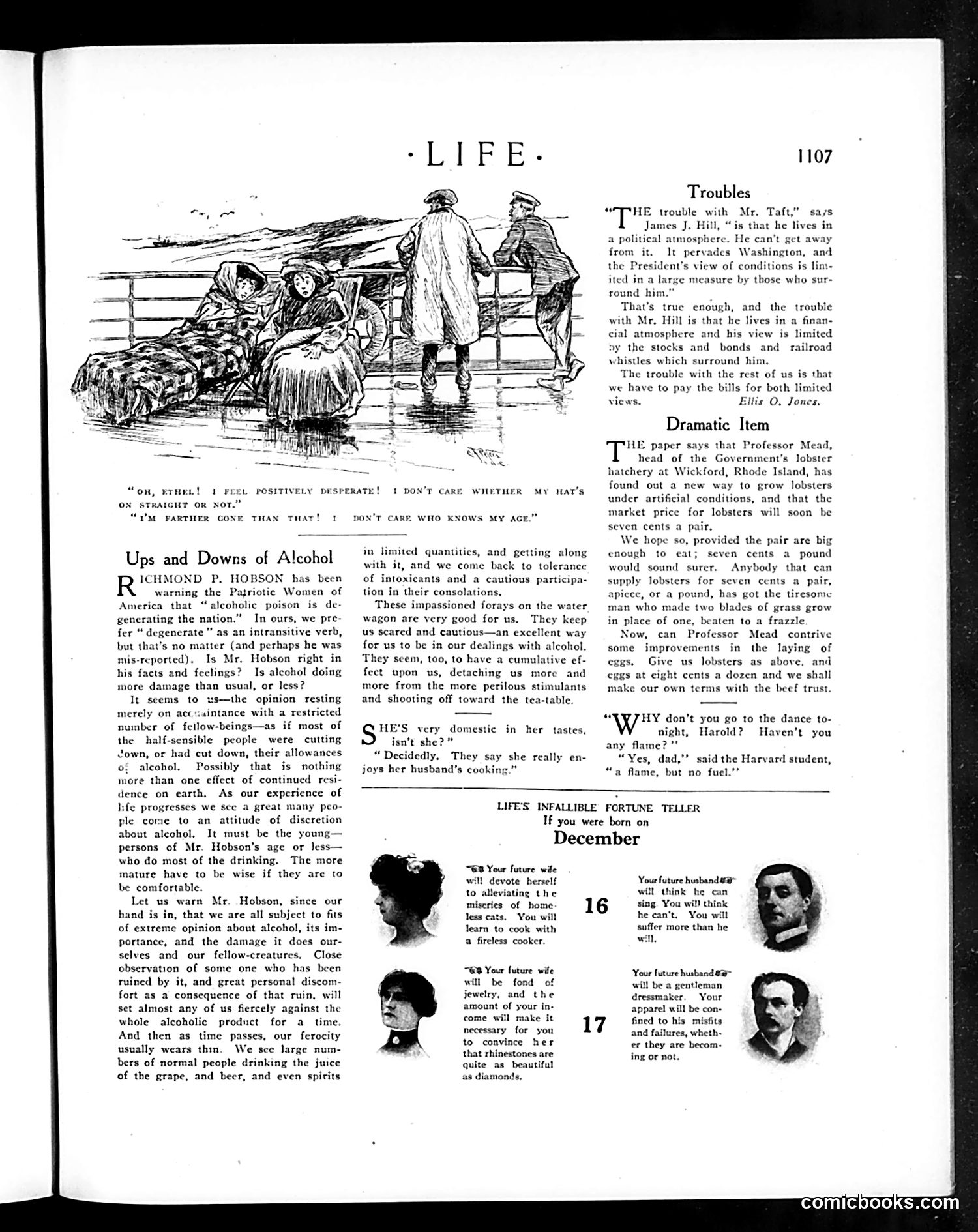
## Main Cartoon The top illustration depicts two disheveled figures in a boat, with dialogue about hats and age. This appears to satirize **Richmond P. Hobson**, a political figure warning against "alcoholic poison." The accompanying article critiques his moralistic stance, arguing that experienced people naturally moderate their drinking, while only the young drink excessively. Life's position: periodic temperance campaigns serve a purpose, but absolute prohibition advocacy oversimplifies a complex social issue. ## Secondary Content - **"Troubles"** column compares Taft's limited political perspective with James J. Hill's financial bias—both men trapped by their environments - **"Dramatic Item"**: Satire on a lobster-farming innovation; sardonic commentary on applying agricultural improvements to commercial food production - Small humor item about a wife enjoying her husband's cooking ## Context Published during the Pre-Prohibition era (likely 1900s-1910s), Life maintains a sophisticated, moderate stance against temperance extremism while acknowledging alcohol's real dangers.
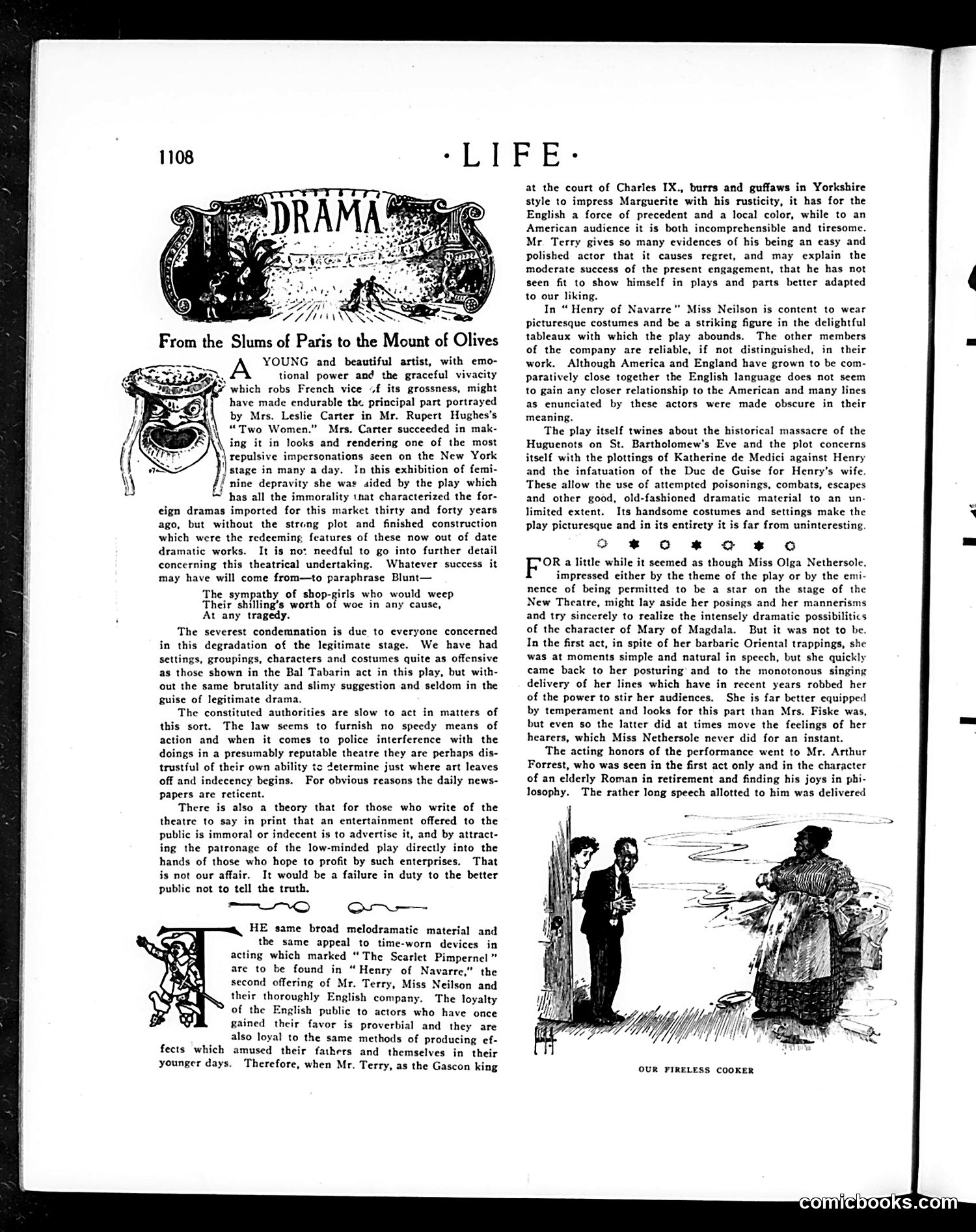
This page contains drama criticism rather than political cartoons. The content critiques two theatrical productions: **"Two Women"** (starring Mrs. Leslie Carter): The reviewer harshly condemns this play as immoral melodrama imported from France, depicting "feminine depravity" with offensive content (including a "Bal Tabarin act"). The critic argues it lacks the artistic merit that might justify its indecency, and attacks authorities and newspapers for failing to oppose such productions. The implicit moral concern reflects Progressive-era anxieties about foreign theatrical influences corrupting American audiences. **"Henry of Navarre"** (starring Terry and Miss Neilson): This piece criticizes English actors for performing in outdated melodramatic style—exaggerated accents and gestures that amuse British audiences but bore Americans. The reviewer suggests Terry is talented but chooses inferior material. Both reviews reflect turn-of-century American cultural anxiety about theatrical standards and foreign influence. The illustration "Our Fireless Cooker" appears unrelated to the text—likely an advertisement or filler.
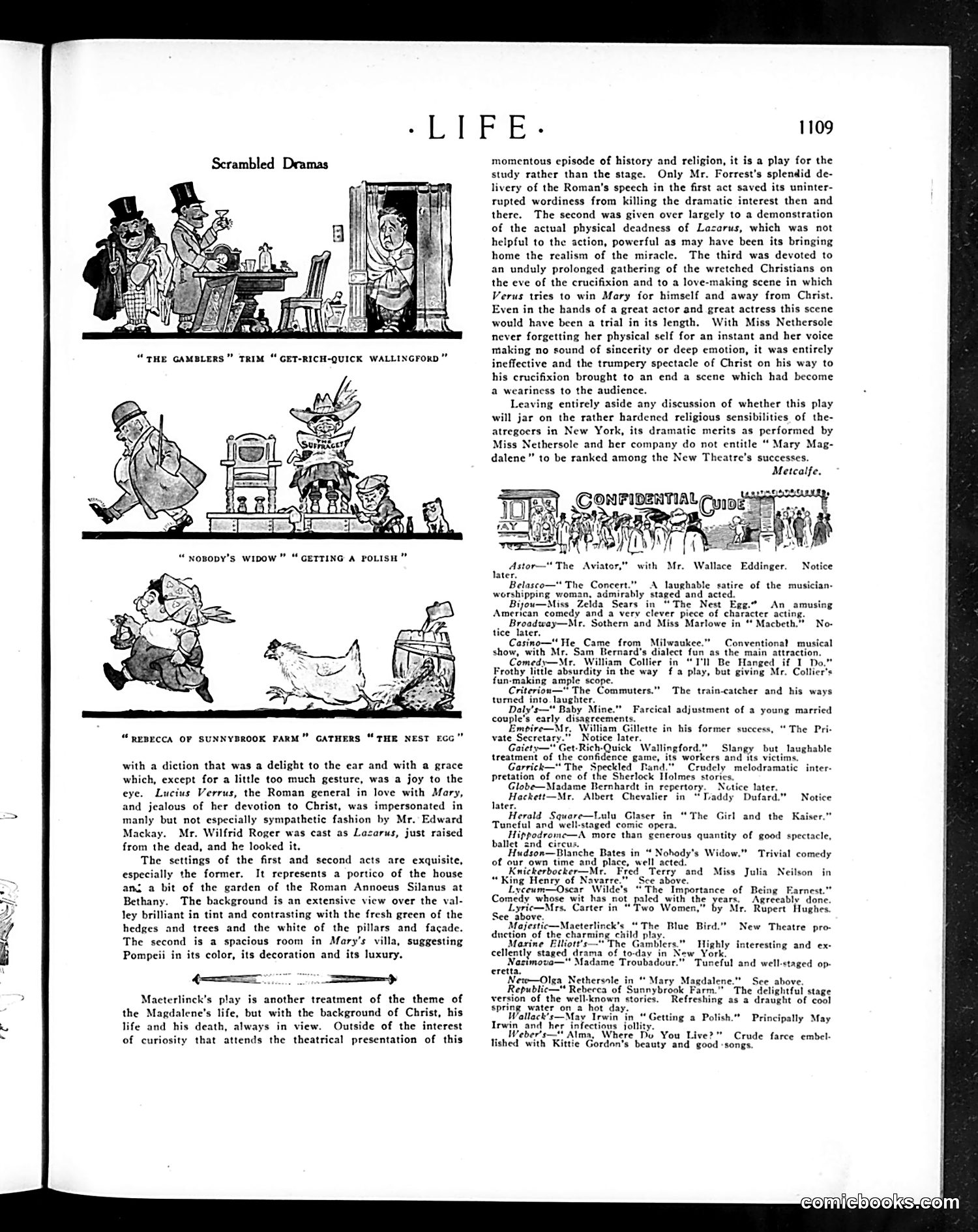
This page reviews Maurice Maeterlinck's play "Mary Magdalene," performed by actress Alla Nazimova. The critic is largely dismissive, praising set design and individual performances (particularly Edward Mackay as the Roman general Lucius Verus) while faulting the overall production as tedious and poorly suited to stage. The cartoons at top left satirize popular Broadway plays of the era—"The Gamblers," "Get-Rich-Quick Wallingford," and "Rebecca of Sunnybrook Farm"—presenting them as commercial spectacles. The sketch captions mock how these productions "trim" (compete with) each other for audiences. The bulk of the page consists of brief theater notices for various New York productions, typical of Life's theater column. The Magdalene review dominates, criticizing Nazimova's emotional restraint and the play's excessive length, particularly in its final act's romantic scene between Mary and Verus.
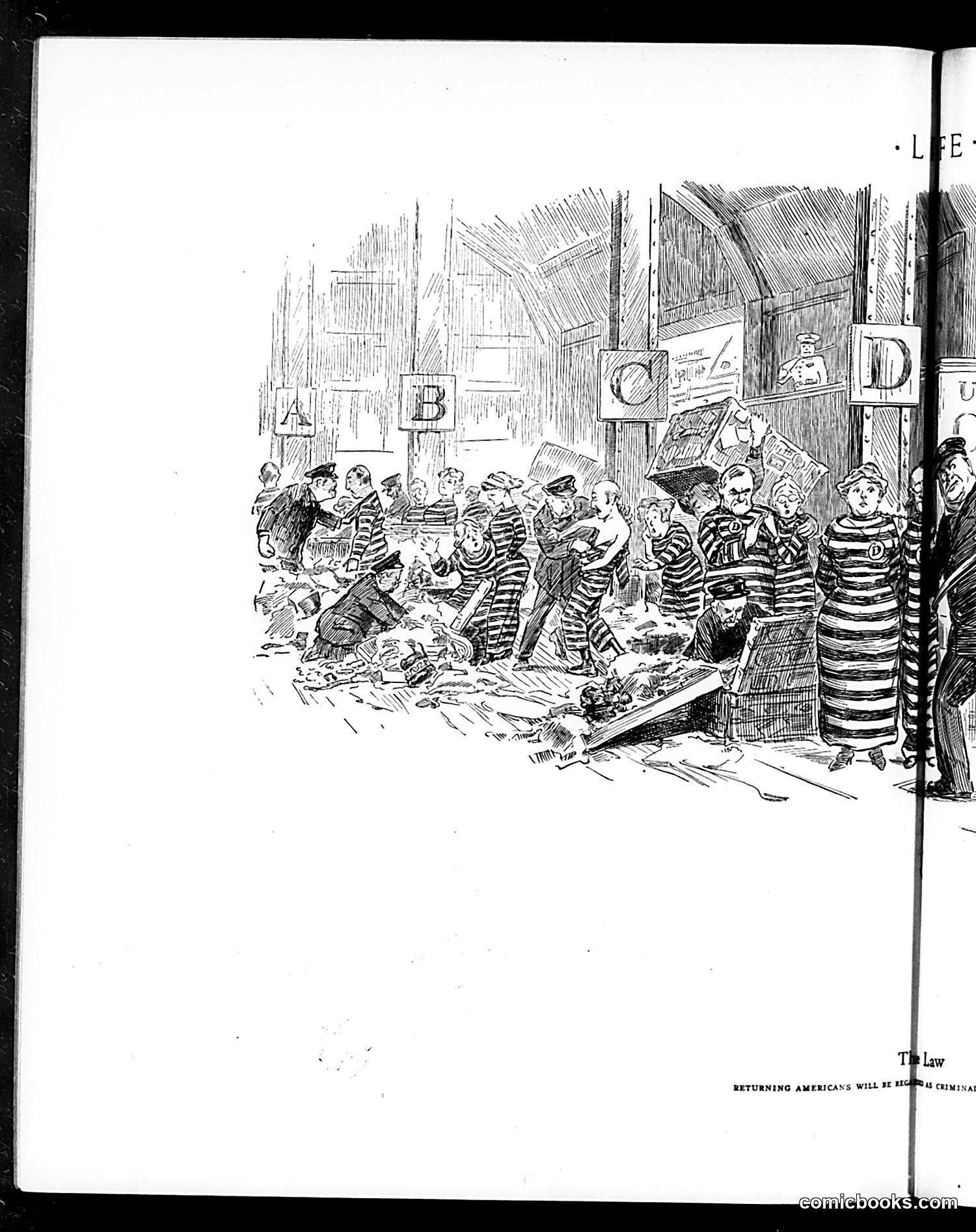
This appears to be a satirical cartoon from *Life* magazine showing a prison yard scene. Multiple figures wear striped prison uniforms, suggesting inmates. The caption at the bottom reads "RETURNING AMERICANS WILL BE HE[LD AS] CRIMINA[LS]" (text cut off). The cartoon likely satirizes American soldiers or citizens returning from abroad—possibly after World War I or a military conflict—being treated as criminals upon their return home. The prison setting and uniforms suggest the artist is critiquing harsh treatment of returning servicemembers or warning of potential legal consequences they might face. Without the complete caption and publication date visible, the specific historical event remains unclear, though the strip uniforms and institutional setting clearly convey criminalization of the returning Americans.
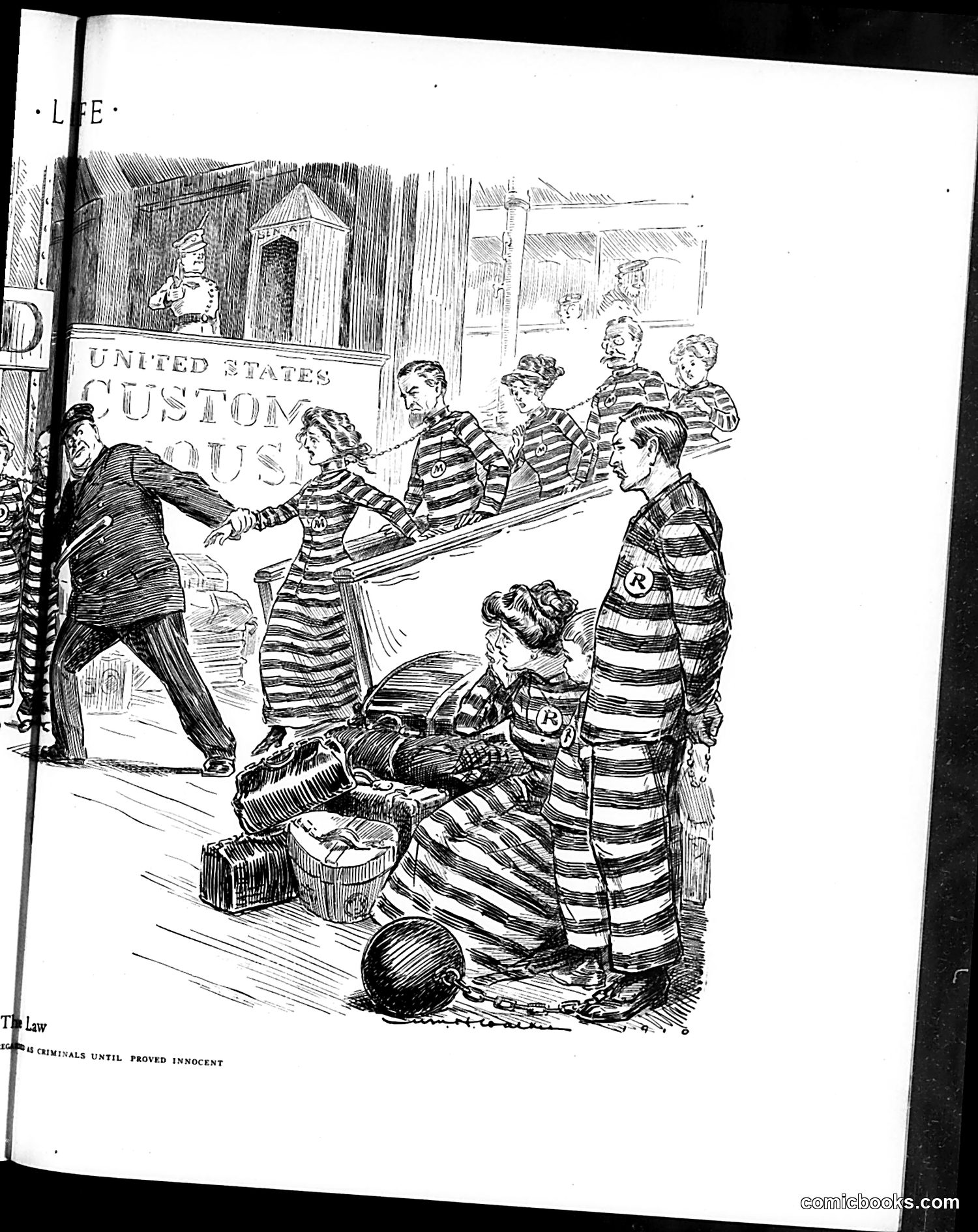
This cartoon satirizes the American legal principle of "innocent until proven guilty." The image shows prisoners in striped uniforms at a U.S. Customs House, with an official (left) appearing to process or detain them. The caption's reversed phrasing—"criminals until proved innocent"—suggests the cartoon critiques how customs enforcement or immigration procedures treat people as guilty by default, inverting proper legal protections. The striped prison garb and crowded scene emphasize dehumanization. This likely addresses early 20th-century concerns about due process violations in customs or immigration enforcement, where individuals could be detained and presumed problematic rather than afforded proper legal protections. The satire warns against abandoning fundamental legal safeguards in pursuit of security or regulatory compliance.
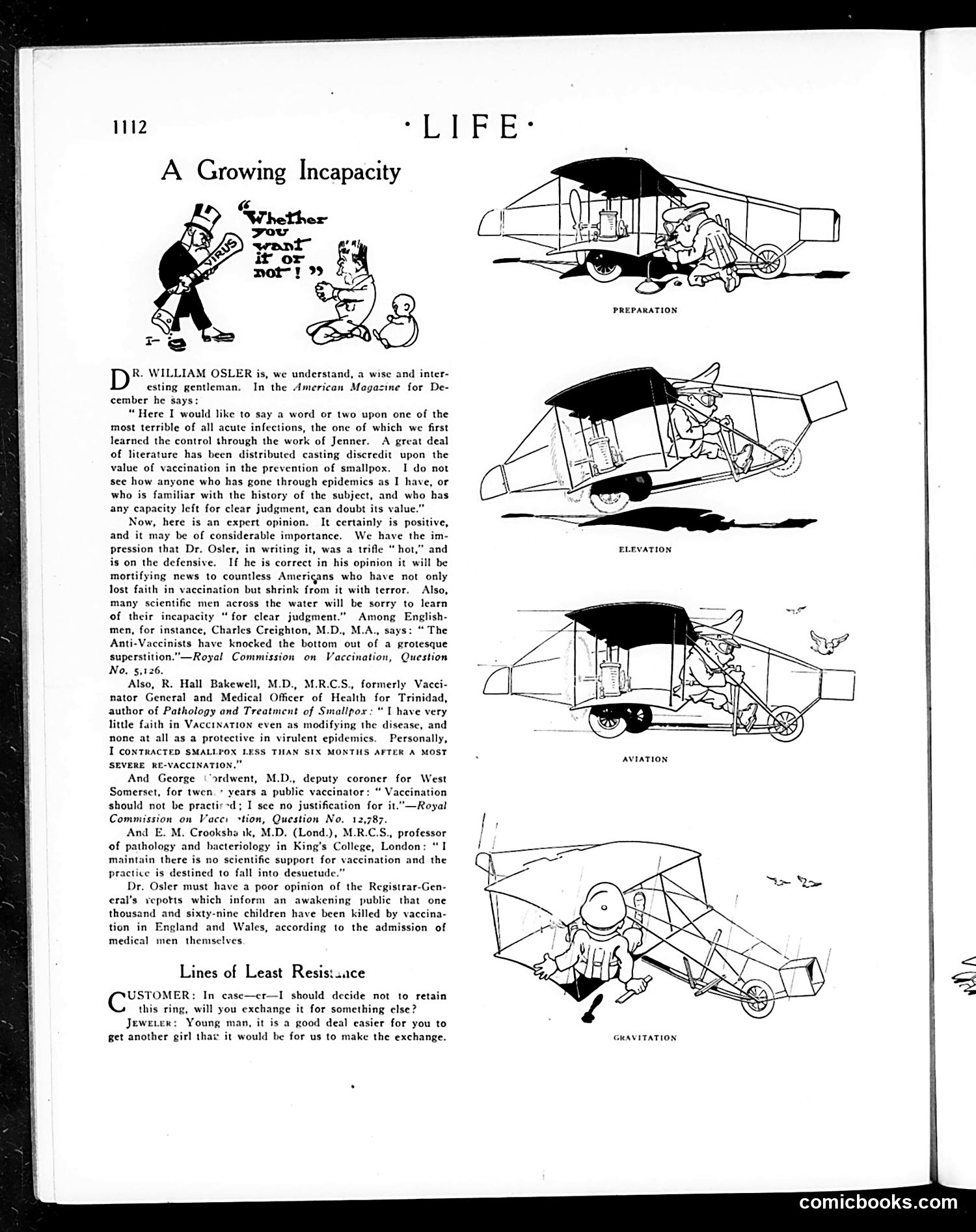
This page satirizes **anti-vaccination sentiment** in early 20th-century America. Dr. William Osler, a respected physician, defends vaccination against smallpox as effective and necessary. Life magazine presents his argument alongside contradictory testimony from other doctors who doubt vaccination's value or claim it harmed them. The satire works by **juxtaposing expert opinion**: Osler confidently endorses vaccination based on epidemiological evidence, while Life quotes prominent medical figures (Creighton, Bakewell, Fordwent, Crookshanks) who reject it entirely. The magazine appears skeptical of Osler's defensive tone, implying his certainty masks uncertainty within the medical profession itself. The cartoon at top left—a figure juggling uncertainty about vaccination—reinforces this theme of confusion. The page demonstrates that **vaccine hesitancy is not modern**: in this era, legitimate doctors publicly rejected vaccination despite its proven track record against smallpox.
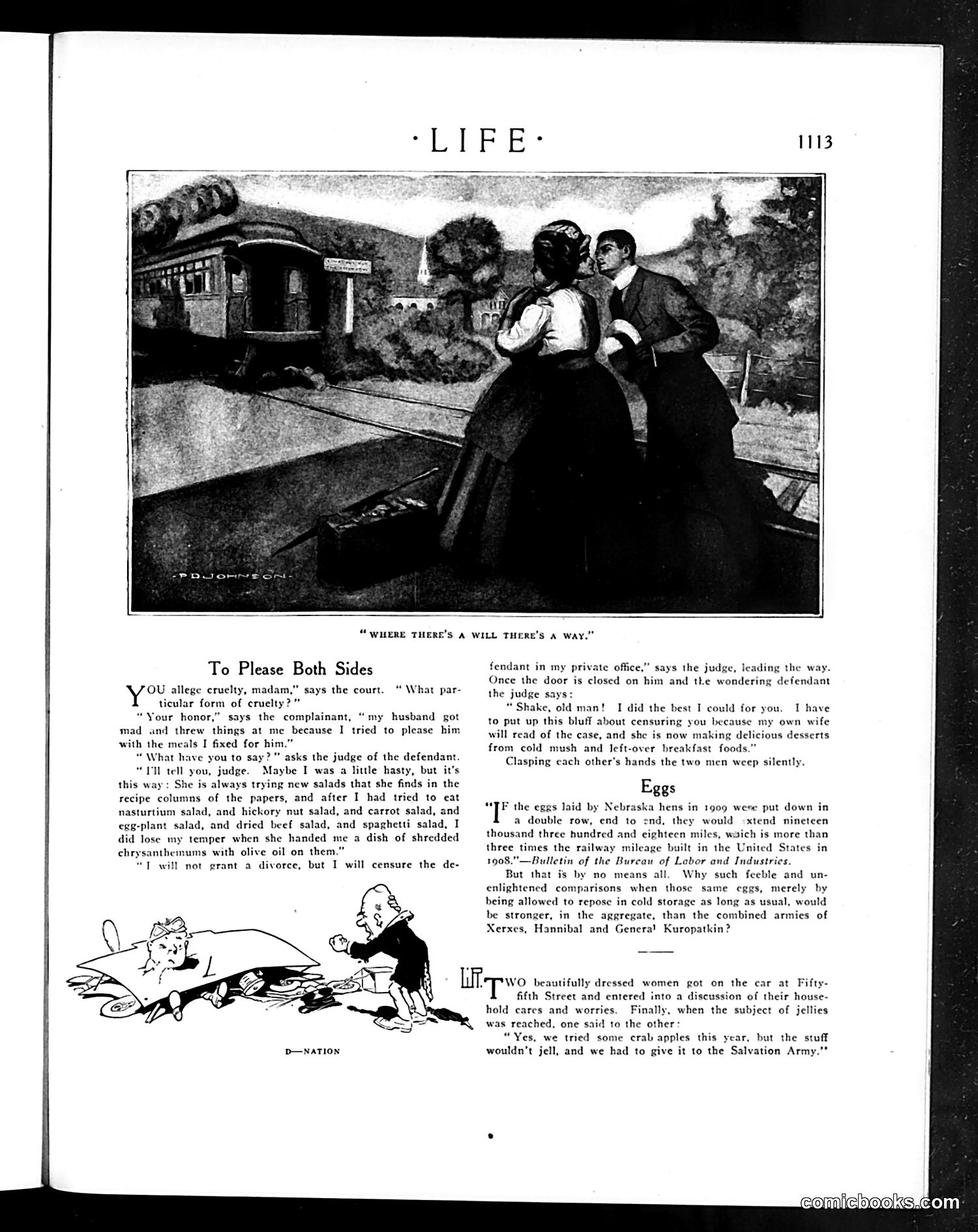
This page contains three satirical pieces mocking domestic life and food culture circa 1909-1912. **"To Please Both Sides":** A husband and wife appear in court—she claims cruelty, he admits throwing things because she serves experimental, bizarre salads (nasturtium, hickory nut, even shredded chrysanthemums). The judge publicly censures him but privately confesses his own wife now torments him with strange recipes too, and they bond in male solidarity. The satire targets two things: women's fascination with trendy recipe columns from newspapers/magazines, and the hypocrisy of judicial authority that secretly shares the defendant's frustrations. **"Eggs" section:** This mocks absurdly inflated statistical comparisons—comparing Nebraska hens' 1909 egg production (mileage-wise) to railroad construction. The satirist then extends the joke absurdly, suggesting eggs in cold storage could match ancient armies' strength. **Final anecdote:** Two wealthy women discuss failed jelly-making, concluding their failed crab apple preserves went to the Salvation Army (charity for the poor). The satire targets privileged women's domestic pretensions and casual class condescension. All three pieces mock early-20th-century middle/upper-class anxieties about domestic duties and social performance.
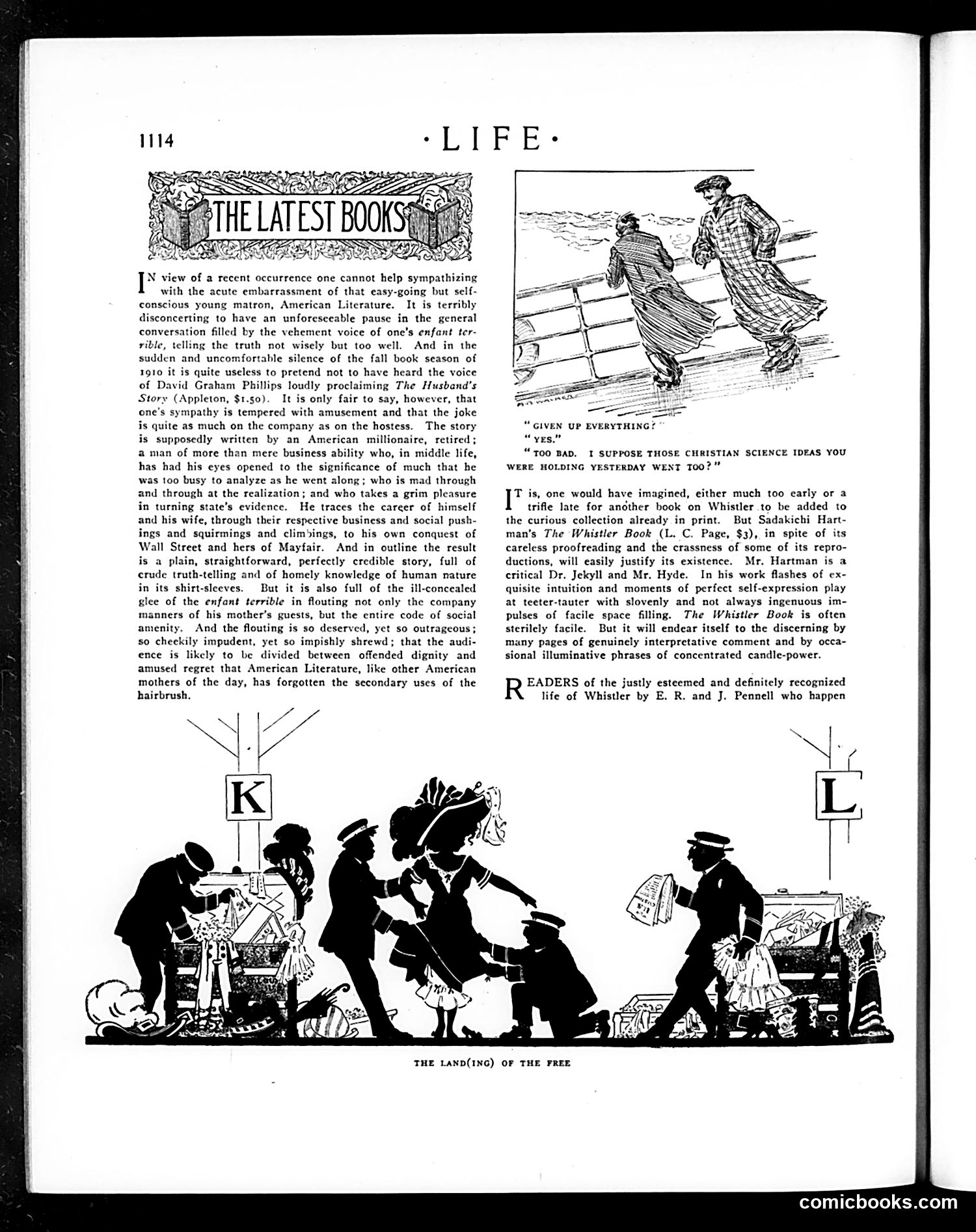
The page contains two satirical pieces about American literature and society circa 1910. **"The Latest Books" section** reviews David Graham Phillips's *The Husband's Story*, comparing American Literature to an embarrassed hostess whose "enfant terrible" (misbehaving child) rudely tells uncomfortable truths at a dinner party. The metaphor criticizes Phillips's novel for its crude social commentary about wealth and ambition, yet acknowledges the criticism is deserved. The satire suggests American high society deserves such exposure—comparing the situation to a child needing discipline ("the hairbrush"). **The cartoon** titled "The Land(ing) of the Free" depicts immigrants arriving with their belongings. The juxtaposition with text mocking Christian Science suggests irony about American freedom and values. **The upper sketch** shows two figures on a fence—likely satirizing hypocrisy or changing convictions, referenced in the dialogue about abandoned "Christian Science ideas." The page reflects early 20th-century American anxieties about new money, social climbing, and immigration.
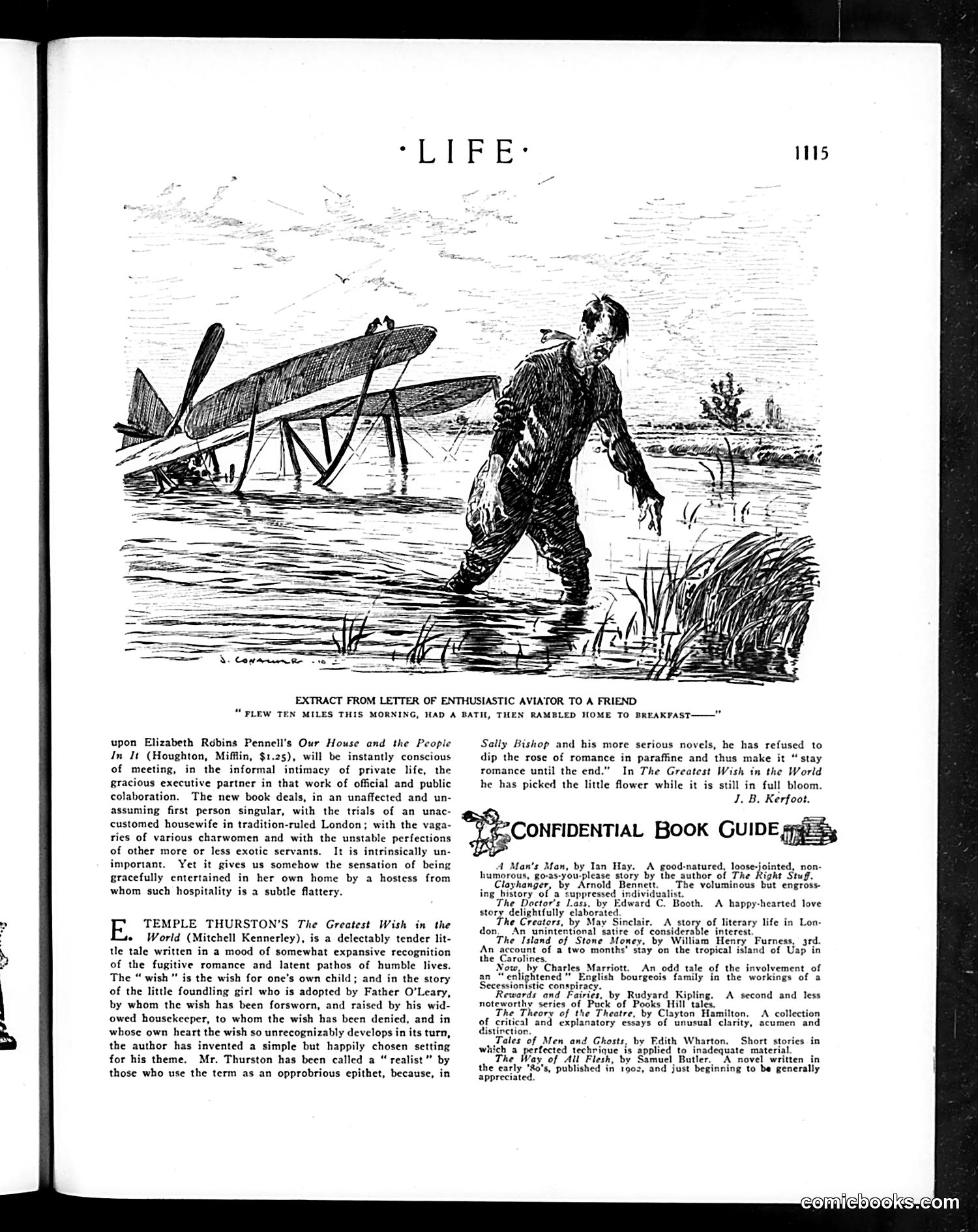
This Life magazine page features a humorous illustration captioned "Extract from Letter of Enthusiastic Aviator to a Friend," depicting an early aviator who has just crash-landed a primitive aircraft in shallow water. The joke satirizes the dangerous, unreliable nature of early aviation (circa 1910s): the pilot casually describes his morning as "flew ten miles...had a bath, then rambled home to breakfast"—treating the crash-landing as an amusing, routine occurrence rather than a near-death experience. The cartoon mocks both aviation's experimental hazards and the nonchalant attitudes of early aviation enthusiasts who downplayed genuine risks. The contrast between the wrecked plane and the pilot's matter-of-fact tone creates the satire: what should be alarming is presented as a mundane part of his day. The page also contains book reviews, indicating this is a literary and cultural commentary magazine.
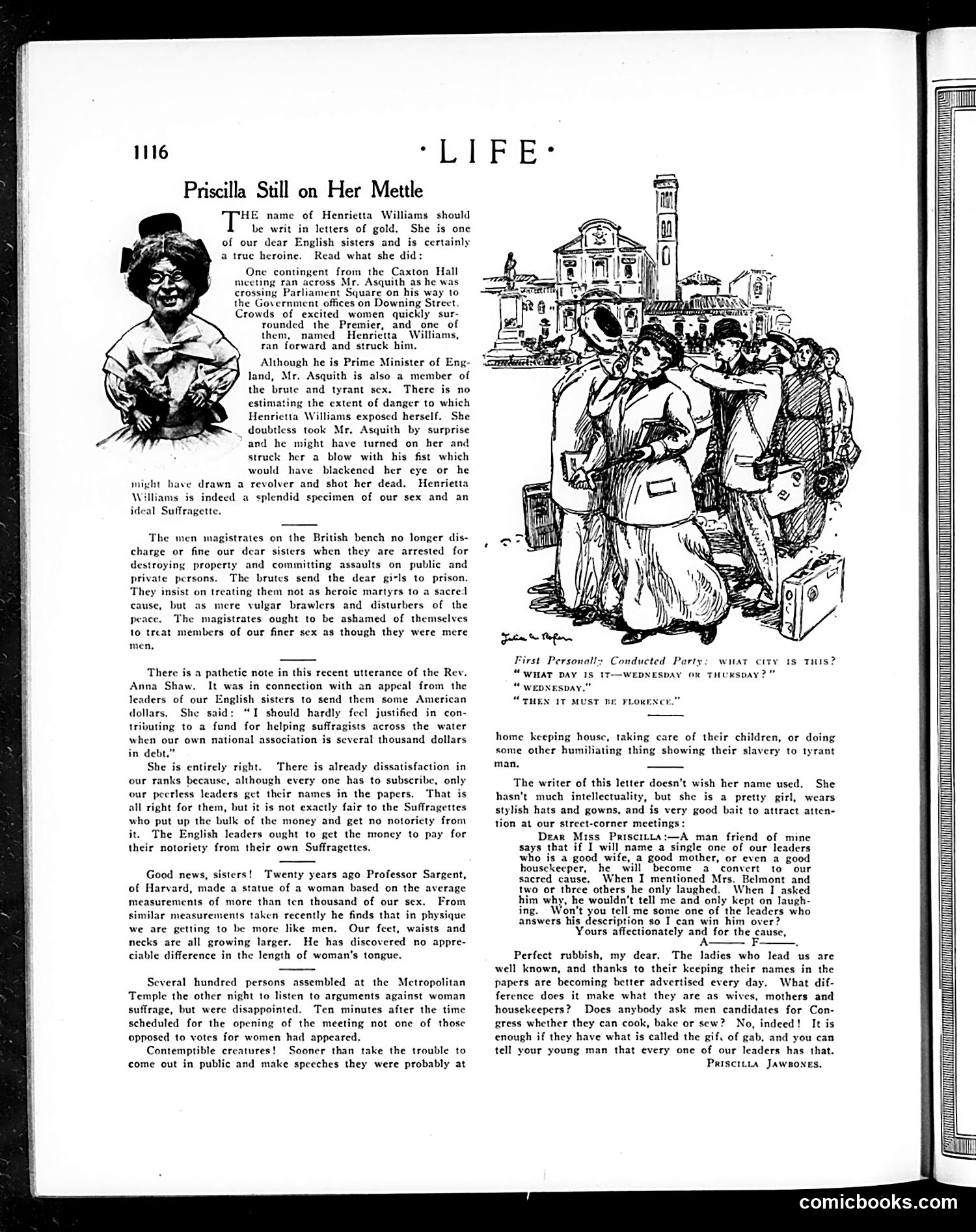
This 1910s *Life* magazine page satirizes the British women's suffrage movement through mock-heroic praise. The headline celebrates Henrietta Williams, who struck Prime Minister Asquith during a suffragette protest at Parliament. **The satire works on multiple levels:** The text ironically praises Williams as a "true heroine" while describing an assault that could have resulted in serious injury or death—highlighting the physical danger suffragettes courted. It mocks male magistrates for treating female activists as "vulgar brawlers" rather than political martyrs, exposing class and gender double standards in the justice system. The page also ridicules suffrage *leadership*—criticizing how funds flow to famous leaders while grassroots activists remain anonymous, and skewering movement infighting over American donations. The cartoon (right) depicts a "First Personally Conducted Party" asking what city they're in, with a woman responding "Florence"—likely mocking tourist groups or suffragette delegations abroad. **Overall:** *Life* presents suffragettes as simultaneously dangerous, vain, and comedically ineffectual, using satire to undermine their political legitimacy.
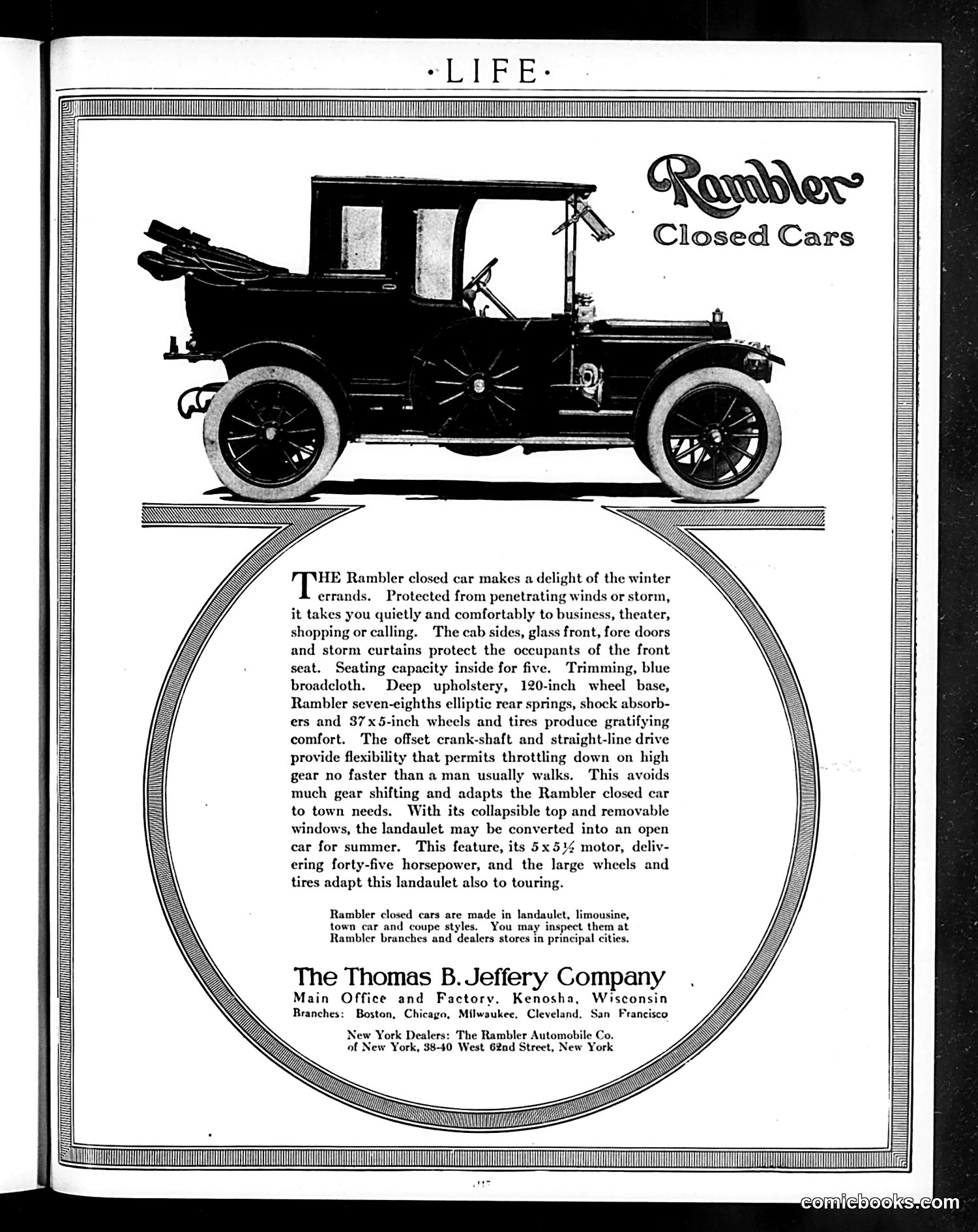
This is an automobile advertisement, not political satire. It promotes the Rambler closed car manufactured by the Thomas B. Jeffery Company, positioned as ideal for winter travel and urban errands. The ad emphasizes practical features: weather protection, passenger capacity, smooth transmission allowing slow speeds ("no faster than a man usually walks"), and convertibility—the collapsible top and removable windows allow conversion to an open car for summer. The appeal is to comfort and convenience for middle-class motorists doing shopping, theater visits, and business travel. The detailed specifications (120-inch wheelbase, 45 horsepower, elliptic springs) target consumers interested in mechanical details. This reflects the early automotive era when closed cars were relatively novel luxuries, and manufacturers competed by highlighting weatherproofing and year-round practicality.
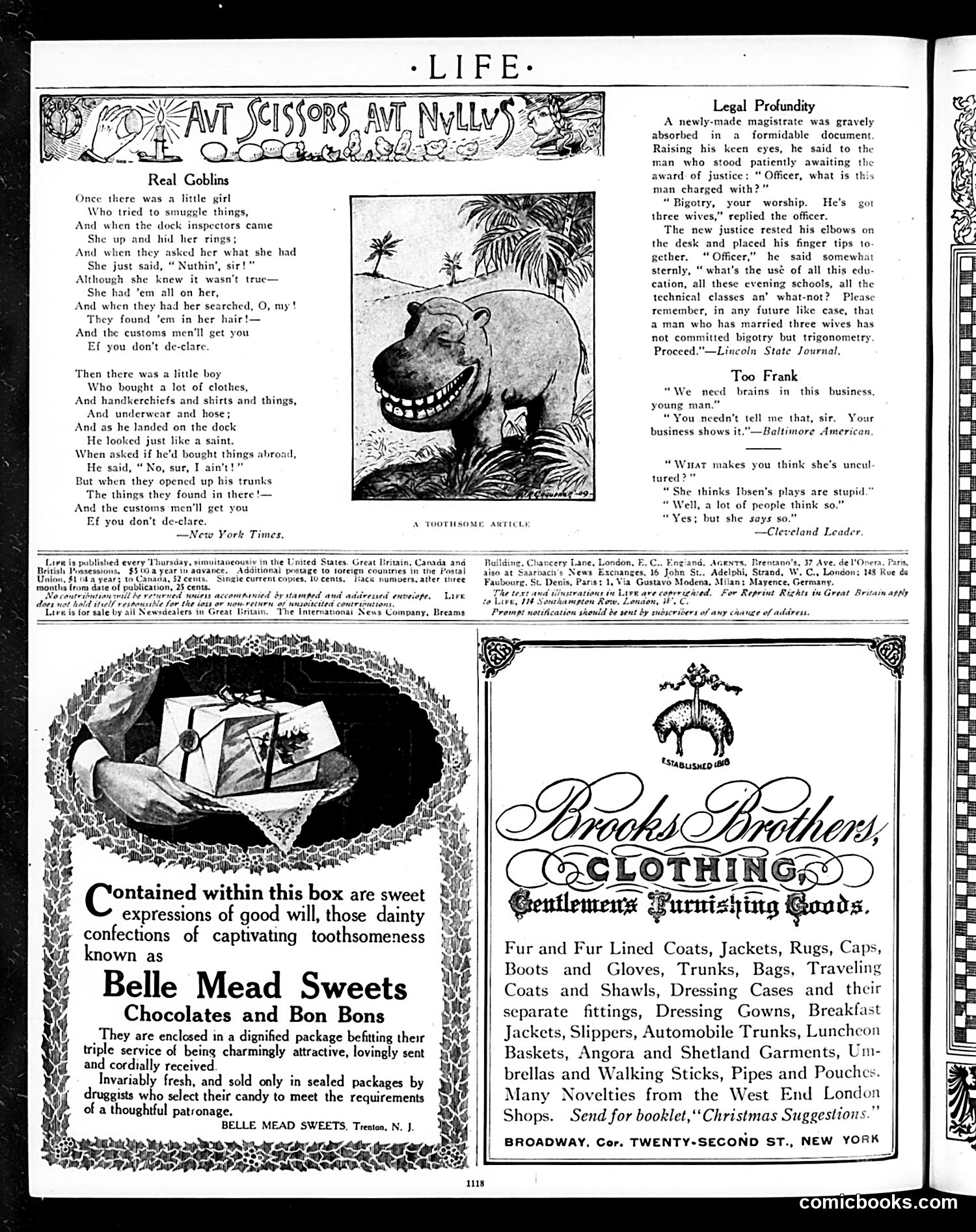
This page contains three satirical pieces typical of Life's early humor: **"Real Goblins"** (left): A cautionary poem about customs enforcement, featuring two children who attempt smuggling—one hiding rings in her hair, another concealing purchased clothes in trunks. The "goblins" are customs inspectors who catch contraband. The satire targets both petty smugglers and the bureaucratic vigilance of customs officials. **"Legal Profundity"** (top right): A joke about a newly appointed magistrate who confuses "bigotry" with "trigonometry" when hearing a case about a man with three wives. The humor mocks judicial incompetence and pretentiousness—the educated official ironically demonstrates ignorance despite his formal training. **"Too Frank"** (bottom right): A brief exchange where a young man brutally agrees that his employer needs brains, implying the business lacks intelligence. The humor lies in his tactless honesty. The page is mostly advertisements (Belle Mead Sweets, Brooks Brothers clothing). The cartoons reflect Life's focus on everyday social folly rather than political satire.
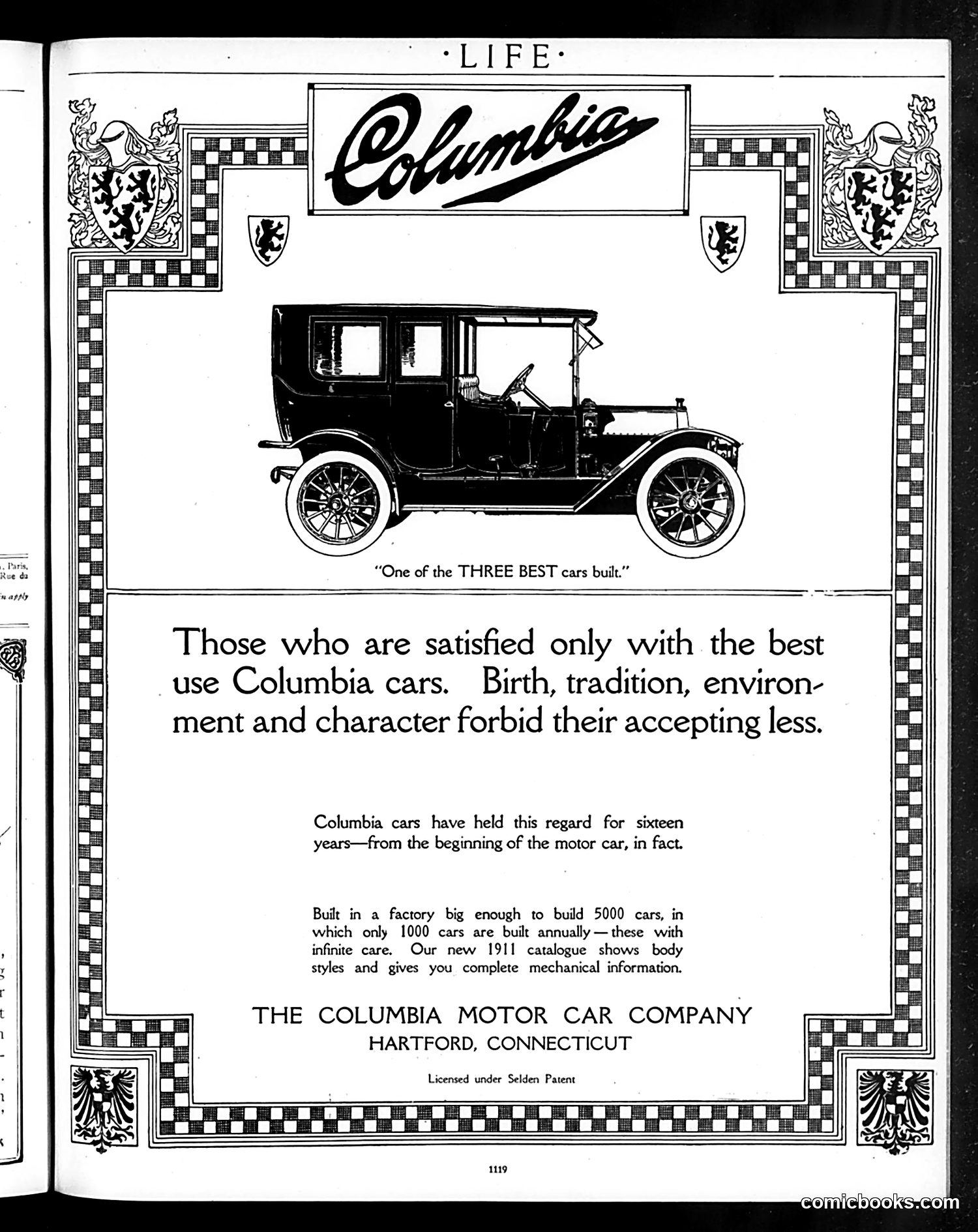
This is a **straight automobile advertisement**, not satire or political commentary. The Columbia Motor Car Company (Hartford, Connecticut) is marketing their 1911 vehicles as luxury products for the wealthy and socially elite. The ad's appeal is explicitly **snobbish**: it claims that only those of superior "birth, tradition, environment and character" use Columbia cars. The company distinguishes itself through *scarcity* (only 1,000 cars built annually in a 5,000-capacity factory) rather than mass production—a reverse-engineering of exclusivity as a selling point. The phrase "one of the THREE BEST cars built" references contemporary automotive rankings; Columbia positioned itself among elite manufacturers. The decorative heraldic borders and formal typography reinforce the aspirational, aristocratic messaging. This reflects early-1900s automotive marketing when cars were still luxury goods for the wealthy.
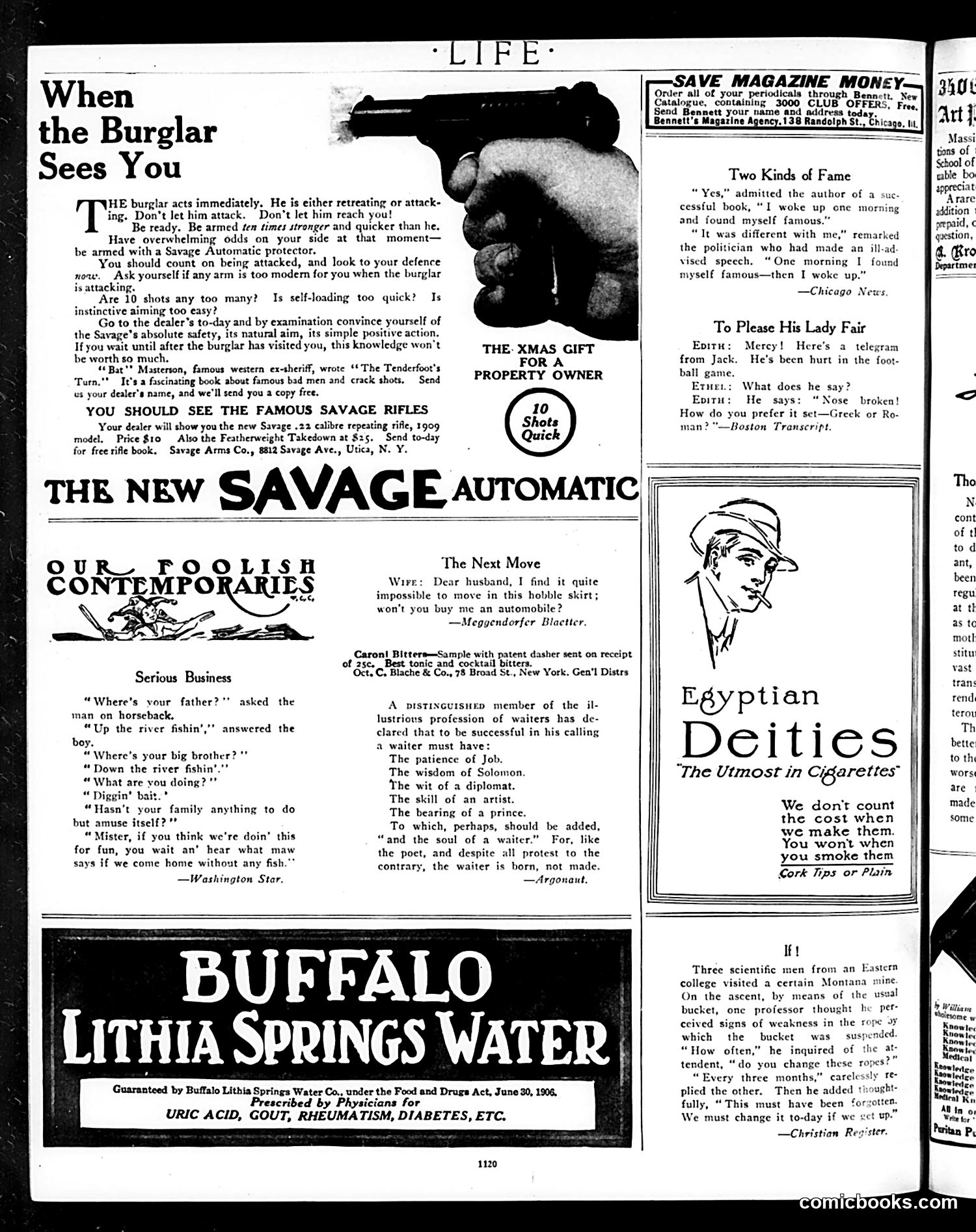
This page is primarily **advertising and humor**, not political cartooning. The main content is a **Savage Automatic rifle advertisement** featuring a silhouetted burglar—appealing to homeowners' security fears in an era of genuine burglary concerns. The advertisement uses fear-mongering ("act immediately," "attacking") to market self-defense weapons. The page also contains **humorous anecdotes** typical of early 1900s magazines: - A dialogue about a family fishing instead of working (social satire on idleness) - A joke about a woman wanting an automobile because hobble skirts prevent movement (commentary on restrictive fashion) - A piece about waiters' required virtues Other sections advertise **cigarettes and mineral water** (marketed for medical purposes like treating gout and diabetes—legal claims now prohibited). The "Two Kinds of Fame" joke plays on a distinction between literary success versus political embarrassment. The "Egyptian Deities" cigarette ad uses Egyptology imagery as a luxury marketing hook popular in that era. The page reflects early 1900s anxieties, fashions, and advertising practices rather than political messaging.
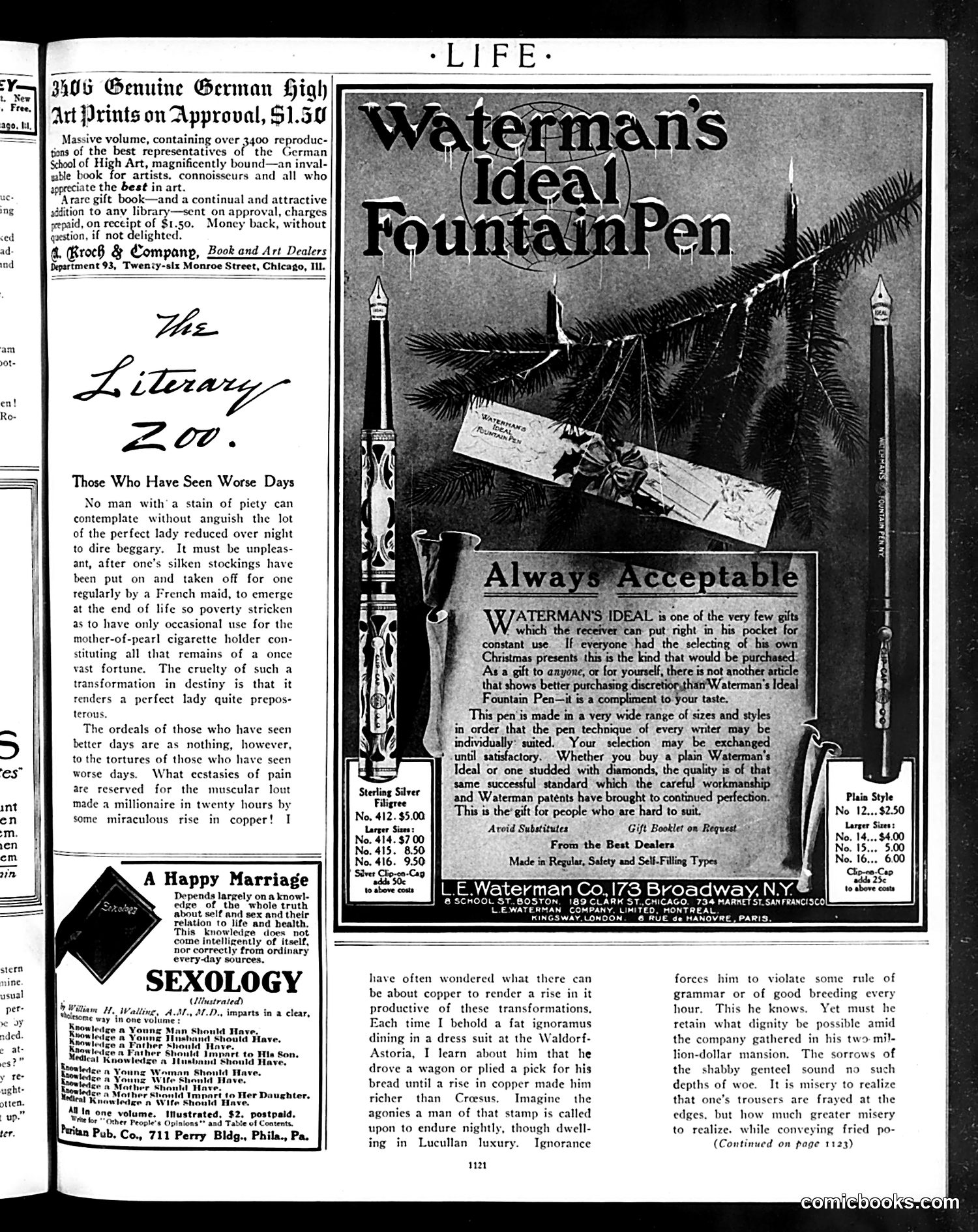
This page is primarily **advertisements** interspersed with satirical commentary. The main content is a Waterman's fountain pen ad (center-right), but the left side contains two pieces of social satire: **"Those Who Have Seen Worse Days"** mocks the pretensions of fallen aristocracy—specifically women from wealthy families reduced to poverty, who cling to remnants of former status (a mother-of-pearl cigarette holder). The satire targets their impracticality and inability to adapt. **The longer untitled piece** satirizes the "nouveau riche"—working-class men (laborers with picks and wagons) who suddenly became millionaires through copper mining booms. The author mocks their discomfort in formal settings (dining at the Waldorf-Astoria in dress suits) and their fundamental ignorance, suggesting their rapid wealth creates psychological torment since they lack the education to enjoy or understand their newfound status. Both pieces reflect early 20th-century class anxiety and snobbery: old money viewing new money as vulgar, uncultured outsiders.
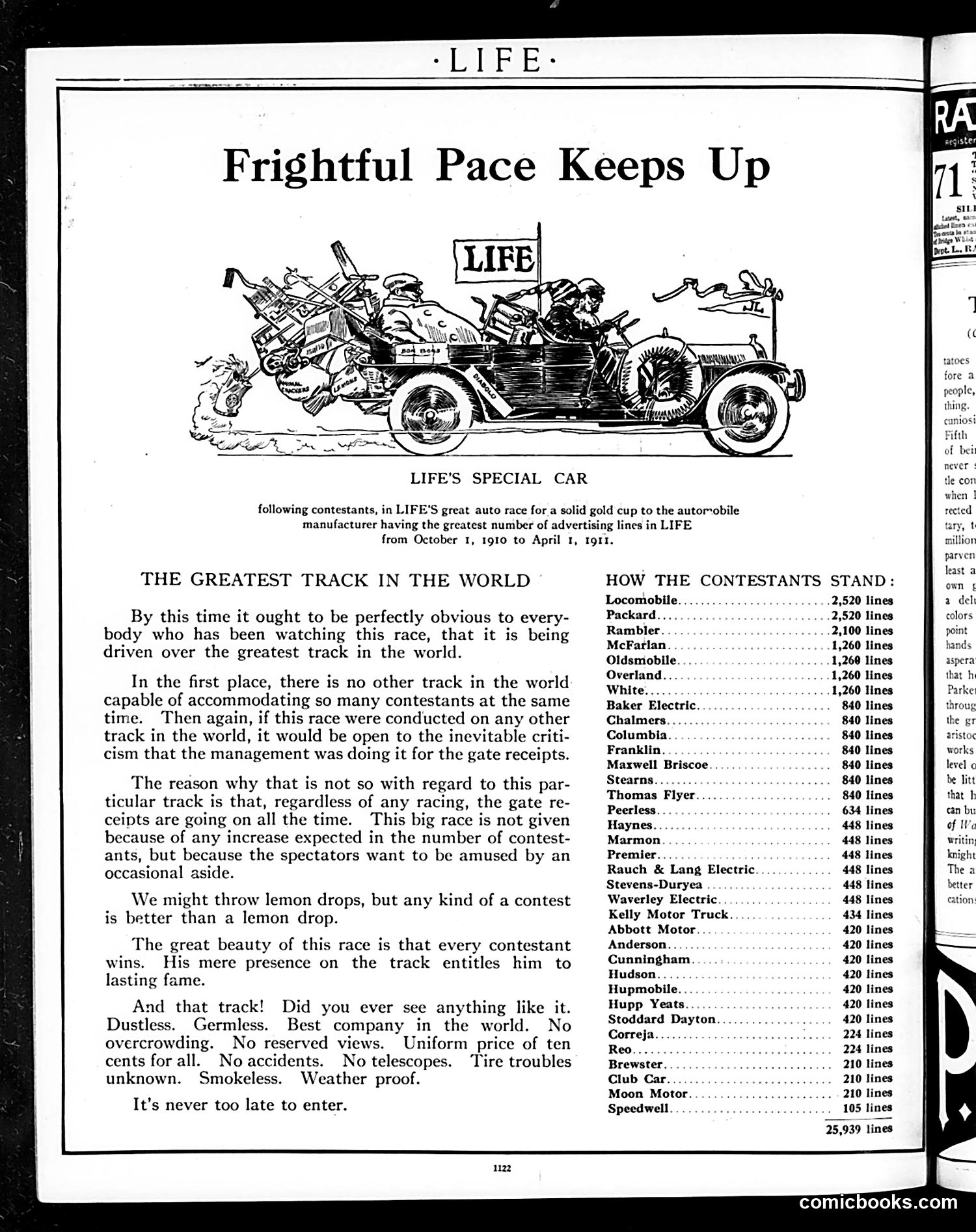
This is **satirical advertising disguised as editorial content**. Life magazine ran a "contest" awarding a gold cup to whichever automobile manufacturer purchased the most advertising lines in the magazine from October 1910 to April 1911. The accompanying essay mockingly praises this "race" and "track" (Life magazine itself), using absurdist language to highlight the transparent commercialism: the track is "dustless" and "germless," admission costs only ten cents, and "every contestant wins" simply by advertising. The satirical point is obvious—Life is essentially auctioning the contest to the highest bidder while pretending to conduct a legitimate competition. The cartoon's chaotic "special car" piled with junk visually reinforces this chaos of competing manufacturers fighting for advertising prominence. The appended standings list shows actual line counts, confirming this was a real, if tongue-in-cheek, advertising competition within the magazine itself.
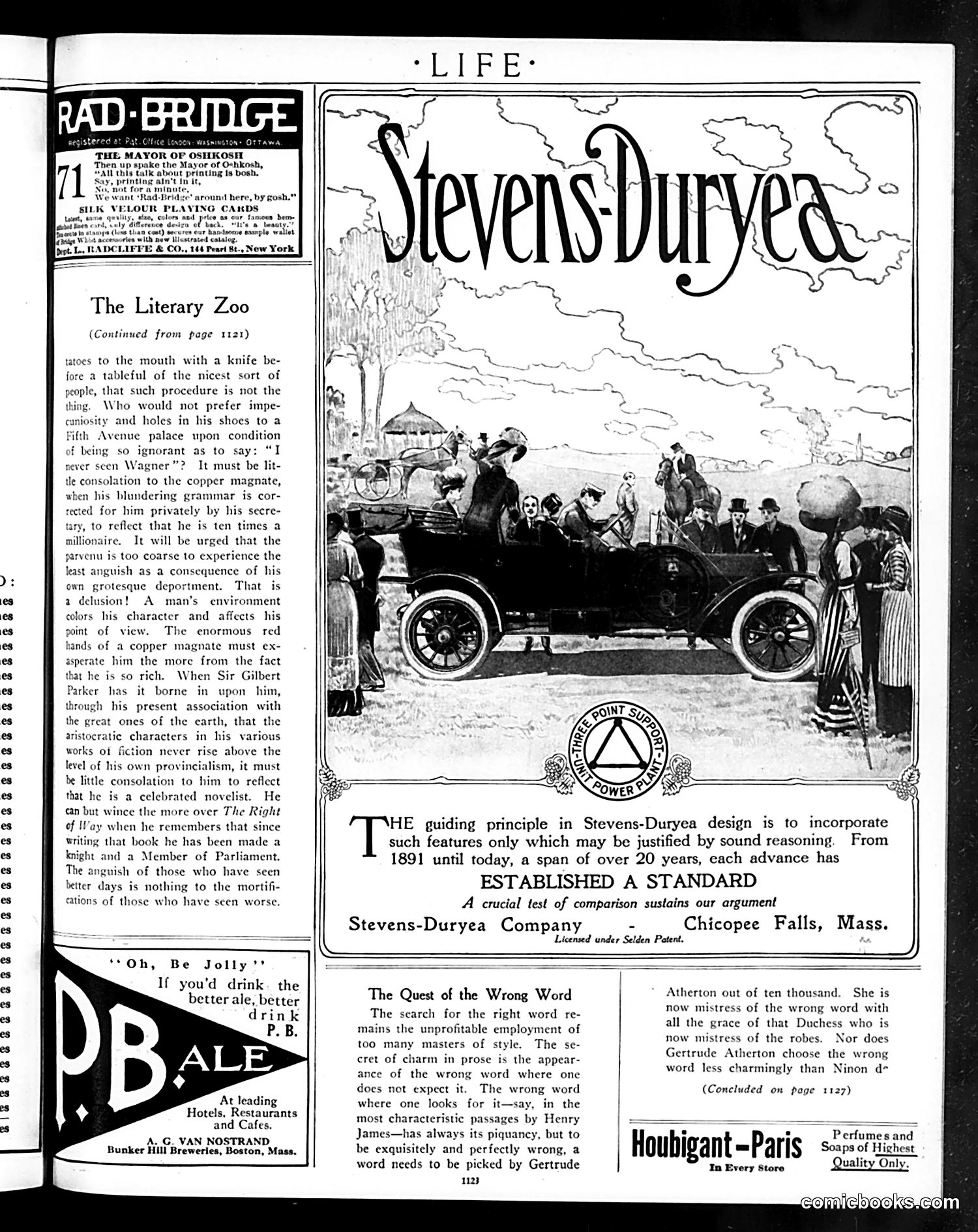
This page from *Life* magazine is primarily **advertising and literary content** rather than political satire. The main elements are: 1. **Stevens-Duryea automobile advertisement** (center): Features an early motorcar surrounded by well-dressed spectators. The ad emphasizes that their design principle incorporates "only features justified by sound reasoning" and claims "established a standard" over 20 years. This is straightforward product marketing appealing to quality-conscious consumers. 2. **"The Literary Zoo"** (left): A continuation of satirical literary criticism targeting pretentious writers and wealthy industrialists who lack culture or proper grammar—particularly "copper magnates" and provincial authors like Sir Gilbert Parker whose works don't match their elevated social status. 3. **"The Quest of the Wrong Word"** (bottom right): A brief essay on prose style, discussing how writers like Gertrude Atherton skillfully deploy unexpected word choices. 4. **Minor advertisements**: DB Ale and Houbigant perfume. The page reflects early 1900s concerns about wealth, social climbing, and literary merit—but lacks specific political cartoons or identifiable caricatures.
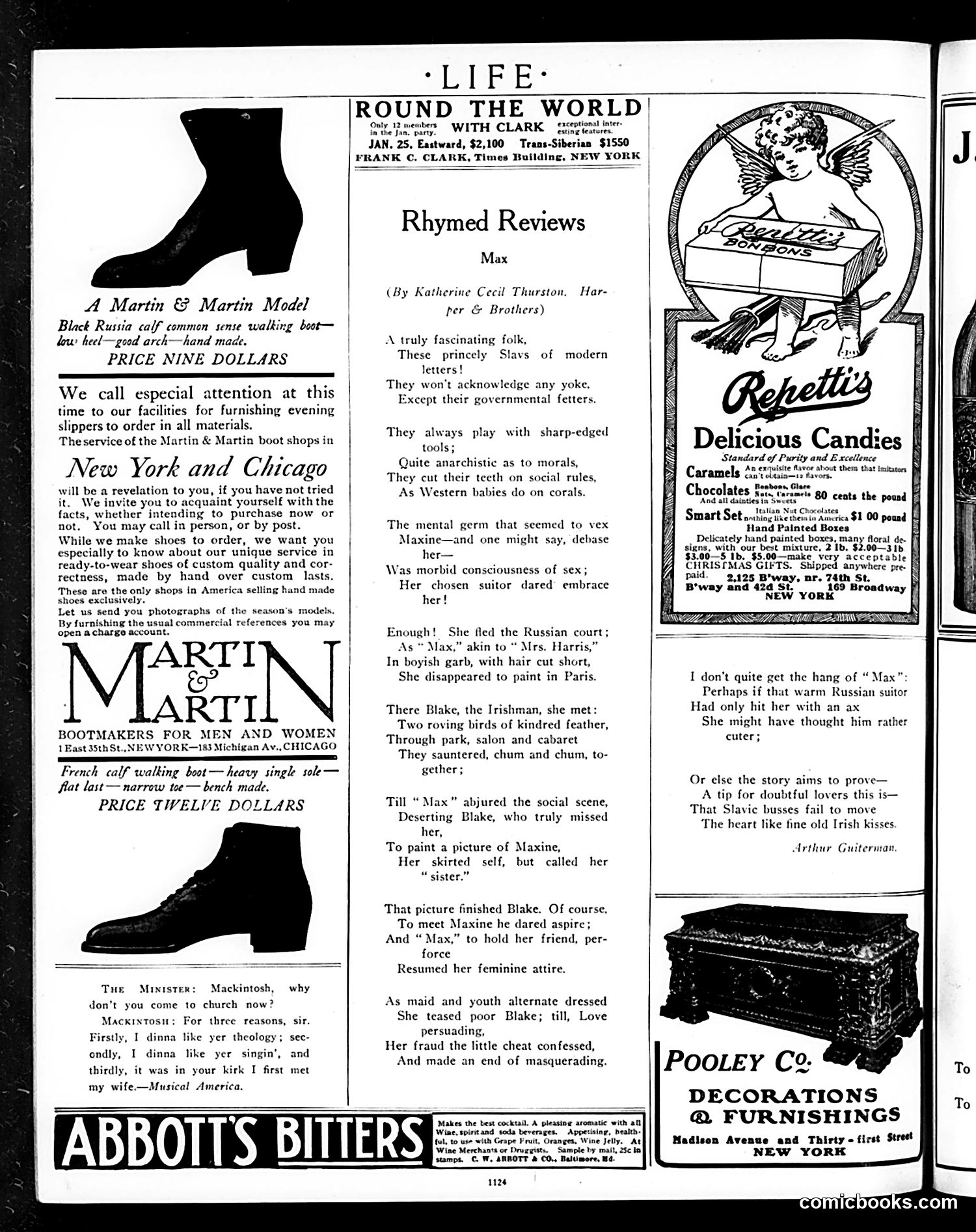
This page is primarily **advertising with a literary review**, not political satire. The central content is a **book review in verse** of "Max" by Katherine Cecil Thurston (published by Harper & Brothers). The poem summarizes the novel's plot: a Russian aristocratic woman named Maxine flees court disguised as a man ("Max"), meets an Irishman named Blake in Paris, and they develop an ambiguous relationship. She eventually reveals her deception and resumes feminine dress. The review gently mocks the story's implausibility—the closing note confesses the reviewer doesn't "quite get the hang" of the plot's logic. The page is otherwise filled with period advertisements for **Martin & Martin bootmakers**, **Repetti's candies**, **Pooley Co. furniture**, **Abbott's Bitters**, and a **"Round the World" travel tour**. There is one unrelated **Scottish dialect joke** about church attendance at bottom left, typical of Life's humor features.
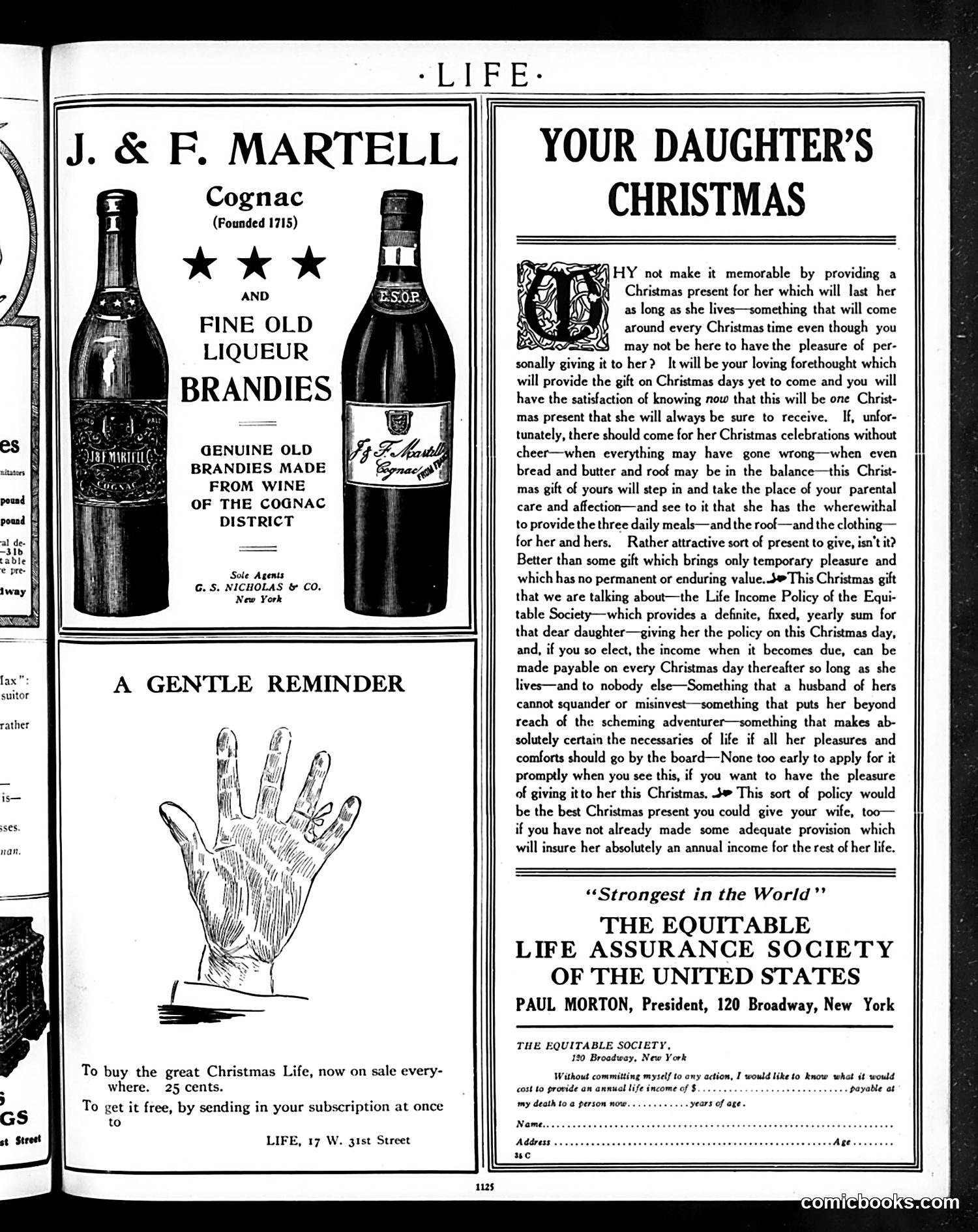
This page contains two advertisements with no political cartoons. **Left side**: A liquor ad for J. & F. Martell Cognac (founded 1715), promoting fine brandies from the Cognac district. Below is a simple illustration of a hand—labeled "A Gentle Reminder"—encouraging readers to buy Life magazine at 25 cents or subscribe. **Right side**: A life insurance advertisement from the Equitable Life Assurance Society. The copy pitches a "Life Income Policy" as an ideal Christmas gift for daughters or wives, emphasizing financial security and independence. It frames the policy as protection against future hardship—ensuring women have money for food, shelter, and clothing even if their father or husband dies or proves financially unreliable ("cannot squander or misinvest"). The ad reflects early 20th-century attitudes about women's economic vulnerability and dependence on male providers. It presents insurance as a paternalistic gift securing daughters' welfare beyond parental control.
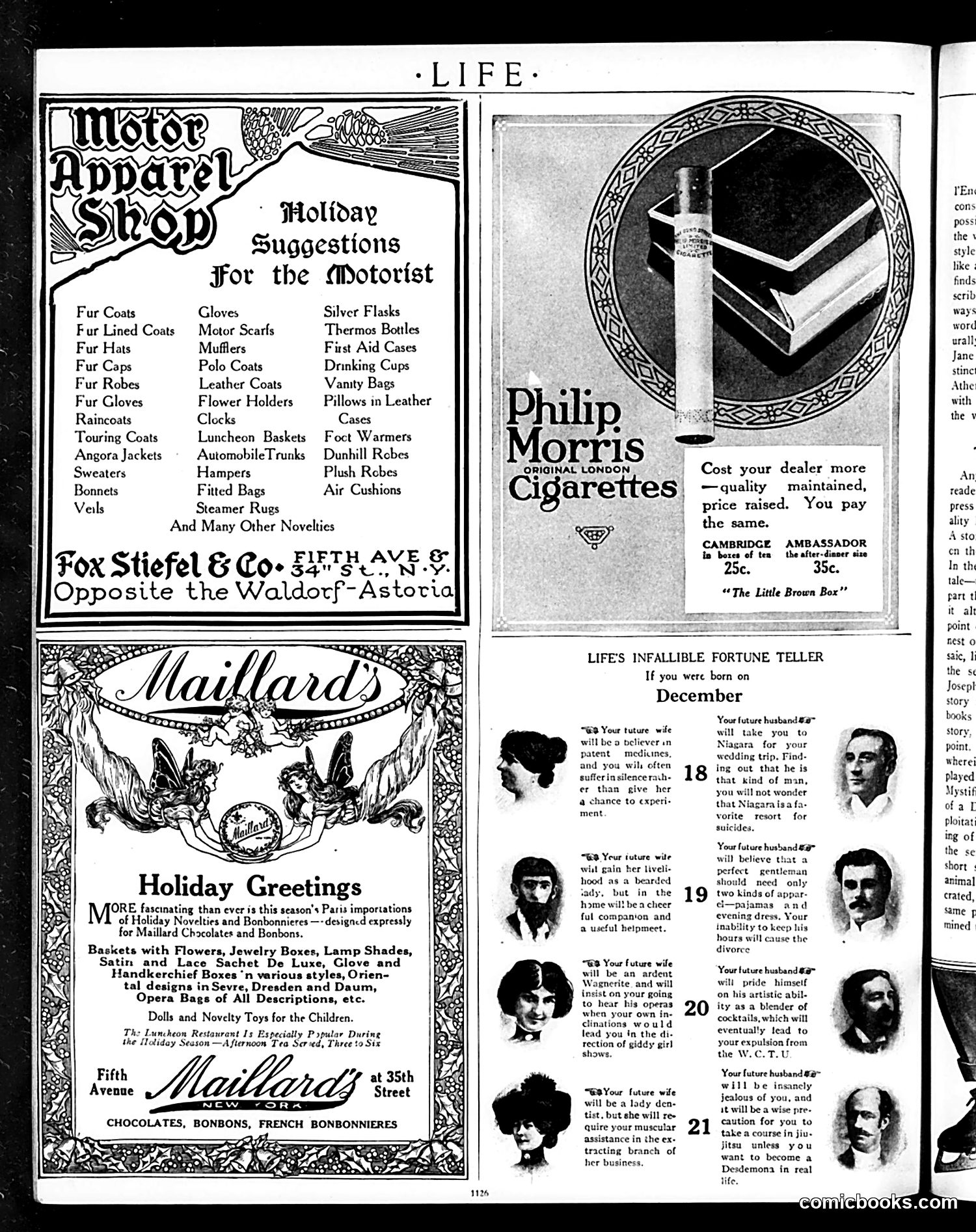
This page is primarily **advertising and entertainment content**, not political satire. The left side features holiday gift suggestions for motorists from luxury retailers (Fox Stiefel & Co., Maillard Chocolates). The substantive content is "Life's Infallible Fortune Teller," a humorous feature predicting the futures of people born in December. The jokes are **satirical commentaries on marriage and gender roles** typical of the era: - Women are portrayed as meddlesome (patent medicine believers, Wagnerian opera enthusiasts) - Men are depicted as flawed (cocktail drinkers, jealous, suicidal honeymoon planners) - The Niagara Falls reference mocks that destination as a suicide spot - References to the W.C.T.U. (Women's Christian Temperance Union) invoke contemporary Prohibition debates The cartoons mock both sexes through exaggerated character sketches, presenting marriage as inherently problematic. This reflects 1920s-era cynicism about domestic life, though the humor now reads as dated gender stereotyping rather than incisive satire.
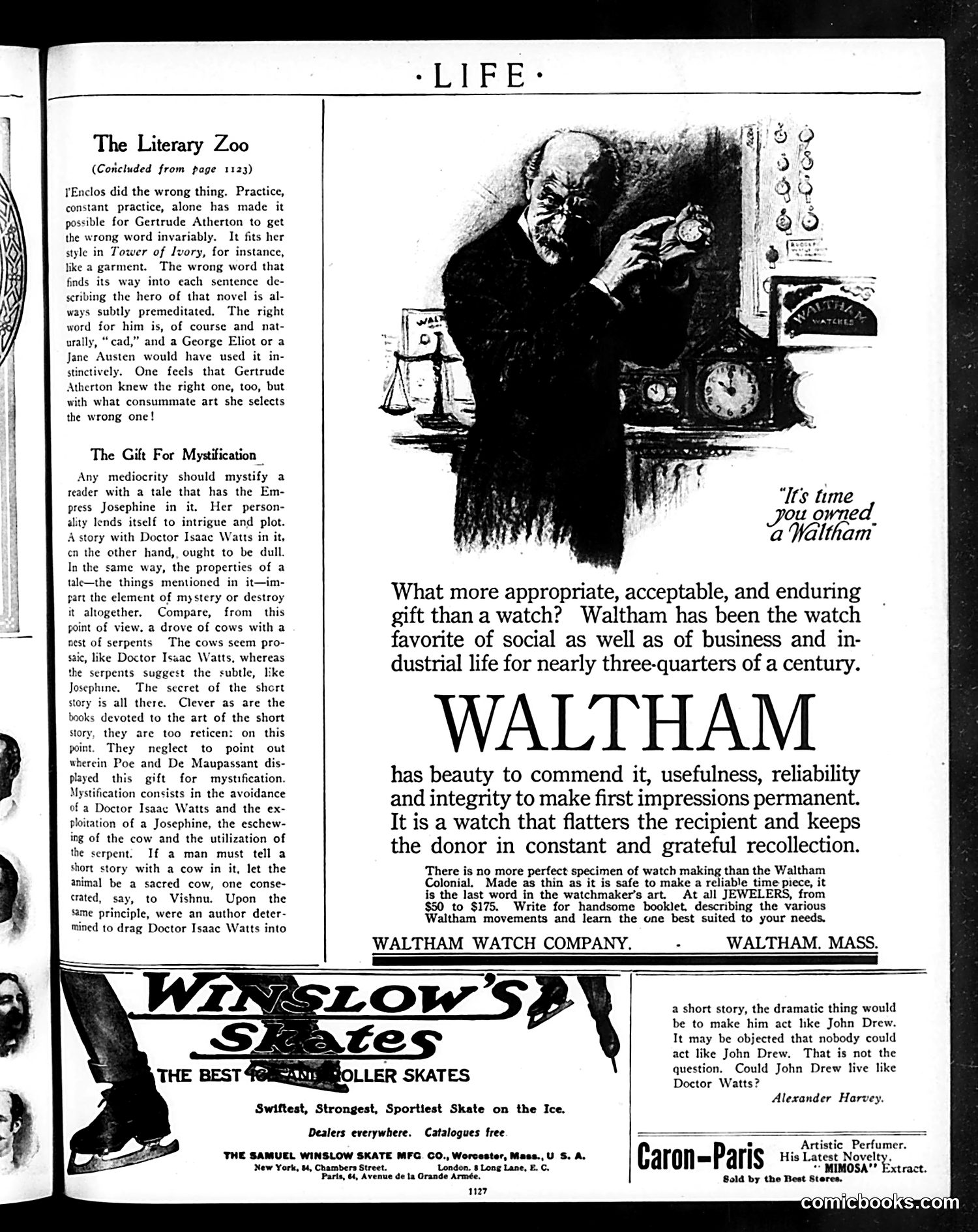
This is primarily a **literary criticism column** with advertisements. The main article, "The Literary Zoo," critiques novelist Gertrude Atherton for her distinctive (and apparently affected) habit of consistently choosing the "wrong word" in her writing—yet doing so deliberately and skillfully. The author argues this style works in her novel *Tower of Ivory*, comparing it to how mystery writers like Poe succeed through what they *omit* rather than include. The piece uses literary references (George Eliot, Jane Austen, Doctor Watts) familiar to educated readers of the era to discuss craft. The page also contains **period advertisements**: a Waltham Watch Company ad featuring an illustration of a watchmaker, Winslow roller skates, and Caron-Paris perfume. These ads are typical of *Life* magazine's business model. For modern readers: this reflects early 20th-century literary taste and the assumption that readers recognized both canonical authors and contemporary novelists by name.
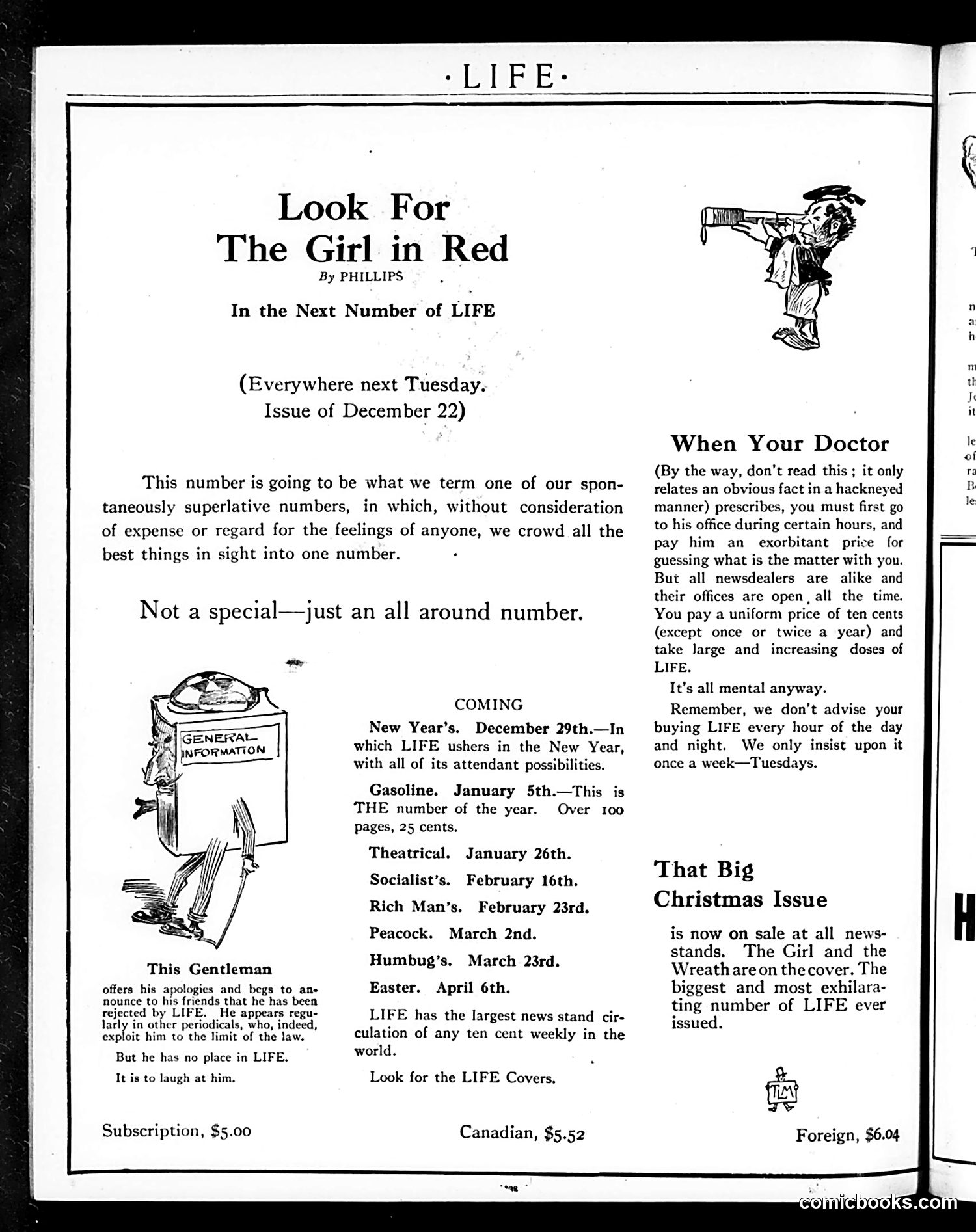
This is primarily a **house advertisement** for LIFE magazine itself, promoting upcoming issues and subscription. **Key elements:** The main cartoon shows a rejected male figure ("This Gentleman") apologizing for being published in competing periodicals. The joke is that LIFE magazine won't accept him—implying LIFE has superior editorial standards and won't tolerate content that "exploit[s] him to the limit of the law" in other magazines. **The satirical pitch** compares LIFE's accessibility to a doctor's office: doctors charge exorbitant fees for diagnosis, but LIFE costs only ten cents and is "open all the time." The humor suggests LIFE is a more democratic, affordable source of information and entertainment than professional services. **Featured upcoming issues** include special editions on topical subjects (Gasoline, Socialist's, Rich Man's, Easter), with January's Gasoline issue promised as "THE number of the year." The ad teases "The Girl in Red" by Phillips as the upcoming cover feature, using it as promotional hook for the next issue (December 22).
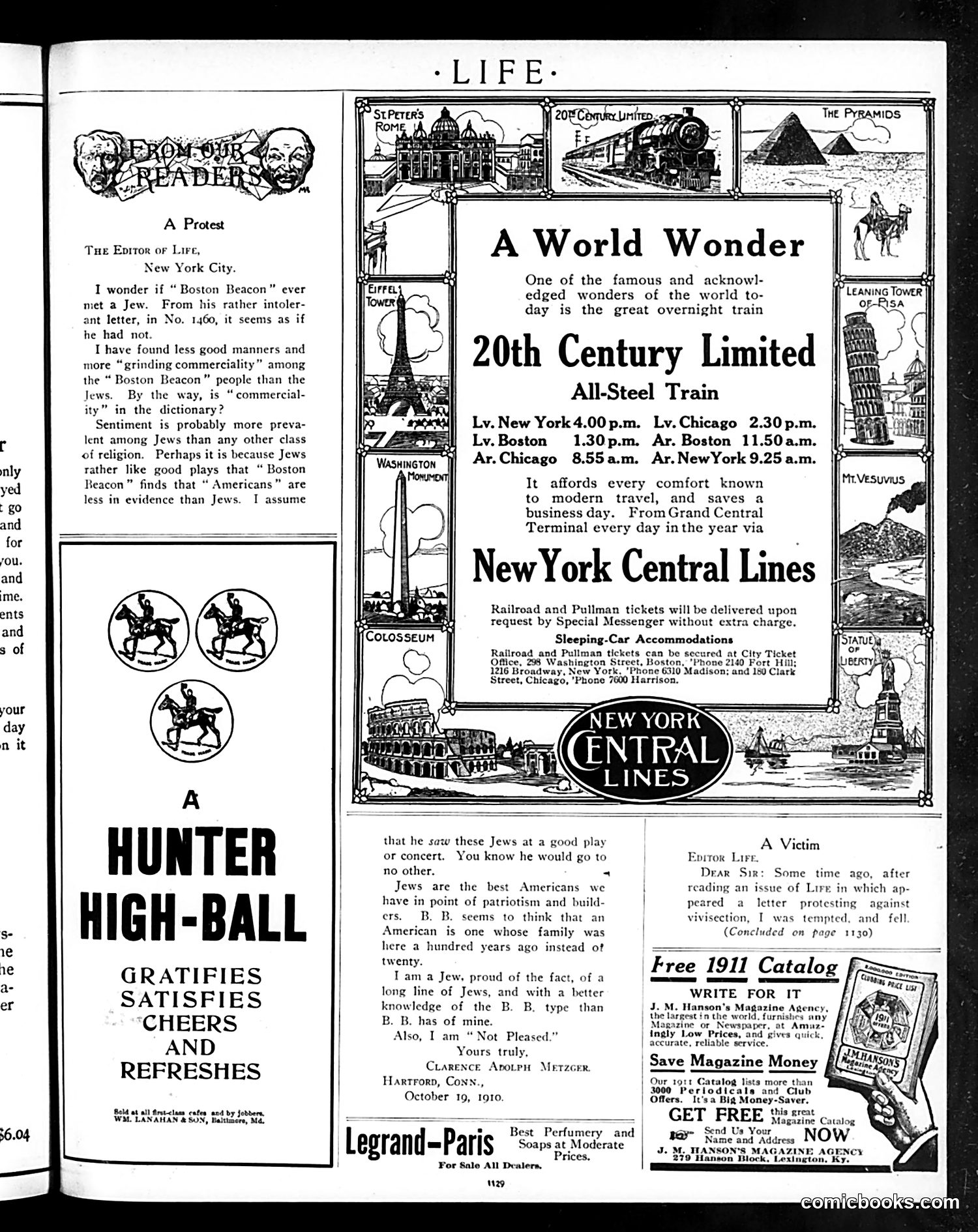
This page is primarily **advertising and reader correspondence**, not political satire. The main content consists of: **"A World Wonder"** — A large advertisement for the 20th Century Limited train, comparing it to the pyramids as a modern marvel of engineering and comfort. **"From Our Reader" and "A Victim"** — Two letters to the editor responding to an earlier anti-Semitic letter from "Boston Beacon" (published in Life No. 1460). The writers defend Jewish Americans' patriotism and character, with one correspondent, Clarence Adolph Metzger, explicitly identifying himself as a proud Jew and criticizing the prejudiced "B.B. type." **"A Hunter High-Ball"** — A small advertisement for a beverage. The page reveals Life's 1910 readers actively engaging with antisemitic discourse in the magazine's letters section, with at least some readers pushing back against stereotyping.
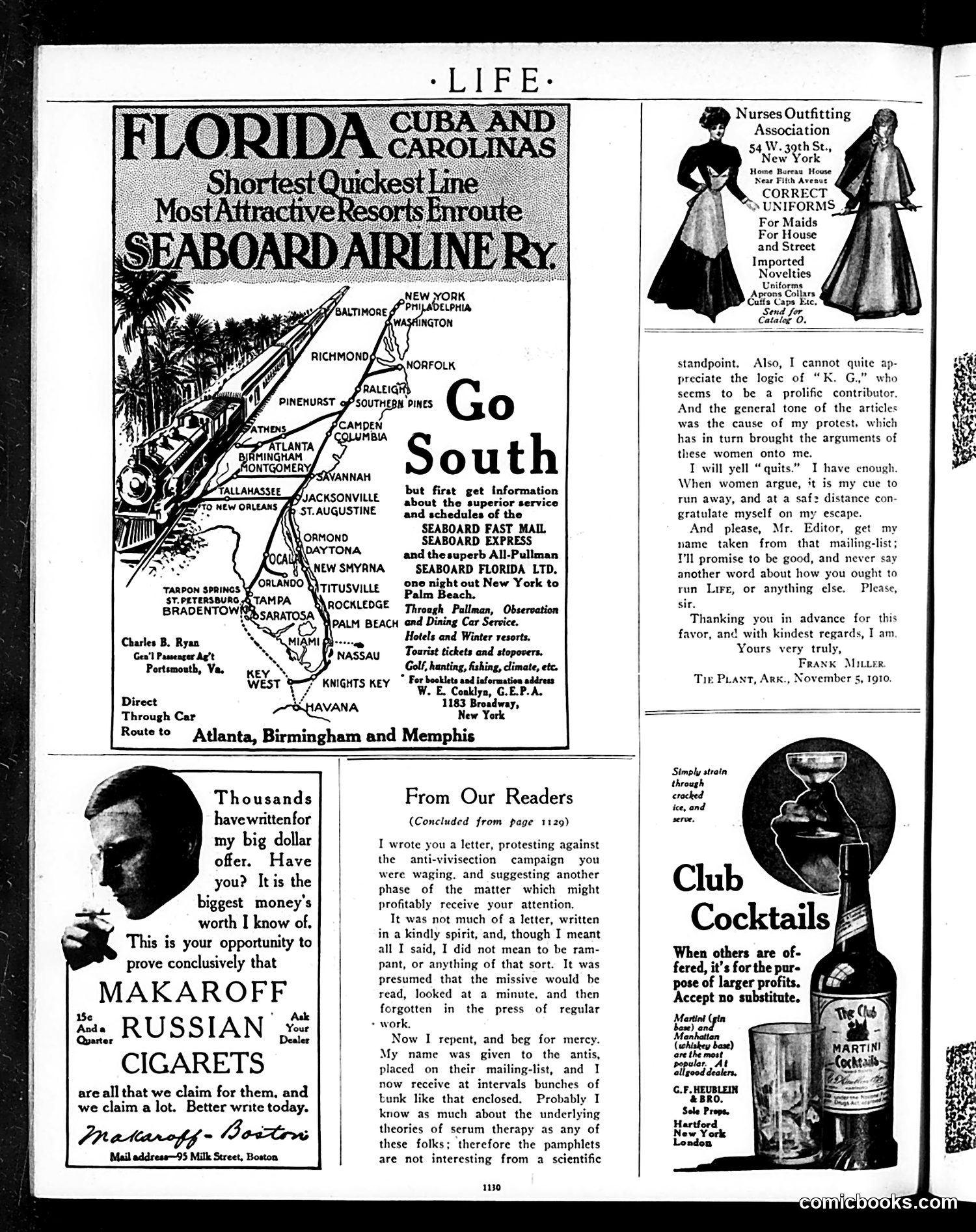
This page is primarily **advertising and reader correspondence**, not political satire. The main elements are: 1. **Seaboard Airline Railway ad** (top left): A transportation advertisement promoting rail service to Florida and the Carolinas, featuring a map and train illustration. 2. **"From Our Readers"** (center): A letter from Frank Miller of The Plant, Arkansas, humorously describing his regret at writing a protest letter to *Life* about anti-vivisection campaigns. He complains that his name was added to mailing lists and now receives unwanted pamphlets. The joke is his self-deprecating surrender—he'll stop complaining about how the magazine should be run. 3. **Product advertisements** (right and bottom): Including Makaroff Russian Cigarettes, Martini cocktails, nursing uniforms, and other consumer goods typical of 1910 advertising. This appears to be a regular issue page with no significant political cartoon or satirical content requiring historical context.
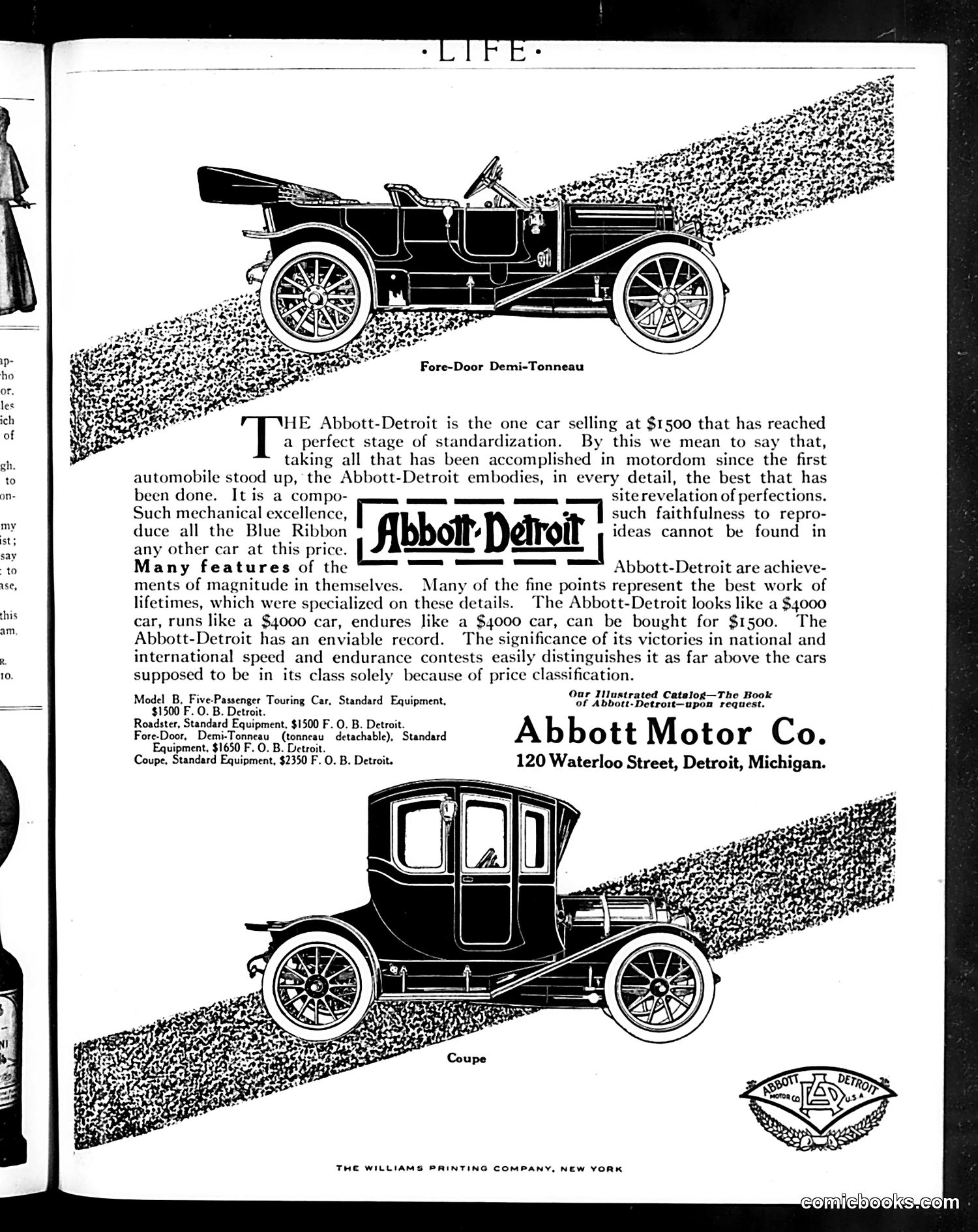
This is **not a political cartoon or satire**—it's a straightforward automobile advertisement from *Life* magazine, likely early 1900s. The page showcases two car models from Abbott Motor Co. (Detroit): a Fore-Door Demi-Tonneau and a Coupe. The ad's central claim is that the Abbott-Detroit, priced at $1,500, offers features and performance comparable to cars costing $4,000—essentially claiming exceptional value. The advertisement emphasizes mechanical excellence, speed/endurance contest victories, and standardized quality as selling points. The textured diagonal bands framing each vehicle are decorative design elements typical of the era. The small Abbott-Detroit logo and company address (120 Waterloo Street, Detroit) appear at bottom right. For modern readers: this represents early automotive marketing emphasizing affordability without sacrificing quality—a pitch still common today.
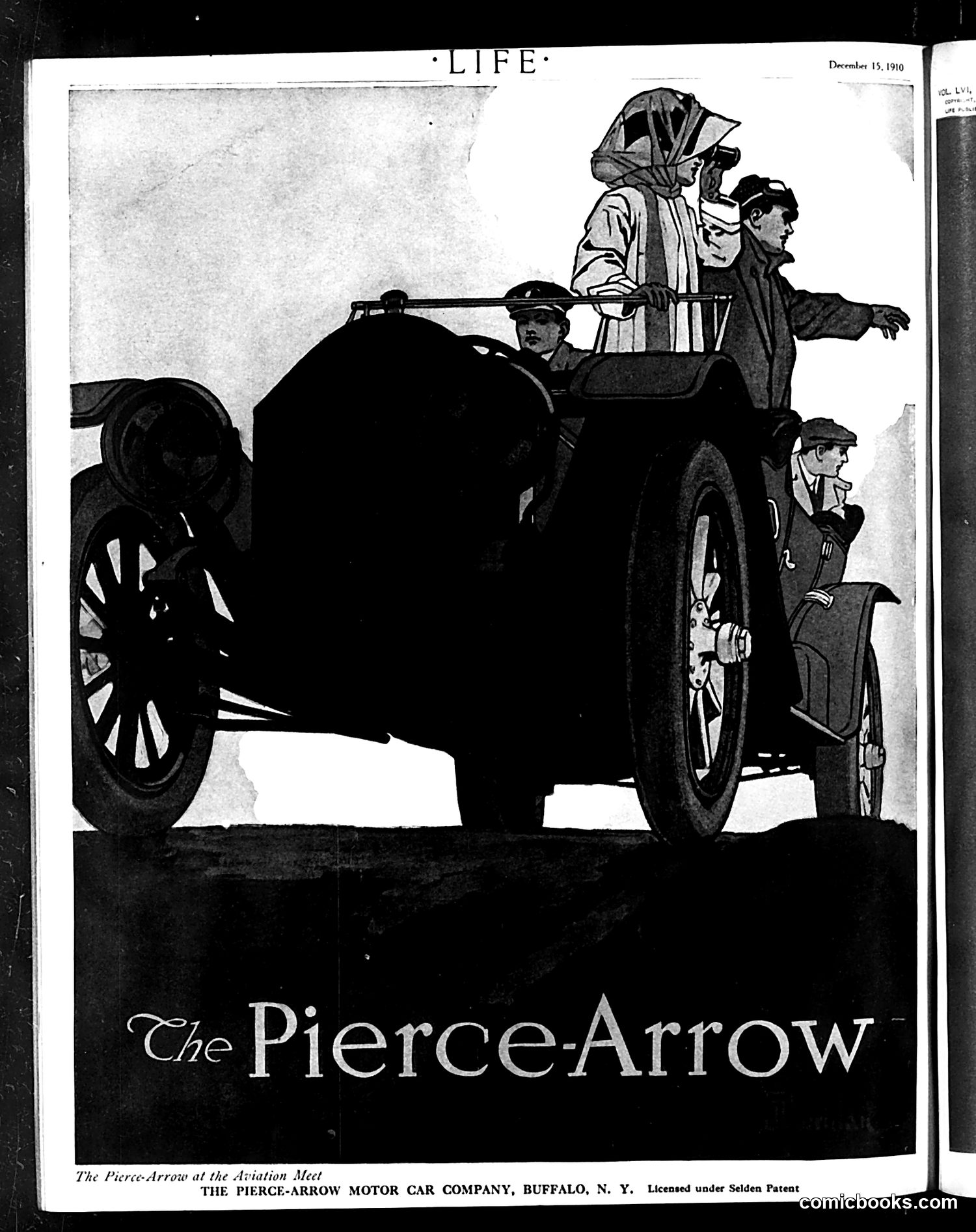
This is primarily a **car advertisement** rather than political satire. It appeared in *Life* magazine on December 15, 1910. The image shows a silhouetted Pierce-Arrow automobile with several figures around it—a driver, passengers, and what appears to be a woman with a parasol. The caption indicates this depicts "The Pierce-Arrow at the Aviation Meet," referencing the early aviation competitions that were popular spectacles around 1910. The advertisement emphasizes the car's association with modern, prestigious events. The Pierce-Arrow Motor Car Company (based in Buffalo, New York) marketed their vehicles as sophisticated and cutting-edge by linking them to aviation—the era's most advanced technology. The silhouette style creates an elegant, upscale impression typical of luxury automotive advertising from this period. This is essentially brand positioning through cultural association rather than political commentary.