
Life, 1910-12-15 · page 26 of 44
Life — December 15, 1910 — page 26: what you’re looking at
What you’re looking at
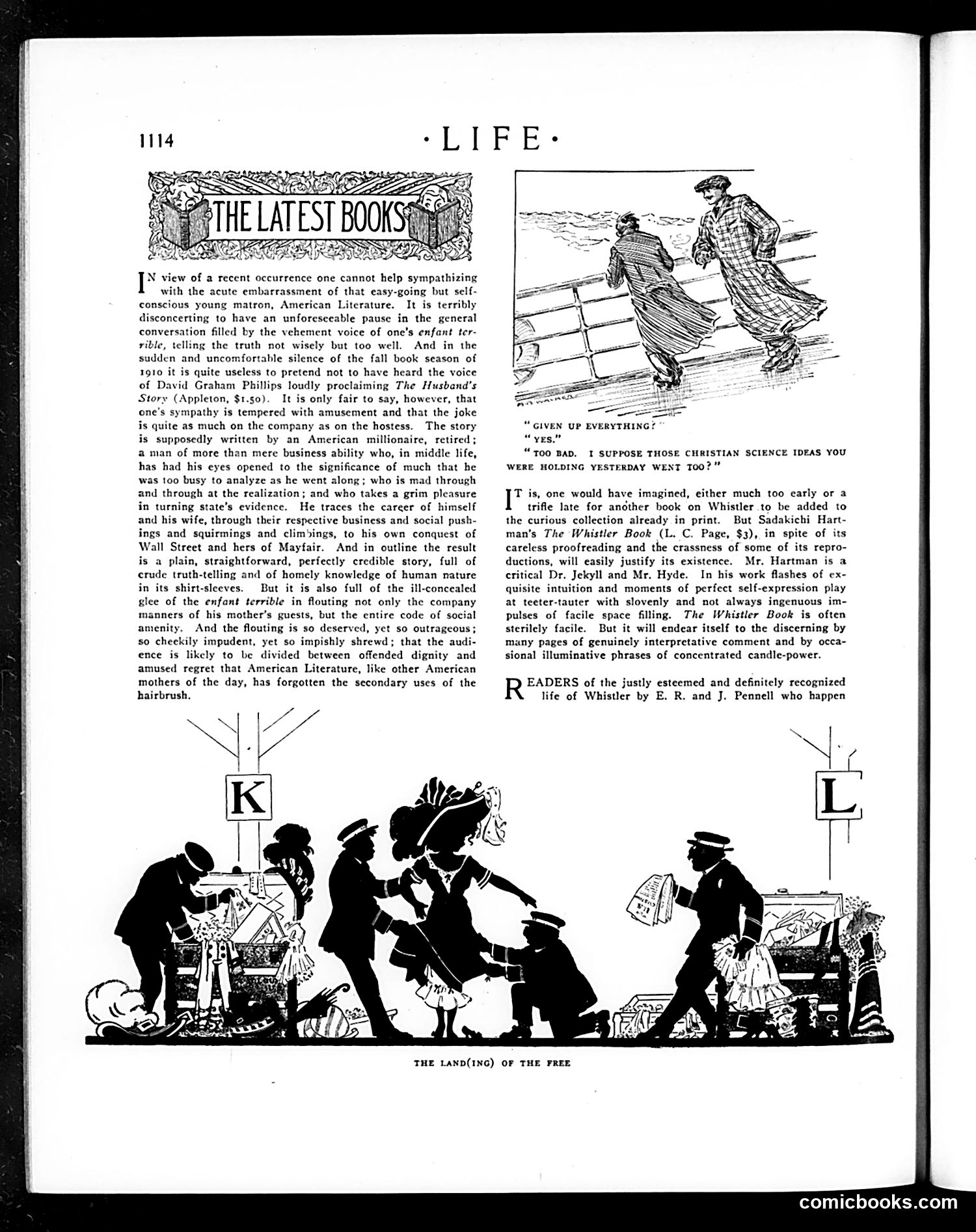
The page contains two satirical pieces about American literature and society circa 1910. **"The Latest Books" section** reviews David Graham Phillips's *The Husband's Story*, comparing American Literature to an embarrassed hostess whose "enfant terrible" (misbehaving child) rudely tells uncomfortable truths at a dinner party. The metaphor criticizes Phillips's novel for its crude social commentary about wealth and ambition, yet acknowledges the criticism is deserved. The satire suggests American high society deserves such exposure—comparing the situation to a child needing discipline ("the hairbrush"). **The cartoon** titled "The Land(ing) of the Free" depicts immigrants arriving with their belongings. The juxtaposition with text mocking Christian Science suggests irony about American freedom and values. **The upper sketch** shows two figures on a fence—likely satirizing hypocrisy or changing convictions, referenced in the dialogue about abandoned "Christian Science ideas." The page reflects early 20th-century American anxieties about new money, social climbing, and immigration.
📄 Transcribed text from this page (OCR, searchable)
Machine-transcribed from the original scan — historical spelling and the odd misread are preserved.
IX view of a recent occurrence one cannot help sympathizing with the acute embarrassment of that easy-going but self- conscious young matron, American Literature. It is terribly disconcerting to have an unforeseeable pause in the general conversation filled by the vehement voice of one’s enfant ter- rible, telling the truth not wisely but too well. And in the sudden and uncomfortable silence of the fall book season of 1910 it is quite useless to pretend not to have heard the voice of David Graham Phillips loudly proclaiming The Husband’s Story (Appleton, $1.50). It is only fair to say, however, that one's sympathy is tempered with amusement and that the joke is quite as much on the company as on the hostess. The story is supposedly written by an American millionaire, retired; a man of more than mere business ability who, in middle life, has had his eyes opened to the significance of much that he was too busy to analyze as he went along; who is mad through and through at the realization; and who takes a grim pleasure in turning state’s evidence. He traces the career of himself and his wife, through their respective business and social push- ings and squirmings and climings, to his own conquest of Wall Street and hers of Mayfair. And in outline the result is a plain, straightforward, perfectly credible story, full of crude truth-telling and of homely knowledge of human nature in its shirt-slceves. But it is also full of the ill-concealed glee of the enfant terrible in flouting not only the company manners of his mother’s guests, but the entire code of social amenity. And the flouting is so deserved, yet so outrageous; so cheekily impudent, yet so impishly shrewd; that the audi- ence is likely to be divided between offended dignity and amused regret that American Literature, like other American mothers of the day, has forgotten the secondary uses of the hairbrush, ———— oe “GIVEN UP EVERYTHING! “yes. “TOO BAD. I SUPPOSE THOSE CHRISTIAN SCIENCE IDEAS YOU WERE HOLDING YESTERDAY WENT 100?” T is, one would have imagined, either much too early or a trifle late for another book on Whistler to be added to the curious collection already in print. But Sadakichi Hart- man’s The Whistler Book (L. C. Page, $3), in spite of its careless proofreading and the crassness of some of its repro- ductions, will easily justify its existence. Mr. Hartman is a critical Dr. Jekyll and Mr. Hyde. In his work flashes of ex- quisite intuition and moments of perfect self-expression play at teeter-tauter with slovenly and not always ingenuous im- pulses of facile space filling. The Whistler Book is often sterilely facile. But it will endear itself to the discerning by many pages of genuinely interpretative comment and by occa- sional illuminative phrases of concentrated candle-power. EADERS of the justly esteemed and definitely recognized life of Whistler by E. R. and J. Pennell who happen THE LAND(ING) OF THE FREE comicbooks.com