
Life, 1910-12-15 · page 21 of 44
Life — December 15, 1910 — page 21: what you’re looking at
What you’re looking at
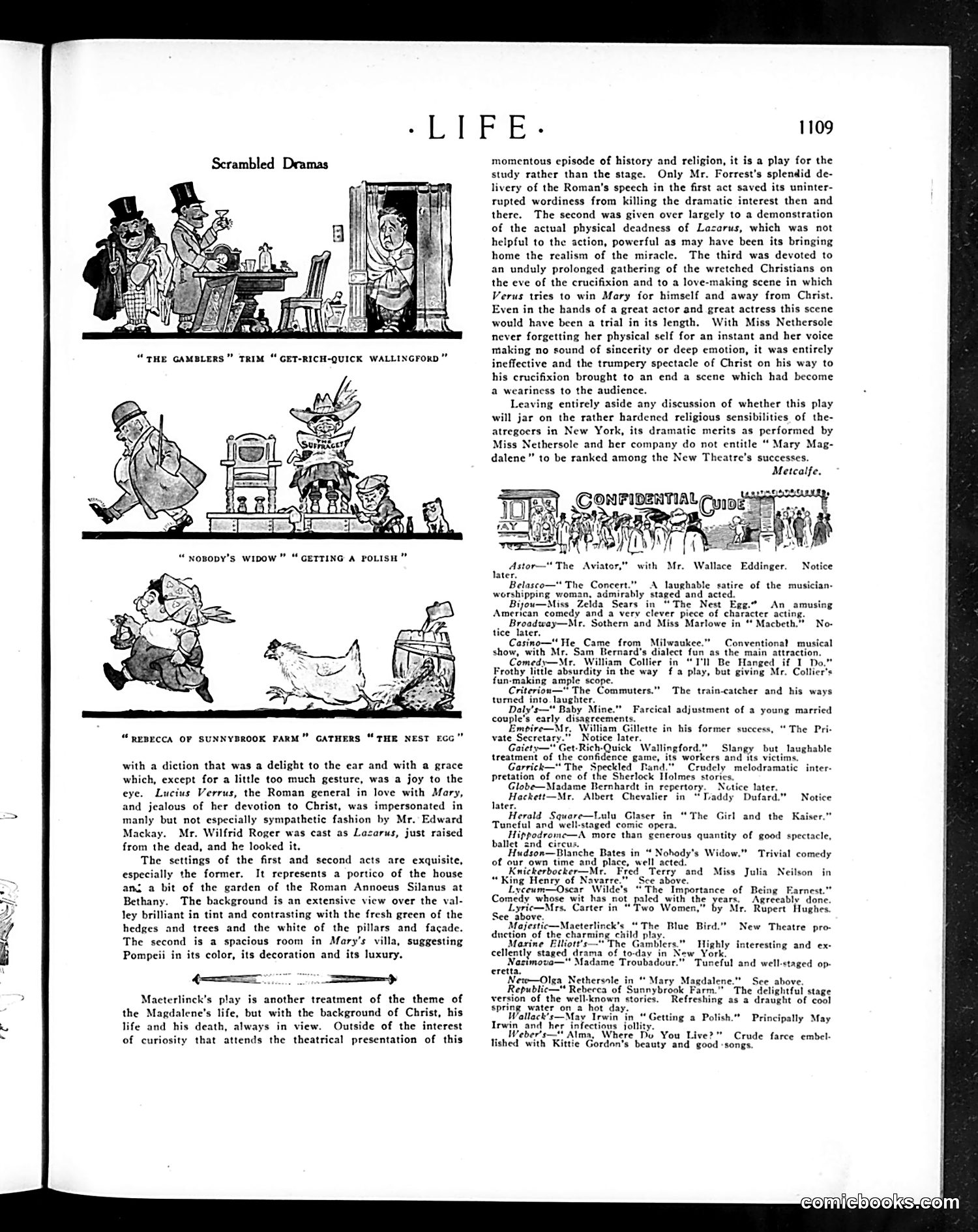
This page reviews Maurice Maeterlinck's play "Mary Magdalene," performed by actress Alla Nazimova. The critic is largely dismissive, praising set design and individual performances (particularly Edward Mackay as the Roman general Lucius Verus) while faulting the overall production as tedious and poorly suited to stage. The cartoons at top left satirize popular Broadway plays of the era—"The Gamblers," "Get-Rich-Quick Wallingford," and "Rebecca of Sunnybrook Farm"—presenting them as commercial spectacles. The sketch captions mock how these productions "trim" (compete with) each other for audiences. The bulk of the page consists of brief theater notices for various New York productions, typical of Life's theater column. The Magdalene review dominates, criticizing Nazimova's emotional restraint and the play's excessive length, particularly in its final act's romantic scene between Mary and Verus.
📄 Transcribed text from this page (OCR, searchable)
Machine-transcribed from the original scan — historical spelling and the odd misread are preserved.
-LIFE.- Scrambled Dramas “THE GAMBLERS” TRIM “ GET-RICH-QUICK WALLINGFORD” “REBECCA OP SUNNYBROOK FARM" GATHERS “THE NEST ECG” with a diction that was a delight to the ear and with a grace which, except for a little too much gesture, was a joy to the eye. Lucius Verrus, the Roman general in love with Mary, and jealous of her devotion to Christ, was impersonated in manly but not especially sympathetic fashion by Mr. Edward Mackay. Mr. Wilfrid Roger was cast as Lazarus, just raised from the dead, and he looked it. The settings of the first and second acts are exquisite, especially the former. It represents a portico of the house an: a bit of the garden of the Roman Annoeus Silanus at Bethany. The background is an extensive view over the val- ley brilliant in tint and contrasting with the fresh green of the hedges and trees and the white of the pillars and facade. The second is a spacious room in Mary’s villa, suggesting Pompeii in its color, its decoration and its luxury. Maeterlinck’s play is another treatment of the theme of the Magdalene’s life, but with the background of Christ, his life and his death, always in view. Outside of the interest of curiosity that attends the theatrical presentation of this 1109 momentous episode of history and religion, it is a play for the study rather than the stage. Only Mr. Forrest's splendid de- livery of the Roman's speech in the first act saved its uninter- rupted wordiness from killing the dramatic interest then and there. The second was given over largely to a demonstration of the actual physical deadness of Lazarus, which was not helpful to the action, powerful as may have been its bringing home the realism of the miracle. The third was devoted to an unduly prolonged gathering of the wretched Christians on the eve of the crucifixion and to a love-making scene in which Verus tries to win Mary for himself and away from Christ. Even in the hands of a great actor and great actress this scene would have been a trial in its length. With Miss Nethersole never forgetting her physical self for an instant and her voice making no sound of sincerity or deep emotion, it was entirely ineffective and the trumpery spectacle of Christ on his way to his crucifixion brought to an end a scene which had become a weariness to the audience. Leaving entirely aside any discussion of whether this play will jar on the rather hardened religious sensibilities of the- atregoers in New York, its dramatic merits as performed by Miss Nethersole and her company do not entitle “ Mary Mag- dalene” to be ranked among the New Theatre's successes. Metcalfe. 1 Astor—" The Aviator,” with Mr. Wallace Eddinger. Notice ater. Belasco—* The Concert.” A laughable satire of the musician- worshipping woman, admirably staged and acted. Biyou—Miss Zelda Sears in “The Nest Ege.” An amusing American comedy and a very clever piece of character actin, _ Broadway—Mr. Sothern and Miss Marlowe in Macbeth." No- tice later. Casino— He Came from Milwaukee.” Conventional musical show, with Mr. Sam Bernard's dialect fun as the main attraction. Comedy—Mr. William Collier in “I'll Be Hanged if I Do.” Frothy little absurdity in the way f a play, but giving Mr. Colli fun-making ample scope. Criterion—" The Commuters.” The train-catcher and his ways turned into laughter. Daly’s—" Baby Mine.” Farcical adjustment of a young married couple's early disagreements. Embire—Mr, William Gillette in his former success, “The Pri- vate Secretary." Notice later. Gaiety—" Get-Rich-Quick Wallingford.” Slangy but laughable treatment of the confidence game, its workers and its victims. Garrickh—*' The Speckled Rand." Crudely melodramatic inter- pretation of one of the Sherlock Holmes stori Globe—Madame Bernhardt in repertory. Nei i Hackett—Mr. Albert Chevalier in Taddy Dufard.”” ater. Herald Square—Lulu Glaser in “The Girl and the Kaiser.” Tuneful and well-staged comic opera. Hippodrome—A more than generous quantity of good spectacle, ballet and circus. Hudson—Blanche Bates in “ Nohody's Widow." Trivial comedy of our.own time and place, well acted. Knickerbocker—Mr. Fred Terry and Miss Julia Neilson in ing Henry of Navarre.” Sce above. Lyceum—Oscar Wilde's “The Importance of Being Earnest.” Comedy whose wit has not paled with the years. Agreeably done. Lyric—Mrs. Carter in “Two Women,” by Mr. Rupert Hughes, See ‘above. Majestic—Maeterlinck’s “The Blue Bird.” duction of the charming child play. Marine Elliott’s—* The Gamblers. Highly interesting and ex- cellently staged drama of to-day in New York. Natimova—" Madame Troubadour.” Tuneful and well-staged op- eretta. New—Olga Nethersale in Mary Magdalene." See above. Republic—"* Rebecca of Sunnybrook Farm.” The delightful stage version of the well-known stories. Refreshing as a draught of cool spring water on a hot da: Wallack’s—May Ir in Irwin and her infectious jolli ., Weber’s—** Alma, Where Du You Live?” Crude farce embel- lished with Kittie Gordon's beauty and good songs. Notice New Theatre pro- Getting a Polish. Principally May