
A complete issue · 44 pages · 1910
Life — October 27, 1910
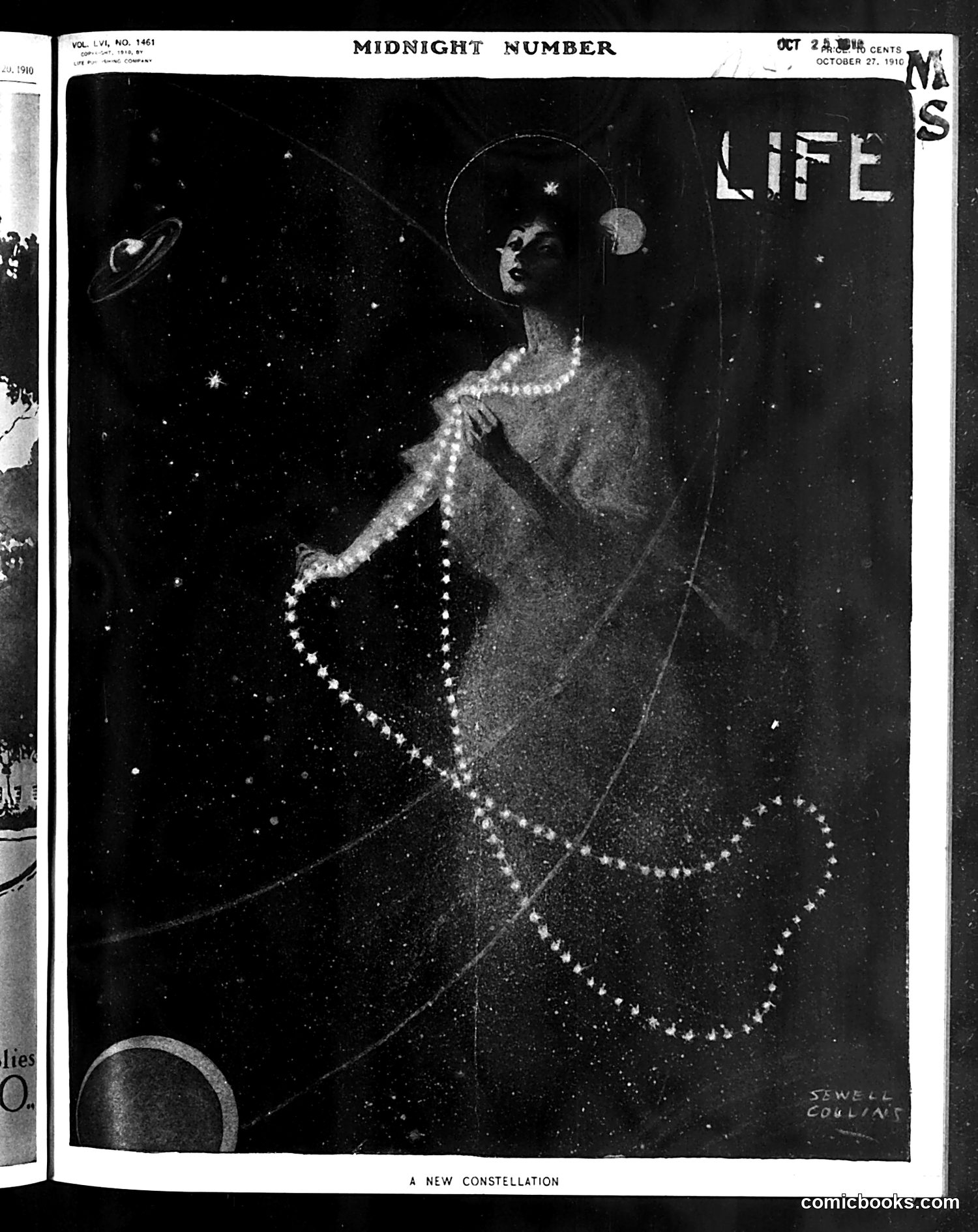
This October 27, 1910 *Life* magazine cover depicts a woman in an elegant gown adorned with pearl necklaces, positioned among celestial bodies—planets and stars. The title "A New Constellation" suggests the woman herself is being positioned as a cosmic entity or celestial body. The image likely satirizes either a famous actress or society figure of the era who was receiving excessive media attention and public adulation. By literally depicting her among the stars, the cartoonist mocks the tendency to elevate celebrities to quasi-divine status. The artist's signature reads "Swell Collians" (or similar). This reflects early 20th-century satirical commentary on celebrity culture and the public's inflation of certain figures to unrealistic, almost celestial importance.
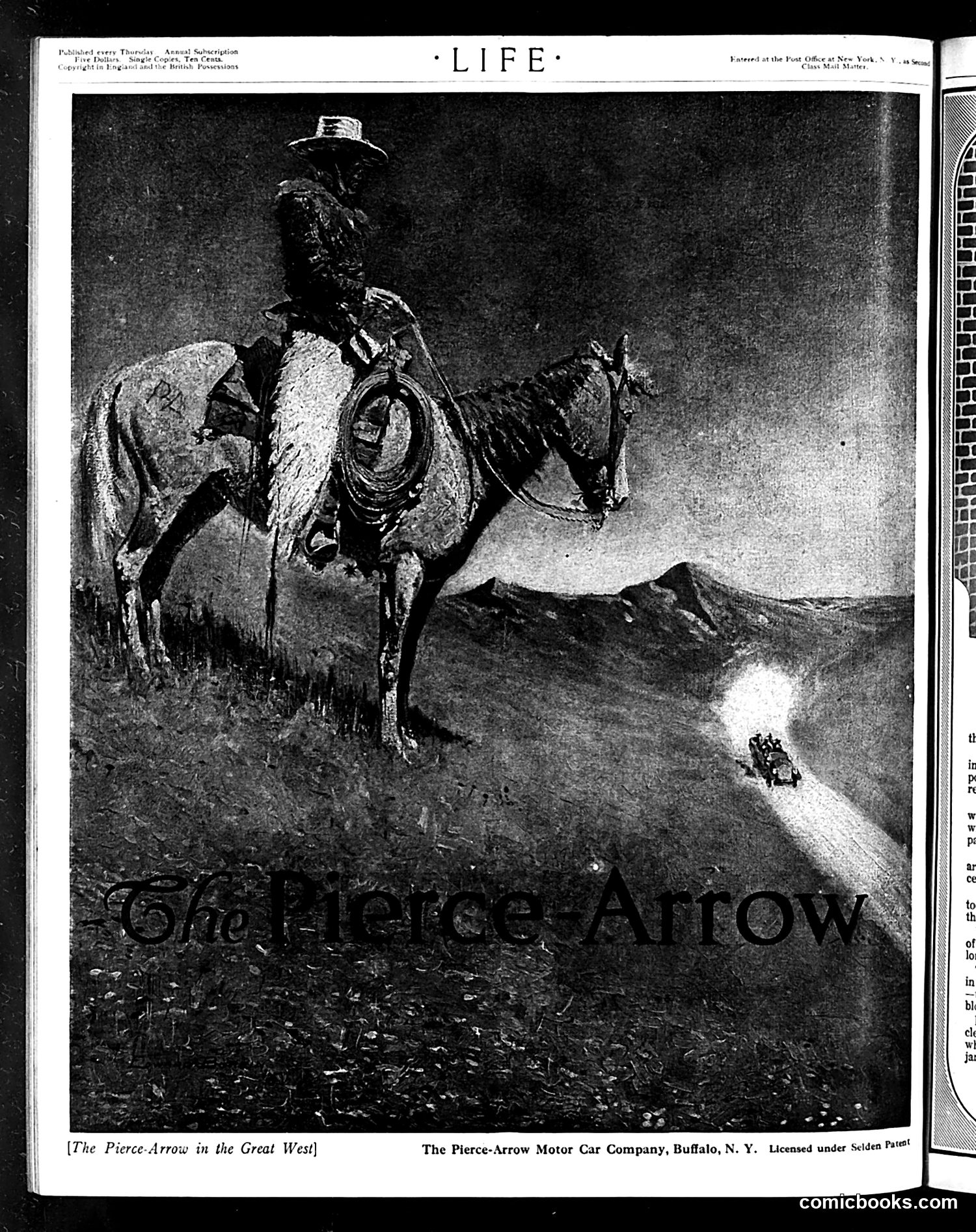
This appears to be a **product advertisement** rather than political satire. The image shows a cowboy on horseback in a Western landscape, with the caption "[The Pierce-Arrow in the Great West]" and text crediting "The Pierce-Arrow Motor Car Company, Buffalo, N.Y." The advertisement uses romanticized Western imagery—a mounted cowboy in traditional gear against desert mountains—to market the Pierce-Arrow automobile. This is a **lifestyle branding strategy**: associating the car with American frontier values like independence, adventure, and rugged capability. The visual juxtaposition of the old West (horseman) with modern technology (automobile company) suggests the Pierce-Arrow represents progress while maintaining frontier spirit. This was common early-20th-century advertising that positioned cars as enablers of American adventure and freedom.
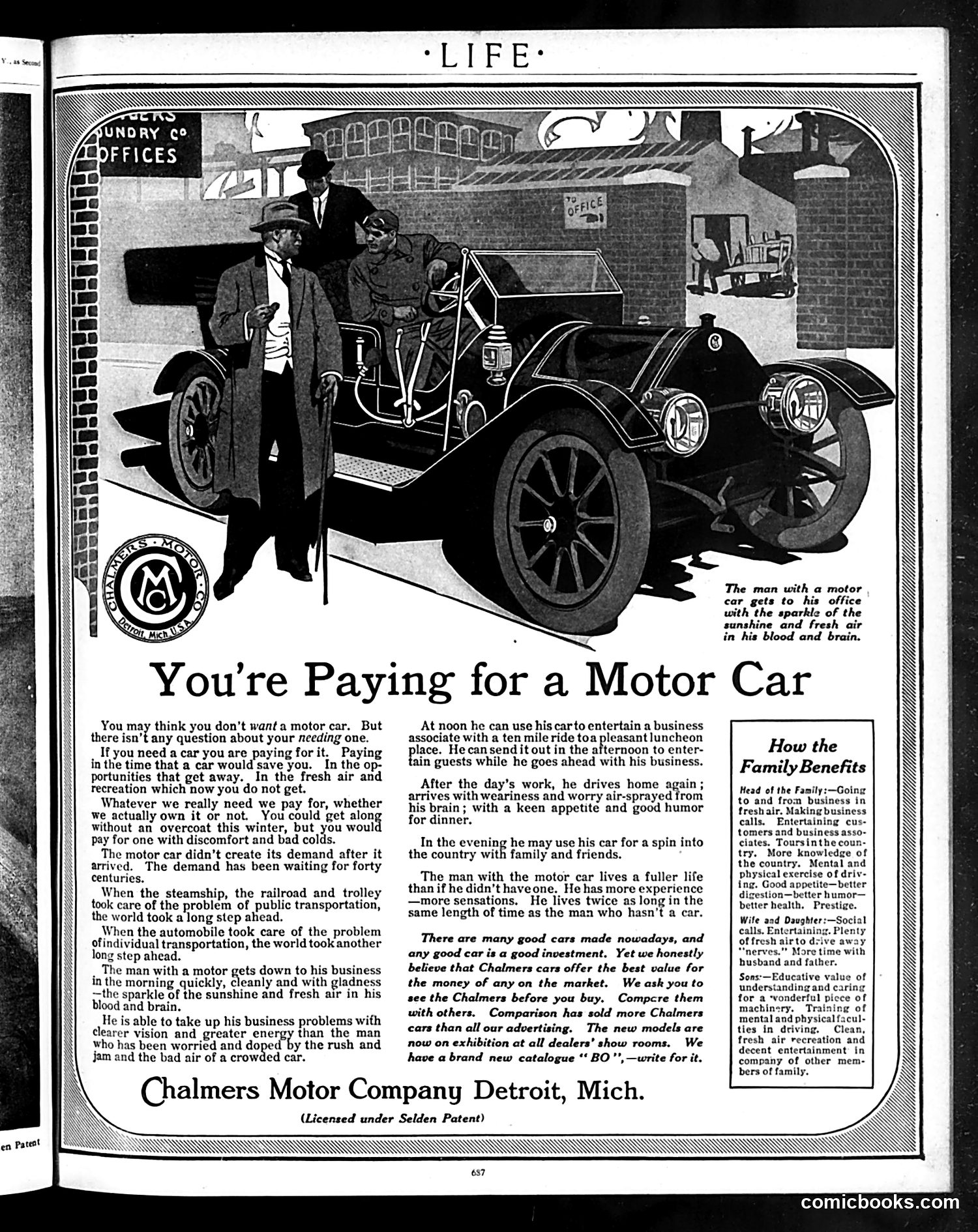
This is primarily a **Chalmers Motor Company advertisement**, not satire. The ad promotes motor cars to businessmen by highlighting practical benefits: quick commutes, fresh air, business entertainment opportunities, and improved health through driving. The illustration shows well-dressed businessmen with an early 1900s automobile outside an office building. The accompanying text argues that owning a motor car—while seemingly expensive—actually pays for itself through time savings and business advantages. The headline "You're Paying for a Motor Car" uses a sales technique (addressing affordability concerns) rather than satire. The "Family Benefits" sidebar lists social and health advantages of car ownership. This reflects early automotive marketing's strategy of justifying expensive vehicles to prosperous professionals as practical business investments, not luxuries.
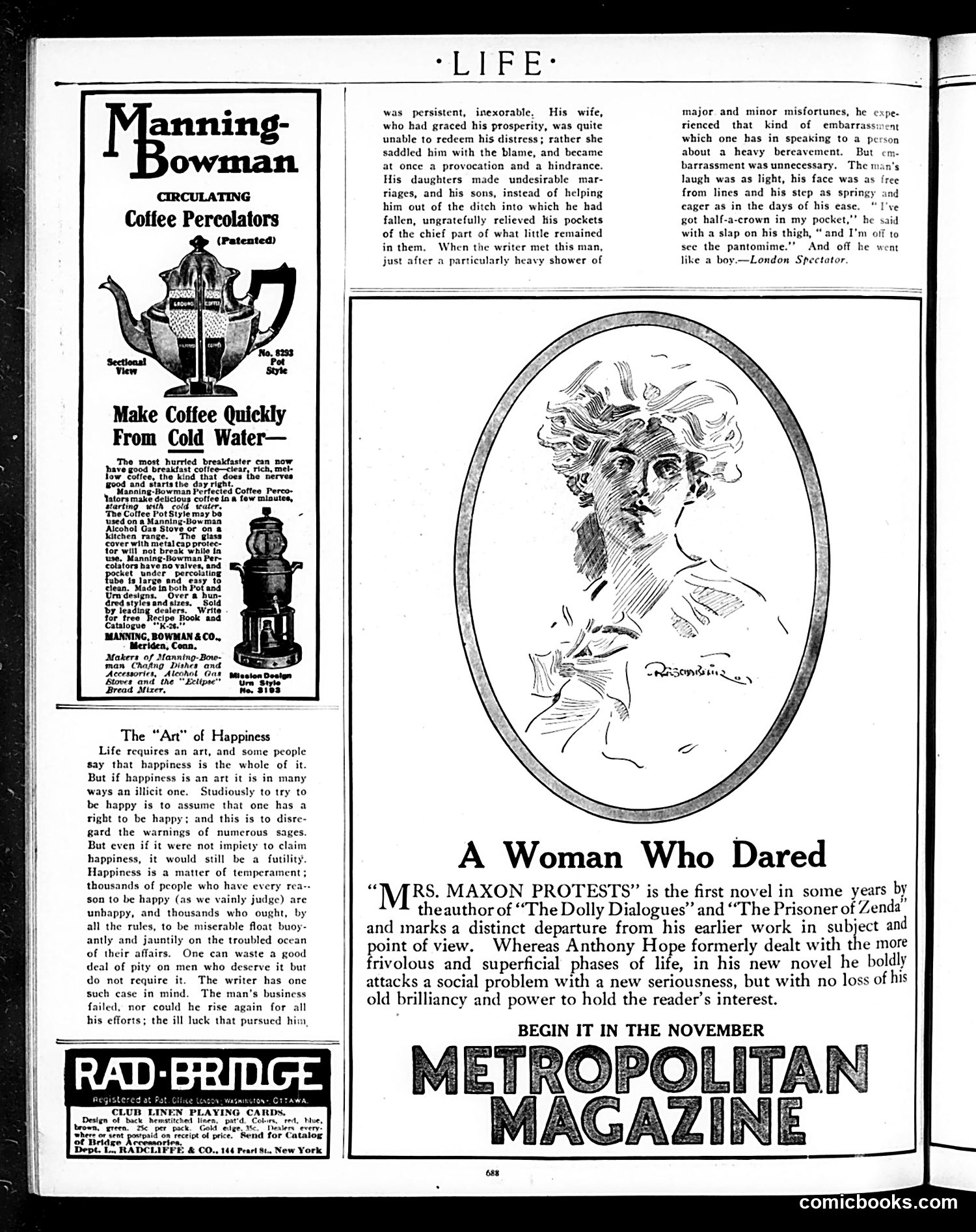
This page is primarily **advertising and literary promotion** rather than political satire. The left side features a Manning-Bowman coffee percolator advertisement. The center contains an essay titled "The 'Art' of Happiness," a philosophical piece arguing that pursuing happiness directly often fails—one must approach it indirectly. The main image is a portrait sketch (signed, appears to be by Ransonette) accompanying promotion for a novel called **"Mrs. Maxon Protests,"** described as the author's first novel in years. The text indicates it tackles "a social problem" seriously, marking a departure from his earlier lighter works. The advertisement promotes its serialization beginning in the November *Metropolitan Magazine*. This page reflects early 20th-century magazine publishing, blending consumer goods advertising with literary promotion and philosophical commentary.
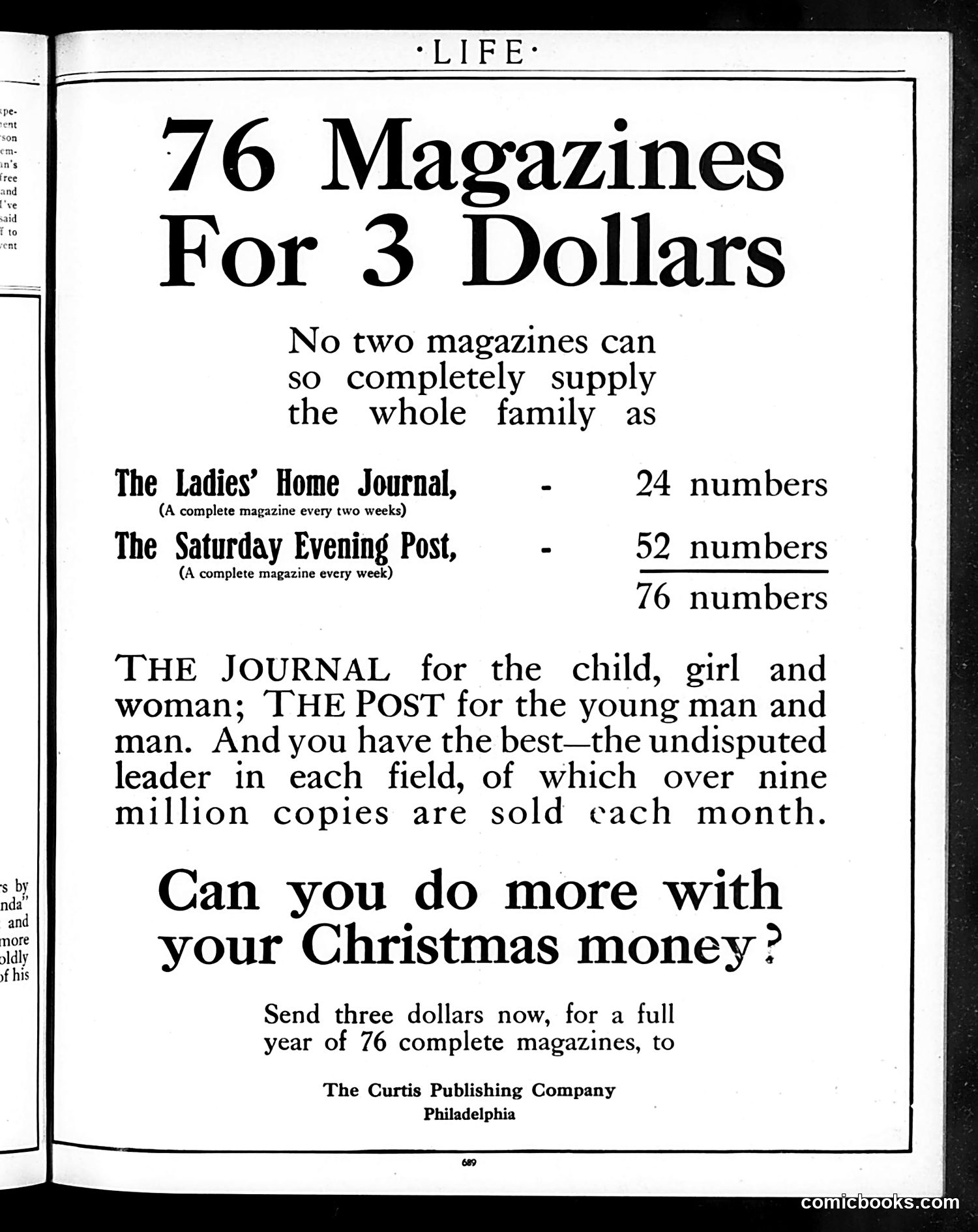
This is a **magazine subscription advertisement**, not a cartoon or satirical content. It appears in *Life* magazine and promotes a bundle offer from The Curtis Publishing Company. The ad pitches two publications: - *The Ladies' Home Journal* (24 issues biannually) - *The Saturday Evening Post* (52 weekly issues) Together they total 76 magazines annually for $3—positioning them as comprehensive family entertainment covering different demographics: the Journal "for the child, girl and woman" and the Post "for the young man and man." The pitch emphasizes value ("Can you do more with your Christmas money?") and circulation credentials ("over nine million copies sold each month"), typical of early 20th-century magazine marketing. There is no satire or political commentary—this is straightforward commercial advertising.
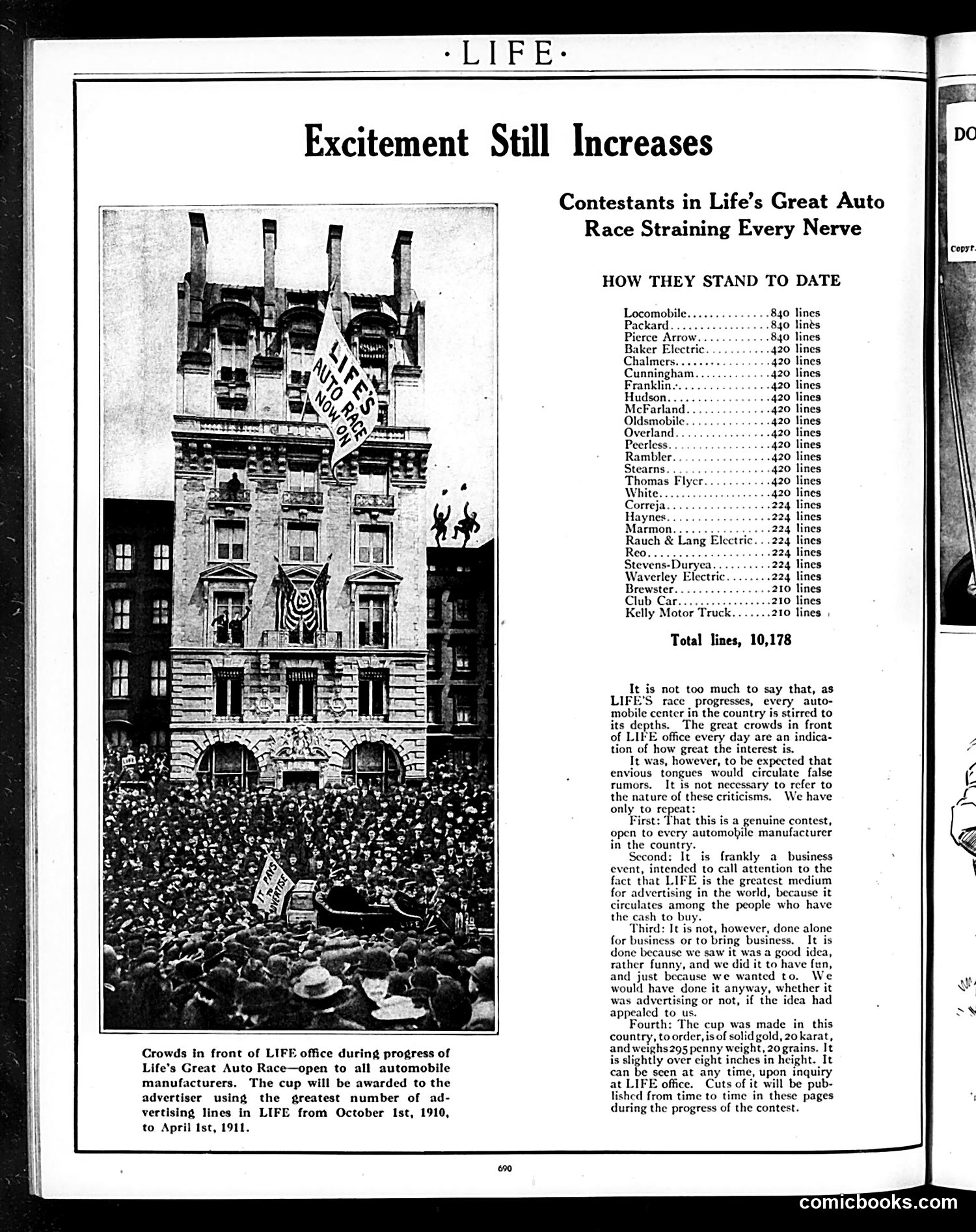
This page announces LIFE's "Great Auto Race"—a competition where automobile manufacturers competed for advertising space based on which company could generate the most public interest and newspaper coverage. The large photograph shows crowds gathered outside LIFE's office, demonstrating the contest's popularity. The right column lists participating car manufacturers (Locomotile, Packard, Pierce Arrow, etc.) ranked by advertising lines earned through October 1910 to April 1911. LIFE explicitly states this was simultaneously a genuine business promotion and a humorous stunt—the magazine admits running the contest partly "to have fun" while generating advertising revenue. The gold cup prize and crowd enthusiasm reflect early 1900s American enthusiasm for automobiles as novel consumer products worthy of public spectacle.
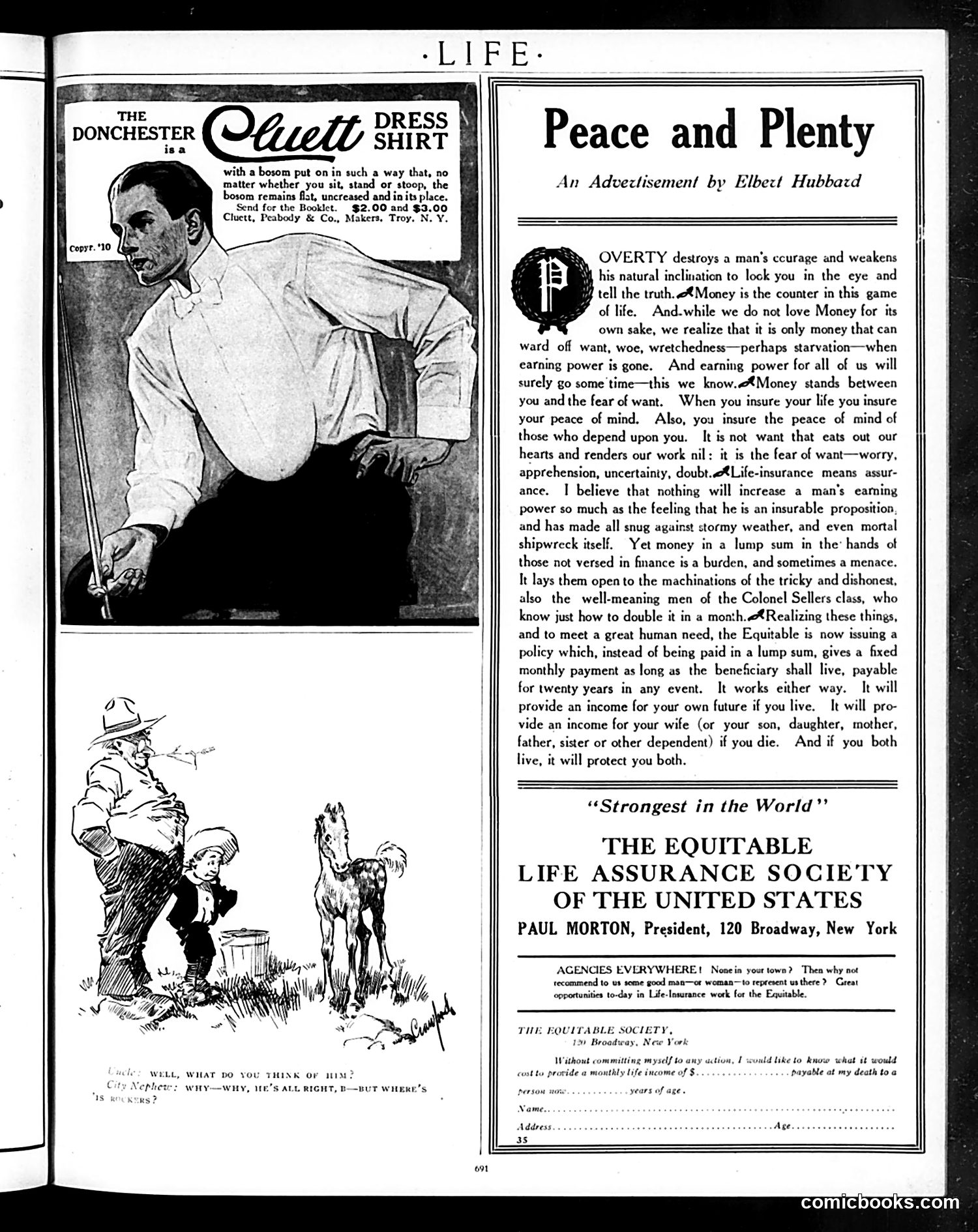
This page contains **two separate items**: a dress shirt advertisement (left) and a life insurance advertisement (right). The **dress shirt ad** shows a man demonstrating the "Cluett" brand's bosom design, which supposedly stays flat and unwrinkled. The smaller cartoon below mocks a cowboy figure, with text reading "WELL, WHAT DO YOU THINK OF HIM? City Nephew: WHY—WHY, HE'S ALL RIGHT,—BUT WHERE'S HIS NECK-TIE?" This satirizes rural versus urban fashion standards of the era—poking fun at a frontier figure lacking metropolitan dress conventions. The **insurance ad** ("Peace and Plenty") by Elbert Hubbard argues that life insurance provides financial security against poverty and uncertainty, presenting it as essential for peace of mind. Both ads target male readers with appeals to respectability and security.
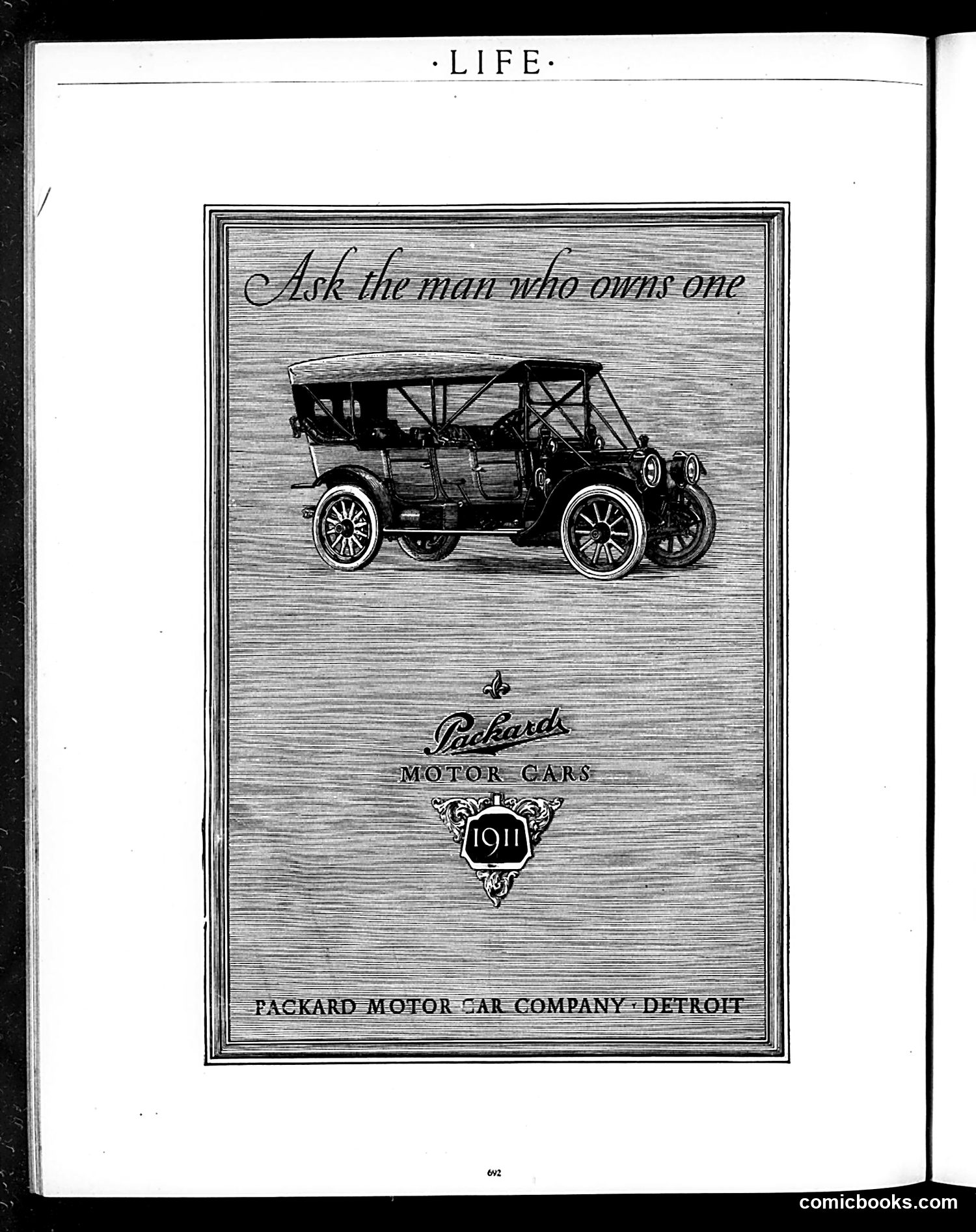
This is a **Packard Motor Cars advertisement** from 1911, not a political cartoon or satirical content. The page appears in *Life* magazine's advertising section. The ad features an early automobile illustration with the tagline "Ask the man who owns one"—a famous Packard slogan emphasizing owner satisfaction as proof of quality. The 1911 date and ornate design reflect the era when automobiles were luxury items, not commonplace. For modern readers: this represents early automotive marketing targeting wealthy consumers. The prestigious branding and appeal to personal testimony reflect how luxury goods were sold before mass production made cars affordable. The elaborate presentation suggests automobiles were still aspirational status symbols rather than practical transportation.
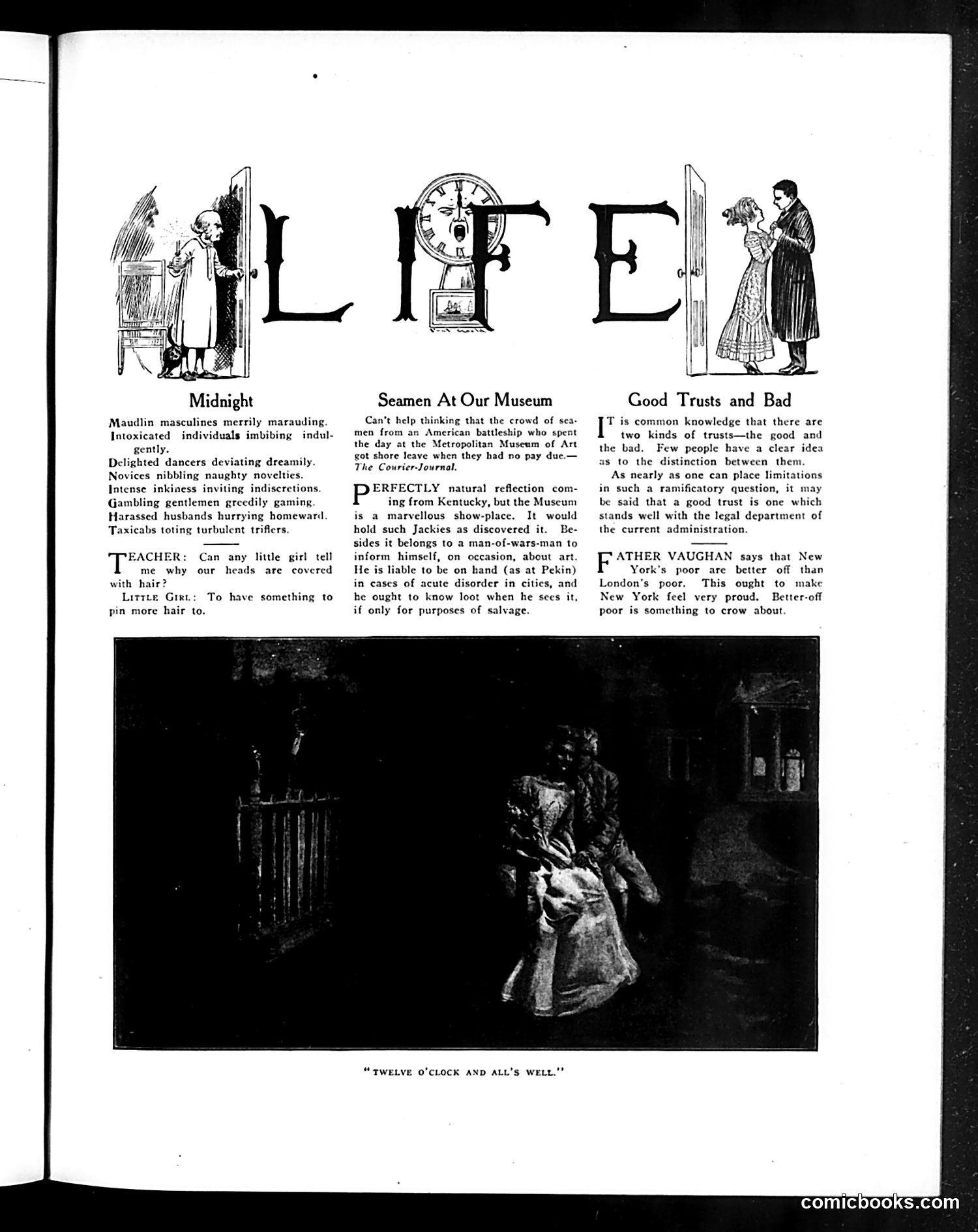
This page contains three brief satirical vignettes about social behavior: **"Midnight"** mocks masculine pretense—men's fashionable vanity despite their affected indifference to appearance. **"Seamen At Our Museum"** jokes about naval officers visiting a battleship exhibit, with the ironic observation that a man-of-war sailor might not recognize his own ship in a museum display. **"Good Trusts and Bad Trusts"** satirizes class hypocrisy: wealthy New Yorkers distinguish between "good" trusts (their own) and "bad" ones (those of rivals), while considering New York's poor preferable to London's because it enhances their self-image. The photograph below illustrates a domestic scene captioned "Twelve O'Clock and All's Well," likely depicting nighttime household security or watchfulness—a common concern of the era. The humor targets class pretension, masculine vanity, and moral double standards.
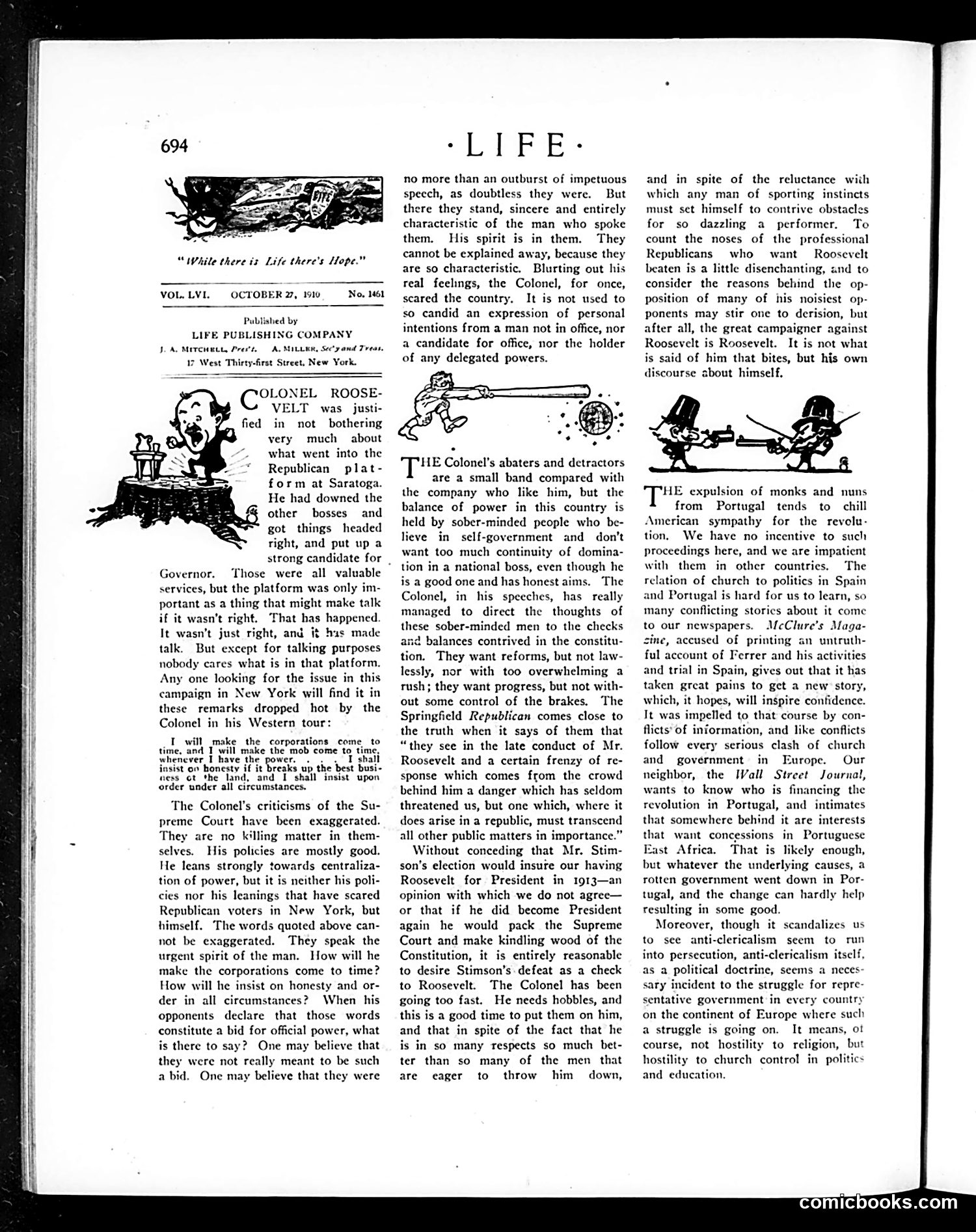
This page contains editorial commentary about Colonel Roosevelt's recent Saratoga speech. The left illustration depicts Roosevelt as an impetuous speaker, caricatured with an exaggerated open mouth—suggesting he speaks without restraint about Republican Party divisions. The text criticizes Roosevelt for publicly airing intra-party conflicts rather than maintaining discretion expected of someone in his position. The cartoonist argues Roosevelt's candid remarks about Republican divisions—while honest—are inappropriate and potentially damaging. The right illustrations appear to reference other political matters (monks/nuns expulsion from Portugal, church-state conflicts in Europe), suggesting Life's broader concerns with international political upheaval affecting American opinion during this Progressive Era period.
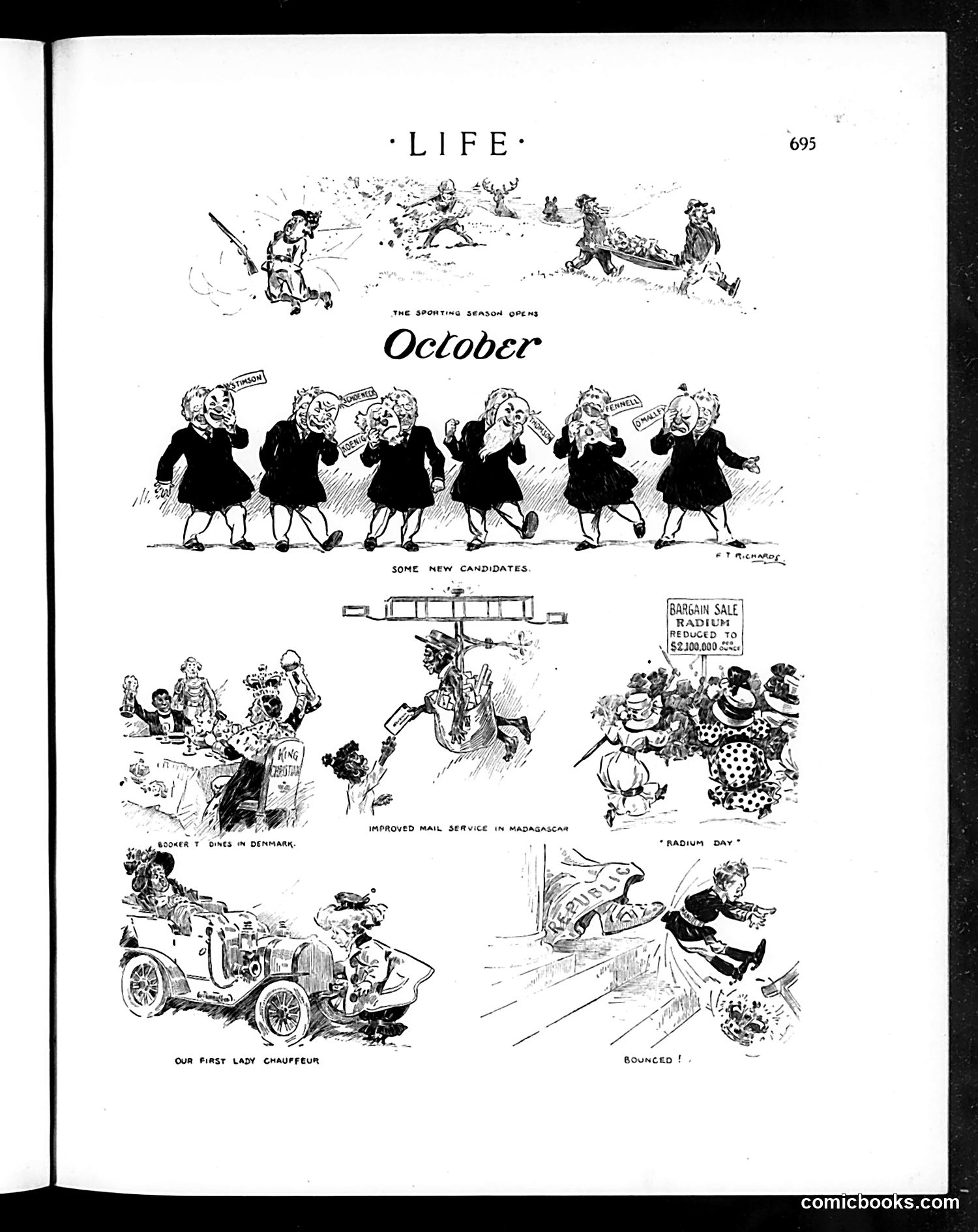
This satirical page from *Life* magazine uses October as its theme, depicting various contemporary events and social commentary: **"Some New Candidates"** shows six identical female figures with voting papers—likely satirizing women's suffrage debates or the influx of female political candidates. **"Radium Day"** references the contemporary radium craze, when this newly-discovered element was marketed (often dangerously) as a cure-all in consumer products. The bargain sale joke mocks this commercial exploitation. **Other vignettes** depict "Our First Lady Chauffeur" (women entering traditionally male-dominated roles), "Improved Mail Service in Madagascar," and "Bounced!"—all contemporary social and political developments. The page's overall tone mocks October's opening of "the sporting season" while satirizing early 20th-century social changes: women's rights, scientific fads, and modernization.
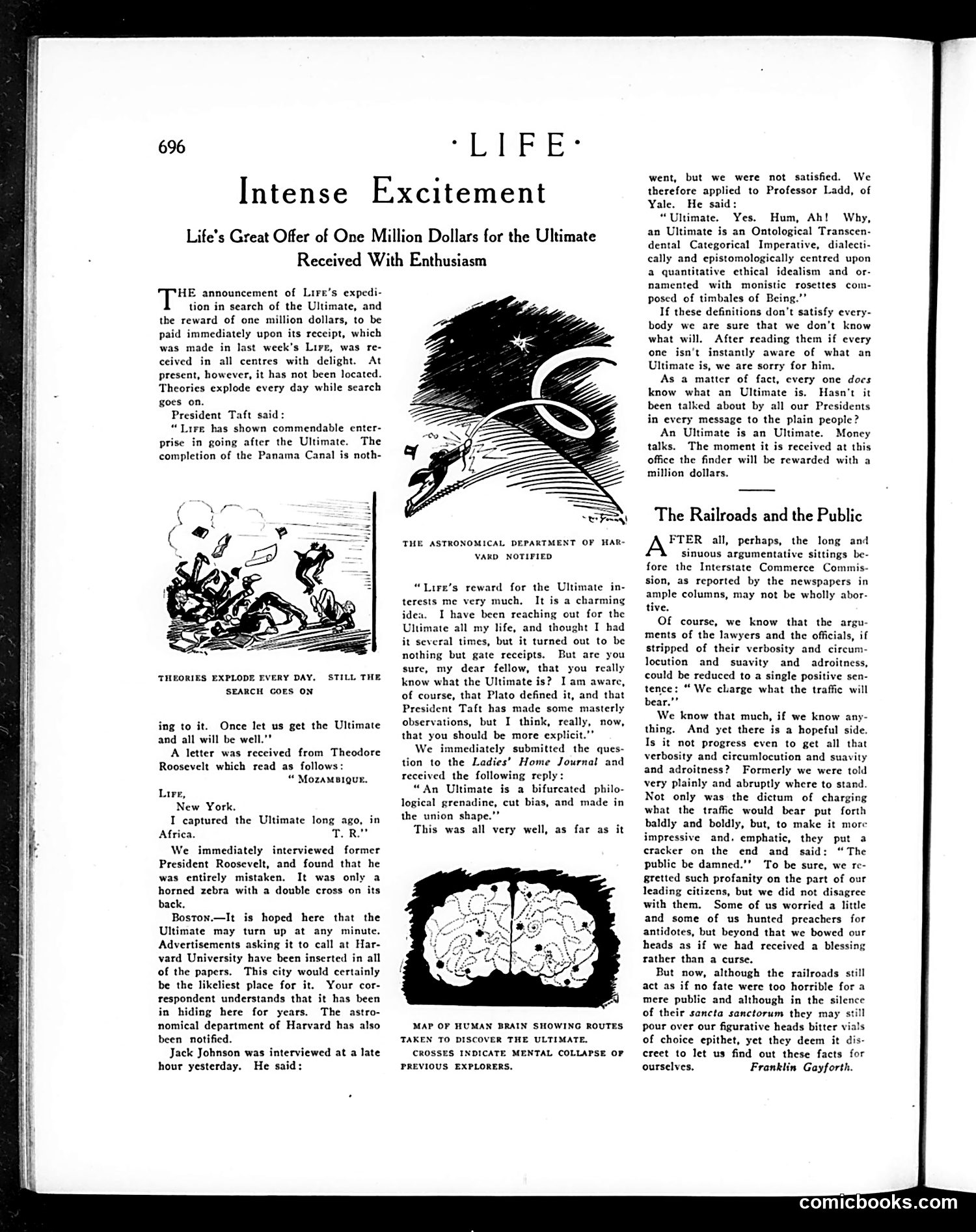
This satirical piece mocks Life magazine's own publicity stunt: a $1 million reward for finding "the Ultimate"—an undefined concept. The cartoons illustrate the absurdity of the search. The left cartoon shows frantic, chaotic activity labeled "THEORIES EXPLODE EVERY DAY. STILL THE SEARCH GOES ON," depicting people scrambling randomly. The right cartoon is a "MAP OF HUMAN BRAIN SHOWING ROUTES TAKEN TO DISCOVER THE ULTIMATE," presenting the brain's neural pathways as hopelessly tangled routes. The text includes mock-serious definitions from Harvard and other sources attempting to define this meaningless concept philosophically. The satire targets both Life's own stunt marketing and the pretentious intellectualization of vague ideas—poking fun at how easily people can be excited by undefined concepts dressed in authoritative language.
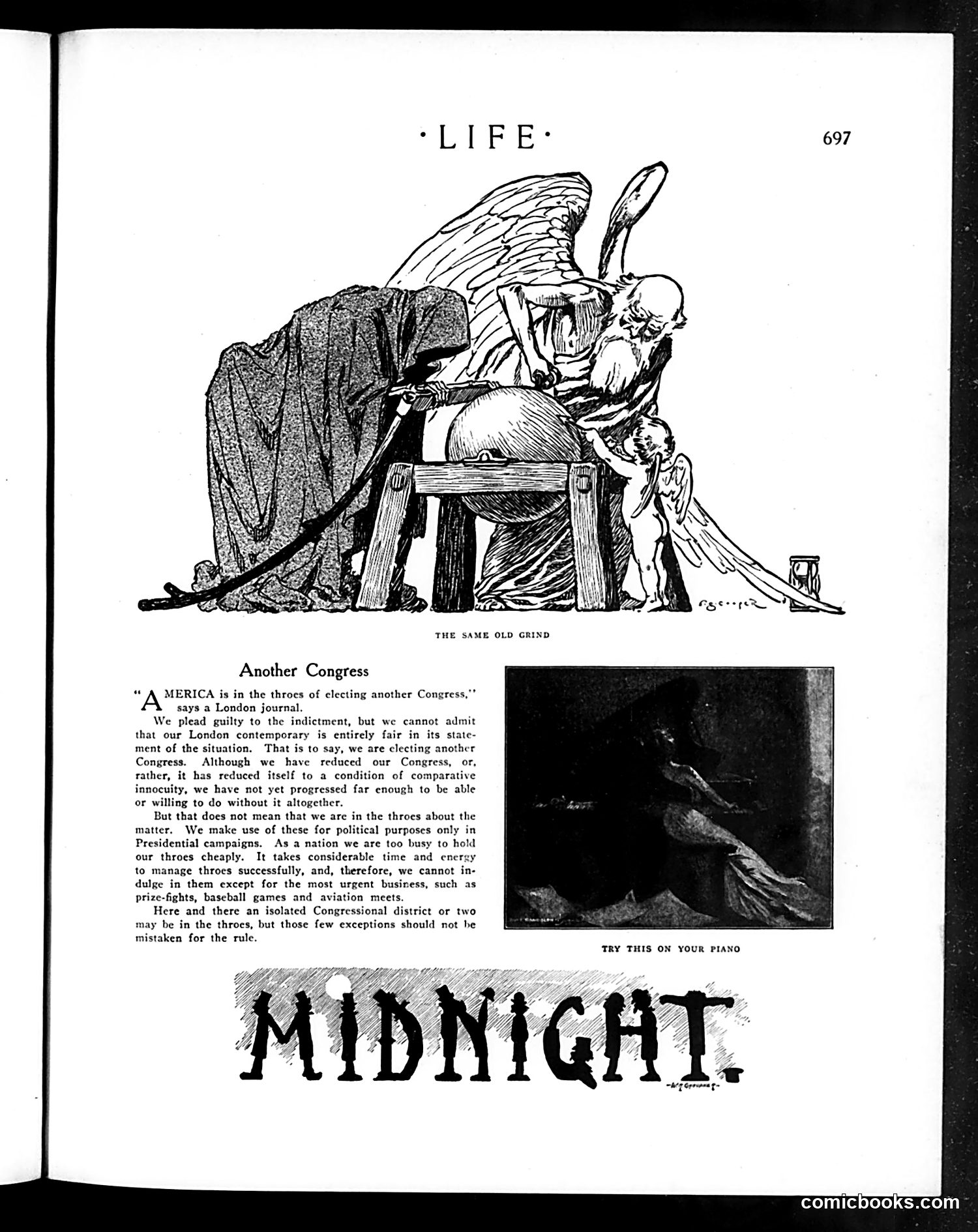
The top cartoon, titled "The Same Old Grind," depicts Death (skeleton with scythe and dark robes) operating a grinding wheel, with small cherub-like figures being processed through it. This allegorizes Congress as a destructive, relentless machine. The accompanying article critiques a London journal's claim that America is "in the throes of electing another Congress." The author argues that while Congress has been "reduced to comparative innocence," Americans remain too busy with entertainment (prize-fights, baseball, aviation meets) to properly engage with governance. The satire suggests that regular Congressional elections have become routine and ineffectual—a grinding, repetitive process that produces little meaningful change.
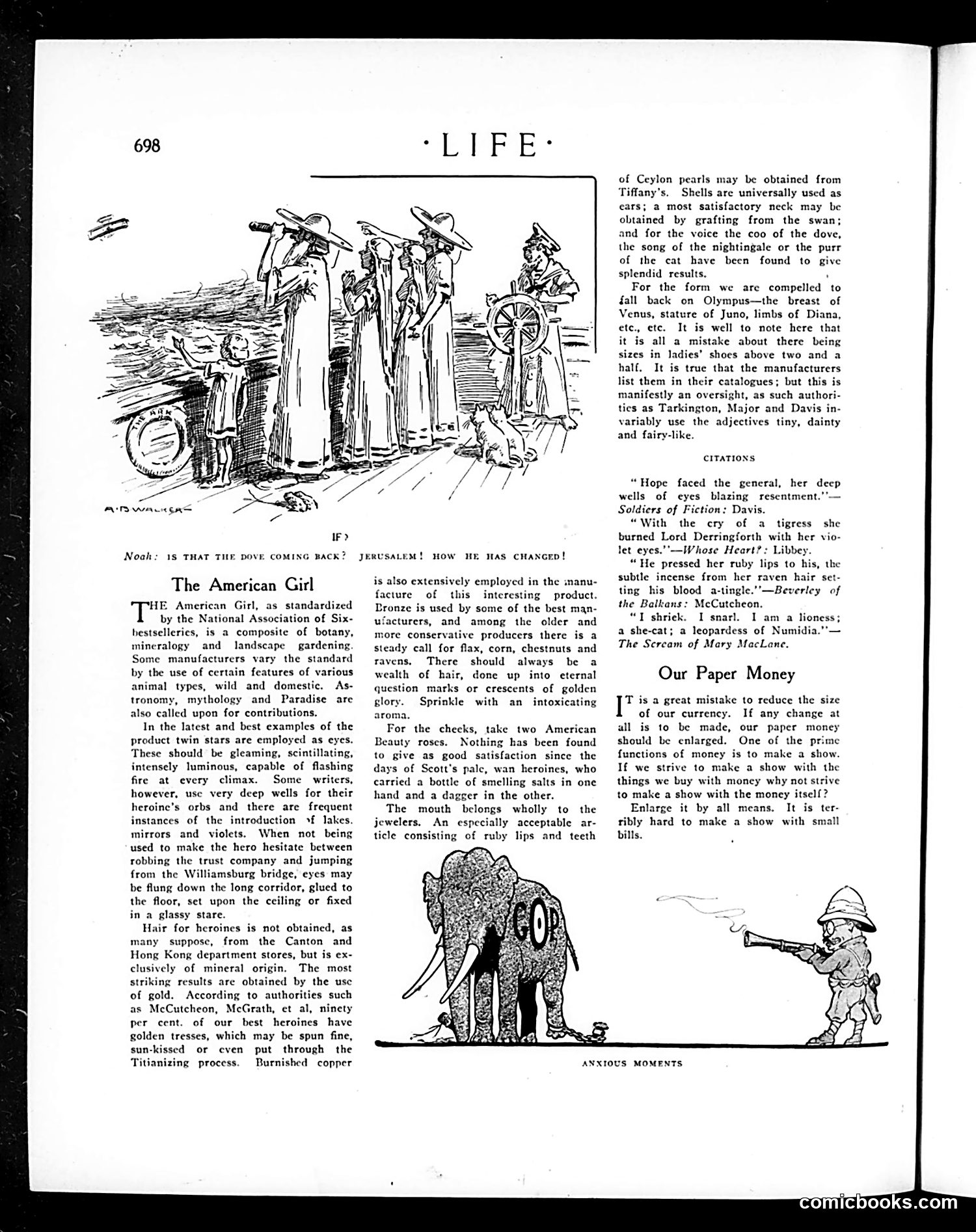
This page satirizes the formulaic, idealized depiction of female characters in popular fiction of the era. The text mock-seriously dissects how bestselling authors construct their heroines as artificial "composites," using absurdly flowery language borrowed from mythology and nature. The satire targets specific literary conventions: heroines with luminous, expressive eyes (referenced in quoted passages from Davis, Libbey, McCutcheon); elaborate descriptions of golden or raven hair; tiny feet; ruby lips. The cited authors (Tarkington, Major, Davis) were contemporary bestselling novelists whose work embodied these clichés. The top cartoon shows figures in classical dress—presumably representing the idealized female form—with the caption joking that even "the dove" (symbolizing classical beauty) has been corrupted by these impossible standards. The satire's point: popular fiction reduces women to standardized, physically impossible fantasies assembled from mythology and jewelry-store descriptions, treating them as manufactured products rather than realistic characters.
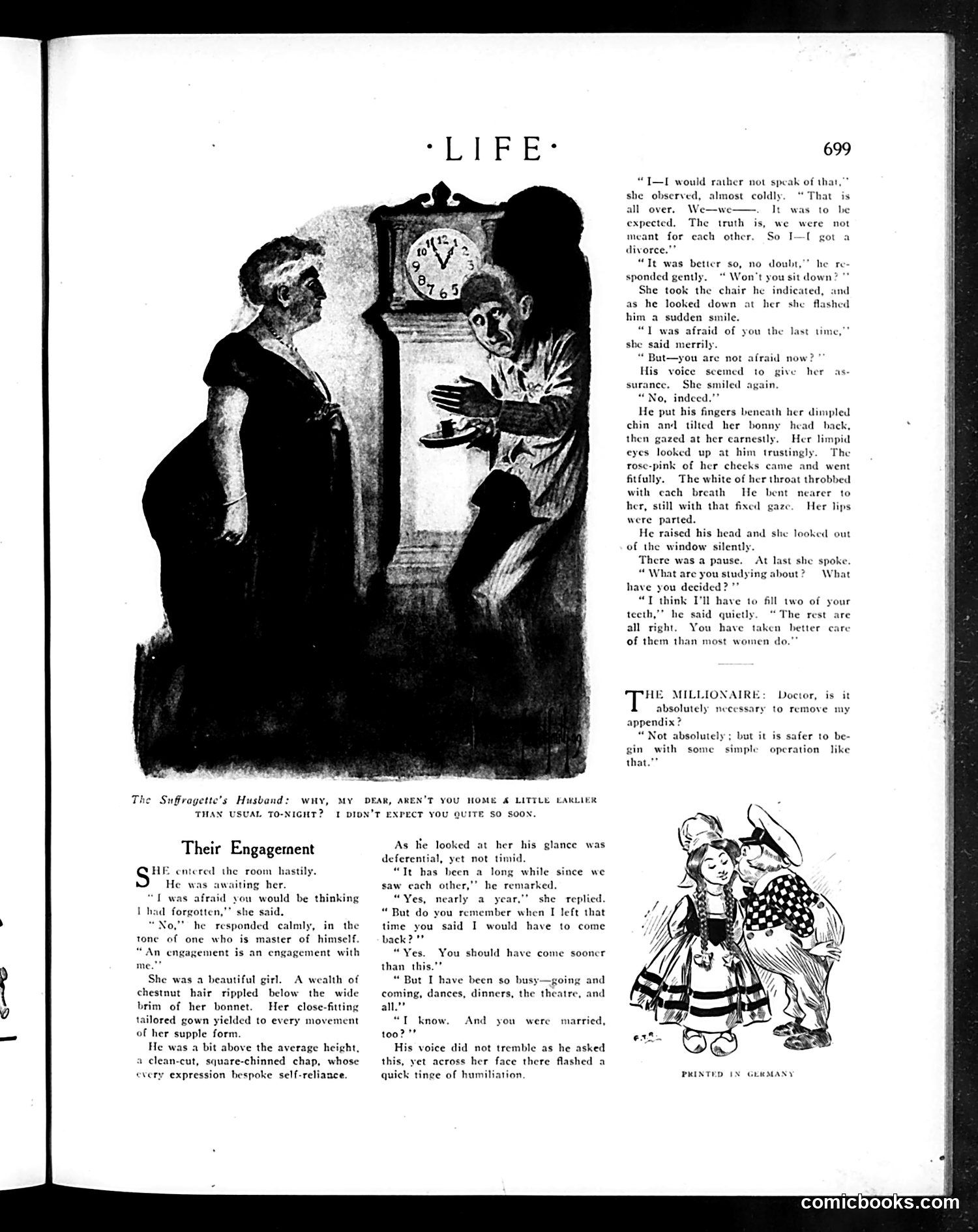
This page satirizes the "New Woman" of the early 20th century, specifically suffragettes who pursued activism and independence. The main cartoon depicts a husband arriving home to find his wife absent, asking why she's home earlier than expected—the ironic joke being that she's *not* home at all. The accompanying story, "Their Engagement," mocks the changing gender dynamics of the era. It presents a woman who abandoned her husband, remarried, divorced again, and now casually reconnects with her first husband—who happens to be a dentist. The satire's point: the husband maintains composed masculine authority (deciding to "fill two of her teeth") while she blushes and defers, suggesting that despite women's new freedoms and activism, traditional power dynamics supposedly persist. The small illustration at bottom-right appears unrelated—a cherub or angel figure captioned "Printed in Germany." The satire mocks both the "suffragette" lifestyle as chaotic and the assumption that women ultimately remain subordinate to men.
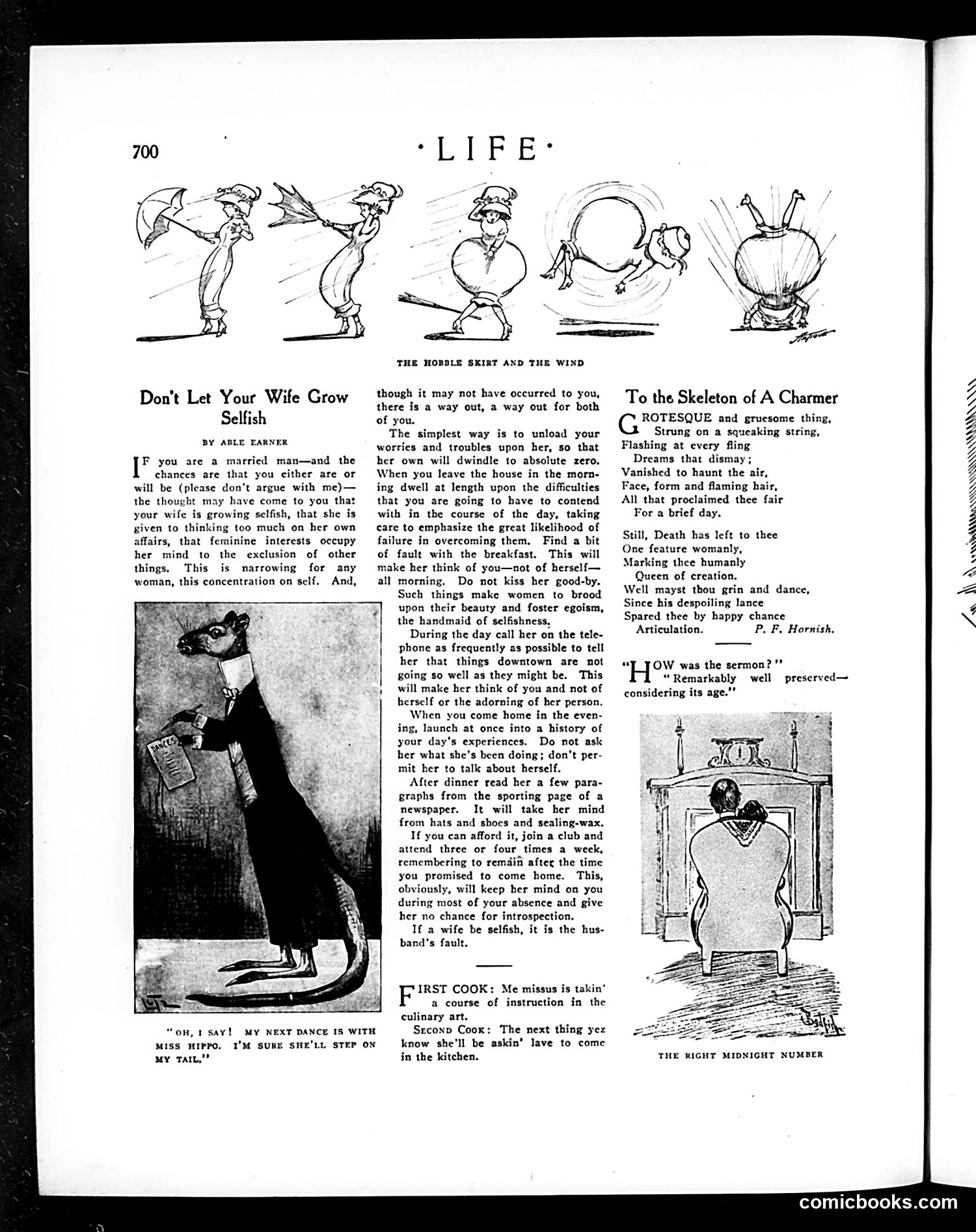
This 1910s *Life* magazine page satirizes early 20th-century gender dynamics through multiple pieces: **Main article "Don't Let Your Wife Grow Selfish":** Uses ironic advice to critique controlling husbands. The author (bylined "Able Earner") sarcastically recommends husbands constantly burden wives with their problems, neglect them emotionally, and monopolize conversation—ostensibly to prevent female "selfishness." The joke exposes how husbands weaponize emotional labor and discourage wives' independence. The closing line—"If a wife be selfish, it is the husband's fault"—reverses blame back onto men. The accompanying illustration shows a woman with an exasperated expression. **Smaller items:** Include jokes about the "hobble skirt" (a restrictive fashion), a brief exchange between working-class men about wives taking cooking classes (implying anxiety about female education/autonomy), and unrelated humorous snippets. The satire targets Victorian-era marital dynamics where wives' interests and autonomy were actively suppressed in favor of men's needs.
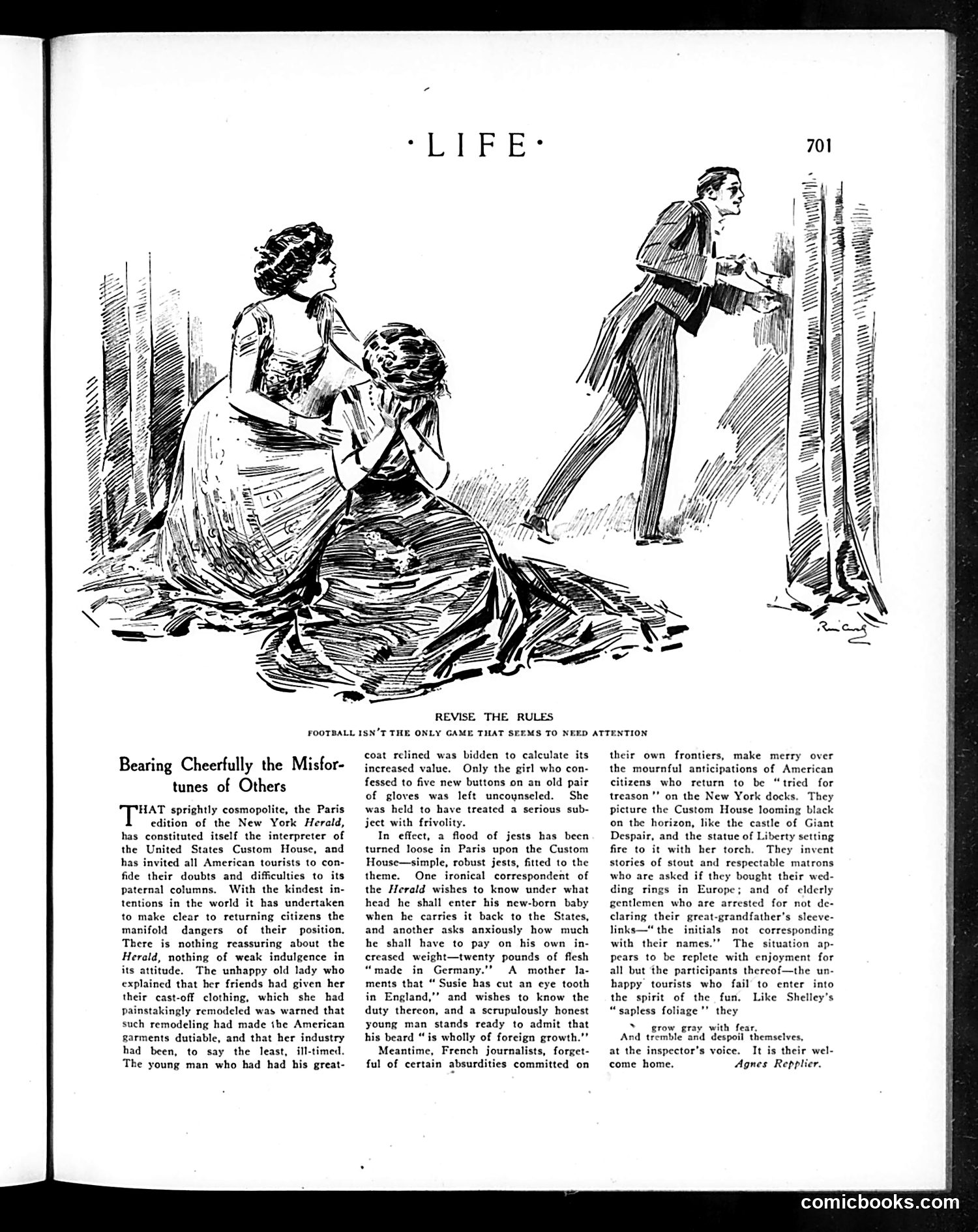
This satirical piece mocks American tourists returning from Europe who face U.S. Customs inspections. The cartoon shows two women and a man at what appears to be a customs checkpoint, with inspectors examining baggage. The humor centers on the absurdity of customs regulations. French and American newspapers had published jokes about borderline-ridiculous scenarios: a woman remodeling gifted clothing faces duty charges; a man's relined coat is now taxable; a mother worries about duty on her daughter's tooth cut in England; a man must declare his "foreign-grown" beard. The satire targets: 1. **Overzealous customs enforcement** that penalizes innocent purchases or modifications 2. **The anxiety of returning Americans** who "grow gray with fear" facing inspectors 3. **International mockery**—French journalists enjoy lampooning American customs while conveniently forgetting similar absurdities at their own borders The piece suggests customs rules need revision, hence the title. The tone is sympathetic to tourists while gently ridiculing both bureaucratic excess and human worry over regulations that seem designed to extract maximum duty from the traveling public.
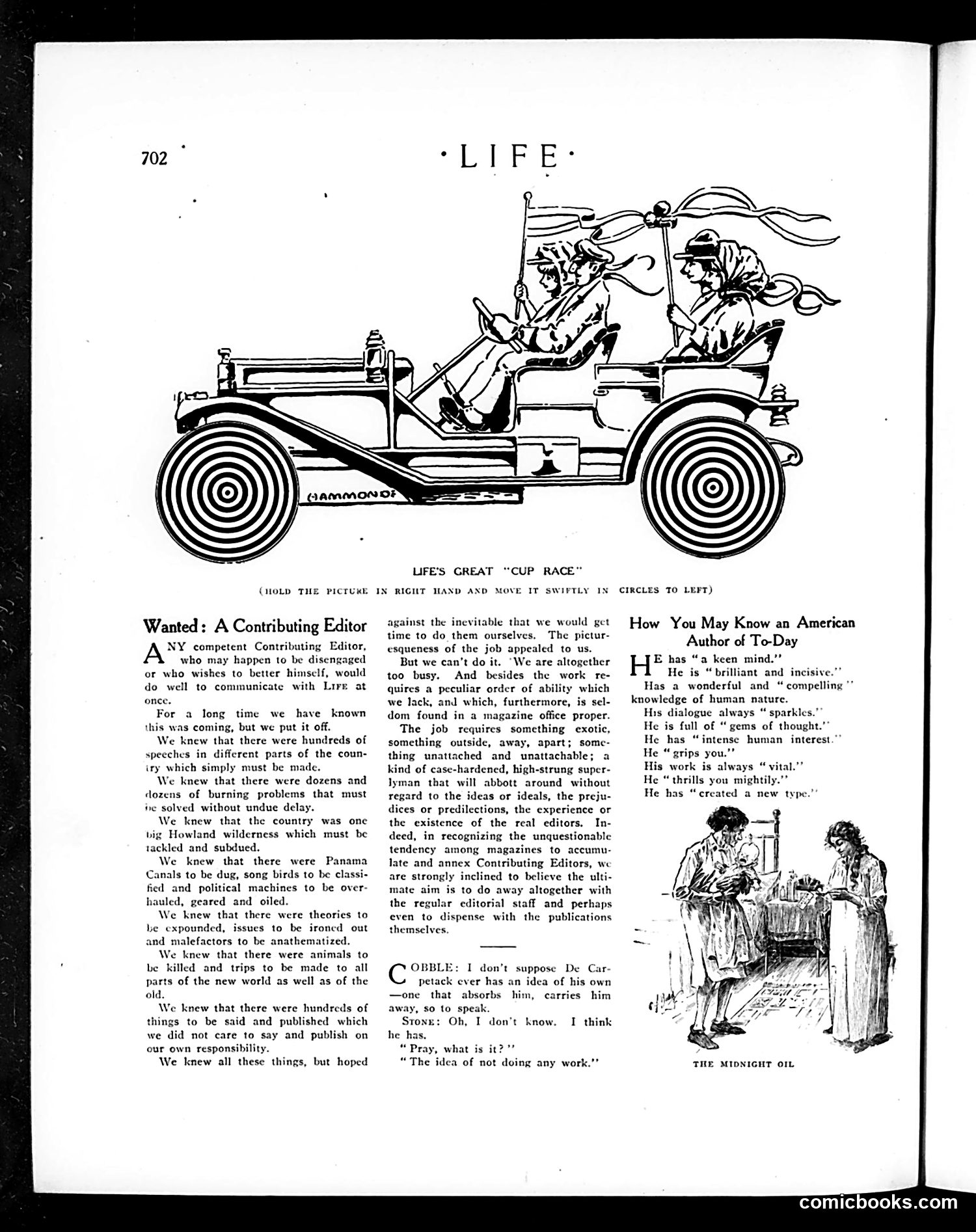
This page from *Life* magazine satirizes the magazine industry's hiring practices and the stereotypical American author. **The top cartoon** shows two figures in a motorcar labeled "HAMMOND" racing in circles—a visual pun instructing readers to move the picture in circles to create motion. It mocks the frantic, circular nature of editorial work and the endless cycle of tasks Life catalogues: Panama Canals, political reform, scientific classification, and more. The satire suggests that despite knowing all these important things need doing, the magazine can't accomplish them. **"Wanted: A Contributing Editor"** is a tongue-in-cheek job posting acknowledging that *Life* needs outside writers to handle work the regular staff won't claim responsibility for—freeing editors from accountability while maintaining content output. **"How You May Know an American Author"** parodies the predictable critical praise lavished on contemporary writers: every successful author is "brilliant," has "sparkling" dialogue, "grips" readers, and has "created a new type." The satire exposes how formulaic and hollow such praise has become.
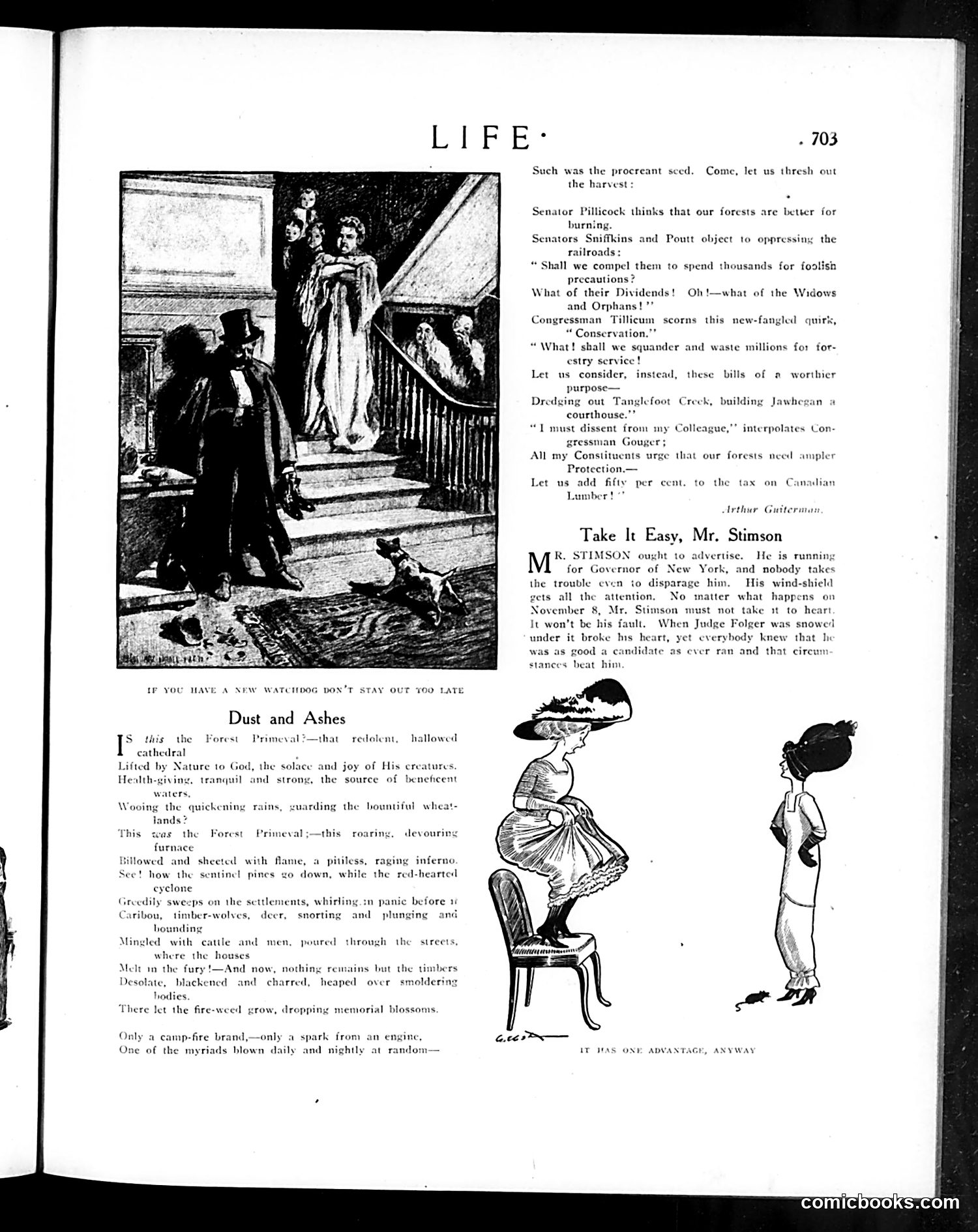
This page satirizes early 20th-century Congressional opposition to forest conservation measures. The upper section mocks senators and congressmen who prioritize corporate dividends and local pork-barrel projects over environmental protection. "Senator Pillicock" and others argue against railroad safety regulations and forestry spending, citing concern for "Widows and Orphans"—a sarcastic reference to dividend-dependent shareholders. Congressman Tillicum dismisses "conservation" as newfangled while promoting wasteful courthouse construction. The poem "Dust and Ashes" contrasts the pristine "Forest Primeval" with catastrophic destruction from uncontrolled logging and fire, ending with desolation and death. The satire suggests politicians prioritize short-term profits over environmental catastrophe. The cartoon featuring "Mr. Stimson" (likely Henry Stimson, New York gubernatorial candidate) jokes that his wind-shield garners more attention than his campaign—implying voter indifference to serious issues.
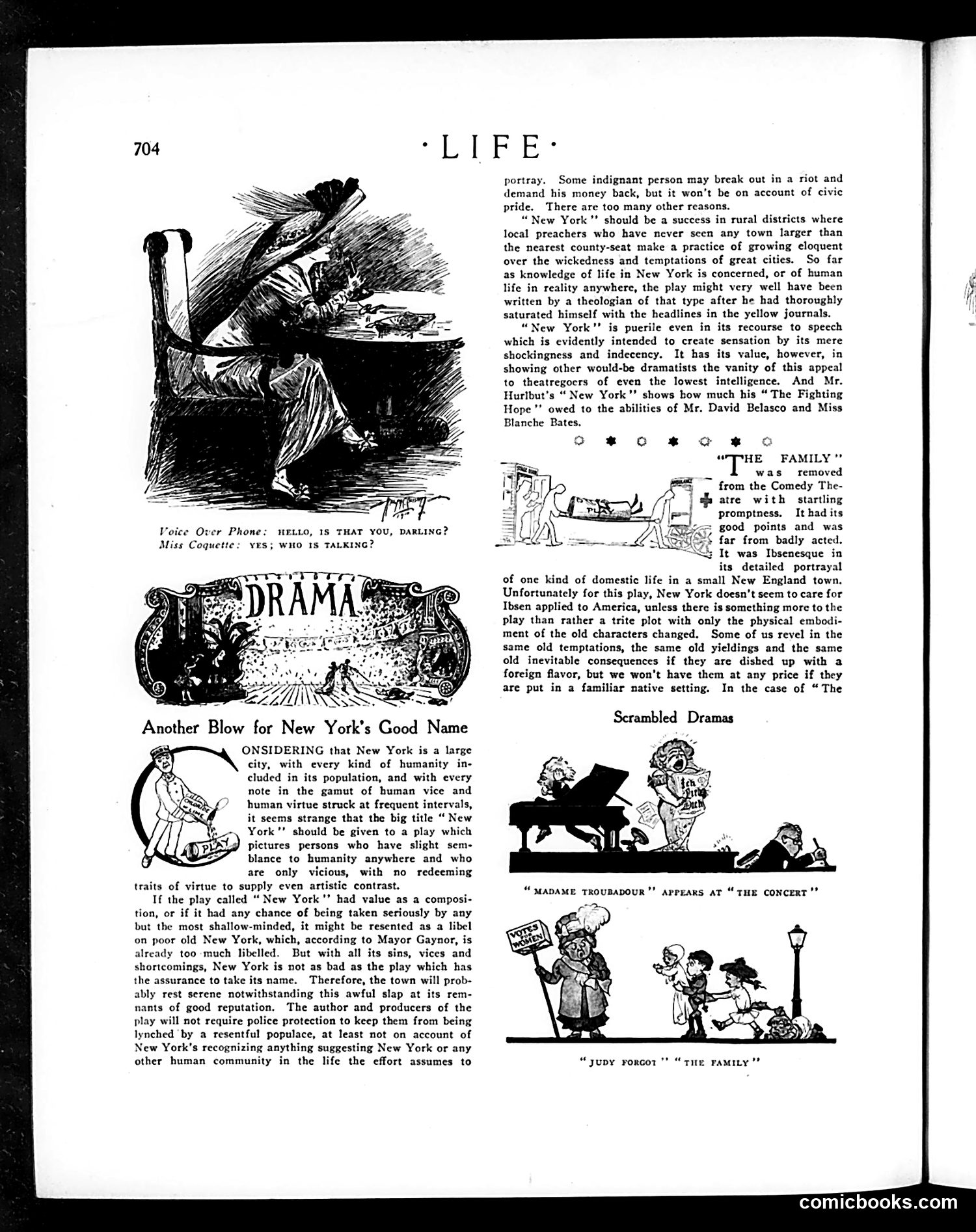
This page critiques recent Broadway plays with titles referencing New York City. The main article attacks a play called "New York" for portraying the city through a sensationalist lens—full of vice and indecency but lacking authentic human complexity or redeeming traits. The author argues the play insults New York's actual character and appeals only to rural audiences eager to confirm their prejudices about big-city corruption. Below, a sidebar discusses "The Family," an Ibsen-influenced domestic drama set in New England that failed because New York audiences reject realistic American settings, preferring European flavor instead. The scattered theatrical illustrations labeled "Scrambled Dramas" appear to be satirical sketches mocking other contemporary plays. The overall point: Broadway's "New York" play is artistically shallow sensationalism that falsely represents the city—neither serious enough to critique honestly nor entertaining enough to succeed on its own merits.
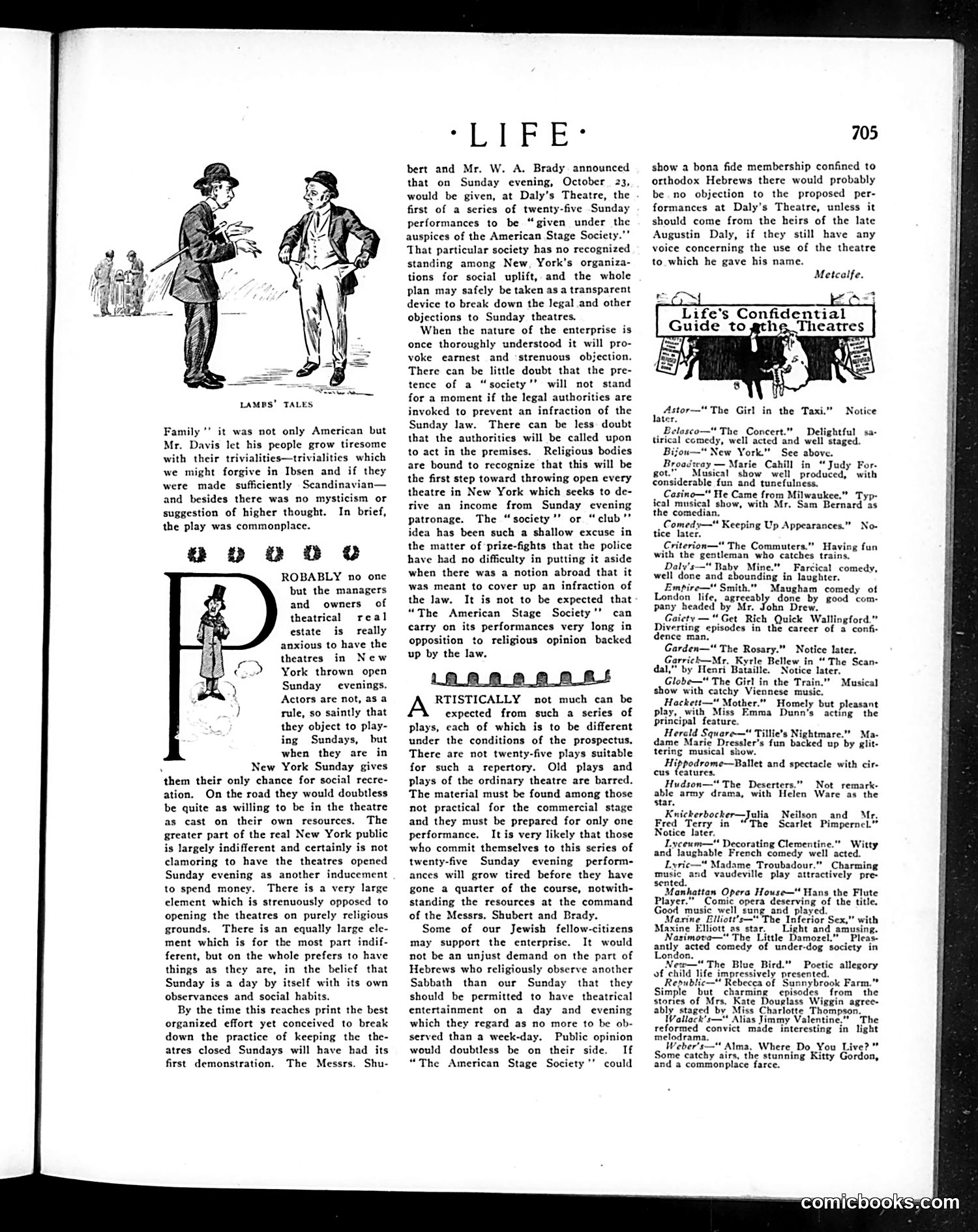
This page discusses a contemporary controversy: theater owners Shubert and W.A. Brady announced plans to open New York theaters on Sunday evenings under the guise of "The American Stage Society," beginning October 23. The article argues this is a transparent legal dodge. Strict Sunday observance laws prohibited commercial entertainment on Sundays, supported by religious organizations and a large portion of the public who believed Sunday should remain sacred. The author contends the "society" pretense will fool no one and predicts authorities and religious bodies will oppose it—just as they'd easily dismissed similar claims by prize-fight organizers. The illustration labeled "Lambs' Tales" (likely referencing the theatrical Lambs Club) shows two figures in conversation, presumably discussing the theatrical scheming involved in this controversy. The article maintains skeptical, satirical tone throughout regarding the enterprise's legitimacy and prospects.
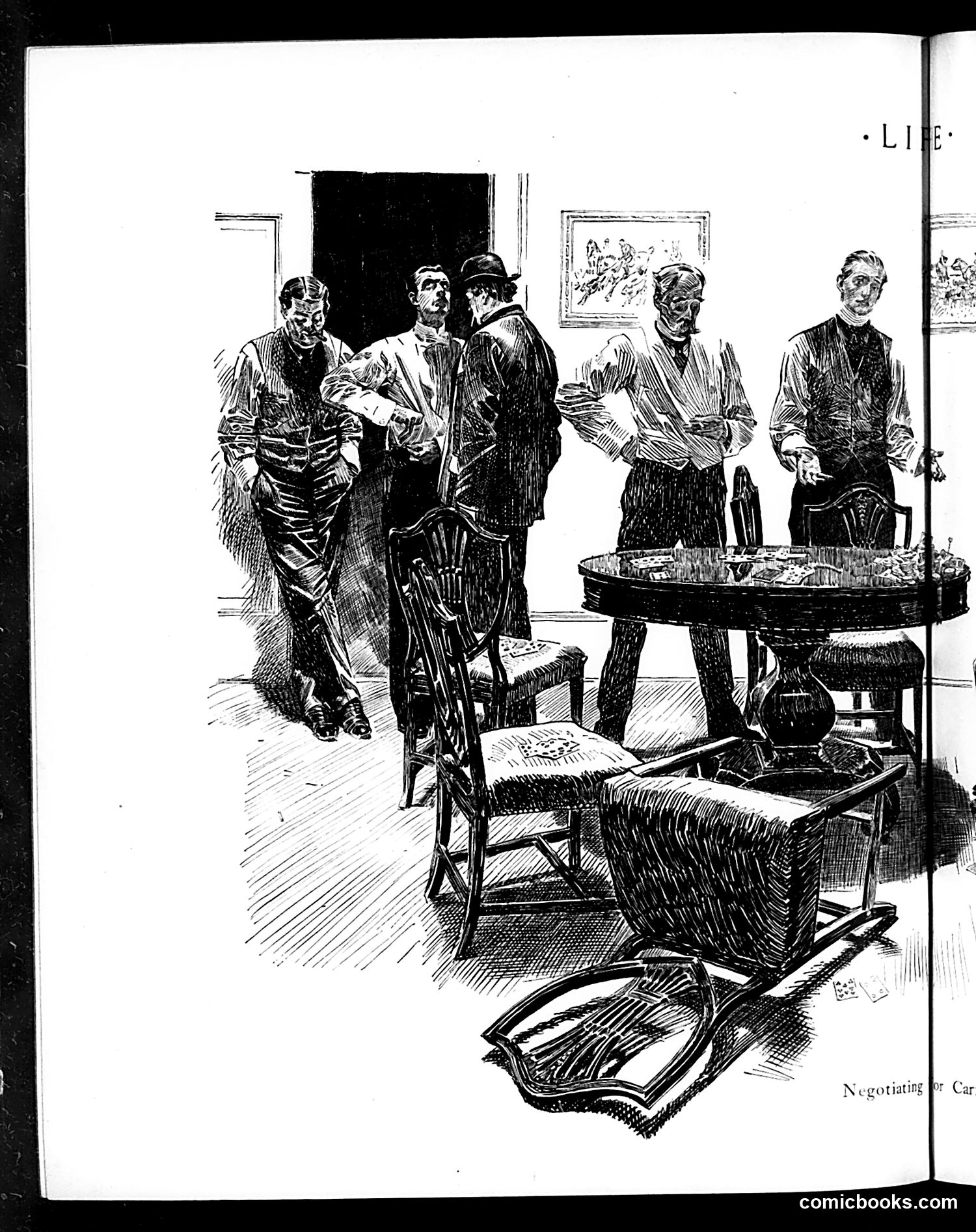
This political cartoon depicts five well-dressed men in what appears to be an indoor office or showroom setting, gathered around furniture and negotiating items. The caption reads "Negotiating for Car" (OCR partially obscured). The scene satirizes business negotiations, likely from the early 20th century based on the art style and clothing. The men's body language and positioning suggest haggling or deal-making over an automobile or related goods. Without additional context about the specific historical moment, it's unclear whether this references a particular scandal, labor dispute, or general commentary on commercial negotiations. The cartoon appears to mock the formal, often tense process of striking business deals during this era.
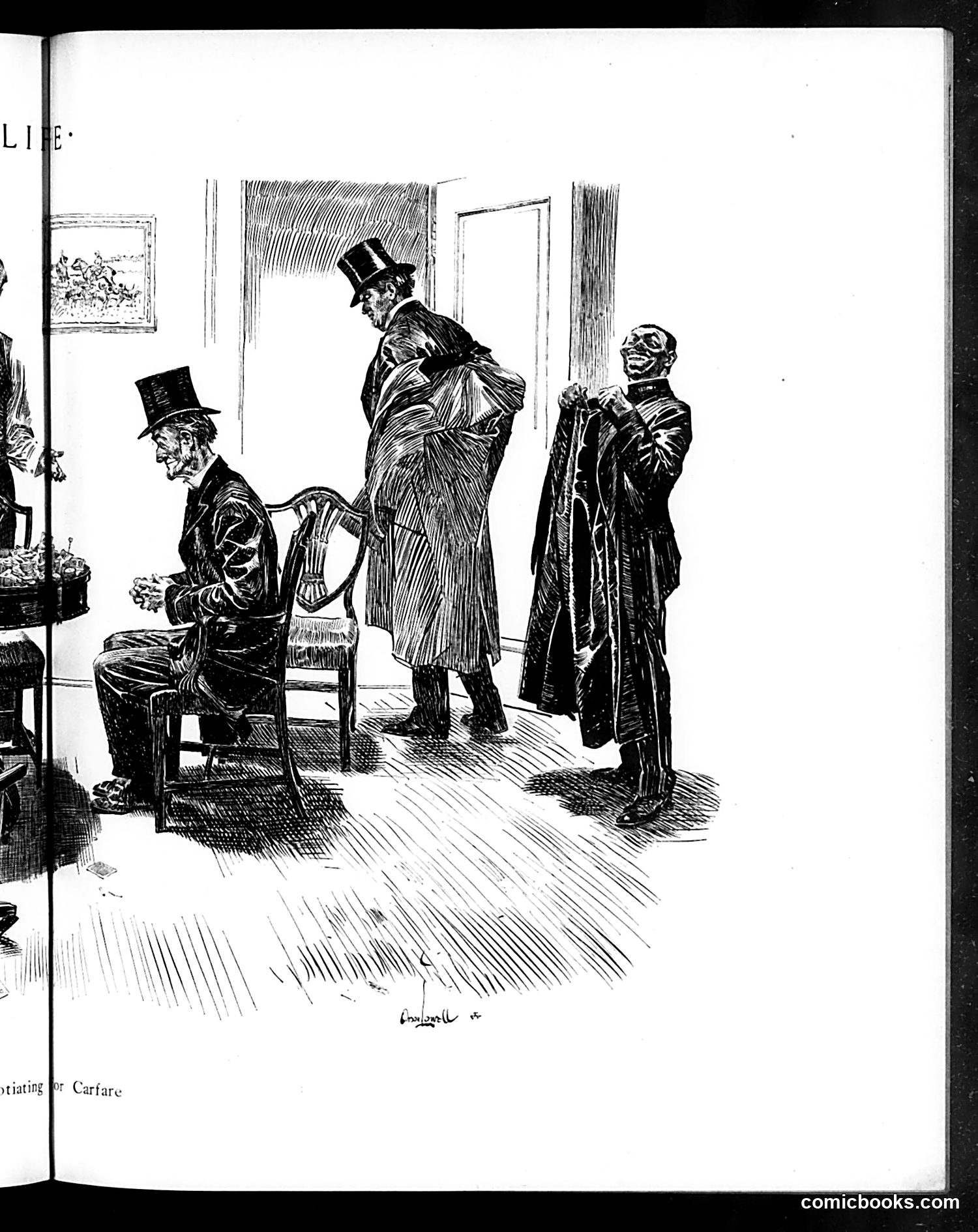
This appears to be a satirical sketch from *Life* magazine showing three well-dressed gentlemen in top hats in an indoor setting. The seated figure on the left appears to be negotiating or conducting business with the standing figures. The artistic style and formal Victorian attire suggest late 19th or early 20th-century subject matter. The partial OCR text mentioning "tiating" (likely "negotiating") and "Carfare" suggests this satirizes some form of negotiation or transaction—possibly political or financial dealing. The title "LIFE" at the top confirms this is from the satirical publication. However, without clearer text or additional context identifying the specific figures or incident being lampooned, I cannot confidently determine which particular political event, scandal, or social commentary this cartoon targets. The humor likely relied on contemporary readers recognizing the subjects or situation.
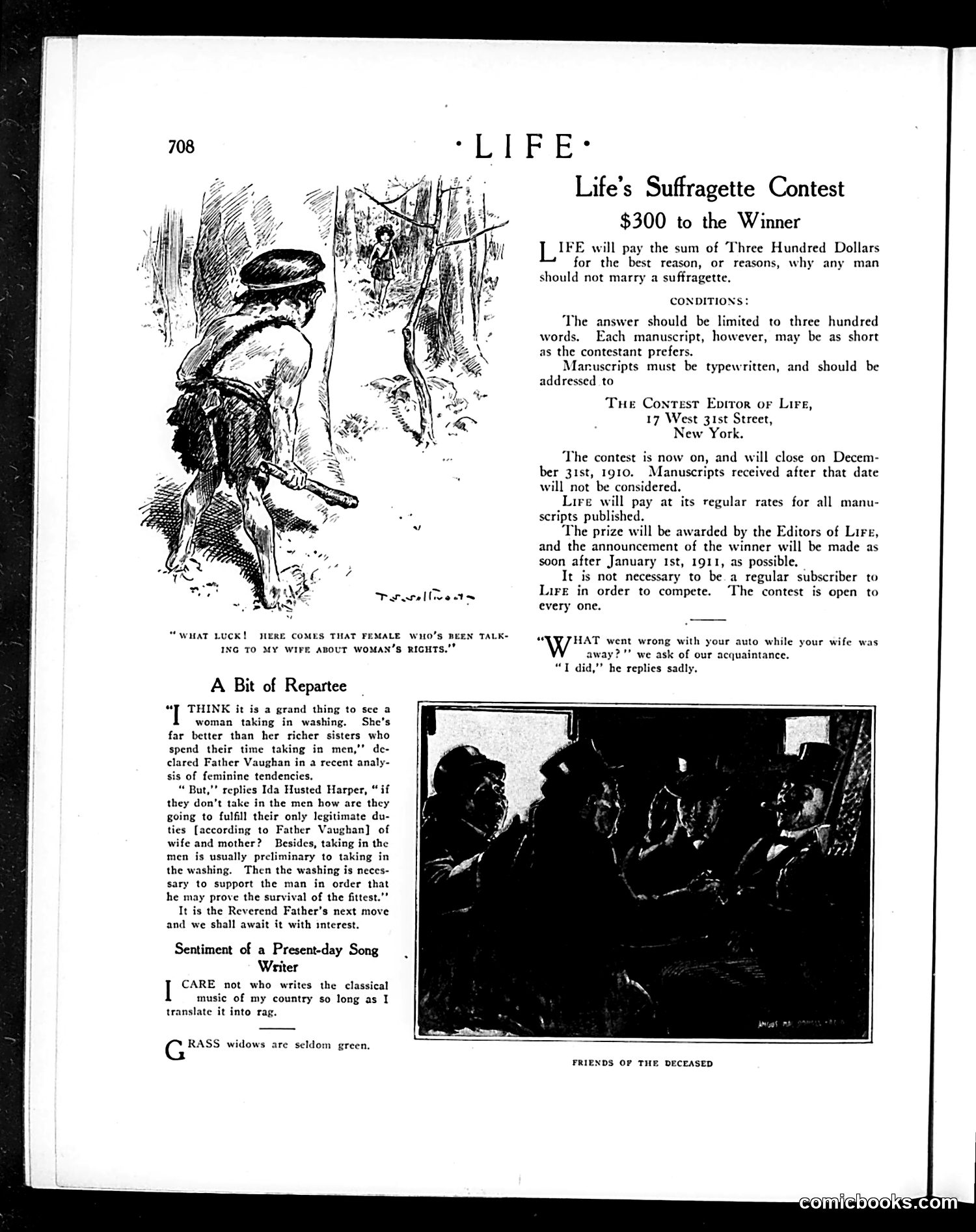
This page satirizes anti-suffrage sentiment through a mock contest. Life magazine offers $300 for the best argument against men marrying suffragettes—a joke exposing the absurdity of such opposition. The cartoon depicts a man fleeing from a woman advocating women's rights, captioned "What luck! Here comes that female who's been talking to my wife about woman's rights." The page includes witty repartee mocking Father Vaughan's critique of women, with Ida Husted Harper countering that women's domestic duties require engaging with men first. The accompanying anecdote plays on marital discord caused by suffragette activism, with a man sadly admitting his wife left during a discussion of women's rights. The satire's point: anti-suffrage arguments were so weak they deserved ridicule. By weaponizing humor, Life supported women's voting rights while entertaining readers through exaggerated male anxiety about empowered women.
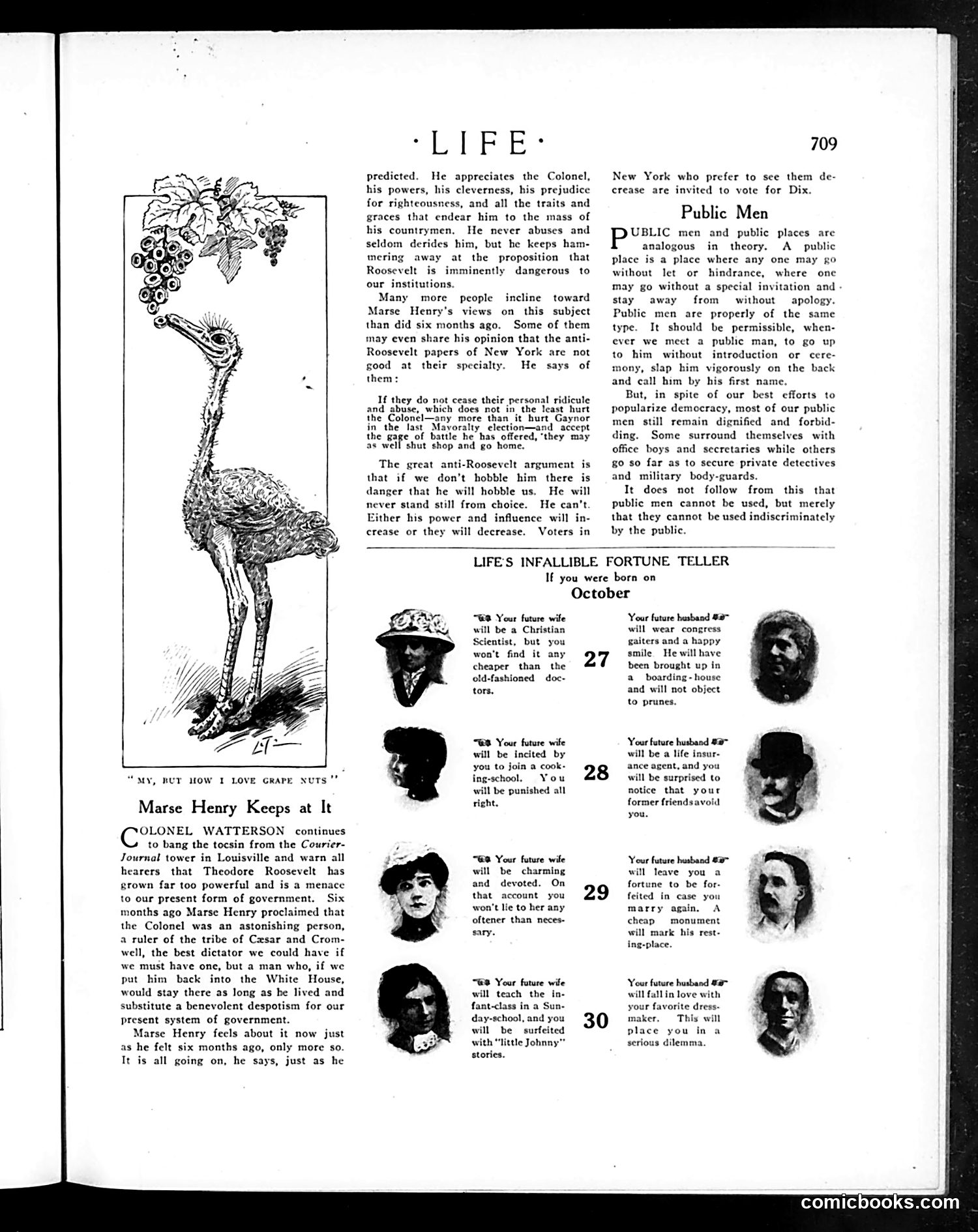
**Main Cartoon & Article: "Marse Henry Keeps at It"** Colonel Henry Watterson, editor of the Louisville Courier-Journal, is caricatured as an ostrich delivering warnings about Theodore Roosevelt. The satire criticizes Watterson's inconsistency: six months prior he praised Roosevelt as a powerful leader; now he warns Roosevelt is a dictatorial threat to democratic institutions. Life mocks this reversal while acknowledging others increasingly share Watterson's anti-Roosevelt stance. The article notes New York voters opposing Roosevelt's continued influence are urged to vote for Dix (the Democratic gubernatorial candidate). **Secondary Feature: "Public Men"** This section satirizes the hypocrisy of American "public men"—supposedly accessible figures like public places—who ironically surround themselves with secretaries, detectives, and bodyguards, maintaining aristocratic distance from ordinary citizens. **"Fortune Teller" Section** Humorous predictions for October-born people mock marriage outcomes with gentle domestic satire (Christian Science doctors, cooking lessons, tedious Sunday school anecdotes).
This page contains book reviews rather than political cartoons. The main content criticizes G.K. Chesterton's *What Is Wrong With the World?*, comparing his writing style to a disorganized vaudeville show—suggesting his work is entertainingly scattered rather than coherently argued. The reviewer praises Hutchins Hapgood's *Types from City Streets* for its observational quality regarding New York lower-class and Bohemian life, though lamenting its fragmentary presentation. Most favorably reviewed is Clayton Hamilton's *The Theory of the Theatre*, which the critic endorses despite initial expectations that theater theory would be esoteric. Hamilton apparently argues that drama represents a "real democrat among the arts"—accessible to all social classes—and explores relationships between stage, life, and audience. The page demonstrates early 20th-century literary criticism standards, where reviewers valued coherent argumentation and observed reality over entertainment value alone.
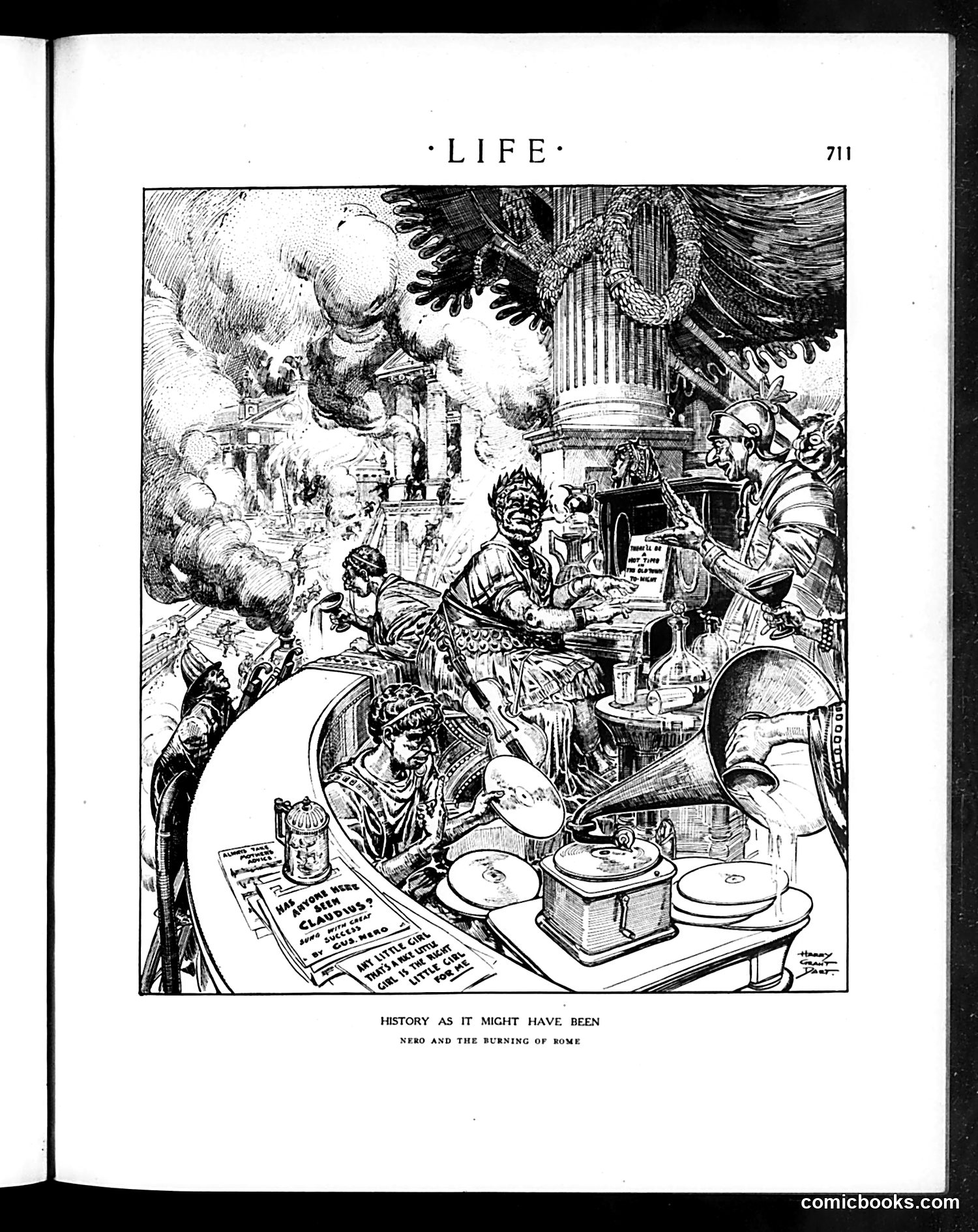
This is a satirical cartoon titled "History as It Might Have Been: Nero and the Burning of Rome." The image depicts the Roman emperor Nero in a modern setting—apparently dining or at a social gathering with contemporary figures—while Rome burns in the background. The satire appears to be comparing Nero's legendary indifference during Rome's destruction to contemporary political or social negligence. Modern figures in formal dress are shown socializing, drinking, and apparently unconcerned with the chaos visible behind them. There's what appears to be a menu or document visible on the table. The cartoon critiques leaders (and their associates) who remain preoccupied with leisure and personal matters while serious crises unfold. Without additional context about *Life* magazine's publication date, I cannot identify the specific modern figures caricatured or what contemporary event this references, but the visual contrast between indifference and disaster drives the satirical point.
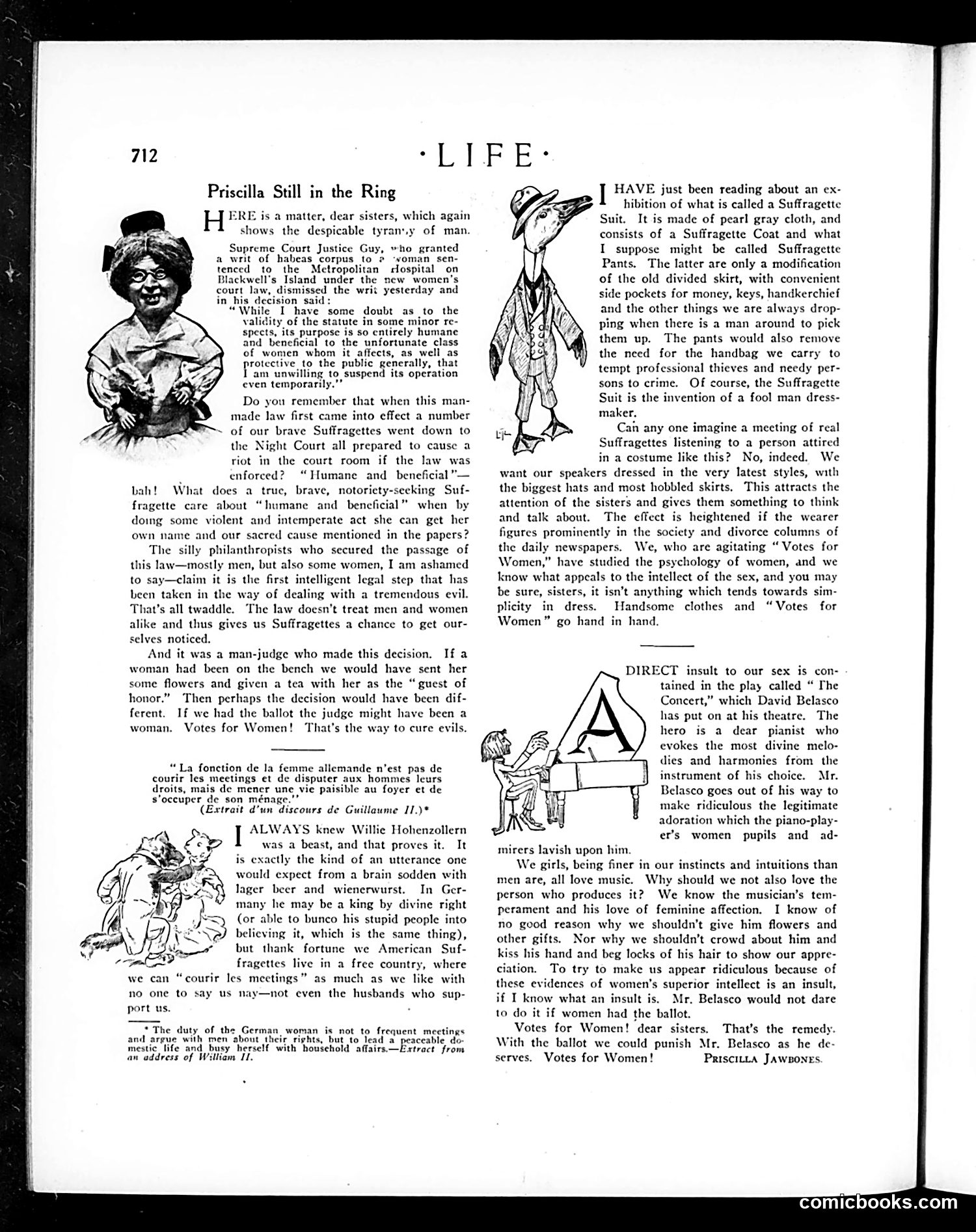
This satirical article by Priscilla Jawbones mocks activist suffragettes through ironic commentary. The piece criticizes a Supreme Court judge's dismissal of a habeas corpus writ regarding women committed under a new women's court law, which Jawbones sarcastically attacks—not because the law is unjust, but because it's *too humane*. She objects that it doesn't give suffragettes the notoriety and conflict they crave. The article also ridicules Kaiser Wilhelm II's quote restricting German women to domestic life, using it to celebrate American suffragettes' freedom to attend meetings. Finally, it mocks a practical "Suffragette Suit" with pants and pockets, sarcastically claiming real suffragettes would reject it for fashionable large hats. The satire's target: suffragettes themselves, portrayed as vain, publicity-seeking, and more interested in controversy than genuine reform or practical improvements for women.
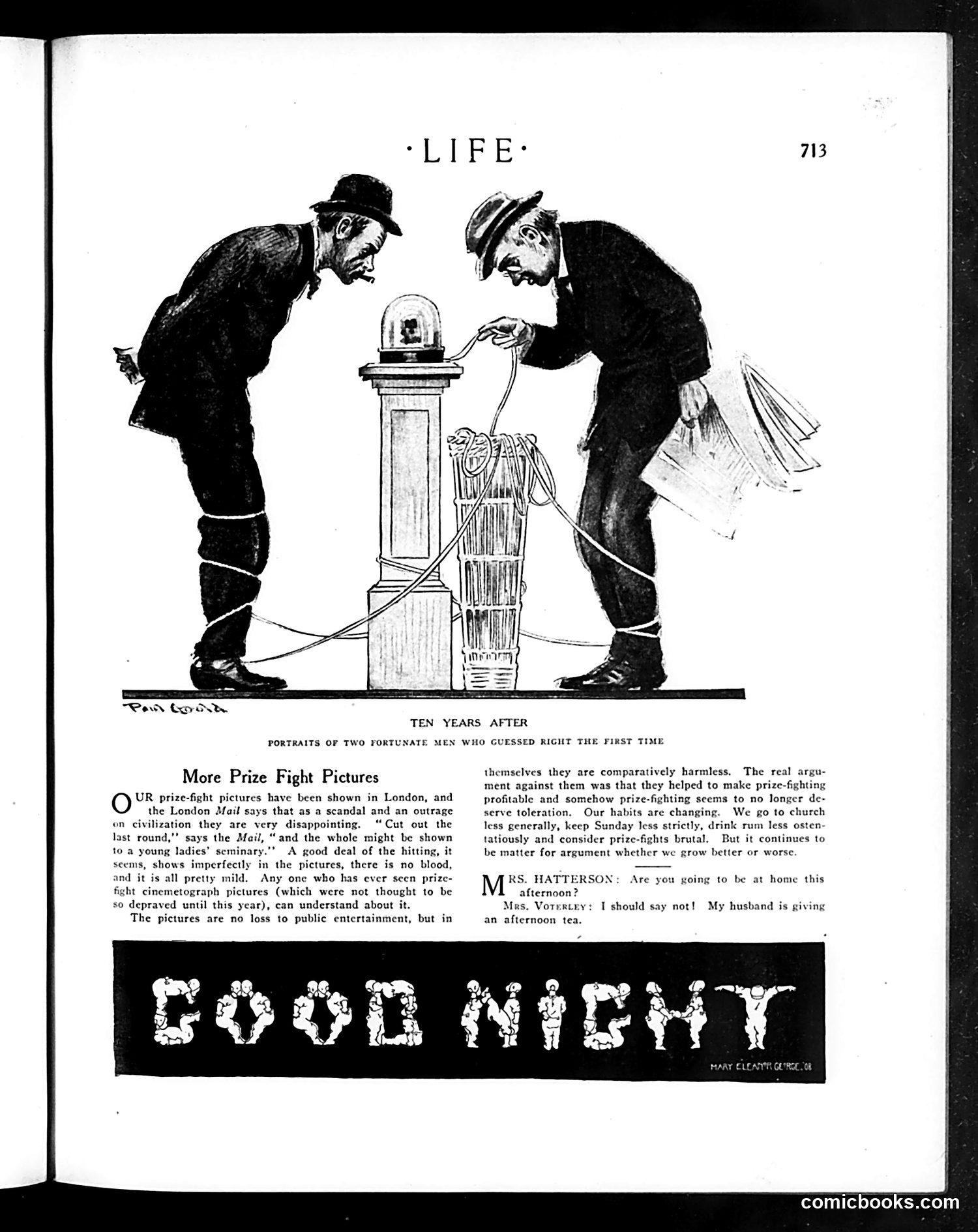
The top cartoon satirizes speculation about financial outcomes. Two men in formal dress lean toward a central pedestal topped with a glowing sphere, operating what appear to be betting mechanisms or fortune-telling devices. The caption "Ten Years After: Portraits of Two Fortunate Men Who Guessed Right the First Time" suggests they made successful predictions—likely about investments, stocks, or other uncertain ventures. The visual joke mocks the impossibility of accurate prediction: their "fortune-telling" apparatus is merely mechanical contraption, implying their success was pure luck rather than skill. The lower section discusses prize-fight cinematograph pictures then controversial in London. The text debates whether boxing films are scandalous or harmless entertainment, noting British moral standards were shifting—people attended church less but found prize-fighting increasingly brutal and unacceptable. The brief dialogue between Mrs. Hatterton and Mrs. Vorteley concerns social plans, likely unrelated to the main content.
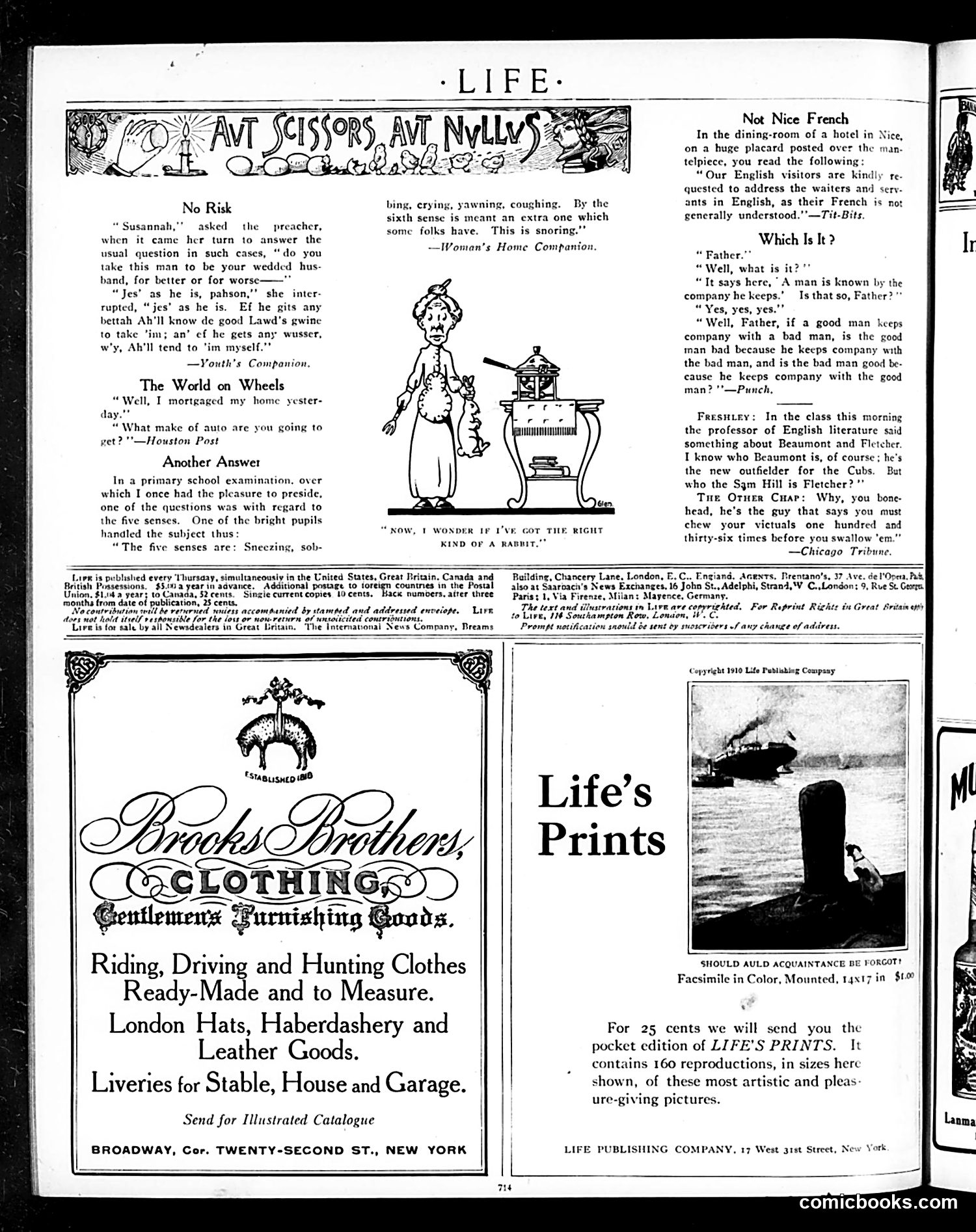
This page contains several brief humorous anecdotes typical of *Life* magazine's satirical format: **"No Risk"** presents a dialectal joke about an African American woman (rendered in period stereotypical vernacular) who pragmatically accepts her husband "as is"—if he improves, God will take him; if he worsens, she'll handle it herself. The humor relies on subverting marital vow expectations. **"The World on Wheels"** satirizes early automobile culture through a man who mortgaged his home to buy a car, reflecting anxieties about auto-mania. **"Another Answer"** mocks a student conflating "sneezing" and "sobbing" as senses, playing on childhood misunderstandings. The remaining short pieces mock pretension (French hotel signage insulting English tourists), logical paradoxes (good/bad company), and cultural confusion (mistaking baseball player for classical dramatist). The page is primarily **advertising-driven**, featuring Brooks Brothers clothing and Life's Print reproductions. The cartoons function as filler content between ads.
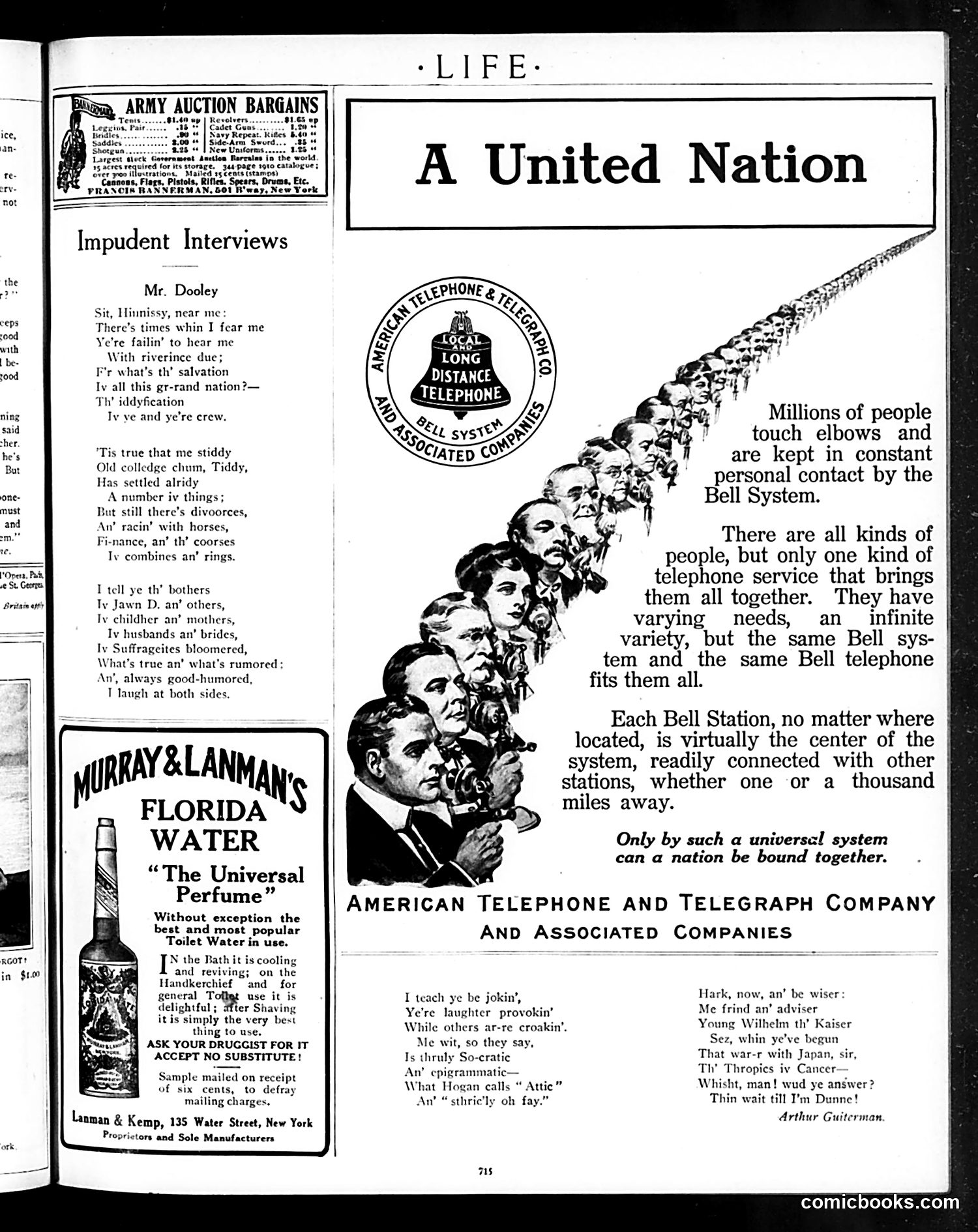
The page features "Impudent Interviews: Mr. Dooley," a satirical column written in Irish-American dialect by what appears to be a character offering commentary on American society. The piece mocks contemporary issues: divorces, horse racing, finance scandals, labor "combines," suffragettes, and political figures. Key references include "Tiddy" (likely Theodore Roosevelt), and a telling joke about "Young Wilhelm th' Kaiser" advising on war with Japan—satirizing how foreign leaders' counsel influences American policy while domestic problems remain unsolved. The dialect humor was typical of early 20th-century American satire, using exaggerated Irish-brogue speech to create a supposedly "common man" perspective critiquing elites and social upheaval. The facing page advertises Bell Telephone's nationwide system as binding "a united nation"—corporate messaging that frames infrastructure as social unity. The page reflects Progressive Era anxieties about modernization, immigration, and national cohesion.
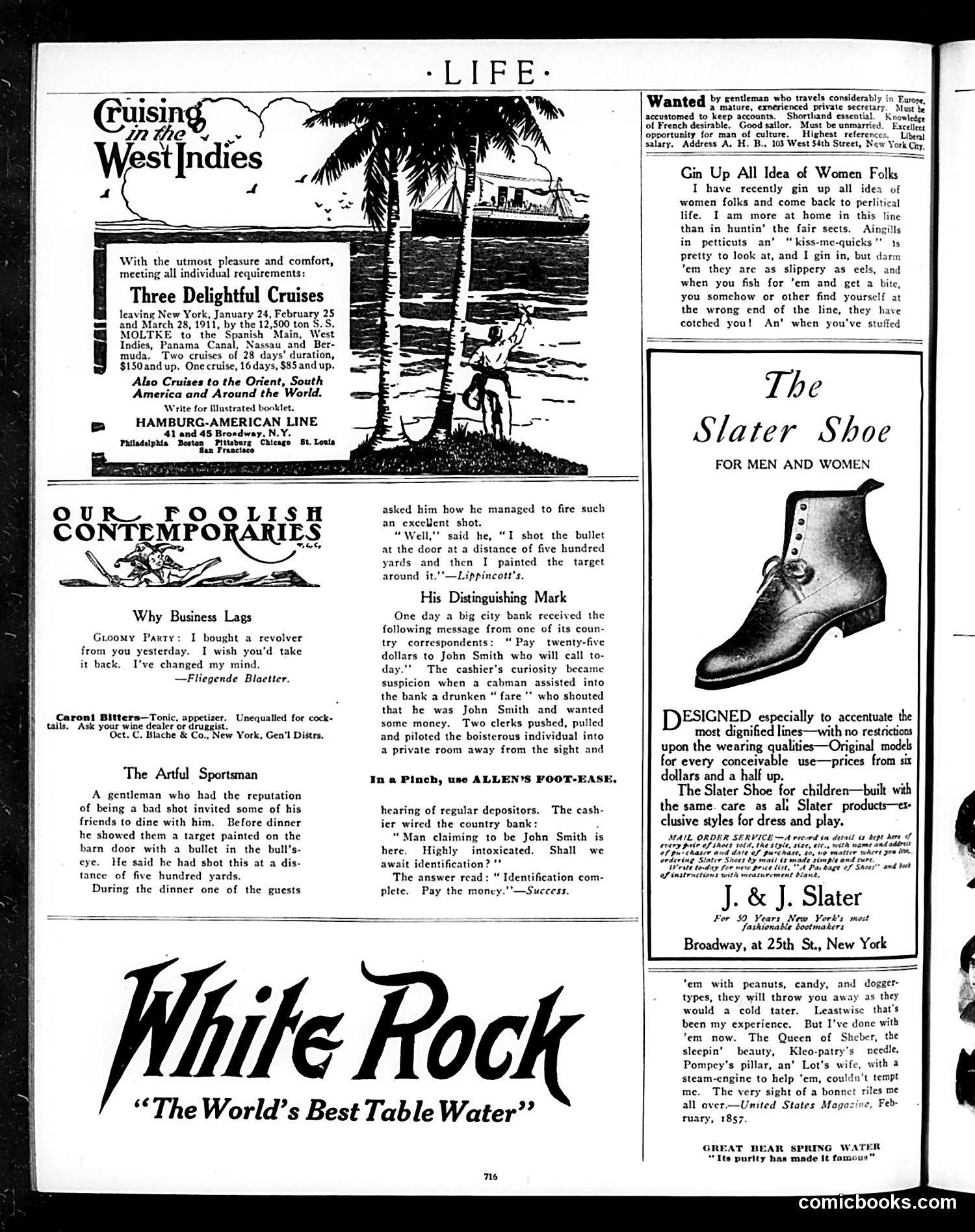
This page from *Life* magazine (appears to be 1911 based on cruise dates) is primarily a collection of brief humorous anecdotes rather than political cartoons. **Key pieces include:** - **"Why Business Lags"**: A dark joke about someone returning a revolver after "changing his mind"—likely satirizing the economic pessimism or suicidal despair of the era. - **"The Artful Sportsman"**: A classic con-artist joke where a man shoots a bullet at a barn door, then paints the target around it—mocking boastful liars and questionable claims of skill. - **"His Distinguishing Mark"**: A humorous anecdote about a drunk man claiming to be "John Smith" at a bank. The country bank's reply—that his intoxication itself serves as complete identification—jokes about the commonness of drunkenness or the man's notorious reputation. - **"Gin Up All Idea of Women Folks"**: A rural-dialect piece humorously comparing dating women to fishing, claiming they're "slippery" and unreliable. The rest is advertising for cruises, shoe brands, and patent medicines typical of the era.
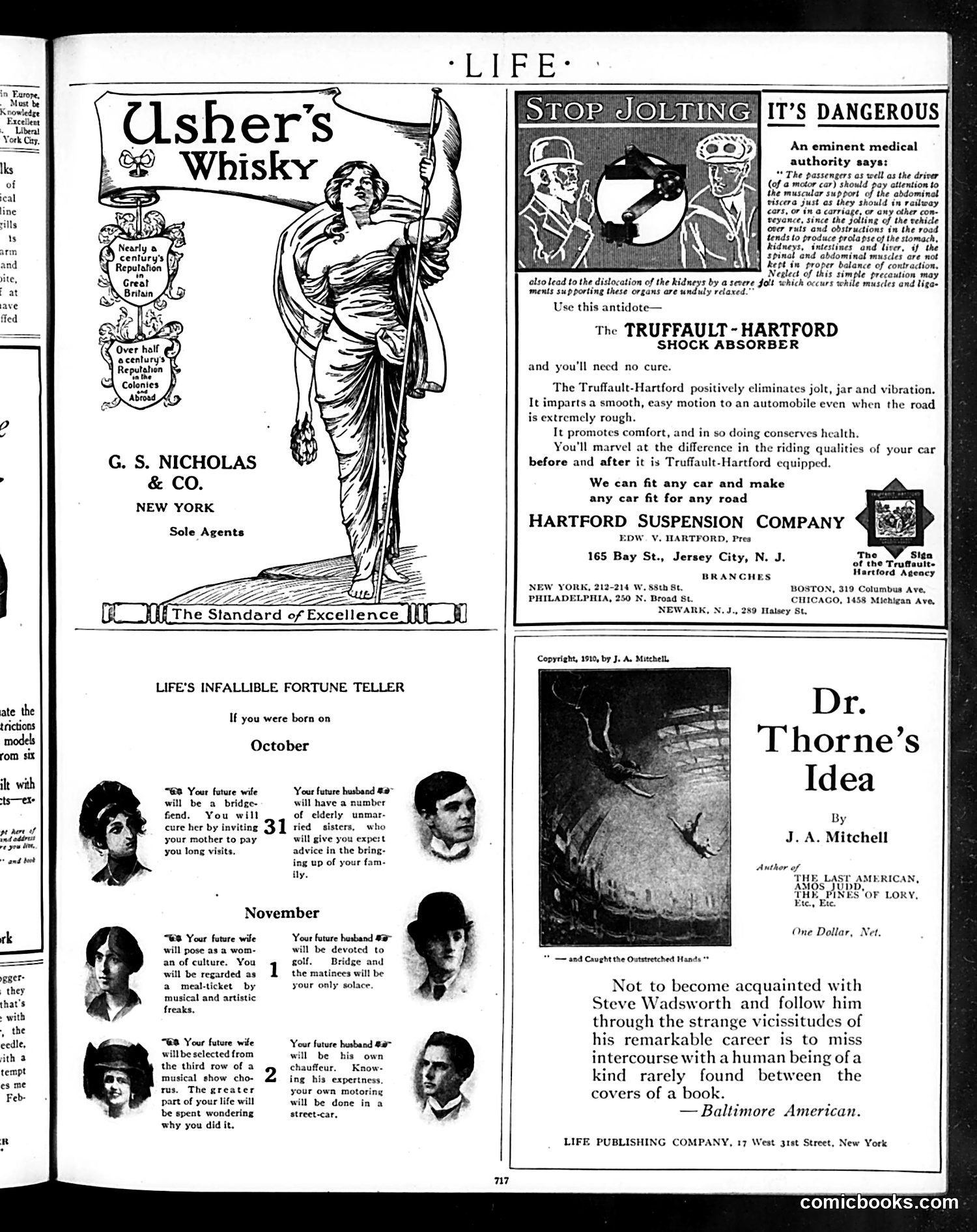
This page contains several distinct elements: **Top Left: Usher's Whisky Advertisement** — A classical allegorical figure promoting whisky as "The Standard of Excellence," using traditional heraldic imagery to suggest centuries of reputation and British prestige. **Top Right: Hartford Suspension Shock Absorber Advertisement** — A pseudo-medical pitch claiming that jolting in automobiles causes internal organ damage (prolapse of stomach, kidneys, intestines). The ad cites an "eminent medical authority" to legitimize the product, appealing to health-conscious motorists. This represents early 20th-century automobiles' notorious roughness and the marketing of mechanical solutions as health remedies. **Bottom Left: "Life's Infallible Fortune Teller"** — A satirical fortune-telling feature for people born in October and November, offering humorous predictions about future spouses—typically mocking stereotypes (gold-digging chorus girls, golf-obsessed husbands, domineering mothers-in-law). **Bottom Right: Advertisement for "Dr. Thorne's Idea" by J.A. Mitchell** — A book advertisement promising an engaging narrative about protagonist Steve Wadsworth. The page is primarily **advertising and satirical humor**, not political commentary.
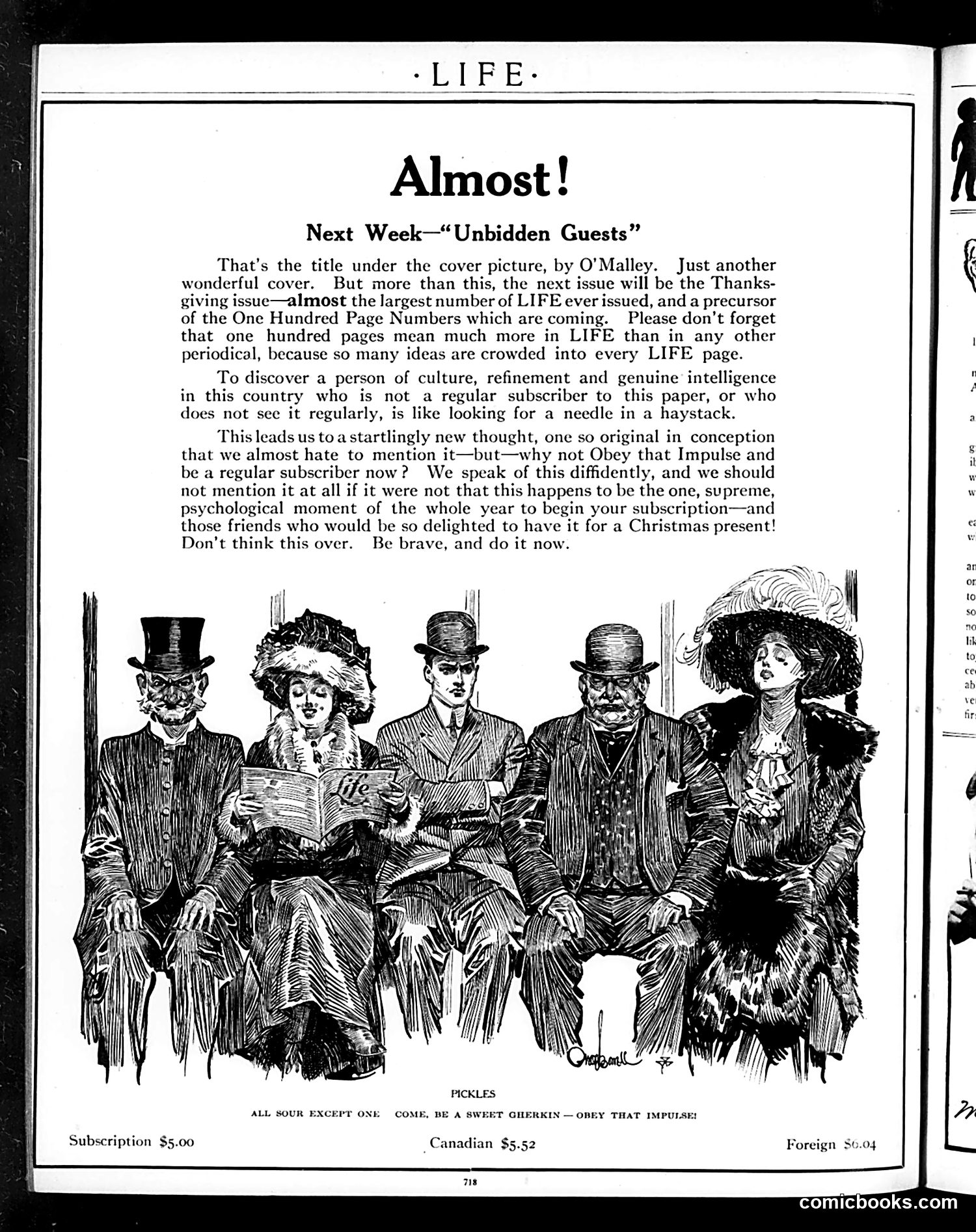
This page is a self-promotional advertisement disguised as editorial content. The headline "Almost!" and main cartoon depict five figures (appearing to represent different social types) reading *Life* magazine together, with the caption "All sour except one—come, be a sweet gherkin—obey that impulse!" The "pickle" metaphor suggests that non-subscribers are "sour" while subscribers are "sweet." The text aggressively urges readers to subscribe as a Christmas gift, using psychological pressure: claiming subscription is a "supreme psychological moment" and suggesting that cultured, intelligent people already subscribe (implying shame for those who don't). The upcoming Thanksgiving issue is touted as the largest ever published. This is essentially hard-sell advertising wrapped in flattery and social shaming—typical of early 20th-century magazine marketing tactics.
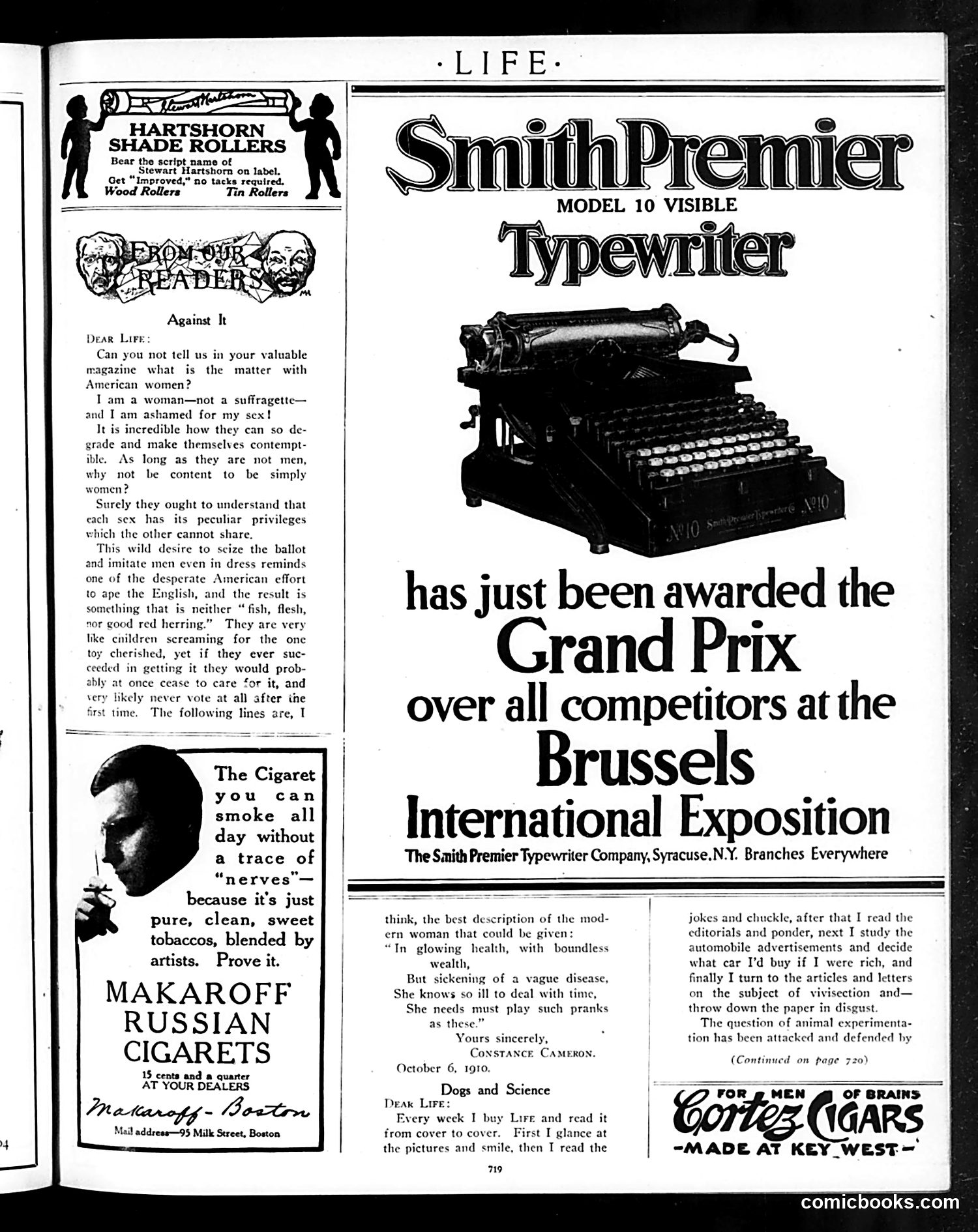
This page is primarily **advertisements and readers' letters**, not satire or political cartoons. The notable content is a letter titled "Against It" from "Constance Cameron," a woman opposing women's suffrage. She argues that women seeking the ballot and imitating men's dress represent degradation and misguided imitation of English culture. She dismisses suffragists' desires as childish—comparing them to children screaming for a toy they'd quickly lose interest in—and predicts women wouldn't even vote if granted the franchise. This letter **reflects the anti-suffrage arguments circulating in 1910**, just before the women's suffrage movement gained major momentum in America. The editor's choice to publish it suggests Life engaged with contemporary political debates, though the magazine's satirical stance on the letter itself remains unclear from the page. The remaining content consists of product advertisements (typewriters, cigarettes, shade rollers) typical of the era.
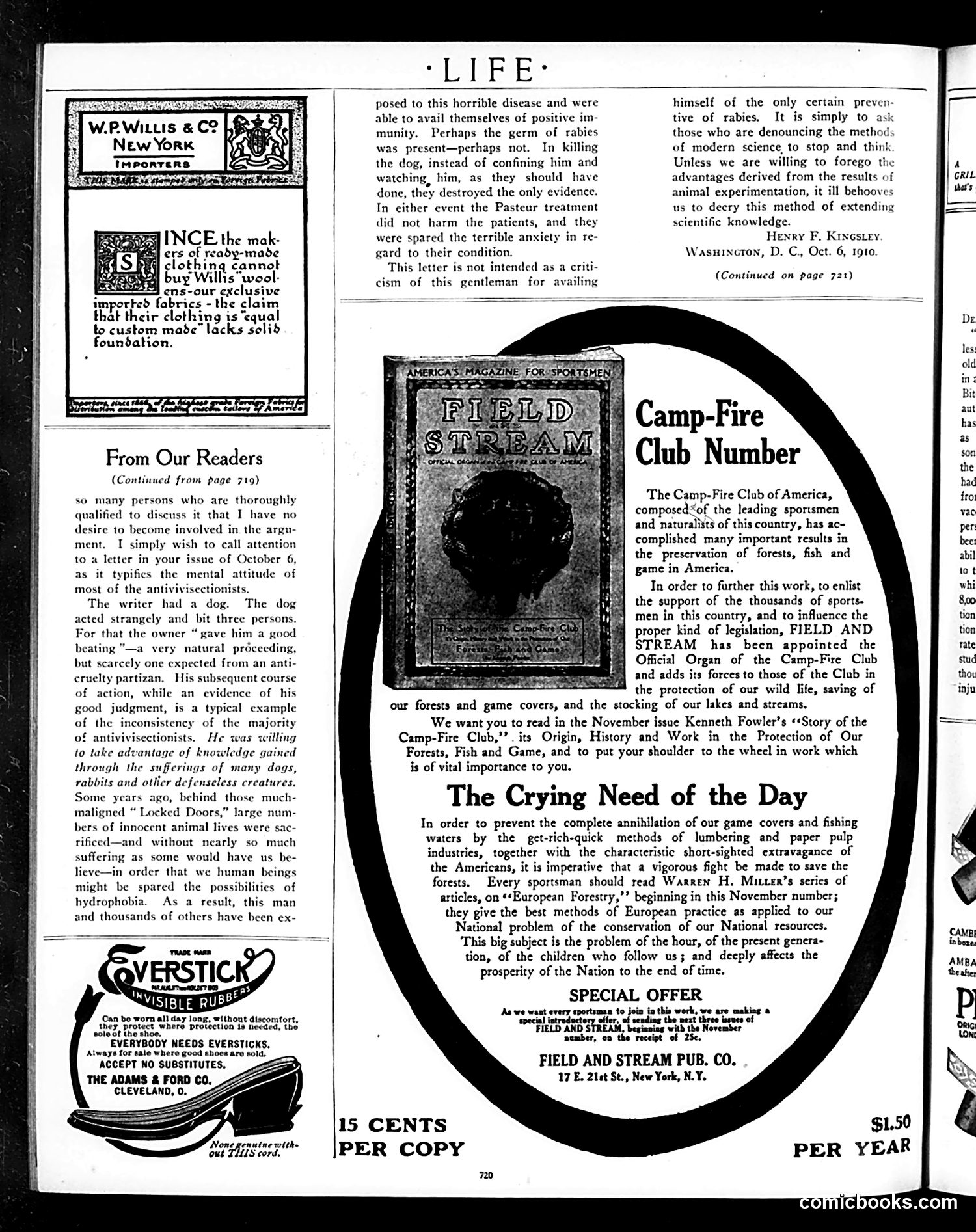
This page primarily contains **reader letters and advertisements** rather than political cartoons. The main substantive content is a letter debating **animal experimentation ethics**. A reader defends vivisection (animal testing) by citing practical benefits: a man whose dog bit him later benefited from rabies prevention developed through animal research. The letter argues antivivisectionists are hypocritical—they oppose animal suffering in labs yet gladly use scientific advances those experiments produced. The **Camp-Fire Club advertisement** promotes conservation of forests, fish, and game, positioning *Field and Stream* magazine as the club's official organ. Other ads include **W.P. Willis & Co.** (imported woolens) and **Eversticks** (shoe soles). The page reflects early 20th-century debates over scientific progress versus animal welfare—a tension that remains relevant today, though modern readers might be surprised by how openly animal testing was then defended as necessary and justified.
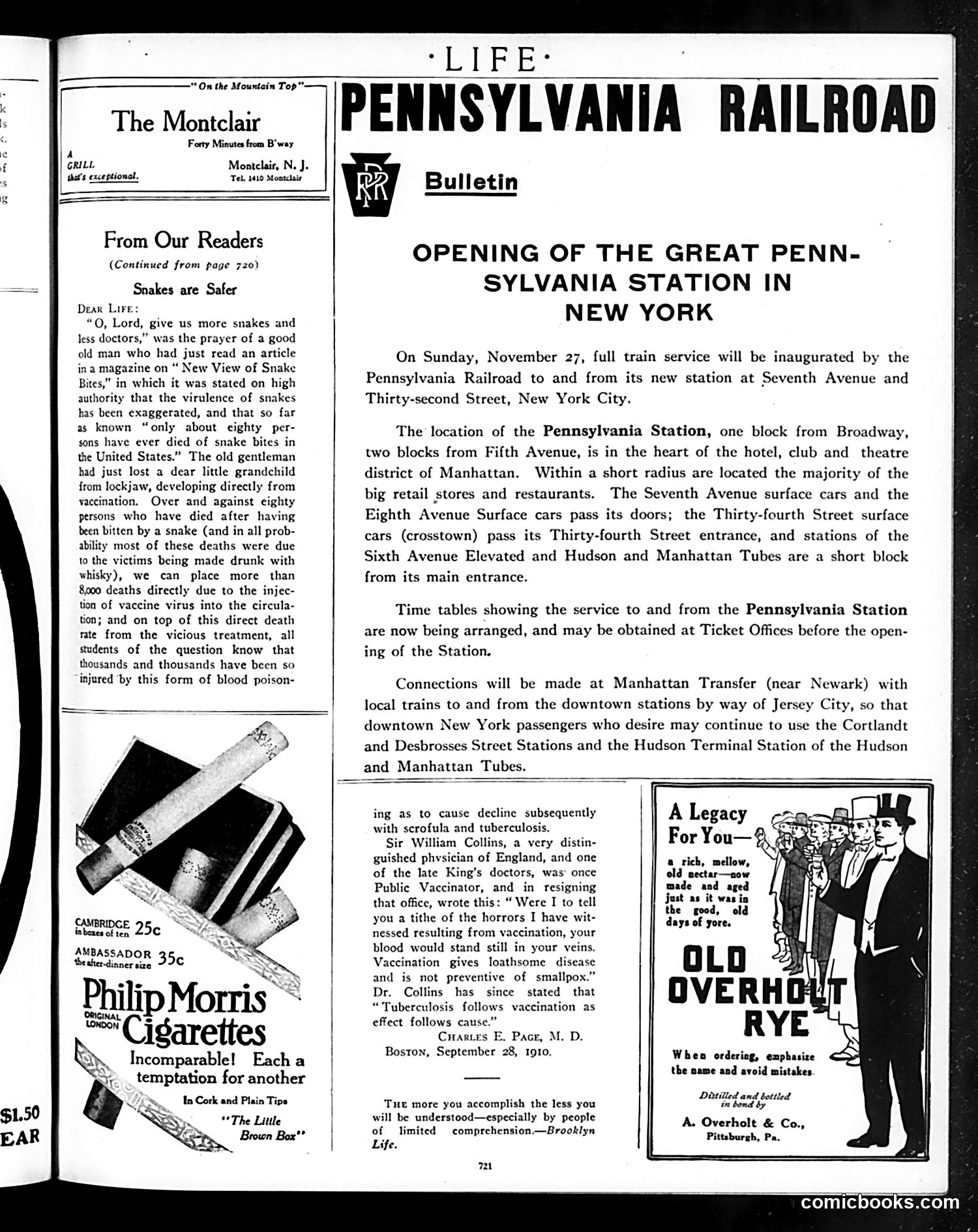
This page consists primarily of advertising and railroad announcements rather than political cartoons. The main content is a Pennsylvania Railroad bulletin announcing the opening of their new station in Manhattan at Seventh Avenue and Thirty-second Street on November 27. It describes the station's convenient location near Broadway and major transportation connections. The left side contains a reader's letter arguing that vaccination is more dangerous than snake bites, citing a British physician (Sir William Collins) who allegedly claimed vaccination causes tuberculosis and other diseases. This reflects early 20th-century anti-vaccination sentiment, though the claims are unfounded. The advertisements include Philip Morris cigarettes and "Old Overhaul Rye" whiskey (depicted with what appears to be period-appropriate imagery of well-dressed men). There is no political cartoon visible on this page—it is essentially a commercial and informational publication page from *Life* magazine.
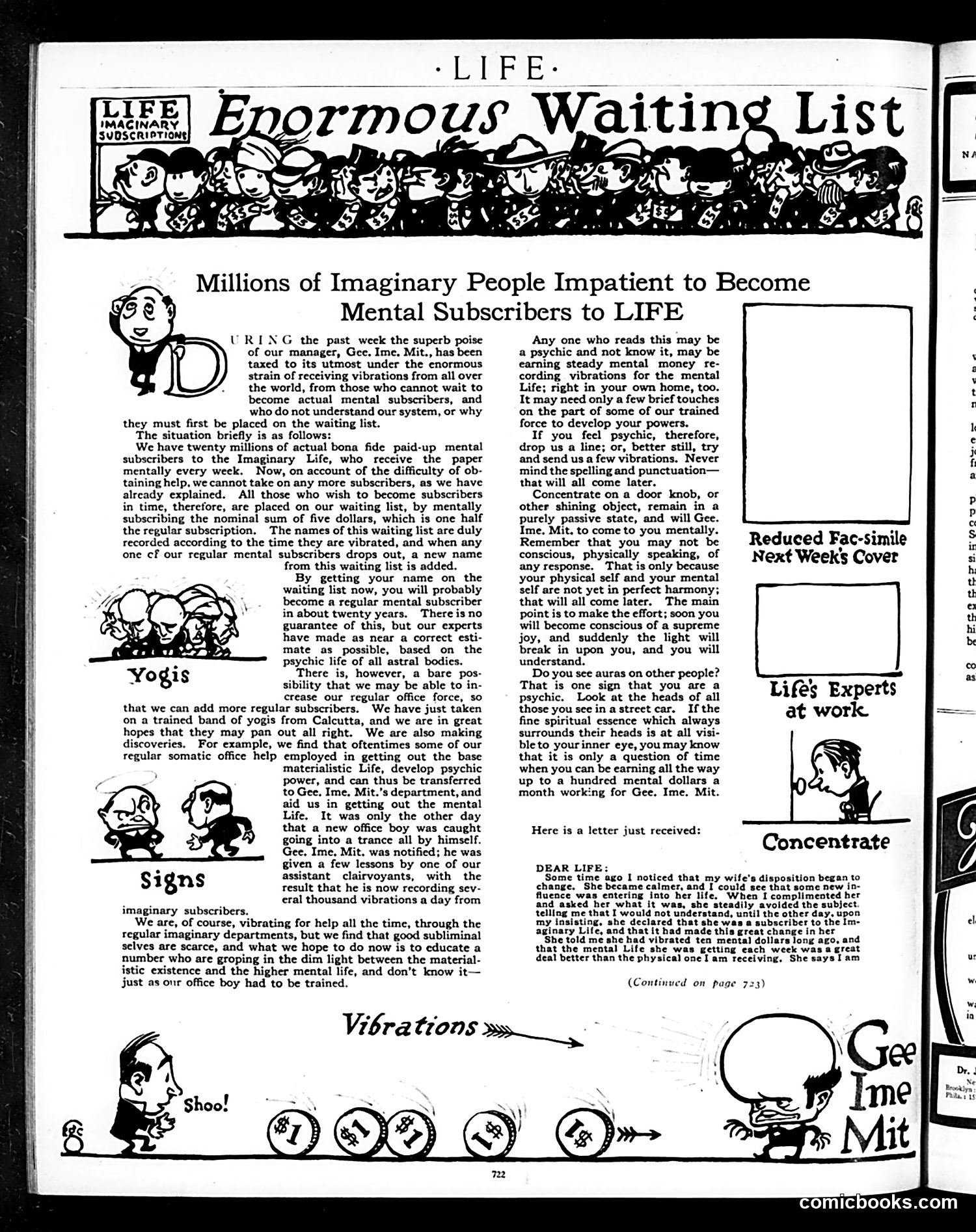
This is satire mocking *Life* magazine's own subscription business—presented as absurdist pseudo-mysticism. The magazine pretends to offer "mental subscriptions" to an imaginary psychic version of itself, received through vibrations and astral projection rather than mail. The satire targets: 1. **New Age/Occult Trends**: The 1920s saw genuine popularity in spiritualism, yoga, and psychic phenomena. Life lampoons this by treating it as completely ridiculous yet conducting it with bureaucratic seriousness. 2. **Business Management**: The character "Gee. Ime. Mit." (likely "G.I.M."—a made-up manager) oversees absurd procedures: 20-million imaginary subscribers, yogis hired from Calcutta, 20-year waiting lists, office boys spontaneously entering trances. 3. **The Joke**: Life is simultaneously advertising actual subscriptions while mocking both occult believers *and* their own subscription-pushing tactics as transparently silly. The cartoons of "Yogis" and "Signs" reinforce the mockery through caricature.
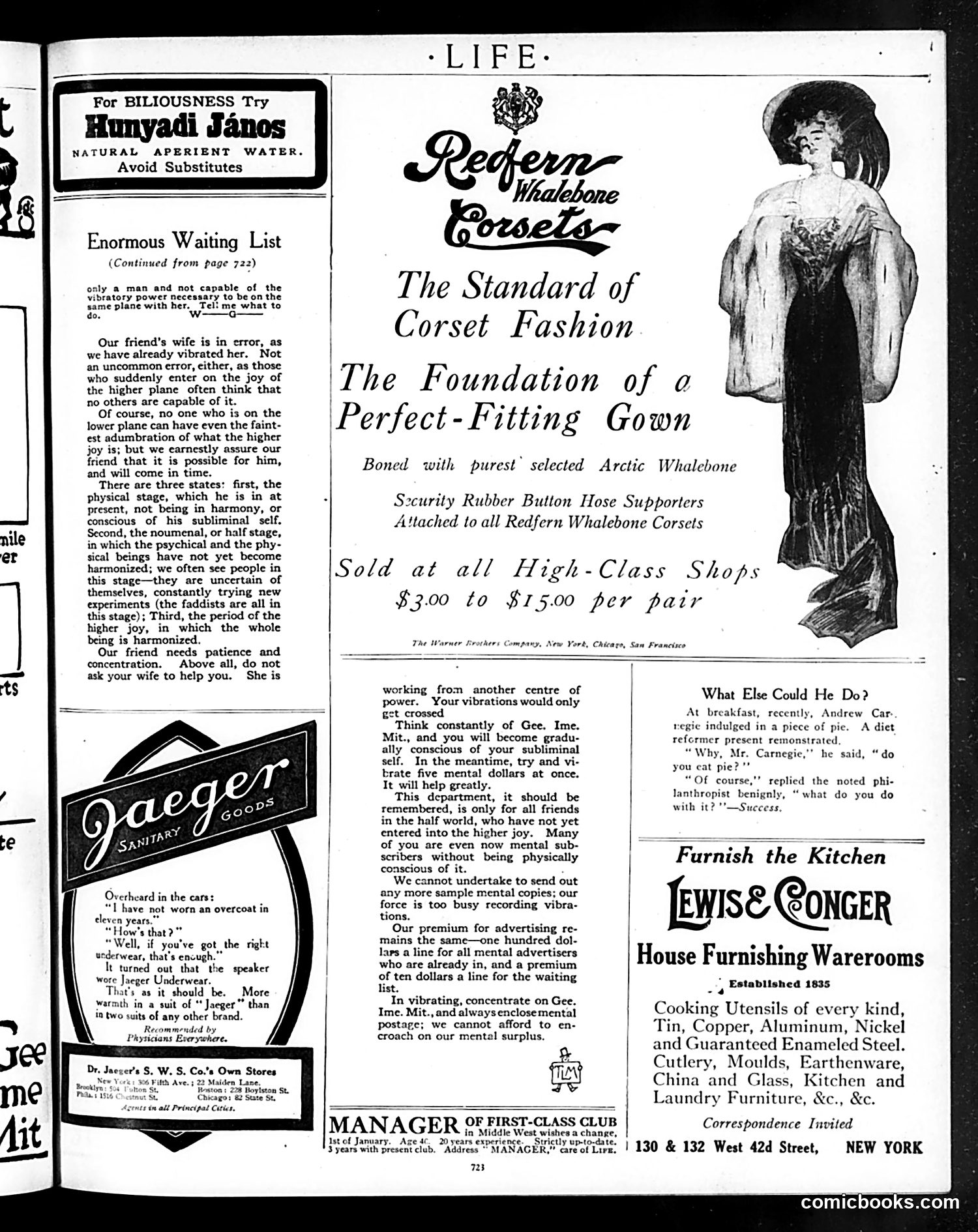
This is primarily **an advertising page** with minimal satirical content. The page features: **Main Advertisements:** - Redfern Whalebone Corsets (prominent center illustration of fashionable woman) - Jaeger Underwear (satirizes health fads—the overheard conversation jokes that proper underwear eliminates need for overcoats) - Lewis & Conger House Furnishings - Hunyadi Janos mineral water (bilousness remedy) **Satirical Content:** The "Enormous Waiting List" column ridicules **New Thought/occult pseudoscience** popular in the era—specifically "vibration therapy," where people supposedly achieved higher consciousness through mental vibration and "concentration." The satire mocks both practitioners and credulous believers seeking mystical enlightenment through dubious mental exercises. The "What Else Could He Do?" anecdote gently ribald humor targeting **Andrew Carnegie**, the industrialist philanthropist, regarding pie consumption versus charitable giving. Overall, this reflects early-1900s consumer culture and satirizes contemporary wellness fads and spiritualism movements.
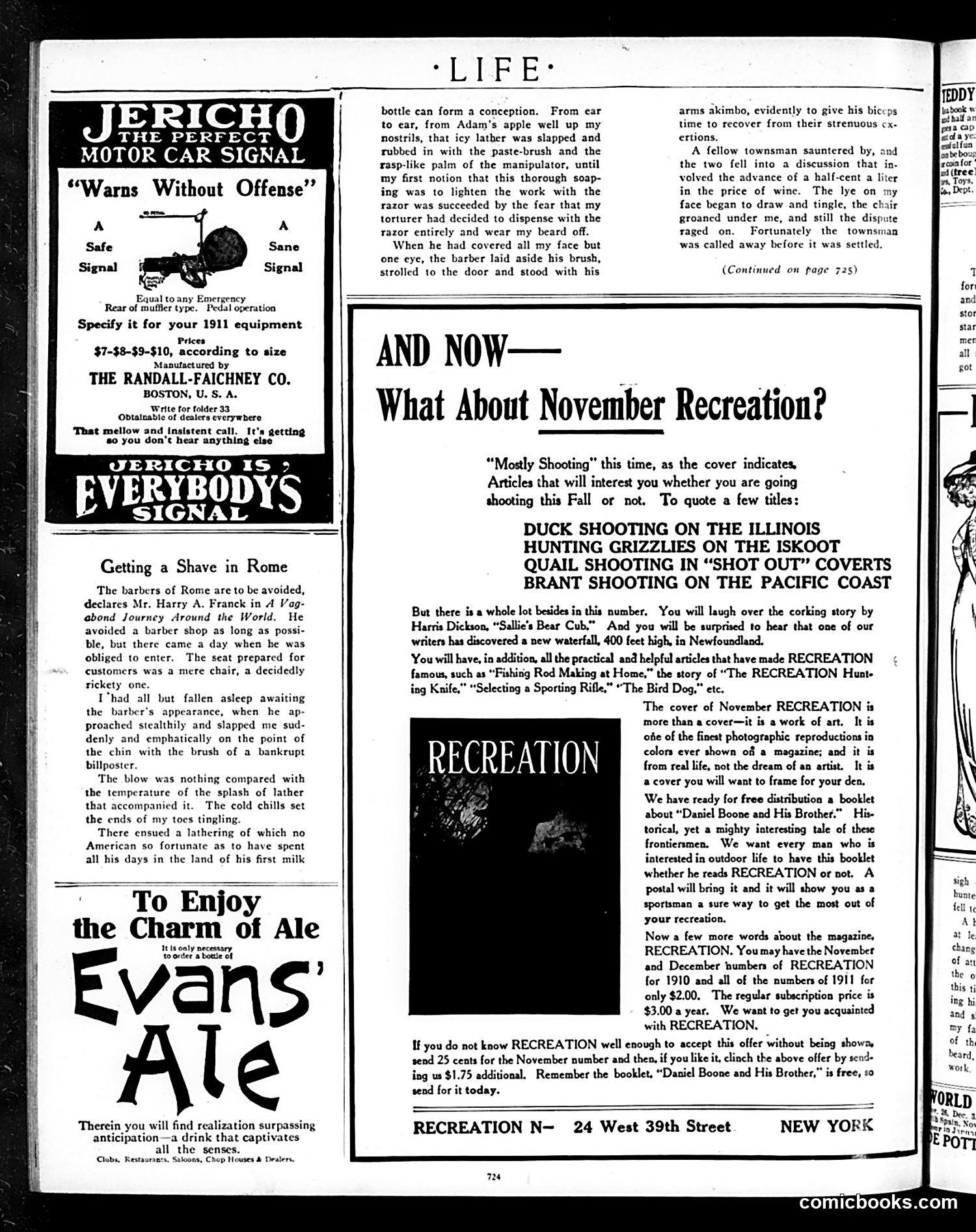
This page is primarily advertising and editorial content rather than political satire. The main articles include: **"Getting a Shave in Rome"**: Humorously recounts travel writer Harry Franck's terrible barber experience—an aggressive Italian barber who slathers scalding lather on his face then abandons him mid-shave for a casual conversation about wine prices, leaving Franck's face burning. **Recreation Magazine Advertisement**: Promotes November's issue featuring hunting and outdoor activities (duck, grizzly, quail, brant shooting), plus articles on fishing, rifles, and survival skills. **Product Ads**: Include a motor car signal device, ales, and automobile equipment—typical 1911 consumer advertising. No political cartoon or satire appears here. The "satire" is purely comedic (the barber story), not political. This is a standard magazine page mixing humor, travel narrative, and period advertisements.
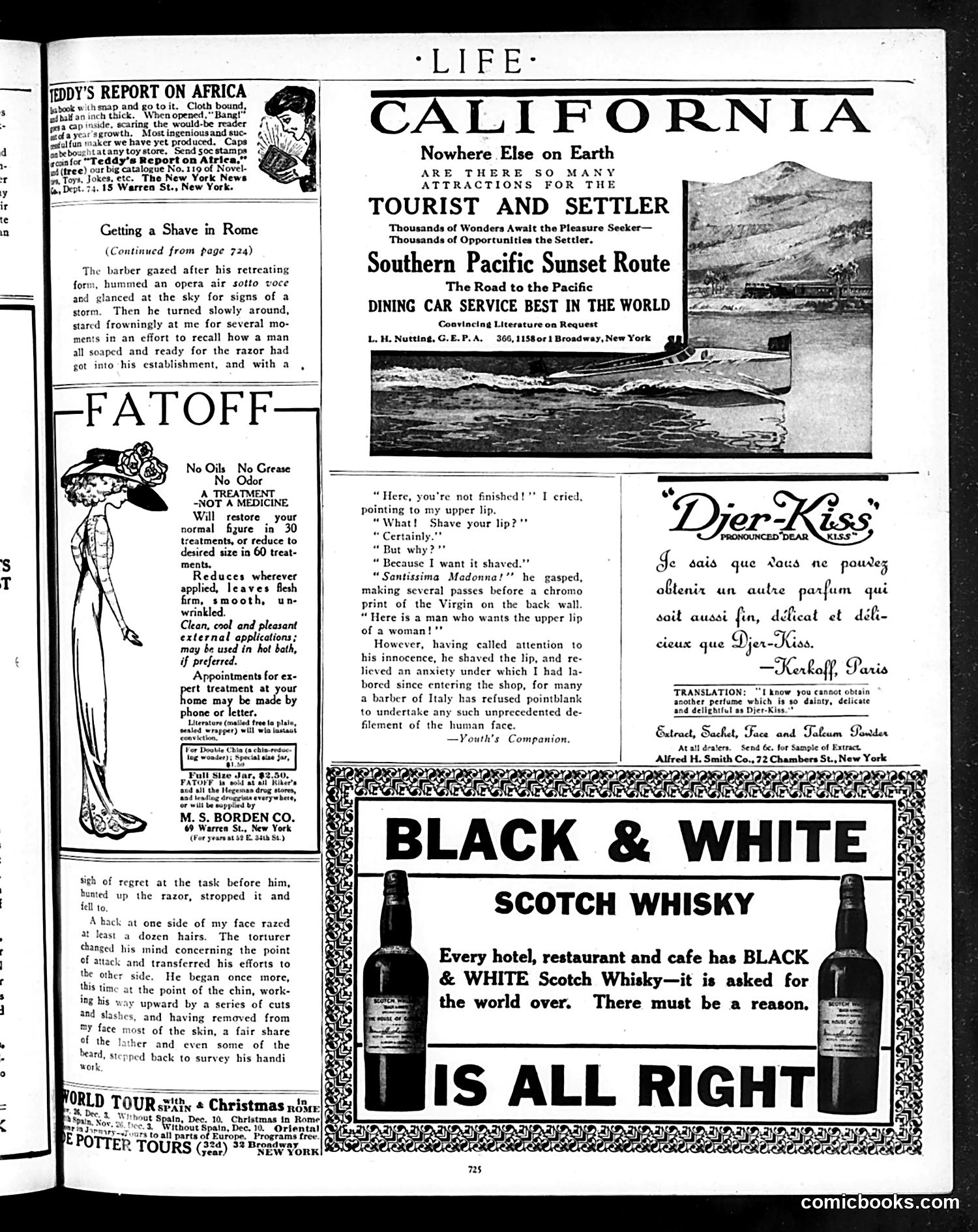
This page is primarily **advertisements and travel promotions** with one short humorous article. The main content is "Getting a Shave in Rome" — a comedic anecdote about an American tourist's bewildering encounter with an Italian barber. The joke centers on cultural misunderstanding: when the American requests his upper lip be shaved, the barber is shocked and scandalized, treating it as an outrageous, unmanly request. The punchline relies on the reader's era-appropriate understanding that upper-lip shaving was considered feminine in Italian culture, making the barber's horror at this "unprecedented element of the human face" comedic. The page also features advertisements for California tourism, the Southern Pacific railroad, beauty treatments (Fatoff reducing cream), and Black & White Scotch Whisky. The only cartoon element is a small illustrated advertisement for Fatoff, showing a stylized woman's figure in period dress—a typical early 20th-century ad illustration rather than political satire.
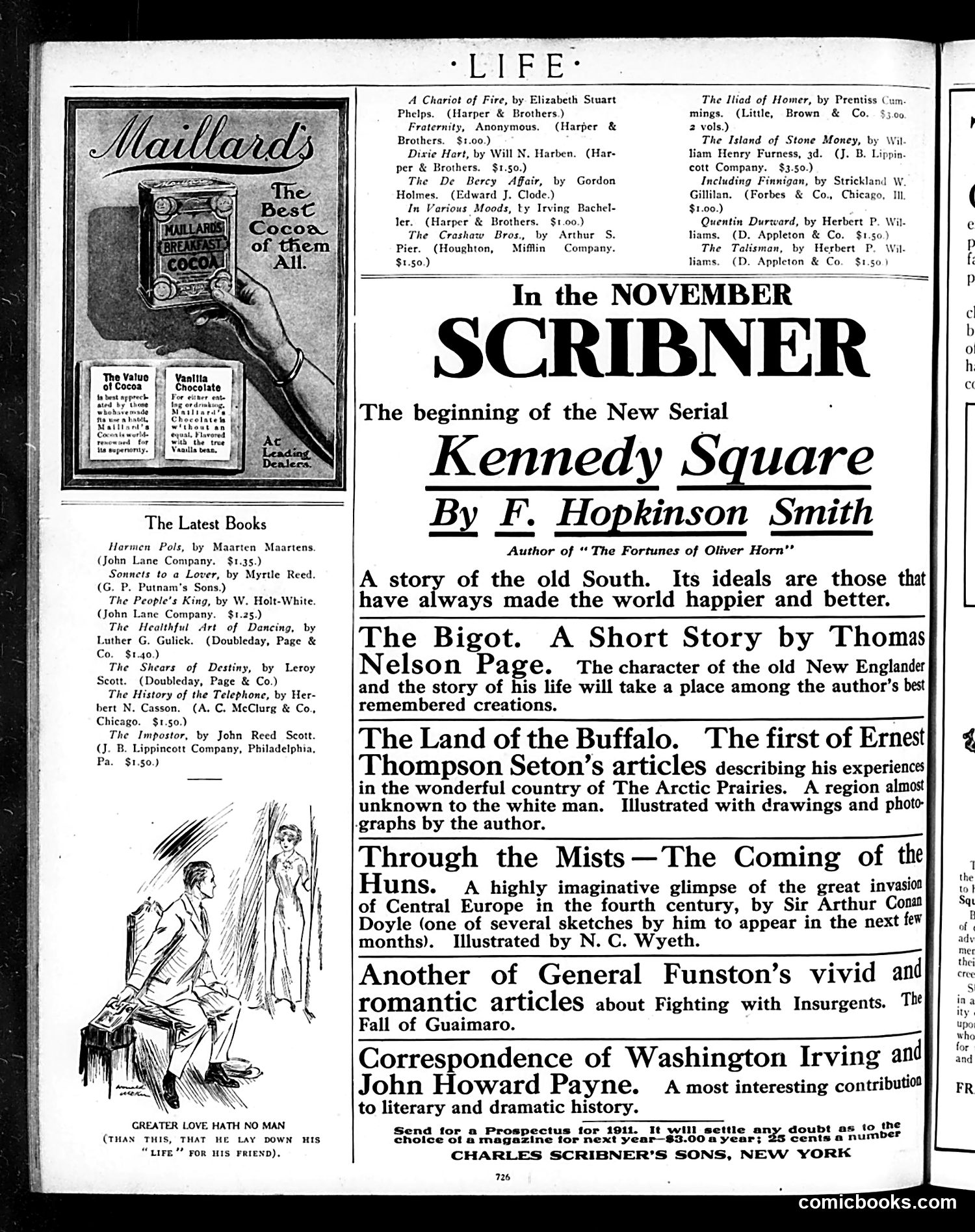
This page is primarily **advertising and editorial content** for Scribner's magazine and books, not political satire. The small cartoon at bottom left ("Greater Love Hath No Man") shows a figure sacrificing himself for a friend—a sentimental illustration accompanying a literary quote, not satire. The page's main content advertises **November 1910 Scribner's magazine**, promoting upcoming serial fiction including: - F. Hopkinson Smith's "Kennedy Square" (described as celebrating "old South" ideals) - Sir Arthur Conan Doyle's historical fiction about the Huns - General Funston's articles on fighting insurgents (appears to reference Philippine-American War conflicts) The **Maillard's cocoa advertisement** at top left is straightforward product marketing. The page reflects early 1900s American literary culture: romantic historical fiction, adventure narratives, and nostalgia for the antebellum South were commercially popular. There is **no apparent political cartoon or satirical commentary**—this is a book/magazine promotion page.
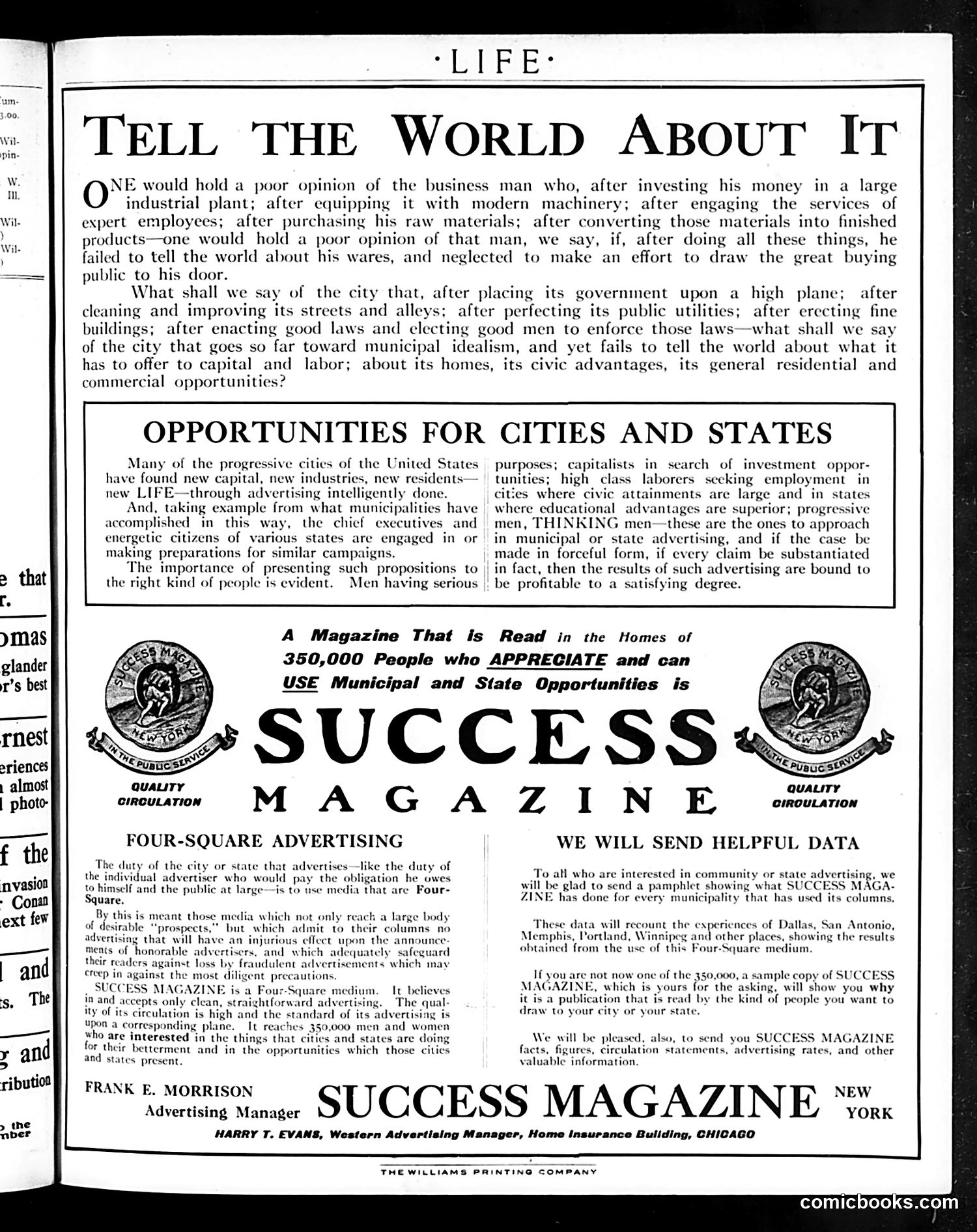
This page is primarily **advertising**, not editorial content or satire. It contains an argumentative advertisement for *Success Magazine* disguised as editorial commentary. The opening essay uses an analogy: just as a businessman who builds a factory but fails to advertise it would be foolish, so too are cities that improve infrastructure, enact good laws, and elect capable leaders yet fail to publicize these achievements to attract capital and labor. The essay advocates for **municipal and state advertising**—promoting cities and states to potential investors, workers, and residents. This reflects Progressive Era (early 1900s) thinking about civic promotion and business-like city management. The advertisement then positions *Success Magazine* as the ideal vehicle for such promotion, claiming 350,000 readers of quality and "four-square" (honest, straightforward) advertising standards. It promises to send data showing results from Dallas, San Antonio, Memphis, Portland, and Winnipeg—cities that allegedly benefited from advertising in the magazine. There is no cartoon or satire visible; this is straightforward promotional content.
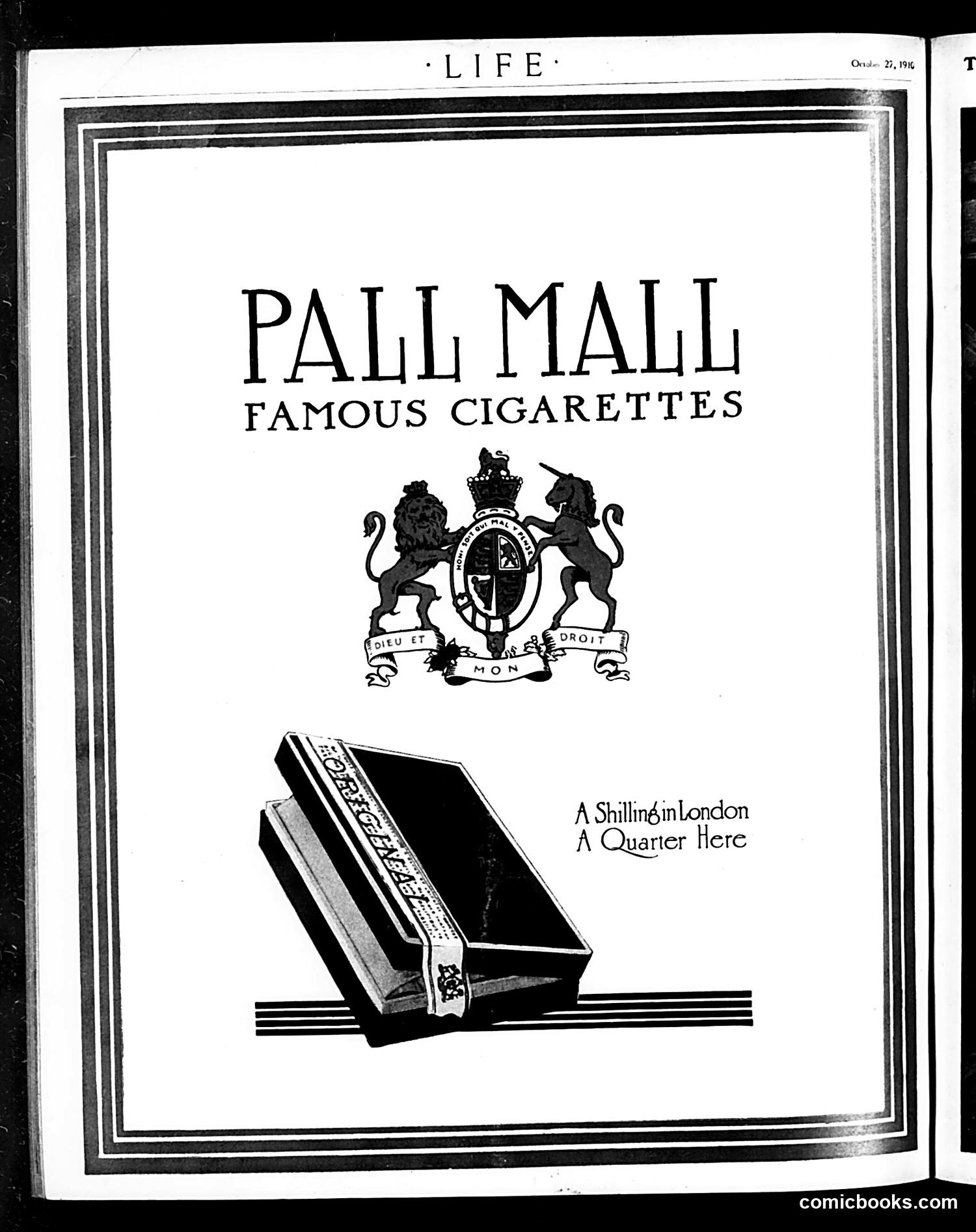
This is a cigarette advertisement, not a political cartoon. It promotes Pall Mall Famous Cigarettes, a British brand. The ad features the brand's coat of arms—a heraldic shield flanked by a lion and unicorn, with a Latin motto—emphasizing the product's prestigious British heritage. The packaging is displayed prominently below. The pricing information ("A Shilling in London / A Quarter Here") indicates this is an American advertisement comparing British and American prices, likely from the 1920s-1930s based on the currency references and magazine styling. The ad targets affluent American consumers by associating the cigarettes with British aristocracy and prestige. There is no satirical content—this is straightforward luxury product marketing.