
Life, 1910-10-27 · page 20 of 44
Life — October 27, 1910 — page 20: what you’re looking at
What you’re looking at
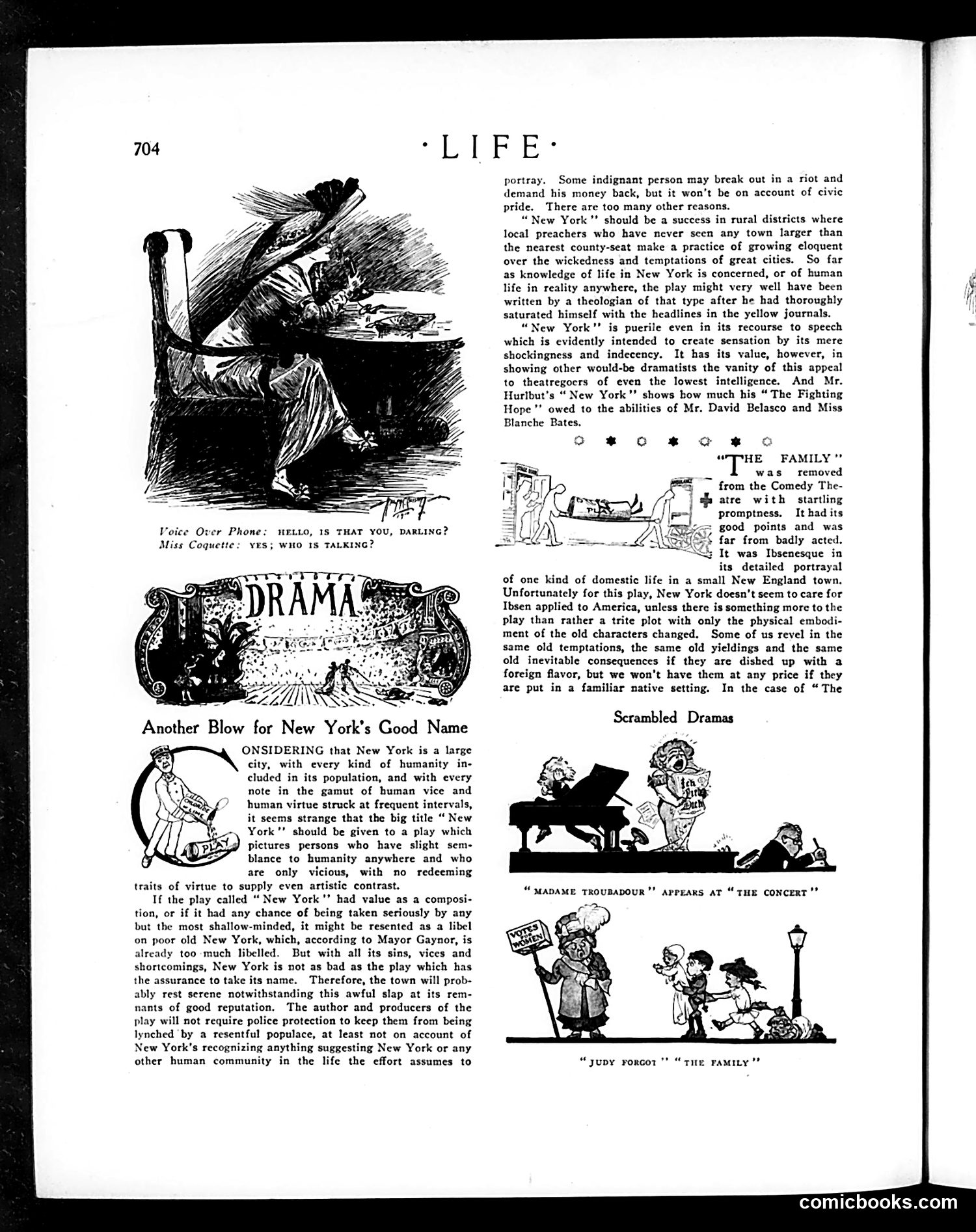
This page critiques recent Broadway plays with titles referencing New York City. The main article attacks a play called "New York" for portraying the city through a sensationalist lens—full of vice and indecency but lacking authentic human complexity or redeeming traits. The author argues the play insults New York's actual character and appeals only to rural audiences eager to confirm their prejudices about big-city corruption. Below, a sidebar discusses "The Family," an Ibsen-influenced domestic drama set in New England that failed because New York audiences reject realistic American settings, preferring European flavor instead. The scattered theatrical illustrations labeled "Scrambled Dramas" appear to be satirical sketches mocking other contemporary plays. The overall point: Broadway's "New York" play is artistically shallow sensationalism that falsely represents the city—neither serious enough to critique honestly nor entertaining enough to succeed on its own merits.
📄 Transcribed text from this page (OCR, searchable)
Machine-transcribed from the original scan — historical spelling and the odd misread are preserved.
‘LIF &* portray. Some indignant person may break out in a riot and demand his money back, but it won't be on account of civic pride. There are too many other reasons. “New York’? should be a success in rural districts where local preachers who have never scen any town larger than the nearest county-seat make a practice of growing eloquent over the wickedness and temptations of great cities. So far as knowledge of life in New York is concerned, or of human life in reality anywhere, the play might very well have been written by a theologian of that type after he had thoroughly saturated himself with the headlines in the yellow journals. “New York’? is puerile even in its recourse to specch which is evidently intended to create sensation by its mere shockingness and indecency. It has its value, however, in showing other would-be dramatists the vanity of this appeal to theatregocrs of even the lowest intelligence. And Mr. Hurlbut’s “ New York’? shows how much his “ The Fighting Hope ’’ owed to the abilities of Mr. David Belasco and Miss Blanche Bates. o * © *£ G * 8 “THE FAMILY” _ was removed from the Comedy The- sh atre with startling promptness. It had its good points and was far from badly acted. Voice Over Phone: wxtto, 18 THAT YOU, DARLING? \ Miss Coquette: ves; WMo 18 TALKING? : ne RS SS It was Ibsenesque in its detailed portrayal of one kind of domestic life in a small New England town. Unfortunately for this play, New York doesn’t seem to care for Ibsen applied to America, unless there is something more to the play than rather a trite plot with only the physical embodi- ment of the old characters changed. Some of us revel in the same old temptations, the same old yieldings and the same iB old inevitable consequences if they are dished up with a rie is foreign flavor, but we won't have them at any price if they ii< < are put in a familiar native setting. In the case of “The 87771] Another Blow for New York’s Good Name Scrambled Dramas ONSIDERING that New York is a large city, with every kind of humanity in- cluded in its population, and with every note in the gamut of human vice and human virtue struck at frequent intervals, it seems strange that the big title “New York’? should be given to a play which pictures persons who have slight sem- blance to humanity anywhere and who are only vicious, with no redeeming traits of virtue to supply even artistic contrast. If the play called “ New York’? had value as a composi- tion, or if it had any chance of being taken seriously by any but the most shallow-minded, it might be resented as a libel on poor old New York, which, according to Mayor Gaynor, is already too much libelled. But with all its sins, vices and shortcomings, New York is not as bad as the play which has the assurance to take its name. Therefore, the town will prob- ably rest serene notwithstanding this awful slap at its rem- nants of good reputation. The author and producers of the play will not require police protection to keep them from being lynched by a resentful populace, at least not on account of New York’s recognizing anything suggesting New York or any other human community in the life the effort assumes to “Jupy rorcor'’ “tite FAMILy "? “ MADAME TROUBADOUR '’ APPEARS AT “ THE CONCERT’? comicbooks.com