
Life, 1910-10-27 · page 26 of 44
Life — October 27, 1910 — page 26: what you’re looking at
What you’re looking at
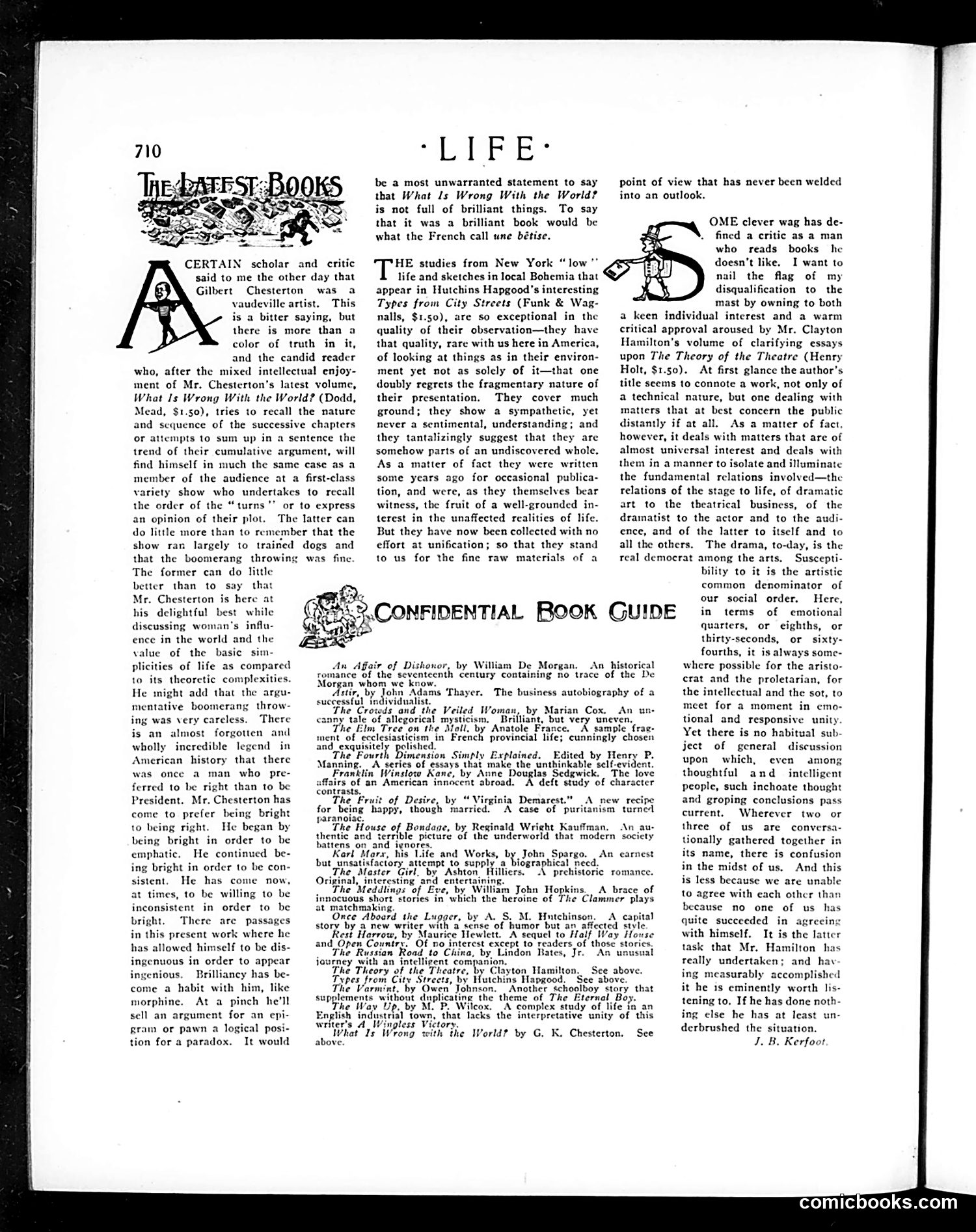
This page contains book reviews rather than political cartoons. The main content criticizes G.K. Chesterton's *What Is Wrong With the World?*, comparing his writing style to a disorganized vaudeville show—suggesting his work is entertainingly scattered rather than coherently argued. The reviewer praises Hutchins Hapgood's *Types from City Streets* for its observational quality regarding New York lower-class and Bohemian life, though lamenting its fragmentary presentation. Most favorably reviewed is Clayton Hamilton's *The Theory of the Theatre*, which the critic endorses despite initial expectations that theater theory would be esoteric. Hamilton apparently argues that drama represents a "real democrat among the arts"—accessible to all social classes—and explores relationships between stage, life, and audience. The page demonstrates early 20th-century literary criticism standards, where reviewers valued coherent argumentation and observed reality over entertainment value alone.
📄 Transcribed text from this page (OCR, searchable)
Machine-transcribed from the original scan — historical spelling and the odd misread are preserved.
CERTAIN scholar and critic said to me the other day that Gilbert. Chesterton was a vaudeville artist. This is a bitter saying, but there is more than a color of truth in it, and the candid reader who, after the mixed intellectual enjoy- ment of Mr. Chesterton's latest volume, What Is Wrong With the World? (Dodd, Mead, $1.50), tries to recall the nature and scquence of the successive chapters or attempts to sum up in a sentence the trend of their cumulative argument, will find himself in much the same case as a member of the audience at a first-class variety show who undertakes to recall the order of the “ turns"? or to express an opinion of their plot. The latter can do little more than to remember that the show ran largely to trained dogs and that the boomerang throwing was fine The former can do little better than to say that Mr. Chesterton is here at his delightful be discussing woman's influ- ence in the world and the value of the basic sim- “LIFE: be a most unwarranted statement to say that What ls Wrong With the World? is not full of brilliant things. To say that it was a brilliant book would be what the French call une bétise. HE studies from New York “low” life and sketches in local Bohemia that appear in Hutchins Hapgood’s interesting Types from City Streets (Funk & Wag- nalls, $1.50), are so exceptional in the quality of their observation—they have that quality, rare with us here in America, of looking at things as in their environ- ment yet not as solely of it—that one doubly regrets the fragmentary nature of their presentation. They cover much ground; they show a sympathetic, yet never a sentimental, understanding; and they tantalizingly suggest that they are somehow parts of an undiscovered whole. As a matter of fact they were written some years ago for occasional publica- tion, and were, as they themselves bear witness, the fruit of a well-grounded in- terest in the unaffected realities of life. But they have now been collected with no effort at unification; so that they stand to us for the fine raw materials of a while ES CONFIDENTIAL Book point of view that has never been welded into an outlook. OME clever wag has de- . fined a critic as a man who reads books he doesn’t like. I want to nail the flag of my disqualification to the mast by owning to both a keen individual interest and a warm critical approval aroused by Mr. Clayton Hamilton's volume of clarifying essays upon The Theory of the Theatre (Henry Holt, $1.50). At first glance the author’s title seems to connote a work, not only of a technical nature, but one dealing with matters that at best concern the public distantly if at all. As a matter of fact, however, it deals with matters that are of almost universal interest and deals with them in a manner to isolate and illuminate the fundamental relations involved—the relations of the stage to life, of dramatic art to the theatrical business, of the dramatist to the actor and to the audi- ence, and of the latter to itself and to all the others. The drama, to-day, is the real democrat among the arts. Suscepti- bility to it is the artistic common denominator of our social order. Here, GUIDE in terms of emotional quarters, or eighths, or thirty-seconds, or sixty- fourths, it is always some- plicities of life as compared to its theorctic complexities. He might add that the argu- mentative boomerang throw- ing was very careless. There is an almost forgotten and wholly incredible legend in American history that there was once a man who pre- ferred to be right than to be President. Mr. Chesterton has come to prefer being bright to being right. He began by being bright in order to be emphatic. He continued be- ing bright in order to be con- sistent. He now, at times, to be willing to be inconsistent in order to be bright. There are passages in this present work where he has allowed himself to be dis- ingcnuous in order to appear ingenious. Brilliancy has be- come a habit with him, like morphine. At a pinch he'll sell an argument for an epi- gram or pawn a logical posi- tion for a paradox. It would has come An Affair of Dishonor, by William De Morgan. An historical romance of the seventeenth century containing no trace of the De Morgan whom we know. stir, by John Adams ‘Thayer. successful individualist. The Crowds and the Veiled Woman, by Marian Cox. An un+ canny tale of allegorical mysticism. Brilliant, but very uneven, The Elm Tree on the Moll, by Anatole France. A sample frag- ment of ecclesiasticism in French provincial life; cunningly chosen and_exquisitely polished. " he Dis Edited by Henry P. The business autobiography of a The Fourti mension Simply Explained. Manning. A series of essays that make the unthinkable self-evident. Franklin Winslow Kane, by Anne Pouglas Sedgwick. The love affairs of an American innocent abroad. A deft study of character contrasts, The Fruit of Desire, by “Virginia Demarest.” A new recipe for being happy, though married. A case of puritanism turned paranoiae, The House of Bondage, by Reginald Wright thentic and ‘rible picture of the underworld 1 battens on and ignore: Karl Mors, his Life and Works, by John Spargo. but unsatisfactory attempt to supply’ a biographical need. The Master Girl. by Ashton Hilliers. Original, interesting and entertaining. __ The Meddlings of Eve, by William John Hopkins, A brace of innocuous short stories in ich the heroine of The Clammer plays at matchmaking. Once Aboard the Lugger, by A. S. M. Hutchinson. A capital story by a new writer with a sense of humor but an affected style. Rest Harrow, by Maurice Hewlett. A sequel to Half Way House and Open Country. Of no interest except to readers of those storie The tan Road to China, by Lindon Bates, Jr. An unusual Kauffman, An aus modern ‘society An earnest “\ prehistoric romance. iowgney swith an intelligent companion. The Theory of the Theatre, by Clayton Hamilton. See above. Types from City Streets, by Hutchins Hapgood. See above. The Varmint, by Owen’ Johnson. Another schoolboy story that supplements without duplicating the theme of The Eternal Boy. he Way Up, by M. P. Wilcox. A complex study of life ia an glish industrial town, that lacks the interpretative unity of this writer's A Wingless Victory. . What Is Wrong with the World? by G. K. Chesterton. See above, where possible for the aristo- crat and the proletarian, for the intellectual and the sot, to meet for a moment in emo- tional and responsive unity. Yet there is no habitual sub- ject of general discussion upon which, even among thoughtful and intelligent people, such inchoate thought and groping conclusions pass current. Wherever two or three of us are conve tionally gathered together in its name, there is confusion in the midst of us. And this is less because we are unable to agree with each other than because no one of us quite succeeded in agreci with himself. It is the latter task that Mr. Hamilton has really undertaken; and hav ing measurably accomplished it he is eminently worth lis- tening to. If he has done noth- ing else he has at least un- derbrushed the situation. J.B. Kerfoot comicbooks.com