
Life, 1910-10-27 · page 10 of 44
Life — October 27, 1910 — page 10: what you’re looking at
What you’re looking at
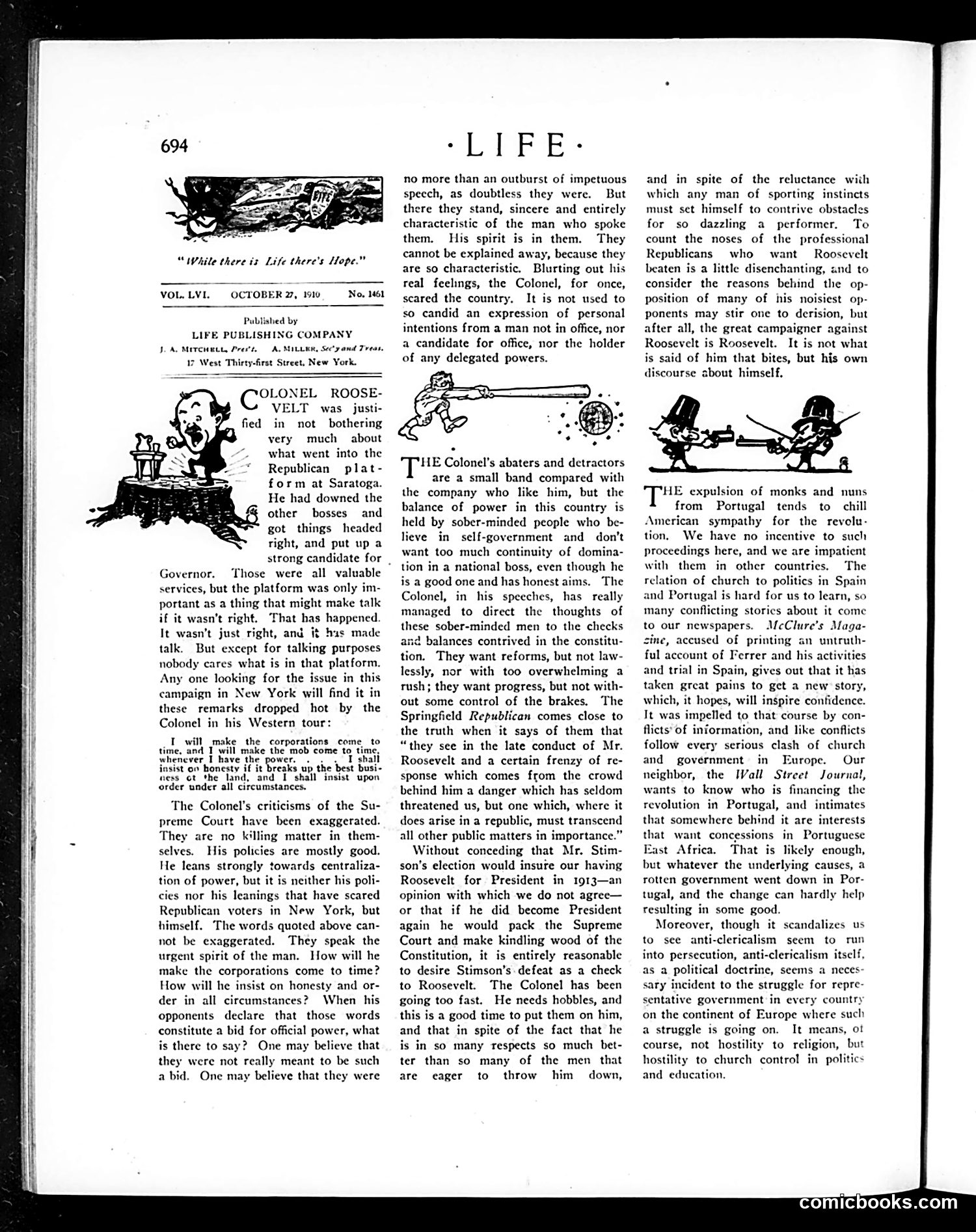
This page contains editorial commentary about Colonel Roosevelt's recent Saratoga speech. The left illustration depicts Roosevelt as an impetuous speaker, caricatured with an exaggerated open mouth—suggesting he speaks without restraint about Republican Party divisions. The text criticizes Roosevelt for publicly airing intra-party conflicts rather than maintaining discretion expected of someone in his position. The cartoonist argues Roosevelt's candid remarks about Republican divisions—while honest—are inappropriate and potentially damaging. The right illustrations appear to reference other political matters (monks/nuns expulsion from Portugal, church-state conflicts in Europe), suggesting Life's broader concerns with international political upheaval affecting American opinion during this Progressive Era period.
📄 Transcribed text from this page (OCR, searchable)
Machine-transcribed from the original scan — historical spelling and the odd misread are preserved.
“While there iz Life there's Hope.” VOL. LVI. OCTOBER 2, 110 No, M461 Published by LIFE PUBLISHING COMPANY JAS METCHELE, Pres, AL MILLER, Sec’y and Treas 7 West Thirty-first Street, New York. VELT was justi- in not bothering very much about what went into the Republican plat- form at Saratoga. He had downed the other bosses and got things headed right, and put up a strong candidate for , Governor. ‘Those were all valuable services, but the platform was only im- portant as a thing that might make talk if it wasn’t right. That has happened. It wasn’t just right, and it hus made talk. But except for talking purposes nobody cares what is in that platform. Any one looking for the issue in this campaign in New York will find it in these remarks dropped hot by the Colonel in his Western tour: Twill make the corporations come to time, and T will make the mob come to time, whenever I have the power... . I shall insist on honesty if it breaks up the best busi- fess ot the land, and I shall insist upon order under all circumstances. The Colonel's criticisms of the Su- preme Court have been exaggerated. They are no killing matter in them- selves. His policies are mostly good. He leans strongly towards centraliza- tion of power, but it is neither his poli- cies nor his leanings that have scared Republican voters in New York, but himself. The words quoted above can- not be exaggerated. They speak the urgent spirit of the man. How will he make the corporations come to time? How will he insist on honesty and or- der in all circumstances? When his opponents declare that those words constitute a bid for official power, what is there to say? One may believe that they were not really meant to be such a bid. One may believe that they were ‘LIPE* no more than an outburst of impetuous speech, as doubtless they were. But there they stand, sincere and entirely characteristic of the man who spoke them. His spirit is in them. They cannot be explained away, because they are so characteristic. Blurting out his real feelings, the Colonel, for once, scared the country, It is not used to so candid an expression of personal intentions from a man not in office, nor a candidate for office, nor the holder of any delegated powers. HE Colonel's abaters and detractors are a small band compared with the company who like him, but the balance of power in this country is held by sober-minded people who be- lieve in self-government and don’t want too much continuity of domina- tion in a national boss, even though he is a good one and has honest aims. The Colonel, in his speeches, has really managed to direct the thoughts of these sober-minded men to the checks and balances contrived in the constitu- tion. They want reforms, but not law- lessly, nor with too overwhelming a rush; they want progress, but not with- out some control of the brakes. The Springfield Republican comes close to the truth when it says of them that “they see in the late conduct of Mr. Roosevelt and a certain frenzy of re- sponse which comes from the crowd behind him a danger which has seldom threatened us, but one which, where it does arise in a republic, must transcend all other public matters in importance.” Without conceding that Mr. Stim- son's election would insure our having Roosevelt for President in 1913—an opinion with which we do not agree— or that if he did become President again he would pack the Supreme Court and make kindling wood of the Constitution, it is entirely reasonable to desire Stimson’s defeat as a check to Roosevelt. The Colonel has been going too fast. He needs hobbles, and this is a good time to put them on him, and that in spite of the fact that he is in so many respects so much bet- ter than so many of the men that are eager to throw him down, and in spite of the reluctance wiih which any man of sporting instincts must set himself to contrive obstacles for so dazzling a performer. To count the noses of the professional Republicans who want Roosevelt beaten is a little disenchanting, and to consider the reasons behind the op- position of many of his noisiest op- ponents may stir one to derision, but after all, the great campaigner against Roosevelt is Roosevelt. It is not what is said of him that bites, but his own discourse about himself, 'HE expulsion of monks and nuns from Portugal tends to chill American sympathy for the revolu- tion, We have no incentive to such proceedings here, and we are impatient with them in other countries. The relation of church to politics in Spain and Portugal is hard for us to learn, so many conflicting storics about it come to our newspapers. McClure’s Maga- sine, accused of printing an untruth- ful account of Ferrer and his activities and trial in Spain, gives out that it has taken great pains to get a new story, which, it hopes, will inspire contidence. It was impelled to that course by con- flicts' of information, and like conflicts follow every serious clash of church and government in Europe. Our neighbor, the Wall Street Journal, wants to know who is financing the revolution in Portugal, and intimates that somewhere behind it are interests that want concessions in Portuguese East Africa. That is likely enough, but whatever the underlying causes, a rotten government went down in Por- tugal, and the change can hardly help resulting in some good. Moreover, though it scandalizes us to sce anti-clericalism seem to run into persecution, anti-clericalism itself, as a political doctrine, seems a neces- sary incident to the struggle for repre- sentative government in every country on the continent of Europe where such a struggle is going on. It means, ot course, not hostility to religion, but hostility to church control in politics and education. comicbooks.com