
Life, 1910-10-27 · page 21 of 44
Life — October 27, 1910 — page 21: what you’re looking at
What you’re looking at
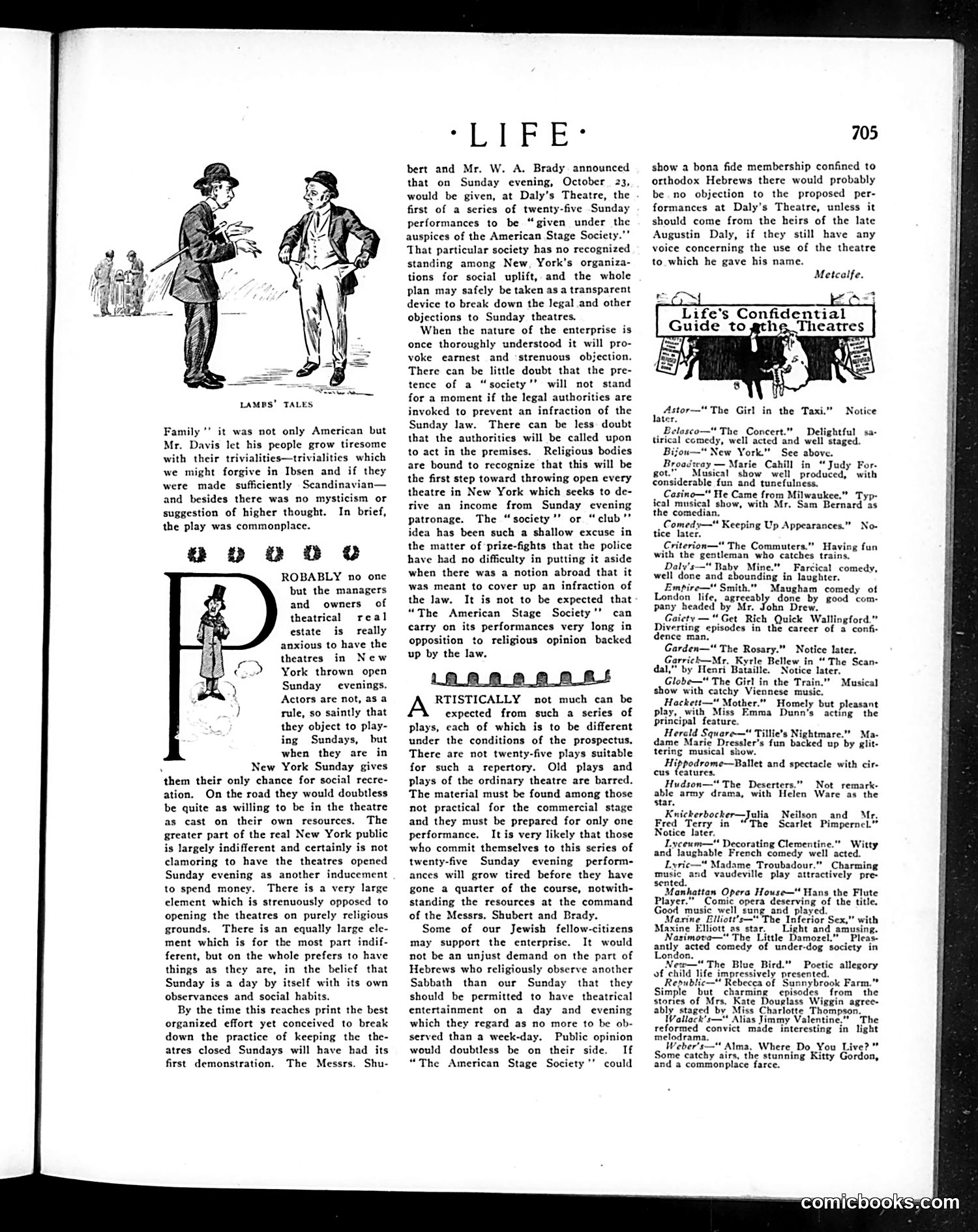
This page discusses a contemporary controversy: theater owners Shubert and W.A. Brady announced plans to open New York theaters on Sunday evenings under the guise of "The American Stage Society," beginning October 23. The article argues this is a transparent legal dodge. Strict Sunday observance laws prohibited commercial entertainment on Sundays, supported by religious organizations and a large portion of the public who believed Sunday should remain sacred. The author contends the "society" pretense will fool no one and predicts authorities and religious bodies will oppose it—just as they'd easily dismissed similar claims by prize-fight organizers. The illustration labeled "Lambs' Tales" (likely referencing the theatrical Lambs Club) shows two figures in conversation, presumably discussing the theatrical scheming involved in this controversy. The article maintains skeptical, satirical tone throughout regarding the enterprise's legitimacy and prospects.
📄 Transcribed text from this page (OCR, searchable)
Machine-transcribed from the original scan — historical spelling and the odd misread are preserved.
LAMBS’ TALES. Family "’ it was not only American but Mr. Davis let his people grow tiresome ith their trivialities—trivialities which we might forgive in Ibsen and if they were made sufficiently Scandinavian— and besides there was no mysticism or suggestion of higher thought. In brief, the play was commonplace. @op oOo B @ ROBABLY no one but the managers and owners of theatrical real estate is really anxious to have the theatres in New York thrown open Sunday evenings. Actors are not, as a rule, so saintly that they object to play- ing Sundays, but when they are in . New York Sunday gives them their only chance for social recre- ation. On the road they would doubtless be quite as willing to be in the theatre as cast on their own resources. The greater part of the real New York public is largely indifferent and certainly is not clamoring to have the theatres opened Sunday evening as another inducement to spend money. There is a very large element which is strenuously opposed to opening the theatres on purely religious grounds. There is an equally large cle- ment which is for the most part indif- ferent, but on the whole prefers to have things as they are, in the belief that Sunday is a day by itself with its own observances and social habits. By the time this reaches print the best organized effort yet conceived to break down the practice of keeping the the- atres closed Sundays will have had its first demonstration, The Messrs. Shu- “LIFE: bert and Mr. W. A. Brady announced that on Sunday evening, October 23, would be given, at Daly’s Theatre, the first of a series of twenty-five Sunday performances to be “given under the auspices of the American Stage Societ ‘That particular society has no recognized standing among New. York's organiza- tions for social uplift, and the whole plan may safely be taken as a transparent device to break down the legal and other objections to Sunday theatres. When the nature of the enterprise is once thoroughly understood it will pro- voke earnest and ‘strenuous objection. There can be little doubt that the pre- tence of a “society’’ will not stand for a moment if the legal authorities are invoked to prevent an infraction of the Sunday law. There can be less doubt that the authorities will be called upon to act in the premises. Religious bodies are bound to recognize that this will be the first step toward throwing open every theatre in New York which seeks to de- rive an income from Sunday evening patronage. The “society '’ or “club’’ idea has been such a shallow excuse in the matter of prize-fights that the police have had no difficulty in putting it aside when there was a notion abroad that it was meant to cover up an infraction of the law. It is not to be expected that “The American Stage Society’? can carry on its performances very long in opposition to religious opinion backed up by the law. LAA A @ 9 9 SF RTISTICALLY not much can be expected from such a series of plays, each of which is to be different under the conditions of the prospectus, There are not twenty-five plays suitable for such a repertory. Old plays and plays of the ordinary theatre are barred. The material must be found among those not practical for the commercial stage and they must be prepared for only one performance. It is very likely that those who commit themselves to this series of twenty-five Sunday evening perform- ances will grow tired before they have gone a quarter of the course, notwith- standing the resources at the command of the Messrs, Shubert and Brady. Some of our Jewish fellow-citizens may support the enterprise. It would not be an unjust demand on the part of Hebrews who religiously observe another Sabbath than our Sunday that they should be permitted to have theatrical entertainment on a day and evening which they regard as no more to be ob- served than a week-day. Public opinion would doubtless be on their side. If “The American Stage Society" could 705 show a bona fide membership confined to orthodox Hebrews there would probably be no objection to the proposed per- formances at Daly’s Theatre, unless it should come from the heirs of the late Augustin Daly, if they still have any voice concerning the use of the theatre to which he gave his name. Metcalfe. Confidential hg_Theatres Astor—"The Girl in the Taxi.” later. _ Belasco—" The Concert.” Delightful sa- tirical comedy, well acted and well staged. ‘ew York." See above. roadteay — Marie Cahill in “Judy For- got.” “Musical show well produced, with considerable fun and tunefulness. _ Casino—"* He Came from Milwaukee.” Typ- ical musical show, with Mr. Sam Bernard as the comedian. _ Comedy—" Keeping Up Appearances.” No- tice later. Criterion with the gen Notice * The Commuters.” Having fun leman who catches trains. ne.” Farcical comedy, ne and ebounding in laughter. Empires Smith” | Maugham comedy ot ndon life, agreeably done by good com: pany headed by Mr. John Drew. “ “°™ Gaicty —" Get Rich Quick Wallingford.” Diverting episodes in the career of = conf dence man Garden—" The Rosary.” Notice later. ich—Mr, Kyrle Bellew in “ The Scan- dal," by Henri Bataille. Notice later. Globe—" The Girl in the Train.” show with catchy Viennese music. Hackett—" Mother.” Homely but pleasant play, with Miss Emma Dunn's acting the principal. feature Herald Square—" Tillie’s Nightmare.” Ma- dame Marie Dressler’s fun backed up by glit- teri musical show. Hippodrome—Ballet and spectacle with ci. cus features Hudson—* The Deserters."” Not remark: ale army drama, with Helen Ware as the star. Knickerbocker—Julia Fred Terry in “The Notice later Lyceum—" Decorating Clementine.” Witty and laughable French comedy well acted. Lyric—“ Madame Troubadour.” Charming music and vaudeville play. attractively “pret sented. Manhatten Opera House—" Hans the Flute Player.” Comie opera deserving of the title. Good music welll sung and played. Marine Elliott's" The Inferior Sex,” with Maxine Elliott as star. — Light and amusing. Nasimovo—* The Little Damozel.” Pleas- antly acted comedy of under-dog society in London. New" The Blue Bird.” Poetic allegory of child life impressively. presented. "Republic" Rebecea of Sunnybrook Farm.” Simple but charming episodes. from. the stories of Mrs. Kate Douglass Wiggin agree- ably staged by Miss Charlotte Thompson. Wallack’s—* Alias Jimmy Valentine.” ‘The reformed convict made interesting in light melodrama, Webers—" Alma, Where Do You Live?” Some catchy airs, the stunning Kitty Gordon, and a commonplace farce. Musical Neilson and Mr, Scarlet Pimpernel.”