
Life, 1910-10-27 · page 17 of 44
Life — October 27, 1910 — page 17: what you’re looking at
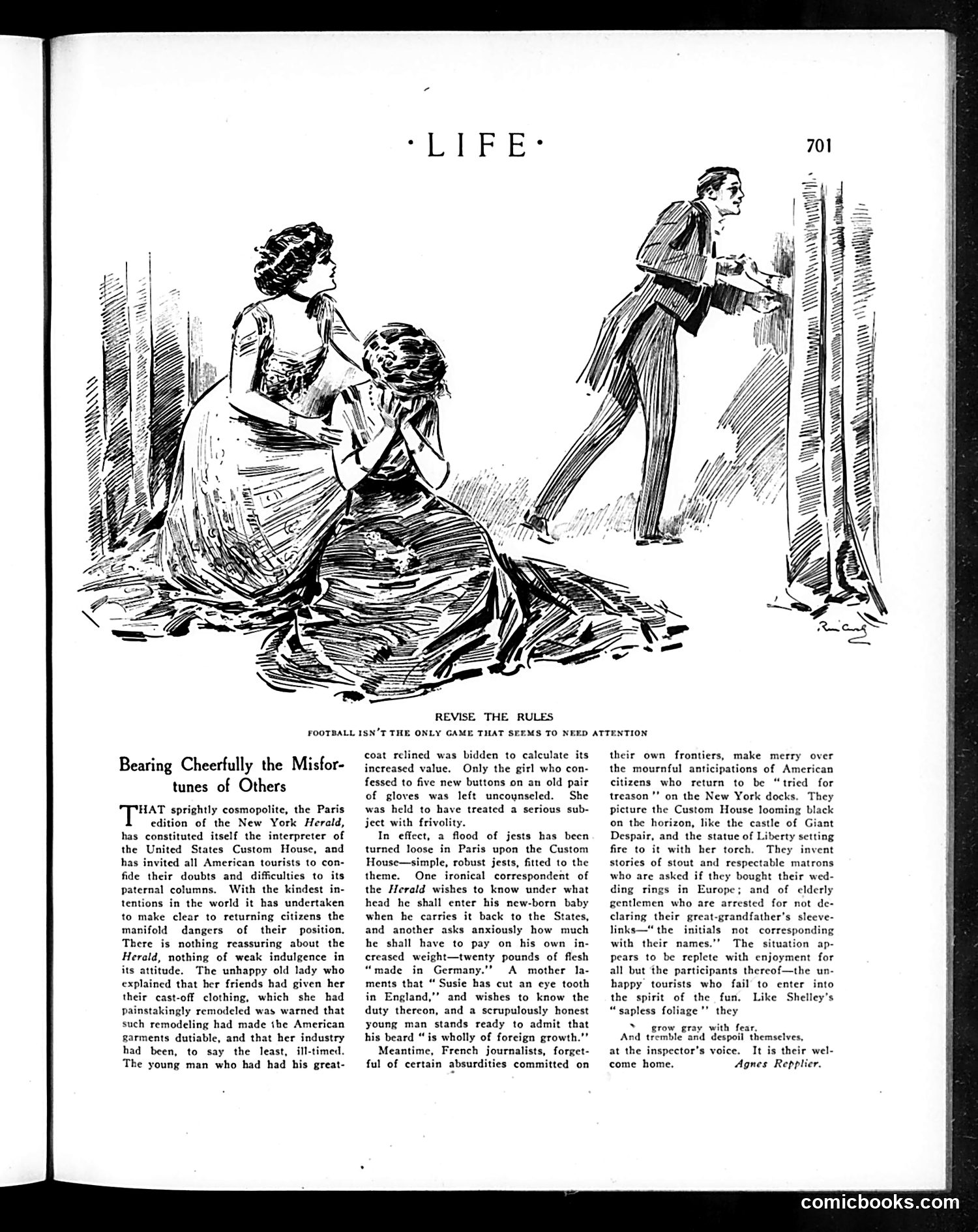
What you’re looking at
This satirical piece mocks American tourists returning from Europe who face U.S. Customs inspections. The cartoon shows two women and a man at what appears to be a customs checkpoint, with inspectors examining baggage. The humor centers on the absurdity of customs regulations. French and American newspapers had published jokes about borderline-ridiculous scenarios: a woman remodeling gifted clothing faces duty charges; a man's relined coat is now taxable; a mother worries about duty on her daughter's tooth cut in England; a man must declare his "foreign-grown" beard. The satire targets: 1. **Overzealous customs enforcement** that penalizes innocent purchases or modifications 2. **The anxiety of returning Americans** who "grow gray with fear" facing inspectors 3. **International mockery**—French journalists enjoy lampooning American customs while conveniently forgetting similar absurdities at their own borders The piece suggests customs rules need revision, hence the title. The tone is sympathetic to tourists while gently ridiculing both bureaucratic excess and human worry over regulations that seem designed to extract maximum duty from the traveling public.
📄 Transcribed text from this page (OCR, searchable)
Machine-transcribed from the original scan — historical spelling and the odd misread are preserved.
REVISE THE RULES t FOOTBALL ISN’T THE ONLY GAME THAT SEEMS TO NEED ATTENTION Bearing Cheerfully the Misfor- tunes of Others HAT sprightly cosmopolite, the Paris edition of the New York Herald, has constituted itself the interpreter of the United States Custom House, and has invited all American tourists to con- fide their doubts and difficulties to its paternal columns. With the kindest in- tentions in the world it has undertaken to make clear to returning citizens the manifold dangers of their position. There is nothing reassuring about the Herald, nothing of weak indulgence in its attitude. The unhappy old lady who explained that her friends had given her their cast-off clothing, which she had painstakingly remodeled was warned that such remodeling had made the American garments dutiable, and that her industry had been, to say the least, ill-timed. The young man who had had his great- coat relined was bidden to calculate its increased value. Only the girl who con- fessed to five new buttons on an old pair of gloves was left uncounseled. She was held to have treated a serious sub- ject with frivolity. In effect, a flood of jests has been turned loose in Paris upon the Custom House—simple, robust jests, fitted to the theme. One ironical correspondent of the Herald wishes to know under what head he shall enter his new-born baby when he carries it back to the States, and another asks anxiously how much he shall have to pay on his own in- creased weight—twenty pounds of flesh “made in Germany." A mother Ia- ments that “ Susie has cut an cye tooth in England,’’ and wishes to know the duty thereon, and a scrupulously honest young man stands ready to admit that his beard “is wholly of foreign growth."” Meantime, French journalists, forget- ful of certain absurdities committed on their own frontiers, make merry over the mournful anticipations of American citizens who return to be “tried for treason’ on the New York docks. They picture the Custom House looming black on the horizon, like the castle of Giant Despair, and the statue of Liberty setting fire to it with her torch. They invent stories of stout and respectable matrons who are asked if they bought their wed- ding rings in Europe; and of elderly gentlemen who are arrested for not de- claring their great-grandfather's sleeve- links— the initials not corresponding with their names.’’ The situation ap- pears to be replete with enjoyment for all but the participants thereof—the un- happy tourists who fail to enter into the spirit of the fun. Like Shelley's “ sapless foliage" they > grow gray with fear, And tremble and despoil themselves, at the inspector’s voice. It is their wel- come home, Agnes Repplier. comicbooks.com NMEA 4 4 7