
A complete issue · 40 pages · 1910
Life — September 8, 1910
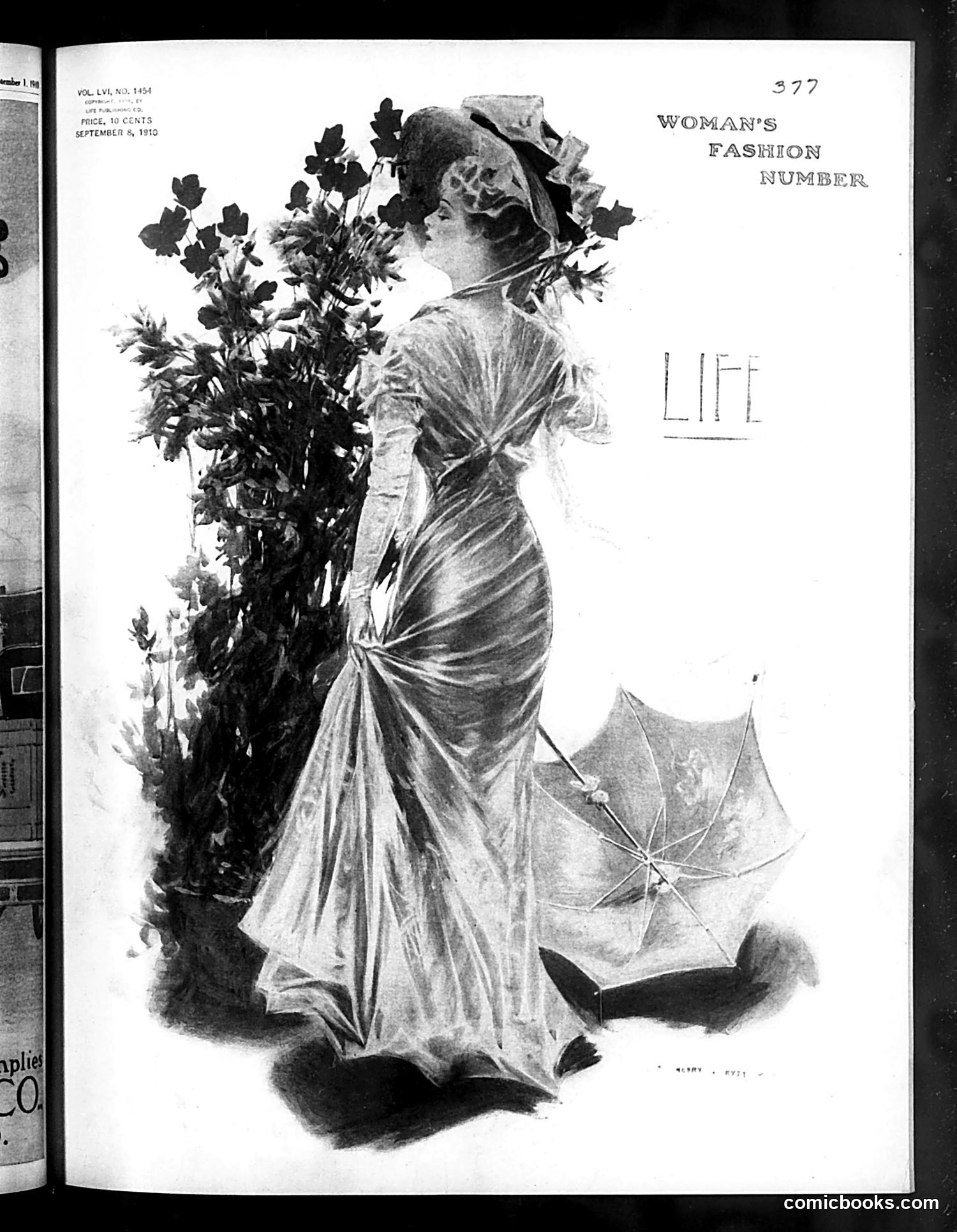
This is a cover illustration for Life magazine's "Woman's Fashion Number," dated September 5, 1910, priced at 10 cents. The image depicts an elegant woman from behind, wearing an elaborate Edwardian-era dress with flowing drapery and a decorative hat adorned with feathers and ribbons. She carries a parasol and holds a bouquet of flowers. This is straightforward fashion illustration rather than political satire—typical cover art for a fashion-focused issue of Life magazine. The drawing showcases the sophisticated silhouettes and accessories fashionable among wealthy women of the 1910 era, emphasizing the S-bend corset shape and ornate millinery that characterized the period. The illustration serves as advertisement for the issue's fashion content.
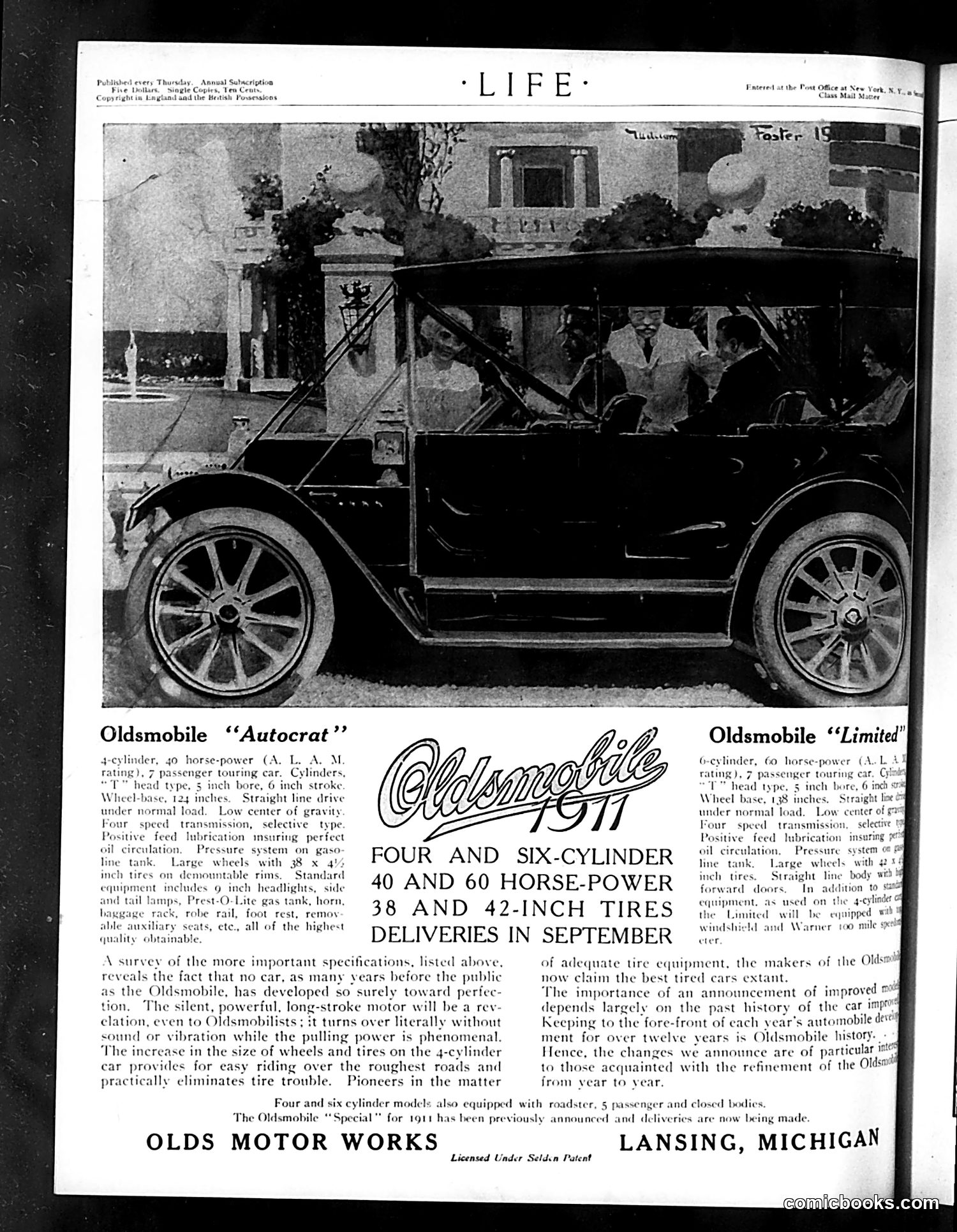
This page is **primarily an advertisement**, not satirical content. It features a 1911 Oldsmobile automobile advertisement from *Life* magazine. The ad showcases two Oldsmobile models—the "Autocrat" (4-cylinder, 40 horsepower) and the "Limited" (6-cylinder, 60 horsepower)—with detailed specifications about engine size, tire dimensions, and delivery dates in September. The large photograph displays a luxury vehicle with several well-dressed passengers, emphasizing the car's status as a refined, sophisticated product. The accompanying text highlights the vehicle's mechanical innovations: silent operation, powerful motor, increased wheel and tire sizes, and improved transmission. This represents early automotive marketing targeting affluent buyers, positioning Oldsmobile as a technologically advanced luxury brand during the nascent automobile era.
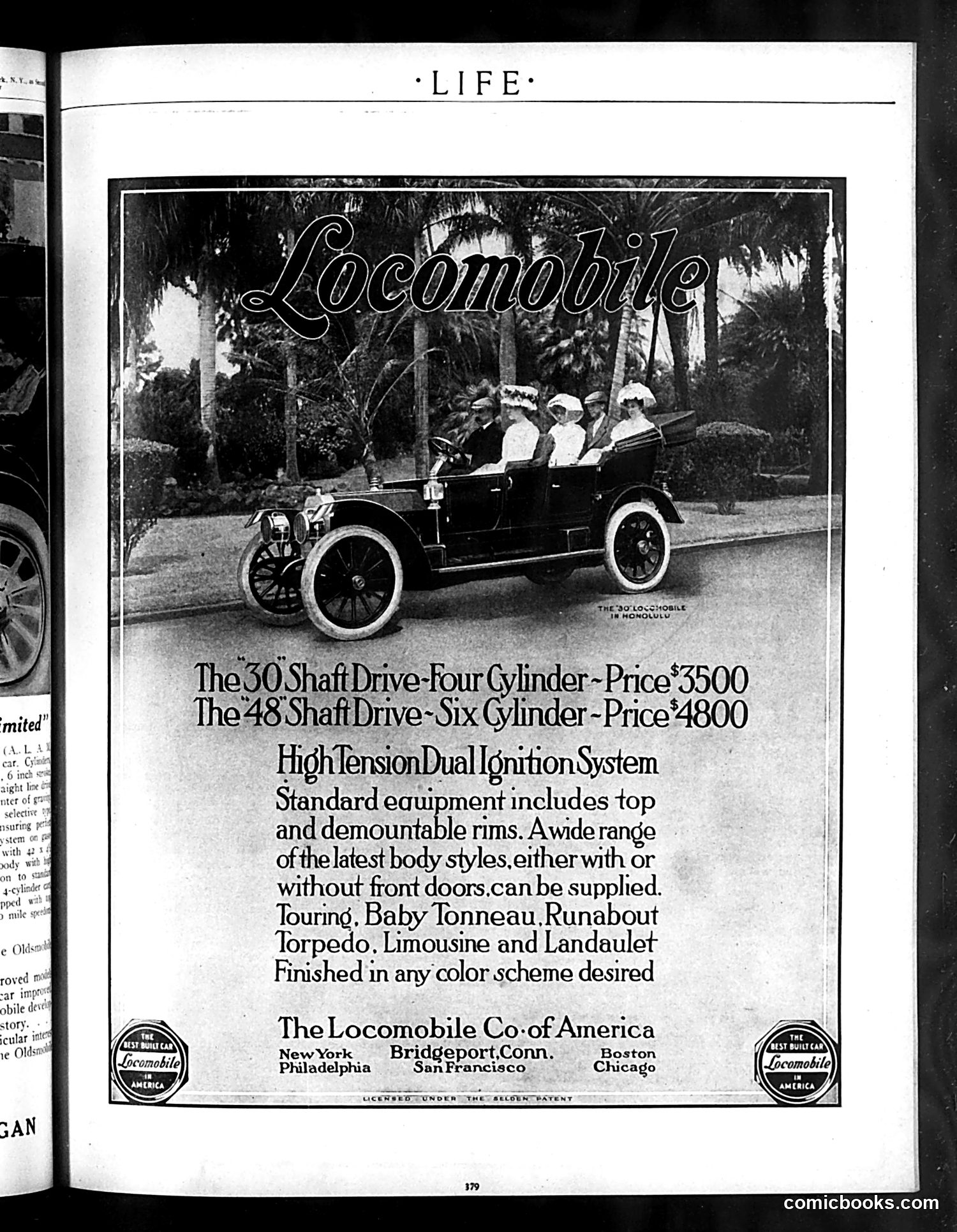
This is primarily a **Locomotobile automobile advertisement**, not political satire. The page features a photograph of an early motorcar with passengers in period dress, set in a tropical or palm-tree lined setting labeled "in Honolulu." The ad promotes two models: the 30 Shaft Drive (four-cylinder, $3,500) and the 48 Shaft Drive (six-cylinder, $4,800). It highlights features like high-tension dual ignition and available body styles (Touring, Baby Tonneau, Runabout, Torpedo, Limousine, Landaulet). The Locomotobile Co. of America lists offices in New York, Philadelphia, Bridgeport, Boston, San Francisco, and Chicago. This appears in a 1910s-era Life magazine as a commercial placement rather than editorial content or satire.
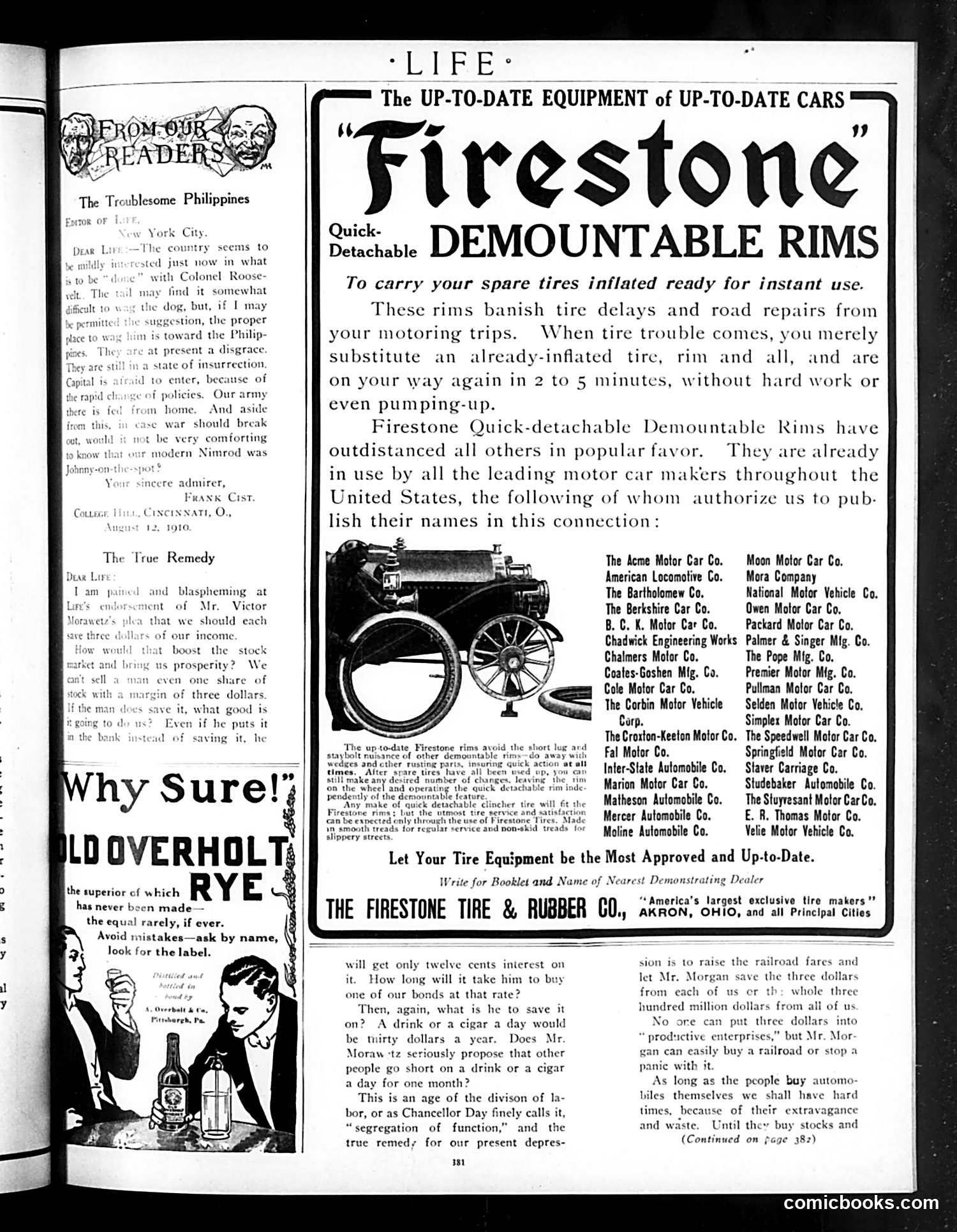
This page is predominantly **advertising** rather than political satire. The main content features a **Firestone tire company advertisement** promoting "Quick-Detachable Demountable Rims" for automobiles—a convenience innovation allowing drivers to swap inflated spare tires quickly during roadside repairs. The left side contains a smaller **Old Overholt Rye whiskey ad**, using the phrase "Why Sure!" with illustrations of a man and woman, presenting the product as a desirable consumer good. The "From Our Readers" section above addresses concerns about the Philippines and war preparedness, reflecting early 1910s anxieties, but this is editorial content, not satire. The page reflects the era's focus on automotive technology and consumer goods marketing rather than political commentary.
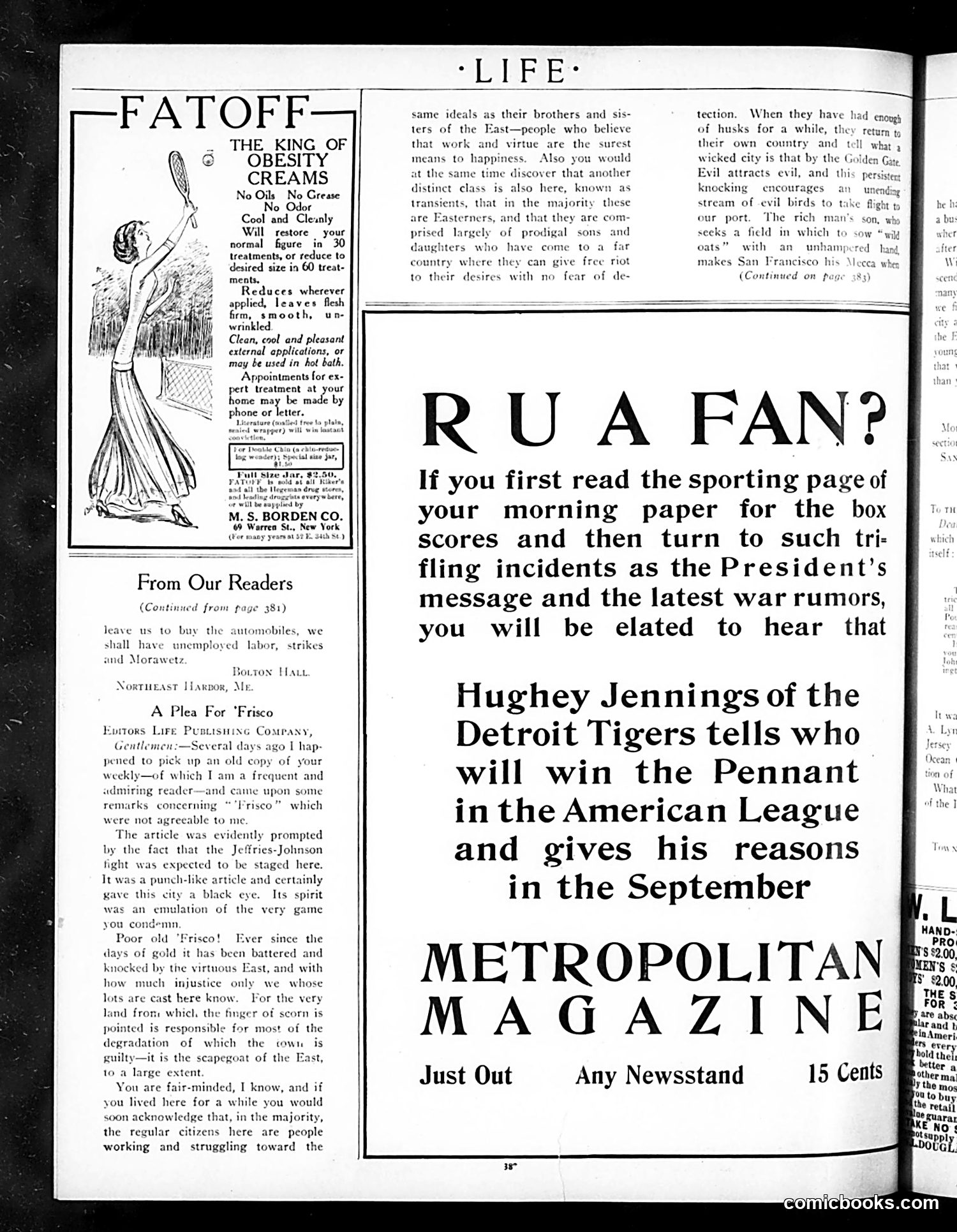
**Main Advertisement:** The large advertisement for *Metropolitan Magazine* (15 cents) promotes an article by Hughey Jennings of the Detroit Tigers predicting the American League pennant winner. This reflects early 20th-century sports journalism's celebrity prognostication trends. **Left Column Advertisement:** A "Fatoff" obesity cream advertisement promises to reduce fat and wrinkles through applications, reflecting era-specific beauty standards and dubious medical claims. **"From Our Readers" Section:** Letters address local concerns: automobile labor unemployment, and criticism of *Frisco* (a previous article), with one writer defending the marginalized working poor of the East against implied urban corruption. The page demonstrates *Life's* mix of satire, advertising, and reader commentary typical of early American periodicals.
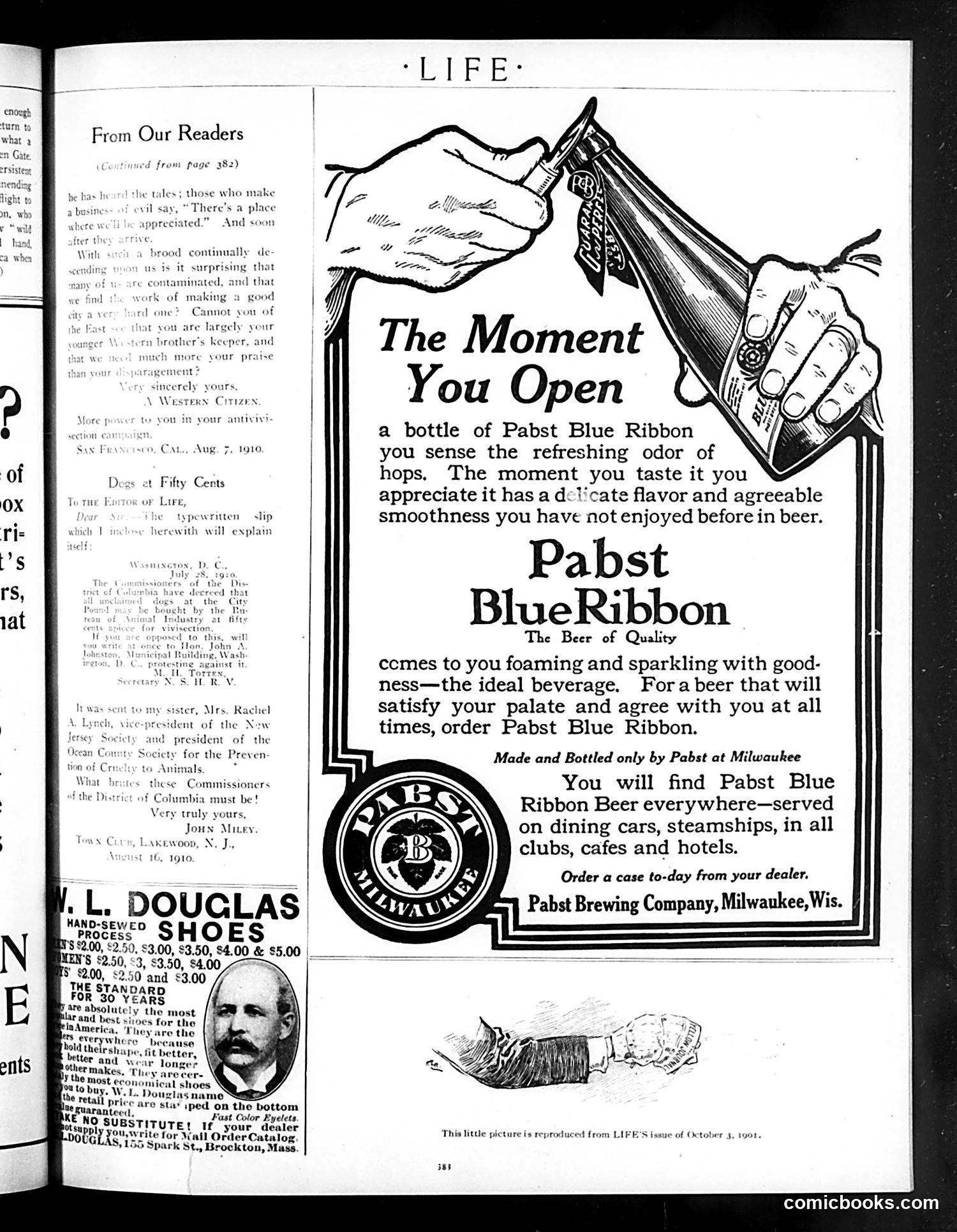
This page is primarily an **advertisement for Pabst Blue Ribbon beer** rather than satirical cartoon content. The ad features illustrated hands opening a beer bottle and emphasizes the product's "refreshing odor of hops" and "delicate flavor and agreeable smoothness." The left column contains a "From Our Readers" section—letters to the editor addressing various topics including animal welfare and urban sanitation concerns. Below that is a separate advertisement for **L.L. Douglas shoes**, featuring a photograph of a man's face and listing shoe prices and product claims about durability and economy. At the bottom is a small illustration credited to *Life's* October 3, 1901 issue. The page reflects early 1900s magazine advertising and reader correspondence rather than political satire.
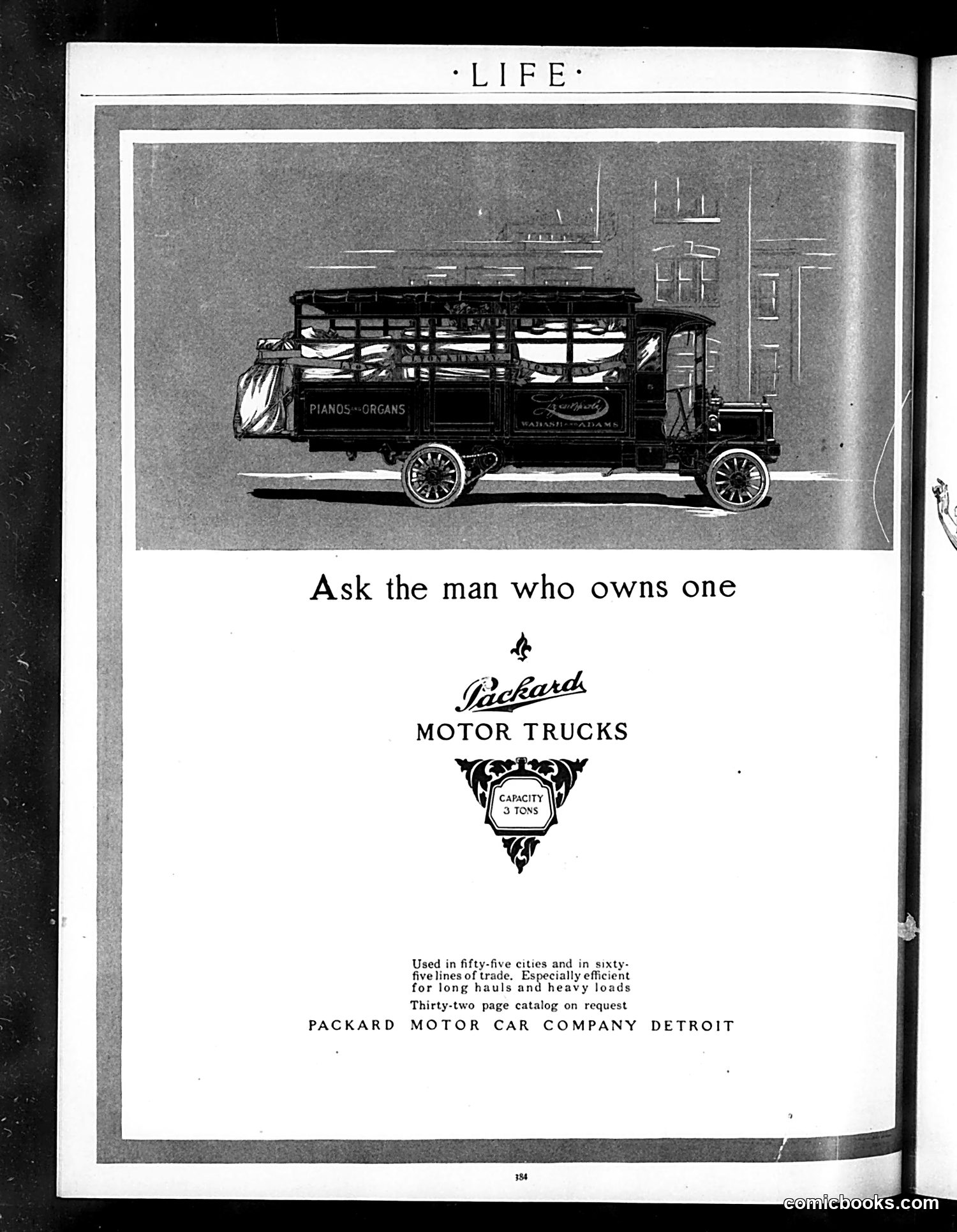
This is primarily a **Packard Motor Trucks advertisement**, not a political cartoon or satirical content. The page features a photograph of an early motorized delivery truck with an open-air cargo bed, labeled as carrying "PIANOS and ORGANS." The truck displays Packard branding and indicates a 3-ton capacity. The advertising copy—"Ask the man who owns one"—was Packard's actual marketing slogan, positioning owner testimonials as credible endorsement. The ad notes the trucks were "used in fifty-five cities and in sixty-five lines of trade" and marketed as "especially efficient for long hauls and heavy loads." This represents early 20th-century commercial vehicle advertising in *Life* magazine, showing the period's transition from horse-drawn to motorized transport for business purposes.
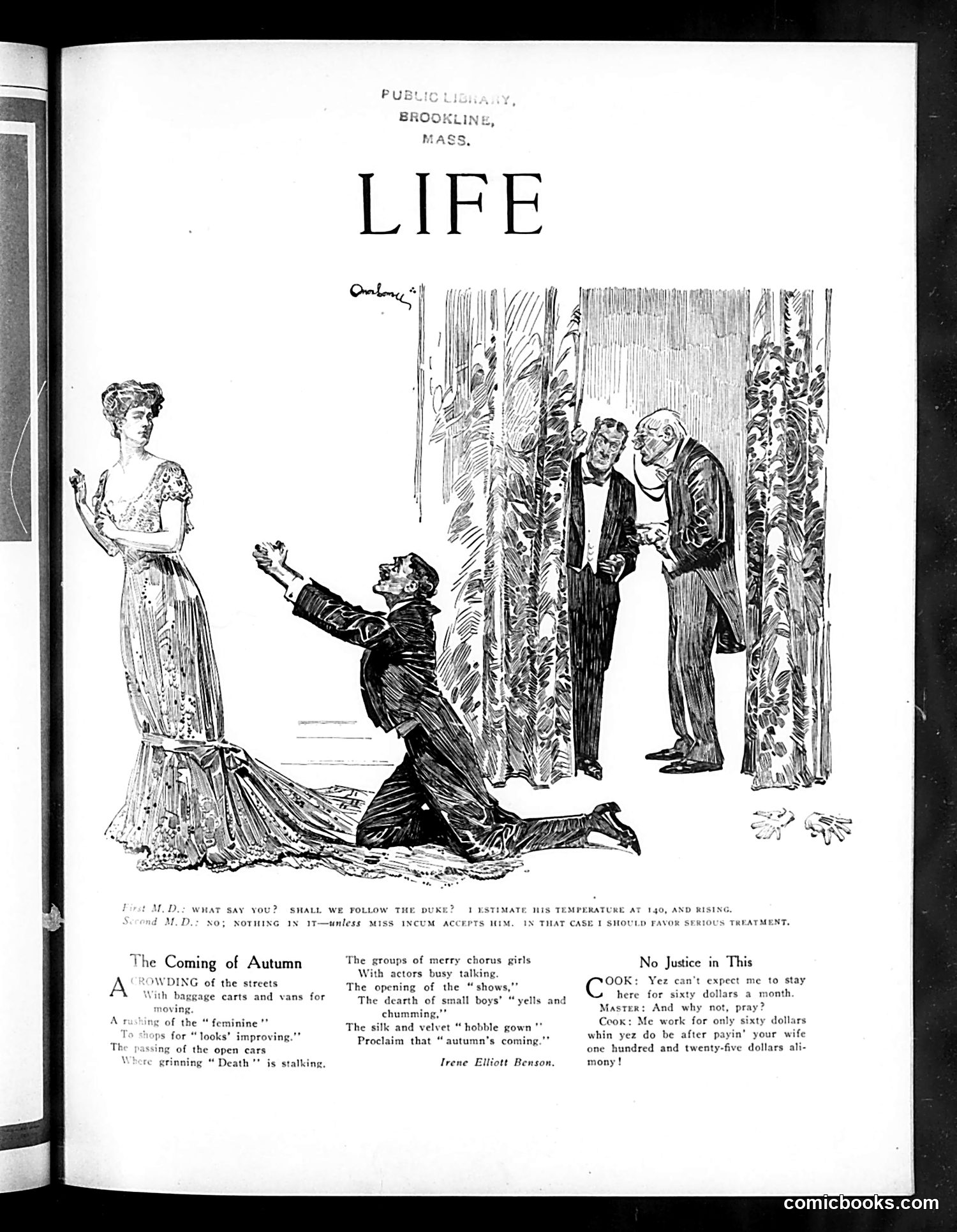
This page from *Life* magazine presents satirical content about social hierarchies and gender dynamics in early 20th-century America. **The main illustration** depicts a man on his knees before a woman, while two other men observe from behind a curtain—likely satirizing courtship rituals and the power dynamics between men and women. **The dialogue** references a doctor's examination, with wordplay about "temperature" and medical "treatment," suggesting sexual innuendo common to the era's humor. **The three accompanying poems** mock contemporary social observations: "The Coming of Autumn" observes seasonal fashion and social changes; "No Justice in This" presents a working-class couple's financial complaint about wives' spending habits—reflecting period anxiety about women's consumer power and economic independence. The overall theme appears to be satirizing both romantic courtship conventions and emerging tensions around women's social and economic roles.
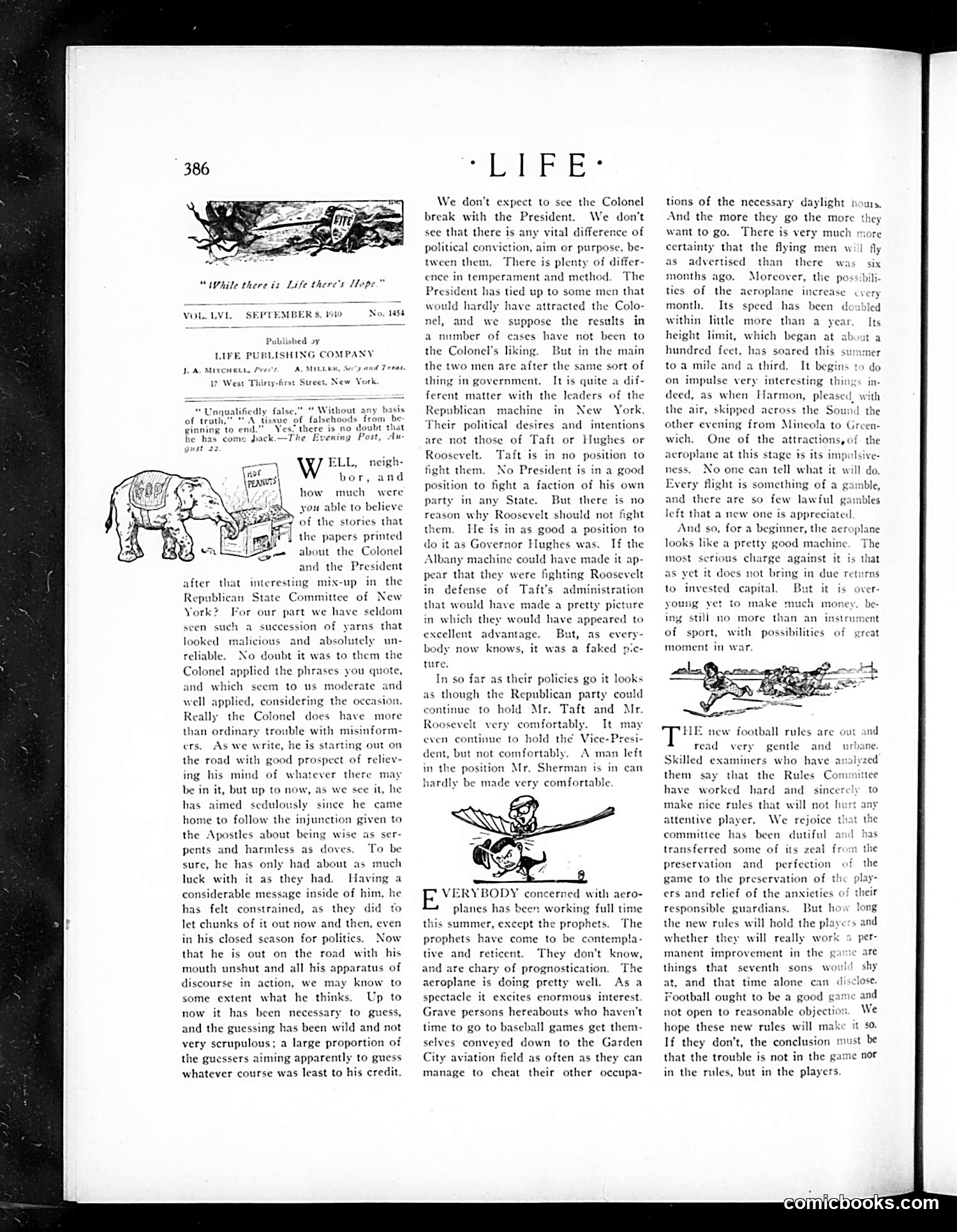
This **Life magazine page from September 5, 1909** contains political commentary on the Roosevelt-Taft transition. The text discusses the Republican State Committee in New York and references Colonel Roosevelt, President Taft, and Governor Hughes—comparing their political positions and the party's internal divisions. The cartoons appear to satirize political factionalism: one shows figures representing the Republican establishment, while illustrations of an elephant (Republican symbol) and what appears to be political figures suggest party discord or maneuvering. The main point critiques Republican leadership's discomfort during this period of succession between Roosevelt and Taft, mocking their attempts to maintain unity while harboring genuine political disagreements about direction and policy.
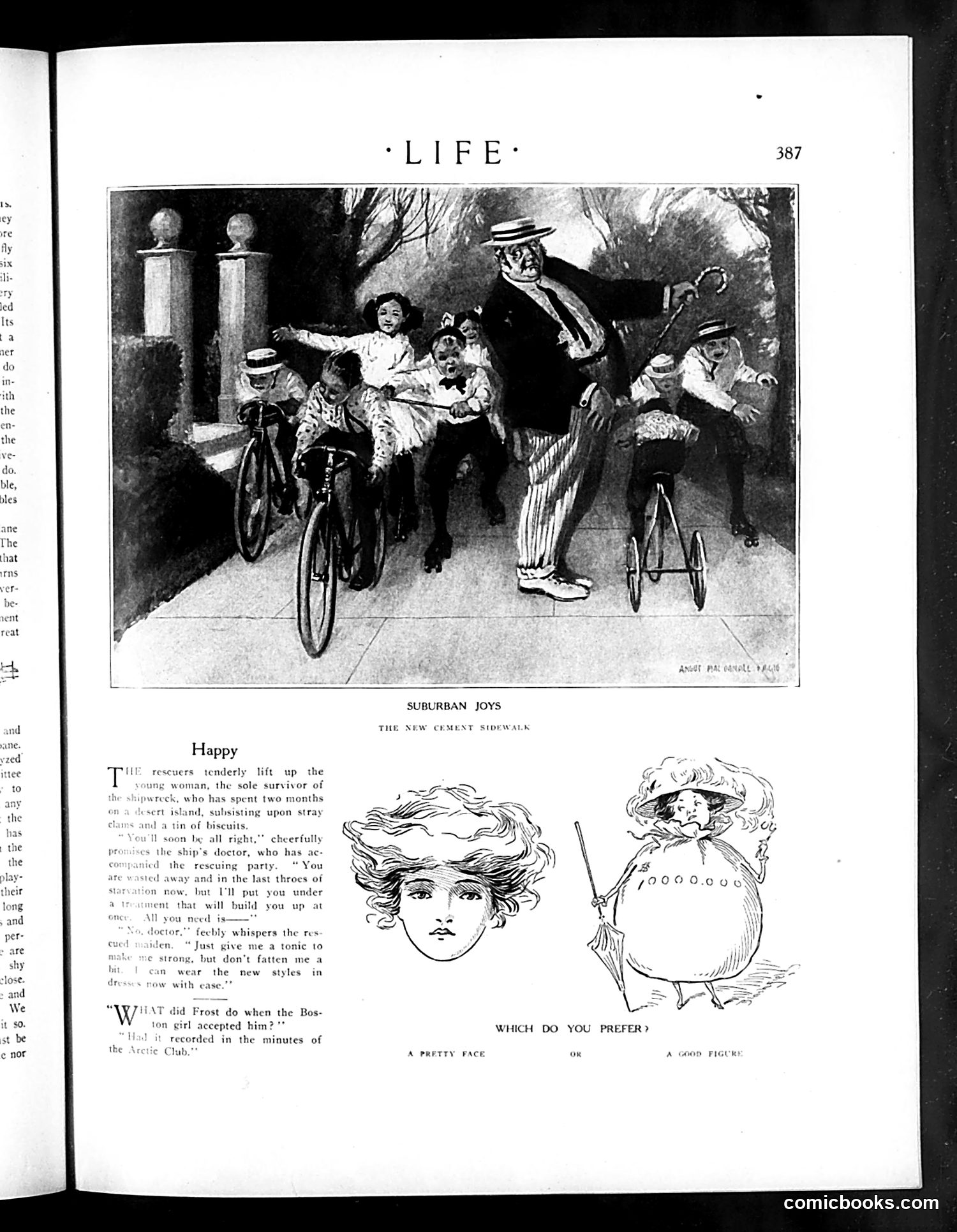
**Top Cartoon: "Suburban Joys - The New Cement Sidewalk"** This satirizes new suburban infrastructure. The illustration shows well-dressed adults and children on bicycles and tricycles, with an older gentleman prominently featured. The joke appears to celebrate cement sidewalks as a novelty that enables leisure activities—cycling and socializing—in suburban developments. This reflects early 20th-century expansion of American suburbs and the excitement around modern amenities like paved walkways. **Bottom Section: "Which Do You Prefer?"** Two female head sketches pose a humorous choice between "A Pretty Face" and "A Good Figure"—a common period joke about feminine beauty standards. The exaggerated proportions mock contemporary debates about women's physical appearance and desirability, typical of Life's satirical approach to social conventions. The page reflects turn-of-the-century suburban optimism and period attitudes toward gender and appearance.
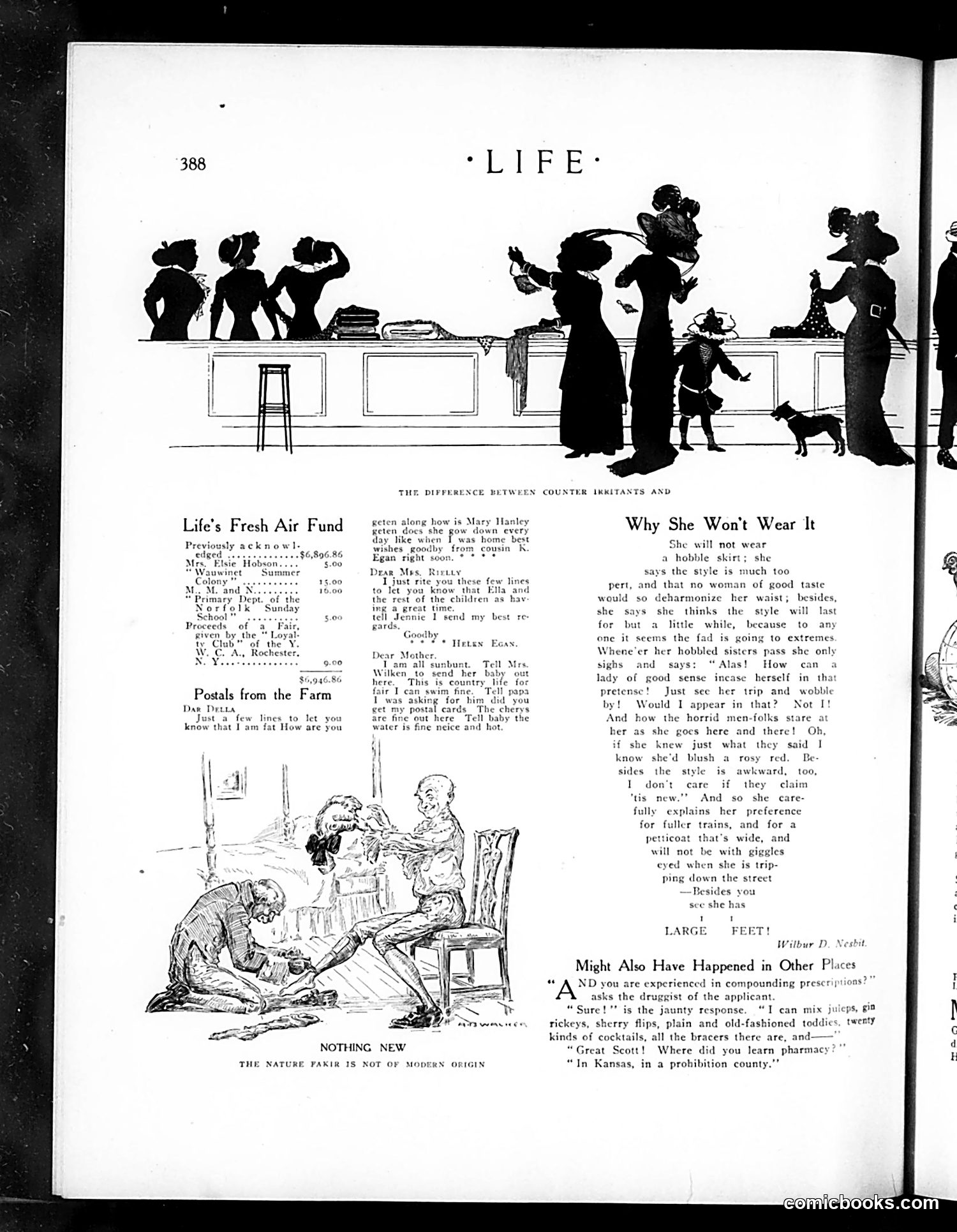
This page contains several satirical sections typical of Life magazine's humor: **"Life's Fresh Air Fund"** lists charitable donations, a regular magazine feature. **"Postals from the Farm"** presents a humorous illustration of rural life—an elderly couple dining, with the caption "NOTHING NEW / THE NATURE FAQIR IS NOT OF MODERN ORIGIN," suggesting that simple country living is timeless, not a modern trend. **"Why She Won't Wear It"** discusses a woman's rejection of a fashionable hat style, mocking both the garment's impracticality (it would "debamoralize her waist") and women who adopt uncomfortable fashions for social status. **"Might Also Have Happened in Other Places"** presents humorous dialogue about pharmacy prescriptions and prohibition-era cocktails, satirizing both medical practice and the challenges of Prohibition enforcement. The overall page exemplifies Life's blend of social satire and domestic humor targeting early 20th-century American life.
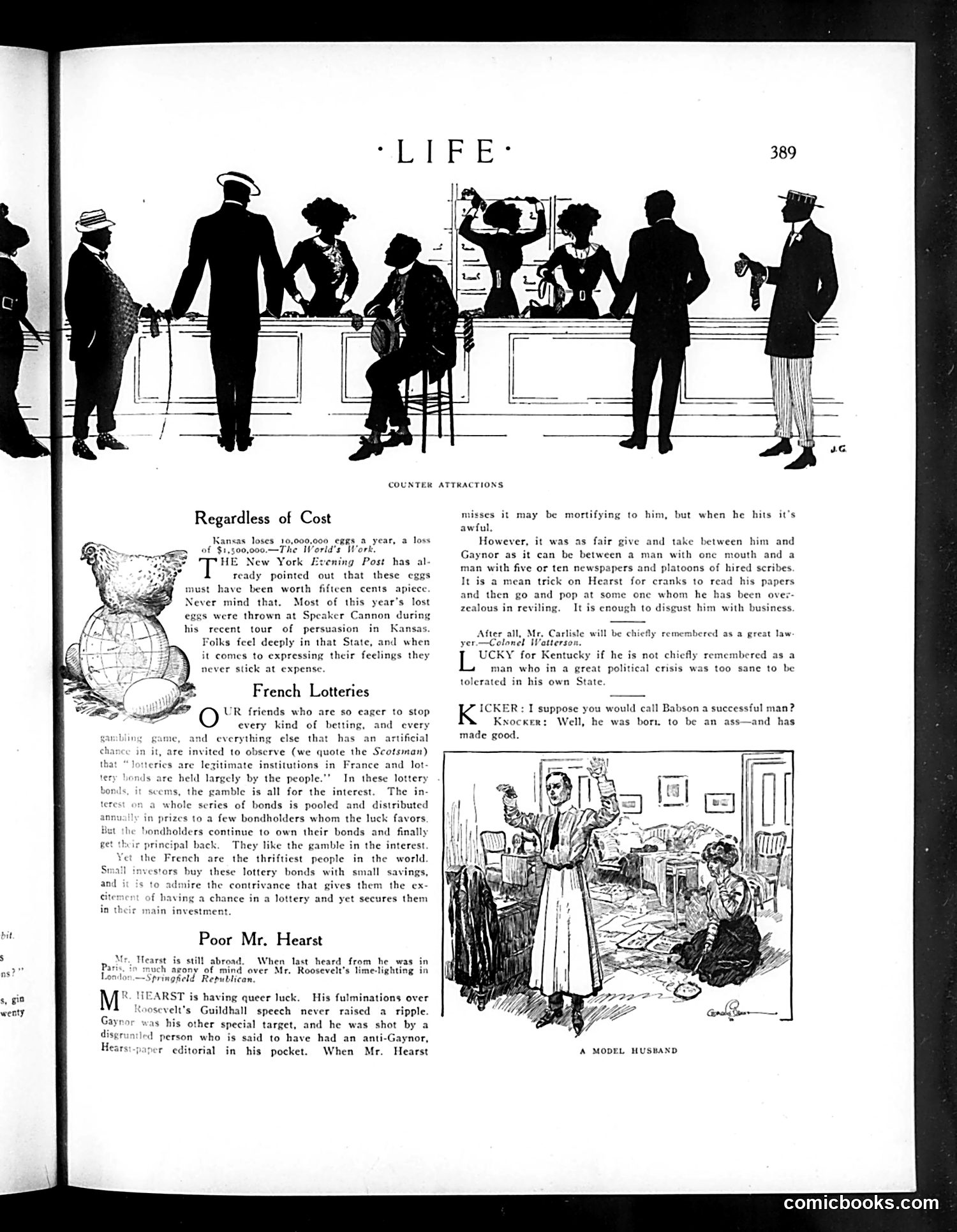
This page contains three satirical pieces about early 20th-century American politics and society: **"Counter Attractions"** (top illustration): Shows various figures at what appears to be a bar or counter, likely satirizing political rivalries or public figures of the era, though specific identities aren't clearly labeled. **"French Lotteries"**: Mocks European gambling institutions, contrasting them with American investment practices—a commentary on financial speculation and working-class hopes for wealth. **"Poor Mr. Hearst"**: References William Randolph Hearst's ongoing misfortunes abroad and failed political ambitions. The text mentions his "Gaynor" feud, suggesting conflict with New York political figures. **"A Model Husband"** (bottom cartoon): Depicts domestic life, likely satirizing marriage dynamics or gender roles of the period. The overall tone is characteristic of *Life*'s satirical approach to contemporary politics and society.
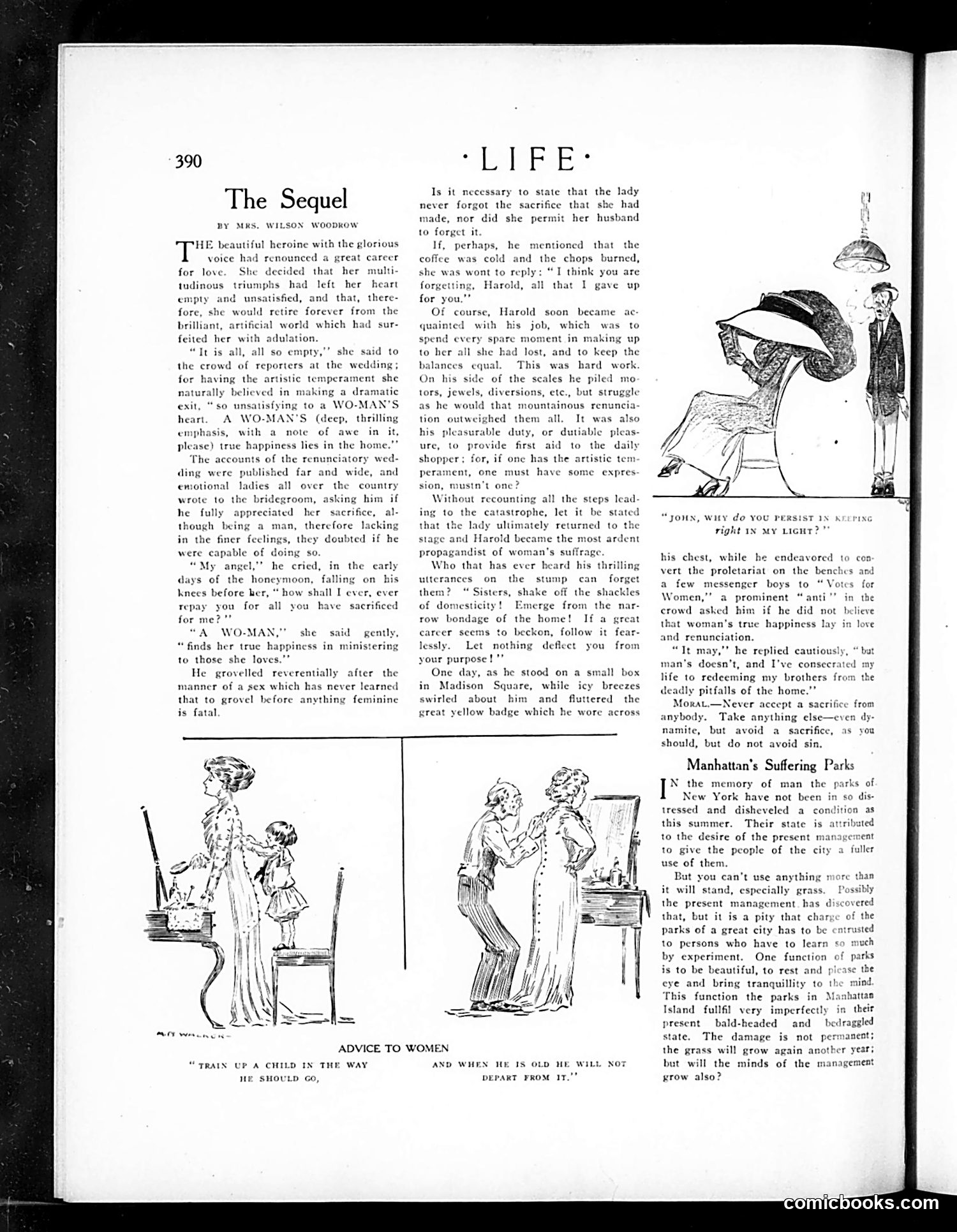
This story satirizes the hypocrisy of women's rights activism by following a soprano who abandons her career for love, claiming a woman's true happiness lies in home and family. She repeatedly reminds her husband Harold of this "sacrifice." The joke: Harold becomes so guilt-ridden that he eventually becomes a **women's suffrage propagandist**, contradicting the very domestic ideal his wife claimed to embrace. He now preaches that women should escape "the narrow bondage of the home" and pursue careers. The satire targets the inconsistency of women who simultaneously demand: - Recognition for sacrificing careers for family - The right to abandon that sacrifice and pursue public life It's also likely mocking suffragists themselves—suggesting their arguments are emotionally manipulative rather than principled. The "moral" warns against accepting sacrifices from anyone, implying they're used as weapons of guilt rather than genuine devotion. Published in *Life* magazine (known for political satire), this reflects anti-suffrage sentiment prevalent before women gained voting rights.
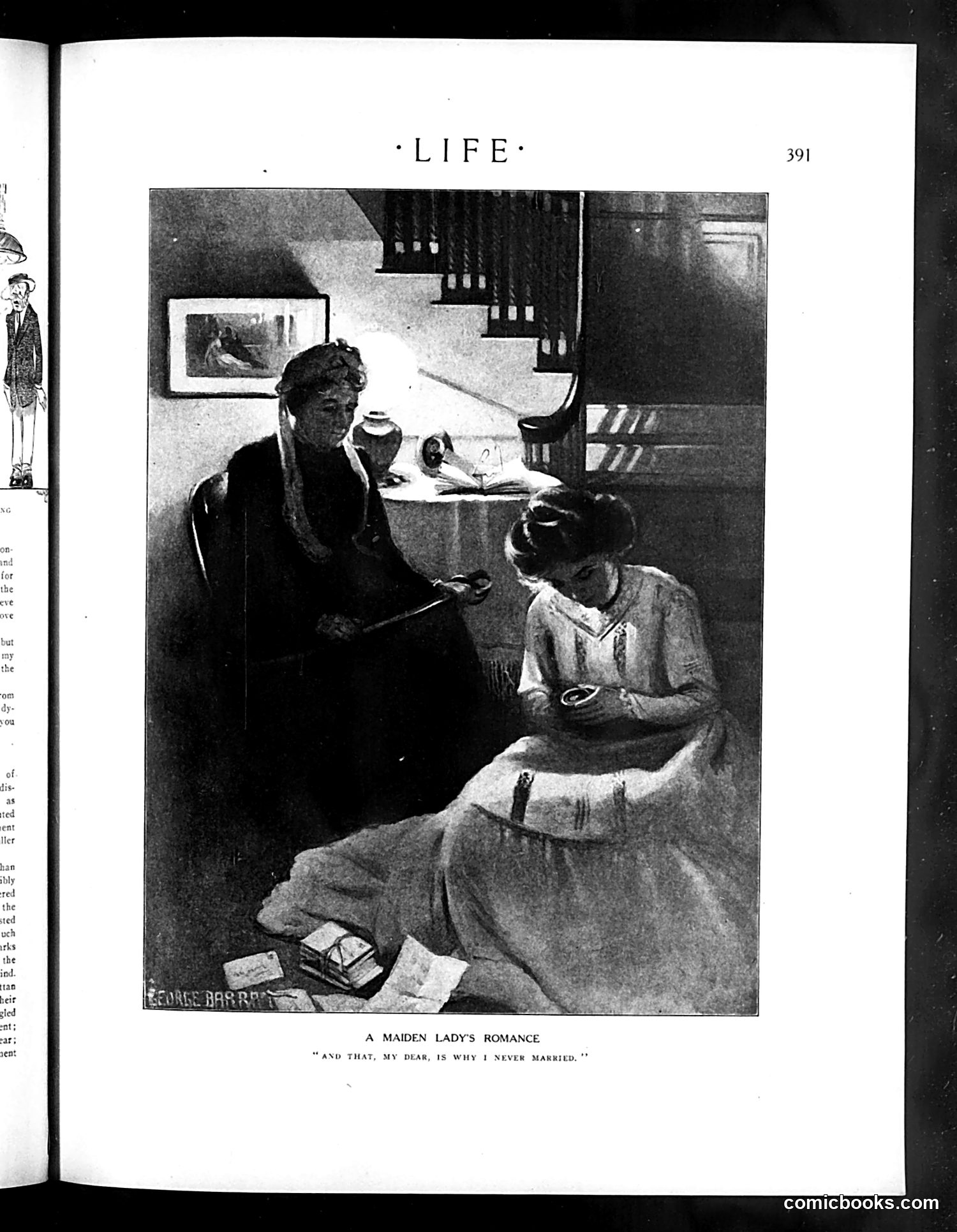
This is a narrative illustration by George Barris titled "A Maiden Lady's Romance." The image shows an older woman in dark clothing speaking to a younger woman seated nearby, apparently recounting her life story. The caption—"And that, my dear, is why I never married"—suggests the accompanying article tells of romantic disappointment or tragedy that prevented the maiden from marrying. This was a common satirical and sentimental theme in early-to-mid 20th century Life magazine: stories of spinsters explaining their unmarried status through romantic misadventure. The illustration's domestic interior setting and the younger woman's attentive posture frame this as a cautionary or poignant tale about unrequited love or lost opportunity—subjects Life frequently explored with a mixture of humor and pathos.
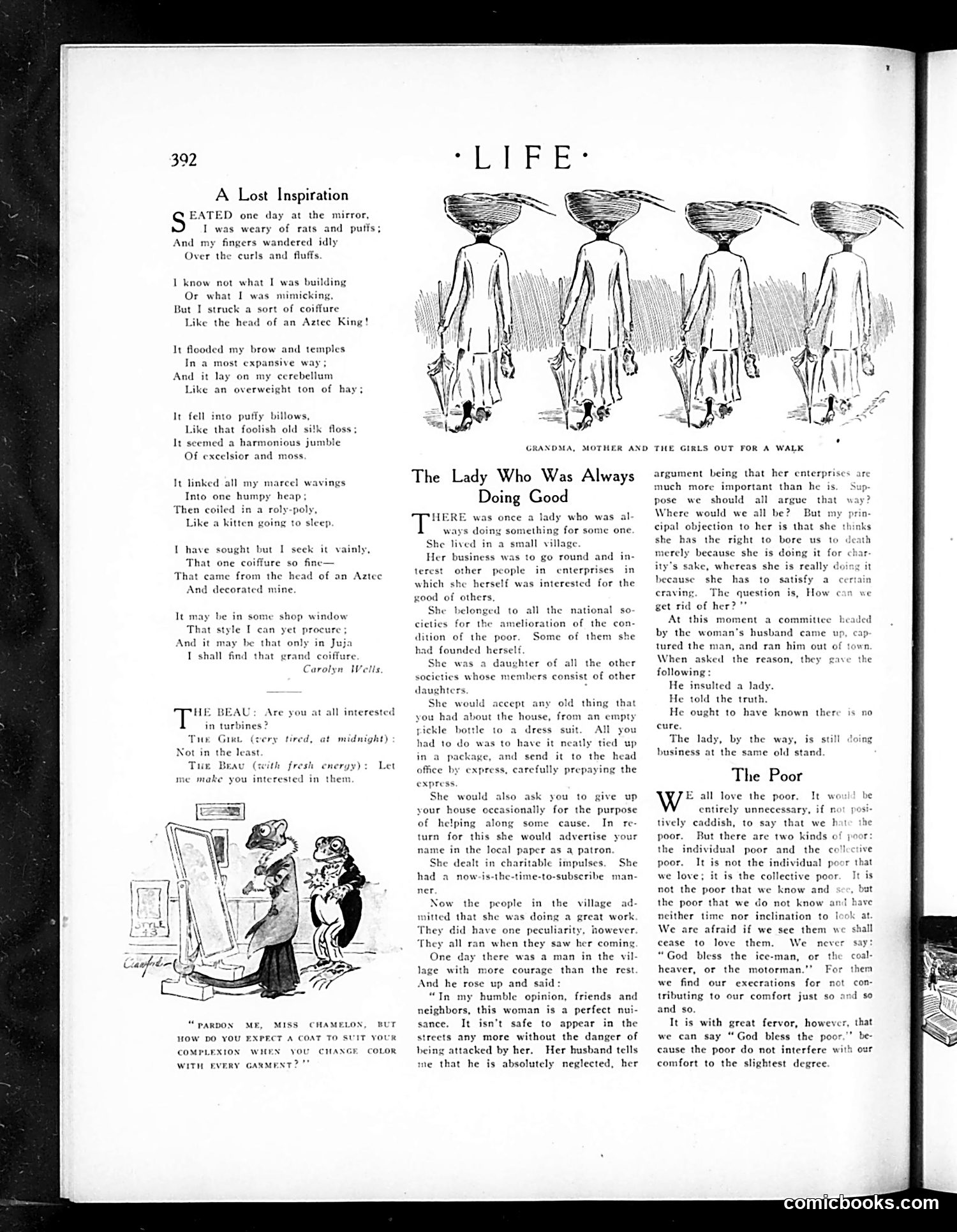
This *Life* magazine page contains three satirical pieces about women's behavior and charity work circa early 1900s. **"A Lost Inspiration"** mocks women's hairstyling fads, particularly elaborate updos resembling an "Aztec King's" head—satirizing the impracticality of fashionable coiffures. **"The Lady Who Was Always Doing Good"** targets self-righteous female charity workers. A village woman constantly organizes relief efforts and solicits donations, boring everyone relentlessly. When a man finally tells her she's a "perfect nuisance," the town defends her charitable work despite universally dreading her visits. The satire critiques performative charity—doing good primarily for social status rather than genuine compassion. **"The Poor"** argues people sentimentally love "the poor" collectively but actually despise poor individuals they encounter. It's a cynical commentary on class attitudes and selective compassion. The cartoon at bottom shows a dandy asking about wearing inappropriate colors—unrelated humor about fashion vanity. Overall, the page satirizes female vanity, self-satisfied charity work, and hypocritical social attitudes toward poverty.
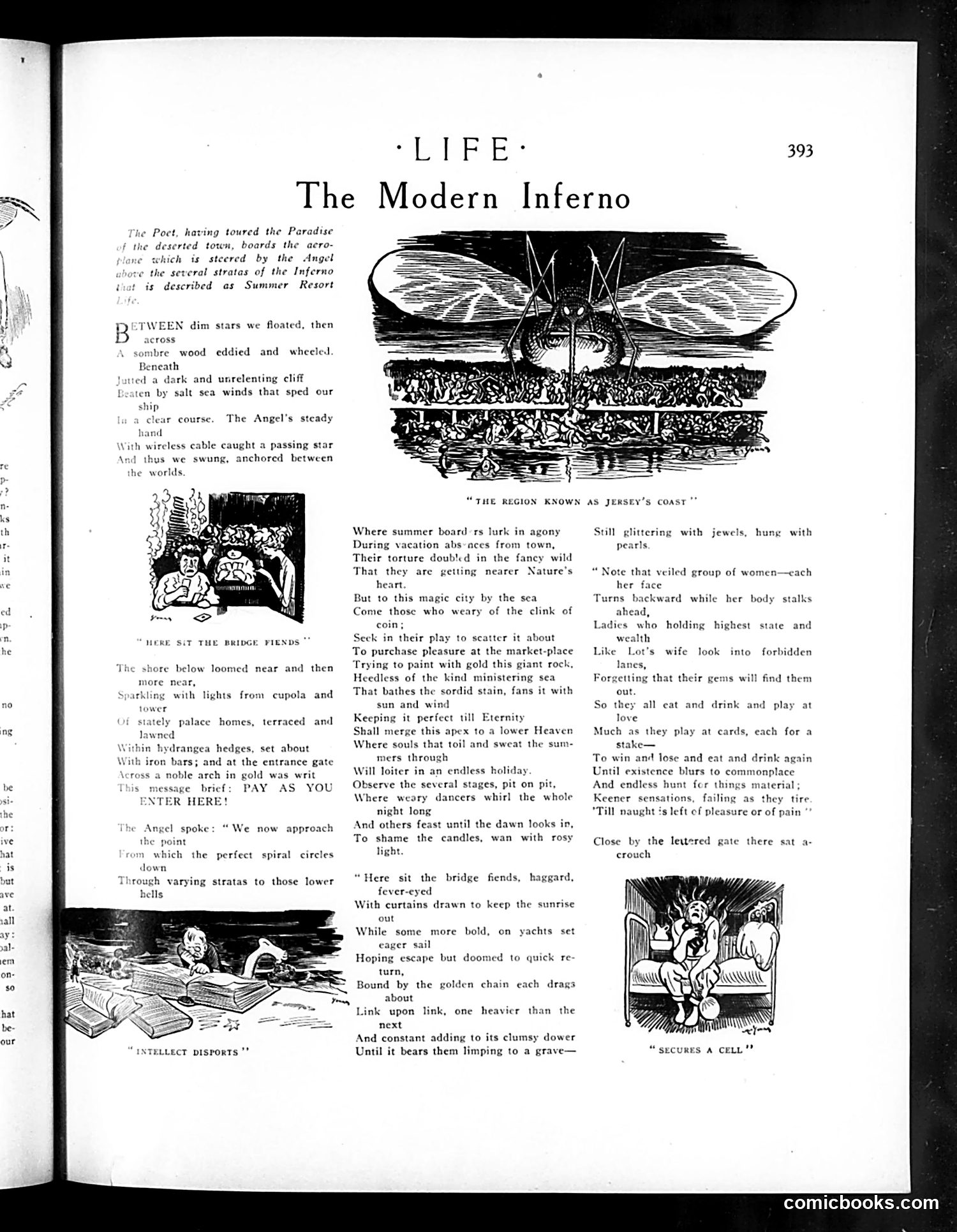
This is a literary satire reimagining Dante's *Inferno* as a contemporary American summer resort—specifically Jersey's Shore. The poet is guided through concentric circles of torment, paralleling Dante's structure but substituting spiritual sins with modern wealthy idleness. The satire mocks the leisure class: vacationers suffer "torture" seeking nature while remaining enslaved to wealth and consumption. Each circle depicts a specific vice—compulsive spending, all-night revelry, gambling, and materialism disguised as pleasure. The "bridge fiends" hide from daylight; wealthy women ("Like Lot's wife") look back longingly at forbidden indulgences. The central joke is that modern capitalist excess has become its own inferno. Pearls and jewels don't liberate but burden ("golden chain each drags about"). The "pay as you enter here" sign replaces Dante's famous gate inscription, suggesting commercialized damnation. The illustrations reinforce this: opulent resort imagery contrasts sharply with the text's condemnation of hollow hedonism.
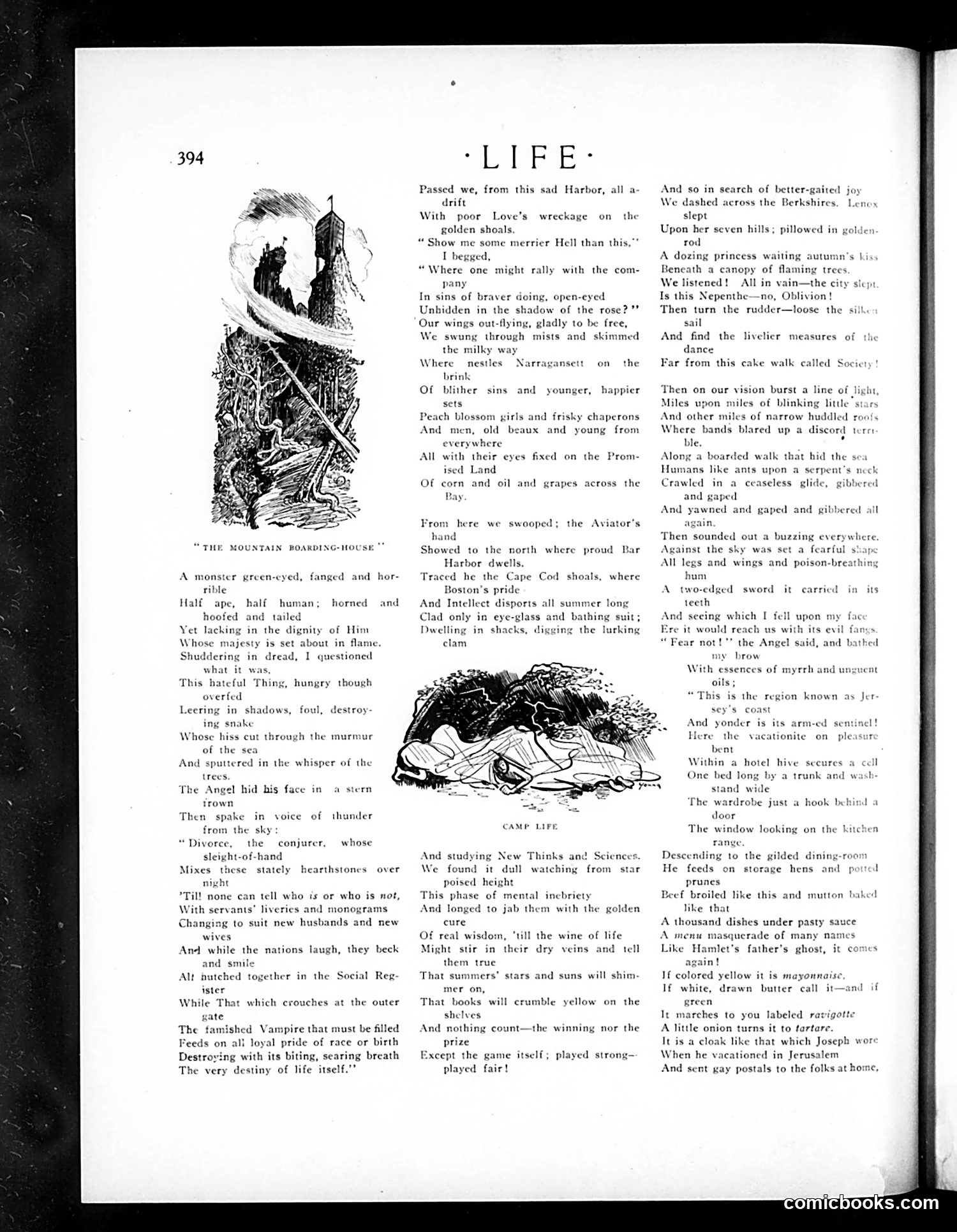
This page contains a satirical poem attacking **divorce** as a destructive social force. The central image depicts a grotesque, demonic creature—described as "half ape, half human; horned and hoofed"—representing Divorce personified as a vampire that "feeds on all loyal pride of race or birth." An Angel warns the narrator that Divorce is a "conjurer" using "sleight-of-hand" to confuse identities, allowing women to change "servants' liveries and monograms" (social status) by marrying successive husbands. The poem criticizes both the institution and society's apparent amusement: "while the nations laugh, they beck and smile." The second illustration ("Camp Life") depicts leisured vacationers, likely wealthy Americans at summer resorts in fashionable locations (Bar Harbor, Cape Cod, the Berkshires). The satire suggests their intellectual pursuits ("New Thinks and Sciences") are shallow distractions. Together, the pieces critique early 20th-century social decay: marital instability among the privileged classes and their frivolous escapism. The magazine uses moral language ("destiny of life itself") to frame divorce as fundamentally threatening to American society.
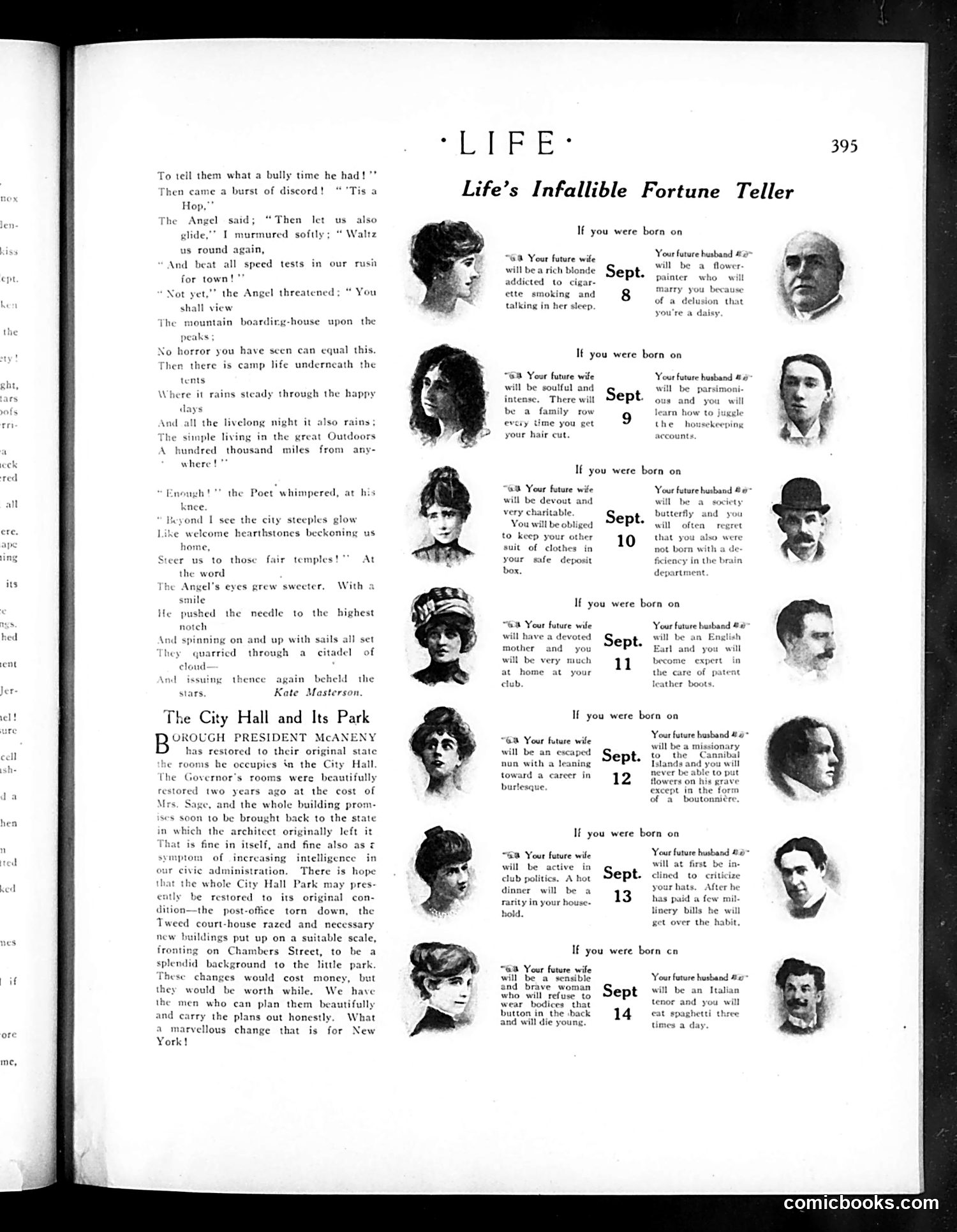
This page features "Life's Infallible Fortune Teller," a satirical horoscope-style section pairing birth dates (September 8-14) with absurdist predictions about future spouses and marriages. The humor operates through **exaggerated stereotypes and domestic complaints**. Women born on these dates receive husbands described with petty flaws: a "flower-painter" who's poor, a "society butterfly" wastrel, a "missionary" who'll die in obscurity. Men get wives with comic vices: a blonde who smokes and talks in her sleep, one prone to "family rows" over haircuts, a nun-turned-burlesque performer. The satire targets **early 20th-century gender anxiety and marriage disappointment**—the joke being that no matter your birth date, matrimony promises compromise, financial strain, and domestic tedium. It mocks both fortune-telling's pretensions and the resigned cynicism many held about marriage itself. The left column contains unrelated poetry and a serious article about restoring New York City Hall.
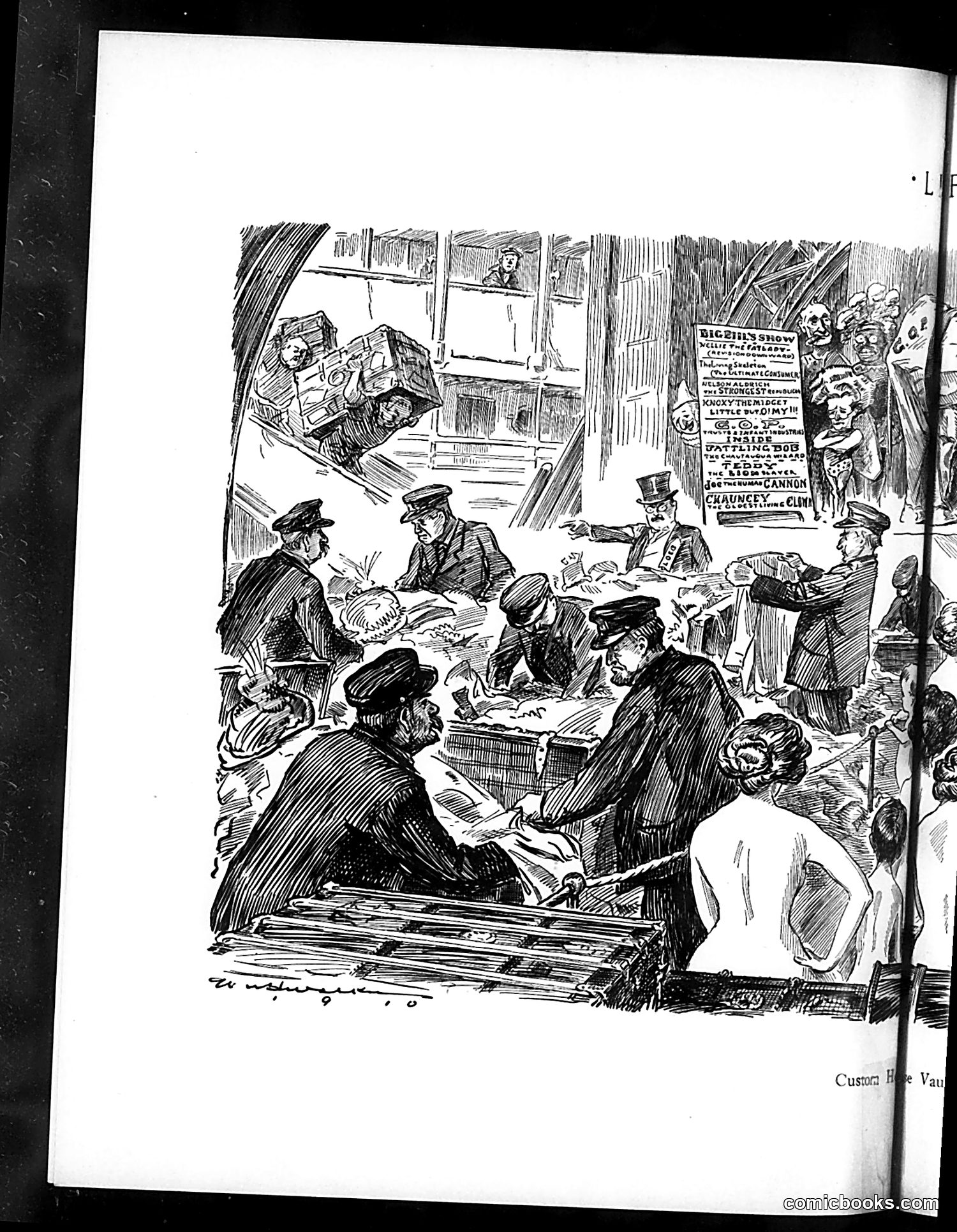
This appears to be a satirical illustration depicting a crowded scene inside a Custom House vault or examination room. Multiple officials in period dress (top hats and formal coats) are examining goods and documents, suggesting an inspection or inspection process. The scene satirizes bureaucratic inefficiency—numerous officials appear to be processing paperwork and inspecting merchandise simultaneously in a chaotic, cramped space. The titled posters visible on the wall in the background suggest this may reference specific customs regulations or tariff debates of the era. The cartoon likely critiques either corruption in customs administration, excessive bureaucratic red tape, or disputes over tariff policies—common satirical targets in *Life* magazine during the late 19th/early 20th century. Without a specific date, the exact political reference remains unclear.
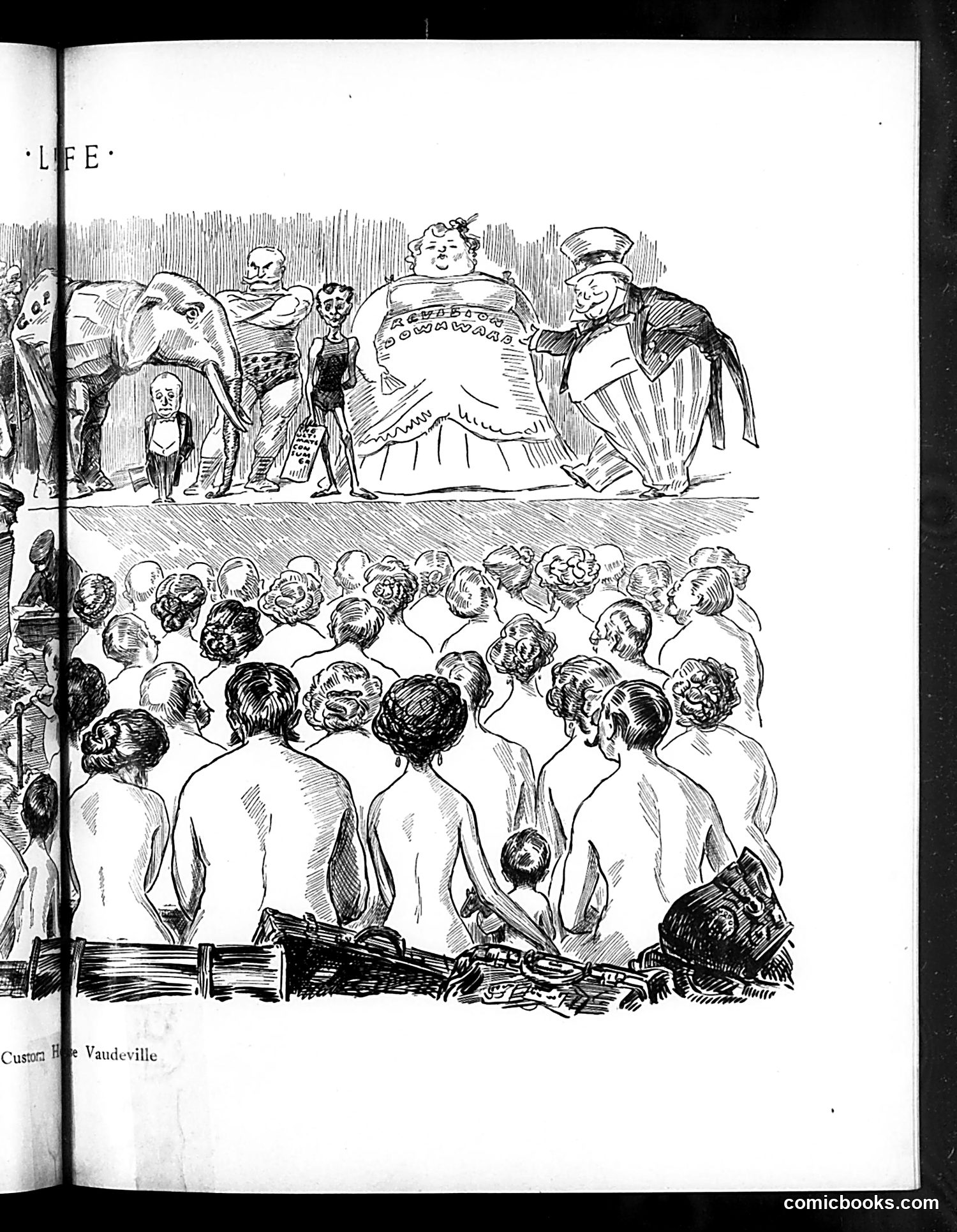
This satirical illustration depicts a circus or theatrical performance before an audience. The central figure appears to be an enormously fat performer on stage, surrounded by smaller performers and what looks like a ringmaster or conductor on the right. The large crowd of spectators shown from behind watches intently. The cartoon likely satirizes either: (1) public fascination with human oddities or "freak shows" popular in that era, or (2) a specific contemporary political or social figure presented as a spectacle for public consumption. The exaggerated scale and circus setting suggest mockery of sensationalism. The credit reads "Cesare Rigo Vaudeville," indicating this relates to vaudeville entertainment culture. Without clearer identification of the central figure, the specific satirical target remains unclear.
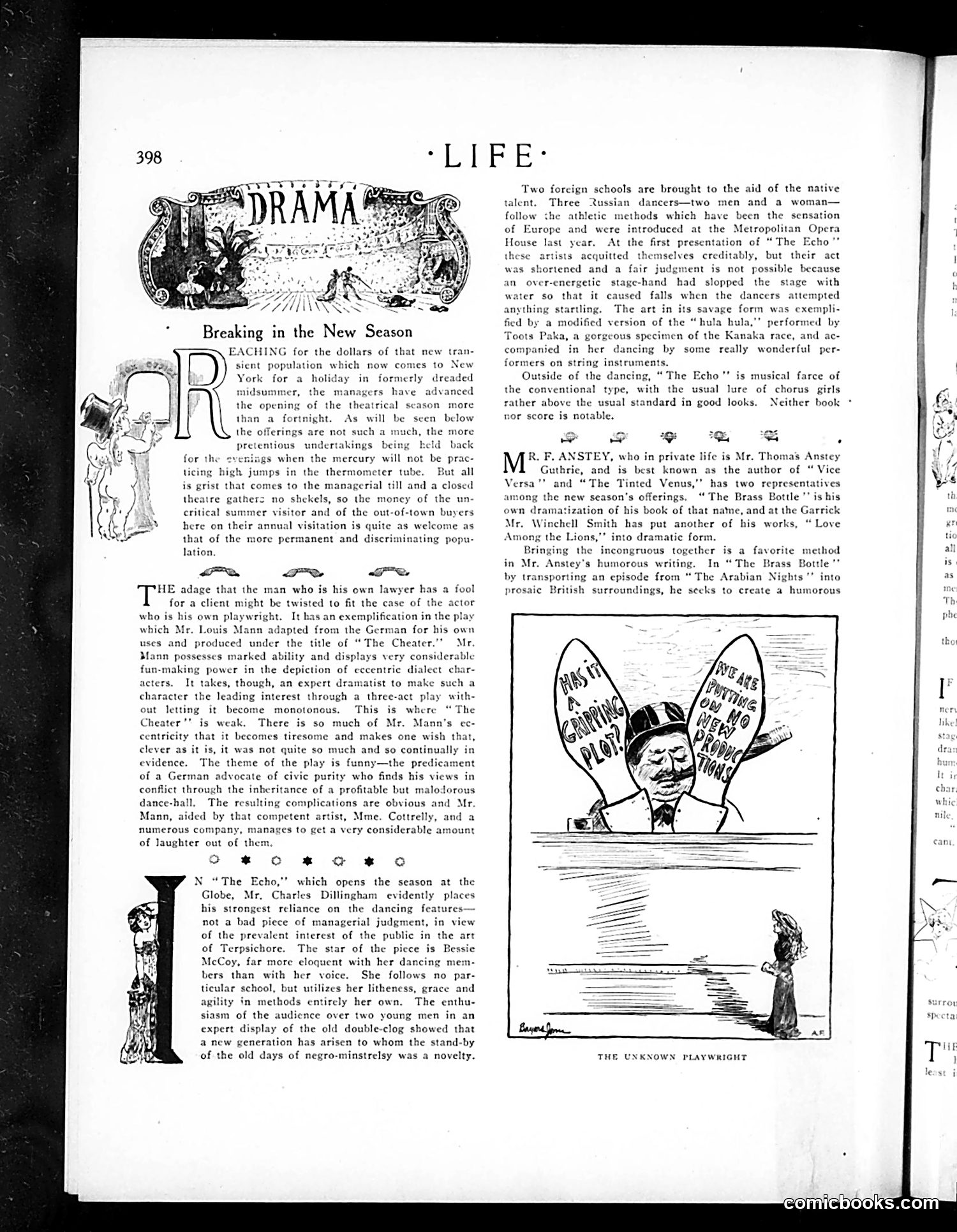
This cartoon satirizes amateur playwrights—actors who write their own material. The image shows a figure with enormous ears labeled with theatrical productions ("The Brass Bottle," "The Unknown Playwright"), suggesting he's all ears but lacks true dramatic talent. The text discusses Louis Mann, an actor-playwright who adapted a German play as "The Cheater." The satire's point: Mann is talented at eccentric characterization but lacks the expertise to sustain a three-act play without becoming tiresome. The accompanying editorial notes that "the man who is his own lawyer has a fool for a client"—twisted here to suggest actors shouldn't be their own playwrights. The exaggerated ears mock the pretension of performers assuming dramatist roles. It's a lighthearted jab at theatrical ambition outpacing actual skill—a common theme in Life magazine's drama criticism during this era (appears to be early 1900s based on referenced productions).
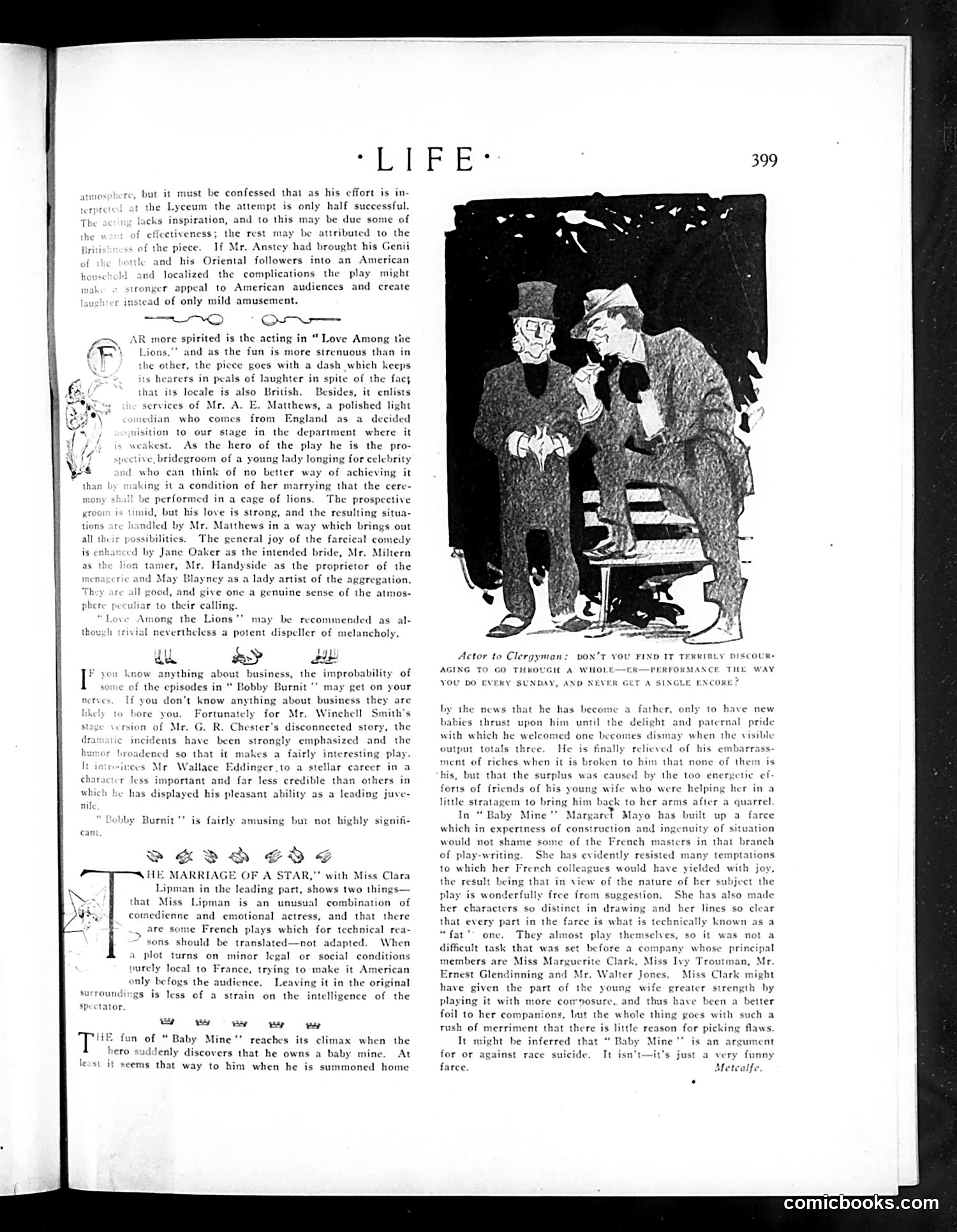
This page contains theatrical reviews with one cartoon. The main illustration (upper right) shows two figures in period costume seated together—likely depicting a scene from "Love Among the Lions," reviewed in the text. The play involves a bride who demands her wedding ceremony occur inside a lion's cage, a premise the reviewer notes is "trivial" but amusing. Below the reviews sits a single-panel cartoon captioned "Actor to Clergyman." It satirizes the contrast between theatrical and religious performance: an actor complains that delivering Sunday sermons lacks the professional satisfaction of stage work—he performs the same "piece" weekly yet receives no encores or audience appreciation. The joke mocks both the actor's vanity and the mundane repetition of clerical duties, treating sermon-delivery as analogous to theatrical performance. The page primarily reviews contemporary Broadway productions (*Love Among the Lions*, *Bobby Burnit*, *The Marriage of a Star*, *Baby Mine*), assessing their plots, acting, and entertainment value for American audiences.
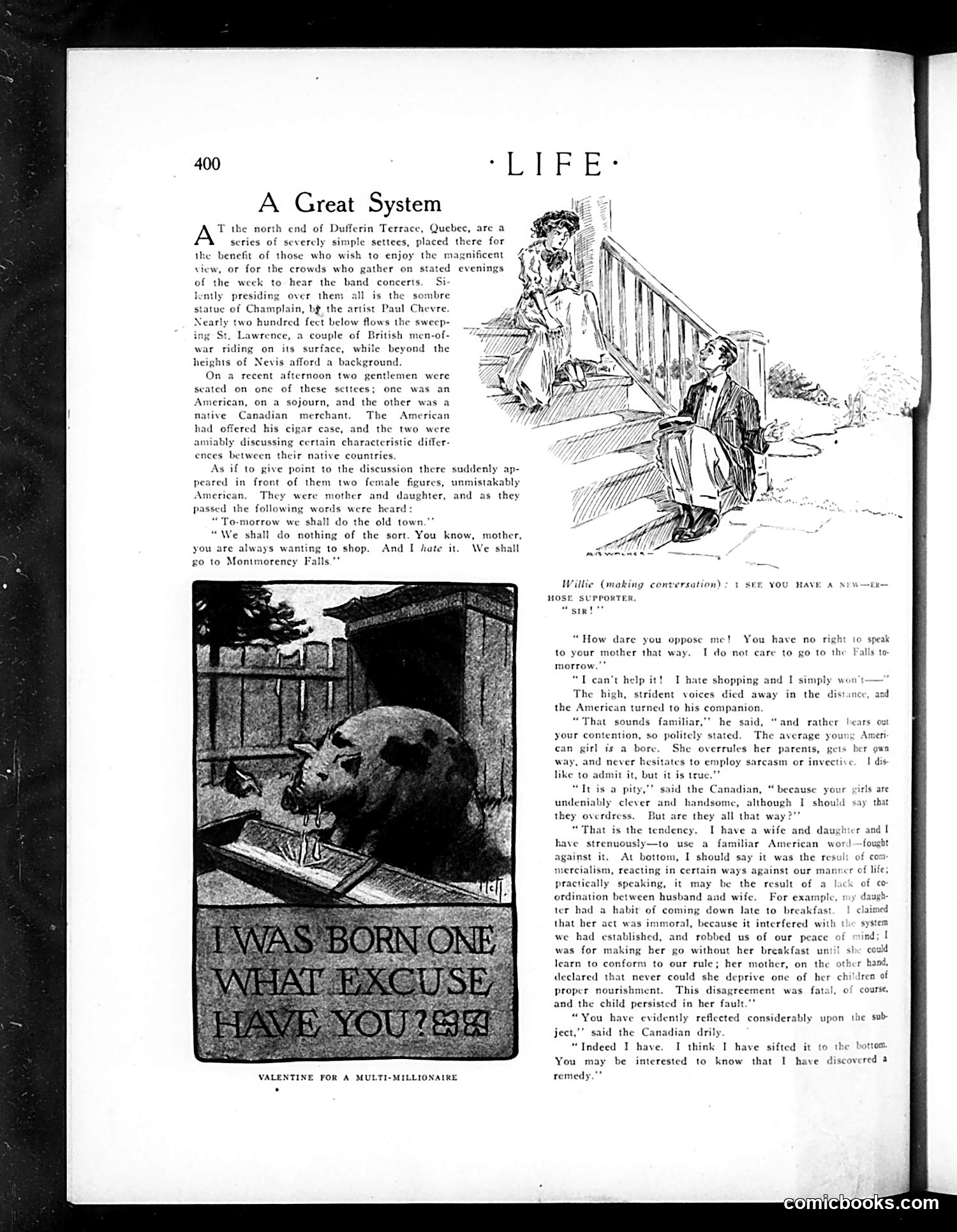
This satirical piece contrasts American and Canadian parenting through a dialogue between two men observing a mother and daughter in Quebec. **The Setup:** An American and Canadian businessman discuss national character differences while seated overlooking the St. Lawrence River. Two American women—a mother and daughter—pass by, and the daughter loudly refuses to go shopping, directly contradicting her mother's wishes. **The Satire's Point:** The incident exemplifies the American man's complaint: young American women are "bores" who disrespectfully defy parental authority, overdress, and employ "sarcasm or invective." He attributes this to commercialism undermining family coordination—specifically, mothers who indulge children rather than enforce paternal discipline. **Historical Context:** This reflects early 20th-century anxieties about changing gender roles and generational rebellion, particularly women's growing independence. The American daughter's defiance is presented as characteristically American excess, contrasted implicitly with (presumably more obedient) Canadian daughters. **The Cartoon Below:** Shows a pig in a pen captioned "Born One—What Excuse Have You?" This appears to criticize wealthy individuals, though its exact connection to the article remains unclear.
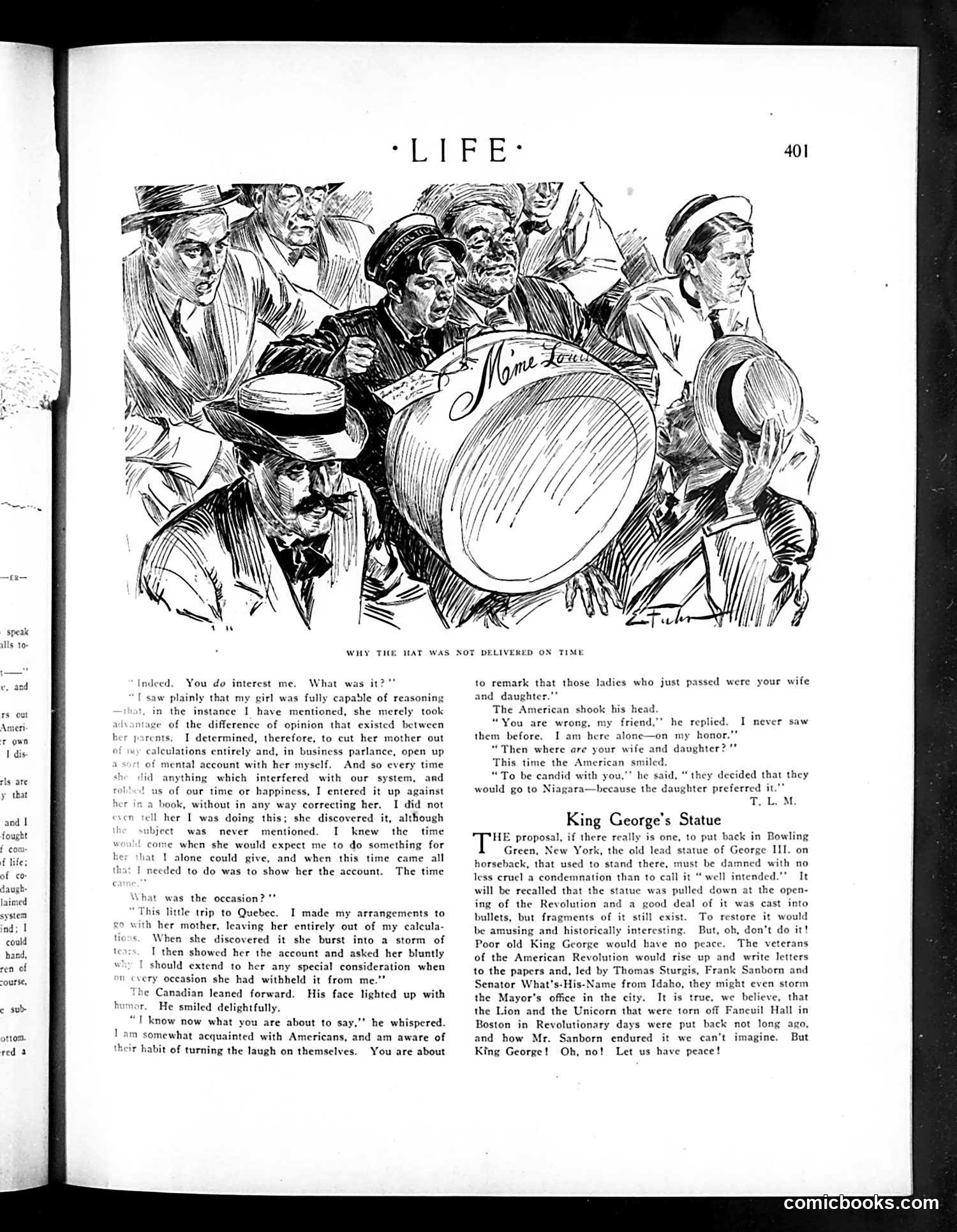
## Top Cartoon: "Why the Hat Was Not Delivered on Time" This appears to be a humorous domestic dispute illustration. An American man describes keeping a detailed financial "account" of grievances against his daughter—withholding favors until she acknowledges her debts to him. When a Canadian interlocutor assumes the women they see are the man's family, the American reveals they aren't, and further admits his wife and daughter have gone to Niagara Falls *against his wishes*, choosing their preference over his. The satire mocks American men's attempts to control family finances and decisions through accounting logic, which ultimately fails when women simply ignore them. ## Bottom Article: "King George's Statue" This discusses a (possibly fictional) proposal to restore the lead statue of King George III that was melted down during the American Revolution in Bowling Green, New York. The author opposes restoration, not on principle, but because Revolutionary War veterans would protest so vociferously it would cause civic chaos. The satire gently mocks American Revolutionary fervor as still militantly active, making peace impossible.
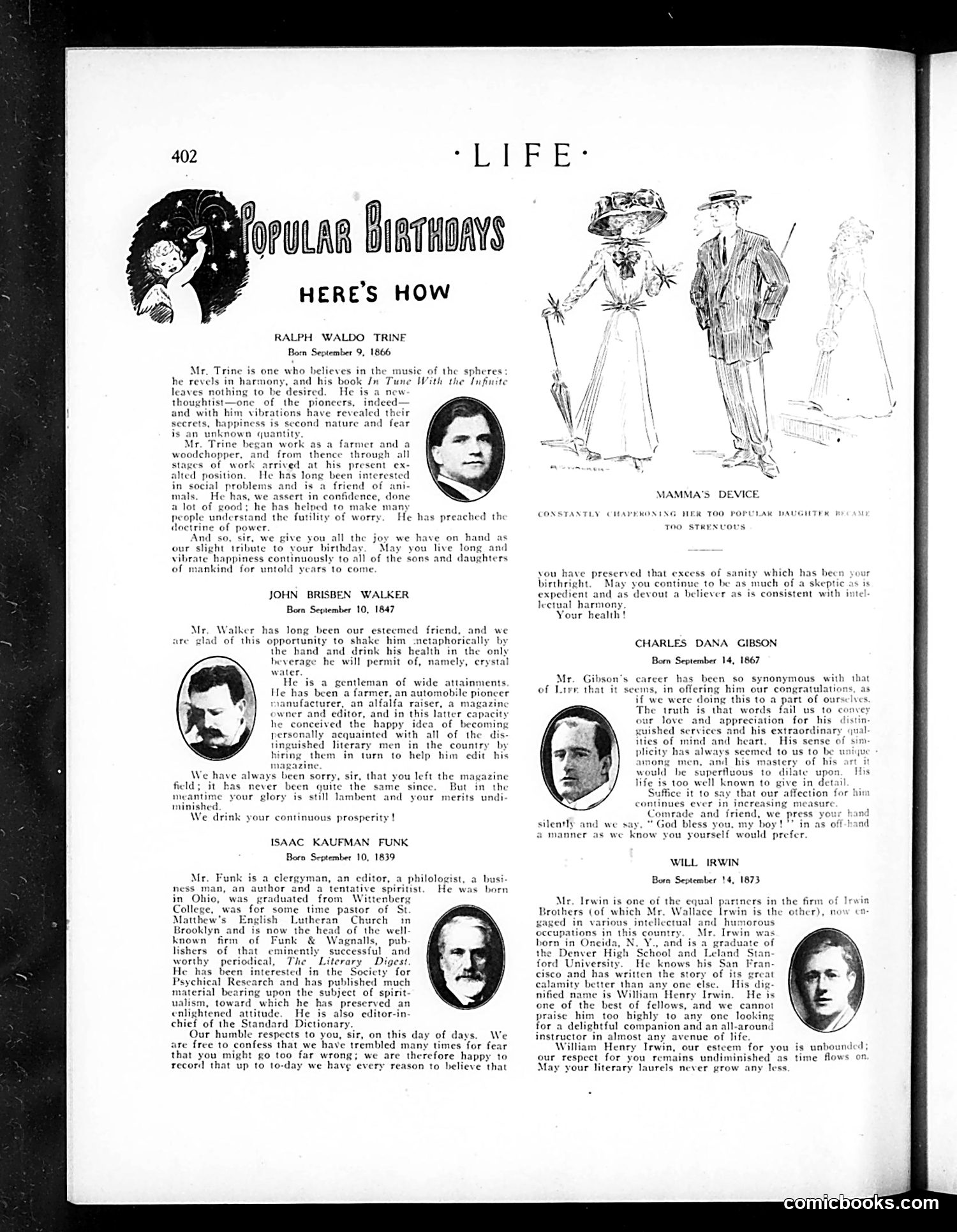
This is a **birthday tribute page** celebrating five prominent American cultural figures born in September. Rather than satire, it's sincere laudatory profiles: **Ralph Waldo Trine** (New Thought author) - praised for his harmonious philosophy and work against worry. **John Brisben Walker** (magazine editor/entrepreneur) - respected for varied accomplishments, though Life notes his absence from publishing is missed. **Isaac Kaufman Funk** (clergyman/editor of *The Literary Digest*) - commended for intellectual rigor and even-handed skepticism toward spiritualism. **Charles Dana Gibson** (illustrator) - celebrated as central to *Life* magazine's success; the tribute is almost reverential about his artistic contributions. The accompanying illustration "Mamma's Device" shows a social satire: a mother chaperoning her popular daughter so closely it causes "too strenuous" anxiety—a dig at Victorian courtship restrictions. The page reflects *Life*'s role as arbiter of respectable American achievement circa 1906.
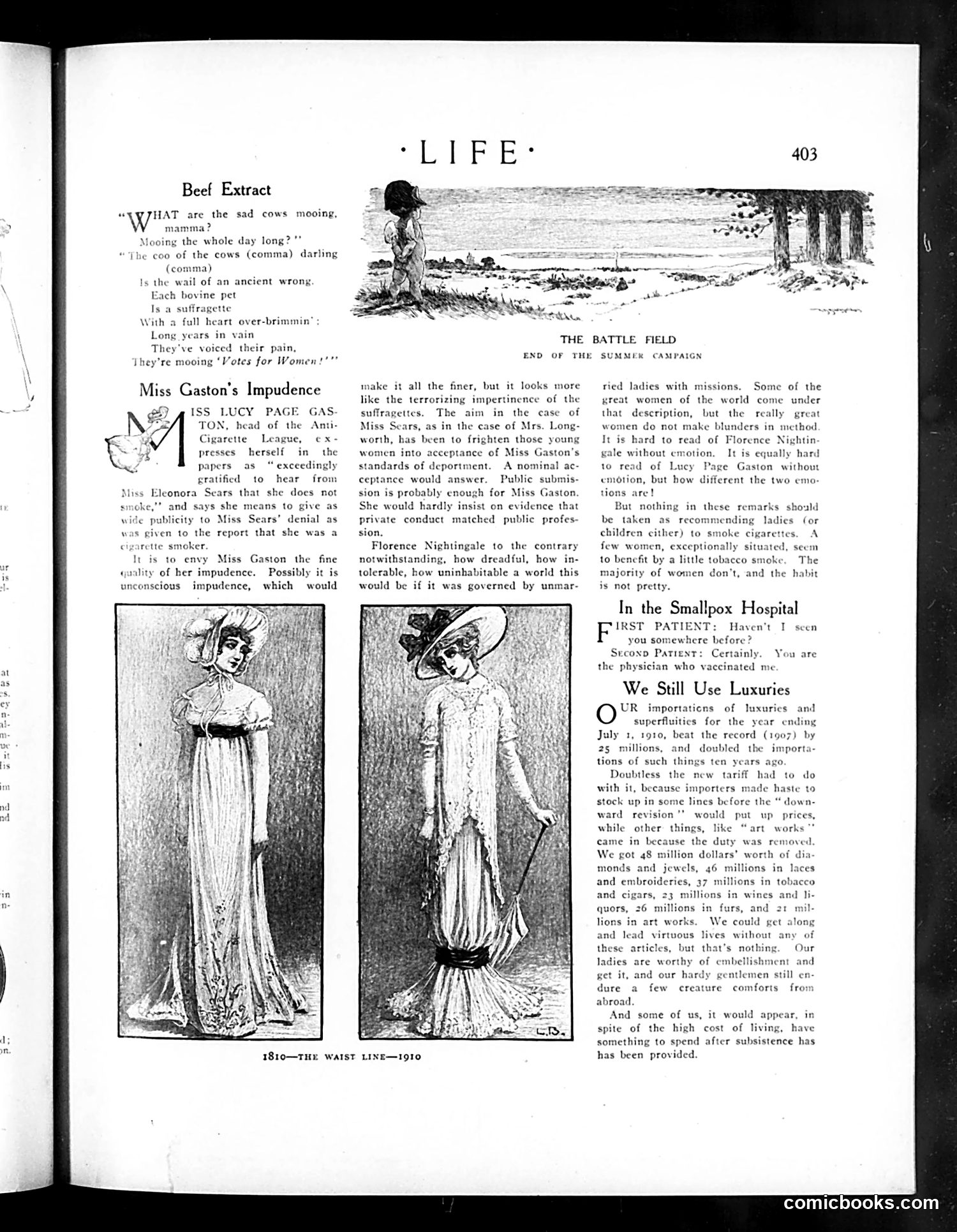
This page contains three satirical pieces targeting early 1910s American social issues: **"Beef Extract"**: A humorous poem mocking suffragettes by comparing cows to women's rights activists, suggesting their demands for voting rights ("Votes for Women") are as futile as cattle mooing. **"Miss Gaston's Impudence"**: Criticizes Lucy Page Gaston, head of the Anti-Cigarette League, for publicly shaming Eleonora Sears (a known smoker) while claiming moral authority. The piece sarcastically argues that unmarried women with "missions" (like anti-smoking crusades) cause social harm, contrasting Gaston unfavorably with Florence Nightingale. **Fashion illustrations (1810-1910)**: Shows how women's waistlines changed dramatically over a century, implying the artificiality and discomfort of fashion constraints. **"We Still Use Luxuries"**: Notes Americans imported record luxury goods in 1910 despite tariff debates, ironically suggesting that even moral crusaders enjoy fine things—a jab at self-righteous reformers like Gaston. The page's overall theme: mocking sanctimonious reformers who judge others while enjoying comforts themselves.
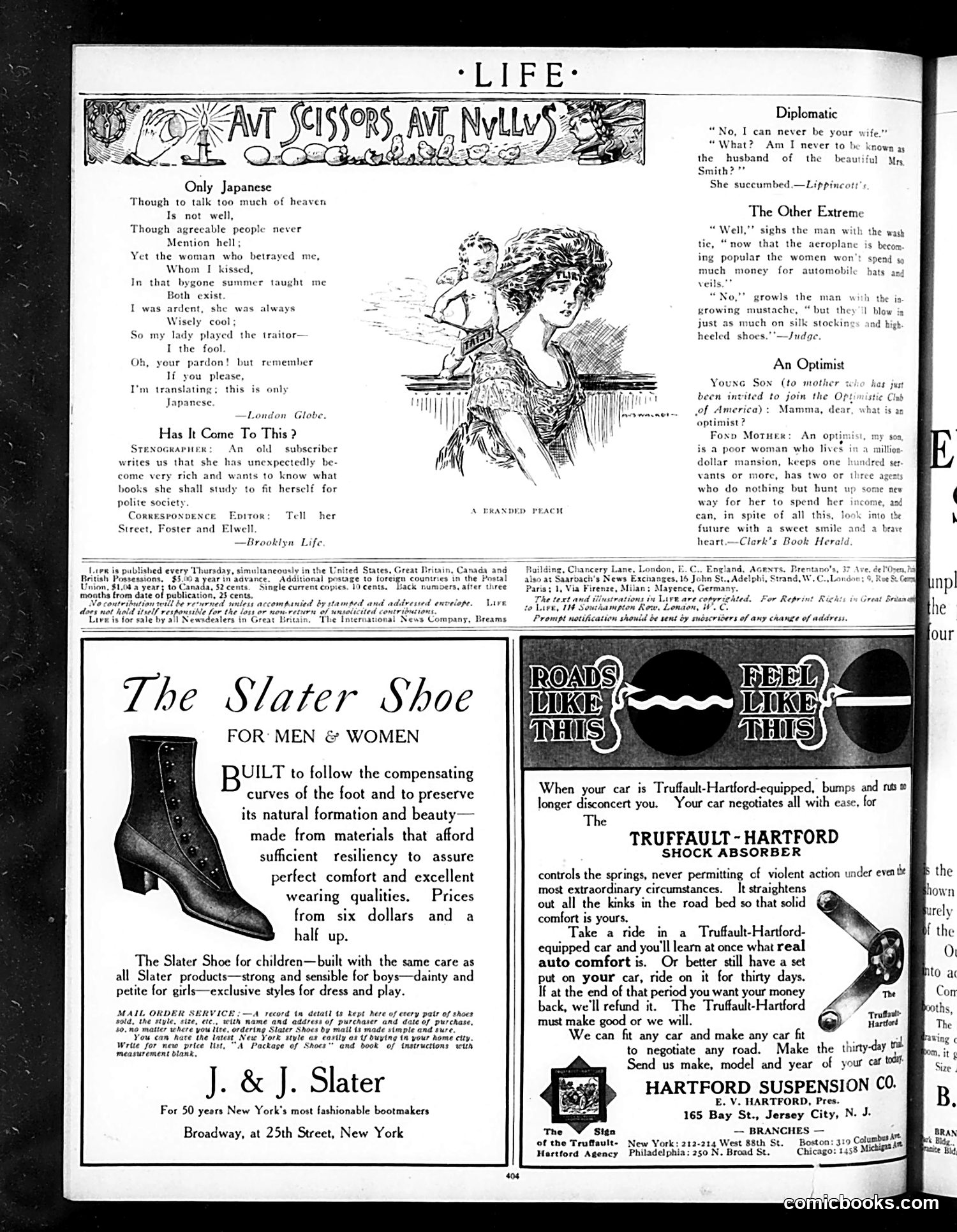
This page contains **humorous short pieces and advertisements** rather than political cartoons. The content includes satirical social commentary typical of early 20th-century Life magazine: - **"Only Japanese"**: A poem about romantic betrayal, framed as a translation from Japanese literature—playing on Western fascination with Japanese aesthetics and melancholy. - **"Has It Come To This?"**: A brief joke about a newly wealthy woman seeking books on "polite society," mocking social climbing and the assumption that wealth requires cultural education. - **"The Other Extreme"** and **"An Optimist"**: Short humorous pieces about gender relations and class pretension—a poor woman maintaining appearances despite poverty. - **"A Branded Peach"**: An illustration accompanying a joke about a woman refusing marriage, then capitulating when told she'd become "Mrs. Smith." The page is predominantly **advertising** for The Slater Shoe, Truffault-Hartford shock absorbers, and other consumer goods—reflecting Life's dual purpose as both satirical commentary and commercial vehicle for middle-class products and anxieties.
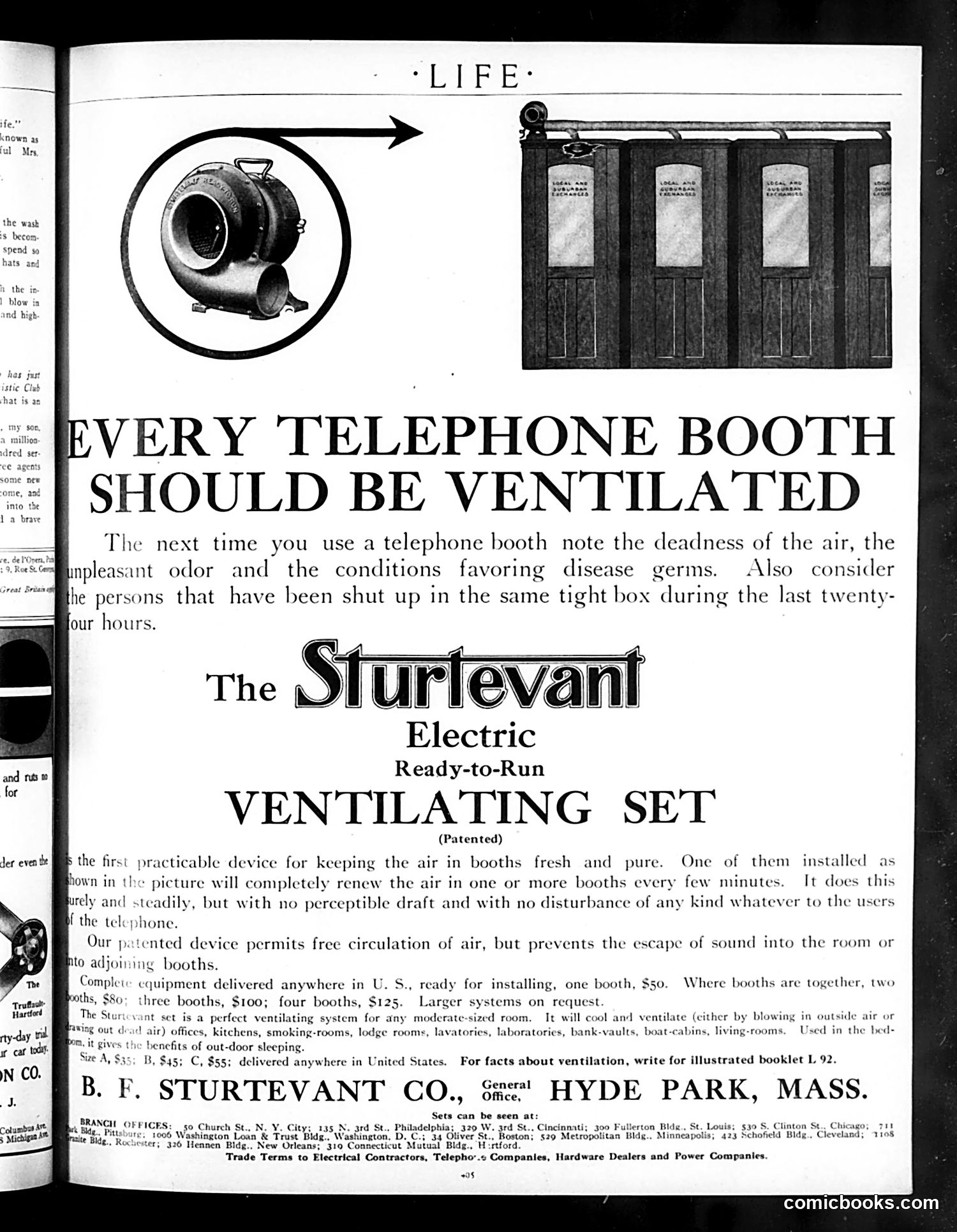
This is primarily a **product advertisement**, not a political cartoon. The page promotes the Sturtevant Electric Ventilating Set for telephone booths. The "satire" is gentle and self-aware: the ad opens by humorously shaming potential customers. It asks readers to notice the "deadness of air," "unpleasant odor," and disease germs in telephone booths—and to consider the unfortunate people "shut up in the same tight box during the last twenty-four hours." This tongue-in-cheek appeal to hygiene anxiety and empathy sets up the product pitch. The accompanying image shows the ventilation device (left circle) and a row of telephone booths (right). The ad then positions the Sturtevant set as "the first practicable device" solving this public health problem, emphasizing circulation without draft or sound leakage. The humor lies in the exaggerated problem statement designed to motivate purchase—a common early 20th-century advertising technique mixing comedy with health consciousness.
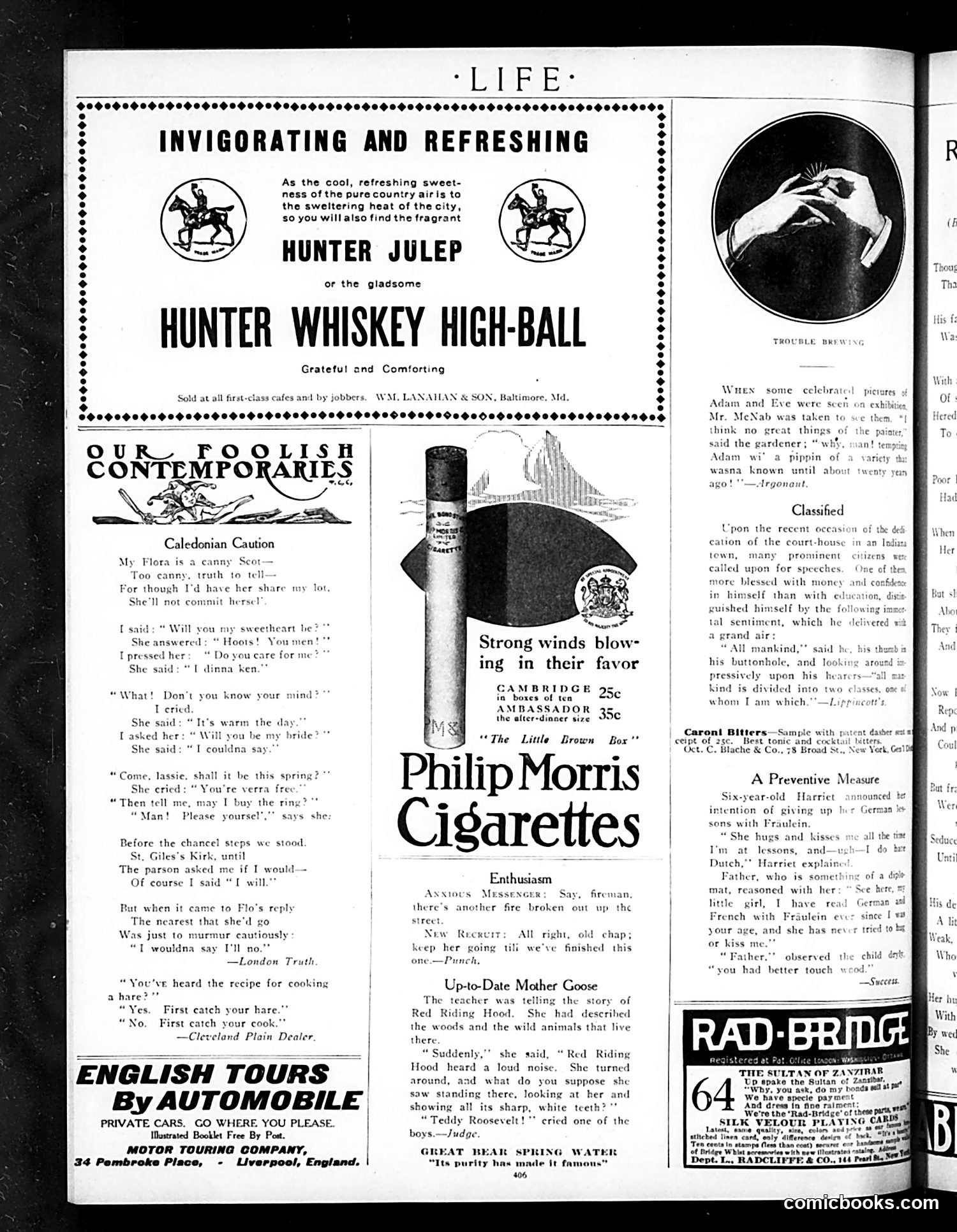
This page is primarily **advertising and light satirical verse** rather than political commentary. The main visual content features ads for **Hunter Whiskey products** (julep and high-ball), positioned as refreshing drinks for hot weather, and a large **Philip Morris Cigarettes advertisement**. The satirical poetry includes "Caledonian Caution," a Scottish dialect verse about courtship hesitation, and "Our Foolish Contemporaries"—a recurring Life feature mocking social absurdities. These verses use humor to critique human behavior: romantic indecision, foolish cooking advice ("first catch your hare"), and a classroom anecdote about children mistaking Theodore Roosevelt for a wild animal. The scattered article fragments reference social occasions and etiquette, typical of the era's upper-class concerns. **Overall context**: This represents early 20th-century American magazine humor—domestic, class-conscious, and focused on social foibles rather than serious political satire. The ads reflect period consumption patterns and gender roles.
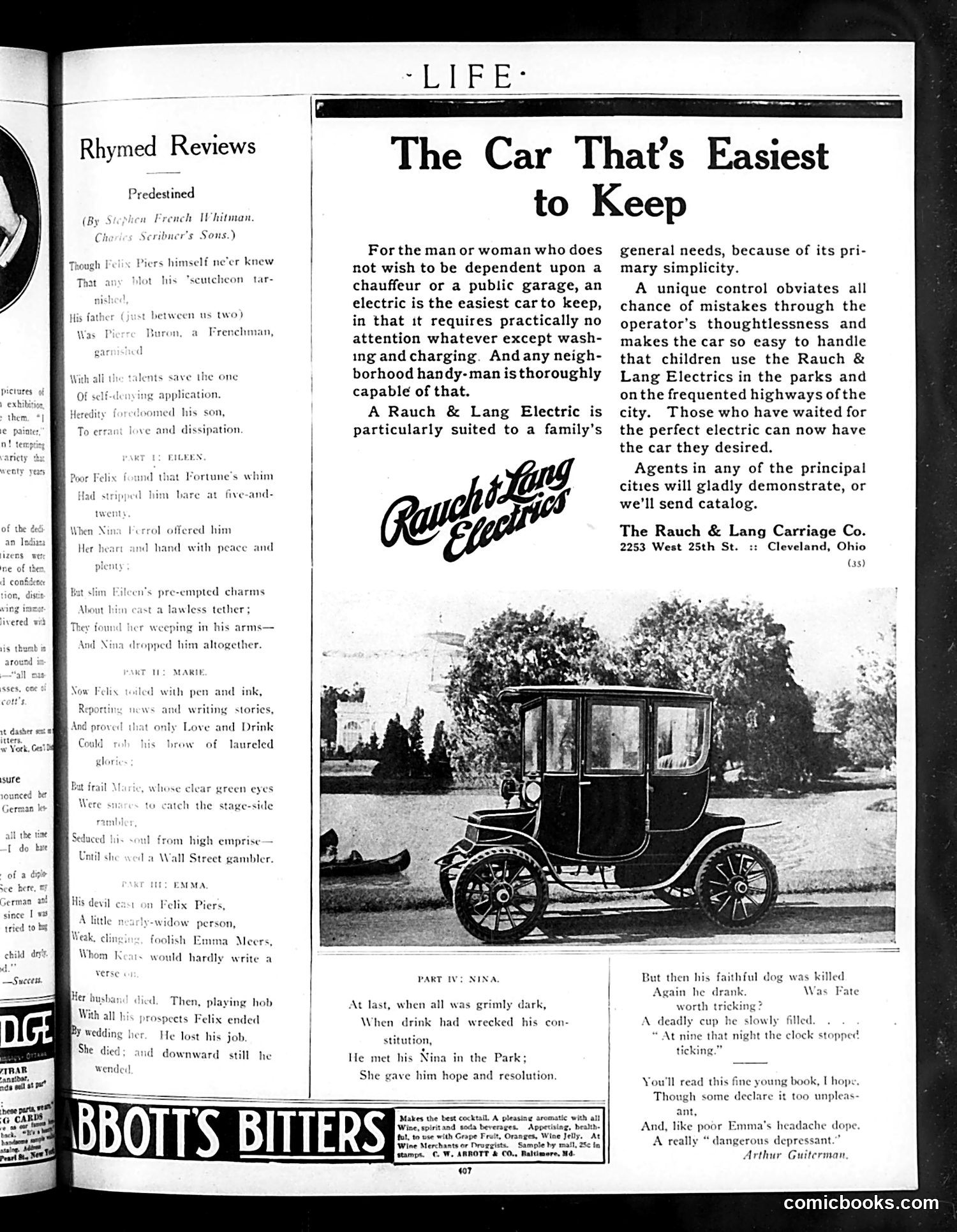
This page combines two distinct elements: **Left side:** A serialized poem titled "Predestined" by Arthur Guiterman, reviewing a novel by Stephen French Whitman (published by Scribner's Sons). The narrative follows Felix Piers through four parts, tracing his moral decline from inherited aristocratic weakness through dissolution, redemption via love for Nina, and ultimate tragedy (suicide by poison). The verse satirizes naturalist fiction conventions—the "doomed by heredity" plot—while Guiterman's closing note calls the book "a really dangerous depressant," mocking its bleakness. **Right side:** A full-page advertisement for Rauch & Lang Electric automobiles, emphasizing ease of maintenance and operation. The ad targets families, particularly women, claiming electric cars require minimal attention and are so simple "children use" them in parks. The juxtaposition is darkly comic: Life pairs Guiterman's sardonic review of a grim literary tragedy with an optimistic pitch for modern domestic convenience—contrasting existential despair with consumer comfort.
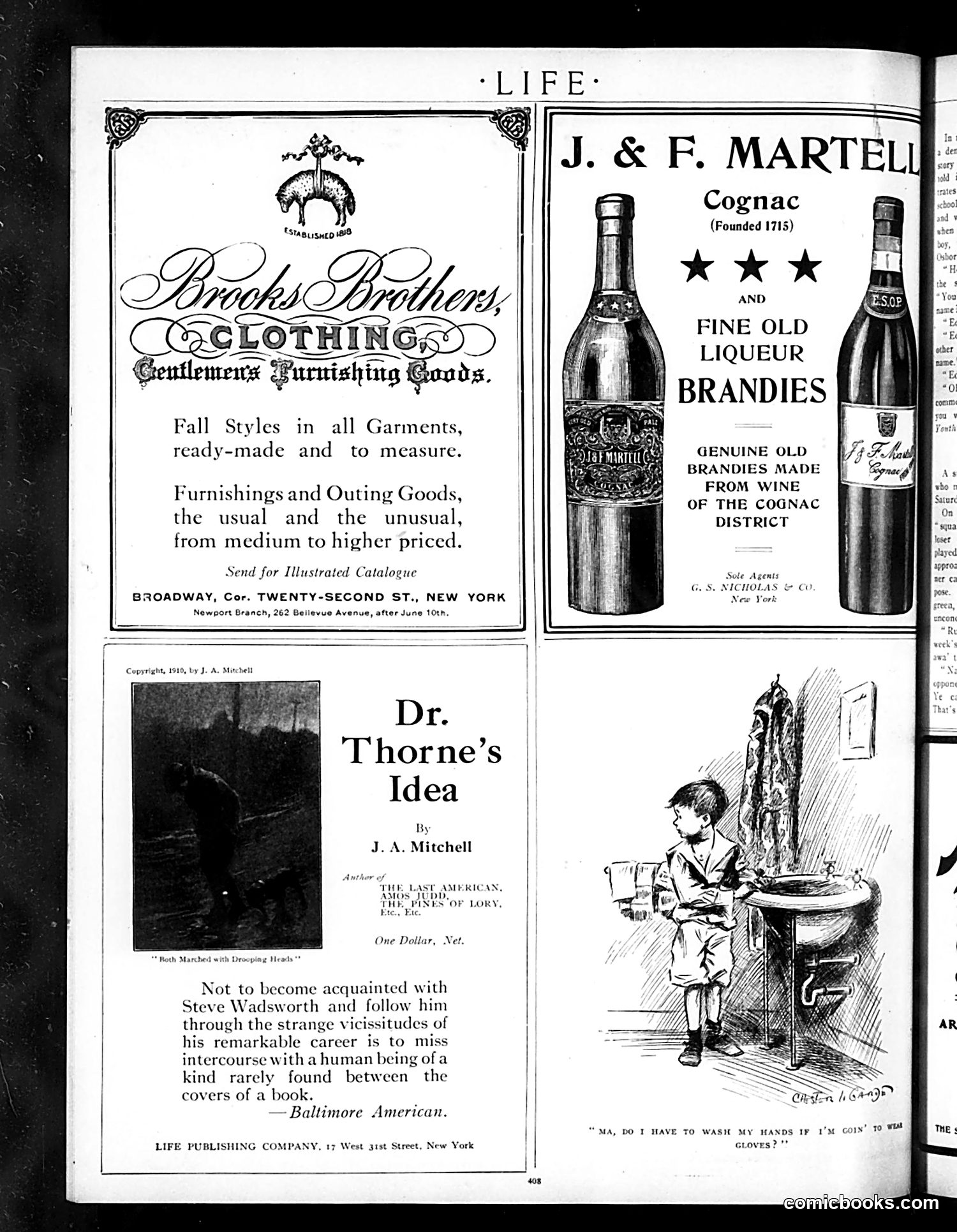
This page is primarily **advertising** interspersed with book promotion. The main content includes: **Advertisements:** - Brooks Brothers clothing (top left) - J. & F. Martell Cognac brandy (top right) **Editorial Content:** A small illustrated cartoon (bottom right) shows a young boy asking his mother whether he needs to wash his hands if he's going to wear gloves. The humor is gentle domestic satire—the child's logic that gloves obviate handwashing. **Book Promotion:** "Dr. Thorne's Idea" by J.A. Mitchell is advertised with a quote from the *Baltimore American* praising the protagonist, Steve Wadsworth, as a remarkable character worth following through the book. **Context for Modern Readers:** This reflects early-20th-century *Life* magazine's mix of light humor, advertising, and literary promotion. The glove joke assumes gloves were common children's wear, making the boy's reasoning recognizable to contemporary readers.
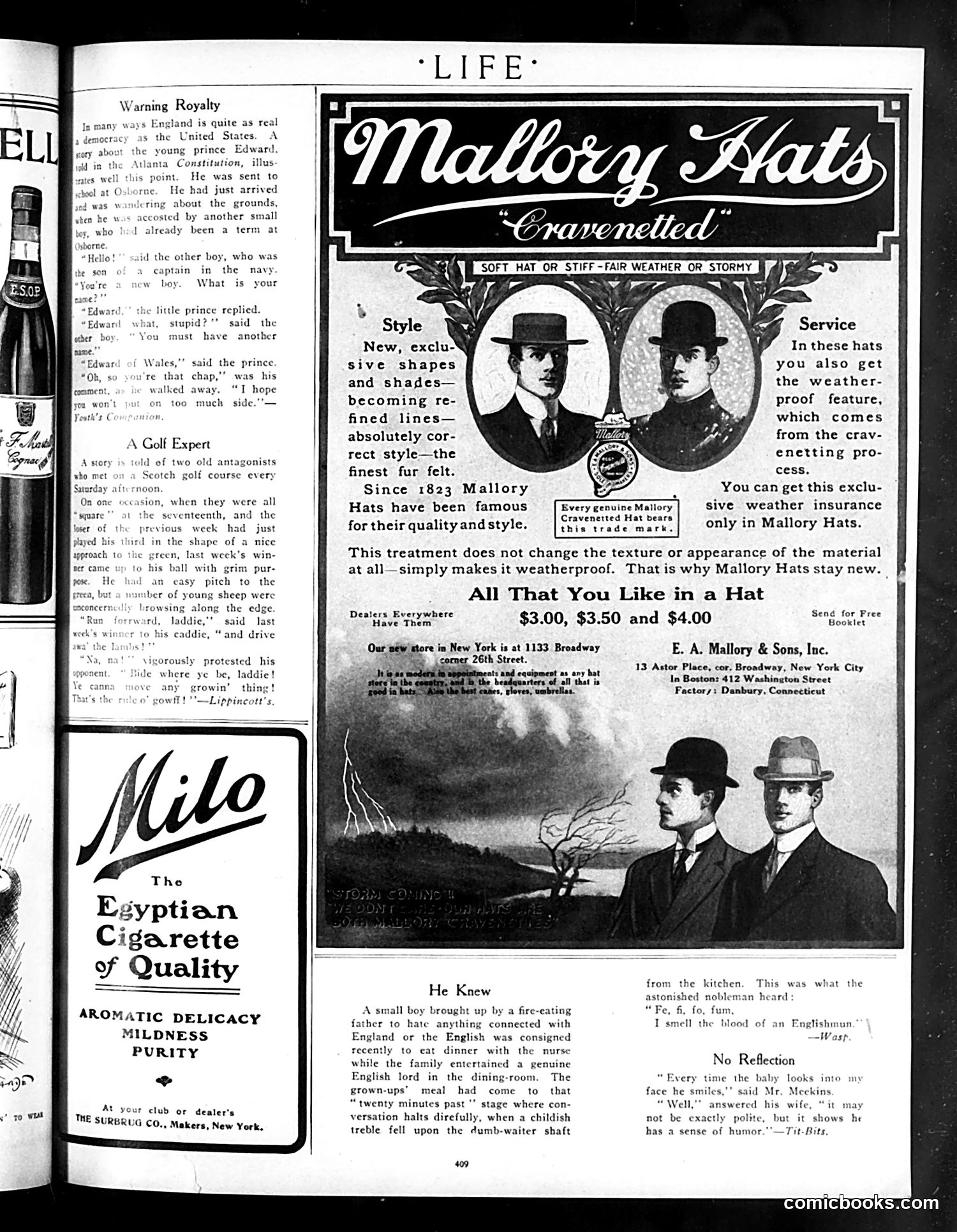
This page contains **three brief humorous anecdotes** satirizing British social hierarchy and manners, interspersed with period advertisements. **"Warning Royalty"** mocks the young Prince Edward's assumed superiority. A schoolboy at Eton confronts him, demanding to know his name. When Edward replies "Edward of Wales," the other boy dismisses him as just another student—a comic deflation of royal pretension. **"A Golf Expert"** depicts Scottish working-class irreverence: an elderly caddie instructs his employer to avoid sheep on the course with casual impudence ("Run forward, laddie"), highlighting class tensions through humor. **"He Knew"** satirizes anti-English prejudice: a boy raised to despise the English recites "Fee-fi-fo-fum...I smell the blood of an Englishman" at dinner with an English lord—innocent rudeness exposing the father's extremism. The advertisements (Mallory Hats, Milo cigarettes) are period standard. The satirical tone reflects Life's focus on social observation and gentle mockery of stuffy Victorian/Edwardian conventions.
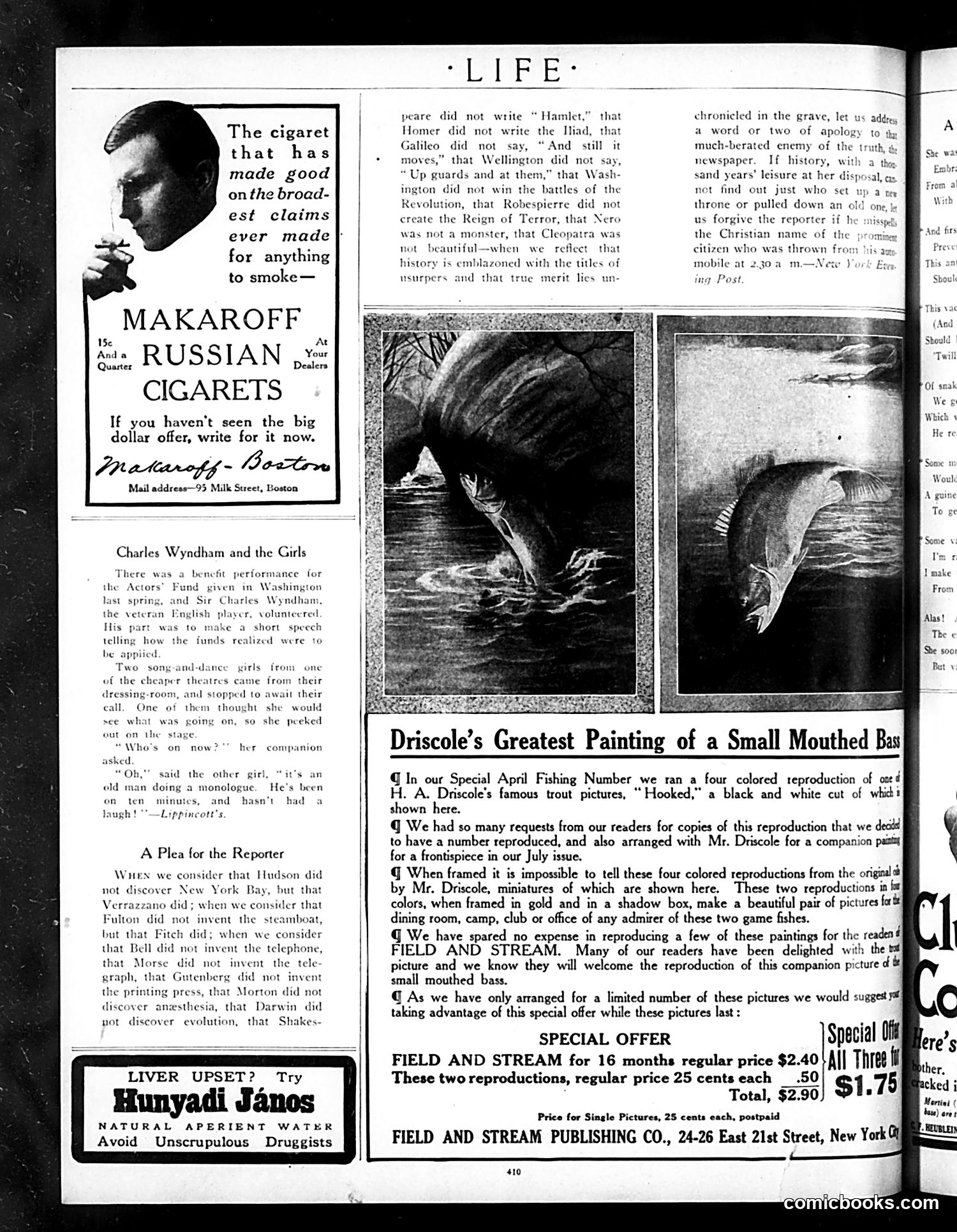
This page is primarily **advertising and light entertainment**, not political satire. **Content:** - A **Makaroff Russian Cigarettes ad** claims superior quality with a profile illustration - **"Charles Wyndham and the Girls"** is a brief comedic anecdote: an actress watching veteran actor Sir Charles Wyndham deliver a monologue complains he hasn't gotten a laugh in ten minutes—a joke about aging performers losing their touch - **"A Plea for the Reporter"** is a satirical essay defending newspaper reporters. It argues that history falsely credits famous figures (Hudson, Fulton, Bell, Darwin, Shakespeare) when others made the discoveries. Similarly, reporters deserve credit for finding and reporting details—like identifying which citizen was thrown from a car at 2:30 a.m.—that historians will later need but won't have recorded **The satire's point:** Newspaper reporters are underappreciated fact-finders doing unglamorous but essential historical work. The page also advertises **Field and Stream magazine** with fishing paintings and **Hunyadi Janos** digestive water.
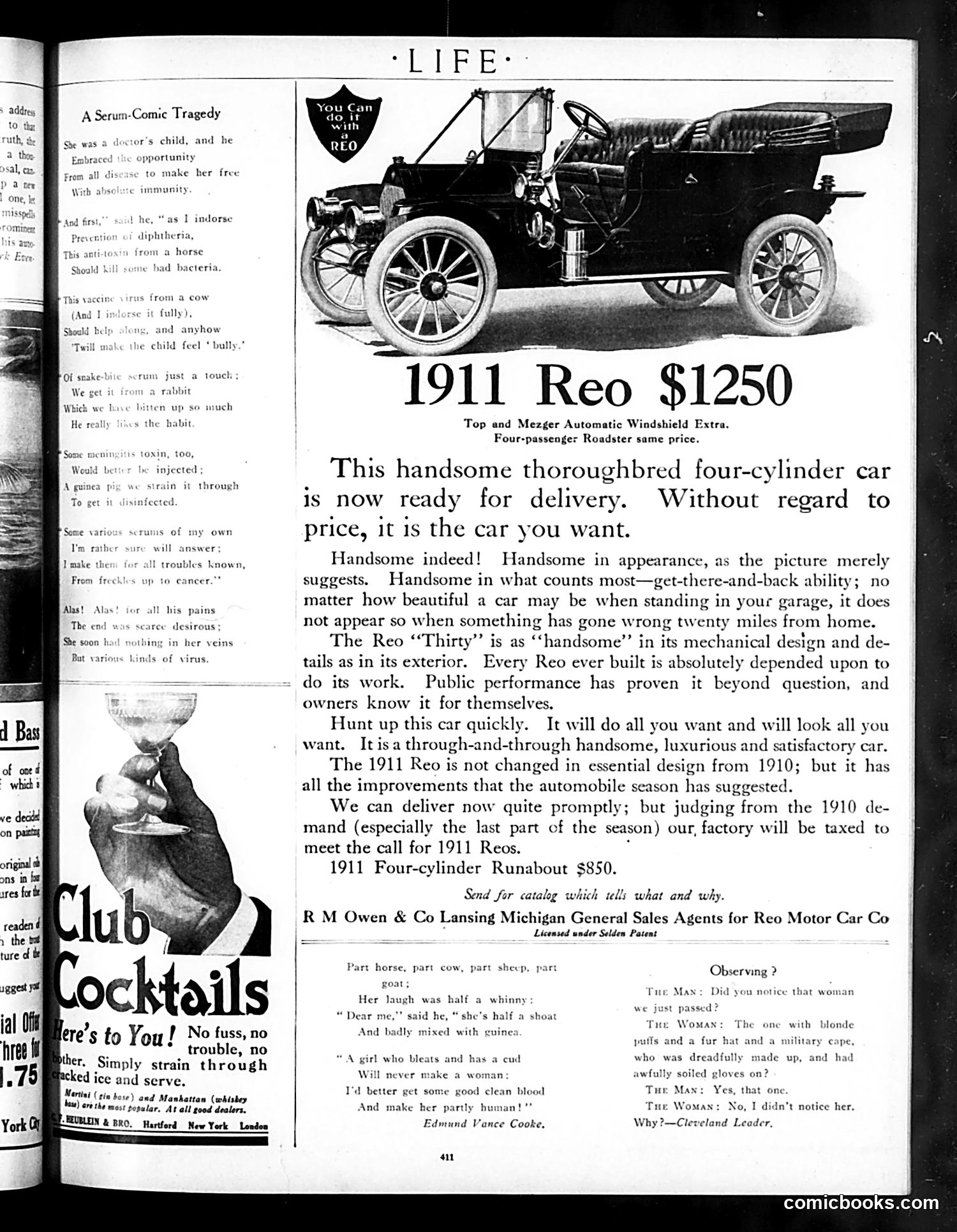
This satirical poem mocks a doctor's overconfidence in vaccination and medical science. The doctor boasts he can make his patient immune to diphtheria using serum from a cow, then adds serums from various sources (horse, rabbit, guinea pig) to cure all ailments "from freckles up to cancer." The tragic irony: instead of health, the child ends up with "various kinds of virus"—the doctor's indiscriminate mixing of animal serums has poisoned her rather than cured her. **The satire targets**: early 20th-century medical hubris and poorly understood vaccination practices. While vaccination was genuinely important for diphtheria prevention, the poem satirizes doctors who treated it as a cure-all, mixing unproven serums without understanding consequences. It reflects contemporary anxiety about modern medicine's safety and efficacy—a reasonable concern when medical science was still developing. The page otherwise contains a Reo automobile advertisement and an unrelated gender-based humor joke.
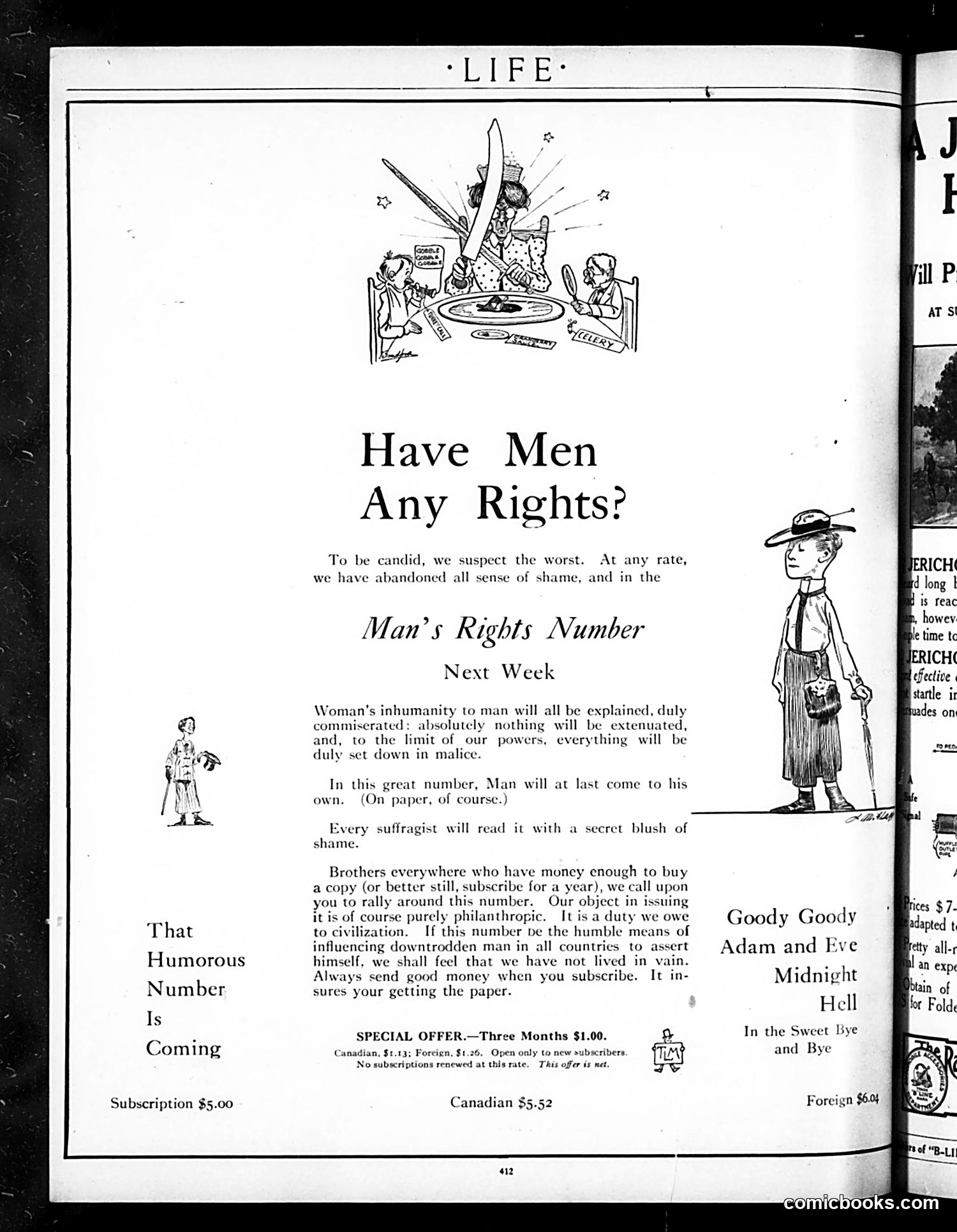
This is a promotional page for an upcoming "Man's Rights Number" of *Life* magazine, presented with satirical irony. The page mocks the growing women's suffrage movement by pretending to champion "men's rights" as a humorous counter-movement. The satire works by inverting feminist rhetoric: the magazine claims to document "woman's inhumanity to man" with mock-serious language about giving downtrodden men a voice. The cartoon at top shows figures engaged in chaotic activity around a dining table, illustrating domestic discord. The accompanying illustrations depict archetypal male figures (a working man with tools, a man in a hat)—likely representing "everyman" characters supposedly oppressed by female empowerment. The exaggerated tone ("we have abandoned all sense of shame," "secret blush of shame") reveals this as tongue-in-cheek satire mocking anti-suffrage sentiment, not genuinely supporting men's rights. *Life* was using humor to ridicule those threatened by women's equality.
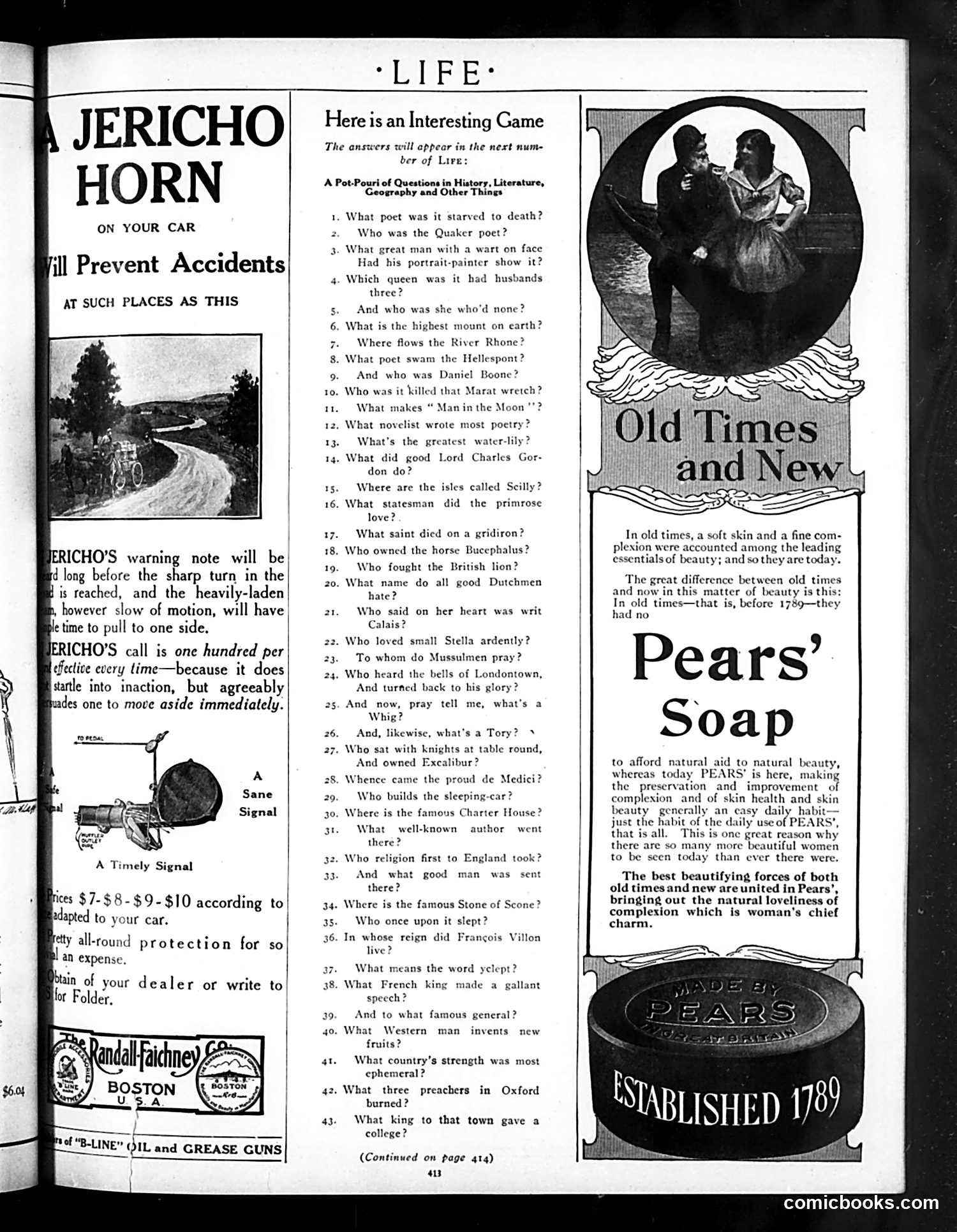
This page mixes advertisements with editorial content typical of early 20th-century Life magazine. **Left side:** An ad for the "Jericho Horn," a car warning device to prevent accidents at blind curves—a practical safety product for the automobile age. **Center:** A trivia game titled "A Pot-Pourri of Questions in History, Literature, Geography and Other Things," offering readers intellectual entertainment. Questions span classical history (Marat, Daniel Boone), literature (poets, novelists), and geography—reflecting educated readership interests. Answers would appear in the next issue, encouraging repeat purchases. **Right side:** A Pears' Soap advertisement using a pseudo-historical argument: claiming that before 1789 (the French Revolution), women lacked beauty aids, but Pears' Soap has since enabled natural beauty preservation. This humorously invokes a major historical event to sell toiletries, blending product marketing with mock-erudite social commentary—typical of Life's satirical advertising style.
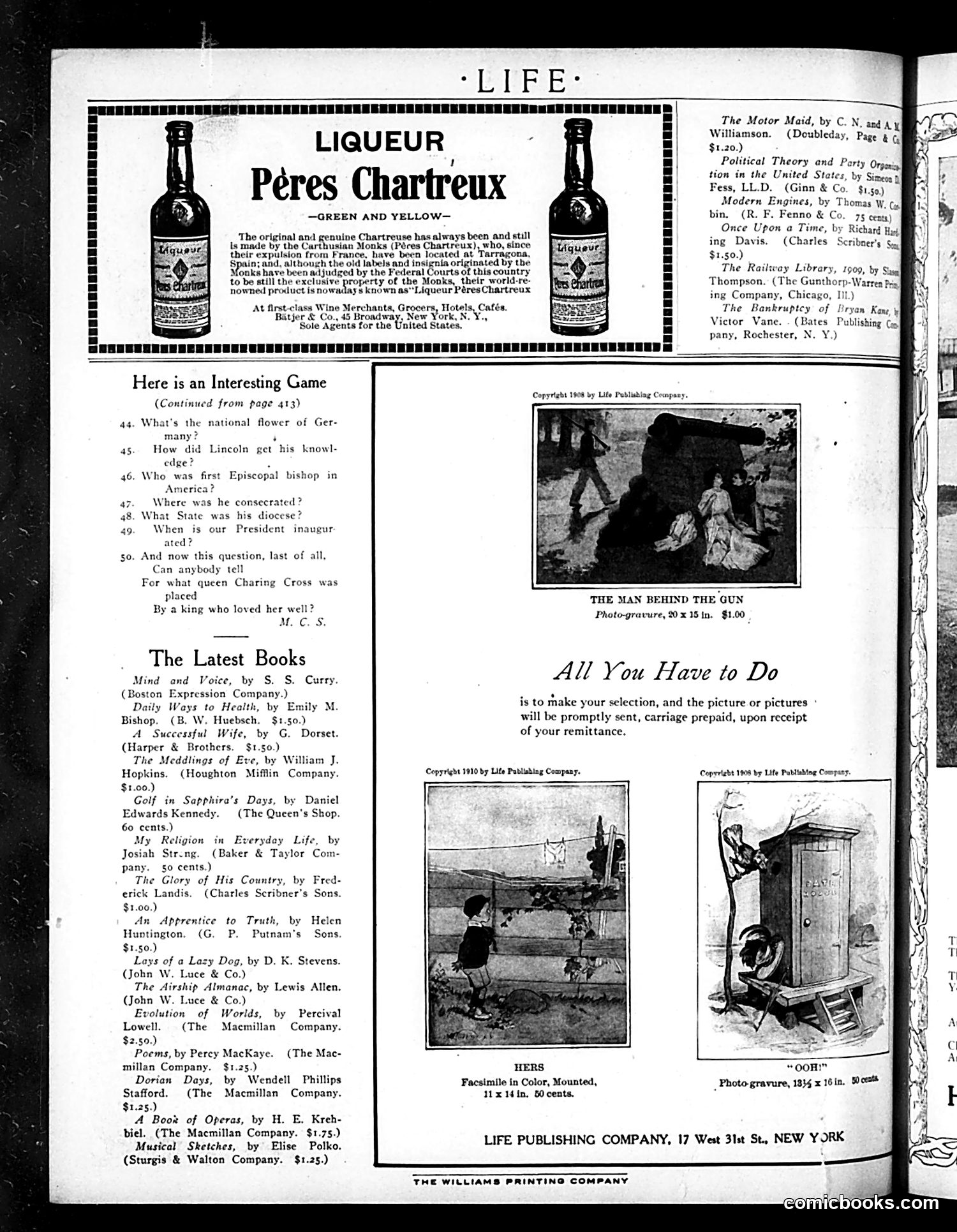
This page is primarily advertising and book listings, not satire or political cartoons. The main advertisement promotes Liqueur Péres Chartreux, a French liqueur made by Carthusian monks. A notable detail: the ad notes the monks were expelled from France and relocated to Spain, reflecting early 1900s anti-clerical tensions in France that led to religious orders' expulsion. The page includes "Here is an Interesting Game"—a trivia quiz continuing from page 413—and "The Latest Books," a publishing catalog listing 1908-1910 titles. Two small photograph reproductions are offered for sale: "The Man Behind the Gun" and "Hers" (a rural scene). The content reflects Life magazine's mixed format: advertising, entertainment, and cultural offerings for educated readers.
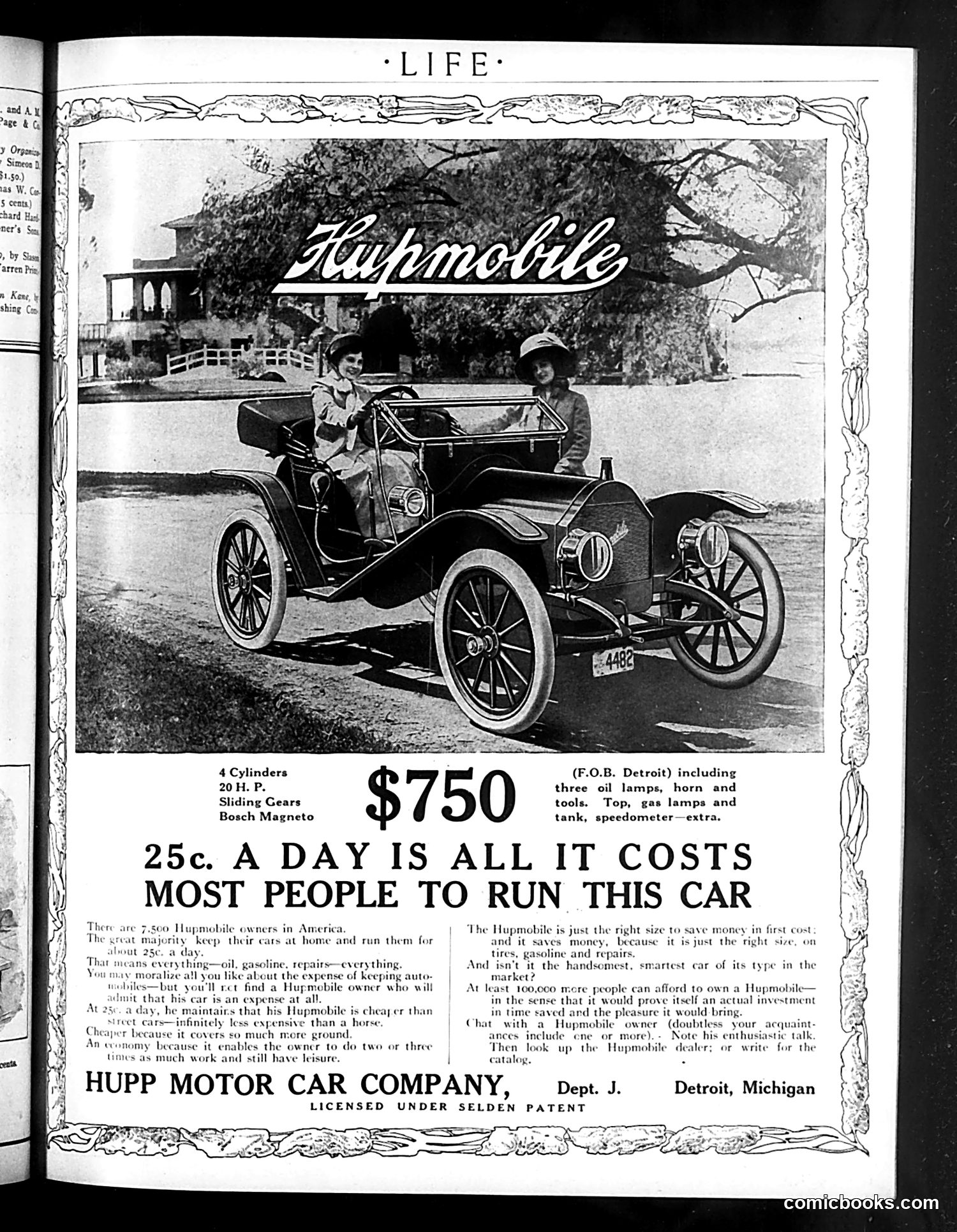
This is a **automobile advertisement**, not political satire. It promotes the Hupmobile, manufactured by Hupp Motor Car Company in Detroit. The ad targets middle-class buyers by emphasizing affordability. The headline claims the car costs only "25¢ a day" to operate—addressing a key barrier to car ownership in the early automotive era (appears to be circa 1910s based on the vehicle design). The image shows two well-dressed passengers in an open-air Hupmobile, suggesting leisure and respectability. The accompanying text stresses durability, economy on fuel and repairs, and that "at least 100,000 more people can afford to own a Hupmobile." This reflects the broader historical moment when automobiles were transitioning from luxury goods to consumer products. The ad's rhetoric—emphasizing practicality and accessibility—was typical of manufacturers competing for the emerging mass market, particularly against Henry Ford's Model T. There is **no political cartoon or satire** on this page.
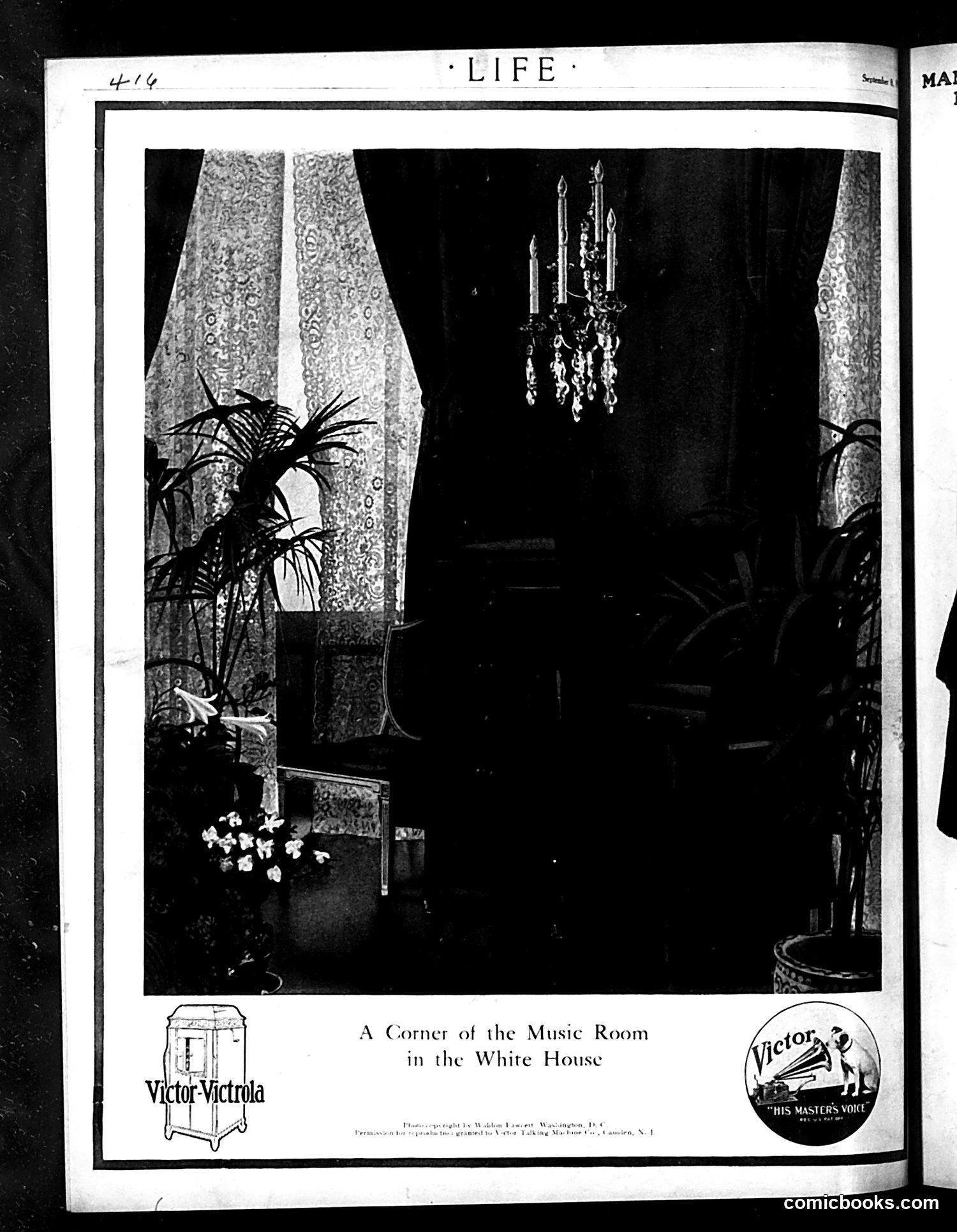
This is primarily an **advertisement** rather than editorial content or satire. It shows "A Corner of the Music Room in the White House" — an elegant interior photograph featuring ornate curtains, potted plants, a chandelier, and small flowers in a vase. The advertisement promotes **Victor Victrola** (a phonograph/record player) and **"His Master's Voice"** (Victor Records' trademark). The implicit message: the White House itself uses Victor products, suggesting quality and prestige. Rather than satire, this is straightforward product placement leveraging the authority and glamour of the presidential residence to market home entertainment technology to affluent American consumers during the early-to-mid 20th century.