
Life, 1910-09-08 · page 23 of 40
Life — September 8, 1910 — page 23: what you’re looking at
What you’re looking at
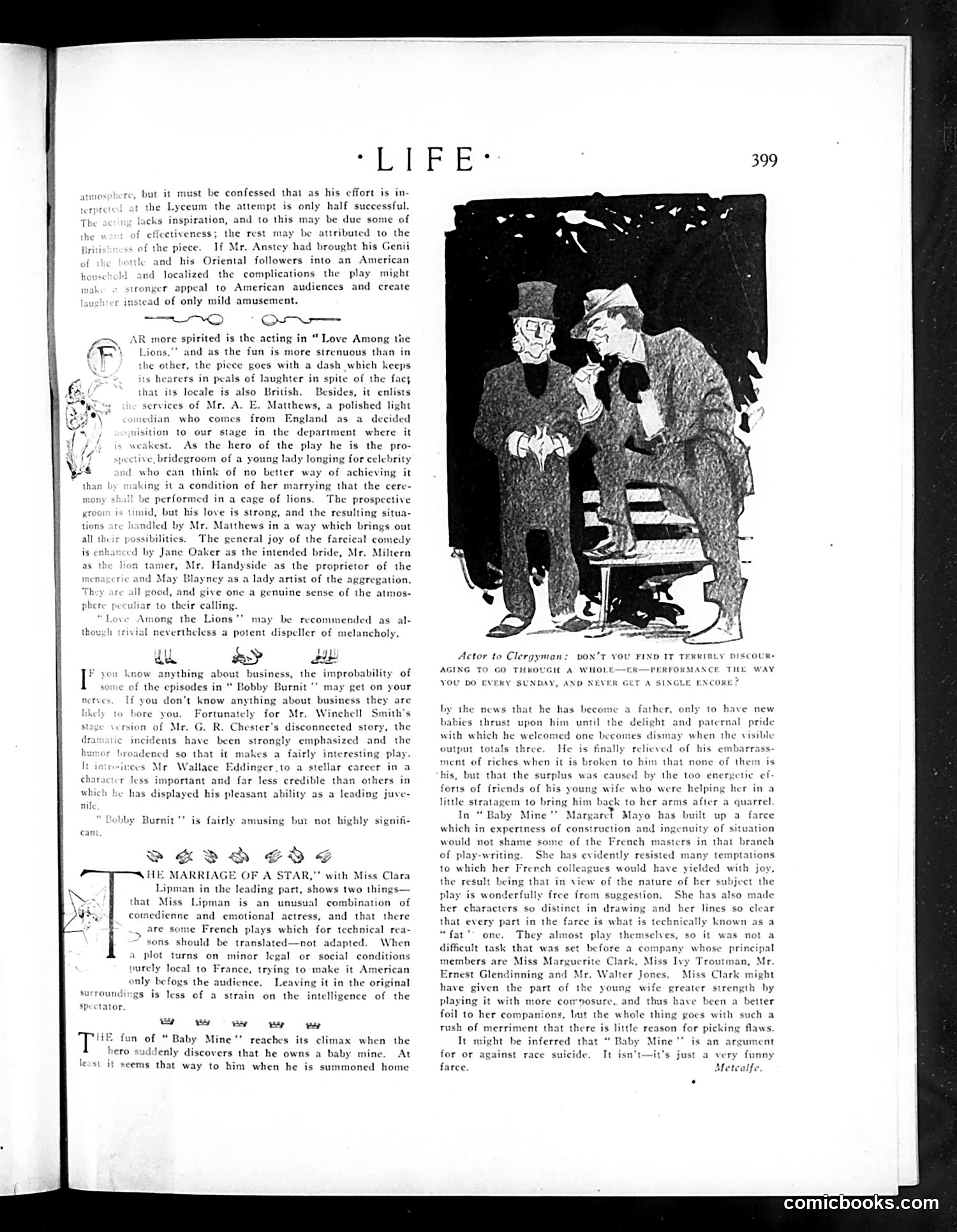
This page contains theatrical reviews with one cartoon. The main illustration (upper right) shows two figures in period costume seated together—likely depicting a scene from "Love Among the Lions," reviewed in the text. The play involves a bride who demands her wedding ceremony occur inside a lion's cage, a premise the reviewer notes is "trivial" but amusing. Below the reviews sits a single-panel cartoon captioned "Actor to Clergyman." It satirizes the contrast between theatrical and religious performance: an actor complains that delivering Sunday sermons lacks the professional satisfaction of stage work—he performs the same "piece" weekly yet receives no encores or audience appreciation. The joke mocks both the actor's vanity and the mundane repetition of clerical duties, treating sermon-delivery as analogous to theatrical performance. The page primarily reviews contemporary Broadway productions (*Love Among the Lions*, *Bobby Burnit*, *The Marriage of a Star*, *Baby Mine*), assessing their plots, acting, and entertainment value for American audiences.
📄 Transcribed text from this page (OCR, searchable)
Machine-transcribed from the original scan — historical spelling and the odd misread are preserved.
‘LPPeE* . but it must be confessed that as his effort is in- t the Lyceum the attempt is only half successful. lacks inspiration, and to this may be due some of the rest_ may be If Mr. Anstey had brought his Genii le and his Oriental followers into an American nd localized the complications the play might ronger appeal to American audiences and create read of only mild amusement. —OO owe AR more spirited is the acting in “ Love Among the Lions,’’ and as the fun is more strenuous than in the other, the piece goes with a dash which keeps its hearers in peals of laughter in spite of the fact that its locale is also British, Besides, it enlists services of Mr, A. E. Matthews, a polished 1 cdian who comes from England as a decided risition to our stage in the department As the hero of the play he is the pro- tive, bridegroom of a young lady longing for celebrity | who can think of no better way of achieving it ¢ ita condition of her marrying that the cere- xe performed in a cage of lions. The prospective is timid, but his love is strong, and the resulting situa- andled by Mr. Matthews in a way which brings out possibilities. The general joy of the farcical comedy cd by Jane Oaker as the intended bride, Mr. Miltern tamer, Mr. Handyside as the proprietor of the erie and May Blayney as a lady artist of the aggregation. I good, and give one a genuine sense of the r to their callin Among the Lions’ may be recommended as al- rivial nevertheless a potent dispeller of melancholy. a ay ait know anything about business, the improbability of ¢ of the episodes in “ Bobby Burnit "’ may get on your you don’t know anything about business they are ore you. Fortunately for Mr, Winchell of Mr. G. R. Chester's disconnected story, the lents have been strongly emphasized and the broadened so that it makes a fairly interesting play ivees Mr Wallace Eddinger.to a stellar career in a r less important and far credible than others in he has displayed his pleasant ability as a leading juve- f effectiveness attributed to the < of the piece. tions all the tmos- Smith's charac whicl nile Burnit ’ is fairly amusing bur not highly signifi- GY « HE MARRIAGE OF A STAR, Lipman in the leading part, shows two things— that Miss Lipman is an unusual combination of comedienne and emotional actress, and tha re some French plays which for technical rea- with Miss Clara there When conditions sons should be transla 1 plot minor legal vurely local to France, trying to make it American only befogs the audience. Leaving it in the original gs is less of a strain on the intelligence of the ed—not adapted. turns on or social wey ey ee oy fun of “ Baby Mine’? reaches its climax when the Jenly discovers that he owns a baby mine. At it seems that way to him when he is summoned home Actor to Clergyman: vON’T YOU PIND IT TERRIBLY DISCOUR- AGING TO GO THROUGH A WHOLE—rK YOU DO EVERY SUNDAY, AND NEVER GET PERFORMANCE THE WAY A SINGLE ENCORE? by news that he has become a father, only to have new babies thrust upon him until the delight with which he welcomed one becomes dismay when the visible and paternal pride output totals three. He relieved of bis embarrass ment of riches when it is broken to him that none of them is his, but that the surplus wa forts of friends of his ittle stratagem to bring him back to her arms after a quarrel In “Baby Mine" Margaret Mayo has built up a farce which in expertness of construction and ingenuity of situation would not shame some of the French masters in that branch any temptations is finally caused by the too energetic ef- fe who were helping her in a of play-writing. She bas evidently resisted to which her French ec the result being that in view of ues would have yielded with joy, he nature of her subject the She has also made tin drawing d her lines so clear play is wonderfully free from suggestion. her characters so dist that every part in the £ “ fat’ one. They almost play difficult task that was set whose principal members are Miss Marguerite Clark, Miss Ivy Troutman, Mr Ernest Glendinning and Mr. Walter Jones. Miss Clark might have given the part of the young wife greater strength by playing it with more composure, and thus have foil to her companions, but the whole thing goes with such a rush of merriment that there is little reason for picking flaws. It might be inferred that “ Baby Mine’? is an argument for or against race suicide. It isn’t—it’s just a very farce. fetce is what is technically known as themselves, so it was not a before a company been a better funny comicbooks.com