
Life, 1910-09-08 · page 22 of 40
Life — September 8, 1910 — page 22: what you’re looking at
What you’re looking at
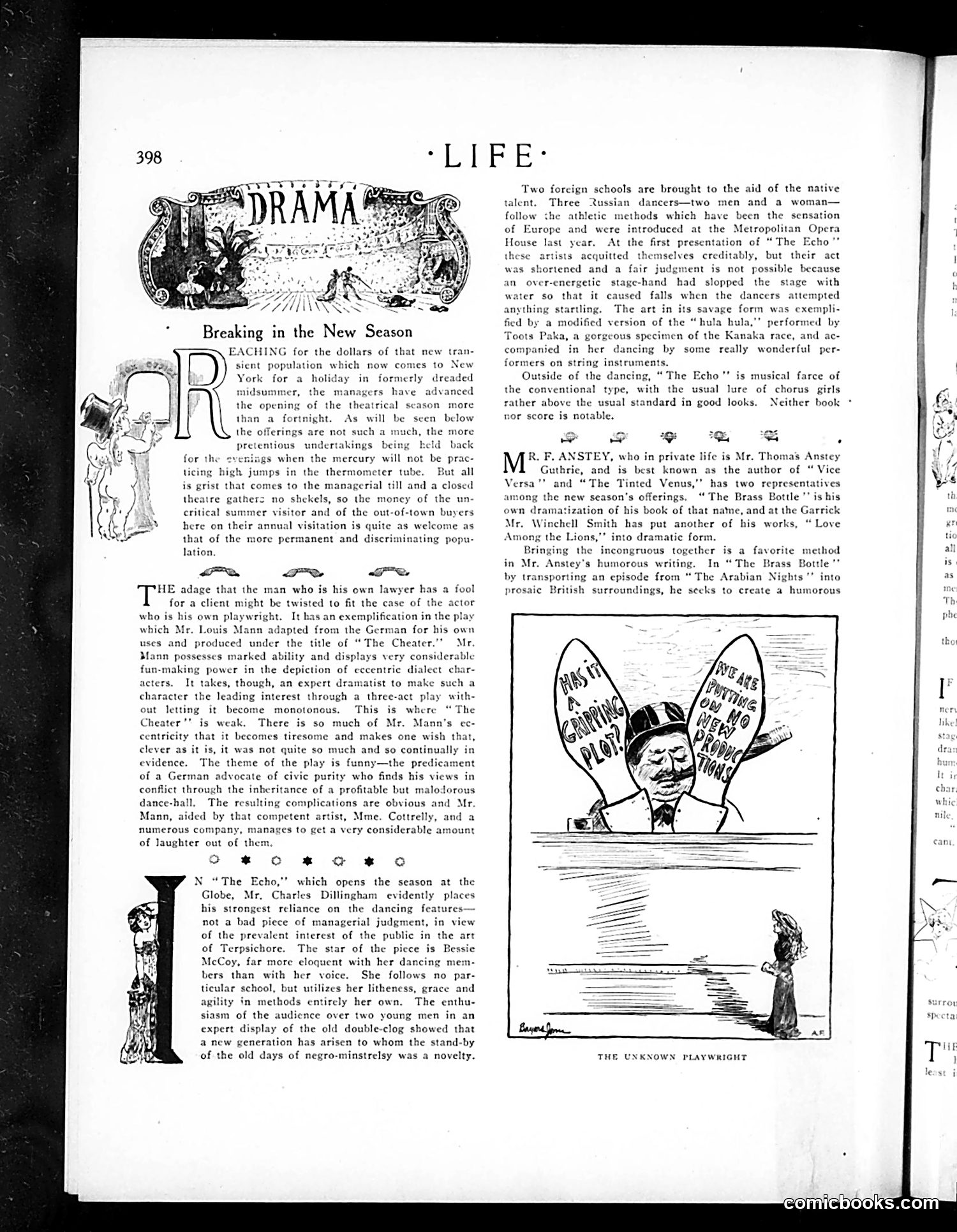
This cartoon satirizes amateur playwrights—actors who write their own material. The image shows a figure with enormous ears labeled with theatrical productions ("The Brass Bottle," "The Unknown Playwright"), suggesting he's all ears but lacks true dramatic talent. The text discusses Louis Mann, an actor-playwright who adapted a German play as "The Cheater." The satire's point: Mann is talented at eccentric characterization but lacks the expertise to sustain a three-act play without becoming tiresome. The accompanying editorial notes that "the man who is his own lawyer has a fool for a client"—twisted here to suggest actors shouldn't be their own playwrights. The exaggerated ears mock the pretension of performers assuming dramatist roles. It's a lighthearted jab at theatrical ambition outpacing actual skill—a common theme in Life magazine's drama criticism during this era (appears to be early 1900s based on referenced productions).
📄 Transcribed text from this page (OCR, searchable)
Machine-transcribed from the original scan — historical spelling and the odd misread are preserved.
“LIFE: Breaking in the New Season EACHING for the dollars of that new sient population which now ¢ York for a holid i midsummer, the ers have a the opening of the theatrical season more than a fortnight. As will be scen below the offerings are not such a much, the more being held back “gs when the mercury will not be prac- high jumps in the thermometer tube. But all is grist that comes to the managerial till and a closed theatre gathers no shekels, so the moncy of the un- critical summer visitor and of the out-of-town buyers here on their annual visitation is quite as welcome 3 that of the more permanent and discriminating pop lation. re Fo Fre HE adage that the man who is his own lawyer has a fool for a client might be twisted to fit the case of the actor pretentious undertakings who is his own playwright. It has an exemplification in the play which Mr. Louis Mann adapted from the Ge uses and produced under the title of “The Cheater.” Mr. Mann possesses marked ability and displays very considerable fun-making power in the depiction of eccentric dialect ch acters, It takes, though, an expert dramatist to make such a character the leading interest through a three-act play wit out letting it become monotonous. This is where “The Cheater’? is weak, There is so much of Mr. Mann’s © centricity that it becomes tiresome and makes one wish that, clever as it is, it was not quite so much and so continually in evidence. The theme of the play is funny—the predicament of a German advocate of civic purity who finds his views in conflict through the inheritance of a profitable but malodorous dance-hall, The resulting complications are obvious and Mr. Mann, aided by that competent artist, Mme. Cottrelly, and a numerous company, manages to g of laughter out of them. n for his own a very considerable amou oc * Oo * G9 *€ 8 “The Echo,” which opens the season at the Globe, Mr, Charles Dillingham evidently places his strongest reliance on the dancing features— not a bad piece of managerial judgment, in view of the prevalent interest of the public in the art of Terpsichore. The star of the picce is Bessie McCoy, far more eloquent with her dancing mem- bers than with her voice. She follows no par- ticular school, but utilizes her litheness, grace and agility in methods entirely her own. The enthu- siasm of the audience over two young men in an expert display of the old double-clog showed that a new generation has arisen to whom the stand-by of the old days of negro-minstrelsy was a novelty. Two foreign schools are brought to the aid of the native talent. Three Russian dancers—two men and a woman— follow the athletic methods which have been the sensation of Europe and were introduced at the Metropolitan Opera House last year, At the first presentation of “The Echo” these artists acquitted selves creditably, but their act was shortened and a fair judgment is not possible because an over-energetic stage-hand had slopped the stage with water so that it caused falls when the dancers attempted anything startling. The art in its savage form was exempli- cd by a modified version of the “hula hula,"’ performed by Toots Paka, a gorgeous specimen of the Kanaka race, and ac- companied in her dancing by some really wonderful per- formers on string instruments. Outside of the dancing, “The Echo’? is musical farce of the conventional type, with the usual lure of chorus girls ther above the usual standard in good looks. Neither book nor score is notable. fan & eH a3) oo] . R. F, ANSTEY, who in private life is Mr. T Guthric, and is best known as the author of “ Vice Versa? and “The Tinted Venus," has two representatives among the new season's offerings. “The Brass Bottle "’ is his own dramatization of bis book of that natne, and at the Garrick Mr. Winchell Smith has put another of his works, “Love Among the Lions,”” into dramatic form. Bringing the incongruous together is mas Anstey favorite method in Mr. Anstey’s humorous writing. In “The Brass Bottle” by transporting an episode from “The Arabian Nights "’ into prosaic British surroundings, he secks to create a humorous THE UNKNOWN PLAYWRIGHT