
Life, 1910-09-08 · page 10 of 40
Life — September 8, 1910 — page 10: what you’re looking at
What you’re looking at
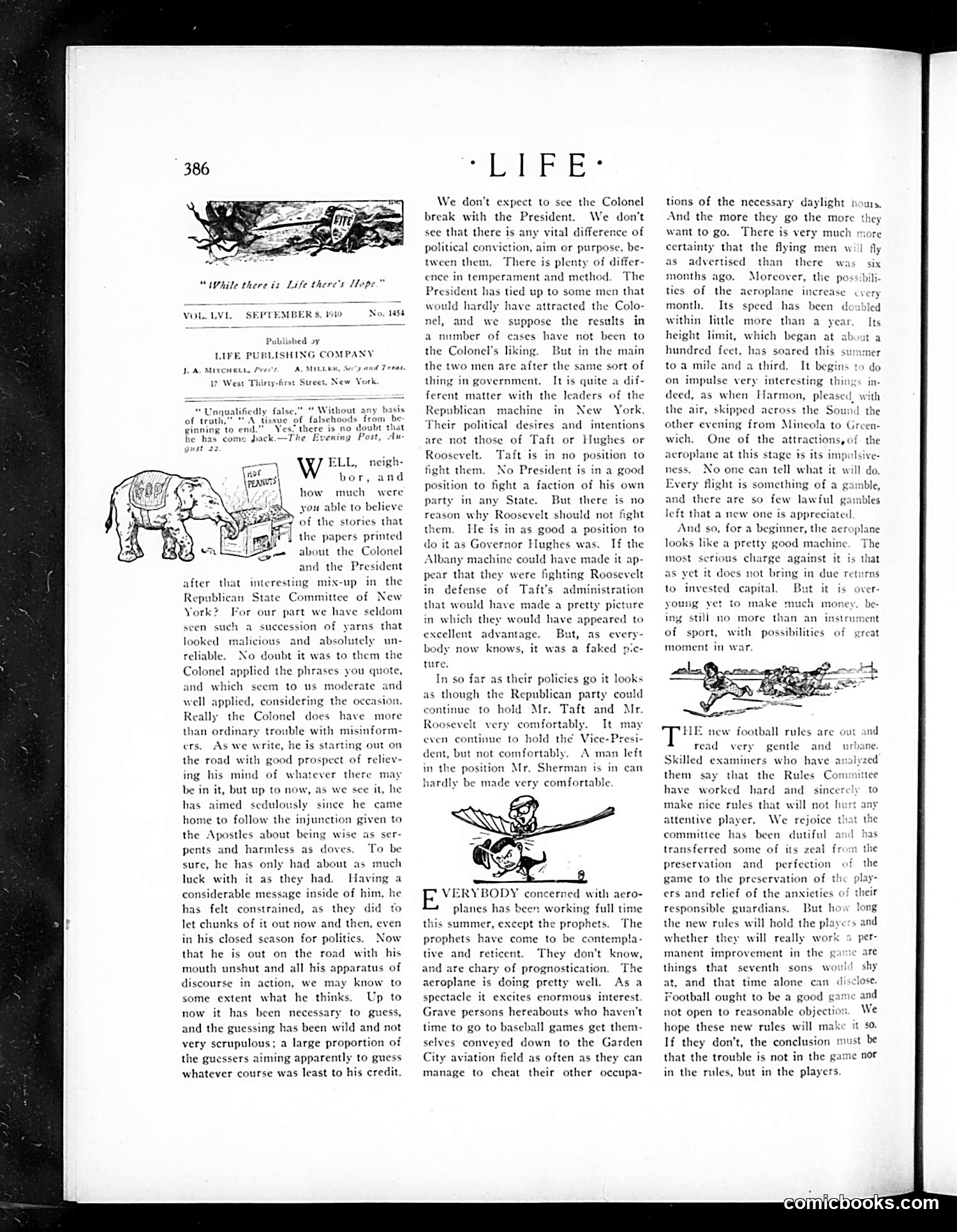
This **Life magazine page from September 5, 1909** contains political commentary on the Roosevelt-Taft transition. The text discusses the Republican State Committee in New York and references Colonel Roosevelt, President Taft, and Governor Hughes—comparing their political positions and the party's internal divisions. The cartoons appear to satirize political factionalism: one shows figures representing the Republican establishment, while illustrations of an elephant (Republican symbol) and what appears to be political figures suggest party discord or maneuvering. The main point critiques Republican leadership's discomfort during this period of succession between Roosevelt and Taft, mocking their attempts to maintain unity while harboring genuine political disagreements about direction and policy.
📄 Transcribed text from this page (OCR, searchable)
Machine-transcribed from the original scan — historical spelling and the odd misread are preserved.
VoL. LVL. SEPTEM Published oy LIFE PUBLISHING COMPANY AL Mitten, Serty and Treas, New York, JA. MiveHeEL, Proce 7 West Thirty-first Stee 1." Without any basis of truth, A tissue of falsehoods from be g to end.” Ves: there is no doubt that Jack.—The Evening Post, Aw “Una ELL, neigh- \or3} bor, and Vec\ how you able to believe Gey of the stories that | the papers printed about the Colonel and the President much were after that interesting mix-up in_ the Republi ommittee of New York? For our part we have seldom seen such a succession of yarns that looked reliable. Colonel applied the phrases you quote, and which scem to us moderate and well applied, considering the occasion. Really the Colonel have more than ordinary trouble with misinform- ers. As we write, he is starting out on the road with good prospect of reliev- ious and absolutely un- o doubt it was to them the does ing his mind of whatever there may be in it, but up to now, has aimed sedulously since he came home to follow the injunction given to the Apostles about being wise as ser- pents and harmless as doves. To be sure, he has only had about as much luck with it as they had. Having considerable message inside of him, he has felt constrained, as they did to let chunks of it out now and then, even in his closed season for politics. Now that he is out on the road with his mouth unshut and all his apparatus of discourse in action, we may know to some extent what he thinks. Up to now it has been to guess, and the guessing has been wild and not very scrupulous; a large proportion of the guessers aiming apparently to guess whatever course was least to his credit. $ we see it, he necessary EE We don't expect to sce the Colonel break with the President. We don't see that there is any vital difference of political conviction, There is plenty of differ- ence in temperament and method. The President has tied up to some men that would hardly have attracted the Colo- nel, and we suppose the results in a number of cases have not been to the Colonel's liking. But in the main the two men are after the same sort of It is quite a dif- aim or purpose, be- tween them, thing in government. ferent matter with the leaders of the Republican machine in New York. Their political desires and intentions are not those of Taft or Hughes or Roosevelt. Taft is in no position to fight them. No President is in a good position to fight a faction of his own party in any State. But there is no reason why Roosevelt should not fight them. He is in as good a position to do it as Governor Hughes was. If the Albany machine could have made it ap- pear that they were fighting Roosevelt in defense of Taft’s administration that would have made a pretty picture in which they would have appeared to excellent advantage. But, as every- body now knows, it wa ture. In so far as their policies go it looks as though the Republican party could to hold Mr. Taft and Mr. very comfortably, It may even continue to hold the Vice-Pre: dent, but not comfortably. A man left in the position Mr. Sherman is in can ardly be made very comfortable. continue Roosevelt VERYBODY concerned with aero- planes has been working full time this summer, except the prophets. The to be contempla- y don’t know, prophets have co tive and reticent. Th nd are chary of prognostication, The acroplane is doing pretty well. As a spectacle it excites enormous interest Grave persons hereabouts who haven't time to go to baseball games get them- selves conveyed down to the Garden City aviation field as often as they can manage to cheat their other occupa- tions of the necessary daylight nous. And the more they go the more want to go. There is very much y that the flying men will fly as advertised than there was six months ago. Moreover, the possibili- ties of the aeroplane month. Its speed has been dow within litthe more than a year. Its height limit, which began at about a hundred feet, has soared this summer toa mile and a third. It begins to do on impulse very interesting things in- deed, as when Harmon, pleasec certain! increase with the air, skipped across the Sound the ions, of the other evening from Minec wich. One of the att aeroplane at this stage is its impulsive- No one can tell what it will do. {very flight is something of a gamble, and there are so few lawiul gambles left that a new one is appreciated. And so, for a beginner, the aeroplane ness. looks like a pretty good machine. The charge against it is that as yet it does not bring in due returns capital. But it is most seric to invested vere young yet to make much money, be- ing still no more than an instrumen of sport, with moment in war. possibilities of great phe new read Skilled ¢ them say football rules are o very gentle miners who hav that the Rules worked hard and make nice rules that will not hu attentive player. We rejoice t committce has dutiful az its zeal fr and our Committe have sincere! been transferred some ¢ preservation and_ perfection game to the preservation of th ers and relief of the anxieties of their responsible guardians. But how long the new rules will hold the players and whether they will really work o per manent improvement in the ¢ are things that seventh sons would shy at, and that time alone can disclose. Football ought to be a good game and not open to reasonable objection. We hope these new rules will make it so. If they don’t, the conclusion must be that the trouble is not in the game nor in the rules, but in the pla